Category Archives: Volunteering/Serving

Monday Morning Moment – A Cause for Celebration and a Celebration Culture – in Pictures

Photo Credit: Unlocking the Bible

What do we celebrate?

Kids’ birthdays, weddings, babies, anniversaries. For sure.

How about mileposts in our careers? A job well-done?

Have workplace celebrations (even micro-celebrations) gone by the wayside? Even before COVID? Too expensive? Too hard to keep up with? Considered frivolous and unaligned with a stream-lined cost-saving workplace? Have these cost-savings cut losses or added to them? If this is your situation, consider re-instituting celebrations. Omitting them may have cost you more than having them.

I’m not going to go into the particulars (links below will support those). However, I want to give a shout-out to one recent celebration which we got to attend and soak up the joy of it all.

[This had to do with a church celebrating the 10th anniversary of their pastor couple. The elements of a beautiful milestone recognition follow in the pictures and brief description. Enjoy.]

Andrew and Marcie came to this job after a catastrophic health event forced them to leave the international work they were deeply committed to. A redemptive story followed in these 10 years since.

They are not the kind of people who are ambitious for center stage, but they find themselves there because of what (and who) they bring with them. They take the hard and display the good and the God in it.

We had the opportunity to be one of the out-of-town guests for a surprise celebration of Andrew and Marcie’s work (10 years so far).

This church covered all bases in celebrating them and drawing all of us into that circle of deep gratitude. #Snacks and #giftbags for the travelers (you planning milestone celebrations – keep this! – for all involved as far as your budget allows).

The surprise actually happened (for Andrew anyway. Marcie helped to keep him in the dark). The sweet first sightings were emotional.

Milestone celebrations must always have food. No need for it to be elaborate, but special is nice. From eating at local specialty restaurants to a potluck. There is something about eating together from time to time (and especially to celebrate a person or progress) that creates a bond between people. When is the last time you ate with your team? Your boss? Make it happen.

Then the words. They matter. Words of affirmation. Words of inspiration. Vision. Purpose. However, not just for the big picture but how the pieces fit together. Celebrations are about the pieces…and the pieces are people. If I may add: God puts the puzzle together. [Because this was a church celebrating their pastor, the Sunday service included all us life-long family and long-time friends – joining their local church family who love them with us. This celebration was a beautiful demonstration of that love. No holds barred.]

Celebrations are meant to honor both the person/project and the larger purpose that holds us together. If it’s work or family or something other. For Andrew and Marcie, it would have been very awkward for them if they were the focus of the 10-year anniversary. Their church family knew this and kept in view what mattered most to them all.

That was our weekend with all the feels of a celebration. It was inspiring. I’m looking forward to being part of a force that celebrates more. The doldrums of this cubicled and isolating season almost put me to sleep. This weekend woke me (back) up!

5 Reasons We Should Celebrate Milestones – Julie Baumgardner

Back to Basics – What Are Community Celebrations? – Aaron Kinne

Creating a Culture of Celebration – Don Rheem

Commentary: Importance of Life’s Milestones – Doug & Lynn Nodland

5 Friday Faves – New Year’s Resolutions, Habit Planner, Year-End Review, Word for the Year, and the Last Days of 2021

2021 is rapidly winding down. Whew! Here are my Friday Faves to get us ready for the new year…hopefully a joyful one!

1) New Year’s Resolutions – 2021…the end is in sight. What do we do with this new year ahead? Do we revisit those habits we thought about changing up in this tumultuous year? Maybe so. Or maybe we didn’t alter course so much for good reason. Let’s give pause a moment and consider…

Photo Credit: David Lose

Monday Morning Moment  – 2021 Come On! – New Year’s Resolutions

Are We Doing New Year’s Resolutions After a Year as Lousy as 2020? There’s One I think We Need More Than Ever – Heidi Stevens

How to Make Healthy, Attainable New Year’s Resolutions During COVID-19 – Ashley Welch, Healthline

Are You Making a New Year’s Resolution This Year? Readers Weigh In – Sarah Fielding

I take New Year’s resolutions very seriously. They have served me well through the years in shaking up troublesome habits as well as galvanizing better ones. New (or restored) habits that nurture the body, the spirit….and, when possible, family and community.

New Year’s resolutions are not always exercises in futility. They can be excellent pathways to help us get off to a strong start into the next year. Some of my family and friends treat resolutions with disdain…they never work; they never last. Oh, but not always!

They are really very energizing. Whether we meet our goals or not, there is great promise within the resolution for resetting our thinking. A keen sense of self, or self-awareness, aids in our understanding of habits and true habit change.

Without knowing it, I have actually used a practice of habit change that Ken Sande writes about on his blog, Relational Wisdom 360. He first influenced my life years ago with his work on conflict resolution through his Peacemaker Ministries. He is a gentle guide in many of the issues that complicate our lives.

His article on Seven Principles of Habit Change came at a great time. Sande talks quite kindly about how we develop habits and what it takes to change them. His first principle of habit change gives us a look at the cycle of habits – the cue, the routine (or response), and the reward. I actually followed Ken Sande’s principles below (without knowing the wisdom of it).

  1. Every habit has three parts: a cue, a routine, and a reward.
  2. You can change an undesirable habit by keeping the cue and reward but learning a new routine.
  3. The best way to overcome the temptation to revert to old routines is to have a detailed action plan.
  4. Habit change builds momentum if you can change a single “keystone habit” and then continue to build on consecutive “small wins”.
  5. Will power is like a muscle: it can be strengthened and yet needs to be exerted strategically.
  6. Faith is an essential part of changing habits.
  7. Habit change is more likely to occur within a community (even if it’s just two people).Ken Sande

Self-awareness is a huge factor relating to habit change. I can see that more now having come through seasons of looking at my own habits.

“Self-awareness is defined as conscious knowledge of oneself; it’s a stepping stone to reinventing oneself, learning to make wiser decisions, and helps you tune into your thoughts and feelings. So often we place blame on externalities because it’s the easiest excuse, when in fact we should be thinking about our thinking, reflecting, trying on different perspectives, and learning from our mistakes.”Paul Jun

It is possible to affect true habit change if we are willing to take a studied look at ourselves – our awareness and our engagement with making choices/decisions and within relationship. I used to think that self-awareness was morally charged, i.e., it drove us to become more self-centered. That doesn’t have to be the case. When we take time to really examine where our minds go, through the day, we can train our thinking toward what matters most – related to people, resources, and life purpose.

New Year’s Resolutions and Reality Checks – Wally Bock

When we are willing to do that, New Year’s resolutions can become much more transformative than just a few weeks of good intentions. These habit change principles can apply to anger issues, pornography, other addictions, and pretty much any habitual process that negatively affects your work, relationships or general peace of mind.

Consider these questions as you think on resolutions for 2022:

  1. What do I want to keep from the changes I made to cope with the pandemic?
  2. What do I want to reclaim from the pre-pandemic time?
  3. How would I “build back better” if I were in charge of the world or my neighborhood?Katherine Arbuthnott

Four years back, our pastor Cliff at Movement Church challenged us to commit to some resolutions to the Lord…together [podcast of 12/31/2017 here].  I have kept the resolutions made that day in a visible place, to be reminded of the good change in life, and the struggle… I still have them in view…four years out. Still relevant to now. For 2022, on it again…plus prayer for wisdom how to be creative and intentional, given COVID’s continued intrusion. And also added this year: writing my life’s story (capturing the memories and maybe restoring/refining some as I write).

Jonathan Edwards, the great 18th century preacher and theologian, definitely understood the importance of praying through and writing out resolutions that would inform his daily life. Over the course of several months, he composed seventy resolutions for life. You can read them here. The five resolutions I made during church on a New Year’s Eve are weighty enough for me…can’t imagine 70! Edwards just gives an example of a man who, even as deeply devoted as he already was, did not want to miss God in a busy life of ministry. Nor did he want to miss the people God placed in his life.

Resolutions help us to keep the main thing the main thing. Sure, we may struggle to keep our bodies and houses in order. Those are temporary situations. Where we hope most to be successful is in keeping our hearts tuned to what matters most. Going deep with God and others. Even in the face of a continuing pandemic...if we are ruthless and wise, and don’t give in to another year of listlessness and waiting.

We’ve already enough of that…coming up on two years.

I am resolved…

Photo Credit: Reformed Outfitters

Resolved – The Resolutions of Jonathan Edwards

Do You Want to Change Your Habits? – Relational Wisdom – Ken Sande

Habit Change is a Team Project – Ken Sande

Seven Principles of Habit Change – Relational Wisdom – Ken Sande

Make Habits, Not Resolutions – Justin Whitmel Earley

Why Self-Awareness Is the Secret Weapon for Habit Change– Paul Jun

RW Acrostics in Action– Relational Wisdom – Ken Sande

Ten Questions for a New Year – Don Whitney – Desiring God

Need Help With Your New Year’s Resolutions? – David Lose

Understanding True Habit Change and Rocking Your New Year’s Resolutions – Deb Mills Writer

2) Habit Planner –Anyone who knows the writing of Justin Whitmel Earley knows his commitment to a life well-lived. He is determined to live intentionally, not leaving the substance of his life to outside powers or sloppy habits.

Unlike resolutions, we actually become our habits. There are no changed lives outside of changed habits. And if we want to actually change, we need to take a sober look at where our habits are leading us.”Justin Whitmel Earley

Habits are the little things we do over and over without thinking about them. And the tiny and subconscious nature of habits makes them powerful. Why? Because they create our “normal.” Normal life is what stays with you from January through December. Normal life is what shapes your kids, your body, your schedule, and your heart.”Justin Whitmel Earley

His two books – The Common Rule and Habits of the Household – lay out a simple path for examining our current lives and then setting strategy for habit change. So accessible and engaging whatever our preferences for methods are. If spreadsheets help, he has one for you. If you need a more fuzzy-boundaried approach (that would be me), you can glean from his wisdom, and alter course accordingly.

Below are his own examples of the habit planner. I appreciate his heart so much. He helps us all he can (in his books and free resources):

Photo Credit: Justin Whitmel Earley, Screenshots

Habits of the Household – Habit Planner – pdf – Justin Whitmel Earley

Make Habits, Not Resolutions – Justin Whitmel Earley

Unlock the Power of Family Habits in 2022 – Justin Whitmel Earley

3) Year-End Review – Business writer Stephen Jones shares author Tim Ferriss’ practice of doing a quick past year review. Ferriss prefers this over new year’s resolutions, and Jones gives a quick snapshot of his 5 steps.

Below is Tim Ferriss’ guide for a past year review from his own blog (and podcast):

  1. Grab a notepad and create two columns: POSITIVE and NEGATIVE.
  2. Go through your calendar from the last year, looking at every week.
  3. For each week, jot down on the pad any people or activities or commitments that triggered peak positive or negative emotions for that month. Put them in their respective columns.
  4. Once you’ve gone through the past year, look at your notepad list and ask, “What 20% of each column produced the most reliable or powerful peaks?”
  5. Based on the answers, take your “positive” leaders and schedule more of them in the new year. Get them on the calendar now! Book things with friends and prepay for activities/events/commitments that you know work. It’s not real until it’s in the calendar. That’s step one. Step two is to take your “negative” leaders, put “NOT-TO-DO LIST” at the top, and put them somewhere you can see them each morning for the first few weeks of 2022. These are the people and things you *know* make you miserable, so don’t put them on your calendar out of obligation, guilt, FOMO, or other nonsense.

We do a year-end review but not in order to plan out the next year. Mostly to celebrate the year rapidly coming to an end and to reflect on how we might reorder the course of the next year (re the negatives).

A creative friend of ours put his “year-end review” into a cool video:

Photo (Video) Credit: Todd AO, Facebook

4) Word for the Year –A year ago, I read Debbie Macomber‘s book One Perfect Word. She tells fascinating stories of persons’ choosing a word to guide their year. Finishing her book and praying a bit, the word compassion became my focus. 2021 was a good year for that as we dealt with so many divisions over COVID, race, politics, etc. Compassion for all on both sides of each issue.

At first I wasn’t going to do “a word” for 2022, and then a rapid series of “coincidences” drew me to the word: joy. As this year ends, I’ve become negative and even a bit cynical. Still having faith in God but not so much in humans, including myself. Even after a year of compassion!!
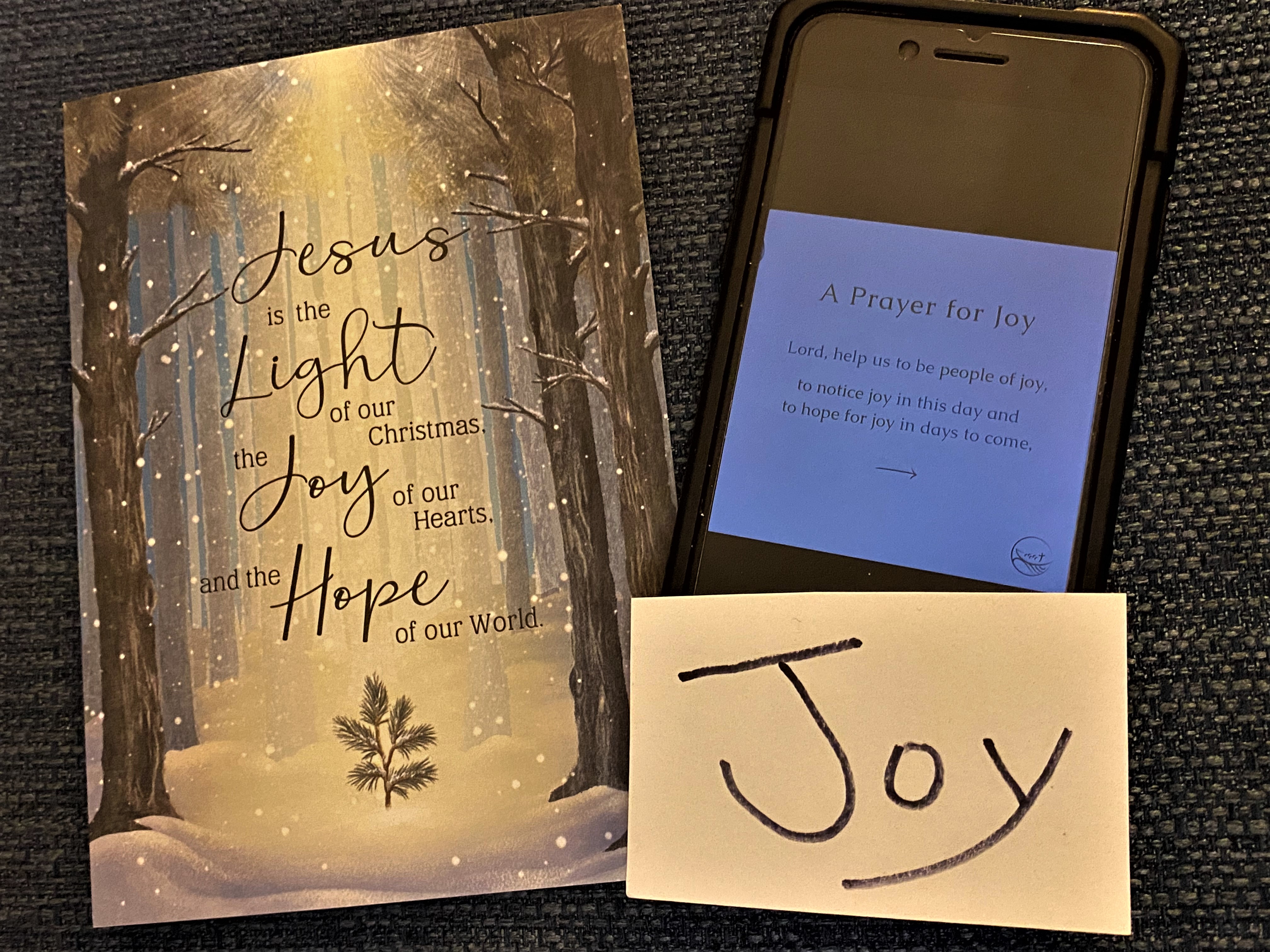
It dawned on me that I haven’t been “counting it all joy”. Or remembering that “the joy of the Lord is my strength”. Now my heart is resolved to be set on joy in 2022…no matter what.

Lord, help us to be people of joy,

to notice joy in this day and to hope for joy in days to come,

to look for light and share it with others this Advent season,

to see beauty in creation and the people we encounter,

to laugh heartily with childlike glee,

to feel true joy in your presence.     Amen.

Photo Credit: Prayer @inthecoracle, Instagram

5) The Last Days of 2021 – As may have been many of your experiences, we had people we know and love dealing with COVID in this last week of 2021. Still managed a sweet end-of-year. Hope yours was as well.


Now on to 2022!! Thanks for stopping by. It means a lot to me.

Bonuses:

Vimeo Video by Rodrigo Souza – Heart – with Nathan Mills, Beyond the Guitar

How to Stop All Procrastination: Dear You Trying to Do that Hard Thing in the New Year – Ann Voskamp (great piece on procrastination and perfectionism – both keeping us from presenting the gifts God’s given us)

Photo Credit: Samantha Reynolds, @Bentlily, Instagram (w/ permission)

52 Week Bible Reading Plan – Michael Coley

What is an Accessory Dwelling Unit (ADU) and Tips for Building One

Photo Credit: Facebook

Monday Morning Moment – Spend a Minute with Pollyanna and the Contrarian – There’s a Place for Each of Us

A friend recently gave me the card above and it set me thinking about how far we get from who we are sometimes. She gets me. She knows my heart, even when it feels a tad dried up.

What would you say to the idea that we are all on some spectrum of Pollyanna to Contrarian (Curmudgeon even)?

Is that a bad thing? I say no.

Since my teens, friends (and not so friendlies) have used the word “Pollyanna” to define my responses and outlook. That person is defined as one who “looks for the good in everyone and everything – and she finds it!” For some odd reason, it wasn’t to be considered a compliment. Even one of my sons has said, “You can’t trust Mom’s take on people” – the reason being I see beauty in everyone, and all sorts of redeeming qualities. Well…I used to anyway.

Now, in recent years, reluctant contrarian is more what I’ve become. [After writing this piece, I came across someone who writes under the title of reluctant contrarian. Funny.] It certainly wasn’t my ambition to become curmudgeonly…but life happens. We see the things that, if tweaked, could make a difference in a person, product, or process…and wonder aloud why not? Then, if we persist in our opinion, we become like a dripping faucet or clanging cymbal. Sigh…

When my friend gave me the card (image above), it set in motion a resolve in me. To rediscover that Pollyanna inside. To look for the good. To extend grace. To brighten the day. To play Pollyanna’s Glad Game…until it becomes a habit again.

Photo Credit: The Glad Game, Pollyanna, Pinterest

The Glad Game – Lost in the Magic – Shez C.

What’s Wrong with Being a Pollyanna? – Christin Ditchfield

Pollyanna Principle: The Psychology of Positivity Bias – Courtney E. Ackerman

The Perils and Possibilities of Pollyanna – Dr. Judith Rich

Pollyanna vs. Curmudgeon: The Case for Realistic Optimism – Peggy Haslar

This contrarian/curmudgeon thing that happened to me in the last few years probably relates to some process of entropy – how life in this broken world drifts toward disorder or randomness…unless we constantly intervene.  This idea breaks down with those who start as contrarians. They don’t move toward being more Pollyanna’ish over time, BUT…it could be they move to being curmudeongly. What do you think?

[Sidebar: I asked my husband – who naturally bends more in the direction of contrarian: “Which would you say you are: Contrarian or Curmudgeon?” He answered quickly: “Are those my only two choices?!” We got a good chuckle out of that…and then decided he was serious more than contrarian, analytical more than curmudgeonly.]

What’s the contrast between these extremes? Night and day.

Photo Credit: Thesaurus

How to Become a Curmudgeon – Wikihow

Curmudgeon’s Day – Word List – Facebook

Walter – Analyst Contrarian – Corsairs – Some language but fascinating workplace observations

Finding My Inner Curmudgeon – Chuck Bloom

I do think there is a healthy place in the world for us to co-exist. The Pollyannas and the Contrarians. In fact, The article above – Walter – Analyst Contrarian – Corsairs – speaks to this somewhat in the workplace. I see the wisdom of cooperating “adversarial pairs” in any setting. Here’s a bit of what the article poses:

“There are two sides to most things. Honestly, most things are wickedly multi-dimensional but most humans are only good at comparing two things…two distinct points of view…Forcing alternate perspective is a great technique for combating cognitive bias…It doesn’t prevent it. It simply makes it more apparent…Minimally, take the contrarian side of every issue…Always test the opposite hypothesis…By forcing a counter view, you expose both sides of the argument…Taking the opposite position artificially, occasionally exposes that your initial inclinations were actually dead wrong. Two perspectives create intellectual leverage…use it.” – Walter – Analyst Contrarian – Corsairs 

For life in the world beyond business, I have had the great pleasure of being on advisory boards and ministry teams, both having very different sorts of people as members. Some more task-oriented, some more people-oriented. Some more thinkers, some more feelers. This is reminiscent of Roger Martin’s The Opposable Mind – regarding integrative thinking – where you are able to seriously consider different points of view – like how we grab hold (with our hands) and understand assessments not our own.

Beware, if you’re looking at yourself [people who think just like you] all around the board or conference room table. We gain from both the Contrarian and the Pollyanna… and all those in between.

Finally, brothers and sisters, whatever is true, whatever is honorable, whatever is right, whatever is pure, whatever is lovely, whatever is commendable, if there is any excellence and if anything worthy of praise, think about these things. – Philippians 4:8

5 Friday Faves – Beyond the Guitar – Beauty to the Ears & Mind, Mental Health Awareness, Antidote for Self-deceit, Showing Up…Or Not, and Unmasking

1) Beyond the Guitar – Beauty to the Ears & Mind – We think of beauty more in what we experience visually, but there is a powerful connection between music and the mind. Beautiful music soothes the soul and lifts our hearts. Moves us. Often it is because of nostalgia attached to the music, but even without that emotional connection, music can bring our minds to a better place.

Your Brain on Music – Pegasus, UCF

Nathan Mills, of Beyond the Guitar, has that way about his craft. Moving our hearts with the beauty of his arrangements and performance. I don’t know any of the pieces in his medley of 4 Underrated (but Beautiful) Video Game Themes, but something happens when I listen. Shoulders drop; breathing slows; wonder sets in. Beauty has its way with our ears and our minds.

Photo Credit: YouTube, Beyond the Guitar

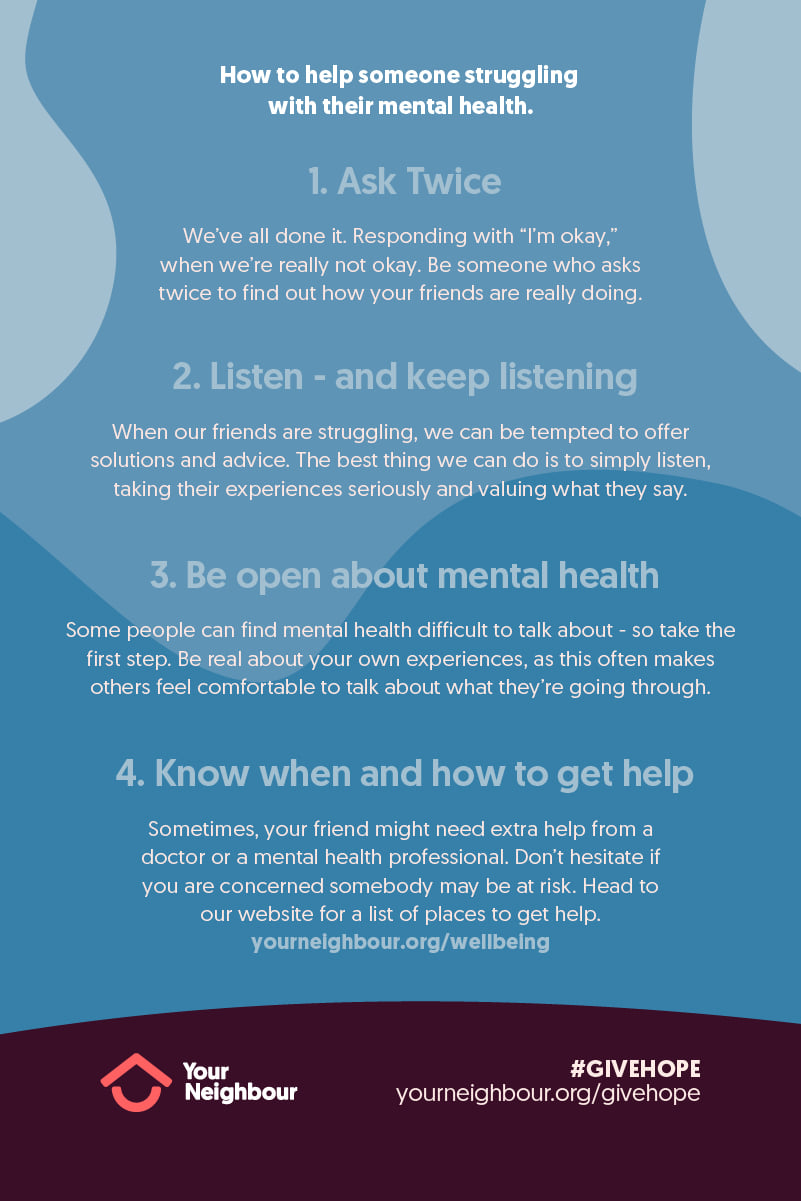
2) Mental Health Awareness –  May is Mental Health Awareness Month. The theme message for 2021 is “You Are Not Alone”. Our need for connection is bigger than ever, having gone through so much COVID isolation. Whether mental health issues are our own personal struggle or we are family, friends, caregivers of those who struggle, helps abound. We just must be aware and utilize them.

Tools 2 Thrive – Mental Health America

Mental Health Awareness Month 2021: What to Know – Karen Veazey

Photo Credit: Twitter, Nicolino Frate

Suicide and death by drug overdose have increased during COVID. They are shocking for us and real losses, either for us or for friends. We can’t keep isolating ourselves from each other. Finding ways to help is imperative.

Photo Credit: Facebook, Key Ministry, Your Neighbour #GiveHope

YouTube Video: Unseen: Exposing the Mental Health Crisis Among Special Needs Caregivers | Documentary Trailer

3) Antidote for Self-Deceit –  Self-deceit (or self-deception) is “a process of denying or rationalizing away the relevance, significance, or importance of opposing evidence and logical argument. Self-deception involves convincing oneself of a truth (or lack of truth) so that one does not reveal any self-knowledge of the deception”.

The Most Dangerous Form of Deception: Self-Deception

I’ve allowed myself to be deceived (either with the help of outside influences or from sheer will and desire, wanting something to be so, or not be so). It’s not pretty. One of my strongest memories was sitting in a circle of friends who essentially did an loving intervention with me. I was in a self-destructive (but non-abusive) relationship, and they had the courage to point me to the changes in my life and thinking. I will never forget it. The life I have now is much impacted by their willingness to go to that place with me. Forever grateful.

Regarding deceit, it is way too easy to get into our own heads and assess life with a self-tuned receiver. I wrote about this before (the practice of noticing). A somewhat dated video (with a still fresh message) speaks to this so well.

During the particular season of self-deception (described above), I got to the place that lying in my bed at night, when I would usually pray, it got impossible to pray. That was terrifying. It’s like all the desires and my rationalizations for them had crowded out any space for God. Especially for a holy God. Like I said, terrifying. No matter how loving God is, I couldn’t justify praying when my own desires trumped His for me.

The Antidote to Self Deception – J. D. Walt

As the video illuminates, as we get out of our own heads, and start seeing other people around us, we find the antidote. Caring more for others than ourselves, we can actually clear our heads some. Self-deception causes us to “circle the wagons” and keep others at a distance. As we determine to get close to people again, especially to genuinely listen and serve, our own deceit can be more readily understood/recognized. Of course, our neglected relationship with God will take its own time and action on our part. He is ready, when we are.

Photo Credit: Chip Scholz

4) Showing Up…or Not – Showing up is a good thing. For all of us. Keeping commitments. Being present. Choosing to lean in. Listening.

So much is said about listening and its positive impact. To listen requires proximity.

On the East Coast, this week, we had a gas shortage (or a perceived gas shortage…not sure which is more accurate). Everyone was making decisions about filling their tanks and sorting out needful car trips vs. those that can be jettisoned for another time.

I was a part of a couple of meetings where some folks didn’t show up. Without a phone call, text, or email message. Was it the gas shortage? Or did it display something else? Honestly, I also wondered how often I’ve done this same thing myself.

We are in a culture right now when a RSVP yes can turn to no without a word. I’m showing my age…but does this matter?

Below you’ll find quotes from three different authors on this and what it can mean. The showing up…or not. After you read their observations, I’d love to hear what you have to say in the Comments.

“Standing someone up is a personal attack. You are saying that you have no respect at all for this person’s time, energy or feelings. This person set aside time from his or her day to hang out with YOU.

And maybe he or she didn’t feel like showing up. But no, this person had enough respect for you to feel as though he or she couldn’t bail on you. Then how did you repay the favor? You didn’t show up. With no warning.

And don’t even get me started on the fact that if this person cared about you enough to make and honor plans with you, odds are that he or she would probably be WORRIED about you when you don’t send a message. Because falling off the face of the Earth is a little alarming….You get the picture here.” – Candice Jalili

Why It Is Literally Never, Ever OK to Just Not Show Up For Your Plans – Candice Jalili

“There are commitments you are not going to keep no matter how hard you try, but even if you fail to keep them, you can still honor them. How do you do this?

“The difference between “keeping” and “honoring” is key: keeping a promise is about the letter of the promise, while honoring a promise is about the spirit. It is even possible to keep a promise while not honoring it. People will forgive an honored but un-kept promise, but it takes a real saint to let go of an un-honored promise—kept or not.

So what are the practical aspects of honoring a commitment? They are:

  • respect
  • communication
  • productive effort

It’s uncomfortable to take responsibility (for a failed commitment), but discomfort is a lot easier to shoulder than disrespect or disappointment. Even if you failed to honor a commitment up until now, it is not too late: disrespect and disappointment can be rolled back or even erased in the face of genuine honor.” –  Kenneth Vogt

How to Cope When You Fail to Honor a Commitment – Kenneth Vogt

[The two writers above have very different tones to their pieces. Both worthy of note. I especially appreciated Vogt’s distinction of honoring a commitment (whether you’re able to keep it or not). Honoring the person by communicating your inability to keep the commitment…as well as the honoring that goes on by making the effort to keep the commitment whether  easy or not. We don’t really know what goes on for another who does the work of keeping a commitment or the one who just can’t. What we do know is what it is like for us to keep or not keep a commitment; to honor or dishonor a person in the commitment. So much more understanding and care come out of the smallest communications. Something to think about.]

Below Rachel Macy Stafford posted an image and (in the link) a Facebook story about sitting in a line for gas this week, and an elderly man, just ahead of her, deliberately nodding her way (as he chose not to completely fill his tank, doing what he could to “leave” some for her). No RSVP’ed commitment. No relationship. But a deeply kind gesture to her that she was seen. We all need that…that being seen.

Photo Credit: Rachel Macy Stafford, Facebook, The Hands Free Revolution

It’s…“a deliberate decision to look out for the person behind (you)…It’s not about us. Even though it’s hard not to think only of our own needs, there is someone behind us…and someone behind that person…with their own set of struggles. If you can…will you look out for them? A wave will do, just so they know they are seen…it’s the kind of gesture that takes people farther than a full tank of gas.”Rachel Macy Stafford

5) Unmasking – Get ready for another new culture shock thanks to the Coronavirus: unmasking!!! I am so excited myself.Photo Credit: Pexels, Gustavo Fring

Based on this week’s CDC recommendations, fully vaccinated people don’t have to wear masks or physically distance anymore (except in rare defined situations). This, of course, is still only a recommendation and each state must give direction at a local level. Our governor just announced that we will align with the CDC recommendations.

Now, no one is going to know who is vaccinated and who isn’t. If we have learned anything from COVID-19, it is to be wise in dealing with the viral world. Those not vaccinated will probably forego masks as well. The freedom feels intoxicating, honestly, but possibly fearful to some, even some who are fully vaccinated.

I hope we can leave fear behind us. COVID is still rampant in some parts of the world and that is tragic. As we in the US and other countries get past our own experiences with this virus, hopefully we can be a help to those still battling the disease.

The culture shock part is real. I will have my mask with me, and see what the signs say on the doors of each business, store, school, or community space.

Still….so worth celebrating!!!

___________________________________________________________________________

That’s a wrap. Would love your comments below on your own favorites of the week. Thanks for stopping by. It means a lot to me.

Bonuses:

Photo Credit: C. S. Lewis, Twitter

Angry with God: Living in the Tension of Partial Understanding – Brad Hambrick

YouTube – Podcast – An Honest and Raw Conversation with Francis Chan – Preston Sprinkle

My next read:

Worship Wednesday – When We Love Like Jesus – How Beautiful – Twila Paris

Photo Credit: Burke Church, Facebook

Don’t just pretend to love others. Really love them. Hate what is wrong. Hold tightly to what is good. Love each other with genuine affection, and take delight in honoring each other. Romans 12:9-10

We know what real love is because Jesus gave up his life for us. So we also ought to give up our lives for our brothers and sisters.  1 John 3:16

“A new commandment I give you: Love one another. As I have loved you, so you also must love one another. By this everyone will know that you are My disciples, if you love one another.” John 13:34-35

Our world is so full of words…so many voices. Too many are divisive and blaming. Too many propose solutions that seem beyond our capability or capacity. Beyond our understanding even.

Especially in the issue of racial inequality, racial reconciliation, and racial healing. When we look at the proposals made by politicians and even some educators, we are stunned and bewildered.

What will it really take for things to get better? What actions can bridge the racial divide? The words blasting through our news outlets seem more hurtful than healing. We as the church are wrestling with what to say…what to do. I have found that so puzzling given how the Lord has told us how to live and how to love…but we seem challenged especially in this dark dilemma of our times.

Then just today…two voices came through the noise: U.S. Senator Tim Scott and Reverend Keith Haney

Senator Scott posted the following on his Instagram and Twitter page today. Take the time to watch the video.

He deals with the politicizing of the racial unrest in our country, and he calls us as Christians to love people…really love people. Wow! Why “Wow!”? Because we know what is the truth and yet we don’t do it. We talk about it, we react when others tell us what we should do, but…We already know what Jesus tells us to do…and He has shown us how by His own beautiful life.

I have been thinking about what Senator Scott said the rest of the day, and then, in the kindness we regularly experience from God, I discovered this blog The Light Breaks Through authored by Reverend Haney. The piece below is a blog he wrote after George Floyd was killed and all that happened in Minneapolis in reaction.

https://alightbreaksthrough.org/how-should-the-church-respond-to-racial-issues/

Reverend Haney writes: “Genuine change only happens when we can change hearts, and only the power of the gospel of Jesus Christ can do that. The community is begging for someone to step up and make things better.

What I hear the world really asking is this:

Dear Christian Church,

As I look at the racial pain all around and the way it is portrayed in the national media, it saddens me. The tone is so negative, and it is feeding into the darkness that is already out there in our sin-sick world. I don’t expect the world to have real solutions. Dr. Martin Luther King, Jr. once said, “Darkness cannot drive out darkness: only light can do that. Hate cannot drive out hate: only love can do that.”

Dear Church, especially the Black Church, just as you answered the call in the Civil Rights Movement, you have a pivotal role to play. You have the Light. You know the only real Love. The world is lost without your voice. Without your direction. It is time to stand and lead. Now is the time to speak out.”

Then Reverend Haney further encouraged us: “…We are living in a broken world, and the racial issues only serve as a stark reminder of our need for a Savior, a healer, a reconciler.

There is a spiritual reason behind this racial rift. Church leaders you have the power to change things. Our Lord and Savior armed you with the spiritual weapons of God. Battle Satan’s lies the way Jesus did with the truth of the Scripture. All people have value because we are created by the same One True God. We all begin our journey at the foot of the cross and end our trip at the grave.”

We have a beautiful Savior who showed us how to really love each other. Not, as Senator Scott read from his devotional, “just pretend to love others”.  We can state our beliefs about racial divides and racism. We can voice commitments as the church on where we stand. Words only (just talking about issues or doling out our opinions) do not take us to the cross…or to the grave.

Our Savior held nothing back. Maybe we don’t know what that means for us in specifics, given the problems we face as a nation, as a world today…but we know where to start.

We start with receiving the love Christ has given us, every one of us. We receive from His hands. Then we become His hands for one another. He loves…we love. He serves…we serve.

I don’t have sweeping answers but, after today, I am less confused… and less distracted by all the negative talk and virtue signaling. We don’t have to be led to answers, especially by people who have no interest in what Jesus says and does about injustices. He has given us a way forward…ours is to take that path.

Worship with me…to this song by Twila Paris on the beauty of Christ and the beauty of His church – How Beautiful

How Beautiful the hands that served
The Wine and the Bread and the sons of the earth
How beautiful the feet that walked
The long dusty roads and the hill to the cross
How Beautiful, how beautiful, how beautiful is the body of Christ

How Beautiful the heart that bled
That took all my sin and bore it instead
How beautiful the tender eyes
That choose to forgive and never despise
How beautiful, how beautiful, how beautiful is the body of Christ

And as He lay down His life
We offer this sacrifice
That we will live just as He died
Willing to pay the price

How Beautiful the radiant bride
Who waits for her Groom with His light in her eyes
How Beautiful when humble hearts give
The fruit of pure lives so that others may live
How beautiful, how beautiful, how beautiful is the Body of Christ

How beautiful the feet that bring
The sound of good news and the love of the King
How Beautiful the hands that serve
The wine and the bread and the sons of the Earth
How Beautiful, how beautiful, how beautiful is the Body of Christ*

Photo Credit: QuotesLyfe

*Lyrics to How Beautiful – Twila Paris

YouTube Video – How Beautiful – Twila Paris (talks about the song before she sings it) 1994

Worship Wednesday – the Small Virtue of Humility – the Grand Journey of Self-Forgetfulness

Do nothing from selfish ambition or conceit, but in humility count others more significant than yourselves. Let each of you look not only to his own interests, but also to the interests of others. Have this mind among yourselves, which is yours in Christ Jesus, who, though he was in the form of God, did not count equality with God a thing to be grasped, but emptied himself, by taking the form of a servant, being born in the likeness of men. And being found in human form, he humbled himself by becoming obedient to the point of death, even death on a cross.Philippians 2:3-8

Thus says the LORD: “Let not the wise man boast in his wisdom, let not the mighty man boast in his might, let not the rich man boast in his riches, but let him who boasts boast in this, that he understands and knows me, that I am the LORD who practices steadfast love, justice, and righteousness in the earth. For in these things I delight, declares the LORD.”Jeremiah 9:23-24

I’m still making my way through a re-read of The Screwtape Letters by C. S. Lewis. Long over-due. Although the chapters are super short, each contains such a wealth of wisdom to think through and process.

In The Letters, a senior demon, Screwtape, is advising his nephew on how to draw away a young Englishman from his new-found faith in God, whom the demon calls The Enemy. The nephew is given strategies to muddle up “the patient’s” thinking on God and how one is to live, “loving our neighbors as ourselves”.

Chapter 14 (in just 3 pages) dissects the issues of humility, pride, and self-forgetfulness. We may think ourselves that humility is having and expressing a low regard of self, even self-deprecation. That is not humility. In the fullest sense, humility is a right understanding of God, other people and ourselves, in relation to all. God and others.

True humility is a growing awareness of how all things work together, including the hard things in life, and an appreciation of the good and glory in the world. Celebrating God, and His choosing to continue to display His goodness in all of life…in mine and yours, and throughout the natural world.

When we can pull our eyes off our own successes or, on the flip side, our challenges, perspective comes. Not puffing ourselves up or bringing yourselves down, but just seeing God everywhere. He purposefully and beautifully knit each of us together and His purposes are not thwarted.

Focused on God and others, we can live in a place of self-forgetfulness. Satan wants to destroy such peace by pressing us to ever compare, ever put ourselves down, or ever feel envy and longing regarding others’ good works. Or, if he can to even push us into pride, thinking more highly of ourselves, even though we operate out of the gifts and opportunities God gives us.

Here’s a bit of Screwtape’s instruction to Wormwood in the tempting of the young Christian:

“To anticipate the Enemy’s strategy, we must consider His aims. The Enemy wants to bring the man to a state of mind in which he could design the best cathedral in the world, and know it to be the best, and rejoice in the fact, without being any more (or less) or otherwise glad at having done it than he would be if it had been done by another. The Enemy wants him, in the end, to be so free from any bias in his own favour that he can rejoice in his own talents as frankly and gratefully as in his neighbour’s talents – or in a sunrise, an elephant, or a waterfall.C. S. Lewis, The Screwtape Letters, Chapter 14

Photo Credit: Brainy Quote

Let’s worship the God who frees us from self as we turn our eyes each day, and through the day, onto Him. Why this old song? It speaks to troubled hearts. If humility is not where we live, our hearts become troubled – either in some embattled state of self-loathing or self-obsessing. We can live free of all that.

O soul, are you weary and troubled?
No light in the darkness you see?
There’s a light for a look at the Savior,
And life more abundant and free!

Chorus:
Turn your eyes upon Jesus,
Look full in His wonderful face,
And the things of earth will grow strangely dim,
In the light of His glory and grace.

Through death into life everlasting
He passed, and we follow Him there;
Over us sin no more hath dominion—
For more than conquerors we are!

Chorus

His Word shall not fail you—He promised;
Believe Him, and all will be well:
Then go to a world that is dying,
His perfect salvation to tell!

Chorus*

Why did I call humility “a small virtue”? Because it doesn’t draw attention to itself. It points to God and to others. However, it doesn’t leave us out. We also get to be on this grand journey. We are flesh, so when God gives us the opportunity to do something amazing, we naively may say, “Wow, I did that!” Pride rears its head, even for a moment. We can then either beat ourselves for the pride and make ourselves small in some sort of false humility or…we regain perspective. “Wow, I got to do that! Thank You, God!” If it was someone else who “got to do that”, we rejoice the same. It is the beautiful sphere of self-forgetfulness.

The Freedom of Self-Forgetfulness – Tim Keller

Room for everyone on the podium in a very real way…because God is at the foundation of every podium we will ever encounter. Actually, forget the podium. The ground is level at the foot of the Cross. We’ve all heard this. Humility is where we live it.

“The thing we would remember from meeting a truly gospel-humble person is how much they seemed to be totally interested in us. Because the essence of gospel-humility is not thinking more of myself or thinking less of myself, it is thinking of myself less. Gospel-humility is not needing to think about myself. Not needing to connect things with myself…True gospel-humility means I stop connecting every experience, every conversation, with myself. In fact, I stop thinking about myself. The freedom of self-forgetfulness. The blessed rest that only self-forgetfulness brings.”– Tim Keller, The Freedom of Self-Forgetfulness

Hallelujah!

Photo Credit: 2 Chron 714 Network, Facebook

*Lyrics – Turn Your Eyes Upon Jesus – Songwriter: Helen Howarth Lemmel

Humble and Kind – Restless Pilgrim Blog & Podcast on The Screwtape Letters – Chapter 14

YouTube Video – Blessed Self-Forgetfulness by Tim Keller – Edited Synopsis – 7 Minutes

YouTube Video – Lyric Video – Turn Your Eyes Upon Jesus – Hillsong Worship

Worship Wednesday – On Compassion – Lead Me to the Cross – Brooke Fraser Ligertwood

Photo Credit: Music Notes World

When he saw the crowds, He had compassion for them, because they were harassed and helpless, like sheep without a shepherd. Then He said to his disciples, “The harvest is plentiful, but the laborers are few; therefore pray earnestly to the Lord of the harvest to send out laborers into his harvest.”  Matthew 9:36-38

Then Jesus said to his disciples, “If any of you wants to be my follower, you must give up your own way, take up your cross, and follow me.”Matthew 16:24

“A new commandment I give to you, that you love one another: just as I have loved you, you also are to love one another. By this all people will know that you are my disciples, if you have love for one another.”
Jesus, the night before He gave His life for us – John 13:34-35

Did you ever ask your child or grandchild, “Do you know how much I love you?” Then you stretched out both arms as far as you could reach, and, with stretch in your voice, exclaimed, “This much!!!!”

That’s the kind of love we experience from Jesus, and that’s the kind of love He calls from us for others.Photo Credit: Your Quote

After reading One Perfect Word, I prayerfully chose a word to saturate myself in and explore the breadth of it…across this year. The word is compassion. You can find the beginning of this journey here. A good friend, also a writer, emailed me last night, having read that blog on my taking on the word, and life of compassion. He asked for action steps toward the goal of being more compassionate – how does one get there?

I don’t have the steps…except for this: the journey to compassion starts at the foot of the cross. Throughout Jesus’ earthly life, He pointed His followers to the Father and to one another, a widening circle of “one anothers” which would encompass the whole world. We are staggered by such a calling. Yet, if we remember His word, He has already given us all we need for a Godly life, and He has promised always to be with us. Always.

What are the steps to a compassionate life? Maybe in a few weeks or months into this year, I might have a different answer to that question. For now, it is small and, at the same time, tall. Love God and love others. Not on my terms…but His. Whew! I am not sure exactly how to make that work, given the conviction that I was a compassionate person, and yet now I think not so much. It has been a fantasy of mine…but in real life terms, in the will or heart…not on the daily.

With COVID and few routine outlets as a person at risk and retired, I can easily pull a blanket over my life…and feel almost justified in it. How about you? Has this been a struggle?

Praise God, I’ve wakened out of that dull slumber, with compassion lying dormant. Where this “wokeness” leads me, only God knows. He, in His kindness and mercy, will shake us out of our sleepiness; then we see where He takes us.

I don’t have the steps of my own making, but He has already given us a few to start just in the Scripture above.

  • Pray.
  • Give up our own way.
  • Follow Him – which would include that taking up His cross and not one of our own making or choosing.
  • Love others as He has loved us – which takes us back to the cross.

Like with New Year’s resolutions, if we make goals and put steps in place toward meeting those goals…those steps and goals just lie in our imagination, our fantasy life, UNTIL we take action. Every day, take action. As I deal in the real with letting go of personal preferences and sacrifice, then the wonder of Romans 5:3-5 happens:

“We rejoice in our sufferings, knowing that suffering produces endurance, and endurance produces character, and character produces hope, and hope does not put us to shame, because God’s love has been poured into our hearts through the Holy Spirit who has been given to us.”
Tuning our heart toward the leading of the Holy Spirit and following Jesus can move us to lives where compassion becomes habit, through perseverance, and then character follows, bathed in the love of God.
Hallelujah!
Now, did Jesus have moments of counting the cost? Being God yet human, for an instant, He did, and we learned from Him. In the garden that night before He died, He asked the Father if it was possible not to have to die…but without hesitation He spoke His resolve, “Not My will, but Yours be done”.
This is where the work of building a life of compassion begins…and continues. Prayer and obedience. Prayer and obedience.
[Wall plaques by the door I take to get out of my house – my comfort zone]
So this is where I am today, with this new journey, exploring the word compassion, both in word and deed. Lead me to the Cross, Lord.

Photo Credit: IMB Photos

Worship with me to Brooke Fraser Ligertwood‘s “Lead Me to the Cross” – where life truly began for us…and the place where we learn how to truly love others.

Savior I come
Quiet my soul remember
Redemption’s hill
Where Your blood was spilled
For my ransom
Everything I once held dear
I count it all as loss

Lead me to the cross
Where Your love poured out
Bring me to my knees
Lord I lay me down
Rid me of myself
I belong to You
Lead me, lead me to the cross

You were as I
Tempted and trialed
Human
The word became flesh
Bore my sin and death
Now you’re risen

Everything I once held dear
I count it all as loss

Lead me to the cross
Where Your love poured out
Bring me to my knees
Lord I lay me down
Rid me of myself
I belong to You
Lead me, lead me to the cross

To your heart
To your heart
Lead me to your heart

Lead me to the cross
Where Your love poured out
Bring me to my knees
Lord I lay me down
Rid me of myself
I belong to You
Lead me, lead me

Lead me to the cross
Where Your love poured out
Bring me to my knees
Lord I lay me down
Rid me of myself
I belong to You
Oh, lead me
Lead me to the cross*

Photo Credit: IMB Photos

Postscript: Below you will find several other worship songs that may prove a blessing to you as they were to me in seeking God’s face to see with His eyes, to love with His heart, and to follow Him in the daily and the real.

*Lyrics to “Lead Me to the Cross” – Songwriter: Brooke Fraser

YouTube Video – Lead You to the Cross – No Other Name

YouTube Video – Give Us Your Heart – The Emerging Sound of People & Songs (feat. Melanie Tierce)

YouTube Video – Give Me Your Eyes – Brandon Heath

YouTube Video – Follow Me – Casting Crowns

YouTube Video – I Will Follow – Chris Tomlin

Monday Morning Moment – One Shocking Revelation After Another – Shaking Off Our Fantasies and Grounding Ourselves in the Real – Deb Mills

Worship Wednesday – Worshipping Together and By Ourselves – God Draws Near – Deb Mills

Monday Morning Moment – Flipping COVID Lethargy into a Larger Life Productivity – Tim Challies

Photo Credit: Tim Challies, How to Get Things Done

How do we get everything done in our day? We can’t. Well, consider that maybe we aren’t supposed to…then we choose a path…driven by external forces (the tyranny of the urgent, the job as defined by the manager, the should’s and ought-to’s)…or internal. What are our internal forces? What kind of life do we hope to live, and the product we hope to leave as foundational for those we care most about?

A favorite old proverb of ours goes like this:Where no oxen are, the crib is clean: but much increase is by the strength of the ox.” (Proverbs 14:4). Canadian writer Tim Challies presents this proverb as a parable on productivity. That “much increase” can be enhanced by having the right tools (oxen, for instance). However, given the right tools, productivity can still be very messy. Hard to perfectly control, thus, cycling back, needing the best tools for the job. Sometimes those tools are people in our lives and workplace, and sometimes they are lists, schedules, apps, or right equipment – even a vacuum cleaner (my highly organized, hard working daughter-in-law had a new vacuum on the top of her Christmas list this year).

Several years ago, Challies wrote an incredibly practical blog series on How to Get Things Done. He has become a master at “learning how to simplify life and how to maximize productivity”. Now in the era of COVID, his counsel on productivity is even more timely as we slog through this pandemic.

[Now for those of you who are essential workers and you lay down exhausted every night, it may seem this isn’t for you. However, with the restrictions of life with COVID, you probably struggle with redeeming time with family and deciding how to maximize your time off the job. Tim Challies has wisdom for you as well. Thanks, also for how you serve us all, out there every day.]

In Challies’ blog intro to his book “Do More Better: A Practical Guide to Productivity”, he offers several work sheets useful for those of us who need to organize our thoughts and time toward greater simplicity and productivity.

Don’t try to do it all. Do more good. Better.

Photo Credit: Tim Challies, Amazon

Too often, we measure the purpose of our lives by “how much” we can get done. What if we flipped that? What if we first sort out what the mission (or purpose) of our lives is? …Given our gifts, our education, our experiences, our opportunities, the people in our circle of influence, and the season in which we live at the moment. COVID informs that as well…informs but doesn’t define.

We do the work of sorting out our purpose, and then we order our days with that as foundation. We can’t do everything, therefore, we set our days on “doing more good…better”. Does that mean my house is always clean or my inbox is always manageable? No…but it is a shift away from shame/guilt and toward intentionality and joyful making of new habits. Sometimes we will have to say no, but the “yes’s” that are then ours to speak can be so freeing.

For me, this kind of restructuring my routines and thinking toward productivity require some prayer and reflection. Then, old-fashioned worksheets help. Challies also suggests other more techy tools, but I prefer starting with pen and paper.

Challies writes: “To be productive, you need a system. You need to build it, use it, perfect it, and rely on it. Your system needs to gain your confidence so that you can trust it to remember what needs to be remembered, to alert you to what is urgent, to direct you to what is important, and to divert you away from what is distracting…When you ought to be working on your computer, you are only ever one or two clicks away from checking out your friends on Facebook or welcoming a few minutes of mindless entertainment on YouTube. Text messages provide a welcome distraction from deep thinking, and binge watching the latest series on Netflix can set you back a week. You are surrounded by temptations to laziness and may succumb far more often than you think.”
COVID has not affected my health, for which I’m very thankful. However, the physical distancing has reeked havoc with daily life, work, routines of a few months ago, and even relationships. We have to work harder…smarter to keep high engagement in life and with our people. Tim Challies’ blog series, productivity tools, and book are a great starting place…for that good night’s sleep. Sweetly exhausted from “doing more good…better”.

5 Friday Faves – “Beyond the Guitar” Doing What He Does, From Cynicism to Delight, the Glad Game, a Great Life & a COVID Death, and Life’s Comforting Rhythms

Happy Weekend! Staying on the positive in my finds this week.

1) Beyond the Guitar Doing What He Does –Classical guitarist Nathan Mills, on the platform Beyond the Guitar, arranges and performs themes from movies, TV shows, and video games. The last couple of weeks he has showcased two arrangements of his that display his genre at its best.

YouTube Video – The Mandalorian/Force Mashup – Classical Guitar Cover

Photo Credit: Beyond the Guitar, YouTube

YouTube Video – Spider-man: Miles Morales (PS5) Main theme on Guitar

Photo Credit: Beyond the Guitar, YouTube

Nathan teaches privately and via his Arrangers Academy (membership opens twice a year). His music (videos, sheet music, and MP3s) are why we are patrons. Well, and because we love the guy playing the guitar. Beautiful, nostalgic themes. Heart-soothing on every level and on any day.

2) From Cynicism to Delight – With that noise of social media and biased news media, we struggle to know what to believe about what’s going on around us. The tendency is to gradually go cynical, thinking ill of others, moving toward mistrust. Our thinking becomes negative, and we become suspicious of motives, questioning authority, and even disbelieving people trying to do right by others.

Negativity can become a habit…a negative habit.

This is no way to live. Cynicism dulls our thinking and darkens our heart.

How do we upend cynicism? Writer Jennie Allen talks on a podcast about how we can move away from cynicism and toward delight. Now, that is a surprising and almost old-fashioned idea. Delight is defined as “a high degree of gratification or pleasure; joy; giving keen enjoyment”.

Jennie Allen Podcast – Cynicism vs. Delight

What do you take delight in? It requires a measure of savoring, pausing to take note, considering a different possibility. We rush around in life, or at least in our thoughts – flipping channels, scrolling endlessly, moving from class to class or meeting to meeting with little notice to what’s going on around us (or in our own heads). What if? What if? We stopped, or slowed down, our minds and just took note.

Allen talks about the importance of what we put into our minds. Do we even think about it? 20 minutes on social media (depending on those we friend/follow) could begin a stubborn funk in our thinking. What about the people in our lives? She doesn’t encourage cutting people off, but guarding our conversations against the negative –  gossiping, complaining, criticizing, thinking ill.

In the space we intentionally gain from the guarding above, we can begin practicing delight. At how well things are going instead of how badly, for instance. How beautiful the weather is, thoughtful your neighbor, generous your colleague, wise your mom or dad…This isn’t putting our heads in the sand; it is just considering life from a different angle…just as true/real as the negative, cynical take.

Allen encourages taking note of art as a fast track to delight. Whether it is music, or poetry, or painting. The world is full of beauty. We forget that sometimes in our “screened-in” lives. Many of us live in a place of four seasons. There’s always something to marvel at in nature. For many years, we lived in a part of the world with only two seasons. In each was still a myriad of beautiful discoveries. I have always enjoyed watching people, taking in all that’s there for the observer, without intruding. Then, of course, there is the wonder of God. How he continues to infuse our lives with good and possibility.

“The opposite of being cynical is being life-giving, and some might call you naive for it, but for the most part, people just need that in their lives. Most people will want to go to coffee with you because they need someone to speak life into them and actually believe it.”Jennie Allen

Photo Credit: Empowered Living, Facebook

3) The Glad Game – There is so much we can learn from sweet Pollyanna and young Anne of Green Gables. Either through the book about Pollyanna or the movie. Or Anne: the books or the movies/TV series.

Both these girls were orphans, and both had figured out a way to thrive in their circumstances. Very different ways, but fascinating.

Ten Things Anne of Green Gables Taught Me – Samantha Ellis

Anne of Green Gables vs. Pollyanna – (In the Battle for My Mind)

I was reminded (see Friday Fave #2 above) of Pollyanna’s Glad Game. She was determined to find something good in every situation… something to be glad about.

YouTube Video – Pollyanna and the Glad Game

YouTube Video – You Surely Will (Pollyann’s conversation with the minister)

“When you look for the bad in mankind, expecting to find it, you surely will.” – Abraham Lincoln

Photo Credit: Pinterest, Abraham Lincoln

If Your Behavior Is Contagious, What Will People Catch?

Networking Lessons from Pollyanna and Anne of Green Gables – Marzena Podhorska

4) A Great Life and a COVID Death – As we continue to physically distance during this pandemic, we are beginning to know people who have died from COVID-19. The nearest one to us died just before Christmas. Reverend David Pickard. He was just 76. One of the pastors Mom wanted to preach her funeral. He did. The pastor who officiated at Dave’s and my wedding close to 40 years ago. 

Pastor David has always held a special place in my heart. So full of joy. A smile and presence that would shake the chill off any roomful of people. He genuinely loved God and people. Generous and good, this man.

He always made time. That meant so much to us as first our mom became ill with cancer, and then years later, our dad with Alzheimer’s. Pastor David was no longer in their church, but he continued in their lives.

We have been in separate countries (for awhile) and states now for many years. When we heard he was in the hospital with COVID, we prayed hard like everyone else who loved him. It wasn’t meant to be. His time here was done, but not without leaving a wide wake of love and Gospel truth to everyone he had a bit of time with. He is so missed.Pastor Dave and his sweetheart for life, Mrs. Dottie.

5) Life’s Comforting Rhythms – Here’s to all the rhythms of our lives that we count on and continue to bless us. Christmas cards, even in 2020 (although most of them arrived in 2021 through a weary postal service).

Christmas cactuses blooming right on schedule (how do they do it?).

Kale planted in the Fall still yummy in January.

Daffodils and irises pushing up through the soil with the promise of blooms in the Spring of this new year.

Sharing hot soup on a cold day with old friends (the lunch location altered somewhat by COVID)

And birthday greetings [this one from a lifelong friend who hung with me through our many losses and gains, and my lapses in communication] and a memoir by someone we have also shared through the years – through radio and concerts. #Garrison[Karen, hope you don’t mind. Your note says it all. Especially getting through all the latest hards.]

That’s it for this Friday Faves.  Please comment yourself on the rhythms that comfort you and the things that bring you delight. Thanks for stopping by. It means a lot.

Bonuses:

Ten Habits of People Who Lose Weight and Keep It Off – Gina Cleo

7 Good Things That Came Out of 2020 (It Actually Wasn’t All Bad)

Here’s How to Get Stronger After 50 – Abigail Barronian

https://thenester.com/2016/03/5-things-people-with-tidy-homes-dont-do.html

What If We Have Another Year Like 2020 – Nice Lessons Leaders Should Already Have Learned – Eli Amdur

Amazing Image of Unborn Baby at 18 Weeks Is Called the Photograph of the Century – Micaiah Bilger

Image may contain: 1 personPhoto Credit: Eric McCool, Facebook

Monday Morning Moment – 2021 Come On! – New Year’s Resolutions

Photo Credit: David Lose

[Adapted from the Archives]

2020…the end is in sight.

What do we do with this new year ahead? Do we revisit those habits we thought about changing up in this tumultuous year? Maybe so. Or maybe we didn’t alter course so much for good reason. Let’s give pause a moment and consider…

Are We Doing New Year’s Resolutions After a Year as Lousy as 2020? There’s One I think We Need More Than Ever – Heidi Stevens

How to Make Healthy, Attainable New Year’s Resolutions During COVID-19 – Ashley Welch, Healthline

Are You Making a New Year’s Resolution This Year? Readers Weigh In – Sarah Fielding

I take New Year’s resolutions very seriously. They have served me well through the years in shaking up troublesome habits as well as galvanizing better ones. New (or restored) habits that nurture the body, the spirit….and, when possible, family and community.

Whether sugar detox or a decluttering project, New Year’s resolutions are not always exercises in futility. They can be excellent pathways to help us get off to a strong start into the next year. Some of my family and friends treat resolutions with disdain…they never work; they never last. Oh, but not always!

They are really very energizing. Whether we meet our goals or not, there is great promise within the resolution for resetting our thinking. A keen sense of self, or self-awareness, aids in our understanding of habits and true habit change.

A couple of times in my life, I resolved to go off sugar. It was a successful endeavor for over a year each of those times. Excluding sugar from my diet. Never having really lost the weight from my first pregnancy, I decided to remove sugar from my diet for the pregnancy of our second-born. In those days, there was a chapter of Overeaters Anonymous in our town, and that group was a great help in my dealing with pretty much a sugar addiction.

The second time I “gave up” sugar was over 4 years ago, and I stayed the course of that habit change for over 1 1/2 years. Less accountability but even more resolve. Although I am back having dessert or sugary snacks sometimes, I am still operating with more self-awareness than ever before. Self-awareness, not self-condemnation. A very different experience.

Without knowing it, I was using a practice of habit change that Ken Sande writes about on his blog, Relational Wisdom 360. He first influenced my life years ago with his work on conflict resolution through his Peacemaker Ministries. He is a gentle guide in many of the issues that complicate our lives.

His article on Seven Principles of Habit Change came at a great time. Sande talks quite kindly about how we develop habits and what it takes to change them. His first principle of habit change gives us a look at the cycle of habits – the cue, the routine (or response), and the reward. For me, in eating sugar (or in overeating, in general), the cue could be a number of things – fatigue, anxiety, loneliness, the mere presence of yummy food. It never takes much to send me to the refrigerator or pantry. The routine: feed the cue, whatever it is…with high-carb oral gratification. The reward: a brief soul satisfaction and temporary relief from whatever was the cue.

In my two seasons of not eating added sugar, I actually followed Ken Sande’s principles below (without knowing the wisdom of it).

  1. Every habit has three parts: a cue, a routine, and a reward.
  2. You can change an undesirable habit by keeping the cue and reward but learning a new routine.
  3. The best way to overcome the temptation to revert to old routines is to have a detailed action plan.
  4. Habit change builds momentum if you can change a single “keystone habit” and then continue to build on consecutive “small wins”.
  5. Will power is like a muscle: it can be strengthened and yet needs to be exerted strategically.
  6. Faith is an essential part of changing habits.
  7. Habit change is more likely to occur within a community (even if it’s just two people).Ken Sande

Self-awareness is a huge factor relating to habit change. I can see that more now having come through seasons of looking at my own habits.

“Self-awareness is defined as conscious knowledge of oneself; it’s a stepping stone to reinventing oneself, learning to make wiser decisions, and helps you tune into your thoughts and feelings. So often we place blame on externalities because it’s the easiest excuse, when in fact we should be thinking about our thinking, reflecting, trying on different perspectives, and learning from our mistakes.”Paul Jun

It is possible to affect true habit change if we are willing to take a studied look at ourselves – our awareness and our engagement with making choices/decisions and within relationship. I used to think that self-awareness was morally charged, i.e., it drove us to become more self-centered. That doesn’t have to be the case. When we take time to really examine where our minds go, through the day, we can train our thinking toward what matters most – related to people, resources, and life purpose.

When we are willing to do that, New Year’s resolutions can become much more transformative than just, for instance, going off sugar for a few weeks. These same habit change principles can apply to anger issues, pornography, other addictions, and pretty much any habitual process that negatively affects your work, relationships or general peace of mind.

Consider these questions as you think on resolutions for 2021:

  1. What do I want to keep from changes I made to cope with the pandemic?
  2. What do I want to reclaim from the pre-pandemic time?
  3. How would I “build back better” if I were in charge of the world or my neighborhood? – Katherine Arbuthnott

Three years back, our pastor Cliff at Movement Church challenged us to commit to some resolutions to the Lord…together [podcast of 12/31/2017 here].  I have kept the resolutions made that day in a visible place, to be reminded of the good change in life, and the struggle… I still have them in view…two years out. Still relevant to now. For 2021, on it again…plus prayer for wisdom how to be creative and intentional, given COVID.

Jonathan Edwards, the great 18th century preacher and theologian, definitely understood the importance of praying through and writing out resolutions that would inform his daily life. Over the course of several months, he composed seventy resolutions for life. You can read them here. The five resolutions I made during church on a New Year’s Eve are weighty enough for me…can’t imagine 70! Edwards just gives an example of a man who, even as deeply devoted as he already was, did not want to miss God in a busy life of ministry. Nor did he want to miss the people God placed in his life.

Resolutions help us to keep the main thing the main thing. Sure, we may struggle to keep our bodies and houses in order. Those are temporary situations. Where we hope most to be successful is in keeping our hearts tuned to what matters most. Going deep with God and others. Even in the face of a pandemic...if we are ruthless and wise, and don’t give in to a year of listlessness and waiting.

We already had a year like that.

I am resolved…

Photo Credit: Reformed Outfitters

New Year’s Day – Resolved – Deb Mills Writer

Resolved – The Resolutions of Jonathan Edwards

Do You Want to Change Your Habits? – Relational Wisdom – Ken Sande

Habit Change is a Team Project – Ken Sande

Seven Principles of Habit Change – Relational Wisdom – Ken Sande

Make Habits, Not Resolutions – Justin Whitmel Earley

Why Self-Awareness Is the Secret Weapon for Habit Change – Paul Jun

RW Acrostics in Action – Relational Wisdom – Ken Sande

Ten Questions for a New Year – Don Whitney – Desiring God

Need Help With Your New Year’s Resolutions? – David Lose

Understanding True Habit Change and Rocking Your New Year’s Resolutions – Deb Mills Writer