Tag Archives: Israel

Worship Wednesday – A Lament on War – Brooklyn Tabernacle Choir

Photo Credit: Public Domain Pictures

Many say of me, “God will not deliver him.” Selah But you, LORD, are a shield around me, my glory, and the One who lifts up my head.Psalm 3:2-3

Blessed be the LORD, for He has heard my cry for mercy. The LORD is my strength and my shield; my heart trusts in Him, and I am helped. Therefore my heart rejoices, and I give thanks to Him with my song.Psalm 28:6-7

Casting all your care upon Him, for He cares for you. Be sober, be vigilant; because your adversary the devil walks about like a roaring lion, seeking whom he may devour. Resist him, steadfast in the faith, knowing that the same sufferings are experienced by your brotherhood in the world.1 Peter 5:7-9

Last night, in the car leaving his taekwondo lesson, our 7 y/o grandson wanted to talk about the most recent conflict between Israel and Palestine. I was shocked that he knew about it given such an adult situation. Maybe he heard his parents talk. Maybe they were praying as a family for the conflict…now war.

He had amazingly mature thoughts and questions about it. You can imagine that it led to a discussion that went all the way back to Adam and Eve and all the way forward to Heaven and Hell. He wondered if America would ever have war and what that would look like. We talked about both the sadness of the situation for Israel and Palestine, and we talked about what our response as Christ-followers must be.

I grew up in the 60s and 70s. During the Vietnam War era. I also grew up with a mom who taught us not to hate. It was never acceptable. If we loved Jesus then we did not have the privilege or luxury or burden (however you see it) of hating another individual or group of people. It went against everything we understood of Jesus, including His very own teaching to love even our enemies (Matthew 5:44).

During the Vietnam war, the culture was mixed (as it is today) with opinions on what was right and what was wrong. In high school, I wrote letters of encouragement to soldiers (brothers, friends, and sometimes strangers who became penpals). Writing to boys only a few years older than me…gone to war.

In college, I, like so many others, participated in protests of a too-long and too-costly war. Protests and prayer vigils.

The music and film of that day reflected our struggle. Some of the songs that have stayed with me for all these years have been “Teach Your Children Well”, “Children Will Listen”, and “You’ve Got to Be Carefully Taught”. Do you know them?

You’ve got to be taught
To hate and fear,
You’ve got to be taught
From year to year,
It’s got to be drummed
In your dear little ear
You’ve got to be carefully taught.

You’ve got to be taught before it’s too late,
Before you are six or seven or eight,
To hate all the people your relatives hate,
You’ve got to be carefully taught.

YouTube Video – Mandy Patinkin Sings You’ve Got to be Carefully taught; Children Will Listen Medley

In these days, we cry out to God for the sake of Israel and Palestine…and the rest of the world, not knowing what will happen in the days, weeks, months, and years ahead.

It feels very weighty.

A lament to God…many laments…are appropriate.

Photo Credit: YouTube

In the book study When You Pray, author/speaker Jennifer Rothschild gives 5 elements of lament:

  1. Address God. (Focus your prayer on the One who hears and answers.)
  2. Pour out your heart. (Bring Him your complaints and concerns.)
  3. Request help. (Ask God for what you need.)
  4. Express trust. (Affirm your faith in His character and His Word.)
  5. Praise Him. (Worship Him because He is worthy.)

“Confessing trust in God is the hinge that turns our grieving into grace, tears into trust, and worries into worship.” Jennifer Rothschild

If you’re like me, you’ve lost confidence in much of what we see in the news. Or at least, we sift through several accounts of events to determine what might be true.

This I know: something catastrophic is happening in the Middle East right now which will most probably have a wide ripple effect into coming generations. There is much to lament here. God’s face is the only one to which we can look with complete trust and confidence.

So here we are…

Worship with me to the Brooklyn Tabernacle Choir‘s rendition of the lament in Psalm 3.

Many are they increased that troubled me
Many are they that rise up against me
Many there be which say of my soul
There is no help for him in God

But Thou, oh Lord are a shield for me
My glory and the lifter of my head
Thou, oh Lord are a shield for me
My glory and the lifter of my head

[Repeat]

I cried unto the Lord with my voice
And he heard me out of His holy hill
I laid me down and slept and awaked
For the Lord sustained, for he sustained me

Thou, oh Lord are a shield for me
My glory and the lifter of my head
Thou, oh Lord are shield for me
My glory and the lifter of my head

[Repeat Twice]
For Thou oh Lord are a shield for me
My glory and the lifter of my head
Of my head
My head*

*Lyrics to Thou O Lord as sung by the Brooklyn Tabernacle Choir
Jesus and Holy Week – Tuesday, Day 3 – A Long Day Teaching & Countering Religious Opposition

Blog - Holy Week - The Olivet Discourse

When He [Jesus] entered the temple, the chief priests and the elders of the people came to Him while He was teaching, and said, “By what authority are You doing these things, and who gave You this authority?”Matthew 21:23

On this long day, Jesus would demonstrate in one situation after another that he spoke and acted with the authority of God Himself. The barren fig tree cursed by Jesus the day before had indeed withered and died. The disciples saw it themselves that morning as they walked again from Bethany to Jerusalem. Jesus spoke to them of faith, which they would need all the more in the days ahead.

Again in Jerusalem, in the Temple and on the busy streets during Passover, Jesus was confronted by the religious leaders. They were determined to trap him in some sort of blasphemous teaching or interpretation of the law. It would not happen, yet they were set on his destruction one way or another.

In an attempt to test Jesus’ understanding of the law, a legal advisor to the Pharisees asked Jesus what was the greatest commandment in the law. The Pharisees emphasized strict adherence to the laws of the Torah, all 613! I don’t think they were prepared for Jesus’ response:

Jesus answered, “The foremost is, ‘Hear, O Israel! The Lord our God is One Lord; and you shall love the Lord your God with all your heart, and with all your soul, and with all your mind, and with all your strength.’ The second is this, ‘You shall love your neighbor as yourself.’ There is no other commandment greater than these.” –   Mark 12:29-31

Two commands: 1) Love God with your whole being; 2) Love your neighbor as yourself. Some might say that a third is presumed in that you must love yourself in a right and wholesome way in order to truly love others. Jesus’ love for the Father and his love for all people were in perfect unity. Loving God, with all we are, gives us perspective and capacity to love those around us, whomever they are, as we have experienced love ourselves, from the God we love.

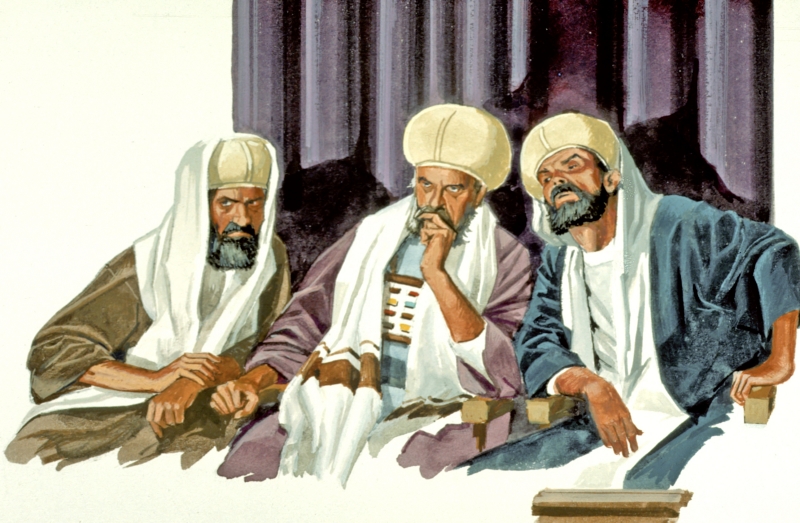
The Pharisees, Sadducees, and other Jewish leaders grew more angry at Jesus and were vexed as to how to destroy his popularity and influence with the masses of Jews loyal to him. All their trickery that day failed. Jesus was not intimidated by them, and in fact, spoke some of his strongest words against them while teaching that day. His 8 “woe to you” pronouncements against the Pharisees are listed at bottom of this page. When I read them, the song from the original Godspell film comes to mind as the Jesus character stands against the religious “machine” of his day – those “hypocrites”, those “blind guides” of the people. Blog - Holy Week Pharisees

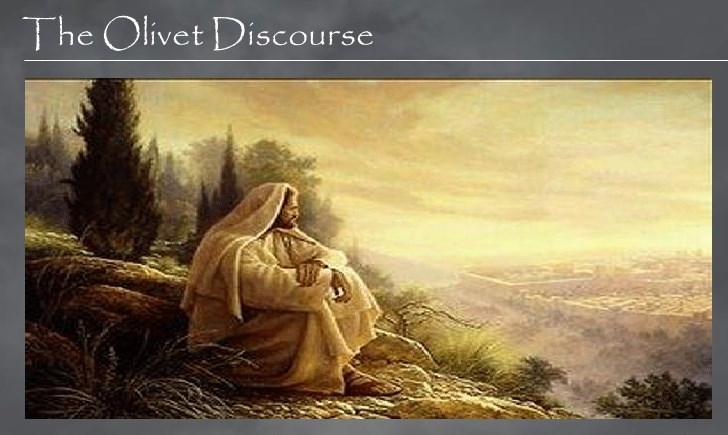
Finally, leaving Jerusalem that day, Jesus stopped on the Mount of Olives (Olivet) to speak about the future. He talked at length, to his disciples and all those who followed, about the end times, cautioning them about false teachers and the evil that would rise up in those last days. What it must have been to listen to Jesus, the Messiah, filled with a mixture of faith in him and fear of what could lie ahead for them, and the generations to come.

When Jesus and his disciples returned for the evening to Bethany, Judas Iscariot, one of the twelve, stole away and met with Jesus’ enemies. [Matthew 26:14-16] He would betray Jesus to them in the dark of night, away from the crowds who would have objected to this…in just two more days…for 30 pieces of silver…Judas would seemingly take history into his own hands, but the clock was already ticking, and Jesus would finish what he came to earth to do.

Holy Week – Day 3: Tuesday in Jerusalem, Mount of Olives

Reasoning Why Jesus Cursed the Fig Tree

Jesus and the Pharisees

*8 Woes Upon the Pharisees

Great Texts of the Bible – The Two Commandments – commentary by James Hastings

613 Laws of the Torah

YouTube video Alas for You from the original film Godspell

Jesus’ Olivet Discourse about Two Future Events

Photo Credits – slidesharecdn.com & www.faithbibleministries.com

8 “Woe’s” Spoken by Jesus Against the Pharisees (Matthew 23:13-30)

1- Woe to you, scribes and Pharisees, hypocrites! for you shut up the kingdom of Heaven against men.

2- Woe to you, scribes and Pharisees, hypocrites! for you devour widows’ houses, and pray at length as a pretense.

3- Woe to you, scribes and Pharisees, hypocrites! for you travel land and sea to win one proselyte, and when he is won, you make him twice as much a son of hell as yourselves.

4- Woe to you, blind guides, who say, “Whoever swears by the temple, it is nothing; but whoever swears by the gold of the temple, he is obliged to perform it.”

5- Woe to you, scribes and Pharisees, hypocrites! for you pay tithe of mint and anise and cumin, and have neglected the weightier matters of the law: justice and mercy and faith.

6- Woe to you, scribes and Pharisees, hypocrites! for you cleanse the outside of the cup and dish, but inside they are full of extortion and self-indulgence.

7- Woe to you, scribes and Pharisees, hypocrites! for you are like whitewashed tombs which indeed appear beautiful outwardly, but inside are full of dead men’s bones and all uncleanness.

8- Woe to you, scribes and Pharisees, hypocrites! Because you build the tombs of the prophets and adorn the monuments of the righteous, and say, “If we had lived in the days of our fathers, we would not have been partakers with them in the blood of the prophets.”*

4 Elements of Uncommon Loyalty in the Life of Jonathan

2014 BLog Pics 001

If you were hanging off a cliff at the end of a rope, you would want someone like Jonathan on the other end. He’s not going to let you fall. This is the kind of loyalty we hope to have in friends, family members, even colleagues, if we were honest. In fact, someone like Jonathan would have intervened before you went over the edge.

We don’t use the term loyalty so often these days. As a character trait, its meaning has been maligned over the years. Being loyal has been perverted to mean something more weak than strong – something puppyish, short-sighted, or weak-willed. Occasionally, loyalty can bring to mind allegiances that serve our own purposes. It’s who you know, right, in advancing in the work force, for example.

Yet, when we look at Jonathan, in the Bible, loyalty is the character quality that comes to mind immediately. Deep, unwavering, costly loyalty. To his friend, David, yes, but also to his flawed king and father, Saul, and most importantly to the Lord Himself.

Jonathan’s story is found in 1 Samuel (beginning in 1 Samuel 13:2), as his father, King Saul, falters and then eventually falls as king of Israel. It’s a fast read to the end of this book and worth your time, if you want to see this picture of Jonathan’s true and steadfast loyalty.

I’ve read this passage many times, but this time, God opened my eyes to the “so much more” that lies at the heart of Biblical loyalty. Read the full account (1 Samuel 13-31) for the mesmerizing details, but here, in brief, is how Jonathan’s life has affected my own today.

The Loyalty of Jonathan

1) He acted on his loyalty – courageously and without hesitation. Jonathan was Saul’s oldest son and heir to the throne as next King of Israel. He was often in battle and led his troops valiantly, even at great risk to his own life (1 Samuel 14). He was loyal to the purposes of God and the direction of his father, King Saul. When his father did not lead well, or at all, Jonathan stayed true to the purposes of God. He found favor among the people (v. 45).

2) He was inclusive, as much as was possible for him to be. Jonathan met David after David killed the giant Goliath. When they met, their souls were knit together (1 Samuel 18:1). A deep love and loyalty grew between these two friends. Jonathan however still obeyed his father as much as he could. He would not follow the king’s orders if they went against God, but when he could obey, he did. [I love this about Jonathan that he didn’t cast off his relationship with his father with the advent of his relationship with David.] Jonathan’s loyalty extended to his God (and God’s purposes for Israel), his father, and his friend.

3) He was selfless in his loyalty, for the sake of those he loved. In reading, the account of Jonathan’s life in 1 Samuel, it became clear pretty early that he would not be heir of Israel’s kingdom after all. He would never be king. What bitterness that could birth in a lesser man! Jonathan must have had a profound trust in God. It seemed the throne was of little consequence to him in comparison to righting the relationships between his father and David. He did everything he could to reconcile the two, even with the knowledge that he would gain nothing more than he had already. That is the purest, truest kind of loyalty. A God-glorifying, unconditional love and loyalty.

4) He did not waver in his loyalty even at great cost. I hope you read the accounts in 1 Samuel that tell Jonathan’s story. From a human standpoint, it doesn’t lead to a happy ending. He dies in battle at his father’s side. David is elsewhere, fighting his own battles, and staying clear of the king who wanted him dead.

Jonathan dies, fighting the enemies of Israel, in obedience to God and his father…faithful, loyal, courageous to the end.  Earlier in his story (1 Samuel 23:17), Jonathan pledged to David, “Do not fear, for the hand of Saul my father shall not find you. You shall be king over Israel, and I shall be next to you. Even my father Saul knows that.” David did become king, but Jonathan would not be at his side. Still, the king that David became was forever altered by how God used Jonathan in his life.

And Jonathan? What of Jonathan? Generations of us who have read his story have squared our shoulders, fixed our gaze, and resolved, with God’s help, to love like Jonathan did…to be truly loyal as he was. This is a greater legacy than being any king…

How would our churches, workplaces, families and friendships be different today if we determined to be wholly and intentionally loyal in our relationships? How would our relationships be with the Lord?

Do not let loyalty and faithfulness forsake you; bind them around your neck, write them on the tablet of your heart. So you will find favor and good repute in the sight of God and of people. – Proverbs 3:3-4 NRV

Short Bible Study on Loyalty

What Does the Bible Say About Loyalty

The Character of Loyalty