Tag Archives: Monday morning

Monday Morning Moment – Offense Revisited

[Adapted from the Archives – Monday Morning Moment – Offense, Being Offended, and Taking Up Offense]

Processing thoughts on the difficult subject of offending and being offended, a song drifts into my hearing from Dave’s office. He is riding his bike (on a trainer) to a playlist that matches his ride (slow/fast/slow). This particular song pounding into my head is rock band The EaglesGet Over It. [Dave will also pull that song up on the occasion he recognizes he’s having a pity party.]

I’ve had some great friends in my life who have spoken reason to me in times when something said or done to me (or to someone I cared about) offended. “Get over it!” was actually a helpful “slap” into reality for me. Reminds me of that old commercial, “Thanks! I needed that.”

The motivation for this piece is walking alongside people I love who have been deeply offended and don’t see a way to get past it. Offenses are hard, especially if they seem intentional.

We still have a choice. We can choose not to be offended…whether it felt the seeming offense was directed toward us or we are tempted to take up offense for another.

Author Desirée M. Mondesir writes a “slap to the face” piece on our culture’s move to looking for and taking up offense. It’s especially fascinating to me because she refers to a student revolt at Yale University. Having taught there years ago, I can see this gradual evolution from reason to riot. It’s a stunning change in society and we are none immune to it.

A Sign of the Last Days – Offense – Desirée M. Mondesir

Mondesir refers to this cultural shift as being a sign of end times.

“And then many will be offended, will betray one another, and will hate one another. Then many false prophets will rise up and deceive many. And because lawlessness will abound, the love of many will grow cold. But he who endures to the end shall be saved.” – JesusMatthew 24:10-13

Sure sounds like today’s culture, in the US anyway.

Writer and counselor John Bevere has written a fascinating book on offense entitled The Bait of Satan: Living Free From the Deadly Trap of Offense. The title put me off at first but in reading it, the whole issue of offense is highlighted as something that turns us inward and keeps us from healthy relationships with one another and with God. When you think about it, Eve, in the first pages of the Torah/Old Testament [Genesis 3:2-7], was the first of humankind to act in offense. In her conversation with the Serpent tempter, she reacted to the Serpent’s suggestion, questioning the instruction (and the goodness) of God. To me, it demonstrates her taking offense that she would be drawn into Satan’s ruse. Even acting in rebellion, presuming God didn’t mean good toward her. She decided for herself to eat from the tree (the one tree God had forbidden), and the consequences of her choosing continue to today.

What could Eve have done differently? She could have trusted God’s heart toward her. If she fell into doubt (through Satan’s cunning argument), she could have sought out the Creator first before she acted on a lie.

When Eve acted in this way, and took the bait, we can see how we, too, can be drawn in – becoming disoriented by someone’s words or deeds, and forgetting what is really the truth of the matter. Our emotions fly away with us, and we bind ourselves in the chains of offense.

Joe Levi puts it this way:

“Someone else cannot “offend” youhowever, you can choose whether or not to take offense at something someone says or does.

Someone else cannot make you mad, happy, sad, or offended – you, and you alone can control how you react to the world around you.

Learn and apply that one relatively simple lesson, and you’ll be much happier in life.”

We may not be able to choose our immediate emotion over a word or action perceived as against us, but we can develop a habit or discipline to determine NOT to take offense.

Currently, the news media is having a hey-day with sound-bytes and interviews hand-picked to incite offense.

We can choose not to take the bait.

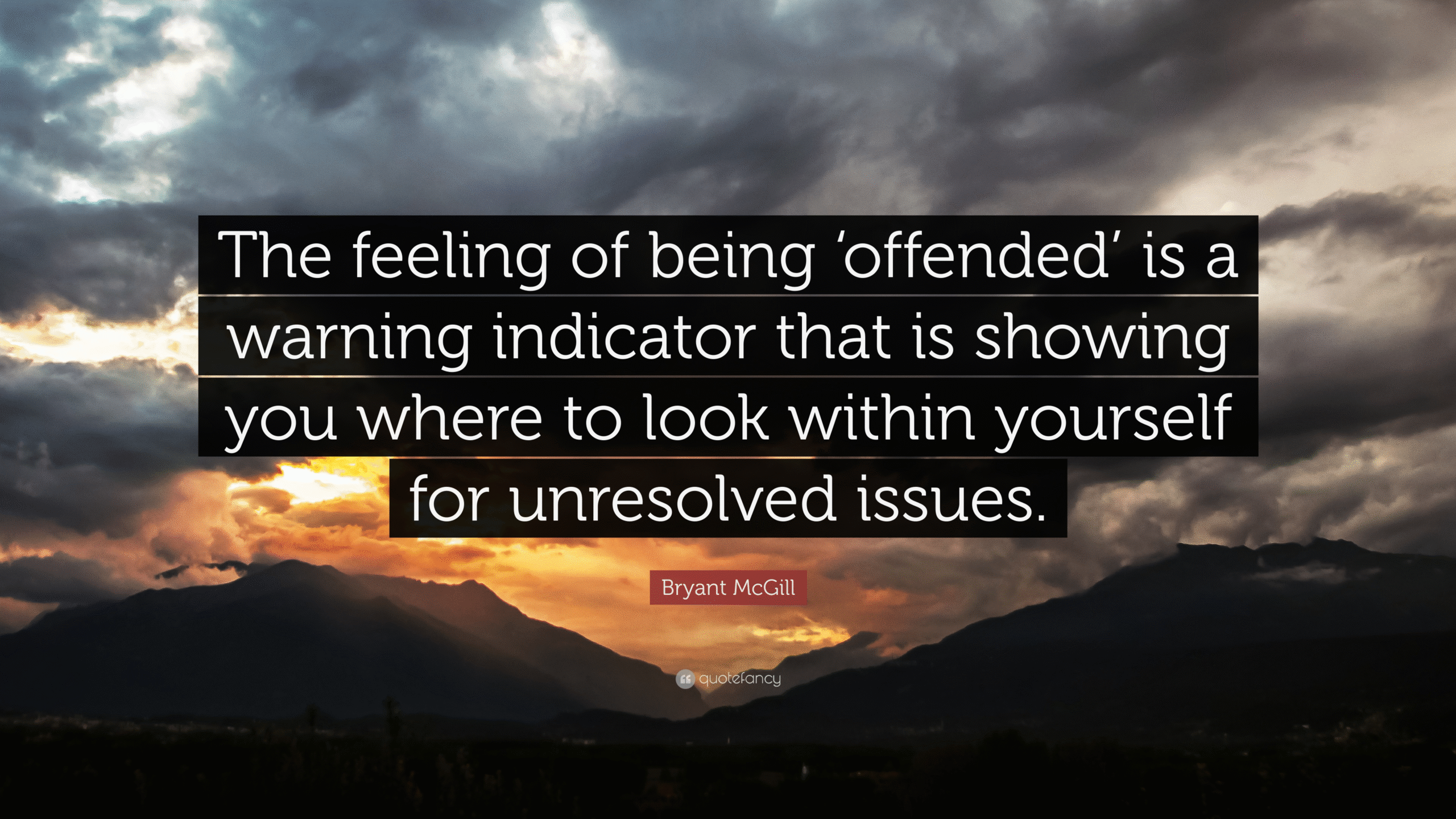
Photo Credit: Quote Fancy, Bryant Mcgill

As for personal situations, people who offend do not always mean to offend. [I don’t say this lightly. Of course, there are those who do. I also am not talking about abuse here. That is a whole other topic, but the principles still apply.] No one knows truly what’s inside us that gives us struggle, not even ourselves. Like the Mcgill quote states, it’s only in our response that we discover that which is still unresolved. Reacting in self-defense or in counter-attack mode brings more hurt. “Hurt people hurt people.” With practice, I can determine not to carry hurt away from a conversation or interaction.

In situations between two people, we can choose not to be offended, but how do we deal with the offense?

Advisor Charles H. Green describes the offender and the offended. He gives excellent counsel in his article Being Offensive vs. Being Offended – and Trust:

  • The offender communicates disrespect. A social violation occurs. Two people are involved and the resolution of that interaction requires input from both of them. When the one offended determines to engage in good faith, trying to seek understanding and rebuild trust, s/he may actually discover the intent of the offending person. A misunderstanding or an action following a perceived threat on the part of the offender may be the issue rather than an intent to hurt.
  • On the side of the one offended, this is not a social situation. It is deeply personal. Only the one offended knows the extent of the offending words/actions. For this reason, the offended person can refuse to think ill of the offender…and not take offense. Then take steps toward reconciliation or, if that’s not possible, make a personal decision not to be hurt by that person. This is not easy…especially at first in training one’s responses.
  • “The answer is a little paradoxical: We should strive not to offend or disrespect others. At the same time, we should also strive to not feel offended, or disrespected, for long. In other words, we should strive to be kind socially, and to feel free psychologically.”
  • Forgiveness opens the door wide to reconciliation. Forgiveness can defuse the hurt. Boundaries may come into play, but if the boundaries are built out of fear, dread, anger, or hatred, we are still not free from offense.

My biological father abandoned us long before my mom left him (before my sixth birthday). I saw him only twice after that. For years, I wrote him letters with no response, and then I stopped. My love for him grew cold. If he had any sense of needing forgiveness or asking for forgiveness, I don’t know. He died before I told him I forgave him. Every time this comes to mind, forgiving him is revisited. That’s a regret for me. However, I know the beautiful experience of forgiving a long-played offense from my older brother. Robert, who had deep pain of his own, struck out at others. My response for years was being offended at him or taking up an offense for other family members. It wasn’t pretty. Then, thanks to the wisdom and honesty of friends, I came to my senses on his offenses and my reactions. No more taking up an offense when Robert attacked…and the attacks died. He and I became closer than we had ever been over our lives. In fact, he gentled in his relationship with our siblings also. Those brief years (which could have been more if I had understood sooner) were great blessings (hopefully to both of us). When he died suddenly in his 60s, I carried no regrets. #Unoffendable #Forgiveness – I forgave him and he forgave me…without the words but walking out forgiveness with each other. So much grace in that.

Photo Credit: Unoffendable, Brant Hansen

Thoughts?

Being Offensive vs. Being Offended – and Trust – Charles H. Green

Unoffendable: How Just One Change Can Make All of Life Better – Brant Hansen

What Is the Difference of Being Offended and Harmed? – Robert Enright

Stop Being Offended Today: 3 Cures for Everything That Irritates You – Bill Apablasa

Forgiving in Two Dimensions – Peace Pursuit

Mel Robbins on the “The Let Them Theory” – Sarah Fielding

Photo Credit: Brant Hansen, Unoffendable, Pinterest

Monday Morning Moment – Word for the New Year – Focus

Photo Credit: Heartlight, James Houston quote

[Adapted from the Archives]

I have set the LORD always before me; because he is at my right hand, I [we] will not be shaken.Psalm 16:8

You, [Lord], will keep him in perfect peace, whose mind is stayed on You, because he trusts in You. Isaiah 26:3

For I know the plans I have for you, declares the LORD, plans to prosper you and not to harm you, to give you a future and a hope. Then you will call upon Me and come and pray to Me, and I will listen to you. You will seek Me and find Me when you search for Me with all your heart. Jeremiah 19:11-13

Not that I have already obtained all this, or have already been made perfect, but I press on to take hold of that for which Christ Jesus took hold of me. Brothers, I do not consider myself yet to have taken hold of it. But one thing I do: Forgetting what is behind and straining toward what is ahead, I press on toward the goal to win the prize of God’s heavenly calling in Christ Jesus. Philippians 3:12-14

Now we have this treasure in jars of clay to show that this surpassingly great power is from God and not from us. We are hard pressed on all sides, but not crushed; perplexed, but not in despair; persecuted, but not forsaken; struck down, but not destroyed…knowing that the One who raised the Lord Jesus will also raise us with Jesus and present us with you in His presence… Therefore we do not lose heart. Though our outer self is wasting away, yet our inner self is being renewed day by day…For our light and momentary affliction is producing for us an eternal weight of glory that is far beyond comparison. So we fix our eyes not on what is seen, but on what is unseen. For what is seen is temporary, but what is unseen is eternal. – 2 Corinthians 4:7-18

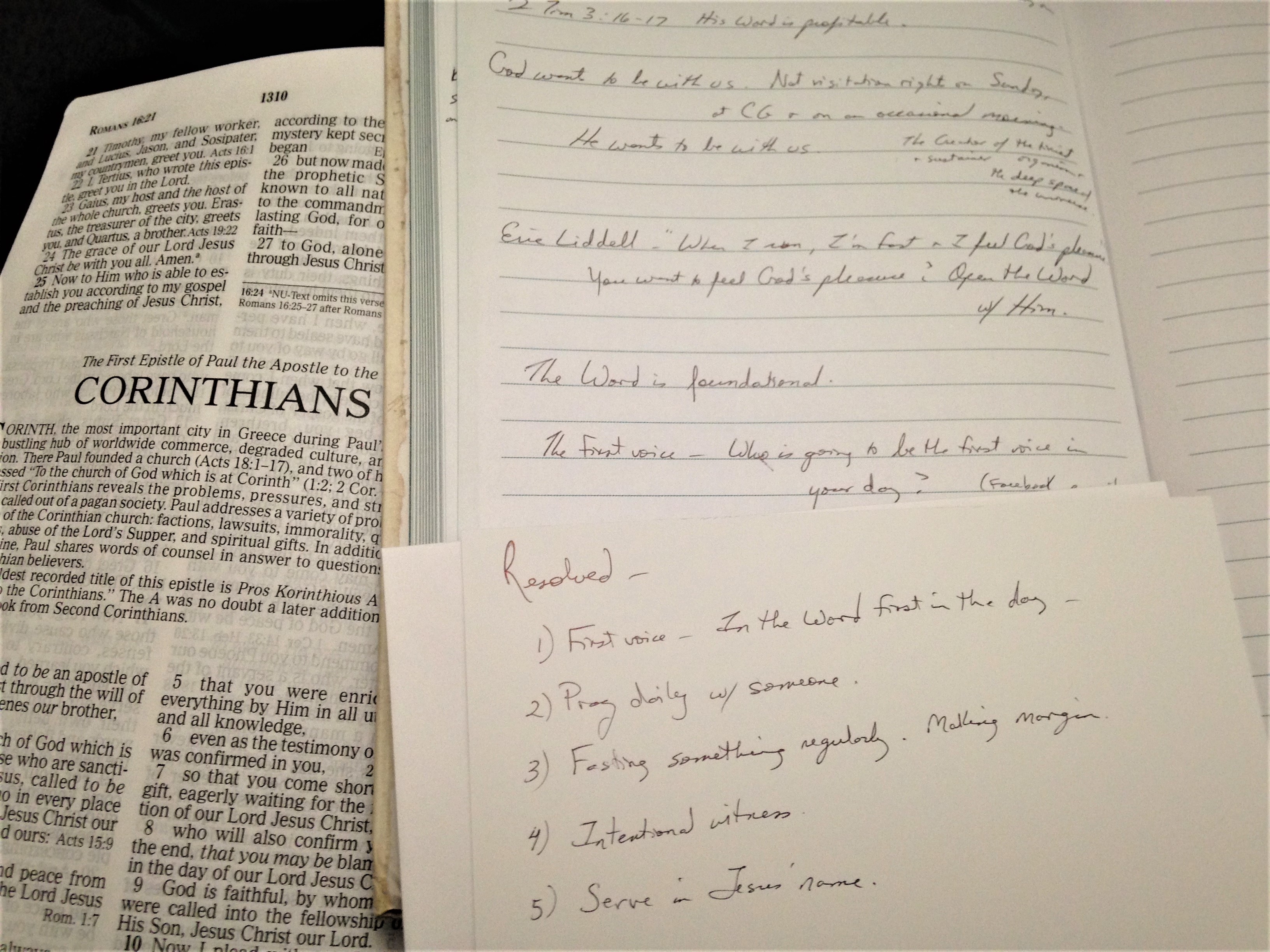
New Year’s Resolutions have been a long-time habit for me. I actually find them very helpful in steering my life into the next year. More intentional, more thoughtful. It doesn’t matter to me if those resolutions don’t get me to whatever goal I set…they have always gotten me a bit closer, a bit farther down the road. In 2017, pastor Cliff at Movement Church challenged us to commit to some resolutions to the Lord…together [podcast of 12/31/2017 here]. That was such a pivotal exercise that I have kept those same resolutions, made that day, in a visible place, to be reminded of those Godly habits, and the struggle to walk in them… Still in view…eight years out. Still relevant to now.

Then in 2020, I read Debbie Macomber‘s book One Perfect Word. It is not the same practice as setting resolutions in motion, but it is a discipline of seeking one word to set the tone for the coming year.

In 2021, my word was “compassion”. In 2022, it was “joy”. “Wonder” in 2023. “Strong” in 2024, when feeling weak was the norm that year. This past year, in a season of medical challenges, my word was “trust”.

Choosing a word for the year gives a sense of direction like I’ve not experienced in the past. It’s a target toward which I take aim or correct my aim. Each year, the Lord seems to direct me (can’t be certain, but it feels like Him) to a word to set in my heart and mind. A marker in my walk with God. In recent weeks, the word that has come to mind for 2026 has been focus. In fact, I’ve seen it repeatedly communicated in Scripture during my quiet time (see verses above) and in every day conversations and sightings (like the cap below in a thrift store).

My whole adult life, I’ve dealt with distractedness. To the point of thinking it could be ADD (attention deficit disorder). Starting strong and then dwindling in my interest and resolve. Distracted by the needs around me (which isn’t a bad thing). Struggling to stay on task. As I approach my 75th birthday (crazy, right?!), the Lord has reminded me that He doesn’t see my distractability as a weakness. It is just part of who I am, and He can mold it into something beautiful and useful to the Kingdom, when I stay focused on Him…and His nature.

Photo Credit: Heartlight

This will be my challenge and delight in 2026. To start with Him each day, to focus (and refocus) on Him through the day, and to finish the day, not in defeat because of any failures or unfinished tasks, but resting in His presence and peace. Eyes on Him, not on me.

Here we go, 2026. As the Scripture above prompts. The LORD always before me. My mind stayed on Him. Seeking Him with my whole heart. Pressing on to take hold of that for which Christ Jesus took hold of me. Fixing my eyes on what is unseen. Running the race marked out for me.

Postscript:

Twentieth-century Quaker Thomas Kelly wrote, “Over the margins of life comes a whisper, a faint call, a premonition of richer living which we know we are passing by. We have hints that there is a way of life vastly richer and deeper than all this hurried existence, a life of unhurried serenity and peace and power. If only we could slip over into that Center! If only we could find the Silence which is the source of sound!”

Lord, withYour coming, our lives have a greater demand placed upon them. Help us learn the art of active, consistent service while maintaining enough silent spaces to hear Your call. Amen. commonprayer.net.

Photo Credit: Heartlight

Photo Credit: Heartlight

Monday Morning Moment – Word for the New Year – Trust – the Object of Our Trust Matters – Deb Mills – [quick review of how a Word of the Year became a habit in my life]

The Focused Christian – Craig Meeker – practical primer to the focused life

Monday Morning Moment – Anger, Contempt, & Forgiveness

Photo Credit: Heartlight

[Turns out I’ve written about contempt several times – if you can set aside some time – you can reference these as well.]

I have a dear friend who differs with me on much of our country’s current politics and policies. However, we continue to be close. Some intentionality in both of us must be at work. No matter who won the elections last week or who’s responsible for the latest government shut-down, whatever our thoughts are on these subjects, our friendship stands. Though our solutions to the ailments of our nation may not align, our hearts resonate with each other. Neither of us holds the other in contempt over these external issues. In fact, conversations with her always increase my understanding of these stressful situations and lead to great compassion for those in the midst of those situations.

This is not always the case in family and friendships.

Some of the postings on my social media in recent days have been riddled with anger “at the other side”, whatever that entails. These are friends in real life. Decent, caring people. However, there seems to be an imperative these days to point out the bad behaviors of others, those considered political enemies. Not just behavior but character. One side devaluing the other. Anger, maybe even righteous anger in the beginning, too often progresses to disgust, or worse contempt.

Photo Credit: Heartlight

Anger is a negative emotion that confronts an action/behavior of another (peer or peer group). Contempt takes anger to a lower, darker place. Contempt demonstrates superiority as it simultaneously dismisses and devalues the other person or group, seeing her/them as inferior. It dehumanizes.

“Anger and contempt are the twin scourges of the earth, these bitter emotions form the poisonous brew in which human existence stands suspended. Few people ever get free of them in this life, and for most of us even old age does not bring relief. To cut off the root of anger is to wither the tree of human evil.” – Dallas Willard, The Divine Conspiracy p. 151

Photo Credit: Psychology Spot

It’s slow going, but I am learning not to allow contempt to gain space in my mind and heart. Like other negative emotions, contempt doesn’t only poison relationships but it poisons the mind of the one who entertains contempt.

John Murdock writes on this subject:

“Willard argued that in the Sermon on the Mount, Jesus was not just pulling marbles from a bag, presenting individual gems of wisdom that could be considered independently. Instead, the order of the presentation mattered greatly. “It is the elimination of anger and contempt,” he asserted, “that [Jesus] presents as the first and fundamental step toward the rightness of the kingdom heart.”

Conversely, today it is the systematic elevation of anger and contempt that is often rewarded across the political spectrum.”

Then, yesterday, we had this incredible teaching on anger and forgiveness at Movement Church. Pastor Cliff powerfully preached on Matthew 5:21-24:

“You have heard that it was said to those of old, ‘You shall not murder; and whoever murders will be liable to judgment.’ But I say to you that everyone who is angry with his brother will be liable to judgment; whoever insults his brother will be liable to the council; and whoever says, ‘You fool!’ will be liable to the hell of fire. So if you are offering your gift at the altar and there remember that your brother has something against you, leave your gift there before the altar and go. First, be reconciled to your brother, and then come and offer your gift.”

Cliff talked about how God’s law has affected morality across the world – most of us get through life without murdering anyone. However, Jesus revealed how, if unchecked, our thoughts and words (be they face-to-face or written in social media) can have murderous impact.

We may think we’re doing the world a good service by pointing out the wrong thinking and actions of others. However, if we lack care for them, if we lack compassion or love, our words draw deep lines dividing us. Tall, thick impenetrable walls between us. And, God forbid, we don’t even care? I’m asking.

Jesus pointed to anger and contempt as deterrents to worship. If we care about being right with God, then we have to confront our part in being wrong with people. We may feel offended and then justified in our reaction to another person/group’s behavior, but acting in anger or contempt hurts everyone involved. Everyone.

One day, maybe our culture will shift to being more kind and long-suffering with each other. Being curious, seeking to understand, leaning in rather than being repelled. Until that day, or if that day never comes, what kind of person do I want to be? What do I want to practice in front of my family…my friends, my neighbors…even my enemies?

What is Contempt? An Intense Feeling Under a Mask of Coldness – Psychology Spot – an extremely helpful resource

Monday Morning Moment – Contempt Revisited – Deb Mills
What Is Contempt – Paul Ekman

Moving Beyond Chronic Resentment and Anger in Relationships – Steven Stosny, Ph.D.

Is Contempt a Form of Anger?

Monday Morning Moment – the Culture of Contempt and How to Change It…or At Least Yourself Within It – Deb Mills

Monday Morning Moment – Contempt is Cancer in the Workplace…and Any Other Place – Deb Mills
Disdain, Dallas Willard, and Donald Trump – John Murdock

Photo Credit: Heartlight

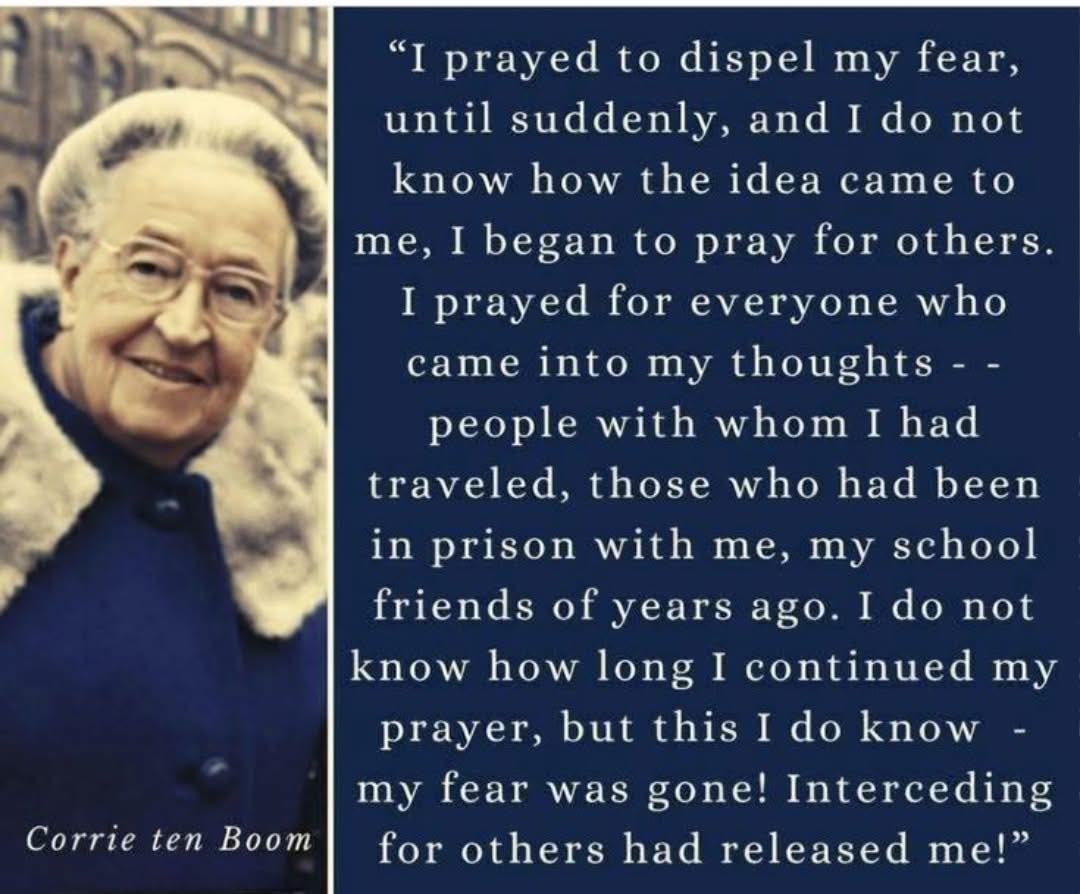
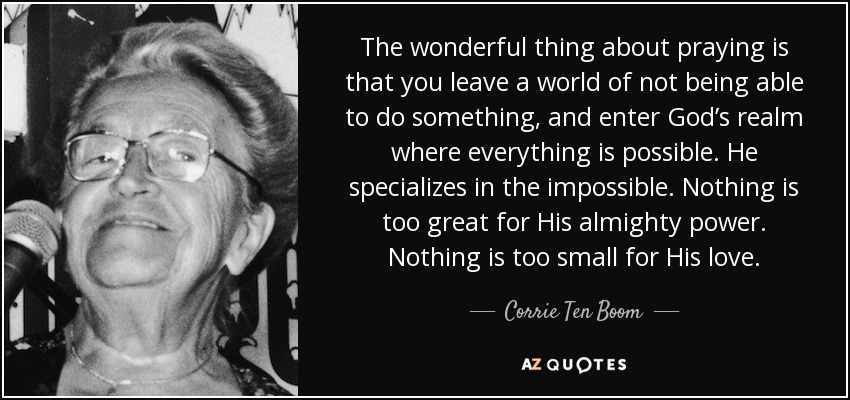
Monday Morning Moment – Released – The Incredible Life of Corrie Ten Boom

Earlier today a miracle happened. The last Israeli hostages were released from Gaza. Twenty of them. Released! Israel also released almost 2000 Palestinian prisoners. Released! Hopefully the cease-fire on both sides will continue, and the Middle East can settle into a much-needed peace.

Also today, I finished reading a book my daughter had long been encouraging me to read. We actually gave each other a book to read. I gave her eye-opening book Just Mercy by Bryan Stevenson. She gave me The Hiding Place – The Triumphant True Story of Corrie Ten Boom (with John and Elizabeth Sherrill). I had seen the movie of Corrie Ten Boom‘s life years ago (also entitled The Hiding Place, 1975). It was riveting then, and this book’s story in her own words was even more so.

Photo Credit: Amazon

The Ten Boom’s were a devoutly Christian family in Holland, and much of the story takes place around the events of World War II. Nazi Germany was making its move to gain power across Europe and was particularly targeting Jews, their own and other nationalities, and Jewish sympathizers. The Ten Boom’s began hiding Jews and developed an effective but dangerous underground to secret them away to safer places. The family’s activities were eventually found out and they were imprisoned. Corrie’s brother Willem and sister Nollie only briefly, but Corrie’s father and sister Betsie were held. Their father would die after a brief time of incarceration. Betsie was Corrie’s older sister. They never married and poured their lives into caring for others.

The notorious German concentration camp, Ravensbrück, would be their “home” for too long. Over 130,000 women would be held there, and over 60,000 died (some in the gas chambers). The conditions were horrific. Corrie and Betsie, by God’s grace, managed to hold onto a Bible during their prison time. When they weren’t laboring long hours, they prayed and encouraged the other women in their barracks. Betsie had enormous faith and a tender heart, even toward their tormentors. She prayed for both prisoners and guards. Corrie struggled more in her faith, angry with their treatment, especially because Betsie was physically weak from a long-term illness. Corrie would learn greater forgiveness and love during their unfathomable time together in the camp.

Finally, Betsie would die in captivity. Corrie would continue on, taking more responsibility in caring for the women around her. Early on in their time at Ravensbrück, Betsie reminded Corrie that God called them to be thankful in all circumstances, not just in lovely ones. Corrie couldn’t thank God for the fleas which infested their quarters. Later, Betsie observed that the guards rarely entered their barracks BECAUSE of the fleas, so they were free to have times of prayer and study. This was not wasted on Corrie as she began to see God at work in all their circumstances…and she gave thanks.

I’m going to leave the rest of the story for you to discover in reading about her life…or watching the movie (movies – others have been made since the first one).

Obviously, Corrie survived her captivity and was released toward the end of 1944 (12 days after Betsie died). Her life continued for almost 40 years, and she was able to see the fruit of Betsie’s visions for the future. It is an incredible story – loss turned to glory.

In rejoicing over the long-awaited release of the Israeli hostages and concurrent release of Palestinian prisoners (also celebrated by their families), we are struck by the enormous experience of being “released”.

For Corrie, and for all of us, the release of bitterness as we forgive and God’s work in our hearts to even love our enemies (Matthew 5:43).

Photo Credit: Corrie Ten Boom, Facebook

Photo Credit: Corrie Ten Boom, Facebook

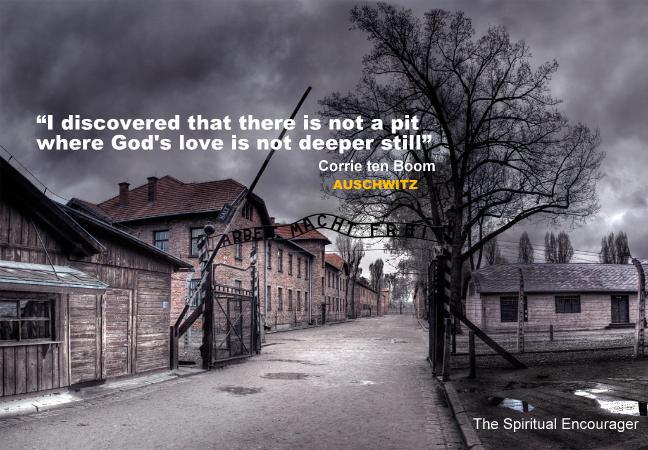
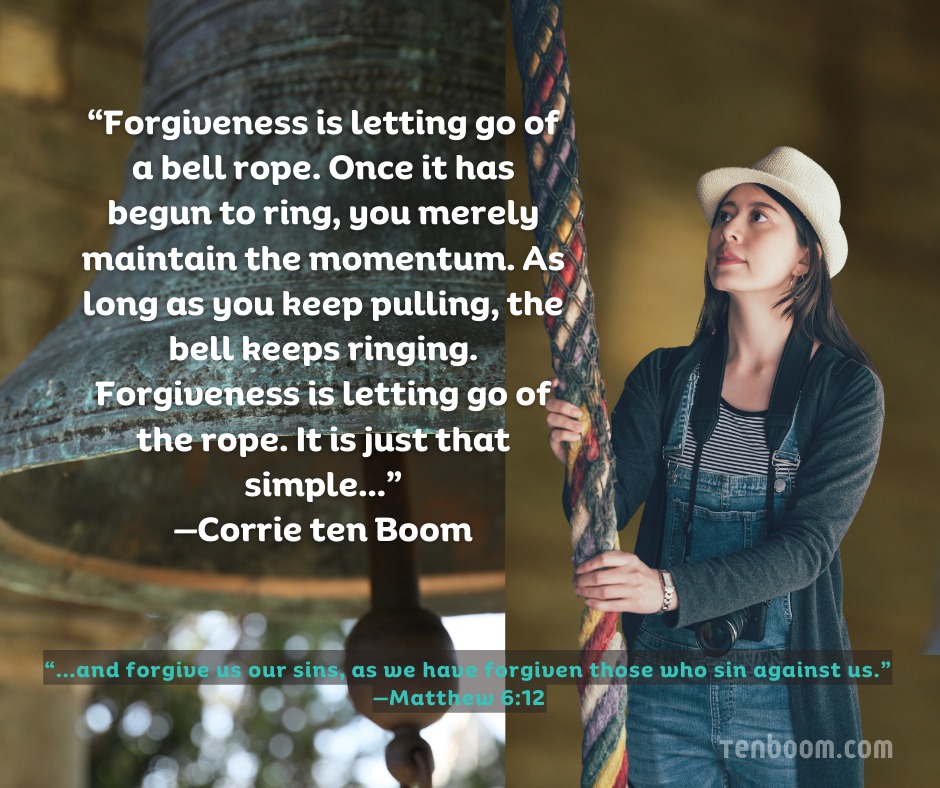
Photo Credit: QuoteFancy

The Ten Boom Family

Return to the Hiding Place – sequel to The Hiding Place film

The Hiding Place – 2023 Remake

Monday Morning Moment – Reflecting on Family

[Dave’s Mom, Our Adult Kids, Dave & Me – Not all the grands are on social media – but they begin the next generation of our family.]

I want to write about family…well, this family right here. In fact, I want to write a letter to them. Feel free to read along.

Dear Family,

Yesterday was a sweet time celebrating our September birthday guys – Dave & Nathan. Father & First Son. You both are so dear to all of us.

To you siblings and siblings-in-law, I love you so much. In the early years, I had this wild idea about how, while we live in the same city, we would get together weekly – like for Sunday dinner – like in the TV show Blue Bloods.

[Blue Bloods – read the short piece on how their weekly family gatherings shaped the show and character relationships.]

We don’t get together weekly, and that’s ok. When we do get together, it can be loud and opinionated, just like that TV family. However, it’s always rich – food for thought as well as body. Hope you leave each time, not just with a full tummy but, with the refreshed understanding of how much you are loved. Not just by Dad and me but by your siblings.

[I’m a faithful documenter of people and special events. Always working on their patience. It means a lot when everyone cues up and smiles, but occasionally someone doesn’t feel like it…and that’s ok.]

To our youngest: I know being the baby of the family can get old, especially when you find yourself in your mid-30s. Hopefully you know that your opinions matter to your family. We want to know what you think… always. It made me sad that you were suffering from a headache through most of the meal yesterday. Please take heart that although we all don’t always agree on everything, we are grounded in love for each other. That’s priority and it will never change. Ever. I want to thank you for loving your family, too. You don’t have to show up and yet you do. There is a measure of hard in your life, different from ours, which would be easy for you to stay focused on. It gives us immeasurable joy when you are able to shake off the hard and laugh about “the old days”, tease your siblings and absorb their ribbing, and love on your nieces and nephews. It’s also no small thing how you serve us (me) – baking and straightening.

[Lots of Sibling Love Right Here]

To the married siblings and their spouses: You have incredibly busy lives, and yet for those hours when we are together for the odd special occasion, time slows. You are present. You are engaged. You are yourselves. The flow of conversation is easy and animated. You roll with the skirmishes between little cousins and you parent them all so well. I hope you know how much you are loved. As your Dad (Dad-in-law) and I get older, we are so grateful for how you hang in there with us and each other. Family estrangement is so prevalent in our world today, but so far, we have weathered the storms. Your commitment to our family is something we do NOT take for granted.

[The Guys]

[The Big Sister & the Little Brother]

To any who are reading: all families are different. Within each family, there are tremendous differences in temperaments, preferences, and even worldview. Ruptures can happen and repair is hard to come by. Our Sunday birthday dinner reminded me of things learned over the last few years:

  • We can make a place of safety and security for those we live.
  • When we are only around people who agree with us, we experience an echo chamber of affirmation. When we experience dissonant voices from those who love us, we learn how to better love those different from us.
  • In a rowdy family discussion, we still probably agree more than we disagree. Take an inventory on that from time to time. How do we affirm each other even when we don’t agree?
  • Lead with curiosity and empathy. If contempt is stirred up, recognize it for the destroyer of relationships it is, and take steps against it (see here).
  • Remember life is messy. Family is messy. We may prefer our lives (and families) to “look” a certain way, but it’s healthier for us to be real and honest with each other. “The human mind doesn’t have the capacity to live a life so curated” (convo with friend/counselor Taryn Blocker).
  • Flexibility is a character quality we all need to navigate relationships when people are crossing our boundaries. Flexibility, humility, and forgiveness. It’s going to happen, especially in family. Respecting boundaries goes both ways and takes both self-care and other-care. Or relationships break down.
  • What else? What would you add to those list? Please share in comments.

[The original three & me]

I am very thankful for this family. With all our warts. Not unlike any other family out there. So thankful for the relationships these siblings have with each other, and for the littles with their sibling and cousin relationships. Check out these beautiful reels from Instagram on the topic.

Instagram – Siblings Are One of the Most Important Relationships You Will Ever Have

Instagram – “Who do we call when you’re not around?”…”Each other.”

Finally, I’d like to just mention psychiatrist Dr. Gabor Maté‘s opinion on how all children grow up in different families with different parents. He justifies that thinking about how we, as parents, change and evolve in our thinking on parenting, with each child, and our children are all different from each other. We may even use the same practices but our children react differently to them. The old adage” of “caught or taught” would bring meaning to this as well.

Siblings may grow up in the same house, but that doesn’t mean their childhoods were the same. Not even close.

Same parents? Nope.
Same family? Nope.
Same childhood? Absolutely not.

Parents show up differently for each child depending on the season of their life, their relationship, and even their financial situation.

It’s not about who is loved more.
It’s about how that love is expressed — and how each child experiences it.

If you’ve ever wondered why you and your siblings remember childhood so differently — this is why. – Clip from The Mel Robbins Podcast, Conversation with Dr. Gabor Maté – “Why You Feel Lost in Life: Dr. Gabor Maté on Trauma & How to Heal”

How Today’s Parents Say their Approach to Parenting Does – or Doesn’t – Match Their Own Upbringing – Pew Research – Kiley Hurst, Dana Braga, Shannon Greenwood, Chris Baronavski, & Michael Keegan

Dr. Gabor Maté Explains His ‘No Two Children HaveThe Same Parents’ Philosophy – Annie Reneau

Then, to those amazing adult children, add spouses, careers, and varied life experiences to the equation, and we continue to have the wonder of family – familiar and yet also new and changing. It makes for a fascinating Sunday dinner experience…and a lifetime of tilling the soil of a safe, secure, and hopefully sacred love for each other.

Monday Morning Moment – Don’t Let Complaining Rewire Your Brain

Photo Credit: Stream

Yesterday, I was taking a break and scrolled through Instagram until it stopped me in my tracks on how complaining can have a chronic negative impact on our health, and, in particular, on our brain. That didn’t surprise me, but I wanted to look further to test out what this influencer was reporting. You can look, too. Do an internet search on “complaining, cortisol, and the brain”. It is startling, but, again, not surprising.

Complaining is extraordinarily detrimental to brain health. In a way, it is also like “second-hand smoke” to those with whom you share it. When we complain, our brain responds by releasing cortisol. We need cortisol, the “stress” hormone, to alert us to possible danger and to stimulate an appropriate (hopefully) response to that danger. The problem with complaining is that it puts stress on a loud speaker when there was no need. Similar to how trauma rewires our brain to expect more trauma.

Why Complaining Is Bad For Your Health – Cindy Tsai, MD

Venting feels good at the moment. It releases the internal pressure that is mentally building up from negative thinking. The dilemma with venting is two-fold – 1) it cements the wiring in the brain in the direction of negative, hopeless thinking, and 2) it activates/re-activates the same process in the caring hearer. Mind you, there is a positive, healthy venting that can take place if it is focused toward hopeful problem-solving and change. This can be life-giving to both persons.

[Side note: We need each other. We were made for community. Talking something out with people who love us is hugely important. There is a difference in lament and grumbling, or complaining and and acknowledging a hard thing, seeking help for forward movement.]

Complaining Won’t Change the World, But Your Actions Can – Susanna Wu-Pong Calvert Ph.D., MAPP, RPh

As one who is getting older and feeling the memory not as sharp and the tendency toward that “cup half empty”, curmudgeonly take on things…I wonder: when and how did it start?

When does analytical become contrarian? When does hopeful turn into doubtful? When does grateful turn into grumbly?

Do we just allow ourselves to turn into different people? Or do we take steps to stay (or become) joyful, engaged, unstoppable humans? People who others love to work with, serve with, spend time with.

A little over a year ago I wrote a blog on how complaining rewires our brains. If you know complaining is a struggle, please take the time to read this one piece (linked below). We may try to eat healthy, exercise, and rest aplenty – maybe there is one more thing we should consider:

Monday Morning Moment – Complaining Rewires Your Brain – How to Curb (Maybe Not Stop) Complaining – Deb Mills

Bottom line: Practice gratitude. Pause your thought process. Resist the urge to complain, rather reframing the complaint into positive action. Surround yourself with people who don’t complain, and, even make you laugh sometimes.

______________________________________________________________________________

When you have more time or you want to consider steps toward positive brain health and a kinder, gentler handling of your life and circumstances, I have excerpted these from my other blogs on complaining and negative thinking:

  1. Complaining Exposed – [From the Archives] When it comes to complaining, we all think of someone else who does it…not us. It is an irritating habit, and it only gets worse if unchecked. Poet writer Anne Peterson talks about complaining and how it flows out of 6 heart attitudes. Complaining reveals that:
  • We feel entitled.
  • We are impatient.
  • We hold on to resentment.
  • We compare ourselves to others.
  • We don’t think life is fair.
  • We are conformed to this world/culture.

Read her article for the particulars. Be prepared to rip the Bandaid (excuses) off your complaining.

What Your Complaints Actually Reveal About Your Heart Anne Peterson

Photo Credit: Gary Vaynerchuk

Entrepreneur Gary Vaynerchuk writes about how his mom and wife seem to be incapable of complaining and it’s one of the things he loves about them: “Complaining has zero value. Looking at the negative, seeing the glass as half empty, and complaining are some of the biggest wastes of time a human being can engage in. Instead, tackle the problem head on. Assess it, see what you can do about it, and then do just that. ‘Woe is me’ is truly one of the biggest things that can stand in the way of success both professionally and personally.”

Gary Vaynerchuk

One of the Few Things I Complain About: Complaining – Gary Vaynerchuk

2. Beyond Grumpiness –[From the Archives] A friend of mine pointed this blog to me today and it bumped its way to the top of my Faves. English professor Alan Jacobs mused about the grumpiness of old people. I don’t know when it happens and why exactly it happens, but it is something that has happened to me of late…and I don’t think I’m old enough yet for it to happen.

Here’s a bit of what Dr. Jacobs says about grumpiness, but you should read his whole piece, especially if you’re finding yourself becoming grumpy (whatever age you are).

“I think the explanation for such widespread grumpiness is fairly simple…It’s not the big foul acts or horribly cruel words that do you in, it’s the slow drip drip drip of little annoyances that become over time a vast sea of frustration. Surely you’ve been there? You become exasperated by someone’s passing comment and when they are genuinely puzzled by your anger over so trivial a matter, you try to explain (apologetically, penitently, I hope) that it wouldn’t be a problem if this thing had happened once but it has happened a thousand times. It’s the repetition that kills you.” [Dr. Jacobs goes on to talk about the divisions on which we’ve taken sides give the sense of being new and revolutionary…and yet they are old divisions revisited.] “You can’t learn from the past if you don’t know what happened in it. So yeah, I’m gradually turning into a grumpy old man. Because nobody learns anything…” [About these things that divide us: We seem to care too much, or too little, or just plain not at all. Dr. Jacobs challenges us that only being truly loving people gives us the right to voice an opinion, and definitely not a shaming one.] “It’s a hard path to walk, this Way of avoiding both indifference and ‘the conscious impotence of rage at human folly.’ But the hard path is the only real Way. (All the others circle back on themselves.) So I try every day to follow it. I don’t think I could manage even that if I did not have an Advocate to accompany me, to encourage me, and to guide me.” – Alan Jacobs, Beyond Grumpiness

Against Stupidity – Alan Jacobs

The Destructive Power of Grumbling and Complaining – Michael Brown

3. Without Grumbling – [From the Archives] Which comes first – anger or grumbling? Or is it a more subtle but growing discontent? When does occasional complaining settle into a set habit of grumbling? What does grumbling communicate to our own minds and to others within hearing?

I’ve written plenty on complaining, grumbling, and negative thinking (see links below). It can absolutely change the wiring in our brains. In my younger years, I always looked for the good and the beautiful in a person/situation…and I found it. Now, as an older person, my temptation is more toward darker thinking. This is NOT where I want to stay.

Photo Credit: QuoteFancy

Below is a beautiful bit of writer Trevin Wax‘s post on grumbling and joy (it is geared toward Christians but there is wisdom for all of life here).

In Philippians 2:6–11, Paul commands the church to adopt the same mind of our risen Lord.  And his first command is, “Don’t grumble.”

“Do all things without grumbling or disputing, that you may be blameless and innocent, children of God without blemish in the midst of a crooked and twisted generation, among whom you shine as lights in the world.” (Philippians 2:14–15)

Why start with grumbling? We might expect an exhortation to spiritual disciplines, or strategies for thriving as pure and faultless people in a sinful world. And yes, Paul does speak about blamelessness and purity and holding firm to the word of life (Philippians 2:16). But this purity in action is somehow connected to the first command to do everything without grumbling. Somehow, grumbling will keep us from faithfulness.

Why start here? Because Paul knows the story of Israel.

Remember the children of Israel? They chose grumbling over gratitude. Grumbling stalled their journey and led to actions that were anything but “blameless and innocent.”

Whether we are given suffering, chains, imprisonment, or worse (Hebrews 11:36–38), or whether we conquer kingdoms, stop the mouths of lions, escape the sword, and put armies to flight (Hebrews 11:33–34), we must know that only joy in and gratitude to Jesus will win the war for our culture…Yes, we may face obstacles, setbacks, and tough days ahead. But in it all, and under it all, we are also joyful. And this cheerful courage comes not from ignoring darkness or looking only for the bright side, but from believing that the Light will overcome the dark.

Do you want to shine like stars? Then do everything without grumbling.” –

Trevin Wax, Facebook, March 27, 2022

Monday Morning Moment – Life & Politics – What If We Refused to Get Angry? – Deb Mills

Monday Morning Moment – Rewiring Your Brain Toward Thinking in the Positive – Deb Mills

Monday Morning Moment – Grumpy Begets Grumpy – Understanding It, Not Reacting, and Turning It Around – Deb Mills

Monday Morning Moment – Them and Us, How Can That Be? Could Them and Us Become a We? – Deb Mills

How Changing This One Bad Habit Changed Our Home for Good – Complaining

4. Breaking Out of Negative Thinking – [From the Archives] I first wrote about negative thinking six years ago (that blog linked below). Since then we have come through COVID 2020, great racial unrest and social upheaval, contentious election cycles, ongoing wars, and a downturn in our economy. Lots to think negatively about with good reason, but if we’re not careful we will begin gearing our thinking in that direction to the detriment of our mental and relational health.

Monday Morning Moment – Rewiring Your Brain Toward Thinking in the Positive – Deb Mills

Photo Credit: Daily Health Post

The team at Daily Health Post focused on complaining as a culprit that can actually cause our brains to default to anxiety and depression. From experience, I know this is true.

They prescribe the following to flip the damaging habit of complaining:

Be grateful: Find something to be grateful for everyday. If you keep a journal, write down 3 things you are grateful for every morning and every night.

If you start to feel anxious or pessimistic, pause a minute and write them down again. If it’s too hard, write down 5 or even 10 new things you’re grateful for. By the end of the exercise, you’ll feel much happier and fulfilled.

Catch yourself: Don’t wait for your friends or family to tell you you’re complaining, pay attention to your thoughts and words.

If you’re complaining, quickly shift your energy to find solutions and lessons to be learned. Afterwards, treat yourself will a nice cup of tea for the effort!

Change your mood: If you feel overwhelmed and negative, remove yourself from whatever you’re doing and shift your state of mind. If you’re home, sit down with your favorite book and cook up a tasty treat. If you’re at work, go to the washroom or break room for a few minutes and listen your favorite song.

Breathe deeply and close your eyes, paying attention to every word. Hold onto that relaxing feeling and carry it with you throughout the day.

Practice wise effort: Wise effort is the practice of letting go of anything that doesn’t serve you. If your worry won’t improve your situation or teach you a lesson, simply let it go and move on.

This is much easier said then done, of course, but if you write it out, ask friends for advice, and take some time to think it through constructively, it really can be done.

Check out the full article below:

How Complaining Physically Rewires Your Brain to Be Anxious and Depressed

Photo Credit: Frank Sonnenberg Online

Why Your Brain is Wired for Pessimism—and What You Can Do to Fix It – Clay Skipper

There should be support groups…or maybe we start some. Peace.

Gratefully yours, Deb

Monday Morning Moment – Contempt – Revisited

Photo Credit: Armstrong Economics

Adapted from the Archives

[Just a bit over a year ago, I wrote a blog entitled “Contempt – the Cold Killer of Hearts and Humanity”. It is such a prevalent emotion/thought process these days, I wanted to update that piece and re-post.]

Ah…contempt. It is defined as a strong negative emotion that joins disgust and disrespect. If we are honest, we have all experienced contempt, either for someone else, or a group of someones…or we’ve experienced the contempt of another towards us.

Contempt is a harsh response…a cold killer of hearts and relationships.

When we express contempt, it is usually in conversation with those who agree with us…about someone else. Rarely do we have the person(s) toward which we feel contempt in front of us. We don’t engage them as much as we complain about them. We hold some in contempt because of their beliefs or actions, and our temptation is to have nothing to do with them. We may view this as a strength, but (as I’ve heard said), “an unguarded strength is a double weakness.”

In a quick summary on contempt (in case you don’t want to read more in depth below), we would never think of ourselves as having contempt of another (or a group of people), but the signs are in our speech and attitudes. No matter how much we think we cover it, others can tell we lack love and respect (even exhibiting hatred). Contempt not only separates us from others but also makes it hard to reconcile. The dark thoughts of condemnation, suspicion, and mistrust are present under the surface. To remove the force of contempt, we must check our hearts. Acknowledge that any compassion we may have is conditional…we withhold love based on the other’s behavior. It is a lose-lose situation. How we can move toward actual reconciliation, or at least stepping toward a more healthy relationship is to be humble. We have a part in any contemptuous relationship. We each have a part. When we lean in, without expectation of the other person, and show curiosity as to how they are, we give grace. We make space for that person to lean in, as well. Refusing to think ill of another person, no matter what happened in the past, opens the door to genuine caring. It can be the start of healing.

Guarding Against Contempt – Bible Hub

What Does the Bible Say About Contempt?

What follows comes from my blog of a year ago. It speaks volumes on how to avoid contempt in two main areas: politics and marriage. However, the counsel given could be applied broadly to families, neighbors, coworkers, etc. There is wisdom here…in any situation where we feel the cold, hate-birthing emotion of contempt…which does harm to our relationships and our own heart.

“Knowing our weakness, dividing leaders on both the left and right seek power and fame by setting American against American, brother against brother, compatriot against compatriot. These leaders assert that we must choose sides, then argue that the other side is wicked—not worthy of any consideration—rather than challenging them to listen to others with kindness and respect. They foster a culture of contempt.” Arthur C. Brooks, Love Your Enemies: How Decent People Can Save Our Country From the Culture of Contempt

Contempt is something I’d like to annihilate in my own thinking, and thankfully there are helps. Below you will find two thought leaders who have worked to expose contempt for what it truly is and does to us, and who have given us counsel on how to recognize it and rid ourselves of it. Author and academician Arthur Brooks and clinical psychologist John Gottman.

How do we confront contempt?

Arthur Brooks’ 5 Rules to Counter Contempt

1. Refuse to be used by the powerful.“The accurate image of a powerful manipulator is someone on your side of the debate: a media figure who always affirms your views, a politician who always says what you think, or a professor who never challenges your biases. They declare the other side is terrible, irredeemable, unintelligent or anything else that expresses contempt — and they say you should think these things as well.” Brooks encourages us to tune out that person “on our side” who seeks to manipulate us, whatever the reason. Then (this is the harder part), we are to call out contemptuous behavior among those with whom we agree (our friends and maybe family). Contempt tears us down, and we don’t want that for ourselves or those we love.

2. Escape your bubble.“The culture of contempt is sustained by polarization and separation. It is easy to express contempt for those with whom we disagree when we view them as “them” or never see them at all. Contempt is much harder to express when we see one another as fellow human beings, as “us.”” We do well to make opportunities to share space and conversation with people not like us. Seek to understand and look for ways we are alike.

3. Treat others with love and respect, even when it’s difficult.“Never treat others with contempt, even if you believe they deserve it. First, your contempt makes persuasion impossible, because no one has ever been insulted into agreement. Second, you may be wrong to assume that certain people are beyond reason. There are many examples of people forming unlikely bonds precisely because they didn’t treat each other with contempt.” Sometimes we are the ones toward which contempt is aimed. If we have offended, then we can apologize. Raising an issue higher than the value of the person doesn’t take us anywhere positive.

4. Be part of a healthy competition of ideas.“I believe disagreement is good because competition is good. As in politics and economics, competition — bounded by rule of law and morality — brings excellence. In the world of ideas, competition is called “disagreement.” Disagreement helps us innovate, improve, correct and find the truth. Of course, disagreement — like free markets and free elections — requires proper behavior to function.” The goal is not to disagree less but to disagree better, notes Brooks.

5. Disconnect from unproductive debates.“Get rid of curated social media feeds. Unfollow public figures who foment contempt. Want to get really radical? Stop talking and thinking about politics for a little while. Do a politics cleanse. For two weeks — maybe during your next vacation — resolve not to read, watch or listen to anything about politics. Don’t discuss politics with anyone. This will be hard to do but not impossible.” This exercise will reveal how much of your life and mental energy is wasted, allowing you to refocus on people you truly love and work/play that matter more than those things you probably won’t be able to change. – Arthur Brooks, Sick of the Culture of Contempt? Here are 5 Ways You Can Subvert It

One last quote from Albert Brooks: “We should be careful to note that love and agreement are not the same thing. There are ideas and actions that are worthy of our contempt. But while some ideas and actions are worthy of contempt, we should always remember that no person is.Defusing a Culture of Contempt: Arthur Brooks on How to ‘Disagree Better’ – Joan Frawley Desmond

Another exceptional thinker and clinician is Dr. John Gottman, psychologist and professor. His focus is primarily on marriages and individual mental health within relationships. The Four Horsemen is a metaphor pointing toward end-times. Dr. Gottman uses the same metaphor in describing four elements of communication, any one of which can predict the demise of a marriage (or any other relationship). These elements are criticism, contempt, defensiveness, and stonewalling. Each has an antidote.

Photo Credit: John Gottman, Gottman Institute, Instagram

The Four Horsemen: Criticism, Contempt, Defensiveness, and Stonewalling – Ellie Lisitsa

Contempt is much more mean-spirited than criticism. It communicates a measure of cold superiority over the one being criticized. Gottman isn’t talking about a political stand or a point of contention over culture or morality. He is concentrating on the relationship between two people, usually being a married couple.

“Contempt, simply put, says, “I’m better than you. And you are lesser than me.” [It] is fueled by long-simmering negative thoughts about one’s partner, and it arises in the form of an attack on someone’s sense of self. Inevitably, contempt leads to more conflict—particularly dangerous and destructive forms of conflict—rather than to reconciliation. It’s virtually impossible to resolve a problem when your partner is getting the message that you’re disgusted with them and that you’re condescending and acting as their superior.”

Gottman prescribes two antidotes for contempt in the marriage relationship – one short-term and the other more long-term:

  • First, the person feeling contempt toward the other would do well to name the emotions that rise to the top during a conflict. Express these emotions to your spouse without blaming, and appeal for help with a solution. “I am sad that we don’t have friends over. Could we talk about a way forward on this?” Or “I get worried when the bills pile up. Can we talk about what we can do to stay within budget?”
  • Second, Gottman suggests establishing (or re-building) a home culture of fondness and admiration for each other. This is a discipline that may take some strong determination, but it is doable. In fact, I have go-to Bible verses (Revelation 2:4-5) that help me immensely during those dry times in my own marriage. It speaks about what to do when we have lost our first love (for God and each other). Essentially, the instruction is to remember how it was in the beginning, repent/return, and repeat the actions/emotions/intentions that came naturally when the relationship was new. We don’t have to feel the fondness or admiration at first, but as we practice them, they can be restored. Among many tools, Dr. Gottman uses the instrument below to kick-start the process as the spouse chooses three descriptors and then gives examples of those to the other person.
Photo Credit: John Gottman, The Gottman Institute

Contempt is deceptive. It feels so good to think we are right, and yet in the practice of contempt, we become more isolated and less engaged in real community. Only preferring people who think like we do. At some point, our competencies will be impacted because our problem-solving shrinks down to just judging others and determining they aren’t worth our time. We miss learning from them, and we miss the possibility of genuinely understanding them, even loving them.

Having faced contempt myself, It has brought me to a “come to Jesus” moment. I don’t want to hold contempt for anyone, no matter how different they are, no matter what wrongs they have done. I want to figure out how to stay engaged with people…such that “if [I] can’t move mountains, [maybe I can] move a stone”.*

Photo Credit: Instagram, Ullie Kaye Poetry*

Monday Morning Moment – What Is It About the Quality of Kindness? It’s Extraordinary.

Photo Credit: Small Joys

OK…so I’ve written loads on kindness. What is it about this quality of kindness? Maybe it doesn’t seem extraordinary, and, well, it shouldn’t be. I still marvel any time I’m on the receiving end…or see someone exhibit kindness to others, not expecting a thing in return.

Kindness has a “tip of the iceberg” character about it. What’s underneath can be any number of other winsome qualities: humility, compassion, love, understanding, empathy. We’re talking about the kindness that has no underlying selfish motivations – only to lighten the load of another or to lift the heart. To show up, be present, draw near. We should never take kindness for granted. It is no small thing. We can also do the work of maturing it in our own lives. Kindness takes effort. Like the iceberg, much that drives kindness is out of our view, and reflecting on that reminds us of its great value. Kindness is way beyond just being nice. It’s extraordinary.

For example, about ten days ago a friend of ours from church had a big heart surgery. A few days after his surgery, I posted my blog on my own cardiac journey (which at this point is way small compared to his). His wife saw my blog and told him about it. He called me straightaway to ask how I was doing and to encourage me!!! That’s extraordinary kindness. Then yesterday, less than two weeks after his surgery, he was in the parking lot of our church, helping young families park and head safely into church. He could have easily stood or sat in the church lobby and everyone would have been thrilled just to see him back at church. It is his nature to serve and show kindness. I’m pretty sure, some of the folks he helped didn’t even know he’d had surgery.

Kindness does have its own rewards – physically, spiritually, mentally, and socially.

Photo Credit: MIBlueDaily, Jake Newby

What makes it the most precious is that genuine kindness has no ulterior motive. It flows out of a pure heart. As Christians, we are taught to do good, to show kindness, to others, not for any show of our own virtue but to point to the goodness of God.

This:

“You are the salt of the earth…You are the light of the world. A city set on a hill cannot be hidden. Nor do people light a lamp and put it under a basket, but on a stand, and it gives light to all in the house. In the same way, let your light shine before others, so that they may see your good works and give glory to your Father who is in heaven.”Jesus, Matthew 5:13-16

Not this:

 “Be careful not to practice your righteousness in front of others to be seen by them.Jesus – Matthew 6:1a

Seeing our friend yesterday, serving with delight after major surgery, caused me to reflect on times I’ve seen other beautiful displays of kindness. Like when our neighbor came to sit with Dave while I was having surgery. She just showed up for him so he wouldn’t be waiting alone. That meant a lot. Or another neighbor who always remembers the birthdays of the children in our neighborhood, and even those not in our neighborhood, like my grandkids. Or the card sent for no other reason except the sender was just being kind. Or the phone call from one of the kids – just checking on us.

In the Christian faith, kindness is a fruit of the Spirit. What that means is we can actually build capacity for kindness by walking with God. He empowers us to be kind.

Photo Credit: Pastor Chris Mullis

Whether one is a Christ-follower or not, kindness is still a character trait we can build, and we can teach it to our children. It is worth the effort.

Photo Credit: SelPowerPack, Facebook

Even Mayo Clinic prescribes a kindness kickstart program as part of their wellness health plan. Below you will find the checklist.

Photo Credit: Mayo Clinic, Kickstart Kindness Checklist

Mayo Clinic Kickstart Kindness Program

We hear much about being kind today. We have it in us to take steps in this direction every day. Even with those we don’t think deserve it. Maybe we didn’t deserve it when people chose to be kind to us. I certainly haven’t deserved all the kindness shown to me. Something to think about and intentionally lean into.

“Let no one ever come to you without leaving better and happier.
Be the living expression of God’s kindness.
Kindness in your face. Kindness in your eyes. Kindness in your smile.”
Mother Teresa

The Fruit of the Holy Spirit – What Is Kindness? – Got Questions

Fruit of the Spirit: Kindness – Eddie Foster

Fruits of the Spirit: Kindness – Sarah Brown

A Deeper Study of the Fruit of the Spirit: Kindness – Emma Danzey

Photo Credit: The Hobbit, Reddit

Monday Morning Moment – On Complications, Comfort, and Caregivers

I’ve been writing this in my head for over a month. Here goes.

For some time now, I’ve been seeing a cardiologist. Mostly about a couple of heart valves that aren’t functioning as well as they should. Then over the last several months, fatigue has been a strange companion for my usual high-energy self. I am told some of the fatigue relates to medications required for my cardiac situation, but lately a new issue arose that also apparently causes me to be tired. Premature ventricular contractions (PVCs). Sorry for all the medical stuff…just trying to give context.

After several other cardiologist visits and recommendations, it was decided a cardiac ablation would be the best course of action. Potentially highly effective with the outcome pushing out into the future my need for a valve replacement (open heart surgery). Highly effective with minimal complications.

The cardiac ablation doesn’t require general anesthesia nor a big incision. Essentially access to the heart is through a catheter threaded to a large vein, and the procedure doesn’t even require an over-night hospital stay usually. Still, in the days before coming in, I finally completed my advance life directive (just in case).

After leaving Dave in the waiting area, I was taken into the prep room and hooked up to monitors. The nurses started an IV and shortly after the sedation. I was surrounded by lovely hospital staff – all was well.

Complications – When I woke in recovery, it didn’t seem so well. Lots of action. Someone was putting lots of pressure where the IV catheter must have been inserted (I had already been sedated for that part). A blood transfusion was being ordered. I wasn’t going home.

The cardiologist who performed the ablation was up-beat as he described what happened. In preparation for the procedure, I was given blood thinners. At some point during the ablation, I had some bleeding (which was one of the listed possible complications). The blood loss was considerable enough to require transfusions. The cardiologist wanted me to be monitored overnight so I was admitted to the cardiac step-down unit.

At some point that evening, I needed to go to the restroom. Dave helped me, walking me from bed to toilet. Unfortunately, it turns out my blood pressure was low enough, because of the blood loss, that I got faint and ended up passing out. Fortunately, Dave broke my fall, and with his and the nurse’s help I got back to the bed without incident.

Why all these details? It has made me think more deeply on the toll of waiting and watching on the person at the bedside. He would tell me later about watching the monitors and seeing my blood pressure and pulse registering lower than seemed safe. Once my pulse got down to 35, he related later.

Still…all was relatively well, thankfully.

The next day, my blood counts hadn’t recovered well enough so more fluids and another transfusion. Otherwise, it was a quiet day. Two of my grandchildren were being baptized in a couple of days, and I was not going to miss that, if at all possible.

Several blood sticks and nursing IV lines along left me with impressive bruises, but by the next morning, they discharged me, with all the precautions and appointments for follow-up. Praise the Lord!

Comfort – It is very difficult, almost impossible, for me to ask for help. Even with the fatigue of the past several months, I just chose to do less rather than to engage helpers. It is a character weakness, I know. Beautiful offers to help abounded, and I was grateful. The offers themselves were a comfort. As were all the prayers, texts, phone calls, visits, notes/cards, flowers, and food. There was also a quietness in my heart that I recognized as the nearness of God Himself to a child not quite herself. Such unexpected and generous comfort… all of it.

Caregivers – Having been a cancer nurse for many years, I can’t say enough about caregivers. Those who put their own lives on hold for the sake of a loved one. Those who care professionally even for strangers. Hats off! Giving care is reflective of a loving God. It is part of who we are bearing His image.

In this season of heart issues, I have had much comfort and much care. It is a season I want to remember (thus this writing about it), especially as my strength is coming back and the fatigue is less (thanks to the ablation). My unseen Helper has been God, and the one I can reach out and touch has been Dave. His gentleness and servant heart aren’t a surprise, because he has shown up for many over the years – especially members of his family, those in need in our church community, and folks on his work teams. He is quiet and doesn’t draw attention to himself. For this moment, in the aftermath of this health issue, I just want to say thanks…thanks to all of you who have been such a comfort to me…and to God for bringing me through…and to Dave. Thank you, Sweet Friend and Husband.

P.S. All this heart stuff the last few years has been a struggle for me. It has tempted me to fear. Thanks to the ablation, the other heart surgeries that were in front of me have been pushed down the road. Who knows, I may not ever need them. If they do become inevitable, or some other health (or relational) crisis becomes an issue, I have (what Jackie Hill Perry talks about below) “history with God”. He will get us through whatever comes. Hallelujah!

Monday Morning Moment – Remembering My Brother, Robert

[My older brother, Robert]

[Adapted from the Archives]

Brothers – I have three. Never had had sisters and always wanted one. Fortunately, I do have two sisters-in-law married to two of those brothers who have given me that sweet experience of sisters for life. [Another amazing sister-in-law thanks to my husband’s brother].

Now, back to my brothers.

[L to R; Dwane, Wade, and Robert]

One died too young, and we miss him. Our older brother, Robert, died of a “shredded aorta”. The surgeon who operated for hours to save his life told our family they were able to repair the aorta but couldn’t get him off bypass. He was just too tired.

Today is his birthday. He would have been 79 but died at 61.

Life was hard for my brother, Robert, twice divorced and struggling with health issues that diminished him. He coped not well by blaming the hard on others. His siblings took some of the brunt of it…his children and parents also. However, we learned especially from our mom’s example that loving him mattered. Two friends of mine, in separate conversations, gave me excellent advice: “Hurt people hurt people… deflect the attacks and lean in anyway.” I learned what the buttons were that Robert pushed for me and “deactivated” them. I wanted our relationship to survive. Somehow, when I didn’t react to his put-downs or temper outbursts, he just stopped trying to engage in that way. What if I had walked away and given up on him, on us. Thankfully, we had time…not as much as we would have liked, but time…to be close, to laugh over memories, to share the daily small victories, to long together for better days, to make plans for those days. I learned so much from him on dealing with challenge and not giving up.

One day I will tell him.

My two “little brothers”, Dwane and Wade, have benefited from what we learned from our older brother. We three have always had strong opinions like our big brother, but less argumentative and more gentle. Now that our parents are gone, we hold together, somewhat imperfectly. Not any of us living in the same state has made closeness more challenging. However, I can’t imagine any disagreement ever separating us from each other. We are family and I am so thankful for them.

How about you?

Sometimes we lose a parent (or both) through divorce or death. We are with our siblings for most all of our lives. They help shape us for life. They know us differently than any one else in the world.

My extended family lives far from me. Every trip to gather, every phone call and text message mean the world.

Let’s celebrate our families while we have them. None are perfect. Some are exceptionally difficult. We have much to learn – from our original families – to live well in our own next families…and to love well, even through the hard.

Remembering Robert today. His passion, his joy in the simple things, his longing for family closeness, his persevering in the hard. He had a temper, too, but it calmed as he got older and nearer to death (although he didn’t know it was coming). So thankful for the life we shared and the time we had. I will never forget. So grateful that his faith in God was restored in the end and we will see each other in Heaven. Until then…

[Robert and his tiny granddaughter]
[Robert & his little niece Christie, all grown-up now]
[Robert with his daughter Stephanie and grandchildren Stephen and Erica]
[Robert with our good friend, Heba, who saw his heart and helped us not to miss it]

Monday Morning Moment – a Wave of Nostalgia and 3 Lessons Taken – Deb Mills