
Worship Wednesday – “How Was Your Week?” – Asking Better Questions

Photo Credit: Red Letter Challenge

We are in a culture that has lost much of its curiosity. Asking questions seems intrusive and not honoring what might be considered private. What a shame, really! It moves us to give the appearance we don’t really want to know the person in front of us. Settling for the few word answer to questions like “How’s your week been?”

Photo Credit: Pinterest

When we do ask questions, we can move past small talk by being curious, even with strangers. Asking questions (beyond “How’s your week been?”) opens the door to the person in front of us to experience being seen…and valued. Just yesterday, I was with a friend younger than me by a lot, a mom of a toddler and newborn. This amazing young woman seems to have the gift of asking great questions. It always recharges my own curiosity because of her genuine interest in people – which clearly included me yesterday morning. I felt seen and better known. And valued.

Pastor Cliff’s sermon this week focused on asking better questions. He drew on John 4 – Jesus speaking to the woman at the well. Depending on the translation, he didn’t ask many questions in this conversation, but he did draw her out and invited reflection. He lingered in conversation with a woman who had known the terrible judgment of others, but she experienced welcome from him. At the end of their talk that day, she ran back to the village, a women who felt known and not judged, influencing many others to experience what she had.

The woman left her water jar, went back into the town, and said to the people, “Come, see a man who told me everything I ever did. Could this be the Christ?” So they left the town and made their way toward Jesus.

[This clip from The Chosen, Season 1, Episode 8 is a depiction of the conversation Jesus had with the Samaritan woman – not all from Scripture but reflective of His character and His impact on her life.]

12 Critical Questions Jesus Asked – Lisa Loraine Baker

Top 10 Questions from Jesus in the Bible – I. Gordon

Jesus and the Samaritan Woman: A Transformative Encounter at the Well

The 305 Questions Jesus Asked with One Shocking Discovery – Zach Zehnder

The Art of Asking Better Questions – Pursuing Stronger Relationships, Healthier leadership, and Deeper Faith – J. R. Briggs – an excerpt

Chuck Olson compiled the following quotes from Briggs’ book. We are called to care for those on the fringes. To help them know they are seen and known and loved by God, through us as His people:

“We live in a world that has conditioned us toward answers. We’ve been taught to give the right answers, yet little attention has been given to teaching us how to ask the right questions. We don’t have a shortage of information; we have a shortage of wisdom, curiosity, and wonder. Asking good questions is a lost art.”

In our world, which elevates accomplishing tasks over deepening relationships, it makes sense that questions aren’t held in high esteem. We value pragmatism, individualism, and efficiency. Certainly, there are times we need to tell to be helpful. But if we’re honest with ourselves, sometimes we just want to win an argument or gain control of a situation, conversation, or person. Other times we want to portray our intelligence. Telling is often much more efficient, and our brains like certainty.

“[Asking questions] is perceived as inefficient and unhelpful. Questions are often seen as unproductive. In our fast-paced, efficient, productivity-oriented world, it feels as though someone has slammed on the brakes of progress when they ask a question. We favor task accomplishment over relational depth. Leaders often feel the need to act decisively and quickly and can become anxious about the perceived inefficiencies that questions might bring.”

“What, then, is required of us if we want to ask great questions? There are four core essentials: curiosity, wisdom, humility, and courage.”

“I’m convinced: there has never been a time in modern history when genuine, thoughtful, caring questions are needed more. In a world saturated not only by ever-increasing loneliness but also by division, polarization, and fragmentation, genuine question-asking can provide healing and connection like almost nothing else.”

“French social activist Simone Weil wrote, “Attention is the rarest and purest form of generosity.””

“Trust is built on thick bonds of relationship, and great questions build trust. I live by the strong conviction that leaders should be the most curious people on the planet. If we want information, we can Google it. But if what we’re after is clarity and connection, we need questions. Our world isn’t in need of more leaders who are smarter, more eloquent, and more efficient; instead, we need more leaders who are wiser, humbler, and more curious…The late leadership and organizational expert Peter Drucker said, “The leader of the past may have been the person who knew how to tell, but certainly the leader of the future will be the person who knows how to ask.””

“Dallas Willard was fond of saying that one of the most revelatory questions regarding the state of our souls is to ask, What’s bothering me? When I’m agitated or angsty or impatient or irritable or downright angry, which happens much more often than I’d like to admit, I’ve learned to take a step back and ask, What’s going on here? Why am I bothered right now? What do I need to pay attention to currently?”

If you want to ask better questions, you have to begin with genuine interest in others. Curiosity is fundamentally at the center of questions. If we don’t possess genuine curiosity, these practices won’t matter all that much in the long run. But even a genuine interest in others is still not enough. We need specific and intentional practices rooted in our everyday lives. Call them what you want—practices, habits, exercises, spiritual disciplines, action steps—but we grow when we live out specific actions in an embodied form, because training takes us further than just trying.”

________________________________________________________________________________

As you pause with me on Worship Wednesday, we can praise the Lord who knows everything there is to know about us and loves us still. We can also learn from Him that asking questions leads to our knowing others better and their reflecting on answers maybe unknown to themselves, until asked. Asked by another who shows genuine interest and care…like Jesus.
Photo Credit: Justin Buzzard, QuoteFancy

100 Questions Jesus Asked – Josh Hunt

Can You Hear Me Now? – Dallas & Nancy Demmitt

25 Questions Jesus Asked (That Most Christians Never Do) – Mark Goering

30 Questions That Build Stronger Bonds Than ‘How Are You?’ – Wendy Rose Gould

This clip just for fun:
Monday Morning Moment – The Addictive Nature of Complaining and Breaking the Cycle

Photo Credit: The Joy Within, Kyle Greenfield

Could I be complaining about complaining? Not at all. Having already written about it twice before (and not counting my pieces on negative thinking), why revisit it?

Here’s why.

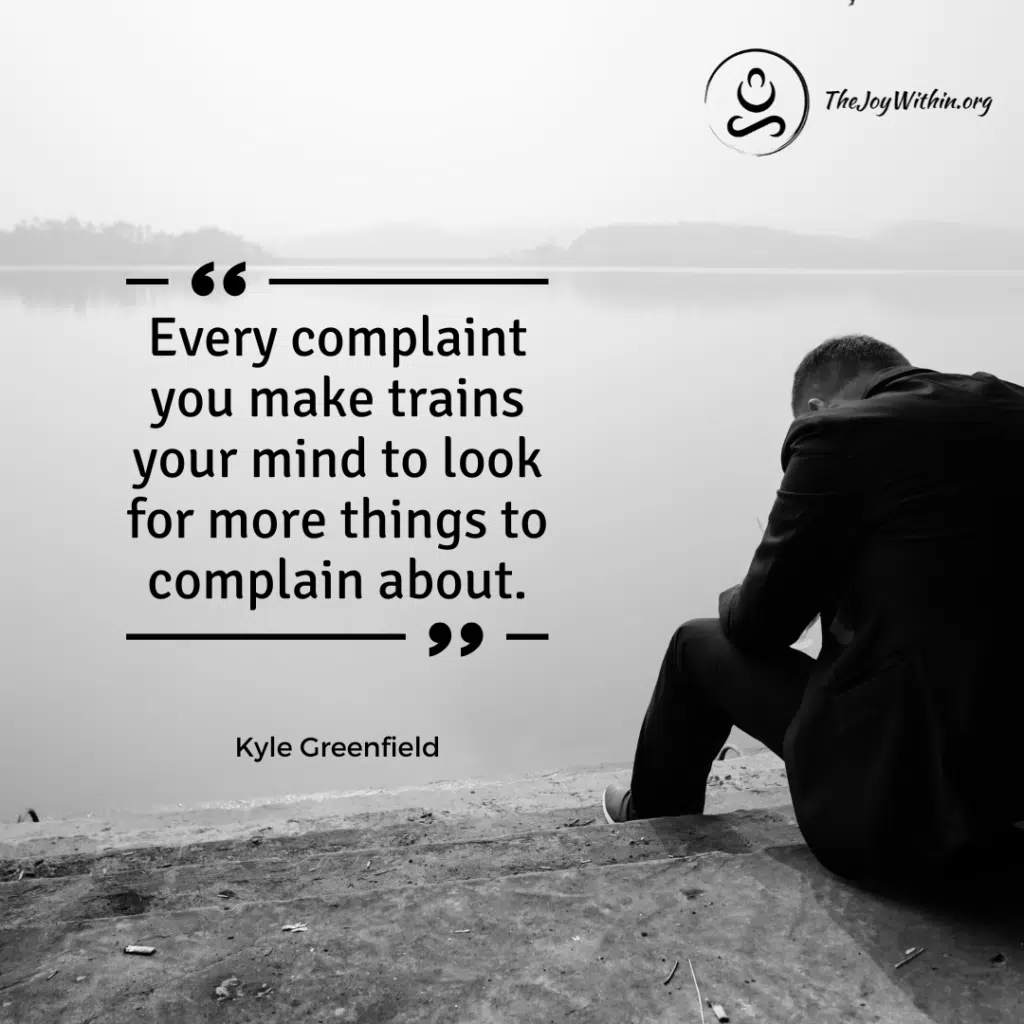
Complaining is bad for us. It actually rewires the brain into thinking our complaints are current reality. Whatever has riled us up in the recent (or not so recent) past stirs up cortisol excretion (a stress hormone). Then as we process our complaint with a sympathetic listener, we actually then get a hit of dopamine. This positive effect of complaining is the pathway to habit. In fact, the brain will default to complaining in the future, rather than positive problem-solving or exercising gratitude for the good over the bad.

If, however, our processing a complicated or stressful situation helps us to get to a positive solution, the brain responds accordingly. This should be much more satisfying than habitual complaining which is personally depressing as well as depressing to others. There are rewards in complaining if it engenders sympathy maybe or gets us out of responsibilities, but those “rewards” turn into negatives when complaining becomes habitual and drives people away. This is not to say complaining should be silenced. We need to process hard things. The problem with complaining is when it becomes the end-goal.

The Psychological Harm of Complaining – Bence Nanay Ph.D.

It is quite sobering actually to consider all that’s written these days (see below) about the neurological changes that can come from repetitive behaviors, such as complaining. Fortunately, reversing this is possible.

High Focus Centers are treatment programs across multiple US states. Their focus is out-patient care for substance abuse and psychiatric disorders/issues. The following is a substantive excerpt from their article on the addictive nature of complaining, its physiological and relational harm, and the benefit of shifting complaining to a healthier mindset in 5 steps. 5 steps! Worth the read and your consideration, if you struggle with complaining or love someone who does.

“The purpose of the complaint often isn’t to fix anything…It’s about drawing attention—maybe to feel seen, validated or pitied. Over time, this loop of discomfort → complaint → attention can become addictive, providing a false sense of control, significance or identity…Victim mentality is a pattern of thinking where a person sees themselves as perpetually wronged by others or by life itself. They may believe they are ‘good’ or ‘right,’ and that any problem in their life is caused by other people who are ‘bad’ or ‘wrong.’..At its core, victim mentality keeps someone trapped in blame. It externalizes every challenge and prevents personal growth, because it shifts responsibility away from the self.”

“Just like substance use or compulsive behaviors, complaining can offer short-term relief. It may feel good to vent, to be validated or to be the center of concern. But over time, this habitual negativity can actually rewire the brain, reinforcing pessimism, resentment and passivity.

Photo Credit: ThinkLink

Here’s why complaining can feel addictive:

  • Dopamine hits: When someone receives sympathy or attention after complaining, it can activate the brain’s reward system.
  • Identity reinforcement: Constantly viewing oneself as the victim can create a strong sense of self—though unhealthy, it’s familiar and consistent.
  • Avoidance of responsibility: Complaining and blaming protect someone from having to make changes, take risks or face uncomfortable truths.
  • Social bonding: In some circles, shared complaining becomes a social glue—even though it reinforces negativity.

Unfortunately, these perceived ‘benefits’ come at a high cost: chronic stress, broken relationships, low self-esteem and an inability to build lasting inner peace.”

Is Complaining an Addiction? Understanding the Trap of Victim Mentality – High Focus Treatment Centers

Shifting from Complaining to Empowerment

“Escaping the cycle of complaining and victimhood begins with awareness. If you find yourself constantly focused on what’s wrong—without seeking solutions—it may be time to ask: What am I hoping to gain from this?

Here are some strategies to begin shifting your mindset:

  1. Notice the Pattern

Start by tracking your complaints. What triggers them? Are you seeking connection, pity or a sense of righteousness?

  1. Ask: “Can I fix this?”

If the answer is yes, take action. If the answer is no, explore acceptance. Complaining about things you can’t or won’t change is a drain on your energy.

  1. Reframe, Don’t Deny

You don’t have to pretend everything is fine. But try reframing: instead of “I hate this heat,” say, “This heat is uncomfortable—maybe I’ll get a fan or find some shade.”

  1. Practice Gratitude

Gratitude is the antidote to victimhood. Regularly recognizing what’s going well helps train your brain to seek out the positive.

  1. Get Support

If complaining and blame feel like your default mode, it may be time to explore why. Often, these patterns are rooted in trauma, insecurity or learned helplessness. Working with a therapist can help uncover those roots and replace them with healthier coping tools.

Is Complaining an Addiction? Understanding the Trap of Victim Mentality – High Focus Treatment Centers

Bottom line: Complaining is bad for you and can become habitual. It can become relational second-hand smoke, harming you and those around you. Ironically, this habit can be transformed, like any other, with great positive impact on your brain. Let’s get after it!

Monday Morning Moment – Don’t Let Complaining Rewire Your Brain – Deb Mills

Monday Morning Moment – Complaining Rewires Your Brain – How to Curb (Maybe Not Stop) Complaining – Deb Mills

How Complaining Rewires Your Brain Toward Negativity – ThinkLink – Super quick read and super helpful as well!

How Complaining Rewires Your Brain – Brain Performance

Chronic Complaining: Examining Its Relationship to Mental Health

The Truth About Complaining – Kyle Greenfield

Is Complaining Good for You? Therapists Explain [The Answer Is Surprising] – Brina Patel

Complaining and Your Brain: 4 Surprising Effects

Why Complaining is Addictive – Dr. Gloria Lee

How Negative Thinking Destroys Your Relationship – Dr. Gloria Lee

Is Complaining an Addiction? Find Out! Take the One-Day “Abstain from Complain” Challenge – Dr. Michael Ceely

Why Do I Complain So Much? Understanding the Psychology of Negativity

The Pros and Cons of Complaining – Barbara Frazier

Photo Credit: QuoteFancy

Worship Wednesday – National Day of Prayer – “If My People”

Photo Credit: The Grace Blog, Jason White

“If My people who are called by My name humble themselves, and pray and seek My face and turn from their wicked ways, then I will hear from heaven and will forgive their sin and heal their land.”2 Chronicles 7:14

On May 7, U. S. churches and Christian organizations (even some in our government and among other religions) will set aside time to observe the National Day of Prayer. We are called to put our political and ethnic differences aside and to seek God’s healing of our country.

National Day of Prayer – Prayer Guide (pdf) – The Shepherd’s Church

The verse above from 2 Chronicles is often quoted. It’s a beautiful promise, conditioned on the response of the people of Israel in ancient times. Does it apply today to believers in America?

Below find commentary by two theologians answering this question. Their answers surprised me a bit, the fact being I am NOT a theologian. However, as you read their answers, remember that God speaks to all of us through all of His Word. As He led His people then, He leads His people now. He calls us to humble ourselves, to pray, to seek Him, and to repent from our evil doing. We can’t rest on our political leanings; we can’t trust in human guardians of our nation’s well-being (over the Sovereign keeping of God Himself); we can’t carry hatred or pride in our hearts without thought of the consequences. We who follow Christ aim to submit to His ways and His word on all things…with His help.

“In context, 2 Chronicles 7:14 is a promise to ancient Israel (and perhaps even modern-day Israel) that, if they will repent and return to the Lord, He will rescue them. However, many Christians in the United States have taken this verse as a rallying cry for America. (Perhaps Christians in other countries have done so as well.) In this interpretation, Christians are the people who are called by God’s name. If Christians will humble themselves, pray, seek God’s face, and repent, then God will heal their land—often a moral and political healing is in view as well as economic healing. The question is whether or not this is a proper interpretation/application.

The United States does not have the same covenant relationship with God that ancient Israel enjoyed. The covenant with Israel was unique and exclusive. The terms that applied to Israel simply did not apply to any other nation, and it is improper for these terms to be co-opted and applied to a different nation. When 2 Chronicles 7:14 is applied to Christians in the U.S. or any other modern nation, it is usually with the understanding that the Christians in that nation—the true believers in Jesus Christ who have been born again by the Spirit of God—will comprise the righteous remnant. God never promised that if a righteous remnant repents and prays for their nation, that the nation will be saved. Perhaps if national repentance occurred, then God would spare a modern nation as He spared Nineveh at the preaching of Jonah (see Jonah 3)—but that is a different issue.

Having said that, it is never wrong to confess our sins and pray—in fact, it is our duty as believers to continuously confess and forsake our sins so that they will not hinder us (Hebrews 12:1) and to pray for our nation and those in authority (1 Timothy 2:1–2). It may be that God in His grace will bless our nation as a result—but there is no guarantee of national deliverance. Even if God did use our efforts to bring about national repentance and revival, there is no guarantee that the nation would be politically or economically saved. As believers, we are guaranteed personal salvation in Christ (Romans 8:1), and we are also guaranteed that God will use us to accomplish His purposes, whatever they may be. It is our duty as believers to live holy lives, seek God, pray, and share the gospel knowing that all who believe will be saved, but the Bible does not guarantee the political, cultural, or economic salvation of our nation.” – Got Questions

Worship with me. We have God’s Word and His wisdom leading us into repentance, for our good and His glory. If God chooses, He may heal our land, but most importantly, for us, is our joyful and hopeful submission to His rule and reign in our lives. Still…this beautiful Imperials rendition of 2 Chronicles 7:14 is a call to prayer and repentance for us Christ followers, no matter the outcome. [I’ve loved this song for many years and still get goosebumps, singing along with the Imperials. Enjoy.]

If My people
Which are called by My name
Shall humble themselves
Shall humble themselves and pray
If My people
Which are called by My name
Shall seek My face
And turn from their wicked ways

Then will I hear from heaven
Then will I hear and will forgive
Forgive their sin

If My people
Which are called by My name
Shall humble themselves
Shall humble themselves and pray
I will forgive their sin
And heal their land

If My people
Which are called by My name
Shall humble themselves
Shall humble themselves and pray*

“If there was ever anyone who had humbled themselves, prayed, sought the Lord, and turned from their wicked ways, it was the disciples and the early church.  But did they receive healing for their land? No, they received persecution.  They were threatened, and some were even thrown in jail for their faith.  Eventually most were even scattered from their land (Acts 8:1-3).

But despite all these terrible situations and circumstances in their lives, they were blessed with every spiritual blessing (Ephesians 1:3).  They had the peace and abundant life of Christ. And this is the promise for all who believe.  We don’t have to find economic and political healing in our land to enjoy God’s blessings.  Our blessings are found in a Person.

Does that mean we shouldn’t pray for our country and hope things get better?

Absolutely not!  We can love our country and be thankful we get to live here.  We can be grateful for the men and women who sacrificed their lives to protect our freedom.  We can pray for our country and hope things get better. But as we pray for our country, our ultimate hope is not that our lives get more comfortable through prosperity but that more people come to know Jesus and the abundant life that can only be found in Him.” – Jason White

*Lyrics to “If My People” – Songwriter: Jimmy Owens, as sung by The Imperials

What Is the Meaning of 2 Chronicles 7:14? – Got Questions