
Category Archives: Attending or Focus

Worship Wednesday – “How Was Your Week?” – Asking Better Questions

Photo Credit: Red Letter Challenge

We are in a culture that has lost much of its curiosity. Asking questions seems intrusive and not honoring what might be considered private. What a shame, really! It moves us to give the appearance we don’t really want to know the person in front of us. Settling for the few word answer to questions like “How’s your week been?”

Photo Credit: Pinterest

When we do ask questions, we can move past small talk by being curious, even with strangers. Asking questions (beyond “How’s your week been?”) opens the door to the person in front of us to experience being seen…and valued. Just yesterday, I was with a friend younger than me by a lot, a mom of a toddler and newborn. This amazing young woman seems to have the gift of asking great questions. It always recharges my own curiosity because of her genuine interest in people – which clearly included me yesterday morning. I felt seen and better known. And valued.

Pastor Cliff’s sermon this week focused on asking better questions. He drew on John 4 – Jesus speaking to the woman at the well. Depending on the translation, he didn’t ask many questions in this conversation, but he did draw her out and invited reflection. He lingered in conversation with a woman who had known the terrible judgment of others, but she experienced welcome from him. At the end of their talk that day, she ran back to the village, a women who felt known and not judged, influencing many others to experience what she had.

The woman left her water jar, went back into the town, and said to the people, “Come, see a man who told me everything I ever did. Could this be the Christ?” So they left the town and made their way toward Jesus.

[This clip from The Chosen, Season 1, Episode 8 is a depiction of the conversation Jesus had with the Samaritan woman – not all from Scripture but reflective of His character and His impact on her life.]

12 Critical Questions Jesus Asked – Lisa Loraine Baker

Top 10 Questions from Jesus in the Bible – I. Gordon

Jesus and the Samaritan Woman: A Transformative Encounter at the Well

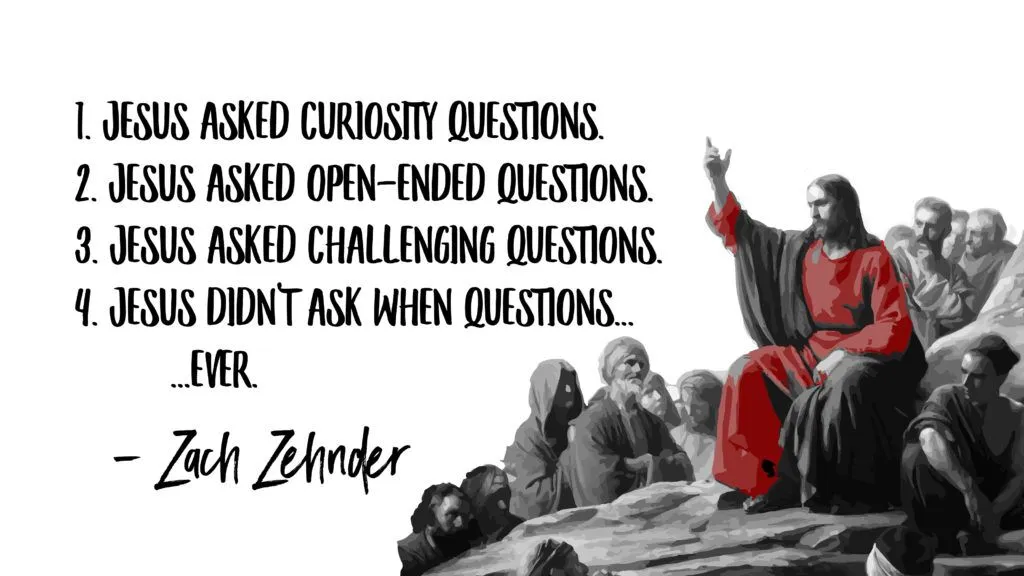
The 305 Questions Jesus Asked with One Shocking Discovery – Zach Zehnder

The Art of Asking Better Questions – Pursuing Stronger Relationships, Healthier leadership, and Deeper Faith – J. R. Briggs – an excerpt

Chuck Olson compiled the following quotes from Briggs’ book. We are called to care for those on the fringes. To help them know they are seen and known and loved by God, through us as His people:

“We live in a world that has conditioned us toward answers. We’ve been taught to give the right answers, yet little attention has been given to teaching us how to ask the right questions. We don’t have a shortage of information; we have a shortage of wisdom, curiosity, and wonder. Asking good questions is a lost art.”

In our world, which elevates accomplishing tasks over deepening relationships, it makes sense that questions aren’t held in high esteem. We value pragmatism, individualism, and efficiency. Certainly, there are times we need to tell to be helpful. But if we’re honest with ourselves, sometimes we just want to win an argument or gain control of a situation, conversation, or person. Other times we want to portray our intelligence. Telling is often much more efficient, and our brains like certainty.

“[Asking questions] is perceived as inefficient and unhelpful. Questions are often seen as unproductive. In our fast-paced, efficient, productivity-oriented world, it feels as though someone has slammed on the brakes of progress when they ask a question. We favor task accomplishment over relational depth. Leaders often feel the need to act decisively and quickly and can become anxious about the perceived inefficiencies that questions might bring.”

“What, then, is required of us if we want to ask great questions? There are four core essentials: curiosity, wisdom, humility, and courage.”

“I’m convinced: there has never been a time in modern history when genuine, thoughtful, caring questions are needed more. In a world saturated not only by ever-increasing loneliness but also by division, polarization, and fragmentation, genuine question-asking can provide healing and connection like almost nothing else.”

“French social activist Simone Weil wrote, “Attention is the rarest and purest form of generosity.””

“Trust is built on thick bonds of relationship, and great questions build trust. I live by the strong conviction that leaders should be the most curious people on the planet. If we want information, we can Google it. But if what we’re after is clarity and connection, we need questions. Our world isn’t in need of more leaders who are smarter, more eloquent, and more efficient; instead, we need more leaders who are wiser, humbler, and more curious…The late leadership and organizational expert Peter Drucker said, “The leader of the past may have been the person who knew how to tell, but certainly the leader of the future will be the person who knows how to ask.””

“Dallas Willard was fond of saying that one of the most revelatory questions regarding the state of our souls is to ask, What’s bothering me? When I’m agitated or angsty or impatient or irritable or downright angry, which happens much more often than I’d like to admit, I’ve learned to take a step back and ask, What’s going on here? Why am I bothered right now? What do I need to pay attention to currently?”

If you want to ask better questions, you have to begin with genuine interest in others. Curiosity is fundamentally at the center of questions. If we don’t possess genuine curiosity, these practices won’t matter all that much in the long run. But even a genuine interest in others is still not enough. We need specific and intentional practices rooted in our everyday lives. Call them what you want—practices, habits, exercises, spiritual disciplines, action steps—but we grow when we live out specific actions in an embodied form, because training takes us further than just trying.”

________________________________________________________________________________

As you pause with me on Worship Wednesday, we can praise the Lord who knows everything there is to know about us and loves us still. We can also learn from Him that asking questions leads to our knowing others better and their reflecting on answers maybe unknown to themselves, until asked. Asked by another who shows genuine interest and care…like Jesus.

Photo Credit: Justin Buzzard, QuoteFancy

100 Questions Jesus Asked – Josh Hunt

Can You Hear Me Now? – Dallas & Nancy Demmitt

25 Questions Jesus Asked (That Most Christians Never Do) – Mark Goering

30 Questions That Build Stronger Bonds Than ‘How Are You?’ – Wendy Rose Gould

This clip just for fun:

Monday Morning Moment – The Addictive Nature of Complaining and Breaking the Cycle

Photo Credit: The Joy Within, Kyle Greenfield

Could I be complaining about complaining? Not at all. Having already written about it twice before (and not counting my pieces on negative thinking), why revisit it?

Here’s why.

Complaining is bad for us. It actually rewires the brain into thinking our complaints are current reality. Whatever has riled us up in the recent (or not so recent) past stirs up cortisol excretion (a stress hormone). Then as we process our complaint with a sympathetic listener, we actually then get a hit of dopamine. This positive effect of complaining is the pathway to habit. In fact, the brain will default to complaining in the future, rather than positive problem-solving or exercising gratitude for the good over the bad.

If, however, our processing a complicated or stressful situation helps us to get to a positive solution, the brain responds accordingly. This should be much more satisfying than habitual complaining which is personally depressing as well as depressing to others. There are rewards in complaining if it engenders sympathy maybe or gets us out of responsibilities, but those “rewards” turn into negatives when complaining becomes habitual and drives people away. This is not to say complaining should be silenced. We need to process hard things. The problem with complaining is when it becomes the end-goal.

The Psychological Harm of Complaining – Bence Nanay Ph.D.

It is quite sobering actually to consider all that’s written these days (see below) about the neurological changes that can come from repetitive behaviors, such as complaining. Fortunately, reversing this is possible.

High Focus Centers are treatment programs across multiple US states. Their focus is out-patient care for substance abuse and psychiatric disorders/issues. The following is a substantive excerpt from their article on the addictive nature of complaining, its physiological and relational harm, and the benefit of shifting complaining to a healthier mindset in 5 steps. 5 steps! Worth the read and your consideration, if you struggle with complaining or love someone who does.

“The purpose of the complaint often isn’t to fix anything…It’s about drawing attention—maybe to feel seen, validated or pitied. Over time, this loop of discomfort → complaint → attention can become addictive, providing a false sense of control, significance or identity…Victim mentality is a pattern of thinking where a person sees themselves as perpetually wronged by others or by life itself. They may believe they are ‘good’ or ‘right,’ and that any problem in their life is caused by other people who are ‘bad’ or ‘wrong.’..At its core, victim mentality keeps someone trapped in blame. It externalizes every challenge and prevents personal growth, because it shifts responsibility away from the self.”

“Just like substance use or compulsive behaviors, complaining can offer short-term relief. It may feel good to vent, to be validated or to be the center of concern. But over time, this habitual negativity can actually rewire the brain, reinforcing pessimism, resentment and passivity.

Photo Credit: ThinkLink

Here’s why complaining can feel addictive:

  • Dopamine hits: When someone receives sympathy or attention after complaining, it can activate the brain’s reward system.
  • Identity reinforcement: Constantly viewing oneself as the victim can create a strong sense of self—though unhealthy, it’s familiar and consistent.
  • Avoidance of responsibility: Complaining and blaming protect someone from having to make changes, take risks or face uncomfortable truths.
  • Social bonding: In some circles, shared complaining becomes a social glue—even though it reinforces negativity.

Unfortunately, these perceived ‘benefits’ come at a high cost: chronic stress, broken relationships, low self-esteem and an inability to build lasting inner peace.”

Is Complaining an Addiction? Understanding the Trap of Victim Mentality – High Focus Treatment Centers

Shifting from Complaining to Empowerment

“Escaping the cycle of complaining and victimhood begins with awareness. If you find yourself constantly focused on what’s wrong—without seeking solutions—it may be time to ask: What am I hoping to gain from this?

Here are some strategies to begin shifting your mindset:

  1. Notice the Pattern

Start by tracking your complaints. What triggers them? Are you seeking connection, pity or a sense of righteousness?

  1. Ask: “Can I fix this?”

If the answer is yes, take action. If the answer is no, explore acceptance. Complaining about things you can’t or won’t change is a drain on your energy.

  1. Reframe, Don’t Deny

You don’t have to pretend everything is fine. But try reframing: instead of “I hate this heat,” say, “This heat is uncomfortable—maybe I’ll get a fan or find some shade.”

  1. Practice Gratitude

Gratitude is the antidote to victimhood. Regularly recognizing what’s going well helps train your brain to seek out the positive.

  1. Get Support

If complaining and blame feel like your default mode, it may be time to explore why. Often, these patterns are rooted in trauma, insecurity or learned helplessness. Working with a therapist can help uncover those roots and replace them with healthier coping tools.

Is Complaining an Addiction? Understanding the Trap of Victim Mentality – High Focus Treatment Centers

Bottom line: Complaining is bad for you and can become habitual. It can become relational second-hand smoke, harming you and those around you. Ironically, this habit can be transformed, like any other, with great positive impact on your brain. Let’s get after it!

Monday Morning Moment – Don’t Let Complaining Rewire Your Brain – Deb Mills

Monday Morning Moment – Complaining Rewires Your Brain – How to Curb (Maybe Not Stop) Complaining – Deb Mills

How Complaining Rewires Your Brain Toward Negativity – ThinkLink – Super quick read and super helpful as well!

How Complaining Rewires Your Brain – Brain Performance

Chronic Complaining: Examining Its Relationship to Mental Health

The Truth About Complaining – Kyle Greenfield

Is Complaining Good for You? Therapists Explain [The Answer Is Surprising] – Brina Patel

Complaining and Your Brain: 4 Surprising Effects

Why Complaining is Addictive – Dr. Gloria Lee

How Negative Thinking Destroys Your Relationship – Dr. Gloria Lee

Is Complaining an Addiction? Find Out! Take the One-Day “Abstain from Complain” Challenge – Dr. Michael Ceely

Why Do I Complain So Much? Understanding the Psychology of Negativity

The Pros and Cons of Complaining – Barbara Frazier

Photo Credit: QuoteFancy

Worship Wednesday – National Day of Prayer – “If My People”

Photo Credit: The Grace Blog, Jason White

“If My people who are called by My name humble themselves, and pray and seek My face and turn from their wicked ways, then I will hear from heaven and will forgive their sin and heal their land.”2 Chronicles 7:14

On May 7, U. S. churches and Christian organizations (even some in our government and among other religions) will set aside time to observe the National Day of Prayer. We are called to put our political and ethnic differences aside and to seek God’s healing of our country.

National Day of Prayer – Prayer Guide (pdf) – The Shepherd’s Church

The verse above from 2 Chronicles is often quoted. It’s a beautiful promise, conditioned on the response of the people of Israel in ancient times. Does it apply today to believers in America?

Below find commentary by two theologians answering this question. Their answers surprised me a bit, the fact being I am NOT a theologian. However, as you read their answers, remember that God speaks to all of us through all of His Word. As He led His people then, He leads His people now. He calls us to humble ourselves, to pray, to seek Him, and to repent from our evil doing. We can’t rest on our political leanings; we can’t trust in human guardians of our nation’s well-being (over the Sovereign keeping of God Himself); we can’t carry hatred or pride in our hearts without thought of the consequences. We who follow Christ aim to submit to His ways and His word on all things…with His help.

“In context, 2 Chronicles 7:14 is a promise to ancient Israel (and perhaps even modern-day Israel) that, if they will repent and return to the Lord, He will rescue them. However, many Christians in the United States have taken this verse as a rallying cry for America. (Perhaps Christians in other countries have done so as well.) In this interpretation, Christians are the people who are called by God’s name. If Christians will humble themselves, pray, seek God’s face, and repent, then God will heal their land—often a moral and political healing is in view as well as economic healing. The question is whether or not this is a proper interpretation/application.

The United States does not have the same covenant relationship with God that ancient Israel enjoyed. The covenant with Israel was unique and exclusive. The terms that applied to Israel simply did not apply to any other nation, and it is improper for these terms to be co-opted and applied to a different nation. When 2 Chronicles 7:14 is applied to Christians in the U.S. or any other modern nation, it is usually with the understanding that the Christians in that nation—the true believers in Jesus Christ who have been born again by the Spirit of God—will comprise the righteous remnant. God never promised that if a righteous remnant repents and prays for their nation, that the nation will be saved. Perhaps if national repentance occurred, then God would spare a modern nation as He spared Nineveh at the preaching of Jonah (see Jonah 3)—but that is a different issue.

Having said that, it is never wrong to confess our sins and pray—in fact, it is our duty as believers to continuously confess and forsake our sins so that they will not hinder us (Hebrews 12:1) and to pray for our nation and those in authority (1 Timothy 2:1–2). It may be that God in His grace will bless our nation as a result—but there is no guarantee of national deliverance. Even if God did use our efforts to bring about national repentance and revival, there is no guarantee that the nation would be politically or economically saved. As believers, we are guaranteed personal salvation in Christ (Romans 8:1), and we are also guaranteed that God will use us to accomplish His purposes, whatever they may be. It is our duty as believers to live holy lives, seek God, pray, and share the gospel knowing that all who believe will be saved, but the Bible does not guarantee the political, cultural, or economic salvation of our nation.” – Got Questions

Worship with me. We have God’s Word and His wisdom leading us into repentance, for our good and His glory. If God chooses, He may heal our land, but most importantly, for us, is our joyful and hopeful submission to His rule and reign in our lives. Still…this beautiful Imperials rendition of 2 Chronicles 7:14 is a call to prayer and repentance for us Christ followers, no matter the outcome. [I’ve loved this song for many years and still get goosebumps, singing along with the Imperials. Enjoy.]

If My people
Which are called by My name
Shall humble themselves
Shall humble themselves and pray
If My people
Which are called by My name
Shall seek My face
And turn from their wicked ways

Then will I hear from heaven
Then will I hear and will forgive
Forgive their sin

If My people
Which are called by My name
Shall humble themselves
Shall humble themselves and pray
I will forgive their sin
And heal their land

If My people
Which are called by My name
Shall humble themselves
Shall humble themselves and pray*

“If there was ever anyone who had humbled themselves, prayed, sought the Lord, and turned from their wicked ways, it was the disciples and the early church.  But did they receive healing for their land? No, they received persecution.  They were threatened, and some were even thrown in jail for their faith.  Eventually most were even scattered from their land (Acts 8:1-3).

But despite all these terrible situations and circumstances in their lives, they were blessed with every spiritual blessing (Ephesians 1:3).  They had the peace and abundant life of Christ. And this is the promise for all who believe.  We don’t have to find economic and political healing in our land to enjoy God’s blessings.  Our blessings are found in a Person.

Does that mean we shouldn’t pray for our country and hope things get better?

Absolutely not!  We can love our country and be thankful we get to live here.  We can be grateful for the men and women who sacrificed their lives to protect our freedom.  We can pray for our country and hope things get better. But as we pray for our country, our ultimate hope is not that our lives get more comfortable through prosperity but that more people come to know Jesus and the abundant life that can only be found in Him.” – Jason White

*Lyrics to “If My People” – Songwriter: Jimmy Owens, as sung by The Imperials

What Is the Meaning of 2 Chronicles 7:14? – Got Questions

Jesus and Holy Week – Day 7 – Black Saturday – the Silent Tomb

http://debmillswriter.com/wp-content/uploads/2015/04/Blog-Holy-Week-Black-Saturday.jpg

Photo Credit: Catholiclane.com – Garden Tomb, Jerusalem

[Adapted from the Archives]

This is the morning of exhausted grief. Jesus, the Messiah, God’s Sent One; His Only Son lay dead in a tomb. Dead. How is this possible?

The disciples, his family, those followers whose lives were completely transformed must have been numb with the stark reality that he was not with them…not on that Saturday. What would they do without him? What would happen to them? What? What?…Why?

There is only one scriptural reference to this day and it related to the threat of Jesus’ power and influence, even in death:

The next day, that is, after the day of Preparation, the chief priests and the Pharisees gathered before Pilate and said, “Sir, we remember how that impostor said, while he was still alive, ‘After three days I will rise.’ Therefore order the tomb to be made secure until the third day, lest his disciples go and steal him away and tell the people, ‘He has risen from the dead,’ and the last fraud will be worse than the first.” Pilate said to them, “You have a guard of soldiers. Go, make it as secure as you can.” So they went and made the tomb secure by sealing the stone and setting a guard. – Matthew 27:62-66

For the Jews, days begin and end at sundown. Most probably this visit with Pilate occurred Friday night. At his command, guards were placed. The tomb was sealed. Jesus would be no more trouble…or so they thought, in their ignorance.

He is dead: this man from Nazareth, the Messiah of Israel, the Lord of the world.

With His dying breaths, He spoke words of forgiveness, finality, and faith.

But now the breathing has ceased, and the lungs that exhaled forgiveness are deflated. My Jesus – dead.* – Trevin Wax

Read the rest of his poem here.

[Inserting here a talk done on Good Friday by a friend of ours – her topic was “What does the cross change?” – fitting for today – then after her talk, I will close on Black Saturday.]

“What does the cross change?

“Everything” is perhaps our knee jerk reaction. The cross changes everything. But that can’t be right when we worship an unchanging God. God did not change at the cross. He was perfectly just before the cross and remains perfectly just today and will be perfectly just forever. He was perfectly loving before the cross, he remains perfectly loving, and he will be perfectly loving forever. He was sovereign, is sovereign, and will be sovereign forever. God did not change at the cross. 

I think to see what changed we have to go back much earlier than Jesus’ lifetime. We have to go back to Eden. God created a perfect garden with a man and a woman and plants and animals. It was an oasis, idyllic, peaceful. And by peaceful I don’t mean free from worry or stress. I mean the hearts of Adam and Eve were at peace with God. It’s hard to imagine that. Hard to imagine no shame, fear, uncertainty. Hard to imagine walking and talking with God, completely vulnerable, knowing you were free from any sort of culpability. Adam and Eve were at peace with God, each other, and themselves.

Then they went to war with God. And each of us makes that same decision, to go to war with God, to sin against him and against our nature as image-bearers. We do not choose peace or freedom, we choose war and shame, darkness and loneliness. When I say war I mean we declare that there must be bloodshed. There must be death. Sin is a declaration that we will not live as God intended. God intended perfect peace. He intended that we all walk with Him, unashamed, in the light. We sin and we disrupt that plan. We may not desire the outcome of that sin, which is death, but the outcome is unavoidable.

So Adam and Eve sinned and that perfect peace was shattered and the cross became inevitable. As we read through the Old Testament, the cross feels like it’s in every story. We see God using men and women to foreshadow what is to come, the perfect prophet, priest, judge, shepherd, and king. We read the Old Testament and we see all the plans God set in motion to reach the cross. What we see also is imperfection. Imperfect prophets, judges, shepherds, and kings. Imperfect sacrifices leading to imperfect relationships. God is with His people but they cannot be at peace with him like they were in the Garden. 

So, does the cross take us backward, to Eden? No. There’s no going back to Eden. That’s not the plan. 

The cross is the culmination of the battle that started in Eden. We declared war in the garden and Jesus Christ declared victory at the cross. Oh death, where is your sting? We can ask that because the battle is over. Jesus Christ conquered death and we who believe have the promise of eternal life, starting today.

It’s strange though. It doesn’t feel over. I don’t feel at peace. Not with God, or others, or myself. It feels like the battle is very much ongoing and it often feels like I’m losing. So, what has the cross really changed?

I’m reminded of my favorite passage in the Bible, which is where Jesus is walking on water and Peter calls out to Him and Jesus says come. It’s an amazing story in so many ways but I’m always struck by the fact that Peter sinks and, it seems, is going to drown. Even with Jesus standing right there, standing on water exhibiting power over nature, declaring he is God, Peter is sinking under the waves. Jesus saves him, of course. But I imagine Peter, while grateful, was a bit unnerved by the sinking part. I’m reminded of this story because the reality of this Earth is that, while God is sovereign and He has won the battle over death, we do not live in Eden. We do not live in the new heaven and new Earth. We are waiting for Jesus Christ to return and while we wait, we will struggle. We’ll perhaps almost drown as we try to walk with God. But because of the cross, we will walk as freely as Adam and Eve walked with God. Death no longer has a hold on us.

So, we have victory over death because of the cross, which is our hope for the future. But what do we cling to in this daily battle? What else does the cross give us today?

I’d like to talk about just one thing. 

When God looked at His Son, He was pleased. It’s such an amazing thought. That God looked from heaven at a man and was pleased. Picture it. Jesus is a man on Earth and God looks at him and addresses him and says He is pleased with him. That’s what the cross changes for us. When God looks at you who believe, He does not see your sin, He sees Christ’s holiness. He sees you, an individual He created in your mother’s womb whom He has loved from the beginning of time. But instead of your sin, He sees Christ’s holiness. And He says, this is my daughter, in whom I am well pleased. This is my son, in whom I am well pleased. Imagine it. The sight of you pleases God. The cross means that we no longer have a broken and distorted relationship with God because we, unlike any person living before the cross, are holy in God’s eyes. No matter how putrid our sin is, no matter how many times we have declared war with God. For those who believe and repent, we can walk in the light, free from the burden of our sin. Like Adam and Eve, we walk with God in peace. Like Jesus, God looks at us and is pleased. I pray you can feel that today. Feel that God knows you, knows your name and your face and sees you and is as pleased to see you as He is to see His own Son. Not because you’re obedient or you are bursting with the fruit of the spirit. To believe that your good deeds can make up for putting Jesus Christ on the cross with your sin is folly. Our sin led to the death of God’s one and only begotten Son. We cannot make up for that with our good behavior. To try and do so is to deny Christ’s sacrifice. 

The cross takes that burden away and replaces it with freedom. We are free to walk in peace with God and to know and feel that God is pleased with us because of the cross.

So what does the cross change? Us.”Amanda, Good Friday reading, Sideris Church

We have the great knowledge of the risen Christ, but his followers, on that Saturday, only had dim recollection of his words of promise. Shrouded in grief, they found themselves quite “in between” – in between the death of their Savior and the life of his glorious promises.

Another dear friend of ours, Beth, shared this message by John Ortberg from a conference where he spoke on Black Saturday, well, “Saturdays” in general. He describes so well this day in between.

“Saturday – the day between the crucifixion and the resurrection. What do you think the disciples were doing on Saturday? Here they have seen their friend and their Master killed the day before but also have this vague promise, which probably seemed ludicrous at the time that he would rise again. Most of life is Saturday…It`s waiting in faith and hanging onto the promise that God is going to come through for us in spite of how bad things look. Most of life is Saturday. — I don`t know where you are this Holy Week. Maybe you`re in a Palm Sunday kind of mood wanting God to get on board with an agenda and maybe he will, but if he doesn’t, know that his plans are always good…Maundy Thursday means that God loves us no matter how dirty our uniform gets from the game of life. Maybe you`re in a Saturday kind of place – between a hard time and a promise you only half believe. Know this for sure that God`s Easter irony is still at work, and he can use even the worst tragedies for good, and he always has at least one more move left. No matter how bleak and dark Saturday gets, Sunday`s coming, and it`s coming sooner than you think. “John Ortberg

http://debmillswriter.com/wp-content/uploads/2015/04/Blog-Garden-Tomb-from-imb.org-Holy-Week-Black-Saturday.jpgPhoto Credit: IMB Resources

Saturday is the “in between day”. Did those who loved Jesus most remember this? Was their grief so consuming, so deafening to His promises, so numbing there was no room for hope? We have the great experience of knowing, for sure, that Sunday is coming!

Today is the waiting day.

We wait like schoolchildren for the final bell.

We wait with tapping foot, huffing breath, rolling eyes.

We wait like a mother for the gushing of birth water.

We wait like branches holding pink petaled secrets.

We wait with tears of frustration or eyes filled with anger.

We wait with tears of joy or eyes wide with wonder.

In the waiting rooms of life, our hope is mixed, our longings more so. But still, we wait. Forgive us for our impatience, Lord. We believe, help our unbelief.

We carry the sorrow of loss even as we hold on to hope of gain. We watch and we wait for your resurrection life. Even though we may not see the evidence, we wait with hope.

Because today is the waiting day.  Emily P. Freeman

The Day Jesus Stayed Dead – Waiting in the Heartache of Holy Saturday – Gerrit Scott Dawson, Desiring God

YouTube Video of John Ortberg on “Saturdays” – American Association of Christian Counselors Conference, October 2011 – So good!!! (starting 5 minutes in)

*My Jesus – Dead by Trevin Wax

On This Holy Saturday: Here at the End of All Things (Triduum Series) – Tea with Tolkien

YouTube Video – Jesus Paid It All (lyric video) – Fernando Ortega

YouTube Video – How Deep the Father’s Love For Us written by Stuart Townend – with David Wesley

YouTube Video with lyrics – In Christ Alone  written by Stuart Townend & Keith Getty

Jesus and Holy Week – Day 6 – Good Friday – His Trial, Crucifixion, & Burial – “It’s Friday, but Sunday’s Coming”

http://debmillswriter.com/wp-content/uploads/2015/04/Blog-Holy-Week-Good-Friday.jpg
Photo Credit: GoodFridayQuotes2015.com

[Adapted from the Archives]

It was a day like no other day in history.

For years we lived in countries where Christianity was a minority religion. While the few of us, in those days, passed this week in reflection and wonder, it was, of course, just another week for most of our friends and neighbors. Easter had its name – Eid Al-Qiyama (“Feast of Resurrection”) – but, for so many, Good Friday was shrouded in the ordinary. However, for Jesus, and all who have experienced life through his teaching and example, this day was and is wholly extraordinary.

Good Friday – good for us, hard for Jesus. The events of his trial, crucifixion, death, and burial are all recorded with great detail in the four Gospels. They are riveting accounts of this terrible and triumphant day – Matthew 26:57-27:61, Mark 15Luke 22:66-23:56, John 18:28-19:42.

Jesus had no opportunity to sleep in the hours of night before this dawn. From the garden where he prayed, he was forcibly taken into the custody of the high priests. Through the early morning hours, he was bounced brutally between the Sanhedrin, the high court of Israel, and the Roman authorities (Pilate and Herod Antipas). While in their custody, Jesus endured hostile interrogation, false accusations, trumped-up charges, relentless attempts at public humiliation, and repeated beatings. Yet, he somehow retained his full faculties, responding to the authorities, when necessary, with great wisdom and understanding of both the proceedings and the people.

In the midst of all this trauma, he even made eye contact with one of his dearest friends and followers, Peter, hiding himself nearby…in his own painful moment.

The outcome of all the wrangling between the Jewish and Roman officials was an unwarranted, undeserved death sentence. Execution by crucifixion. Pilate even washed his hands of the matter, literally, declaring Jesus innocent but still consenting to the death sentence. He didn’t know then but the “blood” he tried to wash of his hands was truly innocent. Still, it wasn’t Pilate who put Jesus on that cross, nor was it Caiaphas, head of the Sanhedrin. Not a Roman, nor a Jew.

Jesus’ death, that day, was an outworking of a divine plan. We cannot begin to understand the holiness of the Father, the sinless resolve of the Son, or the steadfastness of the Spirit. This three-in-one God orchestrated a path forward for us, His fallen and broken people, to be restored to Him.

That we, though wrecked by sin, can be whole again and one in Him, in that unity of Father, Son, Holy Spirit (John 17:21) is a miracle of grace.

Jesus gave his life for us that day. It was not taken from him. He laid it down. For us. Though completely undeserving, we are ransomed and redeemed. At such a great cost. This Jesus. This life. This cross.

It Was My Sin That Held Him There – Greg Morse

Jesus spoke seven times during the three hours he hung on that cross.  Each time he spoke, as in all the other times his words are recorded, there was something for all of us. If you don’t know what he said, in those seven brief cries from the cross, read them and discover more about him…and about us.

Just before he died, he cried out, “It. Is. Finished.” What? What was finished? His life…oh no…not at all…that story comes later. His work? Not completely…for he continues interceding for us (Romans 8:34). What was finished? The perfect sacrifice – the lamb without spot or blemish – his life for ours. “The Lamb of God who takes away the sin of the world” (John 1:29). Hallelujah!

‘Finished’ – What the Son Cried as He Died – Scott Hubbard – Desiring God

Photo Credit: Wikimedia

There is so much more to say about this day and the people present. Pilate’s wife who warned Pilate about ruling against this innocent man. Judas Iscariot, Jesus’ betrayer, who tried to return the money and killed himself in remorse that same day. Simon of Cyrene, a pilgrim, who was drawn into the dreadful drama of that day to carry Jesus’ cross when he could not. Barabbas, a notorious criminal, who gained his freedom, through a strange twist of the day. The nameless thief on the cross who cried out in repentance to Jesus. The Roman centurion who in his witness of Jesus all those hours professed faith in him.  John, Jesus’ closest disciple, and Jesus’ mother Mary to whom Jesus gave each other. The women, lives changed by their faith in Jesus, who stayed at the foot of the cross through all the horror of his crucifixion. Nicodemus, a Pharisee and a Christ-follower, who tried to appeal for Jesus with the Sanhedrin. Joseph of Arimathea, another believing Pharisee, who went to Pilate to receive Jesus’ body for burial, to place in his own tomb.

So many stories of lives changed. Good Friday. This marked the day of Jesus’ trial, his death, and his burial, but it does not mark the end of the story. It’s Friday…but Sunday’s coming.*

http://debmillswriter.com/wp-content/uploads/2015/04/Good-Friday-from-popgodblog.jpg

Photo Credit: popgodblog.com

[In the links below are several beautiful songs of worship. Tributes to the Lord on this day. Don’t miss the articles and the great sermon “It’s Friday But Sunday’s a Coming” by Rev. S. M. Lockridge*.]

*YouTube Video – It’s Friday but Sunday’s a Coming – S. M. Lockridge

YouTube Video – Passion Song – The Story of Holy Week (Lyric Video) by @scartermusic – powerful.

The Final Days of Jesus – Andreas J. Kostenberger & Justin Taylor

The Way of Jesus #3: Unless a Seed – James Nored

The Way of Jesus #4: Who Do I Say Jesus Is? – James Nored & Phil Ware

It Wasn’t Nails that Held Him to the Cross – Blog by Michele Perry

Good Friday – Bible Study

Good Friday – the God Who Bleeds and Dies – Scott Sauls

YouTube Video – “The Man on the Middle Cross Said I Could Come” – Alistair Begg

Spotify Playlist for Holy Week – Beth Wayland

YouTube Video – Sunday’s Coming – Phil Wickham

YouTube Video – It is Finished – Matt Papa

YouTube Video – Forever – Kari Jobe

YouTube Video with Lyrics – The Wonderful Cross by Chris Tomlin & Keith Getty

YouTube Video with lyrics – The Power of the Cross – Kristyn Getty

YouTube Video with lyrics – Lead Me to the Cross – Hillsong

YouTube Video – Skit Guys – Good Friday

Photo Credit: We Love the Bible, Pinterest

Jesus and Holy Week – Day 4 – Wednesday – Quiet Before the Storm…and We Worship

Photo Credit: God Like Fire Ministries

[Adapted from the Archives]

After these things I looked, and behold, a great multitude which no one could count, from every nation and all tribes and peoples and tongues, standing before the throne and before the Lamb, clothed in white robes, and palm branches were in their hands; and they cry out with a loud voice, saying, “Salvation to our God who sits on the throne, and to the Lamb.” And all the angels…fell on their faces before the throne and worshiped God.Revelation 7:9-11

Worthy is the Lamb that was slain to receive power and riches and wisdom and might and honor and glory and blessing.”  – Revelation 5:12

There appears to be nothing recorded in Scripture of events surrounding Jesus on the Wednesday before his crucifixion. Nothing. After two difficult days dealing with his enemies and accusers, it is quite possible that he took a rest. A Sabbath rest. Given the terrible nature of what was ahead of him, starting just the next day, he could surely use a day to rest and reflect. To remember how the Father had sustained him through all the strains of his public life. To refresh himself in prayer and in the company of those on earth who loved him most – his disciples, his friends, possibly his family. We know no details of that day.

Silent Wednesday.

Since we also know what is coming for Jesus…and all for our sakes…we pause today, as well, to worship. He is the perfect lamb, without blemish, perfectly fit to be offered as a sacrifice for our sins. God provided a ram for Abraham to take his son’s place in that strange and amazing sacrifice on Mt. Moriah (Genesis 22:1-14). This was a foreshadowing of our own need for a Savior. We also can be saved by the blood of “the Lamb, who takes away the sin of the world” (John 1:29).

Photo Credit – Baptist Press

Jesus’ life was not taken from him on that Friday, two days hence. His life was not taken. Not by the Jewish or Roman authorities. He gave his life…for us…there are no words adequate to respond…worship is all we have.

Photo Credit – Baptist Press

Worship with me:

Worthy is the Lamb who was slain
Holy, Holy, is He
Sing a new song to Him who sits on
Heaven’s Mercy Seat
[Repeat 2x]

(Chorus)
Holy, Holy, Holy
Is the Lord God Almighty
Who was, and is, and is to come
With all creation I sing:
Praise to the King of Kings!
You are my everything,
And I will adore You…!
Yeah!

Clothed in rainbows, of living color
Flashes of lightning, rolls of thunder
Blessing and honor, strength and
Glory and power be
To You the Only Wise King,
Yeah

(Chorus)

Filled with wonder,
Awestruck wonder
At the mention of Your Name
Jesus, Your Name is Power
Breath, and Living Water
Such a marvelous mystery
Yeah…

(Chorus)

Holy, Holy, Holy
Is the Lord God Almighty
Who was, and is, and is to come,
With all creation I sing:
Praise to the King of Kings!
You are my everything,
And – I – will – adore YOU…

(Chorus)

(Repeat a cappella)

Come up lift up His Name
To the King of Kings…
We will adore YOU Lord…
King of heaven and earth
King Jesus, King Jesus
Aleluya, aleluya, aleluya!
Majesty, awestruck Honor
And Power and Strength and Dominion
To You Lord,
To the King, to King
To the King of Glory

Chorus (Repeats)*

[Read the blog above in its entirety here.]

*Lyrics to Revelation Song written by Jennie Lee Riddle

Story Behind Revelation Song – Jennie Lee Riddle’s vision of the Church wholly united in worship of God – here as we will be one day in Heaven

How is Jesus the Lamb of God?

YouTube Video – Is He Worthy (feat. Chandler Moore & Nate Moore) – Maverick City/TRIBL

Spotify Playlist From Palm Sunday to the Resurrection – Beth Wayland

How is Jesus the Lamb of God?

Holy Week Timeline Graphic

YouTube Video – Is He Worthy (feat. Chandler Moore & Nate Moore) – Maverick City/TRIBL

The Final Days of Jesus – Andreas J. Kostenberger & Justin Taylor

Jesus and Holy Week – Day 2 – Monday – Jesus Curses a Fig Tree and Turns Over Tables

Photo Credit: Fig Tree by Bob Orchard

[Adapted from the Archives]

On the next day, when they had left Bethany, He became hungry. Seeing at a distance a fig tree in leaf, He went to see if perhaps He would find anything on it; and when He came to it, He found nothing but leaves, for it was not the season for figs. He said to it, “May no one ever eat fruit from you again!”Mark 11:12-14

When Jesus woke on Monday morning, after that glorious Sunday entering Jerusalem…I wonder what he thought. Did he know that, in just four days, he would be crucified? Whew…

Back to Monday:

During that week in Jerusalem, Jesus and his disciples spent the nights with friends in Bethany, two miles outside of the city. Each morning, they would walk into Jerusalem. On that Monday morning, just four days prior to his crucifixion, Jesus became hungry on the walk in. Seeing a leafy fig tree, he looked for fruit. With fig trees, where there are leaves, there should be figs. Since green figs are edible, and it wasn’t yet harvest season, there should still be some fruit on the tree.

When he found no figs, Jesus cursed the tree. This seems out of character for Jesus, until his action is put in the context of his culture and community. Throughout his public ministry, especially as he became more known and revered, the Jewish religious leaders held him in contempt.

Jesus’ teaching of our dependence on God’s righteousness and not our own flew in the face of the Pharisaical teaching of the day – that of strict adherence to Jewish law as the only hope of finding favor with God. For Jesus, the leafy barren fig tree must have been a picture of religious Jews of that day, all flash and finery but no fruit of faith.

“Christ’s single miracle of Destruction, the withering of the fig-tree, has proved troublesome to some people, but I think its significance is plain enough. The miracle is an acted parable, a symbol of God’s sentence on all that is ‘fruitless’ and specially, no doubt, on the official Judaism of that age. That is its moral significance.”C. S. Lewis

Jesus was left still physically hungry. He remained spiritually hungry  as well – for this people of the Book to receive the good news that the Messiah had come.

Finally, arriving back in Jerusalem, Jesus was deeply troubled by what he found inside the Temple. The crowds of Passover pilgrims did not disturb him, but temple grounds turned marketplace did. In this sanctified place, meant only for worship, there were money-changers and sellers of animals for sacrifice, right in the Court of the Gentiles – in the only place where non-Jewish God-believers could worship.

Photo Credit: ScreenRant, from the TV show The Chosen

Jesus entered the temple and drove out all those who were buying and selling in the temple, and overturned the tables of the money changers and the seats of those who were selling doves. And He said to them, “It is written, ‘MY HOUSE SHALL BE CALLED A HOUSE OF PRAYER’; but you are making it a ROBBERS’ DEN.”Matthew 21:12-13

Photo Credit:Expulsion of the Moneychangers from the Temple” by Luca Giordano

Often in film depictions of Jesus cleansing the temple, he appears a crazed individual, flailing about, throwing tables and flinging pigeons into the air. I can’t even imagine him that way. We can’t know how it happened except that in Jesus’ anger, he did not sin. He would not sin. I know the Jesus Film is just another director’s film rendering, but in this scene, Jesus showed considerable restraint. Disturbed at the buying and selling that actually kept believing Gentiles from worshiping, he moved to correct the situation. He was unafraid of the temple officials, burning with zeal for his Father to be truly worshiped in that place.

Zeal for Your house has consumed me, And the reproaches of those who reproach You have fallen on me.Psalm 69:9

Later in the week, he himself would be the one for sale –  sold for 30 pieces of silver, betrayed by one of his own disciples, to satisfy the wrath of the religious leaders. That story is for another day.

This Holy Monday, we are drawn again to this Messiah who teaches us that the way we live our lives matters but not more than the way we relate to God. He makes space for us…room for all of us to receive Him. He is holy, and in His righteousness, we stand…on solid ground.

The Final Days of Jesus – Andreas J. Kostenberger & Justin Taylor

YouTube Video with Lyrics of In Christ Alone by Stuart Townend & Keith Getty

Reasoning Why Jesus Cursed the Fig Tree

Monday of Holy Week

Why Did Jesus Get Angry in the Temple – Understanding Righteous Indignation

Cleansing the Court of the Gentiles

Jesus Film Media – website & app to watch videos

Worship Wednesday – Christ Be Magnified – Cody Carnes

Photo Credit: Derek Charles Johnson

For you shall go out in joy 
and be led forth in peace;
the mountains and the hills before you
shall break forth into singing,
and all the trees of the field shall clap their hands.Isaiah 55:12

And some of the Pharisees in the crowd said to him, “Teacher, rebuke Your disciples.”  He answered, “I tell you, if these were silent, the very stones would cry out.”  Luke 19:39-40

To the King of the ages, immortal, invisible, the only God, be honor and glory forever and ever. Amen. 1 Timothy 1:17

Therefore, since we are receiving an unshakable kingdom, let us be filled with gratitude, and so worship God acceptably with reverence and awe. Hebrews 12:28

The old hymns of my childhood are among my favorite worship songs. Too many to list here. It’s rare to hear them these days which makes me a bit sad. We sing them at home, and that is a comfort. Then during my children’s growing up years, we enjoyed a resurgence of hymns – more modern melodies but with rich theology – In Christ Alone and Be Thou My Vision are two of those our whole family still knows the lyrics by heart.

One such worship song, released in 2020, is becoming a new favorite. Christ Be Magnified. The music is easy to engage, and the lyrics are deep and convicting. Written by songwriters who clearly know Christ, love to worship the Lord, and are strongly motivated to bring others along with them in worship.

“Christ Be Magnified” written by Ethan Gregory Hulse, Cody Carnes, and Cory Asbury

This year, three international holidays overlapped yesterday and today – the Lunar New Year, Ramadan, and Lent. This is highly unusual. It is a reminder for all of us of the many, diverse peoples around the world. I have friends celebrating all three holidays. I love and respect them, but the only one I can really celebrate is Lent, a fast that marks a countdown to Easter (the celebration of the resurrection of Christ).

One dear, dear friend of mine years ago asked me why couldn’t I join her faith. I loved her heart that day and still do. We talked about many things in answer to her question, but the bottom line was Jesus. I could not leave Jesus. No way. In fact, even on my darkest days when God seems silent…there is nowhere else for me to go. I remain, knowing He is there (even in silence), because He promised He would be.

Winter is fading where we live, and the first flowering plants have pushed through the soil. As Scripture reminds us, all of nature points to the Creator, even in this broken world. Christ is to be magnified…and we add our human voices.

Worship with me.

[Verse 1]
Were creation suddenly articulate
With a thousand tongues to lift one cry
Then from north to south and east to west
We’d hear ‘Christ be magnified!’

[Verse 2]
Were the whole earth echoing His eminence
His name would burst from sea and sky
From rivers to the mountain tops
We’d hear ‘Christ be magnified!’

[Chorus]
O! Christ be magnified!
Let His praise arise
Christ be magnified in me
O! Christ be magnified!
From the altar of my life
Christ be magnified in me

[Verse 3]
When every creature finds its inmost melody
And every human heart its native cry
O then in one enraptured hymn of praise
We’ll sing ‘Christ be magnified!’
O be lifted high, Jesus

[Chorus]
O! Christ be magnified!
Let His praise arise
Christ be magnified in me
O! Christ be magnified!
From the altar of my life
Christ be magnified in me

[Bridge]

I won’t bow to idols, I’ll stand strong and worship You
And if it puts me in the fire, I’ll rejoice ’cause You’re there too
I won’t be formed by feelings, I hold fast to what is true
If the cross brings transformation then I’ll be crucified with You
‘Cause death is just the doorway into resurrection life
And if I join You in Your suffering then I’ll join You when You rise
And when You return in glory with all the angels and the saints
My heart will still be singing and my song will be the same

[Chorus]
O! Christ be magnified!
Let His praise arise
Christ be magnified in me
O! Christ be magnified!
From the altar of my life
Christ be magnified in me.*

Singer/songwriter Derek Charles Johnson writes beautifully about this worship song, and I’d like to close with his thoughts:

“It’s the song’s bridge that takes it up another notch.  Really this is the part that broke me and the part in which, when first singing it, I had to do a gut check.  Because the verses are not easy Christianity.  They don’t reflect a soft, watered-down Gospel.  It’s an all-or-nothing faith and in that faith, I’m choosing each day to walk a narrow road that Jesus calls me to.  Read these lyrics again:  

I won’t bow to idols, I’ll stand strong and worship You
And if it puts me in the fire, I’ll rejoice ’cause You’re there too
I won’t be formed by feelings, I’ll hold fast to what is true
If the cross brings transformation I’ll be crucified with You
‘Cause death is just a doorway into resurrection life
If I join You in Your sufferings, then I’ll join You when You rise
And when You return in glory with all the angels and the saints
My heart will still be singing, my song will be the same

In the bridge is the response to “Christ be magnified in me” and really the “how” of what that looks like.  I won’t bow down to the culture.  If that means rejection, so be it.  I won’t trust my feelings.  They are fleeting and change day by day.  I’ll crucify my life and my flesh so I am conformed into Jesus’ image.  And here’s the really tough part but the part we cannot ignore (especially as the tide is shifting against Christians):  I’ll willingly lay down my life because death brings me into eternity with Him.  I’ll suffer for His name.  I’ll be ready for His return.  At the end of it all, I’ll still be singing Christ be magnified!Hallelujah! 

For to me to live is Christ, and to die is gain. Philippians 1:21Derek Charles Johnson

[Postscript: Posting late. Thursday evening, I was at church in a women’s Bible study. We were talking about how important it is to turn off distractions and to learn to be silent before the Lord. Listening, waiting, adoring. Just beyond where we met, the worship team was practicing their set for this coming Sunday. They were singing/playing “Christ Be Magnified” and “Abide” (see below) in the sanctuary. Sweetly “breaking into” our discussion. We, this small group of women, sat in a circle pondering the beautiful Savior we have in Christ Jesus…calling us to Himself…to abide in Him…and we worshiped. Oh that we would magnify Him…taking in the expansive nature of His character, His power, His love.

*Lyrics to “Christ Be Magnified” – Songwriters: Ethan Gregory Hulse, Cody Carnes, Cory Asbury

More Than a Song – Christ Be Magnified by Cody Carnes – Derek Charles Johnson

Is “Christ Be Glorified” Biblical? – The Berean Test – Vince Wright

God is so good to us. He deserves our worship in every stage and situation of our lives. [I loved how “The Blessing” below was a great comfort to us all world-wide during the COVID epidemic.]

Worship Wednesday – The Jesus Way – Phil Wickham

Photo Credit: Heartlight

Jesus answered, “I am the way and the truth and the life. No one comes to the Father except through Me.” – John 14:6

“For My thoughts are not your thoughts, neither are your ways My ways,” declares the Lord. “As the heavens are higher than the earth, so are My ways higher than your ways and My thoughts than your thoughts.” Isaiah 55:8-9

Let this mind be in you which was also in Christ Jesus: Who, existing in the form of God, did not consider equality with God something to be grasped, but emptied Himself, taking the form of a servant, being made in human likeness. And being found in appearance as a man, He humbled Himself and became obedient to death—even death on a cross. Philippians 2:5-8

“But the fruit of the Spirit is love, joy, peace, forbearance, kindness, goodness, faithfulness, gentleness and self-control. Against such things there is no law.” Galatians 5:22-23

I will always be grateful for Bernie Cantrell. She loved me enough to tell me the truth.

In my 20s, I had fallen in love with a fellow college student, and we dated into his medical school years. Much of it long-distance and all of it out of God’s will for my life. I had allowed myself to be deceived that him being Jewish and me being Christian melded together two of God’s chosen people. Great spiritualizing, right? His mother wouldn’t think so nor did mine. Not sure about his mom, but mine prayed.

Late in our relationship, I remember vividly a night at my women’s discipleship group, all of us sitting on the floor with our Bibles open, in Bernie Cantrell’s living room. They knew about my relationship with this young man. They knew also that my heart was sincere toward the Lord as well. This is what deception can do…you can be fixed on the way of the Jesus but your eyes can blur from misplaced desires, and, before you know it, you find yourself in a ditch.

I don’t remember if we were in John 14 that night, or if it became a kairos moment when Bernie felt the time was right to talk openly and directly to me about my relationship with this young man. She pointed me to the verse:

Jesus answered, “I am the way and the truth and the life. No one comes to the Father except through Me.” – John 14:6

That night, as she discipled me (all of us) on Jesus being the Way and only in walking in His way will we find Home, the Holy Spirit grabbed my heart. Shortly after that, both this boy and I mutually severed our relationship. Done deal. Full stop. No looking back.

Now there have been other times in life, when I was tempted to choose my way instead of God’s way for me. Seasons when life was hard and I even questioned my salvation (that season was the one of parenting small children – physically exhausting and emotionally overwhelming at times). There were hard seasons when entitlement raised his ugly head and when offenses made me blind with hurt and anger that God’s Word seemed too far out of reach…or beyond my sense of fairness. Misplaced desires.

These days (in our country and occasionally seeping into our church life), we are bombarded by the push and pull of political ideology, cultural swagger, family estrangement, and the sense that God is far away.

Truth: God is NOT far away. We have been drawn off course, but He is as near as a Shepherd’s voice. He is just ahead. His way can be ours again.

I am so thankful for the truth of Scripture. So thankful for friends and family who point me back to Christ when I get distracted or discouraged. So thankful for opportunities when the Lord allows for me to point sweet ones to the way of Jesus.

God tells us that His way is different (higher) than the one we, in our sinful bent, would naturally take. However, when we surrender our lives to Jesus as Lord and Savior, we don’t have to be bound to another way anymore. Through the power of the Holy Spirit, we can walk in His way. We bear the fruits of the Spirit in this world…on this path. What an amazing life we have, reflecting the humility, mercy, and love that Jesus displayed. How much it profits those around us! How much it pleases God the Father! Sometimes it’s me as “the least of these”…staying on the way of Jesus benefits me the most. No more twisted in the wind of Satan’s lies about me and about others.

The King will answer them, “Truly, I say to you, as you did it to one of the least of these my brothers or sisters, you did it to me.”Matthew 25:40

This past Sunday, on an icy day from his office, Pastor Cliff preached on loving our enemies from Matthew 5:43-48. So good! In the worship play list for that morning, our worship leader Ryan included the Phil Wickham song The Jesus Way.

This song has replayed in my mind all week. Jesus’ way is not the way of this world. It is so beautiful and so worth our lives to point in this direction. To walk in His way daily “tapping into a reservoir that is not of this world but for this world” (from Cliff’s message). For our sakes, our neighbors, our children and grandchildren, and our enemies.

Photo Credit: Heartlight

Worship with me.

[Verse 1]
If you curse me, then I will bless you
If you hurt me, I will forgive
And if you hate me, then I will love you
I choose the Jesus way
Oh, ooh-ooh-ooh-ooh

[Verse 2]
If you’re helpless, I will defend you (Ooh-ooh-ooh-ooh)
If you’re burdened, I’ll share the weight (Ooh-ooh-ooh-ooh)
And if you’re hopeless, then let me show you (Ooh-ooh-ooh-ooh)
There’s hope in the Jesus way

[Chorus]
I follow Jesus, I follow Jesus
He wore my sin, I’ll gladly wear His name
He is the treasure, He is the answer
Oh, I choose the Jesus way

[Verse 3]
If you strike me, I will embrace you
And if you chain me, I’ll sing His praise
And if you kill me, my home is Heaven
For I choose the Jesus way

[Chorus]
I follow Jesus, I follow Jesus
He wore my sin, I’ll gladly wear His name
He is the treasure, He is the answer
Oh, I choose the Jesus way

[Bridge]
And I choose surrender, I choose to love
Oh God, my Savior, You’ll always be enough
I choose forgiveness, I choose grace
I choose to worship, no matter what I face
I choose the Jesus way, I choose the Jesus way

[Chorus]
I follow Jesus, I follow Jesus
He wore my sin, I’ll gladly wear His name
He is the treasure, He is the answer
Oh, I choose the Jesus way
I follow Jesus, I follow Jesus
He wore my sin, I’ll gladly wear His name
He is the treasure, He is the answer
Oh, I choose the Jesus way

[Outro]
Ooh-ooh-ooh-ooh*

“Now to Him who is able to do immeasurably more than all we ask or imagine, according to His power that is at work within us, to Him be the glory in the church and in Christ Jesus throughout all generations, forever and ever. Amen.” Ephesians 3:20-21

The Jesus Way – Lyrics – Songwriters: Phil Wickham & Jonathan Smith

Faith Behind the Song: “The Jesus Way” – Phil Wickham – by Scott Savage

Practicing the Way – Course & Free Resources on Spiritual Formation

Worship Wednesday – For Christ-Followers – It’s Surrender – Not Self-Improvement – Deb Mills

Worship Wednesday – First Things First – With Consumed by Fire – Deb Mills

Monday Moment Morning – How Can We Keep From Hating?

Photo Credit: Heartlight

This weekend, we in the State of Virginia had our governor’s inauguration. It was another occasion of either relief and elation or concern and consternation. Our state and nation remains polarized in so many ways.

Can we disagree politically, philosophically, or ideologically…without hating each other?

We are in a season of hating or aligning with whole people groups. Maybe, in all of history, we have such seasons. A season where, if we aren’t careful, we hate a whole group of people or we love that same group, thereby putting us in grave opposition to the “haters”. At least, the news and social media platforms are telling us this is the case.

Whole people groups – be they Somalis, Afghans, Republicans, Democrats, Jews, Evangelical Christians. Whole people groups.

How can we keep from hating?

Maybe an even more core question: do we even want to keep from hating? What do we think is gained by hating another or a group of others?

Oddly, hating people can feel good. We feel justified in hating. Even morally superior. The dilemma here is that hating begets hating. Neuroplasticity is the process in our brain where negative thoughts, and resulting actions, become hard-wired, having a negative impact on our physical and mental health over time.

The Neuroscience of Hate: Why It Feels Good to Be Angry

The Power of Hate and Its Consequences – Andrew Mathews

I don’t want to simplify or downplay the reasons one might have to hate, but the devastating effects of it in our culture, community, families (and in our own brains) are worth taking a step back and considering.

Briefly, here are some actions to consider:

  1. Call to mind the possibility that I hate someone/some peoples. “Check your heart” is a common refrain in my life. If I’m honest, are there persons/people whose actions, or personalities, offend me? Do my speech and attitude betray my hatred? Does this hatred feel justified? If so, do I give myself a pass for feeling such a strong negative emotion?
  2. Consider what is below the surface of my hatred. Do I consider what I feel to be righteous anger? Is it righteous if it moves me toward hatred? In defending the rights of one group of people against another, am I committing the same injustice toward “the offending group” as I see being directed to the one I care more about? Or is fear what stirs me to hate? Or unfairness? We can have any number of reasons to hate. Addressing those reasons (with help, if necessary), brings our hatred more into the light. It doesn’t mean that we don’t seek change in the culture, but with greater care, compassion, and even empathy.
  3. Seek understanding by leaning in to persons whose groups we are tempted to hate. Real, flesh-and-blood, face-to-face conversations can soften our tendency to hate. Asking questions, listening with care, resisting the temptation to argue, leaving the door open for understanding. This is a huge step toward stopping the hate. For those who pray, beginning to pray for that person can grease the tracks for you to love them – pray for her/his needs to be met, for protection and peace, for paths forward that don’t further divide us.

Photo Credit: QuoteFancy, Margaret Walker

8 Ideas for Managing Hatred – Michael Karson, Ph.D., J.D. – Psychology Today

4. Recognize that hating what is evil is different than hating people. Hatred dehumanizes people. Remember the persons with whom we disagree have children, parents, jobs, their own hopes, fears and strivings – just like us. They may even have a faith similar to ours…but the issue has overcome us/them and has pushed itself into paramount position. Extinguishing civility. We may actually agree on a wrong, if we acknowledge that we’re all trying to sort out the right path forward.

Photo Credit: Heartlight

5. For those of us who are believers, we have no leave to hate. For Christians, we are called by Christ Jesus to love even our enemies (Matthew 5:44). When hating becomes a habit, especially of a particular people group, we lose our way. Thinking it is almost our duty to hate. We have to guard against self-deceit.

Photo Credit: Heartlight

Peter D. Kaufman, brilliant and highly successful businessman, gives wise counsel in this for all of us: “Go positive and go first, and be constant in doing it.” Determine to love, resist hating, don’t wait for the other person, and in every conversation and encounter, be constant in this effort.

The Multi-disciplinary Approach to Thinking – Peter Kaufman

Young businessman, world-changer Mitchell Wilson recalls Kaufman’s use of the phrase mirrored reciprocation. How this applies is when we engage others with love, listening as we seek understanding, being gentle where we disagree, we often get the same responses in return.

Wilson writes: “Peter doesn’t go into this in his speech [above], but I can’t help but think of Jesus’s core teachings that relate to the principle of mirrored reciprocation:

  • Love your neighbor as yourself
  • Do unto others as you would have them do unto you
  • Forgive those who trespass against you
  • Blessed are the merciful, for they shall receive mercy
  • Turn the other cheek”

Mirrored Reciprocation: Peter Kaufman’s Profoundly Simple Insight That Helps You Achieve An Enjoyable Life | Blog

6. Don’t give up on developing the habit of loving instead of hating. This is definitely a spiritual disciple and a habit worthy of pursuing. Peter Kaufman also has counsel, from his talk above The most powerful force that could be potentially harnessed is dogged incremental constant progress over a very long time frame. We are going to have to fight against hating, especially if we have allowed it to take up real estate in our minds. However, as with anything worth mastering, the work needed to keep from hating will yield its fruit…if we don’t give up.

Photo Credit: Heartlight

[This blog was inspired by recent, terrible events in our country and also by the sermon at Movement Church yesterday. Our pastor Cliff unpacked Matthew 5:38-42 (YouTube video linked; image below) about showing radical love by resisting retaliation. Can’t wait for his sermon next week on “Love your Enemies” which may end up inspiring a Part 2 on this topic. Hope you stay with me for that one.]

Photo Credit: Heartlight