
Category Archives: Forgiveness

Worship Wednesday – Loving Well, Hating Well

Photo Credit: Destiny City, Don Vess

But to those of you who will listen, I say: Love your enemies, do good to those who hate you, bless those who curse you, pray for those who mistreat you.Luke 6:27-28

Get rid of all bitterness, rage and anger, outcry and slander, along with every form of malice. Be kind and tenderhearted to one another, forgiving each other just as in Christ God forgave you.Ephesians 4:31-32

There are six things that the Lord hates, seven that are an abomination to him: haughty eyes, a lying tongue, and hands that shed innocent blood, a heart that devises wicked plans, feet that make haste to run to evil, a false witness who breathes out lies, and one who sows discord among brothers. Proverbs 6:16-19

Do not repay anyone evil for evil. Carefully consider what is right in the eyes of everybody. If it is possible on your part, live at peace with everyone. Do not avenge yourselves, beloved, but leave room for God’s wrath. For it is written: “Vengeance is Mine; I will repay, says the Lord.”Romans 12:17-19

Finally, all of you, be like-minded and sympathetic, love as brothers, be tenderhearted and humble. Do not repay evil with evil or insult with insult, but with blessing, because to this you were called so that you may inherit a blessing.1 Peter 3:8-9

The beginning of this year in the US has been marked with violence in the streets and clashes with federal agents. Social and news media posts are daily filled with critiques of one group of people vs. another one. Whole people groups. Division is high. Fingers pointed. Disdain fueled by distancing. Even Christians against Christians…sadly.

Writer, theologian Trevin Wax posted a blog this past week on something I’d never heard of before – censoriousness. It is defined as “the state of being censorious, which means having a tendency to blame, criticize, or condemn others. It often involves a habit of finding fault and reproaching others for their actions or opinions.”

How to Deal with a Censorious Spirit – Trevin Wax (really excellent read)

In John Bevere‘s book The Bait of Satan, he teaches on how to respond when we are treated unfairly. Our temptation is to react when someone berates or condemns us. We don’t feel understood. The same applies to those toward whom we express contempt. There is always more to the story. The saying “Two things can be true” is applied. Issues brewing in our country are not so simple as one side against another. The causes are multi-layered and complex. Oh for the simple to reign…and in God’s Word, He breaks down the complex. We are to pray for those in opposition to us (and vice versa). We are to be curious and seek understanding. We are not to allow the world and its evil to divide us. We are to remember that God is in control, and it is His prerogative to judge and make things right.

Photo Credit: Charles Brent, Heartlight

Clinical psychologist, leadership expert Dr. Henry Cloud’s describes how to hate well in his small and fascinating book 9 Things a Leader Must Do. He is wise and succinct on all the topics of this book but especially on hating well, and I quote him here:

“Hate is one of the most crucial ingredients of a good person’s character. What we hate says a lot about who we are, what we value, what we care about…Basically, we are defined in part by what we love and what we hate. You can tell a lot about people by what they love…[and] by what they hate…You can depend on people who…hate arrogance, lying, innocent people being hurt, harmful schemes, evil practices, telling lies about others, and things that stir up dissension among people. [the things that God hates – Proverbs 6:16-19]…The first thing that hate does for us is to help us move against certain traits and issues, thus becoming different from them…The second way hate benefits us is that it causes us to protect what we value…The third way that hate is a good thing is the flip side of protection. Hate moves us to destroy bad things, which are often the things that threaten the good. [However] Unsuccessful leaders hate in ways that solve problems as opposed to creating problems…The difference between leaders who hate well and those who hate destructively lies in the difference between two kinds of hate: subjective and objective. Subjective anger [hate] blasts other people, causes overreactions, dissensions, inability to resolve conflict, broken relationships…Make the subjective hatred objective. Transform it to the kind of hate that solves problems, protects things that you value, and stands against the things that you do not want in your life and work…[he/she] shows up with integrated character. When he brings hate, he brings love as well…and respect, kindness, and forgiveness [taking] a hard stand on a touch issue but remaining loving and kind in the process.” – Dr. Henry Cloud, 9 Things a Leader Must Do – pp. 73-83

In hating well, the focus is on unrighteous acts not on the offenders. It’s not personal. Hating well treats all people as God’s image-bearers. He says repeatedly in His Word that He will avenge, He will make right, He will repay. Because He is without sin, He alone knows just how far to go for the sake of redemption. Our own “righteous anger” moves to sin so quickly because the subjective nature of the offense catapults us to hatred, and not in a good way.

Using the name of Jesus to justify mistreatment of image bearers – Instagram post – Kendra Leeanne Kuntz

I was reminded on a zoom call earlier this week that we are one body with many members – some of us are gifted by the Holy Spirit to speak out against evil, others of us are more the encouragers and mercy-givers, still others serve both the church and those experiencing hardship in the world, and still others point us to the Scripture to make sure we believe what God says and not just what we want to believe He says…

For by the grace given me I say to every one of you: Do not think of yourself more highly than you ought, but think of yourself with sober judgment, according to the measure of faith God has give you. Just as each of us has one body with many members, and not all members have the same function, so in Christ we who are many are one body, and each member belongs to one another. Romans 12:3-5

God calls us to love well (following the example of the Godhead) and to hate well…the same. Only He is the One without sin. He alone can move our hearts to love as He loves and hate as He hates.

Photo Credit: John Stott, Heartlight

Monday Moment Morning – How Can We Keep From Hating? – Deb Mills

Monday Moment Morning – How Can We Keep From Hating?

Photo Credit: Heartlight
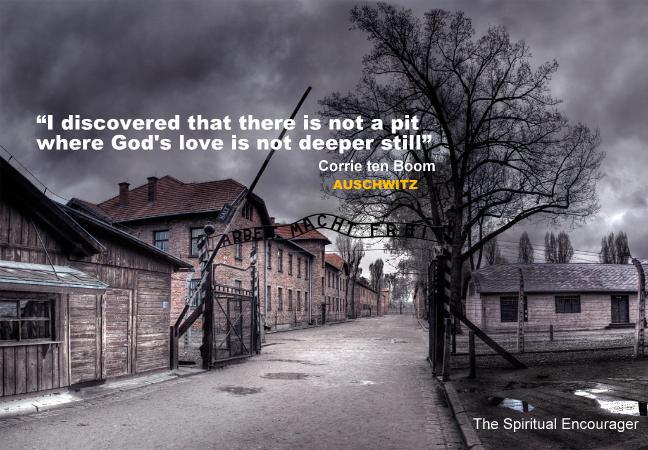
This weekend, we in the State of Virginia had our governor’s inauguration. It was another occasion of either relief and elation or concern and consternation. Our state and nation remains polarized in so many ways.

Can we disagree politically, philosophically, or ideologically…without hating each other?

We are in a season of hating or aligning with whole people groups. Maybe, in all of history, we have such seasons. A season where, if we aren’t careful, we hate a whole group of people or we love that same group, thereby putting us in grave opposition to the “haters”. At least, the news and social media platforms are telling us this is the case.

Whole people groups – be they Somalis, Afghans, Republicans, Democrats, Jews, Evangelical Christians. Whole people groups.

How can we keep from hating?

Maybe an even more core question: do we even want to keep from hating? What do we think is gained by hating another or a group of others?

Oddly, hating people can feel good. We feel justified in hating. Even morally superior. The dilemma here is that hating begets hating. Neuroplasticity is the process in our brain where negative thoughts, and resulting actions, become hard-wired, having a negative impact on our physical and mental health over time.

The Neuroscience of Hate: Why It Feels Good to Be Angry

The Power of Hate and Its Consequences – Andrew Mathews

I don’t want to simplify or downplay the reasons one might have to hate, but the devastating effects of it in our culture, community, families (and in our own brains) are worth taking a step back and considering.

Briefly, here are some actions to consider:

  1. Call to mind the possibility that I hate someone/some peoples. “Check your heart” is a common refrain in my life. If I’m honest, are there persons/people whose actions, or personalities, offend me? Do my speech and attitude betray my hatred? Does this hatred feel justified? If so, do I give myself a pass for feeling such a strong negative emotion?
  2. Consider what is below the surface of my hatred. Do I consider what I feel to be righteous anger? Is it righteous if it moves me toward hatred? In defending the rights of one group of people against another, am I committing the same injustice toward “the offending group” as I see being directed to the one I care more about? Or is fear what stirs me to hate? Or unfairness? We can have any number of reasons to hate. Addressing those reasons (with help, if necessary), brings our hatred more into the light. It doesn’t mean that we don’t seek change in the culture, but with greater care, compassion, and even empathy.
  3. Seek understanding by leaning in to persons whose groups we are tempted to hate. Real, flesh-and-blood, face-to-face conversations can soften our tendency to hate. Asking questions, listening with care, resisting the temptation to argue, leaving the door open for understanding. This is a huge step toward stopping the hate. For those who pray, beginning to pray for that person can grease the tracks for you to love them – pray for her/his needs to be met, for protection and peace, for paths forward that don’t further divide us.

Photo Credit: QuoteFancy, Margaret Walker

8 Ideas for Managing Hatred – Michael Karson, Ph.D., J.D. – Psychology Today

4. Recognize that hating what is evil is different than hating people. Hatred dehumanizes people. Remember the persons with whom we disagree have children, parents, jobs, their own hopes, fears and strivings – just like us. They may even have a faith similar to ours…but the issue has overcome us/them and has pushed itself into paramount position. Extinguishing civility. We may actually agree on a wrong, if we acknowledge that we’re all trying to sort out the right path forward.

Photo Credit: Heartlight
5. For those of us who are believers, we have no leave to hate. For Christians, we are called by Christ Jesus to love even our enemies (Matthew 5:44). When hating becomes a habit, especially of a particular people group, we lose our way. Thinking it is almost our duty to hate. We have to guard against self-deceit.

Photo Credit: Heartlight
Peter D. Kaufman, brilliant and highly successful businessman, gives wise counsel in this for all of us: “Go positive and go first, and be constant in doing it.” Determine to love, resist hating, don’t wait for the other person, and in every conversation and encounter, be constant in this effort.

The Multi-disciplinary Approach to Thinking – Peter Kaufman

Young businessman, world-changer Mitchell Wilson recalls Kaufman’s use of the phrase mirrored reciprocation. How this applies is when we engage others with love, listening as we seek understanding, being gentle where we disagree, we often get the same responses in return.

Wilson writes: “Peter doesn’t go into this in his speech [above], but I can’t help but think of Jesus’s core teachings that relate to the principle of mirrored reciprocation:

  • Love your neighbor as yourself
  • Do unto others as you would have them do unto you
  • Forgive those who trespass against you
  • Blessed are the merciful, for they shall receive mercy
  • Turn the other cheek”

Mirrored Reciprocation: Peter Kaufman’s Profoundly Simple Insight That Helps You Achieve An Enjoyable Life | Blog

6. Don’t give up on developing the habit of loving instead of hating. This is definitely a spiritual disciple and a habit worthy of pursuing. Peter Kaufman also has counsel, from his talk above The most powerful force that could be potentially harnessed is dogged incremental constant progress over a very long time frame. We are going to have to fight against hating, especially if we have allowed it to take up real estate in our minds. However, as with anything worth mastering, the work needed to keep from hating will yield its fruit…if we don’t give up.

Photo Credit: Heartlight
[This blog was inspired by recent, terrible events in our country and also by the sermon at Movement Church yesterday. Our pastor Cliff unpacked Matthew 5:38-42 (YouTube video linked; image below) about showing radical love by resisting retaliation. Can’t wait for his sermon next week on “Love your Enemies” which may end up inspiring a Part 2 on this topic. Hope you stay with me for that one.]

Photo Credit: Heartlight
Monday Morning Moment – Offense Revisited

[Adapted from the Archives – Monday Morning Moment – Offense, Being Offended, and Taking Up Offense]

Processing thoughts on the difficult subject of offending and being offended, a song drifts into my hearing from Dave’s office. He is riding his bike (on a trainer) to a playlist that matches his ride (slow/fast/slow). This particular song pounding into my head is rock band The EaglesGet Over It. [Dave will also pull that song up on the occasion he recognizes he’s having a pity party.]

I’ve had some great friends in my life who have spoken reason to me in times when something said or done to me (or to someone I cared about) offended. “Get over it!” was actually a helpful “slap” into reality for me. Reminds me of that old commercial, “Thanks! I needed that.”

The motivation for this piece is walking alongside people I love who have been deeply offended and don’t see a way to get past it. Offenses are hard, especially if they seem intentional.

We still have a choice. We can choose not to be offended…whether it felt the seeming offense was directed toward us or we are tempted to take up offense for another.

Author Desirée M. Mondesir writes a “slap to the face” piece on our culture’s move to looking for and taking up offense. It’s especially fascinating to me because she refers to a student revolt at Yale University. Having taught there years ago, I can see this gradual evolution from reason to riot. It’s a stunning change in society and we are none immune to it.

A Sign of the Last Days – Offense – Desirée M. Mondesir

Mondesir refers to this cultural shift as being a sign of end times.

“And then many will be offended, will betray one another, and will hate one another. Then many false prophets will rise up and deceive many. And because lawlessness will abound, the love of many will grow cold. But he who endures to the end shall be saved.” – JesusMatthew 24:10-13

Sure sounds like today’s culture, in the US anyway.

Writer and counselor John Bevere has written a fascinating book on offense entitled The Bait of Satan: Living Free From the Deadly Trap of Offense. The title put me off at first but in reading it, the whole issue of offense is highlighted as something that turns us inward and keeps us from healthy relationships with one another and with God. When you think about it, Eve, in the first pages of the Torah/Old Testament [Genesis 3:2-7], was the first of humankind to act in offense. In her conversation with the Serpent tempter, she reacted to the Serpent’s suggestion, questioning the instruction (and the goodness) of God. To me, it demonstrates her taking offense that she would be drawn into Satan’s ruse. Even acting in rebellion, presuming God didn’t mean good toward her. She decided for herself to eat from the tree (the one tree God had forbidden), and the consequences of her choosing continue to today.

What could Eve have done differently? She could have trusted God’s heart toward her. If she fell into doubt (through Satan’s cunning argument), she could have sought out the Creator first before she acted on a lie.

When Eve acted in this way, and took the bait, we can see how we, too, can be drawn in – becoming disoriented by someone’s words or deeds, and forgetting what is really the truth of the matter. Our emotions fly away with us, and we bind ourselves in the chains of offense.

Joe Levi puts it this way:

“Someone else cannot “offend” youhowever, you can choose whether or not to take offense at something someone says or does.

Someone else cannot make you mad, happy, sad, or offended – you, and you alone can control how you react to the world around you.

Learn and apply that one relatively simple lesson, and you’ll be much happier in life.”

We may not be able to choose our immediate emotion over a word or action perceived as against us, but we can develop a habit or discipline to determine NOT to take offense.

Currently, the news media is having a hey-day with sound-bytes and interviews hand-picked to incite offense.

We can choose not to take the bait.

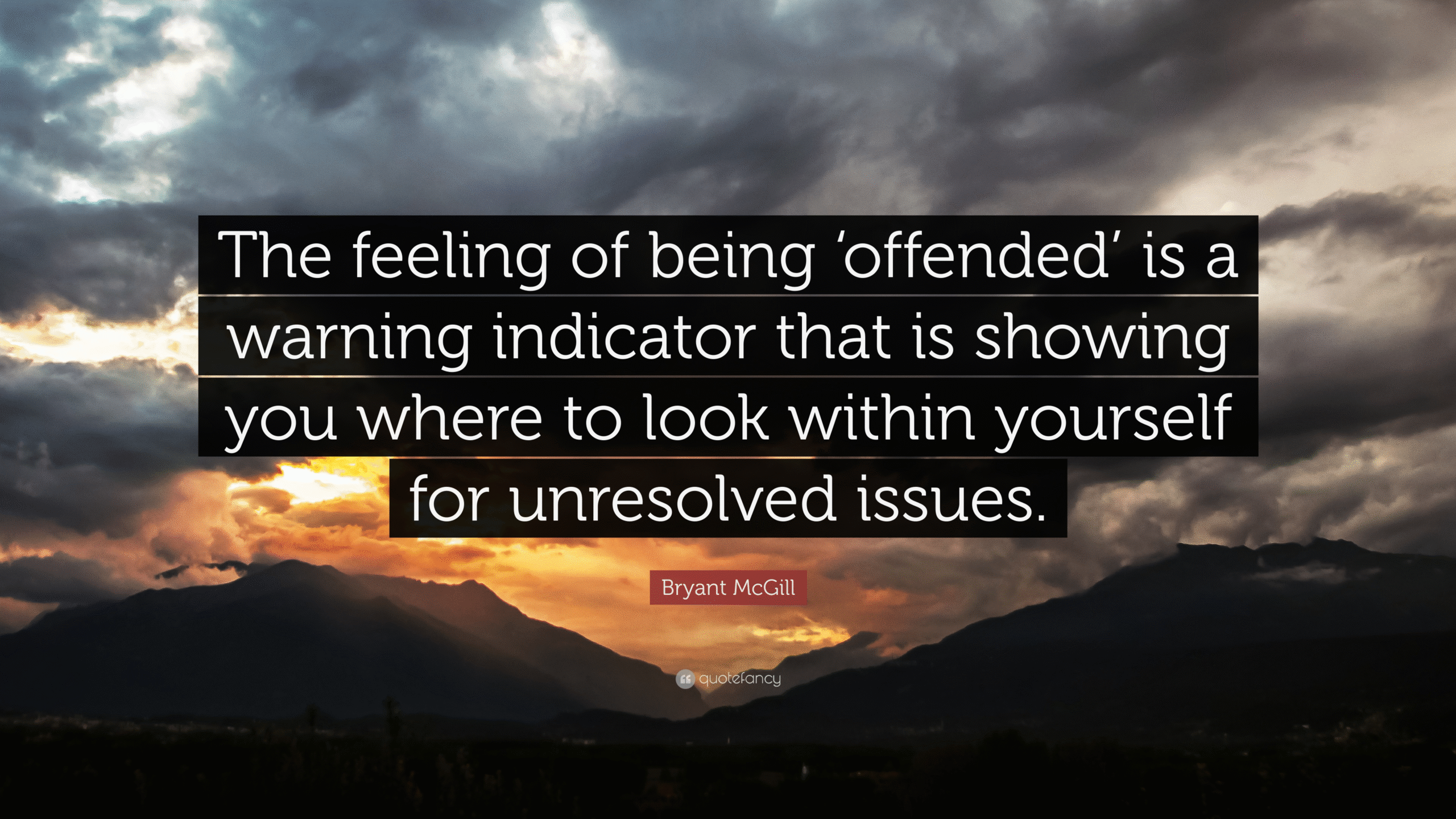
Photo Credit: Quote Fancy, Bryant Mcgill

As for personal situations, people who offend do not always mean to offend. [I don’t say this lightly. Of course, there are those who do. I also am not talking about abuse here. That is a whole other topic, but the principles still apply.] No one knows truly what’s inside us that gives us struggle, not even ourselves. Like the Mcgill quote states, it’s only in our response that we discover that which is still unresolved. Reacting in self-defense or in counter-attack mode brings more hurt. “Hurt people hurt people.” With practice, I can determine not to carry hurt away from a conversation or interaction.

In situations between two people, we can choose not to be offended, but how do we deal with the offense?

Advisor Charles H. Green describes the offender and the offended. He gives excellent counsel in his article Being Offensive vs. Being Offended – and Trust:

  • The offender communicates disrespect. A social violation occurs. Two people are involved and the resolution of that interaction requires input from both of them. When the one offended determines to engage in good faith, trying to seek understanding and rebuild trust, s/he may actually discover the intent of the offending person. A misunderstanding or an action following a perceived threat on the part of the offender may be the issue rather than an intent to hurt.
  • On the side of the one offended, this is not a social situation. It is deeply personal. Only the one offended knows the extent of the offending words/actions. For this reason, the offended person can refuse to think ill of the offender…and not take offense. Then take steps toward reconciliation or, if that’s not possible, make a personal decision not to be hurt by that person. This is not easy…especially at first in training one’s responses.
  • “The answer is a little paradoxical: We should strive not to offend or disrespect others. At the same time, we should also strive to not feel offended, or disrespected, for long. In other words, we should strive to be kind socially, and to feel free psychologically.”
  • Forgiveness opens the door wide to reconciliation. Forgiveness can defuse the hurt. Boundaries may come into play, but if the boundaries are built out of fear, dread, anger, or hatred, we are still not free from offense.

My biological father abandoned us long before my mom left him (before my sixth birthday). I saw him only twice after that. For years, I wrote him letters with no response, and then I stopped. My love for him grew cold. If he had any sense of needing forgiveness or asking for forgiveness, I don’t know. He died before I told him I forgave him. Every time this comes to mind, forgiving him is revisited. That’s a regret for me. However, I know the beautiful experience of forgiving a long-played offense from my older brother. Robert, who had deep pain of his own, struck out at others. My response for years was being offended at him or taking up an offense for other family members. It wasn’t pretty. Then, thanks to the wisdom and honesty of friends, I came to my senses on his offenses and my reactions. No more taking up an offense when Robert attacked…and the attacks died. He and I became closer than we had ever been over our lives. In fact, he gentled in his relationship with our siblings also. Those brief years (which could have been more if I had understood sooner) were great blessings (hopefully to both of us). When he died suddenly in his 60s, I carried no regrets. #Unoffendable #Forgiveness – I forgave him and he forgave me…without the words but walking out forgiveness with each other. So much grace in that.

Photo Credit: Unoffendable, Brant Hansen

Thoughts?

Being Offensive vs. Being Offended – and Trust – Charles H. Green

Unoffendable: How Just One Change Can Make All of Life Better – Brant Hansen

What Is the Difference of Being Offended and Harmed? – Robert Enright

Stop Being Offended Today: 3 Cures for Everything That Irritates You – Bill Apablasa

Forgiving in Two Dimensions – Peace Pursuit

Mel Robbins on the “The Let Them Theory” – Sarah Fielding

Photo Credit: Brant Hansen, Unoffendable, Pinterest

Worship Wednesday – Make Room – The Church Will Sing

Photo Credit: Heartlight

See to it that no one takes you captive through philosophy and empty deception, which are based on human tradition and the spiritual forces of the world rather than on Christ.…When you were dead in your trespasses and in the uncircumcision of your sinful nature, God made you alive with Christ. He forgave us all our trespasses, having canceled the debt ascribed to us in the decrees that stood against us. He took it away, nailing it to the cross! And having disarmed the powers and authorities, He made a public spectacle of them, triumphing over them by the cross.”Colossians 2:8, 13-14

“Submit yourselves, then, to God. Resist the devil, and he will flee from you. Draw near to God, and He will draw near to you.James 4:7-8

“Where your treasure is, there your heart will be also.” – Matthew 6:21

Last night, a small group of women gathered in a dimly light room in a church in Richmond. I was there. Just down the hall an Alcohol Anonymous meeting was also being held. In the quiet of that space, the Lord came close.

We had been prompted earlier in the day by the young woman who spearheaded this prayer force that we would spend part of the evening in confession and repentance. It put me to thinking on what in my life needed confessing and repented of.

We each poured our hearts out to a faithful Father, who is ever ready to forgive, restore, and empower us to walk the way of Christ. My confessions centered on the struggle with keeping my eyes on Him and trusting Him in the complications of life. I confessed a lack of love and a timidity that keeps me from sharing Christ. I also prayed against the things that stand in the way of my focusing on Him, of surrendering wholly to Him. Those idols and counterfeit gods that steal us away from being near to the Lord.

It was a tender time of prayer, talking to God and listening to these other precious women doing the same. We prayed beyond our own need for forgiveness but also for our neighbors and our nation. For the world. For those in our lives most vulnerable to Satan’s arrows in hard marriages and hospital beds.

We sang a song together as part of our gathering. This time I didn’t know the song, but it was perfect for our time together. It was Make Room by a group called The Church Will Sing. In a way it is audacious that we have to “make room” for the Creator of this world to do what He wants to do in our lives. Yet, He doesn’t push in. He is close but waits for us to open the door to our hearts for Him to come in and change everything! Hallelujah!

Photo Credit: Heartlight

Worship with me:

[Verse 1]
Here is where I lay it down
Every burden, every crown
This is my surrender
This is my surrender
Here is where I lay it down
Every lie and every doubt
This is my surrender

[Chorus]
And I will make room for You
To do whatever You want to
And I will make room for You
To do whatever You want to
To do whatever You want to, oh

[Verse 1]
Here is where I lay it down
Every burden, every crown
This is my surrender
Here is where I lay it down
Every lie and every doubt
This is my surrender

[Chorus]
And I will make room for You
To do whatever You want to
To do whatever You want to, Jesus
And I will make room for You, for You
To do whatever You want to
Oh, I will make room for You, Jesus
To do whatever You want to
Oh, I will make room for You
To do whatever You want to
To do whatever You want to, Jesus

[Spontaneous]
Have Your way, have Your way, Jesus, oh
We surrender all, we surrender all, Jesus
Have Your way, Jesus, have Your way, Jesus

[Bridge]
Shake up the ground of all my tradition
Break down the walls of all my religion
Your way is better
Oh, Your way is better
Shake up the ground of all my tradition
Break down the walls of all my religion
Your way is better, Jesus
Oh, Your way is better
Shake up the ground of all my tradition
Break down the walls of all my religion
Your way is better, Jesus
Your way is better
Shake up the ground of all my tradition
Break down the walls of all my religion
Your way is better
Oh, Your way is better

[Chorus]
And I will make room for You
To do whatever You want to
And I will make room for You
To do whatever You want to
To do whatever You want to, oh

[Verse 2]
Here is where I lay it down
You are all I’m chasing now
This is my surrender
Here is where I lay it down
You are all I’m chasing now
This is my surrender
This is my surrender*

*Lyrics to “Make Room” – Songwriters: Josh Farro, Evelyn Heideriqui, Lucas Cortazio & Rebekah White

Make Room – Behind the Lyrics – Malia Rogers

P.S. Below you will find two other songs I discovered with the titles “Make Room”. Enjoy!

Photo Credit: YouTube, Jonathan McReynolds – Make Room

YouTube Video – Jonathan McReynolds – Make Room [Lyric Video]

Make Room – Jonathan McReynolds – Daniel Ploof

Make Room – A Devo by Mark Hall From Casting Crowns

Worship Wednesday – Homecoming – Bethel Music

Photo Credit: Heartlight

Finally he came to his senses and said, ‘How many of my father’s hired servants have plenty of food? But here I am, starving to death!‘ — Luke 15:17

And he arose and came to his father. But while he was still a long way off, his father saw him and felt compassion, and ran and embraced him and kissed him. And the son said to him, ‘Father, I have sinned against heaven and before you. I am no longer worthy to be called your son.’ But the father said to his servants, ‘Bring quickly the best robe, and put it on him, and put a ring on his hand, and shoes on his feet.  And bring the fattened calf and kill it, and let us eat and celebrate.  For this my son was dead, and is alive again; he was lost, and is found.’ And they began to celebrate.Luke 15:20-24

After this I looked and saw a multitude too large to count, from every nation and tribe and people and tongue, standing before the throne and before the Lamb. They were wearing white robes and holding palm branches in their hands. And they cried out in a loud voice: “Salvation to our God, who sits on the throne, and to the Lamb!”Revelation 7:9-10

Coming home. Whatever our situation might be, hopefully that phrase has a comforting ring. In my youth and early adulthood, “coming home” felt very much like the prodigal son’s experience in the Scripture above. My parents were always welcoming and delighted in my arrival. I knew unconditional love from them which helped me understand how much the Lord loves us. Some of us don’t have that experience with our earthly parents. So painful and wrong. Generations of families where performance was demanded to receive love. Not at all what we experience in God’s Kingdom.

As we near the holidays in America, our sense of home is stirred up – in positive and sometimes negative ways. I’ve written about the sweetness of Thanksgivings past. They weren’t perfect given our own imperfections, but they gave a glimpse of the One Day when our homecoming will be something altogether other-worldly.

The first time I heard Bethel Music‘s song “Homecoming” was this past Sunday during worship at Movement Church. Unlike the video below with a huge worship band and a packed house, we were led by a 5-member praise team who still brought the house down in my heart. Not in any kind of performative sense, but in the lyrics and beauty of melody and harmony – telling the story of our welcome Home to Heaven.

None of us deserve such a homecoming. Sin has darkened our way Home. Yet, because of what Jesus did for us on the cross, He has given us the way, and we are confident in Him. Just like with the prodigal, we know our way Home, and we are headed there – a little closer each day.

What an amazing thought – to be rejoined with our dearest family who have gone before us. To be greeted by the saints of old. To look, finally, into the very eyes of Jesus – the One who gave His all so that we might become sons and daughters of the Father. Whew! Hallelujah!

We live in the present with our eyes on the future, and yet, we also plant ourselves in this season of homecoming – to show the Father’s love in both easy and complicated situations. To experience His “welcome Home” in those quiet moments of reveling in Him alone. When boundaries are required to get through the holidays, take hope that the day will come when they will no longer be necessary.

Worship with me.

Lord, I confess
That I’ve been a criminal
I’ve stolen Your breath
And sang my own song

And Lord, I confess
That I’m far from innocent
These shackles I wear
Oh, I bought on my own

These scarlet sins had a crimson cost
You nailed my debt to that old rugged cross
An empty slate, at the empty grave
Thank God that stone was rolled away

Lord, I confess
I’ve been a prodigal
Made for Your house
But I walked my own roads
Then Jesus came
He tore down my prison walls
Death came to life
When He called me by name

Scarlet sins had a crimson cost
You nailed my debt to that old rugged cross
An empty slate, at the empty grave
Thank God that stone was rolled
Scarlet sins had a crimson cost
You nailed my debt to that old rugged cross
An empty slate, at the empty grave
Thank God that stone was rolled away

And I can see it now
Smiling in Heaven, You and I, You and I

And I see bright, crimson robes draped over the ashes
A wide, open tomb where there should be a casket
The children are singing, and dancing, and laughing
The Father is welcoming
This is our homecoming
Roses in bloom pushed up from the embers
Our rivers of tears flow from good times remembered
Families are singing, and dancing, and laughing
The Father is welcoming
This is our homecoming
Heaven joins in with a glorious sound
And the great cloud of witnesses all gather ’round
‘Cause the ones that were lost are finally found
The Father is welcoming
This is our homecoming

Scarlet sins had a crimson cost
You nailed my debt to that old rugged cross
An empty slate, at the empty grave
Thank God that stone was rolled

Oh-oh, oh-oh, oh-oh-oh-oh
The Father is welcoming
This is our homecoming
Oh-oh, oh-oh, oh-oh-oh-oh
The Father is welcoming
This is our homecoming

Can you see it now?
Standing on the shores of Heaven
You and I, and our families
Singing, and dancing, and laughing
There’s truly no place like home
Yeah
Jesus, You’re so beautiful
Haha, see Him face to face

Can we sing that bridge together one last time?
“I see bright, crimson robes”

I see bright, crimson robes draped over the ashes
A wide, open tomb where there should be a casket
The children are singing, and dancing, and laughing
The Father is welcoming
This is our homecoming
Roses in bloom, they pushed up from the embers
Our rivers of tears flow from good times remembered
Families are singing, and dancing, and laughing (Let’s go)
The Father is welcoming (Come on)
This is our homecoming

And Heaven joins in with a glorious sound
And the great cloud of witnesses all gather ’round
‘Cause the ones that were lost are finally found
The Father is welcoming
This is our homecoming


Scarlet sins had a crimson cost
You nailed my debt to that old rugged cross
An empty slate, at the empty grave
Thank God that stone was rolled

Oh-oh, oh-oh, oh-oh-oh-oh
The Father is welcoming
This is our homecoming*

Photo Credit: Air1

*Lyrics to Homecoming – Songwriters: Cory Asbury, Gable Price, Brian Johnson, and Christian Ostrom

Is ‘Homecoming’ Biblical? – the Berean Test (10/10) – Vince Wright

Photo Credit: Heartlight

Monday Morning Moment – Anger, Contempt, & Forgiveness

Photo Credit: Heartlight

[Turns out I’ve written about contempt several times – if you can set aside some time – you can reference these as well.]

I have a dear friend who differs with me on much of our country’s current politics and policies. However, we continue to be close. Some intentionality in both of us must be at work. No matter who won the elections last week or who’s responsible for the latest government shut-down, whatever our thoughts are on these subjects, our friendship stands. Though our solutions to the ailments of our nation may not align, our hearts resonate with each other. Neither of us holds the other in contempt over these external issues. In fact, conversations with her always increase my understanding of these stressful situations and lead to great compassion for those in the midst of those situations.

This is not always the case in family and friendships.

Some of the postings on my social media in recent days have been riddled with anger “at the other side”, whatever that entails. These are friends in real life. Decent, caring people. However, there seems to be an imperative these days to point out the bad behaviors of others, those considered political enemies. Not just behavior but character. One side devaluing the other. Anger, maybe even righteous anger in the beginning, too often progresses to disgust, or worse contempt.

Photo Credit: Heartlight

Anger is a negative emotion that confronts an action/behavior of another (peer or peer group). Contempt takes anger to a lower, darker place. Contempt demonstrates superiority as it simultaneously dismisses and devalues the other person or group, seeing her/them as inferior. It dehumanizes.

“Anger and contempt are the twin scourges of the earth, these bitter emotions form the poisonous brew in which human existence stands suspended. Few people ever get free of them in this life, and for most of us even old age does not bring relief. To cut off the root of anger is to wither the tree of human evil.” – Dallas Willard, The Divine Conspiracy p. 151

Photo Credit: Psychology Spot

It’s slow going, but I am learning not to allow contempt to gain space in my mind and heart. Like other negative emotions, contempt doesn’t only poison relationships but it poisons the mind of the one who entertains contempt.

John Murdock writes on this subject:

“Willard argued that in the Sermon on the Mount, Jesus was not just pulling marbles from a bag, presenting individual gems of wisdom that could be considered independently. Instead, the order of the presentation mattered greatly. “It is the elimination of anger and contempt,” he asserted, “that [Jesus] presents as the first and fundamental step toward the rightness of the kingdom heart.”

Conversely, today it is the systematic elevation of anger and contempt that is often rewarded across the political spectrum.”

Then, yesterday, we had this incredible teaching on anger and forgiveness at Movement Church. Pastor Cliff powerfully preached on Matthew 5:21-24:

“You have heard that it was said to those of old, ‘You shall not murder; and whoever murders will be liable to judgment.’ But I say to you that everyone who is angry with his brother will be liable to judgment; whoever insults his brother will be liable to the council; and whoever says, ‘You fool!’ will be liable to the hell of fire. So if you are offering your gift at the altar and there remember that your brother has something against you, leave your gift there before the altar and go. First, be reconciled to your brother, and then come and offer your gift.”

Cliff talked about how God’s law has affected morality across the world – most of us get through life without murdering anyone. However, Jesus revealed how, if unchecked, our thoughts and words (be they face-to-face or written in social media) can have murderous impact.

We may think we’re doing the world a good service by pointing out the wrong thinking and actions of others. However, if we lack care for them, if we lack compassion or love, our words draw deep lines dividing us. Tall, thick impenetrable walls between us. And, God forbid, we don’t even care? I’m asking.

Jesus pointed to anger and contempt as deterrents to worship. If we care about being right with God, then we have to confront our part in being wrong with people. We may feel offended and then justified in our reaction to another person/group’s behavior, but acting in anger or contempt hurts everyone involved. Everyone.

One day, maybe our culture will shift to being more kind and long-suffering with each other. Being curious, seeking to understand, leaning in rather than being repelled. Until that day, or if that day never comes, what kind of person do I want to be? What do I want to practice in front of my family…my friends, my neighbors…even my enemies?

What is Contempt? An Intense Feeling Under a Mask of Coldness – Psychology Spot – an extremely helpful resource

Monday Morning Moment – Contempt Revisited – Deb Mills

What Is Contempt – Paul Ekman

Moving Beyond Chronic Resentment and Anger in Relationships – Steven Stosny, Ph.D.

Is Contempt a Form of Anger?

Monday Morning Moment – the Culture of Contempt and How to Change It…or At Least Yourself Within It – Deb Mills

Monday Morning Moment – Contempt is Cancer in the Workplace…and Any Other Place – Deb Mills

Disdain, Dallas Willard, and Donald Trump – John Murdock

Photo Credit: Heartlight

Monday Morning Moment – Released – The Incredible Life of Corrie Ten Boom

Earlier today a miracle happened. The last Israeli hostages were released from Gaza. Twenty of them. Released! Israel also released almost 2000 Palestinian prisoners. Released! Hopefully the cease-fire on both sides will continue, and the Middle East can settle into a much-needed peace.

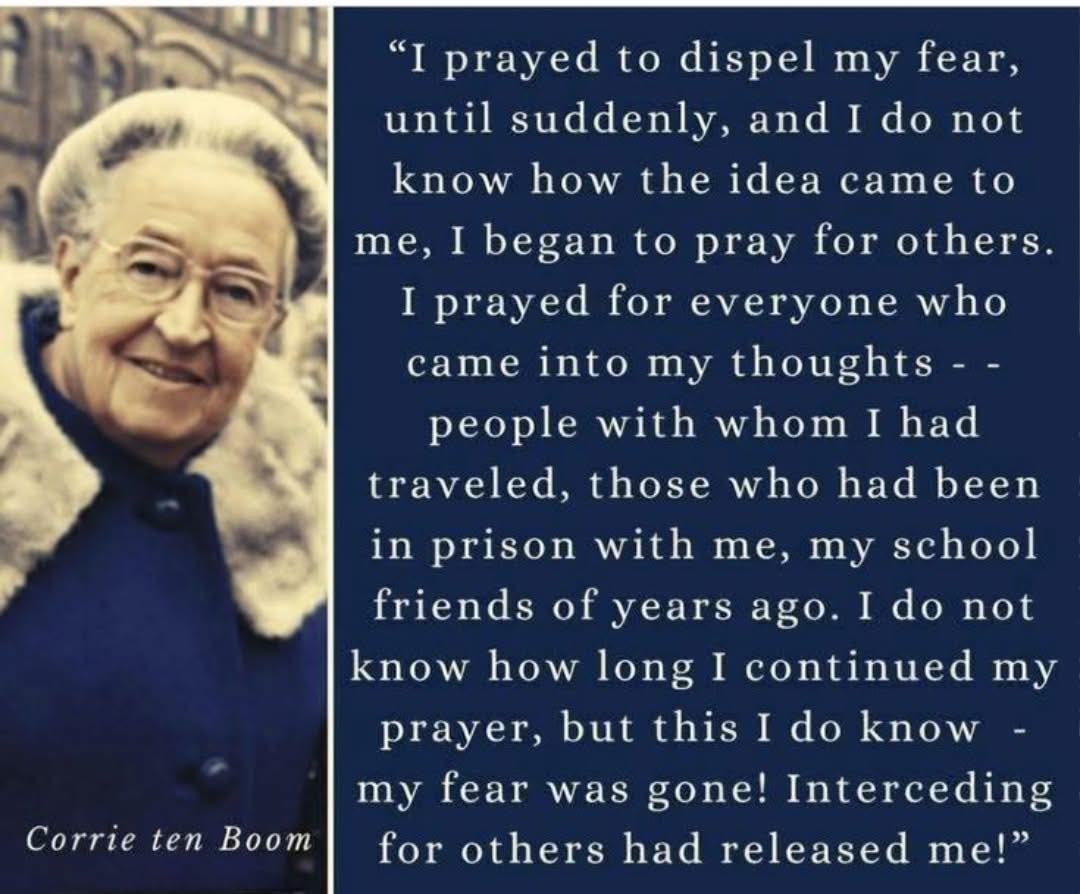
Also today, I finished reading a book my daughter had long been encouraging me to read. We actually gave each other a book to read. I gave her eye-opening book Just Mercy by Bryan Stevenson. She gave me The Hiding Place – The Triumphant True Story of Corrie Ten Boom (with John and Elizabeth Sherrill). I had seen the movie of Corrie Ten Boom‘s life years ago (also entitled The Hiding Place, 1975). It was riveting then, and this book’s story in her own words was even more so.

Photo Credit: Amazon

The Ten Boom’s were a devoutly Christian family in Holland, and much of the story takes place around the events of World War II. Nazi Germany was making its move to gain power across Europe and was particularly targeting Jews, their own and other nationalities, and Jewish sympathizers. The Ten Boom’s began hiding Jews and developed an effective but dangerous underground to secret them away to safer places. The family’s activities were eventually found out and they were imprisoned. Corrie’s brother Willem and sister Nollie only briefly, but Corrie’s father and sister Betsie were held. Their father would die after a brief time of incarceration. Betsie was Corrie’s older sister. They never married and poured their lives into caring for others.

The notorious German concentration camp, Ravensbrück, would be their “home” for too long. Over 130,000 women would be held there, and over 60,000 died (some in the gas chambers). The conditions were horrific. Corrie and Betsie, by God’s grace, managed to hold onto a Bible during their prison time. When they weren’t laboring long hours, they prayed and encouraged the other women in their barracks. Betsie had enormous faith and a tender heart, even toward their tormentors. She prayed for both prisoners and guards. Corrie struggled more in her faith, angry with their treatment, especially because Betsie was physically weak from a long-term illness. Corrie would learn greater forgiveness and love during their unfathomable time together in the camp.

Finally, Betsie would die in captivity. Corrie would continue on, taking more responsibility in caring for the women around her. Early on in their time at Ravensbrück, Betsie reminded Corrie that God called them to be thankful in all circumstances, not just in lovely ones. Corrie couldn’t thank God for the fleas which infested their quarters. Later, Betsie observed that the guards rarely entered their barracks BECAUSE of the fleas, so they were free to have times of prayer and study. This was not wasted on Corrie as she began to see God at work in all their circumstances…and she gave thanks.

I’m going to leave the rest of the story for you to discover in reading about her life…or watching the movie (movies – others have been made since the first one).

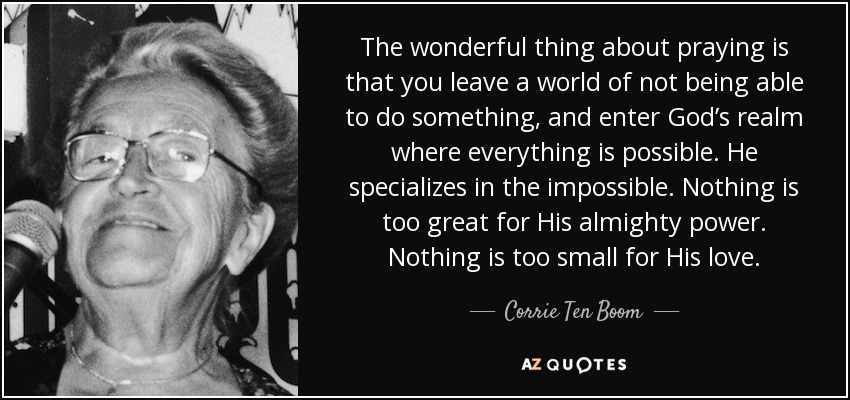
Obviously, Corrie survived her captivity and was released toward the end of 1944 (12 days after Betsie died). Her life continued for almost 40 years, and she was able to see the fruit of Betsie’s visions for the future. It is an incredible story – loss turned to glory.

In rejoicing over the long-awaited release of the Israeli hostages and concurrent release of Palestinian prisoners (also celebrated by their families), we are struck by the enormous experience of being “released”.

For Corrie, and for all of us, the release of bitterness as we forgive and God’s work in our hearts to even love our enemies (Matthew 5:43).

Photo Credit: Corrie Ten Boom, Facebook

Photo Credit: Corrie Ten Boom, Facebook

Photo Credit: QuoteFancy

The Ten Boom Family

Return to the Hiding Place – sequel to The Hiding Place film

The Hiding Place – 2023 Remake

Monday Morning Moment – Reflecting on Family

[Dave’s Mom, Our Adult Kids, Dave & Me – Not all the grands are on social media – but they begin the next generation of our family.]

I want to write about family…well, this family right here. In fact, I want to write a letter to them. Feel free to read along.

Dear Family,

Yesterday was a sweet time celebrating our September birthday guys – Dave & Nathan. Father & First Son. You both are so dear to all of us.

To you siblings and siblings-in-law, I love you so much. In the early years, I had this wild idea about how, while we live in the same city, we would get together weekly – like for Sunday dinner – like in the TV show Blue Bloods.

[Blue Bloods – read the short piece on how their weekly family gatherings shaped the show and character relationships.]

We don’t get together weekly, and that’s ok. When we do get together, it can be loud and opinionated, just like that TV family. However, it’s always rich – food for thought as well as body. Hope you leave each time, not just with a full tummy but, with the refreshed understanding of how much you are loved. Not just by Dad and me but by your siblings.

[I’m a faithful documenter of people and special events. Always working on their patience. It means a lot when everyone cues up and smiles, but occasionally someone doesn’t feel like it…and that’s ok.]

To our youngest: I know being the baby of the family can get old, especially when you find yourself in your mid-30s. Hopefully you know that your opinions matter to your family. We want to know what you think… always. It made me sad that you were suffering from a headache through most of the meal yesterday. Please take heart that although we all don’t always agree on everything, we are grounded in love for each other. That’s priority and it will never change. Ever. I want to thank you for loving your family, too. You don’t have to show up and yet you do. There is a measure of hard in your life, different from ours, which would be easy for you to stay focused on. It gives us immeasurable joy when you are able to shake off the hard and laugh about “the old days”, tease your siblings and absorb their ribbing, and love on your nieces and nephews. It’s also no small thing how you serve us (me) – baking and straightening.

[Lots of Sibling Love Right Here]

To the married siblings and their spouses: You have incredibly busy lives, and yet for those hours when we are together for the odd special occasion, time slows. You are present. You are engaged. You are yourselves. The flow of conversation is easy and animated. You roll with the skirmishes between little cousins and you parent them all so well. I hope you know how much you are loved. As your Dad (Dad-in-law) and I get older, we are so grateful for how you hang in there with us and each other. Family estrangement is so prevalent in our world today, but so far, we have weathered the storms. Your commitment to our family is something we do NOT take for granted.

[The Guys]

[The Big Sister & the Little Brother]

To any who are reading: all families are different. Within each family, there are tremendous differences in temperaments, preferences, and even worldview. Ruptures can happen and repair is hard to come by. Our Sunday birthday dinner reminded me of things learned over the last few years:

  • We can make a place of safety and security for those we live.
  • When we are only around people who agree with us, we experience an echo chamber of affirmation. When we experience dissonant voices from those who love us, we learn how to better love those different from us.
  • In a rowdy family discussion, we still probably agree more than we disagree. Take an inventory on that from time to time. How do we affirm each other even when we don’t agree?
  • Lead with curiosity and empathy. If contempt is stirred up, recognize it for the destroyer of relationships it is, and take steps against it (see here).
  • Remember life is messy. Family is messy. We may prefer our lives (and families) to “look” a certain way, but it’s healthier for us to be real and honest with each other. “The human mind doesn’t have the capacity to live a life so curated” (convo with friend/counselor Taryn Blocker).
  • Flexibility is a character quality we all need to navigate relationships when people are crossing our boundaries. Flexibility, humility, and forgiveness. It’s going to happen, especially in family. Respecting boundaries goes both ways and takes both self-care and other-care. Or relationships break down.
  • What else? What would you add to those list? Please share in comments.

[The original three & me]

I am very thankful for this family. With all our warts. Not unlike any other family out there. So thankful for the relationships these siblings have with each other, and for the littles with their sibling and cousin relationships. Check out these beautiful reels from Instagram on the topic.

Instagram – Siblings Are One of the Most Important Relationships You Will Ever Have

Instagram – “Who do we call when you’re not around?”…”Each other.”

Finally, I’d like to just mention psychiatrist Dr. Gabor Maté‘s opinion on how all children grow up in different families with different parents. He justifies that thinking about how we, as parents, change and evolve in our thinking on parenting, with each child, and our children are all different from each other. We may even use the same practices but our children react differently to them. The old adage” of “caught or taught” would bring meaning to this as well.

Siblings may grow up in the same house, but that doesn’t mean their childhoods were the same. Not even close.

Same parents? Nope.
Same family? Nope.
Same childhood? Absolutely not.

Parents show up differently for each child depending on the season of their life, their relationship, and even their financial situation.

It’s not about who is loved more.
It’s about how that love is expressed — and how each child experiences it.

If you’ve ever wondered why you and your siblings remember childhood so differently — this is why. – Clip from The Mel Robbins Podcast, Conversation with Dr. Gabor Maté – “Why You Feel Lost in Life: Dr. Gabor Maté on Trauma & How to Heal”

How Today’s Parents Say their Approach to Parenting Does – or Doesn’t – Match Their Own Upbringing – Pew Research – Kiley Hurst, Dana Braga, Shannon Greenwood, Chris Baronavski, & Michael Keegan

Dr. Gabor Maté Explains His ‘No Two Children HaveThe Same Parents’ Philosophy – Annie Reneau

Then, to those amazing adult children, add spouses, careers, and varied life experiences to the equation, and we continue to have the wonder of family – familiar and yet also new and changing. It makes for a fascinating Sunday dinner experience…and a lifetime of tilling the soil of a safe, secure, and hopefully sacred love for each other.

Worship Wednesday – Highly Exalted – Robin Mark & Paul Baloche

Photo Credit: Parade

“He was oppressed and afflicted, yet he did not open his mouth; he was led like a lamb to the slaughter, and as a sheep before its shearers is silent, so he did not open his mouth. By oppression and judgment, he was taken away.”Isaiah 53:7-8

“He himself bore our sins in his body on the cross, so that we might die to sins and live for righteousness; by his wounds, you have been healed.” 1 Peter 2:24

Adopt the same attitude as that of Christ Jesus, who, existing in the form of God, did not consider equality with God as something to be exploited. Instead he emptied himself by assuming the form of a servant, taking on the likeness of humanity. And when he had come as a man, he humbled himself by becoming obedient to the point of death — even to death on a cross. For this reason God highly exalted him and gave him the name that is above every name, so that at the name of Jesus every knee will bow — in heaven and on earth and under the earth — and every tongue will confess that Jesus Christ is Lord, to the glory of God the Father. Philippians 2:5-11

[For further study, see also Ezekiel 16:5; Matthew 27:39; Mark 15:29; Acts 8:32; Hebrews 11:25; Luke 19:9; Romans 11:11; Philippians 2:9 – Sifa Lyrics: Highly Exalted – Song Meaning, Biblical Reference and Inspiration https://sifalyrics.com/robin-mark-highly-exalted-lyrics]

This week we have the pleasure of my mom-in-law visiting. She is a complete blessing. Such a humble servant and faithful pray’er. You want her to be praying for you. She is a great story-teller and encourager. Her great-grandchildren adore her! She brings joy with her into the house.

One thing that changes in our home when she is here is some of what we watch on TV. On Sunday evenings in her home, she watches a church program produced through Pensacola Christian University. The name of the program is Rejoice in the Lord. The sermon this week was “Renaming Your Sorrow”. Sunday night’s message was impacting, but what touched me the most was one of the worship songs. It was the first time I heard this song “Highly Exalted” and it’s been on repeat since then. You can watch/listen to the university choir sing it here at 11:40 minutes in. So beautiful. Written by Robin Mark and Paul Baloche (released in 2018). All Scripture. I got goosebumps and still get them. Thank You, Jesus.

This song has burned its message into my heart. We treat Jesus too lightly sometimes…and, if we are honest, we can turn our faces away from His teaching, the example of His life, and His atoning sacrifice for our sins. To our detriment. Lord, have mercy on our souls. Forever a part of the triune nature of the Godhead, the Son of God came in obedience to the Father to make a way for us to become children of the most high God. He came in humility as a baby, lived as a carpenter’s son, touch lives radically for three years of public ministry, died a horrible death…in obedience to the Father and for our sakes. Then God the Father raised Him from the dead, and Christ lives forever to intercede for us and welcome us Home. Thanks be to God.

The rise and fall of this song and the lyrics that Robin and Paul knit together from the Word take us to the booming chorus:

“For God has highly exalted Your name; He has enthroned You on high: Jesus the name above all names!”

Amen and Amen.

We exalt You, Lord Jesus. You are worthy of all our praise.

Let’s worship together to this beautiful anthem:

You were despised
You were rejected Lord
Those who passed by
Even averted their gaze from Your sight
Such was the suffering You bore for us
Led like a lamb, lamb to the slaughter
You spoke not a word
Chose to be silent
Though You did no wrong
Nor was deceitfulness found in You

Yet by Your wounds our salvation has come
Yet by Your suffering our freedom is won
For God has highly exalted Your name
He has enthroned You on high
Jesus the name above all names (2x)
Led like a lamb, lamb to the slaughter
You spoke not a word
Chose to be silent
Though You did no wrong
Nor was deceitfulness found in You
Yet by Your wounds our salvation has come
Yet by Your suffering our freedom is won
(For) God has highly exalted Your name
He has enthroned You on high
Jesus the name above all names (2x)
Yet by Your wounds our salvation has come
Yet by Your suffering our freedom is won

(For) God has highly exalted Your name
He has enthroned You on high
Jesus the name above all names (2x)*

Photo Credit: Knowing-Jesus

*Lyrics to “Highly Exalted” – Songwriter: Paul Baloche & Robin Mark

YouTube Video – Highly Exalted | Schönfeld Projektchor

Highly Exalted Music Video – YouTube

YouTube Video – Highly Exalted – The Allens in Israel

YouTube Video – Highly Exalted – Robin Mark

Monday Morning Moment – Contempt – Revisited

Photo Credit: Armstrong Economics

Adapted from the Archives

[Just a bit over a year ago, I wrote a blog entitled “Contempt – the Cold Killer of Hearts and Humanity”. It is such a prevalent emotion/thought process these days, I wanted to update that piece and re-post.]

Ah…contempt. It is defined as a strong negative emotion that joins disgust and disrespect. If we are honest, we have all experienced contempt, either for someone else, or a group of someones…or we’ve experienced the contempt of another towards us.

Contempt is a harsh response…a cold killer of hearts and relationships.

When we express contempt, it is usually in conversation with those who agree with us…about someone else. Rarely do we have the person(s) toward which we feel contempt in front of us. We don’t engage them as much as we complain about them. We hold some in contempt because of their beliefs or actions, and our temptation is to have nothing to do with them. We may view this as a strength, but (as I’ve heard said), “an unguarded strength is a double weakness.”

In a quick summary on contempt (in case you don’t want to read more in depth below), we would never think of ourselves as having contempt of another (or a group of people), but the signs are in our speech and attitudes. No matter how much we think we cover it, others can tell we lack love and respect (even exhibiting hatred). Contempt not only separates us from others but also makes it hard to reconcile. The dark thoughts of condemnation, suspicion, and mistrust are present under the surface. To remove the force of contempt, we must check our hearts. Acknowledge that any compassion we may have is conditional…we withhold love based on the other’s behavior. It is a lose-lose situation. How we can move toward actual reconciliation, or at least stepping toward a more healthy relationship is to be humble. We have a part in any contemptuous relationship. We each have a part. When we lean in, without expectation of the other person, and show curiosity as to how they are, we give grace. We make space for that person to lean in, as well. Refusing to think ill of another person, no matter what happened in the past, opens the door to genuine caring. It can be the start of healing.

Guarding Against Contempt – Bible Hub

What Does the Bible Say About Contempt?

What follows comes from my blog of a year ago. It speaks volumes on how to avoid contempt in two main areas: politics and marriage. However, the counsel given could be applied broadly to families, neighbors, coworkers, etc. There is wisdom here…in any situation where we feel the cold, hate-birthing emotion of contempt…which does harm to our relationships and our own heart.

“Knowing our weakness, dividing leaders on both the left and right seek power and fame by setting American against American, brother against brother, compatriot against compatriot. These leaders assert that we must choose sides, then argue that the other side is wicked—not worthy of any consideration—rather than challenging them to listen to others with kindness and respect. They foster a culture of contempt.” Arthur C. Brooks, Love Your Enemies: How Decent People Can Save Our Country From the Culture of Contempt

Contempt is something I’d like to annihilate in my own thinking, and thankfully there are helps. Below you will find two thought leaders who have worked to expose contempt for what it truly is and does to us, and who have given us counsel on how to recognize it and rid ourselves of it. Author and academician Arthur Brooks and clinical psychologist John Gottman.

How do we confront contempt?

Arthur Brooks’ 5 Rules to Counter Contempt

1. Refuse to be used by the powerful.“The accurate image of a powerful manipulator is someone on your side of the debate: a media figure who always affirms your views, a politician who always says what you think, or a professor who never challenges your biases. They declare the other side is terrible, irredeemable, unintelligent or anything else that expresses contempt — and they say you should think these things as well.” Brooks encourages us to tune out that person “on our side” who seeks to manipulate us, whatever the reason. Then (this is the harder part), we are to call out contemptuous behavior among those with whom we agree (our friends and maybe family). Contempt tears us down, and we don’t want that for ourselves or those we love.

2. Escape your bubble.“The culture of contempt is sustained by polarization and separation. It is easy to express contempt for those with whom we disagree when we view them as “them” or never see them at all. Contempt is much harder to express when we see one another as fellow human beings, as “us.”” We do well to make opportunities to share space and conversation with people not like us. Seek to understand and look for ways we are alike.

3. Treat others with love and respect, even when it’s difficult.“Never treat others with contempt, even if you believe they deserve it. First, your contempt makes persuasion impossible, because no one has ever been insulted into agreement. Second, you may be wrong to assume that certain people are beyond reason. There are many examples of people forming unlikely bonds precisely because they didn’t treat each other with contempt.” Sometimes we are the ones toward which contempt is aimed. If we have offended, then we can apologize. Raising an issue higher than the value of the person doesn’t take us anywhere positive.

4. Be part of a healthy competition of ideas.“I believe disagreement is good because competition is good. As in politics and economics, competition — bounded by rule of law and morality — brings excellence. In the world of ideas, competition is called “disagreement.” Disagreement helps us innovate, improve, correct and find the truth. Of course, disagreement — like free markets and free elections — requires proper behavior to function.” The goal is not to disagree less but to disagree better, notes Brooks.

5. Disconnect from unproductive debates.“Get rid of curated social media feeds. Unfollow public figures who foment contempt. Want to get really radical? Stop talking and thinking about politics for a little while. Do a politics cleanse. For two weeks — maybe during your next vacation — resolve not to read, watch or listen to anything about politics. Don’t discuss politics with anyone. This will be hard to do but not impossible.” This exercise will reveal how much of your life and mental energy is wasted, allowing you to refocus on people you truly love and work/play that matter more than those things you probably won’t be able to change. – Arthur Brooks, Sick of the Culture of Contempt? Here are 5 Ways You Can Subvert It

One last quote from Albert Brooks: “We should be careful to note that love and agreement are not the same thing. There are ideas and actions that are worthy of our contempt. But while some ideas and actions are worthy of contempt, we should always remember that no person is.Defusing a Culture of Contempt: Arthur Brooks on How to ‘Disagree Better’ – Joan Frawley Desmond

Another exceptional thinker and clinician is Dr. John Gottman, psychologist and professor. His focus is primarily on marriages and individual mental health within relationships. The Four Horsemen is a metaphor pointing toward end-times. Dr. Gottman uses the same metaphor in describing four elements of communication, any one of which can predict the demise of a marriage (or any other relationship). These elements are criticism, contempt, defensiveness, and stonewalling. Each has an antidote.

Photo Credit: John Gottman, Gottman Institute, Instagram

The Four Horsemen: Criticism, Contempt, Defensiveness, and Stonewalling – Ellie Lisitsa

Contempt is much more mean-spirited than criticism. It communicates a measure of cold superiority over the one being criticized. Gottman isn’t talking about a political stand or a point of contention over culture or morality. He is concentrating on the relationship between two people, usually being a married couple.

“Contempt, simply put, says, “I’m better than you. And you are lesser than me.” [It] is fueled by long-simmering negative thoughts about one’s partner, and it arises in the form of an attack on someone’s sense of self. Inevitably, contempt leads to more conflict—particularly dangerous and destructive forms of conflict—rather than to reconciliation. It’s virtually impossible to resolve a problem when your partner is getting the message that you’re disgusted with them and that you’re condescending and acting as their superior.”

Gottman prescribes two antidotes for contempt in the marriage relationship – one short-term and the other more long-term:

  • First, the person feeling contempt toward the other would do well to name the emotions that rise to the top during a conflict. Express these emotions to your spouse without blaming, and appeal for help with a solution. “I am sad that we don’t have friends over. Could we talk about a way forward on this?” Or “I get worried when the bills pile up. Can we talk about what we can do to stay within budget?”
  • Second, Gottman suggests establishing (or re-building) a home culture of fondness and admiration for each other. This is a discipline that may take some strong determination, but it is doable. In fact, I have go-to Bible verses (Revelation 2:4-5) that help me immensely during those dry times in my own marriage. It speaks about what to do when we have lost our first love (for God and each other). Essentially, the instruction is to remember how it was in the beginning, repent/return, and repeat the actions/emotions/intentions that came naturally when the relationship was new. We don’t have to feel the fondness or admiration at first, but as we practice them, they can be restored. Among many tools, Dr. Gottman uses the instrument below to kick-start the process as the spouse chooses three descriptors and then gives examples of those to the other person.
Photo Credit: John Gottman, The Gottman Institute

Contempt is deceptive. It feels so good to think we are right, and yet in the practice of contempt, we become more isolated and less engaged in real community. Only preferring people who think like we do. At some point, our competencies will be impacted because our problem-solving shrinks down to just judging others and determining they aren’t worth our time. We miss learning from them, and we miss the possibility of genuinely understanding them, even loving them.

Having faced contempt myself, It has brought me to a “come to Jesus” moment. I don’t want to hold contempt for anyone, no matter how different they are, no matter what wrongs they have done. I want to figure out how to stay engaged with people…such that “if [I] can’t move mountains, [maybe I can] move a stone”.*

Photo Credit: Instagram, Ullie Kaye Poetry*