

Happy Friday! Here is my gift to you today – so many glorious finds I’ve tried to compress into 5 Friday Faves.
1) Common Purpose – Every year, Glassdoor, a website that assists employers and potential employees to find each other, posts a Top 50 of Best Places to Work.
 Photo Credit: SAP
Glassdoors’ 2017 Best Places to Work
In his LinkedIn article, Barry Sanders talks about one of the characteristics of what makes a “best place to work”. This characteristic is “common purpose”. He writes:
Common purpose is essential to driving organization-wide adaptability, which is key to succeeding in today’s fast-paced business world. A shared set of values and goals across the organization allows leaders and individual contributors to achieve widespread alignment, manage uncertainty, and guide decisions in times of turmoil and change.
Without establishing common purpose, companies risk a lack of motivation, lower levels of commitment, less loyalty, and decreased alignment amongst their employees—not to mention negative Glassdoor reviews.
 Photo Credit: Wikipedia
He also quotes from his CEO General Stanley McChrystal’s bestseller Team of Teams which gives this summary of the importance of common purpose:
“Team members tackling complex environments must all grasp the team’s situation and overarching purpose…Individual SEALs have to monitor the entirety of their operation just as soccer players have to keep track of the entire field, not just their own patch of grass. They must be collectively responsible for the team’s success and understand everything that responsibility entails.”
When you can see the entire field, not just your patch of grass, your organization becomes more effective—and a better place to work. – Barry Sanders
I sure hope senior leaders get this message. Just communicating the purpose is not enough. That “patch of grass” must be given to that soccer player. He must own it and own his part of the entire field. Leaders who genuinely believe in and nurture common purpose cultivate a “best place to work” for their personnel.
15 Things I Learned From Truett Cathy [Founder of Chick-Fil-A]– Paul Sohn
2) Safeguarding Your Marriage – Infidelity or unfaithfulness in our marriage relationships is not just about sexual betrayal. Infidelity can happen when we allow our hearts to become more bonded to someone or something else more than to our own spouses.
Dave Willis defines infidelity as “broken trust or broken loyalty”. He has posted a tremendously helpful article entitled The 9 Forms of Infidelity in Marriage (Hint: 8 of Them Don’t Involve Sex). Willis is a pastor,counselor and founder of Stronger Marriages. Single or married, you will benefit from his article because too often we “fall” into infidelity by letting ourselves be deceived in thinking it’s nothing. Safeguard your relationships!
3) Being Different – Matt Damico has written an excellent piece for Christ-followers. It is The World Needs You to Be Different. If you are reading this and you aren’t keen on the teachings of Jesus, you may already think that Christians are a quirky lot of people. What Damico says in this article is to call us to the rhythms, the routines, the practices of the church that work a peculiarity in us that’s a good thing.
Piano scales make a pianist. Hours behind the wheel make a driver. Weightlifting reps make muscles, and lots of miles make a runner. Routine and repetition aid us in so many ways, yet a lot of us seem allergic to similar habits in our weekly church worship gatherings.
But just as these individual habits do something to us, so it is with our congregational habits: they’re making us into something. God willing, they’re making us the right kind of peculiar.
We’ll bear fruit in this life when our roots are firmly planted in the coming new earth. As C.S. Lewis said, history shows that “the Christians who did most for the present world were just those who thought most of the next.” One of the main ways this happens is through the rhythms and repetitions worked into our weekly gatherings.
So, as your church gathers for worship this weekend, appreciate anew what’s happening, how the strange rituals — the “rhythms of grace,” as Mike Cosper calls them — are making you more faithful and more fruitful. – Matt Damico

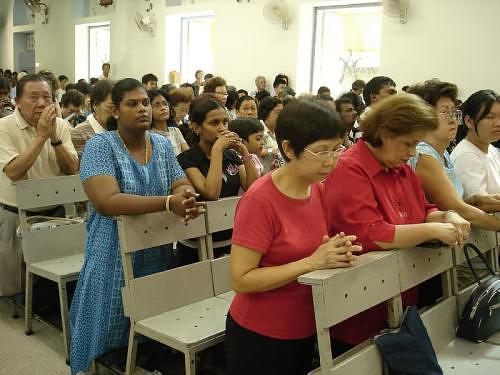 Photo Credit: Wikipedia; Wikipedia
[Cliff Jordan, teaching elder at Movement Church, in Richmond, Va. preaches on this very thing for several weeks in a series entitled Grace On Display. Seriously transformative stuff!]
4) Hard Seasons – I’m not going to wax on here about hard seasons – we all know what ours are. I just always want to keep Syrian refugees on my radar so here’s a photo piece that dramatically displays their reality…in a way that has stayed in my mind all week.
Click the Black Background and Switch on Their Reality – Politiken
 Photo Credit: Flickr
Then I also wanted to share a piece by Aaron Brown. I know his family. He grew up in Chad where his father was a physician. His reflects on a very difficult time and its oddly positive impact on his life…renewing his hope after the very difficult year of 2016.
The Do-Over Year – Ruminate Magazine – Aaron Brown
5) Small Beginnings – In the Bible, the prophet Zechariah encouraged the people, “Do not despise small beginnings.” They had the huge task of rebuilding the Temple, and Scripture tells us, this great work began in the mundane but extraordinary act of Zerubbabel picking up the plumb line. Any beginning may seem small and inadequate for the grand vision that stretches in front of us. However, we never know when the small explodes into wonder.
Chip and Joanna Gaines (HGTV stars of Fixer Upper) have an incredible story of small beginnings which grew into a huge, phenomenally successful business. They started out flipping houses as a young couple and often had just the cash in their pockets. Now they have their own TV show, a real estate business, home goods store, and “The Silos” – a refurbished commercial venue in Waco, Texas.
http://people.com/home/hgtv-chip-joanna-gaines-were-broke-before-fixer-upper/


Another example of small beginnings is pastor and author Tim Keller. Just this past week, Keller announced he was stepping down from the senior pastor position of New York City’s Redeemer Presbyterian Church. He pastored there for almost 30 years and it now is a multi-site 5000-member church. [This is a planned succession and he will be teaching in a seminary.] A friend of mine here in Richmond “knew him when”. Years ago, before his NYC church role he was her pastor, in a small church near here – West Hopewell Presbyterian Church. Small beginnings…

My Tribute to Tim Keller – Scott Sauls
Whether you are examining a small beginning as a Christian or from a different worldview, there is excellent counsel to be had…both in Scripture and in articles (such as those linked below).
Just yesterday I was trying to encourage a young man about what he viewed as a small beginning in his career. Not sure I made sense at all. Then today, my husband emailed me this great article – about the exact same subject.
Don’t you love when you read someone else’s brilliant words that essentially describe the counsel you just gave someone?! Benjamin P. Hardy is way more studied and eloquent than I, so please don’t miss his piece titled The 2 Mental Shifts Every Highly Successful Person Makes. He talks about:
- the power of choice (“you stop playing the victim to external circumstances and take responsibility for your life – the private victory“) and
-
the power of context (“In everything you do, there should be collaborative and synergistic elements. Of course, there is work which is your work. However, that work should be embedded within a group of others and toward something much bigger. – the public victory”)
Hardy’s full article is excellent (even includes components of the assist we get from brain plasticity which I wrote about earlier).
6 Personal Branding Rules To Being Popular and Profitable – Patrick Allmond
8 Highly Effective Habits That Helped Make Bill Gates the Richest Man on Earth – Minda Zetlin
50 Ways Happier, Healthier, and More Successful People Live On Their Own Terms – Benjamin P. Hardy
So what are we waiting for? Let’s get up and get on with this amazing life we’ve been given…it’s never too late.
Bonuses (for your listening pleasure)