Tag Archives: The Older Brother

Worship Wednesday – Daddy’s DNA – Brandon Lake

Photo Credit: Brandon Lake, Praisejamzblog

Then God said, “Let us make man in our image, after our likeness. And let them have dominion over the fish of the sea and over the birds of the heavens and over the livestock and over all the earth and over every creeping thing that creeps on the earth.” So God created man in his own image, in the image of God he created him; male and female he created them.Genesis 1:26-27

“Come to me, all who labor and are heavy laden, and I will give you rest. Take my yoke upon you, and learn from me, for I am gentle and lowly in heart, and you will find rest for your souls. For my yoke is easy, and my burden is light.” – Jesus – Matthew 11:28-30

“Everyone the Father gives me will come to me, and the one who comes to me I will never cast out.” – Jesus – John 6:37

So Jesus said to the Jews who had believed him, “If you abide in my word, you are truly my disciples, and you will know the truth, and the truth will set you free.” John 8:31-32

We are created in the image of God. Astounding fact! That means we are hard-wired for goodness and beauty, love and creativity, mercy and justice. Our problem then? Sin. From the beginning, sin has seeded our nature with self-serving and the warped sense that we belong to ourselves not to the God who knows and loves us perfectly. Apart from surrendering ourselves to His lordship, we attempt to live fragmented with bits of His DNA at work in us but far from what He had in mind for us…far from the freedom we can have in Christ’s forgiveness.

This brings us to the beautiful story Jesus told of the prodigal son. In this parable, Jesus brings into focus the lives and relationships of three men – a father and his two sons. The younger son rejected the life his father had for him and chose to sever himself from him. He asked for his inheritance and his father let him go to what would become a life of debauchery…living loosely on the means he did not earn, except by his lineage from his father. The older son stayed with his father, serving him (and tending his own future) as before. The father was heart-broken, and, although it isn’t written, maybe the older son went looking for the younger son to bring him back home. Or maybe he did not. We don’t know. Once the money ran out, the younger son found himself alone and hungry, without relationship or worth. Shame and regret were his only companions. He decided to return to his father asking for his mercy. Was he truly contrite and repentant – we can’t know his heart. He for sure wanted relief from the constant distress he endured, consequence of his poor choices. As he came, his father recognized him, from far off, as if he never stopped looking for his return. The father came running to receive him, welcoming him back home. The older brother? Not so much. In his own self-righteousness, the older brother did not rejoice, even when it pained his father’s heart that he had such a response. Being a good father has its own anguish, and we should always remember that in our love for God and in our treatment of those He loves.

The Parable of the Prodigal Son

Photo Credit: Geoff Thomas, I’ll Be Honest

The Parable of the Running Father – Geoff Thomas

What the Prodigal Son’s Father Teaches Us About Love and Truth – John Clark [this piece is written by a Catholic author. For those of us not Catholic, don’t let that put you off from reading a beautiful essay on God’s relationship with us and His desire for us to know Him and walk with Him.]

Singer, songwriter Brandon Lake just released his latest single “Daddy’s DNA”. It’s a beautiful, honest confession of a prodigal (most likely some of which is Lake’s own story).

Parable of the Prodigal Son (Luke 15:11-32) – David Gowler

The Prodigal Son’s Father Shouldn’t Have Run! – Putting Luke 15:11-32 in Context – Matthew Williams

Worship with me.

I thought the world had something special I was missing
My daddy told me not to chase it, I didn’t listen
I fell downhill a mile a minute
Before I knew it, I was livin’
In a pig sty a long, long way from home

I went runnin’ like a rebel
Racked up debts I couldn’t pay
I went dancing with the devil
With one foot in the grave
How the Heaven did I get here?
Went and threw it all away
All I’ve given You was trouble
All You’ve given me was grace


And the freedom I was chasing felt like prison
Lord, I’ve done so many things, wish I didn’t
And after all the risky business
Could I ever be forgiven?
I’m afraid to even ask to come back home

‘Cause I went runnin’ like a rebel
Racked up debts I couldn’t pay
I went dancing with the devil
With one foot in the grave
How the Heaven did I get here?
Went and threw it all away
All I’ve given You was trouble
All You’ve given me is grace
Given me was grace

When I sobered up, and came back to my senses
I was too far gone to make up all the distance
I gambled all that I’d been given
I was broke, alone and wishing
That I could turn around and go back home
When I heard the sound of footsteps down the road


And You came runnin’ like a rebel
Paid off debts I couldn’t pay
You went dancing with the devil
Sent that liar to his grave
How the Heaven did I get here?
Where every sin has been erased
All I’ve given You was trouble
All You’ve given me is grace


There was something in the marrow
Always coursing through my veins
Buried deeper than the rubble
Is My Daddy’s DNA*

I love this song. The bridge (or benediction?) at the end really gave me pause. We do have the Lord’s DNA in us…what we do with that has eternal consequence. Either we think it is really our DNA and we can live our lives for ourselves, our own ambition and pleasure, and our own perceived destinies…or we recognize Whose we are and what we need to do to alter course and take on the life we were meant to have. That is where joy and freedom really lie. To recognize the prodigal nature in all of us and to return Home to a Father who came for us, in Jesus, and continues to come for us through the Holy Spirit at work in our lives.

My prayer is that His DNA is on beautiful display in all who call Him Father.

*Lyrics to “Daddy’s DNA” – Songwriters: Brandon Lake, Hank Bentley, Jacob Sooter

The Birth of Sin

“Where Are You?” – Genesis 3:7-15 – Lesson 9 – Bible.org

Worship Wednesday – Our Posture Before a Waiting & Loving Father – with Trevin Wax

Photo Credit: Prodigal Son by Eugene Burnand, article by James Ross Kelly

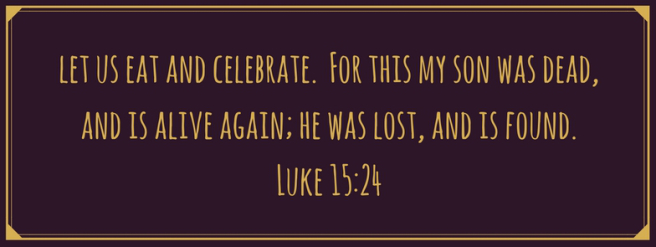
And Jesus said, “There was a man who had two sons; and the younger of them said to his father, ‘Father, give me the share of property that falls to me.’ And he divided his living between them. Not many days later, the younger son gathered all he had and took his journey into a far country, and there he squandered his property in loose living. And when he had spent everything, a great famine arose in that country, and he began to be in want. So he went and joined himself to one of the citizens of that country, who sent him into his fields to feed swine. And he would gladly have fed on the pods that the swine ate; and no one gave him anything. But when he came to himself he said, ‘How many of my father’s hired servants have bread enough and to spare, but I perish here with hunger! I will arise and go to my father, and I will say to him, “Father, I have sinned against heaven and before you; I am no longer worthy to be called your son; treat me as one of your hired servants.”’ And he arose and came to his father. But while he was yet at a distance, his father saw him and had compassion, and ran and embraced him and kissed him. And the son said to him, ‘Father, I have sinned against heaven and before you; I am no longer worthy to be called your son.’ But the father said to his servants, ‘Bring quickly the best robe, and put it on him; and put a ring on his hand, and shoes on his feet; and bring the fatted calf and kill it, and let us eat and make merry; for this my son was dead, and is alive again; he was lost, and is found.’ And they began to make merry.

“Now his elder son was in the field; and as he came and drew near to the house, he heard music and dancing. And he called one of the servants and asked what this meant. And he said to him, ‘Your brother has come, and your father has killed the fatted calf, because he has received him safe and sound.’ But he was angry and refused to go in. His father came out and entreated him, but he answered his father, ‘Lo, these many years I have served you, and I never disobeyed your command; yet you never gave me a kid, that I might make merry with my friends. But when this son of yours came, who has devoured your living with harlots, you killed for him the fatted calf!’ And he said to him, ‘Son, you are always with me, and all that is mine is yours. It was fitting to make merry and be glad, for this your brother was dead, and is alive; he was lost, and is found.’Luke 15:11-32

The following is a treasure by writer and researcher Trevin Wax, used with permission. We met only once, but I’ve been learning from him for several years. You are in for a treat – a life-giving infusion of truth, wisdom, and grace.

“Every now and then, a song brings me to tears.

Sometimes it’s an older song that stirs the heart in a new way. I’ve never been able to sing the last verse of Isaac Watts’s hymn, “There Is a Fountain,” because I’m too moved by that image of my “poor lisping, stammering tongue” lying “silent in the grave” before rising again to sing a “nobler, sweeter song” of Christ and his “power to save.”

Songs about the cross and resurrection strike that chord, such as the vision at the end of “O Praise the Name (Anástasis)” of resurrection hope when our gaze will be fixated on the Savior. Andrew Peterson’s “Well Done, Good and Faithful” builds on a Watts hymn and imagines the Father affirming the Son’s sacrificial work; I blubber every Easter season when I hear it. Other songs do the trick too, even simple ones like Steven Curtis Chapman’s “My Redeemer is Faithful and True” or Fernando Ortega’s “Give Me Jesus.”

But for all the times when glorious gospel truth has me fumbling for a Kleenex, there many times when I sing about amazing grace with dry eyes and a lukewarm heart. This has me wondering, What dries up the heart and keeps us from feeling and experiencing the marvelous, matchless grace of God? What keeps the tear ducts blocked?

For starters, there’s the posture of the older brother in the parable of the prodigal son: the self-righteous, self-sufficient one who remains “close” to the father, at least in terms of proximity, while his heart is far from home. The consummate rule-follower believes deep down that the only possible reason God would love us is because we’ve done something to deserve salvation.

Photo Credit: Rembrandt’s Return of the Prodigal, Stanton Lanier

This assumption can manifest itself in many ways, even among those who talk about grace all the time. The self-justifying tendencies of the human heart can lead us to stand on a pedestal of Christian teaching about grace and then look down on others who’ve not arrived at our level of doctrinal understanding or theological precision.

But we cannot weep before the majestic grace of God if we’re still searching for scraps of self-sufficiency. Tears of gratitude will never fall from eyes looking down on others, only from eyes looking up to God’s grace.

But there’s a second posture that keeps us from marveling at the grace of God: the desire to validate ourselves by doing away with sin.

The New Testament’s insistence on our need for redemption humbles us. But redefining sin removes the need for humility, leaving us affirmed in our natural state.

For many today, the problem isn’t the disease of sin, but those who’d diagnose the disease. So, instead of a father running to us with a heart overflowing with forgiveness and healing mercy, we want a father who runs to affirm us and tell us all is well, that what we’ve done either wasn’t that bad or wasn’t bad at all. We want a God to provide a spiritual presence, a transcendent dimension for the life we’ve chosen to live. God becomes the approver of our own self-validation.

This second posture is also rooted in self-righteousness, but it masks itself in false mercy. For some, sin is not that big a deal because God is merciful and it’s his job to forgive. For others, our focus on brokenness and suffering outstrips any notion of sin as transgression or treason against God. God’s mercy and help are there to make us whole, but this “wholeness” must ultimately be defined by every individual.

The first and greatest commandment is “Be true to yourself.” The second is like it: “Affirm whatever self your neighbor decides to be true to.” In this way, we rid ourselves of vice, not through forgiveness, but through redefining vices as virtues, as part of our authentic selves.

And so, the father runs to the repentant son, not to shower him with undeserved grace, but to follow him to the pigsty, where he insists the son’s rebellion was a bold and courageous act of independence, and the diet of pig food is really a feast for the self-actualized.

This posture strips us of the power to weep at grace. Sin is waved, not washed, away. To deny or minimize your sinfulness is to sever the root of gratitude for undeserved favor. Make favor deserved, a reward that showcases your innate worth and value and goodness, and you’ve gutted grace of everything that makes it amazing.

In both cases, whether it’s the elder brother who won’t lower himself to join the feast, or the younger brother who won’t come to his senses because he wants to be “free” to choose the pigsty, self-righteousness blocks tears of gratitude.

Only Jesus gives us grace that meets us in our darkest hour, grace that plumbs the depths of our cavernous hearts, grace that transforms the heart of stone into a heart of flesh.

Undeserved favor strips us of self-righteousness and shows up our paltry attempts at self-validation. Submit to that humble stripping away of all our pride, and then we can bask in the grace that makes us sing louder, shout for joy, and weep with gratitude. That’s the grace we see in the running feet of the father.” – Trevin Wax, Facebook, May 5, 2024

[If you have time, and want to sing praise to God for His great grace, click on any of the song links – old or new.]

Rembrandt’s Prodigal – A Life Lesson – Stanton Lanier

The Story of the Loving Father – William Barclay – James Ross Kelly

Lost Things Found – A Story and a Parable

img_9889

My husband and I love coffee. We also love to serve coffee to friends who love coffee. Over the years, we’ve collected favorite mugs – pottery mugs from Petra, Jordan; mugs with encouraging verses; favorite cartoon mugs; pretty flowery mugs for moms; mugs with whimsical animals tucked in the bottom, hiding for the coffee-with-cream drinkers. We have other every-day, minimalist mugs but these are the mugs that make us smile.

Then we lost them.

At Christmas, we bring out a box of Christmas mugs for the month of December. Our favorite mugs are then packed in the Christmas mug box until the New Year. Four Christmases ago, that box got misplaced. We looked and looked for it, after Christmas that year – scoured the shed and other less likely storage spots. We never found it.

Over time, we replaced those mugs…but still from time to time, wondered aloud about them.

Until yesterday.

I was out in a different shed (we had since moved from the house where we lost the mugs)…organizing and preparing to use or get rid of the contents of old boxes. When I got to this box that wasn’t labeled (very odd for me because I’m a great packer and inventory-maker after so many years of traveling).

img_9884

This box – this Avery label box – was one of many my mom used when she would pack up treasures at her house and store them to be given to us or shared with others at a later date. In her shed, she had stacks of these Avery boxes. When we closed down our parents’ home, many of these Avery boxes came to our houses. I still have a wave of emotion when I see them, even though we’ve also re-used them for storage of our own things.

Opening this particular box, I began unwrapping…it was a mug, just like one of my favorites. I didn’t remember Mom having this mug!?! By the third “favorite” mug unwrapped, I realized this was the lost box. The box that ended up in a corner with Mom’s treasures that we hadn’t yet begun using. This lost box…found!img_9886

It was so much fun unwrapping each mug…remembering the stories and people related to them. So much joy in re-discovery. img_9888

We have all lost things…my mom used to regularly lose her glasses and we kids would search everywhere until one of us proudly recovered them – from her sewing machine table, or on the Bible by her bed, or in the bathroom… Even though the losing would make us late somewhere, the joy of finding changed “mourning into dancing“.

blog-finding-lost-things-lost-sheep-gregory-dickow-ministriesPhoto Credit: Gregory Dickow

Finding our mugs, and the pleasure in finding them, reminded me of a series of parables Jesus once told his disciples. In Luke 15, he tells about a lost sheep, a lost coin, and a lost son. Jesus first tells about a shepherd with a hundred sheep. When he discovered one of the sheep was gone, he left the ninety-nine out in the open, while he searched for the one. On finding it, he called his neighbors and friends together to rejoice with him over the sheep found and restored to the herd. Then Jesus tells about a woman who lost a coin in her house and turned the house upside down until she found it. She was so thrilled by recovering the coin, she threw a party for her friends and neighbors (her joy was so great).

In both parables, Jesus compares this joy to that of the angels in Heaven over the sinner who repents and is restored to Father God.

Finally Jesus relates a parable of a lost son. This young son was reckless with his life and his inheritance, ending up in a miserable state, in a far country. He finally came to his senses and returned home. His father saw him coming and ran down the road to meet him. That same joyful father ordered a feast for this wayward son who had found his way home. blog-finding-lost-things-son-choosing-todayPhoto Credit: Molly Flinkman

This same joy, throughout these three parables, was that great joy of finding a treasure lost…the same as having a relationship restored.

There are a couple of troubling elements in the last parable. The older brother, the only other brother, was angry at his younger brother’s return. No rejoicing there. It doesn’t seem to fit in these parables of joy.

Also…the coin once lost was searched for. The sheep once lost was searched for…but not the son…not that younger brother.

My husband, Dave, loves these parables. He has often used them in his teaching, when appropriate. His conclusions about these two remarkable elements follow.

This older brother that was not joyful at his brother’s return. Why not? Why was the wayward brother not searched for?

Is it possible that the brother who stayed home, faithfully working beside his father…all those years, in the absence of that other brother…was the one missing from the searching?

Think about it. When my mom lost the glasses she needed…it wasn’t like losing a son; it was just glasses. Yet, because we loved her, we all scattered to find those glasses. That father whose foolish young son left him must have grieved terribly. More than farming beside him, that older son was meant to go after that younger one…that foolish one…and bring him home.

It might have been a struggle…but can you imagine, the immense joy of both the father, and the brothers, if the two came walking toward the house together…the lost one found…by his own brother?

I’m glad we have our mugs back. Rejoicing in that.

In thinking also of these parables of Jesus, my hope is that I won’t give up when there is something of much greater value to be found…recovered…restored. What joy!

Coffee, anyone?

What Finding Things Taught Me About Lost Things – Molly Flinkman

Story Vs. Parable – What’s the Difference?