
Category Archives: Conversations

Global Leadership Summit – 7 Take-Aways from Day One of #GLS15

Blog - Global Leadership Summit - thecrossingchurchnj.orgPhoto Credit: thecrossingchurchnj.org

Today I participated in the Global Leadership Summit at a satellite site near Richmond, Virginia. It was my first time, but I hope not to miss another. It is best described on the website- “a world-class experience designed to help you get better and embrace your grander vision—the reason God called you to lead. Broadcast LIVE in HD from Willow’s campus near Chicago to over 375 Premier Host Sites in North America and later around the world, you are invited to join an expected 260,000 leaders in 2015.”

7 great leaders spoke today, and 6 others will speak tomorrow. The experience was so meaningful and beneficial to me where I am currently in life, but I would recommend it to anyone whatever your situations.

Following are the briefest of 7 take-aways that are still buzzing around in my head. So much to process. Here’s a start.

Bill Hybels (founder/senior pastor of Willow Creek Community Church; chairman of the Willow Creek Association which launched the Global Leadership Summit in 1995):

“Leadership is [simply] moving people from here to there.”

“Armed with enough humility we can learn from anyone.” 

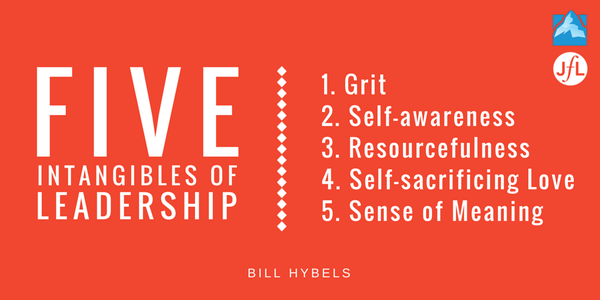
Hybels reflected on Richard Davis’ book The Intangibles of Leadership – and developed his own list of 5 intangibles for leaders:Blog - Global Leadership Summit - 5 Intangibles of LeadershipPhoto Credit: jobsforlife.org

He challenged us to discover the “white-hot why” of our lives – the why of what we do – what really matters for us. For Hybels, it’s “transforming lives”. He is a living example of being faithful to that “why”.

Jim Collins (best-selling author of Good to Great):

Jim Collins talked about what he learned as the recent Chair (2012-2013) for the Study of Leadership at the United States Military Academy at West Point. He reported that: creating a culture out of which great leaders are developed must include

  1. Serving a cause we can be passionate about and for which we would be willing to suffer;
  2. Growing through difficulty; and
  3. Succeeding by helping those around us.

“We succeed at our very best only when we help others succeed. We respond to our own difficulties by reaching out and saying ‘Let me help you.’ To communicate to others: ‘You are never alone.'”

“The greatest leaders find a way to make a contribution, a distinctive impact, on people, on real-live flesh and blood people.”

Ed Catmull (Co-Founder of Pixar Animation Studios; President of Walt Disney Animation Studios; Author of Creativity, Inc.):

Catmull wanted to be an animator from the time he was a child but couldn’t see a path to follow that dream. He ended up studying physics in college.Blog - GLobal Leadership Summit - Ed Catmull by brainpickings.orgPhoto Credit: brainpickings.org

“Science and art are not incongruous. Art isn’t about drawing; it’s about learning to see. Which business or professions do you not want to have enhanced ability to see?”

He talked further about 3 processes in film-making, all relating to accountability:

  1. Teams working together (using a Brain Trust – a group of colleagues all acting as peers, with vested interest, giving feedback;
  2. When failures happen in production – embracing [failure] but at the same time dealing with it with both total candor and kindness; and
  3. Operating within constraints (a budget) – actually pushes creativity higher and delivers better outcomes.

“Stories influence the world. We want to use story-telling for good.”

Adam Grant (Professor, Wharton School of Business; Author of Give and Take: A Revolutionary Approach to Success)

Grant talked about the three kinds of persons you find in the workplace…well, anywhere really:  1) Givers, 2) Takers, and 3) Matchers. After defining each of these and how they interact with each other in the workplace (buy the book), he prescribed ways to build a work culture. A work culture of generosity – the work culture that especially develops the givers, which brings the others along as well.

His three challenges were:

  1. Keep the wrong people off the bus. Get rid of the takers.
  2. Redefine giving. [He talked about the 5-minute favor and the 100 hours of volunteering across a year – these micro-lessons of generosity.]
  3.  Encourage help-seekers. – Developing the givers will nurture a culture of “How can I be the rising tide that lifts all boats?” – a Reciprocity Ring.

Dr. Brené Brown (Research Professor, University of Houston Graduate College of Social Work; Author of Rising Strong):

“Our brain is neuro-biologically hard-wired in the instant of a [hard time; difficult conversation] to make up a story as to what happened. If we can give our brain a story when something hard happens, we are rewarded by our brain (dopamine). Our brain rewards us whether the story is accurate or not. Our worthiness as people lives inside these stories. When we pretend or deny the story, it owns us. When we own the story, we get to write the ending.”

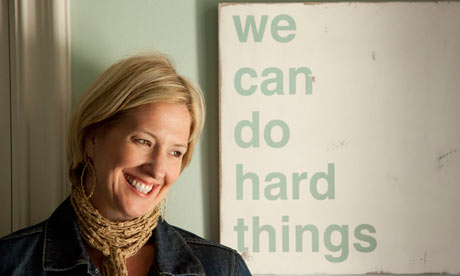
Brene BrownPhoto Credit: TheGuardian.com

Transformational leaders: 1. Do discomfort.  2.They have absolute emotional awareness about their own life, and about the people around them.

“We can’t ignore emotion. We are emotional people who sometimes think. Emotion dictates behavior. If you speak to the way they think or their behaviors, without speaking to their emotions, they will not change. Speak to their emotions. Curiosity and lines of inquiry are the greatest tools of leaders. ‘Help me understand’. “

Sallie Krawcheck (Chair of Ellevate Network; Former President, Bank of America’s Global Wealth & Investment Management):

“The retirement savings crisis is a women’s crisis – we retire with 2/3 the retirement income as men and live 6-8 years longer than men. I love men. I’m married to a man. But you guys are going to die, and we as women will be living with this crisis.”

“My “‘white-hot why’ is advancing women, elevating women. “

“I work every day as though my children are watching me.”

Albert Tate (Founder/Senior Pastor of Fellowship Monrovia, Southern California):

Pastor Tate preached (and I mean preached) on the miracle of Jesus’ feeding of the 5000 (John 6:1-13), using the five loaves of bread and two fish brought to Him from a boy in the crowd.

Tate renounced the leadership lie of “leaving it all on the field”.

“One of the most key things we can do as leaders as to bring what we have, give it to Jesus, and then get out of the way.”

Leaders, you don’t have to go home on empty. You don’t have to leave it all on the field. Christ left it all on the Cross. Bring what you have. Whatever you have, give it back to Him. Then get out of the way, and watch in awe and wonder at what He does.”

These are just 7 take-aways of the 20 pages of notes I took during today’s Summit. Such great teaching – inspiring, empowering, mystifying, really.

Download the Global Leadership Summit app. Read what you can (in these authors’ books and via all the online resources – articles, blogs, video). Take down the dates for the Global Leadership Summit of 2016 and plan to register early.

Being the leader we hope to be is within our reach.

Post-Script: Michael Jr. was on and off stage to make us laugh and to look at life from just a bit of a different angle. Love him!

Blog - Global Leadership Summit - Michael Jr

Photo Credit: MichaelJrComedy

Global Leadership Summit – Willow Creek Association

Global Leadership Summit App

Collaborative Conversations – Quotes to Stir Your Thinking on Leadership and Language in Workplace Decision-making

Blog - Collaborative ConversationsPhoto Credit: AJCarlisle.files.wordpress.com

Change is normal, and resisting change is normal as well. You may be part of an organization or company where sweeping changes are being implemented, even this week. Or maybe you are not on the inside loop of these decisions, so you are not privy to the change coming. Whether you are part of that process or not, consider how you might have a role in making change work, in your sphere of influence, among your colleagues.

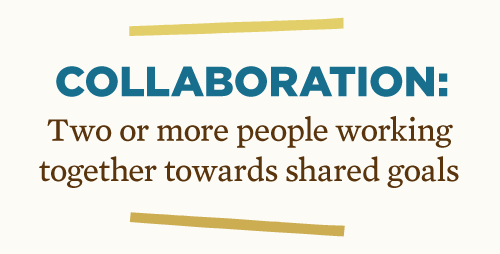
You may already have read and profited from the book Crucial Conversations. Now consider collaborative conversations. Collaboration, simply defined, is “working together towards shared goals”. Collaborative conversations bring a collective intelligence to bear on the problem to be solved, vision to be defined, or direction to be changed.Blog - Collaborative ConversationsPhoto Credit: ThoughtFarmer.com

David Perkins, a Harvard professor, wrote about collaborative conversations in the workplace, using the metaphor of King Arthur’s round table. He described the beneficial nature of bringing several principal players (or stakeholders) to the table and treating each one with an equal or autonomous voice.

“A round table makes it a little easier to pool mental effort. A round table makes a group a little more intelligent…For a group to display intelligence in a sustained way, the members have to value their exchanges and stick together to keep making them. This depends on positive symbolic conduct [side messages sent by our words and behavior]…and collaboration… It’s not ideas, but people with ideas that make things happen.” – David Perkins

“One of the simplest ways to immunize a culture against broken trust, corruption, and animosity is to build a common vision.” – David Perkins

Perkins’ book King Arthur’s Round Table: How Collaborative Conversations Create Smart Organizations is a tremendous resource in developing this kind of decision-making work environment. An Executive Book Summary* can help you get started.

I personally thrive in such a setting and intuitively understand the value-adding nature of collaborative conversations. In researching this workplace topic, and choosing the links below, I came across a fascinating paper** by Heather Davis, a professor of RMIT University Australia.

Davis presented her paper at the 14th International Conference on Thinking (2009, Malaysia). She discussed how workplace leaders often choose “languages of war” in making and communicating decisions and creating change. Her paper is heady stuff but if you read her thoughts below you will want to read the whole paper. It gives huge support to the role of collaborative conversations.

“In [leadership’s] ‘language of zealous allegiance’, there are expectations of allegiance [in the workplace] that lay a path for uncritical acceptance and passivity. This manifests in an expectation that followers be conscripted wholly to the cause. There is little room for questioning. [Davis quotes Hage]: “Conscription means one important thing: there is no questioning of orders, one only executes them; ‘either you’re with us or you’re against us’. “ (Hage, 2004, p. 3).””

“Rhetoric plays out in the workplace too and can be tested by how well leaders:

  • hear and acknowledge the ‘other’ point of view,
  • see the ‘other’ as people rather than pawns or simply abstractions,
  • manage the distance, materially and metaphorically, between themselves and the people and sites affected by their decisions.”

“In the corporate world there are many examples of executives living and working in gated communities or otherwise removed by dint of corporate hierarchy or geography from the people and conditions affected by their decisions. Often, these leaders are also surrounded by people who can only agree, leading to little opportunity for double loop learning or deeply reasoned decision making processes. Whether our leaders live in gated communities is their business, but if they think, work and take refuge within a ‘gated’ mindset then we all need to be concerned. These conditions lead to hubris and have been the undoing of many leaders and corporations.”

“[Leadership’s] language of regrettable necessity translates directly to the “There Is No Alternative”. [This strategy] is used to always move the focus of discussion away from any big picture ‘why’ questions. This is done by shifting the focus to discussions only about the budget pie or, more particularly, the piece of the budget pie that is contestable. People find themselves fighting for a slice of the budget pie and energies focus only on the ‘pie’ and getting the biggest piece of it. This shifts the focus from larger issues such as whether the budget is set correctly, what has been included and what has been excluded. Thinking about alternatives is never an option.”

The role of the organisation is ‘to know its purpose and not be diverted from it’ (Drucker, 1993). This is a timely reminder here – easier said than done in times of flux, complexity and discontinuous change.”

“Language is the visible tip of the cultural iceberg that largely remains hidden.”

“Perkins (2007) used two metaphors in his presentation and so far I have only privileged the five languages of war metaphor in this discussion. The other metaphor used was the “five languages of peace”. The main difference between Perkins’ languages of war and peace are that the war metaphor is founded on exclusivity and a preference for limiting discourse to its [leadership’s] own narrowly defined boundaries. Perkins’s peace metaphor is founded on inclusivity and opening up the space for conversations and conflicting views [i.e., collaborative conversations].”

“Oppositional language and the pitting of one deeply held worldview against another will not lead to resolving the underlying problems of the workplace. Rather, space for conversations to surface underlying assumptions is required. Perkins’ language of peace metaphor confirms that that there are always other lenses to view the world through, not just the one that [leadership] prefers.”

Provocative reading from this Australian educator. Bottom line: Those of us in leadership carry a great burden of responsibility. We at times must make difficult and sometimes painful decisions. Adding voices to that decision-making can generate even more challenging processes to negotiate. Still, we will make more sustainable decisions for “better futures” if we bring those most affected (or most experienced or insightful) to the table. Whenever possible. That’s the gain of collaborative conversations – working together toward shared vision and shared ownership.

Stay engaged in your workplace. You can make a difference.

*King Arthur’s Round TableHow Collaborative Conversations Create Smart Organizations by David Perkins – an Executive Book Summary

Leadership Lessons from King Arthur – a Review of Harvard Professor David Perkins’ book King Arthur’s Round Table

How to Lead When Change is the New Normal

The Art of Collaboration (Collaborative Behaviors) – by Steve Dale (includes a SlideShare)

Collaboration: What Does It Really Mean?

**Troubling Invisible Barriers to Better Futures: Surfacing the “Five Languages of War” in the Workplace – a scholarly paper by Heather Davis, presented at the 14th International Conference on Thinking

The Five Literacies of Global Leadership – What Authentic Leaders Know and You Need to Find Out – by David Hames – Business Book Summary

What Is a Coaching Conversation? from Opening the Door to Coaching Conversations by Linda Gross Cheliotes and Marceta Fleming Reilly 

The Perils of Indifference – a Speech by Elie Wiesel

Cutting Through the Hype – What “Collaboration” Really Means – ThoughtFarmer.com

Making the Workforce Work! The Collaborative Workforce Initiative