Tag Archives: offended

Monday Morning Moment – Offense Revisited

[Adapted from the Archives – Monday Morning Moment – Offense, Being Offended, and Taking Up Offense]

Processing thoughts on the difficult subject of offending and being offended, a song drifts into my hearing from Dave’s office. He is riding his bike (on a trainer) to a playlist that matches his ride (slow/fast/slow). This particular song pounding into my head is rock band The EaglesGet Over It. [Dave will also pull that song up on the occasion he recognizes he’s having a pity party.]

I’ve had some great friends in my life who have spoken reason to me in times when something said or done to me (or to someone I cared about) offended. “Get over it!” was actually a helpful “slap” into reality for me. Reminds me of that old commercial, “Thanks! I needed that.”

The motivation for this piece is walking alongside people I love who have been deeply offended and don’t see a way to get past it. Offenses are hard, especially if they seem intentional.

We still have a choice. We can choose not to be offended…whether it felt the seeming offense was directed toward us or we are tempted to take up offense for another.

Author Desirée M. Mondesir writes a “slap to the face” piece on our culture’s move to looking for and taking up offense. It’s especially fascinating to me because she refers to a student revolt at Yale University. Having taught there years ago, I can see this gradual evolution from reason to riot. It’s a stunning change in society and we are none immune to it.

A Sign of the Last Days – Offense – Desirée M. Mondesir

Mondesir refers to this cultural shift as being a sign of end times.

“And then many will be offended, will betray one another, and will hate one another. Then many false prophets will rise up and deceive many. And because lawlessness will abound, the love of many will grow cold. But he who endures to the end shall be saved.” – JesusMatthew 24:10-13

Sure sounds like today’s culture, in the US anyway.

Writer and counselor John Bevere has written a fascinating book on offense entitled The Bait of Satan: Living Free From the Deadly Trap of Offense. The title put me off at first but in reading it, the whole issue of offense is highlighted as something that turns us inward and keeps us from healthy relationships with one another and with God. When you think about it, Eve, in the first pages of the Torah/Old Testament [Genesis 3:2-7], was the first of humankind to act in offense. In her conversation with the Serpent tempter, she reacted to the Serpent’s suggestion, questioning the instruction (and the goodness) of God. To me, it demonstrates her taking offense that she would be drawn into Satan’s ruse. Even acting in rebellion, presuming God didn’t mean good toward her. She decided for herself to eat from the tree (the one tree God had forbidden), and the consequences of her choosing continue to today.

What could Eve have done differently? She could have trusted God’s heart toward her. If she fell into doubt (through Satan’s cunning argument), she could have sought out the Creator first before she acted on a lie.

When Eve acted in this way, and took the bait, we can see how we, too, can be drawn in – becoming disoriented by someone’s words or deeds, and forgetting what is really the truth of the matter. Our emotions fly away with us, and we bind ourselves in the chains of offense.

Joe Levi puts it this way:

“Someone else cannot “offend” youhowever, you can choose whether or not to take offense at something someone says or does.

Someone else cannot make you mad, happy, sad, or offended – you, and you alone can control how you react to the world around you.

Learn and apply that one relatively simple lesson, and you’ll be much happier in life.”

We may not be able to choose our immediate emotion over a word or action perceived as against us, but we can develop a habit or discipline to determine NOT to take offense.

Currently, the news media is having a hey-day with sound-bytes and interviews hand-picked to incite offense.

We can choose not to take the bait.
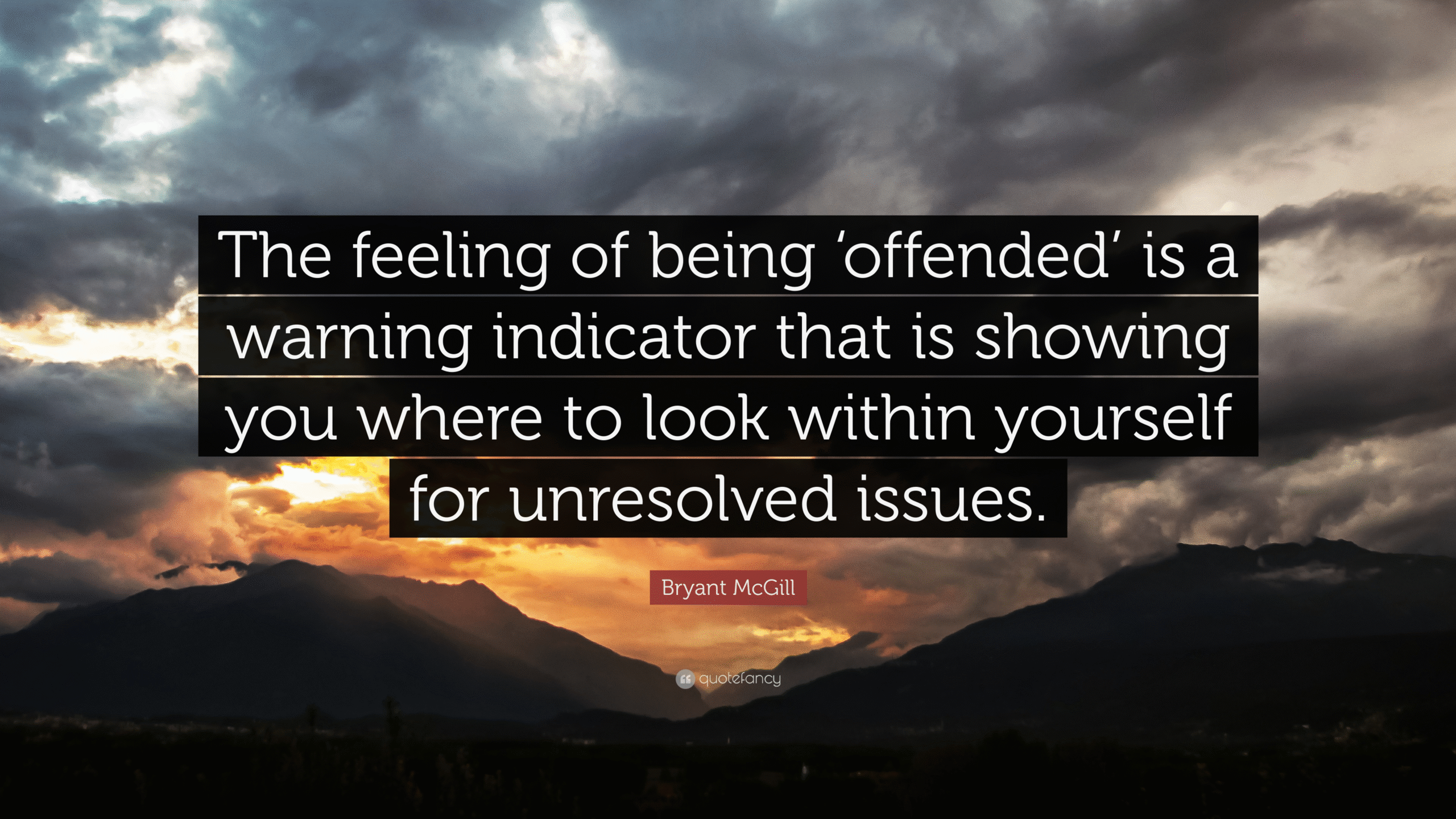
Photo Credit: Quote Fancy, Bryant Mcgill

As for personal situations, people who offend do not always mean to offend. [I don’t say this lightly. Of course, there are those who do. I also am not talking about abuse here. That is a whole other topic, but the principles still apply.] No one knows truly what’s inside us that gives us struggle, not even ourselves. Like the Mcgill quote states, it’s only in our response that we discover that which is still unresolved. Reacting in self-defense or in counter-attack mode brings more hurt. “Hurt people hurt people.” With practice, I can determine not to carry hurt away from a conversation or interaction.

In situations between two people, we can choose not to be offended, but how do we deal with the offense?

Advisor Charles H. Green describes the offender and the offended. He gives excellent counsel in his article Being Offensive vs. Being Offended – and Trust:

  • The offender communicates disrespect. A social violation occurs. Two people are involved and the resolution of that interaction requires input from both of them. When the one offended determines to engage in good faith, trying to seek understanding and rebuild trust, s/he may actually discover the intent of the offending person. A misunderstanding or an action following a perceived threat on the part of the offender may be the issue rather than an intent to hurt.
  • On the side of the one offended, this is not a social situation. It is deeply personal. Only the one offended knows the extent of the offending words/actions. For this reason, the offended person can refuse to think ill of the offender…and not take offense. Then take steps toward reconciliation or, if that’s not possible, make a personal decision not to be hurt by that person. This is not easy…especially at first in training one’s responses.
  • “The answer is a little paradoxical: We should strive not to offend or disrespect others. At the same time, we should also strive to not feel offended, or disrespected, for long. In other words, we should strive to be kind socially, and to feel free psychologically.”
  • Forgiveness opens the door wide to reconciliation. Forgiveness can defuse the hurt. Boundaries may come into play, but if the boundaries are built out of fear, dread, anger, or hatred, we are still not free from offense.

My biological father abandoned us long before my mom left him (before my sixth birthday). I saw him only twice after that. For years, I wrote him letters with no response, and then I stopped. My love for him grew cold. If he had any sense of needing forgiveness or asking for forgiveness, I don’t know. He died before I told him I forgave him. Every time this comes to mind, forgiving him is revisited. That’s a regret for me. However, I know the beautiful experience of forgiving a long-played offense from my older brother. Robert, who had deep pain of his own, struck out at others. My response for years was being offended at him or taking up an offense for other family members. It wasn’t pretty. Then, thanks to the wisdom and honesty of friends, I came to my senses on his offenses and my reactions. No more taking up an offense when Robert attacked…and the attacks died. He and I became closer than we had ever been over our lives. In fact, he gentled in his relationship with our siblings also. Those brief years (which could have been more if I had understood sooner) were great blessings (hopefully to both of us). When he died suddenly in his 60s, I carried no regrets. #Unoffendable #Forgiveness – I forgave him and he forgave me…without the words but walking out forgiveness with each other. So much grace in that.

Photo Credit: Unoffendable, Brant Hansen

Thoughts?

Being Offensive vs. Being Offended – and Trust – Charles H. Green

Unoffendable: How Just One Change Can Make All of Life Better – Brant Hansen

What Is the Difference of Being Offended and Harmed? – Robert Enright

Stop Being Offended Today: 3 Cures for Everything That Irritates You – Bill Apablasa

Forgiving in Two Dimensions – Peace Pursuit

Mel Robbins on the “The Let Them Theory” – Sarah Fielding
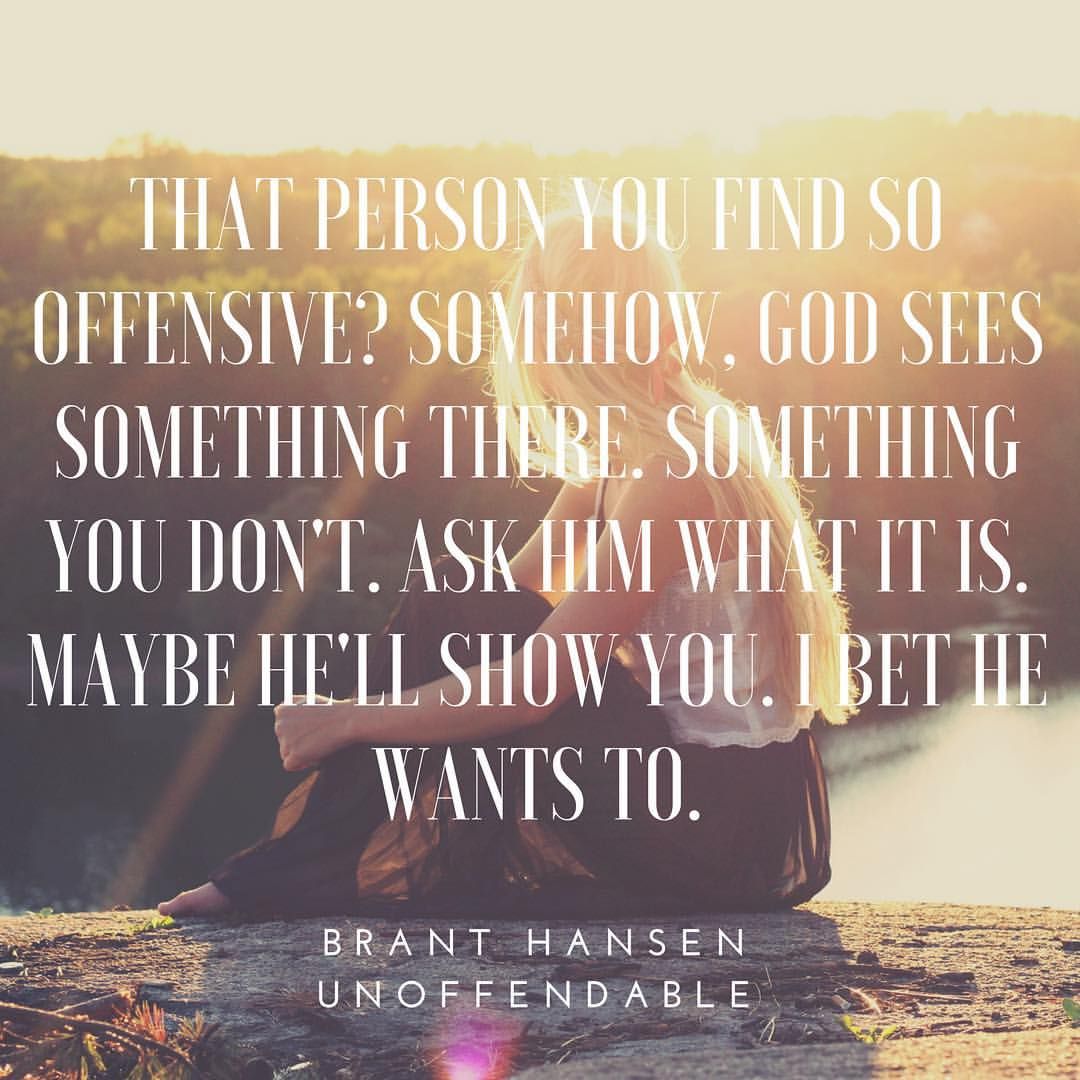
Photo Credit: Brant Hansen, Unoffendable, Pinterest

Monday Morning Moment – Sensitiveness – This Might Not Be About You

Photo Credit: QuickMeme

Adapted from the Archives

The word “victim” is one I rarely use because the word itself further victimizes the person. Sometimes we may intend to wound with our words, but often we just state/post a thought, viewpoint, or opinion having no idea what a strong and public reaction we may receive in the aftermath.

Just yesterday, I was in a Twitter conversation where what I said exploded a barrage of words (from passersby not the person with whom I was engaged). My person (we follow each other but don’t know each other) had been victimized by an awful situation and I was trying to comfort and reason with him over it. Then the attacks came (not from him but from others). The words “Karen”, “gaslighting”, “oppressor”, and a “cishet” Christian (not in a good way) were used to describe me (I had to look up the linked words).

We stick to our own in life, in a way to enjoy a certain measure of understanding and acceptance. If we stay surface enough, we hopefully don’t offend, don’t disturb the sensitiveness of another.

Decide to go deeper or venture out among those different from us (be it politically, or gender identity, or race/ethnicity), in our current culture, it can get messy.

I want deep and wide relationships with people, but at times, I will mess up or be misunderstood. Our social media walls can get full of the most always graffiti, well-deserved, others might say.

Real face-to-face conversation and not fleeing the scene can both help…at least the relationship. The passer-bys? Not so much. I want to scream sometimes, “This might not be about you.”

Photo Credit: Flickr

I digress…

Years ago, my best friend and I went on a cross-country sight-seeing trip. Our plan was to camp out a couple of nights and then stay in a hotel for the third, and continue in that rhythm for the two weeks we were on our adventure. It didn’t always go well. I loved camping; she preferred the hotel. Our food preferences were more different than we realized. We did, fortunately, agree on the “not to be missed” aspects of our journey across America.

Along with all the great memories made, we had some humdinger disagreements through the course of our time away and returned home even better friends as an outcome. However, it didn’t come easily for either of us.

It turns out I could majorly stomp on her feelings without even knowing that was happening.

First, you must know I never intended to plow through her preferences to race toward my own. She was my dearest friend. It gave me joy to see her happy. Still…somewhere I crossed a line.

We have both matured greatly since then so this can encourage you…it has encouraged me in more recent times when I find myself in similar situations.

In our responses to one another, as friends, family, colleagues, (even strangers on social media) we can discover things both about ourselves and about the other.

Emotions are different from feelings. I’m not going into the physiological pathways or mental habit formation of all this, but the quote below by Debbie Hampton is very helpful:

Feelings and emotions are two sides of the same coin and highly interconnected but are two very different things…Emotions originally helped our species survive by producing quick reactions to threat, reward, and everything in between in their environments. Emotional reactions are coded in our genes. Emotions precede feelings, are physical, and instinctual. Feelings are sparked by emotions and colored by the thoughts, memories, and images that have become subconsciously linked with that particular emotion for you. But it works the other way around too. For example, just thinking about something threatening can trigger an emotional fear response. While individual emotions are temporary, the feelings they evoke may persist and grow over a lifetime…In the gaps between emotion, feeling, and acting, we all have the power to change and direct our lives for the better. “Debbie Hampton

In the milliseconds between any stimulus and our response to it, we can choose how we will respond emotionally. However, because we have set a course “over a lifetime” of responding certain ways, emotional patterns (feelings) are formed and put into practice. We can change these, if we find them detrimental to our physical, emotional, and relational lives.

That happened between my friend and me. In close proximity, for two weeks, our daily experience being very dependent on the other, we found we could each be irritating. The statements “That hurt my feelings” or “You hurt my feelings” became her lament…this from an accomplished teacher and successful manager of a classroom of tiny people.

For me…inconceivable. I loved her and had no desire to hurt her, ever. Still, it happened.

[By the way, this expression of sensitiveness using the word “feelings” may be more encountered in women, but men have some similar experience – you know you do – but call it different things. “Offended”, maybe? “Annoyed”? Is that where sarcasm or cynicism is birthed?]

Back to the story: In some way, my behavior set off for my friend emotions that were tagged by past feelings of being discounted, not considered, not favored. It wasn’t pretty…for either of us.

Fast forward, decades later.

We live in a culture of lofty sensitiveness. The measure for political correctness in our speech continues to get moved upward. We are a nation so easily offended that we can’t even discern what is truly intentionally offensive from what is just true.

Have you ever been in a season with a friend or colleague that feels emotionally murky? You don’t really know what’s going on, but you sense something is. Then…you step on the landmine – and you say something or do something or your face shows something – that explodes all kinds of feelings in the other person, from what seems a life-time of storing up.

This is what has now been popularized as weaponizing feelings or emotions. The outcome? Guilt, shame, wounding, and (for some) returning fire.

It will make me sad if this post “hurts feelings”, especially of those dear to me who read the blog. The thing is, just like my friend and me, we can go deeper in our relationships when we refuse to let feelings define our friendships. When we refuse to think ill of others we grow a spiritual maturity and neuroplasticity that impacts our emotional responses and our relational resilience.

What got me thinking about all this, this week was actually a reading from British scholar C. S. Lewis

He talks about the danger of weaponizing sensitiveness long before it became the cultural phenomenon it is today:

“‘Did you fight fair?’ Or did we not quite unknowingly falsify the whole issue? Did we pretend to be angry about one thing when we knew, or could have known, that our anger had a different and much less presentable cause? Did we pretend to be ‘hurt’ in our sensitive and tender feelings…when envy, ungratified vanity, or thwarted self-will was our real trouble? Such tactics often succeed. The other parties give in. They give in not because they don’t know what is really wrong with us but because they have long known it only too well, and that sleeping dog can be roused, that skeleton brought out of its cupboard, only at the cost of imperilling their whole relationship with us. It needs surgery which they know we will never face. And so we win; by cheating. But the unfairness is very deeply felt. Indeed what is commonly called ‘sensitiveness’ is the most powerful engine of domestic tyranny sometimes a lifelong tyranny. How we should deal with it in others I am not sure; but we should be merciless to its first appearances in ourselves.Preparing For Easter: Fifty Devotional Readings from C. S. Lewis.

After being an atheist, Lewis did not come to faith in Christ until his mid-thirties. His intense study of the Bible, relationship with God, and deep, gut-honest conversations with a circle of intimate friends moved him to such understanding of people and life…and our responses to both.

Any thoughts on this? Please comment below.

Preparing For Easter: Fifty Devotional Readings from C. S. Lewis

What Is the Difference Between Feelings and Emotions? – Debbie Hampton

The “Weaponizing” of EmotionsWade Trimmer

The A-Z Guide to Feelings and Emotions – Sebastian Gendry

Monday Morning Moment – Neuroplasticity – Resetting Your Brain for Success at Work and Life – Deb Mills

Inner Circles – the Mad Pursuit of Position, Power, Prominence, and Plenty – Deb Mills

Invisible Wounds of the Sensitive, Empathic and Emotionally Intense Child – Imi Lo – this is a sobering, emotionally charged article. I resonated with it in preparing for the blog above and include it because it might be helpful for some to read. Just a warning that it is hard to read because it honestly did not give much place for hope. [If I missed it, please illuminate me in the Comments below.] Maybe the hope comes in recognizing what we as parents might be doing that’s hurtful to an emotionally intense child and correct course.

Monday Morning Moment – The Tyranny of Sensitiveness – C. S. Lewis

Photo Credit: QuickMeme

Years ago, my best friend and I went on a cross-country sight-seeing trip. Our plan was to camp out a couple of nights and then stay in a hotel for the third, and continue in that rhythm for the two weeks we were on our adventure. It didn’t always go well. I loved camping; she preferred the hotel. Our food preferences were more different than we realized. We did, fortunately, agree on the “not to be missed” aspects of our journey across America.

Along with all the great memories made, we had some humdinger disagreements through the course of our time away and returned home even better friends as an outcome. However, it didn’t come easily for either of us.

It turns out I could majorly stomp on her feelings without even knowing that was happening. We have both matured greatly since then so this can encourage you…it has for me in the times in recent years when I find myself in similar situations.

First, you must know I never intended to plow through her preferences to race toward my own. She was my dearest friend. It gave me joy to see her happy. Still…somewhere I crossed a line. In our responses to one another, as friends, family, colleagues, (even strangers on social media) we can discover things both about ourselves and about the other.

Emotions are different from feelings. I’m not going into the physiological pathways or mental habit formation of all this, but the quote below by Debbie Hampton is very helpful:

“Feelings and emotions are two sides of the same coin and highly interconnected but are two very different things…Emotions originally helped our species survive by producing quick reactions to threat, reward, and everything in between in their environments. Emotional reactions are coded in our genes. Emotions precede feelings, are physical, and instinctual. Feelings are sparked by emotions and colored by the thoughts, memories, and images that have become subconsciously linked with that particular emotion for you. But it works the other way around too. For example, just thinking about something threatening can trigger an emotional fear response. While individual emotions are temporary, the feelings they evoke may persist and grow over a lifetime…In the gaps between emotion, feeling, and acting, we all have the power to change and direct our lives for the better. “Debbie Hampton

In the milliseconds between any stimulus and our response to it, we can choose how we will respond emotionally. However, because we have set a course “over a lifetime” of responding certain ways, emotional patterns (feelings) are formed and put into practice. We can change these, if we find them detrimental to our physical, emotional, and relational lives.

That happened between my friend and me. In close proximity, for two weeks, our daily experience very dependent on the other, we found we could irritate each other. The statements “That hurt my feelings” or “You hurt my feelings” became her lament…this from an accomplished teacher and successful manager of a classroom of tiny children. Somehow, on this trip, I had the capacity, regularly, of stealing her joy.

For me…inconceivable. I loved her and had no desire to hurt her, ever. Still, it happened.

[By the way, this expression of sensitiveness using the word “feelings” may be more encountered in women, but men have some similar experience – you know you do – but call it different things. “Offended”, maybe? “Annoyed”? Is that where sarcasm or cynicism is birthed?]

Back to the story: In some way, my behavior set off for my friend emotions that were tagged by past feelings of being discounted, not considered, not favored. It wasn’t pretty…for either of us.

Fast forward, decades later.

We live in a culture of lofty sensitiveness. The measure for political correctness in our speech continues to get moved upward. We are a nation so easily offended that we can’t even discern what is truly intentionally offensive from what is just true.

Have you ever been in a season with a friend or colleague that feels emotionally murky? You don’t really know what’s going on, but you sense something is. Then…you step on the landmine – and you say something or do something or your face shows something – that explodes all kinds of feelings in the other person, from what seems a life-time of storing up.

This is what has now been popularized as weaponizing feelings or emotions. The outcome? Guilt, shame, wounding, and (for some) returning fire.

It will make me sad if this post “hurts feelings”, especially of those friends of mine who read my stuff. The thing is, just like my friend and me, we can go deeper in our relationships when we refuse to let feelings define our friendships. When we refuse to think ill of others we grow a spiritual maturity and neuroplasticity that impacts our emotional responses and our relational resilience.

What got me thinking about all this, this week was actually a Lenten reading from British scholar C. S. LewisPreparing For Easter: Fifty Devotional Readings from C. S. Lewis.

He talks about the danger of weaponizing sensitiveness long before it became the cultural phenomenon it is today:

“‘Did you fight fair?’ Or did we not quite unknowingly falsify the whole issue? Did we pretend to be angry about one thing when we knew, or could have known, that our anger had a different and much less presentable cause? Did we pretend to be ‘hurt’ in our sensitive and tender feelings…when envy, ungratified vanity, or thwarted self-will was our real trouble? Such tactics often succeed. The other parties give in. They give in not because they don’t know what is really wrong with us but because they have long known it only too well, and that sleeping dog can be roused, that skeleton brought out of its cupboard, only at the cost of imperilling their whole relationship with us. It needs surgery which they know we will never face. And so we win; by cheating. But the unfairness is very deeply felt. Indeed what is commonly called ‘sensitiveness’ is the most powerful engine of domestic tyranny sometimes a lifelong tyranny. How we should deal with it in others I am not sure; but we should be merciless to its first appearances in ourselves.C. S. Lewis

After being an atheist, Lewis did not come to faith in Christ until his mid-thirties. His intense study of the Bible, relationship with God, and deep, gut-honest conversations with a circle of intimate friends moved him to such understanding of people and life…and our responses to both. Any thoughts on this? Please comment below.Photo Credit: Flickr

Preparing For Easter: Fifty Devotional Readings from C. S. Lewis

What Is the Difference Between Feelings and Emotions? – Debbie Hampton

The “Weaponizing” of Emotions Wade Trimmer

The A-Z Guide to Feelings and Emotions – Sebastian Gendry

Monday Morning Moment – Neuroplasticity – Resetting Your Brain for Success at Work and Life – Deb Mills

Inner Circles – the Mad Pursuit of Position, Power, Prominence, and Plenty – Deb Mills

Invisible Wounds of the Sensitive, Empathic and Emotionally Intense Child – Imi Lo – this is a sobering, emotionally charged article. I resonated with it in preparing for the blog above and include it because it might be helpful for some to read. Just a warning that it is hard to read because it honestly did not give much place for hope. [If I missed it, please illuminate me in the Comments below.] Maybe the hope comes in recognizing what we as parents might be doing that’s hurtful to an emotionally intense child and correct course.

Worship Wednesday – ‘Tis the Season – What’s at Stake When We Indulge In Attacking Each Other

Blog - House Divided - coffeewiththeking.orgPhoto Credit: coffeewiththeKing.org

“A new commandment I give to you, that you love one another, even as I have loved you, that you also love one another. By this all men will know that you are My disciples, if you have love for one another.”Jesus, John 13:34-35

“Why do you look at the speck that is in your brother’s eye, but do not notice the log that is in your own eye? Or how can you say to your brother, ‘Let me take the speck out of your eye,’ and behold, the log is in your own eye? You hypocrite, first take the log out of your own eye, and then you will see clearly to take the speck out of your brother’s eye.”Jesus, Matthew 7:3-5

Do not tear down the work of God for the sake of food. All things indeed are clean, but they are evil for the man who eats and gives offense. It is good not to eat meat or to drink wine, or to do anything by which your brother stumbles. The faith which you have, have as your own conviction before God. Happy is he who does not condemn himself in what he approves.”Paul, Romans 14:20-22

The “happy holidays” are upon us – juxtaposed against a landscape of polarizing political campaigns and various divisive protests and boycotts. In a season of the year (for us in the USA, in particular), we could enjoy warm community and loving unity, even when we differ on some things. Yet, we still divide ourselves up into various camps.

Where are we to land in all of this as Christ-followers?

For sure, it is not in attacking those who are not like us or who may be like us but differ in preference or opinion. Especially, we who call the name of Jesus as Savior – we have no ground to stand on in attacking each other…ever.

So why do we do it? There is this soul satisfaction that comes with feeling right, or smarter, or more cool, or culture-savvy. A soulish satisfaction from which God has actually called us, and toward something extraordinarily better. A unity, a bond of love. A love by which we are known to the rest of the world as followers of Jesus. Here there is even ground for all of us, the weaker brother and the stronger one (that one who becomes weaker when he taunts or shames the other). Jesus calls us to deal with our own flawed perspective (“log”) before we can help dislodge the painful speck from our brother’s eye.

Do we really care about the other, that one God calls us to love as we love ourselves? Do we show that love to the world when we treat those with whom we disagree with the same derision or contempt as the world does? Or worse? Are we keeping company with arrogant haters or are we becoming one? When we publically part company with believers who are offended by what we consider silly matters, what is at stake?

You may ask, “what about those hate-filled people who call themselves Christians and who protest all sorts of things, based on their “Christian” sensibilities?”. Still…Scripture is clear how we are to treat them…Jesus calls us to love even our enemies. (Matthew 5:43-45)

“If a house is divided against itself, that house will not be able to stand.”Jesus, Mark 3:25

There is much to lose and much more to gain in wrestling successfully with this dilemma – exposed in our private conversations and public (un-social) media.

Voices of Wisdom to help us – Keep Unity, Guard Community – Choosing to Love, Refusing to Shame

Blog - House Divided - Scott Sauls

Scott Sauls is the author of Jesus Outside the Lines: A Way Forward for Those Who Are Tired of Taking Sides . He has also written the richest piece on this whole shaming and raging culture that colors us as Christ-followers, if we partake in its rank hatefulness. In fact, I can’t even quote from his article, because I want you to read it…please. It is a quick but full read on identifying the problem, and seeing what is the truth of how we are to live, in the example of a living, flesh-and-blood human-like-us man, Tim Keller. Please…read Scott’s article. Transforming.

Christians are in many ways a band of opposites, who over time grow to love one another through the centering, unifying love of Jesus…sincere believers can disagree on certain matters, sometimes quite strongly, and still maintain great respect and affection for one another…I don’t know where I would be without the influence of others who see certain non-essentials differently than I do..In non-essentials, liberty. And to this we might add an open-minded receptivity. We must allow ourselves to be shaped by our ‘other’ brothers and sisters for Jesus’ sake. We will be the richer for it.” – Scott Sauls

“This great passion for souls [Romans 9:1-3] gave Paul perspective. Lesser things did not trouble him because he was troubled by a great thing – the souls of men. ‘Get love for the souls of men’ – then you will not be whining about a dead dog, or a sick cat, or about the crotchets of a family, and the little disturbances that John and Mary may make by their idle talk. You will be delivered from petty worries (I need not further describe them) if you are concerned about the souls of men…Get your soul full of a great grief, and your little griefs will be driven out. – Charles Spurgeon – Spurgeon Gems, p. 7-8

“I will never get why we defend our chicken sandwiches and our gingerbread lattes but we won’t take a stand for the things that actually matter to God. Are we loving the Lord with all our heart, soul, mind, and strength? Are we loving our neighbor as ourselves? Are we obeying God in our personal lives? Are we defending and providing for the poor, the widow, the orphan, and the immigrant? Are we sharing the hope we have in Christ? That’s pretty much our full job description.” – Angela

Blog - House Divided - Jonathanpearson.net

Photo Credit: JonathanPearson.net

What I Came To Respect Most About Tim Keller (Even More Than His Preaching) by Scott Sauls

We Disagree, Therefore I Need You by Scott Sauls

Jesus Outside the Lines – a Way Forward for Those who are Tired of Taking Sides by Scott Sauls

What Stops Our Fighting? by Tony Reinke