Category Archives: Resilience

Monday Morning Moment – Neuroplasticity – Resetting Your Brain for Success at Work and Life

Photo Credit: Pixabay

You know that shocking experience when you are driving to a known destination and then get lost in your thoughts? At some point, you snap back to attention and wonder, “How did I get here, I wasn’t even thinking about it?!” That is neuroplasticity or brain plasticity. It is an amazing capability we all have and can be nurtured and utilized throughout our lives. Yes, “old dogs CAN learn new tricks“.

What is this phenomenon?

Mike Torres, of Refocuser, gives an excellent definition, as well as an explanation of function, in his piece Neuroplasticity: Your Brain’s Amazing Ability to Form New Habits.

Neuroplasticity refers to the brain’s ability to restructure itself after training or practice. An example of how neuroplasticity works: when you view the brains of people who frequently practice playing the violin under fMRI (functional MRI) they appear to have developed a larger area of their brain devoted to mapping their fingers.  Photo Credit: Wikipedia

This change is directly related to the quantity and the quality of the practice they’re performing – their brains are adapting in very real and tangible ways unbeknownst to them... The more practice you accumulate, the more ingrained or grooved the pathways become.  Of course the inverse happens as well: if those pathways aren’t utilized, the space will be used by other pathways needing room to grow. Use it or lose it! …Your brain can change based on repeated experience…People of any age have the ability to learn new things and form new habits. – Mike Torres, Refocuser

Watching Nathan play intricate, complicated runs on his classical guitar boggles my mind. How can he think that fast? It’s lots of practice that causes the brain to connect to the hands, and those difficult pieces get “under his fingers” almost without thinking.

Years ago a friend gave us this book Never Too Late by John Holt. In his “musical life story”, Holt describes how he learned to play the cello in his 40s. We were encouraged by this during a time we moved to Egypt and learned Arabic in mid-life…when language-learning is supposed to be especially difficult.

I love neuroplasticity but it gives me hope, in getting older, of keeping skills and developing new ones, even as an aging person…unless I give in to dumbed-down practices excusing myself for the same reasons of “getting too old”.

When my older brother suffered a stroke, it was neuroplasticity and the repeated efforts of his medical and therapy team that got him back on his feet. He finally “repeatedly practiced” his way back to independence. The personality changes seemed more ingrained, however, they changed, too, as he exchanged his anger and bitterness for a hopefulness and longing for healthy, loving relationships. As he refused to give into anger and chose soft responses, his personality seriously changed over time…with conscious that eventually turned unconscious practice.

How does all this apply to us in the workplace and life, in general? We are confronted at times with a situation that confounds us – a new uncomfortable skillset, an unpredictable relationship, or an unfamiliar decision-making process. Neuroplasticity helps us to not just give up on mastering either a new work process or a complicated interpersonal situation.

Debbie Hampton has written an excellent summary piece on this that will help kick-start any new habit formation necessary for us to continue to do excellently in our work. She was influenced by Dr. Michael Merzenich’s work published in his book Soft-Wired: How the New Science of Brain Plasticity Can Change Your Life. I have listed below Merzenich’s 10 elements of how we can rewire our brain. You will find Hampton’s summary on each very instructive. [I comment briefly on each but don’t miss what she says in her article.]

10 Core Principles for Remodeling Your Brain

1. Change is mostly limited to  those situations in which the brain is in the mood for it. We have to want to learn and change. If we give up, stay resigned to the status quo, or remain fed-up, change will not happen. Want change!

2. The harder you try, the more you’re motivated, the more alert you are, and the better (or worse)  the potential outcome, the bigger the brain change. Focus and persistence or key to mastery.

3. What actually changes in the brain are the strengths of the connections of neurons that are engaged together, moment by moment, in time. Practice strengthens pathways for behavior. Whether it’s learning a new computer system or developing a different way of communicating with a boss…practice hard-wires.

4. Learning-driven changes in connections increase cell-to cell cooperation, which is crucial for increasing reliability. I see this in musicians who live-stream and can read listener chats, respond to them, and continue playing all at the same time. Crazy.

5. The brain also strengthens its connections between teams of neurons representing separate moments of successive things that reliably occur in serial time. This is definitely the mechanism that gets us to our destination when we stop thinking about where we’re going.

6. Initial changes are temporary. Habit formation takes time, and somehow the brain interprets whether the change is vital. Amazing.

7. The brain is changed by internal mental rehearsal in the same ways and involving precisely the same processes that control changes achieved through interactions with the external world. At the simplest level, this is the mechanism of how we “talk ourselves through” a situation. Or when an athlete goes through his routine in his mind before he’s back out on the track or in the pool.

8. Memory guides and controls most learning. Our brain actually helps us to remember what we did well and discards what we didn’t.

9. Every movement of learning provides a moment of opportunity for the brain to stabilize — and reduce the disruptive power of — potentially interfering backgrounds or “noise.” The more we practice, either a physical skill or a way of thinking through a problem, we actually get better at it because somehow the brain reduces the background noise (which can include insecurity, fear of failure or self-doubt).

10. Brain plasticity is a two-way street; it is just as easy to generate negative changes as it is positive ones. Dr. Merzenich warns us, as we get older that we “use it or lose it” by our own decisions to stop learning and mastering new skills and behaviors.
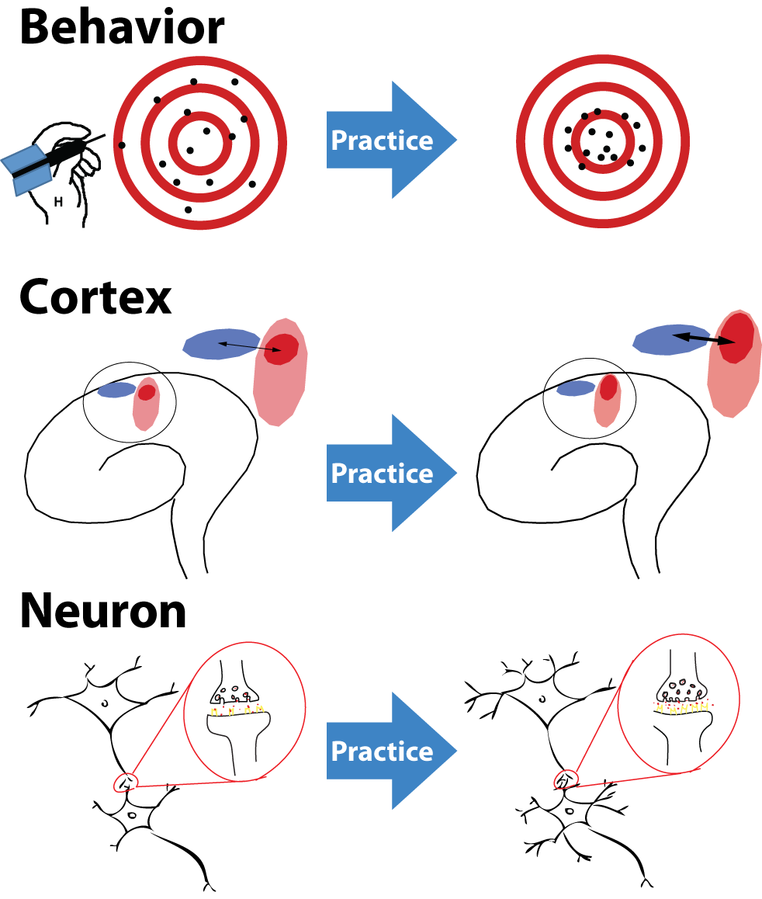
Photo Credit: Commons Wikimedia

How are you using neuroplasticity to help you continue to grow in your work and personal life? Trevor Blake encourages us to set the tone of the day positively and don’t defect from that. Using self-defeating language can blur our focus and mental capacity for mastery. Read more of his excellent counsel here.

As we age, or give in to “what is” at the moment (tracks greased by depression sometimes, or perceived lack of ability or opportunity), we may not realize the great positive effects of neuroplasticity. However, the good news is that we can keep learning and changing and mastering what work and life and relationships bring our way. It’s never too late.

http://www.slideshare.net/smarkbarnes/brain-science-applying-neuroplasticity-principles-to-higher-education-1340661


Neuroplasticity: Your Brain’s Amazing Ability to Form New Habits – Mike Torres

How to Rewire Your Brain for Success – Trevor Blake

Three Simple Steps: A Map to Success in Business and Life – Trevor Blake

Brain HQ Website

How Does Neuroplasticity Work – an Infographic

Never Too Late: My Musical Life Story – John Holt

Deadly: Brain on Multitasking – Bukunmi Adewumi

Toxic Thoughts – Dr. Caroline Leaf

This Quiet Girl – To Know Her Is To Love Her, and I Know Her Very Well

30 years ago, I knew this would be the day. Our baby was coming. It was still the wee hours of the morning, but labor wakes us. I let Dave sleep until it got to a place that I knew we probably needed to go. It was a windy pre-dawn drive to the hospital. That first day of March.

“It’s a girl!” How would I have known then how much she would change our lives? We had an inkling when, just days into parenting, and my hormones all over the place, I looked up at Dave, with her in my lap and tears in my eyes. “What if something were to happen to her?” – asked the new mom on the edge. Dave brought me back to myself when he said, “Look at how much joy she’s brought us in just these few days. We treat each day as precious…” It was something like that. He doesn’t remember, and all I can say is that each day has been precious.

This quiet girl spent her preschool years in East Tennessee enjoying friends from the neighborhood and church. She didn’t require much entertaining. The world of her imagination was rich and deep. She welcomed two little brothers in that time.

As their big sister, she created elaborate make-believe games, and they loved following her lead in play. This, of course, would end in time, as teen years would find all three off doing more of their own thing. Fun times together and shared memories.

Other times, the boys thought of her more like an old aunt…a third parent…rather than sister. Fortunately that season passed with them all still friends.

This quiet girl has known God since she was tiny. She’s always been an old soul, and that sensibleness and understanding about life informed her grasp of God. She isn’t perfect, by any means, but she carries into adulthood a faith that both anchors her and moves her toward His purposes.

She loves music and for all her life she has filled our home with singing or piano playing. I don’t know if that influenced her guitarist or harpist brothers. Their music has just been a joy…for the most part…our musical tastes have all had their own journeys. Remembering her high school girl band days still makes me smile. She plays the radio now more than the piano, and she isn’t pursuing a choir or praise team experience…but I hope she does again one day.

When we pulled her out of her lovely small-town life, along with her brothers, to move to Africa, this quiet girl took it in stride. We were always grateful to see the hand of God in these adjustments. There were tears…great, gushing cries over missing friends and family and grieving precious things left behind (even her dog once)…my heart would almost break over those tears. Then, like the sun breaking through storm clouds, she would give in to laughter. That would break the tension for all of us…that crazy-sweet laughter from a tear-drenched face. Her own wrestling through the many moves of our lives had to have helped our boys do the same. She helped us, for sure.

Making friends was sometimes challenging for this one whom we bounced around from country to country. Always having to start over was hard for her. She’s not one to push in or draw attention to herself. How thankful we were for the friends who opened up to friendship with this quiet girl. They are some of her most cherished friendships. When she does feel comfortable enough to be herself, she probably surprises people with her resoluteness, strong opinions, and deep loyalties. These are actually things I appreciate about this quiet girl. She is not going away. As we get older, it is a tremendous comfort to know that she has settled that. She will be there, God willing. With this one, you get life-long friendships and forever love.

When this quiet girl went back to the US for college, we would miss her terribly. Our home re-configured and the boys became the young men of the house. Her visits home were dear for all of us…as she perched around wherever we had landed at home and told us stories of life at school. I never tired of those stories.

After college, she would teach for several years (both inner city and county schools). Lots of crying followed by laughter in those days. The friendships that came out of both college and teaching are precious to her…lots of battle scars and victories to share there.

This quiet girl fell in love. She never really dated in high school. We as her parents were glad she, or the boys, didn’t suffer serial broken hearts. To find one so right for her as the quiet young man she married gladdened our hearts for her…and for us all.

Then she finally got a much-longed-for sister when one of her brothers married (and another when her husband’s brother married).

…and our first grandchild has this quiet girl as mommy.

[No pics of this little one on the blog yet. One day… The grandparents, I can tell you, are smitten with this little one not-so-quiet as the parents.]

I guess it’s a 30th birthday that made me want to write about this quiet girl. To know her is to love her, and I know her very well.

So Sweet Girl, Dear Daughter of ours, when you read this blog (and you do, so thanks for that), on this your 30th birthday, hope you’re having a Beautiful Day and know how Priceless you are to God Himself and to all who know and love you.

Love Your Neighbor – the Resilience Movie and Adverse Childhood Experiences (ACEs)

Earlier this week, I had the privilege to attend a screening of the film Resilience. This documentary introduces the health issue of Adverse Childhood Experiences* (ACEs) and how, if unchecked, lead to adulthood diseases and dysfunction. This was both alarming and eye-opening for me. A closely related issue had already captured my interest – Trauma Healing – involving intervention with children and adults displaced and wounded by wars, famine, and other calamities.

The long-term impact of Adverse Childhood Experiences was first identified in a huge and significant study done in the 90’s by Dr. Vincent Felitti and Dr. Robert Anda. You can read more of the study, but the main take-away for me is that children who experienced trauma, and do not experience informed intervention, will have compounded health issues through their adult life.

Dr. Robert Block, former president of the American Academy of Pediatrics, had this observation: “Adverse childhood experiences are the single greatest unaddressed public health threat facing our nation today.”

Drs. Felitti and Anda developed a short 10-question questionnaire which can be used by any one of us to identify risks in our children or self-identify high risk. After watching the film, I came home and decided to take the ACE quiz to see what my numbers were. My numbers were low.

Take the ACE Quiz and Learn What It Does and Doesn’t Mean.

[PDF of 10-question ACE Quiz]

However, looking longer at the quiz, I thought of my mom (whose childhood – growing up in poverty with an alcoholic and abusive father – was very different from mine). Even though my childhood had some adversity, Mom buffered our lives from some stresses we would have experienced. I also thought of others in my family and among our friends who have had to endure much tougher childhoods. They are all adults now, so I wondered what their options were to reverse some of the trauma and build resilience. This research and the trauma-informed care that has developed out of it give tremendous hope.

There are so many resources now available to us to heal and help others heal. One of the young pioneers in this field is Dr. Nadine Burke Harris. Here is a bit of her take on the issue of ACEs and their impact on adult health:

As San Francisco pediatrician Nadine Burke Harris recently explained to host Ira Glass on the radio program, “This American Life”, if you’re in a forest and see a bear, a very efficient fight or flight system instantly floods your body with adrenaline and cortisol and shuts off the thinking portion of your brain that would stop to consider other options. This is very helpful if you’re in a forest and you need to run from a bear. “The problem is when that bear comes home from the bar every night,” she said.

Dr. Nadine Burke Harris and faux patient (for the photo)

If a bear threatens a child every single day, his emergency response system is activated over and over and over again. He’s always ready to fight or flee from the bear, but the part of his brain – the prefrontal cortex – that’s called upon to diagram a sentence or do math becomes stunted, because, in our brains, emergencies – such as fleeing bears – take precedence over doing math.

For Harris’ patients who had four or more categories of adverse childhood experiences “their odds of having learning or behavior problems in school were 32 times as high as kids who had no adverse childhood experiences,” she told Glass. – Jane Ellen Stevens, Aces Too High

[TED Talk – How Childhood Trauma Affects Health Across a Lifetime – Dr. Nadine Burke Harris]

If you are like me, you will want to learn more and be a part of trauma-informed care, you can search for local agencies to help. In our city, we have a cooperative called Greater Richmond Trauma-Informed Community Network. I am looking forward to taking advantage of training and volunteering through this agency.

This may be very new knowledge for you. It was for me. Huge “light-bulb” experience. There are children out there put on medication for ADHD when (after further evaluation) are struggling to attend in the classroom because they are chronically on edge (as Dr. Harris defined with the constant threat of an attacking bear).  What a difference could be made in these children’s lives if their stressors are properly confirmed and then counseling for them and education for their parents/other support adults are initiated.

To think about how children who have been traumatized will still bear that trauma through their adult lives and bodies is unthinkable. Now that we know better.

Have a look at the ACEs Quiz. Pour over the infographics.  Learn from the links below.  Think about your own situation and that of those you love or serve (in a classroom, community/medical setting, faith-based institution). Then act…it could mean longer and higher quality of life. Resilience and healing can come out of this.

In closing, I would love to hear something of your take on all this. What did you discover in taking the ACEs quiz? What was your score?

Photo Credit: Donna Jackson Nakazawa

Photo Credit: Donna Jackson Nakazawa

The Adverse Childhood Experiences Study — the largest, most important public health study you never heard of — began in an obesity clinic

*Adverse Childhood Experiences and the Life-long Consequences of Trauma – The American Academy of Pediatrics

Resilience the Film

TED Talk – How Childhood Trauma Affects Health Across a Lifetime – Dr. Nadine Burke Harris

Childhood Disrupted by Donna Jackson Nagazawa

The Adverse Childhood Experiences Study – the Largest Public Health Study You Never Heard of, Part 3 – Jane Ellen Stevens

Adverse Childhood Experiences (ACEs) – CDC

Infographic – Road to Resilience – 10 Ways to Build Resilience – Mercy Family Counseling

Photo Credit: Pinterest