Tag Archives: Monday morning moment

Monday Morning Moment – Who Needs Sharpening?

We lose our edge sometimes.

Once a month I volunteer to teach in the children’s program at church. Second through fifth graders. They happily burn through a lot of activities in a short amount of time, for sure. When I opened the supply cabinet to retrieve colored pencils for them, the image above is what I discovered. Now, to be sure, we still had enough colored pencils, but it struck me with the thought of how life itself renders us in need of sharpening.

We lose our edge sometimes with the press and pressures of daily responsibilities and relationships. We get dull, and we don’t even see it in ourselves. What a blessing to have people in our lives who not only know and love us enough to speak truth to us, but who also lean in and help us out of the ditches or ruts in our lives…before we decide just to stay camped there.

Counselor, writer Barry Pearman posted a practical and easy read: Sharpening: A Spiritual Habit for Better Mental Health. He tackles this topic of sharpening and offers a 5-point solution:

  1. Recognize our need for help. This may come from another’s assessment or our own awareness of a growing fatigue and disengagement.
  2. Lean in to sharpening with someone you trust. Once our quality of life or relationships gives notice that we have gotten ourselves into a rut, ditch, or dull place, we may be able to turn it around without help. However, having a partner in “sharpening” our lives speeds and enhances the whole process.
  3. Beware of how the past shapes our responses (and dulls our edge – these can be past inclinations, besetting sins, defaults – the ruts and ditches we’re prone to fall into). Pearman asks what is our true north and where are we on that thinking compass.
  4. Develop habits of sharpening. What practices each day can be a refresh for us? [This is what Stephen Covey prescribed in his classic book 7 Habits of Highly Effective People. The article by The 10-minute Leader gives quick helps for habit formation in this area of sharpening.
  5. Keep accountable within community. Seek out a small group of like-minded and like-focused individuals who practice iron sharpening iron with each other. “Sharpening the saw”, as Covey calls it, will make sparks fly. We need people who are committed to each other in such a way they just don’t leave the room.

If you got a bit tired reading these 5 points, you may need sharpening. Not to improve productivity necessarily (that’s not what we’re talking about here), but to improve your well-being. Your joy in life. Your relationships. No judging here, by the way. We all need sharpening as part of life. We can’t always see it ourselves…but once recognized, we can act on restoring beauty and balance in our lives.

Photo Credit: FranklinCovey, Stephen Covey, Kim Kerrigan

Would you consider it? Talk to someone you trust. As for the problem of pencils above? I actually think some of them were still usable. For the others? I ordered a best-of-the-best electric pencil sharpener…we’ll see how long it lasts. [Comment below if you want to recommend one…for the next time our sharpener dies. Fortunately for us, when we need sharpening…no purchase is necessary.

10 Ways to Sharpen the Spiritual Saw – Jean Wise

The 7 Habits: Sharpening the Saw – Brett & Kate McKay

Jesus and Holy Week – Monday, Day 2 – Jesus Curses a Fig Tree and Cleanses the Temple

Photo Credit: Fig Tree by Bob Orchard

[Adapted from the Archives]

On the next day, when they had left Bethany, He became hungry. Seeing at a distance a fig tree in leaf, He went to see if perhaps He would find anything on it; and when He came to it, He found nothing but leaves, for it was not the season for figs. He said to it, “May no one ever eat fruit from you again!”Mark 11:12-14

When Jesus woke on Monday morning, after that glorious Sunday entering Jerusalem…I wonder what he thought. Did he know that, in just four days, he would be crucified? Whew…

Back to Monday:

During that week in Jerusalem, Jesus and his disciples spent the nights with friends in Bethany, two miles outside of the city. Each morning, they would walk into Jerusalem. On that Monday morning, just four days prior to his crucifixion, Jesus became hungry on the walk in. Seeing a leafy fig tree, he looked for fruit. With fig trees, where there are leaves, there should be figs. Since green figs are edible, and it wasn’t yet harvest season, there should still be some fruit on the tree.

When he found no figs, Jesus cursed the tree. This seems out of character for Jesus, until his action is put in the context of his culture and community. Throughout his public ministry, especially as he became more known and revered, the Jewish religious leaders held him in contempt. Jesus’ teaching of our dependence on God’s righteousness and not our own flew in the face of the Pharisaical teaching of the day – that of strict adherence to Jewish law as the only hope of finding favor with God. For Jesus, the leafy barren fig tree must have been a picture of religious Jews of that day, all flash and finery but no fruit of faith.

“Christ’s single miracle of Destruction, the withering of the fig-tree, has proved troublesome to some people, but I think its significance is plain enough. The miracle is an acted parable, a symbol of God’s sentence on all that is ‘fruitless’ and specially, no doubt, on the official Judaism of that age. That is its moral significance.”C. S. Lewis

Jesus was left still physically hungry. He remained spiritually hungry  as well – for this people of the Book to receive the good news that the Messiah had come.

Finally, arriving back in Jerusalem, Jesus was deeply troubled by what he found inside the Temple. The crowds of Passover pilgrims did not disturb him, but temple grounds turned marketplace did. In this sanctified place, meant only for worship, there were money-changers and sellers of animals for sacrifice, right in the Court of the Gentiles – in the only place where non-Jewish God-believers could worship.

Photo Credit:Expulsion of the Moneychangers from the Temple” by Luca Giordano

And Jesus entered the temple and drove out all those who were buying and selling in the temple, and overturned the tables of the money changers and the seats of those who were selling doves. And He said to them, “It is written, ‘MY HOUSE SHALL BE CALLED A HOUSE OF PRAYER’; but you are making it a ROBBERS’ DEN.”Matthew 21:12-13

Often in film depictions of Jesus cleansing the temple, he appears a crazed individual, flailing about, throwing tables and flinging pigeons into the air. I can’t even imagine him that way. We can’t know how it happened except that in Jesus’ anger, he did not sin. He would not sin. I know the Jesus Film is just another director’s film rendering, but in this scene, Jesus showed considerable restraint. Disturbed at the buying and selling that actually kept believing Gentiles from worshiping, he moved to correct the situation. He was unafraid of the temple officials, burning with zeal for his Father to be truly worshiped in that place.

Zeal for Your house has consumed me, And the reproaches of those who reproach You have fallen on me.Psalm 69:9

Later in the week, he himself would be the one for sale –  sold for 30 pieces of silver, betrayed by one of his own disciples, to satisfy the wrath of the religious leaders. That story is for another day.

This Holy Monday, we are drawn again to this Messiah who teaches us that the way we live our lives matters but not more than the way we relate to God. He makes space for us…room for all of us to receive Him. He is holy, and in His righteousness, we stand…on solid ground.

Holy Week – Day 2: Monday Jesus Clears the Temple

YouTube Video with Lyrics of In Christ Alone by Stuart Townend & Keith Getty

Reasoning Why Jesus Cursed the Fig Tree

Monday of Holy Week

The Righteous Anger of Jesus

Cleansing the Court of the Gentiles

Jesus Film Media – website & app to watch videos

Monday Morning Moment – Celebrating Those Who are the Real Deal in Our Lives

Photo Credit: Revival Centres

The real deal is defined as “A person or thing who is genuinely superior or impressive in some regard and is therefore worthy of appreciation or respect. A genuine and high-quality example of something. “

A blogger named Sarah Christine recently posted a captivating piece on determining whether something (or, in particular, someone) is or is NOT the real deal.

Something Real – Sarah Christine – Cultiv8ing Character

Why does this matter? We live in a culture that has become more and more cynical…and, superficial. Character seems no longer part of what it takes to win an election, or score a promotion, or get “to the top” of whatever the field is. If everyone lies, we just hope they don’t lie to us. Fake news and pseudo-science have prompted us to be passive in our examination of world events. Do we suspect the real deal just doesn’t exist anymore? Sooner or later, a rock will be turned over, and, even in the best of us, icky, creepy things will be exposed.

Take heart. The real deal still exists, and, in fact, maybe it’s us.

Sarah Christine points out “a three-step process…helpful for assessing whether something is the capital R-Real deal or not in [her] life, and I gotta say, it’s done a good job of rooting out the counterfeits…”

  1. Ask – “when it comes to figuring out whether something is the real deal or a counterfeit, asking people with more experience/expertise who have ‘been there done that,’ so to speak, can be remarkably helpful in discerning whether or not to pursue, sign onto, or invest in something.” Still…this isn’t 100% foolproof: “while the reviews and opinions of others can give you some helpful direction when it comes to discerning something real from a counterfeit, you can’t always just take people’s word for it. Some things require or at least invite more up-close and personal investigation.”
  2. Seek – “A really good way of assessing whether something is real or not is what happens when it gets tested. Because as much of an asset as our own eyes/experiences can be, the human mind has a tremendous capacity for self-deceit. We are… not always the most objective. Thus…when it comes to figuring out whether something is the Real Deal and not a counterfeit does not rely on the opinions/experiences of anyone else or even what we perceive ourselves. It comes down to testing the thing itself.”
  3. Knock – When you’re face-to-face with someone and a strong opinion has been voiced, you can assess whether that person truly believes it at his/her core or if it’s just something believed as true because of cultural influence. Sarah Christine advises: “All I’d have to do was ask,‘Why do you think that?’ And see, asking someone “why?” they said what they said, is the equivalent of a gentle poke if you ask me. It’s a soft knock. A nudge. A loving tap. But if something is the Real Deal–i.e. ironclad–you can more than give it a tentative push-back. You can full on hit it with a baseball bat. Because here’s the thing: Real Deals can take a beating. A solid argument can withstand even the most hostile inquisition. Someone who really loves you won’t cut out even when you act like a total– If you’re struggling to see whether or not something is the Real Deal, and you’ve asked and sought and still aren’t sure whether it is or not, my suggestion is you give it a good, solid hit and see what happens. Because Real things–True things–can take a beating and come back swinging.” – Sarah Christine

Thanks, Sarah Christine. I loved this so much. One challenge about this is how passive we’ve become in this post-COVID, anti-other (almost said anti-Christian, but it’s really anti-other). We struggle with a lethargy of a sort, a dullness in our critical thinking. Do we have it in us to go after the real deal?  Or BE the real deal?

It’s. Just. Too. Hard.

We’ve got to WAKE UP! Look around. Start asking questions and testing out where we align and with whom. Not to become more tribal but to truly find what we believe is worth fighting for…living for. And then going after it. Going after them. Determining not to miss the Real Deals out there – the people who we can learn from and the causes that matter.

I don’t know Jackie Hill Perry personally, but she is the real deal. Karen Swallow Prior is another one. We don’t agree on everything, but they have done the work to know what they believe and they aren’t wavering…and hopefully never will. My mom was (all the years I had her with me) and my mom-in-law continues to be the real deal…with no celebrity but quiet resolve to live a faithful life.

Photo Credit: Quotes in Sight

These are but a few of the many real deals I’ve had the privilege of knowing in my short life.

The most influential? Jesus, the Christ, the Creator, the Savior.

In a conversation last night with a much younger friend, we puzzled over how people can ever walk away from Jesus once they know him. The church, maybe. The Christian life, possible. But Jesus? The only answer is that people who walk away never truly knew him. As for those whose religions or non-religions take no consideration of him, I would invite you to consider digging in and knowing Him. Ask. Seek. Knock.

He’s the real deal.

A never ending test for you will be loving someone that’s failed you. The easy thing is to retreat. To put up a guard. To cuss em out and carry on with your day. Yet God says “love them anyway”. As hard as it is, love is the only way you will truly look like Jesus. Jackie Hill Perry

Monday Morning Moment – Blind Adventurer Erik Weihenmayer Talks the Struggle of Life and the Advantage of Adversity

Photo Credit: Facebook, The Richmond Forum

There was something about his eyes. Knowing already that adventurer Erik Weihenmayer is blind, I still couldn’t get over his eyes – there is searching and wonder in his whole face…which could describe the life he has carved out for himself.

Photo Credit: Facebook, The Richmond Forum

Erik became blind in his early teen’s. Yet even then, he refused to let go of whatever it was he could do, even blind. He wrestled on his high school team and welcomed the sport of rock climbing. He discovered his hands and feet could become his eyes on rock walls…and later ice cliffs.

Dave and I had the great good of hearing Erik speak this weekend at The Richmond Forum. We were fully prepared to spend the evening listening to him regale on his incredible adventurer’s life. What it has been like to be blind and yet to accomplish such feats as climb to the summit of Mt. Everest or kayak the river rapids through the Grand Canyon.

He did not disappoint on that, but deeper still was how he reflected on struggle in life, on the advantage of adversity, on the critical nature of having mentors, and the beauty of a ropes team (those holding the ropes for each other, no one just holding for him/herself alone).Photo Credit: Flickr, Didrik Johnck

Here are just some of my takeaways from his insight into life (for all of us not just those aspiring to climb tall mountains):

  • On what’s possible: He has found a way to see what’s possible while others see what’s only in the way. “What’s within you is stronger than what’s in the way.”
  • On struggle: He focused on the struggle in life and how to build mental maps to “navigate forward”. In wrestling with the struggle, in the hours of preparation and practice, you discover what barriers are more easily overcome and what still remain to be conquered. [Learn more about his organization No Barriers here.]
  • On quitters, campers, & climbers: He talked about three types of people in the world: quitters, campers, and climbers. [This is also covered in his book with Paul StoltzAdversity Advantage.] Erik believes we all start out as climbers but how we deal with the barriers in life separate us out over time. Quitters essentially just give up on the ascent (whatever that means for them). Campers work hard toward a certain level. Then they make the decision that it’s enough and put up their tent right there. Climbers are the few who keep learning, and growing, and pressing forward…committed not just to the summit but to fulfilling their life purpose. Climbers are those who can say, “I gave it my all”. He challenged the audience to ask themselves who they are and who they want to be.
  • On choosing our response: Growing up, Erik dealt with his fear of being left behind or put in a corner (because he was blind). He quoted Victor Frankl about how we deal with what we’re given in life: Between stimulus and response there is a space. In that space is our power to choose our response. In our response lies our growth and our freedom.
  • On reach: There is a reach common to all of us. What we do with it determines our outcomes. We are tempted to stop reaching when we fear failure or falling short.
  • On adversity: When we keep climbing, keep reaching, adversity follows. Rather than fall to hopelessness, we must attack the adversities – the small ones and on to the most complex ones.
  • On teams: “Ropes teams” are invaluable. No one gets to the summit alone. Erik extolled the essential ingredient of trust in a good team. Do you trust your team? Are you linked together behind one vision? Everyone doing what each needs to do for the sake of the team? In climbing, if one hiker starts falling, the climbers on each end do what is necessary to stop them one from falling, for his sake, for theirs and for the whole team, Such a good word for any of us.
  • On fear: Try to do something a little courageous. Small acts of courage lead to big ones. He struggles with fear. What he’s learned in life is that over time, as you prepare yourself for whatever is ahead, fear moves to the periphery, and you have room for awareness, focus, gratitude.
  • On parenting: His counsel to parents was brilliant. “Help your kids develop executive leadership skills. Go explore but be responsible…Don’t let love become a prison…Get kids out there doing something bigger than them. Get them socialized to real life…There are consequences to mouthing off to an older brother”.

I could have listened for hours still. Capture for yourself what Erik has learned about struggle, adversity, and the importance of purpose and people in our lives. You can find some YouTube videos, but his books, documentaries, and podcast give you a deeper dive.

I’ll close with two last quotes from him, and one by writer Ryan Holiday.

“There’s a very blurry line between the things we can’t do and the things we can.” – Erik Weihenmayer
“Adversity alone has the unique power to inspire exceptional clarity, purge any vestiges of lethargy, refocus your priorities, hone your character, and unleash your most potent forces.” – Erik Weihenmayer, The Adversity Advantage: Turning Everyday Struggles into Everyday Greatness

“It’s not just: How can I think this is not so bad? No, it is how to will yourself to see that this must be good—an opportunity to gain a new foothold, move forward, or go in a better direction. Not “be positive” but learn to be ceaselessly creative and opportunistic. Not: This is not so bad. But: I can make this good. Because it can be done. In fact, it has and is being done. Every day.” – Ryan Holiday, The Obstacle Is the Way

Monday Morning Moment – Starve a Cold, Feed a Cold? – Which Is It?

Carey Nieuwhof’s latest leadership podcast on civil conversations was brilliant. His guest, Francesca Gino, author and Harvard Business School professor, offered up great counsel on how wanting control stifles our conversations and how best to open the door to positive change in workplace relationships.

“…the great resignation probably has taken a toll on your team. And the data is telling us that 50% of people either have or will be leaving their job for another job in the next 12 months. So they’re looking for workplaces where they can be engaged and grow every day. So if you think you’re through this, you’re probably not. And you’ve also
got new hires, right? So how do you keep them? Well, Harvard Business Review, speaking of Harvard, says that 70% of the reason people leave a job is because of their relationship with their manager. So that puts a lot of the spotlight on the one-on-one meetings you have with your direct reports. Leadr believes that the one-on-one meeting is the most powerful leadership development tool a manager has.”Carey Nieuwhof, Leadership Podcast, Episode 483

This conversation was to be the focus of this week’s Monday Morning Moment, but alas…

I caught a cold.

We all know the symptoms – feeling cold or hot, achy, stuffy nose, sore throat, cloudy in our thinking. Writing went out the window this morning. All I wanted was to stay in my pajamas and socks, and sleep on the sofa under my favorite fleece throw. Sleep, watch TV, read. Nothing more.

Some people don’t feel like eating when they’re sick. My thinking is our bodies tell us what we need. I needed to eat…so I ate all day.

Do you know the adage about how best to treat a cold? Which is it? Starve a cold or feed a cold? Starve a fever, feed a fever?

“Starving is never the correct answer” says WebMD.

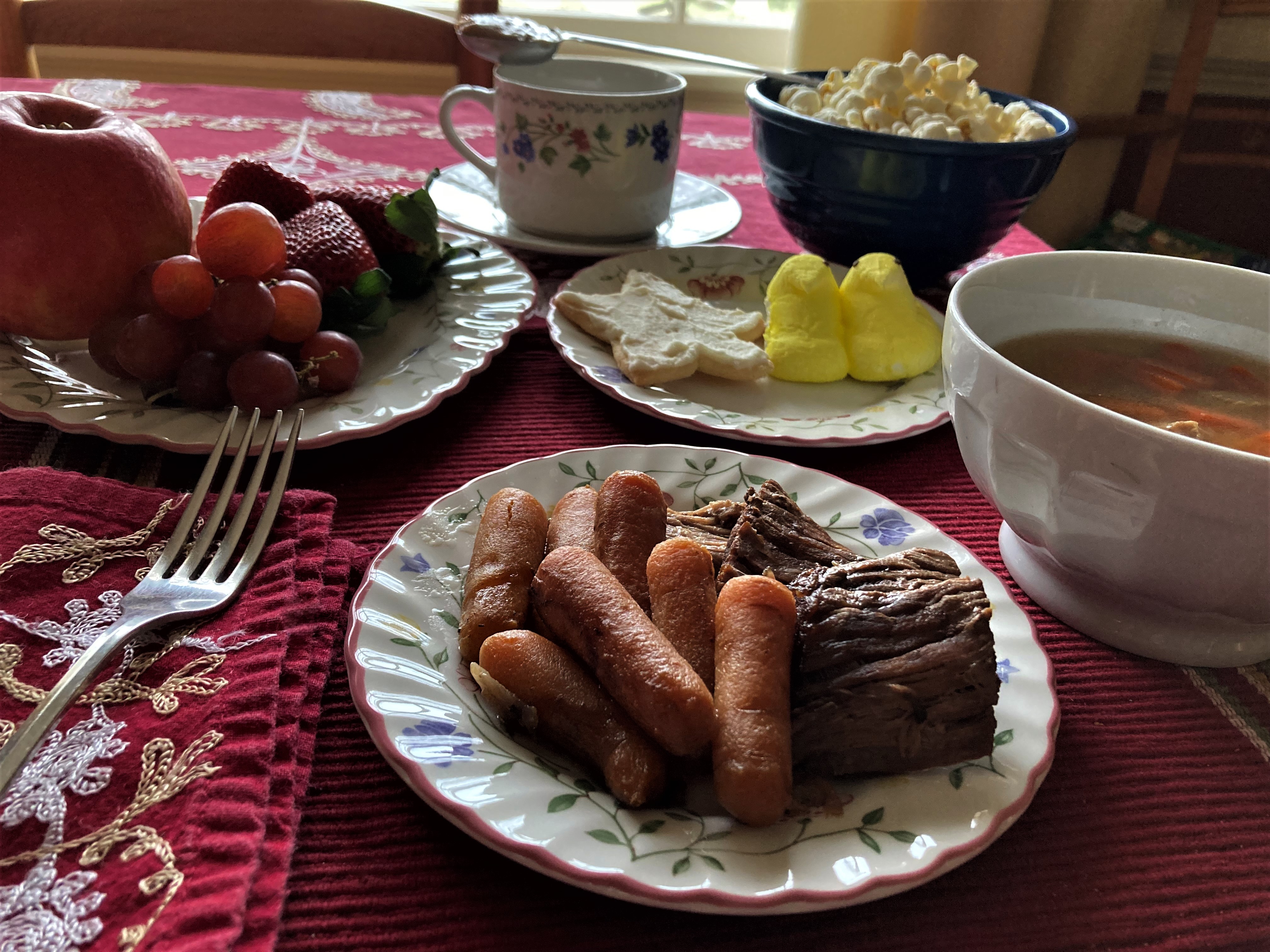
For almost a 1 1/2 years, I have started my day with a cup of coffee and spoonful of natural, crunchy peanut butter. Today was no different. Then, except for the cookie, popcorn, and Peeps, I felt hungry for and ate foods that are actually considered quite therapeutic for people fighting cold viruses. The foods in the picture above (staged afterwards for the blog) were my get-better-as-quick-as-possible choices.

Starve a Cold, Feed a Fever? Learn the Facts – WebMD

So…my day was low productivity…no writing until now (I’m feeling stronger instead of worse this evening, so that feels like a good sign).

Will revisit Cary Nieuwhof’s podcast another day. You should give it a listen, or, if you prefer, read the transcript.

Thanks for keeping me company for these minutes…at a safe distance. 

[Postscript: Take Francesca Gino’s Rebel Test – fascinating!]

Monday Morning Moment – the Rise and Fall of an Empire – Can We Resist the Decline, America?

Photo Credit: Ray Dalio, YouTube

How in the world are we doing as a nation?

As we watch what’s happening around the globe as well as looking inward at our country’s changing culture, how should we then live?

This week, a 43-minute video came to my attention which so fascinated me I shared it widely with friends and family…and now with you.

This YouTube video was created and narrated by Ray Dalio, founder of the hedge fund and investment firm Bridgewater Associates. It is entitled: Principles for Dealing with the Changing World Order – Ray Dalio. He takes history from the last 500 years and tracks it in a mesmerizing animation depicting the rise and fall of world empires.

What are the factors that move nations to become world powers? What also are the causes of the decline of these powers?

Photo Credit: Ray Dalio, YouTube

His video is essentially a summary of his 2021 book Principles for Dealing with the Changing World Order – Why Nations Succeed and Fail. Now if you click on the link to this book, and go to reviews, you will find not all the reviews are glowing. So take heed to the criticism.

Still, I loved this video because it was easy to understand for someone who isn’t much of a historian or, for sure, an economist. His explanation of what lies behind successes and failures of nations seems to line up well with what is happening in the U.S. for sure.

Photo Credit: Ray Dalio, YouTube

These screenshots from the video give you an idea of what you’ll find should you watch it. So good.

Dalio alludes to economic principles that we can apply to help our nation slow its decline as a world power and possibly even reserve it. He goes into these principles much more in his book, but the two he mentions in the video are quite simple:

  1. Don’t spend more than you make.
  2. Treat people well.

Ridiculously simple, but do we do them? We have had national debt since the start of the U.S. as a nation. However, in recent years our debt has wildly ballooned out of control. Also the whole “treating people well”? The last time we were able to pull together as a nation was probably the attacks of 9/11…over 20 years ago. The division in our country is so deep, it is hard to imagine our being able to come back together. It could happen…and I will keep hoping that’s the case.Photo Credit: Ray Dalio, YouTube

On the graphic above, we see the steady decline of the US and the sharp rise of China. Is this the future? Or are other factors also at play? I think there might be…one in particular, the God of this universe. However, He may choose not to save the US from its own self-induced decline. Only time will tell.

[Postscript: There is a word of wisdom here: don’t spend more than we earn and treat others well. Sound counsel all around.]

Economic Principles – Website linked to Dalio’s best-selling book Principles for Dealing with the Changing World Order – Why Nations Succeed and Failincluding bonus content not in the book

U.S. National Debt by Year Kimberly Amadeo

Monday Morning Moment – Generational Sin and Trauma – Don’t Trip Over What’s Behind You

Photo Credit: Seneca, Facebook, Natural Life

My maternal grandfather was a drunk. When he wasn’t withdrawn, walking trails in the woods, he could be mean to both his wife and his five children. How he and my grandmother, a pampered and passive woman, came to be married, I didn’t think to ask. Nor did I ask them or my mom about their childhoods.

My mom was an elegant woman. Beautiful, generous, selfless. She took the brunt of her father’s rages – standing between him and her mother or him and her two younger brothers. The two older brothers left home as soon as they could lie about their ages to join the military.

How she and my biological father married was less a mystery. She thought he was her way out of a hard life at home. It turns out maybe he thought the same about her. Whatever their affection before marriage, it cooled as the years and responsibilities folded on top of each other. It would turn out that although there was not so much violence in our childhood home, there was neglect. He wasn’t a drunk but he never cared to work. When Mom finally divorced him, her heart had become so wounded and weary, it was a matter of just having one less mouth to feed.

Mom would later marry my step-dad who was a sweet daddy to me. He was harder on my brothers…and on his own kids from his first marriage. It made me sad and a little frightened, especially for my older brother. He was old enough to have seen our grandfather drunk; he knew the dismissive behavior of our biological father; he felt the anger of our step-father. My younger brothers and I missed a lot of that.

Divorce and its fallout became something I would determine to avoid…even if it meant not marrying at all.

I did marry, and a wonderful man. We are very different from each other. We have different struggles and different childhood situations. However, from the beginning, we shared the personal experience of  nurturing love of parents, faithful to God and each other. This has been a strong foundation for us to learn to love well and parent well (hopefully). It is not the whole of it though.

In all of this, there is still the puzzling over what we bring to our marriage from past generations…and what will would transmit to our children?

Looking into our pasts isn’t always inviting. Some prefer to “let sleeping dogs lie”. I’m learning that our past informs our future; in fact, our past can predict or prescribe our future. It seems wisdom then to examine what we can of our past, and that of parents and grandparents.

Not to blame. Not to lay responsibility for some present lack in ourselves. We all make mistakes as parents even when we deeply love our children. The look back is to help us to heal any harm and to guard from bringing past hurts to our children…without thinking… without intending.

When our parents experience trauma in childhood – or endure the consequence of sin from a parent – they carry that into adulthood and potentially will transmit it to their own children. Not all survivors of adverse childhood experiences will follow this cycle, but it’s rare to avoid altogether.

My mom was very intentional in showing us love after experiencing so little in her childhood home. She did bring some of her trauma forward and we experienced it…without her meaning for us to. I remember trying, from an early age, to be as good as I could be for my mom…and failing. She had tried to do the same as well, in her growing up years…but with harsher consequences than I had.

“The child speaks what their parents could not. He or she recognizes how their own experience has been authored, how one has been authorized, if unconsciously, to carry their parent’s injury into the future.”Molly Castelloe, How Trauma Is Carried Across Generations

Photo Credit: Twitter

Have you discovered areas in your own life that if left unattended will transmit to your children’s lives? Fears, self-worth issues, anger, negativity, anxiety, perfectionism, sadness…or sin/trauma of all kinds that we have harbored (and maybe witnessed in our childhood). We can change the future, with God’s help, by taking a good long look at our past. Asking questions and considering what consequences are playing out in our current lives and our children’s.

We can break the cycle of generational trauma or sin, but it requires relentless intentionality on the parents’ part. Both for our own healing and for our children’s health. I didn’t want my children to be afraid or unsure of how valued they were. I wanted them to always know the experience of being safe, seen, soothed, and secure. Was I successful…? Not always…in fact, I was unaware of how generational sin clung to me. I didn’t have words for it then like I do now.

The Adam Young Counseling podcast has been a tremendous help to me in looking at childhood trauma and generational sin. He gives practical and reasoned helps in how to heal from our own trauma as well as how to curtail the repeat of generational sin in our children’s lives.

What are your thoughts? Please add to Comments. May God help us all to be blessings (and not cursings) to our children and to theirs.

What Is Generational Trauma and Is It in the Bible? – Ashley Hooker

The Sins of the Fathers Visited Upon the Children – S. Conway

What Are “Sins of the Father”? Understanding Generational Consequences – Michael A. Milton

YouTube Video – Generational Sin + Trauma – Gospel Care Class

Monday Morning Moment – Reflecting on the Story of a Girl and Friendship

[School Days, Cairo, Egypt – a couple of decades ago]

[From the Archives]

This delightful girl has a birthday tomorrow.

I want to celebrate her here. The girl and the understanding of friendship she has brought to her mom and to those who have known her best.

She was born on a windy March morning. Our first-born. I have brothers, and my Mom had all brothers. Having a daughter as our first was a complete joy and wonder to me, as my Mom tells me I was for her in the midst of all boys.

She would be my sidekick for many of our early adventures together. Welcoming two brothers during her preschool years. Enjoying the friendship of neighbors and church family. Homeschooling in East Tennessee.  

I will never forget the Spring when she came home from Jack and Barbara Lavender’s Sunday School class with two tiny cups of growing seedlings. We planted them in her daddy’s garden and they grew an enormous bed of Cushaw squash. From those two little seeds. Sweet memories of friends who invested in our girl’s life.

Then there was the terrible time when she got desperately ill with what we would, over too many days, finally discover to be a ruptured appendix. This girl has always had a high threshold of pain, and it took four trips to the pediatrician’s office before I was taken seriously. She ended up with big surgery and 10 days on IV nutrition. This image shows her having her first meal over a week after her surgery (pillowcase from our friend, Kay – she still has this pillowcase).

Then our travels outside East Tennessee began.

For this quiet girl, having her life, and childhood friendships, disrupted was hard. Despite the incredible experiences of many moves across four countries, she learned resilience the hard way.

In those days, before smartphones, we carried our memories of people and places in tangible ways. Photo albums. This girl would often go deeper with new people in her life by introducing them to her previous life…through these cherished photo albums.

Everywhere we went, everywhere we lived, we have the photo memories of the sweet parts of those years. They are a treasure.

Friendships were not always easy for this girl…most probably related to adjusting to all the changes imposed on her by her parents’ many work moves. She was not the life-of-the-party, center-of-attention, making things happen, people magnet sort of girl. She loved books and they were often her friend -in the reality of multiple moves and too many goodbyes.

She did have two constant friends who went through all those moves with her. Her two brothers. They are still close. Remembering all the good, all the tears, and all the big sister times with her [calling her “Auntie” when she observed and advised where they preferred to be left to their own devices].

As this girl grew up, she learned how to recognize mean girls and not to take them personally nor to become one…which can easily happen for any of us in strained situations. She learned to embrace the new and sift for where she belonged in the different. And could even make a difference.[Her tiny Senior class, 2005, Casablanca, Morocco]

[Noor, a dear friend from high school, knowing the experience and also understanding what it’s like to move places and countries with your family]

[Maria, a fellow student and enduring friend as they both tackled teaching together. Different schools but similar challenges.]

Besides her brothers, this girl had two men she knew she could count on. Her Dad…and in time, her beloved whom she would marry. I love to catch snippets of conversations she and her Dad have on visits home. For two introverts, their words pour out with each other…safe people, safe places.

[This girl and her boy who would capture her heart and parent two little ones by her side – no pics of the littles – this girl’s preference and I honor it]

In this season of making a home and family, she has grown into this beautiful woman (OK…if you’re still reading, you either love her or the idea of her or you have such a her in your own lives). I am in awe of this girl. Not because she is anything of celebrity but because of how she handles today’s bumps. Also how she has taken both the bad and the beautiful of her growing up years and turned them into her own story.

Two Christmases ago she gave me a book by Sarah, Sally, and Joy Clarkson. Girls’ Club – Cultivating Lasting Friendship in a Lonely World.

This sweet girl has recommended Sally Clarkson to me often in the last years as a mom and mentor in life. In the book above, Sally’s daughter Sarah writes a chapter entitled Saturday Mornings: The Girls’ Club Prototype. In this chapter, she describes “five progressive actions…central to the powerful cultivation of friendship”. They are:

  • Invite – Reach out and bring in a new someone to an adventure and your life.
  • Plan – Work out the logistics of an event, a meetup, an outing. Make it a welcome ritual or routine.
  • Provide – Show love, Sarah says, by preparing the table, so to speak. Whether it is the physical space itself (your home, for instance) or your own “mind and heart” to wholly receive the new friend.
  • Stay – This is huge! Whether distance or circumstance separate you, be a continual presence in the life of a friend. Be there. Show up. This takes effort and intentionality, and it’s not easy. It requires both forgiveness and faithfulness…no matter what.
  • Pray – When we remember that every single person we meet is an image-bearer of God, we are reminded of the value there. Even those “mean girls” in our lives didn’t get mean in a vacuum. “Hurt people hurt people”. They have God’s imprint like every other imperfect person… When we recognize our own frailty and that of others, we are drawn to pray. For our own hearts to love like Jesus. For eyes to see how God sees people…and to reach out in love…as only He has made us to do so.

I’ve watched this girl executing all the above. She has commented that making (and nurturing) friendships as an adult has had its own challenges, maybe because of all the other pieces of life that need our attention. However, I rejoice with her that she has settled into a life fairly full of friends with littles and some without (including me).

I’ll close this “Happy Birthday” piece on this note: our girl has a fierce faith in God that brought her through the hard so far in her life. I’m confident that whatever lies ahead – joys and sorrows – she will lean into God to sustain her. She will be there for those whom God has placed in her life – family, friends, and friends-to-be.

Like her, I will leave you with a few last images of life we’ve enjoyed together. Hope your day is filled with joys familiar and joys anew. Happy Birthday, Sweet Girl.[Learning to make biscuits with Memaw – my Mom, the master cook]

Monday Morning Moment – A Cause for Celebration and a Celebration Culture – in Pictures

Photo Credit: Unlocking the Bible

What do we celebrate?

Kids’ birthdays, weddings, babies, anniversaries. For sure.

How about mileposts in our careers? A job well-done?

Have workplace celebrations (even micro-celebrations) gone by the wayside? Even before COVID? Too expensive? Too hard to keep up with? Considered frivolous and unaligned with a stream-lined cost-saving workplace? Have these cost-savings cut losses or added to them? If this is your situation, consider re-instituting celebrations. Omitting them may have cost you more than having them.

I’m not going to go into the particulars (links below will support those). However, I want to give a shout-out to one recent celebration which we got to attend and soak up the joy of it all.

[This had to do with a church celebrating the 10th anniversary of their pastor couple. The elements of a beautiful milestone recognition follow in the pictures and brief description. Enjoy.]

Andrew and Marcie came to this job after a catastrophic health event forced them to leave the international work they were deeply committed to. A redemptive story followed in these 10 years since.

They are not the kind of people who are ambitious for center stage, but they find themselves there because of what (and who) they bring with them. They take the hard and display the good and the God in it.

We had the opportunity to be one of the out-of-town guests for a surprise celebration of Andrew and Marcie’s work (10 years so far).

This church covered all bases in celebrating them and drawing all of us into that circle of deep gratitude. #Snacks and #giftbags for the travelers (you planning milestone celebrations – keep this! – for all involved as far as your budget allows).

The surprise actually happened (for Andrew anyway. Marcie helped to keep him in the dark). The sweet first sightings were emotional.

Milestone celebrations must always have food. No need for it to be elaborate, but special is nice. From eating at local specialty restaurants to a potluck. There is something about eating together from time to time (and especially to celebrate a person or progress) that creates a bond between people. When is the last time you ate with your team? Your boss? Make it happen.

Then the words. They matter. Words of affirmation. Words of inspiration. Vision. Purpose. However, not just for the big picture but how the pieces fit together. Celebrations are about the pieces…and the pieces are people. If I may add: God puts the puzzle together. [Because this was a church celebrating their pastor, the Sunday service included all us life-long family and long-time friends – joining their local church family who love them with us. This celebration was a beautiful demonstration of that love. No holds barred.]

Celebrations are meant to honor both the person/project and the larger purpose that holds us together. If it’s work or family or something other. For Andrew and Marcie, it would have been very awkward for them if they were the focus of the 10-year anniversary. Their church family knew this and kept in view what mattered most to them all.

That was our weekend with all the feels of a celebration. It was inspiring. I’m looking forward to being part of a force that celebrates more. The doldrums of this cubicled and isolating season almost put me to sleep. This weekend woke me (back) up!

5 Reasons We Should Celebrate Milestones – Julie Baumgardner

Back to Basics – What Are Community Celebrations? – Aaron Kinne

Creating a Culture of Celebration – Don Rheem

Commentary: Importance of Life’s Milestones – Doug & Lynn Nodland

Monday Morning Moment – the Power of Acknowledgement

Photo Credit: Pinterest

A pastor friend of mine, Dave Lyle, posted about an encounter he recently had with a homeless man. The man did not ask for money. He just wanted Dave’s opinion on something. As Dave came closer, he noticed a large kitchen knife on the bench near the man, so he kept some distance. It turns out the man was once a chef, thus his knife, and had come on hard times. Homeless for the last 10 years. In Dave’s post, he had noted several other people who passed the man without looking his way, treating him as if he wasn’t really there.

“To acknowledge another person costs you nothing” was Dave’s observation.

Pastor Dave’s story reminded me of a man who “begs” on a busy corner in our city. I put the word “begs” in quotes because he doesn’t really ask for anything. He stands there with a cardboard placard with words of encouragement and affirmation on it for those waiting at the traffic light or driving by. His words are the substance of “a rising tide lifts all boats”. I wonder if, given another set of circumstances, he wouldn’t be a department head or even a CEO. He has given me more impetus to always have food in my car to give to people, like him…especially him. He is a great example of how acknowledgement can affect mindset and action.

Author and trainer Judith W. Umlas has written an excellent book on this subject: The Power of Acknowledgment (©2006 IIL Publishing, New York).

The website for her Center for Grateful Leadership extensively covers the topic of acknowledgement (at work and life, in general).

Her 7 Principles of Acknowledgment follow in brief:

  1. The world is full of people who deserve to be acknowledged…start by practicing your acknowledgment skills on people you don’t know very well, or even know at all. [Acknowledging those you most care about will follow easily.]
  2. Acknowledgment builds intimacy and creates powerful interactions. Acknowledge the people around you directly and fully, especially those with whom you are in an intimate relationship. Look for ways to say how much you value them, and then be prepared for miracles!
  3. Acknowledgment neutralizes, defuses, deactivates and reduces the effect of jealousy and envy! Acknowledge those you are jealous of, for the very attributes you envy.
  4. Recognizing good work leads to high energy, great feelings, high-quality performance and terrific results. Not acknowledging good work causes lethargy, resentment, sorrow and withdrawal. Recognize and acknowledge good work, wherever you find it.
  5. Truthful, heartfelt and deserved acknowledgment always makes a difference, sometimes a profound one, in a person’s life and work.
  6. It is likely that acknowledgment can improve the emotional and physical health of both the giver and the receiver.
  7. Practice different ways of getting through to the people you want to acknowledge. Develop an acknowledgment repertoire that will give you the tools to reach out to the people in your life in the different ways that will be the most meaningful to each situation and each person.

Acknowledgement is more than a compliment or positive feedback. It also has much greater impact that “criticism, finding fault, or saying nothing at all” (see links below). Acknowledgement demonstrates, whether talking to someone you know or a stranger, that you see the person. You truly see them and you see something they are doing that has meaning and gives meaning. You acknowledge, whether it is small thing or large, how that person, in that moment, had influence in your life…or that of others.

The Power of Acknowledgement – Part 1 – Alison Whitmire

The Power of Acknowledgement – Part 2 – Alison Whitmire

Acknowledgement communicates a genuine felt experience. To truly acknowledge someone, we must step into their space. We must pause our agenda. We must search for words to express what just happened for us. Finally, we engage bodily with our words (by this I mean our non-verbal communication aligns with what we are saying). We lean in, give eye contact, and tune our facial expression to what we want to express.

Acknowledgement then is best given in person. However…it can be done via other communication mediums. We can be creative, but the main point of all this is to go the extra mile and not let opportunities for acknowledging others pass us by. [The social distancing foisted on us by COVID has kicked to the corner much of the practice of acknowledgement. We are wise to shake off our doldrums and reestablish these practices.]

Is it your practice to regularly (honestly and in a timely fashion) acknowledge those in your lives who have made a difference? These may be close colleagues, near family, or even essential workers we see regularly and the occasional stranger we may meet only once.

Photo Credit: IZ Quotes

To close, I want to give a shout-out to this one guy I know. He is an off-the-chart introvert, but he regularly and without hesitation uses his voice to give acknowledgement to folks in his work (and life). Often, it comes on the heels of praise he is receiving for some innovation or decision made at a point of crisis. He passes that praise on to those who, in his reckoning, made possible the culmination of an excellent work. I have actually counseled with him to take the acknowledgement himself from time to time, but he is unmoved. In a culture where we are elevated because of ownership of ideas and our confidence in ourselves, he and others like him give the most relatable picture of “it takes a village”.

Photo Credit: Twitter

So…are you the glad recipient of acknowledgements in your workplace or home space? How do you practice acknowledgement in these challenging days – when eyes meet less, heads are down, and we have too often insulated ourselves to task, tribe, or timetable? Please comment below.