Category Archives: Monday Morning

Monday Morning Moment – Last Monday of 2015 – Begin Again

Blog - Mondays with Garfield - Jim DavisPhoto Credit: Garfieldh8sMondays

Here we are on the last Monday of 2015. The last Monday of the year. For some of us, there’s a collective deep sigh! We made it through this year of tough Mondays. Celebrating…quietly.

Over coffee this morning, we talked about the huge build-up to Christmas, and how today, in comparison, is almost a let-down. I don’t feel that way at all. On the Monday after Christmas, I feel satisfied and hopeful. Christmas was wonderful…even with the heart hurt of not having all our children with us and my dad states away in assisted living. Hard things are always strewn across even the best of holidays.

We rejoice in what was good and hope for what can be in the year ahead.

That’s how I also feel about this last Monday of the year. We didn’t deal with a terrifying diagnosis but we have friends who did. We didn’t have to grieve the loss of a family member but we grieve still the great loss of dear friends this year. We went through extraordinary change (in work and community) but thankfully kept those relationships. We did not suffer joblessness and do not take for granted the great blessing of gratifying work.

Work this year was oddly harder than any year I can remember. Some situations in life we expect to be hard – like the adjustments we made living cross-culturally, and like the year my mom died. This year was an unexpected hard.

In a season of chronic financial leanness and a year of organizational change, including planned and necessary downsizing, we still have a job. Months of “just keep doing what you’ve been doing” may now be winding down to make way for new direction and engagement. We breathe deeply the air of new possibilities in the days ahead.

Although there is nothing innately powerful in a last Monday of the year or the coming first Monday of 2016, the idea of a fresh start energizes us with hope and anticipation. This ending and beginning do stir our hearts and minds to begin again…

In 1970, a film was released entitled Scrooge. It was a musical adaptation of Charles Dickens’ A Christmas Carol. The old curmudgeon Scrooge was very well-played by a 30-something Albert Finney. As I look to this Monday and the next, his song “Begin Again” came to mind. If you have never seen it, watch the YouTube clip:

In thinking of finishing out this year at work, and looking to 2016, I hope you also can celebrate whatever victories and mercies you experienced this year. In looking to 2016, I pray you have anticipation of what comes. If you’ve had a hard year, too, then you are even more equipped to take hold of whatever comes.

Scrooge, in his song above, thanked “the world” (1:42) that he was able to begin again. Odd line really. I thank God for another opportunity to begin again – this day and all the days given to us ahead.

“Do not call to mind the former things, Or ponder things of the past. Behold, I will do something new, Now it will spring forth; Will you not be aware of it? I will even make a roadway in the wilderness, rivers in the desert.” – Isaiah 43:18-19

“O taste and see that the LORD is good; How blessed is the man who takes refuge in Him!”Psalm 34:8

Scrooge (1970) with Albert Finney – available on Amazon.com

YouTube Video – Scrooge with Albert Finney (1970)

Monday Morning Quarterback – What a Sunday of Football!

Monday Morning Moment – Stewarding Our Influence Well

Blog - Influence - Alex & Stephen KendrickBlog - Influence - Tony Dungy Son - BPNews net (3)Photo Credit: BPNews.net

Be imitators of me, just as I also am of Christ. 1 Corinthians 11:1

We are all influencers in one way or another. How we steward our influence is strongly affected by those who have influenced us.

[This Monday morning moment has a spiritual bent, but the principles apply, whatever your belief system. It would be disingenuous for me to write about influence without including the impact of following Christ and Christ-followers in the mix. Thanks for your understanding of this.]

When I was in graduate school, my days were heavily committed to class time, clinical work, research and writing. Meeting with my thesis advisor was a regular “intrusion” into that schedule. For weeks, I would arrive late to our meetings, excusing myself always with some sort of “more important” fill-in-the-blank.  Communicating “more important than our time together”. My advisor was one of the most gracious women I’ve ever known. She was always spot-on ready for our meeting, having read my latest submission, with her notes in hand. If ever I was “fly-by-the-seat-of-my-pants”, it was with her.

Finally, one day, without warning, she nailed my tardiness for what it was…and I will never forget her for that. She taught me so much about professionalism and excellence in practice, but she taught me most in this area of honoring a colleague. I will always be grateful to Rose McGee for that.

Since those early years in my professional life, there have been many influencers in my life. Bosses, supervisors, coworkers. Some influencers had more celebrity status, but because they wrote for people like me, I soaked up their wisdom.Blog - Influence - Priscilla Shirer - BPNews net (2)Photo Credit: BPNews.net

Ben Kirksey recently wrote a short piece entitled Are You Worthy of Workplace Imitation?. It got me thinking of how my own workplace processes have changed because of those mentors, friends, and coaches in my life. 7 points of stewardship came to mind:

  1. Time – We all have the same amount. Honoring others’ time does matter – being interruptible, not shortchanging people, keeping and being present in meetings. It’s a balancing act, but we want to be dependable and resourceful in this area.
  2. Tweaking – only when absolutely necessary. Show you value others’ work. Give up control whenever possible. Whenever possible, trust their ownership of their work.
  3. More questions/Less Advice – We jump to advice (or direction). Learning to ask thoughtful and compelling questions is a discipline worthy of our time and effort. Jesus was masterful at this.
  4. Genuine Affirmation – To be truly known is such an empowering gift. General praise or cheery compliments are nothing compared with informed and specific affirmation. You affirm my thinking and hard work on a problem, and I will apply myself even more.
  5. Building Capacity – Investing in others’ success at work while, at the same time, expecting the most out of yourself, builds capacity all around. This collective commitment to the work and each other delivers. Building capacity is a “both/and” arrangement. We can’t cast vision for it effectively, without digging in ourselves.
  6. Leading by Influence – I have rarely enjoyed a position of authority…it is by influence that I have both learned and led in life. Authority has its own cross to bear in that the responsibility for return on investment sometimes interferes with relationships. Too bad, really. It’s through the relationships that we can see a greater return…as we steward influence.
  7. Perspective – I will never forget a workplace story about a creative director and his lead creative. They rarely agreed. In fact, as the younger man tells the story, their discussions could become very heated over the direction of any given project. Then there would come a moment when his boss would say, something like, “Let’s get some coffee.” or “It’s lunch time, let’s grab a bite to eat.” No matter the seriousness of the conversations, this older man was able to bring relational perspective to bear. Their relationship was more valuable than any project decision. I daresay the work didn’t suffer from this perspective.

I am so grateful for those who have influenced my work. As mentioned before, they include some whom I have never met physically. The Apostles Paul and Peter, and Jesus himself teach us volumes on stewarding influence well.

Shepherd the flock of God among you, exercising oversight not under compulsion, but voluntarily, according to the will of God; and not for sordid gain, but with eagerness; nor yet as lording it over those allotted to your charge, but proving to be examples to the flock.1 Peter 5:2-3

Do nothing from selfish ambition or conceit, but in humility count others more significant than yourselves. Let each of you look not only to his own interests, but also to the interests of others. Have this mind among yourselves, which is yours in Christ Jesus, who, though he was in the form of God, did not count equality with God a thing to be grasped, but emptied himself, by taking the form of a servant, being born in the likeness of men.  And being found in human form, he humbled himself by becoming obedient to the point of death, even death on a cross.Philippians 2:3-8

Finally, brethren, whatever is true, whatever is honorable, whatever is right, whatever is pure, whatever is lovely, whatever is of good repute, if there is any excellence and if anything worthy of praise, dwell on these things. The things you have learned and received and heard and seen in me, practice these things, and the God of peace will be with you.Philippians 4:8-9

Do you have a story of an influencer in your life and how that person changed the way you work? I would love to hear it through the Comments below.Blog - Influence - Jesus

Are You Worthy of Workplace Imitation? by Ben Kirksey

The People Skills of Jesus by William Beausay II

The Management Methods of Jesus by Bob Briner

Monday Morning Moment – Honoring Retirees – Workplace Culture & 5 Languages of Appreciation

Blog - Retirement - Gratitude at Work - Thank YouPhoto Credit: Harvard Business Review

It’s Monday morning. Who’s retiring from your team this week? Who retired last week? Who do you see around you at work today? Do they know they matter to you? To your organization? How has their value been reflected back to them? What can you do today to show your appreciation, especially to that one who is retiring? Sorry for all the questions. They’re bouncing in my head. Let’s talk about it.

[This might be a little awkward if you’re the one retiring, especially with reluctance…or if you’re not retiring but question your own relevance or value at work lately. You may not be able to fix much of what your experience has been, but you can set your own “finishing well”…whether it’s official in a few days, or in several years.]

From the sidelines, I am watching a very strange phenomenon this week. On Friday, hundreds of employees in one local company will retire. It relates to a measured downsizing necessary to keep the company operational financially. The downsizing is a much kinder and more valuing option than layoffs. Still, there are huge ramifications for those leaving as well as for those who remain, in the months/years ahead…without them.

How does an organization go about honoring hundreds of retirees? Well…apart from the numbers, it’s in the same way you would honor one. Bill Peel offers a really helpful array of articles on appreciation in his Make Mondays Meaningful, quoting from C.S. Lewis and the Harvard Business Review. This is a good place to start.

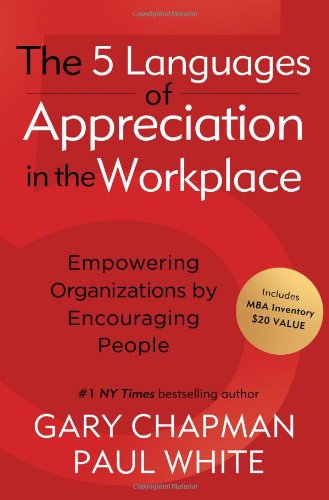
As I was thinking of the challenge for a company’s leadership and the human resources department to honor so many retirees, a little book came to mind. It’s The 5 Love Languages by Gary Chapman. Then I discovered he and Paul White wrote a follow-up book entitled The 5 Languages of Appreciation in the Workplace.

Blog - 5 Love Languages of Appreciation in the Workplace

Photo Credit: Amazon.com

Chapman and White describe five languages of appreciation (see in next paragraph). How we receive meaningful appreciation varies from person-to-person. Therefore we must attempt to personalize our expressions of gratitude to be effective. In a situation where a large number of folks are retiring, or in plan to build a workplace culture of appreciation, a comprehensive “shot-gun” approach may be warranted. If your aim is authentic honoring of your personnel, the extra work and creativity will be well-applied.

Maria Elena Duron, in her US News piece on workplace appreciation describes Chapman’s & White’s 5 Languages:

  1. Words of affirmation. Reassuring words (“thank you for your input,” or “great job on the presentation”) that serve to motivate and show gratitude to team members.
  2. Quality time. Going out of your way to spend a little more time with team members, discussing the topics that are relevant and important to them.
  3. Acts of service. Your words of gratitude could land on the deaf ears of team members who would rather receive help finishing a project or assignment. Going out of your way to lend a hand means more to such people than mere praise.
  4. Tangible gifts. Lots of people appreciate tangible gifts. The important thing here is to make sure the tangible gift is something the person values in their life outside of work, like a jersey of their favorite college football team or a coffee mug with their favorite cartoon character on it.
  5. Appropriate physical touch. Some members respond well to appropriate physical touch, like high-fives, handshakes, fist bumps and pats on the back. You’ll see this in sports, but it also translates well to the work environment.

Delbert Terry (speaking on The 5 Languages of Appreciation in the Workplace) gives this charge to both supervisors and colleagues:

“In order to appreciate, you MUST initiate.”

  1. For appreciation to be effective, it must be individualized and delivered personally.
  2. Appreciation needs to be viewed as valuable to the recipient.
  3. Employees are more likely to “burn out” when they do not feel appreciated or emotionally supported by their supervisors.
  4. When leaders actively pursue communicating appreciation to their team members, the whole culture improves.

Dr. Terry acknowledges: “There are challenges that get in the way of effectively expressing gratitude to our colleagues. Some are internal issues attitudes, thoughts, and beliefs. Other challenges are external and relate to corporate structures and procedures. These challenges need to be faced realistically, but they can be overcome.”

Challenge #1: Busyness

 Challenge #2: Communicating appreciation is not important for you organization

 Challenge #3: Feeling overwhelmed with existing responsibilities

 Challenge #4: Logistical issues that interfere with the process of sharing appreciation for others. Varying schedules, working on different projects…often make it difficult to express appreciation to certain coworkers.

 Challenge #5: Personal discomfort with appreciation *

*The 5 Languages of Appreciation in the Workplace – presented by Delbert Terry (pdf)

In honoring retirees and setting a workplace culture of appreciation, it is never too early and [hopefully] never too late.

As I think of the mammoth task of trying to honor hundreds of retirees in one fell swoop, I am both overwhelmed by and grateful for those who undertake such a task. How do you orchestrate such a celebration of so much human history and accomplishment? You do your best with gracious words, team parties, a speech from a charismatic leader, a slideshow of faces we love, and maybe shrimp and petits fours. I wouldn’t miss it, for sure.

The one thing I hope happens and it’s the hardest thing to make happen is that we capture the story of these lives. History, experience, a personal witness are so valuable and should be preserved somehow. Storycorps is an organization that gives us opportunities to record stories of people’s lives who have made a difference in ours. What a great way to honor those who have gone before us, so that we and future generations can continue learning from them.

Finally, we know something of the importance of authentic appreciation because of the character of God Himself. “Well done, good and faithful servant” are words any of us as Christ-followers hope to hear one day…from God, who knows us best. We reflect that deeply personal “divine compliment” when we truly honor one another.Blog - RetirementPhoto Credit: carp.ca

The 5 Languages of Appreciation in the Workplace: Empowering Organizations by Encouraging People by Gary Chapman & Paul White

Applying Appreciation Language in the Workplace – Maria Elena Duron, U.S. News & World Report

Why Appreciation Matters So Much by Tony Schwartz, Harvard Business Review

How to Give a Meaningful “Thank You” – the Power Thank You by Mark Goulston, Harvard Business Review

StoryCorps.org – “We Believe Every Story Counts”

Appreciation at Work

The 5 Love Languages: The Secret to Love that Lasts by Gary Chapman

Charles, Dave, KevinThese friends are not retiring…transitions and send-offs are also opportunities to say (and show) “You matter.” #SaveOurHistory

TGIM – What Can We Do to Make a “Thank God It’s Monday” Work Culture?

Blog - Thank God It's Monday - bridgepointconnections.org

Photo Credit: BridgeportConnections.org

Don’t hate me, but I’ve always loved Mondays. Mondays read a fresh start for me…a clean slate. New possibilities. Sunday nights would sometimes mean a bout of anxiety or a bit of depression in my questioning of being mentally prepared for whatever Monday brought. All that cleared by the time I stepped outside, into my car, and headed for work.

TGIF (“Thank God/Goodness, it’s Friday!”) was never something I understood. It was hard for me to fathom grinding through a work week, longing for Friday. There’s a rhythm in work, requiring a certain number of days at it, and by Friday, I was ready for a break, but “living for the weekend” wasn’t my thinking on work.

This past Friday was an exception. Pressures at work did spill out over the purpose and pleasure of work such that Friday came just in time. So…I do understand TGIF. Still, it’s clear that God created work for us and I usually take joy in it. Hopefully this resonates with some of you…with others, maybe you might consider how TGIF could make room for TGIM as well.

Tim Hoerr, author of Risking It: An Intersection of Faith and Work, wrote an excellent piece on Building a “Thank God It’s Monday”. It’s a quick read and I strongly recommend it for anyone who struggles with taking joy in their work. It is possible to change your culture.

How does Tim Hoerr define a TGIM Culture?

  • TGIM culture: each team member engaging in challenging, meaningful work – each knowing that their individual contribution is a significant, integral part of the larger whole.
  • Second, each person has ample opportunity for growth and advancement. God has wired each of us to grow and desire new, richer experiences. Entrepreneurial environments are greenhouses for human growth.
  • Another feature of TGIM culture is that each team member and his or her efforts and contributions are being recognized by the company’s leadership. It doesn’t have to be terribly formal or fancy – but each of us want to know we matter and our work is making a difference.
  • TGIM culture means that the fruits of success are being shared by each of those making a contribution to that success. Although surveys show that compensation ranks relatively far down the list of what makes one satisfied, it is essential that the rewards be fairly shared amongst the team.

After defining a TGIM work culture, Hoerr gives a historic example, completely relevant to today’s workplace.

“If you examine the ‘work environment’ Jesus created with his ordinary band of followers, you’d have to say it was a template for our organizations today.”  Then Hoerr lists those components:

  • There was a common mission.
  • A series of challenging assignments.
  • Regular dialogue and interaction amongst the team.
  • Teaching and training in order to replicate the mission on a broader scale.
  • And, importantly, Jesus as the leader facilitating the larger purpose amidst his team’s diverse personalities and all-too-human tendencies.

Don’t miss the rest of Tim Hoerr’s piece on TGIM Culture.

Is the TGIM culture cultivated in your workplace? How might you see the components above implemented where you are – whether top-down or bottom-up? You can be part of making your work and workplace one where you look forward to Monday rather than just longing for Friday.

Tim Hoerr Website and original blog – Building a “Thank God It’s Monday” Culture

Building a “Thank God It’s Monday” Culture – featured at Institute for Faith, Work, & Economics Blog

Bridgeport Connections – Connecting Professional and Spiritual Life

All the “One Another” Commands in the NT (Infographic)

12 Ways to Glorify God at Work

Risking It: An Intersection of Faith and Work by Tim Hoerr

Blog - Thank God It's Monday - Risking It by Tim Hoerr

Photo Credit: Amazon.com