
Category Archives: Workplace Culture

Addicted to Distraction and the Possibility of Restoring a Longer Attention Span

Blog - Addicted to distraction - diygeniusPhoto Credit: DIY Genius

Recently I was at a training event in a remote area where I had no cell phone service and limited internet. It meant I went through stressful training and at the same time experienced a forced exile from screen time. I don’t even have to tell you which was more challenging.

Growing up in my generation was very different than now – playing outside until dark, talking for hours on the phone with friends, falling asleep to the comforting drone of Mom and Dad talking and laughing in their bedroom down the hall. If you’ve ever seen the 1999 film October Sky, it makes me think of Dave’s growing up also – playing in the woods, biking everywhere, building rockets, hunting and fishing.Blog - Playing Outside - jeffs60sPhoto Credit: Jeffs60s

We are enjoying different advantages now for sure…I wonder how our grandchildren will one day describe their childhood. Having computers and the internet have been amazing assets to our lives. The dilemma is when our screen life becomes more engaging that our real life. When “Facetime” replaces face-to-face time.

Don’t get me wrong, I love the opportunity to see people via phone. For instance, friends of ours who got married recently had a small wedding, BUT they had a friend live-stream the wedding and all the rest of us got to “be there” via Periscope. Saw the kiss and everything. 2016 March 5 - Megan & Brian Wedding Kiss

There is something to be said about all the electronic capabilities we have today. For sure.BLog - Addicted to Distraction - littleredfrenchPhoto Credit: LittleRedFrench

The problem is when objects take command of our lives. These screens (phones, TV, computers) eat up so much of our day. Also, what about when we start exchanging real time relationships with the barest minimum associations via Facebook, Instagram, or Twitter? When a friend decided to go off Facebook, I was bummed… At that time, she lived 6 minutes from me. Not like my friends in Morocco or Egypt where I depend most on Facebook to keep up with them. She lives right here in town. We can have real coffee’s and real talks on the phone. Sigh… I had pretty much relegated keeping up with her to social media. Now we’re back affiliated only in real life where I might need to call her. Imagine.

I’ve written about this before (here) and want to manage my life better in this area. Multi-tasking was always something I thought was a strength, but now, getting older, it hasn’t helped me develop much of an attention span (see Charlie Munger’s thoughts on this here). It makes sense that thinking long and hard on something would have a powerful impact on our success or decision-making. Focus. Concentration. These are the things that have suffered in my life with all the distractions.

Kyle Pearce wrote a small piece on being distracted and introduced me to the work of Nicholas Carr (who wrote The Shallows: What the Internet is Doing to Our Brains and The Glass Cage: How Our Computers Are Changing Us). The 4-minute YouTube video below describes some of what he writes about:

Besides managing the distractedness in thinking, memory, and processing information, I want to nurture a habit of deep conversation. Sherry Turkle (author of Alone Together: Why We Expect More from Technology and Less from Each Other and Reclaiming Conversation: The Power of Talk in a Digital Age) writes about this and gives me hope.

Blog - Distracted - conversations - quotesgramPhoto Credit: QuotesGram

Turkle admits she loves computers because they have helped her make tremendous strides in writing, but they are not people. She writes as if she’s reading my heart. This disconnected connection we experience with one another is so illusory.

“Networked, we are together, but so lessened are our expectations of each other that we can feel utterly alone. And there is the risk that we come to see others as objects to be accessed—and only for the parts we find useful, comforting, or amusing.” – Sherry Turkle
Here’s my hope and vision – to re-learn how to really be connected with people, including myself. To practice solitude. To quit living the excuse of being distractible. To learn how to think and work deeply, and to remember how to have deep, thoughtful conversations again.
I’m not prepared to stop using my phone for information, nor am I able to quit using the internet as a resource for work and life, but it’s entirely possible to restrict connection time.  Also, it’s exciting to think of how I might use that time I waste on the internet to actually be with friends and loved ones…to read more books…to rediscover what is right in front of me in real life…to know what it’s like to have (and enjoy) a quiet mind.

The good news is that the process of withdrawal is simple and the healing is spontaneous; because it is only the continuous high volume consumption of mass media that is keeping us sick. So, at root, the detox programme is merely a matter of Just. Say. No.” – Bruce G. Charlton

What might the next generation be like if our grandchildren are nurtured in this way? How can we help them have such mental muscle and true sociability that they could avoid being addicted to distraction?

It’s something to think about…off-line. Gone to find a real face and give that face my full attention.

Distracted? This is How the Internet is Changing Your Brain by Kyle Pearce

Multitasking – Giving the World an Advantage It Shouldn’t Have – Farnam Street Blog

Are We Addicted to Distraction? by Sophie at LittleRedFrench

The Distraction Addiction: Getting the Information You Need and the Communication You Want, Without Enraging Your Family, Annoying Your Colleagues, and Destroying Your Soul by Alex Soojung-Kim Pang

The Shallows: What the Internet is Doing to Our Brains by Nicholas Carr

The Glass Cage: How Our Computers Are Changing Us by Nicholas Carr

Alone Together: Why We Expect More from Technology and Less from Each Other by Sherry Turkle

Reclaiming Conversation: The Power of Talk in a Digital Age by Sherry Turkle

Deep Work: Rules for Focused Success in a Distracted World by Cal Newport

Amusing Ourselves to Death: Public Discourse in the Age of Show Business by Neil Postman – originally written in 1985, brilliantly prophetic of the future (updated in 2015)


5 Friday Faves – Antidepressant Soil, Signs of Spring, Farewell to Downton Abbey, Single Most Important Habit, and Roaring Lambs

Blog - Friday Faves

Happy Friday! Here we are entering the weekend when our Daylight Savings Time springs forward to longer days of sunshine. This beautiful season launches with St. Patrick’s Day and an early Palm Sunday and Easter. It’s such a sweet time of year. Our weekend in Richmond is supposed to be beautiful with lots of opportunity to plan outings and plant gardens.

1) Antidepressant Soil – I came across this article on antidepressant microbes in soil and was intrigued. My husband loves to garden.IMG_4242As hard as he works out there, he always comes in with such a joyful satisfaction, I wonder if this article might actually be true. What do you think?

http://www.gardeningknowhow.com/garden-how-to/soil-fertilizers/antidepressant-microbes-soil.htm

2) Signs of Spring – The morning sky, the changeable weather, and all the new growth are cause for wonder. The sunrises amaze me how they change with the seasons in their glorious presentations.IMG_4282IMG_4286IMG_4260IMG_4276IMG_4278Photo Credit: Bekkah Mills (Beach Sunrise) & me

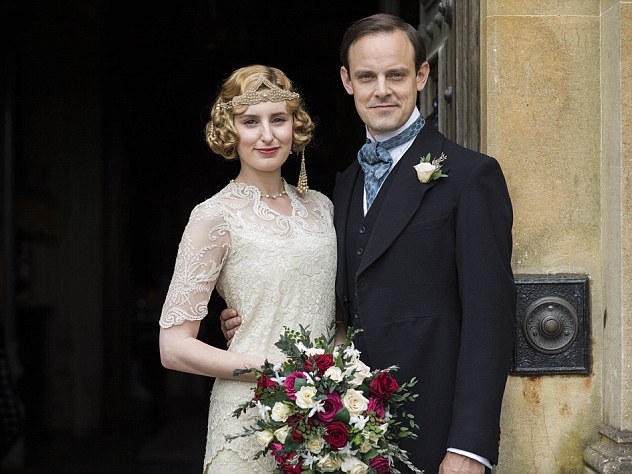
3) Farewell to Downton Abbey – Although the BBC show finished at Christmas 2015, we can manage here in the US to watch it through to its finale without knowing how it ended 3 months prior. The finale episode of this upstairs-downstairs story, set in a Victorian England manor house, was lovely and completely satisfying. All sorts of resolution to the different storylines. A wedding, babies, and NO deaths. Finally, in the end, DA creator, Julian Fellowes “let Edith be happy“. So hopefully you’ve all seen the last episode, otherwise the photo below becomes a spoiler. If you’re not already a fan, I hope you’ll catch up with the family and servants of Downton Abbey sometime over a beach week. 6 great seasons. You won’t be disappointed. The thought of that reminds me of our occasional Pride and Prejudice weekend marathons with friends when our daughter was a teenager at home overseas. Such a lovely diversion…Downton Abbey | Christmas Final Episode 2015 | Behind The Scenes We return to the sumptuous setting of Downton Abbey for the finale of this internationally acclaimed hit drama series. As our time with the Crawleys draws to a close, we see what becomes of them all. The family and the servants, who work for them, remain inseparably interlinked as they face new challenges and begin forging different paths in a rapidly changing world. Photographer: Nick Briggs

Even our son Nathan, who usually watches something altogether different on Sunday night TV, honored Downton Abbey with an arrangement on classical guitar. Enjoy.

4) Single Most Important Habit – So what do you think might be considered the single most important habit of our lives? Probably not the one David Mathis marks as a keystone habit – that is, “simple, but catalytic new routines that inspire other fresh patterns of behavior”.  He contends that for Christ-followers that single most important habit is corporate worship.

David states: “God didn’t make us to live as solitary individuals. Neglecting corporate worship sows seeds of unbelief in our soul.”

Let us consider how to stir up one another to love and good works, not neglecting to meet together, as is the habit of some, but encouraging one another, and all the more as you see the Day drawing near. (Hebrews 10:24–25)

This isn’t just a casual hanging out with each other, nor is it merely church attendance. This is a community of Christ-followers attending to the teaching of God’s Word, agreeing together in prayer, and joining together in response to God’s love, goodness, and sovereignty in all of life…through the singing of songs and the witness of His faithfulness in each of our lives.

Blog - Worship - UMCDiscipleshipPhoto Image: UMC Discipleship

It’s definitely something to consider for our spiritual maturing when staying in bed or making other plans seem so much more inviting, at first, than gathering with other imperfect people who know how much we need God. At first…Something to consider…

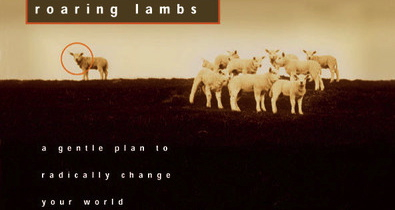
5) Roaring Lambs – Lastly, I just want to give a shout-out to those people in my life and whom I know through their writing and other celebrity who live their faith wherever they are.

roaringlambs

Photo Credit: The Salt Collective

The bus driver, the clerk in the doctor’s office, the TV producer, the teacher, the mail carrier, the retired person, or the [fill in the blank]. Those people in our lives in whom we see the love of Jesus, the excellence of effort, and the tenacity of a life poured out for others. Not baiting and switching, but day in/day out, living their lives with honesty and transparency, faithful to God, loving as He calls us to love. Thank you. Thank God for you.

IMG_4280

Bob Briner’s Roaring Lambs: A Gentle Plan to Radically Change Your World

Johnny Hart’s I Did It His Way celebrated comic strip creator who mixes his faith with his humor. Not in every strip, but from time to time…”drawing” attention to God, Creator and Redeemer, while depicting stories of early (pre-historical) men and women.

They Said I Should Be a Roaring Lamb by Jesse James DeConto

Monday Morning Moment – Them and Us, How Can That Be? Could Them and Us Become a We?

Blog - Work Culture - delta7Photo Credit: Delta 7

Recently, I was in an odd conversation with a friend from work. The more we talked, the more we sounded like a Dr. Seuss book. It went something like this:

“I don’t know how to be us with them. To be with them is to just be them. We must lose us; us no more will be. There’s no us in them; it’s so strange to me. How can they be them, with no us, you see? To give up us is too hard for me. So I can’t see a way to get to we.”

[Seriously, the conversation went like that…but better.]

Battling the us-them assignation is an ongoing workplace discipline. Even in the happiest, coolest companies, there is still an intentionality to keep work life positive for every employee. That inclusiveness is a hallmark for high morale and low walls (read: no silos).

BLog - Us vs Them - Work Culture - Silos - prolearn academy

Photo Credit: Prolearn-Academy

In a work culture where silos still exist, an us/them mentality can grow as each team or department draws in on itself and ignores or suspects the actions/values of others. It’s not a healthy situation for any of us…whether it’s the executive team insulated from others or the [fill in the blank] team hunkered down in its own mode of trying to survive. The first can be as unaware as the subject of the story “The Emperor’s New Clothes“, the second, well, is just miserable, and growing more so by the pay period.

So much has been written on this problem in the workplace – about that culture where us/them thinking and operations color productivity and morale. I have included several links below describing various recommendations and protocols to restore health to such organizations.

Blog - Work Culture 2Photo Credit: My Turnstone

I’ve always been that person who says, “Why can’t we just all get along?” In reality, we don’t have that situation always, but we can grease the tracks in that direction. Here are my own workplace rules regarding moving us and them to we:

  1. Make a practice of assuming the best of your bosses and colleagues. “Refuse to think ill of others” is my goal…and my accuracy in hitting that goal comes with practice and determination…and grace.
  2. Lean in to those with whom you struggle the most – the “thems” in your worklife. Especially the most powerful ones. Study them. Learn their language. Know them as well as you can. NOT for self-serving reasons, but for the benefit of the work itself. Any motive that only serves your personal situation will only make matters worse… ‘Nuff said.
  3. Refuse to get caught up in us/them complaining. Don’t make a big deal about it, but do your best to turn the conversation toward a positive end, change the subject altogether, or bow out if all else fails. Those negative conversations just bring you and your colleagues down and don’t accomplish anything. A short-lived “misery loves company” satisfaction isn’t worth the fall-out of such conversations.
  4. Bring down the silos, one brick at a time, if necessary. Maybe you aren’t experiencing any us/them anguish, but you know it exists. What can you do, individually and as a work team, to move to “we”? We have lots of work models out there for this. In fact, silos in the workplace are “so 80’s” (whatever that means…I hear it a lot, so I’m using it here). Use some of that meeting time, or talks over coffee, to be creative in how you can work better across teams…how you can learn more from each other…how you can defuse territoriality? If the “them” is management, you initiate dialog on setting work culture values that maximizes product excellence and employee engagement.
  5. Put processes in place – through your culture – to keep silos down. I would love to hear what your situation is and how you are making positive steps to grow/keep a healthy culture. Please comment below.

Sure…there are times we need to process a difficult situation at work with a trusted friend. Yes, us/them scenarios are painful…and wrong, honestly…especially in the workplace where we are meant to have shared goals, working toward the same outcomes. Maybe, the us/them relationships in a company are too distracting and we can’t see any solution (back to the Dr. Seuss-like conversation above). In that case, it’s possible we look outside our company for another situation. However, you take with you a piece of the us/them dilemma. You take you along to the next job. Better to develop muscle memory on how to “be we”, whenever possible, right where we are.

[Sidebar: I’ve written a lot about work culture – too many to mention – but you can search work culture under Blog – Deb Mills and learn as I have about what is possible if we stay engaged in our workplace.]

Blog - Work Place Culture - open.bufferPhoto Credit: Buffer

Overcoming Us vs. Them Challenges

Breaking the “Us and Them” Culture

How to Avoid Us vs. Them – Huffington Post

The 10 Buffer Values and How We Act on Them Every Day

The 4 Elements That Make Great Company Culture

How to Save a Broken Work Culture

From Us and Them to We Participative Organizational Culture

Them and us – How to use Trust as a Competitive Advantage

How CEOs Can End an Us Them Mentality

Us vs. Them – a Simple Recipe to Prevent Strong Society from Forming

5 Friday Faves – Emotional Intelligence, Hand Massage, a TV Commercial, 40% Rule, Zelda – & a Bonus

Blog - Friday Faves

Friday is here again…and I’m looking back over another week that went by in a blur. Glad to share some of the discoveries of this past week. Would love to hear about your week’s finds (comment below).

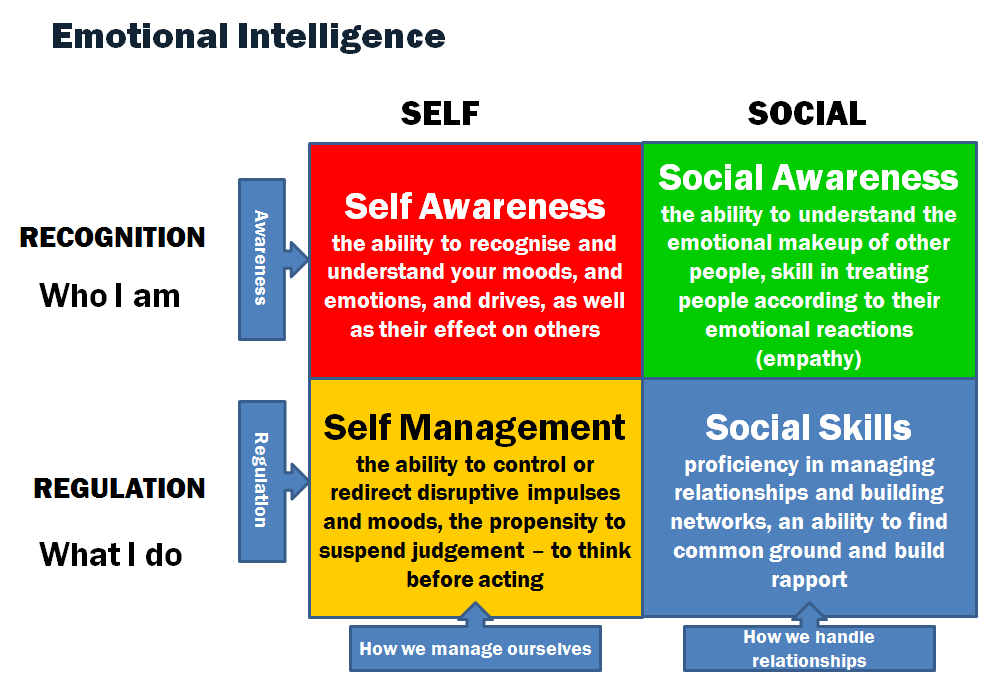
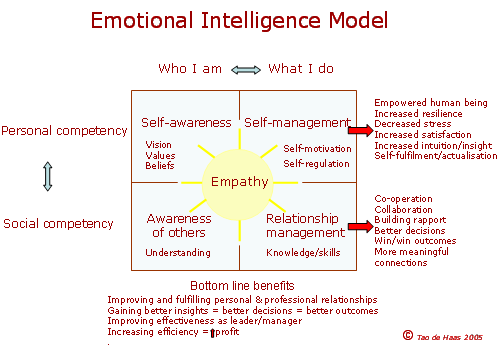
1) Emotional Intelligence – This is a concept that’s been around for awhile now, but I never really read about it until this week.  Matt Monge’s article for The Mojo Company sparked my interest. He described 6 symptoms of leaders with low emotional intelligence. Here’s the definition: “Emotional intelligence (EI) is the ability to monitor one’s own and other people’s emotions, to discriminate between different emotions and label them appropriately, and to use emotional information to guide thinking and behavior.” 

Two of Monge’s points were: 1) Leaders with low emotional intelligence say “I’m sorry you feel that way” more than “I’m sorry,” and 2) Leaders with low emotional intelligence often blame the people they hurt for the situations leading to them being hurt. Daniel Goleman has written several books on this topic including Emotional Intelligence: Why It Can Matter More Than Intelligence and Social Intelligence: The New Science of Human Relationships. The very cool thing about emotional intelligence is that it can be developed. The big dilemma is whether bosses who tend not to be bothered by their impact on personnel would buy into this or not. Incorporating such concepts in personnel accountability metrics might provide some incentive. I’ve added graphics below that helped me further understand emotional intelligence.Blog - Friday Faves - Leadership - Emotional IntelligencePhoto Credit: Self Study History

Blog - Friday Faves - Emotional Intelligence - grid - dollieslagerPhoto Credit: Dollie Slager

Blog - Friday Faves - Emotional Intelligence - low & highPhoto Credit: The King and Queen

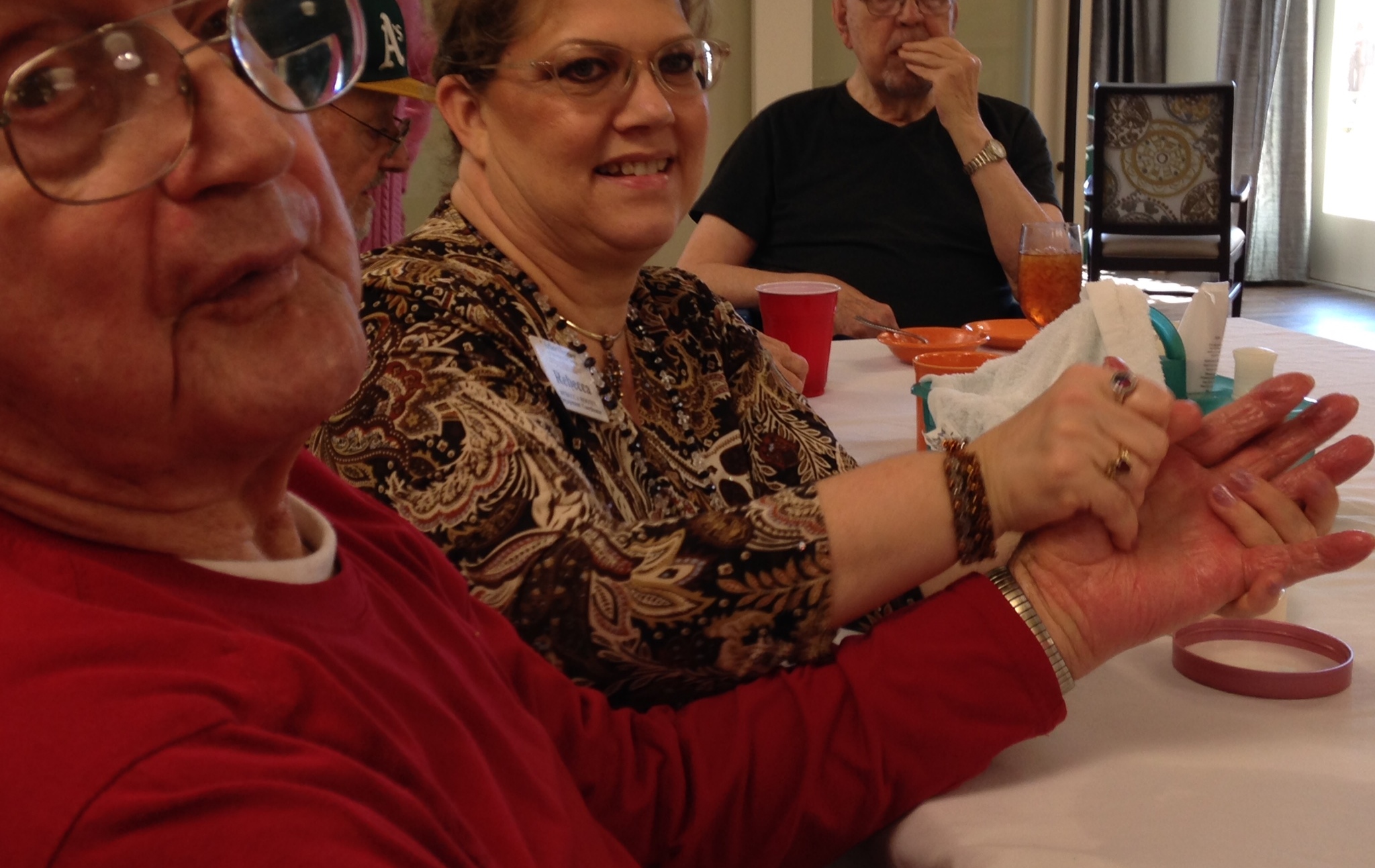
2) Hand Massage – My dad is 93 years old. He has Alzheimer’s. I can’t imagine he has ever had a hand massage in his whole adult life until this past week. The memory care unit which is now home to him has this lovely activities director. One of his first days there, she brought over two warm washcloths and wrapped both his hands. Then she began massaging each one. He just melted into a relaxed, soothed puddle.  One of his repetitive actions is to scratch his hand which he does to distraction. Hand massage is such a thoughtful, therapeutic act. It never dawned on me to do such a thing. Midway down an excellent piece on Alzheimer’s by staff at University of Maryland, massage is recommended as treatment to calm these patients. So glad Dad is where he is with these engaged caregivers.Blog - Dad and hand massage

3) A TV Commercial – We all discover human interest videos through our social media sites. This is my favorite for the week. The #SharetheLoad video produced by Ariel (a washing detergent we used overseas) in India is beautiful. The message is a father’s regret that he modeled for his wife and daughter a very passive role in the home. Even as an older man (the commercial goes), he determined to make that right. Whether it happens or not in such homes today, the message is a powerful one.

4) 40% Rule – So I found this Fortune article on my Twitter feed. Sidd Finch wrote about Jesse Itzler’s encounter with David Goggins, a Navy Seal. during a 100-mile relay race. Goggins was running the entire race without relay partners. Itzler was so intrigued by this ultra-athlete that he actually invited him to live with Itzler’s family for a month. Out of this time together came the book Living with a SEAL: 31 Days Training with the Toughest Man on the Planet. Goggins taught Itzler about the Navy Seals’ 40% Rule.

Itzler explains, “He would say that when your mind is telling you you’re done, you’re really only 40 percent done. And he had a motto: If it doesn’t suck we don’t do it. And that was his way of forcing us to get uncomfortable to figure out what our baseline was and what our comfort level was and just turning it upside-down.”

“The 40% rule, the SEAL explained, is the reason why even though most people hit a wall at mile 16 during a marathon, they’re still able to finish.”

Blog - Friday Faves - 40 percent rule - David GogginsPhoto Credit: Just Go Fitness

“I don’t stop when I’m tired. I stop when I’m done.”David Goggins

Blog - Friday Faves - 40 percent rule - Navy Seals - David GogginsPhoto Credit: AZ Quotes

5) Zelda The Legend of Zelda is celebrating its 30th anniversary this year. I recently wrote briefly about it here. Koji Kondo wrote much of the music for the video game series. Blog - Friday Faves - Video Games - Link of The Legend of ZeldaPhoto Credit: Cogswell.edu

Nathan Mills at Beyond the Guitar has posted two covers so far to showcase how beautiful the music is and how well it’s captured on classical guitar. I wrote about the first cover previously, and here’s his second piece. Happy 30th Anniversary, Legend of Zelda.

HBR’s 10 Must Reads on Emotional Intelligence (with featured article “What Makes a Leader?” by Daniel Goleman)

10 Signs You Have Exceptional Mental Strength by Jessica Stillman

BONUS: If you got this far, you will be so rewarded! Very few people in my life watch American Idol, and this is its final (15th) season. I am not fond of the whole reality show murkiness of it, but the performances of these gifted young people and the judges (Keith Urban, Harry Connick, Jr., and Jennifer Lopez) are captivating as well. I want to post videos of two amazing performances from this week’s elimination show (elimination meaning the week the field of contestants narrows to the Top 10). The first video is that of La’Porsha Renae who may very well become the final American Idol. This one can sing!!!

We were overseas when American Idol’s first season aired. I don’t actually remember how I saw Kelly Clarkson in that competition, but I remember following her. She was the first American Idol winner, and the rest is history. To be honest, Kelly Clarkson was off my music listening grid…until now. The song she wrote and performed, Piece by Piece, deals with the painful subject of a father who deserted her as a young child. The song also celebrates the very different man she married, the faithful father of her daughter. This song may make you cry. Wow!

Monday Morning Moment – Kindness Over Cleverness – Work Culture Where Employee Satisfaction Impacts Marketing

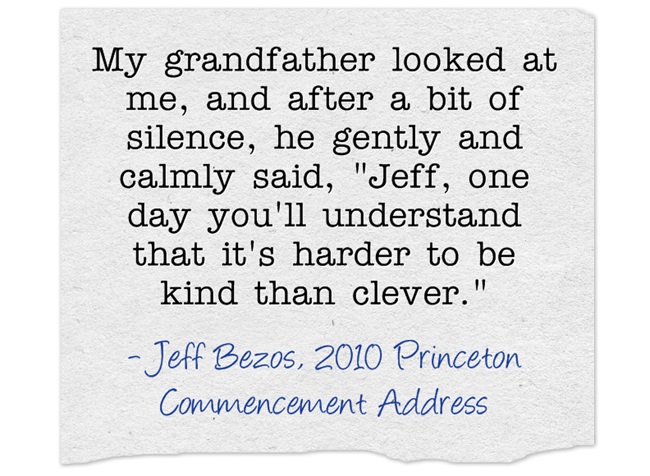
Blog - Kind over Clever - Jeff Bezos - scoopnestPhoto Credit: Scoopnest

Quite remarkably, I recently came across several articles on kindness, of all things, in the Harvard Business Review. It was thrilling for me to see it commended as a business process in such a prestigious journal. I have loved the idea of kindness since early childhood. It seemed such a reasonable choice in dealing with others, much more pleasing than cleverness. [Now, if I were more clever, then it might have proved a harder choice.]

Although we were not in church as young children, my mom taught us the Disney form of kindness: “If you can’t say something nice, don’t say nothing at all.” – from the film Bambi.

When we, later in my childhood, became involved in a church community, I discovered the great teachings of God about kindness, which further stoked my resolve. Whenever possible, acting in kindness was the right choice…in personal relationships and in the workplace.

These days, in tight-knit tribal leadership and competitive companies, kindness is too often sacrificed for the bottom-line. You can imagine how refreshing it is for me to see that business thinkers and strategists are taking note of the profitability of kindness as a process – both internally (organizational human relations) and externally (marketing). A work culture of strategic, intentional kindness – just think of that!

If you go to Harvard Business Review’s website and search the word kindness, all sorts of articles pop up. I was most intrigued by Bill Taylor’s pieces on “kindness over cleverness”. He is the founder of Fast Company magazine and author of Practically Radical. He tells stories of companies who have been successful in practicing kindness strategically. He is inspired by Jeff Bezos’ experience growing up with a wise grandfather who taught him to choose kindness over cleverness. That story is told by Bezos himself in the TED Talk (linked below).Blog - Kind Over Clever - Jeff Bezzos - nepc.colorado.eduPhoto Credit: National Education Policy Center

Ted Talk Video – Jeff Bezos, Founder of Amazon – Princeton Commencement Address on What Matters More Than Talents – Gifts vs. Choices

If we wanted to take individual (and corporate) kindness up several notches in our workplace and workforce, what would those processes be? What would we have to give up  in order to raise employee satisfaction to such a level that it extends to product excellence and customer service? For leadership, it might be giving up some control and extending a kinder and wiser empowerment, For employees, it might be giving up a timid fatalism and risking a kinder boldness (less of “the great Oz” scenario). I would love to hear what business processes you have in place that celebrate kindness over cleverness. What kind of work culture does your leadership model and cultivate? What can you do yourself, whatever your leadership culture is? See Matt Monge’s article on leading without a title.  [Please share in Comments section below.]

We have a choice, after all.

I hope to write more about this because it is intriguing to me how our own delight in our work and product can pour over into our profitability and success.

For today, I close with some of my favorite quotes from these Harvard Business Review articles:Blog - What Can I Do Right Now - Heres-the-question-Id-q57pgs - larry ferlazzoPhoto Credit: Larry Ferlazzo

“Kindness has a strategic role to play, especially when it comes to winning over customers in an intensely competitive and slowly recovering economy.”Jeffrey F. Rayport

Success today is about so much more than just price, quality, reliability – pure economic value. It is about passion, emotion, identity – sharing your values.”Bill Taylor

Success is not just about marketing differently from other companies…It is also, and perhaps more important, about caring more than other companies — about customers, about colleagues, about how the organization conducts itself in a world with endless opportunities to cut corners and compromise on values…You can’t be special, distinctive, and compelling in the marketplace unless you create something special, distinctive, and compelling in the workplace. How does your brand shape your culture? How does your culture bring your brand to life? – Bill Taylor

What is it about business that makes it so hard to be kind?” I asked at the time. And what kind of businesspeople have we become when small acts of kindness feel so rare? …By all means, encourage your people to embrace technology, get great at business analytics, and otherwise ramp up the efficiency of everything they do. But just make sure all their efficiency doesn’t come at the expense of their humanity. Small gestures can send big signals about who we are, what we care about, and why people should want to affiliate with us. It’s harder (and more important) to be kind than clever.”Bill Taylor

Compassion is a great equalizer. When you approach others with genuine concern for their well-being, your standing in the organizational hierarchy is less of a barrier to a productive conversation…Kindness, in other words, is rarely inappropriate.Allison Rimm

Is Kindness a Strategy? – Jeffrey F. Rayport

Brand Is Culture, Culture is Brand – William C. Taylor

It’s More Important to Be Kind Than Clever – William C. Taylor

Why Is It So Hard to Be Kind? – William C. Taylor

10 Ways You Can Show Leadership Without a Title – Matt Monge – The Mojo Company

To Guide Difficult Conversations, Try Using Compassion – Allison Rimm

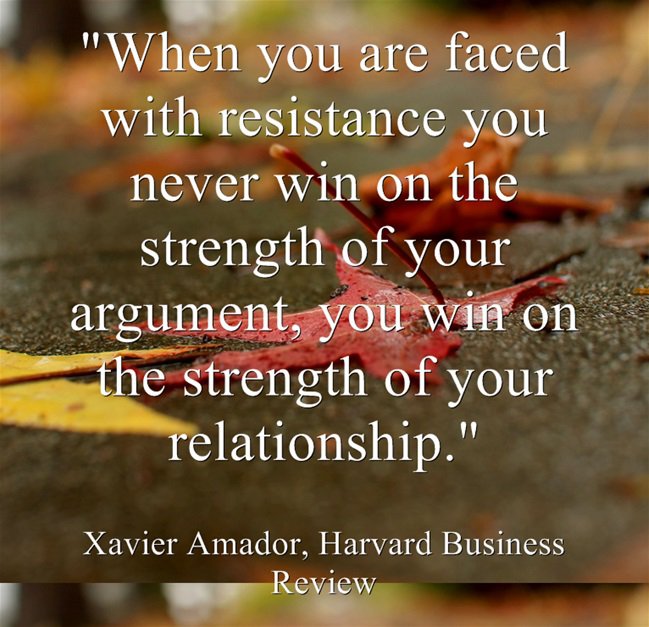
Blog - Relationships vs. Resistance - Leadership - Larry FerlazzoPhoto Credit: Larry Ferlazzo