The state of contentment is on my mind this morning. From time to time, I’m moved to check my heart in this area, because being content can be a struggle. Contentment is NOT the same as resignation. In fact, it is far from it. Contentment can be defined as “the state of being mentally or emotionally satisfied with things as they are.”
During a season of emotional and spiritual discontent decades ago (which I wrote about here), my sweet husband introduced me to Jerry Bridges‘ book The Practice of Godliness. He had marked the chapter on contentment and gave the book to me on his way to work. Without judgment. Just love and concern. I read it right at that moment.
Bridges (now with the LORD) had this great gift of writing with such clarity and simplicity that we could soak up these truths with life-changing certainty. Thanks to Bridges’ gentle, humble writing, I didn’t take offense – “He doesn’t know what it’s like for me!” – and I learned afresh contentment in life. I am still learning.
In the book of Genesis, the very first sin of humankind was born out of discontent. Satan tempted Eve, and then Adam, with the idea that God was not good and didn’t not have their best interest in mind. His temptation wooed Eve into taking her life into her own hands, choosing to disobey God’s one command. Bridges wrote about the eroding nature of discontent in three areas – possessions, position/power, and the providence of God.
The Apostle Paul commented on how he had learned to be content in all things. He doesn’t give the secret of being content here, but in 2 Corinthians 12:9 as the foundation for his contentment.
Jerry Bridges gives the secret of living in humble and joyful contentment:
“This is the secret of being content: To learn and accept that 1) we live daily by God’s unmerited favor given through Christ, and that 2) we can respond to any and every situation by His divine enablement through the Holy Spirit.” – Jerry Bridges, AZ Quotes
If you struggle with discontent, with wanting life to be different than what it is right now, you would do well to read Jerry Bridges’ chapter on contentment. It brought me to my senses, for sure.
In honoring the impact this man has had on my life and thousands of others, I’d like to post some of his quotes. Learn from this dear brother even as he’s right now in the presence of God.
“Contentment is one of the most distinguishing traits of the Godly person, because a Godly person has his heart focused on God rather than on possessions or position or power.” – Jerry Bridges, LikeSuccess
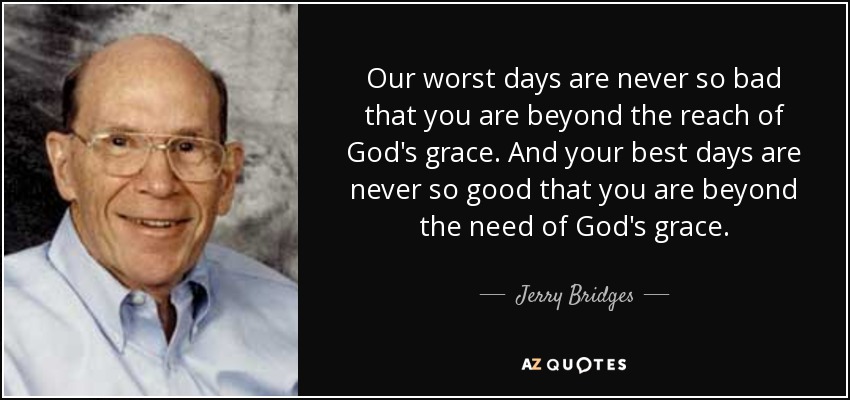
“Your worst days are never so bad that you are beyond the reach of God’s grace. And your best days are never so good that you are beyond the need of God’s grace.” – Jerry Bridges, AZ Quotes
“Lord, I am willing To receive what You give. To lack what You withhold. To relinquish what You take, To suffer what You inflict, To be what You require.” – Jerry Bridges, AZ Quotes
“Grace is never cheap. It is absolutely free to us, but infinitely expensive to God… Anyone who is prone to use grace as a license for irresponsible, sinful behavior, surely does not appreciate the infinite price God paid to give us His grace.” – Jerry Bridges, AZ Quotes
“Every day that we’re not practicing godliness we’re being conformed to the world of ungodliness around us.” – Jerry Bridges, Top Famous Quotes
“One thing we may be sure of, however: For the believer all pain has meaning; all adversity is profitable. There is no question that adversity is difficult. It usually takes us by surprise and seems to strike where we are most vulnerable. To us it often appears completely senseless and irrational, but to God none of it is either senseless or irrational. He has a purpose in every pain He brings or allows in our lives. We can be sure that in some way He intends it for our profit and His glory.” – Jerry Bridges, AZ Quotes
“Be glad in the Lord, and rejoice, O righteous, and shout for joy, all you upright in heart!” – Psalm 32:11
“Shout for joy to God, all the earth; sing the glory of his name; give to him glorious praise!” – Psalm 66:1-2
Clap your hands, all you peoples! Shout to God with the voice of triumph! – Psalm 47:1
Come, let us sing for joy to the LORD; let us shout to the Rock of our salvation! Let us enter His presence with thanksgiving; let us make a joyful noise to Him in song. – Psalm 95:1-2
Make a joyful noise to the LORD, all the earth; break forth—let your cry ring out, and sing praises! Sing praises to the LORD with the lyre, in melodious song with the harp. With trumpets and the blast of the ram’s horn shout for joy before the LORD, the King. – Psalm 98:4-6
In the Fall of 1998, we returned to the US from living overseas for three years. It was a bit of a sabbatical where we had a few weeks to reconnect with friends and family. For that period of time, we traveled around the US, visiting folks. On Sundays, we would go to their churches.
Oddly, every Sunday (or the majority of them), the same song was on that church’s worship list. A song released in 1994 in Australia by composer, worship leader Darlene Zschech. This song would put the then 10-year-old Hillsong Church on the global worship map.
Our kids were still youngsters in 1998 but remember well how we stood gathered with other believers and sang that glorious anthem to the Lord – week after week. Amused at times, we puzzled over how many times we ended up singing it. That song and those worship experiences would bring me (at least) to tears in those moments. In awe of Jesus…and His provision for His beloved.
We don’t sing this song much anymore, now over 30 years since its release. However, its call to worship is still real and relevant. Yesterday, I found Australian pastor/teacher Robert Griffith‘s piece on shouting to the Lord. He writes that there are 135 references in Scripture referring to our shouting to the Lord. His observations are powerful and transformative, some quoted below.
Now, all of us shout. If we have voices, we have all shouted many times, and for numerous reasons. We’ve shouted in the overflow of great joy. We’ve shouted in the exultation of victory. We’ve shouted in the tension of competition. We’ve shouted in the chaos of battle. We’ve shouted in the tumult of controversy and argument. We’ve shouted in moments of great danger. We’ve shouted in the explosion of hot anger.
But we rarely shout alone. Have you noticed that? Similar to laughing, and to some extent singing, shouting seems to be designed primarily as a corporate expression of strong emotion, something we find most enjoyable or helpful or needful when we do it with other people.
There’s something profound and mysterious about a group of people sharing a common excitement and joy. Often, joy is heightened when we experience it together with others – and certain joys are only properly expressed in shouting. To not shout together in the stadium as your team crosses the line to score, would emotionally mute the whole experience.
Most of the scriptural instructions to shout are addressed to the gathered saints – the Psalms were mainly meant to be sung (and sometimes shouted) together with others.
What about when our Church gathers together to worship (and it’s not a funeral)? What does our Church culture encourage? Are there occasionally moments of exuberance in song where all the saints “shout for joy to God” (Psalm 66:1)? Or does that always feel out of place, or only done by one or two courageous (and odd) people?
Do we ever feel the realities of the mercies of God, our redemption, the spiritual conflict we’re engaged in, the promise of our resurrection, and Christ’s ultimate triumph strongly enough to inspire a shout? I ask this question for a couple of reasons. One, it might reveal a personal deficiency in our souls that we need to address with the Lord – that we’re not connecting deeply enough with the realities of what God has done for us, and what God has promised us. And, of course, that’s all of us to a greater or lesser degree. What we may need is to repent of giving excessive attention to lesser things and spend more extended time meditating on “the surpassing worth of knowing Christ Jesus” (Philippians 3:8) in order to stoke the embers of our deep passion for Him. Without passion, nobody is going to shout.
But a second reason is that, to some degree, an affectional deficit might be due to the fact that we don’t shout together. I often feel certain great truths of God, or at least dimensions of them, more deeply and intensely when I share and shout over them with others.
Shouting is commended and commanded in the Bible, like singing, because there are dimensions of joy in God that are only experienced when we express ourselves in this way – particularly when we express ourselves this way together as the people of God.
Because of the clear biblical exhortations to shout, I commend these thoughts to you for your prayerful consideration – especially pastors and leaders who craft worship times for gathered saints. What we all want is for the saints to experience as much blessing of delighting in God as possible.” – Shout to the Lord – Robert Griffith
Let’s make some noise! Our church when gathered is definitely Spirit-filled but, at the same time, somewhat reserved. I do sense a movement stirring…may we voice our delight in the Lord in ways that honor Him.
My Jesus, my Savior Lord, there is none like You All of my days I want to praise The wonders of Your mighty love
My comfort, my shelter Tower of refuge and strength Let every breath, all that I am Never cease to worship You
Shout to the Lord, all the earth, let us sing Power and majesty, praise to the King Mountains bow down and the seas will roar At the sound of Your name
I sing for joy at the work of Your hands Forever I’ll love You, forever I’ll stand Nothing compares to the promise I have in You
(My Jesus) To my Savior (my Savior) Oh, Lord there is nothing like You All of my days I want to praise The wonders of Your mighty love
You’re my comfort (my comfort), and my shelter, yes (my shelter) You’re my tower of refuge and strength Let every breath, and all that I am Never cease to worship You
Shout to the Lord, all the earth, let us sing Power and majesty, praise to the King Mountains bow down and the seas will roar At the sound of Your name
I sing for joy at the work of Your hands Forever I’ll love You, forever I’ll stand Nothing compares to the promise I have in…
Shout to the Lord, all the earth, let us sing, yeah Power and majesty, praise to the King Mountains bow down (mountains bow down and the seas will roar) At the sound of Your name
I sing for joy at the work of Your hands Forever I’ll love You, forever I’ll stand Nothing compares to the promise I have in You (Nothing compares to the promise I have in You…) Oh, nothing compares to the promise I have in You*
Yesterday, I was taking a break and scrolled through Instagram until it stopped me in my tracks on how complaining can have a chronic negative impact on our health, and, in particular, on our brain. That didn’t surprise me, but I wanted to look further to test out what this influencer was reporting. You can look, too. Do an internet search on “complaining, cortisol, and the brain”. It is startling, but, again, not surprising.
Complaining is extraordinarily detrimental to brain health. In a way, it is also like “second-hand smoke” to those with whom you share it. When we complain, our brain responds by releasing cortisol. We need cortisol, the “stress” hormone, to alert us to possible danger and to stimulate an appropriate (hopefully) response to that danger. The problem with complaining is that it puts stress on a loud speaker when there was no need. Similar to how trauma rewires our brain to expect more trauma.
Venting feels good at the moment. It releases the internal pressure that is mentally building up from negative thinking. The dilemma with venting is two-fold – 1) it cements the wiring in the brain in the direction of negative, hopeless thinking, and 2) it activates/re-activates the same process in the caring hearer. Mind you, there is a positive, healthy venting that can take place if it is focused toward hopeful problem-solving and change. This can be life-giving to both persons.
[Side note: We need each other. We were made for community. Talking something out with people who love us is hugely important. There is a difference in lament and grumbling, or complaining and and acknowledging a hard thing, seeking help for forward movement.]
As one who is getting older and feeling the memory not as sharp and the tendency toward that “cup half empty”, curmudgeonly take on things…I wonder: when and how did it start?
When does analytical become contrarian? When does hopeful turn into doubtful? When does grateful turn into grumbly?
Do we just allow ourselves to turn into different people? Or do we take steps to stay (or become) joyful, engaged, unstoppable humans? People who others love to work with, serve with, spend time with.
A little over a year ago I wrote a blog on how complaining rewires our brains. If you know complaining is a struggle, please take the time to read this one piece (linked below). We may try to eat healthy, exercise, and rest aplenty – maybe there is one more thing we should consider:
Bottom line: Practice gratitude. Pause your thought process. Resist the urge to complain, rather reframing the complaint into positive action. Surround yourself with people who don’t complain, and, even make you laugh sometimes.
When you have more time or you want to consider steps toward positive brain health and a kinder, gentler handling of your life and circumstances, I have excerpted these from my other blogs on complaining and negative thinking:
Complaining Exposed – [From the Archives] When it comes to complaining, we all think of someone else who does it…not us. It is an irritating habit, and it only gets worse if unchecked. Poet writer Anne Peterson talks about complaining and how it flows out of 6 heart attitudes. Complaining reveals that:
We feel entitled.
We are impatient.
We hold on to resentment.
We compare ourselves to others.
We don’t think life is fair.
We are conformed to this world/culture.
Read her article for the particulars. Be prepared to rip the Bandaid (excuses) off your complaining.
Entrepreneur Gary Vaynerchukwrites about how his mom and wife seem to be incapable of complaining and it’s one of the things he loves about them: “Complaining has zero value. Looking at the negative, seeing the glass as half empty, and complaining are some of the biggest wastes of time a human being can engage in. Instead, tackle the problem head on. Assess it, see what you can do about it, and then do just that. ‘Woe is me’ is truly one of the biggest things that can stand in the way of success both professionally and personally.”
2. Beyond Grumpiness –[From the Archives] A friend of mine pointed this blog to me today and it bumped its way to the top of my Faves. English professor Alan Jacobs mused about the grumpiness of old people. I don’t know when it happens and why exactly it happens, but it is something that has happened to me of late…and I don’t think I’m old enough yet for it to happen.
Here’s a bit of what Dr. Jacobs says about grumpiness, but you should read his whole piece, especially if you’re finding yourself becoming grumpy (whatever age you are).
“I think the explanation for such widespread grumpiness is fairly simple…It’s not the big foul acts or horribly cruel words that do you in, it’s the slow drip drip drip of little annoyances that become over time a vast sea of frustration. Surely you’ve been there? You become exasperated by someone’s passing comment and when they are genuinely puzzled by your anger over so trivial a matter, you try to explain (apologetically, penitently, I hope) that it wouldn’t be a problem if this thing had happened once but it has happened a thousand times. It’s the repetition that kills you.” [Dr. Jacobs goes on to talk about the divisions on which we’ve taken sides give the sense of being new and revolutionary…and yet they are old divisions revisited.] “You can’t learn from the past if you don’t know what happened in it. So yeah, I’m gradually turning into a grumpy old man. Because nobody learns anything…” [About these things that divide us: We seem to care too much, or too little, or just plain not at all. Dr. Jacobs challenges us that only being truly loving people gives us the right to voice an opinion, and definitely not a shaming one.] “It’s a hard path to walk, this Way of avoiding both indifference and ‘the conscious impotence of rage at human folly.’ But the hard path is the only real Way. (All the others circle back on themselves.) So I try every day to follow it. I don’t think I could manage even that if I did not have an Advocate to accompany me, to encourage me, and to guide me.” – Alan Jacobs, Beyond Grumpiness
3. Without Grumbling – [From the Archives] Which comes first – anger or grumbling? Or is it a more subtle but growing discontent? When does occasional complaining settle into a set habit of grumbling? What does grumbling communicate to our own minds and to others within hearing?
I’ve written plenty on complaining, grumbling, and negative thinking (see links below). It can absolutely change the wiring in our brains. In my younger years, I always looked for the good and the beautiful in a person/situation…and I found it. Now, as an older person, my temptation is more toward darker thinking. This is NOT where I want to stay.
Below is a beautiful bit of writer Trevin Wax‘s post on grumbling and joy (it is geared toward Christians but there is wisdom for all of life here).
“In Philippians 2:6–11, Paul commands the church to adopt the same mind of our risen Lord. And his first command is, “Don’t grumble.”
“Do all things without grumbling or disputing, that you may be blameless and innocent, children of God without blemish in the midst of a crooked and twisted generation, among whom you shine as lights in the world.” (Philippians 2:14–15)
Why start with grumbling? We might expect an exhortation to spiritual disciplines, or strategies for thriving as pure and faultless people in a sinful world. And yes, Paul does speak about blamelessness and purity and holding firm to the word of life (Philippians 2:16). But this purity in action is somehow connected to the first command to do everything without grumbling. Somehow, grumbling will keep us from faithfulness.
Why start here? Because Paul knows the story of Israel.
Remember the children of Israel? They chose grumbling over gratitude. Grumbling stalled their journey and led to actions that were anything but “blameless and innocent.”
Whether we are given suffering, chains, imprisonment, or worse (Hebrews 11:36–38), or whether we conquer kingdoms, stop the mouths of lions, escape the sword, and put armies to flight (Hebrews 11:33–34), we must know that only joy in and gratitude to Jesus will win the war for our culture…Yes, we may face obstacles, setbacks, and tough days ahead. But in it all, and under it all, we are also joyful. And this cheerful courage comes not from ignoring darkness or looking only for the bright side, but from believing that the Light will overcome the dark.
Do you want to shine like stars? Then do everything without grumbling.” –
4.Breaking Out of Negative Thinking – [From the Archives] I first wrote about negative thinking six years ago (that blog linked below). Since then we have come through COVID 2020, great racial unrest and social upheaval, contentious election cycles, ongoing wars, and a downturn in our economy. Lots to think negatively about with good reason, but if we’re not careful we will begin gearing our thinking in that direction to the detriment of our mental and relational health.
The team at Daily Health Post focused on complaining as a culprit that can actually cause our brains to default to anxiety and depression. From experience, I know this is true.
They prescribe the following to flip the damaging habit of complaining:
“Be grateful: Find something to be grateful for everyday. If you keep a journal, write down 3 things you are grateful for every morning and every night.
If you start to feel anxious or pessimistic, pause a minute and write them down again. If it’s too hard, write down 5 or even 10 new things you’re grateful for. By the end of the exercise, you’ll feel much happier and fulfilled.
Catch yourself: Don’t wait for your friends or family to tell you you’re complaining, pay attention to your thoughts and words.
If you’re complaining, quickly shift your energy to find solutions and lessons to be learned. Afterwards, treat yourself will a nice cup of tea for the effort!
Change your mood: If you feel overwhelmed and negative, remove yourself from whatever you’re doing and shift your state of mind. If you’re home, sit down with your favorite book and cook up a tasty treat. If you’re at work, go to the washroom or break room for a few minutes and listen your favorite song.
Breathe deeply and close your eyes, paying attention to every word. Hold onto that relaxing feeling and carry it with you throughout the day.
Practice wise effort: Wise effort is the practice of letting go of anything that doesn’t serve you. If your worry won’t improve your situation or teach you a lesson, simply let it go and move on.
This is much easier said then done, of course, but if you write it out, ask friends for advice, and take some time to think it through constructively, it really can be done.“
“He was oppressed and afflicted, yet he did not open his mouth; he was led like a lamb to the slaughter, and as a sheep before its shearers is silent, so he did not open his mouth. By oppression and judgment, he was taken away.” – Isaiah 53:7-8
“He himself bore our sins in his body on the cross, so that we might die to sins and live for righteousness; by his wounds, you have been healed.” – 1 Peter 2:24
Adopt the same attitude as that of Christ Jesus, who, existing in the form of God, did not consider equality with God as something to be exploited. Instead he emptied himself by assuming the form of a servant, taking on the likeness of humanity. And when he had come as a man, he humbled himself by becoming obedient to the point of death — even to death on a cross. For this reason God highly exalted him and gave him the name that is above every name, so that at the name of Jesus every knee will bow — in heaven and on earth and under the earth — and every tongue will confess that Jesus Christ is Lord, to the glory of God the Father.– Philippians 2:5-11
[For further study, see also Ezekiel 16:5; Matthew 27:39; Mark 15:29; Acts 8:32; Hebrews 11:25; Luke 19:9; Romans 11:11; Philippians 2:9 – Sifa Lyrics: Highly Exalted – Song Meaning, Biblical Reference and Inspiration – https://sifalyrics.com/robin-mark-highly-exalted-lyrics]
This week we have the pleasure of my mom-in-law visiting. She is a complete blessing. Such a humble servant and faithful pray’er. You want her to be praying for you. She is a great story-teller and encourager. Her great-grandchildren adore her! She brings joy with her into the house.
One thing that changes in our home when she is here is some of what we watch on TV. On Sunday evenings in her home, she watches a church program produced through Pensacola Christian University. The name of the program is Rejoice in the Lord. The sermon this week was “Renaming Your Sorrow”. Sunday night’s message was impacting, but what touched me the most was one of the worship songs. It was the first time I heard this song “Highly Exalted” and it’s been on repeat since then. You can watch/listen to the university choir sing it here at 11:40 minutes in. So beautiful. Written by Robin Mark and Paul Baloche (released in 2018). All Scripture. I got goosebumps and still get them. Thank You, Jesus.
This song has burned its message into my heart. We treat Jesus too lightly sometimes…and, if we are honest, we can turn our faces away from His teaching, the example of His life, and His atoning sacrifice for our sins. To our detriment. Lord, have mercy on our souls. Forever a part of the triune nature of the Godhead, the Son of God came in obedience to the Father to make a way for us to become children of the most high God. He came in humility as a baby, lived as a carpenter’s son, touch lives radically for three years of public ministry, died a horrible death…in obedience to the Father and for our sakes. Then God the Father raised Him from the dead, and Christ lives forever to intercede for us and welcome us Home. Thanks be to God.
The rise and fall of this song and the lyrics that Robin and Paul knit together from the Word take us to the booming chorus:
“For God has highly exalted Your name; He has enthroned You on high: Jesus the name above all names!”
Amen and Amen.
We exalt You, Lord Jesus. You are worthy of all our praise.
You were despised You were rejected Lord Those who passed by Even averted their gaze from Your sight Such was the suffering You bore for us Led like a lamb, lamb to the slaughter You spoke not a word Chose to be silent Though You did no wrong Nor was deceitfulness found in You Yet by Your wounds our salvation has come Yet by Your suffering our freedom is won For God has highly exalted Your name He has enthroned You on high Jesus the name above all names (2x) Led like a lamb, lamb to the slaughter You spoke not a word Chose to be silent Though You did no wrong Nor was deceitfulness found in You Yet by Your wounds our salvation has come Yet by Your suffering our freedom is won (For) God has highly exalted Your name He has enthroned You on high Jesus the name above all names (2x) Yet by Your wounds our salvation has come Yet by Your suffering our freedom is won (For) God has highly exalted Your name He has enthroned You on high Jesus the name above all names (2x)*
Jesus returned to the Mount of Olives,but early the next morning he was back again at the Temple. A crowd soon gathered, and he sat down and taught them.As he was speaking, the teachers of religious law and the Pharisees brought a woman who had been caught in the act of adultery. They put her in front of the crowd.
“Teacher,” they said to Jesus, “this woman was caught in the act of adultery.The law of Moses says to stone her. What do you say?”
They were trying to trap him into saying something they could use against him, but Jesus stooped down and wrote in the dust with his finger.They kept demanding an answer, so he stood up again and said, “All right, but let the one who has never sinned throw the first stone!”Then he stooped down again and wrote in the dust.
When the accusers heard this, they slipped away one by one, beginning with the oldest, until only Jesus was left in the middle of the crowd with the woman.Then Jesus stood up again and said to the woman, “Where are your accusers? Didn’t even one of them condemn you?”
“No, Lord,” she said.
And Jesus said, “Neither do I. Go and sin no more.”– John 8:1-11
Two others, who were criminals, were led away to be put to death with [Jesus].And when they came to the place that is called The Skull, there they crucified him, and the criminals, one on his right and one on his left.And Jesus said, “Father, forgive them, for they know not what they do.”
One of the criminals who were hanged railed at him, saying, “Are you not the Christ? Save yourself and us!”But the other rebuked him, saying, “Do you not fear God, since you are under the same sentence of condemnation?And we indeed justly, for we are receiving the due reward of our deeds; but this man has done nothing wrong.”And he said, “Jesus, remember me when you come into your kingdom.”And he said to him, “Truly, I say to you, today you will be with me in paradise.” – Luke 23:32-34, 39-43
The Bible is filled with accounts of people in desperate situations. Too many alone in circumstances they can’t seem to escape. Maybe some of us have known that kind of isolation, self-hatred, hopelessness. Singer, songwriter Matthew West brings these people, these lost and wounded ones, into the light. Into the light of God’s love…and ours, if we don’t turn away. “Mended” is West’s speaking forth the Gospel of Christ over brokenness…as if Jesus is speaking to the wounded one, through the lyrics of the song.
[Chorus] When you see broken beyond repair I see healing beyond belief When you see too far gone I see one step away from home When you see nothing but damaged goods I see something good in the making I’m not finished yet When you see wounded, I see mended
[Verse 1] How many times can one heart break? It was never supposed to be this way Look in the mirror, but you find someone You never thought you’d be Oh, but I can still recognize The one I love in your tear stained eyes I know you might not see him now So lift your eyes to me
[Chorus] When you see broken beyond repair I see healing beyond belief When you see too far gone I see one step away from home When you see nothing but damaged goods I see something good in the making I’m not finished yet When you see wounded, I see mended
[Verse 2] You see your worst mistake But I see the price I paid And there’s nothing you could ever do To lose what grace has won So hold on, it’s not the end No, this is where love’s work begins I’m making all things new And I will make a miracle of you
[Chorus] When you see broken beyond repair I see healing beyond belief When you see too far gone I see one step away from home When you see nothing but damaged goods I see something good in the making I’m not finished yet When you see wounded, I see mended
[Bridge] I see my child, my beloved The new creation you’re becoming You see the scars from when you fell But I see the stories they will tell You see worthless, but I see priceless You see pain, but I see a purpose You see unworthy, undeserving But I see you through eyes of mercy
[Chorus] When you see broken beyond repair I see healing beyond belief You’re not too far gone You’re one step away from home When you see nothing but damaged goods I see something good in the making I’m not finished yet, no When you see wounded, I see mended
[Outro] Oh, I see mended Woah, oh I see mended I’m not finished yet When you see wounded, I see mended*
In closing, I’d like to shine a light on a young Christian man who is shining light on persons broken by addiction in the Kensington area of Philadelphia, Pennsylvania. Mal Love is a filmmaker and he is capturing stories of these people, on the streets, prisoners of their addictions. He brings a Godly dignity to them and shows genuine care for them. Talking to them, filming their stories, asking what they need and doing what he can to provide (food, beverages, pillows, recovery helps). He has even administered Narcan when encountering someone who’d overdosed. You can see and hear these stories every day as he goes out onto the streets – on Instagram, Facebook, or his YouTube channel. Mal gives us the opportunity to look into faces of people Jesus loves and pray for them. Whew!
OK…so I’ve written loads on kindness. What is it about this quality of kindness? Maybe it doesn’t seem extraordinary, and, well, it shouldn’t be. I still marvel any time I’m on the receiving end…or see someone exhibit kindness to others, not expecting a thing in return.
Kindness has a “tip of the iceberg” character about it. What’s underneath can be any number of other winsome qualities: humility, compassion, love, understanding, empathy. We’re talking about the kindness that has no underlying selfish motivations – only to lighten the load of another or to lift the heart. To show up, be present, draw near. We should never take kindness for granted. It is no small thing. We can also do the work of maturing it in our own lives. Kindness takes effort. Like the iceberg, much that drives kindness is out of our view, and reflecting on that reminds us of its great value. Kindness is way beyond just being nice. It’s extraordinary.
For example, about ten days ago a friend of ours from church had a big heart surgery. A few days after his surgery, I posted my blog on my own cardiac journey (which at this point is way small compared to his). His wife saw my blog and told him about it. He called me straightaway to ask how I was doing and to encourage me!!! That’s extraordinary kindness. Then yesterday, less than two weeks after his surgery, he was in the parking lot of our church, helping young families park and head safely into church. He could have easily stood or sat in the church lobby and everyone would have been thrilled just to see him back at church. It is his nature to serve and show kindness. I’m pretty sure, some of the folks he helped didn’t even know he’d had surgery.
Kindness does have its own rewards – physically, spiritually, mentally, and socially.
What makes it the most precious is that genuine kindness has no ulterior motive. It flows out of a pure heart. As Christians, we are taught to do good, to show kindness, to others, not for any show of our own virtue but to point to the goodness of God.
This:
“You are the salt of the earth…You are the light of the world. A city set on a hill cannot be hidden. Nor do people light a lamp and put it under a basket, but on a stand, and it gives light to all in the house. In the same way, let your light shine before others, so that they may see your good works and give glory to your Father who is in heaven.” – Jesus, Matthew 5:13-16
Not this:
“Be careful not to practice your righteousness in front of others to be seen by them.“ – Jesus – Matthew 6:1a
Seeing our friend yesterday, serving with delight after major surgery, caused me to reflect on times I’ve seen other beautiful displays of kindness. Like when our neighbor came to sit with Dave while I was having surgery. She just showed up for him so he wouldn’t be waiting alone. That meant a lot. Or another neighbor who always remembers the birthdays of the children in our neighborhood, and even those not in our neighborhood, like my grandkids. Or the card sent for no other reason except the sender was just being kind. Or the phone call from one of the kids – just checking on us.
In the Christian faith, kindness is a fruit of the Spirit. What that means is we can actually build capacity for kindness by walking with God. He empowers us to be kind.
Whether one is a Christ-follower or not, kindness is still a character trait we can build, and we can teach it to our children. It is worth the effort.
We hear much about being kind today. We have it in us to take steps in this direction every day. Even with those we don’t think deserve it. Maybe we didn’t deserve it when people chose to be kind to us. I certainly haven’t deserved all the kindness shown to me. Something to think about and intentionally lean into.
“Let no one ever come to you without leaving better and happier. Be the living expression of God’s kindness. Kindness in your face. Kindness in your eyes. Kindness in your smile.” – Mother Teresa
Yet they did not obey or incline their ear, but walked in their own counsels and in the stubbornness of their evil heart, and went backward and not forward. – Jeremiah 7:24
“They are darkened in their understanding and alienated from the life of God because of the ignorance that is in them, due to their hardness of heart.” – Ephesians 4:18
For this reason we must pay much closer attention to what we have heard, so that we do not drift away from it. – Hebrews 2:1
“Blessed is the one who always trembles before God, but whoever hardens their heart falls into trouble.” – Proverbs 28:14
Unbelief is a dangerous state of being. Rather than take a disturbing or confusing situation, and dig into prayer, Bible study, and reasoning with other believers…we are tempted to take our own counsel. We are drawn to a lesser gospel which “allows” for us to come out on top or to be right and the other is wrong. We want to be comfortable, justified, without sin.
Recently, we were blessed to be in a long conversation with a young family member who is struggling with a theological matter. He has studied long on this issue and can’t wrap his mind around it. Is that unbelief? I don’t think so. His heart is earnest toward the Lord. He wants to know what is true, and he wants to believe what God is saying. As we grapple over this, continue to study, and pray, I believe God will give him enough understanding that faith will take him the rest of the way…wherever he lands. He wants to believe and God will reveal what He needs to know.
What’s scary is those who choose unbelief as their only recourse…their only way forward in our post-Christian culture. Those, even in the church, who refuse to bend to the teaching of Christ…it’s enough to be moral, to be nice, to be ____________ (whatever our culture says is correct).
I knew a man once, a beloved brother, in the church where I grew up. He stopped coming to church after a long season of perceived faithfulness. His reason? He said he felt so burdened by what he had already learned and known about God that he didn’t want to risk being held responsible for any more knowledge of God!!!!!
Tragic.
Yet do we sometimes struggle with that ourselves? Being a part of church but having false beliefs…shutting our ears to what we hope not to have to obey. Or walking away from the church because of the same hardening of heart and refusing to believe.
“…is true Christianity only to be measured by what I believe, or also by how I live? Functional Christianity is when your confession impacts your way of life — you are functioning in accordance with your confession that Jesus is Lord. If Jesus is the reigning Lord of heaven and earth, then discipleship (true Christianity) is measured not simply by what I believe, but by how I live my life in relation to the rule of Jesus. In other words, the gospel should impact every area of my life.” – John H. Armstrong, Functional Christianity
A hardened heart has lost its desire to obey the Lord. Oh that we would never allow our hearts to be so far from Him as to not be able to hear His voice. He is always calling us back to Himself. Believe Him…trust Him…and obey. What freedom and beauty we have in this life with Him!
Worship with me to singer/songwriter Blessing Offor‘s heart-gripping call for us to believe. Not just in God’s Word but in His love as well. No matter what.
So You catch me when I fall, right? And You hear me when I call cryin’ And You fix me when I’m broke, right? And that’s all I need to know So the storm is gonna break right? And the sun is gonna start shining And everything is gonna go right And that’s all I need to know
But what if You know something I don’t? What if You will something I won’t? If You don’t give me what I want But You give me what I need Is that enough to…
Believe, believe, believe, believe in Your love? Will I still Believe, believe, believe, believe in Your love?
So nothing’s ever going wrong, right? And every day I’m gonna be smiling Turned my water into good wine And let the good times roll
But what if You know something I don’t? What if You will something I won’t? If You don’t give me what I want But You give me what I need Is that enough to…
Believe, believe, believe, believe in Your love? Will I still Believe, believe, believe, believe in Your love? Believe, believe, believe, believe in Your love Will I still Believe, believe, believe, believe in Your love?
Do I want You? Do I want You? Do I want You or what You can do for me? Do I love You? Do I love You? Do I love You or what You can do for me? Sometimes I don’t know But all I wanna do is
Believe, believe, believe, believe in Your love (Yes, I do) Believe, believe, believe, believe in Your love (All I wanna do, all I wanna do is believe) Believe, believe, believe, believe in Your love (Yes, I do) Believe, believe, believe, believe in Your love (Believe in Your love) Believe, believe, believe, believe in Your love (Yes, I believe) Believe, believe, believe, believe in Your love (I believe, I believe, I believe) Believe, believe, believe, believe in Your love (In Your love, in Your love, in Your love) Believe, believe, believe, believe in Your love*
““Lord, I believe; help my unbelief!” – Mark 9:24b
“I will give them a heart to know me, that I am the Lord; and they shall be my people, and I will be their God, for they shall return to me with their whole heart.” – Jeremiah 24:7
Years ago, when I was a little girl in a small Baptist church in the South, all the ladies wore flowers to church on Mother’s Day. White flowers if our mothers were no longer living, and red flowers if they were still with us. Flowers still mark the celebration of Mother’s Day. However, much has changed in how we commemorate moms.
In recent years, family estrangement has become a thing. Boundaries another thing. Not everyone has a positive relationship with their mothers. It is sad really. The bond between us and those who birthed and raised us can tragically be shadowed by trauma. Then there are the post-modern issues of fewer marriages and fewer children and increasing incidence of infertility and decreasing adoptions.
So…there’s that. Still I want to celebrate and remember moms. Mothers matter. Mothering can also be beautifully accomplished by grandmothers, aunts, and friends of the family. Thankful for those as well.
[In the links below, you will find other blogs I have written on moms and mothering. Some of what follows has been pulled from those blogs.]
In celebration of Mother’s Day, here are some sweet salutes to all of you who mother well…it’s a long and beautiful journey through life.
“Go to battle, my friend. You are mighty, because you mother! Happy Mother’s Day to Mighty Mothers everywhere! Motherhood is Kingdom business, Jesus work. This shaping of souls, this raising tiny humans…Motherhood is anything but ordinary. You are mighty because you mother!” – Lisa-Jo Baker
“You are braver than you know…because you mother.” I thank God for the mothers in my life – some with children, some without but who love that deeply.
Those Other Mothers – Shout-out to those other mothers. You’ve heard the expression guys at times use: “Brothers from another mother”. I’d like to focus a moment on those other mothers. Our mom was that “other mother” for some. She was a treasure – loving, sacrificing, praying for us, grieving our pain with us, and taking joy in us…and those many others God dropped into her life and she simply loved.
The other mothers I want to celebrate today are the mothers-in-law in our lives. My mom is gone…but my mom-in-law, Julia, is still with us and I am so grateful. She, from a distance away, partnered with my mom in teaching me about loving well my husband and children…
With two children married, I am blessed with two co-moms-in-law. This was an unexpected joy – to be able to know and call as friends these two women. They are faithful in loving my children (and our grands) and I hope they see me as that with their treasures. We count on each other…and celebrate every milestone. Prayer warriors together for our kiddos.
Becky & Karen
The last two “other mothers” are the mommies of our grands – our daughter and daughter-in-love. Seeing how they love and parent the littles is a great joy for us. They themselves are a great joy. Happy Mother’s Day, Girls. You are both wonders!
Bekkah & Christie
How about you? Are there other mothers in your lives who inspire or spur you on (whether they have kids themselves or not)? Share in the Comments if you choose.
An Old Story – “I remember, when I was a boy, watching a dog fight. A little dog of uncertain lineage, and not built for war, sailed into the street to engage in an argument that bade fair to enlist all the canines of legal age in the neighborhood. I remember watching the little fellow as he tried out the fight for a few minutes only to turn tail and make for his own yard. I was just marking him down for a coward when he reached his front gate, stopped a minute for breath, and returned for the fray. I think he must have run home three or four times during the fight to rest for a moment and then go back with redoubled energy…There are many times when I can keep on only by taking a fresh start from my own fireside…That is one thing home does, and that is one thing for which most of our mothers will be remembered.“ – Umphrey Lee, in William H. Leach compilation: Sermon Hearts From the Gospels, pp. 173-174, 1934
A Mama’s Lament – “Slow Down” – “I don’t know of a more uttered or whispered phrase from a mother of any age, about her child of any age, than ‘It’s going by too fast.’ I feel like I spend my life trying to slow time. Trying to celebrate the growth and the milestones of my children, and then secretly day dreaming about building a time machine in my garage, so I can return to rocking my babies at midnight. If you’ve ever looked at your child running across a field, or striding across a graduation stage, or walking down the middle aisle of a church clutching a bouquet, you’ll know why this song is special to me. Please enjoy the video below, remembering the moments we wish we could slow down, and sharing them with those we love most.” – Nichole Nordeman
Today is the first day of Holy Week (for most Christians in the world). Each day is significant as Jesus began the week with a triumphant entry into Jerusalem and then endured crucifixion for sins not His own on the Friday of this week…followed by a glorious Resurrection. This year, I will point you to each day’s events through the links below…recapping the significance for us of Jesus’ journey through this most holy of weeks.
Today is Palm Sunday.
For you critical thinkers, this week in the life of Jesus of Nazareth is one worthy of analysis. No matter your religion or non-religion, this Jesus, in these days, warrants examination, related to anything you may think of God. You will better understand the core beliefs of a Christ-follower, not just a person known to you as Christian. For in the study of Jesus’ life and his followers, in just this one week, you will see a deep distinction between “the religious” and “the redeemed”.
Palm Sunday is celebrated as the “triumphal entry” of Jesus into Jerusalem, just days before he would endure a mock trial and then be crucified. He and his closest followers (disciples) came to Jerusalem for the celebration of Passover. Passover was an annual remembrance of God’s protection and deliverance of Israel during a time of slavery (Exodus 12:26-28). Jesus would celebrate Passover on Thursday of that coming week, but he did not come to Jerusalem for that reason alone.
He knew from his Father God why he came to Jerusalem, and he tried to prepare his disciples for what was coming.
From that time Jesus began to show His disciples that He must go to Jerusalem, and suffer many things from the elders and chief priests and scribes, and be killed, and be raised up on the third day. – Matthew 16:21
Imagine the scene as Jesus entered Jerusalem. Some in the crowd did recognize him, and then the word spread of the arrival of this great teacher, this healer, this man whose teaching was like none before him. Palm branches were pulled to wave in tribute to him, as others flung their cloaks on the dust before him welcoming him.
Most of the crowd spread their coats in the road, and others were cutting branches from the trees and spreading them in the road. The crowds going ahead of Him, and those who followed, were shouting, “Hosanna** to the Son of David; BLESSED IS HE WHO COMES IN THE NAME OF THE LORD; Hosanna in the highest!” When He had entered Jerusalem, all the city was stirred, saying, “Who is this?” – Matthew 21:8-10
“Who is this?” For those who did not know him, the wild welcome for him must have been confusing and captivating. For the religious authorities in Jerusalem, who knew him and were unwilling to welcome this “king of the Jews”, his popularity was infuriating.
The clock began ticking as they plotted against this man Jesus.
Over that bright hopeful day of palms hung the shadow of the Cross – the Cross that would bring even greater hope to all people. The “Hosanna” of Palm Sunday would change to cries to “Crucify!” just five days later. Jesus had no ambition to please the crowds; he was resolutely on task to redeem those who could not redeem themselves – the whole world.
Each day of Holy Week is highlighted in the following posts – one for each day in Jesus’ last week of life before He was resurrected and gave us the sure hope of eternal life with Him. Links follow below.
Sunday, Palm Sunday – Day 1 of Holy Week – Jesus’ Triumphant Entry into Jerusalem on the Way to the Cross
You will keep him in perfect peace, Whose mind is stayed on You, Because he trusts in You. – Isaiah 26:3
“Trust in the LORD with all your heart, and lean not on your own understanding; in all your ways acknowledge Him, and He will make your paths straight.” – Proverbs 3:5-6
Be anxious about nothing, but in everything, by prayer and supplication with thanksgiving, let your requests be made known to God.And the peace of God, which surpasses all understanding, will guard your hearts and your minds in Christ Jesus. – Philippians 4:6-7
My word for 2025 is trust. It was a curious choice for me – Holy Spirit inspired – because I rarely use that word. However, just in the last few weeks, I’ve been diving into its meaning to the believer. Author, speaker Brennan Manning, in his book Ruthless Trust: The Ragamuffin’s Path to God has helped me understand it better.
Mid-way through the book, he proposes a single equation:
Faith + Hope = Trust.
Faith and trust are words often used interchangeably. How I see them now is this: Faith focuses on God’s character, His promises, and His power. We have faith in Him because of what He says about Himself and how we have seen Him act in history and in the lives of those around us and in our very own lives. Faith believes “He can.” Hope focuses on what’s coming in the future and how God, based on our faith and experience already, He will act. Hope is positive because we have experienced the movement of God as positive. Then trust relates to the relationship between God and me. I have faith He can do something; I have hope that He is going to do something (good), and I trust, because of His love, He will do that good thing for me. Our trust does extend to others, believing that God’s love and goodness includes others. However, trust is deeply personal and experiential. As we grow in trust, we grow in our understanding of His love. Out of that comes deep gratitude…even in our darkest of times.
The reality of naked trust is the life of the pilgrim who leaves what is nailed down, obvious, and secure, and walks into the unknown without any rational explanation to justify the decision or guarantee the future. Why? Because God has signaled the movement and offered it his presence and his promise.” ― Brennan Manning, Ruthless Trust: The Ragamuffin’s Path to God
“We are only grateful people when we can say thank you to all that has brought us to the present moment. As long as we keep dividing our lives between events and people we would like to remember and those we would rather forget, we cannot claim the fullness of our beings as a gift of God to be grateful for. Let’s not be afraid to look at everything that has brought us to where we are now and trust that we will soon see in it the guiding hand of a loving God.” ― Brennan Manning, Ruthless Trust: The Ragamuffin’s Path to God
Why is Brennan Manning lovable in the eyes of God? Because on February 8th of 1956, in a shattering, life-changing experience, I committed my life to Jesus. Does God love me because ever since I was ordained a priest in 1963, I roamed the country and lately all over the world proclaiming the Good News of the gospel of grace? Does God love me because I tithe to the poor? Does he love me because back in New Orleans I work on skid row with alcoholics, addicts, and those who suffer with AIDS? Does God love me because I spend two hours every day in prayer? If I believe that stuff I’m a Pharisee! Then I feel I’m entitled to be comfortably close to Christ because of my good works. The gospel of grace says, “Brennan, you’re lovable for one reason only—because God loves you. Period.” – Brennan Manning
[Some of my favorite books – Manning’s most famous book The Ragamuffin Gospel is loaned out.]
[The video below is 3:42 minutes of Brennan Manning’s understanding of God and His love for us. Powerful.]
Worship with me to Twila Paris‘ “Do I Trust You, Lord?”. This song came out in 1994. I remember many times sitting at the piano singing that song, with tears streaming down my cheeks…feeling His presence even in the grief of those moments…trusting Him.
Sometimes my little heart can’t understand What’s in Your will, what’s in Your plan So many times I’m tempted to ask You why But I can never forget it for long Lord, what You do could not be wrong So I believe You, even when I must cry
Chorus: Do I trust You, Lord? Does the river flow? Do I trust You, Lord? Does the north wind blow? You can see my heart You can read my mind And You got to know That I would rather die Than to lose my faith In the One I love Do I trust You, Lord? Do I trust You?
I know the answers, I’ve given them all But suddenly now, I feel so small Shaken down to the cavity in my soul I know the doctrine and theology But right now they don’t mean much to me This time there’s only one thing I’ve got to know
Chorus: Do I trust You, Lord? Does the robin sing? Do I trust You, Lord? Does it rain in spring? You can see my heart You can read my mind And You got to know That I would rather die Than to lose my faith In the One I love Do I trust You, Lord? Do I trust You?
I will trust You, Lord, when I don’t know why I will trust You, Lord, till the day I die I will trust You, Lord, when I’m blind with pain! You were God before, and You’ll never change I will trust You I will trust You I will trust You, Lord I will trust You*
Our dear brother Brennan Manning had many dark periods in his life – depression, alcoholism, terrible self-doubt. If you have read any of his books, you will see the beauty of his struggle. God was there with him in the dark. Manning wrote brilliantly and experientially about the love of God, His character and transcendence, and the persevering nature of the Trinity drawing him to Himself…through it all. Another Twila Paris song which I also sang in times of weakness and doubt reminds me of him – “The Warrior Is a Child”. Take time to play it in memory of our brother (died in 2013) and in honor of the God who sees us wherever we are and stays with us in His incomprehensible love.