Category Archives: Global Leadership Summit

Pixar’s Inside Out – and a Second Thought on Joy & Sadness

Blog - Inside Out - Theology of Sadness - scpr.org

Weeping may tarry for the night, but joy comes with the morning.Psalm 30:5

“Blessed are those who mourn, for they shall be comforted.Matthew 5:4

My husband and I watched Disney/Pixar’s Inside Out this weekend. It was so stressful. We wondered how children managed coping with the anxiousness of the story. Riley, the heroine of the film, is an 11y/o who moved with her parents far away from her hometown. The story tells how she deals with that move with the help of her emotions (5 in particular – Joy, Sadness, Anger, Fear, and Disgust).

Happy, happy, happy little Joy is the moon-faced, darling emotion of Riley’s. The tension in the story is Joy’s attempt at damage control as little Sadness begins coloring some of Riley’s happy memories “blue”. The plot twists and turns as Joy tries to right Riley’s world.  She is pulled into a journey with Sadness alongside and spends most of the film trying to get back to Riley’s “presence of mind”. Meanwhile, Anger, Fear, and Disgust do what they can to help Riley maneuver through her day…without Joy and Sadness’s help. It’s a scary prospect.

I’m thinking children must get caught up in the adventure, the mesmerizing visuals and the familiar faces of these emotions. For me, it was just stressful.

I have a huge respect and admiration for Ed Catmull after hearing him speak at Global Leadership Summit 2015. Catmull heads the work of Disney/Pixar Animation Studios. Dave recently read his book Creativity, Inc. and so enjoyed it that I’m reading it also.

Blog - GLobal Leadership Summit - Ed Catmull by brainpickings.orgPhoto Credit: Brainpickings.org

Watching Inside Out, my mind wandered to the creative teams at Disney/Pixar. What were they thinking?! Then later, I had second thoughts on the film…after watching bits again as our youngest son, visiting over the weekend, watched it on pay-per-view.

He, too, also thought it was stressful, but as I watched his face, watching the film…I saw what we might have missed as older ones watching. Wonder, surprise, vexation, empathy. In the strong face of this young man, I saw the response to the film maybe hoped for by the creators. The audience identifying with the film…and in the end…understanding and a sweet resolution of the seeming conflict between Joy and Sadness.

On that second watching (both the film and watching my son watching), I liked Inside Out much better. It helped me to Google that great “Aha!” moment of Joy’s – when she discovered:

“Sadness…Mom and Dad, the team…they came to help because of sadness.”

No spoilers for those of you who haven’t seen the film, but for me, a couple of articles really resonated (see below). I struggle personally with sadness which shades the joy I also experience.  Then that same joy re-colors the sadness, bringing perspective and healing. Josh Larsen, in an article on the Think Christian website, wrote beautifully about this film’s message (at a deeper level):

It’s a rich subject – one mined with Pixar’s usual combination of wit, intelligence and emotional resonance – and also one that echoes a Christian understanding of the human experience. Christianity, after all, is an expression of joy in response to – not in denial of – deep sadness…we can’t fully understand our place in God’s story unless we’ve experienced sadness of some sort. It isn’t until we recognize the deep sorrow of this world – the Fall, and our perpetuation of its effects – that we can fully appreciate the almost laughable generosity of Christ’s redemptive act. And only then will we know true joy, the fairy-tale ending that is God’s restoration of His creation. – Josh Larsen

Toward the end of the film, there’s a lovely moment between Riley and her parents. She finally comes to terms with her deep sadness in moving away from home. It’s a place all of us have been if we linger with a person grieving…a person who knows we love them.

I was reminded how sadness sometimes  overtakes us and it’s best confronted head-on in all its real…on-another’s-shoulder…Riley, tears spilling down her face, doesn’t hold back as she pours out her grief to her parents. As they cradle her into their arms they, too, confess their own sadness.  Then it happens…that last wet-faced shudder into Daddy’s chest; that deep sigh…all cried out.

That’s what we love about Disney/Pixar…and the God-given emotions of joy and sadness…especially when love is in the mix.

Inside Out and a Theology of Sadness – Josh Larsen, Think Christian

Many critics love Pixar’s ‘Inside Out.’ Not this guy.

Inside Out Quotes

All 15 Pixar Movies, Ranked From Worst to Best

Creativity, Inc. – Ed Catmull’s Story of Pixar, Working with Creatives, & Steve Jobs

untitledIMG_0223Photo Credit: Amazon.com (l) & Deb Mills (r)

Dave, the husband in my story, has always pointed me in the direction of transformative books and learning experiences. That path converged with this year’s Global Leadership Summit and Ed Catmull’s Creativity, Inc.

Bill Hybels interviewed Ed Catmull about his role in co-founding Pixar Animation Studios and pioneering the field of computer animation. Now President of Pixar Animation and Disney Animation, he has an extraordinary story to tell of leading creatives in innovative film-making. Mr. Catmull’s wisdom and humility can be well-applied in any workplace situation.Blog - GLobal Leadership Summit - Ed Catmull by brainpickings.orgPhoto Credit: brainpickings.org

“Science and art are not incongruous. Art isn’t about drawing; it’s about learning to see. Which business or professions do you not want to have enhanced ability to see?”

During this interview at GLS15, he talked about the business processes he uses in film-making. We can relate this level and quality of  accountability in any organization or company:

  1. Teams working together (using a Brain Trust – a group of colleagues all acting as peers, with vested interest, giving feedback;
  2. When failures happen in production – embracing [failure] but at the same time dealing with it with both total candor and kindness; and
  3. Operating within constraints (a budget) – actually pushes creativity higher and delivers better outcomes.

“Stories influence the world. We want to use story-telling for good.”

Listening to Ed Catmull talk about leading at Pixar and Disney whetted our appetites to read his book Creativity, Inc.

Originally, Mr. Catmull worked in the computer graphics department of Lucasfilm, in the beginning years of computer animation. In his book, he tells about his incredible journey in those early years right through to today. It was a wildly bumpy road at first and the work was almost sidelined had it not been for Steve Jobs buying Pixar from Lucasfilm.

Toward the end of the book, Catmull writes about Steve Jobs. They worked together for over 25 years, and the Jobs he knew was a much more complex and lovely man than who we knew through other media. A tribute full of “candor and kindness” – as much about how Ed Catmull sees people as about the amazing leader that was Steve Jobs.

Whatever your work, you want to read this book. Catmull describes how he modeled openness, confidence in, and care for his employees. There are trust builders and wide gates for innovation woven into Pixar’s business processes. Whatever our sphere of influence is, we can all learn to be more effective leaders as we think through how Catmull leads.

At the end of Creativity, Inc., there are 5 pages of bulleted principles that Mr. Catmull encourages as starting points for critical thinking. Here are just a few:

  • If there are people in your organization who feel they are not free to suggest ideas, you lose. Do not discount ideas from unexpected sources. Inspiration can, and does, come from anywhere.
  • It’s isn’t enough merely to be open to ideas from others. Engaging the collective brainpower of the people you work with is an active, ongoing process. As a manager, you must coax ideas out of your staff and constantly push them to contribute.
  • There is nothing quite as effective, when it comes to shutting down alternative viewpoints, as being convinced you are right.
  • If there is more truth in the hallways than in meetings, you have a problem.
  • Change and uncertainty are part of life. Our job is not to resist them but to build the capability to recover when unexpected events occur. If you don’t always try to uncover what is unseen and understand its nature, you will be ill prepared to lead.

Creativity, Inc. is not just a book for whom we now consider “creatives”. It’s a book for any of us who want to employ and empower people to grow personally and in community and to produce in ways that yield great products/services.

We all have stories that can influence the world for good…if we grow a work culture where those stories matter and can be freely explored.

Creativity, Inc.: Overcoming the Unseen Forces That Stand in the Way of True Inspiration by Ed Catmull and Amy Wallace

Global Leadership Summit – 7 Take-Aways from Day One of #GLS15

YouTube Video – Steve Jobs Remembered by Larry Ellison and Pixar’s Ed Catmull

YouTube Video – Ed Catmull: Keep Your Crises Small

Grit – When You’re Hurtin’ But Not Quittin’ – the Role of Personal Resolve and a Team Alongside

131118-Z-WM549-015Photo Credit: Pacific News Center

Diligence is a word that defined my many years in learning Arabic while we lived overseas. Keeping at it, even when I wanted to quit, helped immensely. The joy of living life in a second language is worth all the work. Diligence is a great assist to staying on course, but it is not “grit”.

I saw grit at work recently in a group of servicemen, in Virginia Beach, doing their morning exercise. [Not the picture above but that image has its own neat story of grit]. We had taken a couple of days away from the city to get our breath, by the ocean. Walking on the boardwalk early in the morning, we encountered this small group of airmen from the nearby Naval Base, doing a group jog. We saw them starting the run and saw them again coming back – 6 miles total. Most of them were young, thin, and fit.

What caught our eye, in particular, were two men in mid-life, carrying a bit of weight, bringing up the rear. Approaching the end of that run, they looked like they were hurting, but they definitely weren’t quitting. I’m sure to stay as fit as the rest of the group was, a certain measure of grit was at play…but these two, in this snapshot of life, showed the grit that brought me to write today.

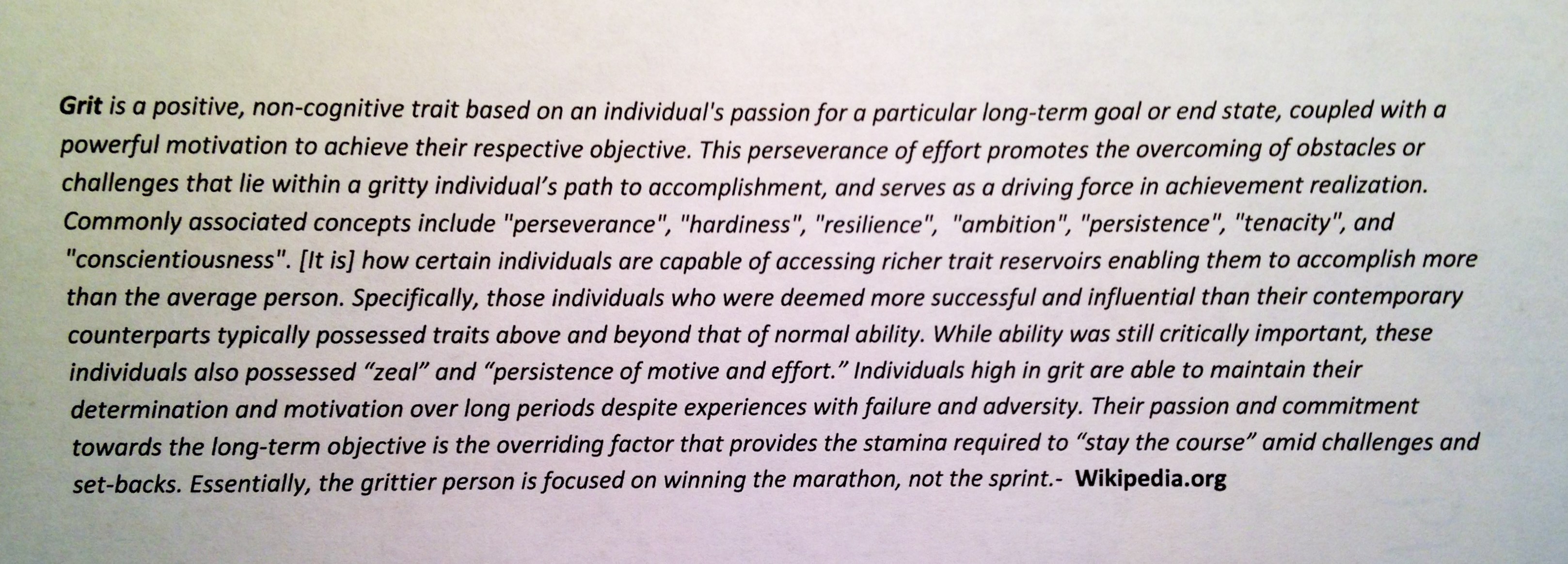
Wikipedia.org defines grit as a character trait  of applying passion and perseverance over time toward a goal, end state or objective. Grit goes beyond ability and can withstand failure, keeping the end goal in sight, and pushing through to it.Blog - Grit - Definition 2

Bill Hybels, at the Global Leadership Summit 2015*, talked about grit as “one of the greatest indicators of success”. Gritty people, he said, are the ones who “play hurt” and rarely ever give up. “They expect progress to be difficult, but believe with their whole being that they can be successful if they don’t quit.” It’s “The Little Engine That Could”. Abraham Lincoln. Nelson Mandela. Gandhi. Martin Luther King. Hybels also encouraged the audience that grit can be developed. From childhood through adulthood.

Jon Acuff (author of Do Over) defines grit as “stubbornness in the face of fear“.  In his book, he gives a short list of what’s needed in making gritty decisions (in the “hustle” of work):

  • Time – we think the world “hustle” has to mean fast, but it can also mean focus, intention, pace.
  • Counsel – Lean on your relationships. Some of the worst decisions are made alone. Who are your advocates? Have you given them time to reflect on it or are you rushing right by the wisdom they have to offer? Let them speak into it. A year from now, looking back on the decision, you’ll be glad you made it as a team.
  • Questions – Always ask awesome opportunities, awesome questions. We skimp on due diligence. “What am I not seeing right now?”
  • Kindness – Give yourself permission to make the wrong decision, because…you’re going to. Break the tension of feeling like you’re going to be perfect by giving yourself some kindness from the outset.
  • Honesty – When you look back on a decision, remember that you made that decision with the best information you had at the time.

As we saw those two older heavyset men running just behind their younger airmen colleagues, we saw men with a goal in mind. There was also something more – the cadence to the group’s run that seemed to work to keep them all together. Whether at work or in family relationships, we want to do all we can to help those gritty ones be successful. Their resolve may get them to the goal anyway, but we all benefit when we are able to “stay on course” together.

Have you “grown gritty” over your lifetime? Are there gritty folks in your life who you love to champion? Tell us about them below.

*Session 1: Bill Hybels Opening Session – Global Leadership Summit

Wikipedia Article on Grit

The Truth About Grit

The Grit Test

Jon Acuff on the Role of Hustle in Taking Hold of Career Opportunities – Notes & Quotes – Part 5 of Do Over Series

How to Make Grit Decisions and Built a Grit List by Jon Acuff

Do Over: Rescue Monday, Reinvent Your Work, and Never Get Stuck by Jon Acuff

Does Teaching Kids To Get ‘Gritty’ Help Them Get Ahead?

Givers, Takers, or Matchers in the Workplace – Which One Are You? – with Adam Grant

Blog - Givers, Takers, Matchers - Adam GrantPhoto Credit: Chuck Scoggins.com

A smart and gifted friend of mine is going through a taxing time on her new job. Long hours, piling up responsibilities, with no end in sight. She lamented that maybe the problem is that she’s a people-pleaser. That expression seems to communicate a character weakness, and I don’t see that operating so much with this friend of mine. What seems more her dilemma is that she’s what Adam Grant calls a “giver”…which is a good thing. The dilemma for my friend and her workplace is to establish a culture where she, and other givers, can thrive.

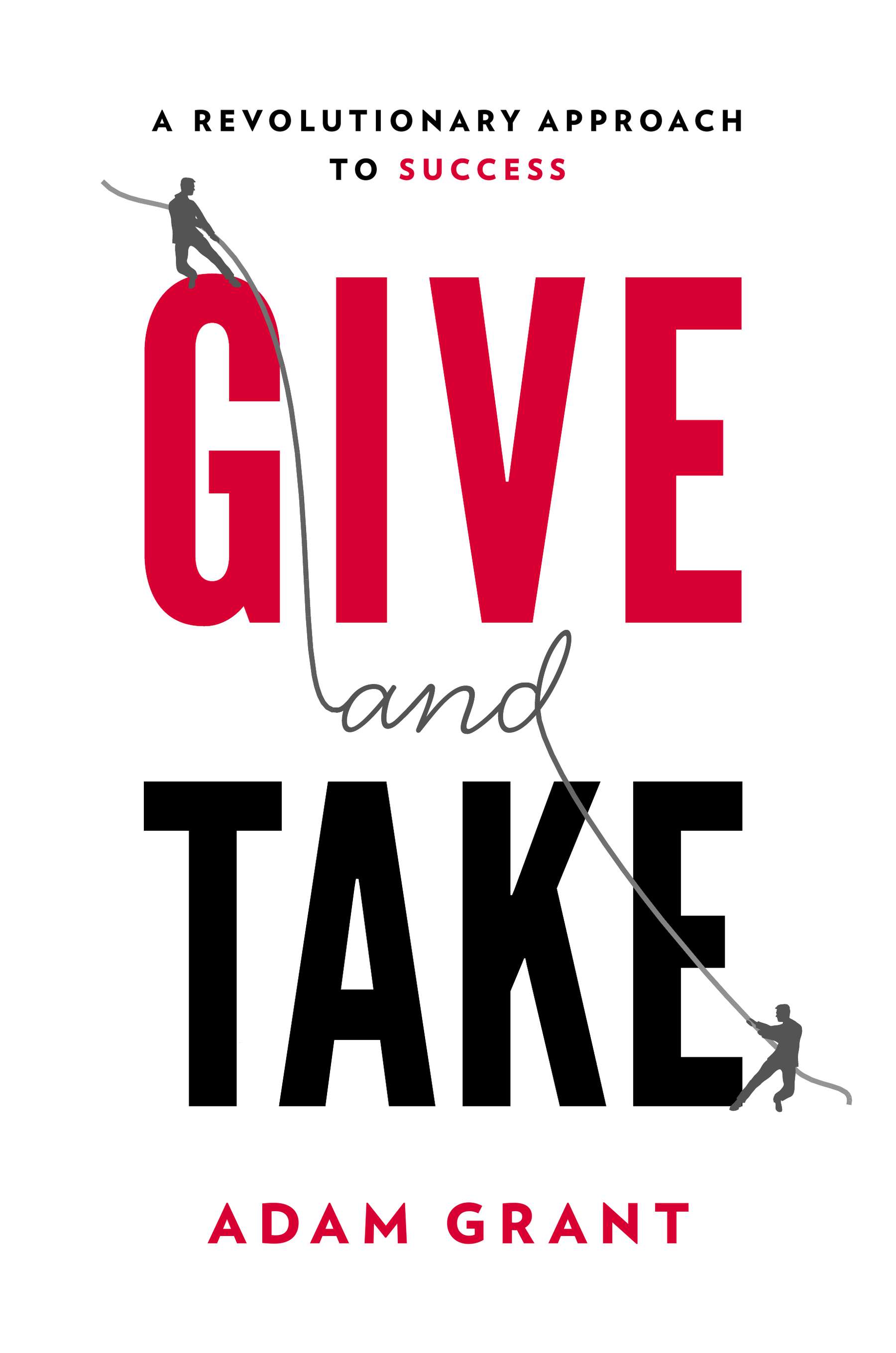
Adam Grant is a professor at the Wharton School of the University of Pennsylvania. He has also written this great book – Give and Take: Why Helping Others Drives Our Success. I heard him speak at the Global Leadership Summit and bought his book. His take on the three tops of people who make up our work culture was both fascinating and practical.Blog - Give and Take by Adam Grant - cminds.netPhoto Credit: Amazon.com

Grant sees us all as either givers, takers, or matchers. “It’s very hard to judge our own style. What values you live each day is in the eye of the beholder.” We may not necessarily see ourselves in these categories, but our colleagues will. Ask them, if you have the courage. Then you might consider taking what you learn and thinking through how you might use that information to become a more effective employee and valued colleague.

Takers are those who often manage to do the least amount of work yet gaining the most notice. They manage to get “the lion’s share of credit for collective achievements”, notes Grant. The Takers are the shirkers in the workplace. They are not at their desks because they are off schmoozing (oops, I meant networking, right?) in another department. They somehow get their jobs done partly by leaning on the strong work ethic of the Givers.

Givers are the people who simply enjoy helping others – “no strings attached”. They get to work early and stay late, if necessary. Their core values resonate in the quantity and quality of their work.

Matchers are most of us, really, doing our part in the workplace. Matchers can be counted on to keep things “fair” at work. “I’ll do something for you if you do something for me” is their mantra. They believe in “an eye for an eye” and “just worlds”.  They are the “fairness” or “Karma” police in the workplace.

Grant readily admits that we may operate out of all three styles from time to time, but we each have a dominant style at work.

How do givers, takers, and matchers fare in the workplace? Which of these sinks to the bottom in terms of performance and impact?

Givers are the worst performers (but keep reading). “The ones who get the least work done are the ones who help the others and never get their own jobs done”, reports Grant.  “I love helping others” is not the one on top of the heap of performers. “The lowest revenue accrues to the most generous salespeople.”

It’s sad news that givers sink to the bottom. If you want to boost your organization, have more givers….unfortunately the givers do it at their own expense – unless the organization builds a culture that helps the givers to thrive.

Who rises to the top?

If givers are the worst performers, who are the best performers? You think it’s takers? Takers rise quickly, and fall quickly. They often fall at the hands of the Matchers who can use gossip (or, said another way, workplace channels of influence) to call out the abuse of the Takers. Beware, Takers, of the Matchers in the shadows. Also, other Takers can also take down those more abusive, or less-well-liked Takers.

Are the Matchers the best performers? Not usually. The best results belong to the Givers. Wait! How can they also be the best performers? It’s a both/and situation.

Grant encourages: “Helping others can sink your career but it can also accelerate your careers. Hang in there.”

It takes a while for Givers to learn and build connections, but when they do, it’s a win-win for the organization.

How can we build cultures to help Givers be successful?

3 Things We Can Do:

  1. Keep the wrong people off the bus. – Get the right people on the bus. If possible, keep Takers off the bus. “One Taker on the team and paranoia starts to spread.” Put one Giver on the team, and you don’t necessarily have an explosion of generosity. It’s not bringing in the Givers; it’s weeding out the Takers. Matchers follow the norm. Matchers will follow the example of the Givers.
  2. Redefine Giving.   Wisdom is to know who is who in the workplace. Or at least not be thrown off by behaviors vs. motives. Then we can shape our work culture to empower Givers, influence Matchers, and avoid enabling Takers. In an interview with Adam Grant, Thinkers50 spelled this process out very well. For instance, consider Agreeableness vs. Disagreeableness – in Takers, Givers, and Matchers. We usually think Takers are disagreeable, but not necessarily so. Givers aren’t always agreeable either. Just because someone is nice to you (an agreeable Taker) doesn’t mean they care about you (Givers, in general, really care). Adam Grant also talks about the importance of kindness in the workplace. This is a strength of Givers, but it can also push them to over-work and exhaustion. Grant prescribes “5-minute favors (a microloan of your time, skills, or connections). Volunteering – 100 hours a year – is the sweet spot. Greater than 100 hours a year is too much. 2 hours a week.”
  3. Encourage Help-Seekers – A work culture of Help-Seekers will take silos down. “People step up when others say ‘I’m stuck; I need some help’. If no one asks for help, you have a lot of frustrated Givers in your organization.” Grant recommends an exercise called the Reciprocity Ring – Gathering teams together and having each person state a request of something they want or need and then everyone else in the room tries to use their expertise and networks to make it happen. “People are often unbelievably generous if you ask for help. Givers step up. The Takers become more generous. All the offers of help are visible. Takers don’t want to get outed. The Matchers realize that matching is useful, but it’s an inefficient way to run an organization. If you have given help to others without getting back, then you can increase your productivity because you don’t have to just ask those you’ve helped.”

Givers ask the question “How can I be the rising tide that lifts all boats?” We can move our organizations in this direction of maximum impact and satisfaction, by nurturing a Giver culture.  Instead of workplace paranoia, imagine a culture distinguished by a “Pro-noia” – the “delusion” that other people are plotting your wellbeing.  May it not be a delusion but a daily reality.

Give and Take – An Interview with Adam Grant by Thinkers50

Give and Take – A Revolutionary Approach to Success by Adam Grant

Outward Focused Lives // Givers, Takers, Matchers

Give and Take – An introduction

YouTube Video – Adam Grant, Professor – Givers, Takers, and Matchers

YouTube Video – Adam Grant’s Give and Take Talk at Google

Global Leadership Summit 2015

The Reciprocity Ring

Live Blog: 2015 Leadership Summit – 30 Leadership Quotes from Adam Grant – Brian Dodd on Leadership

The Global Leadership Summit Session Three – Adam Grant – Notes by Chuck Scoggins

Today Is The Day the Crayons Came Home and Two Other Worthy Reads

Blog - Great Books Cover

Book-lovers are divided into three kinds of people – those who borrow books from the library, those who buy electronic versions to read on tablets of some sort, and people like me. I buy books. Usually online. Two days later they arrive and I love tearing open the cardboard box, and turning the pages of those anticipated books.

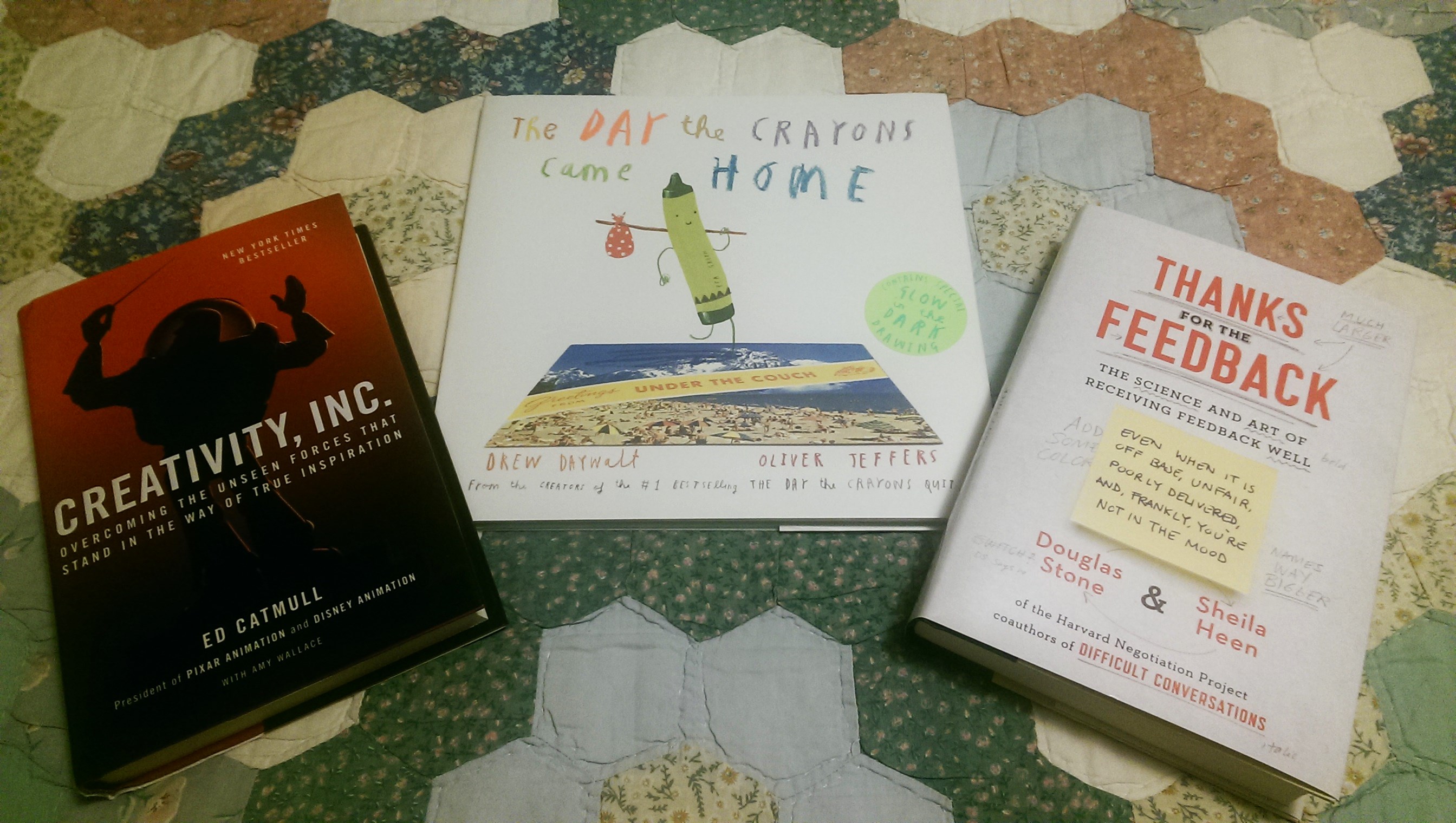
I might read one book right away, or save it for a plane trip, or file it into the stack of “next reads”. Today my pre-ordered copy of the just out The Day the Crayons Came Home arrived in that cardboard box.

This children’s story, written by Drew Daywalt and illustrated by Oliver Jeffers, is that best sort of book both kids and adults enjoy together. Its best-selling predecessor, The Day the Crayons Quit, is my current favorite children’s story. It sits on the bookshelf to the right of my work desk as my inspiration for the day I write such a book.

Both books tell the woes of various crayons in the possession of young Duncan. So funny, and so human…for crayons. Jeffers’ illustrations are the perfect match for Daywalt’s writing. You want to buy these books for your children, or yourself. Of course, you can borrow them from the library. Not me, but you can.Blog - Great Books - Crayons

Two other great books came in today’s cardboard box…

Thanks for the Feedback is written by Douglas Stone and Sheila Heen. They also authored the book Difficult Conversations, with Bruce Patton. I heard Sheila Heen speak about feedback at the Global Leadership Summit recently. It seems feedback is something we all want at work…until we get it. Stone and Heen talk about learning how to receive feedback well. My husband will read this book before me, but I look forward to tackling this subject and growing through it.

The third book that arrived today was Ed Catmull’s Creativity, Inc. It is a manual for managers who want to merge creativity and excellence. Catmull, one of the founders of Pixar Animation, and the president of Disney Animation Studios, was also a speaker at this year’s Global Leadership Summit. I’m excited to read Creativity, Inc. to apply his principles in my work and life among creative. I am also intrigued by his many stories of how he keeps the culture and operations so user-friendly for the artists and designers. Looking forward to learning more from him in this book.

This day delivered on great books. I may review them later, but for now I’m just looking forward to reading them myself. For the joy and for the empowering that come with good books.

What books are you reading these days? Would love to hear about them. Maybe I’ll order them, too.

Coming Soon [Today]…The Day the Crayons Came Home by Drew Daywalt and Oliver Jeffers

Global Leadership Summit – 7 Take-Aways from Day One of #GLS15

Creativity, Inc. Quotes at Good Reads

The Pixar Way: 37 Quotes on Developing and Maintaining a Creative Company

Global Leadership Summit – 6 Take-Aways from Day 2 of #GLS15

Thanks for the Feedback Quotes at Good Reads

Slideshare – How to Give and Receive Feedback – The Triad Consulting Group – Sheila Heen & Douglas Stone (authors of Thanks for the Feedback)

World-Class Customer Service – The Key Is Caring – Horst Schulze on a Culture of Service

Blog - Horst SchulzePhoto Credit: Arnezzy.tumblr.com

Just the expression “5-Star Hotels” summons delicious images of ocean views and chic, comfortable rooms and all those tiny touches to insure your return. Though never a guest in such a hotel, I have enjoyed 4-star treatment, and I have been a customer of Chick-fil-A  and Southwest Airlines. All through our days, we are administering and receiving some sort of customer service.

A couple of weeks ago, I had the privilege of learning about customer service from Horst Schulze, a world-renowned leader in the field of luxury hotels. He gained his wisdom and expertise, up through the ranks, and his counsel is applicable to any peopled workplace or organization. Schulze puts caring at the foundation for world class excellence – not just caring about the customer or client (albeit extremely important) but caring for all people (the employees and all who interface with each other in his industry).

Mr. Schulze talks about the service process as three parts: delivering an excellent product (without defect), in a timely manner, with genuine caring. Genuine caring. Not silly over-friendliness, or with casual sloppiness. Genuinely caring for the customer’s personage, time, and purpose for that interaction.

Since his presentation, I have intentionally looked at service very differently. Whether we’re talking about a small business or a large franchise, a school or university, or even such a thing as a church connection team. We can enhance customer satisfaction and loyalty by intentionally and comprehensively setting our culture.

Mr. Schulze is people-oriented – with his employees, vendors, and customers. He manages this in his hiring and training practices and through a vigilant daily (industry-wide) practice of his canon of customer service standards* (definitely worth a read- click on the link below to read the 24 standards). As I listened to him speak, his whole demeanor was that of one who joyfully delights in excellence and bringing it to bear in improving the lives of those around him.

No matter how well we think we’re doing in providing services or responding to the needs of our clients/customers, we would do well to look at the practices of such businesses as the Capella Hotel Group, Chick-fil-A, and Southwest Airlines. You will see this common thread of caring in their philosophies, culture, and standards.

“I dreamed of hotels where every employee comes to work not just to work but to create excellence, where every employee is committed, and where it’s not about creating rules but about every customer being taken care of the way they want to be taken care of.” – Horst Schulze**

“Focus on creating an organization of excellence and have processes where you can transfer excellence. That starts by finding out what is excellent in the eyes of the customer – what the guest really wants from us – based not just on what they said they wanted but what they were really thinking.” – Horst Schulze**

“It’s my responsibility to set standards. I have no right to accept mediocrity or limitation. If you don’t point out flaws, mediocrity will set in. It’s my business to do what is right and not make excuses for mediocrity. I agonize when I make a decision that it is good for all concerned; if it’s not, I don’t do it.” – Horst Schulze**

[Leading by Culture] “Southwest was the first to create a position entitled “Vice President of Customers.” For many years Colleen Barrett held the position. She understood that Customers always come first, and that in order to have a Customer service mindset you cannot separate the importance of the internal Customer (Employees) from the external Customers (passengers). If the internal Customer is happy, it will naturally flow to the external Customer in the form of good service.” – Lessons in Loyalty, Ian BrooksBlog - Southwest Airlines - Customer Service Culture - leapq.orgPhoto Credit: leapQ.org

 “Every life has a story, and often our customers and our employees, need a little grace and a little space when you deal with them because they are either experiencing a problem, just finished having a problem, or are about to have one. The word ‘restaurant’ means place of restoration. We think of Chick-fil-A as an oasis where people can be restored.  We’re all people with a lot of emotional things going on that don’t necessarily show on the surface, so we try to offer amenities and kindness that minister to the heart.” – Dan Cathy, President, Chick-fil-A***

Blog - Customer Service - Chick-fil-APhoto Credit: jyontheroad.blogspot.com

“Forty years ago, exceptional was a glass elevator in the lobby; then it became real paintings and fine marble and so on. Now it’s coming back to doing what the individual guest really wants: personalized and individualized service geared not to the market, but to the individual. True luxury today is about responding to each individual guest.” – Horst Schulze**

*Capella Hotel Group’s Canon service standards conceived by chairman and founder Horst Schulze

**Defining Luxury – LEADERS Interview with Horst Schulze

YouTube Video – Horst Schulze- Presentation on Customer Service

Global Leadership Summit – 6 Take-Aways from Day 2 of #GLS15

Summaries on All Speakers of Global Leadership Summit 2015 by David M. Arnold

Notes from the GLS15 – Creating World Cass Service – Horst Schulze

****A Lesson in Customer Service from Chick-fil-A President Dan Cathy

The Chick-fil-A Difference: Why Customer Lingo Matters

Thank you. My pleasure.

What You Can Learn from Southwest Airlines’ Culture

***Lessons in Loyalty: How Southwest Airlines Does It – An Insider’s Point of View

Southwest Airlines – the Airlines with Heart – and One Heart I Know Well