“Glory to God in the highest, and on earth peace, goodwill toward men!” – Luke 2:14
For unto us a child is born, unto us a son is given, and the government will be upon His shoulders. And He will be called Wonderful Counselor, Mighty God, Everlasting Father, Prince of Peace. Of the increase of His government and peace there will be no end. He will reign on the throne of David and over his kingdom, to establish and sustain it with justice and righteousness from that time and forevermore. The zeal of the LORD of Hosts will accomplish this. – Isaiah 9:6-7
Be angry, and do not sin; ponder in your own hearts on your beds, and be silent. Selah. Offer right sacrifices, and put your trust in the Lord. In peace I will both lie down and sleep; for you alone, O Lord, make me dwell in safety. – Psalm 4:4-5, 8
I will instruct you and teach you in the way you should go; I will counsel you with my eye upon you. Be not like a horse or a mule, without understanding, which must be curbed with bit and bridle, or it will not stay near you. Many are the sorrows of the wicked, but steadfast love surrounds the one who trusts in the Lord. Be glad in the Lord, and rejoice, O righteous, and shout for joy, all you upright in heart! – Psalm 32:8-11
Repay no one evil for evil, but give thought to do what is honorable in the sight of all.If possible, so far as it depends on you, live peaceably with all. Beloved, never avenge yourselves, but leave it to the wrath of God, for it is written, “Vengeance is mine, I will repay, says the Lord.” – Romans 12:17-19
[From the Archives: One week ago this morning, I woke to the results of the 2024 US presidential election. Before going to bed in the early hours of today, I prayed, wanting to trust the outcome to Him. Wanting to believe Him for whatever direction our country would go. Affirming that the Scripture validates that He is sovereign, and we are in His care.]
October is near, and in our home, it begins the season of Christmas music. So many beautiful anthems to the glory of God – the month of December is not enough to listen, sing, and meditate on the message of these words written by inspired authors and composers.
As this week has unfolded around our nation, social media and news outlets are filled with a range of both shock and jubilation. Of fear and relief. We continue a nation divided…for now. May the church not be a vessel of division…but an instrument of God’s peace.
In December, 1863, American poet and scholar Henry W. Longfellow received his wounded son home from battle. It was Christmas time, and the U.S. Civil War raged on. Having already lost his wife years earlier, Longfellow nursed his son, Charley, back to health. His own thoughts, in turmoil over all that was happening around him, he poured out in the poem “Christmas Bells”.
Longfellow clearly took comfort from God as he wrote, ending the poem with this stanza:
“God is not dead, nor doth He sleep; The Wrong shall fail, The Right prevail, With peace on earth, good-will to men.”*
I Heard the Bells is a Christmas carol, not a worship anthem. Yet, given the continuing wars of our day, and the politics surrounding them, we must tend the fires of our hope. God is the “lifter of our heads” (Psalm 3:3). He is the One who gives strength to our “weak hands and shaking knees” (Isaiah 35:3). He will do as He’s promised. He is faithful. When you hear the bells ring where you are in the wake of this past week, and as Christmas looms in weeks ahead, take heart in that. We must continue to pray for His peace on earth. We can be vessels of His good-will toward our neighbors, both near and far away.
Leaning into “the right [to] prevail” is where we stand, as Christ-followers. Straight and resolute in our understanding of God’s intentions and His movement in our world. We can resist and refuse to add to the noise of hopelessness and cynicism in this world. We bend our hearts to hear the voice of God speak through the chaos…speaking the peace that only He can bring…through our Savior and Lord, Jesus Christ. We can speak that peace to our neighbor – the truth wrapped in His love.
I heard the bells on Christmas day Their old familiar carols play And mild and sweet their songs repeat Of peace on earth good will to men
And the bells are ringing (Peace on Earth) Like a choir they’re singing (Peace on Earth) In my heart I hear them Peace on earth, good will to men
And in despair I bowed my head There is no peace on earth I said For hate is strong and mocks the song Of peace on earth, good will to men
But the bells are ringing (Peace on Earth) Like a choir singing (Peace on Earth) Does anybody hear them? Peace on earth, good will to men
Then rang the bells more loud and deep God is not dead, nor doth He sleep (Peace on Earth, peace on Earth) The wrong shall fail, the right prevail With peace on earth, good will to men
Then ringing singing on its way
The world revolved from night to day A voice, a chime, a chant sublime Of peace on earth, good will to men
And the bells they’re ringing (Peace on Earth) Like a choir they’re singing (Peace on Earth) And with our hearts we’ll hear them Peace on earth, good will to men
Do you hear the bells they’re ringing? (Peace on Earth) The life the angels singing (Peace on Earth) Open up your heart and hear them (Peace on Earth) Peace on earth, good will to men
Peace on earth, Peace on earth Peace on earth, Good will to men*
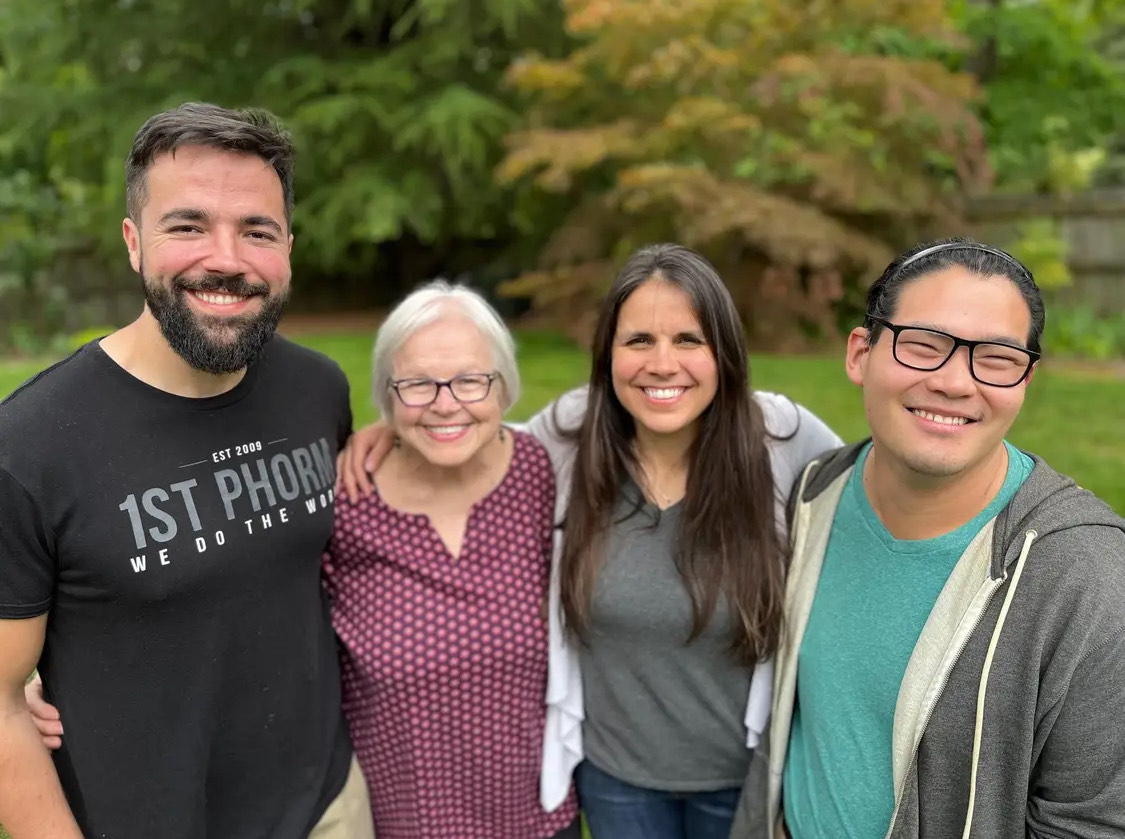
[Dave’s Mom, Our Adult Kids, Dave & Me – Not all the grands are on social media – but they begin the next generation of our family.]
I want to write about family…well, this family right here. In fact, I want to write a letter to them. Feel free to read along.
Dear Family,
Yesterday was a sweet time celebrating our September birthday guys – Dave & Nathan. Father & First Son. You both are so dear to all of us.
To you siblings and siblings-in-law, I love you so much. In the early years, I had this wild idea about how, while we live in the same city, we would get together weekly – like for Sunday dinner – like in the TV show Blue Bloods.
[Blue Bloods – read the short piece on how their weekly family gatherings shaped the show and character relationships.]
We don’t get together weekly, and that’s ok. When we do get together, it can be loud and opinionated, just like that TV family. However, it’s always rich – food for thought as well as body. Hope you leave each time, not just with a full tummy but, with the refreshed understanding of how much you are loved. Not just by Dad and me but by your siblings.
[I’m a faithful documenter of people and special events. Always working on their patience. It means a lot when everyone cues up and smiles, but occasionally someone doesn’t feel like it…and that’s ok.]
To our youngest: I know being the baby of the family can get old, especially when you find yourself in your mid-30s. Hopefully you know that your opinions matter to your family. We want to know what you think… always. It made me sad that you were suffering from a headache through most of the meal yesterday. Please take heart that although we all don’t always agree on everything, we are grounded in love for each other. That’s priority and it will never change. Ever. I want to thank you for loving your family, too. You don’t have to show up and yet you do. There is a measure of hard in your life, different from ours, which would be easy for you to stay focused on. It gives us immeasurable joy when you are able to shake off the hard and laugh about “the old days”, tease your siblings and absorb their ribbing, and love on your nieces and nephews. It’s also no small thing how you serve us (me) – baking and straightening.
[Lots of Sibling Love Right Here]
To the married siblings and their spouses: You have incredibly busy lives, and yet for those hours when we are together for the odd special occasion, time slows. You are present. You are engaged. You are yourselves. The flow of conversation is easy and animated. You roll with the skirmishes between little cousins and you parent them all so well. I hope you know how much you are loved. As your Dad (Dad-in-law) and I get older, we are so grateful for how you hang in there with us and each other. Family estrangement is so prevalent in our world today, but so far, we have weathered the storms. Your commitment to our family is something we do NOT take for granted.
[The Guys]
[The Big Sister & the Little Brother]
To any who are reading: all families are different. Within each family, there are tremendous differences in temperaments, preferences, and even worldview. Ruptures can happen and repair is hard to come by. Our Sunday birthday dinner reminded me of things learned over the last few years:
We can make a place of safety and security for those we live.
When we are only around people who agree with us, we experience an echo chamber of affirmation. When we experience dissonant voices from those who love us, we learn how to better love those different from us.
In a rowdy family discussion, we still probably agree more than we disagree. Take an inventory on that from time to time. How do we affirm each other even when we don’t agree?
Lead with curiosity and empathy. If contempt is stirred up, recognize it for the destroyer of relationships it is, and take steps against it (see here).
Remember life is messy. Family is messy. We may prefer our lives (and families) to “look” a certain way, but it’s healthier for us to be real and honest with each other. “The human mind doesn’t have the capacity to live a life so curated” (convo with friend/counselor Taryn Blocker).
Flexibility is a character quality we all need to navigate relationships when people are crossing our boundaries. Flexibility, humility, and forgiveness. It’s going to happen, especially in family. Respecting boundaries goes both ways and takes both self-care and other-care. Or relationships break down.
What else? What would you add to those list? Please share in comments.
[The original three & me]
I am very thankful for this family. With all our warts. Not unlike any other family out there. So thankful for the relationships these siblings have with each other, and for the littles with their sibling and cousin relationships. Check out these beautiful reels from Instagram on the topic.
Finally, I’d like to just mention psychiatrist Dr. Gabor Maté‘s opinion on how all children grow up in different families with different parents. He justifies that thinking about how we, as parents, change and evolve in our thinking on parenting, with each child, and our children are all different from each other. We may even use the same practices but our children react differently to them. The old adage” of “caught or taught” would bring meaning to this as well.
“Siblings may grow up in the same house, but that doesn’t mean their childhoods were the same. Not even close.
Same parents? Nope. Same family? Nope. Same childhood? Absolutely not.
Parents show up differently for each child depending on the season of their life, their relationship, and even their financial situation.
It’s not about who is loved more. It’s about how that love is expressed — and how each child experiences it.
Then, to those amazing adult children, add spouses, careers, and varied life experiences to the equation, and we continue to have the wonder of family – familiar and yet also new and changing. It makes for a fascinating Sunday dinner experience…and a lifetime of tilling the soil of a safe, secure, and hopefully sacred love for each other.
The state of contentment is on my mind this morning. From time to time, I’m moved to check my heart in this area, because being content can be a struggle. Contentment is NOT the same as resignation. In fact, it is far from it. Contentment can be defined as “the state of being mentally or emotionally satisfied with things as they are.”
During a season of emotional and spiritual discontent decades ago (which I wrote about here), my sweet husband introduced me to Jerry Bridges‘ book The Practice of Godliness. He had marked the chapter on contentment and gave the book to me on his way to work. Without judgment. Just love and concern. I read it right at that moment.
Bridges (now with the LORD) had this great gift of writing with such clarity and simplicity that we could soak up these truths with life-changing certainty. Thanks to Bridges’ gentle, humble writing, I didn’t take offense – “He doesn’t know what it’s like for me!” – and I learned afresh contentment in life. I am still learning.
In the book of Genesis, the very first sin of humankind was born out of discontent. Satan tempted Eve, and then Adam, with the idea that God was not good and didn’t not have their best interest in mind. His temptation wooed Eve into taking her life into her own hands, choosing to disobey God’s one command. Bridges wrote about the eroding nature of discontent in three areas – possessions, position/power, and the providence of God.
The Apostle Paul commented on how he had learned to be content in all things. He doesn’t give the secret of being content here, but in 2 Corinthians 12:9 as the foundation for his contentment.
Jerry Bridges gives the secret of living in humble and joyful contentment:
“This is the secret of being content: To learn and accept that 1) we live daily by God’s unmerited favor given through Christ, and that 2) we can respond to any and every situation by His divine enablement through the Holy Spirit.” – Jerry Bridges, AZ Quotes
If you struggle with discontent, with wanting life to be different than what it is right now, you would do well to read Jerry Bridges’ chapter on contentment. It brought me to my senses, for sure.
In honoring the impact this man has had on my life and thousands of others, I’d like to post some of his quotes. Learn from this dear brother even as he’s right now in the presence of God.
“Contentment is one of the most distinguishing traits of the Godly person, because a Godly person has his heart focused on God rather than on possessions or position or power.” – Jerry Bridges, LikeSuccess
“Your worst days are never so bad that you are beyond the reach of God’s grace. And your best days are never so good that you are beyond the need of God’s grace.” – Jerry Bridges, AZ Quotes
“Lord, I am willing To receive what You give. To lack what You withhold. To relinquish what You take, To suffer what You inflict, To be what You require.” – Jerry Bridges, AZ Quotes
“Grace is never cheap. It is absolutely free to us, but infinitely expensive to God… Anyone who is prone to use grace as a license for irresponsible, sinful behavior, surely does not appreciate the infinite price God paid to give us His grace.” – Jerry Bridges, AZ Quotes
“Every day that we’re not practicing godliness we’re being conformed to the world of ungodliness around us.” – Jerry Bridges, Top Famous Quotes
“One thing we may be sure of, however: For the believer all pain has meaning; all adversity is profitable. There is no question that adversity is difficult. It usually takes us by surprise and seems to strike where we are most vulnerable. To us it often appears completely senseless and irrational, but to God none of it is either senseless or irrational. He has a purpose in every pain He brings or allows in our lives. We can be sure that in some way He intends it for our profit and His glory.” – Jerry Bridges, AZ Quotes
“Be glad in the Lord, and rejoice, O righteous, and shout for joy, all you upright in heart!” – Psalm 32:11
“Shout for joy to God, all the earth; sing the glory of his name; give to him glorious praise!” – Psalm 66:1-2
Clap your hands, all you peoples! Shout to God with the voice of triumph! – Psalm 47:1
Come, let us sing for joy to the LORD; let us shout to the Rock of our salvation! Let us enter His presence with thanksgiving; let us make a joyful noise to Him in song. – Psalm 95:1-2
Make a joyful noise to the LORD, all the earth; break forth—let your cry ring out, and sing praises! Sing praises to the LORD with the lyre, in melodious song with the harp. With trumpets and the blast of the ram’s horn shout for joy before the LORD, the King. – Psalm 98:4-6
In the Fall of 1998, we returned to the US from living overseas for three years. It was a bit of a sabbatical where we had a few weeks to reconnect with friends and family. For that period of time, we traveled around the US, visiting folks. On Sundays, we would go to their churches.
Oddly, every Sunday (or the majority of them), the same song was on that church’s worship list. A song released in 1994 in Australia by composer, worship leader Darlene Zschech. This song would put the then 10-year-old Hillsong Church on the global worship map.
Our kids were still youngsters in 1998 but remember well how we stood gathered with other believers and sang that glorious anthem to the Lord – week after week. Amused at times, we puzzled over how many times we ended up singing it. That song and those worship experiences would bring me (at least) to tears in those moments. In awe of Jesus…and His provision for His beloved.
We don’t sing this song much anymore, now over 30 years since its release. However, its call to worship is still real and relevant. Yesterday, I found Australian pastor/teacher Robert Griffith‘s piece on shouting to the Lord. He writes that there are 135 references in Scripture referring to our shouting to the Lord. His observations are powerful and transformative, some quoted below.
Now, all of us shout. If we have voices, we have all shouted many times, and for numerous reasons. We’ve shouted in the overflow of great joy. We’ve shouted in the exultation of victory. We’ve shouted in the tension of competition. We’ve shouted in the chaos of battle. We’ve shouted in the tumult of controversy and argument. We’ve shouted in moments of great danger. We’ve shouted in the explosion of hot anger.
But we rarely shout alone. Have you noticed that? Similar to laughing, and to some extent singing, shouting seems to be designed primarily as a corporate expression of strong emotion, something we find most enjoyable or helpful or needful when we do it with other people.
There’s something profound and mysterious about a group of people sharing a common excitement and joy. Often, joy is heightened when we experience it together with others – and certain joys are only properly expressed in shouting. To not shout together in the stadium as your team crosses the line to score, would emotionally mute the whole experience.
Most of the scriptural instructions to shout are addressed to the gathered saints – the Psalms were mainly meant to be sung (and sometimes shouted) together with others.
What about when our Church gathers together to worship (and it’s not a funeral)? What does our Church culture encourage? Are there occasionally moments of exuberance in song where all the saints “shout for joy to God” (Psalm 66:1)? Or does that always feel out of place, or only done by one or two courageous (and odd) people?
Do we ever feel the realities of the mercies of God, our redemption, the spiritual conflict we’re engaged in, the promise of our resurrection, and Christ’s ultimate triumph strongly enough to inspire a shout? I ask this question for a couple of reasons. One, it might reveal a personal deficiency in our souls that we need to address with the Lord – that we’re not connecting deeply enough with the realities of what God has done for us, and what God has promised us. And, of course, that’s all of us to a greater or lesser degree. What we may need is to repent of giving excessive attention to lesser things and spend more extended time meditating on “the surpassing worth of knowing Christ Jesus” (Philippians 3:8) in order to stoke the embers of our deep passion for Him. Without passion, nobody is going to shout.
But a second reason is that, to some degree, an affectional deficit might be due to the fact that we don’t shout together. I often feel certain great truths of God, or at least dimensions of them, more deeply and intensely when I share and shout over them with others.
Shouting is commended and commanded in the Bible, like singing, because there are dimensions of joy in God that are only experienced when we express ourselves in this way – particularly when we express ourselves this way together as the people of God.
Because of the clear biblical exhortations to shout, I commend these thoughts to you for your prayerful consideration – especially pastors and leaders who craft worship times for gathered saints. What we all want is for the saints to experience as much blessing of delighting in God as possible.” – Shout to the Lord – Robert Griffith
Let’s make some noise! Our church when gathered is definitely Spirit-filled but, at the same time, somewhat reserved. I do sense a movement stirring…may we voice our delight in the Lord in ways that honor Him.
My Jesus, my Savior Lord, there is none like You All of my days I want to praise The wonders of Your mighty love
My comfort, my shelter Tower of refuge and strength Let every breath, all that I am Never cease to worship You
Shout to the Lord, all the earth, let us sing Power and majesty, praise to the King Mountains bow down and the seas will roar At the sound of Your name
I sing for joy at the work of Your hands Forever I’ll love You, forever I’ll stand Nothing compares to the promise I have in You
(My Jesus) To my Savior (my Savior) Oh, Lord there is nothing like You All of my days I want to praise The wonders of Your mighty love
You’re my comfort (my comfort), and my shelter, yes (my shelter) You’re my tower of refuge and strength Let every breath, and all that I am Never cease to worship You
Shout to the Lord, all the earth, let us sing Power and majesty, praise to the King Mountains bow down and the seas will roar At the sound of Your name
I sing for joy at the work of Your hands Forever I’ll love You, forever I’ll stand Nothing compares to the promise I have in…
Shout to the Lord, all the earth, let us sing, yeah Power and majesty, praise to the King Mountains bow down (mountains bow down and the seas will roar) At the sound of Your name
I sing for joy at the work of Your hands Forever I’ll love You, forever I’ll stand Nothing compares to the promise I have in You (Nothing compares to the promise I have in You…) Oh, nothing compares to the promise I have in You*
Yesterday, I was taking a break and scrolled through Instagram until it stopped me in my tracks on how complaining can have a chronic negative impact on our health, and, in particular, on our brain. That didn’t surprise me, but I wanted to look further to test out what this influencer was reporting. You can look, too. Do an internet search on “complaining, cortisol, and the brain”. It is startling, but, again, not surprising.
Complaining is extraordinarily detrimental to brain health. In a way, it is also like “second-hand smoke” to those with whom you share it. When we complain, our brain responds by releasing cortisol. We need cortisol, the “stress” hormone, to alert us to possible danger and to stimulate an appropriate (hopefully) response to that danger. The problem with complaining is that it puts stress on a loud speaker when there was no need. Similar to how trauma rewires our brain to expect more trauma.
Venting feels good at the moment. It releases the internal pressure that is mentally building up from negative thinking. The dilemma with venting is two-fold – 1) it cements the wiring in the brain in the direction of negative, hopeless thinking, and 2) it activates/re-activates the same process in the caring hearer. Mind you, there is a positive, healthy venting that can take place if it is focused toward hopeful problem-solving and change. This can be life-giving to both persons.
[Side note: We need each other. We were made for community. Talking something out with people who love us is hugely important. There is a difference in lament and grumbling, or complaining and and acknowledging a hard thing, seeking help for forward movement.]
As one who is getting older and feeling the memory not as sharp and the tendency toward that “cup half empty”, curmudgeonly take on things…I wonder: when and how did it start?
When does analytical become contrarian? When does hopeful turn into doubtful? When does grateful turn into grumbly?
Do we just allow ourselves to turn into different people? Or do we take steps to stay (or become) joyful, engaged, unstoppable humans? People who others love to work with, serve with, spend time with.
A little over a year ago I wrote a blog on how complaining rewires our brains. If you know complaining is a struggle, please take the time to read this one piece (linked below). We may try to eat healthy, exercise, and rest aplenty – maybe there is one more thing we should consider:
Bottom line: Practice gratitude. Pause your thought process. Resist the urge to complain, rather reframing the complaint into positive action. Surround yourself with people who don’t complain, and, even make you laugh sometimes.
When you have more time or you want to consider steps toward positive brain health and a kinder, gentler handling of your life and circumstances, I have excerpted these from my other blogs on complaining and negative thinking:
Complaining Exposed – [From the Archives] When it comes to complaining, we all think of someone else who does it…not us. It is an irritating habit, and it only gets worse if unchecked. Poet writer Anne Peterson talks about complaining and how it flows out of 6 heart attitudes. Complaining reveals that:
We feel entitled.
We are impatient.
We hold on to resentment.
We compare ourselves to others.
We don’t think life is fair.
We are conformed to this world/culture.
Read her article for the particulars. Be prepared to rip the Bandaid (excuses) off your complaining.
Entrepreneur Gary Vaynerchukwrites about how his mom and wife seem to be incapable of complaining and it’s one of the things he loves about them: “Complaining has zero value. Looking at the negative, seeing the glass as half empty, and complaining are some of the biggest wastes of time a human being can engage in. Instead, tackle the problem head on. Assess it, see what you can do about it, and then do just that. ‘Woe is me’ is truly one of the biggest things that can stand in the way of success both professionally and personally.”
2. Beyond Grumpiness –[From the Archives] A friend of mine pointed this blog to me today and it bumped its way to the top of my Faves. English professor Alan Jacobs mused about the grumpiness of old people. I don’t know when it happens and why exactly it happens, but it is something that has happened to me of late…and I don’t think I’m old enough yet for it to happen.
Here’s a bit of what Dr. Jacobs says about grumpiness, but you should read his whole piece, especially if you’re finding yourself becoming grumpy (whatever age you are).
“I think the explanation for such widespread grumpiness is fairly simple…It’s not the big foul acts or horribly cruel words that do you in, it’s the slow drip drip drip of little annoyances that become over time a vast sea of frustration. Surely you’ve been there? You become exasperated by someone’s passing comment and when they are genuinely puzzled by your anger over so trivial a matter, you try to explain (apologetically, penitently, I hope) that it wouldn’t be a problem if this thing had happened once but it has happened a thousand times. It’s the repetition that kills you.” [Dr. Jacobs goes on to talk about the divisions on which we’ve taken sides give the sense of being new and revolutionary…and yet they are old divisions revisited.] “You can’t learn from the past if you don’t know what happened in it. So yeah, I’m gradually turning into a grumpy old man. Because nobody learns anything…” [About these things that divide us: We seem to care too much, or too little, or just plain not at all. Dr. Jacobs challenges us that only being truly loving people gives us the right to voice an opinion, and definitely not a shaming one.] “It’s a hard path to walk, this Way of avoiding both indifference and ‘the conscious impotence of rage at human folly.’ But the hard path is the only real Way. (All the others circle back on themselves.) So I try every day to follow it. I don’t think I could manage even that if I did not have an Advocate to accompany me, to encourage me, and to guide me.” – Alan Jacobs, Beyond Grumpiness
3. Without Grumbling – [From the Archives] Which comes first – anger or grumbling? Or is it a more subtle but growing discontent? When does occasional complaining settle into a set habit of grumbling? What does grumbling communicate to our own minds and to others within hearing?
I’ve written plenty on complaining, grumbling, and negative thinking (see links below). It can absolutely change the wiring in our brains. In my younger years, I always looked for the good and the beautiful in a person/situation…and I found it. Now, as an older person, my temptation is more toward darker thinking. This is NOT where I want to stay.
Below is a beautiful bit of writer Trevin Wax‘s post on grumbling and joy (it is geared toward Christians but there is wisdom for all of life here).
“In Philippians 2:6–11, Paul commands the church to adopt the same mind of our risen Lord. And his first command is, “Don’t grumble.”
“Do all things without grumbling or disputing, that you may be blameless and innocent, children of God without blemish in the midst of a crooked and twisted generation, among whom you shine as lights in the world.” (Philippians 2:14–15)
Why start with grumbling? We might expect an exhortation to spiritual disciplines, or strategies for thriving as pure and faultless people in a sinful world. And yes, Paul does speak about blamelessness and purity and holding firm to the word of life (Philippians 2:16). But this purity in action is somehow connected to the first command to do everything without grumbling. Somehow, grumbling will keep us from faithfulness.
Why start here? Because Paul knows the story of Israel.
Remember the children of Israel? They chose grumbling over gratitude. Grumbling stalled their journey and led to actions that were anything but “blameless and innocent.”
Whether we are given suffering, chains, imprisonment, or worse (Hebrews 11:36–38), or whether we conquer kingdoms, stop the mouths of lions, escape the sword, and put armies to flight (Hebrews 11:33–34), we must know that only joy in and gratitude to Jesus will win the war for our culture…Yes, we may face obstacles, setbacks, and tough days ahead. But in it all, and under it all, we are also joyful. And this cheerful courage comes not from ignoring darkness or looking only for the bright side, but from believing that the Light will overcome the dark.
Do you want to shine like stars? Then do everything without grumbling.” –
4.Breaking Out of Negative Thinking – [From the Archives] I first wrote about negative thinking six years ago (that blog linked below). Since then we have come through COVID 2020, great racial unrest and social upheaval, contentious election cycles, ongoing wars, and a downturn in our economy. Lots to think negatively about with good reason, but if we’re not careful we will begin gearing our thinking in that direction to the detriment of our mental and relational health.
The team at Daily Health Post focused on complaining as a culprit that can actually cause our brains to default to anxiety and depression. From experience, I know this is true.
They prescribe the following to flip the damaging habit of complaining:
“Be grateful: Find something to be grateful for everyday. If you keep a journal, write down 3 things you are grateful for every morning and every night.
If you start to feel anxious or pessimistic, pause a minute and write them down again. If it’s too hard, write down 5 or even 10 new things you’re grateful for. By the end of the exercise, you’ll feel much happier and fulfilled.
Catch yourself: Don’t wait for your friends or family to tell you you’re complaining, pay attention to your thoughts and words.
If you’re complaining, quickly shift your energy to find solutions and lessons to be learned. Afterwards, treat yourself will a nice cup of tea for the effort!
Change your mood: If you feel overwhelmed and negative, remove yourself from whatever you’re doing and shift your state of mind. If you’re home, sit down with your favorite book and cook up a tasty treat. If you’re at work, go to the washroom or break room for a few minutes and listen your favorite song.
Breathe deeply and close your eyes, paying attention to every word. Hold onto that relaxing feeling and carry it with you throughout the day.
Practice wise effort: Wise effort is the practice of letting go of anything that doesn’t serve you. If your worry won’t improve your situation or teach you a lesson, simply let it go and move on.
This is much easier said then done, of course, but if you write it out, ask friends for advice, and take some time to think it through constructively, it really can be done.“
[Just a bit over a year ago, I wrote a blog entitled “Contempt – the Cold Killer of Hearts and Humanity”. It is such a prevalent emotion/thought process these days, I wanted to update that piece and re-post.]
Ah…contempt. It is defined as a strong negative emotion that joins disgust and disrespect. If we are honest, we have all experienced contempt, either for someone else, or a group of someones…or we’ve experienced the contempt of another towards us.
Contempt is a harsh response…a cold killer of hearts and relationships.
When we express contempt, it is usually in conversation with those who agree with us…about someone else. Rarely do we have the person(s) toward which we feel contempt in front of us. We don’t engage them as much as we complain about them. We hold some in contempt because of their beliefs or actions, and our temptation is to have nothing to do with them. We may view this as a strength, but (as I’ve heard said), “an unguarded strength is a double weakness.”
In a quick summary on contempt (in case you don’t want to read more in depth below), we would never think of ourselves as having contempt of another (or a group of people), but the signs are in our speech and attitudes. No matter how much we think we cover it, others can tell we lack love and respect (even exhibiting hatred). Contempt not only separates us from others but also makes it hard to reconcile. The dark thoughts of condemnation, suspicion, and mistrust are present under the surface. To remove the force of contempt, we must check our hearts. Acknowledge that any compassion we may have is conditional…we withhold love based on the other’s behavior. It is a lose-lose situation. How we can move toward actual reconciliation, or at least stepping toward a more healthy relationship is to be humble. We have a part in any contemptuous relationship. We each have a part. When we lean in, without expectation of the other person, and show curiosity as to how they are, we give grace. We make space for that person to lean in, as well. Refusing to think ill of another person, no matter what happened in the past, opens the door to genuine caring. It can be the start of healing.
What follows comes from my blog of a year ago. It speaks volumes on how to avoid contempt in two main areas: politics and marriage. However, the counsel given could be applied broadly to families, neighbors, coworkers, etc. There is wisdom here…in any situation where we feel the cold, hate-birthing emotion of contempt…which does harm to our relationships and our own heart.
“Knowing our weakness, dividing leaders on both the left and right seek power and fame by setting American against American, brother against brother, compatriot against compatriot. These leaders assert that we must choose sides, then argue that the other side is wicked—not worthy of any consideration—rather than challenging them to listen to others with kindness and respect. They foster a culture of contempt.” – Arthur C. Brooks, Love Your Enemies: How Decent People Can Save Our Country From the Culture of Contempt
Contempt is something I’d like to annihilate in my own thinking, and thankfully there are helps. Below you will find two thought leaders who have worked to expose contempt for what it truly is and does to us, and who have given us counsel on how to recognize it and rid ourselves of it. Author and academician Arthur Brooks and clinical psychologist John Gottman.
How do we confront contempt?
Arthur Brooks’5 Rules to Counter Contempt
1. Refuse to be used by the powerful. – “The accurate image of a powerful manipulator is someone on your side of the debate: a media figure who always affirms your views, a politician who always says what you think, or a professor who never challenges your biases. They declare the other side is terrible, irredeemable, unintelligent or anything else that expresses contempt — and they say you should think these things as well.” Brooks encourages us to tune out that person “on our side” who seeks to manipulate us, whatever the reason. Then (this is the harder part), we are to call out contemptuous behavior among those with whom we agree (our friends and maybe family). Contempt tears us down, and we don’t want that for ourselves or those we love.
2. Escape your bubble. – “The culture of contempt is sustained by polarization and separation. It is easy to express contempt for those with whom we disagree when we view them as “them” or never see them at all. Contempt is much harder to express when we see one another as fellow human beings, as “us.”” We do well to make opportunities to share space and conversation with people not like us. Seek to understand and look for ways we are alike.
3. Treat others with love and respect, even when it’s difficult. – “Never treat others with contempt, even if you believe they deserve it. First, your contempt makes persuasion impossible, because no one has ever been insulted into agreement. Second, you may be wrong to assume that certain people are beyond reason. There are many examples of people forming unlikely bonds precisely because they didn’t treat each other with contempt.” Sometimes we are the ones toward which contempt is aimed. If we have offended, then we can apologize. Raising an issue higher than the value of the person doesn’t take us anywhere positive.
4. Be part of a healthy competition of ideas. – “I believe disagreement is good because competition is good. As in politics and economics, competition — bounded by rule of law and morality — brings excellence. In the world of ideas, competition is called “disagreement.” Disagreement helps us innovate, improve, correct and find the truth. Of course, disagreement — like free markets and free elections — requires proper behavior to function.”The goal is not to disagree less but to disagree better, notes Brooks.
5. Disconnect from unproductive debates. – “Get rid of curated social media feeds. Unfollow public figures who foment contempt. Want to get really radical? Stop talking and thinking about politics for a little while. Do a politics cleanse. For two weeks — maybe during your next vacation — resolve not to read, watch or listen to anything about politics. Don’t discuss politics with anyone. This will be hard to do but not impossible.” This exercise will reveal how much of your life and mental energy is wasted, allowing you to refocus on people you truly love and work/play that matter more than those things you probably won’t be able to change. – Arthur Brooks, Sick of the Culture of Contempt? Here are 5 Ways You Can Subvert It
Another exceptional thinker and clinician is Dr. John Gottman, psychologist and professor. His focus is primarily on marriages and individual mental health within relationships. The Four Horsemen is a metaphor pointing toward end-times. Dr. Gottman uses the same metaphor in describing four elements of communication, any one of which can predict the demise of a marriage (or any other relationship). These elements are criticism, contempt, defensiveness, and stonewalling. Each has an antidote.
Contempt is much more mean-spirited than criticism. It communicates a measure of cold superiority over the one being criticized. Gottman isn’t talking about a political stand or a point of contention over culture or morality. He is concentrating on the relationship between two people, usually being a married couple.
“Contempt, simply put, says, “I’m better than you. And you are lesser than me.” [It] is fueled by long-simmering negative thoughts about one’s partner, and it arises in the form of an attack on someone’s sense of self. Inevitably, contempt leads to more conflict—particularly dangerous and destructive forms of conflict—rather than to reconciliation. It’s virtually impossible to resolve a problem when your partner is getting the message that you’re disgusted with them and that you’re condescending and acting as their superior.”
Gottman prescribes two antidotes for contempt in the marriage relationship – one short-term and the other more long-term:
First, the person feeling contempt toward the other would do well to name the emotions that rise to the top during a conflict. Express these emotions to your spouse without blaming, and appeal for help with a solution. “I am sad that we don’t have friends over. Could we talk about a way forward on this?” Or “I get worried when the bills pile up. Can we talk about what we can do to stay within budget?”
Second, Gottman suggests establishing (or re-building) a home culture of fondness and admiration for each other. This is a discipline that may take some strong determination, but it is doable. In fact, I have go-to Bible verses (Revelation 2:4-5) that help me immensely during those dry times in my own marriage. It speaks about what to do when we have lost our first love (for God and each other). Essentially, the instruction is to remember how it was in the beginning, repent/return, and repeat the actions/emotions/intentions that came naturally when the relationship was new. We don’t have to feel the fondness or admiration at first, but as we practice them, they can be restored. Among many tools, Dr. Gottman uses the instrument below to kick-start the process as the spouse chooses three descriptors and then gives examples of those to the other person.
Contempt is deceptive. It feels so good to think we are right, and yet in the practice of contempt, we become more isolated and less engaged in real community. Only preferring people who think like we do. At some point, our competencies will be impacted because our problem-solving shrinks down to just judging others and determining they aren’t worth our time. We miss learning from them, and we miss the possibility of genuinely understanding them, even loving them.
Having faced contempt myself, It has brought me to a “come to Jesus” moment. I don’t want to hold contempt for anyone, no matter how different they are, no matter what wrongs they have done. I want to figure out how to stay engaged with people…such that “if [I] can’t move mountains, [maybe I can] move a stone”.*
OK…so I’ve written loads on kindness. What is it about this quality of kindness? Maybe it doesn’t seem extraordinary, and, well, it shouldn’t be. I still marvel any time I’m on the receiving end…or see someone exhibit kindness to others, not expecting a thing in return.
Kindness has a “tip of the iceberg” character about it. What’s underneath can be any number of other winsome qualities: humility, compassion, love, understanding, empathy. We’re talking about the kindness that has no underlying selfish motivations – only to lighten the load of another or to lift the heart. To show up, be present, draw near. We should never take kindness for granted. It is no small thing. We can also do the work of maturing it in our own lives. Kindness takes effort. Like the iceberg, much that drives kindness is out of our view, and reflecting on that reminds us of its great value. Kindness is way beyond just being nice. It’s extraordinary.
For example, about ten days ago a friend of ours from church had a big heart surgery. A few days after his surgery, I posted my blog on my own cardiac journey (which at this point is way small compared to his). His wife saw my blog and told him about it. He called me straightaway to ask how I was doing and to encourage me!!! That’s extraordinary kindness. Then yesterday, less than two weeks after his surgery, he was in the parking lot of our church, helping young families park and head safely into church. He could have easily stood or sat in the church lobby and everyone would have been thrilled just to see him back at church. It is his nature to serve and show kindness. I’m pretty sure, some of the folks he helped didn’t even know he’d had surgery.
Kindness does have its own rewards – physically, spiritually, mentally, and socially.
What makes it the most precious is that genuine kindness has no ulterior motive. It flows out of a pure heart. As Christians, we are taught to do good, to show kindness, to others, not for any show of our own virtue but to point to the goodness of God.
This:
“You are the salt of the earth…You are the light of the world. A city set on a hill cannot be hidden. Nor do people light a lamp and put it under a basket, but on a stand, and it gives light to all in the house. In the same way, let your light shine before others, so that they may see your good works and give glory to your Father who is in heaven.” – Jesus, Matthew 5:13-16
Not this:
“Be careful not to practice your righteousness in front of others to be seen by them.“ – Jesus – Matthew 6:1a
Seeing our friend yesterday, serving with delight after major surgery, caused me to reflect on times I’ve seen other beautiful displays of kindness. Like when our neighbor came to sit with Dave while I was having surgery. She just showed up for him so he wouldn’t be waiting alone. That meant a lot. Or another neighbor who always remembers the birthdays of the children in our neighborhood, and even those not in our neighborhood, like my grandkids. Or the card sent for no other reason except the sender was just being kind. Or the phone call from one of the kids – just checking on us.
In the Christian faith, kindness is a fruit of the Spirit. What that means is we can actually build capacity for kindness by walking with God. He empowers us to be kind.
Whether one is a Christ-follower or not, kindness is still a character trait we can build, and we can teach it to our children. It is worth the effort.
We hear much about being kind today. We have it in us to take steps in this direction every day. Even with those we don’t think deserve it. Maybe we didn’t deserve it when people chose to be kind to us. I certainly haven’t deserved all the kindness shown to me. Something to think about and intentionally lean into.
“Let no one ever come to you without leaving better and happier. Be the living expression of God’s kindness. Kindness in your face. Kindness in your eyes. Kindness in your smile.” – Mother Teresa
1) Beyond the Guitar’s “Superman” – John Murphy composed the stunning soundtrack for the 2025 big-screen edition of “Superman”. His treatment of the iconic theme (originally composed by John Williams) is absolutely gorgeous. Listen to his version of “Raising the Flag”here.
Then…sit back and listen to Nathan Mills at Beyond the Guitar perform his arrangement of this incredible theme on classical guitar. One instrument. Played with the heart and skill of a musician who does beautiful justice to a magnificent orchestral piece of work. So good!
2) Rachel Haack on Hope in Family Estrangement – Whether we are in the midst of a family estrangement or we know someone estranged from family members, it’s safe to say that none of us are untouched by family estrangement. It seems a part, an accepted part of our culture today. I just saw the Instagram reel below on therapist Rachel Haack’s page. It gave me hope – hearing sanity in what feels like a crazy hard relational world.
[Rachel Haack and her family – 5 girls and her husband – Facebook]
Instagram – Reel describing Rachel Haack’s bold prescription to replace the family member descriptors of “emotionally immature, boomer, toxic, dehumanizaion” with the actions/goals of “respect, compassion, understanding, and collaboration”.
Setting boundaries in painful relationships may feel like a necessary safety maneuver, but too often those boundaries become deadends. No way forward really and the years go by. I so appreciate Haack’s measured and gentle approach to reconciliation in difficult family situations. Below are excellent resources, including one podcast with Joshua Coleman, author of Rules of Estrangement: Why Adult Children Cut Ties and How to Heal the Conflict.
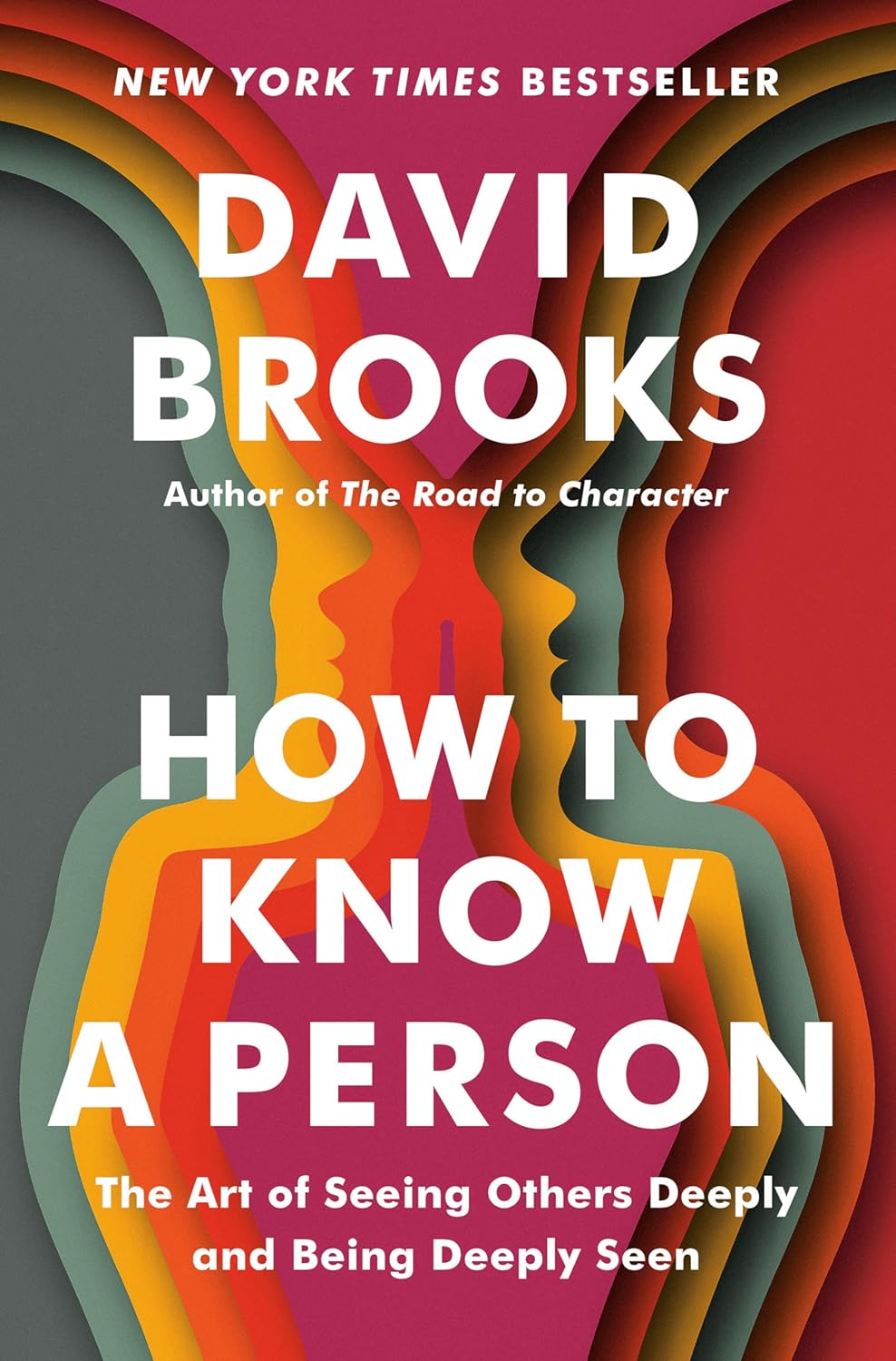
3) lluminators – How to Know a Person – I bought this book “How to Know a Person” after reading author David Brooks‘ guest blog on Ann Voskamp‘s website (linked below).
I’m not sure if it was after the 9/11 attacks or exactly when the cultural phenomenon began, but people seem not to look in people’s faces so much. There’s a disinterest, or lack of curiosity, or maybe even guarding. We feel it might be intrusive to ask questions, and for sure there are unhelpful questions. However, to be truly curious about someone, to want to know someone deeply, is a beautiful and honoring thing.
Below you will find two quotes from Brooks’ book. In the blog above and the book as well, he talks about being illuminators. Shining a light on someone. Not in an negative, exposing way but in a way that draws out who they really are and how amazing they are.
“When you’re practicing Illuminationism, you’re offering a gaze that says, “I want to get to know you and be known by you.” It’s a gaze that positively answers the question everybody is unconsciously asking themselves when they meet you: “Am I a person to you? Do you care about me? Am I a priority for you?” The answers to those questions are conveyed in your gaze before they are conveyed by your words. It’s a gaze that radiates respect. It’s a gaze that says that every person I meet is unique, unrepeatable, and, yes, superior to me in some way. Every person I meet is fascinating on some topic. If I approach you in this respectful way, I’ll know that you are not a puzzle that can be solved but a mystery that can never be gotten to the bottom of. I’ll do you the honor of suspending judgment and letting you be as you are.” – How To Know a Person – The Art of Seeing Others Deeply and Being Deeply Seen – David Brooks
“The real act of, say, building a friendship or creating a community involves performing a series of small, concrete social actions well: disagreeing without poisoning the relationship; revealing vulnerability at the appropriate pace; being a good listener; knowing how to end a conversation gracefully; knowing how to ask for and offer forgiveness; knowing how to let someone down without breaking their heart; knowing how to sit with someone who is suffering; knowing how to host a gathering where everyone feels embraced; knowing how to see things from another’s point of view.” – How To Know a Person – The Art of Seeing Others Deeply and Being Deeply Seen – David Brooks
Brooks talks about being a witness, about giving attention. I love that!
He reminds me of psychiatrist Curt Thompson MD who writes and often talks about compassion and curiosity. I’ve written lots about Curt and his wisdom on mental and relational health. He, like David Brooks, encourages us to give our attention to those around us. It’s part of the beauty of life.
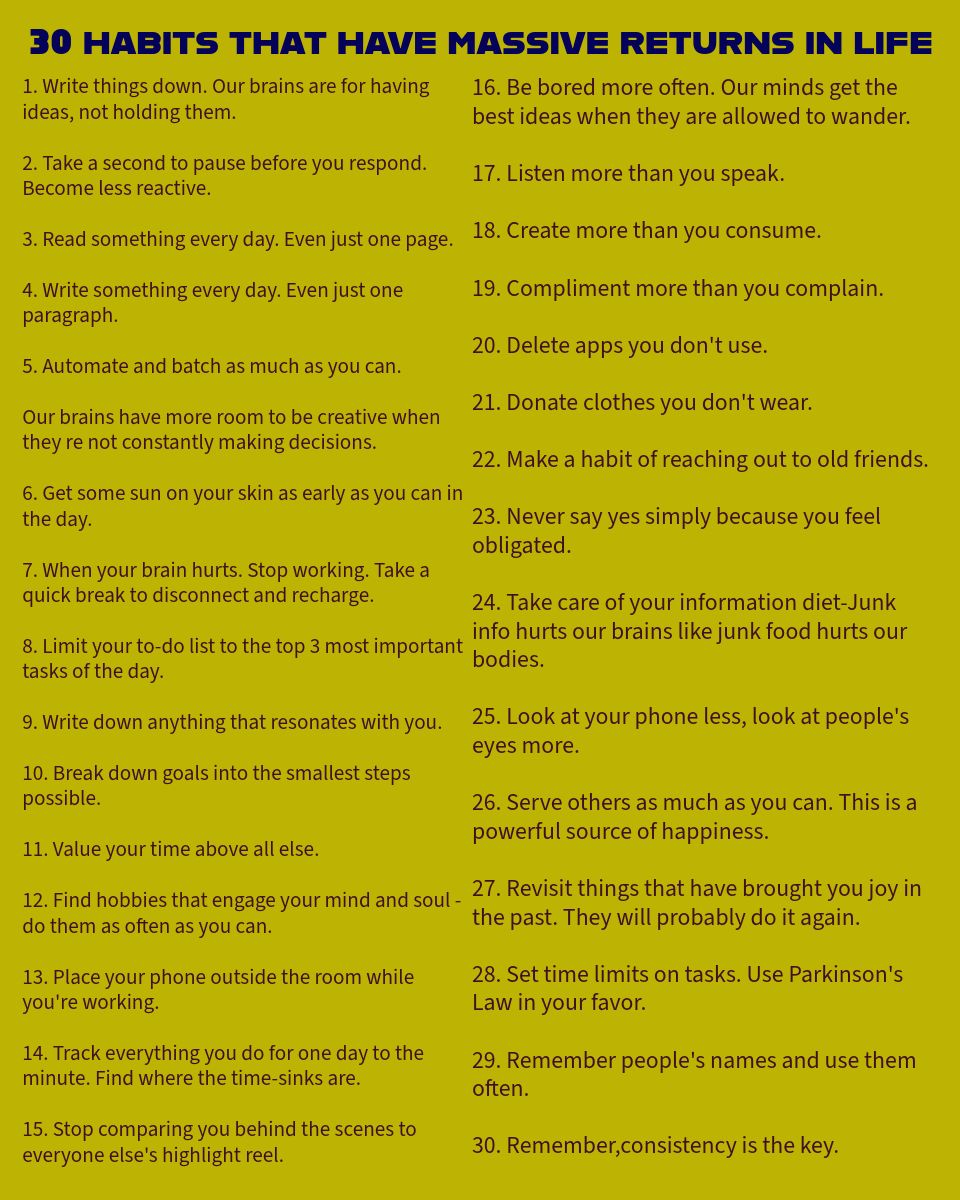
4) 30 Habits with Massive Returns in Life – I’m all about habit formation. Not saying I’m great at developing healthy habits, but I love the science of habits including New Year’s resolutions. Author Justin Whitmel Earley has written two excellent books on habit formation and a third for children (on sibling relationships) entitled TheBig Mess. Earley’s websites (The Common Rule and Habits of the Household) have great free resources as well on habit formation. For today’s Friday Fave, I’m just posting this little graphic on 30 habits with big returns…how many have you already formed? It’s not a race though…choose a habit and begin there.
5) 45 Life Lessons – Here is another list, not of habits but life lessons. They are written by author and cancer survivor Regina Brett of the Plain Dealer, Cleveland, Ohio, and have been widely reprinted.
“To celebrate growing older, I once wrote the 45 lessons life taught me. It is the most requested column I’ve ever written.
Here is the column once more:
1. Life isn’t fair, but it’s still good.
2. When in doubt, just take the next small step.
3. Life is too short – enjoy it.
4. Your job won’t take care of you when you are sick. Your friends and family will.
5. Pay off your credit cards every month.
6. You don’t have to win every argument. Stay true to yourself.
7. Cry with someone. It’s more healing than crying alone.
8. It’s OK to get angry with God. He can take it.
9. Save for retirement starting with your first paycheck.
10. When it comes to chocolate, resistance is futile.
11. Make peace with your past so it won’t screw up the present.
12. It’s OK to let your children see you cry.
13. Don’t compare your life to others. You have no idea what their journey is all about.
14. If a relationship has to be a secret, you shouldn’t be in it.
15. Everything can change in the blink of an eye, but don’t worry, God never blinks.
16.. Take a deep breath. It calms the mind.
17. Get rid of anything that isn’t useful. Clutter weighs you down in many ways.
18. Whatever doesn’t kill you really does make you stronger.
19.. It’s never too late to be happy. But it’s all up to you and no one else.
20. When it comes to going after what you love in life, don’t take no for an answer.
21. Burn the candles, use the nice sheets, wear the fancy lingerie. Don’t save it for a special occasion. Today is special.
22. Over prepare, then go with the flow.
23. Be eccentric now. Don’t wait for old age to wear purple.
24. The most important sex organ is the brain.
25. No one is in charge of your happiness but you.
26. Frame every so-called disaster with these words ‘In five years, will this matter?’
27. Always choose life.
28. Forgive.
29. What other people think of you is none of your business.
30. Time heals almost everything. Give time time.
31. However good or bad a situation is, it will change.
32. Don’t take yourself so seriously. No one else does.
33. Believe in miracles.
34. God loves you because of who God is, not because of anything you did or didn’t do.
35. Don’t audit life. Show up and make the most of it now.
36. Growing old beats the alternative of dying young.
37. Your children get only one childhood.
38. All that truly matters in the end is that you loved.
39. Get outside every day. Miracles are waiting everywhere.
40. If we all threw our problems in a pile and saw everyone else’s, we’d grab ours back.
41. Envy is a waste of time. Accept what you already have, not what you need.
42. The best is yet to come…
43. No matter how you feel, get up, dress up and show up.
44. Yield.
45. Life isn’t tied with a bow, but it’s still a gift.” – Facebook
Post in Comments any lessons that you particularly appreciate.
Instagram – Reel – Jonathan Haidt on slow Dopamine – holding off social media – see his caption screenshot below. [Also below is the full podcast on this topic – Dr. Haidt starts at 8:14.]
Celebrities acting like average Joes, a wholesome thread 🧵
1. The fact that a random couple ran into Keanu Reeves in a hotel lobby, invited him to their wedding, and he put on a suit and joined is proof he really is The One. pic.twitter.com/a3DGRDiC70
Yet they did not obey or incline their ear, but walked in their own counsels and in the stubbornness of their evil heart, and went backward and not forward. – Jeremiah 7:24
“They are darkened in their understanding and alienated from the life of God because of the ignorance that is in them, due to their hardness of heart.” – Ephesians 4:18
For this reason we must pay much closer attention to what we have heard, so that we do not drift away from it. – Hebrews 2:1
“Blessed is the one who always trembles before God, but whoever hardens their heart falls into trouble.” – Proverbs 28:14
Unbelief is a dangerous state of being. Rather than take a disturbing or confusing situation, and dig into prayer, Bible study, and reasoning with other believers…we are tempted to take our own counsel. We are drawn to a lesser gospel which “allows” for us to come out on top or to be right and the other is wrong. We want to be comfortable, justified, without sin.
Recently, we were blessed to be in a long conversation with a young family member who is struggling with a theological matter. He has studied long on this issue and can’t wrap his mind around it. Is that unbelief? I don’t think so. His heart is earnest toward the Lord. He wants to know what is true, and he wants to believe what God is saying. As we grapple over this, continue to study, and pray, I believe God will give him enough understanding that faith will take him the rest of the way…wherever he lands. He wants to believe and God will reveal what He needs to know.
What’s scary is those who choose unbelief as their only recourse…their only way forward in our post-Christian culture. Those, even in the church, who refuse to bend to the teaching of Christ…it’s enough to be moral, to be nice, to be ____________ (whatever our culture says is correct).
I knew a man once, a beloved brother, in the church where I grew up. He stopped coming to church after a long season of perceived faithfulness. His reason? He said he felt so burdened by what he had already learned and known about God that he didn’t want to risk being held responsible for any more knowledge of God!!!!!
Tragic.
Yet do we sometimes struggle with that ourselves? Being a part of church but having false beliefs…shutting our ears to what we hope not to have to obey. Or walking away from the church because of the same hardening of heart and refusing to believe.
“…is true Christianity only to be measured by what I believe, or also by how I live? Functional Christianity is when your confession impacts your way of life — you are functioning in accordance with your confession that Jesus is Lord. If Jesus is the reigning Lord of heaven and earth, then discipleship (true Christianity) is measured not simply by what I believe, but by how I live my life in relation to the rule of Jesus. In other words, the gospel should impact every area of my life.” – John H. Armstrong, Functional Christianity
A hardened heart has lost its desire to obey the Lord. Oh that we would never allow our hearts to be so far from Him as to not be able to hear His voice. He is always calling us back to Himself. Believe Him…trust Him…and obey. What freedom and beauty we have in this life with Him!
Worship with me to singer/songwriter Blessing Offor‘s heart-gripping call for us to believe. Not just in God’s Word but in His love as well. No matter what.
So You catch me when I fall, right? And You hear me when I call cryin’ And You fix me when I’m broke, right? And that’s all I need to know So the storm is gonna break right? And the sun is gonna start shining And everything is gonna go right And that’s all I need to know
But what if You know something I don’t? What if You will something I won’t? If You don’t give me what I want But You give me what I need Is that enough to…
Believe, believe, believe, believe in Your love? Will I still Believe, believe, believe, believe in Your love?
So nothing’s ever going wrong, right? And every day I’m gonna be smiling Turned my water into good wine And let the good times roll
But what if You know something I don’t? What if You will something I won’t? If You don’t give me what I want But You give me what I need Is that enough to…
Believe, believe, believe, believe in Your love? Will I still Believe, believe, believe, believe in Your love? Believe, believe, believe, believe in Your love Will I still Believe, believe, believe, believe in Your love?
Do I want You? Do I want You? Do I want You or what You can do for me? Do I love You? Do I love You? Do I love You or what You can do for me? Sometimes I don’t know But all I wanna do is
Believe, believe, believe, believe in Your love (Yes, I do) Believe, believe, believe, believe in Your love (All I wanna do, all I wanna do is believe) Believe, believe, believe, believe in Your love (Yes, I do) Believe, believe, believe, believe in Your love (Believe in Your love) Believe, believe, believe, believe in Your love (Yes, I believe) Believe, believe, believe, believe in Your love (I believe, I believe, I believe) Believe, believe, believe, believe in Your love (In Your love, in Your love, in Your love) Believe, believe, believe, believe in Your love*
““Lord, I believe; help my unbelief!” – Mark 9:24b
“I will give them a heart to know me, that I am the Lord; and they shall be my people, and I will be their God, for they shall return to me with their whole heart.” – Jeremiah 24:7
Then God said, “Let us make man in our image, after our likeness. And let them have dominion over the fish of the sea and over the birds of the heavens and over the livestock and over all the earth and over every creeping thing that creeps on the earth.” So God created man in his own image, in the image of God he created him; male and female he created them. – Genesis 1:26-27
“Come to me, all who labor and are heavy laden, and I will give you rest.Take my yoke upon you, and learn from me, for I am gentle and lowly in heart, and you will find rest for your souls. For my yoke is easy, and my burden is light.” – Jesus – Matthew 11:28-30
“Everyone the Father gives me will come to me, and the one who comes to me I will never cast out.” – Jesus – John 6:37
So Jesus said to the Jews who had believed him, “If you abide in my word, you are truly my disciples, and you will know the truth, and the truth will set you free.” – John 8:31-32
We are created in the image of God. Astounding fact! That means we are hard-wired for goodness and beauty, love and creativity, mercy and justice. Our problem then? Sin. From the beginning, sin has seeded our nature with self-serving and the warped sense that we belong to ourselves not to the God who knows and loves us perfectly. Apart from surrendering ourselves to His lordship, we attempt to live fragmented with bits of His DNA at work in us but far from what He had in mind for us…far from the freedom we can have in Christ’s forgiveness.
This brings us to the beautiful story Jesus told of the prodigal son. In this parable, Jesus brings into focus the lives and relationships of three men – a father and his two sons. The younger son rejected the life his father had for him and chose to sever himself from him. He asked for his inheritance and his father let him go to what would become a life of debauchery…living loosely on the means he did not earn, except by his lineage from his father. The older son stayed with his father, serving him (and tending his own future) as before. The father was heart-broken, and, although it isn’t written, maybe the older son went looking for the younger son to bring him back home. Or maybe he did not. We don’t know. Once the money ran out, the younger son found himself alone and hungry, without relationship or worth. Shame and regret were his only companions. He decided to return to his father asking for his mercy. Was he truly contrite and repentant – we can’t know his heart. He for sure wanted relief from the constant distress he endured, consequence of his poor choices. As he came, his father recognized him, from far off, as if he never stopped looking for his return. The father came running to receive him, welcoming him back home. The older brother? Not so much. In his own self-righteousness, the older brother did not rejoice, even when it pained his father’s heart that he had such a response. Being a good father has its own anguish, and we should always remember that in our love for God and in our treatment of those He loves.
Singer, songwriter Brandon Lake just released his latest single “Daddy’s DNA”. It’s a beautiful, honest confession of a prodigal (most likely some of which is Lake’s own story).
I thought the world had something special I was missing My daddy told me not to chase it, I didn’t listen I fell downhill a mile a minute Before I knew it, I was livin’ In a pig sty a long, long way from home
I went runnin’ like a rebel Racked up debts I couldn’t pay I went dancing with the devil With one foot in the grave How the Heaven did I get here? Went and threw it all away All I’ve given You was trouble All You’ve given me was grace
And the freedom I was chasing felt like prison Lord, I’ve done so many things, wish I didn’t And after all the risky business Could I ever be forgiven? I’m afraid to even ask to come back home
‘Cause I went runnin’ like a rebel Racked up debts I couldn’t pay I went dancing with the devil With one foot in the grave How the Heaven did I get here? Went and threw it all away All I’ve given You was trouble All You’ve given me is grace Given me was grace
When I sobered up, and came back to my senses I was too far gone to make up all the distance I gambled all that I’d been given I was broke, alone and wishing That I could turn around and go back home When I heard the sound of footsteps down the road
And You came runnin’ like a rebel Paid off debts I couldn’t pay You went dancing with the devil Sent that liar to his grave How the Heaven did I get here? Where every sin has been erased All I’ve given You was trouble All You’ve given me is grace
There was something in the marrow Always coursing through my veins Buried deeper than the rubble Is My Daddy’s DNA*
I love this song. The bridge (or benediction?) at the end really gave me pause. We do have the Lord’s DNA in us…what we do with that has eternal consequence. Either we think it is really our DNA and we can live our lives for ourselves, our own ambition and pleasure, and our own perceived destinies…or we recognize Whose we are and what we need to do to alter course and take on the life we were meant to have. That is where joy and freedom really lie. To recognize the prodigal nature in all of us and to return Home to a Father who came for us, in Jesus, and continues to come for us through the Holy Spirit at work in our lives.
My prayer is that His DNA is on beautiful display in all who call Him Father.