Category Archives: Monday Morning Moment

Monday Morning Moment – Confronting and Overcoming Disappointment

Photo Credit: Pixabay

Disappointment is a common experience for all of us. We can’t have expectations low enough to avoid it. Patterns, in dealing with disappointment, begin in early childhood. We have both experiences of either disappointing someone or being disappointed ourselves, and we lock in on a way to prevent or minimize it in the future.

With our children, I remember an occasion with each when disappointment stormed in hard. Our quiet oldest and only daughter had disappointments to overcome of too many hellos and goodbyes in our overseas life. However, the disappointment that comes to mind was a high school birthday party when I pretty much ruined it by including someone who could go all “mean girl” when she deemed it advantageous. She came to the party, and it happened. I was wrong to include her and our daughter suffered from my decision.

Our older son’s 8th grade disappointment was not getting on his school’s soccer team. At the time, he loved soccer and this was a unique opportunity that should have yielded success for him. It didn’t and he was devastated. Sitting by him, while he cried the most heart-broken tears in his pillow, I was so angry and sad…trying to figure out what to say…feeling like such a failure and having hate-filled thoughts for that coach who so flippantly capped his team, leaving just two students without a place on it. You hear the emotion still with me at my son’s disappointment so many years ago?!

Our youngest, who is adopted, has probably had the most adjustments through his life, of all three of the kids. He has weathered them well, for the most part, or as far as we can tell. There was a time when he was very small that he suffered some sort of disappointment. I can’t even remember what it was, but I will never forget his anguish. At one point, through his tears, he cried out, “I miss my mommy”.

Now, he had never known his birth mother. It’s possible he was missing his foster mother who cared for him until he was 14 months old. Even that seemed doubtful…that he would remember her at that point. The missing, I believe, came from a deep place of longing…an expectation that some mommy…some mommy he no longer had could have kept him from the pain he was having at that moment.

I missed that mommy, too. Metaphorically speaking.

Photo Credit: AF.mil

Disappointment happens when our desires get thwarted. These desires can be very temporal and superficial or they can be deep full-on longings. When we disappoint ourselves or others, we want to hide. That’s when sadness or anger roll in which takes our response to disappointment to a darker place.

Overcoming disappointment begins when we recognize how common a human experience it is. Those of us who struggle with disappointment do not have targets on our backs. Even those who seem never to show disappointment, it just speaks to their own deceptively well-developed pattern of communicating or not communicating it.

My mom was our sole provider in the early years of our childhood. She was my hero and I never wanted to add to her stress. The goal was to be good. Full-stop. My little-girl “being good” could not take away all the difficulty of Mom’s life. The sitting by her, as a little girl, when she was crying over some disappointment, very naturally carried over into my own mothering of our children.

If I could be good (enough) maybe I could fend off the disappointment of those I loved…it does not always work out that way.

Once we reckon with our knee-jerk responses to disappointment, when our desires or goals in life get blocked, then we can moderate those responses. Again, that doesn’t mean we drop our expectations or hopes as low as possible. Nor does it mean we try to control every possible outcome. Or create a hard shell to protect ourselves.

Overcoming disappointment is to “check our hearts” regarding the cause of the disappointment and “set our minds” to put it into perspective. In that, we determine ways to deal with the loss or failure such that we can diminish the amount of time we spend sad and hopeless. We can reason together with others in the equation (family, friends, coworkers), but this is ultimately a private process through which we will wrestle on our own. We need to be patient with ourselves and with  others near us dealing with disappointment. It will not become our permanent address. Disappointment is best written with pencil to move forward.

I came to grips with the fact that my “being good” didn’t solve all my mom’s troubles, and that had to be ok. It was a worthy goal and cost me little really not to add to Mom’s load. When I got to that place, her disappointments were not because I wasn’t “good enough”, and her quick emotional recovery didn’t have to be an outcome of my coming close and showing care. It was simply a loving thing to do. We both grew together in responding to and overcoming disappointment.

As for my kiddos. Our daughter notes “mean girl” behavior but doesn’t let it define her or steal her joy; she is also aware that she could fall into the same patterns and has put accountability safeguards in her life to avoid that. Our older son played soccer for a county youth league and learned a lot about just having fun with other kids who didn’t make the school team. We have watched him mature so much, using his disappointments to fuel change and resilience. Our youngest has leaned into the “mommy” he has, and the life he has now. He, too, has learned to roll with his disappointments and to re-calibrate when things don’t go as he hoped.

Disappointment is a mean experience. However, if we can identify the deeper why (that longing or desire) that ignites disappointment, we can put out its fire. The fire that prompts us to loathe ourselves and our failings or moves us to punish or distance ourselves from those who disappoint. The fire is just best put out.

Life has so much more joy and meaning for us than our sinking down into the sackcloth and ashes of disappointment. It is possible to not even be aware of disappointment because some of us have put such controls into our lives so as NOT to feel it or ever be the cause of it for someone else. If this is you, consider what you are missing in the busyness of all the work of managing and deflecting disappointment. Join the rest of us, and let’s learn together how to overcome it and how to comfort others going through it.

[Below are helpful links – two are devotional; two are clinical; and the last is a list of to-do’s. Blessings.]

Worship Wednesday – In Disappointment, Peace…and Finally, Joy – a Playlist – Deb Mills Writer

Disappointment with God – the Root of Our Frustration – Dodie Smith

Expectation, Disappointment, and Sadness – Mary Lamia Ph.D.

Dealing with Disappointment – Manfred F. R. Kets de Vries

11 Ways Emotionally Intelligent People Overcome Disappointment – Laurie Sue Brockway

Monday Morning Moment – Two Steps Forward – Rhythms, Routines & Rituals

Photo Credit: Self

“Two steps forward, one step back.”

Monday mornings are usually invigorating to me. The whole prospect and potential of a week unfolding ahead. Who knows what can happen?

This morning, it was all I could do to roll slowly out of bed. Flattened by a hectic week before and a full weekend, Monday morning dawned in slow motion.

If I had to show up to work today, it would not be pretty. While I was pulling myself into the reality of morning, the waste management truck pulled up outside and took away a heavy load of garbage. How thankful I am for people who show up for work.

Now it’s my turn.

Because of a neighbor and friend’s rigorous routines, I am spurred on to stiffly tie on my sneakers and get out the door to walk with her and others. That woman who springs into her workout shoes and actually looks great in activewear…does not live at my house.

During that walk, my body starts to remember how to function, along with this bear of a brain waking from a long winter sleep.

Whether work in outside the home or inside, I am inspired by the great benefit of rhythms, routines, and rituals. That morning walk is someone else’s routine that I’m trying to make my own.

All the productivity gurus promote some configuration of these 3 r’s.

Photo Credit: Justin Clark, Time Doctor

I’m completely sold on incorporating rhythms, routines, and rituals in my daily life…even adding a 4th “r” to the mix with New Year’s resolutions. These are a great help to one who probably has un-diagnosed ADHD…distractible and a wanderer on my own when not reined in by good habits.

For this Monday morning, and any other, my rituals and routines follow. They help set up rhythms that keep me thinking and working in ways that yield some measure of impact by the end of the day.

  1. Night before: in bed by 10:00pm.
  2. Night before: beginning of a to-do list that frames the next day.
  3. Up early.
  4. Make the bed.
  5. Coffee.
  6. No phone or other electronic distraction until after #7.
  7. Spend time with God (Bible reading, journaling, prayer) – the God Benjamin Franklin referred to as the Powerful Goodness.

Photo Credit: Scott Tousley, Hubspot

Some days these rituals/routines are followed by breakfast, a walk, writing, or straightaway out the door. Whatever comes next, these form the foundation to my every day.

How about you? Any routines, rituals, or rhythms that help you get going? Don’t be discouraged by the “one step back” – we all have those and it’s still progress. Also don’t let the cultural naysayers redefine life as “one step forward; two steps back”. Like the story of the tortoise and the hare – we don’t have to take the tack in life of frantic and cynical pursuit of a life that gets us nowhere (good, anyway). Steady, steady…choosing well and wisely…we will finish the race, fight the fight, and keep the faith (2 Timothy 4:7).

Even overcoming a hard Monday…

[Deb Mills Writer – I’ve written a lot on productivity. Search here.]

This Is How Your Daily Routine Should Look (According to Science) – Erin Brodwin

12 Morning and Evening Routines That Will Set Up Each Day for Success – Stephen Altrogge

The Morning Routines of the Most Successful People – Kevan Lee

8 Life Lessons from Benjamin Franklin – Quincy Seale

Rhythms, Routines, Rituals – Pinterest

A New Routine for the Work at Home Family – Leigh Ann Dutton

Monday Morning Moment – Martin Luther King Jr. Day – Where Are We Now?

Photo Credit: Wikipedia

Recently, flying back to Richmond, the inflight entertainment included the Spike Lee film BlacKkKlansman. The film is based on the Ron Stallworth book written about his experience (in 1979) as an undercover policeman investigating a local chapter of the Ku Klux Klan. John David Washington and Adam Driver are the lead actors in the film. The movie trailer was funny and won the film a place on my “gotta see” list.

It was definitely entertaining, but more serious than funny. As well as deeply thought-provoking. Spike Lee highlighted Civil War images, lynchings and other Jim Crow era horrors, Civil Rights era leaders, as well as real-life footage from the more recent Charlottesville riots.

To think that Ku Klux Klan membership (along with other racist groups) could be on the rise again gives pause. Full. Stop. Pause.

This social disease…racism…is not the fault of one man, one government administration, one political party. Minister and social activitist, Martin Luther King, Jr. called racism a moral issue, a sin problem, an evil of our society. None of us are immune to it or the hatred that both births racism and is borne out of it.Photo Credit: The Blue Diamond Gallery, Alpha Stock Images

He was murdered for his non-violent stand for people and against racism…or was he murdered simply because he was a black man?

Fast forward 50+ years, and we are still struggling with the real societal ill of racism. Fortunately, we also have voices like Martin Luther King, Jr.’s stirring us to act in truth and in love. One of those voices in my life is that of a young local minister, Rayshawn Graves.

Some time ago, Rayshawn preached out of Ephesians 2:11-16 on the reconciling of Jewish and Gentile believers. He also preached on Galatians 2:11-16 on how racism can creep into even the most devout believers if we aren’t careful. My takeaways from his sermon follow:

  • Racism is a sin which will always be present. It separates and isolates us from God and each other.
  • Jesus died for that sin as for all other sins.
  • Through Him, we can have the guilt of that sin removed. We can all be free to live in unity with God and each other.
  • Our identity in Christ is above every other identity we may have.
  • We don’t have to live out guilt (as whites) or the hurt of racism (as blacks). We belong to Christ and we are called to live that out – loving God, loving others, making every effort to keep and preserve the unity of the Spirit and the bond of peace (Ephesians 4:2-3).
  • We are called to bear one another’s burdens (Galatians 6:2) – within the church and with marginalized peoples especially. Unless we come close to each other, and have heart conversations, how will we know what those burdens are?
  • Because our identity is in Christ, and we love Him and want to be like Him, we make a habit of being proactive in pursuing reconciliation.

You can listen to Rayshawn’s sermon in entirety here. So helpful.

Martin Luther King, Jr. preached to the church on racism but he also spoke to the world.

I take hope in Dr. King’s words…and in those of today’s influencers like Rayshawn.

In closing, excerpted below are just a few of Martin Luther King, Jr.’s observations on what was happening in his day. He wrote these to a group of white pastors who had expressed concern about his actions.  He wrote from the Birmingham jail where he was imprisoned for nonviolent demonstrations against segregation.

[Bold emphases are mine. Read his letter in its entirety here.]

Injustice anywhere is a threat to justice everywhere. We are caught in an inescapable network of mutuality, tied in a single garment of destiny. Whatever affects one directly affects all indirectly.
“Justice too long delayed is justice denied.”
I must confess that over the last few years I have been gravely disappointed with the white moderate…the white moderate who is more devoted to order than to justice; who prefers a negative peace which is the absence of tension to a positive peace which is the presence of justice…
I am coming to feel that the people of ill will have used time much more effectively than the people of good will. We will have to repent in this generation not merely for the vitriolic words and actions of the bad people but for the appalling silence of the good people.
I gradually gained a bit of satisfaction from being considered an extremist. Was not Jesus an extremist in love? — “Love your enemies, bless them that curse you, pray for them that despitefully use you.” Was not Amos an extremist for justice? — “Let justice roll down like waters and righteousness like a mighty stream.” Was not Paul an extremist for the gospel of Jesus Christ? — “I bear in my body the marks of the Lord Jesus.” Was not Martin Luther an extremist? — “Here I stand; I can do no other so help me God.” Was not John Bunyan an extremist? — “I will stay in jail to the end of my days before I make a mockery of my conscience.” Was not Abraham Lincoln an extremist? — “This nation cannot survive half slave and half free.”  Was not Thomas Jefferson an extremist? — “We hold these truths to be self – evident, that all men are created equal.” So the question is not whether we will be extremist, but what kind of extremists we will be. Will we be extremists for hate, or will we be extremists for love?

“For those who are telling me to keep my mouth shut, I can’t do that. I’m against segregation at lunch counters, and I’m not going to segregate my moral concerns. And we must know on some positions, cowardice asks the question, “Is it safe?” Expediency asks the question, “Is it politic?” Vanity asks the question, “Is it popular?” But conscience asks the question, “Is it right?” And there are times when you must take a stand that is neither safe nor politic nor popular, but you must do it because it is right.“ – Martin Luther King, Jr.

King’s Letter

Photo Credit: Slate, Patheos

Monday Morning Moment – On Being White in a #BlackLivesMatter America – in Remembrance of Martin Luther King, Jr. – Deb Mills Writer

Don’t Just Blame the Cops: Who Is responsible for America’s Killing Fields? – John W. Whitehead – Huffington Post

Racial Reconciliation and National Covenant – Gerald McDermott

YouTube Video – If Someone Doesn’t Understand Privilege, Watch This

YouTube Video – A Biblical Response on Race – Sermon by Tony Evans

Providence Is No Excuse: Exposing a Reformed White Supremacist – Daniel Kleven

The National Memorial for Peace and Justice

Photo Credit: The National Lynching Memorial

Monday Morning Moment – Teach Your Children Well…12 Essential Lessons of Life

Photo Credit: Pixabay

[Adapted from the Archives]

Parenting is a job…almost a vocation. Feeding, clothing, and protecting children are all crucial…but what do we teach them? What are the essential lessons of life?

Two old songs come to mind when I think of the serious nature of teaching our children what they must learn for life. The old folk/rock group Crosby, Stills, and Nash & Young wrote and performed Teach Your Children. Graham Nash wrote the lyrics out of his painful relationship with an absent, sometimes imprisoned, father. Nash’s message is that we have to teach our children to make a better life…if not better world.

You’ve Got to Be Carefully Taught is the other deeply emotional song out of the musical South Pacific. This song points to racial prejudice and cultural bias, and how hatred must be taught to children when they are young. Mandy Patinkin‘s version of this song communicates its meaning powerfully.

Although hatred or bias can be taught, even from an early age, such dreadful things can also be caught over time in culture. Things like entitlement, dishonesty, greed, and irresponsibility. We as parents (teachers and employers) have a huge role in guiding children and young people to mature into caring and responsible adults…even in a culture that may cut across the grain of our own values.

I’d like to explore what we must teach our children. Intentionally, with meaningful purpose. Catching those teachable moments and seasons. Some things are more “caught than taught”, as the saying goes. Kids will catch some values living in close proximity to us and others. That makes the case, as well, for how we choose to live and what companions we seek for ourselves and our children.

More Is Caught Than Taught – Gabbie Nolen-Fratantoni

When our children were young, we taught them a set of rules which we honored in our home. The 21 Rules of This House by Gregg and Joshua Harris. These rules were, in ways, simplistic but also comprehensive enough to help us create a safe, orderly, and loving home, where children AND parents had the same expectations. Photo Credit: Choosing HomeSchool Curriculum

Our children are grown now, out on their own. Two of them are already in the season of small ones and will establish their own essentials for teaching their children.

This is a reminder to them of their own family values…I hope it’s also a help to you. These are 12 lessons of life. They are not comprehensive, and you may not agree with all of them. I would love to hear what you think should have been there as well, in the Comments section below. Thanks.

1) Love God – “You shall love the Lord your God with all your heart and with all your soul and with all your mind. This is the great and first commandment.” – Jesus – Matthew 22:37-38 If you are reading this and don’t share a faith in one God, then this won’t have meaning for you. Jesus was asked what was the greatest commandments of the law (in that day, they were burdened by the weight of over 600 laws). His answer? Love God with everything in your being.  Parents can model and teach this kind of love from the time children are tiny.

2) Love others – “You shall love your neighbor as yourself.” – Jesus – Matthew 22:39  Jesus didn’t stop at the greatest commandment. He added this one as just second to the most important. Love others. Not just your buddies. Not just those like you…but whomever neighbor is…the nobody, the every man. Jesus was clear in his instruction in “as yourself”. However it is we would serve ourselves, we give of ourselves to those around us. Wow! Great wisdom to teach our children.

[Jesus even went further in his teaching on loving others. Before his crucifixion, he encouraged his disciples to love others even as He loved them – a love that lays down its own life for others (John 13:34).]

3) Be obedient (honoring) – Children, obey your parents in the Lord, for this is right. “Honor your father and mother” (this is the first commandment with a promise), “that it may go well with you and that you may live long in the land.” – Ephesians 6:1-3 What a struggle it is for us to teach our children to obey! What a developmental milestone when they get it! Not after we count to 3, or 10…or whatever other enticement to obey comes to mind. Immediate obedience – in attitude and action.

Raising our children in huge cities made it crucial for them to obey the instant they heard us speak to them, especially over the noise of the city. One thing we did was a bird call (a whistle sounding “bob, bobwhite”. When they heard they looked up and started heading in our direction immediately. I still marvel when even today, that will still get their big grown-up attention.

More on obedience can be found here.

Photo Credit: Flickr

4) Be grateful. – Give thanks in everything, for this is God’s will for you in Christ Jesus. – 1 Thessalonians 5:18  God’s Word is filled with examples and encouragements toward being grateful (here are just a few). Jesus’ life was a testament of thankfulness to God the Father, and He taught us to pray with thanksgiving. Our kids grew up with The Thankful Song (from the Veggie Tales Madame Blueberry video) – “A grateful heart is a happy heart; that’s why we say thanks everyday.”

The Power of Gratitude – 21 Verses of Thanks to God – Debbie McDaniel

Avoid Raising an Entitled Child – 5 Strategies That Really Work – Amy McCready

5) Speak the truth. – Lying lips are an abomination to the Lord, but those who act faithfully are his delight. – Proverbs 12:22 The worst offense in our home was lying. Jesus spoke of Satan as being the father of lies (John 8:44). Telling the truth is something we model and something, I hope, our children value highly in their adult lives. No spin, no deception…straight-up truth. Truth in love (Ephesians 4:15).

6) Work with diligence and excellence. – Whatever you do, work heartily, as for the Lord and not for men. – Colossians 3:23   In grasping this lesson, children learn perseverance, patience, and an understanding of the value of work. Our youngest struggled with academics and he would say, about homework, “I just want to get it done!” As he matured, he moved his lament to more of a charge of “get it done and done well”. Watching him grow in that continues to make us so proud of him.

12 Ways to Glorify God at Work – Jose Etter

7) Seek joy. – Be joyful in hope, patient in affliction, persistent in prayer. – (Romans 12:12) Grumbling, discontent, and whining are such a part of human nature. When we count our situation joy, whatever it is, everyone wins. Other verses here.

8) Seek peace. – “Blessed are the peacemakers, for they will be called children of God.” – Jesus (Matthew 5:9) Sometimes we crave peace, and we’ll do anything to get it. Our children don’t need to learn how to be peace-keepers but to be peace-makers. It’s not about giving way to the one causing trouble, for instance. It’s developing relational skills to bring peace to a situation, resolving the conflict. More verses here on peace.

9) Be forgiving. – Bear with each other and forgive any complaint you may have against one another. Forgive as the Lord forgave you. – Colossians 3:13 Holding grudges and distancing ourselves from others in un-forgiveness is no way to live. Forgiving because we are forgiven carries with it a deep loving perspective. Helping our children understand how to forgive, especially little ones who have been gravely hurt by others, is huge. More on forgiveness.

10) See beauty; create beauty. – He has made everything beautiful in its time. Also, He has put eternity into man’s heart, yet so that he cannot find out what God has done from the beginning to the end. – Ecclesiastes 3:11 My children tease me sometimes because they say I think everyone out there is handsome/pretty. God has given me eyes to see, maybe as He sees. He creates beauty and He means for us to see and appreciate it…and create beautiful things ourselves.Photo Credit: Public Domain Pictures

Our children are all musicians (one professionally) or writers . They create beauty as we all can…in some way or another.

Nathan Mills -Beyond The Guitar

Top 10 Bible Verses about Art with Commentary

Saying Beautifully as a Way of Seeing Beauty – John Piper

11) Be kind. – Be kind to one another, tenderhearted, forgiving one another, as God in Christ forgave you. – (Ephesians 4:32) Again, years ago, when our kids were very young, they participated in a Vacation Bible School and learned a little song on kindness. “K-I-N-D, Love Is Kind”. I couldn’t find it anywhere for today’s blog, but the message stuck in all our heads. One of the simplest ways to show love is to be kind – to be generous and caring in our consideration of others. The Scripture points often to kindness in loving each other.

Be Kind to One Another – John Piper

12) Serve others. – Do not neglect to do good and to share what you have, for such sacrifices are pleasing to God. – Hebrews 13:16 This lesson of serving others is one I actually struggled to teach well. I fell into the excuse (like many in America do) that they had so much homework, so many assignments to complete, that they should just have fun when they had the time. Serving could have totally been a “fun” way of life. I hope our children do better with teaching serving than I did. More on serving here.Photo Credit: Niagara

In closing, I’ve left off many things. Critical thinking is one. Modesty and physical purity are others. In fact, do you remember that little song, “Be Careful Little Eyes What You See.”? Our kids learned that in English and Arabic.

Still probably the greatest lesson across the years of childhood (which goes along with the two greatest commandments Jesus taught) is the one Bob Pierce, founder of World Vision, taught us.

Let (your) heart be broken with the things that break the heart of God.

We want to teach our children to do right, for for the sake of others and for themselves, and to stand up for what is right.

Train up a child in the way he should go: and when he is old, he will not depart from it. – Proverbs 22:6

Let Your Heart Be Broken – Jeremiah 8, 9 – Rick Ezell

Bible Verses on Injustice

Monday Morning Moment – 3 Observations on Life Around Here

Photo Credit: Wikimedia Commons

  1. What Might Goofing Off Communicate? – This weekend, a friend told me about her son’s internship in a local organization. This young man expressed his disappointment at the amount of goofing off he saw among his coworkers, all more senior than he was.Photo Credit: Wikipedia

Suffice it to say, after his internship, he did not seek employment with this company.

What can we take from such a situation? Is it possible, those employees were blowing off steam from already completing large chunks of work, either earlier in the day or at home the night before? Are they taking healthy breaks from doing a good job, or have they lost the vision of their value in the big picture of their work? Also, what part of this scenario belongs to their supervisor? When goofing off is a pattern, where is the leader guy or gal in the mix?

This may be a disconnect for you, but I found myself strangely sympathetic to those “goofing off”. Maybe an organizational move toward leanness would be appropriate, but never without drilling down to the core of what’s going on here. Otherwise lean becomes just mean.

Any thoughts?

Why You Shouldn’t Punish Employees Who Goof Off – Rob Enderle

Ten Signs You’re Failing as a Manager – Liz Ryan

2. Proverbs – a Father Appeals to His Children – A couple of times a year, I read through the Book of Proverbs in the Bible. All the Proverbs were either written or collected by Solomon, the son of King David. There are 31 chapters in the book so it’s easy to incorporate one a day in one’s usual Bible reading. This time around, I noticed something in the ESV Bible study notes that was new: 10 paternal appeals. As a father might teach his son about life and making good choices, so Solomon did the same in this wisdom book.Photo Credit: Flickr

Here are the 10 paternal appeals in brief:

  1. Do not join those greedy for unjust gain (Proverbs 1:8-19).
  2. Get wisdom (Proverbs 2:1-22).
  3. Fear the Lord (Proverbs 3:1-12).
  4. Walk securely in wisdom (Proverbs 3:21-35).
  5. Wisdom is a tradition worth maintaining (Proverbs 4:1-9).
  6. The two ways: the way of wisdom or the way of folly. We choose. (Proverbs 4:10-19)
  7. Maintain a heart of wisdom (Proverbs 4:20-27).
  8. Sexuality – the presence of sexual temptations and the response of a wise person (Proverbs 5:1-23).
  9. Adultery leads to ruin (Proverbs 6:20-35).
  10. Keep away from temptations to adultery (Proverbs 7:1-27).

What might appear to be redundancy is more for emphasis. God will give us wisdom, but it is on us to live according to the wisdom he gives.

Trust in the LORD with all your heart, and do not lean on your own understanding. In all your ways acknowledge him, and he will make straight your paths. – Proverbs 3:5-6

Proverbs – a 12-week Study (pdf) – Lydia Brownback

3. None of Us Are Invisible – We are Seen – A circumstance this weekend struck a chord about how easy it is to just not see others. We have our close friends, our near colleagues, our people. It takes an intentionality to watch for those on the outside of our circles…and to extend to them a welcome. An old song by Casting Crowns came to mind today, as it relates to this dilemma – this strange experience of feeling invisible. Can Anybody Hear Her? is that “looking for love in all the wrong places” kind of story. Searching for a place to belong, to flourish, to be loved.

I’ve taken to watching for those solitary ones…they are not all in the midst of poor life choices. Those closest to God can feel isolation as well. The key to all of this is to know He sees…He sees, and He loves us. We can reflect that love to those who feel unseen…because they are…who feel they don’t matter…because they do.Photo Credit: Pixabay

Monday Morning Moment – New Year’s Eve Reflection – Auld Lang Syne

Photo Credit: Pixabay

[Adapted from the Archives]

Happy New Year! As this year winds down, we all look to the next with anticipation and hope. For many, tonight will be a partied out with friends. For us, this year, it’s spent with family…full of food, laughter, games and movies, huddled closely, filling all the sofas in Mommom’s living room.

We’ve already reflected back over this past year…we’ve written out resolutions for the one coming…and now, we mark the few hours remaining until this year is finished and the next begins.[I’m going back to this year’s resolutions to drive them deeper into my heart for 2019.]

When the clock strikes midnight, a song will ring out, for sure in the English-speaking world. That song is Auld Lang Syne. We don’t even know all the lyrics or its exact origin, but it stirs our hearts to remember the gift of old friends. What a gift they are!

Old friends…including the one I’m spending this New Year’s Eve with…

Auld Lang Syne: Should Old Lyrics Be Forgot…What the Song Means, and Eight Things You Didn’t Know About It – Alice Vincent

Auld Lang Syne celebrates those relationships that get us through whatever a year brings. Old friends. Sometimes we find those friends in our families…and sometimes across oceans.

One thing I love about this song is how the melody also lends itself to different lyrics…especially when the lyrics call to remembrance the finest friend it is possible to have in one’s life.

Our lives can take a myriad of turns that take us far from the friends we love. Fortunately, wherever we are…no matter how peopled or solitary our seasons are…there is a friend who is near to us always.

Two Christian bands have put lyrics to this melody and those songs follow. Take heart in these words in a familiar tune. Celebrate with me – as this year closes and a new one begins, there is One unchangeable in His love for us. Constant. A friend who sticks closer than a brother.

Happy, happy New Year.

1) For All That You Have Done by Rend Collective

Your grace will never be forgot
Your mercy all my life
Will be my source forever song
My story and my light

From mountain top to valley low
Through laughter and through tears
Surely the goodness of my God
Will follow all the years

For all that You have done for us
For every battle won
We’ll raise a song to bless Your heart
For all that you have done

You know our failures and regrets
You always led us home
Redemption’s arm has raised us up
Our triumph in the storm

For all that You have done for us
For every battle won
We’ll raise a song to bless Your heart
For all that you have done

(You’re faithful through the ages)

In unity we’ll stand as one
As family we’ll go
Shoulder to shoulder
Hand in hand
Into the great unknown

For all that You have done for us
For every battle won
We’ll raise a song to bless Your heart
For all that you have done*

Lyrics to For All That You Have Done – Rend Collective

2) All Glory Be to Christ – Kings Kaleidoscope

Should nothing of our efforts stand
No legacy survive
Unless the Lord does raise the house
In vain its builders strive

To you who boast tomorrow’s gain
Tell me, What is your life?
A mist that vanishes at dawn
All glory be to Christ!

[Chorus]
All glory be to Christ our king!
All glory be to Christ!
His rule and reign we’ll ever sing
All glory be to Christ!

His will be done, His kingdom come
On earth as is above
Who is Himself our daily bread
Praise Him, the Lord of love

Let living water satisfy
The thirsty without price
We’ll take a cup of kindness yet
All glory be to Christ!

[Chorus]
All glory be to Christ our king!
All glory be to Christ!
His rule and reign we’ll ever sing
All glory be to Christ!

When on the day the great I Am
The faithful and the true
The Lamb who was for sinners slain
Is making all things new

Behold our God shall live with us
And be our steadfast light
And we shall e’er his people be
All glory be to Christ!

[Chorus]
All glory be to Christ our king!
All glory be to Christ!
His rule and reign we’ll ever sing
All glory be to Christ!*

*Lyrics to All Glory Be to Christ – Kings Kaleidoscope

Monday Morning Moment – Christmas Eve – Come Behold the Wondrous Mystery – Matt Papa

[Adapted from the Archives]

Have this attitude in yourselves which was also in Christ Jesus, who, although He existed in the form of God, did not regard equality with God a thing to be grasped, but emptied Himself, taking the form of a bond-servant, and being made in the likeness of men. Being found in appearance as a man, He humbled Himself by becoming obedient to the point of death, even death on a cross. – Philippians 2:5-8

There are words, it seems, we can’t use any more in polite company – words that have changed as culture changes and have been altered, perverted, in the common language. I have happened on such words by using them and then being gently corrected by my 20-something-young friends. “That word doesn’t mean what you think anymore.”

Condescension seems to be one of those words. In today’s usage, it  has come to mean “an attitude of patronizing superiority; disdain”. Merriam-Webster has retained some of the fuller meaning of the word: voluntary descent from one’s rank or dignity in relations with an inferior.

At Movement Church, Pastor Cliff has spoken on it and our worship team led us in singing Matt Papa‘s Come Behold the Wondrous Mystery (lyrics follow below). Afterward, we had this lively conversation on whether referring to God as condescending was correct or not.

Oh yes…in the fullest sense of that word!

Hang in there with me as I take you through a quick study of the word…with the help of others much smarter than I am.

“God is condescending. It’s true. However, the problem is not that God is condescending, but that most people have no idea what condescending really means, nor why it should be a good thing that God has such an attitude.

If you were paying attention during high school English class, you know that there are actually two definitions for every word. One is the denotation, which is what the word actually means. The other is the connotation, which is the way the word is usually used in popular conversation. Condescension has a pretty bad connotation; it’s usually used to refer to someone who thinks they’re better than you are, and talks down to you as if coming down to your level is a major chore for them.

The denotation, however, is quite different. The word itself merely means “to come down [descend] together.” The prefix “con-” means “together with.”

If you split the word up and look at its parts, “to descend with,” you actually get a pretty good idea of what God’s interaction with humanity is all about. While it might be offensive for me to act as if I was in any way superior to my fellow humans, it would be silly for God to pretend that he was not superior to us in every single way.

Descending to our level is the only way he could possibly have a relationship with us at all. There is certainly no way that we humans, imperfect as we are, could otherwise ascend to his level. Unless God comes down to our level, we’re stuck with this gigantic gap between God’s holy perfection and our miserable imperfection.” – Jim Barringer

“Christ did not receive us because we were perfect, because he could see no fault in us, or because he hoped to gain somewhat at our hands. Ah, no! But, in loving condescension covering our faults, and seeking our good, he welcomed us to his heart; so, in the same way, and with the same purpose, let us receive one another.” – Charles Spurgeon

“There do meet in Jesus Christ, infinite highness, and infinite condescension.” – Jonathan Edwards

For you know the grace of our Lord Jesus Christ, that though He was rich, yet for your sake He became poor, so that you through His poverty might become rich. – 2 Corinthians 8:9

Condescension, when applied to Redeemer God, is a word that must be reclaimed from the common vernacular of this culture. God, in sending His son, did not just descend. He condescended…He came down to be with us. He came as close as it was possible for a holy God to come to His people…bridging the great gap we could not bridge in our own helpless estate. He came down to be with us.

Thank You, God, for your glorious transcendent condescension. We are forever changed.

Worship with me to “Come Behold the Wondrous Mystery“.

Come behold the wondrous mystery in the dawning of the King,
He, the theme of heaven’s praises, robed in frail humanity.
In our longing, in our darkness, now the light of life has come;
Look to Christ, who condescended, took on flesh to ransom us.

Come behold the wondrous mystery: He the perfect Son of Man,
In His living, in His suffering, never trace nor stain of sin
See the true and better Adam come to save the hell-bound man,
Christ, the great and sure fulfillment of the law, in Him we stand.

Come behold the wondrous mystery: Christ the Lord upon the tree;
In the stead of ruined sinners hangs the Lamb in victory.
See the price of our redemption; see the Father’s plan unfold,
Bringing many sons to glory, grace unmeasured, love untold!

Come behold the wondrous mystery: slain by death, the God of life;
But no grave could e’er restrain Him, praise the Lord, He is alive!
What a foretaste of deliverance; how unwavering our hope:
Christ in power resurrected, as we will be when he comes.*

Explore God – Is Jesus really God?

Come Behold the Wondrous Mystery by Matt Boswell, Michael Bleecker, and Matt Papa

God Condescends – Charles Spurgeon

Jonathan Edwards: The Infinite Highness and Condescension of Christ

God Is Condescending by Jim Barringer

Messiah, the Condescension of God Transcendent

The Condescension of our Transcendent God by Lee Tankersley

The Condescending God?

Does Condescend-Condescension Always Have a Negative Connotation?

Lady Catherine’s Condescension

*Come Behold the Wondrous Mystery: Hymn Wednesday

“In our longing, in our darkness
Now the light of life has come
Look to Christ, who condescended
Took on flesh to ransom us”*

Monday Morning Moment – Lessons on Life From a Grieving Husband

Photo Credit: National Institute on Aging

Time can be so fluid…like water in our hands. Hard to hold onto. This is evidenced often in this blog as Monday Morning Moments are posted on Tuesdays at times, and Friday Faves don’t make it up until Saturday or Sunday…or not until the next week.

Life happens…and is punctuated by significant and not-so events. One full-stop experience is the death of a loved one. It stops us in our tracks. We are shocked by it even when we see it coming. Death turns our feet into concrete and yet at the same time moves us to action. Necessary action that drags us forward in dealing with the loss of that one so important to us. Someone has to make arrangements; someone has to make decisions.

When that someone is you, a grand narrative is born in the darkness of loss. It is a gift from God in the wake of bereavement.

We who are bystanders, or close watchers, in the company of one grieving can learn so much about life…and the attentiveness of God over that one in distress.

In Genesis, an account is given, centuries ago, of the death of Sarah, the beloved wife of Abraham. This Abraham is considered the founding father of three major world religions today. In the Scripture he was considered a friend of God (James 2:23), and his faith was counted to him as righteousness (Genesis 15:6).

The lessons on life that we learn from this husband grieving the loss of his wife include the following:

  • Death of a loved one reorients us to the transient nature of life. Even though Abraham and Sarah had been married for 90-100 years, the day would come that death would separate them. Their lives had taken them far from their home of Ur, in Mesopotamia. For many years, they lived in Canaan, always in tents. Always “foreigners and outsiders” (Genesis 23:4). As Abraham wept over the loss of his wife, he realized he had no place to bury her. Should he take her back home or make some provision for burying her where they lived? No matter how long we live, how long we may be married, or how wealthy we are…in this life, in many ways, we are simply sojourners…passing through.
  • The loss of someone we love moves us to put down a stake. In Abraham’s situation, this was a literal “planting a stake”. He negotiated with the men of Hebron to purchase a burial cave (and the land surrounding it) to lay his Sarah to rest. This was huge for him because, although he was wealthy, he had not bought any land, waiting on God. God had promised the land of Canaan to Abraham and his descendants. Now, because of the necessity of a burial tomb, Abraham would stake claim to God’s promise by exercising his faith that Canaan would be his family home for all time. The cave for Sarah would also be where he and others in his family would be buried as well. In this land, Canaan. For many of us, the reality of losing a loved one brings into sharp clarity what all is lost with them. My mom was an incredibly faithful prayer warrior for her family and friends. She also lived a life of self-less service to others. It was joy for her that God would allow her such a life of purpose. When she died, I realized that putting down a stake, in her passing, would be to enter into the spiritual work she left behind. Taking hold of the baton my mom passed to us. Praying for and serving others. I’m not where she was in that…but growing.
  • Even in our pain, we can trust God to give us wisdom and care in dealing with those around us. When we are grieving, life doesn’t feel normal. It’s as if we operate on slow-motion. Our thoughts are muddled. People are saying things to us but we can’t seem to hear correctly. In the depth of his grief, in order to secure a burial place for Sarah, Abraham had to deal with people not like him in a culture not his own. Yet, he negotiated with sensitivity and clarity. In fact, the way he did his business that day is a lesson for any of us in working with others. He was gracious and generous. The sale of that land to Abraham went very well for the seller, and the ownership of it should never come into question in the future. When we are faced with responding to others, in the midst of our grief, we can take his example. God will lead us to be our best selves, even in the hardest of situations…if we keep our eyes on Him and we treat those in front of us in good faith. When we lose someone, people usually mean well…even when motives are suspect, we can respond graciously. If, like the owner of the property Abraham would buy, the person seems focused on their own gain, we can act with wisdom and expedience. Abraham needed a burial place that would forever be considered his property. He did what needed to be done…and God gave grace.
  • Lastly, whatever the loss, we can look to the future in hope and confidence. Abraham had a great promise from God for the future. He had only begun to see the promise unfold, but he trusted God for the rest (see Hebrews 11:13-16 below). When we lose someone the idea of never seeing them again would be horrific. In fact, I don’t see how people, who believe that this life is all we have, can survive the death of a loved one. Everything in this life gives evidence that we are made for eternity. I rejoice in the knowledge that this life is not our forever home. We have another homeland…a better place. God has it ready for His children – for that loved one we are mourning now and for us on another glorious day.

“These all died in faith, although they had not received the things that were promised. But they saw them from a distance, greeted them, and confessed that they were foreigners and temporary residents on the earth. Now those who say such things make it clear that they are seeking a homeland. If they were thinking about where they came from, they would have had an opportunity to return. But they now desire a better place—a heavenly one. Therefore, God is not ashamed to be called their God, for he has prepared a city for them.” – Hebrews 11:13-16

Made of the Stuff of Eternity – A. W. Tozer

Our Hope in Grief – Ross Rhoads

Dealing with Death – Bob Deffinbaugh

Death of Sarah and Abraham – Ralph F. Wilson

Mourning the Death of a Spouse – National Institute on Aging

An End-of-Year Leadership Checklist – Priority for Your Team, Your Organization, and Your Own Longevity and Effectiveness

Photo Credit: Wild Apricot

[This is the followup piece from yesterday’s Monday Morning Moment.]

It’s December. Back to the office after the snow day. The squeeze is on our calendars as we march toward the end of the year. Here’s the question: how do we truly finish strong with the hope of an even stronger start in the new year?

If it’s all you can do to just try to finish…then you do what you can, for sure. Reflecting on this year may have to come in January. We all know the pressure doesn’t change just because we have new planners to fill. If we make this a priority, it actually could have great impact on the pressures…and the people under your watch, experiencing a similar pressure. We can change it up.Photo Credit: Gryphon Networks

Here are summaries of 5 end-of-the-year checklists from 5 business leaders. We can choose one or choose from each. In brief:

Lolly Daskal, founder of the leadership consulting firm Lead From Within, is one of my favorite writers/speakers on leadership. Her end-of-the-year checklist is in the form of 18 no-nonsense questions on your own leadership and character. Penetrating and informative. Here are a few of my favorites from that list:

  • Did you act decisively?
  • Did you build others up?
  • Did you listen before you speak?
  • Did you cultivate leadership in others?
  • Did you lead with positivity?
  • Did you navigate or fix?
  • Did you value the unique contributions of others?
  • Did you lead by example? – Lolly Daskal

___________________________

Marcel Schwantes, founder of Leadership From the Core, gives a rapid read, 5-point checklist which follows. Everything he writes is golden, so you definitely want to click on the article to fill in the blanks on how you execute these points starting now and into the new year:

  1. Shine the spotlight on your employees.
  2. Give direct and actionable feedback.
  3. Get to personally know your employees.
  4. Get in the habit of recognizing and praising your people.
  5. Create and communicate a shared vision of the future. – Marcel Schwantes

[We all think we do the 5 above well. Re-assessing, especially at end-of-year is key to truly being who we think we are for those we lead.]

___________________________

“As leaders, we often move from one year to the next with little or no time spent reviewing the year just past from a purely leadership perspective.” – Les McKeown

Business writer, Les McKeown, also prescribes a brilliant 5-point end-of-the-year checklist for leaders:

  1. Manage the narrative.
  2. Straighten the angels.
  3. Cull.
  4. Restock.
  5. Center yourself.

McKeown gives practical examples and exercises on how to finish the year healthy…for your benefit and that of your employees and organization. Honestly, this is creative and illuminating stuff…worth every minute of what you invest in it.

___________________________

Business consultant and writer Terry St. Marie offers a 10-point end-of-year checklist that covers all the bases. The following are my 3 favorites from his list:

  1. Read Your Fine Print – Every leader’s strengths, if overplayed, can turn out to be a negative – I call that the leader’s “fine print“; things that we need to be careful about.  Sort it all out early and become more aware of your “fine print“.
  2. Put The Right Team On The Field – Take stock of your team and their strengths and weaknesses, and ask a few hard questions:  Is everyone committed to the new year and the new plan?  Did you have some unresolved issues from last year that are still hanging out there?  Do you need to reshuffle a few things now before things get too busy? Answer these questions NOW,  take whatever corrective action is necessary, and give your team a better chance for success.
  3. Clean Out Your Ears – This one’s real simple – prepare your ears to listen, with this virtual “Q-Tip”.   Sit down at your desk, close the door, and turn off your handheld and computer.   Feel and “hear”  what it’s like to not multitask, and just take in what’s happening around you.   Make a mental note to recreate this “listening environment” every time you are in the presence of your teammates.

Don’t miss the other points of St. Marie’s checklist. Again, brilliant.

___________________________

Following are my favorite 5 of the 15-point end-of-the-year checklist formulated by the Forbes Coaches Council.

The end of the year is the perfect time for a SWOT analysis — a review of Strengths, Weaknesses, Opportunities and Threats. (Forbes Coaches Council)

Celebrate – If we don’t take time to celebrate (even the small things), we become burnt out, frustrated, and ineffective. Do something special for your team to celebrate their strengths. – (Forbes Coaches Council)

Show appreciation for your employees – Go beyond the usual card. Offer your clients and employees something of significance that you believe will make them feel special…valued. – (Forbes Coaches Council)

Get to know someone new in the company – While the holidays are full of food and stories, leaders should take the time to meet others downline in the company. Brown bag it with someone you don’t know. Invite an employee out to lunch. And talk about everything other than work! This will help you relate to others who typically don’t see you every day. This can improve the culture, as you challenge others to do the same. – (Forbes Coaches Council)

Budget for leadership development – At the end of the year, take time to add leadership development training in the next year and invest in your upcoming talent. This way, you increase employee retention and employee engagement. Plan for the future, invest in your talent. – (Forbes Coaches Council)

___________________________

There you have it. My hope is that this is more encouraging than burdening. If we carve a chunk of time to do this, both privately and with our team, it will yield all kind of good with which to enter the new year. Both relationally and strategically for the sake of the organization.

A Year-end Checklist That Will Make You a Much Better Leader – Lolly Daskal (2018)

15 Things to Top Your Business Checklist for the new Year – Forbes – 2017

A Year-end Checklist That Will Make You a Much Better Leader – Marcel Schwantes (2016)

A Great Leader’s Year-end Checklist – Les McKeown – 2012

A Leadership Checklist – 10 Things to Do Right Now to Make it a Great Year – Terry St. Marie (2010)

Monday Morning Moment – a Snow Day and an End-of-the-year Leadership Checklist

Monday morning. Quieter than usual. 11+ inches of snow has closed down much of the goings and comings of Richmond life today.

Although we know it’s not really a gift of time, snow days sure have the feel of a free day. Work still goes on for some (thank you all in the service industries), but for others we will catch up another day.

Today I am working on Christmas cards but they can’t be finished until husband Dave and I do our end-of-year reflection. We both look back separately, over the highs and lows of the year, and then come together to write a summary for our Christmas newsletter.

[If you hate those newsletters, just throw them in your recycling. They are probably more for the sender as the receiver…so the good has already been done. Happy Christmas.]

Dave works for an international organization. If we had kids or grandchildren at home, he may have just called it a snow day as his office, like many others in the city, is closed. However, because much of his day was already scheduled conference calls with people in different parts of the US and the world, he could work, from his office at home.

I say all this to emphasize how challenging it is to do any sort of review of the year…even on a snow day.

Still, year-end reflections are such a positive and productive activity, both for ourselves and for our workplace.

By year’s end, we are often just trying to appease the tyranny of the urgent. The dilemma is that a work life of putting out fires rarely puts in place barriers that can prevent further fires.

A year-end checklist used by leaders in concert with their direct reports can make a huge difference in accountability, employee engagement, evaluating practices, and planning for the next year.

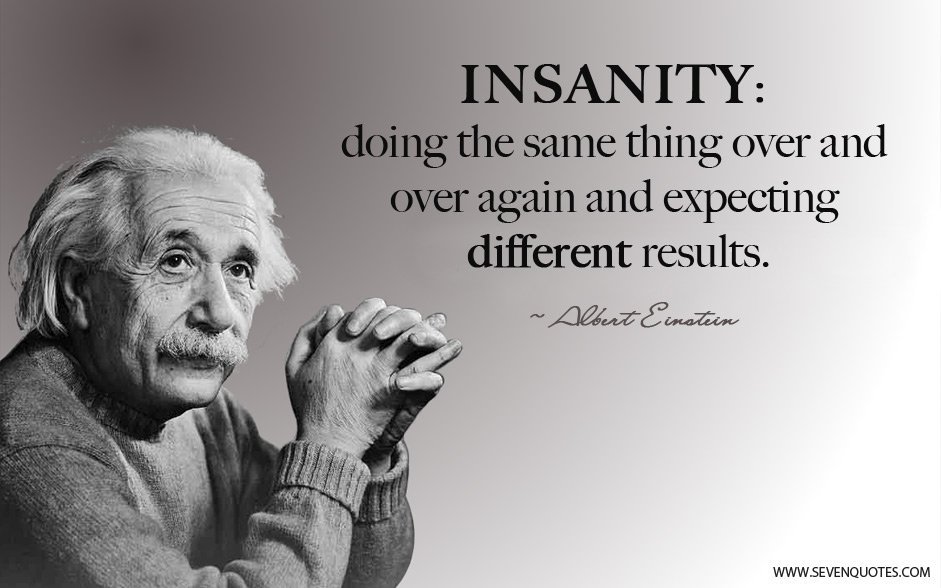
Otherwise we live and work in the insanity that comes when we don’t block out time for reflection, evaluation, celebration, and development or planning.Photo Credit: Twitter, Seven Quotes

We think we’re doing all those things…but are we?

Below, you will find five links with five different end-of-the-year checklists. Some are longer than others. Some require deeper reflection than others. They are a nice mix written by brilliant thought leaders. [two have the same title but they are very different, by two different leaders].

Tomorrow, I will post my favorite points of the checklists below. Today, maybe you would take the time to look at them, like me, and come up with a checklist you would use…or one of your own making.

A Year-end Checklist That Will Make You a Much Better Leader – Lolly Daskal (2018)

15 Things to Top Your Business Checklist for the new Year – Forbes – 2017

A Year-end Checklist That Will Make You a Much Better Leader – Marcel Schwantes (2016)

A Great Leader’s Year-end Checklist – Les McKeown – 2012

A Leadership Checklist – 10 Things to Do Right Now to Make it a Great Year – Terry St. Marie (2010)