Category Archives: Productivity

Monday Morning Moment – Blind Spots…Gulp. What Are Yours?

Photo Credit: Dan Rockwell, Leadership Freak

What do our faces and body language communicate? A friend and I were talking recently about how, as we’ve aged, our faces apparently have a resting pose of anger or disapproval. What?! When we were clued in on this, we both took action to keep a bit of a smile on, as a practice to avoid being misunderstood.

Not really a blind spot or is it? Blind spots are features of our personality (and physicality) that communicate something (usually negative) to others yet we are unaware of it ourselves. Blind spots are not necessarily intentional and if we were made aware of them we might be highly motivated to change or reckon with them.

Do we have blind spots in our posture and our behavior? In our decision-making or execution? Yes…and yes.

This isn’t a case for navel-gazing or over-thinking. We actually can’t discover our own blind spots without the help of others. However, sorting out our blind spots can, in fact, makes for healthier and happier relationships. As we realize how these not-easy-to-see patterns can have impact on work and life.

Following are four takes on blind spots by four business leaders. You seriously might want to jot down any of the blind spots that could be at work in you. Then check out these authors’ take on how to wrestle with these blind spots. Read the full articles by clicking on the links.

Thought leader, and CEO of her own management consulting firm, Davia Teman on 10 Leadership Blind Spots That Can Trigger Business Crises in 2017

Photo Credit: Davia Teman, Forbes

[Teman goes into these 10 surprising “don’ts” in her article here with excellent  counsel on how to get started dealing with these blind spots. Her expertise in crisis management in companies and careers gives weight to the idea of steering clear of over-trust and leaning into tested verification. Fascinating.]

The Top 10 Leadership Blind Spots, and 5 Ways to Turn Them Into StrengthsMarissa Levin – Entrepreneur and CEO of Successful Culture

  1. Going it alone
  2. Being insensitive of your behavior on others
  3. Having an “I know” attitude
  4. Avoiding the difficult conversations
  5. Blaming others or circumstances
  6. Treating commitments casually
  7. Conspiring against others
  8. Withholding emotional commitment
  9. Not taking a stand
  10. Tolerating “good enough”

Levin’s consulting firm provides help with leadership and strategy development, as well as culture-building. I am amazed sometimes what kind of assistance we can get online for such things. You can read more on her 10 leadership blind spots and especially her 5 compelling prescriptions for them here.

Leadership coach, consultant, and blogger Dan Rockwell‘s piece on Sudden Breakthroughs in Subtle Blind Spots

  1. Over-estimating your strengths. You think you’re a great communicator. They think you’re boring.
  2. Over-estimating your approachability. You see yourself as welcoming and open. Teammates nickname you, “Pitbull.”
  3. Over-estimating your listening skills. You think you’re exploring options. In reality, you’re killing ideas, cutting people off, and talking too much.
  4. Over-confidence in your solutions. You call it problem solving. They call it defending your viewpoint and devaluing theirs.
  5. Over-confidence in your ability to understand how others think and feel. You call it insight. They call it out of touch.

Rockwell gives 10 gut-punch but empowering rapid-read prescriptions on how to take blind spots to breakthroughs. Read them here, if you’re ready to deal with those 5 blind spots or others.

7 Leadership Blind Spots That Drive Your Team Crazy – Carey Nieuwhof, Pastor, Leadership Consultant, and Podcaster

  1. Underestimating How Much Work It Takes
  2. Impulsive, Emotion-based Decision Making
  3. Being Indecisive
  4. Being Too Decisive and Not Valuing Input
  5. Creating an Unsustainable Pace
  6. Working Too Few Hours
  7. Expecting Others to Put in More Than You’re Willing to Put In

[Read Nieuwhof’s succinct and helpful commentary on each of these here.]

Months ago, I also wrote about blind spots (here). The following is an excerpt:

Life coach and writer Martha Beck prescribes a way to discover our blind spots.

“I know how valuable honest feedback can be, how much precious time it can save in my struggle to awaken. I still have to force myself to go looking for it, but when I do I almost always benefit.

Try this: For a week, ask for blind-spot feedback from one person a day, never asking the same person twice. Just say it: “Is there anything about me that I don’t seem to see but is obvious to you?” You’ll probably want to start with your nearest and dearest, but don’t stop there. Surprisingly, a group of relative strangers is often the best mirror you can find. I’ve worked with many groups of people who, just minutes after meeting, could offer one another powerful insights. Like the emperor in his new clothes, we often believe that our illusions are confirmed by the silence of people who are simply too polite to mention the obvious. Breaking the courtesy barrier by asking for the truth can change your life faster than anything else I’ve ever experienced.”Martha BeckPhoto Credit: Vimeo

As hard as negative feedback is to stomach, it is a great help to avoid continued odd responses from people or the distancing that can happen when our blind spots get in the way of intimacy and care in relationships.

Now blind spots and “buttons” are different and yet connected. Buttons – those things people do that make us crazy – actually point to some of our blind spots in the way we respond to people pushing those buttons.

For instance, one of my buttons is when someone treats me like I’m stupid, or gullible. Like when a person tries to help me understand a decision he/she has made as if it’s a good thing when I know, and he/she knows, it’s not necessarily a good thing for me. This sort of thing makes me really burn (standing in the need of prayer here). OK…that’s a button, but my response can reveal a blind spot. My blind spot is that if I take a stand in some area then it means that I am “totally right” in that stand. Sort of the same as the button but from a different direction, you know what I’m saying? My blind spot response in that situation leaves little room for figuring out what the other person’s own “stand” truly meant.  It’s helpful to know our blind spots and our buttons so we can work out ways of being more honest and honoring in our communications with colleagues…well, with everyone.

What do you think?

Seeing Your Emotional Blind Spots – Martha Beck

What’s Your Blind Spot – Jane Taylor

6 Career Derailing Blind Spots and How to Overcome Them

How Successful People Cure Their Blind Spots – Kevin Kruse

How to Watch Out for Blind Spots in Your Leadership – Lolly Daskal

5 Friday Faves – Leaning Into Relationships, Year-End Review, Coco Guitar Arrangement, Attention Management, and For Better or Worse

Here we find ourselves in the last Friday of 2017. Such a mix of emotions, closing out one year, anticipating the next. These reflections have definitely colored my selection of these Friday Faves. How is your year ending? How is your week ending? This week of Christmas rolling into New Year.

1) Leaning Into RelationshipsDr. Robert Waldinger is the current program director of the 75+ year Harvard research study (entitled the Grant Study, with a subsequent complementary Glueck study). In a wildly popular TED Talk on What Makes a Good Life?, Waldinger talks about the findings of this long study of men (and later their wives and children). The data strongly support that a long and happy life is not about genetics or socioeconomic status. It is about relationships, relationships, relationships. Not the superficial or fleeting acquaintances often seen today in workplace and community. The “good life” is made up of sustained, deep, nurturing relationships. Relationships you can depend on…long-term.

“Loneliness kills. It’s as powerful as smoking or alcoholism.” Robert Waldinger

Lean into relationships.

TED Talk – What Makes a Good Life? Lessons From the Longest Study on Happiness – Dr. Robert Waldinger

Good Genes Are Nice, But Joy Is Better – Liz Mineo

2) Year-End Review – Dave and I, like many of you, I’m sure, do a year-end review. It’s a discipline that helps us reflect on the year in anticipation of a strong start to the next year coming. This year-end review becomes part of our Christmas letter. Photo Credit: Pixabay

This year was a hard one, both to reflect on and to write about. It was more a year of hanging tough, holding the rudder steady, persevering. Being thankful for more the big general things (good health, having a job) rather than the small significant events – those highlights that punctuate most years. Please don’t get us wrong: we are still very thankful for all the big general things and for a God who knows our hearts and loves us through the prickly places of personal struggle. Thank God, for GOD.

Through the years, Dave has enjoyed the wit and writing of humorist Dave Barry.  His 2017 year-end review is biting to the point of being caustic. Not the usual chuckle. An atheist and libertarian, Dave Barry’s take on life in America, especially this year, does not hold anything back. If you read his piece, I want to warn you of the graphic and partisan elements you will find. However, the question Dave Barry asks over and over is “Did That Really Happen?”

That question is one that resonates for us as we work and live in a culture so different than we imagined at this stage of our lives. Funny guy Barry turns darkly serious in his take on politics, in particular, and life in America, in general. His last comments, in his long month-by-month year review, return to more his usual funny style. In the end, he actually communicates hope…and, although we come from vastly different takes on life (especially on God), we share his hope. This, because we believe God is at work…and is not bound by politics or religion.

3) Coco Guitar Arrangement – The 2017 musical fantasy film Coco which I wasn’t interested in watching until Nathan arranged this beautiful piece from the film.

It is Remember Me by Kristen Anderson-Lopez and Robert Lopez. The film depicts the story of a young Mexican boy seeking both his destiny as a musician and peace with his family’s past. Lots of skeletons and spirits in the film, as it focuses on the Day of the Dead (Dia de los Muertos). I may have to watch it now.

Here’s Beyond the Guitar‘s lovely arrangement of Remember Me:

4) Attention Management – As we think of New Years’ Resolutions, one issue that always tops the list (after eating and exercise) is improving our time management. Writer Oliver Burkeman has posted a thought-provoking, down-right riveting piece on attention management as the real key to our struggle with making best use of our time. It’s not about getting our Inbox to zero as it is about thinking through what is most important in life. What really matters? And then being about that. Burkeman highlights below:

Photo Credit: Wikimedia Commons

“The allure of the doctrine of time management is that, one day, everything might finally be under control. Yet work in the modern economy is notable for its limitlessness. And if the stream of incoming emails is endless, Inbox Zero can never bring liberation: you’re still Sisyphus, rolling his boulder up that hill for all eternity – you’re just rolling it slightly faster.”

Personal productivity presents itself as an antidote to busyness when it might better be understood as yet another form of busyness. And as such, it serves the same psychological role that busyness has always served: to keep us sufficiently distracted that we don’t have to ask ourselves potentially terrifying questions about how we are spending our days. “How we labour at our daily work more ardently and thoughtlessly than is necessary to sustain our life because it is even more necessary not to have leisure to stop and think,” wrote Friedrich Nietzsche, in what reads like a foreshadowing of our present circumstances. “Haste is universal because everyone is in flight from himself.”

You can seek to impose order on your inbox all you like – but eventually you’ll need to confront the fact that the deluge of messages, and the urge you feel to get them all dealt with, aren’t really about technology. They’re manifestations of larger, more personal dilemmas. Which paths will you pursue, and which will you abandon? Which relationships will you prioritise, during your shockingly limited lifespan, and who will you resign yourself to disappointing? What matters?”Oliver Burkeman

Why Time Management Is Ruining Our Lives – Oliver Burkeman

Are Smartphones Making us Stupid? – Christopher Bergland

Monday Morning Moment – Ignoring in the Workplace and the Powerful Practice of Noticing – Deb Mills Writer

5) For Better or Worse – Our dear strong father/father-in-law, John, has Parkinson’s. This disease is robbing him of his strength, his memory, his speech. One thing it will not take from him is Julia. His wife of over 60 years is his primary care-giver.

As we were visiting them over the Christmas holiday, I overheard her talking to our son, Daniel, about marriage. She was helping John finish his lunch. I could see her leaning tenderly over him, as she chatted with Daniel. John doesn’t say much anymore, but Julia still talks to him. Lovingly drawing him back into life.

She was telling Daniel about the vows she and John made to each other all those many years ago. This was the season of “for better or worse”, she told Daniel. Not in a self-pitying way, but in her matter-of-fact wholly committed way. Julia loves God and she loves her family…that love tempered like steel through decades of attending to each.

Over the many years her son and I have been married, we have watched the love between them, her and John, grow even deeper. I remember how he would come in from working in the yard, still neat as a pin, with a little bouquet of flowers for the love of his life. She added those little flowers to the beauty which was ever their homes, richer with each season’s changing. Also Julia was ever faithful at “greasing the tracks” for deepening their walk with God and serving in the church. John’s own strong integrity and high sense of responsibility was boosted by Julia’s strong spiritual devotion.

His days of serving are done, but she continues to serve him and the God who watches over each of them…in these times of “better or worse”. May I be the kind of wife she is.

Those were my faves for this week. What have been yours? Any thoughts about what you’ve read above? Please comment below. Have a safe New Year’s Eve and a joyous reflective start to this next year. May we see peace and goodwill and may we be the start of that for each other.

Bonuses:

Attic Finds – Any trip to my Inlaws makes for tons of sweet memory-making. It also means trips into the attic and retrieving some of the lovely keepsakes MomMom has kept for us over our years of overseas travel. This time we brought home pictures from the pre-digital era, toys and clothes from our kids’ yester-years (including Christie’s wee “zippahs”, and treasured journals/letters.

Quote:  “Do not waste time bothering whether you ‘love’ your neighbor; act as if you did. As soon as we do this we find one of the great secrets. When you are behaving as if you loved someone, you will presently come to love him.” – C. S. Lewis

Best Seed Catalog Ever (Gardener Dave’s recommendation)

Monday Morning Moment – Taking Care of Our High Capacity Employees and Volunteers

Photo Credit: Ben+Sam, Flickr

The Energizer Bunny is an iconic symbol of its own message: “It just keeps going and going…” Such is our belief in high capacity employees and volunteers. In fact, the default is never imagine these tireless folks could run out of steam.Photo Credit: Sarah_Ackerman, Flickr

They don’t usually. However, there are situations when their “keep going and going” is out the door.

Photo Credit: LinkedIn

This week, Carey Nieuwhof, one of my favorite leadership guys, pointed us to the 6 reasons he believes we lose high capacity volunteers.  

[High capacity: Nieuwhof describes these folks as those who “can attract other capable leaders; don’t drop balls; love a challenge; constantly overperform”.]

This content is easily generalized to the workplace.

Before we launch into Nieuwhof’s observations, let’s celebrate high capacity folks for a moment. Even as you read this, you may be thinking of a colleague or fellow volunteer who immediately came to mind. That person who stays long at-task after others have lost interest, determined to figure out the solution or finish the project. That person we count on to be “a rising tide that lifts all boats”. That person who carries the ball or puts all she has in the game as if the outcome depends on her. Dependable, tireless, and visionary. Like in the classroom, we in leadership roles too often focus on others more than these because 1) others are either more needy or more demanding, and 2) we figure these “energized” ones don’t need our oversight.Photo Credit: Pixabay

We communicate core values in this, whether we’re aware or not. Nieuwhof’s insight and counsel are much-needed in a high-pressure workplace or organization. For leaders who themselves are already stretched, we count on our high capacity folks to stay at the work they love and we focus our energy elsewhere. Actually, the return on such our investment here, as prescribed by Nieuwhof, would work to our advantage.

6 reasons you’re losing high capacity volunteers (employees)

  1. The challenge isn’t big enough. – When the role is too well-defined and task-oriented with little scope for a broader impact, high capacity individuals may lose interest. It’s less that they have to matter (to the larger organization) but that their work matters…and they can see that by the trust given to them in the challenge.
  2. Your vision, mission and strategy are fuzzy. – Nieuwhof defines these as: Mission is the what. Vision is the why. Strategy is the how.” If high capacity individuals are clear on the why, they can engage with the mission and go all crazy with the generation and execution of strategy. Leaders are wise to set vision and then let loose these folks to get after it.
  3. You’re disorganized. – Plenty of us struggle with being organized. It can come with the chaotic schedule of leaders and managers. As we work with our high capacity employees and volunteers, we are wise to focus on providing them with what they need to be successful (direction, resources, right people at the table – including those in charge, on occasion). As time-consuming as this may seem, the outcomes will always be worth it.
  4. You let people off the hook too easily. – Nieuwhof doesn’t mean this in a mean-spirited way. Without intention, we can find ourselves modeling a low-accountability, slacker-friendly work ethic. Not because it is what we value but because our own heavy work-load keeps us from moving our personnel (or volunteers) to the next level of performance. We talk about it (in meetings galore) but we struggle to truly expect it in a real (work)life situation. We keep depending on our high performers to carry the bulk of the workload. High capacity individuals don’t necessarily mind the work but they crave high standards. They see the value and want it for themselves and for those they work alongside. Again, not in a mean way but in a genuinely caring way.
  5. You’re not giving them enough personal time. – Ouch! Where on our full to busting schedules are we going to insert time to touch base with our high capacity folks? We’re talking minutes here – fractions of time in a workweek – that will yield way more than we think. Dropping a meeting or two off our schedule to add face-time with these individuals will speak volumes to how you value them and what they bring.
    “Unless you’re intentional, you’ll end up spending most of your time with your most problematic people and the least amount of time with your highest performing people. Flip that.” – Carey Nieuwhof
  6. You don’t have enough other high capacity volunteers (or employees) around them. – We make a grave error in judgment when we think our high performers just want to be left alone to do their work. These individuals are often energized by others like them. They welcome opportunities to learn from and encourage each other. Turn over large projects to these folks and give them the authority and resources to run them together. Then give them the perks of such responsibility – they present on the project; their names are linked to the project; they travel to represent the project. Is it because high capacity individuals need the recognition or significance such a collaboration gives them? No. They have already had the satisfaction of doing a good work with valued coworkers. What this does is to say to the company, organization or world that their bosses truly know and publicly value their contribution. That matters.

A lot to chew on on a Monday morning. Thanks, Carey Nieuwhof. Please write another piece on how you apply this wisdom in your own workplace.

[By the way, y’all, don’t miss the Carey’s commentary on his 6 reasons AND the comments at the end of his blog – so good!]

Blessings!

6 Reasons You’re Losing High Capacity Volunteers – Carey Nieuwhof

9 Phrases Bosses Should Say Often to Inspire and Motive Others – Marcel Schwantes

The 5 Languages of Appreciation in the Workplace: Empowering Organizations by Encouraging People – Gary Chapman & Paul White

The 5 Languages of Appreciation in the High-Tech Industry: a Tool for Engineers to Grow Soft Skills – Paul White

8 Bad Mistakes That Make Good Employees Leave – Travis Bradberry

Great Entrepreneurs Look After Their Employees

Photo Credit: Pixabay

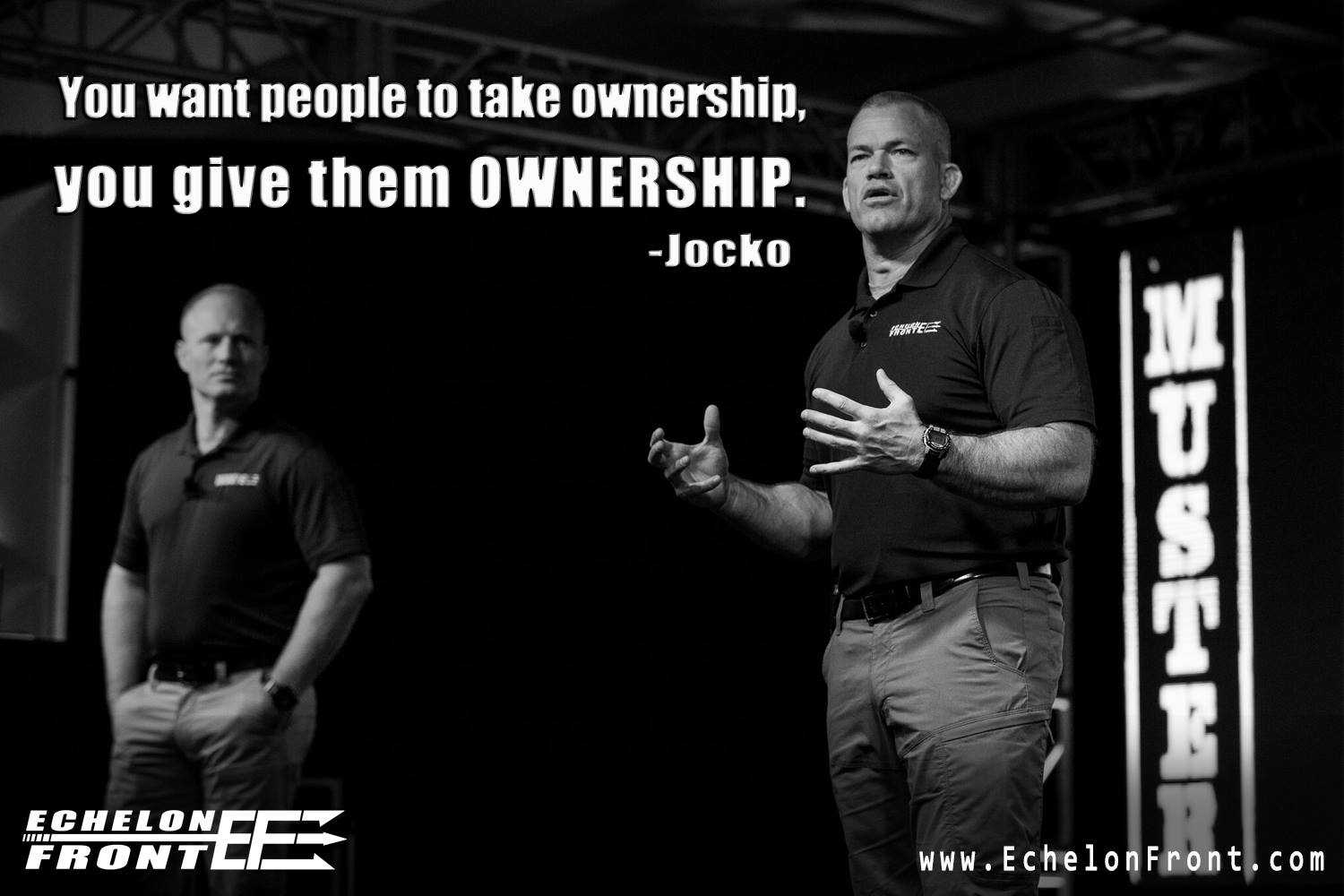
Monday Morning Moment – Extreme Ownership – the Greater Good of Both Taking Responsibility and Letting Go of Control

Photo Credit: Echelon Front, Facebook

When we see individuals in the military with some form of Special Forces training and experience, we are captivated and sorely aware of how different they are from most of us. That level of discipline, courage, expertise and physicality is uncommon. Nothing I ever imagined for myself. Still what can we learn from these leaders that we can apply to life and work?

Although the book Extreme Ownership was published in 2015, it was unknown to me until this weekend. Thanks to my Twitter feed and then reading some reviews, I ordered my own personal copy. The authors, and former Navy SEAL team commanders, Jocko Willink and Leif Babin are heroes and the stuff of legend.

[OK…I haven’t read the book yet…pre-ordered the latest edition coming out November 21, 2017. however, the reviews and summaries (listed in the links below) have already been so informative, I will gush away even before reading the book. So sink your teeth into these bits below until we have both read the book…or have you already read it?]

The phrase extreme ownership really tantalized because it spoke to my own leader heart. It resonates with servant leadership which is hard to fathom as a norm in military structure and authority. The idea of everyone on a team, in an organization, owning their part of a vision or operation is thrilling to me. It makes sense that this would, of course, lead to highest performance…provided…and this is imperative: the leadership, up and down the organization, is equipping each team member, communicating thoroughly, and sharing decision-making as appropriate.

Leadership coach Brian Dodd was the one who first guided me to the book Extreme Leadership through his blog: 25 Lessons on Extreme Ownership – How the U.S. Navy SEALS LEAD And WIN. Some of his points from the book are:

  1. “Without a team – a group of individuals working to accomplish a mission – there can be no leadership.  The only meaningful measure for a leader is whether the team succeeds or fails.”
  2. “For leaders, the humility to admit and own mistakes and develop a plan to overcome them is essential to success.  The best leaders are not driven by ego or personal agendas.  They are simply focused on the mission and how best to accomplish it.”
  3. “Leaders must own everything in their world.  There is no one else to blame.”
  4. “There are only two types of leaders: effective and ineffective.  Effective leaders that lead successful, high-performance teams exhibit Extreme Ownership.  Anything else is simply ineffective.  Anything else is bad leadership.”
  5. “Leadership isn’t one person leading a team.  It is a group of leaders working together, up and down the chain of command, to lead.”
  6. “Ego clouds and disrupts everything: the planning process, the ability to take good advice, and the ability to accept constructive criticism.  It can even stifle someone’s sense of self-preservation.  Often, the most difficult ego to deal with is your own.”
  7. “As a leader, it doesn’t matter how well you feel you have presented the information or communicated an order, plan, tactic, or strategy.  If your team doesn’t get it, you have not kept things simple and you have failed.  You must brief to ensure the lowest common denominator on the team understands.”
  8. “Human beings are generally not capable of managing more than six to ten people.”
  9. “Trust is not blindly given.  It must be built over time.  Situations will sometimes require that the boss walk away from a problem and let junior leaders solve it, even if the boss knows he might solve it more efficiently.”

Business leader Tom Niesen also lists his takeaways from the book, and they align nicely with the other summaries I read:

  1. Mission (Commander’s Intent and Effectiveness)
  2. It is on the leader! (Assuming a good “hire,” now, it is the leader).
  3. Extreme Ownership – everyone believes in the “why”, understands the “why”, and then pursues the “what”. Beginning with the leader. But, everyone “owns it all”.
  4. Get rid of the undermining, not-carrying-the-load, under-performer [this should be a rare necessity in extreme ownership but it can happen].
  5. Get very good at information sharing.
  6. Simplify! Keep it simple. (Not simplistic – simple).
  7. Communicate – thoroughly communicate. Up and down and all around. Confirm that the communication was sent and received and understood.
  8. Prioritize and execute. – [Tom Niesen’s summary of Extreme Ownership]

I hope these two summaries (and others in the links below) will whet your appetite to consider reading Willink’s and Babin’s book. Especially  consider taking steps toward extreme ownership in your business or organization.

Sometimes, we struggle in leadership to trust those around us to speak into decisions or even to carry out their assignments without us hovering. Worse is when we just don’t trust others and, as a result, take too much responsibility on ourselves or just a few trusted members of the team. I’ve learned through my life to take joy in the many…even with all its messiness.

I’m reminded of a proverb along these lines:

Without oxen a stable stays clean, but you need a strong ox for a large harvest.  Proverbs 14:4Photo Credit: Wikimedia Commons

If we want processes neat and tidy, we must hold tight to control and keep our trust to a very few colleagues. We lose so much in the process…holding onto control, trusting just our “tribe”, and excluding the input and energy of those outside the circled wagons.

Extreme ownership requires a great deal from leaders…a letting go; an allowing ownership to spread through to a greater mass of people toward a greater good.

We must operate with wisdom and excellence to fully equip our teams and then to give them the freedom to execute. Clear and full communication, up and down the command chain, greases the tracks for this kind of operation. Shouldering personal responsibility at all levels is also crucial, but the key is ultimately the executive leader takes full responsibility in the end…especially if something goes wrong.

I love this concept of extreme ownership. Who’s with me? Fortunately we can apply these principles without having to go through the grueling process of being a Navy SEAL. Thanks, Gentlemen, for your incredible service.Photo Credit: Wikimedia Commons

Extreme Ownership: How US Navy SEALS Lead and Win – Jocko Willink and Leif Babin

25 Lessons on Extreme Ownership – How the U.S. Navy SEALS LEAD And WIN – Brian Dodd

United States Navy SEAL Teams

Here are my 8 Lessons and Takeaways from Extreme Ownership by former Navy SEALs Jocko Willink and Leif Babin

Extreme Ownership – Leadership Lessons From the SEAL Team – Gerardo A. Dada

Extreme Leadership Training

YouTube Video – Extreme Ownership – Jocko Willink – TEDx University of Nevada

New Release (November 21, 2017) – Extreme Ownership: How US Navy SEALS Lead and Win – Jocko Willink and Leif Babin

Extreme Leadership – Leading Blog @LeadershipNow – Michael McKinney

Extreme Ownership by Jocko Willink – Book Summary & PDF – Paul Minors

15 Minute Business Books – First Friday Book Synopsis