He that goes forth weeping, bearing precious seed, shall doubtless come again with rejoicing, bringing his sheaves with him. – Psalm 126:6, King James 2000 Bible
Two Sundays ago, I was visiting family in Georgia. We didn’t go to church that day but we watched Jentezen Franklin on TV. He is my brother and sister-in-law’s pastor. His sermon was entitled The Power of the Precious. Its impact still continues on my heart.Photo Credit: Jentezen Franklin
Listening to sermons by mega-church pastors is not my usual…but I’m so glad I heard this sermon.
What Pastor Franklin focused his teaching on that morning was what happens when we surrender our “precious” to Him. “Doubtless” (in the King James version of the Bible) we will have a fruitful harvest by sowing precious seed.
When we give God what we consider most precious, He will do what only He can do in our lives.
The Scripture gives so many accounts of such surrender:
Abraham was willing to give his son, Isaac, in obedience to God and God provided a ram instead (Genesis 22).
Jacob gave his precious son, Benjamin, into the hands of his other sons for the sake of the family (Genesis 43:12-14), and God takes care of them through 5 more years of famine. Besides that, He restored Jacob’s beloved son, Joseph, to him again.
When God gave barren Hannah her son, Samuel, she remembered her promise to God, and gave Samuel back to Him to serve Him (1 Samuel 1:9-28)…and God used Samuel mightily to bring in the Davidic Kingdom. God did not forget Hannah either – giving her 5 more children (1 Samuel 2:21).
Stories abound in the Bible and in history since the writing of Scripture about of the supernatural return on our giving to God what is most precious.
He did the same for us…giving His only Son that all of us who believed in Him would be saved (John 3:16)…restored to our Heavenly Father through this sinless Savior. Jesus was given to us and gave Himself to us (Philippians 2:5-8).
What is precious to each of us? We all have that precious person or persons that we struggle even to say their names out loud if it means we surrender them to God.
Or maybe it’s our health or our career or our dreams or our hope of purpose or influence. Whatever it is, God is trustworthy, and He will do so much more, so much more beautifully, with that which we call precious, than we ever could.
Take a moment, in worship, as I did two Sundays ago, to again place that which is most precious to me, into the loving and capable care of a good God. I say “again”, because we have all had opportunity to do that with every good gift God has given us… Still, it’s important to revisit that which is precious to us to make sure we aren’t clutching it to our own selves but giving it to God…every day, in every way. So much better for them, for us, and for the glory of God.
There’s an account in Exodus where God was calling Moses to speak for Him as part of a divine plan for the Israelites to be set free from their Egyptian bondage. In Exodus 4, Moses questions his ability to do such a thing. God then uses Moses’ grasp of his most precious possession, his shepherd’s staff, as an object lesson. A lesson on what He can do in and through us when we surrender that which is most precious to us…to Him.
Singer/songwriter Ken Medema has put this story to music. It is one of my most favorite pieces of music. The lyrics come out of Exodus 4 with a heart-stopping challenge at the end. Listen to it all. 6 minutes into this beautiful and powerful song/story of Moses’ encounter with God, you will hear the lyrics below.
“Do you know what it means, Moses?
Do you know what I’m trying to say, Moses?
The rod of Moses became the rod of God!
With the rod of God, strike the rock and the water will come;
With the rod of God, part the waters of the sea;
With the rod of God, you can strike old Pharaoh dead;
With the rod of God, you can set the people free.”
What do you hold in your hand today? To what or to whom are you bound? Are you willing to give it to God right now? Give it up, Give it up, let it go, let it go, Throw it down.*
Monday’s are usually real up days for me. An opportunity for a fresh start…a new beginning. This morning I was dragging. Not really feeling it. In fact, wrestling against a flat-out negative mind-set.
What does it matter if I show up…or not?
Sure, we keep our commitments, make it to the meetings, answer the emails. However, a rut begins to form. A tuning down of expectations…or hopes. We check off our lists, but if we’re not vigilant, we find those lists lackluster…the vision dimmed.
You may never have to climb out of your own ditch, but I do sometimes. Having the help of another can make all the difference. A word of encouragement that resonates with understanding and care.
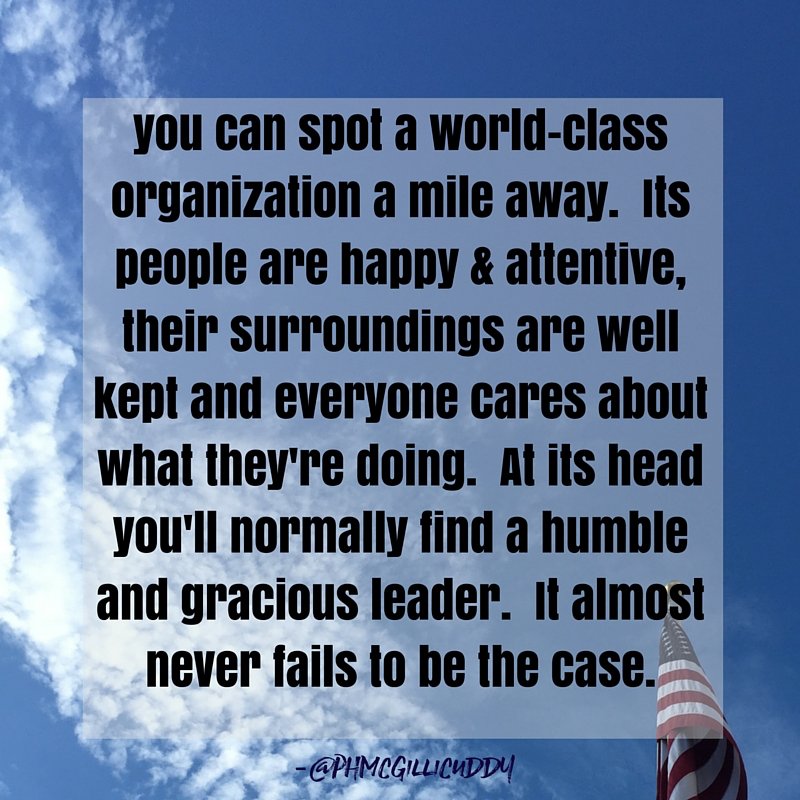
The quote below from my Twitter feed was all it took to get me back on course:
A world-class organization: Happy, attentive people. Well-kept surroundings. Everyone cares about what they’re doing. A humble and gracious leader.
A world-class organization is the workplace where you want to alert your friends when a new position opens up. It’s the church you talk about all week long because being a part of it is real true community. It’s the charity you can trust with generous support.
Marketing strategist Julie Taeko Gramlich lists six characteristics of a world-class organization:
Delighted employees, customers, and vendors;
Innovation-focused, dynamic;
Outstanding leadership;
Mission-driven;
Operational excellence; and
Sense of ownership.
Gramlich prioritizes the role of the leader, whom we think of as the CEO, or the lead in product design, or the senior pastor, or whomever is at the helm.
If your boss or primary influencer is gracious, humble, generous with ownership, and driven by mission and excellence, then you have the great pleasure of working for a world-class organization. Or, for sure, it can be…
I am convinced we all lead, in one way or another. We bring to the table our own skills and our own caring for the others around the table. Mission drift doesn’t just happen to CEOs or boards of an organization.
It can happen to any one of us. This Monday morning I was reminded of the importance of staying on course, of not giving up, of genuinely caring for those around me, and of marking excellence in others and making it my goal daily…
I’m out of the ditch…one more Monday. Let’s get after it.
Change is normal, and resisting change is normal as well. You may be part of an organization or company where sweeping changes are being implemented, even this week. Or maybe you are not on the inside loop of these decisions, so you are not privy to the change coming. Whether you are part of that process or not, consider how you might have a role in making change work, in your sphere of influence, among your colleagues.
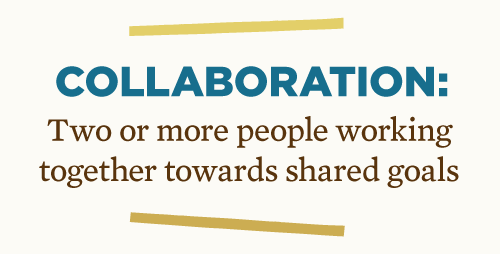
You may already have read and profited from the book Crucial Conversations. Now consider collaborative conversations. Collaboration, simply defined, is “working together towards shared goals”. Collaborative conversations bring a collective intelligence to bear on the problem to be solved, vision to be defined, or direction to be changed.Photo Credit: ThoughtFarmer.com
David Perkins, a Harvard professor, wrote about collaborative conversations in the workplace, using the metaphor of King Arthur’s round table. He described the beneficial nature of bringing several principal players (or stakeholders) to the table and treating each one with an equal or autonomous voice.
“A round table makes it a little easier to pool mental effort. A round table makes a group a little more intelligent…For a group to display intelligence in a sustained way, the members have to value their exchanges and stick together to keep making them. This depends on positive symbolic conduct [side messages sent by our words and behavior]…and collaboration… It’s not ideas, but people with ideas that make things happen.” – David Perkins
“One of the simplest ways to immunize a culture against broken trust, corruption, and animosity is to build a common vision.” – David Perkins
I personally thrive in such a setting and intuitively understand the value-adding nature of collaborative conversations. In researching this workplace topic, and choosing the links below, I came across a fascinating paper** by Heather Davis, a professor of RMIT University Australia.
Davis presented her paper at the 14th International Conference on Thinking (2009, Malaysia). She discussed how workplace leaders often choose “languages of war” in making and communicating decisions and creating change. Her paper is heady stuff but if you read her thoughts below you will want to read the whole paper. It gives huge support to the role of collaborative conversations.
“In [leadership’s] ‘language of zealous allegiance’, there are expectations of allegiance [in the workplace] that lay a path for uncritical acceptance and passivity. This manifests in an expectation that followers be conscripted wholly to the cause. There is little room for questioning. ‘Conscription means one important thing: there is no questioning of orders, one only executes them; “either you’re with us or you’re against us”.’ “
“Rhetoric plays out in the workplace too and can be tested by how well leaders:
hear and acknowledge the ‘other’ point of view,
see the ‘other’ as people rather than pawns or simply abstractions,
manage the distance, materially and metaphorically, between themselves and the people and sites affected by their decisions.”
“In the corporate world there are many examples of executives living and working in gated communities or otherwise removed by dint of corporate hierarchy or geography from the people and conditions affected by their decisions. Often, these leaders are also surrounded by people who can only agree, leading to little opportunity for double loop learning or deeply reasoned decision making processes. Whether our leaders live in gated communities is their business, but if they think, work and take refuge within a ‘gated’ mindset then we all need to be concerned. These conditions lead to hubris and have been the undoing of many leaders and corporations.”
“The role of the organisation is ‘to know its purpose and not be diverted from it’ (Drucker, 1993). This is a timely reminder here – easier said than done in times of flux, complexity and discontinuous change.”
“The main difference between Perkins’ languages of war and peace are that the war metaphor is founded on exclusivity and a preference for limiting discourse to its [leadership’s] own narrowly defined boundaries. Perkins’s peace metaphor is founded on inclusivity and opening up the space for conversations and conflicting views [i.e., collaborative conversations].”
“Oppositional language and the pitting of one deeply held worldview against another will not lead to resolving the underlying problems of the workplace. Rather, space for conversations to surface underlying assumptions is required. Perkins’ language of peace metaphor confirms that that there are always other lenses to view the world through, not just the one that [leadership] prefers.” – Heather Davis
Provocative reading from this Australian educator.
Bottom line: Those of us in leadership carry a great burden of responsibility. We at times must make difficult and sometimes painful decisions. Adding voices to that decision-making can generate even more challenging processes to negotiate. However, we will make more sustainable decisions for “better futures” if we bring those most affected (or most experienced or insightful) to the table. Whenever possible. That’s the gain of collaborative conversations – working together toward shared vision and shared ownership.
Stay engaged in your workplace. Don’t entertain indifference. Stay in the conversation. You can make a difference.
Let the heavens rejoice, and let the earth be glad; let the sea roar, and the fulness thereof. – Psalm 96:11
“If I say, ‘I will not mention Him or speak any more in His name,’ His message becomes a fire burning in my heart, shut up in my bones, and I become weary of holding it in, and I cannot prevail.” – the prophet Jeremiah, Jeremiah 20:9
“Blessed is the King who comes in the name of the Lord!” “Peace in heaven and glory in the highest!” But some of the Pharisees in the crowd said to Him, “Teacher, rebuke Your disciples!” “I tell you,” He answered, “If they remain silent, the very stones will cry out.” – Luke 19:38-40
But Peter and John replied, “Judge for yourselves whether it is right in God’s sight to listen to you rather than God. For we cannot stop speaking about what we have seen and heart.” – Acts 4:20
The Scripture speaks over and over again about how God is always present with us. Always present. How do we respond to such a phenomenal truth? The accounts in the Bible resonate our own experiences – we are moved to worship this amazing ever-present God and we are loosed in speaking of His greatness. We can’t but speak.
“He is here. Right now. Fully, completely. He is in you, around you, with you, over you, about you, for you, on time, in the middle of, surrounding you and the ones you love, in complete power, communicating as clearly as any time in history, doing perfectly to you, for you, by you, thinking about you every moment, walking directly into the middle of your worst day, your worst moment, your worst fear, your pain, your loneliness, your doubts, your insecurity, your sickness, your tragedy, your fragileness, your hope, your joy, your peace, your dreams, your relationships, your love, your longing to have your life count. He is here. He is champion and author of every beauty you find yourself longing for. He is the one who stands over you in the darkest hour. He is lifting you up, when you are too exhausted, too devastated, too hopeless, too failed, too compromised, too far gone. He is in this season.” – John Lynch
In Genesis 37-50, we marvel at the story of Jacob’s son, Joseph – sold into slavery by his own brothers, wrongly imprisoned, and then… forgotten? No. Not forgotten. Not by God.
Joseph lived as a slave and a prisoner for a total of 13 years. Always faithful to a very present God. Then in a providential, “for such a time as this” moment, the Lord brought him out and he was placed in the highest position of authority under Pharoah. It would be another 9 years before he would see his brothers again, but when he did, he would be able to come to their aid, and that of all the peoples of that day.
We are moved by the God who is always present with us. We are riveted by what we find in the Scriptures about how He works in the smallest details to bring about our good and His glory (Genesis 50:20; Romans 8:28). Then we are taken to our knees when we see Him do the same in our lives today.
“God glorifies himself towards the creatures also [in] two ways: (1) by appearing to them, being manifested to their understanding; (2) in communicating himself to their hearts, and in their rejoicing and delighting in, and enjoying the manifestations which he makes of himself. . . . God is glorified not only by his glory’s being seen, but by its being rejoiced in. . . . [W]hen those that see it delight in it: God is more glorified than if they only see it; his glory is then received by the whole soul, both by the understanding and by the heart.” – Jonathan Edwards
We can do nothing less than worship. It is our complete joy to do so. Out of that worship, we understand God and His purposes more, and we rejoice. It becomes a joy to walk with Him wherever He takes us…right?Photo Credit: Media Shout
[We all have times when we feel alone…that no one cares; that we are invisible. Truth is…that is not true no matter how real it feels. Hold on to the “each others” that God brings to you…hold onto Him.]
MercyMe with lead singer/songwriter Bart Millard has delivered two of my favorite contemporary worship songs: I Can Only Imagine and Even If. This song God With Us reminds us of His loving constancy in our lives. It also reveals how it is that we can’t help but lift our voices about Him and raise our hands because of Him. He is with us!
Who are we
That You would be mindful of us
What do You see
That’s worth looking our way
We are free
In ways that we never should be
Sweet release
From the grip of these chains
Like hinges straining from the weight
My heart no longer can keep from singing
CHORUS
All that is within me cries
For You alone be glorified
Emmanuel . God with us
My heart sings a brand new song
The debt is paid these chains are gone
Emmanuel . God with us
Lord . You know
Our hearts don’t deserve Your glory
Still You show
A love we cannot afford
Like hinges straining from the weight
My heart no longer can keep from singing
CHORUS
Such a tiny offering
Compared to Calvary
But nevertheless
We lay it at your feet
Such a tiny offering
Compared to Calvary
But nevertheless
We lay this at your feet
CHORUS
O my soul, bless God. From head to toe, I’ll bless his holy name! O my soul, bless God, don’t forget a single blessing!
He forgives your sins—every one. He heals your diseases—every one. He redeems you from hell—saves your life! He crowns you with love and mercy—a paradise crown. He wraps you in goodness—beauty eternal. He renews your youth—you’re always young in his presence. – Psalm 103:1-5, The Message
How do American politics affect our ability and capacity to be a force for good on the world stage? What elements align to make any of global nations consequential or inconsequential? What natural or geopolitical events will lead to migrations of people to who knows where? What are the top political risks facing our country and our world today?
Political scientist and thought leader Ian Bremmer was just an unknown name on our Richmond Forum subscription for this year’s season. Then we heard him speak. Wow! My ignorance was what was showing.
Ian Bremmer is a brilliant, funny, courageous, optimistic analyst of all things global. He has conversations with world political and economic leaders and their staff, and I’m sure he asks excellent questions. His analysis is intriguing because he clearly knows what he’s talking about and he kindly brought it down to a fifth grader’s understanding.Photo Credit: Richmond Forum
The best part of the whole evening was his unflappable honesty. He clearly had his biases regarding world leaders, including our own country’s leaders. Yet, he takes the larger and longer view. I so appreciated that. It’s part of why he’s not “crazy”, as he encouraged us not to be as well when we read and watch the news each day.
Bremmer told the audience his goal for the evening was to make us all “10% less crazy.” What makes us crazy regarding our country’s politics? He summed it up memorably:
“A lot of us feel like our system is rigged. A lot of us feel like our representatives are not representing us. A lot of us feel like the American dream no longer applies to us. And they feel like when the political leaders or the CEOs or the bankers or the journalists or the public intellectuals—God forbid—are talking to us, that they’re lying.” – Ian Bremmer
If we daily wonder if we’re being lied to by our politicians and not truly represented by our elected officials, then we do become a little crazy…distrusting our government and divided and polarized in our thinking, depending on our particular brand of politics.
Adding to this, Bremmer gives four other factors that fuel the divide:
Immigration – So much talk and very little done on either side of the aisle to improve the system – with the hope of making it fair for all who would like a chance to immigrate as well as humane and just for those foregoing lawful entry to the country.
Economic Inequality – This continues to increase, and it heightens the political divide between peoples as well. It adds to the “us vs. them” scenario.
Wars – When we seem always on the brink of a war (either threatened by a nuclear power or compelled to enter because of an oppressed ally, we struggle again with trusting our leadership, especially as our spouses and children lay their lives on the line for these wars. For what purpose?
Social Media – The rage of the average citizen who feels unheard or discounted by his government is stoked through the comments of others on social media. Where are the conversations being had by reasonable people with a stake in the outcome?
Ian Bremmer addressed these stressors and then he calmly proceeded with a survey of global and national threats and trends. I won’t go into them here but you can follow his generous, insightful commentary on all the latest news via his website, broadcasts, books, and Twitter/Facebook feeds. He will educate you and encourage how to engage rather than isolate.
[Forgive me for staying general on this, regarding geo-political risks.]
Bremmer gave two excellent challenges to us. The first is to find a person who we disagree with politically but who we respect (I have a short list of those valuable friends and family members). Then engage in conversation, with the goal to listen, learn, and better understand. Our default is to be enraged but not engage…we just read their social media posts and don’t comment, or worse, do…when we could actually create face-to-face dialogue. Neither of us may change but we have the opportunity to grow closer in coming to viable solutions to the problems we face.
His second challenge was to encourage our young people to study abroad…even in high school, even just for a semester. To put themselves in the minority. To learn from others who have similar problems as well as quite different ones. To learn how to draw down conflict and create understanding. To learn how to problem-solve with less monetary resources. These young people of ours will be the ones who will have to figure out how to flourish in the world we are leaving them.
Ian Bremmer talks reality but with hope and a healthy sense of humor. We would do well to follow his example in this…whether we agree with him on all points or not.
From a secular point of view, he came as close to answering my life-long question “Why can’t we all get along?” Bremmer’s talk also reminded me of Dr. Seuss’ book Oh, the Places You’ll Go. In the midst of a forum on global politics, economic upheaval, war and poverty, he posed the possibility of hope…if we show up and engage with one another.
Global Warming: Severe Consequences for Africa – Dan Shepard [Ian Bremmer got me to consider global warming more seriously when he talked about how the peoples of equatorial Africa will one day have to leave their countries and immigrate north.]
Here’s to your weekend! 5 favorite finds from this week:
1) The Godfather Theme – One of the most iconic films of all time was The Godfatheradapted from the 1969 novel of the same name. The story focused on the fictional New York crime family, the Corleone’s. So engrossing was the narrative that two later films of the same name followed. Composer Nino Rota‘s theme from The Godfather is beautiful and memorable. Whether or not you’ve ever seen the film(s), you know this melody. Nathan Mills has again taken this giant of a song and arranged a gorgeous piece for a single classical guitar.
[Sidebar: One of Nathan’s guitar students is doing a semester abroad in Dublin, Ireland. He heard a local guitarist playing and it reminded him of Nathan’s style of playing -at Beyond the Guitar. He engaged the guitarist in conversation and found out that he knows Nathan’s work and follows his music. Small guitar world. Sweet little story for you who follow and support Nathan’s music as well.]
2) Roaring Lambs – Many years ago, I read TV producer Bob Briner‘s book Roaring Lambs. Says Briner: “In my circles, Christians are thought of as people who are against things. I want us to be known as people who are for things good, wholesome, creative, wonderful, and fulfilling. That’s the message of the Gospel and it ought to be the message in all that we do.” His audience was Christians but there is wisdom for anyone who wants to make a difference rather than just a reputation or wants to make a change rather than just noise. We don’t think of lambs roaring, but Briner challenged the reader to take their work to the next level but not only aiming for excellence but for a depth and breadth that touches the lives of those around them.Photo Credit: Mountain Pleasant Granary
A woman I only know by what her “roaring lamb” reputation retired recently. Her job was made redundant by a new software program that was adopted in her workplace. What everyone will miss, as much as they will miss her diligence to task, is the beauty she brought to her department. Her generous gift of hospitality in both decorating common areas and serving food to her colleagues made it a joy just to leave the elevator and enter that office suite. She will be so missed.
Another “roaring lamb” work can be environmental services in a hospital. The tasks that make for a safe place to heal often go unseen and unrewarded. However, we all know personally or have heard stories of what can happen when either care or diligence aren’t exercised in this vital work group.
Finally, award-winning cartoonist Johnny Hart, after coming to Christianity later in life, made an intentional decision to incorporate his faith into some of his work. Some newspapers dropped his comic strips (B. C. and Wizard of Id) because of this, but most continued to publish them. His work was much-loved and his intent was just to use the medium of cartoons to inform on faith issues (as some use comics to do the same with political issues).
He died at his drawing table on Easter Eve 2007 after finishing his strip for the next day. It was fitting for this “roaring lamb”. [I wish I could post it but you can find it here.]
3) A Very Different Jesus – I am always baffled when Jesus is treated as inconsequential…some sort of weak made-up messiah of even weaker people who call themselves Christians. Maybe, the reason is because of how we Christians have represented Him in the world. This historical profoundly world-changing Jesus is so much more than is captured in the Charles Wesley song“Gentle Jesus, Meek and Mild”.Photo Credit: Slideplayer
The Scriptures say that Jesus is “the same, yesterday, today, forever” (Hebrews 13:8). If this is true then we can search out who He is and what He is like.
“Aslan is a lion – the Lion, the great Lion.” “Ooh”, said Susan, “I’d thought he was a man. Is he…quite safe? I shall feel rather nervous about meeting a lion.”…”Safe?”, said Mr. Beaver…”Who said anything about safe? ‘Course he isn’t safe. But he’s good. He’s the King, I tell you.”Photo Credit: Mark Meynell, Chronicles of Narnia: Prince Caspian
The night before the crucifixion of Christ, a large mob of both religious authorities and Roman soldiers came for him in the dark of night (John 18:1-14). If he had resisted, by the might of His power seen previously, they would need large numbers to insure his arrest. Jesus did not resist arrest. He went of his own accord, knowing his journey to the Cross was at hand. For our sake, He laid down His own power…His own life (Philippians 2:5-8 and John 10:17-18).
We admire first responders – those who run into danger for the sake of those who can’t save themselves. Everything we know, when we read both the Gospel and other religious (and secular) texts, is that Jesus was this kind of different.
The question for all of us is “what will you do with this Jesus?”
4) Core Values – A friend of mine this week raised the question of what were my family’s core values. I hadn’t thought of that…in a long while. Not even sure I’ve wrestled with my own core values lately.
Corporate strategist and author Ben Sands has written a super helpful piece on discovering your core values. He talks about how our core values are those few we lead out with in our lives.
So I went through this article and his list of values. He also gives a 4-step process for narrowing down to our core values. I’m still working through it, but below are my list of values (that I need to fine-tune to a Top 5, and then determine guiding principles, per his prescription):
Belonging/Inclusion
Collaboration/Teamwork
Community
Compassion/Kindness
Dependability
Faith
Family
Gratitude
Honesty/Transparency
How about you? Sands calls our core values our “safety net”. Otherwise, we don’t really have a mooring to dock our lives. I’m thinking he is right. What do you think?
5) Finally Spring – While this week marked the coming of Fall in the Southern Hemisphere, we in the North finally have Spring. Yes. Just a few pics of the glorious flowering around us right now.
Wherever you happen to live, your community needs you to show up and say words out loud, because white silence is violence.
Your people need you to acknowledge that Muslims are people who Jesus loves, and that whether we agree or disagree with their beliefs, nobody deserves this.
They need you to pray against terrorism, violence, and white supremacy, but also to do something about it.
They need you to shut down jokes and little comments that make targets out of people of color or other faiths. Don’t let them slide. Make supremacists uncomfortable.
Your community needs you because only when white people, a LOT of white people, actively stand up and stand with those who experience oppression, terrorism, and loss of life because of the color of their skin and their place of worship, will the terrorists understand that they have lost. That their sickening philosophies are not welcome, even among other white people.
POC cannot do this for us. It is up to us to fill our lives and words and deeds and spaces with so much love and inclusivity that white supremacy cannot fit. That it is squeezed out. We do this by how we react to jokes and comments, what we say or do not say, what we do, how we speak about and treat Muslims and other folks in the margins. Again, we don’t have to agree with their theology, but are we kind? Are we gentle? Are we protective of the oppressed? Do we shut down casual racism and xenophobism when we see and hear it?
Then the LORD God said, “It is not good for the man to be alone. I will make a helper corresponding to him.”– Genesis 2:18
But now, thus says the LORD, your Creator, O Jacob, And He who formed you, O Israel, “Do not fear, for I have redeemed you; I have called you by name; you are Mine!” When you pass through the waters, I will be with you; And through the rivers, they will not overflow you. When you walk through the fire, you will not be scorched, Nor will the flame burn you. “For I am the LORD your God.”– Isaiah 43:1-3
In all the good that God had accomplished in creating this world (Genesis 1), He Himself points out the one “not good” thing. “It is not good for the man to be alone.”
Pastor Cliff is preaching a series on Genesis, and this was where we landed this past Sunday. He talked about that aloneness as being something we experience apart from intimacy with God and His human provision for us. Not just marriage, but family, close friendships, and genuine community.
Our hardest battles are the private ones…the ones in which we feel alone. We could be surrounded by coworkers, family members, friends, yet we can’t really bring to words the terror in our hearts…the questions…the sense of isolation, of aloneness. We are not usually overcome by such things; it’s not who we are. Yet, there are days when it seems, seems, that we are alone. Everyone else is rocking with the latest turn in life…but me. It seems I am somehow alone in this.
First…if we could speak it out loud, we would find others with questions and wondering. We are not alone. Especially in the deepest places. Then, remembering again: we have great and many promises that God is with us through all of where He takes us. Most importantly, He sometimes orchestrates these places of weakness for us to remember His strength. It is for us to learn afresh to trust Him. His desire is for us to see and manifest His glory meant for our good and for those around us. This sometimes comes through those dark, desperate times of seeming aloneness. We. Are. Not. Alone.
Several years ago, I heard a seminary professor, Chuck Lawless, teach on spiritual warfare. He reminded us, through passage after passage from God’s Word, that our battles belong to God. He will fight for us. We are not alone.
“We turn to Job when our own life hits the wall. Job 1:20 – Job worshipped. I hope if I lost everything, I would still worship God. In all this, Job did not sin or charge God with wrong. Spiritual warfare – It’s not escaping from the battle; it’s worshipping God in the battle. Job is in a battle he can’t win. He trusts the Lord anyway. And we must as well.
It is in our weakness that we find victory. When the noose is around our neck. When we can come to a place where we’re content with the worst…then Satan can’t affect us. We lean on God in our weakness – we lean on God. We can say, “I’m o.k. with this.” We don’t like spiritual warfare because we want to hang on to our stuff – our dreams, our idea of ourselves, our position – whatever it is. Hang on to God. Alone.”
When our job is on the line or we are facing an uphill battle in our work, when we face a devastating diagnosis or diminishing health in our elder years, when our marriage is in a hard place or there seems no hope for marriage for us…whatever our situation. We are not alone.
As I listened to Dr. Lawless back then and to Pastor Cliff on Sunday, I looked around the room and my heart filled with love for those people God had placed in our lives. We may be unaware of the struggle…but we know a God who knows and joins us together with Himself and each other…in our struggles.
We have this amazing spiritual privilege, a divine work: to take each other to God in prayer…preemptively. Proactively not just reactively. The more we do this, the more quickly we will remember that the battle belongs to the Lord. [2 Chronicles 20:14-18] Satan would have us divided against each other, feeling on the outside of whatever is the preferred inside, stuck in thinking we are missing whatever is the better part. Not true! God loves us and He fights for each of us. Remember the Truth; cling to Him. We can pray confidently, knowing that we are not alone. Ever.
“The dark of night will not overtake me I am pressing into You.” – Kari Jobe
When I walk through deep waters
I know that You will be with me
When I’m standing in the fire
I will not be overcome
Through the valley of the shadow
I will not fear
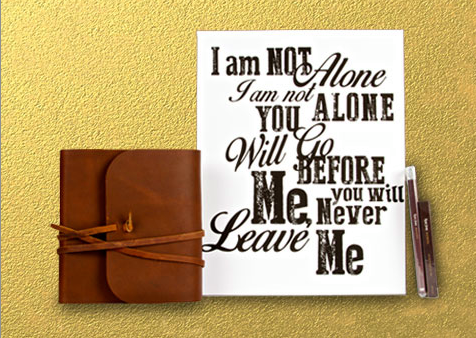
I am not alone
I am not alone
You will go before me
You will never leave me
In the midst of deep sorrow
I see Your light is breaking through
The dark of night will not overtake me
I am pressing into You
Lord, You fight my every battle
And I will not fear
You amaze me
Redeem me
You call me as Your own
You’re my strength
You’re my defender
You’re my refuge in the storm
Through these trials
You’ve always been faithful
You bring healing to my soul.*
Years ago, my best friend and I went on a cross-country sight-seeing trip. Our plan was to camp out a couple of nights and then stay in a hotel for the third, and continue in that rhythm for the two weeks we were on our adventure. It didn’t always go well. I loved camping; she preferred the hotel. Our food preferences were more different than we realized. We did, fortunately, agree on the “not to be missed” aspects of our journey across America.
Along with all the great memories made, we had some humdinger disagreements through the course of our time away and returned home even better friends as an outcome. However, it didn’t come easily for either of us.
It turns out I could majorly stomp on her feelings without even knowing that was happening. We have both matured greatly since then so this can encourage you…it has for me in the times in recent years when I find myself in similar situations.
First, you must know I never intended to plow through her preferences to race toward my own. She was my dearest friend. It gave me joy to see her happy. Still…somewhere I crossed a line. In our responses to one another, as friends, family, colleagues, (even strangers on social media) we can discover things both about ourselves and about the other.
“Feelings and emotions are two sides of the same coin and highly interconnected but are two very different things…Emotions originally helped our species survive by producing quick reactions to threat, reward, and everything in between in their environments. Emotional reactions are coded in our genes. Emotions precede feelings, are physical, and instinctual. Feelings are sparked by emotions and colored by the thoughts, memories, and images that have become subconsciously linked with that particular emotion for you. But it works the other way around too. For example, just thinking about something threatening can trigger an emotional fear response. While individual emotions are temporary, the feelings they evoke may persist and grow over a lifetime…In the gaps between emotion, feeling, and acting, we all have the power to change and direct our lives for the better. “ – Debbie Hampton
In the milliseconds between any stimulus and our response to it, we can choose how we will respond emotionally. However, because we have set a course “over a lifetime” of responding certain ways, emotional patterns (feelings) are formed and put into practice. We can change these, if we find them detrimental to our physical, emotional, and relational lives.
That happened between my friend and me. In close proximity, for two weeks, our daily experience very dependent on the other, we found we could irritate each other. The statements “That hurt my feelings” or “You hurt my feelings” became her lament…this from an accomplished teacher and successful manager of a classroom of tiny children. Somehow, on this trip, I had the capacity, regularly, of stealing her joy.
For me…inconceivable. I loved her and had no desire to hurt her, ever. Still, it happened.
[By the way, this expression of sensitiveness using the word “feelings” may be more encountered in women, but men have some similar experience – you know you do – but call it different things. “Offended”, maybe? “Annoyed”? Is that where sarcasm or cynicism is birthed?]
Back to the story: In some way, my behavior set off for my friend emotions that were tagged by past feelings of being discounted, not considered, not favored. It wasn’t pretty…for either of us.
Fast forward, decades later.
We live in a culture of lofty sensitiveness. The measure for political correctness in our speech continues to get moved upward. We are a nation so easily offended that we can’t even discern what is truly intentionally offensive from what is just true.
Have you ever been in a season with a friend or colleague that feels emotionally murky? You don’t really know what’s going on, but you sense something is. Then…you step on the landmine – and you say something or do something or your face shows something – that explodes all kinds of feelings in the other person, from what seems a life-time of storing up.
This is what has now been popularized as weaponizing feelings or emotions. The outcome? Guilt, shame, wounding, and (for some) returning fire.
It will make me sad if this post “hurts feelings”, especially of those friends of mine who read my stuff. The thing is, just like my friend and me, we can go deeper in our relationships when we refuse to let feelings define our friendships. When we refuse to think ill of others we grow a spiritual maturity and neuroplasticity that impacts our emotional responses and our relational resilience.
He talks about the danger of weaponizing sensitiveness long before it became the cultural phenomenon it is today:
“‘Did you fight fair?’ Or did we not quite unknowingly falsify the whole issue? Did we pretend to be angry about one thing when we knew, or could have known, that our anger had a different and much less presentable cause? Did we pretend to be ‘hurt’ in our sensitive and tender feelings…when envy, ungratified vanity, or thwarted self-will was our real trouble? Such tactics often succeed. The other parties give in. They give in not because they don’t know what is really wrong with us but because they have long known it only too well, and that sleeping dog can be roused, that skeleton brought out of its cupboard, only at the cost of imperilling their whole relationship with us. It needs surgery which they know we will never face. And so we win; by cheating. But the unfairness is very deeply felt. Indeed what is commonly called ‘sensitiveness’ is the most powerful engine of domestic tyranny sometimes a lifelong tyranny. How we should deal with it in others I am not sure; but we should be merciless to its first appearances in ourselves.“ – C. S. Lewis
After being an atheist, Lewis did not come to faith in Christ until his mid-thirties. His intense study of the Bible, relationship with God, and deep, gut-honest conversations with a circle of intimate friends moved him to such understanding of people and life…and our responses to both. Any thoughts on this? Please comment below.Photo Credit: Flickr
Invisible Wounds of the Sensitive, Empathic and Emotionally Intense Child – Imi Lo – this is a sobering, emotionally charged article. I resonated with it in preparing for the blog above and include it because it might be helpful for some to read. Just a warning that it is hard to read because it honestly did not give much place for hope. [If I missed it, please illuminate me in the Comments below.] Maybe the hope comes in recognizing what we as parents might be doing that’s hurtful to an emotionally intense child and correct course.
For I am already being poured out as a drink offering, and the time of my departure has come. I have fought the good fight, I have finished the course, I have kept the faith; in the future there is laid up for me the crown of righteousness, which the Lord, the righteous Judge, will award to me on that day; and not only to me, but also to all who have loved His appearing. – 2 Timothy 4:6-7
Kara Tippetts is one of the loveliest women I’ve never met. She died of cancer four years ago this month. Although cancer sharpened her experience of life, it did not define her life. She was a Christ-follower, pastor’s wife, mom of 4, writer, and amazing sister and friend. How I know her is through the cancer she battled, through her faith, and through her writing…this is how I know her and how I love her (from my earlier blog on her life).
On March 22, the documentary The Long Goodbye is released. Directed by Jay Lyons, it is an intimate story of Kara’s last months of life here on earth. It is a story of deep love, crazy humor, hard yet sweet moments, and forever faith. [See trailer here.]Photo Credit: Hallels
Some of my friends here in Richmond are joining with me for a premier party to watch the documentary together. I am excited to introduce them to Kara. It will be sad but also funny and supremely victorious.
Over the course of Kara’s cancer, she wrote three books (with the help of friend Jill Lynn Buteyn). I remember the blog she wrote about signing contracts for the two last books just weeks before she died. Her determination to leave this legacy was buoyed by a husband, family, and friends who helped her keep living the life she loved until the end. These books are so beautiful. I spent a couple of decades doing cancer nursing and those experiences forged an understanding of the rare and beautiful gifts found in suffering. Walking through it with God. Kara has captured so much of that and shares it with us in these sweet, sometimes hard stories.
By the way, there is way more joy than sorrow in her story. Her love for her family and friends. Her joy in the beauty that surrounded her. Her confidence in the God who loved her. It’s all there.
“…So here we are. The truth is that now you are in my bones, my bone marrow, my blood-making place. I did not want you there. I asked you not to go there. But you did it anyway. But here’s something. You will never separate me from the Holy Spirit. He’s watching you, every single cell of you. He’s the One giving me all this peace that confounds you. You won’t take my joy, cancer. You won’t keep me from living as close as I can to my people. And I know you think you are killing me with all your fast-growing cell business, but you are not the boss. The day I breathe my last is exactly numbered. You don’t have a say in that, sorry. And when that day comes, and it will come, my people will be kept safe in God’s beautiful arms…I do hate you, and I’m still here.” – Kara
This year during Lent, I’m reading Dietrich Bonhoeffer‘s 40-Day Journey. He writes beautifully about what it is to be a true disciple of Jesus. Here is one excerpt:
Luther translates the Greek word for what is blessed with “to bear suffering.” The important part is the bearing. The community of disciples does not shake off suffering, as if they had nothing to do with it. Instead they bear it. In doing so, they give witness to their connection with the people around them. At the same time this indicates that they do not arbitrarily seek suffering, that they do not withdraw into willful contempt for the world. Instead, they bear what is laid upon them and what happens to them in discipleship for the sake of Jesus Christ. Finally, disciples will not be weakened by suffering, worn down, and embittered until they are broken. Instead, they bear suffering, by the power of him who supports them. The disciples bear the suffering laid on them only by the power of him who bears all suffering on the cross. As bearers of suffering, they stand in communion with the Crucified. They stand as strangers in the power of him who was so alien to the world that it crucified him. – Dietrich Bonhoeffer
You have turned my mourning into dancing; you have taken off my sackcloth and clothed me with joy, so that my soul may praise You and not be silent. O Lord my God, I will give thanks to You forever.Psalm 30:11-12
Kara, in your living and your dying, you taught me so much about being a disciple of Jesus. You knew/know Him so well. Thank you. Photo Credit: Life News
My poor husband. The last month has been fairly brutal. His father had a massive stroke and died a week later. Between travel to be with his dad in his last days and travel for the funeral, Dave had a packed work schedule. In the midst of that, a friend died. After PopPop’s funeral and our friend’s funeral, we settled back into another busy work week. Interrupted for me by a vicious stomach bug. Interrupted for Dave by a vigilant attempt to avoid said stomach bug. We saw little of each other as he slept in the guest room and tried to stay clear of my germs, except for kindly offering me provisions. The day that I was for sure well, he got the same bug, even harder hit than I was.
So sick, he was forced to miss the majority of a week of meetings he had helped plan and was looking forward to. Such is life when sick.
At some point in all this, I began to get grumpy.
Don’t get me wrong…there was grace upon grace for all we experienced this month. Grace upon grace.
My grumpiness was a product of assumptions about how life should go and arrogance that it should always go well for me. Right?
I was frustrated that Dave had to get sick after all our safeguards against it. Also frustrated that he had to miss meetings he should have been able to attend.
With both of us recovering from heart grief and grumbling tummies, grumpiness came as a default reaction. Sadly, toward each other. [I have asked his forgiveness already, by the way., and he mine].
This happens with grumpiness. Whether we are prone to it in our closest relationships or in more casual work or friend situations, grumpy begets grumpy.
As a teenager, our middle child, Nathan, had waves of grumpiness easily turned around with some cheese or a sandwich. The quicker I assessed he was hungry (“hangry” before that became a word), the faster he returned to his usual, more fun self…once his blood sugar was on the rise.
Grumpy begets grumpy if it goes unchecked. When we are grumpy to others, over and over, it is almost impossible not to react in kind. And I don’t mean kindly.
Habits can develop that lead to us isolate ourselves…especially as we age.Photo Credit: QuoteFancy
Canadian writer Ian Fortey wrote a somewhat coarse and humorous (unless you’re its subject) piece on getting older. When he covered the general grumpiness of today’s older people, he made this observation:
“It doesn’t help that today’s old-folks were raised at a time when it wasn’t considered cool to talk about your problems in any kind of constructive way. You sucked it up and lived with it….Well, if you “suck it up” for 80 years it eventually just overflows onto everyone who walks past your house.”
Realtor and writer Gary Woltal also speaks with understanding on this same topic: The negativity [in old age] comes from regrets they harbor about missteps in their judgment, hard feelings about words inflicted upon them along the way, omissions of things they should have said and done, and just life’s disappointments…Unfortunately, I think they also believe they will have no good legacy. The fact is starting TODAY we ALL can have a great legacy if we work at it. We all should not go through life with hard hearts.
Check yourself in the mirror today and use a few role models I have used on how you want to exit stage left someday. Women or men, think of these great celebrities who left us with nary a discouraging word said about them. Lou Gehrig, Jimmy Stewart, Fred Rogers, Red Skelton, Mother Teresa.– Gary Woltal
Dave and I are off to a new week…all forgiven…and hopefully not too wounded or wary from the brushes with grumpiness of the weeks prior. If you’re finding yourself in a season of grumpiness, my hope is that you can turn that ship around before grumpy begins to define you.
We all don’t have to be saints, but we can leave behind people feeling like this about us: “When you were born, you were crying and everyone around you was smiling. Live your life so that when you die, you’re the one smiling, and everyone around you is crying.” – Gary Woltal

 Photo Credit: Berea Project, Joshua Batchelor
 Photo Credit: Jentezen Franklin