Category Archives: creativity

Worship Wednesday – Stand Firm – for We Are “Almost Home” – Matt Papa, Matt Boswell, & MercyMe

Photo Credit: Heartlight

Therefore, my dear brothers and sisters, stand firm. Let nothing move you. Always give yourselves fully to the work of the Lord, because you know that your labor in the Lord is not in vain.1 Corinthians 15:58

Therefore take up the full armor of God, so that when the day of evil comes, you will be able to stand your ground, and having done everything, to stand. Stand firm then…Ephesians 6:13-14a

My help comes from the LORD, the Maker of heaven and earth. He will not allow your foot to slip; your Protector will not slumber.Psalm 121:2-3

Stand firm. So what if the ground seems to tremble underneath our feet?

We have the great witness of the earth shaking (Matthew 27:50-51) on the dark day when Jesus died, for us, on that lonely cross. The earth shook again three days later (Matthew 28:2) – as the stone rolled away from the entrance to the tomb revealed it empty – a dead teacher now a risen Savior.

Clearly, there is a shaking going on right now, all around us. We can’t explain it away…nor can we be sure the meaning of it theologically. The mind and intention of God are beyond our human understanding. However, we know for sure that He is good and His love surpasses anything we can understand this side of Heaven.

Therefore, we stand firm. With hope, extending comfort, and showing His love as opportunity arises (which is a fairly constant experience). As His people, God means for us to ever come alongside.Photo Credit: Heartlight, George Swinnock

In Curt Thompson‘s book The Soul of Desire, the chapter “Trauma and Shame” reveals a word of wisdom for this time we find ourselves:

“Everywhere we turn the world appears to be enduring pathos without end…We know this not just because others “out there” are encountering pain or foisting it upon us: we carry it in the center of our own souls, and it courses through our own bodies…Perhaps this is why the Old Testament prophets Isaiah, Jeremiah, and Ezekiel are so full of words of warning and judgment while offering, by sheer number, far fewer words of comfort and hope.”

Thompson goes on to explore how our thinking strays from the beauty God intended for us to create in this world and fixes onto analyzing, judging, and processing what’s going on around us. Rather than being attuned “to the present moment and being open to creating with God whatever may be in front of me”, we struggle with “the anxiety of the future or the regret of the past”.

As we ruminate on the losses of the past and a dread of the future, Thompson reminds us: God is literally in the middle of all places and events, not least those that are the most appalling, debilitating, and anguishing; he is never away from us but always willing and working (Philippians 2:13) to use even our most painful experiences to create beauty in the context of vulnerable community, the likes of which we are otherwise unable to imagine.”

In the last page of the above chapter, we are called to remember that we are an Easter people. For our sinful sakes, God provided a substitution for us – a Savior – to shake up eternity for us – in this life and the next.

What are we to do? We are to stand firm. To stay at the plow. To keep our eyes fixed on Him. To flourish in community. To hold fast to hope. To comfort in word and deed. To rest in the Lord…always.

“In this scene set in shadows
Like the night is here to stay,
There is evil cast around us
but, it’s Love that wrote the play.
…In this darkness Love can show the way.”David Wilcox

For the truth of the matter is we are almost home. The struggle won’t last forever. In fact, the battle belongs to the Lord. Period. Full stop.

Worship with me (Matt Papa‘s and Matt Boswell‘s Almost Home).

…and with another – MercyMe‘s Almost Home.

Therefore, since we are surrounded by such a great cloud of witnesses, let us throw off every encumbrance and the sin that so easily entangles, and let us run with endurance the race set out for us. Let us fix our eyes on Jesus, the author and perfecter of our faith, who for the joy set before Him endured the cross, scorning its shame, and sat down at the right hand of the throne of God. Consider Him who endured such hostility from sinners, so that you will not grow weary and lose heart. Hebrews 12:1-3

MercyMe Share the Heartwarming Story Behind the Little Astronaut in Their ‘Almost Home’ Video – Deborah Evans Price

YouTube Video – On Christ the Solid Rock I Stand – Michael W. Smith

YouTube Video – Firm Foundation (He Won’t) [feat. Chandler Moore & Cody Carnes/Maverick City Music/TRIBL

YouTube Video – A Mighty Fortress Is Our God – Matt Boswell

Photo Credit: Fitting Farewell, Pinterest, Henry Van Dyke

Monday Morning Moment – Parenting – Teaching & Modeling Essential Life Lessons

[Adapted from the Archive]

I married late in life, and the children came even later. Parenting wasn’t an instinctual process for me. Fortunately, mentors came along at pivotal times, as did parents whom, unfortunately, I did not want to be like. Between the two, I found my way.

Feeding, clothing, and protecting children are all crucial…but what do we teach them? What are the essential lessons of life?

Photo Credit: Pixabay

Two old songs come to mind when I think of the sober nature of teaching our children what they must learn for life. The old folk/rock group Crosby, Stills, Nash & Young wrote and performed Teach Your Children. Graham Nash wrote the lyrics out of his painful relationship with an absent, sometimes imprisoned, father. Nash’s message is that we have to teach our children to make a better life…if not better world.

You’ve Got to Be Carefully Taught is the other deeply emotional song out of the musical South Pacific. This song points to racial prejudice and cultural bias, and how hatred must be taught to children when they are young. Mandy Patinkin‘s version of this song communicates its meaning powerfully.

Although hatred or bias can be taught, even from an early age, such dreadful things can also be caught over time in culture. Things like entitlement, dishonesty, greed, and irresponsibility. We as parents (teachers and employers also) have a huge role in guiding children and young people to mature into caring and responsible adults…even in a culture that may cut across the grain of our own values.

I’d like to explore what we must teach our children. Intentionally, with purpose and meaning. Watching for those teachable moments and seasons. Some things are more “caught than taught”, as the saying goes. Kids will catch some values living in close proximity to us and others. That makes the case, as well, for how we choose to live and what companions we seek for ourselves and our children.

More Is Caught Than Taught – Gabbie Nolen-Fratantoni

When our children were young, we taught them a set of rules which we honored in our home. The 21 Rules of This House by Gregg and Joshua Harris. These rules were, in ways, simplistic but also comprehensive enough to help us create a safe, orderly, and loving home, where children AND parents had the same expectations. Photo Credit: Choosing HomeSchool Curriculum

Our children are grown now, out on their own. Two of them are already in the season of small ones and are establishing their own essentials for teaching their children.

This is a reminder to our adult children of their family values, growing up…I hope it’s also a help to you.

Below are 12 essential lessons of life. Some of them we inherited gladly from Christ-follower parents. As adults, we chose them for our own family. They are not comprehensive. I would love to hear what you think should have been there as well, (post in the Comments section below). Thanks.

[Also I want to revisit these relational commandments with my husband and adult children to see what they think now AND to consider, if I were parenting again, what would be different.]

1) Love God – You shall love the Lord your God with all your heart and with all your soul and with all your mind. This is the great and first commandment.” – Jesus – Matthew 22:37-38 If you are reading this and don’t share a faith in one God, then this won’t have meaning for you. Jesus was asked what was the greatest commandments of the law (in that day, they were burdened by the weight of over 600 laws. His answer? Love God with everything in your being. Clearly it’s good for us to do and something parents can model and teach from the time children are tiny.

2) Love others – You shall love your neighbor as yourself.– Jesus – Matthew 22:39  Jesus didn’t stop at the greatest commandment. He added this one as just second to the most important. Love others. Not just your buddies. Not just those like you…but whomever neighbor is…the stranger, the alien, the “less preferred”, the every man. Jesus was clear in his instruction in “as yourself”. How ever it is that we would serve ourselves, we give of ourselves to those around us. Wow! Great wisdom to teach our children.

3) Be obedient (honoring) – Children, obey your parents in the Lord, for this is right. “Honor your father and mother” (this is the first commandment with a promise), “that it may go well with you and that you may live long in the land.” – Ephesians 6:1-3 What a struggle it is for us to teach our children to obey! What developmental milestones when they get it! Not after we count to 3, or 10…or whatever other enticement to obey comes to mind. Immediate obedience – in attitude and action.

Raising our children in huge cities made it crucial for them to obey the instant they heard us speak to them, especially over the noise of the city. One thing we did was a bird call (a whistle sounding “bob, bobwhite”. When they heard that sound, they looked up and started heading in our direction immediately. I still marvel when even today, that still gets their big grown-up attention.

More on obedience can be found here.

Photo Credit: Flickr

4) Be grateful. – Give thanks in everything, for this is God’s will for you in Christ Jesus. – 1 Thessalonians 5:18  God’s Word is filled with examples and encouragements toward being grateful (here are just a few). Jesus’ life was a testament of thankfulness to God the Father, and He taught us to pray with thanksgiving. Our kids grew up with The Thankful Song (from the Veggie Tales Madame Blueberry video) – “A grateful heart is a happy heart; that’s why we say thanks everyday.”

The Power of Gratitude – 21 Verses of Thanks to God – Debbie McDaniel

Avoid Raising an Entitled Child – 5 Strategies That Really Work – Amy McCready

5) Speak the truth. – Lying lips are an abomination to the Lord, but those who act faithfully are his delight. – Proverbs 12:22 The worst offense in our home was lying. Jesus spoke of Satan as being the father of lies (John 8:44). Telling the truth is something we model and something, I hope, our children value highly in their adult lives. No spin, no deception…straight-up truth. Truth in love (Ephesians 4:15).

6) Work with diligence and excellence. – Whatever you do, work heartily, as for the Lord and not for men.Colossians 3:23   In grasping this lesson, children learn perseverance, patience, and an understanding of the value of work. Our youngest struggled with academics and he would say, about homework, “I just want to get it done!” As he matured, he moved his lament to more of a charge of “get it done and done right”. Watching him grow in that continues to make us so proud of him.

12 Ways to Glorify God at Work – Jose Etter

7) Seek joy. – Be joyful in hope, patient in affliction, persistent in prayer. – (Romans 12:12) Grumbling, discontent, and whining are such a part of human nature. When we count our situation joy, whatever it is, everyone wins. Other verses here.

8) Seek peace. – “Blessed are the peacemakers, for they will be called children of God.” – Jesus (Matthew 5:9) Sometimes we crave peace, and we’ll do anything to get it. Our children don’t need to learn how to be peace-keepers but to be peace-makers. It’s not about giving way to the one causing trouble, for instance. It’s developing relational skills to bring peace to a situation, resolving the conflict. More verses here on peace.

9) Be forgiving. – Bear with each other and forgive any complaint you may have against one another. Forgive as the Lord forgave you.Colossians 3:13 Holding grudges and distancing ourselves from others in unforgiveness is no way to live. Forgiving because we are forgiven carries with it a deep loving perspective. Helping our children understand how to forgive, especially little ones who have been gravely hurt by others, is huge. More on forgiveness.

10) See beauty; create beauty. – He has made everything beautiful in its time. Also, He has put eternity into man’s heart, yet so that he cannot find out what God has done from the beginning to the end. Ecclesiastes 3:11 My children tease me sometimes because they say I think everyone out there is handsome/pretty. God has given me eyes to see, maybe as He sees. He creates beauty and He means for us to see and appreciate it…and create beautiful things ourselves.Photo Credit: Public Domain Pictures

Our children are all musicians (one professionally) or writers . They create beauty as we all can…in some way or another.

Nathan Mills -Beyond The Guitar

Top 10 Bible Verses about Art with Commentary

Saying Beautifully as a Way of Seeing Beauty – John Piper

11) Be kind. – Be kind to one another, tenderhearted, forgiving one another, as God in Christ forgave you. – (Ephesians 4:32) Again, years ago, when our kids were very young, they participated in a Vacation Bible School and learned a little song on kindness. “K-I-N-D, Love Is Kind”. I couldn’t find it anywhere for today’s blog, but the message stuck in all our heads. One of the simplest ways to show love is to be kind – to be generous and caring in our consideration of others. The Scripture points often to kindness in loving each other.

Be Kind to One Another – John Piper

12) Serve others. – Do not neglect to do good and to share what you have, for such sacrifices are pleasing to God.Hebrews 13:16 This lesson of serving others is one I actually struggled to teach well. I fell into the excuse (like many in America do) that they had so much homework, so many assignments to complete, that they should just have fun when they had the time. Serving could have totally been a “fun” way of life. I hope our children do better than we did with teaching serving. More on serving here.Photo Credit: Niagara

In closing, I’ve left off many things. Critical thinking is one. Physical purity another. In fact, do you remember that little song, “Be Careful Little Eyes What You See.” Our kids knew that in English and Arabic.

Still probably the greatest lesson across the years of childhood (which goes along with the two greatest commandments Jesus taught) is the one Bob Pierce, founder of World Vision, taught us.

Let (your) heart be broken with the things that break the heart of God.

We want to teach our children to do right, for for the sake of others and for themselves, and to stand up for what is right.

Train up a child in the way he should go: and when he is old, he will not depart from it.Proverbs 22:6

[Sidebar: Right now I am studying Dr. Henry Cloud‘s Changes that Heal. He prescribes for his clients to write out the ten relational commandments of their families. As I mentioned above, I hope to revisit this again soon.]

Let Your Heart Be Broken – Jeremiah 8, 9 – Rick Ezell

Bible Verses on Injustice

Monday Morning Moment – 10 Lies of Contemporary Culture – Dr. Peter Kreeft

Photo Credit: Catholic Speakers

Who remembers commencement speeches? I’ve remembered a few over the years. Just a few. Still at the time, in all the emotion of a graduation day, whether we remember or not, maybe those words implant deeply in the brains of both the graduate and the audience… whether they recall them or not.

I hope Dr. Peter Kreeft‘s speech has that effect.

He gave the commencement speech in May this year at the Franciscan University of Steubenville. At 85 years old, he was funny and bold and unflinching as he punched holes into much of what our post-Christian culture holds as sacred. From all I gleaned online and the students’ warm and welcoming responses, he is much loved and his thoughtful handling of uncomfortable topics was surprising. His brief speech (just under 20 minutes) was clear and pointed.

He covered what he considered The 10 Lies of Contemporary Culture. I wish I could have found a transcript but could not so took verbatim notes myself. Take the time to watch or, if you aren’t convinced, scan my notes below…and then watch.

Here are his “10 lies” in brief:

  1. You can be whatever you want to be.
  2. The most important person in the whole wide world is you.
  3. The world needs you. You can save the world.
  4. You need education in creative thinking. [the ability to create “a new reality, a new world. You are the creator of truth.”]
  5. You also need education in critical thinking. [“not the search for any positive truth but a negative skepticism towards anything that claims to be truth except that truth which you yourself have created.”]
  6. The superiority of spiritual passivism. [“All peace is good including peace with the world, the flesh, and the devil….We must be tolerant of everything except intolerance…If all peace is good, then all war is bad.”]
  7. Peace and justice. If you want peace, then seek justice. [“Demand justice and nothing more. If you can’t deny the very existence of your enemies then at least don’t forgive them.”]
  8. Exaltation of openness, welcoming, and tolerance as the supreme good.
  9. All you need is love, sweet love. [“If all you need is love then you don’t need truth.”]
  10. The exaltation of freedom as an end rather than a means.

Well, he is a professor of philosophy after all. So much to think about in these 10 points.

He closed with the following:

“Love cannot stop warring against hate. Light cannot stop warring against darkness…No matter how smoky, stinky, and slimy the darkness is, it cannot endure the light. However successful the darkness may be for however long a time and however it may increase and however many more times we continue to lose every battle in the culture war: yet the light is imperishable. All lies die. Truth alone remains.

Just go forth and preach the truth, the good news, by both word and deed, and then let the chips fall where they may. And please remember Mother Teresa’s words: ‘God did not put you in this world to be successful; He put you in this world to be faithful.’Dr. Peter Kreeft

Photo Credit: The Catholic Rose, Pinterest

Dr. Kreeft is a prolific writer and fascinating speaker. Some of his quotes are linked below. I’m not Catholic nor was he originally. Maybe it’s one of the reasons he is so passionate about the truth and doing what he can to bring his Catholic and Protestant brothers toward unity. As for those who do not follow the teachings of Christ, he still has a word of wisdom…delivered with humor, honesty, and humility.

Photo Credit: AZ Quotes

Peter Kreeft Website

Peter Kreeft Quotes

Peter Kreeft Quotes – GoodReads

Monday Morning Moment – Blind Adventurer Erik Weihenmayer Talks the Struggle of Life and the Advantage of Adversity

Photo Credit: Facebook, The Richmond Forum

There was something about his eyes. Knowing already that adventurer Erik Weihenmayer is blind, I still couldn’t get over his eyes – there is searching and wonder in his whole face…which could describe the life he has carved out for himself.

Photo Credit: Facebook, The Richmond Forum

Erik became blind in his early teen’s. Yet even then, he refused to let go of whatever it was he could do, even blind. He wrestled on his high school team and welcomed the sport of rock climbing. He discovered his hands and feet could become his eyes on rock walls…and later ice cliffs.

Dave and I had the great good of hearing Erik speak this weekend at The Richmond Forum. We were fully prepared to spend the evening listening to him regale on his incredible adventurer’s life. What it has been like to be blind and yet to accomplish such feats as climb to the summit of Mt. Everest or kayak the river rapids through the Grand Canyon.

He did not disappoint on that, but deeper still was how he reflected on struggle in life, on the advantage of adversity, on the critical nature of having mentors, and the beauty of a ropes team (those holding the ropes for each other, no one just holding for him/herself alone).Photo Credit: Flickr, Didrik Johnck

Here are just some of my takeaways from his insight into life (for all of us not just those aspiring to climb tall mountains):

  • On what’s possible: He has found a way to see what’s possible while others see what’s only in the way. “What’s within you is stronger than what’s in the way.”
  • On struggle: He focused on the struggle in life and how to build mental maps to “navigate forward”. In wrestling with the struggle, in the hours of preparation and practice, you discover what barriers are more easily overcome and what still remain to be conquered. [Learn more about his organization No Barriers here.]
  • On quitters, campers, & climbers: He talked about three types of people in the world: quitters, campers, and climbers. [This is also covered in his book with Paul StoltzAdversity Advantage.] Erik believes we all start out as climbers but how we deal with the barriers in life separate us out over time. Quitters essentially just give up on the ascent (whatever that means for them). Campers work hard toward a certain level. Then they make the decision that it’s enough and put up their tent right there. Climbers are the few who keep learning, and growing, and pressing forward…committed not just to the summit but to fulfilling their life purpose. Climbers are those who can say, “I gave it my all”. He challenged the audience to ask themselves who they are and who they want to be.
  • On choosing our response: Growing up, Erik dealt with his fear of being left behind or put in a corner (because he was blind). He quoted Victor Frankl about how we deal with what we’re given in life: Between stimulus and response there is a space. In that space is our power to choose our response. In our response lies our growth and our freedom.
  • On reach: There is a reach common to all of us. What we do with it determines our outcomes. We are tempted to stop reaching when we fear failure or falling short.
  • On adversity: When we keep climbing, keep reaching, adversity follows. Rather than fall to hopelessness, we must attack the adversities – the small ones and on to the most complex ones.
  • On teams: “Ropes teams” are invaluable. No one gets to the summit alone. Erik extolled the essential ingredient of trust in a good team. Do you trust your team? Are you linked together behind one vision? Everyone doing what each needs to do for the sake of the team? In climbing, if one hiker starts falling, the climbers on each end do what is necessary to stop them one from falling, for his sake, for theirs and for the whole team, Such a good word for any of us.
  • On fear: Try to do something a little courageous. Small acts of courage lead to big ones. He struggles with fear. What he’s learned in life is that over time, as you prepare yourself for whatever is ahead, fear moves to the periphery, and you have room for awareness, focus, gratitude.
  • On parenting: His counsel to parents was brilliant. “Help your kids develop executive leadership skills. Go explore but be responsible…Don’t let love become a prison…Get kids out there doing something bigger than them. Get them socialized to real life…There are consequences to mouthing off to an older brother”.

I could have listened for hours still. Capture for yourself what Erik has learned about struggle, adversity, and the importance of purpose and people in our lives. You can find some YouTube videos, but his books, documentaries, and podcast give you a deeper dive.

I’ll close with two last quotes from him, and one by writer Ryan Holiday.

“There’s a very blurry line between the things we can’t do and the things we can.” – Erik Weihenmayer
“Adversity alone has the unique power to inspire exceptional clarity, purge any vestiges of lethargy, refocus your priorities, hone your character, and unleash your most potent forces.” – Erik Weihenmayer, The Adversity Advantage: Turning Everyday Struggles into Everyday Greatness

“It’s not just: How can I think this is not so bad? No, it is how to will yourself to see that this must be good—an opportunity to gain a new foothold, move forward, or go in a better direction. Not “be positive” but learn to be ceaselessly creative and opportunistic. Not: This is not so bad. But: I can make this good. Because it can be done. In fact, it has and is being done. Every day.” – Ryan Holiday, The Obstacle Is the Way

Monday Morning Moment – A Cause for Celebration and a Celebration Culture – in Pictures

Photo Credit: Unlocking the Bible

What do we celebrate?

Kids’ birthdays, weddings, babies, anniversaries. For sure.

How about mileposts in our careers? A job well-done?

Have workplace celebrations (even micro-celebrations) gone by the wayside? Even before COVID? Too expensive? Too hard to keep up with? Considered frivolous and unaligned with a stream-lined cost-saving workplace? Have these cost-savings cut losses or added to them? If this is your situation, consider re-instituting celebrations. Omitting them may have cost you more than having them.

I’m not going to go into the particulars (links below will support those). However, I want to give a shout-out to one recent celebration which we got to attend and soak up the joy of it all.

[This had to do with a church celebrating the 10th anniversary of their pastor couple. The elements of a beautiful milestone recognition follow in the pictures and brief description. Enjoy.]

Andrew and Marcie came to this job after a catastrophic health event forced them to leave the international work they were deeply committed to. A redemptive story followed in these 10 years since.

They are not the kind of people who are ambitious for center stage, but they find themselves there because of what (and who) they bring with them. They take the hard and display the good and the God in it.

We had the opportunity to be one of the out-of-town guests for a surprise celebration of Andrew and Marcie’s work (10 years so far).

This church covered all bases in celebrating them and drawing all of us into that circle of deep gratitude. #Snacks and #giftbags for the travelers (you planning milestone celebrations – keep this! – for all involved as far as your budget allows).

The surprise actually happened (for Andrew anyway. Marcie helped to keep him in the dark). The sweet first sightings were emotional.

Milestone celebrations must always have food. No need for it to be elaborate, but special is nice. From eating at local specialty restaurants to a potluck. There is something about eating together from time to time (and especially to celebrate a person or progress) that creates a bond between people. When is the last time you ate with your team? Your boss? Make it happen.

Then the words. They matter. Words of affirmation. Words of inspiration. Vision. Purpose. However, not just for the big picture but how the pieces fit together. Celebrations are about the pieces…and the pieces are people. If I may add: God puts the puzzle together. [Because this was a church celebrating their pastor, the Sunday service included all us life-long family and long-time friends – joining their local church family who love them with us. This celebration was a beautiful demonstration of that love. No holds barred.]

Celebrations are meant to honor both the person/project and the larger purpose that holds us together. If it’s work or family or something other. For Andrew and Marcie, it would have been very awkward for them if they were the focus of the 10-year anniversary. Their church family knew this and kept in view what mattered most to them all.

That was our weekend with all the feels of a celebration. It was inspiring. I’m looking forward to being part of a force that celebrates more. The doldrums of this cubicled and isolating season almost put me to sleep. This weekend woke me (back) up!

5 Reasons We Should Celebrate Milestones – Julie Baumgardner

Back to Basics – What Are Community Celebrations? – Aaron Kinne

Creating a Culture of Celebration – Don Rheem

Commentary: Importance of Life’s Milestones – Doug & Lynn Nodland

5 Friday Faves – New Year’s Resolutions, Habit Planner, Year-End Review, Word for the Year, and the Last Days of 2021

2021 is rapidly winding down. Whew! Here are my Friday Faves to get us ready for the new year…hopefully a joyful one!

1) New Year’s Resolutions – 2021…the end is in sight. What do we do with this new year ahead? Do we revisit those habits we thought about changing up in this tumultuous year? Maybe so. Or maybe we didn’t alter course so much for good reason. Let’s give pause a moment and consider…

Photo Credit: David Lose

Monday Morning Moment  – 2021 Come On! – New Year’s Resolutions

Are We Doing New Year’s Resolutions After a Year as Lousy as 2020? There’s One I think We Need More Than Ever – Heidi Stevens

How to Make Healthy, Attainable New Year’s Resolutions During COVID-19 – Ashley Welch, Healthline

Are You Making a New Year’s Resolution This Year? Readers Weigh In – Sarah Fielding

I take New Year’s resolutions very seriously. They have served me well through the years in shaking up troublesome habits as well as galvanizing better ones. New (or restored) habits that nurture the body, the spirit….and, when possible, family and community.

New Year’s resolutions are not always exercises in futility. They can be excellent pathways to help us get off to a strong start into the next year. Some of my family and friends treat resolutions with disdain…they never work; they never last. Oh, but not always!

They are really very energizing. Whether we meet our goals or not, there is great promise within the resolution for resetting our thinking. A keen sense of self, or self-awareness, aids in our understanding of habits and true habit change.

Without knowing it, I have actually used a practice of habit change that Ken Sande writes about on his blog, Relational Wisdom 360. He first influenced my life years ago with his work on conflict resolution through his Peacemaker Ministries. He is a gentle guide in many of the issues that complicate our lives.

His article on Seven Principles of Habit Change came at a great time. Sande talks quite kindly about how we develop habits and what it takes to change them. His first principle of habit change gives us a look at the cycle of habits – the cue, the routine (or response), and the reward. I actually followed Ken Sande’s principles below (without knowing the wisdom of it).

  1. Every habit has three parts: a cue, a routine, and a reward.
  2. You can change an undesirable habit by keeping the cue and reward but learning a new routine.
  3. The best way to overcome the temptation to revert to old routines is to have a detailed action plan.
  4. Habit change builds momentum if you can change a single “keystone habit” and then continue to build on consecutive “small wins”.
  5. Will power is like a muscle: it can be strengthened and yet needs to be exerted strategically.
  6. Faith is an essential part of changing habits.
  7. Habit change is more likely to occur within a community (even if it’s just two people).Ken Sande

Self-awareness is a huge factor relating to habit change. I can see that more now having come through seasons of looking at my own habits.

“Self-awareness is defined as conscious knowledge of oneself; it’s a stepping stone to reinventing oneself, learning to make wiser decisions, and helps you tune into your thoughts and feelings. So often we place blame on externalities because it’s the easiest excuse, when in fact we should be thinking about our thinking, reflecting, trying on different perspectives, and learning from our mistakes.”Paul Jun

It is possible to affect true habit change if we are willing to take a studied look at ourselves – our awareness and our engagement with making choices/decisions and within relationship. I used to think that self-awareness was morally charged, i.e., it drove us to become more self-centered. That doesn’t have to be the case. When we take time to really examine where our minds go, through the day, we can train our thinking toward what matters most – related to people, resources, and life purpose.

New Year’s Resolutions and Reality Checks – Wally Bock

When we are willing to do that, New Year’s resolutions can become much more transformative than just a few weeks of good intentions. These habit change principles can apply to anger issues, pornography, other addictions, and pretty much any habitual process that negatively affects your work, relationships or general peace of mind.

Consider these questions as you think on resolutions for 2022:

  1. What do I want to keep from the changes I made to cope with the pandemic?
  2. What do I want to reclaim from the pre-pandemic time?
  3. How would I “build back better” if I were in charge of the world or my neighborhood?Katherine Arbuthnott

Four years back, our pastor Cliff at Movement Church challenged us to commit to some resolutions to the Lord…together [podcast of 12/31/2017 here].  I have kept the resolutions made that day in a visible place, to be reminded of the good change in life, and the struggle… I still have them in view…four years out. Still relevant to now. For 2022, on it again…plus prayer for wisdom how to be creative and intentional, given COVID’s continued intrusion. And also added this year: writing my life’s story (capturing the memories and maybe restoring/refining some as I write).

Jonathan Edwards, the great 18th century preacher and theologian, definitely understood the importance of praying through and writing out resolutions that would inform his daily life. Over the course of several months, he composed seventy resolutions for life. You can read them here. The five resolutions I made during church on a New Year’s Eve are weighty enough for me…can’t imagine 70! Edwards just gives an example of a man who, even as deeply devoted as he already was, did not want to miss God in a busy life of ministry. Nor did he want to miss the people God placed in his life.

Resolutions help us to keep the main thing the main thing. Sure, we may struggle to keep our bodies and houses in order. Those are temporary situations. Where we hope most to be successful is in keeping our hearts tuned to what matters most. Going deep with God and others. Even in the face of a continuing pandemic...if we are ruthless and wise, and don’t give in to another year of listlessness and waiting.

We’ve already enough of that…coming up on two years.

I am resolved…

Photo Credit: Reformed Outfitters

Resolved – The Resolutions of Jonathan Edwards

Do You Want to Change Your Habits? – Relational Wisdom – Ken Sande

Habit Change is a Team Project – Ken Sande

Seven Principles of Habit Change – Relational Wisdom – Ken Sande

Make Habits, Not Resolutions – Justin Whitmel Earley

Why Self-Awareness Is the Secret Weapon for Habit Change– Paul Jun

RW Acrostics in Action– Relational Wisdom – Ken Sande

Ten Questions for a New Year – Don Whitney – Desiring God

Need Help With Your New Year’s Resolutions? – David Lose

Understanding True Habit Change and Rocking Your New Year’s Resolutions – Deb Mills Writer

2) Habit Planner –Anyone who knows the writing of Justin Whitmel Earley knows his commitment to a life well-lived. He is determined to live intentionally, not leaving the substance of his life to outside powers or sloppy habits.

Unlike resolutions, we actually become our habits. There are no changed lives outside of changed habits. And if we want to actually change, we need to take a sober look at where our habits are leading us.”Justin Whitmel Earley

Habits are the little things we do over and over without thinking about them. And the tiny and subconscious nature of habits makes them powerful. Why? Because they create our “normal.” Normal life is what stays with you from January through December. Normal life is what shapes your kids, your body, your schedule, and your heart.”Justin Whitmel Earley

His two books – The Common Rule and Habits of the Household – lay out a simple path for examining our current lives and then setting strategy for habit change. So accessible and engaging whatever our preferences for methods are. If spreadsheets help, he has one for you. If you need a more fuzzy-boundaried approach (that would be me), you can glean from his wisdom, and alter course accordingly.

Below are his own examples of the habit planner. I appreciate his heart so much. He helps us all he can (in his books and free resources):

Photo Credit: Justin Whitmel Earley, Screenshots

Habits of the Household – Habit Planner – pdf – Justin Whitmel Earley

Make Habits, Not Resolutions – Justin Whitmel Earley

Unlock the Power of Family Habits in 2022 – Justin Whitmel Earley

3) Year-End Review – Business writer Stephen Jones shares author Tim Ferriss’ practice of doing a quick past year review. Ferriss prefers this over new year’s resolutions, and Jones gives a quick snapshot of his 5 steps.

Below is Tim Ferriss’ guide for a past year review from his own blog (and podcast):

  1. Grab a notepad and create two columns: POSITIVE and NEGATIVE.
  2. Go through your calendar from the last year, looking at every week.
  3. For each week, jot down on the pad any people or activities or commitments that triggered peak positive or negative emotions for that month. Put them in their respective columns.
  4. Once you’ve gone through the past year, look at your notepad list and ask, “What 20% of each column produced the most reliable or powerful peaks?”
  5. Based on the answers, take your “positive” leaders and schedule more of them in the new year. Get them on the calendar now! Book things with friends and prepay for activities/events/commitments that you know work. It’s not real until it’s in the calendar. That’s step one. Step two is to take your “negative” leaders, put “NOT-TO-DO LIST” at the top, and put them somewhere you can see them each morning for the first few weeks of 2022. These are the people and things you *know* make you miserable, so don’t put them on your calendar out of obligation, guilt, FOMO, or other nonsense.

We do a year-end review but not in order to plan out the next year. Mostly to celebrate the year rapidly coming to an end and to reflect on how we might reorder the course of the next year (re the negatives).

A creative friend of ours put his “year-end review” into a cool video:

Photo (Video) Credit: Todd AO, Facebook

4) Word for the Year –A year ago, I read Debbie Macomber‘s book One Perfect Word. She tells fascinating stories of persons’ choosing a word to guide their year. Finishing her book and praying a bit, the word compassion became my focus. 2021 was a good year for that as we dealt with so many divisions over COVID, race, politics, etc. Compassion for all on both sides of each issue.

At first I wasn’t going to do “a word” for 2022, and then a rapid series of “coincidences” drew me to the word: joy. As this year ends, I’ve become negative and even a bit cynical. Still having faith in God but not so much in humans, including myself. Even after a year of compassion!!
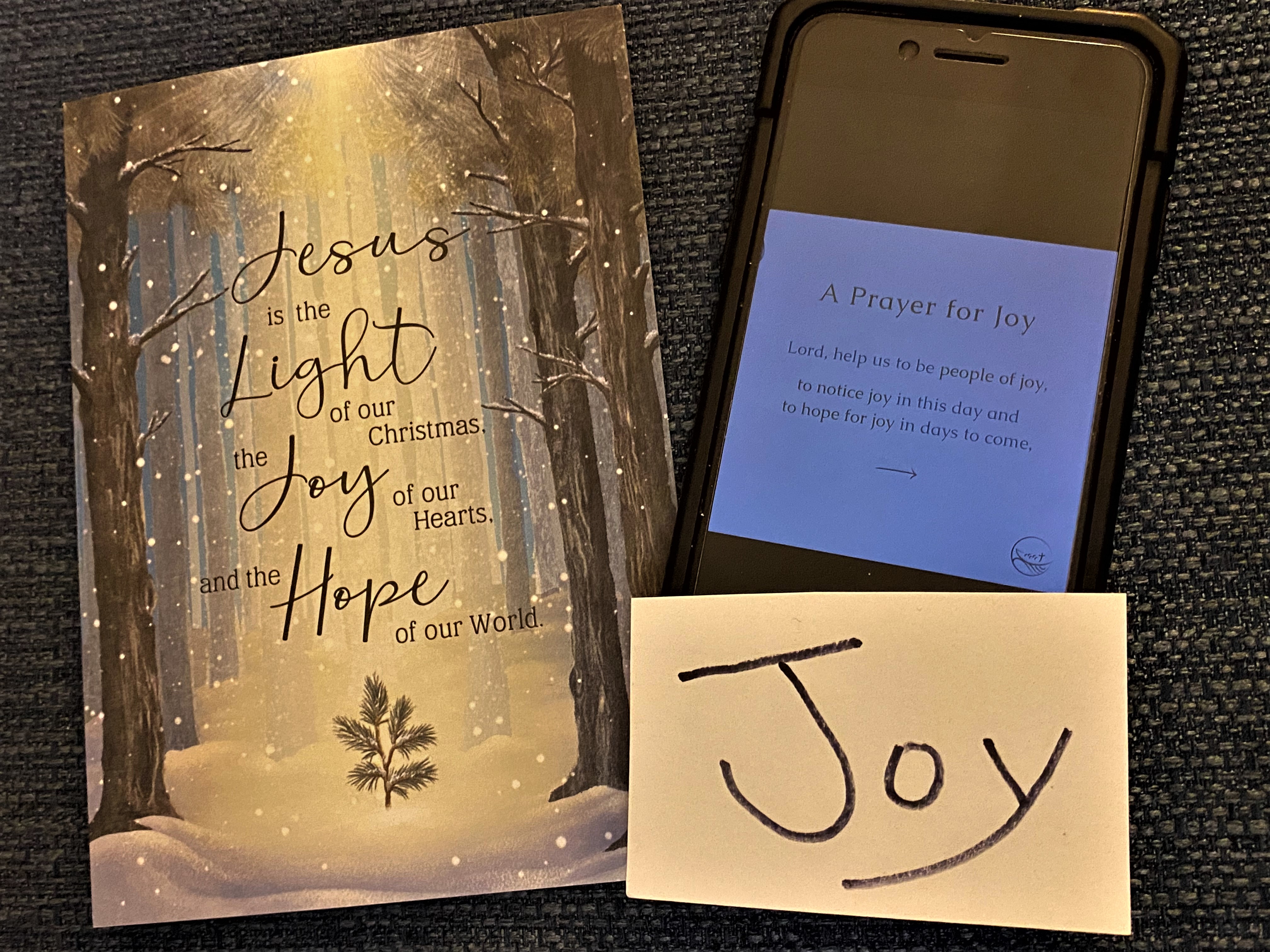
It dawned on me that I haven’t been “counting it all joy”. Or remembering that “the joy of the Lord is my strength”. Now my heart is resolved to be set on joy in 2022…no matter what.

Lord, help us to be people of joy,

to notice joy in this day and to hope for joy in days to come,

to look for light and share it with others this Advent season,

to see beauty in creation and the people we encounter,

to laugh heartily with childlike glee,

to feel true joy in your presence.     Amen.

Photo Credit: Prayer @inthecoracle, Instagram

5) The Last Days of 2021 – As may have been many of your experiences, we had people we know and love dealing with COVID in this last week of 2021. Still managed a sweet end-of-year. Hope yours was as well.


Now on to 2022!! Thanks for stopping by. It means a lot to me.

Bonuses:

Vimeo Video by Rodrigo Souza – Heart – with Nathan Mills, Beyond the Guitar

How to Stop All Procrastination: Dear You Trying to Do that Hard Thing in the New Year – Ann Voskamp (great piece on procrastination and perfectionism – both keeping us from presenting the gifts God’s given us)

Photo Credit: Samantha Reynolds, @Bentlily, Instagram (w/ permission)

52 Week Bible Reading Plan – Michael Coley

What is an Accessory Dwelling Unit (ADU) and Tips for Building One

Photo Credit: Facebook

Monday Morning Moment – Confessional Communities – What Are They? You’ll Wish You Were In One If You Aren’t Already

Photo Credit: Group Therapy Central

[As I was preparing my own take on confessional communities, I came across Aimee Byrd‘s piece on the same, as part of her analysis of Curt Thompson‘s latest book The Soul of Desire. Byrd’s blog is a quick read and very helpful.]

Confessional communities – probably sounds like some sort of monastery life. Or a group with all kinds of touchy-feely exercises framed by unintelligible psycho-babble, right? Oh no! So much more and so much better!

I’ve been awakened to the presence and possibilities of confessional communities since recently reading of the Thompson trilogy below.

What rung intuitively right for me throughout my adult life has actually been tested and found true in something called Interpersonal Neurobiology (IPNB). No time to go deeply into this now, but, in short, our brains are wired for connection, and that is connection inside the brain/mind itself as well as with others (and God).

Confessional communities are used by Dr. Curt Thompson and others as ways to help clients get in touch with shame, trauma, fear, anxiety, etc. in the company of others struggling with some of the same. Shame, for instance, drives us to isolate from God and others. It compounds interest over time, if left to itself in our own minds, and muffles our desires and longings, as it condemns and flattens us.

“We need to create confessional communities where people are confessing the truth about their life – some of which includes confessing sin or doing things that show my brokenness. Some of it is just things that have happened to me, or things that I feel; things that I sense; things that I dream; things that I long for; things that I’m conflicted about. But I’m trying to tell the whole truth about my life – but not so that anybody can just hear it and then move on.…In confession, what I’m really looking for – in your eyes, in your body language, in your voice – is for you to be able to say, “You’re right, Curt; you were wrong to do that. You’re forgiven. I’m not leaving.” I need to know you can bear the weight of what I know to be really wrong [with me], and that you will still stay. If it’s minimized, it will continue to linger with me…Shame always requires outside help for healing. My shame needs you. If it’s a small thing, I might need only one conversation with you. But, if it’s much bigger than a very, very small thing, I’m going to need multiple conversations with multiple people, because shame will come through multiple different doors into my head when I’m left by myself…”Curt Thompson

Photo Credit: Curt Thompson, Twitter

“…in order for me to be liberated from the shame I carry, …I need to hear that my behavior was really as bad as I think, if not worse, while simultaneously sensing that the person I am confessing to is not leaving. Shame has the effect of coaxing us into pretending that sin is not as bad as it seems; for if it really is that bad, and I have to face it, it would be too much and I fear I would be overwhelmed. When someone seeks forgiveness for the wrong they have committed, we who have been wounded must be able to acknowledge the reality of the pain inflicted if forgiveness is to be real, and if the offender’s shame is to be effectively healed.” – Curt Thompson, The Soul of Shame

Confessional communities are spelled out in Thompson’s writing, teaching (found on YouTube), and podcasts (his own and as guest on many others). The common factors include:

  • small group meetings over weeks or months.
  • willingness to tell our stories as truly as we can.
  • intentional leaning in to the stories of other group members such that “being known” is part of the outcome for all.
  • commitment to stay with each other; to “not leave the room”.
  • imagine beauty together – learning to explore and create beauty, to see what is good, true, and beautiful in each other’s personhoods.Photo Credit: Curt Thompson, Twitter

I have a friend who for several months was part of what I would now call a confessional community. She called it “Vegas”. Remember the adage “What happens in Vegas stays in Vegas”? It was a Bible study/house church. A group of people who committed to care for each other with masks off (not the COVID kind, but the masks we don in shame or fear). A group of people who would stay in the hard and love no matter what.

My Mom modeled this for our family. She died way too soon. My prayer is that our (birth) family will model it for each other, and my children will learn from their Dad and me how to love like this…To have the joy of being fully known and deeply loved. No matter what.

Trauma, Healing, and Side Effects with Dr. Curt Thompson – Jamie Ivey’s Podcast, The Happy Hour

Shining Light on Shame – Curt Thompson, Angulus Wilson, Steve Beers, and Morgan C. Feddes

Curt Thompson – 51 Podcast Episodes

5 Friday Faves – Shame Revisited, Classical Guitar & Squid Game, Cartoons & Classical Music, Left Brain/Right Brain, and Beach Food

Friday Faves! Go!

1) Shame Revisited – [Posted here previously] Author Andy Crouch has written an essay on how our culture has changed. For most of our history as a country, we have been a guilt-based culture. By that, I mean we measured ourselves and others as being “right or wrong” in our thinking, choosing to do right or wrong.

This is how we raised our children. We determined not to measure our children up against (compared with) other people, but to raise them up with a standard of right living and making right choices (for us, it was based on the Bible…on the teachings and life of Jesus). “Right” was not legalistic or moralistic; “right” was loving, kind, serving, non-judgmental.

Only in recent years has our culture been moving toward more of a shame-based view on life. Here the difference is how our character and behavior reflects on a larger community (“how others see us”). This is somewhat different from the traditional shame-honor culture. In that culture, honoring your family, country, religion was all-important. If your behavior did not comply with those values, you were shamed, even ostracized.Photo Credit: The Rise of Shame in America, Honor Shame

Today’s American culture has definitely moved away from a guilt orientation. We hear it all the time in statements like “Well, that may be OK for you.” “You have the right to believe that way.” “Don’t try to put that guilt on me.” However, our culture is not moving toward the traditional shame society, but more a shame-fame culture. Fame over honor. Social media has driven this in recent years. We want to be “seen” a certain way. In fact, a young colleague of ours once said, “It’s my job to make you look good.” I was shocked at that. One, “looking good” was not even on my radar. Either I was “good” (competent, responsible, dependable, etc) or I wasn’t. It demonstrated the culture shift and generational disconnect.

Shaming continues to happen in our culture. Children can be shamed for not behaving in ways that make their parents “look good”. Public shaming of people who don’t agree with each other can be as brutal as real ostracism. And so it goes.

I miss the guilt culture. Where, whatever your religion or political ideology, you could tell the good guys from the bad guys. Or maybe we were naive, but I hope not. Today, it seems all about how we portray ourselves…how we are received by those that matter to us.

Sigh…any thoughts? Please.

[Don’t forget to return and read Andy’s essay and David Brooks’ review of Crouch’s essay and this whole social phenomenon.]

__________________________________________________________________________

Postscript: I’m just today beginning to dig into Curt Thompson‘s book The Soul of Shame. So excited really to glean from his wisdom on the subject.

The Return of Shame – Andy Crouch

The Shame Culture – David Brooks

The Rise of Shame in America – HonorShame

When Shame Shapes Our Stories: Five Tips for Rewiring Negative Neural Pathways – Tricia McCary Rhodes

2) Classical Guitar & Squid Game – So whether you’re a fan of Korean cinema or creepy TV shows (insert Netflix’s popular Squid Game), you’re going to love the latest arrangement by Nathan Mills at Beyond the Guitar. It’s a medley of Squid Game themes, including the classic melody “Fly Me to the Moon”. So gorgeous.

3) Classical Music in Cartoons – Recently I was reading (again in Curt Thompson book – this time the recently published The Soul of Desire. He encouraged an intentional pursuit of beauty (a right brain renewing). He mentioned Dvorak’s 9th Symphony. I’m not a big fan of classical music, although every single time I attend a symphony performance, it slays me. So…I searched out thia particular piece on YouTube and clicked on this performance of the second movement of the symphony. Profoundly beautiful. Then…oddly familiar.

The first time I ever heard this symphony was on Saturday morning cartoons. In those days (late ’50s, early ’60s), cartoons had classical music as their soundtracks! In fact, this practice goes all the way back to the cartoons of the 1930s. Ingenious.

Cartoons and Classical Music – Bring Bach the Good Stuff – Nuriyah Johar

Classical Music in Cartoons

I’m learning later in life how the beauty of music, tucked in the background, can actually enrich what the eye sees on the many screens of our childhood and now that of our children’s children.

15 Pieces of Classical Music That Showed up in Looney Tunes – Mark Mancini [Some of the links are broken in the article but the information is preserved.]

YouTube Video – 10 Classical Music Pieces in Cartoons

YouTube Video – Most Iconic Classical Music Masterpieces Everyone Knows in One Single Video

4) Rain Brain/Left Brain I’ve written on the brain several times (as a learning layperson).

Again, thanks to Curt Thompson‘s recently published book The Soul of Desire, I’ve been learning about these two very different but inter-connected hemispheres in our brain. Thompson talks about how God made our brain for connection, but with trauma and shame, the two hemispheres become less integrated. Neural pathways are hijacked. [Talking very simply here because that’s about the level of my understanding.]

He delineates the two in many ways, but one that really spoke to me was how the right brain (the seat of our emotions and the space where we create and appreciate beauty) is very much focused on “here and with”. Being in the moment and preferably with others we care about. The left brain (our center for reasoning, analysis, and logic) favors more a “separate from” state. Standing back, evaluating, referring to the past and imagining the future.

Photo Credit: Janice Tarleton

Trauma and shame steal the easy flow of having fear and anxiety that is checked by rational reasoning. We can become stuck. Isolated from the healthy thinking we were made to have…and from each other. Thompson gives some excellent helps in his book on how to strengthen pathways between each side of the brain. Much of this is in community. Also upping our intentional appreciation of what is beautiful around us. Left brain activity is rewarded in our culture, to the detriment of right brain activity. We need both…and the beauty and community that comes with such integration.

Want to Sync the 2 Hemispheres of Your Brain? Neuroscience Says to Do This Daily (It Only Takes 4 Minutes) – Melanie Curtin

I Met Jesus in My Right Brain – Janice Tarleton

Photo Credit: Custom Writing

5) Beach Food– A long weekend in Virginia Beach this past week was lovely. Much-needed. Rain and a gusty wind kept us from as much walking as we would have liked, but it did not deter us from eating from favorite restaurants. Every year, we change that list up a bit. 19th Street Italian Bistro has been our #1 go-to restaurant every year and it is not budging from that position of honor.

Two new favorites for the year are (in the #2 spot for beach favorites) C. P. Shucker’s Cafe & Raw Bar

and (#3) Ray Ray’s at the Mayflower.

[Chef Ray is Filipino and adds all sorts of yummy island touches to the menu.]

And dessert? Always Dairy Queen Butterfinger Blizzard.

You don’t want to miss these if Virginia Beach is your destination.

How about you? What is your favorite beach food restaurant? Tell us in the Comments.

___________________________________________________________________________

That’s it for this week. Hope you’re able to get some time with those you love in the days ahead. Never take time together for granted. Life is such a gift. Thanks for stopping by. It means a lot.

5 Friday Faves – Beyond the Guitar, Senses and Memories, Parenting Well, Fishing Perks, and Attention Alcohol

Late again. That kind of week. Here’s the rapid but not to miss runthrough.

1) Beyond the Guitar – If you love Star Wars, you will love Nathan‘s interpretation of John WilliamsAcross the Stars. Actually…whether you love Star Wars or not, this is achingly beautiful.

Then there is his piece later this week, posting his arrangement of the theme of Genshin Impact video game. This was actually sponsored by the game creators. I am sure they are pleased. Another really gorgeous treatment.

2) Senses and Memories – One of the appealing features of Nathan’s music is the nostalgia attached to much of it. It takes us back. To a scene from a movie, a TV show we shared with family, a video game of one’s childhood. Sound is powerfully attached to memory. We have all had those experiences or have read/watched the positive impact of beloved music on critically ill patients, or those suffering with brain injury or Alzheimer’s. Memory is stirred.

Where we live right now, we can hear the sound of planes, trains, and interstate traffic. The sound is just in the background but it is oftentimes powerful. Looking up at a commercial jet going over takes me back to being new in Cairo, Egypt, walking toward a taxi stand. I wondered at the destination of the flight and in my stress as a newbie to to language and culture, that sound (and sight) comforted me somehow.

The sound of a train takes me all the way back to Sfax, Tunisia, when we lived by a train track. The train whistles marked time for us through the day.Photo Credit: Pixabay

Farther still, the sound of a train took me back to childhood, as we waited for it to pass, and looking between the cars to my friend Evelyn’s house. Her family was only there briefly, but I loved her. She was from a different era. Wore hand-me-down dresses to middle school every day. Old everything. Poor. Stretched by poverty, but she was elegant and full of dignity. Their large, spooky old house peeked between the passing train cars, and I wondered at their lives inside that house. They were gone too soon…but the memory of her remains…with the sound of trains.

We know when Fall is here, because all of a sudden, it is all things pumpkin spice. Flavored coffee, pies, and decor – all pumpkiny.Photo Credit: Pexels – Valeriia Miller

What the Nose Knows – Colleen Walsh

Brain’s Link Between Sounds, Smells and Memory Revealed – Rachael Rettner

Music and Memory – Why the Music We Love as Teens Stays with Us for Life – Catherine Loveday

Comment below what are some of your favorite sensory memories.

3) Parenting Well – Our grandchildren (six years old and younger) have big emotions. Then they act on those big emotions. Whining, crying, hitting, screaming. This is not who these precious children are, but they are trying to communicate what is going on deep inside. How we respond to them – as parents and other significant (to them) adults – is huge!

Emotions relate to desire. This topic hit me hard when I saw the poem below on a friend’s Facebook page.

Our responses to our children (in normal developmental situations as well as in distressed situations) communicate far more than we think. We have recurring opportunities to connect with our children in ways that help them grow into emotionally healthy and relationally mature adults.

Lately I’ve been learning more about this whole parenting thing from two brilliant psychiatrists Dr. Dan Siegel and Dr. Curt Thompson.

Dr. Thompson has written a trilogy of powerful, ground-breaking books – Anatomy of the Soul, The Soul of Shame, and The Soul of Desire.  He describes these books as exploring “how neuroscience relates to the ways we experience relationships, deep emotions like shame and joy and especially our own stories — and how we can process our longings and desire for spiritual connection with God and each other to live more fully integrated, connected lives.”

[I highly recommend the above books, and not just for parents.]

Thompson refers often to Dr. Siegel’s “4 S’s of Attachment-Based Parenting“. Those S’s relate to what we communicate to our children even as infants but throughout life. We want them to know they are “safe and seen” and to experience being “soothed and secure”. This is especially poignant when we introduce the word “No” into the great adventure of their lives. No…and discipline as they get bigger.

I’ll be writing about this more in the days ahead. For now, check out the “refrigerator sheet” below with Siegel’s 4 S’s, referencing his book The Power of Showing Up.

Photo Credit: Dr. Dan Siegel & Dr. Tina Payne Bryson

The 4 S’s of Attachment-Based Parenting – Daniel J. Siegel – Podcast

The Power of Showing Up – Daniel J. Siegel, MD & Tina Payne Bryson, PhD

Mindful Parenting: 4 S’s of Secure Attachment – Esther Goldstein

4) Fishing Perks – My sweet husband is a fisherman. He is a “catch-and-release” guy, fishing the rivers and lakes of Virginia. This joy started for him as a boy fishing with his dad. Then it grew during our years in Tennessee. Finally now, after years of living in North African cities, just on the edge of the Sahara. There are so many perks to this avocation. Some of which really came to mind on a recent adventure. [I realize this is a “duh” for many, but for me, it was a great revelation.]

  • The Buildup – The day of fishing is preceded by all the planning and preparation. Weather checks, getting the equipment ready, fueling the boat, provisioning for the day. It makes for a happy evening of anticipation…and to bed early.
  • The Thrill of the Hunt – or Thrill of the Catch – You hope not to get skunked, but the marking and revisiting sites where fish were caught once before, the thrill of the pull on the line, and finally the fish pulled into the boat. Fun stuff!

  • Solitude – the single chair on this old dock says it all. The quiet of being on the water in the woods. So refreshing. So invigorating.

  • Beauty – Everywhere you look. Water, trees, wildlife. Sun and cloud playing on the water. Changing colors as the hours pass.

  • Company [I’m glad Dave has fishing buddies who share the experience with him. I fish rarely but always gain from the time with him, in nature.]

5) Attention Alcohol –  Author attorneyJustin Whitmel Earley pointed to an article by journalist Derek Thompson‘s article on social media and its use like that of alcohol.

Photo Credit: Rachel Claire, Pexels

Earley gives these reasons below for considering limiting or taking sabbath fasts from social media:

THREE REASONS SOCIAL MEDIA IS LIKE ALCOHOL:

  • It is Addictive. This means you are not as in control as you think you are. Remember, there are 1,000 people on the other side of this screen paid inordinate amounts of money to get you to keep scrolling.
  • It Changes Your Mental Health. This means it is not neutral. Your interactions with yourself, your family, and your friends are changed because of what you do with social media. You must recognize that to use it appropriately.
  • Someone Needs to Teach You How to Use It. This is one of the hardest things about our cultural moment. Because this technology is so new, none of us had parents to teach us how to use it, set boundaries, and practice moderation. But that doesn’t mean we can’t start to learn now, teach our kids, and help our friends. 

Social Media and Alcohol – Justin Whitmel Earley

Social Media Is Attention Alcohol – Derek Thompson

That’s the 5 for this week. How about you? Please enrich my life and that of other readers with your favorite finds. Comment below. Thanks always for stopping by.

Bonuses:

Quote of the Week: “Beauty is…that which draws our attention with wonder and welcome and that ultimately leads us to worship – not worship of the object itself but worship of God in gratitude, humility, and joy.”Curt Thompson, The Soul of Desire

The “10 Things” Rule Keeps My House Uncluttered, Even with a Family of Six – Alexandra Frost – We actually had the 20 Things rule in our family once the kids were big enough to count to 10. It helped!

YouTube Video – Dr. Curt Thompson – Shame: The Details of Devouring

YouTube Video: Curt Thompson: Vulnerability Reframed: Healing Shame & Promoting Human Flourishing

Photo Credit: Ian Kremer, Twitter

How the Brain Stays Young Even as We Age – Katherine Ellen Foley

My Boyfriend Is Spiritually Lethargic. Should I Marry Him? – John Piper

87-year-old Man Rewrites News Headlines for 2020 and Inspires Us All

Biscuit Lover – Sean Dietrich

100 Skills Every Man Should Know – The Art of Manliness [Some are also excellent skills for us women as well. Not so ambitious about most of them, but glad I know men and women who do.]

Beauty is the extravagance that makes us human

Worship Wednesday – I Need Thee Every Hour – Fernando Ortega

Photo Credit: Heartlight, Phil Ware

Then God said, “Let Us make man in Our image, after Our likeness, to rule over the fish of the sea and the birds of the air, over the livestock, and over all the earth itself and every creature that crawls upon it.” So God created man in His own image; in the image of God He created him; male and female He created them. God blessed them and said to them, “Be fruitful and multiply, and fill the earth and subdue it…”Genesis 1:26-28

Jesus explained, “My food is to do the will of Him who sent Me and to finish His work.”  – John 4:34

Jesus said, “Father, forgive them, because they do not know what they are doing.”Luke 23:34

We are needy people…by design.

Years ago, husband Dave and I led a Singles Sunday School class. These young people were top of the heap – well-educated, gifted, socially astute, emotionally intelligent, independent, and committed Christians. Yet, no matter the Scripture being studied that day, Dave always managed to insert two concepts:

  • We are all worms.
  • Obedience is always where we want to land.

I was like (on the first point) “Dude! What about we are fearfully and wonderfully made“?! [Psalm 139:14] [Years down the road, “dude” and “worm” would remind me of this exclamation as “worm” in Arabic is “dooda”. Sorry for the rabbit trail.]

As for the second point – the “O” word…no right or reasonable objection there. Period. Full stop.

Being Needy Is Not a Fault – It Is a Design – Christine Chappell

Yesterday I came across an Instagram story with Jackie Hill Perry talking about our inadequacy and deep need for God. If you know Instagram stories, they seem to last a minute. I wanted to hear it again, but couldn’t. So I’ve been thinking about it and praying since about it. We all have head knowledge about our dependence on God, our need for Him…it just doesn’t always settle into our hearts.

We (ok…is it just me?) go through too much of life with Paul’s affirmation that we have everything we need for “life and godliness” without remembering the context – dependence on His power and through knowing Him, in His glory and because of His goodness. [See verse below.]

His divine power has given us everything required for life and godliness through the knowledge of him who called us by his own glory and goodness.  2 Peter 1:3

Wow! That right there.

Our days are busy and fraught with care (different depending on each of our situations, but its there…and draws our focus). God does  expect us to show up for work, for our families, for the church, for our communities…That is necessary…but not sufficient.

“Necessary but not sufficient”

“What we do is necessary but not sufficient. We are fearfully and wonderfully made and have substantial creative capacity and we can do a lot of neat things. God expects us to use our abilities, giftings, and capacities, and to work at it as hard as we can. However, all those things fall flat apart from our dependence on God – if He doesn’t breathe His life into our efforts and make them accomplish His purposes. Our work is necessary but not sufficient. He is sufficient.” – Dave Mills

We go to God each day for those things outside our power (cancer, COVID, conflict), but we forge ahead on what we think we can accomplish on our own (including growing our own character and that of our children). What then do we miss, in treating prayer and time in His Word as a sprinkling on our day? A seasoning rather than the meat. [See again John 4:34 above.] We miss God.

We miss God in working out our budgets, in counseling with a friend in crisis, in trips to the grocery store or playground, in studying for an exam. We miss His infusion of His own character, His own wisdom, His own wonder. We wear ourselves out walking in the flesh with just a touch of Him, even though we are indwelt by the very Spirit of God.

Whose image do we take into the public square? His or our own frail self? Preaching to the choir of one here (unless you are singing along with me).

Jesus taught us by His example that He revered the Word of God, and lived in obedience to It, and basked in the Father’s presence, and understood how being human can distract from the greatest reality in our lives – a holy yet approachable God. Even from the Cross, in His greatest need, He prayed for those who participated in the unspeakable. They didn’t know, He said (Luke 23:34).

We know.

“My grace is sufficient for you, for power is made perfect in weakness.” So I will boast all the more gladly of my weaknesses [of my imperfections], so that the power of Christ may dwell in me. For when I am weak, then I am strong.” – 2 Corinthians 12:9-10 

“You see, our power as Christians is not in our strength, our own performance, or our own striving towards perfection. Our power comes when we can admit our vulnerability, our weakness, our neediness, and our dependence on the Lord. It was when Paul accepted his weaknesses and his imperfections that he discovered how strong he was in God.  

It’s when we are at our wits end that we discover that His ways are higher than our ways. It’s when we can’t do something that we discover He can. It’s when we realize the power is not in us that we find our strength in Him. Our imperfection is the pathway to the grace of God. It’s in that connection that we find His grace is indeed sufficient, even in spite of our weaknesses. –  Delman Coates

God chose what is foolish in the world to shame the wise; God chose what is weak in the world to shame the strong; God chose what is low and despised in the world, even things that are not, to bring to nothing things that are, so that no human being might boast in the presence of God.  –     1 Corinthians 1:27–29

If you feel your neediness on a regular basis, know that you are in good company. All of us are needy, all of the time—we’re just too busy being “independent” to realize it.  We easily forget that neediness is inherent. Take a high-level view of the concept by starting with our neediness in the sight of God. Think back to the garden of Eden and all that Adam required from the Lord to live. Everything Adam had, he was given. Everything he possessed—even his very body and breath—came from God (Genesis 2:7). This truth hasn’t changed since the fall.

Think about it: what do you have at this moment that God did not give to you? …There’s no kidding ourselves: we are utterly dependent upon Someone else for all the things, all the time.

Man’s reliance upon God is a healthy relational construct, not an annoying character flaw. Our neediness is forged out of God’s good design (Genesis 1:31) and is meant to foster fellowship, faithfulness, and fruitfulness. In that sense, dependence upon God and interdependence upon each other is a blessed design meant for our good and God’s glory.Christine M. Chappell

Photo Credit: Heartlight

Be encouraged as I am (after hearing Jackie Hill Perry’s brief story). How different our lives are when we see God as He truly is and see ourselves in proper relationship to Him and each other (my definition of humility, actually). Our lives are small really, no matter how cool, independent or self-sufficient we think we are. How much more beautiful to receive that smallness as a gift in our lives as we walk in the fullness as His increase (in our decrease) (John 3:29-30).

Praying without ceasing (1 Thessalonians 5:16-18) is cause for rejoicing and gratefulness. I want more of this…more of Him. AND our children and grandchildren need to know they don’t have to grow up so grand and gifted…they can grow up knowing Him in all His power and glory and goodness!

Worship with me to this wonderful old hymn by Annie Hawks. OR if your heart would prefer a newer version then sing with Matt Maher’s Lord, I Need You.

I need Thee every hour, most gracious Lord;
No tender voice like Thine can peace afford.

Refrain:
I need Thee, oh, I need Thee;
Every hour I need Thee;
Oh, bless me now, my Savior,
I come to Thee.

I need Thee every hour, stay Thou nearby;
Temptations lose their pow’r when Thou art nigh.

I need Thee every hour, in joy or pain;
Come quickly and abide, or life is vain.

Oh, bless me now, my Savior,
I come to Thee.

[If you prefer the newer pink and blue background, live version of Lord, I Need You, with lyrics, here it is.]

Worship Wednesday – Deep Disappointment – Lord, I Need You – with Matt Maher & Audrey Assad – Deb Mills

YouTube Video – I Need Thee Every Hour – Anthem Lights

Needy People, Mighty God – Steven J. Cole

I Need You Every Hour – Tom Norville

Photo Credit: Heartlight