[Blog first posted on Ash Wednesday, the beginning of Lent 2023 – as we look toward the Cross of Christ.]
God demonstrates His own love toward us, in that while we were still sinners, Christ died for us. – Romans 5:8
Let this mind be in you which was also in Christ Jesus: Who, existing in the form of God, did not consider equality with God something to be grasped, but emptied Himself, taking the form of a servant, being made in human likeness. And being found in appearance as a man, He humbled Himself and became obedient to death—even death on a cross. – Philippians 2:6-8
Hold with me while we work through the concept of scandal involving grace. We usually think of scandal as a negative, to-be-avoided word, but the first definition that popped up is this:
“A publicized incident that brings about disgrace or offends the moral sensibilities of society”
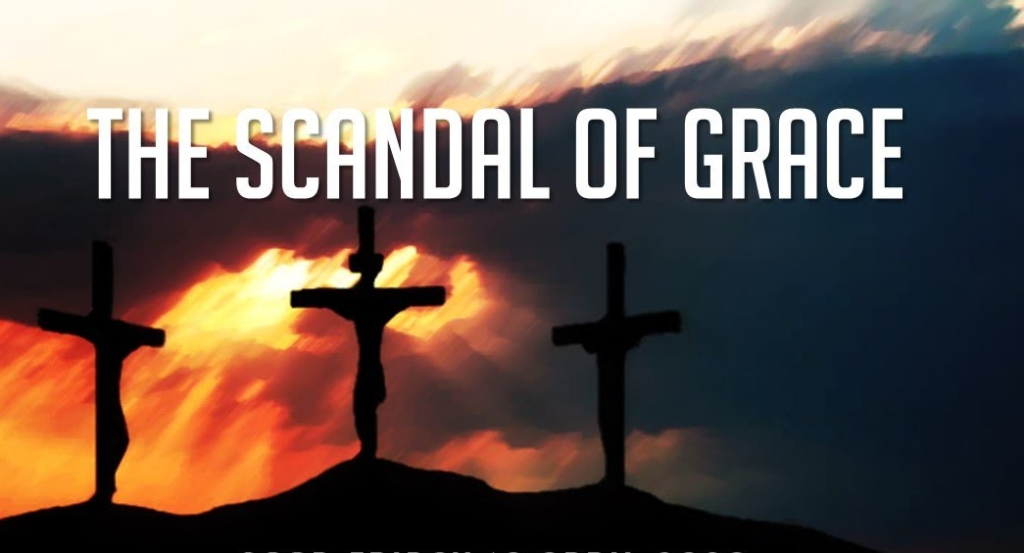
Not long ago, I heard the song Scandal of Grace for the first time. The lyrics are striking and so moving. As defined above, what Jesus did for us on the day of his crucifixion was scandalous. He suffered false testimony, public humiliation, torturous treatment, the unimaginable weight of our sin on himself, and the horrific aloneness as God the Father seemed to turn His face away…even for a moment.
Ash Wednesday begins the season of Lent, counting down to Easter, the day we celebrate the resurrection of Christ. Whether or not we commemorate Ash Wednesday, it is a good day to marvel at the Savior we have in Jesus, and the scandalous grace He showed to us on the cross.
John Piper describes (in 2 1/2 minutes) this history-shaking act of God – this death of a sinless Savior for us hopeless sinners. Take the time to watch this and wonder with me at the extravagant love of God.
Grace, what have You done? Murdered* for me on that cross Accused in absence of wrong My sin washed away in Your blood
*[Only word I struggle with in this song. Jesus gave His life; it was not taken from Him…What seemed like murder was a shocking, wholly loving, definitive, complete and merciful work of God.]
Too much to make sense of it all I know that Your love breaks my fall The scandal of grace, You died in my place So my soul will live
Oh to be like You Give all I have just to know You Jesus, there’s no one besides You Forever the hope in my heart
Death, where is your sting? Your power is as dead as my sin The cross has taught me to live And mercy, my heart now to sing
The day and its trouble shall come I know that Your strength is enough The scandal of grace, You died in my place So my soul will live
Oh to be like You Give all I have just to know You Jesus, there’s no one besides You Forever the hope in my heart
Oh to be like You Give all I have just to know You Jesus, there’s no one besides You Forever the hope in my heart
And it’s all because of You, Jesus It’s all because of You, Jesus It’s all because of Your love that my soul will live
Oh to be like You Give all I have just to know You Jesus, there’s no one besides You Forever the hope in my heart
Oh to be like You Give all I have just to know You Jesus, there’s no one besides You Forever the hope in my heart*
You will keep him in perfect peace, Whose mind is stayed on You, Because he trusts in You. – Isaiah 26:3
“Trust in the LORD with all your heart, and lean not on your own understanding; in all your ways acknowledge Him, and He will make your paths straight.” – Proverbs 3:5-6
Be anxious about nothing, but in everything, by prayer and supplication with thanksgiving, let your requests be made known to God.And the peace of God, which surpasses all understanding, will guard your hearts and your minds in Christ Jesus. – Philippians 4:6-7
My word for 2025 is trust. It was a curious choice for me – Holy Spirit inspired – because I rarely use that word. However, just in the last few weeks, I’ve been diving into its meaning to the believer. Author, speaker Brennan Manning, in his book Ruthless Trust: The Ragamuffin’s Path to God has helped me understand it better.
Mid-way through the book, he proposes a single equation:
Faith + Hope = Trust.
Faith and trust are words often used interchangeably. How I see them now is this: Faith focuses on God’s character, His promises, and His power. We have faith in Him because of what He says about Himself and how we have seen Him act in history and in the lives of those around us and in our very own lives. Faith believes “He can.” Hope focuses on what’s coming in the future and how God, based on our faith and experience already, He will act. Hope is positive because we have experienced the movement of God as positive. Then trust relates to the relationship between God and me. I have faith He can do something; I have hope that He is going to do something (good), and I trust, because of His love, He will do that good thing for me. Our trust does extend to others, believing that God’s love and goodness includes others. However, trust is deeply personal and experiential. As we grow in trust, we grow in our understanding of His love. Out of that comes deep gratitude…even in our darkest of times.
The reality of naked trust is the life of the pilgrim who leaves what is nailed down, obvious, and secure, and walks into the unknown without any rational explanation to justify the decision or guarantee the future. Why? Because God has signaled the movement and offered it his presence and his promise.” ― Brennan Manning, Ruthless Trust: The Ragamuffin’s Path to God
“We are only grateful people when we can say thank you to all that has brought us to the present moment. As long as we keep dividing our lives between events and people we would like to remember and those we would rather forget, we cannot claim the fullness of our beings as a gift of God to be grateful for. Let’s not be afraid to look at everything that has brought us to where we are now and trust that we will soon see in it the guiding hand of a loving God.” ― Brennan Manning, Ruthless Trust: The Ragamuffin’s Path to God
Why is Brennan Manning lovable in the eyes of God? Because on February 8th of 1956, in a shattering, life-changing experience, I committed my life to Jesus. Does God love me because ever since I was ordained a priest in 1963, I roamed the country and lately all over the world proclaiming the Good News of the gospel of grace? Does God love me because I tithe to the poor? Does he love me because back in New Orleans I work on skid row with alcoholics, addicts, and those who suffer with AIDS? Does God love me because I spend two hours every day in prayer? If I believe that stuff I’m a Pharisee! Then I feel I’m entitled to be comfortably close to Christ because of my good works. The gospel of grace says, “Brennan, you’re lovable for one reason only—because God loves you. Period.” – Brennan Manning
[Some of my favorite books – Manning’s most famous book The Ragamuffin Gospel is loaned out.]
[The video below is 3:42 minutes of Brennan Manning’s understanding of God and His love for us. Powerful.]
Worship with me to Twila Paris‘ “Do I Trust You, Lord?”. This song came out in 1994. I remember many times sitting at the piano singing that song, with tears streaming down my cheeks…feeling His presence even in the grief of those moments…trusting Him.
Sometimes my little heart can’t understand What’s in Your will, what’s in Your plan So many times I’m tempted to ask You why But I can never forget it for long Lord, what You do could not be wrong So I believe You, even when I must cry
Chorus: Do I trust You, Lord? Does the river flow? Do I trust You, Lord? Does the north wind blow? You can see my heart You can read my mind And You got to know That I would rather die Than to lose my faith In the One I love Do I trust You, Lord? Do I trust You?
I know the answers, I’ve given them all But suddenly now, I feel so small Shaken down to the cavity in my soul I know the doctrine and theology But right now they don’t mean much to me This time there’s only one thing I’ve got to know
Chorus: Do I trust You, Lord? Does the robin sing? Do I trust You, Lord? Does it rain in spring? You can see my heart You can read my mind And You got to know That I would rather die Than to lose my faith In the One I love Do I trust You, Lord? Do I trust You?
I will trust You, Lord, when I don’t know why I will trust You, Lord, till the day I die I will trust You, Lord, when I’m blind with pain! You were God before, and You’ll never change I will trust You I will trust You I will trust You, Lord I will trust You*
Our dear brother Brennan Manning had many dark periods in his life – depression, alcoholism, terrible self-doubt. If you have read any of his books, you will see the beauty of his struggle. God was there with him in the dark. Manning wrote brilliantly and experientially about the love of God, His character and transcendence, and the persevering nature of the Trinity drawing him to Himself…through it all. Another Twila Paris song which I also sang in times of weakness and doubt reminds me of him – “The Warrior Is a Child”. Take time to play it in memory of our brother (died in 2013) and in honor of the God who sees us wherever we are and stays with us in His incomprehensible love.
Too much of life and culture these days is polarizing. It may have always been so. Good guys and bad guys. Heroes and villains. Liberals and conservatives. Secular and religious. The list goes on forever.
When I woke this morning, many of these ideas and conflicts were bouncing around in my brain. Then the idea came to mind: “Not Us and Them, but We.” What can grow our capacity for civil discourse? How can we nurture curiosity in our thinking, especially in communication with those who have very different ideas than we might have? What moves us toward understanding rather than acting on the motivation to move “them” to think like “us”?
Often in the last several weeks, in particular, conversations either center on politics, or it’s “the elephant in the room”. Fortunately I have friends who differ from me in some of our political views but they seek to understand, which gives me the same potential for my understanding their views.
Organizational psychologist and author, Adam Grant, often points to the distractions that keep us divided or on edge with each other. He gives wise counsel.
I also have friends who have pretty much ghosted me over the same views. Conversation is just too emotionally charged. Too anxiety-provoking. I respect that, but I also miss the possibility of learning from them and dialoging together such that both of us can see things from a higher vantage point.
Writer, leadership coach Scott Sauls posted an article just this weekend that resonates with this very current issue. Without really focusing on politics, he expands the idea of differences to incorporate our stances on all of life…and on people with whom we have conflict. In fact, he points to three identities we may have for ourselves and others, and how those identities keep us divided against each other. Below are quotes from this article – click on the link to read all the wisdom found there. Still a quick read.
“Family, work, team, tribe, church, community, and nation—every sphere of life has its culture, and in each one, we assign roles. We naturally place people or groups into the categories of victim, villain, or hero to suit our own biases. Sometimes, one person or group is cast in all three roles, as we seek to simplify complex situations and deflect blame away from ourselves.”
“In almost every conflict, we instinctively conclude that someone is hurt, someone is to blame, and someone must intervene to make things right. These roles are common in the stories we read, the movies we watch, the news we consume, and the communities we are part of. But victim, villain, and hero are also the roles we quietly assign to ourselves and others as we navigate difficult relationships and painful experiences.”
“The Peril of Playing the Victim – When we assume the role of victim as our primary identity, we risk trapping ourselves in a story of bitterness and self-pity. We replay the wrongs done to us over and over, feeding a narrative that makes the presumed offender larger than life and ourselves perpetually powerless. Over time, the victim mindset tempts us to believe that others are responsible for our misery and that our healing depends almost entirely on their repentance or punishment.”
“The Peril of Casting Others as Villains – If playing the victim is one danger, the second is casting others as villains. When someone wrongs us, it is easy to reduce them to their very worst moment or season, and to nothing more than the sum of their sins. They are no longer a whole person with complexities, struggles, and good qualities—they are simply “the one who hurt me.” We judge them harshly, as though their worst moment defines their entire character, while conveniently minimizing our own flaws…The labels we assign—especially when shaped by our pain—often obscure the truth.”
“The Peril of Seeing Ourselves or Others as Heroes – Another dangerous role to assume is that of the hero. Heroes see life in black and white—good versus bad, victims versus villains—and position themselves as the ones who can fix it all. Sometimes, this looks like trying to rescue others from pain, taking on burdens that aren’t ours. Other times, it looks like moral superiority: we believe we’re the righteous ones who would never behave like “those people,” and our role is to rescue others from “them.” Still other times, people want to step in as heroes to protect themselves from the wrath of “victims” who are known for punishing and persecuting those who refuse to rescue them from their “villains.””
Sauls ends his post with the Gospel of Jesus Christ being the better story:
“The gospel dismantles the victim, villain, and hero roles by telling a different story—one where Jesus is the only one who can truly make things right. It teaches us that:
If we are in fact victims, we are seen, loved, and cared for by a God who is near to the brokenhearted (Psalm 34:18). But our healing is not dependent on human justice; it is rooted in the grace of God, who works all things together for good (Romans 8:28).
As those who have been wronged, we must forgive as we have been forgiven (Ephesians 4:32). Forgiveness does not deny the reality of harm, and it does not grant trust where trust has not been reestablished through repentance, reconciliation, and sincere efforts to repair, but it releases us from the burden of bitterness and entrusts justice to God.
As those tempted to self-righteousness and pride, we are reminded that we, too, have sinned and that our salvation is a gift, not a reward (Romans 3:24). Paul’s rhetorical question and subsequent answer—“Are we any better? Absolutely not” (Romans 6:15)!—become relevant for us, as well.
When we let go of the victim, villain, and hero mindsets, we step into a life shaped by humility, grace, and reconciliation. Humility reminds us that we are all broken and in need of mercy. Grace empowers us to forgive others as we have been forgiven. And reconciliation—where possible—invites us to repair what is broken and pursue peace.” – Scott Sauls
Where do you see yourself in these scenarios? Do we view ourselves as the hero, fighting for others? Or are we the victim and see another (person or party) as the villain?
Thoughtful disagreement doesn’t start with “You’re wrong!” It begins with “I’d love to understand your thinking better.” Attacking conclusions closes minds. Asking about reasoning opens them. Good debates don’t have winners or losers. They leave everyone more informed. – Adam Grant, X
My husband often puts one of his favorite adages – “We are better than me.” – in work conversations, especially those related to drifting into silo thinking. So much better than where we often find ourselves, if we’re not intentional, which is an “us and them” mentalities. Unfortunately, the “us” is too often deemed better than “them”. Whenever we can, let’s work toward getting “the us’s” to talk to “the them’s” with the goal of becoming “a we”. I know this might seem less complicated in a work situation when an employer mandates this sort of action. However, it is also possible in families, friend groups, and communities which have become fractured because of a rift or rupture. We can be hopeful if we’re willing to be humble, forgiving, curious, and full of grace. God will definitely grease the tracks in that direction.
“Seeing every interaction as win-lose isn’t smart. It’s shortsighted. Evidence: People who view others’ gains as their loss see potential allies as hostile and miss out on productive collaborations. In the long run, the best path to success and happiness is striving for win-win.” – Adam Grant, X
Following is a brief history of how choosing and exploring a word for the year became a habit for me starting in 2020. If you want, just skip down to the highlighted start of 2025 that takes you to this year.
In 2020 (the year of COVID), I read Debbie Macomber‘s book One Perfect Word. She tells fascinating stories of persons’ choosing a word to guide their year. Finishing her book and praying a bit, the word compassion became my focus. 2021 was a good year for that as we dealt with so many divisions over COVID, race, politics, etc. Compassion for all on both sides of each issue.
At first I wasn’t going to do “a word” for 2022, and then a rapid series of “coincidences” drew me to the word: joy. As that year ended, I had become negative and even a bit cynical. Still having faith in God but not so much in humans, including myself. Even after a year of compassion!!
Then 2023 followed, and I chose the word “wonder”. It was inspired by my study of Dr. Curt Thompson’s books. He encourages a pursuit of mental health and healing including staying “in the path of oncoming beauty”. This focus on wonder – in searching out beauty in the context of community and a loving God – brought me through a year tougher than I imagined it would be.
Then at the end of 2023, I’d been lamenting being older (i.e. weaker, more frail). Having lost 2 inches in stature (just in the years of pounding on my vertebra) also made me feel small. I’ve decided to push back against the weakness and seemingly diminished nature of getting older. After all, what does that even mean?! I’m not that old. Right?
In Joshua 14, Caleb was 85 years old. He gives a beautiful and faith-filled declaration: “I am still as strong today as I was on the day Moses sent me; as my strength was then, so my strength is now, for war and for going out and coming in. Now then, give me this hill country about which the Lord spoke on that day, for you heard on that day that Anakim (giants) were there, with great fortified cities; perhaps the Lord will be with me, and I will drive them out just as the Lord has spoken.” [Joshua 14:11-12.]
Talking to Dave (that husband of mine), he commented that Caleb had that strength for which I was longing because he had “a different spirit in him” (Numbers 14:24). Whereas the 10 spies and the Israelites influenced by them were driven by a spirit of fear, Caleb was filled by the Spirit of God. In his determination to obey and follow wholeheartedly, his faith emboldened him. He demonstrated strength physically, mentally, and spiritually.
He would not be defined by age, aptitude, or ability…but by the great and gracious God he sought to serve. That’s what I have longed for in this year soon to be ending. To be strong. In all ways possible. Including strong in my love for God and others. This can only be mine if nested in being filled with the very Spirit of God.
Ironically, or not so much with the Lord, I have struggled with even more physical weakness (a painful and limiting hip pain) but not without working toward being strong again. Months ago, in choosing “strong” as the word for this year, God knew. In this season still, I am reminded of His goodness. “For when I am weak (and it will happen), then His strength is manifested perfectly and completely!” (2 Corinthians 12:10)
These last days of December 2024, I have pondered what word would be a fixed point for this coming year. New Year’s resolutions and habit formation are both great helps for my slightly scattered brain. This Word of the Year exercise (which will span the next year) has also been a tremendous help.
The word “trust” has come to mind, in my times in the Word, in recent conversations, and in circumstances beyond my control. “Trust” – whew! That word has always been troubling for me. I think we put too much importance on trusting people – we will all disappoint and fail each other. It happens. Will I put that same bias on God, or can I treat Him as He is and as the Trustworthy One He reveals Himself to be?
Trust – Why Trust matters – Psychology Today – Trusting others and being trustworthy matter, but human trust is flawed and has to be handled with some measure of understanding and grace.
The object of our trust can’t be on people but on God. He alone will not disappoint. He alone will always keep His promises.
Praying to trust God more seems to carry the same human-borne threat of praying for patience. Yikes! We want more patience but not the sorts of experiences that will bring it. Is God drawing me to focus on trust in 2025 because I’m going to need it more? No…refusing to think there would be any negative outcome with trusting God more. It is a beautiful thing and He is worthy.
Just yesterday Dave and I talked about trust and what it means. He defined it as having confidence that someone (including God, of course) will be who he/she says they are and will do what they say they will do. Again, as humans, we don’t always prove to be trust-worthy…and we apply grace, not unforgiveness. But God!!! We can have complete confidence in Him. Complete trust.
“The biblical definition of trust goes beyond mere belief or reliance. It involves a complete surrender and reliance on God, knowing that He is faithful and will fulfill His promises. Trust, according to biblical definition, is the means of putting aside our own understanding and leaning on God’s wisdom and guidance. It means acknowledging that God’s ways are higher than our ways and trusting that He is in control of all things. Trust requires us to have faith, to believe in the unseen and to confidently depend on God’s faithfulness. It is an unwavering assurance that God is trustworthy and will never fail us. This biblical concept of trust is not just a casual belief, but an active and intentional decision to place our confidence in God alone.” – Daniel, Prayer Warrior – Bible Definition Of Trust (How The Lord Defines Trusting Him)– Read the whole article!
I am going to turn my heart toward trusting God in 2025 for small and big things – for situations only He can move toward healing and wholeness. For the prodigals in my life. For a family rift that continues unchanged since 2020. For salvation for some dear friends (and family) I love deeply (and God loves more). For direction in moment-by-moment turns in life (eyes on Him instead of my own faulty decision-making). For grace to trust He is creating beauty even in and through me. Finally, trusting God for all those previous word lessons He has begun in my life to continue to grow into maturity – compassion, joy, wonder, and strength.
“They did the best they could.” This statement usually follows a description of one’s hard childhood, lack of closeness to one or both parents, or attachment or addiction issues in adulthood. For some, this may be an attempt to pull back from blaming our parents. When we become curious about our childhood, we also find ourselves curious about our parents’ childhood…and their parents. Blaming really gets us nowhere. What we have available to us these days in terms of mental and relational health is so much more than our parents had available to them.
My parents may have done the best they could. For sure, they did what they knew to do. I think of my mom sometimes. What a difference it would have made in her own life to have access to the helps we have today! And she was a good mom. She, my absent biological father, and my beloved step-dad all made mistakes in parenting. I sure did, as well. In many ways, I wish I could go back and change some things. My kids and I have talked about this. In their graciousness, they have released me from the less-than-best parenting I did. Still, it requires me to forgive myself.
[Sidebar: one of my children reminded me that generations of parents have had the Bible as a guidebook and it is full of wisdom. When I talk about present-day helps, I mean experts in the fields of science and medicine who have added to our application of Biblical truth. Curt Thompson, MD is one of those experts.]
Where am I going with this? Last week, I attended my first Connections conference. It is sponsored by the Center for Being Known (CBK), and Curt Thompson is the founder of CBK. Curt also chairs the podcast Being Known with Pepper Sweeney and Amy Cella. That podcast has been like a masterclass for me. So good! Curt is also an accomplished writer, and I’ve read all his books! He is easy to read and has literally changed my life…changed my thinking on so many things – how the brain was created, how we can rewire it after trauma, how we can reframe memory, how we can deal with shame in healthy ways, how we can flourish in community. So many things!
Below you will find some quotes from his books. During the conference, a powerpoint was running between sessions with these and many more quotes displayed. So rich…and delightful to be reminded of these truths. Whatever your background and wherever you are in life, his books will change your life as they have mine.
I will revisit the content from this Connections conference (“Imagination to Incarnation”) on another day. For now, I just wanted to whet your appetite for the possibility of healing, even in the face of childhood trauma, family estrangement, anxiety, depression, isolation and shame.
Whatever your situation, there is help. We can’t go back, but we can go forward. We can reframe memories. We can repair breaches in relationships. We can tell our stories to people who care about us. We can name our struggle. We can begin again.
These are not just lofty ideas. I sat in a room with 450 or so others who are doing the work of healing. Of being better, even doing better. It was a beautiful, hopeful experience.
Postscript: The speakers from this Connections conference and the promo for Connections 2025.
Let’s say you need to have a difficult conversation with someone…a crucial conversation. How do we make it happen and still preserve the relationship, the trust between us? We’ve all heard of (and probably experienced the “feedback sandwich” – start with the positive, then interject the negative, and finish off with a last positive (see here for the many takes on this approach). This approach doesn’t wash anymore, right? It’s just not honest.
I’d like to point to a great piece written by a pastor. Well, he was a pastor until last Fall when he resigned from his position because of what was labeled as “harsh leadership”. Scott Sauls, this pastor, until last year, was a gifted Bible teacher and celebrated author (I’ve read many of his books). He was mentored for years by the late Timothy Keller who was himself a man of great integrity. Keller walked the talk…always.
Scott Sauls was this sort of man also…and in the months after he resigned from the pastorate, he has done the work of restoration…reconciling with those he led (not always well) and returning to a work where he is using what he’s learned to help others not make his same mistakes.
His blog “Speaking Words that Make Souls Stronger” has the clarity of one who hasn’t always spoken the truth in love and yet understands the cost of ill-spoken words. He has corrected course. His counsel is weighty and life-giving:
“In a sincere effort to “speak the truth,” we can lose our way and miss the fact that truth — in order to be true in the truest sense — must be packaged in a love that is patient, kind, does not envy or boast, is not proud or dishonoring, is not self-seeking or easily angered, that keeps no record of wrongs, that does not delight in evil but rejoices in the truth, that always protects, always trusts, always hopes, always perseveres, and that never fails (1 Corinthians 13:4-7).“
“Rather than rushing to find fault, we have every reason proactively seek opportunities to, as Tim Keller called it, ‘catch others doing good’ and to encourage (put courage into) others.”
“Does that mean we just “live and let live” when we see friends and family exhibiting destructive behaviors? Of course not. When someone in our lives is caught in addiction or destructive behavior, the loving thing to do is to help them out of it through intervention.
But intervention is not damning criticism; it’s redemptive critique that is motivated by restoring and building up. Criticism aims to harm and shame. Critique, on the other hand, seeks to leave a person feeling cared for and called to become a better version of themselves. Criticism will leave a person feeling belittled and beaten down. Paul says, ‘If anyone is caught in any transgression, you who are spiritual should restore him in a spirit of gentleness‘ (Galatians 6:1-2).”
“Sometimes love calls us to be courageous because it takes courage to offer the gift of redemptive critique. It also takes courage to receive the same…So, critique redemptively when you must. And at all times, for God’s sake, affirm and encourage.Put courage into a soul — wherever and whenever you can.”
I appreciate Scott Sauls. He may still have days when he is tempted to be critical of others…probably does have those days. Yet, it sounds like he has gained wisdom from those days. And we all benefit from it.
We all have situations that require hard conversations. They can be less hard as we incorporate a gentler, but no less honest approach. “Speaking the truth in love”. Not backing away from conflict, but “using our words” to affirm and encourage when possible. Then when necessary, practicing a redemptive critique rather than a harsh criticism. Genuinely caring for the welfare of the other person communicates more than we may think. The conversation still happens (don’t shy away from it), but it can be restorative.
Bottom line: To have an effective, impactful hard conversation, you have to love the person in front of you. If your care only extends to the mission of your organization, the health of your family, or your own personal interests/concerns, the outcome you want will evade you. You can care about those things, of course. You probably wouldn’t push to have the conversation if you didn’t. The first step to that conversation has to be a heart check on yourself. The key motivation has to be that you genuinely care about the person in front of you. That changes everything, including the tone of your words and your approach. If you love someone, you communicate it (in the workplace, organization, family, friendship). If you don’t love that person, the conversation won’t turn out redemptively for you, the other person, or the situation. Loving that person matters.
When I was a child, I talked like a child, I thought like a child, I reasoned like a child. When I became a man, I set aside childish ways. Now we see but a dim reflection as in a mirror; then we shall see face to face. Now I know in part; then I shall know fully, even as I am fully known. And now these three remain: faith, hope, and love; but the greatest of these is love. – 1 Corinthians 13:11-13
The wages of sin is death, but the gift of God is eternal life through Jesus Christ our Lord. – Romans 6:23
God’s law was given so that all people could see how sinful they were. But as people sinned more and more, God’s wonderful grace became more abundant. – Romans 5:20
The seriousness of sin has been on my mind lately, reading through John Mark Comer‘s book “Live No Lies: Recognize and Resist the Three Enemies that Sabotage Your Peace”. Those enemies are Satan (“the father of lies”), the world (that tempts us to live in whatever way we choose, encouraging self-deception), and our own flesh (“the heart wants what it wants”). We all sin. It is why Jesus had to die for us, because none of us have the ability to restore our own standing before a holy God. He loves us. Full stop. Our problem is letting sin get between us and God…and it will. Lying, for instance, births deceit. When we think we can get away with lying, we fall into even more trouble, inside our own heads, in relationship with others, and with God. Satan, the world, and our own flesh deceive us into thinking that sin is not such a big deal. Wrong! It separates us from God and each other, destroying our peace and joy.
Our flesh can be bent toward any number of self-gratifying sins. In reading Comer’s book, I was reminded of “The 7 Deadly Sins” is a grouping that covers many. This list goes back to the early church (Tertullian, Evagrius Ponticus). At some point in my life, I have struggled with all of these, as you might have as well.
The Lord loves us. When we continue in sin, treating it casually and indulgently, we step away from Him, His love, and His protection and provision. Repentance is how we overcome sin. We take it seriously and we confront it (sometimes multiple times through the day) in the power of the Holy Spirit.
“The truth is our sins are overwhelming. The magnitude of their number is enormous. We are natural born sinners. There are so many terrible or shameful things we’ve done, thought, and said. There are so many good things that we neglected, failed to do, or refused to do. We identify with the confession of Ezra that “our iniquities have risen higher than our heads, and our guilt has mounted up to the heavens.” (Ezra 9:6) Likewise, we sing with solidarity the lyrics of David’s lament, “My iniquities have gone over my head; like a heavy burden, they are too heavy for me” (Psalm 38:4). We are sinners and there’s no doubt about it. Our rap sheet says it all as it piles into a heap rising high above our heads. This dark and dismal reality is enough to make our palms sweat.
And that’s where the gospel bursts forth with explosive mercy! The mercy of God is greater than your sin. The grace of God is stronger than your sin. The kindness of God overwhelms your sin. The compassion of God smothers your sin. The goodness of God is literally larger than your sin. Do you believe it yet? Is it sinking in? Do you feel the stronghold of shame beginning to erode under the force of God’s mercy? This is why we call it good news. There is no better news for sinners like us. Praise God.” – Josh Maloy
Matt Papa was inspired, in the writing of the contemporary hymn “His Mercy Is More”, by a letter written by John Newton to a man in his church who struggled with doubt and besetting sin. John Newton was once a British slave trader who finally came under the conviction of sin by the Holy Spirit. The weight of that sin and the goodness of God to save him upon his repentance led to him writing the song “Amazing Grace”. Below is an excerpt from that letter which Matt discovered and was moved to write “His Mercy Is More”.
“You have one hard lesson to learn, that is, the evil of your own heart. You know something of it, but it is needful that you should know more. For the more we know of ourselves, the more we shall prize and love Jesus and His salvation.
I hope what you find in yourself by daily experience will humble you, but not discourage you: humble you it should, and I believe it does.
Are not you amazed sometimes that you should have so much as a hope, that, poor and needy as you are, the Lord thinketh of you?
But let not all you feel discourage you. For if our Physician is almighty, our disease cannot be desperate and if He casts none out that come to Him, why should you fear?
Our sins are many, but His mercies are more: our sins are great, but His righteousness is greater: we are weak, but He is power. Most of our complaints are owing to unbelief, and the remainder of a legal spirit. And these evils are not removed in a day.
Wait on the Lord, and He will enable you to see more and more of the power and grace of our High Priest. – John Newton
Yesterday, a young woman very dear to me gave a tribute to her grandfather at his memorial service. What she said was beautiful and honoring as she said goodbye (for now) to a man who loved her deeply, as she also loved him. She shared her short talk with me, and it reminded me of the precious gift of good fathering. [I’ve written several times on fathering. It’s a hard job, maybe even harder than mothering.]
Reading her talk, she spoke of a grandfather who treasured her. As a grandparent, I understand how easy it is to just love our grandchildren. The raising, training up, civilizing of children is long and arduous, but the joy of grandchildren, both little and grown, usually requires little from us. Still to have a good father as a grandparent is a great blessing. I know this young one will miss him terribly.
Being a good father is a daunting task, especially for men whose own fathers were absent or punishing (maybe from their own sense of inadequacy or pain). As women, we are allowed to cry and vent our struggles to other women. With men, the message is too often to ignore the emotions that are hard to control or to strike out in anguish when facing disappointment or failure. I can’t imagine really.
Today, I heard of Jason O. Wilson for the first time. He is a martial arts instructor but much more. For decades, he has mentored young boys (and their fathers). Scrolling through X (formerly Twitter), I came across this quote on some of his teaching:
It’s impossible to overstate how important it is for a child to hear these words from their dad:
I’m here for you.
I love you.
I’m proud of you.
Speak them as often as you can. [v/c to the incredible @mrjasonowilson. I dare you watch his videos without tearing up.]
Having grown up himself with no father in the home, he founded Cave of Adullam. That’s the name of Jason Wilson’s transformational training academy.
Cave of Adullam is identified in the Bible as a place of refuge for David. In that period of Israel’s history, King Saul was trying to kill David, but David refused to kill the King even when he had several opportunities.
Wilson’s teaching and mentoring is like nothing I’ve seen before. He teaches discipline, but his main focus is for the boys to know they are loved. Their fathers are as much a part of their training as they are.
If you’re a dad or grandfather and you’re reading this, you obviously are invested in fathering. It is never too late to connect with your children and grandchildren. It may be uncomfortable and even unwelcome. We live in an era of family estrangement. However, you will never regret trying or starting over, if given the opportunity. As we reach out to our children, sometimes we find our own healing in the process.
Dig into Jason Wilson’s practices. His website, books, X tweets, YouTube videos, and guest spots on podcasts are extremely helpful. He’s even been a guest on the Joe Rogan Experience where they talk together for 2 hours! Wilson’s own lack of good fathering has not stopped him from fathering and mentoring well. In fact, he was propelled into that better life because of his loss. He was not defeated by the lack of a good father. His faith in a good Heavenly Father has set a solid foundation for him, and now he comforts and empowers others.
Coming back around to the impetus for this post – the grieving granddaughter of a good grandfather – she will be comforted by the love she knew in their relationship. Her children will benefit from that as well. We take note of good fathers and have hope for ourselves to be that kind of parent.
And let the peace of Christ rule in your hearts, to which indeed you were called in one body. And be thankful. Let the word of Christ dwell in you richly, teaching and admonishing one another in all wisdom, singing psalms and hymns and spiritual songs, with thankfulness in your hearts to God. And whatever you do, in word or deed, do everything in the name of the Lord Jesus, giving thanks to God the Father through him. Wives, submit to your husbands, as is fitting in the Lord. Husbands, love your wives, and do not be harsh with them. – Colossians 3:15-20
On August 4, we will be 40 years married! Whew! Thanks be to God!
The flight of years shows in our bodies and minds, but for us, it is most apparent in the launch of adult children into their own lives, work, and marriages. Then…it comes back to just the two of us…and I am grateful for his company.
Our marriage has always been of a quiet steady sort . My husband and I married best friends. We were polar opposites in most ways, except our faith and being raised in Southern families, with Godly, praying mamas. He was “read and follow directions” marrying “fly by the seat of her pants.” It was definitely a match made in Heaven because we would need the God of Heaven to keep us on course as we figured marriage out…both without and, later, with children.
In fact, those of you who know us well know the struggles we have had figuring out parenting (both young children and then adult children). Also the challenges of having very different ideas and giftings on doing life. I’ve written so much about this in my journals over the years, wrestling with God and my own heart in these areas. Should our kids read those journals one day, I trust them to handle the pages of angst about our marriage with gentleness and understanding. Hopefully they have always seen us pull together more than pull apart.
I’ve often quoted Elisabeth Elliot on love and marriage. Two thoughts come to mind. She speaks of love as being “a laid-down life.” She also talks of marriage as being good for Christians to mature in their walk with God, because [in marriage] “there’s so much scope for sinning.” My husband has taught me a lot in both of these areas, and I, him – hopefully more on the lines of laying down our lives for each other, rather than the scope for sinning part…sigh.
Whatever these nearing forty years have produced with us together, the best of it has been 3 great young people (and the 2 beautiful extra children who’ve joined our family through them, so far)…and GRANDCHILDREN! Alongside those treasures is the unalterable way the Lord has knit us together, my husband and me, with each other and with Him.
I have some idea what is ahead, given our ages and the world around us (we’ve already been through a cancer diagnosis, big job changes, losses of dear parents, and sickness in our children and grandchildren). The hard is softened by what is promised (and proven) through God’s Word. Whatever is ahead, I am so grateful for what I’ve learned through this man who married me 40 years ago.
He has given me the face of a man who does not give up, of one who never leaves the room, of one who fights for what is right, of one who is tender toward the weak, of one who loves no matter what. I have been both the recipient of this and the one by his side as he extends himself to others.
Now, we are two again…as in the beginning of our relationship. Yet we are at a very different place. God has shown Himself to be ever-present in all these years of our lives. For many years I didn’t think marriage was to be mine…then Dave came into my life quite providentially. God gave me exactly what I needed in this husband of mine – a man as true as steel in his walk with God and with his family. We count on him; he counts on God. Whatever happens out there in front of us…I have peace, on this 40th anniversary, that God will be there for each of us, to show us how to live…as He has in all these years thus far.
Put on the full armor of God, so that you can take your stand against the devil’s schemes. For our struggle is not against flesh and blood, but against the rulers, against the authorities, against the powers of this dark world and against the spiritual forces of evil in the heavenly realms. Therefore put on the full armor of God, so that when the day of evil comes, you may be able to stand your ground, and after you have done everything, to stand. Stand firm then, with the belt of truth buckled around your waist, with the breastplate of righteousness in place, and with your feet fitted with the readiness that comes from the gospel of peace. In addition to all this, take up the shield of faith, with which you can extinguish all the flaming arrows of the evil one...praying at all times. – Ephesians 6:11-16, 18
He who dwells in the secret place of the Most High shall abide under the shadow of the Almighty. I will say of the Lord, “He is my refuge and my fortress; My God, in Him I will trust.” …His truth shall be your shield and buckler…Because you have made the Lord, who is my refuge, even the Most High, your dwelling place, no evil shall befall you…for He shall give His angels charge over you, to keep you in all your ways. “Because he has set his love upon Me, therefore I will deliver him; I will set him on high, because he has known My name. He shall call upon Me, and I will answer him; I will be with him in trouble; I will deliver him and honor him.” – Psalm 91:1-2, 4b, 9-11, 14-15
From the Creation story to present day, we are confronted by lies. Through the world’s influence, in our own fallen flesh, and from Satan and his emissaries. Maybe we don’t think much about it, because lies just become part of our worldview if we aren’t on guard. Weighing truth against what seems true or what might be true. Just yesterday, my son told me about his 8 y/o’s troubling thought that he didn’t really love God. What I know of the Holy Spirit, that thought did not come from Him. Satan is the father of lies and the accuser of believers. My son was able to comfort our grandson with the truth, both about God and how this precious child’s thoughts can wrongly condemn him. The talk about our enemy, the Devil, will come later.
Much is written about spiritual warfare, and too often, it is as if it’s us, rather me, against Satan. God is our victor. The battle is truly His, and Satan is no match for the Creator. The Scripture is full of encouragements for us to be strong and courageous, to stand against our enemies, and to trust the Lord. The battle does not depend on our winning, it is God’s to win. However, God calls us to plant our feet on the truth of who He is, who we are, and what He intends for our lives (John Mark Comer, Live No Lies).
In recent days, I’ve been digging into John Mark Comer‘s and Henri Nouwen‘s writings. “Beloved” is a small volume calling us to recognize our identity in Christ and to draw near to Him in prayer, away from what we think is the busyness of a significant life. Comer’s book’s Live No Lies is a substantial and serious read on recognizing and resisting the same temptations Jesus endured in the wilderness, at the beginning of His public ministry. Both authors refer to this experience as common to all of us.
“Jesus had three temptations in the desert [Matthew 4:1-11]: to be relevant – turning stones into bread; to be popular – jumping from the tower and have angels catch Him; to have power to possess all the land. Jesus refused all that because He didn’t have to prove to anybody that He was loveable. He was already the beloved. That’s precisely what the Spirit revealed to Him after He was baptised in the Jordan. The voice came and said, ‘You are My beloved son, on You My favour rests’. That’s who you are; you are the beloved, so you don’t have to be busy proving it. You don’t have to run around. Immediately, that same Spirit who revealed to Him that He was the beloved sent Him into the desert to be tested….Solitude is listening to the voice who calls you the beloved. It is being alone with the One who says, ‘You are My beloved, I want to be with you’...Solitude is the place where we go in order to hear the truth about ourselves. – Henri Nouwen, “Beloved”
“The devil’s goal is to first isolate us, then implant in our minds deceitful ideas that play to our disordered desires, which we feel comfortable with because they are normalized by the status quo of our society. Specifically, he lies about who God is, who we are, and what the good life is, with an aim to undermine our trust in God’s love and wisdom. His intent is to get us to seize autonomy from God and redefine good and evil for ourselves, thereby leading to the ruin of our souls and society.” – John Mark Comer, Live No Lies: Recognize and Resist the Three Enemies That Sabotage Your Peace
We are probably all familiar with Jesus’ 40 days in the wilderness and Satan’s tempting Him. The Evil One has not changed his ways of beguiling since the beginning, when he similarly tempted Eve to distrust God. Ours is to follow and practice the way Jesus dealt with lies and with the accuser. With quiet prayer (in solitude), with seeking the truth (Scripture), with fasting. And in community. Satan attacks most when we are isolated from God and one another.
With the Spirit of God ruling in our hearts and lives, we need never fear. The battle is real, but God is present with us. We stand in His strength. Although our enemies are real and the world seems hostile to us, we have a greater Overcomer.
Singer/songwriter David Crowder tells this story in his rocking anthem Unstoppable. It puts in perspective that our God is invincible, and because we are in Him, we have the confidence and privilege of tasting His victory. Hallelujah!
Devil’s playing fiddle Demons coming like a missile To my left, to my right But I ain’t be dancing with ’em I got angels watching over me Fighting all my enemies Wear ’em out, knock ’em down ‘Bout to taste that victory
Hey, hey They can try to slow me Thinking that they own me They be thinking crazy Hey Welcome to the showdown They about to find out
When I got You, I am unstoppable When I got You, nothing’s impossible No way I lose, I am unbeatable, powerful Stronger than invincible I feel bulletproof when I got You When I got You
See these arrows in my quiver Winner, winner, chicken dinner If I’m bitten by the serpent He’ll be sucking out the venom I got someone watching over me Fighting all my enemies See that smile on my face ‘Bout to taste that victory
Hey, hey They can try to slow me Thinking that they own me They be thinking crazy Hey Welcome to the showdown They about to find out A-a-amen
When I got You, I am unstoppable When I got You, nothing’s impossible No way I lose, I am unbeatable, powerful Stronger than invincible I feel bulletproof when I got You When I got You
When I got You When I got You
That’s my dad, I’m His son He’s gonna make that Devil run That’s my dad, that’s my dad That’s my dad, I’m His son Watch him make that Devil run That’s my dad, that’s my dad
That’s my dad, and I’m His son He’s gonna make that Devil run That’s my dad, that’s my dad That’s my dad, I’m His son He’s gonna make that Devil run That’s my dad, yeah, that’s my dad
When I got You, I am unstoppable When I got You When I got You, nothing’s impossible When I got You No way I lose, I am unbeatable, powerful No way I lose Stronger than invincible I feel bulletproof when I got You When I got You