
Category Archives: Relationships

Monday Morning Moment – Contempt is Cancer in the Workplace…and Any Other Place

Blog - Contempt - ArmstrongeconomicsPhoto Credit: Armstrong Economics

In a culture that clamors for political correction, how is it that contempt can be so freely expressed? Even rewarded, at times? This is an enigma for me. Contempt at home or in the workplace divides people, often against one another. Like cancer, it can spread if left unchecked…changing people and impacting product.

Having a certain measure of confidence is positive for all of us on a team. It’s freeing to be in relationships with people who have a strong sense of what they bring to the table as well as what others bring. Confidence and humility actually partner well together. When we have an honest understanding of our strengths, we also extend humility as we defer to the strengths of our colleagues.

The problem comes for all of us when confidence shifts into arrogance. Worse yet, when arrogance darkens into contempt. Arrogance is an attitude of thinking so highly of oneself that we tend to put down the thinking and efforts of others. Contempt is similar except the emotions are stronger and more mean-spirited.

Blog - Contempt 3 - slidesharePhoto Credit: SlideShare

What makes contempt so cancerous in our relationships is that it tends to spread, both internally and externally. When we allow ourselves the luxury of contempt, we grow in our justification of it. It may have started with an unappreciative boss or demanding client, but contempt, unchecked, will inject its poison indiscriminately.  We become comfortable with our disdainful opinions of others…at work, in our families, and pretty much toward anyone who crosses or annoys us.Blog - Contempt 2 - liveforchristresourcesPhoto Credit: LiveforChristResources

Chris Johnson, CEO, Simplifilm Inc. of Portland, Oregon, wrote a piece confronting contempt as a cancer in the workplace. He offers 5 steps to preventing contempt from shattering our work and our work relationships:

1. Don’t Vindicate Yourself. A customer had an experience they didn’t like. You don’t need to prove if you are right or wrong. That’s not relevant. What’s important is making a judgement: is this worth fixing?

2. Look At The Opportunity. Some people are surly, disrespectful, ungrateful and wrong. Some of them have big jobs. Some people like that have power. Learning to work with these people — without getting drawn in — is a skill that you should have.

3. Always Err on the side of empathy. What are the consequences of being nicer to someone than they deserved? What are the consequences of being meaner? Will too nice of a response to a human ever ruin a career?

4. Cultivate Improvement Bias. When something goes wrong at Simplifilm, there are two components: what do we do with our transaction, and what do we do with our system. For the transaction, we try and fix it with empathy. We believe that we caused it. Because if we caused it we can improve our system.

5. Rethink your filter. Most people say “block out everyone, make customers prove themselves to you.” Being available can be hard. Many filters are vanity in disguise. If you knew the people that answered their personal emails…Chris Johnson

Contempt like cancer can be smoldering without our awareness. I am generally a positive and empathetic person, but, if I’m honest with myself, there are those in the workplace who don’t experience much compassion from me. It’s an uncomfortable confession to have to make.

As we practice mindfulness in our relationships at work, we hopefully will remember to respond instead of react. We can rein in contempt by refusing to think ill of others, by staying engaged, and by acknowledging none of us get it right every time (exercising humility).

On the old TV sitcom, Everybody Loves Raymond, Frank, Ray’s father would often make observations that sizzled with sarcasm. One comment remains a part of our family’s lexicon: “People are idiots!” It’s so easy for any of us to look at actions or decisions made by others and shake our heads…until we remember that we all have it in us to do the same. Contempt can be diagnosed…and treated…

…with empathy, compassion, and humility. Not necessarily the coolest or trendiest work (or relationship) processes in our culture…but… What a difference they can make in the tone of our meetings, the depth of our relationships, and the measure of our own character.

So let’s get after it!

How Contempt Breeds Business Cancer (& 5 Ways to Kill It) by Chris Johnson

Contempt or Compassion by Brian Fletcher

Detecting Deception by David Berglund – SlideShare [Slide 76ff]

Confidence vs. Arrogance – and Knowing the Difference by Michele Cushatt

10 Ways to Tell if You’re Confident or Arrogant by Carmine Gallo
How Contempt Destroys Relationships by Susan Heitler

Monday Morning Moment – Creativity in Community – the Skill of the Future

Blog - Creativity - creativeskillsforlifePhoto Credit: Creative Skills for Life

When you hear the word “creatives”, you might immediately think of 20- or 30-somethings. They are classed as young “color-outside-the-lines” right-brain “think-outside-the-box” sorts of folks…who sometimes make the rest of us nuts. You might think of the artists, writers, and musicians out there. However, in truth, creatives include all those people who solves problems, including the ones who set up problems and then solve them. They are the inventors, the entrepreneurs, the designers, the planners who have the capacity to make our lives better…to even make the world better.

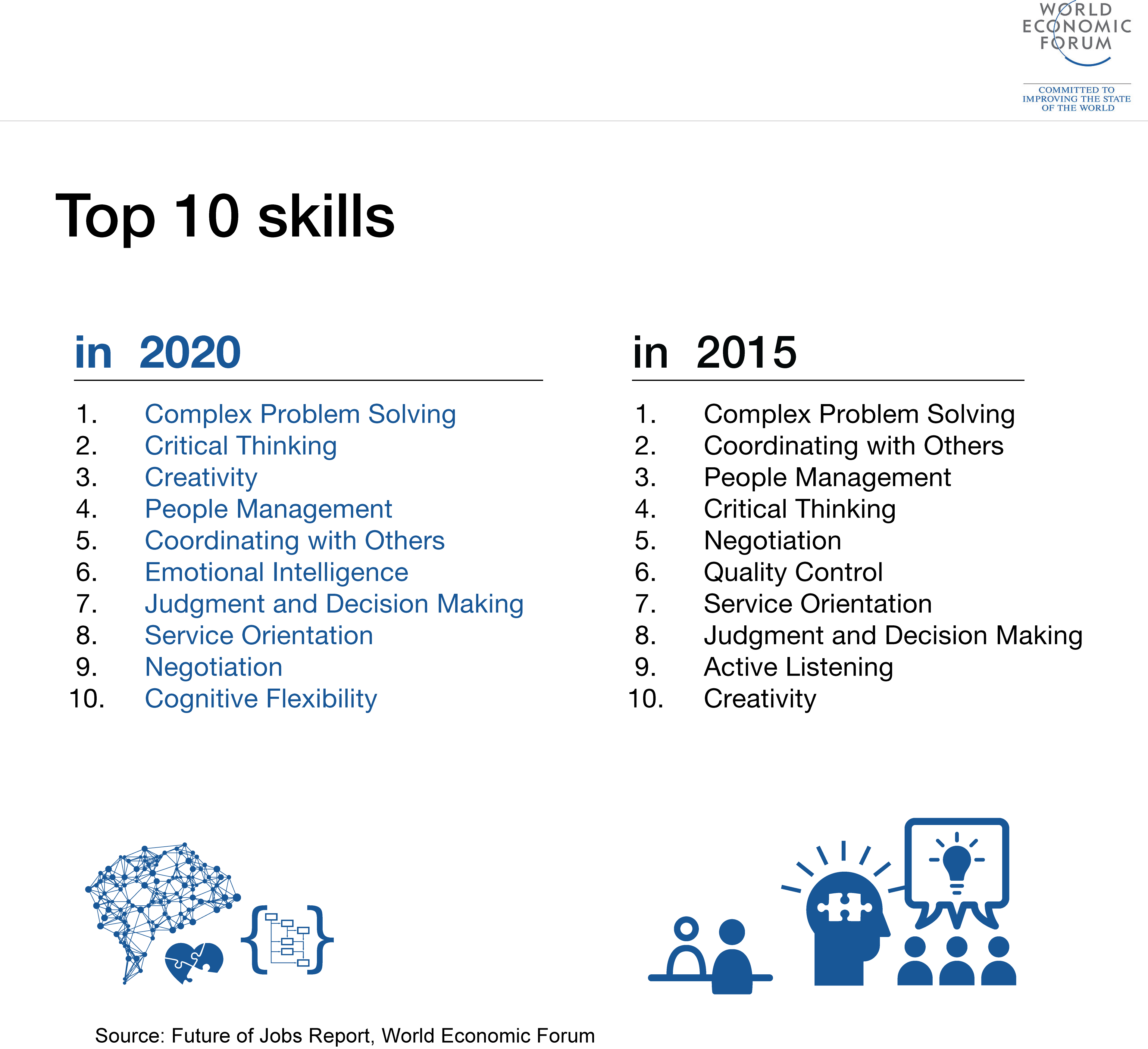
Hanneke Siebelink (of LeadershipWatch) just wrote a piece on the top skills of the future. She pointed to a graphic from the World Economic Forum which showed, over the course of 5 years, how creativity will jump from #10 to #3 in a Top 10 Skills List.Blog - Creativity - weforumPhoto Credit: WEForum.org

What does that sort of creativity entail? Is creativity alone enough?

Richard Florida wrote extensively on this in his book The Rise of the Creative Class. He defines the Creative Class as “people in science and engineering, architecture and design, education, arts, music and entertainment whose economic function is to create new ideas, new technology, and new creative content.”Business Insider

Writer Jeff Goins also defines “creatives”:

A creative is an artist. Not just a painter or musician or writer. She is someone who sees the world a little differently than others.

A creative is an individual. He is unique, someone who doesn’t quite fit into any box. Some think of creatives as iconoclasts; others see them as rebels. Both are quite apt.

A creative is a thought leader. He influences people not necessarily through personality but through his innate gifts and talents.

As fascinating as Florida’s writing is, I disagree with his premise that creatives are their own class of people, because I believe it’s within any of us to develop our capacity for creativity. Those of us who might be suspect of Florida’s promotion of the Creative Class would do well to read the critiques of his thinking (this and also this are excellent).

When people in our communities or workplaces class themselves as distinctively creative, they tend to operate in a tribal fashion. These tribes may even be quite diverse, but too often, I believe, they operate to satisfy their own needs and desires rather than that of the larger workplace or community. Thus in the workplace, decision-making is made by the few like-minded thinkers, that tribe of influential creatives. And communities? Where such a population of creative, expansive thinkers could enhance the appeal and value of a neighborhood, too often, , and communities can steer in the direction of gentrification, becoming less inclusive, making housing less accessible even for those who were there before.

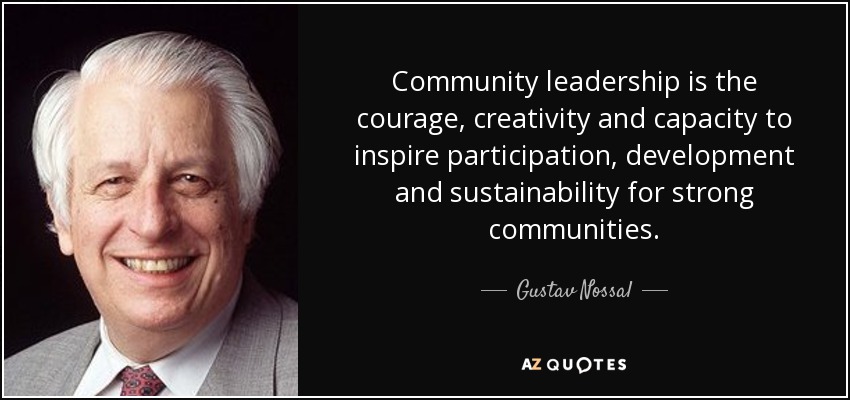
Blog - Creativity & Community Leadership - azquotesPhoto Credit: AZQuotes

My bias in how creatives work best is in community – not just a tribe of creatives, but in a community of folks with other giftings,  other strengths,and other history.

However, all that being said, I do love the increasing view that creatives add value to any enterprise. My husband, for many years, was a research chemist who developed new products and was awarded several patents for his company. Even today, outside the chemical industry, he continues to be creative in thinking through new pathways toward solving problems, getting to goal, and developing personnel.

Even Florida in his revised and updated book recommends a compact dealing with creatives. His first (of 6 principles) is: Invest in Developing the Full Human Potential and Creative Capabilities of Every Single Human Being. It’s somewhat grandiose but it’s a worthy goal. Having this principle in play would promote a workforce where employees are encouraged to always be thinking and engaged in both today’s work and what changes must be made for the future.

Along these same lines, I love Howard Gardner’s Five Minds for the Future:Blog - Creativity - slidesharePhoto Credit: Slideshare

As creatives are sought after more and more in our workplaces (om both private and public sectors), I hope we also encourage them to build strengths in other areas of their thinking (or mindfulness). For those colleagues of ours who might not consider themselves creative, we need to communicate across organizations as to their value as well. This would include our creatives to gain from what other bring to the table.

I would like to think that I’m a creative…in ways, maybe, born out of time. Early on in my career, I had the privilege of working as a team with other colleagues in developing and implementing cancer care in a small town in the Southeast. It was thrilling for me to be part of such an innovative and comprehensive system of care where we could actually plan and dream for the future.

Three of us, in particular, worked as creatives in community. I was a content specialist and idea person. Kay was the nurse manager who brought vision and authority to the task. Kathy was a clinician with steely resolve and the determination to take the ideas to completion. We were a force to be reckoned with…just saying.

We all have different giftings and strengths. My influence was helpful but Kay’s authority settled matters. My ideas were large and lofty (sometimes), and Kathy’s keenness for how to make those ideas work were what brought them into reality.

That’s how creatives work in community. I think of top skills for the future that “in community” piece would be essential for creatives who want to make a lasting difference…not just for their own purposes at work but for the benefit of the larger community.

A hugely successful example of this is the work culture and philosophy of Pixar & Disney Animation which I wrote about here.

Daan Roosegaarde in Siebelink’s article talks about creativity in community: There are two ways to turn an idea into reality. You can play bowling, or you can play ping pong. The old way, at least that is what I think, is bowling. You have that ball in your hand and it’s so big, it is so heavy, it shines so beautifully. Then you throw that bowling ball and pray it will hit target.

I no longer believe this is a good way to create and innovate. I believe in playing ping pong: you take a tiny little ball, not expensive, and there you go: poek poek poek poek … and you create something together. And THAT is nice, this is how I create, this is how I learn.”

Bring on these kinds of creatives any day!

Skills of the Future: The Best Expert Advice on Creativity

The Rise of the Creative Class — Revisited (Revised and Expanded) by Richard Florida

The Creative Compact – Richard Florida – Huffington Post

Creativity – the Unique Soft Skill – Slideshare

6 Ways to Make Your Leadership and Workplace Fun Again

Creativity, Inc. – Overcoming the Unseen Forces that Stand in the Way of True Inspiration by Ed Catmull

untitled

Monday Morning Moment – Them and Us, How Can That Be? Could Them and Us Become a We?

Blog - Work Culture - delta7Photo Credit: Delta 7

Recently, I was in an odd conversation with a friend from work. The more we talked, the more we sounded like a Dr. Seuss book. It went something like this:

“I don’t know how to be us with them. To be with them is to just be them. We must lose us; us no more will be. There’s no us in them; it’s so strange to me. How can they be them, with no us, you see? To give up us is too hard for me. So I can’t see a way to get to we.”

[Seriously, the conversation went like that…but better.]

Battling the us-them assignation is an ongoing workplace discipline. Even in the happiest, coolest companies, there is still an intentionality to keep work life positive for every employee. That inclusiveness is a hallmark for high morale and low walls (read: no silos).

BLog - Us vs Them - Work Culture - Silos - prolearn academy

Photo Credit: Prolearn-Academy

In a work culture where silos still exist, an us/them mentality can grow as each team or department draws in on itself and ignores or suspects the actions/values of others. It’s not a healthy situation for any of us…whether it’s the executive team insulated from others or the [fill in the blank] team hunkered down in its own mode of trying to survive. The first can be as unaware as the subject of the story “The Emperor’s New Clothes“, the second, well, is just miserable, and growing more so by the pay period.

So much has been written on this problem in the workplace – about that culture where us/them thinking and operations color productivity and morale. I have included several links below describing various recommendations and protocols to restore health to such organizations.

Blog - Work Culture 2Photo Credit: My Turnstone

I’ve always been that person who says, “Why can’t we just all get along?” In reality, we don’t have that situation always, but we can grease the tracks in that direction. Here are my own workplace rules regarding moving us and them to we:

  1. Make a practice of assuming the best of your bosses and colleagues. “Refuse to think ill of others” is my goal…and my accuracy in hitting that goal comes with practice and determination…and grace.
  2. Lean in to those with whom you struggle the most – the “thems” in your worklife. Especially the most powerful ones. Study them. Learn their language. Know them as well as you can. NOT for self-serving reasons, but for the benefit of the work itself. Any motive that only serves your personal situation will only make matters worse… ‘Nuff said.
  3. Refuse to get caught up in us/them complaining. Don’t make a big deal about it, but do your best to turn the conversation toward a positive end, change the subject altogether, or bow out if all else fails. Those negative conversations just bring you and your colleagues down and don’t accomplish anything. A short-lived “misery loves company” satisfaction isn’t worth the fall-out of such conversations.
  4. Bring down the silos, one brick at a time, if necessary. Maybe you aren’t experiencing any us/them anguish, but you know it exists. What can you do, individually and as a work team, to move to “we”? We have lots of work models out there for this. In fact, silos in the workplace are “so 80’s” (whatever that means…I hear it a lot, so I’m using it here). Use some of that meeting time, or talks over coffee, to be creative in how you can work better across teams…how you can learn more from each other…how you can defuse territoriality? If the “them” is management, you initiate dialog on setting work culture values that maximizes product excellence and employee engagement.
  5. Put processes in place – through your culture – to keep silos down. I would love to hear what your situation is and how you are making positive steps to grow/keep a healthy culture. Please comment below.

Sure…there are times we need to process a difficult situation at work with a trusted friend. Yes, us/them scenarios are painful…and wrong, honestly…especially in the workplace where we are meant to have shared goals, working toward the same outcomes. Maybe, the us/them relationships in a company are too distracting and we can’t see any solution (back to the Dr. Seuss-like conversation above). In that case, it’s possible we look outside our company for another situation. However, you take with you a piece of the us/them dilemma. You take you along to the next job. Better to develop muscle memory on how to “be we”, whenever possible, right where we are.

[Sidebar: I’ve written a lot about work culture – too many to mention – but you can search work culture under Blog – Deb Mills and learn as I have about what is possible if we stay engaged in our workplace.]

Blog - Work Place Culture - open.bufferPhoto Credit: Buffer

Overcoming Us vs. Them Challenges

Breaking the “Us and Them” Culture

How to Avoid Us vs. Them – Huffington Post

The 10 Buffer Values and How We Act on Them Every Day

The 4 Elements That Make Great Company Culture

How to Save a Broken Work Culture

From Us and Them to We Participative Organizational Culture

Them and us – How to use Trust as a Competitive Advantage

How CEOs Can End an Us Them Mentality

Us vs. Them – a Simple Recipe to Prevent Strong Society from Forming

5 Friday Faves – Emotional Intelligence, Hand Massage, a TV Commercial, 40% Rule, Zelda – & a Bonus

Blog - Friday Faves

Friday is here again…and I’m looking back over another week that went by in a blur. Glad to share some of the discoveries of this past week. Would love to hear about your week’s finds (comment below).

1) Emotional Intelligence – This is a concept that’s been around for awhile now, but I never really read about it until this week.  Matt Monge’s article for The Mojo Company sparked my interest. He described 6 symptoms of leaders with low emotional intelligence. Here’s the definition: “Emotional intelligence (EI) is the ability to monitor one’s own and other people’s emotions, to discriminate between different emotions and label them appropriately, and to use emotional information to guide thinking and behavior.” 

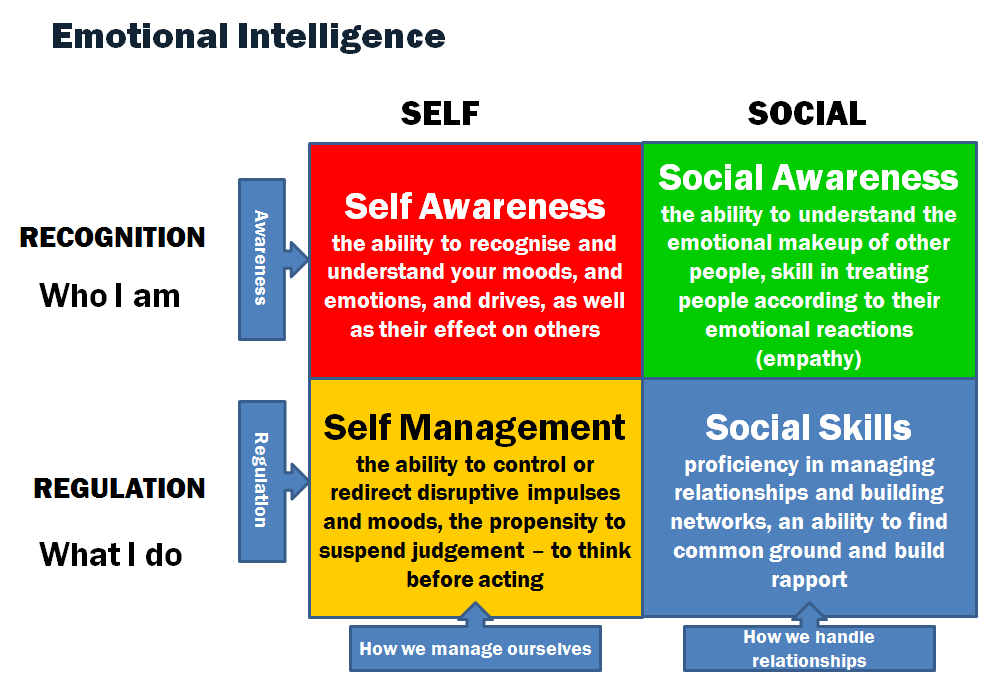
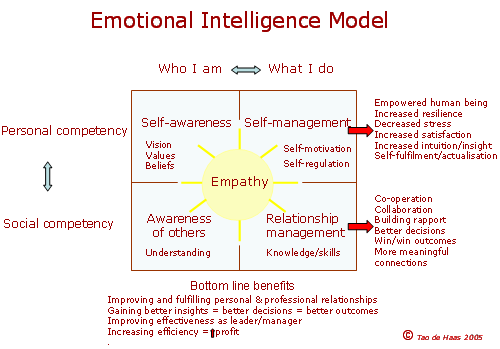
Two of Monge’s points were: 1) Leaders with low emotional intelligence say “I’m sorry you feel that way” more than “I’m sorry,” and 2) Leaders with low emotional intelligence often blame the people they hurt for the situations leading to them being hurt. Daniel Goleman has written several books on this topic including Emotional Intelligence: Why It Can Matter More Than Intelligence and Social Intelligence: The New Science of Human Relationships. The very cool thing about emotional intelligence is that it can be developed. The big dilemma is whether bosses who tend not to be bothered by their impact on personnel would buy into this or not. Incorporating such concepts in personnel accountability metrics might provide some incentive. I’ve added graphics below that helped me further understand emotional intelligence.Blog - Friday Faves - Leadership - Emotional IntelligencePhoto Credit: Self Study History

Blog - Friday Faves - Emotional Intelligence - grid - dollieslagerPhoto Credit: Dollie Slager

Blog - Friday Faves - Emotional Intelligence - low & highPhoto Credit: The King and Queen

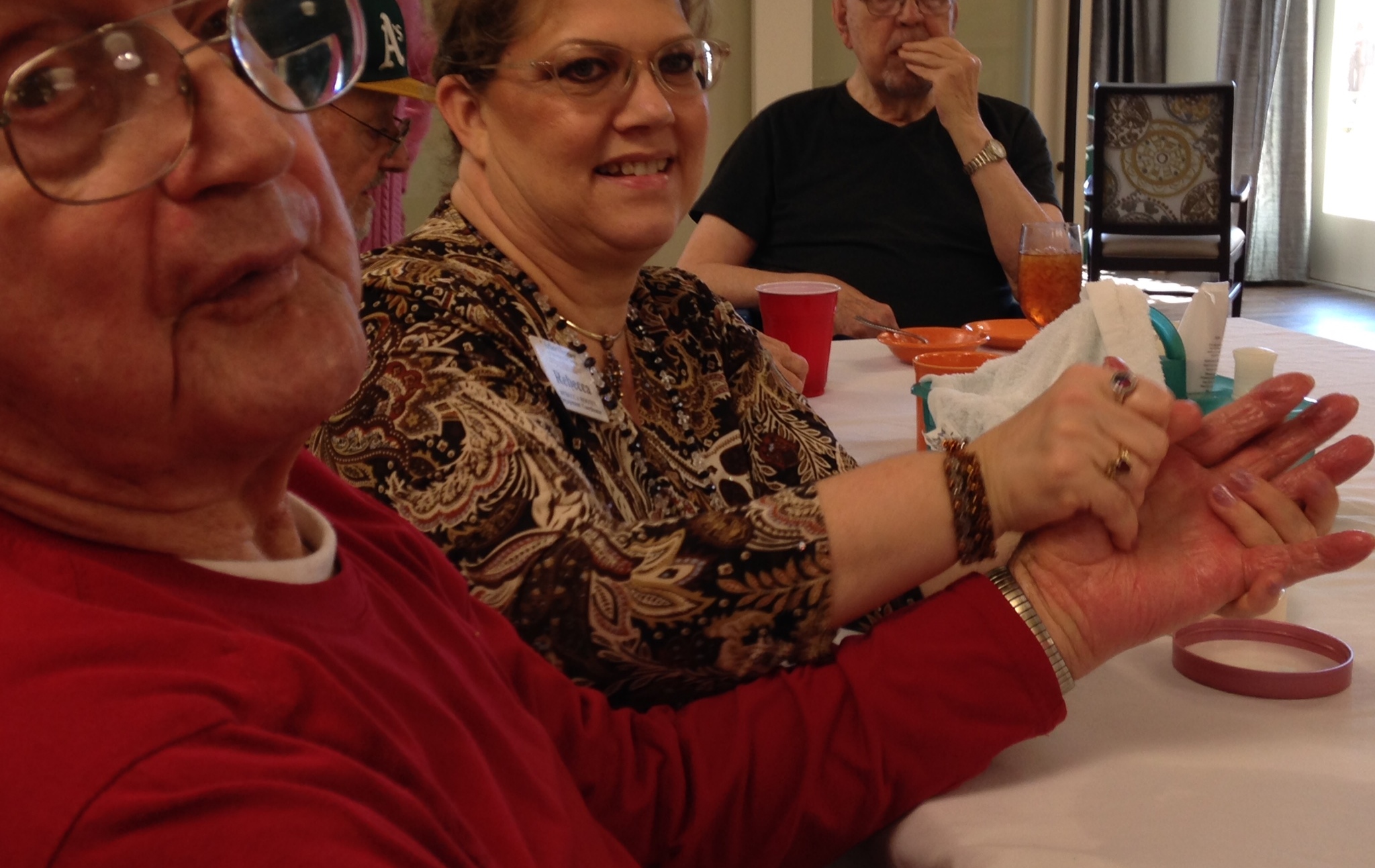
2) Hand Massage – My dad is 93 years old. He has Alzheimer’s. I can’t imagine he has ever had a hand massage in his whole adult life until this past week. The memory care unit which is now home to him has this lovely activities director. One of his first days there, she brought over two warm washcloths and wrapped both his hands. Then she began massaging each one. He just melted into a relaxed, soothed puddle.  One of his repetitive actions is to scratch his hand which he does to distraction. Hand massage is such a thoughtful, therapeutic act. It never dawned on me to do such a thing. Midway down an excellent piece on Alzheimer’s by staff at University of Maryland, massage is recommended as treatment to calm these patients. So glad Dad is where he is with these engaged caregivers.Blog - Dad and hand massage

3) A TV Commercial – We all discover human interest videos through our social media sites. This is my favorite for the week. The #SharetheLoad video produced by Ariel (a washing detergent we used overseas) in India is beautiful. The message is a father’s regret that he modeled for his wife and daughter a very passive role in the home. Even as an older man (the commercial goes), he determined to make that right. Whether it happens or not in such homes today, the message is a powerful one.

4) 40% Rule – So I found this Fortune article on my Twitter feed. Sidd Finch wrote about Jesse Itzler’s encounter with David Goggins, a Navy Seal. during a 100-mile relay race. Goggins was running the entire race without relay partners. Itzler was so intrigued by this ultra-athlete that he actually invited him to live with Itzler’s family for a month. Out of this time together came the book Living with a SEAL: 31 Days Training with the Toughest Man on the Planet. Goggins taught Itzler about the Navy Seals’ 40% Rule.

Itzler explains, “He would say that when your mind is telling you you’re done, you’re really only 40 percent done. And he had a motto: If it doesn’t suck we don’t do it. And that was his way of forcing us to get uncomfortable to figure out what our baseline was and what our comfort level was and just turning it upside-down.”

“The 40% rule, the SEAL explained, is the reason why even though most people hit a wall at mile 16 during a marathon, they’re still able to finish.”

Blog - Friday Faves - 40 percent rule - David GogginsPhoto Credit: Just Go Fitness

“I don’t stop when I’m tired. I stop when I’m done.”David Goggins

Blog - Friday Faves - 40 percent rule - Navy Seals - David GogginsPhoto Credit: AZ Quotes

5) Zelda The Legend of Zelda is celebrating its 30th anniversary this year. I recently wrote briefly about it here. Koji Kondo wrote much of the music for the video game series. Blog - Friday Faves - Video Games - Link of The Legend of ZeldaPhoto Credit: Cogswell.edu

Nathan Mills at Beyond the Guitar has posted two covers so far to showcase how beautiful the music is and how well it’s captured on classical guitar. I wrote about the first cover previously, and here’s his second piece. Happy 30th Anniversary, Legend of Zelda.

HBR’s 10 Must Reads on Emotional Intelligence (with featured article “What Makes a Leader?” by Daniel Goleman)

10 Signs You Have Exceptional Mental Strength by Jessica Stillman

BONUS: If you got this far, you will be so rewarded! Very few people in my life watch American Idol, and this is its final (15th) season. I am not fond of the whole reality show murkiness of it, but the performances of these gifted young people and the judges (Keith Urban, Harry Connick, Jr., and Jennifer Lopez) are captivating as well. I want to post videos of two amazing performances from this week’s elimination show (elimination meaning the week the field of contestants narrows to the Top 10). The first video is that of La’Porsha Renae who may very well become the final American Idol. This one can sing!!!

We were overseas when American Idol’s first season aired. I don’t actually remember how I saw Kelly Clarkson in that competition, but I remember following her. She was the first American Idol winner, and the rest is history. To be honest, Kelly Clarkson was off my music listening grid…until now. The song she wrote and performed, Piece by Piece, deals with the painful subject of a father who deserted her as a young child. The song also celebrates the very different man she married, the faithful father of her daughter. This song may make you cry. Wow!

Shared Memories – On Family with a Grateful Nod to the Story-telling of Downton Abbey

Blog - Downton Abbey - Shared memories - vanity fairPhoto Credit: Vanity Fair

Shared memories…those places, friendships, events, emotions, experiences, and impressions known intimately by that little circle called family of origin. Notwithstanding, shared memories can also be the property of life-long friends or even a happenstance experience of strangers. Still I am enthralled by the great legacy of shared memories – some shimmering with joy and some we wish forgotten – both binding us together as family.

What a blessing are the in-law family members added to the fold! Those who listen with interest or at least value that bond – as dinner conversation is hijacked by memories of growing up together. What a gift that arena is where shared memories are rehearsed and celebrated…one. more. time.

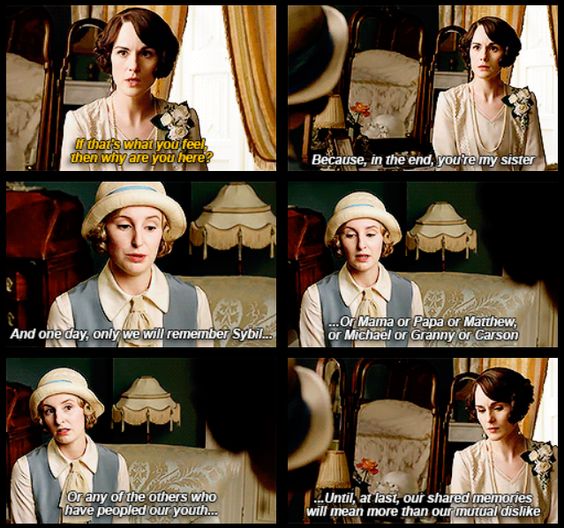
For those reading not Downton Abbey fans, don’t miss this lesson on family life. Mary and Edith are adult sisters (missing the youngest, Sybil, whose sweetness had knit the other two together, before her untimely death). Their relationship is not close, to say the least, and their actions have, at times, been brutally hurtful toward each other.

In the next-to-last episode of the final season of Downton Abbey, Mary’s venomous words cut deep again, seemingly destroying once again Edith’s prospect for happiness. Then in a turn of the story, (spoiler alert), Mary accepts the proposal of Henry, and they prepare to wed days later.

Enter Edith…as we watch enrapt. What next between these two?

Sarene Leeds, of the Wall Street Journal, recaps this bit of the episode:

“By the time of Mary’s wedding day, Edith has cooled off enough to not only attend the nuptials, but take the high road when it comes to her relationship with her sister. She hasn’t gotten over what Mary did, but family remains paramount to her:

“In the end, you’re my sister,” Edith tells Mary. “And one day, only we will remember Sybil. Or Mama or Papa, or Matthew or Michael or Granny or Carson or any of the others who have peopled our youth. Until at last, our shared memories will mean more than our mutual dislike.”

Blog - Downton Abbey - Shared memories - pinterestPhoto Credit: Pinterest.com

“Only we will remember…” How powerful that is! Not in an exclusive, “none others welcomed” sort of way…but in a high value, meant to be treasured way.

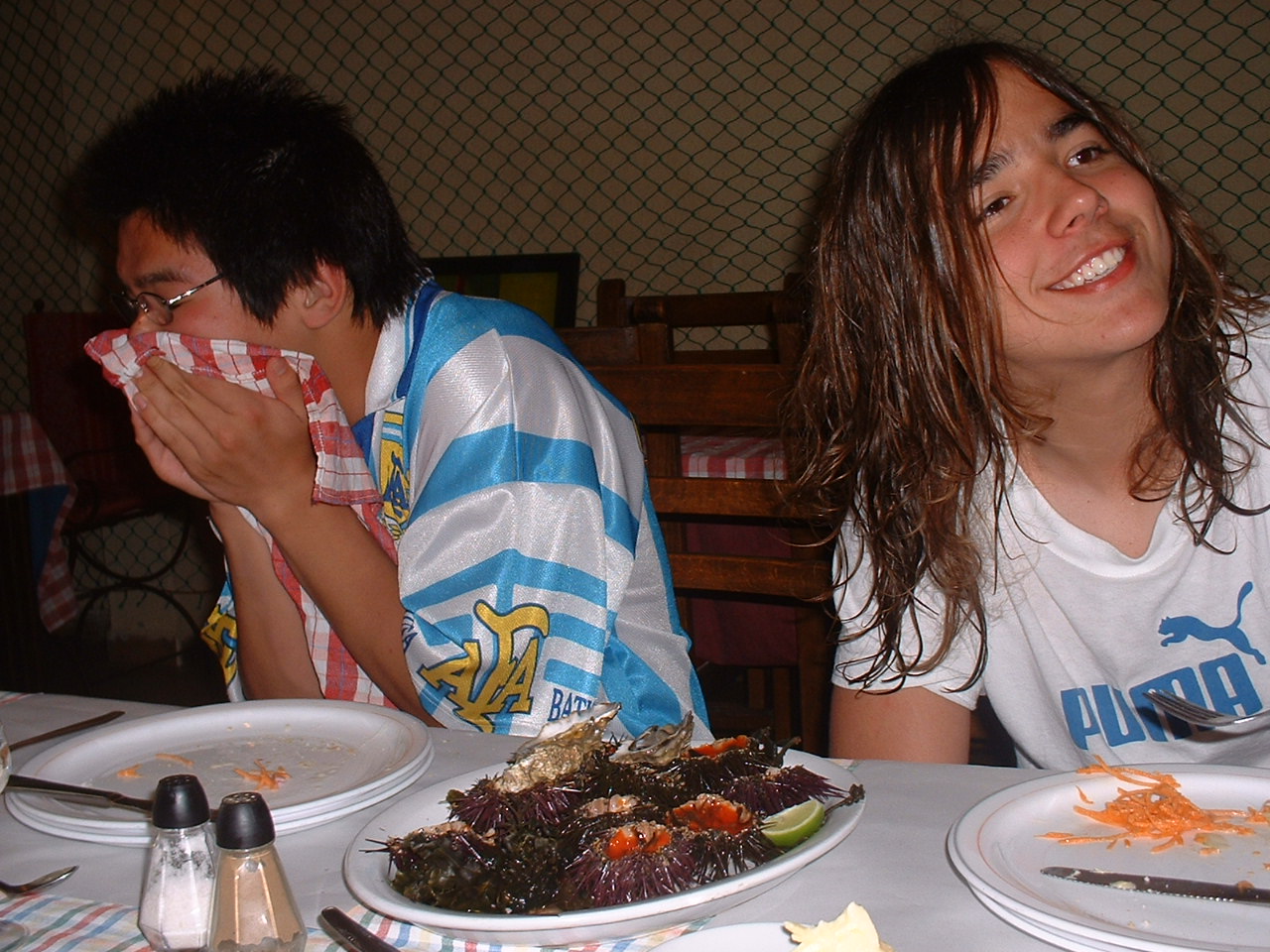
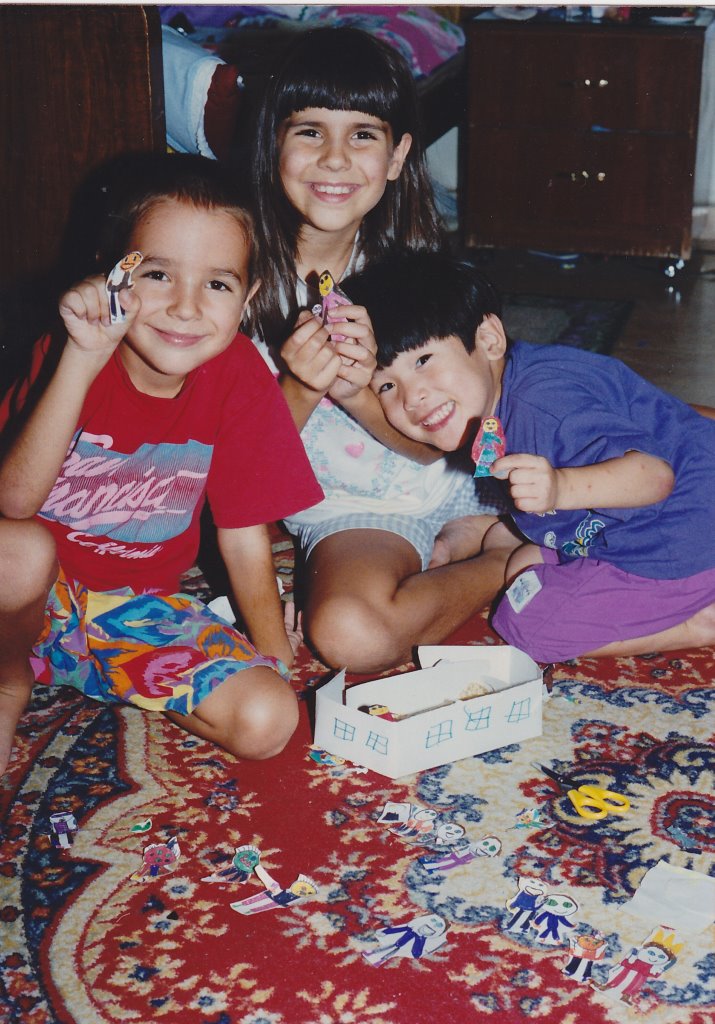
I think of our children – spending their pre-school years in eastern Tennessee, then living the rest of their childhood in North Africa. What they missed and what they gained…in this somewhat nomadic life with all the hellos and goodbyes…is their shared experience.

We also share it with them…for which I am beyond grateful…and out of which I can be, at times, this mama who clings a bit to them…not as much to the memories as to the ones who soldiered with us through that life. We know each other in that shared memory way.Blog - Running into His Marvelous Light2006 May -- Oualidia weekend 1522006 May -- Oualidia weekend 116 - Copy

They remember all the moves, the beauty of those places, and all the wonderful friendships in each place. They understand God’s grace in that. In some ways, as expats in countries not our own, we grew up together.

They remember the sweet times with family back in the States…and the growing up together (through too occasional visits but deep belonging). Blog - Shared Memories - OcracokeBlog - Shared Memories - Ocracoke 2013 (2)

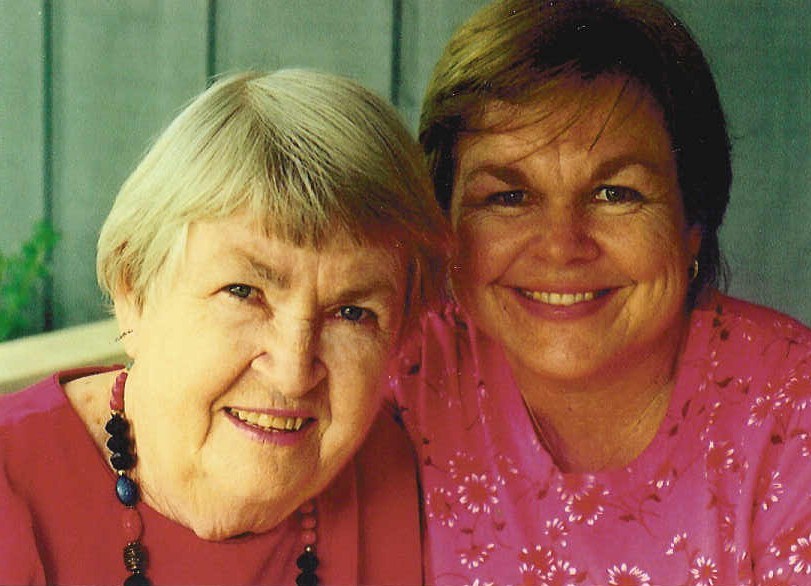
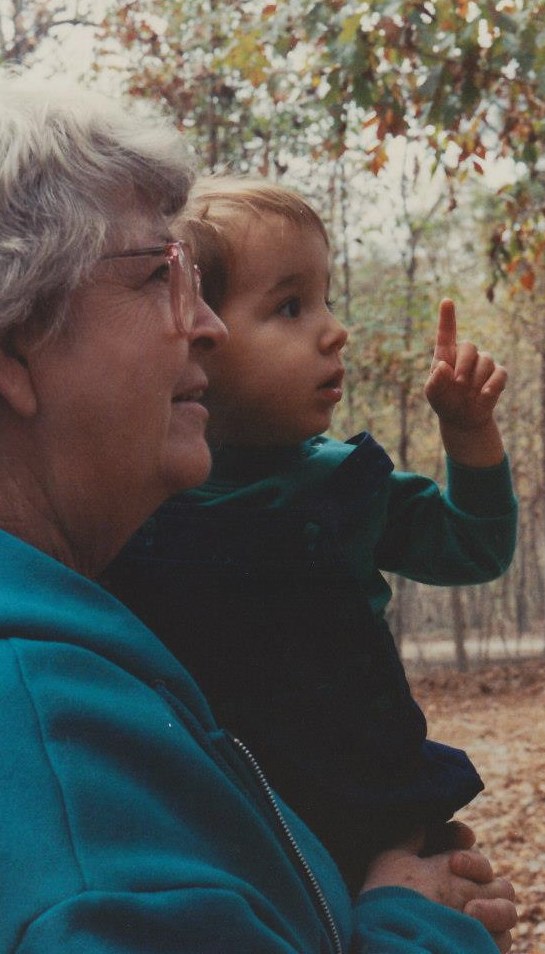
They remember their grandmother, my mom, who died too early. They remember how much she loved them (I hope); for sure they remember the woman she was.Blog - MomIMG_0023 (2)Blog - Shared memories - Mom and Christie

So many shared memories include other loved ones who are no longer here (cousin Chad and their Uncle Robert)…and births, graduations, weddings, life accomplishments and disappointments…and on it goes.

My hope and prayer, like with Edith’s wonderful lines from Downton, is that, as adult life fills with relationships and experiences less-shared, we return regularly to the bonds of shared memories…including making new ones together. Edith returned to her childhood home to witness her sister Mary’s wedding…as hard as it was for her; it mattered.

You may be in the throes of change in your life that you can’t stop. A looming divorce, a frightening illness, a company down-sizing – where loss of history, situation, or relationship are all too present. Shared memories cannot be destroyed in community – they may feel altered by present circumstance, but they don’t have to be. Our memories belong to us.

My dad has Alzheimer’s. His memories are diminished now. When we visit, we remind him of stories that bring joy to his heart. We look at photo albums and remember together those faces who love him. We, his children, keep his memories for him. Such a privilege for us.Blog - Dad - Alzheimers - Feb 2016

What a great legacy we have with each other – this life we shared…this life we share.Blog - Shared Memories - egypt (2)

Love Notes – A Family Tradition – Started by Our Mom

IMAG2718 (2)

From the Archives

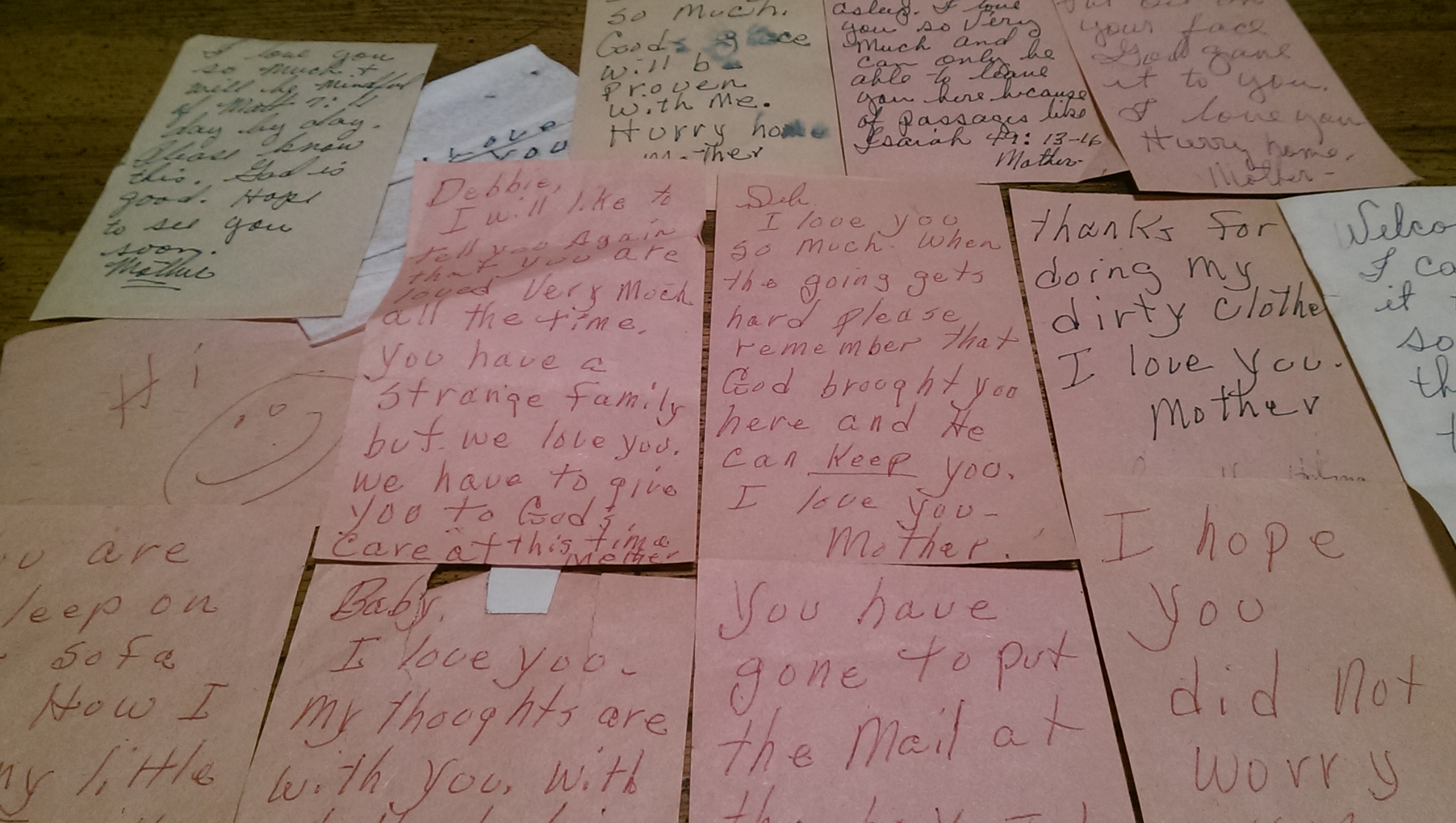
[On the eve of what would have been my Mom’s 89th birthday, I want to look back a bit to one of the sweetest customs she had – leaving love notes hidden to encourage us in her absence. She still encourages us…even in her absence. Love you, Mom.]Blog - Mom

Therefore encourage one another and build up one another, just as you also are doing.1 Thessalonians 5:11

Encourage one another day after day, as long as it is still called “Today,” so that none of you will be hardened by the deceitfulness of sin.Hebrews 3:13

Our family has never lived close to the grandparents. This was never easy…for any of us. Before I married, I did live close to home, and my mom was my best friend. She died several years ago, and I often say to people who knew her that “when I grow up, I want to be just like her.” Still working on that.

Mom and I shared a weakness for words…they are probably excessively important to us, delivering both positive and (sometimes) negative weight. She was an amazing encourager. She rarely missed an opportunity to lift another’s spirit or to speak loving truth to someone desperate for God’s touch.

When I moved away to take a teaching job, she and my dad helped me move. New Haven, Connecticut was a 2-day drive from Georgia. It’s the farthest I had ever wandered from home. She stayed a week to help me settle in.  While there, she was such great company. We explored the city together and laughed over a new culture and cried at the missing that was ahead for us.

She filled my freezer with her baking, and, while I was at work, she wrote notes. Then she hid them everywhere. After she flew home, I began finding them. In my coffee mug. Under my pillow. In the pocket of my coat. Among my reference books. Behind my music on the piano. She was with me in the love notes she left, and it made the distance between us…less.

IMAG2720 (2)

My mom and I also had a weakness for bits of paper. I kept every one of her notes. These from that move over 30 years ago are fading…red ink on pink paper. There are a lifetime of notes between my mom and me. The tradition she started on that first move has become a life-long tradition for our family. Our visits back and forth, across the US and then the globe, have been papered by these little notes.

Our children, from the time they could write, entered into this tradition much to the joy of their grandparents. Before we would leave again, these three young ones would write of their affection for their grandparents and hide them all over their houses. I delighted in their cooperation in this conspiracy of love.

Mom always wrote notes…not just to us but to so many. She and her Sunday School Class ladies would send cards every week to the sick ones or the sad ones. She had a special burden for the elderly, for widows (including functional widows, deserted by husbands) and for fatherless children (again including those “orphaned” by still-living fathers). She inspired me by her humble ambition .

Pure and undefiled religion before our God and Father is this: to look after orphans and widows in their distress and to keep oneself unstained by the world. – James 1:27

I am so thankful for my mom’s bits of paper…for her love…and for her perseverance in encouraging and serving others. Her generation is aging, and it is for us to pick up these traditions and pass them on somehow to the next generations…Maybe there won’t be bits of paper or love notes like in the past. I do hope we still take the time to write. Definitely, the call to serve and to encourage is as current as today. My life continues to be rich with those, young and old, who reach out to those around them with words of affirmation and kindness. Written or not, they are love notes to my heart.

Thanks, Mom. Thank God for you.

Mom pictures for website 012

The 59 “One Anothers” of the New Testament

Blog - Mom and nathan

5 Friday Faves – On Studying Your Spouse, Aging, Taking Criticism, Daily Routines, & Black History Month

Blog - Friday Faves

Hello, Friday. I don’t know about you but this has been a week of highs and lows in this world of mine. Hard news in some situations washed over by exquisite answers to prayer in other situations. As happens often with God, in the quiet of this morning, a favorite, heart-lifting passage in the Bible came up in my reading.

“You will keep him in perfect peace whose mind is stayed on You, because he trusts in You. Trust in the Lord forever, for the Lord God is an everlasting rock.”Isaiah 26:3-4

Even the Bible verses atop my facing journal pages this morning were like an anthem from God that all will be well. “Peace I leave with you; My peace I give you.”John 14:27 and “My times are in Your hands, Lord.”Psalm 31:15

With that intro to welcoming Friday this week, here are five of my favorite finds – all from the internet this week, although I did have a lot of sweetness in the real, as well.

1) Studying Your Spouse – Michael Hyatt welcomed Jackie Bledsoe as guest blogger on his website this week. Bledsoe writes very winsomely about how he learned to study his wife. He talks about how we, too often, think we know enough (relating to any field of study and work, ministry, marriage and family). Regarding his marriage, he observed: “We were both growing, just not together. My interests were changing and my wife, Stephana, didn’t always notice. Stephana’s needs were changing, but I was oblivious to them. Finally, we reached a point where we felt we didn’t really know each other. That was a scary discovery, one that you may be able to relate to. You may know the ins and outs of your business or ministry like nobody else. But maybe you don’t know the ins and outs of your spouse like nobody else. It may be time for you to enroll in the continuing education about your spouse.” Bledsoe lists 3 ways to get an advanced degree in your spouse: 1) Do new things together; 2) Take notes: and 3) Use your calendar. Read more here.Blog - Friday Faves - Marriage - DaddyshangoutPhoto Credit: Daddy’s Hangout

2) Aging – a Video – I came across a video this week that really got me thinking about how I view aging. It is entitled The Wall. It is the work of Aroha Philanthropies, an organization “devoted to the transformative power of the arts and creativity, inspiring vitality in those over 55, joy in children and youth, and humanity in adults with mental illness”. Blog - Aging - ioagingPhoto Credit: IoAging.org

The video begins with two elderly persons looking at the imposing face of a wall filled with the words that terrify most of us about getting older. Then as the video progresses, the images change to  more engaging and lovely words that depict what can be part of our experience moving from youth to mid-life to older life. Through creativity and the arts from childhood throughout our years, we might see a very different future, with growing older being our “encore years”. Something to think about for all of us…and especially for our young creatives – to see these “old ones” as valuable peers…just a bit farther down the same road.

3) Taking Criticism – Dan Cumberland, writer and photographer in Seattle, Washington, writes about responding to a scathing comment he received once on one of his blogs. Complete with foul offensive language. In his article This Guy Really Hates Me (How to Take Criticism). In his post, he lists 5 guidelines of how to handle criticism:

1) Is there truth in it?; 2) Is it affirmed by others?; 3) Is the source credible?; 4) What are the source’s motives?; and 5) What can I learn here? Then Dan talked about how he dealt with his critic.

We all receive criticism and also, if we’re honest, dole it out ourselves. Hear Dan’s counsel: “When you receive criticism and negative feedback there’s a needed balance. Don’t write it off, but also be careful not to let it bring you down too much. Work to find the truth. When you don’t understand, ask for clarification.”

When we are offered criticism, take it – as a gift. Do with it what is helpful. Don’t fall into the trap of returning harm for what you perceived as harmful. You want to be better than that.Blog - Taking Criticism - Feedback - quotesgramPhoto Credit: Quotesgram

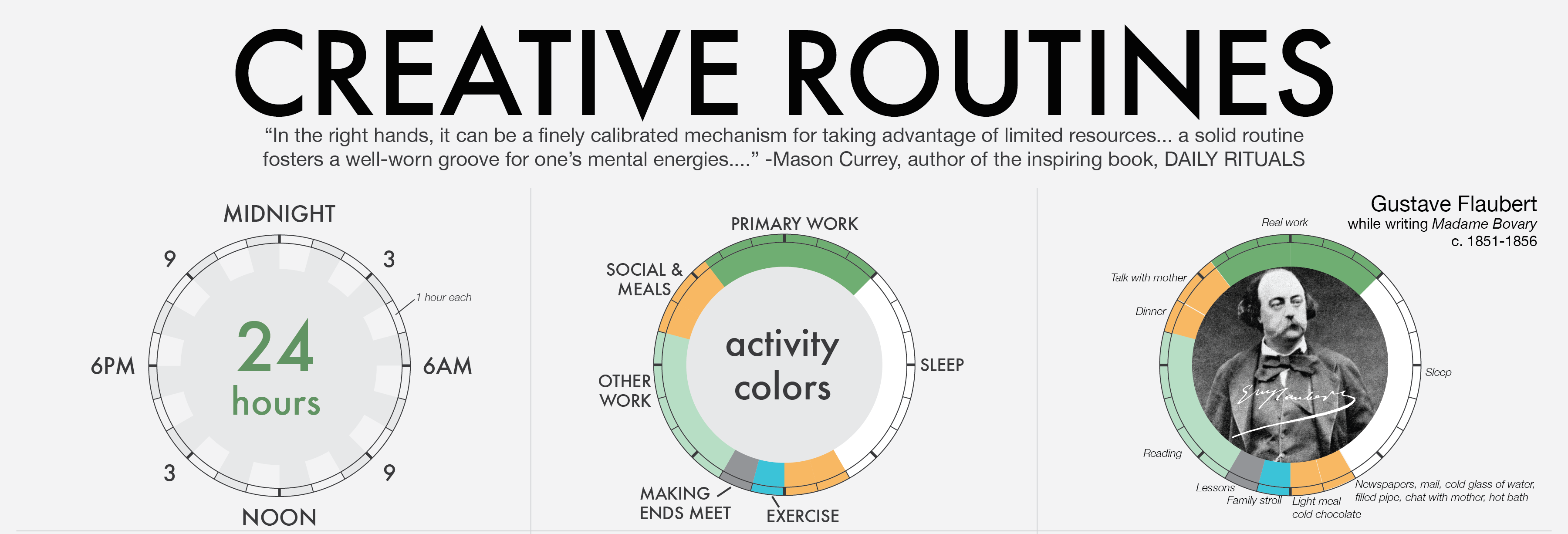
4) Daily Routines Maria Popova, of Brain Pickings, wrote a fascinating post on Mozart’s Daily Routine – How a day is composed in the hours between sleep o’clock and symphony o’clock. Routines are a great help for me to organize life and truly accomplish what I hope to accomplish. I’ve written on routines, habit change, and productivity previously. Popova’s article (and others she linked in her post) offers a glimpse into the daily life of greatness. It was inspiring and refreshing. Early in Mozart’s life, he went without employment but maintained deep discipline in his composing of music. Later, as his popularity rose, he compromised his sleep in order to continue writing. Mozart’s life was legend for unhealthy choices, and he struggled at times with deep depression. The lesson for us is in a daily routine that helped him, whether poor or privileged, to produce magnificent music that continues timeless in its beauty.

Blog - Daily Routines Photo Credit: Tito Goldstein

5) Black History Month – Phillip Holmes wrote a great piece, on Black History Month, for Desiring God. It is entitled More Tough Skin and Tender Hearts – How to Prepare for Conversations on Ethnic Harmony. He talks in a frank and loving manner about evangelicalism and ethnic harmony. Holmes urges us to have real conversations across races and ideologies, rather than white-with-white (or black-with-black) discussion with those already in agreement with us. If we wrestle with the struggle, across racial, religious, and political lines, we might actually come to a place of true reconciliation.

I want to have the kinds of conversations he encourages: “As we engage in complicated conversations about racism, be sober-minded rather than drunk with hatred, frustration, and annoyance. Embrace humility and love those you disagree with. But continue to pursue truth and justice as these two are defined in the Holy Scriptures. The Bible must remain the basis for why we believe what we believe and a careful study of it reveals that it has much to say about ethnicity and injustice…These conversations are complex but necessary and we need men and women who can sit down and have hard conversations considering the other more significant.”

Read his full post. I do want to quote one more vital point Holmes covered beautifully: “As a church, whether we as individuals are white, black, brown, red, or yellow, Christians have to constantly remind ourselves of our primary allegiance. If you are a child of the king, adopted into the household of faith, you are Christian first. I am one million times more Christian than I am black. My brown skin may be what you first notice about me, but by God’s grace, my Christian faith is what you will remember… I count it a privilege to be physically dressed by my creator in such a beautiful skin tone…but I will forever check others and myself when I notice our ethnicity is taking precedent over our heavenly citizenship.”

Also read Kimberly Davis’ Black History Month and the Common Language of Christ.

Vector Illustration for black history month including names, time periods and what each person did. See others in this series. Makes a great poster large print.

Photo Credit: Teach Hub

What were some of your finds or favorite things of this week? I would love to hear about them. Have a safe and joyful weekend!

5 Friday Faves – a Podcast, Communication Helps, a Business Startup, a Song, and a Poem

Blog - Friday Faves

Friday! Winter storm Jonas is behind us here in Richmond, Virginia. It leaves in its wake a heightened gratefulness for heat and electricity, and for those who serve their neighbors by clearing streets and sidewalks. Kids finally went back to school, and work returned to normal. I’m looking forward to getting out tonight to the movies with Dave and our youngest. Finally I will see Star Wars – the Force Awakens which inspired our guitarist middle to do an arrangement of Rey’s Theme. Before proceeding to devour an obscene amount of movie popcorn, here are my 5 faves for this week.

1) Podcast – My favorite podcast this week was Srini Rao‘s interview with Chris Bailey. Rao is the host and founder of Unmistakable Creative where you can hear lots fascinating stories from people who are unmistakably creative (good stuff). Chris Bailey is the author of The Productivity Experiment: Accomplishing More By Managing Your Time, Attention, and Energy. I loved both Chris Bailey podcasts – Earlier, Living an Insanely Productive Life with Chris Bailey and this week’s Bridging the Gaps in Our Productivity with Chris Bailey. Bailey makes a critical distinction between just getting a lot of stuff done and real accomplishments. I appreciate that. Check out Chris Bailey’s blog A Life of Productivity where he lists 100 time, energy, and attention hacks (shortcuts) to help us reach higher productivity. Out of this 100, three of my favorites are: Every day, journal one great experience you had. At the start of every day, define three outcomes you want to accomplish (not to-dos; actual outcomes). When you meet with someone in person, shut off your phone completely.Blog - Chris Bailey - ProductivityPhoto Credit: Unmistakable Creative

2) Communication – Brad Hambrick is my go-to counselor guy when I need wisdom or direction in a difficult or complicated relationship. Truth is, I’ve never met him. He is the pastor of counseling at Summit Church, in Raleigh-Durham, North Carolina.  What makes his counsel so easily accessible is that he posts videos online on a wide variety of subjects. His notes for deeper study are also available free of charge via an email to his office. His website bills him as a Counselor for the Church (Summit Church and anyone else who could use his help). Today, I want to point you to Brad’s favorite posts on communication. So helpful. Blog - Brad hambrick - Counselor - CommunicationPhoto Credit: Summit RDU

 3) Business Startup –  I love wood – the smell of it, the look of it. All of it. Wood is timeless. A recent and happy discovery is Wellborn + Wright (a local company founded by Sam Sikes which sells reclaimed wood). Read how they describe themselves (from their website: “Wellborn + Wright is committed to providing timeless high-quality finished products. Our wood is reclaimed from all over the east coast from turn-of-the-century barns in western Pennsylvania all the way to textile mills in Boston. This salvaged wood is saved from landfills and given new life by our skilled team of craftsmen. We utilize sustainable and detail-oriented processing techniques, ensuring that all of our products maintain their character. We work directly with architects, interior designers, and builders. This unique ability allows us to deliver your vision of a consistent aesthetic in both the design and in the integrity of the architectural elements in your project.” Visit their website and you will find a visual feast of old wood brought back to life. My plan is to write more about this young company after a visit there soon. Wonder what I can have made by these craftsmen…makes me smile to think about it.BLog - Small Business - Wellborn Wright - Sam Sikes owner - richmondbizsensePhoto Credit: Richmondbizsense.com

4) A Song – Kenny G’s Over the Rainbow from the album – Classics in the Key of G  – Once upon a time, many years ago, before moving our family to Cairo, Egypt, my husband decided he needed to scale back on his passion for music. We were downsizing in preparation for that move overseas. Dave had a huge music collection and decided that he would leave behind most of his music to focus on being with people more, instead of having his head in his music. Fast forward a few years, living now in Cairo, Egypt. On a shopping trip (for my birthday), he discovered this Kenny G CD at a local market. He bought this one and another by The Temptations. The song “Over the Rainbow” re-kindled his love for music and his music collection would grow again. It turned out to be a very good thing because of what a joy and stress-reliever music is for him. I had forgotten that story until the song came up on a playlist a few days ago, and he reminded me, “That song got me listening to music again.” It is beautiful.

5) A Poem – I am a slave to bits of paper. It’s hard for me to get rid of things, especially treasures with words – like essays my kids wrote, or sweet notes from friends, or poems my mom saved over the years. This one I discovered from a friend on Facebook, and its lesson is timely for anyone who still has their mom or dad. My mom died over 13 years ago, and I still wish we had had more time. Dad has Alzheimer’s and we spend time together…but the days of receiving advice from him are done. Part of saving those bits is like having the people attached near again. Sweet…like this poem.

Blog - Poem - Back Home - Sharon Brooks FB pagePhoto Credit: Facebook

Do you have any favorite finds from this week that you’re willing to share? Use the comments section.

The weekend beckons.

Friendly Fire in the Family of God – How to Go Forward When You Are Hit by Surprise

Blog - Friendly Fire - thecripplegate

Photo Credit: The CrippleGate

We expect attacks from those we know don’t care for us or, in fact, want us gone. They want our jobs or view us as threats, or they can’t stomach our beliefs or ideologies. These confrontations are a part of life and work and we take them in stride; hurtful as they may be, they are expected.

It’s the surprise attacks that catch us off-guard, especially when we come under-fire by those who should have our backs. “Friendly fire” is a phrase coined from military situations when something goes very wrong in battle, and a fellow soldier is wounded or killed by a comrade in arms. Too often, we have experienced the sting of friendly fire.

We may endure long periods of hardship at the hands of difficult bosses or through relentless attacks by acquaintances or colleagues who think very differently than we do. What happens, though, when those who believe as we do (in this case, fellow Christ-followers or true believers) fire on us…sometimes over and over again?  Here is where the breath is knocked out of us and we straighten up again, bewildered, disoriented, and hurt deeply.

This isn’t supposed to happen. As Christians, we know to love one another, even our enemies, to forgive without exception, and to bear with one another and be deferent toward each other. This is not the stuff of doormats or deer “in the headlights”. This is living life in community (whether, work, family, or church) as Jesus calls us to live. I think that’s why we’re caught off-balance when someone who identifies with Christ fires away at us…and especially if there’s no repentance of that “friendly fire”.

How are we to respond in those situations? In fact, how are we to live with our eyes wide open, knowing friendly fire happens, and understanding that we might be the perpetrator the same as anyone else.

Michael Milton wrote an excellent piece on this entitled Hit By Friendly Fire: What To Do When Christians Hurt You. If you are right now dressing the wounds of such an attack, his counsel may be hard to bear. The truth is, though, that the wounds you have right now will never really heal until you do what is necessary for a full recovery. In fact, as we follow Jesus’ example of enduring such attacks, then we can recover much quicker and refuse to retaliate ourselves. We also restrain from launching such barbs ourselves in the heat of some battle.

Milton offers 3 steps in responding when someone hurts you – and this someone can be a family member, friend, colleague or one in authority over you (a Christian boss or pastor).

Step 1 – Take up Your Cross – Followers of Christ are not kept from pain; it is part of our lives as much as it was part of the life of Christ Himself. Even looking back to Old Testament accounts, we see betrayal, deceit, and hurt of every kind. The story of Joseph (Genesis 50:15-21) sold by his brothers into slavery, and then falsely accused and placed in prison for years is a great example. Joseph would finally end up in a position of influence where he was able to save his whole family from famine. He told his terrified and repentant brothers, “You meant evil against me, but God meant it for good.” (Genesis 50:15-21).

Milton points out the lesson of taking up our cross in the face of friendly fire: “Every sorrow, every act of treachery, every act of betrayal [becomes] a point of identification with Christ.” He calls us to deny ourselves and take up our cross daily (Luke 9:23). Even when we are hurt or offended or betrayed. “You and I are called to take up our cross in every way, including our relationships. It is true that you may be hurt, but you are a disciple of One who was betrayed, who was hurt, and you are no better than Jesus.” (Milton) As we wrestle with this truth, we actually move from being victims to victors in Christ.

Step 2 – Take Off Your Crown – When we are injured by another, we want that person to pay for it. We want to be in control of determining the punishment that person deserves. The truth is we are not sovereign, not in control; only God is. The crown of sovereign rule belongs to Him, and we really wouldn’t want it any other way. In the Genesis account, Joseph “escaped being a victim and became a victor by naming God, not as the author of evil, but the One who caused it to work together for good…The crucial step in coming to terms with any pain that has come against us, including getting hurt by someone close to us, is to say, “God, You are in control. What do You want me to learn?” (Milton)

Step 3 – Go to Your Gethsemane – The Apostle Paul trusted God through his many hardships and imprisonments to use that suffering, sometimes at the hands of people who knew him well, to make him more like Jesus.

I count all things to be loss in view of the surpassing value of knowing Christ Jesus my Lord, for whom I have suffered the loss of all things, and count them but rubbish so that I may gain Christ..that I may know Him and the power of His resurrection and the fellowship of His sufferings, being conformed to His death.” – Paul (Philippians 3:8, 10)

Milton urged: “Gethsemane is the place where, like Jesus, like Paul, like Joseph, you come face-to-face with your crucifixion and with the fact that God is in control. If there is to be resurrection – a new life to emerge from the pain, the betrayal, the hurtful words – there must be a crucifixion, and if there is to be a crucifixion – by the Father for the good of many – there must be a Gethsemane moment when you say, ‘Not my will but yours.’ There must be a moment when you say, even when the shadow of pain is falling over you, ‘They meant it for evil, but God meant it for good.’

God loves us so much. He knows very intimately the pain of the cross. He knows the weight of sovereignty. He knows the deep surrender of a Gethsemane moment. He calls us to a life gloriously beyond being victims, or “walking wounded”. Milton closes his piece with this proclamation of truth: “He will transform you who have been hurt, wounded, abandoned, sinned against, betrayed, from a victim to a victor by trusting in the One who was hurt, wounded, abandoned, sinned against, betrayed, but who pronounced forgiveness from the cross. In Him there can be no more victims – only victors.”

I pray for us all who have come under friendly fire, for months or a moment, to trust God to bring us through victoriously…for His glory and our good…for the good of all of us.

Hit By Friendly Fire: What To Do When Christians Hurt You by Michael Milton

Christian Friendly Fire: With “Friendly-Enemies” Like These Who Needs Christianity? by Kevin Benton

8 Responses to Friendly Fire by Jim Stitzinger

My Story by Jenny – Surviving Friendly Fire by Ronald Dunn

Surviving Friendly Fire – How to Respond When You’re Hurt by Someone You Trust by Ronald Dunn

Blog - Friendly Fire

Photo Credit: Amazon.com

5 Friday Faves Plus a Bonus – New Year, Fruit in Season, Shepherding People, Decluttering & Thrift Shops, Self-awareness, and a Playlist

Blog - Friday Faves

Happy New Year! Thanks for stopping by. It means a lot. Here are 5 plus 1 faves of this week. Hope you find them helpful and/or refreshing for your first day of 2016.

1) New Year StormsLeslie Leyland Fields wrote a fascinating piece for us as we face the New Year. She reflects on the Apostle Peter’s experience of a stormy sea and applies that to our personal storms. The One who calms storms is the same today as then.  We all hope for a fair weather year, but staying storm-ready is wisdom.Blog - Winter Storm - gull - Theo BosboomPhoto Credit: NaturePhotoBlog.com – Theo Bosboom

2009 May Trip to Scotland 276Our son Daniel in Scotland

2) Fruit in Season – When we first moved to Egypt, I was happily surprised at the long growing season of this desert nation. With irrigation from the Nile River, and the hot sunny days, we had yummy fruit for many months. Fruit that, in the US, we would have too briefly. Large luscious strawberries in December were a special treat in Egypt.Blog - Fruit in Season - Strawberries - EgyptPhoto Credit: Fresh Plaza

Mandarin season in Morocco is also very special. Ripe from the tree. Sweet and perfectly juicy. It’s mandarin season now. Happy New Year!2015 December - Phone Pics - Christmas, Delaware, Sadie, Blog 045Photo Credit: Sarah Storm

3) Shepherding People – Think of those for whom you steward leadership. Shepherding does not just apply to pastors and churches, but to parents and children, and to those in our charge in the workplace. Abraham Kuyper writes of our example of the shepherds watching their sheep on the night of Jesus’ birthday. “If the shepherds in Ephrata’s fields had not been faithfully involved in keeping watch over their flock, they would have seen nothing of that night’s brilliance, witnessed nothing of the Lord’s glory shining around them, heard no angel song, and would never have paid homage to God’s Holy Child. Doesn’t the same apply to you? The heavens still sometimes open.” It is often in the ordinary faithfulnesses of the day that we see the most extraordinary…if we keep watch.Blog - Sheep & Shepherd - bpnews.netPhoto Credit: BPNews.net

4) Decluttering & Favorite Thrift Shops – If December doesn’t drive us to look at our household clutter, January sure will. I struggle with this. Holding on to beloved books and sentimental bits of this or that. Or those precious piles of “things I may need later”. The article 200 Things to Throw Away Today was very helpful for me this week. She gives a tremendous array of things I can work with, and there is no judging. Whew! You also don’t have to “throw away” all these items because there are various avenues through which you can recycle, repurpose, or reuse (including local agencies that help house the homeless, for instance). Two of my favorite small business thrift shops in our neighborhood are 2BInspired and Nomadic Attic.

Blog - Small Business - Thrift Shop - 2 Be InspiredPhoto Credit: 2BInspired

Blog - Friday Fave - Small Business - Nomadic AtticPhoto Credit: Nomadic Attic

Decluttering: 300+ Things to Throw Away Today – City Waste Services

5) Self-Awareness – Matt Monge of The Mojo Company published a great pre-New Year article on 13 Questions to Increase Your Self-Awareness. Our default with people is to scrutinize those around us as to how they are doing life, work, relationships. Self-awareness seemed a negative thing because anything with “self” in front of the word must not be good. Right? Wrong! The questions Matt presents are so insightful. Two of my favorites were: Did I demonstrate vulnerability today? If not, why not? What is the root cause of my reluctance to do so? and Was my leadership today reflective of someone who views his role as one of a steward rather than one who views the team and organization as something to be used for my benefit?

I want to go into 2016 having done my homework such that, at least, I have looked at my own heart, thinking, and motivations…first! Don’t miss this gem of a piece before heading back to work on Monday.Blog - themojocompany.com - self-awarenessPhoto Credit: The Mojo Company

6) A Playlist – What a delight when someone else does the work of putting together a playlist. I still have some audiocassettes, from our days in Egypt, that local friends put together with our pop music favorites of that time. Mary Carver (co-author with Sarah Frankl of the new book Choose Joy) put together a playlist to take us into the New Year. Every one will make you smile, dance around, or just have a mind break to reset toward job. Enjoy!

Blog - 31 Songs of JoyPhoto Credit: GivingUpOnPerfect.com

The video below is a bonus bonus. It’s been viewed a lot, but I only saw it yesterday. It reminded me of a book I read years ago by television producer Bob Briner. In Roaring Lambs, he challenged us to use whatever profession we are in to be “culture-altering” for good. These hair stylists are sure an example of that. Lovely.

Would love you to share one of your week’s favorites. Please use the comments section. Have an amazing start to your New Year! Step by step.