Tag Archives: Monday morning

Monday Morning Moment – a Principled Life

Photo Credit: Boltgroup

Recently a conversation with a young friend drew me to the idea of “a principled life”. She recalled a comment a friend of hers made about this friend’s life, something along the lines of how remarkably principled her life was. As if that was an odd thing. Unusual. Commendable but on an altogether different plane.

We were both surprised at this. Doesn’t reaching adulthood come with the establishing of certain principles for living? Those attitudes and actions that define us as people.

In our family, we often have conversations around the dinner table about how we engage with people, especially those who are challenging, demanding, and even uncaring. It makes sense, at some level, to distance ourselves from such folks, put walls between us and them, and not be drawn into their neediness or manipulation.

The question for me, however, in such situations, is “what kind of person do I want to be?” Is another’s behavior going to change the way I want to show up in relationships? Is another’s character going to move me to change my own?

Thus the thinking about a principled life. What does that look like for each of us? What does that look like to our children and grandchildren?

Now, we derive our principles from varied sources. Some from our parents. Some from teachers or mentors. Some from classical literature, history, or sacred texts. Some of our principles (whether we consciously acknowledge it or not) may even come from movie quotes and characters. Below you will see some examples of principles.

Ex-heroin addict and neuroscientist Brian Pennie PhD writes and speaks regularly on this topic:

“Principles are fundamental truths that are universal in nature.”Brian Pennie

“Values are beliefs, attitudes and standards of behaviour about what’s important in life. They are also subjective and may change over time.” – Brian Pennie

“Unlike values which are subjective, principles are fundamental truths that are permanent, unchanging, and universal in nature.”Brian Pennie

[Values and principles can often be seen used interchangeably, as in the graphic below.]

Photo Credit: Slideshare, Sean Covey

Seven Habits of Highly Effective Teens – Sean Covey – PowerPoint Presentation – Slideshare

A principled life is one that demonstrates a foundation and follow-through of certain truths consistent with how a person thinks and behaves – living life with intention not in reaction.

Principles are action-oriented (see below as an example).

Photo Credit: Happiness Collective

Principles form a life compass. Brian Pennie writes:
“Through my own suffering and aimless behavior [during those days as a young drug addict], I developed a technique based on values and principles. I call it my life compass, and use it whenever I feel anxious, overwhelmed, or frustrated; or any negative state for that matter. In other words, I use it when I’m not aligned with my values.

The aim is to develop a set of principles that will guide your actions when life gets tough. Note that values direct you towards what’s important in life, while principles are actionable and always result in outcomes.

Below is a list of my own values, and several of the principles I’ve developed to keep me on the path.”

Photo Credit: Thrive Global, Brian Pennie

For me, a principled life aligns with the life of Jesus. Albeit imperfectly, given my human tendency to serve self. The Apostle Paul writes in his letter to the Roman church about “the marks of a Christian life”:

Let love be genuine. Abhor what is evil; hold fast to what is good. Love one another with brotherly affection. Outdo one another in showing honor. Do not be slothful in zeal, be fervent in spirit, serve the Lord. Rejoice in hope, be patient in tribulation, be constant in prayer. Contribute to the needs of the saints and seek to show hospitality.

Bless those who persecute you; bless and do not curse them. Rejoice with those who rejoice, weep with those who weep. Live in harmony with one another. Do not be haughty, but associate with the lowly. Never be wise in your own sight. Repay no one evil for evil, but give thought to do what is honorable in the sight of all. If possible, so far as it depends on you, live peaceably with all. Beloved, never avenge yourselves, but leave it to the wrath of God, for it is written, “Vengeance is mine, I will repay, says the Lord.” To the contrary, “if your enemy is hungry, feed him; if he is thirsty, give him something to drink; for by so doing you will heap burning coals on his head.” Do not be overcome by evil, but overcome evil with good.” Romans 12:9-21

That is a principled life.

[What are your thoughts as to the guiding principles of your life? What are you modeling for your family, friends, colleagues – just by showing up? What do people count on you for? What are you intentionally teaching to your children/grandchildren? Would love to hear about these in the Comments section. Thanks for stopping by.]

How to Live by Life Principles That Matter

30 Life Principles – Dr. Charles F. Stanley

10 Principles of Life

Seven Basic Principles That Govern our Personal Lives and Relationships – Vatican in Exile

How to Find Meaning and Direction in Life – Brian Pennie

YouTube Video – My talk from Pendulum 2024: How to Find Your True North – A Guidance System for Life – Brian Pennie Ph.D.

Monday Morning Moment – Family of Origin – What’s Your Story?

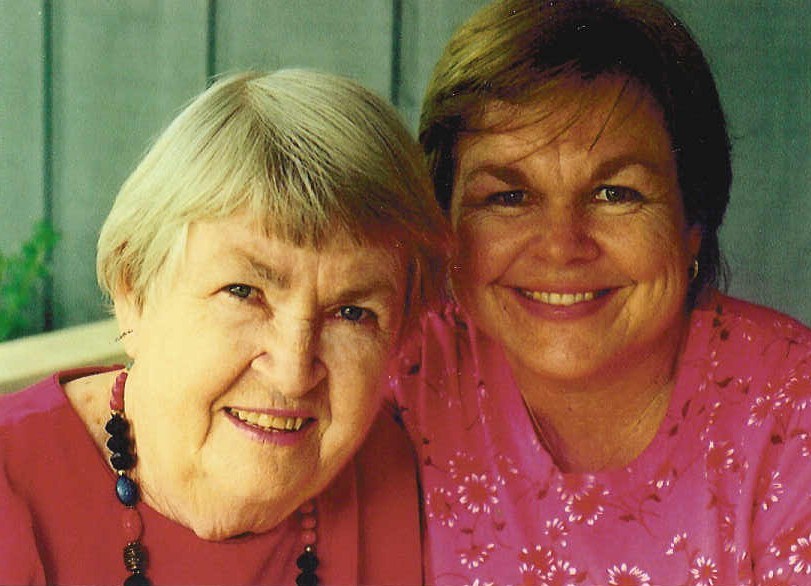
[My mom, two of my brothers, and me]

Memories of childhood can be sparse…difficult to pull forward into the present. It’s hard to accept that some of those memories, as we re-engage with them, are still colored by the fears of a 7y/o or the anger of a 15y/o. Even though we now, as adults, can reframe them. Those memories don’t have to keep us as victims. We are grown now. We can look at them again from a different viewpoint…and heal.

I’ve been immersed for a few years now in examining family of origin stuff, generational trauma, and how those experiences (both the bad and beautiful) are passed onto our children. Some close friends and family have said to me that exploring the past is not helpful. Being present in the present is the way to live. I agree for the most part, except the past is still with us in the present. I don’t want the past to mess with my present…or the future of my children and grandchildren.

A few weeks ago, I had the pleasure of attending an Allender Center conference on our family of origin story. What a treat to sit under the teaching of these wise therapists and hear how to engage the memories of our childhood. This is not at all about blaming parents for mistakes they made raising us. However, it is about confronting what we continue to carry with us from those days. We often say, “They did the best they could…or knew to do.” That may be true. As I look at my own parenting, I sometimes didn’t do the best I could or knew to do. Sometimes I did wrong to my children. It is part of life along with the beautiful, so we reckon with it and wrestle with it, for the sake of the good that is possible.

L to R – Adam Young, Cathy Loerzel, Dan AllenderAllender Center Conference

We can learn from our mistakes and our parents’ mistakes on a path to healing. In the conference I attended, Allender, Loerzel, and Young all called for three components necessary in engaging our family of origin stories:

Curiosity, Kindness, and Community – We don’t just leave the past “in the past”. It is always with us. However, to heal from the hard of our past, we must gaze into our memories with curiosity and kindness and within a trusted community. Sometimes memories seem few and spotty, but as we engage them, recalling them, they will come more to our consciousness. The adage, “If we don’t learn from the past, we’re bound to repeat it.”, is truer than we think.

I have appreciated taking a deeper look into my own family of origin (thanks to the helps and guidance of these therapists, Dr. Curt Thompson, and others).

Here’s part of my story. Consider examining your own. You might be surprised at the freedom that comes.

My parents grew up in the American South at the end of the Great Depression. They knew poverty. I know next to nothing about my paternal grandparents, but my mom’s parents were very much in our lives. That’s grandma in the picture below surrounded by some of her grandchildren. Grandpa rarely made it into a picture. He was a loner and alcoholic who clearly experienced terrible disappointment during those years of under-employment. 5 children, all boys except mom who was the middle child. Her role in the family was a buffer for her dad’s anger, and the boys all left home as soon as they could get into the military.

[My 3 brothers and me in the front of pic]
[Grandpa and Grandma Byrd, my mom’s parents]

My biological father didn’t work. He grew up on a farm, but when he and mom married, he just couldn’t quite hold down a job. Mom worked long days, but instead of my father caring for us, she had to hire babysitters. He didn’t want the responsibility. I don’t know much more. They divorced when I was 5 or 6. I saw him only once after that.

[My biological father]

Abandonment and neglect were part of my mom’s childhood and part of mine. She loved us and did what she could to feed us and house us. While we were growing up, we didn’t feel particularly poor. I did somehow experience food insecurity and fear which led to a life-long struggle with food and fear that I hoped not to pass on to my children.

Generational trauma has become a fascination for me in recent years because of the therapists above and others and because of its frightfully common occurrence. It is a concept that winds its way through human history (“sins of the fathers revisited on their children to the third and fourth generation”). We know from personal experience that we learn habits and responses from our parents (and they learned from their parents). We have the capability, as parents ourselves, of continuing healthy expressions of care for our children. We also have it in us to stop the succession of wrongs we have endured in family relationships…if we are attuned to them in our own parenting and grand-parenting.

How God Visits Sins on the Third and Fourth Generation – John Piper

Therapist Adam Young podcasts on these processes regularly. I’ve learned much from him as well as Dr. Curt Thompson’s podcasts. Young talks about something he calls “The Big Six – What Every Child Needs From Their Parents”.

  1. Attunement – our parents’ ability to read how we were doing/feeling
  2. Responsiveness – our parents’ willingness to respond to our upset (whatever it might be)
  3. Engagement – our parents’ desire to genuinely know us (at a heart level, whatever age)
  4. Affect regulation – our parents’ ability and willingness to soothe us, whatever our emotional state was at the time – scared, angry, shut down, etc.
  5. “Strong enough to handle your big emotions” – our parents’ ability to stay with us when our emotions were potentially uncomfortable for them; not taking these big emotions personally but welcoming them rather than shaming them.
  6. Willingness to repair – our parents’ willingness to own and right any harm they may have done to us as children (whatever the age).

Attachment: What It Is and Why It Matters – Adam Young

Why Your Family of Origin Impacts Your Life More Than Anything Else – Adam Young Counseling [Podcast]

My siblings and I grew up much loved by our Mom. She did what she could to give us a safe and secure childhood. One of her struggles was having had a childhood that leveled its own share of hard. She brought that forward without knowing. She knew abandonment and didn’t want us to experience it. I believe this is one of the reasons, ironically, that she divorced my biological father. We wouldn’t have to experience up-close his own lack of care for us. Never knowing him or his family, I have wondered in recent years what affected his own neglect of us.

You can tell it’s all very curious for me. I hope you are curious as well. Not to blame a parent but to understand your experience growing up and the impact of attachment in your relationship to your parents and their relationship with theirs. With the hope of setting a foundation of deep love and care for your children and theirs. It doesn’t have to be the situation of where “hurt people hurt people”.

Would you consider journaling your family of origin story and processing it with trusted individuals? Curiosity, kindness, and community – Be curious about your family as far back as you can take it. Treat those memories…those family members…with kindness. It’s very possible those memories will have greater meaning as you explore them as an adult. Where they were painful, repair and healing are possible…if we don’t just try to stuff them somewhere out of sight, out of mind. In community, our stories help us to understand each other and ourselves…and find the beauty and freedom there in the discovery.

Even Hollywood gets it right sometimes. In the TV show FBI (S6, E2, “Remorse”), the last line of the episode is so pertinent. A father (who struggled with alcoholism) talking to his teenaged son (who had begun drinking and was repentant):

“Mistakes are just part of the game. What’s important is what we do next.” Owning your part. Asking forgiveness. Treating each other with kindness, not contempt. Repentance and repair.

I’ll come back to this another day…hoping to learn from your journey as well. Thanks for stopping by.

[Mom, our step-dad, and our 3 kiddos – much loved all the way around]
[Dave’s parents]
[4 generations with Dave’s grandmother, mom, and our first-born]
[Another 4 generations pic with Dave’s dad, Dave, our son, and wee grandson]
…they grew up so fast.

Monday Morning Moment – Generational Sin and Trauma – Don’t Trip Over What’s Behind You – Deb Mills

Monday Morning Moment – Sins of the Fathers – Neglect and Abandonment – It Stops Here. – Deb Mills

Monday Morning Moment – Abuse – Where Does It Begin and How Do We Respond? – Deb Mills

Monday Morning Moment – Generational Trauma and an Early Morning Exercise Toward Flourishing – Deb Mills

Monday Morning Moment – As Adults We Still Need to Feel Safe, Seen, Soothed, and Secure – Deb Mills

Monday Morning Moment – Mom – a Lifetime Full of Love Notes – Her Birthday Just Ahead of Valentine’s Day

Mildred Jane Byrd Stephens McAdams – Feb. 2 1927-Nov. 2 2002

[Today is Mom’s birthday – 22 of them now in Heaven. This blog adapted from the Archives. ]

Our little family has never lived close to the grandparents. This was not easy…for any of us. Before I married, I lived close to home, and Mom was my best friend. She died 22 years ago, and I still miss her every day. To people who knew her well, I would often say  “when I grow up, I want to be just like her.” Still working on that.

Mom and I shared a weakness for words…they are probably excessively important to us, delivering both positive and (sometimes) negative weight. She was a consummate encourager. She rarely missed an opportunity to lift another’s spirit or to speak loving truth to someone desperate for God’s touch.

Mom pictures for website 012

When I moved away to take a teaching job, she and my dad helped me with the move. New Haven, Connecticut would be a 2-day drive from Georgia. At that time, it was the farthest I had ever lived from home. She stayed a week to help me settle in.  While there, she was such great company. We explored the city together and laughed over a new culture and cried at the missing that was ahead for us.

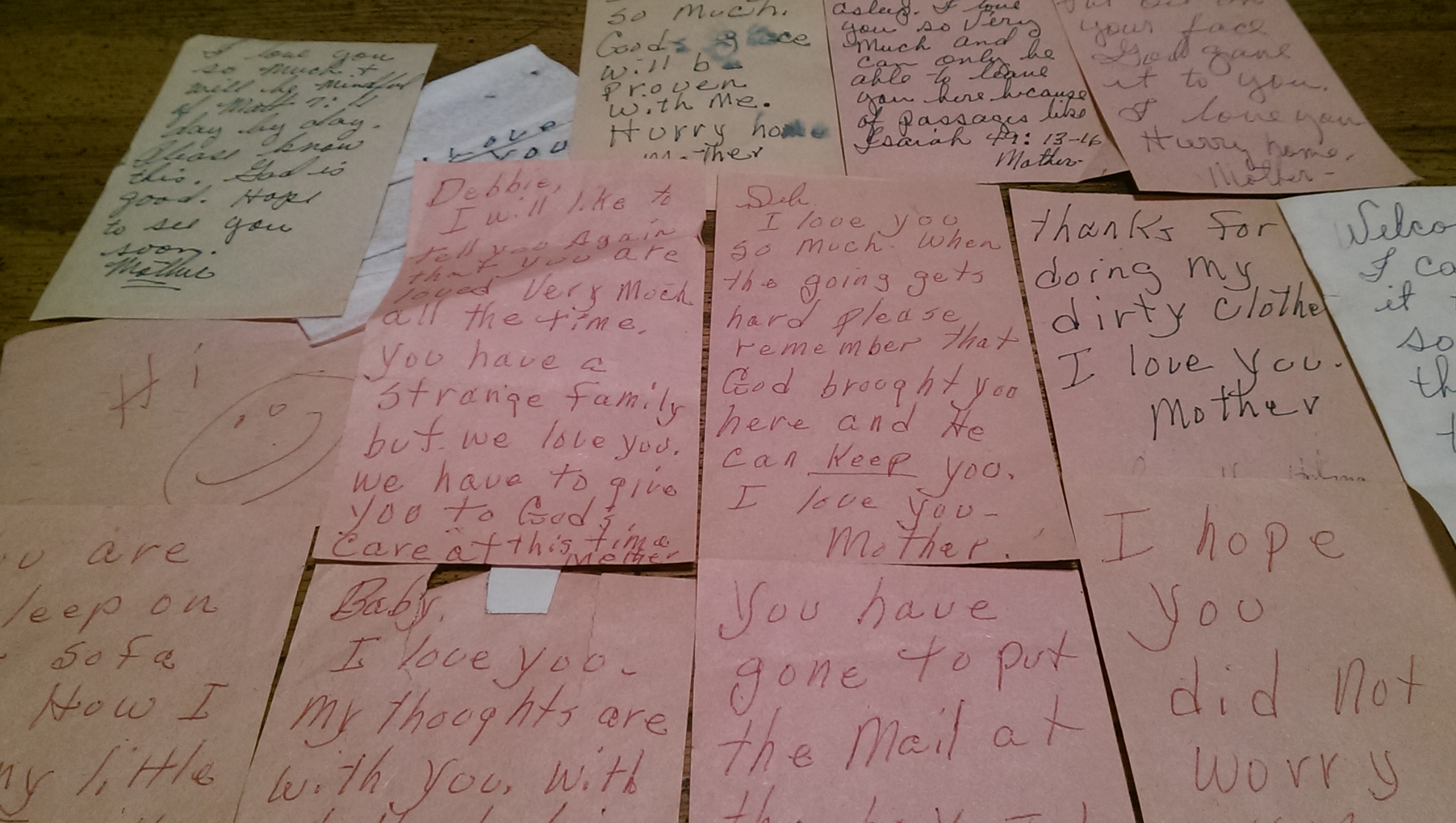
She filled my freezer with her baking, and, while I was at work, she wrote notes. Then she hid them everywhere. After she flew home, I began finding them. In my coffee mug. Under my pillow. In the pocket of my coat. Among my reference books. Behind my music books on the piano. She was with me in the love notes she left, and it made the distance between us…less.

My mom and I also had a weakness for bits of paper. I have kept every one of her notes. These from that move over 30 years ago are fading…red ink on pink paper. There is a lifetime of notes between Mom and me. The tradition she started on that first move has become a life-long tradition for our family. Our visits back and forth, across the US and then the globe, have been papered by little notes like these.

Our children, from the time they could write, entered into this tradition much to the joy of their grandparents. Before we would leave from visits with them, these three young ones would write of their affection for their grandparents and hide them all over their houses. I delighted in their cooperation in this conspiracy of love.

Mom always wrote notes…not just to us but to so many. She and her Sunday School Class ladies would send cards every week to the sick ones or the sad ones. She had a special burden for the elderly, for widows (including functional widows, deserted by husbands) and for fatherless children (again including those “orphaned” by still-living fathers). She inspired me by her humble ambition .

Pure and undefiled religion before our God and Father is this: to look after orphans and widows in their distress and to keep oneself unstained by the world. – James 1:27

I am so thankful for my mom’s bits of paper…for her love…and for her perseverance in encouraging and serving others. Her generation is sadly almost gone, and it is for us to pick up these traditions, or traditions like them. Passing them on somehow to the next generations…Maybe there won’t be bits of paper or love notes like in the past. I do hope we still take the time to write. Definitely, the call to serve and to encourage is as current as ever. My life continues to be rich with those, young and old, who reach out with words of kindness and encouragement. Written or spoken, they are love notes to the heart.

[Thankfully, our grown-up children continue to show love to their parents with words – both written and spoken.]

Thanks, Mom. After twenty-two years, many may have forgotten you for now. Many more won’t know of you this side of Heaven. Your life may have seemed small, but it was larger than life to me.

Thank you. Thank God for you.

Therefore encourage one another and build up one another, just as you also are doing.1 Thessalonians 5:11

The 59 “One Anothers” of the New Testament

Sunday Grace – A Valentine’s Day Reflection of the Deep, Deep Love of God – Deb Mills

Monday Morning Moment – Birthdays and Seasons – the Punctuation of Life

Photo Credit: ArborMaxTree

Hello, Dear Ones. As I write, Keith Jarrett‘s Shenandoah is playing in the background. Have a little sit with me, and let’s talk about birthdays and seasons. My birthday has just passed, and it was truly fine. Full of reflection of past years and wonder at the possibility of another calendar year added to my life.

Grateful.

Oh…there was a momentary pity party. A singular evening-long regret that I have not always stewarded friendships very well. Not sure that will be changing (sigh…) which then took me again to gratitude for the friends who have stuck with me through all these years. What treasures you are!

This birthday has unfolded…with cake, cards, family, and some of those faithful friends showing up anyway.

Life is such an amazing thing. In every season. As we get older, so many things change but our hearts don’t really age. We still long for closeness with those we love; we seek out purpose in our days; we pray to finish well. All the things.

Photo Credit: Heartlight

A few hours ago, I had birthday lunch with a dear friend who is coming up on her 80th birthday. We both lamented that if birthdays punctuate life, then those celebrations ahead could barely count into double digits. Those times with family. Those opportunities of looking back and ahead. This beautiful woman with a heart full of love wondered aloud if she was/is doing what she was supposed to do with her life. I am so glad she trusted me with that, because it was my joy to remind her of the huge ripple effect she has across so many lives. All the good quietly overflowing from this servant of a woman. Continually.

My heart is just encouraged thinking about her…and inspired by the possibility of living life well at 80.

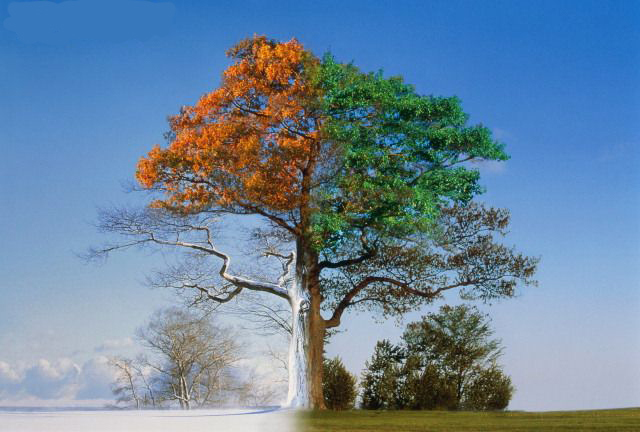
Another friend gave me a beautiful photo calendar. Every page has a picture of this tall, proud maple tree in our yard. She had taken a picture of the tree through all the months of this year – in all its glory, in every season. If that maple tree could talk, it would not lament one season over another one, I don’t believe. Oh, it may remember most gladly the leafy summers or its deep red Fall foliage, but each season has its own sweetness, its own beauty.

As happens, I find, one experience flows into another, deepening the lessons we’re meant to learn. Facebook Memories today took me to a blog I read 10 years ago written by Amanda Hill. She wrote about “glory days” and reflected on seasons, using the example of the towering oak eventually ending up in bundles of firewood. Here are the last few paragraphs – so worth your read:

I am not good at letting go.  I hold onto old pictures and handprint wreaths and have all kinds of problems letting friends slip away through the years.  I want to hold onto them like warm blankets, safe and folded, loved and cared for, put away in a cedar chest.  I want to hold onto a better time or a better place when secrets were yet unearthed and I was an oak who protected.  I want to go back to a time when I didn’t believe anyone could really chop me down.

And yet sometimes we have to be stripped down to be built up again.  Ripped into bundles and packaged differently and oftentimes devalued in the world’s eyes to realize what our true worth is.  A piece of wood cannot again become a tree, but it can light a glorious blaze of sacrifice…

Photo Credit: PxHere

This is a worthy calling as great as a tree standing tall, for “we know that in all things, God works for the good of those who love him, who have been called according to his purpose.” Romans 8:28.

Don’t look backward. Let the past slip through your fingers like fine sifted sand, knowing that God will reshape, and reuse, and redirect into something magical. Your glory days are ahead.  Brilliant blazing bursts of light that will dance and spit and pop with fire.

Burn bright. It’s what you were born to do. Amanda Hill

I’ve embraced this birthday with peace and even joy. Thankful for the life that’s been given to me. All of it.

Every birthday. Every season. With still many adventures ahead.

Our kids grew up with “Calvin and Hobbes” (1985-1995) created by Bill Watterson. Last week, on the Facebook page Everything Calvin and Hobbes, an essay was posted detailing Calvin, as an old dying man having his last visit with his friend Hobbes. It reminded me once again of all the seasons, before children and after, and relationships that weave together to make this wonderful life in all its hard and good. Thank You, God.

Thanks also to any of you still reading this ramble. Wish you could come by to share the last piece of my birthday cake.

Photo Credit: Calvin and Hobbs, Facebook, Everything Calvin and Hobbs, Lizzie Friden

Monday Morning Moment – Staying Curious & Leading Children to Be So

Photo Credit: UVA Today

We were born curious. Little children asking “Why?” over and over again. Wanting to know, to understand, to shine light on this great big world of ours.

“Curiosity is the very basis of education and if you tell me that curiosity killed the cat, I say only the cat died nobly.”Arnold Edinborough

As we get older, we get comfortable with what we know. Our sense of wonder too often flattens into the daily routine. We have occasional forays into a trending pursuit, or we hunker down for a time to develop a new skill. Can we call those activities and intentionalities curiosity?

Curiosity comes out of a desire to understand those around us and the world we share.

“Listen with curiosity. Speak with honesty. Act with integrity. The greatest problem with communication is we don’t listen to understand. We listen to reply. When we listen with curiosity, we don’t listen with the intent to reply. We listen for what’s behind the words.”Roy T. Bennett, Compassionate Curiosity – Asking Good Questions

Curiosity communicates caring. As we fix our gaze on another person and ask the questions needed to actually get to know them, we show genuine interest. That interest draws the other person into a space of belonging…of belonging with us. Curiosity about the world, beyond the person, fills us with wonder.

“The important thing is not to stop questioning. Curiosity has its own reason for existence. One cannot help but be in awe when he contemplates the mysteries of eternity, of life, of the marvelous structure of reality. It is enough if one tries merely to comprehend a little of this mystery each day.”Albert Einstein, —”Old Man’s Advice to Youth: ‘Never Lose a Holy Curiosity.'” LIFE Magazine (2 May 1955) p. 64”

What happens to us as we grow up? Do children lose their sense of curiosity and can it be regained? Yes and yes. Be curious yourself about the children around you. Have they already shrunk their worlds into a small group of friends and a few preferred activities? Do they find people intriguing and nature wholly fascinating? Are they open to being a part of a larger community…one that is multi-generational and multi-cultural?

Recently I came across an Instagram post by Ian Simkins. As you swipe left, across several screens, Simkins talks about the curiosity of children and what happens as we get older. Before I can really impress upon my grandchildren to be more curious, I have to practice it myself.

Jeffrey Davis, a researcher and business consultant, gives us a compelling look at curiosity as a key to belonging:

Curiosity is the proactive facet of wonder that spurs us to question the way things are and our desire to learn or know. Curiosity propels us to become more engaged in new experiences, seek novel perspectives, and—especially important—connect with other human beings in more enriching and meaningful ways.

As much as we’re wired to crave belonging, we’re also wired for bias...which is why we naturally gravitate toward people who look like us, share similar views, or come from similar backgrounds. It’s also why we pursue things that are comfortable, familiar, and reinforce our existing beliefs.

In short, our brain unconsciously sizes people up as friends or foes to keep us safe, inadvertently closing us off from the connections we so desperately need. But when we allow wonder and curiosity to take the wheel, we can break out of our bias boxes, and often, we’re much happier for it.

  • Strike up a conversation with a stranger.
  • Lead with questions out of genuine curiosity.
  • Share experiences of wonder.

By leveraging wonder and igniting your curiosity, you can build more authentic connections, deepen your relationships, and improve your mental and physical well-being.

Photo Credit: Walt Whitman, QuoteFancy

I want to challenge us to stay curious. To show genuine care for others. To practice life-long learning about our world and the people who populate it.

Then, we can model curiosity and care to our children…coaxing them into the wonder that surrounds us. Taking it all in with gratitude…because we don’t necessarily deserve the goodness in our lives, but we have it just the same…curiously. Wonder at that for a bit!

Curiosity: Why It Matters, Why We Love It and How to Get It Back – Christy Geiger – Excellent resource and fast read. Don’t miss this one!!!

Six Surprising Benefits of Curiosity – Emily Campbell

Curiosity and Compassion: Your Super Powers for Emotional and Mental Well-Being – Kelly Hine

Curious About Curiosity? Professor Studies How Children Learn – Anna Katherine Clay, UVA Today

Why Curious People Have Better Relationships – Jill Suttie

Be Curious, Not Judgmental – a Leadership Lesson From Ted Lasso – Connie Whittaker Dunlop

Curiosity as a Moral Virtue – Elias Baumgarten

Why We Should Be Curious About Each Other – Lisa Bortolotti and Kathleen Murphy-Hollies

Photo Credit: Slideshare, The Art of Powerful Questions

Monday Morning Moment – Hall-of-Famers and What Makes Them So

[One of the W-3 Huddles – staff retreat for Holston Valley Hospital’s W-3 cancer nurses]

What is it that distinguishes an individual or group and sets them apart from all the rest?

I’ve had the privilege of working with such folks from time to time through my life. In the late 80s-early 90s, it was a group of nurses in Kingsport, Tennessee. We had moved there as young marrieds after Dave finished his Ph.D. for him to start work as a research chemist at Tennessee Eastman Chemical Company. I left my job as professor in the nursing program at Yale University to find my way into a tight medical community. People were kind, but it would take awhile for me to prove that I had something to offer.

The nurses on 3rd Floor Wilcox Hall of Holston Valley Hospital, in those days, were a rare collection of capable and caring women. We all know the adage about working smarter, not harder. They worked both smart and hard. I was honored just to help in whatever way I could as they shouldered heavy patient loads with stressed families to care for as well.

They were funny, scrappy, no-nonsense, determined, and loving. It’s been almost 30 years since our days together, but I will never forget them (and others of whom I don’t have pictures).

L to R: Nurses – Nan Ritchie, Kay Mitchell, Debbie Seymore Shields, Chris Blue

Just this weekend, I was on a long, refreshing phone conversation with Kay Mitchell. She, Kathy Visneski, and I worked closely together during those W-3 days. Kay was nurse manager, Kathy a nurse educator, and I was clinical nurse specialist. We dreamed, planned, and executed programming, support, and training for some of the best nurses we would ever know.

Kathy and I led a support group for cancer survivors and their families. Part of its success was the trust these folks had in the care they received during the times when the cancer was new and raw, and for some, when it would finally take them. The W-3 nurses would be wholly there for them in every season.

[in conversation during Take Time…to Help to Heal cancer support group]
[an activity from the Take Time…to Help to Heal support group]

Love Your Neighbor – Cancer Support – How It’s Done Well – Deb Mills

In our phone call, Kay told me a story. A few months back she had a knee replacement surgery. Years of nursing, like with many professions, are hard on our knees. As she was “ambulated” – being walked in the hall shortly after surgery, she was in the company of nursing friends who’d come to see her. Friends from the era we shared. Like Kay, they had gotten older (it is odd how we get older but still, with each other, feel the full vigor of life shared in the workplace). It must have been a sight, this nurse “patient” and her friends filling the hall, walking slowly together, in conversation and encouragement. A physical therapist observing them captured the scene with the word, “Hall-of-Famers”. These women who were known and, as it should be, revered.

Kathy Visneski & Dr. Chip Helms, Radiation Oncologist
L to R: Nurses Chris Blue, Ruth Couch, Kathy Visneski, Volunteer Sherry Weaver
Amy Thacker, Chemo Nurse
Sherri Rogers, Nurse Manager

So how do people become “hall-of-famers”? What made these women…and other men and women like them…notable? Remembered with tremendous fondness and honor.

Here’s what I think. It was their servant leadership. Whether staff nurses or nurse managers, they led with excellence and a serving heart.

The phrase “servant leadership” is not new, but it is more than just a prescriptive or descriptive style of leading. Such a leader, as described by Collins and Collins, is “‘compelled by an unshakeable desire to serve’. Leaders who lack that core belief are not servant leaders but rather using servant leadership practices among the many in their toolkits. Notice we are not describing a servant but a servant leader. Servants generally don’t have a choice, but a servant leader, through humility, chooses to put others first…Leaders who do this well focus on where they can bring the most value to others…When we see someone step up in a difficult situation despite the probability of failure and commit themselves wholly because it is the right thing to do, we are more likely to join with them for the long journey. The unconditional nature of serving may be the most defining quality”..of these women.

“I saw this picture today that captured so well the amazing nurse Chris Blue. I was so blessed to have had the best role models as nurses! Chris Blue, Nan Ritchie, Joan Bishop, Jane Faries, Evelyn Parker, Kathy Visneski, Deb Mills, Amy Thacker, Ruth Couch, and Cynthia Wright to name a few. This picture captures the care we provided on good ole W3! Beyond blessed. So glad my roots are strong that started with this group. Brought back some amazing memories!”Teresa Bailey, 2020
Teresa Bailey

Hall-of-famers. Steadfast. Hard-working. Resilient. Intelligent. Caring. Full of life and love.

Who are the hall-of-famers in your life? Maybe you share your workload with some of these wonders. Please comment, if you’d like, about your experience with hall-of-famers. Maybe you are one…or on your way to becoming one. Thank you.

[A note I sent to our nurses and other cancer nurses in the region in 1994, the year we left East Tennessee]
Kathy, me, and Kay…some years later.

Monday Morning Moment – Word for the New Year – Strong (Nested in “Filled” – There’s a Story)

Photo Credit: Heartlight

In 2020 (the year of COVID), I read Debbie Macomber‘s book One Perfect Word. She tells fascinating stories of persons’ choosing a word to guide their year. Finishing her book and praying a bit, the word compassion became my focus. 2021 was a good year for that as we dealt with so many divisions over COVID, race, politics, etc. Compassion for all on both sides of each issue.

At first I wasn’t going to do “a word” for 2022, and then a rapid series of “coincidences” drew me to the word: joy. As that year ended, I had become negative and even a bit cynical. Still having faith in God but not so much in humans, including myself. Even after a year of compassion!!

Then 2023 followed, and I chose the word “wonder”. It was inspired by my study of Dr. Curt Thompson’s books. He encourages a pursuit of mental health and healing including staying “in the path of oncoming beauty”. This focus on wonder – in searching out beauty in the context of community and a loving God – brought me through a year tougher than I imagined it would be.

Monday Morning Moment – Word for the Year 2023 – Wonder – Deb Mills

Now we stand at the start of 2024.

The last several days of December 2023, I have pondered what word would be a fixed point for this coming year. New Year’s resolutions and habit formation are both great helps for my slightly scattered brain.

5 Friday Faves – New Year’s Resolutions, Habit Planner, Year-End Review, Word for the Year, and the Last Days of 2021 – Deb Mills

Here’s how it all came together, look toward 2024. In recent days, I’ve been lamenting behing older (i.e. Weaker, more frail). Having lost 2 inches in stature (just in the years of pounding on my vertebra) also made me feel small. I’ve decided to push back against the weakness and seemingly diminished nature of getting older. After all, what does that even mean?! I’m not that old. Right?

Then the passage in Joshua 14 came to my attention. First the back-story: During the years after God freed the Israelites from slavery in Egypt, they wandered in the wilderness awaiting his timing on entering the Promised Land. In obedience to God, Moses had sent 12 spies to scope out the land. It was amazing, filled with much good but also peoples of formidable strength. Only Caleb and Joshua returned with good reports that, with God’s help, they could take the land as their own. The other spies terrified the people and they pushed back against God’s call to enter and conquer. [This historical account is found in Numbers 13 and 14.]

Because of their disobedience, those in rebellion would not receive their homeland. They would die in the wilderness. For forty years, Caleb and Joshua would patiently endure the punishment not their own, as they waited for God’s command to enter the land, along with all the Israelite children now grown.

40 years later, when Caleb was 85, he gives a beautiful and faith-filled declaration:

 “I am still as strong today as I was on the day Moses sent me; as my strength was then, so my strength is now, for war and for going out and coming in. Now then, give me this hill country about which the Lord spoke on that day, for you heard on that day that Anakim (giants) were there, with great fortified cities; perhaps the Lord will be with me, and I will drive them out just as the Lord has spoken.” [Joshua 14:11-12.]

Talking to Dave (that husband of mine), he commented that Caleb had that strength for which I am longing because he had “a different spirit in him” (Numbers 14:24). Whereas the 10 spies and the Israelites influenced by them were driven by a spirit of fear, Caleb was filled by the Spirit of God. In his determination to obey and follow wholeheartedly, his faith emboldened him. He demonstrated strength physically, mentally, and spiritually.

He would not be defined by age, aptitude, or ability…but by the great and gracious God he sought to serve.

That’s what I long for in this coming year. To be strong. In all ways possible. Including strong in my love for God and others. This can only be mine if nested in being filled with the very Spirit of God.

Let’s see what’s ahead that will require me to be strong. Is that a tad unnerving? Absolutely! Yet, again, I am reminded of the goodness of God. “For when I am weak (and it will happen), then His strength is manifested perfectly and completely!” (2 Corinthians 12:10)

How is God’s strength made perfect in weakness (2 Corinthians 12:9)? – Got Questions [Read this brief glorious article about how God moves in our weakness – like helping us choose a word for the year, in my case right now.]

Photo Credit: The World of Calvin & Hobbs, Facebook
Photo Credit: Heartlight

Monday Morning Moment – Advent – Celebrating the Coming of Christ

Advent means “coming”. We celebrate the coming of Christ, as Messiah, a helpless baby born of a virgin mother. God in arms. Miracle and mystery. Advent also commemorates the coming again of Christ in the last days. We look with hope to the day He will come again for His people, as Redeemer King.

Advent is a time of preparing our hearts for His coming – we light candles to remind us how Jesus’ birth brought light into a dark world. Celebrating Advent happens over the four Sundays before Christmas. The candles we light represent Christ’s gifts to us: Hope, Peace, Joy, and Love. A fifth candle is lit on Christmas Eve celebrating Jesus, the One who came for us.

[Our current favorites for this Advent]

What the practice of Advent does is to keep Christ central in all the busyness of Christmas.

Those Sunday advent worship gatherings lead us then to continue in the Word through each week, focused, in particular, on the wonder of God coming so near to us…humbling Himself to enter this human space as an infant…to awaken us to who He was and is and grasp what only He could fully bring to us.

In celebrating the joy and peace we have in Advent, anticipating Christ’s coming, we look to the blessing Paul wrote to the Roman church which, at the time, was enduring terrible suffering.

May the God of HOPE fill you with all joy and peace, in believing, so that by the power of the Holy Spirit you may abound in HOPE. – Romans 15:13

Let’s rest in Christ’s beautiful word to us. Focusing on all the other stuff of Christmas can be exhausting…and sometimes unsatisfying. Keeping Christ as center is where we experience his hope, peace, joy and love.

This Christ who drew near to us in a humble creche and held nothing back from us, even in His death on a cross. Oh the love, the joy, the hope and peace, we have in Him. Hallelujah!

[Below are images of the Women’s Christmas Event, celebrating Advent, at Mt. Vernon Baptist Church, Richmond, Virginia. We were surrounded by beauty and loving hospitality in this experience.]

Lord Jesus, Master of both the light and the darkness, send Your Holy Spirit upon our preparations for Christmas. We who have so much to do seek quiet spaces to hear your voice each day. We who are anxious about many things look forward to Your coming among us. We who are blessed in so many ways long for the complete joy of Your kingdom. We whose hearts are heavy seek the joy of your presence. We are your people walking in darkness, yet seeking the light. To You we say, “Come, Lord Jesus!” Amen. – Henri J. M. Nouwen

Online Advent Readings/Studies

Biola University Center for Christianity, Culture and the Arts – The Advent Project – a daily Advent offering of art, poetry, music, and devotional from Scripture

The Gospel Coalition – Advent Readings

Gospel in Life – Advent Devotional Readings

Kate Bowler – Bless the Advent We Actually Have

Justin Whitmel Earley – Advent Readings

The Dawning of Indestructible Joy – John Piper – pdf

[What are some of your favorite Advent resources? Please post in Comments for all of us reading.]

Monday Morning Moment – Healing from Sorrow and Grief – with Adam Young, Francis Weller, Curt Thompson, & Jesus

Photo Credit: C. S. Lewis, Allume

So much sorrow and grief in the world…if you clicked on this blog at all, with such a sober title, then you are facing what is true for you, and for all of us.

Take a moment more and let’s sit together over this. Or if you have 2-3 friends or family members you deeply trust, gather them for a talk that will begin the healing of both a current grief or a distant sorrow. Losses, whatever they are, endure in our minds and bodies. If we leave them unshared, we still attend to them, either by the work of keeping them buried or by numbing them with the aid of our idols or addictions.

“When I stopped trying to block my sadness and let it move me instead, it led me to a bridge with people on the other side.” … I learned that sadness does not sink a person; it is the energy a person spends trying to avoid sadness that does that.”Barbara Brown Taylor

When you think about a sorrow, grief, or loss in your own life (current or past), what comes to mind? Something always comes. We are all experiencing a global sorrow in the war brewing in the Middle East. Here in my town, a young widow and an older one are daily finding their way forward through grief. For you, maybe it is a past loss of great import…or even one you think is only important to you. If it’s important to you, it matters to those who care about you. We self-edit and compare our sorrows, but they stay strong and real in our own life experience.

What can we do to heal the ache of these sadnesses? To refuse to isolate ourselves and our losses from community? To experience hope again?

Just today I came across the incredibly helpful series of podcasts on sorrow and grief by the therapist Adam Young.

How to Heal from Sorrow and Grief – Part 1 of 5 – Adam Young Counseling – Podcasts 132-124, 137, & 138

Adam Young describes the four conditions needed to allow us to work with sorrow and grief:

  1. We own that our sorrows and griefs matter and should be taken seriously.
  2. We need to gradually move from a posture of contempt toward our sorrow and grief to a posture of compassion and kindness and welcome.
  3. We need to find a few people who can be the village for us… allowing us to risk sharing our sorrow and grief with other people.
  4. We need to move our bodies in a way that allows for the integration and release of our sorrow and grief. Adam Young

We can be very hard on ourselves regarding our sorrow and grief, because somehow we think we should get over it or not care so much or ___________________________ (fill in the blank). Even when we push our grief into the deep interior of our minds, or we try to forget through our “drugs” of choice, it is present. Closer to the surface than we imagine.

Photo Credit: Francis Weller, Pilates Embodied, Pinterest

In the above podcasts, Adam Young quotes psychotherapist Francis Weller extensively, which is a huge help for those of us who have yet to read Weller’s book The Wild Edge of Sorrow. Weller emphasizes the impact of grief over time, on our minds and bodies and relationships. He encourages community as the place, or people with whom, to release our sorrow.

Francis Weller Quotes from his book The Wild Edge of Sorrow: Rituals of Renewal and the Sacred Work of Grief

I’ve been reading The Deepest Place by Dr. Curt Thompson (the fourth book he has written and the fourth book of his I have devoured!). Thompson talks about the common nature of suffering in all our lives. Once we embrace that fact, then we can be more open and honest with “villages” of people who are there for us…and we for them. This has been so healing for me as I’ve opened up about my own sadness regarding the rupture of my extended family and the pain we have all suffered from it.

A group of us just today were hearing an update from a friend who has endured through a chronic illness for which her doctors have found no solution…yet. She is tired and struggling. Reading Thompson’s chapter on perseverance reminded me of her ordeal. Her faith in God and her determination to keep open and close to her community have given us all hope that the future will be brighter for her…and we will be there with her for it.

Healing from Trauma: the Power of “Being With” – Parts 1 & 2 (Podcasts episodes 141-142) – With Curt Thompson MD and Adam Young

That new landscape that C. S. Lewis talks about (in first image above)? It’s one we have the privilege of seeing together when we show up for one another…especially in sorrow and grief.

Photo Credit: Heartlight

Being Known Podcast – Season 7 – Confessional Communities – Curt Thompson MD

Monday Morning Moment – My Take on “Braving the Wilderness” with Brené Brown

Some books you happen upon by chance. Author and researcher Brené Brown‘s Braving the Wilderness: the Quest for True Belonging and the Courage to Stand Alone was just such a book. I pulled it off a used book shelf at my favorite thrift shop recently and have read it twice over the last couple of weeks. Having heard her speak many years ago, and, since then, quoting her often on this blog, she has been a definite influence in my thinking. Then our culture took us all on a mad roller coaster ride, and her voice became one I stopped attending.

Until this book, published in 2017, and just now read.

Brené Brown has much studied wisdom on who we are in relationship to others. I’d like to share some of my takeaways from this little treasure of a book. [Sidebar: Not in lockstep with all her conclusions, but some are so rich and needful, I want to offer them to those of you who might not read them yourselves.]

1) Belonging is the innate human desire to be part of something larger than us. Brown talks about the crucial work of valuing who you are and what you bring to any community, family, or workplace.

“Even in the context of suffering—poverty, violence, human rights violations—not belonging in our families is still one of the most dangerous hurts. That’s because it has the power to break our heart, our spirit, and our sense of self-worth. It broke all three for me. And when those things break, there are only three outcomes, something I’ve borne witness to in my life and in my work: 1. You live in constant pain and seek relief by numbing it and/or inflicting it on others; 2. You deny your pain, and your denial ensures that you pass it on to those around you and down to your children; or 3. You find the courage to own the pain and develop a level of empathy and compassion for yourself and others that allows you to spot hurt in the world in a unique way. I certainly tried the first two. Only through sheer grace did I make my way to the third.”Brené Brown, Braving the Wilderness: the Quest for True Belonging and the Courage to Stand Alone, p. 14

2) There are at least four elements of true belonging.

a. People are hard to hate close up. Move in.

b. Speak truth to bullsh*t. Be civil.

c. Hold hands. With strangers.

d. Strong back. Soft front. Wild heart.

These are chapter headings in Brown’s book Braving the Wilderness. Each could stand alone as inspiring to us in embracing how we are meant to live life. To truly belong. In community that is honoring to those around us, ourselves, and our Creator.

In a capsule, each element (or practice) speaks to the choices we make in leaning in to those both like us and not at all like us. In fact, we can see how we are doing in “braving the wilderness” – dealing with the strange and isolating sides of life – as we examine our daily habits. Am I willing to be in proximity with those different from me, those who think, speak, or act in opposition to me? With those who clearly communicate that I don’t belong. We collude with such opinions if we pull ourselves away, believing we don’t belong. We silence ourselves. We don’t show up. [I’m choosing not to hate as a daily practice and not to be counted out. Full stop.]

We can be civil. If we find ourselves in conversations filled with belittling, loathing, sarcasm, one-up-manship, then it is a sign we have bought into someone’s bullsh*t. Maybe even our own unchecked attitudes or opinions. Do we need boundaries sometimes? Sure…but if we can practice civility (even love) toward someone acting in ways that exclude or diminish us, maybe we can find a place of belonging to meet. To live with that person instead of forever without them.

The courage to take hold of strangers’ hands can open a whole new world of belonging and meaning to us. Concerts, sporting events, volunteering to aid people in need. People who link arms over something larger than themselves. Our children need us to belong and bring them along. I’m not sure if it was 9/11 or COVID or what has moved us to gather in small, tight circles. We miss out on a larger life in this way. A life full of purpose.

Brown uses the acronym “braving” in how to maneuver through whatever wilderness we find ourselves. You can see it in the image below.

Photo Credit: Brene Brown, Lanre Dahunsi

3) Strong Back. Soft Front. Wild Heart. I want to return to this element.

Brown closed her book “Braving the Wilderness” with challenge and encouragement. We can have strong backs as opposed to rigid backs. A strong back is one that is capable of carrying burdens, ours and others, without becoming rigid with unmet expectations or misunderstanding. We strengthen our backs with showing up and growing capacity for caring. The soft front comes not from looking for the negative of rejection, exclusion, or insecurity. It comes from honoring what we each bring and what we each need. A soft front encourages, empowers, and elevates. We refuse to diminish our own place at the table, nor do we push others away, because they are not like us. Something to think about. And that wild heart Brown talks about? It’s that heart we can have when we don’t believe lies or attitudes that make us feel small or overlooked or outside the circle.

“The mark of a wild heart is living out the paradox of love in our lives. It’s the ability to be tough and tender, excited and scared, brave and afraid—all in the same moment. It’s showing up in our vulnerability and our courage, being both fierce and kind.”Brené Brown, Braving the Wilderness: the Quest for True Belonging and the Courage to Stand Alone, p. 155

The heart becomes wild, free if you will, because we believe what is truest and most beautiful about ourselves, about others, and especially about God. The world is still a wilderness, but we don’t have to be afraid.

So…those are my takeaways from this special little book, and its author’s wild heart!

Photo Credit: Anatomy Worksheets

Braving the Wilderness Companion Worksheet