Category Archives: Leadership

5 Friday Faves – Birthday Freebies, Decluttering, Untold Stories, Global Ancestry, and Rhythms of Life

What a week! Maybe all weeks finish with an exclamation point… This one sure did. In the midst of all the crazy, there are delights to discover and life-enriching finds for all of us.

Here are five of mine:

1) Birthday Freebies – Having just experienced another birthday, I make a practice of celebrating not just the day but as far as I can take it. Sometimes weeks but definitely several days. Birthday freebies grease the tracks. We all have favorite restaurants, right? If you sign up for email updates, many times you’re placed in a VIP club of sorts. You probably already do this, but it’s new for me. It’s especially nice when you’re not deluged with email….otherwise they become less favorite.

Four of my favorite “clubs” are Mission BBQ (free sandwich for your birthday), Silver Diner (an entree AND a dessert free for birthday person), O’Charley’s (free dessert), and Qdoba (buy one entree get one free). In the comments section, pass on your favorites to sweeten our birthday celebrations even more.

2) Decluttering – Okay…I have a small problem with this. However, much that’s written these days feels so punishing, like a character-beat-down. I have no interest in dumping all my clothing in the floor and deciding whether each piece makes me happy or not…and then thanking the discards before they’re shipped off to wherever.  Sometimes, people discard only to buy more of the same stuff. Their choice; not my business.  [See the fascinating Opposing Views’ video below.]

Brie Dyas has written a thought-provoking and kindly piece on 11 Things in Your Home That Are Making You Unhappy. Some of the clutter she covers doesn’t make me the least bit distressed, and she writes in a way that doesn’t judge the reader for her clutter. In fact, I was incentivized after reading her post. Decluttering doesn’t have to communicate devaluing (of the person or the clutter)…nor do we need to express ungratefulness when gifted with what we might consider just clutter.  There is a stewardship principle that applies to managing our possessions. I want to be a good steward of the stuff of our lives and the time necessary to manage it. A more ordered home…life…is also my desire. I do appreciate the loves in my life who guard against conspicuous consumption. I am also frugal. So where do I begin decluttering? The stuff that’s sentimental to me?…still keeping. The piles of papers I’m afraid to file and forget somewhere? Maybe I can happily let those go!  Dyas’ piece has encouraged me to deal with the things I have hung onto…for no good reason. Definitely don’t need the stress of excess. Any thoughts? [Comments]Photo Credit: Prairie Home Therapy

3) Untold StoriesMatthew West is a songwriter and story-teller. His website I Am Untold gives the accounts of abortion survivors (both the babies and the parents) and other like stories. There is so much division in our world over life issues – the pre-born, the men and women who unwittingly conceive or who abort and then regret. Here are stories from a very different side of this issue.

Then there are also people challenged all through the life-cycle (with disabilities or problems of poverty or aging). We hear from those in the business (Planned Parenthood) and those with political motives.

I don’t have my own abortion story, but knowing and loving friends and family who live with heartache – the heartache of a decision they would make differently now also need our care and consideration.Photo Credit: Insider

4) Global Ancestry – The United States is a “melting pot” country – a nation of both native peoples and immigrants from all over the world. It’s one of the many things I love about my homeland. Photo Credit: Ellis Island

Defining words like populism and nationalism have taken on a whole new intensity and seriousness in our current political situation. I’m hopeful still that our country will continue to be founded on the ideas of our founding fathers and shaped by the great men and women of more recent years…Photo Credit: Urbs

Part of the richness of this country is what others have brought with them from other homelands. My own history tracks back to the Bruce’s and Wallace’s of Scotland. Watch this video of how we are connected much more than we could imagine.

It would be much more complicated for us to choose certain peoples that we don’t want as part of our country when we see that we are more part of each other than not.

Exploring the Origins of Language – Video

5) Rhythms of Life – Rhythms are defined as “strong, regular, repeated patterns of sound or movement”. We all have them in our lives. Some rhythms in our lives relate to our habits and routines. Others are strictly recreational which can dampen the rhythms which require us to go deep. I hadn’t give rhythms much thought until Our pastor, Cliff Jordan, talked about them as a discipline of grace.

Photo Credit: NewsongPDX

In this Sunday’s sermon, Cliff talked about the deep rhythms of intaking God’s Word. Too often, we treat spiritual disciplines as a task to be checked off with little impact on us at all. Or even as a sidebar to other pursuits or pleasures that absorb our hours and focus and energy. Oh what we miss in not going deep into the knowledge of God and what He wants to say to us…through His Word. I have known rhythms in life when pouring over and meditating on Scripture was a deep passion for me…to know God and to make Him known…my heart has been stirred afresh this week.

Podcast – The Rhythm of Intaking God’s Word – Cliff Jordan – Movement Church

Explore God

Finally…there is this guy…publishing a most ambitious video next week. Can’t wait. Because of him…I’m now a patron of the arts.

Have a great weekend!

Monday Morning Moment – Inner Rings – the Mad Pursuit of Position, Power, Prominence, and Plenty

Photo Credit: Chris Russo

[Adapted from a previous blog]

When C. S. Lewis introduced the occurrence of “inner rings” to a classroom of young men in university, he wasn’t talking about high school cliques.Photo Credit: Smosh

[You will want to read Lewis’ short, humorous, and piercing lecture…I read it aloud, attempting my “best” British accent. The British accent, in my opinion, gives what is true even more authority and winsomeness.]

Lewis talked about the universal, life-long allure of wanting to be “on the inside”…whatever that might mean at the time. Inner rings are, for the most part, morally neutral in themselves. What becomes the issue for us is how our thinking is altered and what we are willing to do to gain entry to these exclusive (and often secretive) inner circles.Blog - Inner Rings 2 - BPNews.netPhoto Credit: BPNews

Inner rings are part of every level of life – personal relationships, government, teams, military, clubs, organizations, and workplaces. They aren’t necessarily represented by team rosters or org. charts, as much as they are the more fluid unwritten associations. Like secret societies, they can change quite without explanation – sometimes you are in and then you are not. Inclusion and exclusion are defined by the group itself…and are not accidental.

Let’s face it – we all want to belong…somewhere among the best of the best. Even when we don’t say it out loud, some sort of identity appeals to us and drives our pursuits. Jeremy Writebol wrote a piece where he explores this pursuit of belonging, referencing C. S. Lewis’ Inner Rings. Lewis talked about what we are willing to do to be identified as one inside those rings, or inner circles. There’s the danger – what we’re willing to do.

Writebol presents 4 inner rings of belonging:

1) The Inner Ring of Acceptance [Position]

2) The Inner Ring of Authority [Power]

3) The Inner Ring of Applause [Prominence]

4) The Inner Ring of Abundance [Plenty]

None of us is immune to the influence of one or more of these inner rings or social circles. The deceit of pursuing membership to an inner ring is that it’s never enough. Like taking apart an onion, you find inner rings within inner rings…until there’s nothing left. No place to find belonging…because this passion is never satisfied. It becomes futile. Lewis does offer a two-part antidote:

  • In the workplace, make your work your focus. Whenever we lose our focus, the pull of desire for significance disrupts our engagement in the work. “The quest of the Inner Ring will break your hearts unless you break it. But if you break it, a surprising result will follow. If in your working hours you make the work your end, you will presently find yourself all unawares inside the only circle in your profession that really matters. You will be one of the sound craftsmen, and other sound craftsmen will know it.”
  • Outside of work, pursue friendships with people you like. This seems obvious, but if our desires to belong in a certain group have hijacked us relationally, it might not even be clear anymore who the people are we truly enjoy.  “If in your spare time you consort simply with the people you like, you will again find that you have come unawares to a real inside: that you are indeed snug and safe at the center of something which, seen from without, would look exactly like an Inner Ring. But the difference is that the secrecy is accidental, and its exclusiveness a by-product, and no one was led thither by the lure of the esoteric: for it is only four or five people who like one another meeting to do things that they like. This is friendship…It causes perhaps half of all the happiness in the world, and no Inner Ring can ever have it.”

Take the time to read Writebol’s piece. He defines each circle and asks clarifying questions, in a very kind way, to help the reader deal with the deceit or justification we may have developed, without realizing it.

[Writebol wrote a follow-up piece entitled Why Are We Chasing? which exquisitely unwraps the cost and consequence of our chasing – chasing after what we think we must apprehend, having become blind to what we already have.]

Here’s to work well-done and friendships that last for a lifetime. Here’s to choosing well and inclusion and celebration…and knowing we already belong.

Great Monday morning reads…Go!

The Inner Ring – C. S. Lewis

The Weight of Glory – C. S. Lewis – Collection of Addresses Including The Inner Ring

4 Inner Rings You May Be Pursuing – Jeremy Writebol

Why Are We Chasing? – Jeremy Writebol [Followup piece to above article]

The Inner Ring – Chris Russo’s Blog

C. S. Lewis and the Inner Ring of Cronyism – Elise Daniel – Institute For Faith, Work, and Economics

C.S. Lewis and the Inner Ring – Nicholas T. Batzig

The Inner Ring and the Moral Question of Our Time – Nozomi Hayase

Monday Morning Moment – Belonging and Going Deep and the Blind Presumptions that It’s Actually Happening When It Isn’t

The Fellowship: The Literary Lives of the Inklings: J.R.R. Tolkien, C.S. Lewis, Owen Barfield, Charles Williams – Philip Zaleski & Carol Zaleski

Photo Credit: Paste Magazine; Commonweal

Monday Morning Moment – 22 Influencers and Thought Leaders You Want In Your Life

Photo Credit: Arnold Street

Who are the influencers in your life? Those people who hold your attention, who cause you to think, who give impetus to change. Who are those thought leaders who challenge you – those whose reach exceeds their grasp?Photo Credit: Inc.

It wasn’t so long ago, in the training division of our company, that our director actually reprimanded new employees about their phone use during a session. It wasn’t so long ago…but it seems so. These days, no matter who is speaking at the front of the room, heads are down in the audience, folks pounding out texts or scrolling for their amusement. How do we fight this mental and relational disconnect?Photo Credit: PC World

What has helped me in recent years is finding people both inside and outside of my organization whose thinking inspires me…and learn from them. We have so many helps in print and electronic form. So much encouragement and possibility…in the words, attitudes, and actions of these business and professional leaders.Photo Credit: Hashmeta

In 2012, I became a Twitter user. It was a boon for me intellectually and a huge assist as I began a very new and challenging job. I began by following people I knew and respected in my field and then chose from whom they followed. Social media can keep you from deep thinking and problem-solving UNLESS you use these networks to broaden your understanding of people and processes. Twitter has done that for me.

[Sidebar: Social media has also been a source of professional encouragement for me. When Patrick Lencioni followed me on Twitter after I wrote about his influence in my professional thinking, it was, as you can imagine, huge for me. Such a small thing…but so significant for a novice writer and workplace thinker.]

Below you will find 22 influencers in my life, in alphabetical order, most of whom I discovered via Twitter. [These are just a few, but as I was going through my Twitter follows, these are the ones I wanted to showcase first.] Give them a look-see and a follow if they scratch your particular itch…professionally. You can find them via their websites also, especially if you’re not interested in subscribing to Twitter. It’s been akin to graduate education for me (but much more practical and timely, given where I am career-wise).

Moe Abdou – Founder of 33 Voices – interviews (podcasts and blog) with a wide array of entrepreneurs, innovators, thought leaders.

Sam Adeyemi – Senior Pastor of Daystar Christian Centre, based in Lagos, Nigeria. International speaker and a positive force in casting vision and leadership development for a new Nigeria…and Africa.

Ron Carucci –  Cofounder of Navalent –  best-selling writer, consultant, and speaker on executive leadership, change, and strategy. He is one of the good guys…how do I know? He actually follows ME on Twitter and has even read my blog. Sharp and people-smart. I’ve also learned from one of his teammates: Jarrod Shappell.

Randy Conley –  Works with Ken Blanchard and writes for Leading With Trust. Selected as one of the Top 100 Trust Leaders (2012).

Mark C. Crowley – Authored the book Lead From the Heart and writes at his website on the same topic. Speaker and consultant. Love his thinking.

Brian Dodd – Writes at Brian Dodd on Leadership. Prolific and brilliant maker of bulleted lists. My goal is to make one of his lists one day. Dodd serves pastors but helps all of us with leadership insights from a huge range of sources – athletes and coaches, and a myriad of other cultural icons.

Tom Elliff – Tom is not on Twitter but you will want to hear him speak any chance you can. He also writes at Living In The Word. Author of many books, his latest is The Unwanted Gift focusing on his and his wife’s journey with God through cancer and grief. Tom is a master story-teller, effective encourager, and all-round good guy.

Christopher Gray – Founder of My Scholly. While in high school with no means to go to college, he did the work of applying for every scholarship for which he was a candidate. Tedious, tedious effort that paid off. This deserving young man was awarded 1.3 million dollars in scholarship monies. He was able to both pay for his college education and set up a business to help other young people, as well, find the means to pay for their college education. Amazing story.

Mike Henry Sr. – Founder of Lead Change Group. Writing for global leaders who want to apply Christian principles to their business. Solid practical training/teaching/mentoring no matter your beliefs.

Photo Credit: Inbound Growth

Ryan Holmes  – Founder of Hootsuite – a great help to us in juggling our workplace or personal social media needs. Holmes is also an insightful futurist who writes and consults to prepare us for what’s next in the business world. He has written on Generation C and old-school hacks for building a 2017 work culture. Fascinating stuff.

Gerald Leonard PfMP – Writer, consultant and speaker on business processes and work culture.  Author of Culture Is The Bass. A business thinker, Leonard is also a bass player and uses music as a platform for teaching on culture. Great teaching (written and video) on his website Principles of Execution.

Susan Mazza – Speaker, trainer, leadership coach. Writes at Random Acts of Leadership.

Ron McIntyre – Principle leadership coach at TLGCoach. Consultant and writer. Great helps on website.

David Mills – Google this guy and you will find a professor, writer, atheist, and actor…none of whom are him. He is a quiet man with strong integrity. A PhD. in chemistry and a couple of decades working overseas. He was leading from the heart years before Crowley’s excellent book came out on the same topic. Mills’ workplace and leadership insights inform much of my thinking. He follows me on Twitter and I follow him…not surprisingly since I’ve been following him for more than 30 years…wherever life takes us.

Michael A. Milton – Founder and president of Faith for Living, Inc. He is a theologian, song-writer, and teacher. Author of the book Silent: No More: a Biblical Call for the Church to Speak to State and Culture. His tweets and writing on his website inspire and challenge.

Mark Modesti – Consultant with UPS Customer Solutions. TED Talk – The Argument for Trouble – Disruption in BusinessGreat leadership resource on Twitter.

Matt Monge – Founder of The Mojo Company.  He consults and writes on all things business, leadership, and work culture. He has also endured through depression which gives him particular insight into some of the things that make us want to give up. If you work, you want to learn from Matt Monge. Full stop. And HE follows me on Twitter.

Carey Nieuwhof – Pastor, blogger, podcaster. His is one of the few blogs that I welcome to my inbox. He has authored Lasting Impact and Leading Change. He writes to leaders, some of whom are pastors.

Star Parker – President and founder of the Center for Urban Renewal and Education (Urban CURE) – political conservative confronting poverty in our country with real substantive solutions (quoted here). Inspiring and courageous voice.

Srinivas Rao – CEO of The Unmistakable Creative Podcast. I learn so much from this guy and his varied guests – all unmistakably creative.

Paul Sohn – Award-winning blogger, speaker, leadership coach. Author of Quarter-Life Calling. Appreciate his blogs so much.

Liz Wiseman – President of The Wiseman Group. Author of Multipliers. Heard her speak at the Global Leadership Summit and just wanted to follow her around and bring her coffee. Truly smart and encouraging.

That’s it for now…would love to know who some of your influencers and thought leaders are. Please share in Comments for all of us. Thanks.

Global Leadership Summit – Registration Information

Monday Morning Moment – True Humility in Leadership – So Not Cliché

Photo Credit: LinkedIn

There is just so much cliché out there these days. From what’s hip in men’s facial hair, to cool shoes or right purses, to shirts in or out, jeans skinny and cuffed…and the lingo. Oh the lingo!Photo Credit: Contently

Vu Le writes this hilarious article: 21 Irritating Jargon Phrases, and New Clichés You Should Replace Them With. He doesn’t just list out some of those phrases we hear (and say?) at work…ad nauseam. He also suggests alternative language. Just read the piece. Your endorphin level will rise…unless they are your fave phrases…oops!Photo Credit: Disquscdn

I’m weary of having to search for just the right phrase to communicate that what I have to say has merit (see…I shied away from the word “value”). Oh…for a culture where plain speak isn’t judged or suspect or treated as just too uncool.

Where jargon becomes cliché, our definitions can as well. What it takes to be good leaders has had a gargantuan amount written about it…and being a servant or humble leader can also fall into the category of cliché – just another fancy of today’s business culture.

Not so with true humility. Here’s my take on humility in the workplace. There is this seeming humility that masks something else – whether arrogance or insecurity, I couldn’t say. Then there is true humility – this is what makes a leader so easy to follow.

Writer Pat Lencioni has written a book on humility as one of three essential virtues of team players. In his book,  The Ideal Team Player – How to Recognize and Cultivate the three Essential Virtues, he tells a story about humility, hunger, and smarts.

Photo Credit: Amazon

“There are three required virtues that make someone an ideal team player. Those virtues are humble, hunger and smarts. The most important of those virtues is humility. The ultimate foundation of being a team player is a person being willing and able to put the team’s interests above his or her own. Only a truly humble person can do this effectively. The second virtue required is hunger, the desire to work hard, make a difference and get things done. The third and final virtue of an ideal team player is something I call smarts. It has nothing to do with intelligence, however, but is all about social awareness and interpersonal common sense. Ideal team players, in addition to being humble and hungry, demonstrate smarts with their ability to understand their colleagues and work with them effectively.”Patrick Lencioni, Author Q & A, TableGroup
This ideal team player is the kind of person we hope to always have leading our team…and our organizations.
I asked my husband recently what was the mark of a truly humble person. This was his response:
“Humble people pay attention to the people around them, whether they’re big or little.”
As wise as my husband is, he got that idea from Patrick Lencioni after reading his book.
Lencioni had much to say about humility, including:

“So many people there are so concerned about being socially conscious and environmentally aware, but they don’t give a second thought to how they treat the guy washing their car or cutting their grass.” Pat Lencioni

[I write about the power of noticing people here.]

Humility is cliché if it’s just coming at you from the front of the room or the head of the conference table. True humility communicates a right, or proper, understanding of relationship between colleagues, clients, and customers. No lone rangers or rock stars in this equation.  Photo Credit: AZQuotes

Great team players lack excessive ego or concerns about status. They are quick to point out the contributions of others and slow to seek attention for their own. They share credit, emphasize team over self, and define success collectively rather than individually. It is no great surprise, then, that humility is the single greatest and most indispensable attribute of being a team player.Pat Lencioni

True humility in leadership is so not cliché. It can be observed, modeled, and developed. What’s cool today can become cliché tomorrow. True humility?…never.

“Throw the passes when no one is watching. Write the pages no one sees. Work through the business plans people don’t believe in yet. Hustle long before the spotlight finds you. You don’t need the whole world on your side to create something that changes the world.”Marcus Mariota

6 Ways Humility Can Make You a Better Leader – Fast Company – Gwen Moran

Your Picks for the Worst Nonprofit Jargon by Cody Switzer

Infographic: 50 Terrible Work Phrases You Need to Stop Using by Nicole Dieker

5 Friday Faves – Politics and a Confession, Beyond the Guitar, Must-See Documentaries, Writing Your Story, and the Tail End of Life – Plus Bonuses

Friday Faves – my favorite finish to a writing week. It suffers when I travel…today, I’m home. Lots of faves over the last several weeks went without my pushing them forward to you. I’ve added some bonuses to this one to pull in a few more.

Hope you are doing well in this first week of the New Year. I wrote about making resolutions and experiencing real change earlier. New resolve is something as welcome as each new year. It helps me, for sure…no matter how successful, I am energized by resolution. Glad for new beginnings.

Here are this week’s 5 and a handful of bonuses:

1) Politics and a Confession – Whatever your political bent, we are in a new era in the US. The presidential inauguration is fast-approaching, and President-elect Trump will become the next POTUS. I have enjoyed reading the pundits on their take on the new normal. Two of my favorite finds this week are from very different: pieces by New York Times writer Ross Douthat and former Speaker of the House Newt Gingrich. From opposing sides, their articles (with Gingrich, it was a speech delivered after the 2016 Presidential election) are enlightening and the stuff that will help us move forward and cross aisles toward a nation for all Americans.Photo Credit: Joshua Lott, New York Times

Hope you take the time to read them…would love to hear your take on them (Comment below). Also Gingrich refers his audience to an article by Nassim Nicholas Taleb. In it, Taleb describes the Intellectual Yet Idiot – “the inner circle of no-skin-in-the-game policymaking ‘clerks’ and journalists-insiders, that class of paternalistic semi-intellectual experts with some Ivy league, Oxford-Cambridge, or similar label-driven education who are telling the rest of us 1) what to do, 2) what to eat, 3) how to speak, 4) how to think… and 5) who to vote for…The IYI pathologizes others for doing things he doesn’t understand without ever realizing it is his understanding that may be limited.”

I felt so vindicated in Taleb’s article – probably not an intellectual, hopefully not an idiot.

2) Beyond the Guitar – When Nathan’s Facebook hits on his Star Wars Medley passed 1.3 millions, I was like, “What?!” Not because I don’t complete agree with the beauty of these themes when arranged for classical guitar…but because of that whole social media phenomenon. Wild! Anyway, here’s his latest arrangement of Princess Leia’s Theme – as a tribute to Carrie Fisher:

3) Must-See Documentaries – Documentaries have neveer been high my watch-list, but this list was intriguing to me. 200  Documentaries You Must See Before You Die. My favorite documentary production group is Fourth Line. Bono & Eugene Peterson: The Psalms is my favorite film from that company…not on the list of 200 (this time around). After reading the list and making notes to self on what to watch, I’ve determined to come up with my own short-list of must-see’s (stay tuned for that). Any recommendations?

Photo Credit: Coffee and Celluloid

4) Writing Your Story – A dear friend of mine writes biographies – not for publication, necessarily, but for her and her family’s own pleasure. Lee Taylor-Wimett, twice-widowed, has written her husband’s stories and her parents’ stories. She has also written her own story…thus far. I had the joy of reading her story when she shared it with me – a simply bound volume of real life. She has, for years, encouraged me to write…to write about my own parents…and maybe, one day, to write my story. I have begun that process – writing about my mom and dad…and keeping up with bits of my own life. Memory is a precious thing and not to be taken for granted.

Photo Credit: Flickr

In this throw-away culture, I have boxes of bits of our lives – growing up in Georgia, having babies in Tennessee, moving around Africa, and now “empty-nesting”, figuring out this life with sweet aging parents, adult children with children…and work in a very different season. Whether any of my children or grandchildren read the story (and I know some will), I want to document this life…this amazing life God has given us.

Steve Anderson of Family Search has made a quick assist in this process with 52 Questions in 52 Weeks: Writing Your Life Story. This is a good week to get started.

Photo Credit: Family Search

5) The Tail End of Life – Tim Urban and Andrew Finn of Wait But Why make charts and graphs that put all kinds of information in a visual form. As a visual learner, I love that. This one is by Tim Urban who helps us look at the human lifespan in a lot of meaningful ways – how many Red Sox games or pizzas or presidential elections we might have left…and more.Photo Credit: Wait But Why

Urban’s observation on time left with parents was poignant [and for my children – this is even more telling for us and our own remaining parents,   as for you]:

I’ve been thinking about my parents, who are in their mid-60s. During my first 18 years, I spent some time with my parents during at least 90% of my days. But since heading off to college and then later moving out of Boston, I’ve probably seen them an average of only five times a year each, for an average of maybe two days each time. 10 days a year. About 3% of the days I spent with them each year of my childhood.

Being in their mid-60s, let’s continue to be super optimistic and say I’m one of the incredibly lucky people to have both parents alive into my 60s. That would give us about 30 more years of coexistence. If the ten days a year thing holds, that’s 300 days left to hang with mom and dad. Less time than I spent with them in any one of my 18 childhood years.

When you look at that reality, you realize that despite not being at the end of your life, you may very well be nearing the end of your time with some of the most important people in your life. If I lay out the total days I’ll ever spend with each of my parents—assuming I’m as lucky as can be—this becomes starkly clear:

It turns out that when I graduated from high school, I had already used up 93% of my in-person parent time. I’m now enjoying the last 5% of that time. We’re in the tail end.

So what do we do with this information? I see three takeaways here:

1) Living in the same place as the people you love matters. I probably have 10X the time left with the people who live in my city as I do with the people who live somewhere else.

2) Priorities matter. Your remaining face time with any person depends largely on where that person falls on your list of life priorities. Make sure this list is set by you—not by unconscious inertia.

3) Quality time matters. If you’re in your last 10% of time with someone you love, keep that fact in the front of your mind when you’re with them and treat that time as what it actually is: precious.

Thanks, Tim Urban! I’m calling my Mom-in-law right now. Have a great weekend, y’all. Be safe!

Bonuses

New BookBellum Academicus: War Academy by Kevin Prewett – free today on Amazon (Kindle version). Great sci-fi read with lots of suspense – fun cross-generational read and read-aloud.


Sherlock (Season 4) on Masterpiece Theater – I love this mini-series. 3 episodes. Available on PBS.Photo Credit: PBS

First Episode: The Six Thatchers

A Garage the place Hewlett-Packard got started…

Photo Credit: Twitter

Tolkien Quote from The Hobbit

“Some believe it is only great power that can hold evil in check, but that is not what I have found. It is the small everyday deeds of ordinary folk that keep the darkness at bay. Small acts of kindness and love. Why Bilbo Baggins? Perhaps because I am afraid, and he gives me courage.” – J. R. R. Tolkien, The Hobbit

Monday Morning Moment – A Word of Wisdom for the New Year – Holding Onto Good Employees

Photo Credit: Forbes

It’s the end of the year…anyone who is able is grabbing those vacation days and running with them. Probably few people are reading leadership posts this week, but even on end-of-year time off, I still think about the workplace. Occupational hazard (so to speak).

Thinking about the coming year always sets momentum for change for me. Not just wishful New Year’s resolutions…but actually taking strategic steps toward some change or another. When I came across Ron Carucci‘s post this week on leadership, he got me thinking about what keeps us on our jobs…and what causes us to pull away.

Thinking about work, we gravitate to what challenges us more than what satisfies us. Having interesting work, close colleagues, and a good boss would be a wonderful way to start the new year. If that’s your situation, then you should be off sipping hot cider, head in that new book, or playing games with your grandchildren.

If the challenges of your job are causing you to rethink whether to stay or look for other work, take some time to evaluate what is it that would put you on such a course of action. Having a job at all is no small thing. Go slowly in changing course and know, for sure, why you would make such a change.

There’s a cliché that surfaces in leadership articles (like the ones linked below) which speaks to the reasons why employees quit. It goes something like this: “People don’t leave jobs; they leave managers.”Photo Credit: Pinterest

Bosses have their own struggles – balancing the bottom line with keeping their employees equipped and engaged. It can be complicated to keep the customers, employees, and investors all pleased with their efforts and the product/service provided. Still…it is those in leadership that have the onus of keeping the best employees on the job.

So much has been written about this, because losing good people is hard on everyone in the workplace. Carucci talks about the three types of power that bosses wield: positional, relational, and informational. Using their power, managers can do much to assure fair treatment throughout divisions, to invest personally in individuals and teams, and to keep information pathways open and multi-directional. Read more of Carucci’s advice here…and here.

I’ve had some great bosses across my career – bosses that made me want to stay even when the work had become too hard or too same and colleagues had become too wearisome (or maybe it was me). There were times I stayed because of my relationship with that boss.

One of those bosses was Mary Florence Woody. In my first job after graduate school, she was the director of nursing of an 1100-bed inner-city teaching hospital. I interviewed with her for the oncology clinical specialist job. In my mid-20s, full of youth and confidence with little understanding of how much I didn’t know, I presented myself to this great lady. She was a giant in nursing in those days, and for all of her career actually. She asked me big questions that day and listened deeply, and somehow I got that job. It was a tremendous launch into a profession that was very kind to me.

Photo Credit: WHSC

Ms. Woody gave me some great counsel that day. She told me not to let my youth or inexperience define me. “If you determine to get to know and revere the people and their work, at all levels, then respect and regard will be returned to you.” Over the whole of my seven years working there, in the role of educator and practitioner, I did as she had advised. Mopping up spills, delivering food trays, making beds, troubleshooting equipment, rounding with physicians, nurses, dietitians, and chaplains. In whatever capacity the patients were served, I tried my hand at it. Not always well…but with persistence. That’s how I learned how valuable each person was on the team…and it helped me have perspective on the piece of care I provided as well.Photo Credit: Massey

Mary Woody helped me from that first day. Did we hang out together? Absolutely not. She had enormous responsibilities and time constraints, but she communicated what mattered.  Ms. Woody cared about her employees and it was obvious to all of us. She also let us find our own way, but not without applying her position and influence on our behalf.

Was I a “keeper”? Not sure…but I never had to guess whether Ms. Woody had confidence in me. She did…and the strength of that kept me out of the ditch for months into that new role. In fact, opportunities came my way that I could never have imagined. Thanks to Ms. Woody and other colleagues like her, I left that job to teach at Yale University…having so much more to offer than before.

All that to say what? When we look to the future as to whether we stay in a job or leave for another one, we must reckon with what matters most to us. There is no guarantee we won’t find a similar set of circumstances in the next job, so there’s that…

I hope you’ll read the Carucci, Bradberry and Myatt articles below. They all resonate with the same message, just different aspects of it. What can make a difference in keeping quality personnel on the job? Care and control are the critical components – more caring and less controlling. Something we can all consider in the new year…whatever our position…

Photo Credit: LinkedIn

Hold onto that resignation letter for a bit.  What would compel you to stay? When the right next job presents itself, take it…absolutely …but know for sure why you’re leaving this job. Then leave burning as few bridges as possible…like Jon Acuff advises, “Make sure you leave with one finger raised high: your thumb. As in, ‘Thumbs‑up guys. Thanks for letting me work here. I’m off to a different adventure, but you guys are awesome.'”

If you stay, maybe you can influence others by genuinely caring for them and by letting go of some control yourself. If your boss struggles in these areas, she could learn from you. Who knows?

Happy New Year…done with thinking about work for today… Bring on the apple cider.Photo Credit: Foodie Misadventures

Bad Mistakes That Make Good Employees Leave – Travis Bradberry

9 Things That Make Good Employees Quit – Travis Bradberry

10 Reasons Your Top Talent Will Leave You – Mike Myatt

5 Friday Faves – Spoken Word, Final Fantasy Guitar Arrangement, Kindness, Becoming a Super Achiever, and Acts of Service

Friday Faves is a highlight of my week. Just like my reading and life experiences are enriched by other writers’ weekly favorite finds, I take pleasure in thinking mine also encourage and even delight you as well sometimes. Unfortunately, in the last few weeks, I’ve run out of steam by week’s end. Travel is part of the drag on my writing, and some grieving over a very ill dad. Not many words to float my faves. Thanks to you who continue to stop by. It means the world to me. Following are five of my favorites for this week…enjoy…

1) Spoken Word – A poetry form, spoken word is defined as “an oral art that focuses on the aesthetics of word play, intonation, and voice inflection – includes any kind of poetry recited aloud, including hip-hop, jazz poetry, and traditional poetry readings”.  Glen Scrivener is poet and performer of spoken word. He’s Australian now living in the UK, so he’s got the accent and all.  He also has to be a very cool minister, given his gift with words that grab the heart. I just discovered him this week as one of his videos crossed my Facebook news-feed. It is entitled Santa Vs. Jesus and follows:

He Came Down and Christmas in Dark Places are two others that will minister to your heart…especially if life isn’t going as you thought it would. You can read more about Glen here and here.Photo Credit: Mackellars

2) Final Fantasy Guitar ArrangementNathan Mills of Beyond the Guitar has added another haunting arrangement to his guitar repertoire. His inspiration this time was the main theme (“Somnus”) of the video-game Final Fantasy XV. Nathan is an accomplished classical guitarist who has also applied his craft to arranging themes from movies, TV shows, and video games – music he’s loved over the years. I am still astounded at the beauty of these pieces when they are rendered through his skill, heart, and classical guitar. So lovely.

3) Kindness – When you are distracted by the stresses of life, and you’re just not yourself…every kindness is a great mercy. I’ve certainly experienced many over the last year during the illness of my dad. This week was not an exception. Traveling to Georgia to help care for dad, I was struck again at all the kindnesses extended to him by other family members, hospice staff, and friends. His pastor has become a pastor to me even. It got me thinking again of how we teach kindness to our children… I have the book Each Kindness by  Jacquelin Woodson and E. B. Lewis about a young girl, new to a school, who didn’t quite fit in. Although she was kind herself, she was shunned by other children. That tension and the story’s resolution captured so much about the transforming nature of kindness.

Modeling kindness is foundational as children see and then do. Reading about kindness can also strengthen that message. Joanna Goddard and her commenters have listed a treasure trove of books on kindness lessons for children.  A Sick Day for Amos McGee by Philip C. Stead and Erin E. Stead is a sweet story about a man caring uniquely for various animals in the zoo. Also The Empty Pot by Demi speaks of both kindness and truthfulness. Lastly, Mo Willems’ My Friend Is Sad speaks to a tenderness found between true friends. 

What books or experiences do you recommend to help young ones learn to be kind? Please comment below.

4) Becoming a Super Achiever – Camille Sweeney and Josh Gosfield have authored a book on how any of us might become a “super achiever” – The Art of Doing: How Superachievers Do What They Do and How They Do It So Swell. I have not read this book yet (nowhere near a superachiever in this skin…yet). However, thanks to Forbes writer Tanya Prive, we have a great intro to the subject in a quick list of 10.

Photo Credit: Amazon

Sweeney and Gosfield interviewed several highly successful individuals across many fields and discovered ten practices common to “super achievers”. They are:

  • Good Storytelling
  • Dedication to a Vision
  • Listening and Remaining Open
  • Pursuing Happiness
  • Intelligent Persistence
  • Testing Ideas in the Market
  • Fostering a Community
  • Constantly Evolving
  • Managing Emotions
  • Practicing Patience

Read more on each of these from Prive’s article, or better yet, check out the book. From the reviews so far on Amazon, it’s less a “how-to” for us and more a “how they did it” – as a myriad of super achievers tell their stories to the authors…worth the read for me to hear those stories.

5) Acts of Service – Years ago, I read this book 5 Love Languages by Gary Chapman. He talks about how we express and receive love in five major ways – time, touch, gifts, words of affirmation and acts of service. My husband, Dave, and I both experience love most deeply through words of affirmation and acts of service. Photo Credit: Pinterest

Christmas is a huge gift-giving holiday in our culture. I’m not the best at that, BUT I understand it, especially for those who experience love most happily through receiving gifts (our youngest son, for example). For me…acts of service and words of affirmation. Now…that can come through gift making or buying. [I need socks, etc., like everyone else.] Or, it can come through the raw work of serving. Dave has taken on a much harder job of giving me a requested act of service for Christmas, and the time he’s putting into it is already like receiving this gift every day, even before Christmas arrives. I won’t go into details, but we are both “pilers“. It’s just hard for us to expediently go through and get rid of stuff we’re no longer using. Order is a lovely thing, and as we get older, it is even more calming to a stressed and tired mind. He is giving the gift of “order” to me this Christmas…and hasn’t even asked the same from me. What love!!Photo Credit: DawsonandDawsonInc

So….there you have it…another Five Friday Faves…and on a Saturday. That’s just the kind of week it’s been. Enjoy the rest of your weekend…and receive every kindness as the gift it’s meant to be.

Monday Morning Moment – Them and Us, How Can That Be? Could Them and Us Become a We?

Blog - Work Culture - delta7Photo Credit: Delta 7

From the archives:

Recently, I was in an odd conversation with a friend from work. The more we talked, the more we sounded like a Dr. Seuss book. It went something like this:

“I don’t know how to be us with them. To be with them is to just be them. We must lose us; us no more will be. There’s no us in them; it’s so strange to me. How can they be them, with no us, you see? To give up us is too hard for me. So I can’t see a way to get to we.”

[Seriously, the conversation went like that…but better.]

Battling the us-them assignation is an ongoing workplace discipline. Even in the happiest, coolest companies, there is still an intentionality to keep work life positive for every employee. That inclusiveness is a hallmark for high morale and low walls (read: no silos).

BLog - Us vs Them - Work Culture - Silos - prolearn academy

Photo Credit: Prolearn-Academy

In a work culture where silos still exist, an us/them mentality can grow as each team or department draws in on itself and ignores or suspects the actions/values of others. It’s not a healthy situation for any of us…whether it’s the executive team insulated from others or the [fill in the blank] team hunkered down in its own mode of trying to survive. The first can be as unaware as the subject of the story “The Emperor’s New Clothes“, the second, well, is just miserable, and growing more so by the pay period.

So much has been written on this problem in the workplace – about that culture where us/them thinking and operations color productivity and morale. I have included several links below describing various recommendations and protocols to restore health to such organizations.

Blog - Work Culture 2Photo Credit: My Turnstone

I’ve always been that person who says, “Why can’t we just all get along?” In reality, we don’t have that situation always, but we can grease the tracks in that direction. Here are my own workplace rules regarding moving us and them to we:

  1. Make a practice of assuming the best of your bosses and colleagues. “Refuse to think ill of others” is my goal…and my accuracy in hitting that goal comes with practice and determination…and grace.
  2. Lean in to those with whom you struggle the most – the “thems” in your worklife. Especially the most powerful ones. Study them. Learn their language. Know them as well as you can. NOT for self-serving reasons, but for the benefit of the work itself. Any motive that only serves your personal situation will only make matters worse… ‘Nuff said.
  3. Refuse to get caught up in us/them complaining. Don’t make a big deal about it, but do your best to turn the conversation toward a positive end, change the subject altogether, or bow out if all else fails. Those negative conversations just bring you and your colleagues down and don’t accomplish anything. A short-lived “misery loves company” satisfaction isn’t worth the fall-out of such conversations.
  4. Bring down the silos, one brick at a time, if necessary. Maybe you aren’t experiencing any us/them anguish, but you know it exists. What can you do, individually and as a work team, to move to “we”? We have lots of work models out there for this. In fact, silos in the workplace are “so 80’s” (whatever that means…I hear it a lot, so I’m using it here). Use some of that meeting time, or talks over coffee, to be creative in how you can work better across teams…how you can learn more from each other…how you can defuse territoriality? If the “them” is management, you initiate dialog on setting work culture values that maximizes product excellence and employee engagement.
  5. Put processes in place – through your culture – to keep silos down. I would love to hear what your situation is and how you are making positive steps to grow/keep a healthy culture. Please comment below.

Sure…there are times we need to process a difficult situation at work with a trusted friend. Yes, us/them scenarios are painful…and wrong, honestly…especially in the workplace where we are meant to have shared goals, working toward the same outcomes. Maybe, the us/them relationships in a company are too distracting and we can’t see any solution (back to the Dr. Seuss-like conversation above). In that case, it’s possible we look outside our company for another situation. However, you take with you a piece of the us/them dilemma. You take you along to the next job. Better to develop muscle memory on how to “be we”, whenever possible, right where we are.

[Sidebar: I’ve written a lot about work culture – too many to mention – but you can search work culture under Blog – Deb Mills and learn as I have about what is possible if we stay engaged in our workplace.]

Blog - Work Place Culture - open.bufferPhoto Credit: Buffer

Overcoming Us vs. Them Challenges

Breaking the “Us and Them” Culture

How to Avoid Us vs. Them – Huffington Post

The 10 Buffer Values and How We Act on Them Every Day

The 4 Elements That Make Great Company Culture

How to Save a Broken Work Culture

From Us and Them to We Participative Organizational Culture

Them and us – How to use Trust as a Competitive Advantage

How CEOs Can End an Us Them Mentality

Us vs. Them – a Simple Recipe to Prevent Strong Society from Forming

5 Friday Faves – Skyrim Guitar Cover, Workplace Wisdom, Repair Cafes, Belonging, and Movie Previews

Blog - Friday Faves 006 (2)

Just jumping in today with my favorite finds of the week:

1) Skyrim Guitar CoverNathan Mills of Beyond the Guitar posted a new arrangement on Youtube this week – Skyrim – Dragonborn Main Theme. You video gamers probably know this song.  I’ve no experience with this personally, but this song seems to generate sweet emotions for gaming folks. This young man amazes me with his skills, yes, but especially his heart. It comes out in his music. On another note: He has over 1 million views of his Harry Potter medley on the Facebook group Harry Potter and the Deathly Hallows. Exciting.blog-nathan-mills-guitar-youtubePhoto Credit: YouTube

2) Workplace Wisdom – Finally…on millennials. I know, I know…there is so much written and spoken about millennials. I usually just pass over it…but Simon Sinek’s observations on millennials in the workplace are fascinating and telling. I appreciated that what he sees applies to both millennials and the rest of us. blog-simon-sinek-leadership-and-millennials-why-millennials-matterPhoto Credit: Why Millennials Matter

It is wisdom. Sinek came on my radar this week through a talk he did on IQ with Tom BIlyeu. In his talk, he focused on four components that millennials bring with them into the workplace that affect their professional maturing. These are 1) parenting, 2) technology, 3) impatience, and 4) environment. His take on “failed parenting strategies” may apply to some cultures, but many parents of millennials saw early on the fallacy of communicating how “special” our children are…no matter what they bring to the table. Sinek does communicate a victim mentality here and that’s the weakest of his 4 components. The other three were applicable to the workplace, in general, and to millennials, in particular.

Technology can be a crutch and squelch our creativity more than fuel it. Technology has a negative impact on the depth and breadth of our relationships…we have to pay attention to this. Impatience – for purpose, impact, advancement – is a big issue in the workplace. We need colleagues willing to hang in there through the doldrums. Environment at work is changing at a rapid pace…as much as it appears, on the surface, that it is bending toward the millennial, what is needed is a workplace where millennials can actually grow their skillsets. Sinek speaks to this.

4 Damaging Mentalities Millennials Must Break – Jeremy Chandler (a millennial)

3) Repair Cafes – Wouldn’t you love to have a place within an easy drive where you could take your aging laptop, or blinking lamp, or burned out leafblower for a repair? Is it possible to ever reasonably repair instead of replace? There is a phenomenon around the world where this is happening…not just in rural “third world” settings but in cities. Repair cafes are on the rise. If you want to find one, or start one, go here. This isn’t just about being frugal; this is a craft – this learning how to repair your own broken stuff with the help of a skilled professional – someone’s mom or dad who has learned how to fix things. The closest repair café to us is in Charlottesville, Virginia – do you have one near you?blog-repair-cafe-nytimesPhoto Credit: New York Times

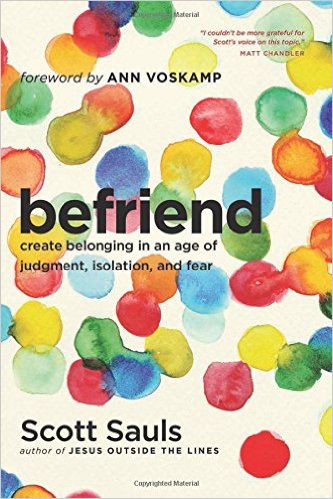
4) Belonging Scott Sauls‘s book Befriend: Create Belonging in in an Age of Judgment, Isolation, and Fear is next on my reading list. Belonging is a core need for all of us, and Sauls takes the reader deeply into the realm of true friendship and solid relationships. Whether between peers, family members, colleagues, or even strangers at first encounter. I long to get past superficial and to know and be genuinely known by at least a few people. My desire is to be open to the possibilities of befriending and being “friended” with true authenticity. This book seems a good place to reboot.blog-befriend-scott-sauls-amazon

Photo Credit: Amazon

I discovered this book from a tweet about Matt Smethurst’s article 20 Quotes from Scott Sauls’s New Book on Friendship. I ordered the book based on those 20 quotes. Here are three:

“Compelled by the love of Christ, we must not withhold kindness or friendship from any person or people group, and we must not engage in any sort of us-against-them posturing. This in itself is countercultural in modern society. Compelled by the truth of Christ, we must honor and obey the Creator’s design—even when his design is countercultural and, at times, counterintuitive to us. His ways and his thoughts are higher than ours.” (75–76)

“This is what you call reversing the flow of the umbilical cord: parents demanding that their children function as their source of life; their emotional nourishment; their identity; their Jesus. This always ends in sorrow and alienation and loss. Just as in marriage, we must not place a burden on our children to provide for us the things that only God can supply.” (87–88)

“The best way to measure your desire to serve is to look at how you respond when someone treats you like a servant.” (98)

5) Movie Previews – Call them teasers and then trailers. Whenever we go to the theater, we have to be in place with a family-sized popcorn before the previews start. That is just how it is. I love these glimpses into coming feature films. Two I’ve seen recently follow: On the darker side – Jackie. On the lighter side – Table 19 . Whether I ever see these movies in the theater, watching the trailers was satisfying and wholly entertaining!

blog-friday-faves-table-19-cdn-colliderPhoto Credit: Collider – Table 19

Have a safe and peaceful weekend. Tacky Lights Tour is on our schedule…let the festivities begin.

Also:

Life On My Knees – Chocolate Raspberry Cream Pie – Angela

blog-aletheia-praise-band-nathan-angelas-blogPhoto Credit: Chocolate Raspberry Cream Pie

YouTube Video – Big Crosby & David Bowie – “The Little Drummer Boy” (Peace On Earth)

Macy’s Christmas Adv 2016 Video – #OldFriends – [Sorry about the Poo-pourri ad at the beginning of the video.]


Monday Morning Moment – Turning Around a Work Culture – From “Not Good Enough” to “Job Well Done”

blog-demanding-bosses-linkedin-dave-kerpenPhoto Credit: LinkedIn – Dave Kerpen

Aha moments can occur in all sorts of settings. My latest happened during our pastor’s sermon this week. Toward the end of a deep and fascinating exposition of Colossians 2, Pastor Cliff reminded us that we are not meant to earn God’s approval. He gives it unconditionally. Then Cliff talked about how we get caught in the trap of “It’s never enough!” when thinking of our efforts or accomplishments. Then “It’s never enough” or “Not good enough” too easily turns into “You’re not good enough.” This is the place where what we do intersects with who we are…

Switch from the Sunday Bible lesson to the Monday workplace application. I’m not talking the unconditional love of God here, but what happens to us in continuous feedback loops. Stay with me…This made me think uncomfortably about the way I once operated in the area of idea generation and innovation.

I am “an editor”…it gives me great satisfaction to take a document or process and make it better. Recently a friend asked me to edit his manuscript. It’s going to be such a great read…can’t wait for it to be published. Still, there will be lots of edits. For me, being an early reader, I just took care of some grammar and flow issues. There will be more qualified editors down the road. It’s enough for me to do quick, elementary edits and wildly praise the author and his riveting storyline, cheering him on to the next steps of publishing.

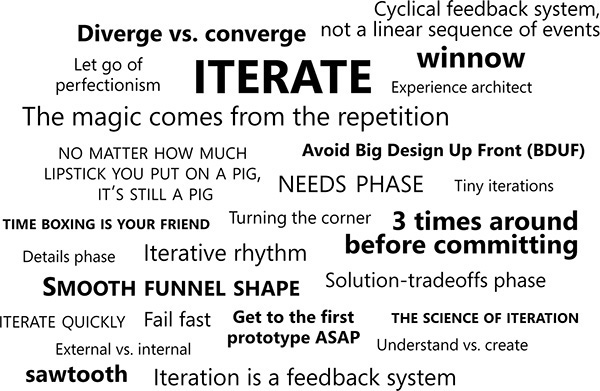
The tweaking that I used to do regularly in my earlier professional life was more intense in those days…and less forgiving. I wanted it (whatever it was) to be right, and it was my immodest opinion that I could get it to right. Especially when evaluating someone else’s work (ironically, I was less hard on my own work – figuring it was perfect already, right? Sigh…). The tweaking of another era has come round to a newish process called iteration.

One definition of iteration is the “process of learning and development that involves cyclical inquiry, enabling multiple opportunities for people to revisit ideas and critically reflect on their implication”. These feedback loops are meant to be fast-paced with the finish in view.

ScenarioPhoto Credit: SafariBooksOnline

Where iteration (or tweaking) breaks down (if I might be so bold) is when it’s taken well past rapid feedback loops into a realm of fine-tuning that has the team guessing “will it ever be good enough?” Product design and process development are vital to any company, but what we must also consider is the team or personnel involved.

If the feedback loops relate to the launch of a new product or a new business process, excitement and brainstorming are part of the momentum. Continuing to tweak over months instead of weeks before the launch can take a negative toll on the team. No one wants to forfeit excellence, but we don’t want to lose excellent personnel either.

blog-demanding-bosses-lifehackerPhoto Credit: Lifehacker

Trusting the judgment of our best thinkers is worth the risk of possibly releasing a product or service when we may not all be sure it’s “perfect”. That is what beta-testing is all about…the feedback that then comes to us from the consumer or user.

I’m really talking out of my element here (not being a designer or innovator so much as a lifelong learner). My leap from the sermon to the workplace relates to my own past struggle with wanting something with my name on it to be perfect while exhausting my teammates  with “what if we do this?” or “What if we say it this way?”

What a gift for us to take a well-thought-out proposal and, instead of putting it through the “just not good enough” wringer, we read it and pass it back to that colleague and say, “Good job”…empowering them to execute the proposal. How often does that happen these days?

Please share stories [in the Comments] of work situations where you experienced genuine affirmation for a job well-done.

Recently when water started backing up into the kitchen sink, I was afraid that it was something I had done. Too liberal using the disposal, for instance. Dave was out of town and nothing I could do would remedy the situation. Finally, on a Sunday afternoon, in desperation, I called our plumber (Richmonders, if you need a good plumber, email me, and I will give you his contact info). He came and fixed the problem, and best of all, it wasn’t my fault, after all. This young man literally LOVES his job and was kind to take the time, after he was off the clock, to give me the breakdown of what the problem was. What he charged me? Worth every penny…especially the part where it wasn’t something I had done wrong.

Why I bring this up is that being a fairly capable and creative person doesn’t prevent me from faltering at the likelihood that I messed-up.  See the Imposter Syndrome. My mental wiring is such that I get discouraged when my contribution to a situation actually causes more work for someone else, adds expense, or slows down progress. I’ve learned over the years that all that tweaking I may not have taken the product from good to great, and most assuredly caused some amount of frustration to hard-working, quality colleagues. Lesson learned.

There are times and seasons when tweaking is appropriate in developing a product and changing a business process. What we want to take into account is the cost of that tweaking, or iteration, on the people who make things happen in our workplaces. Free them from the “not good enough’s” to enjoy the fruit of “jobs well done”.blog-demanding-bosses-the-musePhoto Credit: The Muse

10 Tips for Dealing With an Overly Demanding Boss – Jacquelyn Smith

How to Get Over the Feeling that You’re Not Good Enough for Your Job – Michele Hoos

10 Things You Can Do to Get Out of Your Boss’s Doghouse – Brian Dodd

Why Incentive Plans Cannot Work – Alfie Kohn – Harvard Business Review

Good Is Not Good Enough: The Culture of Low Expectations and the Leader’s Challenge – Karlene M. Kerfoot

Innovation and Iteration: Friends Not Foes – Scott Anthony – Harvard Business Review

Holding a Team Retrospective – Morale

Workplace Bullying: Protecting Yourself at Work – Slideplayer