Category Archives: Purpose

5 Friday Faves – A Lullaby by Beyond the Guitar, the Art of Neighboring, the Beauty of Fall, Ethnic Foods, and Telling Our Stories

Friday Faves. Here we go!

1) A Lullaby by Beyond the Guitar – Nathan Mills has been on hiatus from his public YouTube channel as he worked through the summer creating course content for his other channels. Big news: he’s back!!

Photo Credit: YouTube, Beyond the Guitar

Talking through and then performing his treatment of the Game of Thrones theme (his previous arrangements of this can be found here). He takes Ramin Djawadi‘s epic piece and makes it into an ethereal lullaby. Just plain gorgeous.

2) The Art of Neighboring – Several years ago, my husband and I landed in an incredible neighborhood. With great neighbors. As happens, our neighborhood has changed significantly with elderly neighbors downsizing and moving away and new families coming in. The tight-knit feeling we had toward each other has changed…not lost but changed.

This Fall, our community group at church is studying “The Art of Neighboring”. This aligns closely with my deep dive, over the last several months, into our need for being known.

Being Known Podcast with Curt Thompson MD

Photo Credit: Art of Neighboring

There is neighboring where we might know someone by sight or even name, but little else. Then there is neighboring which leans in, where we know each other in ways that honors, enjoys, and serves.

It’s an art and it adds to our quality of lives and that of each other in immeasurable ways.Photo Credit: Grace Fellowship, The Art of Neighboring

The Art of Neighboring – Website, Book, Resources – Jay Pathak & Dave Runyon

3) The Beauty of Fall – Just a quick salute to the end of summer and beginning of Fall. Cooler weather prompting pulling out our hoodies and cozying up to fire pits. The harvest continues. The flowers, many going to seed, still have a glory that moves artists to paint. And pumpkins!

Photo Credit: Karen Burnette Garner, Facebook

4) Ethnic Foods – Our family has had the rich experience of living in several countries and enjoying the yummy “home cooking” of local friends. Some of that food is also sold by street vendors or in tiny restaurants for such a cheap price you wonder how they can afford to sell it, except for the volume of customers.

We search out those authentic food opportunities here, and various food festivals help fill the bill. Recently, we attended Armenian and Egyptian food festivals. So good! Visiting friends took us on the hunt of discovering new restaurants serving up foods so good they could have been cooked in mama’s homes.

In America, ethnic foods are not cheap. Part of that, I’m sure, is the cost of ingredients and labor. I couldn’t imagine paying the equivalent of $12 for a falafel sandwich when we lived overseas. Here, I’m just glad for the opportunity.

What Is ‘Ethnic’ Food? – Aaron Hutcherson

In the Hutcherson piece linked above, the phrase “ethnic food” may even be offensive in today’s cancel culture. Of me, it’s the best of home cooking served outside the home. America is such a cultural “melting pot” that we may come to the place where international foods become a part of the American food culture. Blended in. Beautifully.

“American food is the mixture of all food brought by our immigrants. Perhaps the recipes have been tweaked a little here, but they originate from past cultures, from identities new and old, and from our ethnic nation. Ethnic food is American food.”

This encouraging American ideal explains why Americans long to assimilate almost every food culture into their diets. It is socially encouraged to be more and more inclusive. The main way people try to find common ground is through food.

Ethnic food can best be described as a classification for types of food favored by cultural groups of people. This is different from authentic, which is a word used to describe food as something genuine or real. American cuisine may be classified as being only ethnic food because of the rich cultural diversity of its population. – DevTome

Still…I think we foodies will still look for the dining experiences that take us back to our mom’s table…or that table of friends in far-away places. Sweet memories.

Here in Virginia, we have an ethnic equivalent of food that’s hard to find anywhere but here and it’s Ukrop’s – a family-owned bakery, deli, and grocery business that’s been around since 1937. Their baked goods are very American. I say this because we have been told, by our international friends, that American sweets are “too sweet” for them. Maybe this is one American food that is uniquely American. I don’t know…but it’s good! No one does buttercream frosting like Ukrop’s. 

4) Telling Our Stories – Storytelling is in our very DNA. We appreciate the stories that draw us in – whether through books or film – or in the telling of our own lives.

Memory tends to embellish. A detail is added or emphasized beyond what really happened.

“Well, all good stories deserve embellishment.”J. R. R. Tolkien, The Hobbit

The Link Between Memory and Stories – Shawn Callahan

Embellishment entertains but what if our memory of an event or conversation stays the same even as we have grown into a person who has changed.

I think of childhood trauma or an incident that changed the course of our relationship with a person or organization. Sometimes all it takes is one circumstance.

Something may come to mind right now.

Is that a something that you want to affect your story forever?

Many of you may never have seen the 1981 British sports film Chariots of Fire. If you haven’t I highly recommend it. It gives an account of the Olympic Games of 1924. In particular, two runners, who compete against each other, are the focus. Two runners with very different stories.

Harold Abrahams and Eric Liddell.

These two athletes had two very different stories…very different motivations and goals for life. In the film, some of their story may be fictionalized, but there are lessons for us here. Check out the film clips linked below.

“10 lonely seconds [will] justify my whole existence.” – Abrahams

“When I run, I feel His pleasure.” – Eric Liddell

[An extra: In the film, Eric was pushed off the track during an Olympic race, falling to the ground. He got back on his feet and got back on the track. In the crowd, a man was asked if Eric could do (recover the time lost), and he said, “his head’s not back yet”. Eric would put his head back as he felt the pleasure of God on him. And where did the power come from? Another clip.]

YouTube Video – He Who Honors God – Chariots of Fire – don’t miss this scene.

What is your story? Whether you know it or not, you’re telling a story? Is it the one you want to be remembered for? Or is there a healing, a reconciliation, a resolve you want to leave behind as part of your legacy?

Something to consider.

___________________________________________________________________________

That’s it for this week. Hope you have a delightful weekend. Thanks for stopping by.

Bonuses:

8 Rules to Do Everything Better – Brad Stulberg

What To Do When You Feel Like You Don’t Fit in at Work – Lisa Evans

How to Say the Unsayable – 10 Ways to Approach a Sensitive Daunting Conversation – Kathryn Mannix

Photo Credit: Facebook, Marjolein Bastin

Worship Wednesday – Asking Questions – 4 Questions the LORD Asks – Psalm 27 – Motion Worship

Photo Credit: Highland Park LC, Daily Verses

Daily our prayers are full of questions. We “inquire (ask from) the Lord”. The questions in our heads don’t always end up in our prayers, but they are there nonetheless.

Earlier this week, I wrote about the discipline of leading with powerful questions. God has certainly shown the way in this.

Why Does God Ask Questions If He Is Omniscient?

He wants us to wonder about Him, about life, about people…with Him. He also means for us to use His own explorations as a model for our interactions – our deep interactions – with each other.

Christian psychiatrist Curt Thompson writes about four questions the Lord asks (in his book The Soul of Desire). These questions, when we ask them of each other, within context of relationship, can forge a path. A path for that other person to experience being “seen, soothed, safe, and secure” with us.   

1) “Where are you?” – God asked Adam this question (in Genesis 3:9), not because He didn’t know where he was but to give him an opportunity to say for himself what had happened. After Adam and Eve had sinned, they hid from God. In fear and shame. They had succumbed to distorted thinking after being tempted by the Evil One. They doubted the goodness of God and made the eternally consequential decision to choose for themselves what was good.

We also hide. We might not ask of another “Where are you?” exactly, but we might ask, “What’s going on?”, “What’s on your mind?” or “What are you feeling right now?” Rather than react to another’s anger, fear, or other distress, we lean in. Just as God was drawing out Adam, we give space for a person to feel safe to come out of hiding. We give space to ourselves in the same way when we go deep with God around this question.

2) “What do you want?” – In the beginning of Jesus’ public ministry, two of John the Baptist’s disciples began following him. His first question to them was “What do you want?” (John 1:38) We don’t often ask God what He wants with us because the Scripture is clear. Yet, we struggle with what we want. Are our desires in line with the Lord’s? Do we ever edit or stifle our desires because we can’t fathom they are in line with the will of God? What if they are? Or some form of them? This is where we inquire of the Lord. This is also where we can be helpful to each other by giving opportunity to wrap words around those desires. To bring them out in the open in a safe environment with a trusted friend/family member. This, like Question 1, is something we also can explore with and seek affirmation from our Heavenly Father.

3) “Can you drink the cup?” – In Matthew 20:22, Jesus responded to a voiced desire of James and John to sit on each side of him in His kingdom. His question communicated that their desire implied a cost – a cup of suffering. They naively said they could drink the cup. His gentle reply was that they would drink that cup but the decision was not his but the Father’s. What beauty in the freedom of transparency and intimacy Jesus and his disciples had with each other.

“If we want to be this close to Jesus – if we are willing to enter into a confessional community and ask the first two questions – we must be prepared to suffer. Naming where we are and what we want invariably leads to discoveries that bring us great comfort but also demand that we be present to the brokenness of our own lives and that of others.” Curt Thompson, The Soul of Desire, p. 201

Part of the benefit of exploring the two first questions with a trusted someone is that we come to question 3. No longer is the stuff in our minds and emotions still hidden, but it’s out there. In the real world. This is when we can confront the cost…and this is where we find both healing and flourishing.Photo Credit: Heartlight

This is where we can have hope. Where our fear and shame can be removed. Where our addictions can be faced. Where our delights in the Lord can be fortified…within community.

“Evil does not intend to go quietly into the night. In this way, we will suffer; we will drink the cup that represents our resistance to evil as we swim against its current… In the context of a confessional community, we suffer, we grieve together, and as such our suffering itself is transformed…I learn to hope. I hope not in receiving exactly what I thought I wanted in the way I wanted it, but more.”Curt Thompson, The Soul of Desire, p. 205

4) “Do you love me?” – After his resurrection, Jesus appeared several times to his disciples before ascending to Heaven. This question he put to Peter. Now Peter was probably still reeling with shame from his denial of Jesus. He felt disqualified. Purposeless. Such that he returned to the trade he did before ever knowing Jesus. Jesus’ question “Do you love me?” clearly had multiple layers. He understood the rupture that happened when Peter acted the way he did. It wasn’t ruptured from Jesus’ side but was, in Peter’s head, from his side. Jesus drew close to Peter to fix that rupture and to remind him of the great work he had called Peter. “Feed my sheep”.

“Jesus takes the essence of our traumas and its attendant shame and creates New Wine. There is beauty to be found everywhere. But never is beauty more poignant than when we see it through our trauma and shame. We see Good Friday through the lens of Easter and everything about its brutality, its pulverization of God in the person of Jesus, is transformed into the beauty of the resurrection. This is what it means to fully answer the question, “Do you love me?”Curt Thompson, The Soul of Desire, p. 210

Worship, with me, the God who seeks after us and draws us close – the God who will create beauty in and through our lives as we live in the real, with Him within. [Psalm 27Motion Worship]

One thing I ask, one thing I seek
To live in Your house, to sit at Your feet
All of my days, delight in Your ways
And dwell in Your temple

So hide me in shelter when troubles may come
My feet set on high ground, my head lifted up
When darkness surrounds, in You I am found
And there’s joy in this temple

[Chorus]
I will sing, I will praise
With all that’s within me
I will seek, seek Your face
Jesus, my one thing
Oh Jesus, my one thing
(Yeah, yeah)

My heart believes, our eyes will see
The goodness of God in the land wе’re living
So we will be strong, and Hе won’t be long
And we’ll wait on You, Lord, yeah

[Chorus]
And I will sing, I will praise
With all that’s within me
I will seek, seek Your face
Jesus, my one thing, yeah
And I will sing, I will praise
With all that’s within me
And I will seek, seek Your face
Oh Jesus, my one thing
And oh Jesus, my one thing, yeah
Oh Jesus, my one thing (Oh, yes, You are, You are)
Oh Jesus, my one thing (Yes, You are, yes, You are)
Oh Jesus, my one thing, yeah

[Bridge]
And there’s joy in this temple, there’s praise in this house
With light and salvation, no fear can be found
When enemies rise up, they tremble and fall
None stand against Jesus, the name above all
There’s joy in this temple, there’s praise in this house
With light and salvation, no fear can be found
When enemies rise up, they tremble and fall
None stand against Jesus, the name above all

[Chorus]
And I will sing, I will praise
With all that’s within me
I will seek, seek Your face
Oh Jesus, my one thing
Oh Jesus, my one thing (You are)
Oh Jesus, our one thing
Yes, You are our one thing (Jesus, my one thing)*

*Lyrics to Psalm 27 (Whom Shall I Fear?) – Motion Worship (Songwriters: Jesse Reeves & Caitlin Reeves)

Inquiring of the Lord – Posturing Ourselves for Success – Selenia Vera, International House of Prayer, Kansas City

Monday Morning Moment – “Be Curious, Not Judgmental.” – Leading With Questions

Photo Credit: Quotefancy

“Be curious, not judgmental”. This brilliant and pithy statement is attributed to the American poet Walt Whitman. I’d never heard it before today, and yet it speaks volumes to any human relationship – whether personal or professional.

There comes a time in knowing people that we think we have them figured out. Or we know enough…for better or worse. We stop asking questions. Whether in marriage or in the workplace. We think we know all we need to know about a person… ironically, just when we are feeling the less fond of them. When conflict bubbles up. When a critical decision is being made. When a door closes in our face…or on our way out.

This is humorously and poignantly illustrated in a scene from the TV show Ted Lasso. [Full disclosure: I have never seen the show itself. Also my understanding is the language is fairly unfiltered, so this isn’t exactly a recommendation…but this scene is perfect.]

Be Curious, Not Judgmental: A Leadership Lesson From Ted Lasso – Connie Whittaker Dunlop – super helpful article using the video above to introduce a great leadership lesson.

“Be Curious, Not Judgmental” – Something Walt Whitman Used to Say – Steve M. Nash – read this! You’ll be glad you did.

Questions are the main ingredient in curiosity. And curiosity is itself an important component of the communication patterns that generate psychological safety, quality in interpersonal relations, and collective intelligence. In other words: all the different elements that impact on the quality of our collaboration, decisions, and actions, and which ultimately become a determining factor for the results and value we create for our customers and the wider world.

We can ask questions in many different ways, and all are not equally constructive. For example, there is a great difference between a leader asking his employees: Why didn’t you do something about the problem? and asking: What do you see as possible solutions to the problem we are facing? The first question reflects the leader’s view that the employees ought to have responded and taken responsibility earlier. It creates a focus on blame. The second question expresses the view that there is a problem that everyone involved needs to address and come to a solution together. It invites employees to commit and involve themselves in finding solutions in a forward-looking movement. Being aware of our way of asking questions has a big impact on the way we relate to each other – and also on our ability to contribute, do, and achieve things together. As such, good questions can’t really be put in a template. The quality and effect of the questions always depend on the context they are asked in.” – Henry Kleive, Thomas Johansen and Thomas Specht, “Leadership for Sustainability Powered by Questions”

What if we went into conversations or meetings with an open mind and questions aimed at honoring and understanding the person across the table? What if we wanted to reconcile our relationship as much as we wanted to prove ourselves right about the project, or problem, or predicament?

Learning to ask powerful questions and being willing to use them can make a huge difference in our relationships.  Asking questions well can demonstrate care for that person. Sometimes questions actually help both the one who asks and the one who answers with what they really think about a situation…questions draw us out…often in positive and fruitful ways.

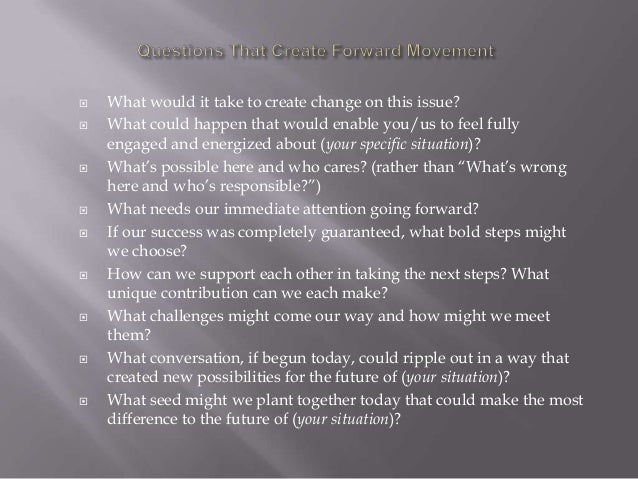
https://image.slidesharecdn.com/questions-130807203819-phpapp02/95/the-art-of-powerful-questions-7-638.jpg?cb=1424648128Photo Credit: Slideshare, Mark Gillow, The Art of Powerful Questions

So whether or not we think we’re right about a person – their motives, intentions, abilities, or intellect – we won’t do justice to the relationship if we stop asking questions.

Get to know him or her again…use the questions offered in the resources above and below. Find common ground, through good questions. See if you can turn the (relation)ship around…not just for the sake of the team, organization, or family…but because of the benefit to each of you.

“Lead From Within: A leader is as good as their questions. When you ask questions, you will change what you know. When you change what you know, you will have a new understanding. When you have a new understanding, you change your actions—and, ultimately, your leadership.” – Lolly Daskal

The Art of Asking Powerful Questions and 51 Powerful Questions to Ask in Different Situations – Sumit Gupta

The Art of Powerful Questions – Catalyzing Innovation, Insight, and Action – Eric E. Vogt, Juanita Brown, and David Isaacs – PDF

The Art of Powerful Questions – Slideshare – Mark Gillow (concise slideshare on book above)

The Art of Powerful Questions – Slideshare – Peter Bricknell (refers to the interviewing style from Mahan Khalsa’s bookLet’s Get Real or Let’s Not Play‘ 

“Leading With Questions” – Michael Marquardt – Notes by Dave Kraft

YouTube Video – Top 10 Most Heartwarming Ted Lasso Moments

5 Friday Faves – Beyond the Guitar Medleys, Life Online, Late Summer, the Older Generation, and Friendship

Friday Faves…here we go!

1) Beyond the Guitar Medleys – Music themes can fill us with such emotion – deep nostalgia about a shared experience, a memorable adventure, or a sweet story. Really great soundtracks often have several themes that draw us in and take us back. Nathan Mills, at Beyond the Guitar,  has arranged and performed some lovely medleys from such music scores. Here are some of them (5 faves for Friday) and the rest are at the bottom of today’s blog:

2) Life Online – Obviously, if you’re reading this, then you’re online. The thing is, our lives have been greatly enhanced by the benefits of technology. We do, from time to time, need to revisit our habits which might include time spent online and for what purposes.

So much has been written already about the downside of screen-time and the prevalence of smartphone addiction. The distractions, mental laziness, shallow thinking, almost communication.

My husband got his first smartphone for work around 2005 or after. The rest of our family slowly moved in that direction.

I personally spend way too much time online. Sometimes for positive outcomes, sometime just because it has become knee-jerk…a time-filler. It’s what I do now unfortunately. When I used to carry a book around in my purse.

It could be addiction, and that’s got to change.

Photo Credit: Science Info

“The same chemicals are released in your brain when you get a text message as when you drink an alcoholic beverage, smoke a cigarette or gamble. What in essence is happening is we’re allowing children from 6 to 10 years of age access to our liquor cabinet when we give them a smartphone. They’re constantly texting so they’re continually getting high.”John Gatica

Our Brains on Smartphones

John Gatica is an educator, and his observations regarding children and neuroscience are sobering. Now not all texts are happy for adults, but the addiction phenomenon still holds true.

Our phones give the illusion of presence…and good. We are doing “good” with a text to a friend or family member – a text taking the place of a full-on “showing up”. Social media have grown a forest over our sleepy selves where we become lazy and reactive (mildly or harshly depending on the subject matter).
Now I’ll take a text over no contact. What the concern here is more what is happening to us when our online life is more real to us than our actual face-to-face, with skin-on, encounters with people… What’s going on in our brains long-term? Something to think about.
For more than a few seconds.

The Effects of Smartphones on Your Brain – Kendra Cherry

Is Social Media Making us Stupid? – Alex Kantrowitz

3) Late Summer – My sweet husband’s garden is all a tangle now. The vegetables are finishing up, and the flowers, though still beautiful, are winding down. As the feel of Fall teases us in the early mornings, I wanted to capture, once again, for your enjoyment and my own, some of this not-to-be-undone late summer garden of ours. Please post some of your own beauties below.

4) Older Generation – Just want to give a quick shout-out to the older generation – our parents and others who have graced our lives with wisdom, beauty, humor and Godly values.

When our children gather around our table, I realize we are fast becoming the older generation. We have one precious mom left this side of Heaven and hopefully she will be with us for many years more. I am thankful for her – and all I’ve learned from her over the years… Hopefully our own adult children and the grands will take every opportunity to lean in to her wisdom and love. We are a bit of an “old soul” family and I’m thankful for each one in this family.

“But I know people who as children had their grandparents’ memories in their memories, so that in a sense, as young people
they had old minds.  They had a kind of seasoning.”  Wendell Berry, 1973 [Source undetermined]

So here’s just a bit of gratitude for the older generations…those who give us a glimpse into the future which can seem too dark at times, and yet with faith in a good God and a love that holds us together, we take hope. Thankful for three sweet parents who have gone on ahead…and for MomMom still very much with us, encouraging us always.

Do you have the pleasure and great good of the company of “olders”?

YouTube Video – Mother – (Love Bigger Than the Ocean Is What You’ve Given to Me)

5) Friendship – Friendships have always come easy for me and I’m thankful. A few years back, I read Scott Sauls‘ book Befriend. It was both affirming and convicting as the realization that friendship, like marriage, takes nurturing…more than maybe I was giving. Then 2020 happened and the Coronavirus wreaked havoc on relationships, isolating us from one another.

Fast forward to 2022, and I find myself very much needing Jennie Allen‘s latest book Find Your People. Oddly, her online study (shades of COVID Zoom calls) drew me to the book. Finishing the study this coming week, I now want to take her counsel in finding my people.

Allen talks about how we can quite accidentally just stop investing in relationships. Our post-COVID culture has pushed us into even more independence and self-reliance than we had before. We isolate without even thinking about it and our days move quietly on.

Maybe that isn’t your experience…so hang in there with me.

Allen reflects back on how life through the ages flourishes within community. More a village experience than whatever it is we have today. People know each other and they are invested in each other. She lists out the realities necessary for healthy community:

  • Proximity
  • Transparency
  • Accountability (real connection)
  • Shared Mission
  • Consistency

It’s out of this realm that true friendship grows. Spending time together. Being our real selves. Allowing others to speak into our lives. Teaming together for a greater good. Showing up again and again.

These are the basic elements of community…and friendship.

If you are experiencing the loneliness of untended friendships, Allen’s book will help. If you just can’t put another book in your queue right now, at least consider what’s going on in your friendships. I’m not talking about acquaintanceships either. Deep, beautiful, lasting friendships.

Let’s get back out there and find our people.Photo Credit: Find Your People, Jennie Allen

[The liturgy below doesn’t really focus on friendship, but it speaks to hospitality which also took a hit with COVID. A beautiful prayer.]Photo Credit: Tiffany Holden, Facebook, Rabbit Room Chinwag

___________________________________________________________________________

Thanks for stopping by. It means a lot. Hope you have a weekend full of your people…with quiet in between.

Bonuses:

Even Tolkien Felt Like a Failure – Scott Sauls

An incredibly helpful Twitter thread on marriage:

[Trip to Cracker Barrel]

3 Simple Habits that Can Protect Your Brain From Cognitive Decline – Tara Swart

Photo Credit: AZ Quotes, C. S. Lewis

Photo Credit: Facebook, Rabbit Room Chinwag

*The rest of Beyond the Guitar’s medleys (so far):

Monday Morning Moment – Back to School – 12 Essential Lessons of Life

Photo Credit: Pixabay

[Adapted from the Archives]

It’s Back to School days around here. Whether we teach our children at home or contract and cooperate with other teachers, this time of year is both exciting and sobering.

I married late in life, and the children came even later. Parenting wasn’t an instinctual process for me. Fortunately, mentors came along at pivotal times, as did parents whom I did not want to be like. Between the two, I found my way.

Feeding, clothing, and protecting children are all crucial…but what do we teach them? What are the essential lessons of life?

Two old songs come to mind when I think of the serious nature of teaching our children what they must learn for life. The old folk/rock group Crosby, Stills, and Nash & Young wrote and performed Teach Your Children. Graham Nash wrote the lyrics out of his painful relationship with an absent, sometimes imprisoned, father. Nash’s message is that we have to teach our children to make a better life…if not a better world.

You’ve Got to Be Carefully Taught is the other deeply emotional song out of the musical South Pacific. This song points to racial prejudice and cultural bias, and how hatred must be taught to children when they are young. Mandy Patinkin‘s version of this song communicates its meaning powerfully.

Although hatred or bias can be taught, even from an early age, such dreadful things can also be caught over time in culture. Things like entitlement, dishonesty, greed, and irresponsibility. We as parents (teachers and employers also) have a huge role in guiding children and young people to mature into caring and responsible adults…even in a culture that may cut across the grain of our own values.

I’d like to explore what we must teach our children. Intentionally, with meaningful purpose. Catching those teachable moments and seasons. Some things are more “caught than taught”, as the saying goes. Kids will catch some values living in close proximity to us and others. That makes the case, as well, for how we choose to live and what companions we seek for ourselves and our children.

More Is Caught Than Taught – Gabbie Nolen-Fratantoni

When our children were young, we taught them a set of rules which we honored in our home. The 21 Rules of This House by Gregg and Joshua Harris. These rules were, in ways, simplistic but also comprehensive enough to help us create a safe, orderly, and loving home, where children AND parents had the same expectations. Photo Credit: Choosing HomeSchool Curriculum

Our children are grown now, out on their own. Two of them are already in the season of small ones, establishing their own essentials for teaching their children.

This is a reminder to them of their own family values…I hope it’s also a help to you. These are 12 essential lessons of life. They are not comprehensive. I would love to hear what you think should have been there as well, in the Comments section below. Thanks.

1) Love God – You shall love the Lord your God with all your heart and with all your soul and with all your mind. This is the great and first commandment.” – Jesus – Matthew 22:37-38 If you are reading this and don’t share a faith in one God, then this won’t have meaning for you. Jesus was asked what was the greatest commandments of the law (in that day, they were burdened by the weight of over 600 laws). His answer? Love God with everything in your being. Clearly it’s good for us to do and something parents can model and teach from the time children are tiny.

2) Love others – You shall love your neighbor as yourself.– Jesus – Matthew 22:39  Jesus didn’t stop at the greatest commandment. He added this one as just second to the most important. Love others. Not just your buddies. Not just those like you…but whomever neighbor is…the nobody, the every man. Jesus was clear in his instruction in “as yourself”. However it is we would serve ourselves, we give of ourselves to those around us. Wow! Great wisdom to teach our children.

3) Be obedient (honoring) – Children, obey your parents in the Lord, for this is right. “Honor your father and mother” (this is the first commandment with a promise), “that it may go well with you and that you may live long in the land.” – Ephesians 6:1-3 What a struggle it is for us to teach our children to obey! What a developmental milestone when they get it! Not after we count to 3, or 10…or whatever other enticement to obey we use in desperation. Immediate obedience – in attitude and action. That is a lesson they will take all the way through adulthood.

Raising our children in huge cities made it crucial for them to obey the instant they heard us speak to them, especially over the noise of the city. One thing we did was a bird call (a whistle sounding “bob, bobwhite”). When they heard that, they looked up and started heading in our direction immediately. I still marvel when even today, that still gets their big grown-up attention.

More on obedience can be found here.

Photo Credit: Flickr

4) Be grateful. – Give thanks in everything, for this is God’s will for you in Christ Jesus. – 1 Thessalonians 5:18  God’s Word is filled with examples and encouragements toward being grateful (here are just a few). Jesus’ life was a testament of thankfulness to God the Father, and He taught us to pray with thanksgiving. Our kids grew up with The Thankful Song (from the Veggie Tales Madame Blueberry video) –A thankful heart is a happy heart; that’s why we say thanks everyday.”

The Power of Gratitude – 21 Verses of Thanks to God – Debbie McDaniel

Avoid Raising an Entitled Child – 5 Strategies That Really Work – Amy McCready

5) Speak the truth. – Lying lips are an abomination to the Lord, but those who act faithfully are his delight. – Proverbs 12:22 The worst offense in our home was lying. Jesus spoke of Satan as being the father of lies (John 8:44). Telling the truth is something we model and something, I hope, our children value highly in their adult lives. No spin, no deception…straight-up truth. Truth in love (Ephesians 4:15).

6) Work with diligence and excellence. – Whatever you do, work heartily, as for the Lord and not for men.Colossians 3:23   In grasping this lesson, children learn perseverance, patience, and an understanding of the value of work. Our youngest struggled with academics and he would say, about homework, “I just want to get it done!” As he matured, he moved his lament to more of a charge of “get it done and done well”. Watching him grow in that continues to make us so proud of him.

12 Ways to Glorify God at Work – Jose Etter

7) Seek joy. – Be joyful in hope, patient in affliction, persistent in prayer. – (Romans 12:12) Grumbling, discontent, and whining are such a part of human nature. When we count our situation with joy, whatever it is, everyone wins. Other verses here.

8) Seek peace. – “Blessed are the peacemakers, for they will be called children of God.” – Jesus (Matthew 5:9) Sometimes we crave peace, and we’ll do anything to get it. Our children don’t need to learn how to be peace-keepers but to be peace-makers. It’s not about giving way to the one causing trouble, for instance. It’s developing relational skills to bring peace to a situation, resolving the conflict. More verses here on peace.

9) Be forgiving. – Bear with each other and forgive any complaint you may have against one another. Forgive as the Lord forgave you.Colossians 3:13 Holding grudges and distancing ourselves from others in unforgiveness is no way to live. Forgiving because we are forgiven carries with it a deep, loving perspective. Helping our children understand how to forgive, especially little ones who have been gravely hurt by others, is huge. More on forgiveness.

10) See beauty; create beauty. – He has made everything beautiful in its time. Also, He has put eternity into man’s heart, yet so that he cannot find out what God has done from the beginning to the end. Ecclesiastes 3:11 My children tease me sometimes because they say I think everyone out there is handsome/pretty. God has given me eyes to see, maybe as He sees. He creates beauty and He means for us to see and appreciate it…and create beautiful things ourselves.Photo Credit: Public Domain Pictures

Our children are all musicians (one professionally) or writers . They create beauty as we all can…in some way or another.

Nathan Mills -Beyond The Guitar

Top 10 Bible Verses about Art with Commentary

Saying Beautifully as a Way of Seeing Beauty – John Piper

11) Be kind. – Be kind to one another, tenderhearted, forgiving one another, as God in Christ forgave you. – (Ephesians 4:32) Again, years ago, when our kids were very young, they participated in a Vacation Bible School and learned a little song on kindness. “K-I-N-D, Love Is Kind”. I couldn’t find it anywhere for today’s blog, but the message stuck in all our heads. One of the simplest ways to show love is to be kind – to be generous and caring in our consideration of others. The Scripture points often to kindness in loving each other.

Be Kind to One Another – John Piper

12) Serve others. – Do not neglect to do good and to share what you have, for such sacrifices are pleasing to God.Hebrews 13:16 This lesson of serving others is one I actually struggled to teach well. I fell into the excuse (like many parents do) that they had so much homework, so many assignments to complete, that they should just have fun when they had the time. Serving could have totally been a “fun” way of life. I hope our children do better with teaching serving than I did. More on serving here.Photo Credit: Niagara

In closing, I’ve left off many things. Critical thinking is one. Purity another. In fact, do you remember that little song, “Be Careful Little Eyes What You See.” Our kids knew that in English and Arabic.

Still probably the greatest lesson across the years of childhood (which goes along with the two greatest commandments Jesus taught) is the one Bob Pierce, founder of World Vision, taught us.

Let (your) heart be broken with the things that break the heart of God.

We want to teach our children to do right, for the sake of others and for themselves, and to stand up for what is right.

Train up a child in the way he should go: and when he is old, he will not depart from it.Proverbs 22:6

Let Your Heart Be Broken – Jeremiah 8, 9 – Rick Ezell

Bible Verses on Injustice

Monday Morning Moment – Parenting – Teaching & Modeling Essential Life Lessons

[Adapted from the Archive]

I married late in life, and the children came even later. Parenting wasn’t an instinctual process for me. Fortunately, mentors came along at pivotal times, as did parents whom, unfortunately, I did not want to be like. Between the two, I found my way.

Feeding, clothing, and protecting children are all crucial…but what do we teach them? What are the essential lessons of life?

Photo Credit: Pixabay

Two old songs come to mind when I think of the sober nature of teaching our children what they must learn for life. The old folk/rock group Crosby, Stills, Nash & Young wrote and performed Teach Your Children. Graham Nash wrote the lyrics out of his painful relationship with an absent, sometimes imprisoned, father. Nash’s message is that we have to teach our children to make a better life…if not better world.

You’ve Got to Be Carefully Taught is the other deeply emotional song out of the musical South Pacific. This song points to racial prejudice and cultural bias, and how hatred must be taught to children when they are young. Mandy Patinkin‘s version of this song communicates its meaning powerfully.

Although hatred or bias can be taught, even from an early age, such dreadful things can also be caught over time in culture. Things like entitlement, dishonesty, greed, and irresponsibility. We as parents (teachers and employers also) have a huge role in guiding children and young people to mature into caring and responsible adults…even in a culture that may cut across the grain of our own values.

I’d like to explore what we must teach our children. Intentionally, with purpose and meaning. Watching for those teachable moments and seasons. Some things are more “caught than taught”, as the saying goes. Kids will catch some values living in close proximity to us and others. That makes the case, as well, for how we choose to live and what companions we seek for ourselves and our children.

More Is Caught Than Taught – Gabbie Nolen-Fratantoni

When our children were young, we taught them a set of rules which we honored in our home. The 21 Rules of This House by Gregg and Joshua Harris. These rules were, in ways, simplistic but also comprehensive enough to help us create a safe, orderly, and loving home, where children AND parents had the same expectations. Photo Credit: Choosing HomeSchool Curriculum

Our children are grown now, out on their own. Two of them are already in the season of small ones and are establishing their own essentials for teaching their children.

This is a reminder to our adult children of their family values, growing up…I hope it’s also a help to you.

Below are 12 essential lessons of life. Some of them we inherited gladly from Christ-follower parents. As adults, we chose them for our own family. They are not comprehensive. I would love to hear what you think should have been there as well, (post in the Comments section below). Thanks.

[Also I want to revisit these relational commandments with my husband and adult children to see what they think now AND to consider, if I were parenting again, what would be different.]

1) Love God – You shall love the Lord your God with all your heart and with all your soul and with all your mind. This is the great and first commandment.” – Jesus – Matthew 22:37-38 If you are reading this and don’t share a faith in one God, then this won’t have meaning for you. Jesus was asked what was the greatest commandments of the law (in that day, they were burdened by the weight of over 600 laws. His answer? Love God with everything in your being. Clearly it’s good for us to do and something parents can model and teach from the time children are tiny.

2) Love others – You shall love your neighbor as yourself.– Jesus – Matthew 22:39  Jesus didn’t stop at the greatest commandment. He added this one as just second to the most important. Love others. Not just your buddies. Not just those like you…but whomever neighbor is…the stranger, the alien, the “less preferred”, the every man. Jesus was clear in his instruction in “as yourself”. How ever it is that we would serve ourselves, we give of ourselves to those around us. Wow! Great wisdom to teach our children.

3) Be obedient (honoring) – Children, obey your parents in the Lord, for this is right. “Honor your father and mother” (this is the first commandment with a promise), “that it may go well with you and that you may live long in the land.” – Ephesians 6:1-3 What a struggle it is for us to teach our children to obey! What developmental milestones when they get it! Not after we count to 3, or 10…or whatever other enticement to obey comes to mind. Immediate obedience – in attitude and action.

Raising our children in huge cities made it crucial for them to obey the instant they heard us speak to them, especially over the noise of the city. One thing we did was a bird call (a whistle sounding “bob, bobwhite”. When they heard that sound, they looked up and started heading in our direction immediately. I still marvel when even today, that still gets their big grown-up attention.

More on obedience can be found here.

Photo Credit: Flickr

4) Be grateful. – Give thanks in everything, for this is God’s will for you in Christ Jesus. – 1 Thessalonians 5:18  God’s Word is filled with examples and encouragements toward being grateful (here are just a few). Jesus’ life was a testament of thankfulness to God the Father, and He taught us to pray with thanksgiving. Our kids grew up with The Thankful Song (from the Veggie Tales Madame Blueberry video) – “A grateful heart is a happy heart; that’s why we say thanks everyday.”

The Power of Gratitude – 21 Verses of Thanks to God – Debbie McDaniel

Avoid Raising an Entitled Child – 5 Strategies That Really Work – Amy McCready

5) Speak the truth. – Lying lips are an abomination to the Lord, but those who act faithfully are his delight. – Proverbs 12:22 The worst offense in our home was lying. Jesus spoke of Satan as being the father of lies (John 8:44). Telling the truth is something we model and something, I hope, our children value highly in their adult lives. No spin, no deception…straight-up truth. Truth in love (Ephesians 4:15).

6) Work with diligence and excellence. – Whatever you do, work heartily, as for the Lord and not for men.Colossians 3:23   In grasping this lesson, children learn perseverance, patience, and an understanding of the value of work. Our youngest struggled with academics and he would say, about homework, “I just want to get it done!” As he matured, he moved his lament to more of a charge of “get it done and done right”. Watching him grow in that continues to make us so proud of him.

12 Ways to Glorify God at Work – Jose Etter

7) Seek joy. – Be joyful in hope, patient in affliction, persistent in prayer. – (Romans 12:12) Grumbling, discontent, and whining are such a part of human nature. When we count our situation joy, whatever it is, everyone wins. Other verses here.

8) Seek peace. – “Blessed are the peacemakers, for they will be called children of God.” – Jesus (Matthew 5:9) Sometimes we crave peace, and we’ll do anything to get it. Our children don’t need to learn how to be peace-keepers but to be peace-makers. It’s not about giving way to the one causing trouble, for instance. It’s developing relational skills to bring peace to a situation, resolving the conflict. More verses here on peace.

9) Be forgiving. – Bear with each other and forgive any complaint you may have against one another. Forgive as the Lord forgave you.Colossians 3:13 Holding grudges and distancing ourselves from others in unforgiveness is no way to live. Forgiving because we are forgiven carries with it a deep loving perspective. Helping our children understand how to forgive, especially little ones who have been gravely hurt by others, is huge. More on forgiveness.

10) See beauty; create beauty. – He has made everything beautiful in its time. Also, He has put eternity into man’s heart, yet so that he cannot find out what God has done from the beginning to the end. Ecclesiastes 3:11 My children tease me sometimes because they say I think everyone out there is handsome/pretty. God has given me eyes to see, maybe as He sees. He creates beauty and He means for us to see and appreciate it…and create beautiful things ourselves.Photo Credit: Public Domain Pictures

Our children are all musicians (one professionally) or writers . They create beauty as we all can…in some way or another.

Nathan Mills -Beyond The Guitar

Top 10 Bible Verses about Art with Commentary

Saying Beautifully as a Way of Seeing Beauty – John Piper

11) Be kind. – Be kind to one another, tenderhearted, forgiving one another, as God in Christ forgave you. – (Ephesians 4:32) Again, years ago, when our kids were very young, they participated in a Vacation Bible School and learned a little song on kindness. “K-I-N-D, Love Is Kind”. I couldn’t find it anywhere for today’s blog, but the message stuck in all our heads. One of the simplest ways to show love is to be kind – to be generous and caring in our consideration of others. The Scripture points often to kindness in loving each other.

Be Kind to One Another – John Piper

12) Serve others. – Do not neglect to do good and to share what you have, for such sacrifices are pleasing to God.Hebrews 13:16 This lesson of serving others is one I actually struggled to teach well. I fell into the excuse (like many in America do) that they had so much homework, so many assignments to complete, that they should just have fun when they had the time. Serving could have totally been a “fun” way of life. I hope our children do better than we did with teaching serving. More on serving here.Photo Credit: Niagara

In closing, I’ve left off many things. Critical thinking is one. Physical purity another. In fact, do you remember that little song, “Be Careful Little Eyes What You See.” Our kids knew that in English and Arabic.

Still probably the greatest lesson across the years of childhood (which goes along with the two greatest commandments Jesus taught) is the one Bob Pierce, founder of World Vision, taught us.

Let (your) heart be broken with the things that break the heart of God.

We want to teach our children to do right, for for the sake of others and for themselves, and to stand up for what is right.

Train up a child in the way he should go: and when he is old, he will not depart from it.Proverbs 22:6

[Sidebar: Right now I am studying Dr. Henry Cloud‘s Changes that Heal. He prescribes for his clients to write out the ten relational commandments of their families. As I mentioned above, I hope to revisit this again soon.]

Let Your Heart Be Broken – Jeremiah 8, 9 – Rick Ezell

Bible Verses on Injustice

5 Friday Faves – Beyond the Guitar Does Batman, the Hard-won Wisdom of Erik Weihenmayer, Without Grumbling, Parenting & Grandparenting, and Urban Farming

Friday Faves – Go!

1) Beyond the Guitar Does Batman – Nathan‘s latest. Enjoy the music below and all his other sweet pieces at Beyond the Guitar‘s YouTube channel.

…and this one.

2) The Hard-won Wisdom of Erik Weihenmayer – We had the great joy of hearing Erik Weihenmayer speak at The Richmond Forum this past week. He is a climber, kayaker, and biker, among other sports, AND he is blind. That distinctive is huge, but even so he doesn’t talk about his adventuring life as executing one impossible stunt after another. He speaks from a deeper place that we can all understand. He talks about the meaning of struggle and the advantage of adversity (even has a book with that title). His persuasive take on how one uses struggle to grow and reach beyond where we are at the moment is both inspiring and emboldening.

Below please note just a few of his wise words, and then find and watch the films, and read his books, where he discovers and fleshes out this wisdom.

Photo Credit: AZ Quotes

There is a very blurry line between the things we can’t do and the things that we can.

You don’t just deal with adversity. You use it to propel you forward.

I found climbing to be a very tactile sport. There’s no ball that is zipping through the air ready to crack you in the head. It is just you and the rock base.

I have a variety of friends I climb with. But the common thing is I trust all of them. They’re solid climbers, the sort of people I trust to know what they’re doing.

You can’t always get out on the mountain, so I’ll put rubber on the end of my ice tools and climb the tread wall, a rotating rock wall I have in my backyard.

I’ve been lucky to have lots and lots of mentors. I think that is incredibly important in anyone’s life to encourage and inspire them, let them understand that their own potential is a reality that they can strive for.

What a thrill to be able to say that you had a contribution in the life of someone – a young person, perhaps, who is trying to take a look at the possibility of their own lives and find out what they are good at and you can help steer their career.

The key is to really have tremendously high expectations and to teach kids how to be self sufficient and confident and give them the skills that they need to succeed.Erik Weihenmayer

3) Without Grumbling – Which comes first – anger or grumbling? Or is it a more subtle but growing discontent? When does occasional complaining settle into a set habit of grumbling? What does grumbling communicate to our own minds and to others within hearing?

I’ve written plenty on complaining, grumbling, and negative thinking, in general (see links below). It can absolutely change the wiring in our brains. In my younger years, I always looking for the good and the beautiful in a person/situation…and I found it. Now, as an older person, my temptation is more toward darker thinking. This is NOT where I want to stay.Photo Credit: QuoteFancy

Below is a beautiful bit of writer Trevin Wax‘s post on grumbling and joy (it is geared toward Christians but there is wisdom for all of life here).

In Philippians 2:6–11, Paul commands the church to adopt the same mind of our risen Lord.  And his first command is, “Don’t grumble.”
“Do all things without grumbling or disputing, that you may be blameless and innocent, children of God without blemish in the midst of a crooked and twisted generation, among whom you shine as lights in the world.” (Philippians 2:14–15)
Why start with grumbling? We might expect an exhortation to spiritual disciplines, or strategies for thriving as pure and faultless people in a sinful world. And yes, Paul does speak about blamelessness and purity and holding firm to the word of life (Philippians 2:16). But this purity in action is somehow connected to the first command to do everything without grumbling. Somehow, grumbling will keep us from faithfulness.
Why start here? Because Paul knows the story of Israel.
Remember the children of Israel? They chose grumbling over gratitude. Grumbling stalled their journey and led to actions that were anything but “blameless and innocent.”
Whether we are given suffering, chains, imprisonment, or worse (Hebrews 11:36–38), or whether we conquer kingdoms, stop the mouths of lions, escape the sword, and put armies to flight (Hebrews 11:33–34), we must know that only joy in and gratitude to Jesus will win the war for our culture…Yes, we may face obstacles, setbacks, and tough days ahead. But in it all, and under it all, we are also joyful. And this cheerful courage comes not from ignoring darkness or looking only for the bright side, but from believing that the Light will overcome the dark.
Do you want to shine like stars? Then do everything without grumbling.

Trevin Wax, Facebook, March 27, 2022

Monday Morning Moment – Life & Politics – What If We Refused to Get Angry? – Deb Mills

Monday Morning Moment – Rewiring Your Brain Toward Thinking in the Positive – Deb Mills

Monday Morning Moment – Grumpy Begets Grumpy – Understanding It, Not Reacting, and Turning It Around – Deb Mills

Monday Morning Moment – Them and Us, How Can That Be? Could Them and Us Become a We? – Deb Mills

How Changing This One Bad Habit Changed Our Home for Good – Complaining

Blog - Work Culture - delta7Photo Credit: Delta 7

4) Parenting & Grandparenting – Who are the adults in your home? Usually we think of them as parents, but maybe they are grandparents, aunts/uncles, older siblings, or some other configuration of guardian. When our daughter taught elementary school, she never presumed her students’ parents would be the ones showing up at the parent-teacher conference. The most important issue is that there is one or more adult in the home who is doing the parenting.

Writer Vikki Claflin contrasts parents and grandparents this way:

“Parenting is hard. It’s basically 18 years of schooling an often-recalcitrant young human into how to be a socially acceptable, productive member of the community.

Grandparenting, however, is less goal-oriented. We are not actually raising the future of our country…Simply put, we are not responsible for the way they turn out. That’s the parents’ job, and we’ve already done it. Now it’s just fun.”

14 Contrasts Between Parenting and Grandparenting – Vikki Claflin

Imagine how your children (or you, as a child) didn’t have those adults who took the responsibility for the way we/our children turned out. Claflin lists 14 lessons that might be missed without parenting. Check those out and think about the many others that could be missed…including resolving conflict and a reasonable bedtime.

I love being a grandparent, making fun memories and lavishing love on our grands. However, I’m thankful that they have parents holding the hard line on the things they especially need from their mom and dad. For you grandparents acting in the role of parents, you are doing a huge work. Whatever circumstance foisted this work on you, you will never regret fully embracing it. Kids need raisin’. By someone.

Do you have families in your lives where although adults are in the home, they struggle to stay on top of the growing up of their children? Leaning in as loving mentors of both the adults and children (if you’re allowed) can make a huge difference.

Monday Morning Moment – Teach Your Children Well…12 Essential Lessons of Life – Deb Mills

Parenting – the Way We Did It and the Way the French Do It – Bringing Up Bébé – Deb Mills

Routines, Rituals, & Rhythms of Life – 10 Disciplines that Can Help Us Reclaim Our Life for Good – Deb Mills

5) Urban Farming – In our years in Casablanca, Morocco, we were able to participate in an urban gardening venture. The weather and seasons were perfect for growing vegetables and herbs in containers on apartment balconies.  We lived in a house and had a compost bin in our backyard in support of this food venture.

[A funny story attached to this: Months into composting, I was concerned that rats were devouring the vegetable and fruit peelings tossed into the bin every night. The next morning, those peelings were gone. Then one night, I was late putting the last of the day’s vegetable leavings into the bin. Coming close, I heard sounds coming from atop the compost. Going back into the house, I brought out a flashlight. The top of the bin was shiny black with what must have been hundreds of African beetles. At the light, they scurried, burying themselves below the surface. I couldn’t deal…so we dismantled the compost bin the next day. Sigh…]Photo Credit: Bug Spray

However, we have an excellent compost bin now and use its rich product in our garden every year.

Urban agriculturist and farm manager Allison Hurst showcases the work of Church Hill Activities & Tutoring (C.H.A.T.) and Legacy Farm in the video below. The efforts of these two organizations is changing the culture of what has been a food desert in our city. Exciting and enlightening.

Front Porch RVA

___________________________________________________________________________

Thanks for stopping by. It means a lot. Also any of your own faves, share in Comments.

Bonuses:

Singing the Blues with Kevin Gullage:

Fighting with My Family – fun film about wrestling

Worship Wednesday – Sidelined? By Whom? – A Musical Account of Moses and His God – Ken Medema

Photo Credit: Heartlight

The Lord asked him [Moses], “What is that in your hand?”
“A staff,” he replied.
“Throw it on the ground,” he said. So Moses threw it on the ground, it became a snake, and he ran from it. The Lord told Moses, “Stretch out your hand and grab it by the tail.”
So he stretched out his hand and caught it, and it became a staff in his hand.
“This will take place,” he continued, “so that they will believe that the Lord, the God of their ancestors, the God of Abraham, the God of Isaac, and the God of Jacob, has appeared to you.”Exodus 4:3-5
The life of Moses inspires us all. He definitely had seasons when he must have felt side-lined…looking out the palace windows with no royal way to help the Israelite slaves; then 40 years tending sheep on the far side of nowhere; and finally after leading God’s people through the wilderness to the Promised Land, dying without entering himself.
Who sidelines us? What exactly sidelines us? Too often we are our own limiting factor…we put ourselves on the bench.
Is God not still at work in our lives…through every season?
Earlier this week, I was lamenting (maybe even whining) to a friend about something that gets to me from time to time. That feeling of being sidelined…after a lifetime of great productivity and unmerited influence. What is it, I asked her (or maybe God), about this season that is so hard? That feeling of being place-less, ministry-less. Surely it’s not my age or gender…or is it? Is there no more fruitfulness to look forward to this side of Heaven?
Can I execute bountiful pity parties or what?!
Then even in this talk with my friend, God’s sweet truth broke through. Dr. Curt Thompson is spot on when he talks about how we can come “to our senses” just in the simple experience of being seen…being known by a trusted friend. At the end of that conversation, as we prayed, the tears flowed (which is rare for me), and God reminded me of His own goodness and good purposes – and while I had breath, nothing was about to thwart what He was doing in and through me…in and through all of us.

Photo Credit: Heartlight

Just in the course of a few hours after that conversation, the Lord worked His grace in my heart, and I’m back in the life He has so generously given me.

5 lessons God taught me…again:

  • Let go of the past. – We can romanticize and pedestalize previous seasons of our life and work. We look back over the plow (Luke 9:62) and long for other days. This is the field. This is the day where He has us now. I don’t want to miss what He has for my life today because my thoughts are languishing, settled in the distant past. We don’t forget the past, but we remember it, glorifying God, not glorying in our own supposed “usefulness”. Sigh…
  • Check your heart. – Anytime a spirit of complaining clouds our thinking, it is a good reminder to see what’s going on in our hearts. Am I feeling unseen, unappreciated, under-utilized? [So what?! If that happens then we’re completely free to listen more closely to how God is directing.] Arm-chair quarterbacking is not a good look for any of us. I remember my mom was a treasure to the young pastors she had through the years. In fact, three of them preached her funeral…with others in the room, with the same testimony. They talked of how she loved them, spoke truth to them, and prayed over them faithfully. In her own quiet life, growing older…closer to God. The Lord got hold of me the other day in this area. So thankful for His love and care…and forgiveness.
  • Watch for the new thing. – God is always with us and at work in us. He may take us down familiar, well-worn paths (those we get caught up longing for), but He also chooses to stretch our faith and build our capacity for loving Him and loving others. Not necessarily in grand and glorious ways, but in small and subtle ways where we have the opportunity to decrease while He increases. Whew! Watching for it.
  • Will there be barriers? Always. The thing we should have learned from previous seasons of life and work is that God is our over-comer. More often than not, we find the battle belongs to God; all we have to do is stand. We forget that sometimes. We stare at the barriers (fashioning them, at times, to look like our own brothers and sisters in Christ), and fume about them…forgetting that our battle is NOT against flesh and blood…nor is it really our battle. [There’s a very short story that comes to mind about how we’re called to push against what seems an impossible weight…but God* (see below, worth the read). Compared to the person and presence of God, all seeming barriers are small.
  • Eyes on God – The most beautiful reminder out of this pity party of mine is that setting our eyes on God changes everything. If He means for me to finish in this life’s “Promised Land” or, like Moses, looking down into it but not quite arriving…it is His to make happen and for me to follow. The Scriptures do not record Moses grumbling about not getting to enter with all those he led… I think the reason it’s not recorded is that it didn’t happen. For Moses, being with God was enough. More than enough. Period. Full stop. Eyes on God.

If then you have been raised with Christ, seek the things that are above, where Christ is, seated at the right hand of God. Set your mind on things that are above, not on things that are on earth. For you have died, and your life is hidden with Christ in God. When Christ who is your life appears, then you also will appear with him in glory.Colossians 3:1-4

OK…so Moses…he may have felt sidelined…and except for the years in Pharaoh’s palace, he did the sidelining to himself. God, however, did not let him stay on the bench. Singer songwriter Ken Medema wrote and performed an incredible account of Moses’ early encounter with God (the verses above, Exodus 4:3-5).

Worship with me, or listen to this amazing and revealing story of God…and His servant Moses. [In the video, you may notice Ken Medema is blind…but in his heart, he can see and sing God so clearly!].

“Do you know what it means, Moses?
Do you know what I’m trying to say, Moses?
The rod of Moses became the rod of God!
With the rod of God, strike the rock and the water will come;

With the rod of God, part the waters of the sea;
With the rod of God, you can strike old Pharaoh dead;

With the rod of God, you can set the people free.”

What do you hold in your hand today?
To what or to whom are you bound?
Are you willing to give it to God right now?
Give it up, let it go, throw it down.Ken Medema

I Stutter All the Time: Moses by Ken Medema

Photo Credit: Rick Warren, Heartlight

Thanks for joining me today. Do you ever struggle in this area? Maybe you don’t…yet. Maybe you do. Would love for you to share some of your own insight on how God redeemed that season for you.

Prayerfully…

What do you hold in your hand today?
To what or to whom are you bound?
Are you willing to give it to God right now?
Give it up, let it go, throw it down. from Moses by Ken Medema

Exodus 17:1-7 and Numbers 20:1-13

Worship Wednesday – Surrendering What’s Precious in Exchange for the Doubtless…the Supernatural Movement of God – Deb Mills

The Two Hurdles of God’s Will – Greg Matte

Intimacy with God Is the Main Thing – Letter to My 30-Year-Old Self – Kim Cash Tate

I’m Too Distracted with Life to Meditate on Christ – John Piper

*Pushing the Rock – Joshua Adams

The greatest gospel force is the lay person in the pew equipped by the preacher in the pulpit! Scott Sullivan

Monday Morning Moment – Blind Adventurer Erik Weihenmayer Talks the Struggle of Life and the Advantage of Adversity

Photo Credit: Facebook, The Richmond Forum

There was something about his eyes. Knowing already that adventurer Erik Weihenmayer is blind, I still couldn’t get over his eyes – there is searching and wonder in his whole face…which could describe the life he has carved out for himself.

Photo Credit: Facebook, The Richmond Forum

Erik became blind in his early teen’s. Yet even then, he refused to let go of whatever it was he could do, even blind. He wrestled on his high school team and welcomed the sport of rock climbing. He discovered his hands and feet could become his eyes on rock walls…and later ice cliffs.

Dave and I had the great good of hearing Erik speak this weekend at The Richmond Forum. We were fully prepared to spend the evening listening to him regale on his incredible adventurer’s life. What it has been like to be blind and yet to accomplish such feats as climb to the summit of Mt. Everest or kayak the river rapids through the Grand Canyon.

He did not disappoint on that, but deeper still was how he reflected on struggle in life, on the advantage of adversity, on the critical nature of having mentors, and the beauty of a ropes team (those holding the ropes for each other, no one just holding for him/herself alone).Photo Credit: Flickr, Didrik Johnck

Here are just some of my takeaways from his insight into life (for all of us not just those aspiring to climb tall mountains):

  • On what’s possible: He has found a way to see what’s possible while others see what’s only in the way. “What’s within you is stronger than what’s in the way.”
  • On struggle: He focused on the struggle in life and how to build mental maps to “navigate forward”. In wrestling with the struggle, in the hours of preparation and practice, you discover what barriers are more easily overcome and what still remain to be conquered. [Learn more about his organization No Barriers here.]
  • On quitters, campers, & climbers: He talked about three types of people in the world: quitters, campers, and climbers. [This is also covered in his book with Paul StoltzAdversity Advantage.] Erik believes we all start out as climbers but how we deal with the barriers in life separate us out over time. Quitters essentially just give up on the ascent (whatever that means for them). Campers work hard toward a certain level. Then they make the decision that it’s enough and put up their tent right there. Climbers are the few who keep learning, and growing, and pressing forward…committed not just to the summit but to fulfilling their life purpose. Climbers are those who can say, “I gave it my all”. He challenged the audience to ask themselves who they are and who they want to be.
  • On choosing our response: Growing up, Erik dealt with his fear of being left behind or put in a corner (because he was blind). He quoted Victor Frankl about how we deal with what we’re given in life: Between stimulus and response there is a space. In that space is our power to choose our response. In our response lies our growth and our freedom.
  • On reach: There is a reach common to all of us. What we do with it determines our outcomes. We are tempted to stop reaching when we fear failure or falling short.
  • On adversity: When we keep climbing, keep reaching, adversity follows. Rather than fall to hopelessness, we must attack the adversities – the small ones and on to the most complex ones.
  • On teams: “Ropes teams” are invaluable. No one gets to the summit alone. Erik extolled the essential ingredient of trust in a good team. Do you trust your team? Are you linked together behind one vision? Everyone doing what each needs to do for the sake of the team? In climbing, if one hiker starts falling, the climbers on each end do what is necessary to stop them one from falling, for his sake, for theirs and for the whole team, Such a good word for any of us.
  • On fear: Try to do something a little courageous. Small acts of courage lead to big ones. He struggles with fear. What he’s learned in life is that over time, as you prepare yourself for whatever is ahead, fear moves to the periphery, and you have room for awareness, focus, gratitude.
  • On parenting: His counsel to parents was brilliant. “Help your kids develop executive leadership skills. Go explore but be responsible…Don’t let love become a prison…Get kids out there doing something bigger than them. Get them socialized to real life…There are consequences to mouthing off to an older brother”.

I could have listened for hours still. Capture for yourself what Erik has learned about struggle, adversity, and the importance of purpose and people in our lives. You can find some YouTube videos, but his books, documentaries, and podcast give you a deeper dive.

I’ll close with two last quotes from him, and one by writer Ryan Holiday.

“There’s a very blurry line between the things we can’t do and the things we can.” – Erik Weihenmayer
“Adversity alone has the unique power to inspire exceptional clarity, purge any vestiges of lethargy, refocus your priorities, hone your character, and unleash your most potent forces.” – Erik Weihenmayer, The Adversity Advantage: Turning Everyday Struggles into Everyday Greatness

“It’s not just: How can I think this is not so bad? No, it is how to will yourself to see that this must be good—an opportunity to gain a new foothold, move forward, or go in a better direction. Not “be positive” but learn to be ceaselessly creative and opportunistic. Not: This is not so bad. But: I can make this good. Because it can be done. In fact, it has and is being done. Every day.” – Ryan Holiday, The Obstacle Is the Way

5 Friday Faves – Beyond Grumpiness, the Coming of Spring, Shame as Our Personal Assistant, Vulnerability, and Great Marriage Advice

Friday Faves – Go!

1) Beyond Grumpiness –A friend of mine pointed this blog to me today and it bumped its way to the top of my Faves. English professor Alan Jacobs mused about the grumpiness of old people. I don’t know when it happens and why exactly it happens, but it is something that has happened to me of late…and I don’t think I’m old enough yet for it to happen.

Photo Credit: Stream

Here’s a bit of what Dr. Jacobs says about grumpiness, but you should read his whole piece, especially if you’re finding yourself becoming grumpy (whatever age you are).

“I think the explanation for such widespread grumpiness is fairly simple…It’s not the big foul acts or horribly cruel words that do you in, it’s the slow drip drip drip of little annoyances that become over time a vast sea of frustration. Surely you’ve been there? You become exasperated by someone’s passing comment and when they are genuinely puzzled by your anger over so trivial a matter, you try to explain (apologetically, penitently, I hope) that it wouldn’t be a problem if this thing had happened once but it has happened a thousand times. It’s the repetition that kills you.” [Dr. Jacobs goes on to talk about the divisions on which we’ve taken sides give the sense of being new and revolutionary…and yet they are old divisions revisited.] “You can’t learn from the past if you don’t know what happened in it. So yeah, I’m gradually turning into a grumpy old man. Because nobody learns anything…” [About these things that divide us: We seem to care too much, or too little, or just plain not at all. Dr. Jacobs challenges us that only being truly loving people gives us the right to voice an opinion, and definitely not a shaming one.] “It’s a hard path to walk, this Way of avoiding both indifference and ‘the conscious impotence of rage / At human folly.’ But the hard path is the only real Way. (All the others circle back on themselves.) So I try every day to follow it. I don’t think I could manage even that if I did not have an Advocate to accompany me, to encourage me, and to guide me.” – Alan Jacobs, Beyond Grumpiness

Against Stupidity – Alan Jacobs

The Destructive Power of Grumbling and Complaining – Michael Brown

2) The Coming of Spring –March weather – “In like a lion, out like a lamb”. Of course, we’re only mid-way through March, but we have no more predictions of snow. Daffodils bloomed in snow last week, but the winds of March have blown all the rough weather away for now. I’m not rushing Spring, but it is such a beautiful and refreshing time of the year. Here are some pics of our March so far.

Photo Credit: Kathryn Visneski (East Tennessee; we had this same snow but no captures of red cardinals in it.)

3) Shame as our Personal Assistant – In Dr. Curt Thompson‘s excellent book The Soul of Shame: Retelling Stories We Believe About Ourselves, we find the intriguing term shame assistant.

Imagine having a personal assistant who means us only evil. Whispers in our ear of how we’re not prepared enough, not attractive enough, not smart enough…just not enough.

It’s hard not to believe what seems to be coming out of our own reasoned thinking. Maybe…just maybe…we’re not enough.

To defend ourselves, without consciously being aware, we armor up against those thoughts…protecting ourselves from being too exposed to others. Isolating ourselves. This hiding keeps us from community which we need the most in dealing with shame.

At times, we strike out against the shame. Either by punishing ourselves or by blaming someone else for the pain we feel. Again, this further isolates us from others…leaving us alone with the shame attendant of our lives.

There’s good news, though, Friend. See #4.

Shame: Your Inner Attendant – Katelyn Entz

Toxic Shame Has Its Own Neurobiology. The Gospel Offers a Cure – Werner Mischke

4) Vulnerability – Curt Thompson spends a chapter in his book on the remedy for shame. It is vulnerability. How do we convince ourselves, all armored up against being exposed that the path to healing is dropping the armor? Here’s the thing: armor or no, we are vulnerable. Period. Full stop. We can’t keep shame at a distance. It crouches at our mind’s door, ready at a moment’s notice, to destroy our peace…and diminish our relationships.

Photo Credit: Curt Thompson MD, Instagram

“To be vulnerable is not first something we choose. It is something we are.”* We are vulnerable. It is our state of being. We spend an enormous amount of energy protecting it. We can be free of this.

*Being Known Podcast – Vulnerability – Season 1, Episode 3

You know how we teach little ones to say, “Please” and “Thank you”? These aren’t just practices of good manners. They are actually acknowledgements of our vulnerability from an early age. Little ones have to ask for what they can’t get on their own, and then they express gratitude that their need was seen and responded to.

Our willingness to be openly vulnerable within community moves us toward intimacy. “Vulnerability creates opportunity for connection.” When we don’t avail ourselves to these opportunities, we just stay in our protective armor. Opening up to a trusted friend or small group emboldens us to tell our stories and recognize that the stinging words of shame don’t belong to us. We matter. We are enough. Being able to share such things with people who will NOT leave the room gives us the courage to then be more vulnerable with others – like our boss, or professor, or estranged family member.

Dr. Thompson also talks about the other side of being vulnerable – when we are the ones others are being vulnerable with. We may want to move away from the awkwardness of that kind of disclosure. Or we may want to try to fix it which early on is more to help ourselves dealing with the discomfort than the one sharing. “What they most need from us is our empathic presence…” To lean in, to demonstrate that they are being seen, and to connect with them, and validate what they are feeling, to see them in whatever the hard is for them in being vulnerable. In the end, we may ask how we can be helpful but we don’t go right there in the immediate of their telling their story.

This is vulnerability and it moves us to healing, to community, and to joy.

5) Great Marriage Advice – Marriage…whew! Earlier in my adult life, I always cringed at the observation that marriage is work. It didn’t look like work, and having the opportunity to share life with your special person seemed more joy than labor. Then I got married.

It is joy and it is work…not in the dull, redundant sort of work we may have from time to time…but the challenging, invigorating, problem-solving, “in it to win it” kind of work.

I happened across a sweet thread on Jane Lewis’ Twitter page. She reached out to her followers for marriage wisdom. Lots of response!

Below are just some of them…the ones I especially found valuable:

“No one”……and I mean “no one” can read your mind!

Develop and maintain hobbies independent of each other AND protect the hobbies you do together.

Attack the problem, not the person.

Faith (if you are inclined that way), mutual respect, and honest, loving, open communication are the Big Three that get you through life together.

Don’t take the little things for granted.

There is a challenge to live connected but free with your spouse. I’ve read that your primary job in marriage is to protect your spouse from your control.

My advice is laugh a lot, kiss each other often, and pray for and with each other daily.

Forgive quickly and keep a short memory of the bad. Focus on the good and appreciate him immensely!

1. Communicate, communicate, communicate – not just about money, work, chores, kids or health, but also spirituality, fun, world events. 2. Each of you needs ‘me’ time. 3. Do something fun together every week. 4. Sex is great, but marriage is about more than that. 5. Communicate.

Seek to have a quiet heart each day. Thought today of Mary facing extreme excitement (Luke 1:18,19) and deep coming sorrow (Luke 1:35). The Lord is your Keeper in highs and lows.

Don’t criticize or complain about your spouse in public. Smile at the “husbands be like” jokes, but don’t contribute. Be honest & kind. Talk to each other about your problems, not to friends/family. Keep your own hobbies, bank account & bathroom if possible.

Don’t be easily offended. As John Bevere says in his book, it is “The Bate of Satan.”

Stay curious. Keep flirting. Never forget to tell him you appreciate his hard work…never forget the reasons why you fell in love with each other…never forget that you are on the same team.

Neither of you is the same person you will be in 5 years, 20 years, or 45 years. You’re each committing to the version of the person you love now, but you’re also committing to the many versions they will become.

As much as you love him and he loves you, know that you cannot completely fulfill him, nor he fulfill you…it’s unfair to put that burden on either and will only end in heartache.

Have close girlfriends. Be humble when you fight. Hold healthy boundaries. Learn how he processes. Let him be different than you. Stick. Bad times pass. Glorify God. Forgive. Remember marriage is a picture to help us understand Christ’s love for the church. Let that sink in.

Find ways to laugh together and always have compassion for one another.

Find a reason to laugh, fist bump or high five with your spouse everyday.

Mind who you talk about your marriage with and who you listen to about your marriage. There’s a lot of wisdom to be gained from others who have gone before, but there are also people who you shouldn’t let speak to your marriage.

My advice to a new bride- maintain your friendships.with your girlfriends. He does not want to chit chat, go shopping or do your hair the way your girlfriends do. Keep your girlfriends. He will be happier and so will you.

Hold to your integrity. Trust Jesus w everything. Listen deeply. Celebrate madly. Speak truth in love. Have fun! Pray together. Walk together. Hold hands. Let there be space in your togetherness. Let go & hold on.

Give dignity to your differences. Make adequate space for whatever conversation needs to happen. You’ll both still be there tomorrow, and few things are urgent. Have your own tubes of toothpaste.

An abbreviated quote by Camille Paglia: “Men have sacrificed and crippled themselves physically and emotionally to feed, house, and protect women and children. (But the world) portrays men as oppressive and callous exploiters.” Be understanding of his burden.

Talk through how you deal with money and come up with a budget you both agree on. One spouse can pay the bills but both of you should be aware of the state of your finances and financial goals.

You are the same team. In disagreements, in different skill sets and ways of communicating, you are all on the same team. Argue and forgive like teammates. Notice and applaud like teammates. Work out problems and brainstorm like teammates. We use “same team” as shorthand to stop ourselves when we disagree or misunderstand each other. Take a breath and explain what is going on. Learning to argue well, to listen well and be self-aware enough to give names to things and be heard. And give loads of grace.

@janeelisabethh, you have some wise women (and a couple of guys) in your Twitter world. People (and threads) like this are why I am still on Twitter.

Coming up on 38 years with this guy.

___________________________________________________________________________

Thanks for stopping by. It means a lot.

Bonuses:

Photo Credit: Ann Voskamp, Tim Keller

Photo Credit: Instagram, Tim Keller NYC

10 Ways to Live Life to the Fullest After 60 – Rebecca Wilson