Tag Archives: Monday morning moment

Monday Morning Moment – Emotional Intelligence at Work and in Life – We Think We Have It or Can’t Be Bothered – Don’t Miss This!

blog-emotional-intelligence-ucreativePhoto Credit: UCreative

[From the Archives – I wrote before on Emotional Intelligence here, here, and here. Below you’ll find the summaries from those pieces.]

You can probably remember an encounter with someone who was so engaging and interesting that you hoped you would meet them again, or work with them some more, or even become their friend.

Below is a story of how I experienced emotional intelligence in a beautiful and transforming way.

Years ago, I worked for a beloved organization. In that work context, I’d had an idea of a particular needed next step. Even though it wasn’t a strength of mine to carry the ball on it, I saw such a need for it to happen that I floated it a couple of times to our leads.

It didn’t go anywhere…timing, not the right people in place…lots of variables.

Then, out of the blue, an announcement came down that we were going to run a pilot on that very idea. The woman leading the pilot was perfect for it. Enthusiastic, funny, bright, humble, and inclusive. Perfect.

I messaged her about how excited I was about the pilot and told her if I could be any help at all, just let me know.

Because of who she was (and maybe the timing…although I think it was just her), the project hummed along. Lots of others jumped in to help. I was so excited. Felt no need to push in but wanted to cheer-lead any way possible.

Then she wrote me this brief message – surprising and lovely – full of emotional intelligence. She said at that time she didn’t need more folks on the project, BUT she commended me and expressed her gratitude for my support. Just a message. A few lines.

It was just what I needed and I didn’t even know I needed it.

Emotional intelligence (EI) is the ability to monitor one’s own and other people’s emotions, to discriminate between different emotions and label them appropriately, and to use emotional information to guide thinking and behavior.” 

__________________________________________________________________________

The Little-Known Relationship Between Emotional Intelligence and Success – Shane Barker– rapid read with definition and characteristics of emotional intelligence.

__________________________________________________________________________

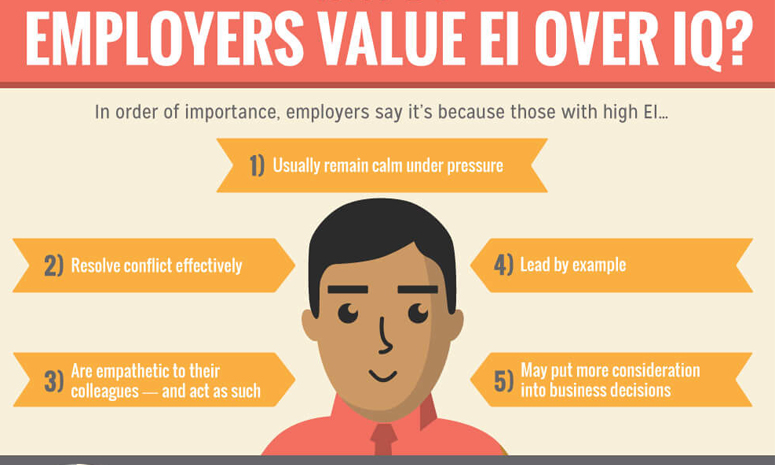
Remember this distinction: there are smart people and then there are emotionally intelligent people. If you don’t have a sense of the difference in these two, Paul Sohn posted an infographic (yay!) that gives an excellent description of emotional intelligence. There are a lot of smart people out there but what a joy when your boss, as smart as he may be, is also a great communicator with and appreciator of people.  [Go back and click on that infographic – very helpful!]

Emotional Intelligence is a concept that’s been around for awhile now.  Matt Monge’s article for The Mojo Company sparked my interest some time ago. He described 6 symptoms of leaders with low emotional intelligence.

Two of Monge’s points were: 1) Leaders with low emotional intelligence say “I’m sorry you feel that way” more than “I’m sorry,” and 2) Leaders with low emotional intelligence often blame the people they hurt for the situations leading to them being hurt.

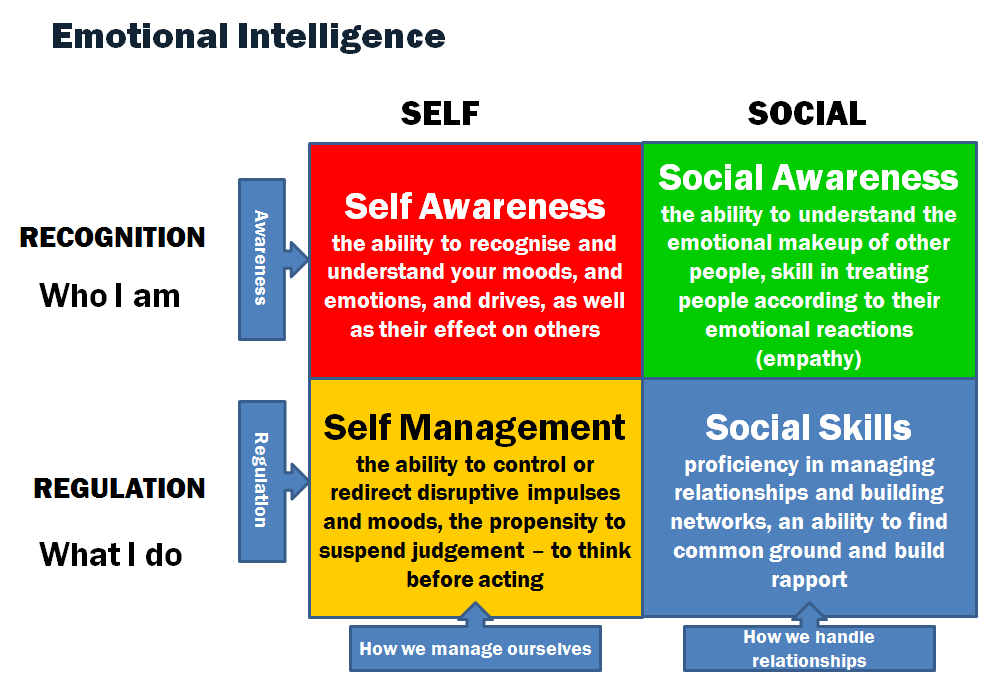
Daniel Goleman has written several books on this topic including Emotional Intelligence: Why It Can Matter More Than Intelligence and Social Intelligence: The New Science of Human Relationships. The very cool thing about emotional intelligence is that it can be developed. The big dilemma is whether bosses or even teammates, not bothered by their impact on others, would buy into this relational skillset. Incorporating such concepts in personnel accountability metrics might provide some incentive. I’ve added graphics below that helped me further understand emotional intelligence.
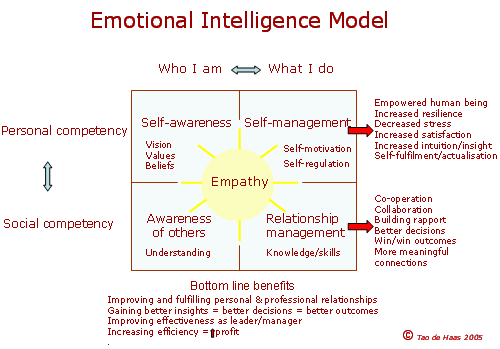
Blog - Friday Faves - Emotional Intelligence - grid - dollieslagerPhoto Credit: Dollie Slager

Blog - Friday Faves - Emotional Intelligence - low & highPhoto Credit: The King and Queen

___________________________________________________________________________

Even people with strong emotional intelligence can find themselves off-balance when in conflict with someone. Leadership writer Marcel Schwantes gives counsel for this in 7 Brilliant Things Emotionally Intelligent People Do When Their Buttons Are Pushed.Photo Credit: Wikimedia Commons

Schwantes encourages us to respond rather than react in a conflict situation. His seven action points follow (read more of his article for his commentary on each one).

  1. Get perspective.
  2. Take a 6-second pause.
  3. Stay humble.
  4. Try empathy.
  5. Ask the most conflict-diffusing question. [“Are you ok?” What’s going on?”….what else would you think would diffuse the situation?]
  6. Speak from your authentic self.
  7. Be the first to reach out after conflict.

Don’t miss the brief video at the end of Schwantes’ piece on 3 Simple Questions to Improve Your Emotional Intelligence.
Blog - Friday Faves - Leadership - Emotional IntelligencePhoto Credit: Self Study History 

I hope you’re surrounded by emotionally intelligent people. Maybe you’re an “EI” rockstar yourself. For me, that woman above, piloting the project, had my respect from the beginning, but because she responded to me in such an honoring, genuinely considerate way, she also has my complete support and more.

Do you have any emotional intelligence stories? Please comment below. We can always use  stories of great bosses and coworkers to inspire and spur us on.

___________________________________________________________________________

Try These Two Smart Techniques to Help You Master Your Emotions – Lisa Feldman Barrett

How Emotional Intelligence Boosts Your Endurance – Alex Hutchinson

___________________________________________________________________________

Bonus: Resources for Raising Our Children to Be Emotionally Intelligent

Research Shows Reading Improves Kids’ Emotional Intelligence and Increases Empathy – Katie Priske

This Is How to Raise Emotionally Intelligent Kids: 5 Secrets From Research – Eric Barker

Parents Who Raise Emotionally Intelligent Kids Teach This Important Skill, Says Neuroscientist and Parenting Expert – Here’s How – Willian Stixrud & Ned Johnson

Chores Lead to Happy Children. So Why Do So Few Parents Require Them? – Annie Holmquist – OK…this doesn’t really have to do with emotional intelligence but it fits in the mix of raising kids well.

Monday Morning Moment – You’re Stronger Than You Think – Really? – A Truer Truth

Photo Credit: Quotir, Winnie the Pooh

OK…who hasn’t heard this encouragement? “You’re stronger than you think.” I have never cared for it. Why? Because it pushes the weary soul, doing all we can to stay afloat already, to “just keep swimming”.

Not that any of us wants to quit whatever we’re about…but…is there a truer truth?

The “stronger than you think” quote has been attributed to A. A. Milne, author of the Winnie-the-Pooh stories. Written by  and published in the 1920s. This was a time post-World War I and prior to The Great Depression and World War II. The expression of “pull yourself up by your boot straps” and the mentality of self-reliance was fueled in those days, in literature and culture. It continues today.

[Now, you should know Milne did NOT write that expression. A writer at Disney must have. It is a quote from the animated film (1997) “Pooh’s Grand Adventure: the Search for Christopher Robin”. Pooh’s dear friend Christopher Robin is going away to boarding school and is trying to give Pooh, and himself, the courage for them to be apart. That message is there but not in so many words as in the Disney film.]

So…after that bubble burst, let’s return to the oft-quoted “stronger than you think” encouragement we find everywhere. It seems to speak to our culture…across generations.

Self-reliance. Work harder. Work smarter. We can do better. Sigh…

When we are told by a friend or family member, or even a social media stranger, that we’re stronger than we think, we are not being encouraged to lean on community…or God. We are given the message that somewhere inside ourselves, alone, without others, we can tap into more strength than we are feeling at the moment.

Is that really encouragement? I know we mean well…but do we really want to offer up Disney verbiage to a real struggle?

When I’ve gone about as far as I can go, can I slog out more, just with my own “main strength and awkwardness”? Maybe. At what cost and to what gain?

I got a phone call earlier today from a mom needing an understanding ear on a hard struggle involving her young son. She’s a terrific mom. Yet…she’d come to the end of her rope on this one. She sounded on Empty. Did it help that we talked? I think so…and definitely it helped to pray afterwards. She will find the way to help her son. She has a way forward even if she doesn’t see it clearly yet. Through her own resolve and experience. Through deep community. Through an enduring faith in a wise and loving God.

Photo Credit: Heartlight

The Apostle Paul speaks so eloquently and practically on this issue of our weakness and God’s strength. In fact, when we come to the end of ourselves, we find God’s strength perfect in our weakness. It’s both a hard truth and great comfort. We don’t like the experience of coming to the end of ourselves. Nor do we like to see our friends and family moving so close to that reality. For this reason, we encourage those we love to dig deeper.

Photo Credit: Heartlight

You know I love words…and I squeeze as much good out of them as I can. The Pooh video clip above and its messages of the richness of relationship do have meaning for us. Part of that meaning is how sustaining relationships can be even with we are apart from each other. However, the best part of relationships and how much stronger they make us comes from the moment-by-moment reach of them in the present. When we are there for each other (and pray for each other) we become stepping stones rather than stumbling blocks.

When we seek to encourage with words like “You’re stronger than you think”, your heart will be heard. Lean in with those words…and pray for that one in the struggle.

Why I Believe ‘You Are Stronger Than You Think’ Is Not Always True – Arlene Pellicane

Monday Morning Moment – That Thing Does Doesn’t Need to Be Said – and If It Does – Deb Mills [Remember the quote from the Disney film Bambi? “If you can’t say anything nice, don’t say anything at all.” That is actually part of my family’s lexicon – so Disney does have wisdom sayings in its film library. 🙂

[Mandisa sings about how hard things make us stronger BUT she says that in the face of God being right there with us – holding us through whatever comes. We can rest in Him…and each other.]

11 Reasons Why You’re Stronger Than You Think – Coaching-Online – this is actually a good article on the argument of “you’re stronger than you think”…but, there is a truer truth.

If you can’t get enough of Pooh – this is a sweet film:

Monday Morning Moment – Back to School – 12 Essential Lessons of Life

Photo Credit: Pixabay

[Adapted from the Archives]

It’s Back to School days around here. Whether we teach our children at home or contract and cooperate with other teachers, this time of year is both exciting and sobering.

I married late in life, and the children came even later. Parenting wasn’t an instinctual process for me. Fortunately, mentors came along at pivotal times, as did parents whom I did not want to be like. Between the two, I found my way.

Feeding, clothing, and protecting children are all crucial…but what do we teach them? What are the essential lessons of life?

Two old songs come to mind when I think of the serious nature of teaching our children what they must learn for life. The old folk/rock group Crosby, Stills, and Nash & Young wrote and performed Teach Your Children. Graham Nash wrote the lyrics out of his painful relationship with an absent, sometimes imprisoned, father. Nash’s message is that we have to teach our children to make a better life…if not a better world.

You’ve Got to Be Carefully Taught is the other deeply emotional song out of the musical South Pacific. This song points to racial prejudice and cultural bias, and how hatred must be taught to children when they are young. Mandy Patinkin‘s version of this song communicates its meaning powerfully.

Although hatred or bias can be taught, even from an early age, such dreadful things can also be caught over time in culture. Things like entitlement, dishonesty, greed, and irresponsibility. We as parents (teachers and employers also) have a huge role in guiding children and young people to mature into caring and responsible adults…even in a culture that may cut across the grain of our own values.

I’d like to explore what we must teach our children. Intentionally, with meaningful purpose. Catching those teachable moments and seasons. Some things are more “caught than taught”, as the saying goes. Kids will catch some values living in close proximity to us and others. That makes the case, as well, for how we choose to live and what companions we seek for ourselves and our children.

More Is Caught Than Taught – Gabbie Nolen-Fratantoni

When our children were young, we taught them a set of rules which we honored in our home. The 21 Rules of This House by Gregg and Joshua Harris. These rules were, in ways, simplistic but also comprehensive enough to help us create a safe, orderly, and loving home, where children AND parents had the same expectations. Photo Credit: Choosing HomeSchool Curriculum

Our children are grown now, out on their own. Two of them are already in the season of small ones, establishing their own essentials for teaching their children.

This is a reminder to them of their own family values…I hope it’s also a help to you. These are 12 essential lessons of life. They are not comprehensive. I would love to hear what you think should have been there as well, in the Comments section below. Thanks.

1) Love God – You shall love the Lord your God with all your heart and with all your soul and with all your mind. This is the great and first commandment.” – Jesus – Matthew 22:37-38 If you are reading this and don’t share a faith in one God, then this won’t have meaning for you. Jesus was asked what was the greatest commandments of the law (in that day, they were burdened by the weight of over 600 laws). His answer? Love God with everything in your being. Clearly it’s good for us to do and something parents can model and teach from the time children are tiny.

2) Love others – You shall love your neighbor as yourself.– Jesus – Matthew 22:39  Jesus didn’t stop at the greatest commandment. He added this one as just second to the most important. Love others. Not just your buddies. Not just those like you…but whomever neighbor is…the nobody, the every man. Jesus was clear in his instruction in “as yourself”. However it is we would serve ourselves, we give of ourselves to those around us. Wow! Great wisdom to teach our children.

3) Be obedient (honoring) – Children, obey your parents in the Lord, for this is right. “Honor your father and mother” (this is the first commandment with a promise), “that it may go well with you and that you may live long in the land.” – Ephesians 6:1-3 What a struggle it is for us to teach our children to obey! What a developmental milestone when they get it! Not after we count to 3, or 10…or whatever other enticement to obey we use in desperation. Immediate obedience – in attitude and action. That is a lesson they will take all the way through adulthood.

Raising our children in huge cities made it crucial for them to obey the instant they heard us speak to them, especially over the noise of the city. One thing we did was a bird call (a whistle sounding “bob, bobwhite”). When they heard that, they looked up and started heading in our direction immediately. I still marvel when even today, that still gets their big grown-up attention.

More on obedience can be found here.

Photo Credit: Flickr

4) Be grateful. – Give thanks in everything, for this is God’s will for you in Christ Jesus. – 1 Thessalonians 5:18  God’s Word is filled with examples and encouragements toward being grateful (here are just a few). Jesus’ life was a testament of thankfulness to God the Father, and He taught us to pray with thanksgiving. Our kids grew up with The Thankful Song (from the Veggie Tales Madame Blueberry video) –A thankful heart is a happy heart; that’s why we say thanks everyday.”

The Power of Gratitude – 21 Verses of Thanks to God – Debbie McDaniel

Avoid Raising an Entitled Child – 5 Strategies That Really Work – Amy McCready

5) Speak the truth. – Lying lips are an abomination to the Lord, but those who act faithfully are his delight. – Proverbs 12:22 The worst offense in our home was lying. Jesus spoke of Satan as being the father of lies (John 8:44). Telling the truth is something we model and something, I hope, our children value highly in their adult lives. No spin, no deception…straight-up truth. Truth in love (Ephesians 4:15).

6) Work with diligence and excellence. – Whatever you do, work heartily, as for the Lord and not for men.Colossians 3:23   In grasping this lesson, children learn perseverance, patience, and an understanding of the value of work. Our youngest struggled with academics and he would say, about homework, “I just want to get it done!” As he matured, he moved his lament to more of a charge of “get it done and done well”. Watching him grow in that continues to make us so proud of him.

12 Ways to Glorify God at Work – Jose Etter

7) Seek joy. – Be joyful in hope, patient in affliction, persistent in prayer. – (Romans 12:12) Grumbling, discontent, and whining are such a part of human nature. When we count our situation with joy, whatever it is, everyone wins. Other verses here.

8) Seek peace. – “Blessed are the peacemakers, for they will be called children of God.” – Jesus (Matthew 5:9) Sometimes we crave peace, and we’ll do anything to get it. Our children don’t need to learn how to be peace-keepers but to be peace-makers. It’s not about giving way to the one causing trouble, for instance. It’s developing relational skills to bring peace to a situation, resolving the conflict. More verses here on peace.

9) Be forgiving. – Bear with each other and forgive any complaint you may have against one another. Forgive as the Lord forgave you.Colossians 3:13 Holding grudges and distancing ourselves from others in unforgiveness is no way to live. Forgiving because we are forgiven carries with it a deep, loving perspective. Helping our children understand how to forgive, especially little ones who have been gravely hurt by others, is huge. More on forgiveness.

10) See beauty; create beauty. – He has made everything beautiful in its time. Also, He has put eternity into man’s heart, yet so that he cannot find out what God has done from the beginning to the end. Ecclesiastes 3:11 My children tease me sometimes because they say I think everyone out there is handsome/pretty. God has given me eyes to see, maybe as He sees. He creates beauty and He means for us to see and appreciate it…and create beautiful things ourselves.Photo Credit: Public Domain Pictures

Our children are all musicians (one professionally) or writers . They create beauty as we all can…in some way or another.

Nathan Mills -Beyond The Guitar

Top 10 Bible Verses about Art with Commentary

Saying Beautifully as a Way of Seeing Beauty – John Piper

11) Be kind. – Be kind to one another, tenderhearted, forgiving one another, as God in Christ forgave you. – (Ephesians 4:32) Again, years ago, when our kids were very young, they participated in a Vacation Bible School and learned a little song on kindness. “K-I-N-D, Love Is Kind”. I couldn’t find it anywhere for today’s blog, but the message stuck in all our heads. One of the simplest ways to show love is to be kind – to be generous and caring in our consideration of others. The Scripture points often to kindness in loving each other.

Be Kind to One Another – John Piper

12) Serve others. – Do not neglect to do good and to share what you have, for such sacrifices are pleasing to God.Hebrews 13:16 This lesson of serving others is one I actually struggled to teach well. I fell into the excuse (like many parents do) that they had so much homework, so many assignments to complete, that they should just have fun when they had the time. Serving could have totally been a “fun” way of life. I hope our children do better with teaching serving than I did. More on serving here.Photo Credit: Niagara

In closing, I’ve left off many things. Critical thinking is one. Purity another. In fact, do you remember that little song, “Be Careful Little Eyes What You See.” Our kids knew that in English and Arabic.

Still probably the greatest lesson across the years of childhood (which goes along with the two greatest commandments Jesus taught) is the one Bob Pierce, founder of World Vision, taught us.

Let (your) heart be broken with the things that break the heart of God.

We want to teach our children to do right, for the sake of others and for themselves, and to stand up for what is right.

Train up a child in the way he should go: and when he is old, he will not depart from it.Proverbs 22:6

Let Your Heart Be Broken – Jeremiah 8, 9 – Rick Ezell

Bible Verses on Injustice

Monday Morning Moment – “The Chosen” – Jesus and Generation Z

Screenshot from “Unfiltered: Gen-Z Reacts to The Chosen”

The Chosen is an online TV series created and directed by Dallas Jenkins. The statement of faith posted by Jenkins includes the following: “The Chosen is a narrative show, which means it’s not a documentary…it’s absolutely not a replacement for Scripture. It is not focused on religious tradition, but on Jesus. It’s a show…but it’s a high calling for me.”

Dallas Jenkins and “The Chosen” production team developed a film project entitled “Unfiltered: Gen-Z Reacts to The Chosen”. It is a documentary where 9 strangers of Gen Z age were brought together to binge-watch “The Chosen” Season 1. They did not know what they would be watching. The documentary was just posted this week. It is below (starting 32 minutes in). You will love it!!

The Gen Z’ers (young people born after 1995) were really lovely. Different religious backgrounds. Very different social and family situations. More trauma and isolation than I would have imagined. Hard. Yet here they are grown, bright, their own people.

Screenshot from “Unfiltered: Gen-Z Reacts to The Chosen”

Binge-watching “The Chosen”. Their perspectives were fascinating – starting out, watching, and then processing afterward.

A little bit about “The Chosen” (from a previous blog I wrote):

I love the stories. They are reflective of Jesus and those closest to Him. They are plausible given what we know of Jesus in Scripture and what we know of the whole counsel of God in the Bible.

I have so many favorite scenes in this production (Season 1 and Season 2 also, and coming soon Season 3). One of the scenes is when Jesus calls Matthew as a disciple. Matthew…a Jewish tax collector – under the protection of the Romans – hated by his fellow Jews for the hardships he brings on them. In this treatment of this real person, Matthew is shown as one who could be on the Autism spectrum…brilliant and different. Watch the scene here.

Jesus’ line, “Get used to different”, although extra-Biblical, is so in character with the person of Christ. Winsome, loving, and right.

Merch from The Chosen Gifts

Worship Wednesday – Trouble – From The Chosen – Deb Mills

So what happens when a group of young people, very different from each other, watch this TV series?

Screenshots from “Unfiltered: Gen-Z Reacts to The Chosen”

I appreciated their take on “The Chosen”. Thoughtful, analytical, emotional, and open. No arrogance or judging. They considered the stories and the message. Did they all convert to people who follow Jesus? I don’t think so and it isn’t fully disclosed in the documentary …and…that certainly did not seem like the producers’ ploy.

What did happen for these Gen Z’ers is that they saw Jesus differently. Hopefully more accurately… They left the room changed.Screenshot from “Unfiltered: Gen-Z Reacts to The Chosen”

This documentary was just really good. I wish I could say to each one, thanks for being willing to risk being a part of that project. Their vulnerability was something we could all benefit from.

I wonder if they watched Season 2 of The Chosen on their own. I’m certainly looking forward to Season 3. In a world as cynical and jaded as ours, to be immersed in the place and community of Jesus is a great refreshing of the soul. Jonathan Roumie, who plays Jesus, is an actor, of course…but his portrayal of Jesus is brilliant and true to the heart of Christ.

If you haven’t seen The Chosen yet, it is free to you, on YouTube and the app. Catch up…you’ll be glad you did.

Monday Morning Moment – Parenting – Teaching & Modeling Essential Life Lessons

[Adapted from the Archive]

I married late in life, and the children came even later. Parenting wasn’t an instinctual process for me. Fortunately, mentors came along at pivotal times, as did parents whom, unfortunately, I did not want to be like. Between the two, I found my way.

Feeding, clothing, and protecting children are all crucial…but what do we teach them? What are the essential lessons of life?

Photo Credit: Pixabay

Two old songs come to mind when I think of the sober nature of teaching our children what they must learn for life. The old folk/rock group Crosby, Stills, Nash & Young wrote and performed Teach Your Children. Graham Nash wrote the lyrics out of his painful relationship with an absent, sometimes imprisoned, father. Nash’s message is that we have to teach our children to make a better life…if not better world.

You’ve Got to Be Carefully Taught is the other deeply emotional song out of the musical South Pacific. This song points to racial prejudice and cultural bias, and how hatred must be taught to children when they are young. Mandy Patinkin‘s version of this song communicates its meaning powerfully.

Although hatred or bias can be taught, even from an early age, such dreadful things can also be caught over time in culture. Things like entitlement, dishonesty, greed, and irresponsibility. We as parents (teachers and employers also) have a huge role in guiding children and young people to mature into caring and responsible adults…even in a culture that may cut across the grain of our own values.

I’d like to explore what we must teach our children. Intentionally, with purpose and meaning. Watching for those teachable moments and seasons. Some things are more “caught than taught”, as the saying goes. Kids will catch some values living in close proximity to us and others. That makes the case, as well, for how we choose to live and what companions we seek for ourselves and our children.

More Is Caught Than Taught – Gabbie Nolen-Fratantoni

When our children were young, we taught them a set of rules which we honored in our home. The 21 Rules of This House by Gregg and Joshua Harris. These rules were, in ways, simplistic but also comprehensive enough to help us create a safe, orderly, and loving home, where children AND parents had the same expectations. Photo Credit: Choosing HomeSchool Curriculum

Our children are grown now, out on their own. Two of them are already in the season of small ones and are establishing their own essentials for teaching their children.

This is a reminder to our adult children of their family values, growing up…I hope it’s also a help to you.

Below are 12 essential lessons of life. Some of them we inherited gladly from Christ-follower parents. As adults, we chose them for our own family. They are not comprehensive. I would love to hear what you think should have been there as well, (post in the Comments section below). Thanks.

[Also I want to revisit these relational commandments with my husband and adult children to see what they think now AND to consider, if I were parenting again, what would be different.]

1) Love God – You shall love the Lord your God with all your heart and with all your soul and with all your mind. This is the great and first commandment.” – Jesus – Matthew 22:37-38 If you are reading this and don’t share a faith in one God, then this won’t have meaning for you. Jesus was asked what was the greatest commandments of the law (in that day, they were burdened by the weight of over 600 laws. His answer? Love God with everything in your being. Clearly it’s good for us to do and something parents can model and teach from the time children are tiny.

2) Love others – You shall love your neighbor as yourself.– Jesus – Matthew 22:39  Jesus didn’t stop at the greatest commandment. He added this one as just second to the most important. Love others. Not just your buddies. Not just those like you…but whomever neighbor is…the stranger, the alien, the “less preferred”, the every man. Jesus was clear in his instruction in “as yourself”. How ever it is that we would serve ourselves, we give of ourselves to those around us. Wow! Great wisdom to teach our children.

3) Be obedient (honoring) – Children, obey your parents in the Lord, for this is right. “Honor your father and mother” (this is the first commandment with a promise), “that it may go well with you and that you may live long in the land.” – Ephesians 6:1-3 What a struggle it is for us to teach our children to obey! What developmental milestones when they get it! Not after we count to 3, or 10…or whatever other enticement to obey comes to mind. Immediate obedience – in attitude and action.

Raising our children in huge cities made it crucial for them to obey the instant they heard us speak to them, especially over the noise of the city. One thing we did was a bird call (a whistle sounding “bob, bobwhite”. When they heard that sound, they looked up and started heading in our direction immediately. I still marvel when even today, that still gets their big grown-up attention.

More on obedience can be found here.

Photo Credit: Flickr

4) Be grateful. – Give thanks in everything, for this is God’s will for you in Christ Jesus. – 1 Thessalonians 5:18  God’s Word is filled with examples and encouragements toward being grateful (here are just a few). Jesus’ life was a testament of thankfulness to God the Father, and He taught us to pray with thanksgiving. Our kids grew up with The Thankful Song (from the Veggie Tales Madame Blueberry video) – “A grateful heart is a happy heart; that’s why we say thanks everyday.”

The Power of Gratitude – 21 Verses of Thanks to God – Debbie McDaniel

Avoid Raising an Entitled Child – 5 Strategies That Really Work – Amy McCready

5) Speak the truth. – Lying lips are an abomination to the Lord, but those who act faithfully are his delight. – Proverbs 12:22 The worst offense in our home was lying. Jesus spoke of Satan as being the father of lies (John 8:44). Telling the truth is something we model and something, I hope, our children value highly in their adult lives. No spin, no deception…straight-up truth. Truth in love (Ephesians 4:15).

6) Work with diligence and excellence. – Whatever you do, work heartily, as for the Lord and not for men.Colossians 3:23   In grasping this lesson, children learn perseverance, patience, and an understanding of the value of work. Our youngest struggled with academics and he would say, about homework, “I just want to get it done!” As he matured, he moved his lament to more of a charge of “get it done and done right”. Watching him grow in that continues to make us so proud of him.

12 Ways to Glorify God at Work – Jose Etter

7) Seek joy. – Be joyful in hope, patient in affliction, persistent in prayer. – (Romans 12:12) Grumbling, discontent, and whining are such a part of human nature. When we count our situation joy, whatever it is, everyone wins. Other verses here.

8) Seek peace. – “Blessed are the peacemakers, for they will be called children of God.” – Jesus (Matthew 5:9) Sometimes we crave peace, and we’ll do anything to get it. Our children don’t need to learn how to be peace-keepers but to be peace-makers. It’s not about giving way to the one causing trouble, for instance. It’s developing relational skills to bring peace to a situation, resolving the conflict. More verses here on peace.

9) Be forgiving. – Bear with each other and forgive any complaint you may have against one another. Forgive as the Lord forgave you.Colossians 3:13 Holding grudges and distancing ourselves from others in unforgiveness is no way to live. Forgiving because we are forgiven carries with it a deep loving perspective. Helping our children understand how to forgive, especially little ones who have been gravely hurt by others, is huge. More on forgiveness.

10) See beauty; create beauty. – He has made everything beautiful in its time. Also, He has put eternity into man’s heart, yet so that he cannot find out what God has done from the beginning to the end. Ecclesiastes 3:11 My children tease me sometimes because they say I think everyone out there is handsome/pretty. God has given me eyes to see, maybe as He sees. He creates beauty and He means for us to see and appreciate it…and create beautiful things ourselves.Photo Credit: Public Domain Pictures

Our children are all musicians (one professionally) or writers . They create beauty as we all can…in some way or another.

Nathan Mills -Beyond The Guitar

Top 10 Bible Verses about Art with Commentary

Saying Beautifully as a Way of Seeing Beauty – John Piper

11) Be kind. – Be kind to one another, tenderhearted, forgiving one another, as God in Christ forgave you. – (Ephesians 4:32) Again, years ago, when our kids were very young, they participated in a Vacation Bible School and learned a little song on kindness. “K-I-N-D, Love Is Kind”. I couldn’t find it anywhere for today’s blog, but the message stuck in all our heads. One of the simplest ways to show love is to be kind – to be generous and caring in our consideration of others. The Scripture points often to kindness in loving each other.

Be Kind to One Another – John Piper

12) Serve others. – Do not neglect to do good and to share what you have, for such sacrifices are pleasing to God.Hebrews 13:16 This lesson of serving others is one I actually struggled to teach well. I fell into the excuse (like many in America do) that they had so much homework, so many assignments to complete, that they should just have fun when they had the time. Serving could have totally been a “fun” way of life. I hope our children do better than we did with teaching serving. More on serving here.Photo Credit: Niagara

In closing, I’ve left off many things. Critical thinking is one. Physical purity another. In fact, do you remember that little song, “Be Careful Little Eyes What You See.” Our kids knew that in English and Arabic.

Still probably the greatest lesson across the years of childhood (which goes along with the two greatest commandments Jesus taught) is the one Bob Pierce, founder of World Vision, taught us.

Let (your) heart be broken with the things that break the heart of God.

We want to teach our children to do right, for for the sake of others and for themselves, and to stand up for what is right.

Train up a child in the way he should go: and when he is old, he will not depart from it.Proverbs 22:6

[Sidebar: Right now I am studying Dr. Henry Cloud‘s Changes that Heal. He prescribes for his clients to write out the ten relational commandments of their families. As I mentioned above, I hope to revisit this again soon.]

Let Your Heart Be Broken – Jeremiah 8, 9 – Rick Ezell

Bible Verses on Injustice

Monday Morning Moment – Attuned Listening to the Stories Wanting to Be Told

Photo Credit: Tina Miroshnichenko, Pexels

We want to be good listeners, right? To hear what is truly being communicated. To stay with the person’s story. With its meaning to that person. Maybe even, as we listen deeply, to actually elevate that person’s comfort and capability to tell their story more truly… moving toward possible revelation, and, where needed, healing.

Over the last several months, I’ve been deep into studying about the brain/mind and how we process experience, memory, emotions, and trauma. “Deep” as defined, not by graduate study but, by reading and learning from seriously brilliant and practical therapists – the main one being Dr. Curt Thompson (you can find the blogs I’ve written on his content here).

Thompson recently spoke with Adam Young on Young’s podcast – The Place We Find Ourselves. It is Episode 115, entitled Why It’s So Important to Tell Your Story to an Attuned Listener.

When we are able to tell some part of our story, without fear of judgement, within a community and context of genuine care, transformation can result. How do we make this happen? By truly, deeply listening. Attuned. Without agenda.

Being attuned to a person sending us a message [telling us their story] means that we offer the other person our total attention and listen to them on a deeper level. We seek to understand rather than just making our own point, and this helps to reduce noise in the communication channel between us.

Attuning or ‘tuning in’ means refining your attention to the source of the information — just like you would do to a radio signal…Give them your complete attention and be open to what they are sending you in order to fully receive it.

Deep listening is a way of hearing in which we are fully present with what is happening at that moment without trying to control it or manipulate it. When we reduce our own internal psychological noise and allow the other person to communicate what they need to, we can receive the message as it is, without colouring it in with additional noise and without creating a judgement of it — thereby distorting it — before we fully understand it. We need to hear precisely what is being said to us so we know how to respond appropriately.Zahara Chetty

How Do You Listen? Improve Your Ability to Engage in Deep Listening Through Attunement – Zahara Chetty

Attuned Listening – Sonya Thomas – Lightning-fast read – succinct Do’s & Don’ts

Too often of late, we give ourselves permission to tune out. To be almost present with each other. To multi-task until no task is done well…including listening.Photo Credit: Charlotte May, Pexels

Attuned listening is a discipline…it is ours with practice, care, and intentionality. A few helps follow:

  • Silence or, better still, stash electronic devices.
  • Block off time.
  • Be fully present. When distractions press in, shake them off and refocus.
  • Demonstrate in every way possible your commitment to that person and their story (eye contact, posture, tone of voice).
  • Strive to be truly curious about the other person. Ask questions.
  • Seek to understand.
  • Do what you can to give the one speaking the experience of being seen, soothed, safe, and secure.
  • Determine not to “leave the room”.

What else would you add to the list above for a listener to be gifted with the story you long to tell? That story of childhood (or adult) trauma, regret, disappointment, loss…or that story of joy, gratitude, love, or beauty.

Attune to another…and listen. Both your lives will be enriched.

Attuned Listening – Kimberley Lewis – for parents of small children

Right Brain to Right Brain Therapy – Linda Graham

Monday Morning Moment – In or Out – Your Choice, but You DO Choose

Photo Credit: Corinne Dobbas

A friend of mine lamented this morning that someone in her family unfriended her on Facebook. Painful. I get it. Been there.

We make choices every day to lean in or pull out. Some of these choices have little consequence. Others break hearts or turn them into concrete. Taking ourselves out of others’ lives has consequence.

Father’s Day is coming and it has become a complicated holiday for me. I had a distant birth father and a great step-dad – both gone. My husband is a good father. My son and son-in-law as well. What complicates it is when things with fathers aren’t so good. This Father’s Day marks two years of a painful extended family rift. The pain of that has wide circles reverberating throughout. Everyone hurts for those hurt the most. Do we just ignore it or take sides? That would be choosing the “out” option. Or do we choose to stay in – refusing to leave the room (or either room since there are two now), praying for wholeness and healing, and fiercely fighting for our family?

I choose the latter for as long as I’m allowed to do so.

To be honest, whether it is family/friend conflict, or political, social or theological division – we choose where we stand. We choose to set up camp in a tight zone of comfort with those like us, or we choose to battle for those in harm’s way…including ourselves.

Maybe it’s always been this way, but today, for sure, we must be on watch of being deceived by popular opinion. It is not unifying. A choice is required. To think we don’t have to choose is its own delusion.

We’re either in…or we’re out.

“We all, like Frodo, carry a Quest, a Task: our daily duties. They come to us, not from us. We are free only to accept or refuse our task- and, implicitly, our Taskmaster. None of us is a free creator or designer of his own life. “None of us lives to himself, and none of us dies to himself” (Romans 14:7). Either God, or fate, or meaningless chance has laid upon each of us a Task, a Quest, which we would not have chosen for ourselves. We are all Hobbits who love our Shire, or security, our creature comforts, whether these are pipeweed, mushrooms, five meals a day, and local gossip, or Starbucks coffees, recreational sex, and politics. But something, some authority not named in The Lord of the Rings (but named in the Silmarillion), has decreed that a Quest should interrupt this delightful Epicurean garden and send us on an odyssey. We are plucked out of our Hobbit holes and plunked down onto a Road.Peter Creeft
Now, we can scramble back into the “shire” of our own choosing. Life is so much grander than that. Being an avid book person and homebody myself, I can easily snuggle down into a self-made and self-soothing burrow. This is my daily battle of thinking I am “in the world but not of the world”.
When we are physically (emotionally) absent in real life, we are choosing “out”, not “in”. That real life includes work, family, neighborhood, and some semblance of the world…which means choosing to be in with some we would NOT have chosen to be in with. Am I wrong here? Please talk to me in the Comments below.
“Reading a book about something can be an obstacle to doing it because it gives you the impression that you are doing what you are only thinking about doing. It is tempting to remain in the comfortable theater of our imagination instead of the real world, to fall in love with the idea of becoming a saint and loving God and neighbor instead of doing the actual work, because the idea makes no demands on you. It is like a book on a shelf. But, as Dostoyevsky says, ‘love in action is a harsh and dreadful thing compared to love in dreams’ (The Brothers Karamazov).”Peter Creeft
This choosing “in” even when it’s uncomfortable may actually be the road chosen for us. The choosing “out” dulls us to what could actually happen with {God and] us in the formula.
“This [the choosing out] is where our culture has evolved and I say reject it!”Angela
As these thoughts were cooking in my head, I came across the YouTube video below by Catholic priest Father Mike. It relates to a question he received on whether Judas Iscariot was in Heaven or Hell. Judas was the one who betrayed Jesus to the authorities who had him crucified. Later Judas would hang himself. Beyond that topic, Father Mike talked about our choices and how they affect both life and after-life.
“In light of heaven, the worst suffering on earth will be seen to be no more serious than one night in an inconvenient hotel.”St. Teresa of Avila
Photo Credit: Heartlight
We make choices all day long. Choosing how we spend our time, whose lives we lean into, and what we teach our children (by attitude and action) – all those choices have an “in or out” component. The quote above speaks to these choices. If we live for this world, our default is to hold tightly to our choices. However, if we live for the next, we can open our hands, and lean in. This life, no matter how hard, compared with Heaven, is like “one night in a bad hotel”. At its worst!
Perspective.
It’s our choice. In or out.

Monday Morning Moment – 10 Lies of Contemporary Culture – Dr. Peter Kreeft

Photo Credit: Catholic Speakers

Who remembers commencement speeches? I’ve remembered a few over the years. Just a few. Still at the time, in all the emotion of a graduation day, whether we remember or not, maybe those words implant deeply in the brains of both the graduate and the audience… whether they recall them or not.

I hope Dr. Peter Kreeft‘s speech has that effect.

He gave the commencement speech in May this year at the Franciscan University of Steubenville. At 85 years old, he was funny and bold and unflinching as he punched holes into much of what our post-Christian culture holds as sacred. From all I gleaned online and the students’ warm and welcoming responses, he is much loved and his thoughtful handling of uncomfortable topics was surprising. His brief speech (just under 20 minutes) was clear and pointed.

He covered what he considered The 10 Lies of Contemporary Culture. I wish I could have found a transcript but could not so took verbatim notes myself. Take the time to watch or, if you aren’t convinced, scan my notes below…and then watch.

Here are his “10 lies” in brief:

  1. You can be whatever you want to be.
  2. The most important person in the whole wide world is you.
  3. The world needs you. You can save the world.
  4. You need education in creative thinking. [the ability to create “a new reality, a new world. You are the creator of truth.”]
  5. You also need education in critical thinking. [“not the search for any positive truth but a negative skepticism towards anything that claims to be truth except that truth which you yourself have created.”]
  6. The superiority of spiritual passivism. [“All peace is good including peace with the world, the flesh, and the devil….We must be tolerant of everything except intolerance…If all peace is good, then all war is bad.”]
  7. Peace and justice. If you want peace, then seek justice. [“Demand justice and nothing more. If you can’t deny the very existence of your enemies then at least don’t forgive them.”]
  8. Exaltation of openness, welcoming, and tolerance as the supreme good.
  9. All you need is love, sweet love. [“If all you need is love then you don’t need truth.”]
  10. The exaltation of freedom as an end rather than a means.

Well, he is a professor of philosophy after all. So much to think about in these 10 points.

He closed with the following:

“Love cannot stop warring against hate. Light cannot stop warring against darkness…No matter how smoky, stinky, and slimy the darkness is, it cannot endure the light. However successful the darkness may be for however long a time and however it may increase and however many more times we continue to lose every battle in the culture war: yet the light is imperishable. All lies die. Truth alone remains.

Just go forth and preach the truth, the good news, by both word and deed, and then let the chips fall where they may. And please remember Mother Teresa’s words: ‘God did not put you in this world to be successful; He put you in this world to be faithful.’Dr. Peter Kreeft

Photo Credit: The Catholic Rose, Pinterest

Dr. Kreeft is a prolific writer and fascinating speaker. Some of his quotes are linked below. I’m not Catholic nor was he originally. Maybe it’s one of the reasons he is so passionate about the truth and doing what he can to bring his Catholic and Protestant brothers toward unity. As for those who do not follow the teachings of Christ, he still has a word of wisdom…delivered with humor, honesty, and humility.

Photo Credit: AZ Quotes

Peter Kreeft Website

Peter Kreeft Quotes

Peter Kreeft Quotes – GoodReads

Monday Morning Moment – Real Friendship – on Friends Who Wound, Fierce Friends, Friends who Turn Around, and Friends Who Stay

When you think of a real friend, who comes most immediately to mind? That old friend you’ve known your whole life? That new friend who came close quickly during a life crisis? That like friend who shares many of the same growing pains you’re having in life right now? Real friends. What an incredible gift they are! As we look for a few minutes at friendships, a bit of self-examination might prove profitable.

On the way to the airport last week, returning home, I grabbed a quick supper with one of my dearest long-time friends. As we caught up on the latest turns in our lives, she shared something I didn’t expect. Well…to be honest, it is a subject that occasionally comes up. I, at some point or the other, drop the ball on communication. It is a failing of mine through the years. Quick to repent, but the turning and trying to do better don’t last. Sigh… And it’s not because that friend (or any other) is not worthy of constancy. She certainly is.

These relational struggles and misfires make the gift of real friendship even more precious. We are not always great friends to one another…but being great at friendship…being real…is worth the effort. You, Dear One, who actually reads my blog, are worth the effort.

Photo Credit: Amazing Things, Facebook

I’ve written about friendship several times. Below are some of the pieces I’ve shared previously…and a new bit. Maybe you’d benefit from a review…I sure have.

Friends Who Wound – OK, this isn’t for everyone. When my friend shared what she did above, it felt yucky. Wounding. However it was a wound that potentially brings healing. I don’t want something inside my own heart to grow, without my awareness, into something that hurts others. Greg Morse recently wrote a piece for Desiring God on finding a friend to wound you.

We see on social media, and say ourselves sometimes, that it’s right to just get rid of people who have a negative impact on us, to walk away from punishers or diminishers, and hang with people who only affirm us.

The article above talks about friends who love us enough to say the hard thing…and stay. I appreciate people who love me in this way and take the risk to point out the huge potholes in my path or who reach into my life and help hoist me out of a ditch of my own poor choices. Here’s a quote from Morse’s article (he’s speaking to Christ-followers):

“The world cares nothing for our eternal good. Ungodly friends cheer us on toward destruction. They bequeath the kiss of flattery — the Dementor’s kiss. They coddle our egos, telling us what we want to hear, not what we need to hear. Even the most genuine and moral among them sets sail away from God. Thus we need a crew of Christian companions — a body — to keep us from shipwreck. Finishing the race is not an individual endeavor, and eternity is at stake.

Praise God then for the faithful wounds of true friends who protect us from ultimate injury. They tell us plainly, “You’re flirting with destruction!” …Friends who ask us hard questions, who crush the whispering lizard on our shoulder, who are for our eternal soul above our momentary feelings — these are true friends.”   – Greg Morse

There is a delicate balance here…and relationship matters. We’ve too often been put off balance by words unfitly spoken. What is your experience of friends who wound in a good way? For me, the best experiences I’ve had with this have turned into crossroads in life…isolated incidents where a friend helped me step back from a habit, a person, a life choice that could have destroyed me…and step toward a better way. Very thankful for the courage and love of such friends. – Deb Mills, from the archive

blog-best-friends-woundsPhoto Credit: Dgreetings

Fierce Friends – How grateful I am for friends who don’t give up on me. You have friends like these, too – those who love us enough to tell us the truth without ripping our hearts out. Friends who will keep loving us no matter the distance or ideologies that could separate us but don’t. These are fierce friends…friends who “stick closer than a brother” (Proverbs 18:24).

I’m reminded of an occasion when a room full of women gathered to discuss a hard thing going on in our current city. These women deeply love each other but have some very different stances on issues that mattered to all of us. The tension was palpable but the love more so. Our culture today seems peopled with friends when convenient, fair weather friends, and friends with benefits. Friends who politic together, work together, play sports together, or drink together. Take away the activity, and the friendship fades. What a wonder are these fierce friends who stay with us through the worst…those we know have our backs and we have theirs.Photo Credit: Quotesta

Real Spiritual friendship is eagerly helping one another know, serve, love, and resemble God in deeper and deeper ways.”
Timothy Keller

When connections are real, they simply never die…If you’ve deeply resonated with another person or place, the connection remains despite any distance, time, situation, lack of presence, or circumstance… Real connections live on forever.” Victoria Erickson

True friends aren’t the ones who make your problems disappear. They are the ones who won’t disappear when you’re facing problems.” —Author Unknown

“If you fishin’ for a friend you just gon’ catch and release, then I ain’t got no desire to be your friend…but if you is lookin’ for a real friend, then I’ll be one. Forever.”Ron Hall, Same Kind of Different as Me

Who are some of your fierce friends? Please share in Comments if you want to give a salute to some of them. – Deb Mills from the Archive

Real Friends – Beyond Cliques and Closed Communities – Because friendships seem fragile and temporary, when we find ourselves in a group with staying power, we hold on tight. Now some of my dearest friends are actually family…I guess that would constitute somewhat of a closed community. They aren’t going anywhere…not to say it couldn’t happen, but so far, so good.[The husband, the daughter]

As my friend lamented above about my own “leaving the room”, I was deeply convicted by Curt Thompson’s work in confessional communities. He talks often and at-length about the healing nature of groups who listen hard, speak truth, and commit to care over time – choosing over and over NOT to leave the room. These are therapy groups, but I think they are the substance of what may develop into cliques outside of mental health situations. A good thing that can turn too inward. Now, none of us would say we’re in a clique, but do we sometimes find ourselves so committed to a few that those friends just beyond our tight circles begin to miss us?…and we didn’t know it was happening…in fact, didn’t mean for it to happen.

“Is it possible to have the benefits of close relationships without becoming a clique with our close friends? It is. And the process is very simple (although like many simple things, it isn’t easy). There is one basic movement that can transform a closed clique into an open and welcoming community:

Turn around.

That’s it. Instead of facing in, focusing only on the good things inside the group, we can face out, focusing on sharing whatever good we have with others. We can unlock the circle, and let it grow.

I’ve seen this in action in our church—a community of people who are facing out together. I was freely welcomed into that circle by those who were there before me, and I’ve experienced the joy of joining them in welcoming others. I’ve seen how a welcoming circle of friends is deepened, not diluted, by including others…friendships do not grow the deepest when we face in and focus only on the deepness of our friendships—they deepen most when we face out, together, in a shared mission of giving for the good of others beyond us. –  Seth Lewis, How to Turn a Clique Inside Out

Photo Credit: Emily P. Freeman, Quote Fancy

Friends Who Stay – Finally, I offer this book on friendship:

Photo Credit: Sarah, Sally, and Joy Clarkson – Girls’ Club – Cultivating Lasting Friendship in a Lonely World

In the book above, Sally’s daughter Sarah writes a chapter entitled Saturday Mornings: The Girls’ Club Prototype. In this chapter, she describes “five progressive actions…central to the powerful cultivation of friendship”. They are:

  • Invite – Reach out and bring in a new someone to an adventure and your life.
  • Plan – Work out the logistics of an event, a meetup, an outing. Make it a welcome ritual or routine.
  • Provide – Show love, Sarah says, by preparing the table, so to speak. Whether it is the physical space itself (your home, for instance) or your own “mind and heart” to wholly receive the new friend.
  • Stay – This is huge! Whether distance or circumstance separate you, be a continual presence in the life of a friend. Be there. Show up. This takes effort and intentionality, and it’s not easy. It requires both forgiveness and faithfulness…no matter what.
  • Pray – When we remember that every single person we meet is an image-bearer of God, we are reminded of the value there. Even those “mean girls” in our lives didn’t get mean in a vacuum. “Hurt people hurt people”. They have God’s imprint like every other imperfect person… When we recognize our own frailty and that of others, we are drawn to pray. For our own hearts to love like Jesus. For eyes to see how God sees people…and to reach out in love…as only He has made us to do so.

_______________________________________________________________________

Forgive the length of this piece…hopefully you were able to skim over parts and dig into others. I want to be a real friend to those God has placed in my life. Not a thin-veneer, “say all the things” but not truly by there for that person, shallow kind of friend. In closing, I had wanted to share a bunch of images of friends through the years…but decided not to. We have been wildly blessed with great people in our lives… people who have been real friends to us and others over a lifetime. You know who you are. Thankful for all the real friends in my life…striving to be one.

[P.S. We can be real friends and not always behave so. Life circumstances, personality, strengths/weaknesses, losses, pressures, as well as joyful distractions can all affect our leaning into and staying deep into a friendship. When we come up short, we can face it and hopefully restore, and be restored in, real friendship. Grace upon grace.]

Photo Credit: Incourage.me

What Makes For a Lifelong Friendship? – A Snapshot of Such a One – Deb Mills

15 Signs that Prove Your Friendship Is the Real Deal

I Believe in Guilt-Free Friendship – Lisa-Jo Baker

Befriend – Create Belonging in an Age of Judgment, Isolation, and Fear – Scott Sauls

Monday Morning Moment – Empowered People – Reckoning with a Victim Identity

Photo Credit: The Minds Journal

We hold the doors open for each other.

In recent days, I’ve marveled at common spaces we share in the world.

Out early in the morning, we pull into Wawa for coffee,  and gas if we need it (maybe where you are the gas station/convenience store has another name). On the way to our jobs or appointments. We wait on each other topping off our coffee per personal preferences. We share spaces. We check out together.

We hold the doors open for each other.

In the line at UPS, we wait. We are there to mail packages, return items, or maybe get a passport picture. We wait together. Young and old. Latino, Asian, Black, White. We wait and we hold the door open for each other.

Sitting or standing in the crowded reception area of the local free clinic, we wait to be seen. Again, a wide mix of people. All of whom, except for me, were not born in the US. [I was there with an Afghani refugee lady, helping her get medical services.] All of us there having successfully jumped through the hoops of obtaining that first appointment. We have this in common. We share this comradery.

We hold the doors open for each other.

In all these situations…and others…we are people with stories not necessarily known and yet with common threads. We have our stories. Both victim and victor stories. We do not have to choose to be defined by them…especially not the victim stories.

By definition, a victim is someone who has been injured, harmed, has suffered as a result of circumstances or what we consider to be disrespectful behavior from others. Linda and Charlie Bloom

The Victim Identity: Signs and How to Recover – Linda and Charlie Bloom [Quick read in 3 parts. Excellent resource.]

Maybe it’s different where you are in the world, but in our current socio-political system and culture, we are grappling with critical theory – the push to believe that all of humanity is either in the oppressor camp or the oppressed camp.

Deconstructing Critical Theory: Oppressed and Oppressor – Kevin Watson

Are there oppressors in the world? Absolutely. Are there those who are or have been oppressed? Unfortunately, also yes.

However, we, as peoples, are neither only oppressed or oppressor, in our fullest identities. We can rise up; not pointing fingers at each other, but in a larger understanding of one another. Not being subservient to either worldview.

Overcomers…

For those of us who have capacity and capability to help others, we help most effectively and comprehensively by influencing a pathway forward for those who have identified themselves as victims.

Or maybe the victim mindset was thrust upon some. A very wise person said to me just this morning, “If you want to ‘control’ people, convince them they are victims”.

Think about it…that is definitely oppressor behavior…and yet sometimes it is communicated by those in positions of power or influence who seem the most benevolent.

  Photo Credit: Courtney Wadley

As for doors? Most doors are closed; that’s their nature. That is their purpose. No added meaning. Sometimes, oppressors lock doors and control who goes through. Those who primarily think of themselves as victims may feel intimidated or persecuted at the prospect of prying open the door. If we look at doors as both giving access and protecting from evil (whatever that is), we use them accordingly. Most people, thankfully, hold the doors open for each other…and will continue to do so no matter how culture changes.

How we self-identify matters, in terms of a way forward. When we see ourselves as victims, our sense of agency or self-empowerment is diminished by our own mindset. Then there are the myriad of messages calling us to align ourselves with victimhood. These messages come from both well-meaning people and those who would seek to pigeon-hole us in ways we can be exploited.

All the scenarios mentioned at the start of this piece have stories attached to them. I don’t know those stories, but I do know many others. We all do. Telling and living our stories truly make for real legacy, for ourselves and our children.

Bad things have happened to us (some more than others). We can learn from each other if we are willing.

A victim mindset imprisons both the one who was harmed and the one who did the harming…as well as those in between who want to help but may not know how…yet. What a difference if we can empower rather than impoverish. Embrace CommunitiesWendy McCaig trains people to understand and operate with this worldview. Away from identifying victims and just doing “for” people as if they can’t possibly do for themselves. She lives and teaches to do “with” people, together discovering giftings and orchestrating opportunities to express those giftings (along the way, strengthening their families and communities).

In this way, we hold the doors open for each other.

Photo Credit: Wendy McCaig, Embrace Richmond, Embrace Communities

YouTube Video – TED Talk – How I Stopped Being a ‘Victim’ and Restarted My Life – Arman Abrahimzadeh

How to Know if Your Victimhood Has Become Your Identity – Rick Thomas

Monday Morning Moment – Building and Re-building Community – Deb Mills

Monday Morning Moment – Steps Forward in “We the People” Becoming True for All Americans – Deb Mills

Sunday Reflection – Am I My Brother’s Keeper? On Neglect – Part 1  and Part 2 – Deb Mills