Category Archives: Critical Thinking

5 Friday Faves – Politics and a Confession, Beyond the Guitar, Must-See Documentaries, Writing Your Story, and the Tail End of Life – Plus Bonuses

Friday Faves – my favorite finish to a writing week. It suffers when I travel…today, I’m home. Lots of faves over the last several weeks went without my pushing them forward to you. I’ve added some bonuses to this one to pull in a few more.

Hope you are doing well in this first week of the New Year. I wrote about making resolutions and experiencing real change earlier. New resolve is something as welcome as each new year. It helps me, for sure…no matter how successful, I am energized by resolution. Glad for new beginnings.

Here are this week’s 5 and a handful of bonuses:

1) Politics and a Confession – Whatever your political bent, we are in a new era in the US. The presidential inauguration is fast-approaching, and President-elect Trump will become the next POTUS. I have enjoyed reading the pundits on their take on the new normal. Two of my favorite finds this week are from very different: pieces by New York Times writer Ross Douthat and former Speaker of the House Newt Gingrich. From opposing sides, their articles (with Gingrich, it was a speech delivered after the 2016 Presidential election) are enlightening and the stuff that will help us move forward and cross aisles toward a nation for all Americans.Photo Credit: Joshua Lott, New York Times

Hope you take the time to read them…would love to hear your take on them (Comment below). Also Gingrich refers his audience to an article by Nassim Nicholas Taleb. In it, Taleb describes the Intellectual Yet Idiot – “the inner circle of no-skin-in-the-game policymaking ‘clerks’ and journalists-insiders, that class of paternalistic semi-intellectual experts with some Ivy league, Oxford-Cambridge, or similar label-driven education who are telling the rest of us 1) what to do, 2) what to eat, 3) how to speak, 4) how to think… and 5) who to vote for…The IYI pathologizes others for doing things he doesn’t understand without ever realizing it is his understanding that may be limited.”

I felt so vindicated in Taleb’s article – probably not an intellectual, hopefully not an idiot.

2) Beyond the Guitar – When Nathan’s Facebook hits on his Star Wars Medley passed 1.3 millions, I was like, “What?!” Not because I don’t complete agree with the beauty of these themes when arranged for classical guitar…but because of that whole social media phenomenon. Wild! Anyway, here’s his latest arrangement of Princess Leia’s Theme – as a tribute to Carrie Fisher:

3) Must-See Documentaries – Documentaries have neveer been high my watch-list, but this list was intriguing to me. 200  Documentaries You Must See Before You Die. My favorite documentary production group is Fourth Line. Bono & Eugene Peterson: The Psalms is my favorite film from that company…not on the list of 200 (this time around). After reading the list and making notes to self on what to watch, I’ve determined to come up with my own short-list of must-see’s (stay tuned for that). Any recommendations?

Photo Credit: Coffee and Celluloid

4) Writing Your Story – A dear friend of mine writes biographies – not for publication, necessarily, but for her and her family’s own pleasure. Lee Taylor-Wimett, twice-widowed, has written her husband’s stories and her parents’ stories. She has also written her own story…thus far. I had the joy of reading her story when she shared it with me – a simply bound volume of real life. She has, for years, encouraged me to write…to write about my own parents…and maybe, one day, to write my story. I have begun that process – writing about my mom and dad…and keeping up with bits of my own life. Memory is a precious thing and not to be taken for granted.

Photo Credit: Flickr

In this throw-away culture, I have boxes of bits of our lives – growing up in Georgia, having babies in Tennessee, moving around Africa, and now “empty-nesting”, figuring out this life with sweet aging parents, adult children with children…and work in a very different season. Whether any of my children or grandchildren read the story (and I know some will), I want to document this life…this amazing life God has given us.

Steve Anderson of Family Search has made a quick assist in this process with 52 Questions in 52 Weeks: Writing Your Life Story. This is a good week to get started.

Photo Credit: Family Search

5) The Tail End of Life – Tim Urban and Andrew Finn of Wait But Why make charts and graphs that put all kinds of information in a visual form. As a visual learner, I love that. This one is by Tim Urban who helps us look at the human lifespan in a lot of meaningful ways – how many Red Sox games or pizzas or presidential elections we might have left…and more.Photo Credit: Wait But Why

Urban’s observation on time left with parents was poignant [and for my children – this is even more telling for us and our own remaining parents,   as for you]:

I’ve been thinking about my parents, who are in their mid-60s. During my first 18 years, I spent some time with my parents during at least 90% of my days. But since heading off to college and then later moving out of Boston, I’ve probably seen them an average of only five times a year each, for an average of maybe two days each time. 10 days a year. About 3% of the days I spent with them each year of my childhood.

Being in their mid-60s, let’s continue to be super optimistic and say I’m one of the incredibly lucky people to have both parents alive into my 60s. That would give us about 30 more years of coexistence. If the ten days a year thing holds, that’s 300 days left to hang with mom and dad. Less time than I spent with them in any one of my 18 childhood years.

When you look at that reality, you realize that despite not being at the end of your life, you may very well be nearing the end of your time with some of the most important people in your life. If I lay out the total days I’ll ever spend with each of my parents—assuming I’m as lucky as can be—this becomes starkly clear:

It turns out that when I graduated from high school, I had already used up 93% of my in-person parent time. I’m now enjoying the last 5% of that time. We’re in the tail end.

So what do we do with this information? I see three takeaways here:

1) Living in the same place as the people you love matters. I probably have 10X the time left with the people who live in my city as I do with the people who live somewhere else.

2) Priorities matter. Your remaining face time with any person depends largely on where that person falls on your list of life priorities. Make sure this list is set by you—not by unconscious inertia.

3) Quality time matters. If you’re in your last 10% of time with someone you love, keep that fact in the front of your mind when you’re with them and treat that time as what it actually is: precious.

Thanks, Tim Urban! I’m calling my Mom-in-law right now. Have a great weekend, y’all. Be safe!

Bonuses

New Book – Bellum Academicus: War Academy by Kevin Prewett – free today on Amazon (Kindle version). Great sci-fi read with lots of suspense – fun cross-generational read and read-aloud.


Sherlock (Season 4) on Masterpiece Theater – I love this mini-series. 3 episodes. Available on PBS.Photo Credit: PBS

First Episode: The Six Thatchers

A Garage the place Hewlett-Packard got started…

Photo Credit: Twitter

Tolkien Quote from The Hobbit

“Some believe it is only great power that can hold evil in check, but that is not what I have found. It is the small everyday deeds of ordinary folk that keep the darkness at bay. Small acts of kindness and love. Why Bilbo Baggins? Perhaps because I am afraid, and he gives me courage.” – J. R. R. Tolkien, The Hobbit

Monday Morning Moment – A Word of Wisdom for the New Year – Holding Onto Good Employees

Photo Credit: Forbes

It’s the end of the year…anyone who is able is grabbing those vacation days and running with them. Probably few people are reading leadership posts this week, but even on end-of-year time off, I still think about the workplace. Occupational hazard (so to speak).

Thinking about the coming year always sets momentum for change for me. Not just wishful New Year’s resolutions…but actually taking strategic steps toward some change or another. When I came across Ron Carucci‘s post this week on leadership, he got me thinking about what keeps us on our jobs…and what causes us to pull away.

Thinking about work, we gravitate to what challenges us more than what satisfies us. Having interesting work, close colleagues, and a good boss would be a wonderful way to start the new year. If that’s your situation, then you should be off sipping hot cider, head in that new book, or playing games with your grandchildren.

If the challenges of your job are causing you to rethink whether to stay or look for other work, take some time to evaluate what is it that would put you on such a course of action. Having a job at all is no small thing. Go slowly in changing course and know, for sure, why you would make such a change.

There’s a cliché that surfaces in leadership articles (like the ones linked below) which speaks to the reasons why employees quit. It goes something like this: “People don’t leave jobs; they leave managers.”Photo Credit: Pinterest

Bosses have their own struggles – balancing the bottom line with keeping their employees equipped and engaged. It can be complicated to keep the customers, employees, and investors all pleased with their efforts and the product/service provided. Still…it is those in leadership that have the onus of keeping the best employees on the job.

So much has been written about this, because losing good people is hard on everyone in the workplace. Carucci talks about the three types of power that bosses wield: positional, relational, and informational. Using their power, managers can do much to assure fair treatment throughout divisions, to invest personally in individuals and teams, and to keep information pathways open and multi-directional. Read more of Carucci’s advice here…and here.

I’ve had some great bosses across my career – bosses that made me want to stay even when the work had become too hard or too same and colleagues had become too wearisome (or maybe it was me). There were times I stayed because of my relationship with that boss.

One of those bosses was Mary Florence Woody. In my first job after graduate school, she was the director of nursing of an 1100-bed inner-city teaching hospital. I interviewed with her for the oncology clinical specialist job. In my mid-20s, full of youth and confidence with little understanding of how much I didn’t know, I presented myself to this great lady. She was a giant in nursing in those days, and for all of her career actually. She asked me big questions that day and listened deeply, and somehow I got that job. It was a tremendous launch into a profession that was very kind to me.

Photo Credit: WHSC

Ms. Woody gave me some great counsel that day. She told me not to let my youth or inexperience define me. “If you determine to get to know and revere the people and their work, at all levels, then respect and regard will be returned to you.” Over the whole of my seven years working there, in the role of educator and practitioner, I did as she had advised. Mopping up spills, delivering food trays, making beds, troubleshooting equipment, rounding with physicians, nurses, dietitians, and chaplains. In whatever capacity the patients were served, I tried my hand at it. Not always well…but with persistence. That’s how I learned how valuable each person was on the team…and it helped me have perspective on the piece of care I provided as well.Photo Credit: Massey

Mary Woody helped me from that first day. Did we hang out together? Absolutely not. She had enormous responsibilities and time constraints, but she communicated what mattered.  Ms. Woody cared about her employees and it was obvious to all of us. She also let us find our own way, but not without applying her position and influence on our behalf.

Was I a “keeper”? Not sure…but I never had to guess whether Ms. Woody had confidence in me. She did…and the strength of that kept me out of the ditch for months into that new role. In fact, opportunities came my way that I could never have imagined. Thanks to Ms. Woody and other colleagues like her, I left that job to teach at Yale University…having so much more to offer than before.

All that to say what? When we look to the future as to whether we stay in a job or leave for another one, we must reckon with what matters most to us. There is no guarantee we won’t find a similar set of circumstances in the next job, so there’s that…

I hope you’ll read the Carucci, Bradberry and Myatt articles below. They all resonate with the same message, just different aspects of it. What can make a difference in keeping quality personnel on the job? Care and control are the critical components – more caring and less controlling. Something we can all consider in the new year…whatever our position…

Photo Credit: LinkedIn

Hold onto that resignation letter for a bit.  What would compel you to stay? When the right next job presents itself, take it…absolutely …but know for sure why you’re leaving this job. Then leave burning as few bridges as possible…like Jon Acuff advises, “Make sure you leave with one finger raised high: your thumb. As in, ‘Thumbs‑up guys. Thanks for letting me work here. I’m off to a different adventure, but you guys are awesome.'”

If you stay, maybe you can influence others by genuinely caring for them and by letting go of some control yourself. If your boss struggles in these areas, she could learn from you. Who knows?

Happy New Year…done with thinking about work for today… Bring on the apple cider.Photo Credit: Foodie Misadventures

Bad Mistakes That Make Good Employees Leave – Travis Bradberry

9 Things That Make Good Employees Quit – Travis Bradberry

10 Reasons Your Top Talent Will Leave You – Mike Myatt

Monday Morning Moment – Turning Around a Work Culture – From “Not Good Enough” to “Job Well Done”

blog-demanding-bosses-linkedin-dave-kerpenPhoto Credit: LinkedIn – Dave Kerpen

Aha moments can occur in all sorts of settings. My latest happened during our pastor’s sermon this week. Toward the end of a deep and fascinating exposition of Colossians 2, Pastor Cliff reminded us that we are not meant to earn God’s approval. He gives it unconditionally. Then Cliff talked about how we get caught in the trap of “It’s never enough!” when thinking of our efforts or accomplishments. Then “It’s never enough” or “Not good enough” too easily turns into “You’re not good enough.” This is the place where what we do intersects with who we are…

Switch from the Sunday Bible lesson to the Monday workplace application. I’m not talking the unconditional love of God here, but what happens to us in continuous feedback loops. Stay with me…This made me think uncomfortably about the way I once operated in the area of idea generation and innovation.

I am “an editor”…it gives me great satisfaction to take a document or process and make it better. Recently a friend asked me to edit his manuscript. It’s going to be such a great read…can’t wait for it to be published. Still, there will be lots of edits. For me, being an early reader, I just took care of some grammar and flow issues. There will be more qualified editors down the road. It’s enough for me to do quick, elementary edits and wildly praise the author and his riveting storyline, cheering him on to the next steps of publishing.

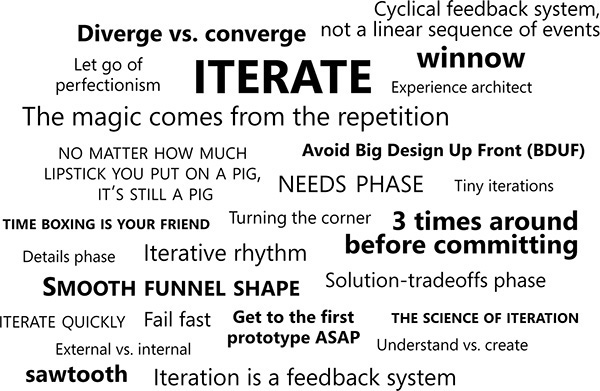
The tweaking that I used to do regularly in my earlier professional life was more intense in those days…and less forgiving. I wanted it (whatever it was) to be right, and it was my immodest opinion that I could get it to right. Especially when evaluating someone else’s work (ironically, I was less hard on my own work – figuring it was perfect already, right? Sigh…). The tweaking of another era has come round to a newish process called iteration.

One definition of iteration is the “process of learning and development that involves cyclical inquiry, enabling multiple opportunities for people to revisit ideas and critically reflect on their implication”. These feedback loops are meant to be fast-paced with the finish in view.

ScenarioPhoto Credit: SafariBooksOnline

Where iteration (or tweaking) breaks down (if I might be so bold) is when it’s taken well past rapid feedback loops into a realm of fine-tuning that has the team guessing “will it ever be good enough?” Product design and process development are vital to any company, but what we must also consider is the team or personnel involved.

If the feedback loops relate to the launch of a new product or a new business process, excitement and brainstorming are part of the momentum. Continuing to tweak over months instead of weeks before the launch can take a negative toll on the team. No one wants to forfeit excellence, but we don’t want to lose excellent personnel either.

blog-demanding-bosses-lifehackerPhoto Credit: Lifehacker

Trusting the judgment of our best thinkers is worth the risk of possibly releasing a product or service when we may not all be sure it’s “perfect”. That is what beta-testing is all about…the feedback that then comes to us from the consumer or user.

I’m really talking out of my element here (not being a designer or innovator so much as a lifelong learner). My leap from the sermon to the workplace relates to my own past struggle with wanting something with my name on it to be perfect while exhausting my teammates  with “what if we do this?” or “What if we say it this way?”

What a gift for us to take a well-thought-out proposal and, instead of putting it through the “just not good enough” wringer, we read it and pass it back to that colleague and say, “Good job”…empowering them to execute the proposal. How often does that happen these days?

Please share stories [in the Comments] of work situations where you experienced genuine affirmation for a job well-done.

Recently when water started backing up into the kitchen sink, I was afraid that it was something I had done. Too liberal using the disposal, for instance. Dave was out of town and nothing I could do would remedy the situation. Finally, on a Sunday afternoon, in desperation, I called our plumber (Richmonders, if you need a good plumber, email me, and I will give you his contact info). He came and fixed the problem, and best of all, it wasn’t my fault, after all. This young man literally LOVES his job and was kind to take the time, after he was off the clock, to give me the breakdown of what the problem was. What he charged me? Worth every penny…especially the part where it wasn’t something I had done wrong.

Why I bring this up is that being a fairly capable and creative person doesn’t prevent me from faltering at the likelihood that I messed-up.  See the Imposter Syndrome. My mental wiring is such that I get discouraged when my contribution to a situation actually causes more work for someone else, adds expense, or slows down progress. I’ve learned over the years that all that tweaking I may not have taken the product from good to great, and most assuredly caused some amount of frustration to hard-working, quality colleagues. Lesson learned.

There are times and seasons when tweaking is appropriate in developing a product and changing a business process. What we want to take into account is the cost of that tweaking, or iteration, on the people who make things happen in our workplaces. Free them from the “not good enough’s” to enjoy the fruit of “jobs well done”.blog-demanding-bosses-the-musePhoto Credit: The Muse

10 Tips for Dealing With an Overly Demanding Boss – Jacquelyn Smith

How to Get Over the Feeling that You’re Not Good Enough for Your Job – Michele Hoos

10 Things You Can Do to Get Out of Your Boss’s Doghouse – Brian Dodd

Why Incentive Plans Cannot Work – Alfie Kohn – Harvard Business Review

Good Is Not Good Enough: The Culture of Low Expectations and the Leader’s Challenge – Karlene M. Kerfoot

Innovation and Iteration: Friends Not Foes – Scott Anthony – Harvard Business Review

Holding a Team Retrospective – Morale

Workplace Bullying: Protecting Yourself at Work – Slideplayer

Monday Morning Moment – People You Love Working With – and Becoming One of Them

blog-likable-guys-at-work-askmenPhoto Credit: AskMen

It’s Monday morning and whatever you’re facing today, these folks help to bring down your stress and lighten your load…just by being in your path. You can name them easily. They are the ones who make you laugh and see a different side to your situation. They are the ones who give you second thoughts when considering a job change. They are the ones who add value to you, not just as a colleague but as a real in-the-skin human being. These are the folks who can turn the course of your day with just a few minutes conversation…or even a wave from across the parking lot. It’s just that simple.blog-likeable-cowoers-muffy-bennettPhoto Credit: Mashable

For you guys in a dark place…and not one person comes to mind…maybe, it’s good to think back…to people in your past who helped set you on a positive course in your career…think of those people. If you are in a hole in your workplace right now, and many of us have been there at some point in our professional lives, could you rally and become one of these people who light up the place?

blog-likeable-coworkers

Photo Credit: Friendship.about

Here’s the challenge for today. I read an article by content strategist Scott Tousley recently which got me thinking about this.  Is it possible to become “a rising tide that lifts all boats”? If you’ve read this far, you probably are already that kind of person. However, if somehow you struggle with keeping fellow employees in your view while dealing with large-scale problem-solving, you might want to consider a personal assessment and do-over. It’s never too late.

Scott Tousley – who has the longest eyelashes and most infectious smile – also gets to live and work in San Diego, California. Besides all that, he writes really insightful articles about the workplace. His article, The 9 Habits of Insanely Likable and Charismatic People, is so good, I’m not going to write my own commentary on this topic, because you HAVE to go read his article. It lists the 9 habits (included below) with real-life anecdotes, brilliant support data, and links to read more. So don’t miss it – lightning-fast read for us visual learners.

Tousley’s 9 habits of insanely likable & charismatic people: 

1. They are empathetic

2. They are humble

3. They are vulnerable

4. They have a sense of humor

5. They are present

6. They are genuinely interested in EVERYONE

7. They avoid social narcissism

8. They are generous and altruistic

9. They reciprocate praise (and take blame)

Being likable and charismatic isn’t about being popular or climbing the career ladder as much as it’s about making a huge chunk of our lives just more enjoyable… We have choices here.

blog-likable-coworkers-the-question-academyblog-likeable-coworkers-amanda-gorePhoto Credit: The Question Academy; LinkedIn

If you had trouble calling to mind people you really like at work, then you’ve probably fallen down but you can get up! Don’t let that snarky, seemingly self-important coworker or boss mess with your head and steal your joy. Refocus to those in your workspace who you can’t help but be encouraged around them. Don’t miss them in that cloud of bother over the less likable ones around you. So what if they don’t seem to care about you or others at work. You be one who cares…and it can make a big difference. Take Scott Tousley’s excellent counsel in noting and affirming those likable ones around you…and set your course to return to being one yourself.

The 9 Habits of Insanely Likable and Charismatic People – Scott Tousley

4 Simple Questions That Will Instantly Make You More Likable at Work – Sara McCord

Being More Likable at Work – Cherie Burbach

10 Traits of Likeable People – Evan West

13 Habits of Exceptionally Likeable People – Travis Bradberry

How to Develop Your Charisma and Become More Likable – WATCH the Olivia Fox Cabane Video – Patrick Allan

How To Be More Likeable at Work – 10 Things To Do Today – G. L. Hoffman

YouTube Video – Amanda Gore – Stress Busters and Mood Management and Turning on the Joy Switch

5 Friday Faves – Kids in Costume, Infographic for Learners, Words, Eric Metaxas, and Walking to School

Blog - Friday Faves 006 (2)

It’s Friday! Another week finished… I’m looking forward to catching up with some family this weekend. How about you? Choosing favorite finds for the week was difficult – lots to choose from, but some were most note-worthy negatively rather than friendly favorites – political commentary, etc. I decided to stay more upbeat with the faves posted. So here they are.

1) Kids in Costume – Don’t you love kids in costume? When our children were preschoolers, we had a toy-chest full of dress-up clothes thanks to grandmothers who made or found fun outfits for them. Some of those costumes ended up overseas with us. [See below.}img_9943With Halloween around the corner, I’m sure we’ll see kids of all ages in their favorite character wear. It’s nice when there are more opportunities to dress-up besides just this one day of the year (like superhero day at school). We didn’t celebrate Halloween when our kids were growing up, but I do love the costumes….well, and the candy (but that’s another topic). There’s sometime transformative when kids put these kinds of duds on… Let the bravado begin!blog-kids-in-costume-bourdoff-familyPhoto Credit: Aaron and Jamie Burdorf

2) Infographic of Usual Tips for All Types of Learners – Two of my favorite things to discover are 1) infographics and 2) helps for various types of learners. Here it’s two-in-one. Design Taxi created a study guide to aid four types of learners – the visual learner, the auditory learner, the read and write learner, and the kinesthetic learner. I’m a blend of visual and read/write learner. Check out the infographic, especially you students out there – could help you change gears through your heavy reading assignments and exams. As an example, a visual learner comprehends more information off a printed page rather than a screen. Highlighting words in my notes also helps me focus on key concepts. Lots of great study hacks.blog-lachlan-brown-infographic-of-useful-tips-twitter

Photo Credit: Lachlan Brown, Twitter

3) Words – Gary Chapman has written several books around the theme of love languages. Here’s one. Chapman defines love languages as the ways we most clearly experience love from a spouse, a friend, a coworker. He lists five love languages – touch, words of affirmation, gifts, time, and acts of service. Words are definitely one of my love languages. I really appreciate when people affirm something they see in me that they love.

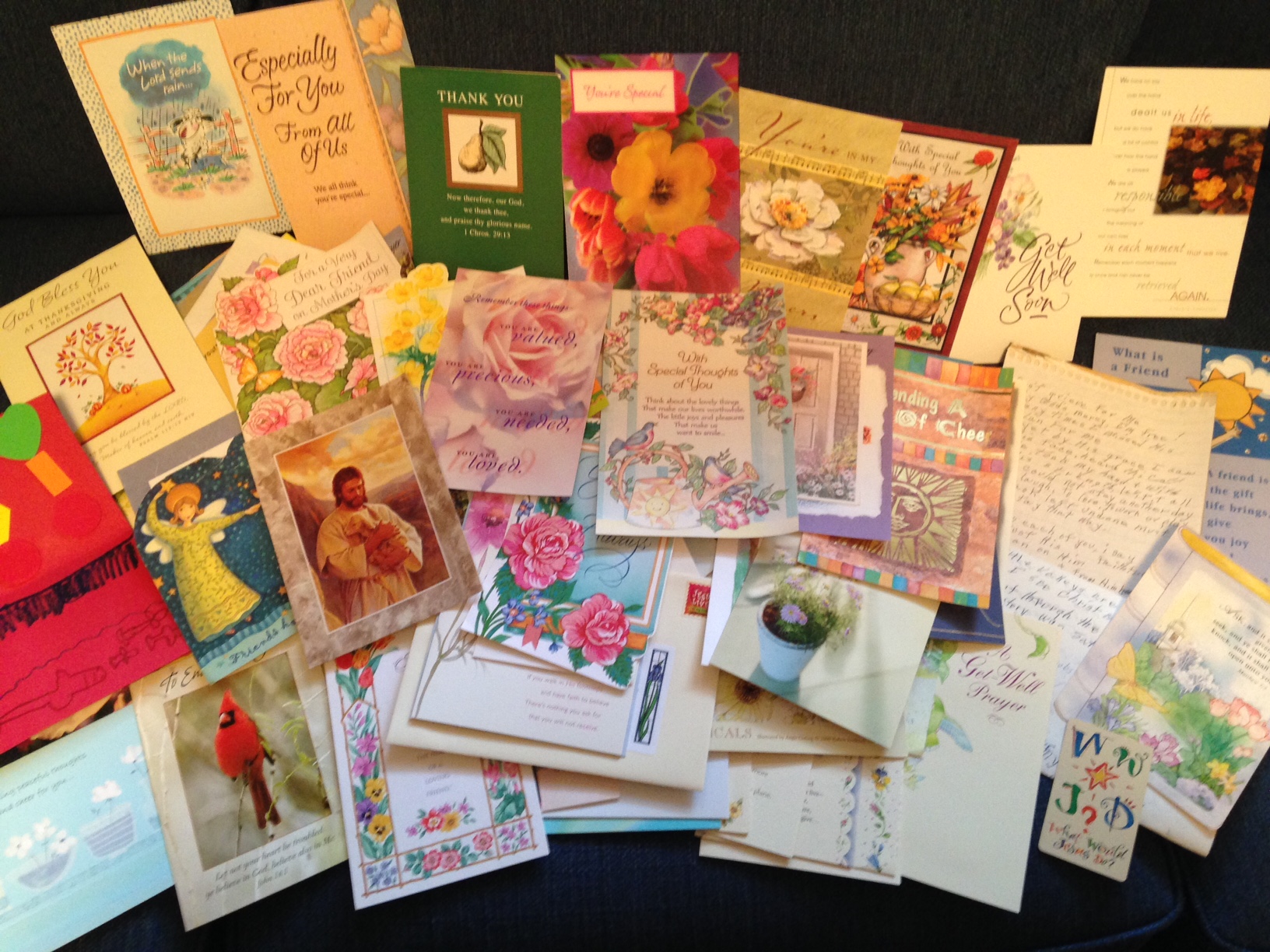
My mama was always encouraged by the gift of words.  In 2002, the cancer she had already had for two years was getting worse. She died in November 2002. Some time afterward, I was one of the family responsible for packing up her personal belongings. In the drawers of her computer desk, she had hundreds of cards.img_9942

I just couldn’t throw them away. That day, too near to her dying, I just put them all in a box.  Just this week I pulled them out and went through them. It was a huge and healing experience. All the words – cards chosen by friends and family in the year of her fiercest battle. All the words that they also wrote to her to express their love and to remind her how strong she was…and how big her God was. As I read through card after card, I could feel the deep love between these card writers and my mom. Some of these friends have also died since Mom died. So grateful for the legacy of these words and the love they expressed so beautifully. Thankful for them…and for you who took the time to share them with her.

That era when people sent cards…I miss it. What a blessing to have folks in my life who still write and send cards. Those words fill my heart and lighten the load.

4) Eric Metaxas – Do you know him? His writing and speaking have been excellent company for me this year.  Eric Metaxas is a historian, writer, lecturer, and social commentator. His books include Bonhoeffer, 7 Men, 7 Women, and most recently If You Can Keep It: The Forgotten Promise of American Liberty. Metaxas has been a strong conservative voice in this election year. I have learned from him.President Barack Obama stands with keynote speaker Eric Metaxas as Vice President Joe Biden takes their photo during the National Prayer Breakfast at the Washington Hilton Hotel in Washington, D.C., Feb. 2, 2012. (Official White House Photo by Pete Souza) This official White House photograph is being made available only for publication by news organizations and/or for personal use printing by the subject(s) of the photograph. The photograph may not be manipulated in any way and may not be used in commercial or political materials, advertisements, emails, products, promotions that in any way suggests approval or endorsement of the President, the First Family, or the White House.blog-eric-metaxas-eventbritePhoto Credit: Wikimedia Commons, Eventbrite

What has been especially gratifying for me this year is Metaxas’ take on what is happening in our country. I am ignorant about so many things and he has aided my understanding of some of the cultural changes we are experiencing.

[A sidebar on Metaxas is that he was once a wary and restless intellectual. Then at the age of 25, he had a dream that drew him to a personal faith in God. He describes more about his faith in the I Am Second video. Still a studied intellectual, he is focused, fearless, and empassioned…a Christ-follower and patriot.]

5) Walking to School – This week, on Facebook, I saw a video short entitled School The World: Journey. It compared two children’s very different experiences of getting to school each day. One was a young Guatemalan boy whose trek to school took him 2 1/2 hours.

I then discovered another film by French director Pascal Plisson. This documentary, On the Way to School, follows four children (in Kenya, India, Morocco, and Argentina) on their difficult paths to schools far from their homes. We take easily accessible education so for granted in the West.  Tymm Hoffman, a regular guy, who works for Compassion International decided to do something about this…at least for one community, for now. He and his wife, Laura, spearheaded a great effort called Brighton Their World. One of the goals of this was to fund a school in Ethiopia. Brighton Academy is a reality today, thanks to them and those who help support this great work. By the way, Brighton is the name of one of their children – all of whom were born in Ethiopia, but he died before coming home to them in the States.

On the Way to School – Film Review

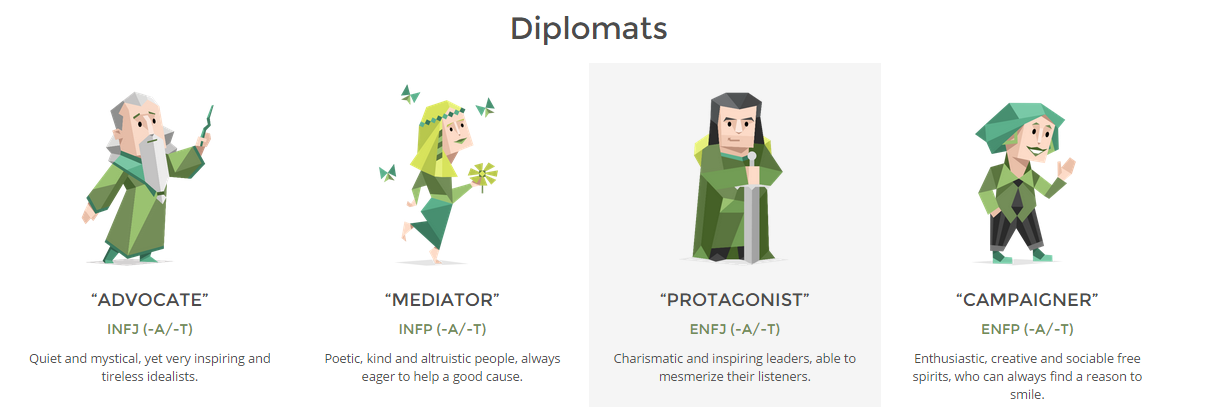
Bonus: 16 Personalities – The Myers-Briggs [Personality] Type Indicator(MBTI) is a fascinating look at our differences. It’s not really about putting us in some behavior box; it’s about seeing what our preferences are how we are energized, how we take in information, and how we make decisions. I’ve enjoyed knowing coworkers’ personalities (based on the MBTI)…it’s helped me better understand them and how to communicate to them in ways they prefer. Cuts through a lot… Anyway, here’s a free test with good commentary.  In case you’re interested, I’m an ENFP – a “campaigner”. What is your personality type?

blog-16-personalities-snapcraft

Photo Credit: Snapcraft

Have a sweet weekend…be safe. Share your favorites with us in the Comments. Thanks!

Monday Morning Moment – Getting Outside and Taking a Real Breather From Work

blog-taking-a-break-from-work-youtubePhoto Credit: YouTube

Some weekends are meant for lots of play mixed with Fall clean-ups…this was one of those. Then Monday comes around.  You pull your tired body out of bed, try to stretch those shoulders out and loosen up your knees again. In a matter of minutes, you settle that frame in your desk chair, and expect your brain to be on task with new work-week vigor. Right?

Maybe. Whether it’s Monday or any other day, our workspaces (especially if it’s cubicle life) can, over the course of the day, do a number on our creative thinking and problem-solving. Our minds and bodies cry out for stretch breaks…and not just to hit the restroom and pour the next cup of coffee. A change in location – i.e., to the next meeting – isn’t the recipe for clearing our heads either.

Getting outside…now that’s a grand solution.

My husband works on an incredibly beautiful street in our city. He is in meetings inside, of course, much of the day. When not in meetings, he’s at his desk. Eating his apple and bag of nuts, at lunchtime…right there. At his desk.

While this is going on outside…

blog-work-break-in-fall-monument-ave-flickriverPhoto Credit: FlickRiver

I don’t take advantage of being outside myself, so no shaming here. Still, the individual worker and the work itself would certainly profit from a breather…a step away from the desk or conference room table…a few minutes on the outside.blog-work-break-foster-school-of-businessPhoto Credit: University of Washington

“Brain breaks can make a big difference in your ability to be productive, creative, and innovative. The paradox is that doing less often allows you to do more.” – Jeff Stibel

In Courtney Seiter’s article The Science of Taking Breaks at Work: How to Be More Productive by Changing the Way You Think About Downtime, she gives support to the broad benefits of taking breaks. Taking your coffee, outside, for a walk around the block are some of my favorites tips of hers.blog-break-at-work-open-bufferPhoto Credit: Open.Buffer

Walking into an office building and around the folks smoking, I think, “Hey, nice they [have to] go outside…just that alone probably counters some of the impact of smoking on their health.”

Hopefully, you didn’t use up your break reading the blog today…unless you’re reading it while you’re sitting outside in the sun.

I love Philip Terman’s poem Some Days about the replenishing affect of the quietening out-of-doors. Here’s a portion:

Some days you have to turn off the news
and listen to the bird or truck…
You have to close all the books and open
all the windows so that whatever swirls
inside can leave and whatever flutters
against the glass can enter. Some days
you have to unplug the phone and step
out to the porch and…allow the sun to tell you what to do.
– Philip Terman, Our Portion: New and Selected Poems

blog-work-break-daily-mailPhoto Credit: Daily Mail

Take that breather…clear your head…and stretch your legs. Either with someone or all alone. It’s worth the trouble…

The Science of Taking Breaks at Work: How to Be More Productive by Changing the Way You Think About Downtime – Courtney Seiter

The Writer’s Almanac with Garrison Keillor

5 Ways to Give your Brain a Break Right Now – Jeff Stibel

3 Easy Ways to Give Your Brain a Break During Your Workday– Jacquelyn Smith

Monday Morning Moment – A Look at Power with Andy Crouch

 Blog - Andy Crouch = Playing God - thegospelcoalition
Just recently I heard a friend quote from the book Playing God – Redeeming the Gift of Power by Andy Crouch. It struck me as odd that he was reading such a book because, although he is a powerful man in his own circle, he doesn’t seem vulnerable to such a phenomenon. Wisdom is to mark such a supposition and guard against it. This friend does that. My husband has also been reading Crouch’s book, so I am persuaded to add it to my list of reads.
Here’s a taste of what you’ll find thanks to Good Reads. It is often where I start with a book given my long list of wanna-reads. Andy Crouch makes a strong case for our need to wrestle with our temptation to “play God” in our relationships, institutions, and culture. See for yourself….
On Power in Creating Good or Evil – in Work and Culture
“It is a source of refreshment, laughter, joy and life—and of more power. Remove power and you cut off life, the possibility of creating something new and better in this rich and recalcitrant world. Life is power. Power is life. And flourishing power leads to flourishing life. Of course, like life itself, power is nothing—worse than nothing—without love. But love without power is less than it was meant to be. Love without the capacity to make something of the world, without the ability to respond to and make room for the beloved’s flourishing, is frustrated love. This is why the love that is the heartbeat of the Christian story—the Father’s love for the Son and, through the Son, for the world—is not simply a sentimental feeling or a distant, ethereal theological truth, but has been signed and sealed by the most audacious act of true power in the history of the world, the resurrection of the Son from the dead. Power at its best is resurrection to full life, to full humanity. Whenever human beings become what they were meant to be, when even death cannot finally hold its prisoners, then we can truly speak of power.”
“Power at its worst is the unmaker of humanity—breeding inhumanity in the hearts of those who wield power, denying and denouncing the humanity of the ones who suffer under power…This power ultimately will put everything around it to death rather than share abundant life with another. It is also the power of feigned or forced ignorance, the power of complacency and self-satisfaction with our small fiefdoms of comfort. Power, the truest servant of love, can also be its most implacable enemy.”
“Over and over in the Gospels, Jesus interrupts his agenda for those who have nothing to offer him but need everything from him.”
On Power and Information
“I am also practicing cello to wean myself from power and accomplishment, to place myself back in the posture of a learner, cultivator, and creator. To become a bit like a child. To detoxify from the too-ready recognition and privilege that accompany even the most modest forms of success, to become available again for something surprising and new. Just as children flourish by growing into adults, so adults flourish by cultivating childlikeness, avoiding the spiritual hardening of the arteries that comes with competence and experience.”
On Poverty and Privilege
“How many times have I been put at the front of the line without even knowing there was a line? How many times have I walked through a door that opened, invisibly and silently, for me, but slammed shut for others? How many lines have I cut in a life of privilege?”
“Poverty is the absence of linkages, the absence of connections with others…”
“Benevolent god playing happens when we use the needs of the poor to make our own move from good to great—to revel in the superior power of our technology and the moral excellence of our willingness to help. Benevolent god playing makes us, not those we are serving, the heroes of the story. It happens whenever technological and financial resources are deployed in such overwhelming force, and with so little real trust building or relationship, that we maintain a safe distance between ourselves and the recipients of our largesse.”
“The poor are poor,” Jayakumar said to me, “because someone else is trying to play God in their lives.”
On Idolatry and Injustice
“All idols begin by offering great things for a very small price. All idols then fail, more and more consistently, to deliver on their original promises, while ratcheting up their demands, which initially seemed so reasonable, for worship and sacrifice. In the end they fail completely, even as they make categorical demands. In the memorable phrase of the psychiatrist Jeffrey Satinover, idols ask for more and more, while giving less and less, until eventually they demand everything and give nothing.”
“God hates injustice and idolatry because they are the same thing.”
Crouch’s book just got moved to the top of my reading list. Have a great Monday! Let’s exercise our power wisely today…

5 Friday Faves – Words, Trauma Healing, Street Smart Kids, Thunderstorms, #GrowingUpInABlackChurch

Blog - Friday Faves

Happy Friday! Another whirlwind week. Ours is to savor the moments and those sweet finds of each day of  life. Below are a few of my favorites from this week. Would love to hear about yours [in Comments].

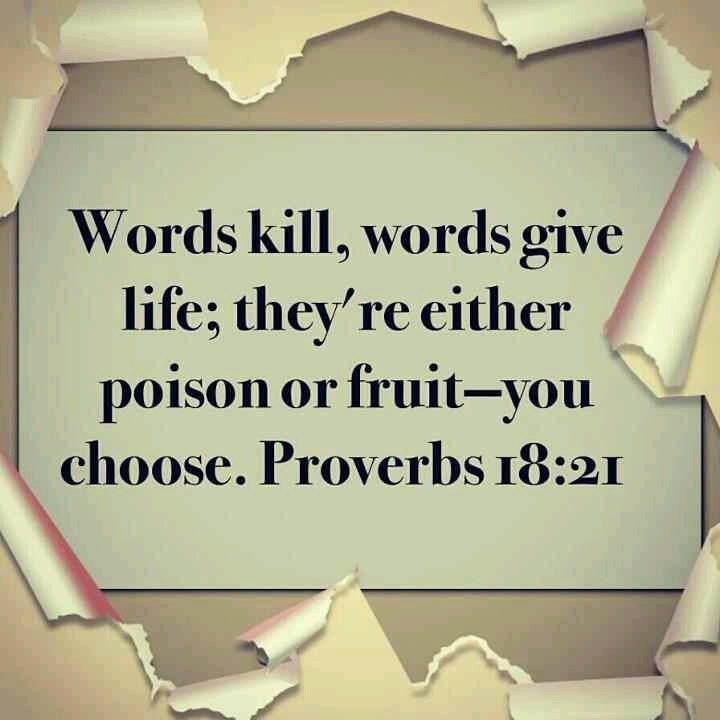
1) Words – You know when you mean to send that card or make that phone call? Or when you could speak to that downcast stranger or give a shout-out to someone worthy of celebrating…and you didn’t? This is a salute to all you folks out there who use your words for life – to encourage, celebrate, comfort, guide, and lovingly speak the truth. We are bombarded with words. Literally, blasted with words. Some sound so true, we are swayed by them…to find out later, they were not true…and the course of our lives, maybe even our country, was set in a direction we wouldn’t have chosen, if we understood what the words really meant.BLog - WordsPhoto Credit: Pinterest

I’ve been blessed by good friends and colleagues who use words in a life-giving manner. They inspire me to do the same.2016 Phone Pics 2449

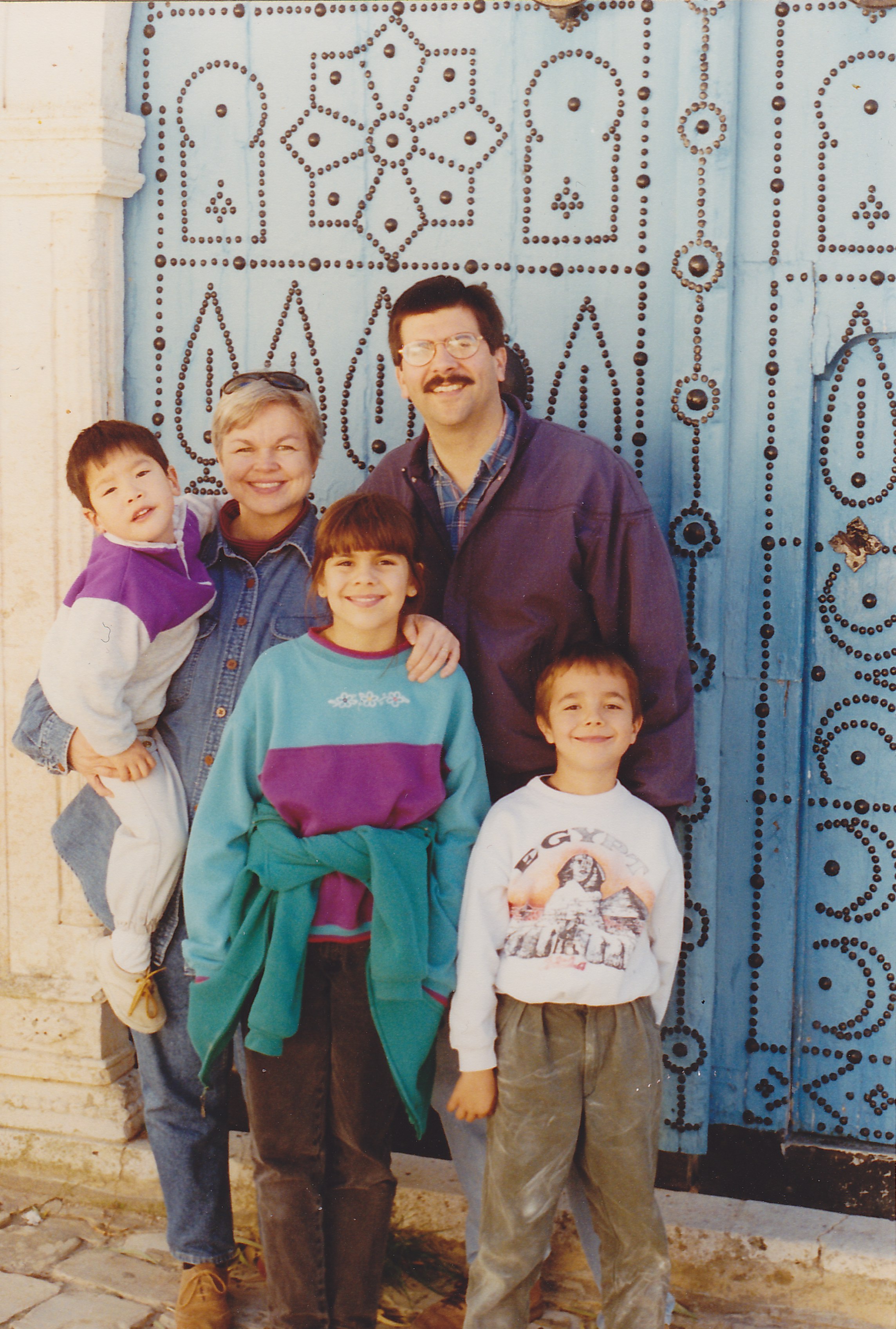
2) Trauma Healing – The Trauma Healing Institute is a training and service arm of The American Bible Society. The goal here is to respond at a heart-level to the trauma in people’s lives. When you think of the numbers of people who have endured extreme trauma (1 out of 7 persons globally), it is a good thing to reach out to them with shelter and  supplies but also with listening ears and honoring comfort. This intervention is Bible-based so may not be the go-to training for everyone, but I’m hoping to take it in the Fall. Check here for stories and more info.
Blog - Trauma Healing - THIPhoto Credit: Trauma Healing Institute

3) Street Smart Kids – Earlier this week, I wrote about situational awareness. One of the resources I posted was the blog by Chonce Maddox on 50 Things You Can Do to Make Your Kids Street Smart I wrote this week about situational awareness here. Maddox talks about her reasoning for writing: “As a parent, my worst fear is that I won’t be able to protect my child when he needs it. My second worst fear is that he won’t be able to protect himself and make wise decisions depending on what situation he’s in.” Her list of 50 things are age-specific and are brilliant and easy-to-apply. Whether you have a newborn or a soon-to-be-launched teen, take the time to equip your children in this way.
Schoolchildren embracing happy. Multi cultural racial classroom.

Photo Credit: A Fine Parent

4) Thunderstorms and Heat Lightning  – I love rain and especially thunderstorms. It’s been really hot here in Richmond, Va., the last couple of weeks. Occasionally the lightning has only been heat-related. We had both heat lightning yesterday as well as an amazing thunderstorm last night. My pic below is of the late afternoon sky. The rains that came later were drenching and cooling. No electricity outages – just a glorious and wet light and sound show.Blog - ThunderstormBlog - Heat LightningPhoto Credit: Wunderground

5) #GrowingUpInABlackChurch – Growing up outside Atlanta , in the suburbs, was a pretty homogeneous experience for me, culture-wise. When I finished grad school, my first job was in an innercity hospital in downtown Atlanta. This was my first time experiencing the richness and otherness of predominately African American worship or “church”. In those days, working on an oncology unit, I went to a lot of funerals. Both in those times and regular Sunday services, I discovered a very different way of doing church and community. Sunday morning church is still too often a too-segregated experience, but I’m glad for the opportunities to be in a more racially and culturally diverse worship. What got me thinking about this was the trending hashtag this month which was fun to watch…although, not having the experience of #GrowingUpInABlackChurch, I celebrate it. ALso trending this week: #blackwomendidthat.

Blog - GrowingUpInABlackChurch - hbcuBlog - GrowingUpInABlackChurch - imgurPhoto Credit: HBCU, HBCU

Have a safe and sweet weekend out there. Use the Comments below to post your own favorites from this week. Thanks!

Situational Awareness – It Could Save Your Life…or Someone Else’s

BLog - Situational awareness - preppersillustratedPhoto Credit: Preppers Illustrated

We moved from East Tennessee when our children were still small. Taking a job abroad, we were excited at all the possibilities of living in a different culture. Still we wanted to be wise in living as expats – in a country where neither we nor our children understood the subtle signs of threat, unrest or possibly even danger. We wanted our children to be prepared for the unexpected but not afraid. Living quietly and confidently aware of our surroundings can have a strong positive influence on engaging a new culture, and even our home culture.

IMG (3)IMG (19)

Situational awareness is a discipline of being tuned into your surroundings in such a way that you can be alert to a threat or crisis before it actually happens. It is not complicated but does take practice and discipline. Brett and Kate McKay blog extensively  on this and define it as:

“a skill that can and should be developed for reasons outside of personal defense and safety. Situational awareness is really just another word for mindfulness, and developing mine has made me more cognizant of what’s going on around me and more present in my daily activities, which in turn has helped me make better decisions in all aspects of my life.”

It’s not to instill fear (especially in teaching our children) but rather it can actually create calm and confidence. Where we want to be, in assessing our surroundings, is in a “yellow zone”, and we want that for our children as well – alert and calm, as a normal life pattern.Blog - Situational Awareness - Cooper's Color Code - domestic preparednessPhoto Credit: Domestic Preparedness

The links below are extremely helpful in terms of learning situational awareness and applying it to child safety, personal protection, and, in general, responding to a threatening situation.Blog - Situational Awareness - slidesharePhoto Credit: Slideshare

In The Tao of Boyd – How to Master the OODA Loop, another blog by the McKay’s, they talk about military strategist John Boyd’s OODA Loop – Observe, Orient, Decide, Act. This can be used in dealing with uncertainty in any situation – whether a personal threat or a business transaction. I just wanted to mention it here as a rapid process we go through in situational awareness when we train ourselves to respond proactively, rather than in a panic.

Blog - Situational Awareness - Observe, Orient, Decide, Act - gsbPhoto Credit: Stanford Business

In the first McKay blog on situational awareness, they encourage parents to teach it to children as a game. You don’t even have to raise the issues of safety or security. It just becomes a game of being “in the moment”, observing your surroundings (while taking a trip across town, or eating in a restaurant, or playing in a park). When you alert your kids that the game is on, they know that, as part of that experience, to be especially observant. Then you ask questions later: “Can you describe the people sitting next to us in the restaurant?” or “How would you describe the adults closest to us in the park?” or “What do you remember about the people around us in the subway?” “What did we do to safely cross that huge street?” It doesn’t have to be a scary thing for children to learn to be more observant…instead of being zoned out or into their electronics or playing with your phone.

The same is true, of course, for us adults. The discipline part of situational awareness is practicing it often enough that it becomes a part of your every day life. In the old days, before smart phones, I was a people watcher…just taking in the people around me (in a “fascinated by them”, not “stalking” sort of way as we think today).

Too often, people tend to guard their own privacy, by looking down or not making eye contact some other way. We don’t survey where we are and who surrounds us, like we might should. Not because there is evil everywhere…that would be weird to think like that…but as a discipline…for our sake and for those around us.

There may be a time we can actually avoid or possibly defuse a situation, if we are focused. After the 9/11 bombings, and until situational awareness became “a thing” in my life, I would tend to kind of stay in a bubble around strangers…like on a subway or bus, or walking on a crowded street. One of the practices in situational awareness is to train your peripheral vision. It’s amazing what you can note if you learn to widen your view. [Use the image below to give it a try.]Blog - Situational Awareness bubble - modernsurvivalblogPhoto Credit: Modern Survival Blog

Today, I just wanted to introduce situational awareness. In a world that seems to be more and more violent, with stranger-on-stranger attacks, we may be vulnerable without even knowing it. Rather than being victims, there are steps we can take to become more aware and savvy. This can work toward our own safety and that of our family, but it can also be a means to help others more vulnerable than we are.

[Sidebar: Please don’t hear me say we need to be super-vigilant, like there is a bad guy coming through every door. Situational awareness is a discipline that we can use in many positive ways – both socially and in the workplace. It’s a skill in our toolbox.]

I am reminded of times, both overseas and here in the States, when a local friend or stranger stepped in and moved us to a safer place, or intervened when I didn’t know what to do in a new situation. Soon, I want to write again about this and will post some of our stories. Nothing really dramatic, thankfully, but definitely remarkable for us in negotiating new cities and situations. It would be wonderful if you shared some of your stories where you were situationally aware…or where it might have been helpful. Please comment below.

Check out the links. Very practical. Be safe out there…and help make it safer for those around you.

How to Develop the Situational Awareness of Jason Bourne – Brett & Kate McKay – Excellent overview and practical helps – Must Read

The Tao of Boyd – How to Master the OODA Loop – Brett & Kate McKay – Indepth article on OODA – Observe, Orient, Decide, Act

10 Ways to Improve Your Situational Awareness – Sergeant Survival

50 Things You Can Do To Make Your Kids Street Smart – Chonce Maddox

Situational Awareness: Staying Safe When Life Gets Dangerous – The Survival Mom

5 Drills for Situational Awareness – Ken Jorgustin

A Practical Guide to Situational Awareness – Scott Stewart

10 Basic Safety Tips for Women – Mom With a Prep

I Do This Every Single Day But After This Warning I’ll Definitely Be Thinking Twice – Video

red orchid isolated on black background

5 Friday Faves – Pokemon Guitar Medley, Dr. Tony Evans on Race, Burgess Owens on Liberalism, Coconut Cake, and Back to School

Blog - Friday Faves

Friday again. It’s been a hot weather week here as we move to the end of July. How the summer flies by! I get my walks in early and try to get work done before the afternoon dulls my brain. For those of you who have long workdays with some out in this heat, the weekend is almost here. My Friday Faves this week are:

1) Pokémon Guitar Medley – For me, Pokémon stirs up old memories of my boys hunkered down playing it on the old Gameboy system. The melodies emitted from the game had no emotional attachment for me; just signaled their playing nearby.  Blog - Pokemon -GameboyPhoto Credit: YouTube

Fast-forward a couple of decades to a new phone app – Pokémon Go. Genius! Nostalgia reigns. This version of the game weds the old with the new – social gaming and a quasi-outdoor-adventure. Even in our quiet old neighborhood, there are now young folks walking around with their phones out like flashlights (reminds me of the old guys on the beach waving their metal detectors back and forth). Blog - Pokemon Go - timesfreepressPhoto Credit: Times Free Press

This phenomenon has definitely stirred up sweet memories for guitarist Nathan Mills at Beyond the Guitar. He’s arranged a melody of some of those old tinkly electronic tunes from childhood of playing Pokémon. Whether you ever played the game, you will enjoy the music (hard to believe the beauty those composers instilled into the gaming experience for the kids who played back then).

2) Dr. Tony Evans on Race – A Biblical Response on Race – You already know I love radio.  Well, Tony Evans has been a go-to for me for 30 years. His program, The Alternative, and his preaching, speaking, and writing are just as fresh and relevant today as ever.Blog - Tony EvansPhoto Credit: Tony Evans

This past Sunday he preached on Race, Culture, and the Biblical Response. His message is to the church, but anyone could benefit from what he has to say on these issues. So timely also as our nation is going through an intensified examination of our own thinking and actions in this. Evans used the text of Jesus’ encounter with the woman at the well, crossing culture and class, demonstrating the love of God.

“It’s real easy in here….we can all get along…in here. What happens when you go out and you have to face your own race? What happens when your biblical view is not the popular view? What happens when you’re rejected for not being black enough, white enough….?  When you have to take that stand responsibly, kindly, in love, but clearly. When you hear messages on love and unity….it’s good…inside the House. What God is looking for are some serious Christians on this issue who start biblically and spiritually and work it down racially, socially, and culturally. You do not start with your culture and work it up. You start with the Word and the authority of your faith and work it in. May God help us to do our part locally, personally, in our families, and through our influence, to bring people to a spiritual biblical approach to the issue of race, culture, and class so at least we can model, before the world, biblical solutions to a society in chaos.” – Tony Evans

3) Burgess Owens on Liberalism – We are in the political season of party conventions and a presidential election. So much rhetoric. So many promises. So much finger-pointing and blame-shifting. Over the course of my life, I’ve changed political parties as they have changed ideologies. This election is a tough one for some of us…

I love to discover unusual heroes who are rarely found in popular media. Star Parker is one of these – a politically conservative black woman who also changed her thinking over the course of her life. She was the impetus for me to search for other conservative thinkers who, because of their race or beliefs, have to have a deeper sort of courage to give voice to their ideas. This week, I discovered Superbowl Champion Burgess Owens.  You can see him speak about persistence in this YouTube video on “the 13th season”. He is the author of Liberalism or How to Turn Good Men into Whiners, Weenies and Wimps.  He writes about the first 100 year, post-slavery, history of entrepreneurial, faith- and family-centered American blacks. He also writes about the founding of the NAACP by mostly white, Marxist social engineers, and that influence on African-American thinking and culture. Blog - Book - Liberalism - Burgess OwensPhoto Credit: Simon & Schuster

I have not read the book yet, so this is not a recommendation of the book as much as of the author. After hearing him speak during an interview (as part of his book tour), I was struck by this “other side” of what we see in the news media. His thinking is compelling.  In my 20s, I worked in a huge inner-city hospital in Atlanta (wrote about it here). It was then that my thinking politically began to change. I loved our patients and families so much, and the poverty that encased them seemed impenetrable. It was then I began to see that throwing money at poverty doesn’t make it go away. Ignoring it doesn’t make it go away either. My nursing friends and I would have deep and anguished conversations about the tangled mess of poverty, welfare, class, race, and politics. I am thankful for how those years and relationships changed my thinking. Still have so much to learn.Debbie & Grady nurse buddy

I welcome your recommendation of other voices…these kinds of conversations could affect real and crucial change…beyond any political party or government power.

4) Three Day Coconut Cake – OK…something a little lighter. My mom-in-law is an amazing cook. She also knows I love coconut. We had a huge family gathering this past week to celebrate the newest addition to our family. She always makes strawberry pretzel salad which is top of the list of our family favorites. For me (and a handful of others who also like coconut), she made this refrigerator coconut cake. It’s practically a food group all by itself. Enjoy. Here’s the recipe.

Blog - Friday Faves - Coconut Cake - chindeepPhoto Credit: ChinDeep

5) Back to School – During the hottest days of summer, a Fall breeze blows through our favorite stores. Back to school supplies and cool kids’ clothes pop up everywhere. I have always loved the smell of pencils and paper. However, I never loved the long hours of school that boxed in our children to spend evenings separated from us and each other with hours and hours of homework. Sorry, wonderful teacher friends of mine. Anyway, seeing school supplies in the stores this week was fun…and also a reminder of the flight of time. Summer slow down.Blog - Back to School Supplies - friday Faves

I always love to hear about your favorite finds of the week. Please comment below. Have a safe and sweet weekend!