Category Archives: Critical Thinking

Monday Morning Moment – Kindness Over Cleverness – Work Culture Where Employee Satisfaction Impacts Marketing

Blog - Kind over Clever - Jeff Bezos - scoopnestPhoto Credit: Scoopnest

Quite remarkably, I recently came across several articles on kindness, of all things, in the Harvard Business Review. It was thrilling for me to see it commended as a business process in such a prestigious journal. I have loved the idea of kindness since early childhood. It seemed such a reasonable choice in dealing with others, much more pleasing than cleverness. [Now, if I were more clever, then it might have proved a harder choice.]

Although we were not in church as young children, my mom taught us the Disney form of kindness: “If you can’t say something nice, don’t say nothing at all.” – from the film Bambi.

When we, later in my childhood, became involved in a church community, I discovered the great teachings of God about kindness, which further stoked my resolve. Whenever possible, acting in kindness was the right choice…in personal relationships and in the workplace.

These days, in tight-knit tribal leadership and competitive companies, kindness is too often sacrificed for the bottom-line. You can imagine how refreshing it is for me to see that business thinkers and strategists are taking note of the profitability of kindness as a process – both internally (organizational human relations) and externally (marketing). A work culture of strategic, intentional kindness – just think of that!

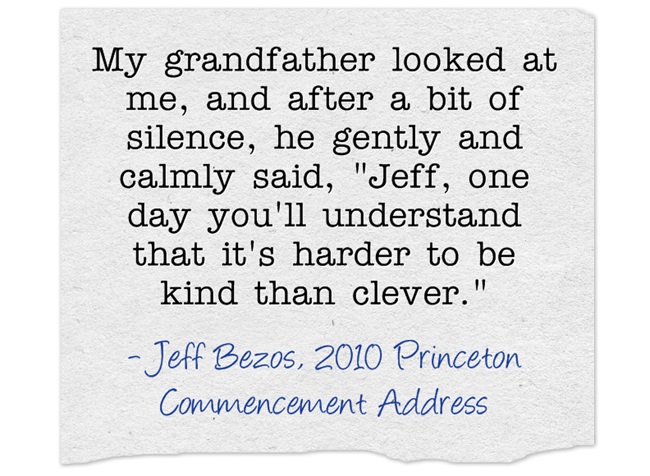
If you go to Harvard Business Review’s website and search the word kindness, all sorts of articles pop up. I was most intrigued by Bill Taylor’s pieces on “kindness over cleverness”. He is the founder of Fast Company magazine and author of Practically Radical. He tells stories of companies who have been successful in practicing kindness strategically. He is inspired by Jeff Bezos’ experience growing up with a wise grandfather who taught him to choose kindness over cleverness. That story is told by Bezos himself in the TED Talk (linked below).Blog - Kind Over Clever - Jeff Bezzos - nepc.colorado.eduPhoto Credit: National Education Policy Center

Ted Talk Video – Jeff Bezos, Founder of Amazon – Princeton Commencement Address on What Matters More Than Talents – Gifts vs. Choices

If we wanted to take individual (and corporate) kindness up several notches in our workplace and workforce, what would those processes be? What would we have to give up  in order to raise employee satisfaction to such a level that it extends to product excellence and customer service? For leadership, it might be giving up some control and extending a kinder and wiser empowerment, For employees, it might be giving up a timid fatalism and risking a kinder boldness (less of “the great Oz” scenario). I would love to hear what business processes you have in place that celebrate kindness over cleverness. What kind of work culture does your leadership model and cultivate? What can you do yourself, whatever your leadership culture is? See Matt Monge’s article on leading without a title.  [Please share in Comments section below.]

We have a choice, after all.

I hope to write more about this because it is intriguing to me how our own delight in our work and product can pour over into our profitability and success.

For today, I close with some of my favorite quotes from these Harvard Business Review articles:Blog - What Can I Do Right Now - Heres-the-question-Id-q57pgs - larry ferlazzoPhoto Credit: Larry Ferlazzo

“Kindness has a strategic role to play, especially when it comes to winning over customers in an intensely competitive and slowly recovering economy.”Jeffrey F. Rayport

Success today is about so much more than just price, quality, reliability – pure economic value. It is about passion, emotion, identity – sharing your values.”Bill Taylor

Success is not just about marketing differently from other companies…It is also, and perhaps more important, about caring more than other companies — about customers, about colleagues, about how the organization conducts itself in a world with endless opportunities to cut corners and compromise on values…You can’t be special, distinctive, and compelling in the marketplace unless you create something special, distinctive, and compelling in the workplace. How does your brand shape your culture? How does your culture bring your brand to life? – Bill Taylor

What is it about business that makes it so hard to be kind?” I asked at the time. And what kind of businesspeople have we become when small acts of kindness feel so rare? …By all means, encourage your people to embrace technology, get great at business analytics, and otherwise ramp up the efficiency of everything they do. But just make sure all their efficiency doesn’t come at the expense of their humanity. Small gestures can send big signals about who we are, what we care about, and why people should want to affiliate with us. It’s harder (and more important) to be kind than clever.”Bill Taylor

Compassion is a great equalizer. When you approach others with genuine concern for their well-being, your standing in the organizational hierarchy is less of a barrier to a productive conversation…Kindness, in other words, is rarely inappropriate.Allison Rimm

Is Kindness a Strategy? – Jeffrey F. Rayport

Brand Is Culture, Culture is Brand – William C. Taylor

It’s More Important to Be Kind Than Clever – William C. Taylor

Why Is It So Hard to Be Kind? – William C. Taylor

10 Ways You Can Show Leadership Without a Title – Matt Monge – The Mojo Company

To Guide Difficult Conversations, Try Using Compassion – Allison Rimm

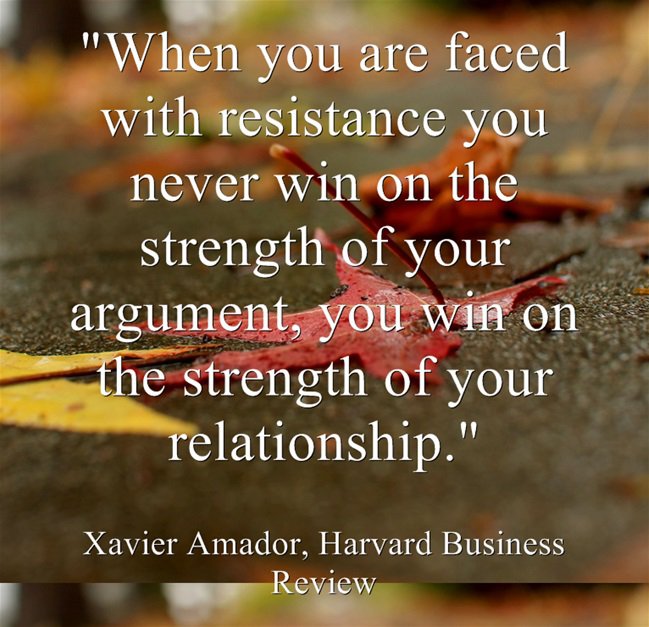
Blog - Relationships vs. Resistance - Leadership - Larry FerlazzoPhoto Credit: Larry Ferlazzo

5 Friday Faves – On Studying Your Spouse, Aging, Taking Criticism, Daily Routines, & Black History Month

Blog - Friday Faves

Hello, Friday. I don’t know about you but this has been a week of highs and lows in this world of mine. Hard news in some situations washed over by exquisite answers to prayer in other situations. As happens often with God, in the quiet of this morning, a favorite, heart-lifting passage in the Bible came up in my reading.

“You will keep him in perfect peace whose mind is stayed on You, because he trusts in You. Trust in the Lord forever, for the Lord God is an everlasting rock.”Isaiah 26:3-4

Even the Bible verses atop my facing journal pages this morning were like an anthem from God that all will be well. “Peace I leave with you; My peace I give you.”John 14:27 and “My times are in Your hands, Lord.”Psalm 31:15

With that intro to welcoming Friday this week, here are five of my favorite finds – all from the internet this week, although I did have a lot of sweetness in the real, as well.

1) Studying Your Spouse – Michael Hyatt welcomed Jackie Bledsoe as guest blogger on his website this week. Bledsoe writes very winsomely about how he learned to study his wife. He talks about how we, too often, think we know enough (relating to any field of study and work, ministry, marriage and family). Regarding his marriage, he observed: “We were both growing, just not together. My interests were changing and my wife, Stephana, didn’t always notice. Stephana’s needs were changing, but I was oblivious to them. Finally, we reached a point where we felt we didn’t really know each other. That was a scary discovery, one that you may be able to relate to. You may know the ins and outs of your business or ministry like nobody else. But maybe you don’t know the ins and outs of your spouse like nobody else. It may be time for you to enroll in the continuing education about your spouse.” Bledsoe lists 3 ways to get an advanced degree in your spouse: 1) Do new things together; 2) Take notes: and 3) Use your calendar. Read more here.Blog - Friday Faves - Marriage - DaddyshangoutPhoto Credit: Daddy’s Hangout

2) Aging – a Video – I came across a video this week that really got me thinking about how I view aging. It is entitled The Wall. It is the work of Aroha Philanthropies, an organization “devoted to the transformative power of the arts and creativity, inspiring vitality in those over 55, joy in children and youth, and humanity in adults with mental illness”. Blog - Aging - ioagingPhoto Credit: IoAging.org

The video begins with two elderly persons looking at the imposing face of a wall filled with the words that terrify most of us about getting older. Then as the video progresses, the images change to  more engaging and lovely words that depict what can be part of our experience moving from youth to mid-life to older life. Through creativity and the arts from childhood throughout our years, we might see a very different future, with growing older being our “encore years”. Something to think about for all of us…and especially for our young creatives – to see these “old ones” as valuable peers…just a bit farther down the same road.

3) Taking Criticism – Dan Cumberland, writer and photographer in Seattle, Washington, writes about responding to a scathing comment he received once on one of his blogs. Complete with foul offensive language. In his article This Guy Really Hates Me (How to Take Criticism). In his post, he lists 5 guidelines of how to handle criticism:

1) Is there truth in it?; 2) Is it affirmed by others?; 3) Is the source credible?; 4) What are the source’s motives?; and 5) What can I learn here? Then Dan talked about how he dealt with his critic.

We all receive criticism and also, if we’re honest, dole it out ourselves. Hear Dan’s counsel: “When you receive criticism and negative feedback there’s a needed balance. Don’t write it off, but also be careful not to let it bring you down too much. Work to find the truth. When you don’t understand, ask for clarification.”

When we are offered criticism, take it – as a gift. Do with it what is helpful. Don’t fall into the trap of returning harm for what you perceived as harmful. You want to be better than that.Blog - Taking Criticism - Feedback - quotesgramPhoto Credit: Quotesgram

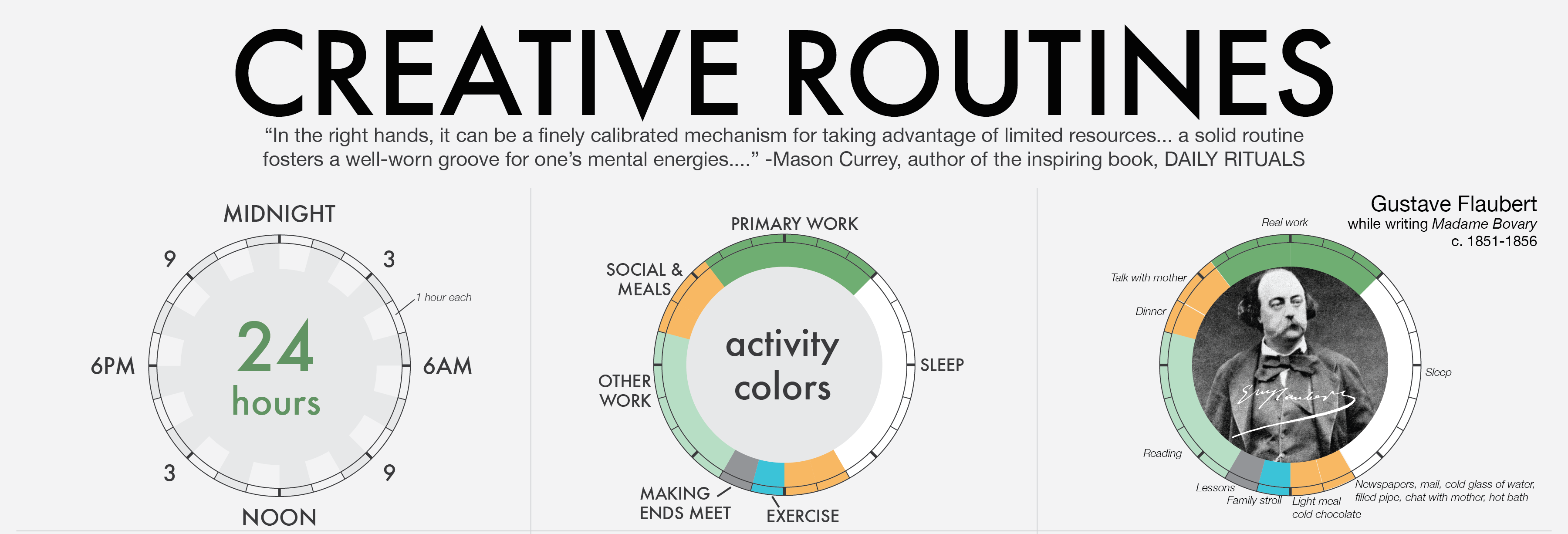
4) Daily Routines Maria Popova, of Brain Pickings, wrote a fascinating post on Mozart’s Daily Routine – How a day is composed in the hours between sleep o’clock and symphony o’clock. Routines are a great help for me to organize life and truly accomplish what I hope to accomplish. I’ve written on routines, habit change, and productivity previously. Popova’s article (and others she linked in her post) offers a glimpse into the daily life of greatness. It was inspiring and refreshing. Early in Mozart’s life, he went without employment but maintained deep discipline in his composing of music. Later, as his popularity rose, he compromised his sleep in order to continue writing. Mozart’s life was legend for unhealthy choices, and he struggled at times with deep depression. The lesson for us is in a daily routine that helped him, whether poor or privileged, to produce magnificent music that continues timeless in its beauty.

Blog - Daily Routines Photo Credit: Tito Goldstein

5) Black History Month – Phillip Holmes wrote a great piece, on Black History Month, for Desiring God. It is entitled More Tough Skin and Tender Hearts – How to Prepare for Conversations on Ethnic Harmony. He talks in a frank and loving manner about evangelicalism and ethnic harmony. Holmes urges us to have real conversations across races and ideologies, rather than white-with-white (or black-with-black) discussion with those already in agreement with us. If we wrestle with the struggle, across racial, religious, and political lines, we might actually come to a place of true reconciliation.

I want to have the kinds of conversations he encourages: “As we engage in complicated conversations about racism, be sober-minded rather than drunk with hatred, frustration, and annoyance. Embrace humility and love those you disagree with. But continue to pursue truth and justice as these two are defined in the Holy Scriptures. The Bible must remain the basis for why we believe what we believe and a careful study of it reveals that it has much to say about ethnicity and injustice…These conversations are complex but necessary and we need men and women who can sit down and have hard conversations considering the other more significant.”

Read his full post. I do want to quote one more vital point Holmes covered beautifully: “As a church, whether we as individuals are white, black, brown, red, or yellow, Christians have to constantly remind ourselves of our primary allegiance. If you are a child of the king, adopted into the household of faith, you are Christian first. I am one million times more Christian than I am black. My brown skin may be what you first notice about me, but by God’s grace, my Christian faith is what you will remember… I count it a privilege to be physically dressed by my creator in such a beautiful skin tone…but I will forever check others and myself when I notice our ethnicity is taking precedent over our heavenly citizenship.”

Also read Kimberly Davis’ Black History Month and the Common Language of Christ.

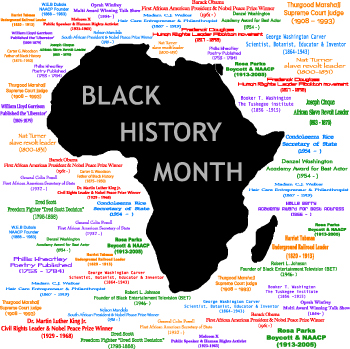
Vector Illustration for black history month including names, time periods and what each person did. See others in this series. Makes a great poster large print.

Photo Credit: Teach Hub

What were some of your finds or favorite things of this week? I would love to hear about them. Have a safe and joyful weekend!

Monday Morning Moment – Notes on Chris Bailey’s Life of Productivity

Blog - Productivity - Chris bailey - by Lewis HowesPhoto Credit: Lewis Howes, The School of Greatness

Where does the time go? How do I get so tired before the day is done? I just can’t stay focused…too distracted, I guess. You know what I’m talking about. Then there are the reactions of those friends and family. The ones (who treat us with kindness) tell us sympathetically “You are just so busy”. Then others, more in our faces, say, “The things you want to do, you do. You just don’t want time with me enough.” I get the logic of those statements, but I’ve been perplexed as to how to improve my life choices, such that I get more accomplished…more of the important things.

Until recently…when I experienced the convergence of making New Year’s resolutions, having a big birthday, and hearing Chris Bailey talk productivity.

Blog - Chris Bailey - ProductivityPhoto Credit: Unmistakable Creative

Chris Bailey is the age of my children. Although he had job offers, he took the year after graduating university to go deep into a study of productivity.  During that year, he wrote about his experiments in his blog – A Life of Productivity. Then, he designed a roadmap of 25 tactics to greater productivity in his book The Productivity Project: Accomplishing More by Managing Your Time, Attention, and Energy .

You may be tempted to yawn at another book on productivity, but this is clearly one not like the others. I listened to a couple of podcasts on Unmistakable Creative where host Srini Rao talks with Chris Bailey. They pour over what Chris discovered about productivity during that year of experiments. [Disclaimer: I haven’t read the book yet but plan to. My takeaways are from these podcasts and the other sources linked below. Can’t wait to read his roadmap on productivity.]

As Chris talks with Srini (and we get to listen in – love these podcast opportunities), he talks about what he’s learned from others regarding productivity. His tipping point was reading David Allen’s book Getting Things Done. Srini also refers to Cal Newport’s writing on deep work (you can listen to him on Unmistakable Creative here and here). They also mentioned Charles Duhigg’s book The Power of Habit: Why We Do What We Do in Life and Business. Chris Bailey’s year of productivity experiments included studying what was already in the literature – a big help to us less-read hopefuls.

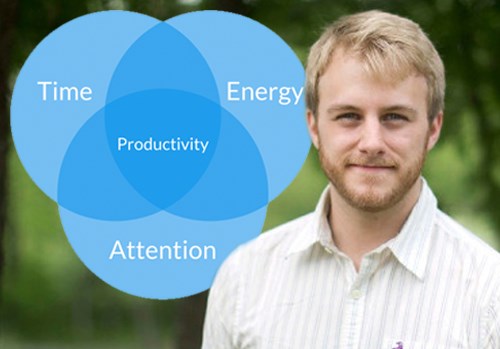
Chris defines productivity not as getting more things done but getting more accomplished. The difference is huge. It’s not just the “to-do list” but the view toward the “done list”. “Productivity is time, energy, and attention, and where the three meet in the middle is where you are in being productive. It is achieving what you intend to accomplish. It’s not about doing more things faster, but doing the right things deliberately and with intention.”

Here are the takeaways from my first-look into Chris Bailey’s “life of productivity”.

  • Take a step back from your life and ask the questions: What do I care about? What motivates me? When was I most inspired, driven, or felt the most meaning or passion for what I was doing?
  • The three commodities we all bring to the table are time, energy, and attention. It’s not just about time management, but also increasing our capacity for work (energy) and focus (attention).
  • Start every day with intentionality. Make your to-do lists to manage the minutia of life, but then do something more. Take a step back. Execute what he calls the Rule of 3. At the start of the day, mentally fast-forward to the end of the day and ask: “When the day is done, what three main things do I want to accomplish?” From this you form your intentions on what you want to accomplish.
  • Being busy, even in ticking off the things on your to-do list, doesn’t mean you’re being productive. This gives an illusion to productivity, but only when you step back do you discover whether you have accomplished what you thought you did in the busy-ness.
  • Start small in working toward productivity. Real change takes time and intentionality. “Write down everything in your job and personal life that you’re responsible for. Then ask, if I can only do one of these things every day, which adds value/meaning to my life (I would add or to that of another who matters deeply to me)? Ask again of the remaining tasks. And a third time.”
  • We all have limitations and constraints in our life. Bear those in mind as you plan and execute and evaluate. Being hard on ourselves won’t get us to greater productivity. Small, incremental steps toward change should be celebrated.
  • Work on one thing at a time. Single-tasking. Working mindfully.  “Multi-tasking holds people back from accomplishing more over the course of the day. It stimulates your mind; it’s like being busy. However, it actually makes you less productive, increases your errors, decreases your memory,  and takes longer to do everything” [in reality]. “You can only focus on one thing at one time. You then dedicate 100% of your time, energy, and attention to one thing – it will yield the highest productivity.” Counter-intuitive, I know, but I’m beginning to believe the wisdom of this.
  • Procrastination involves 7 triggers that cause your mind to resist certain tasks: when they are boring, frustrating, difficult, ambiguous, unstructured, lacking intrinsic reward or personal meaning. We put off doing those types of tasks (which often are ones we actually need to attack to be truly productive) and instead while away our time on social media or marathoning Netflix. Chris Bailey gives a way out: “Once you step back from the task, noticing you’re procrastinating, trick the triggers – reward yourself, set time limits, structure it, etc.”
  • Mindfulness is continually bringing your attention back to the work that’s in front of you. Chris Bailey uses meditation to build “attentional muscle”. Taking mental breaks (however you do) is important to make attentional space which we need for creativity. Our mind goes back and forth from “the essential executive mode (constantly thinking of something, like when on a smartphone), and the mind-wandering mode (like when you’re in the shower). You often have those brilliant ideas while in the shower.” Make space for building attention and creativity. Take breaks and disconnect a bit from the internet or Netflix (you knew that was coming, right?).

I am so encouraged by the possibilities of building capacity in my time, energy, and attention. Chris gets us started with his 100 Time, Energy, and Attention Hacks to Be More Productive. Remember, he urges us to start small. Change one thing, maybe, in each area. It’s a process but one we can master toward gaining a life of greater meaning and capacity, accomplishing what we have hoped for…not just waiting for the future self to do it. We can be more that person beginning today.

Blog - Chris Bailey - Productivity Experiment

Photo Credit: Amazon.com

Chris Bailey – A Life of Productivity – Website

The Productivity Project: Accomplishing More by Managing Your Time, Attention, and Energy by Chris Bailey

Unmistakably Creative – Podcast with Chris Bailey – Bridging the Gaps in Our Productivity

The Top 10 Lessons I Learned From a Year of Productivity by Chris Bailey

100 Time, Energy, and Attention Hacks to Be More Productive by Chris Bailey

YouTube Video – The Path to Meaningful Work: Chris Bailey at TEDxGatineau

Five Habits that Help Chris Bailey Stay Productive

From 90-hour Work Week to Rising Before Dawn, Author Experiments with Productivity – CTV News

Chris Bailey on Twitter

Monday Morning Moment – Are You Engaged at Work? It Matters that YOU Show Up

Blog - Engagement - idonethis blogPhoto Credit: IDoneThis.com

In the pre-dawn light of this Monday morning, my husband and I sat briefly together. Over our first cup of coffee, we were talking about employee engagement, of all things. I had just read the most excellent blog (by Corinne Rogero) on being engaged, and it inspired a rare early morning conversation. Be encouraged.

This beautiful young woman, Corinne, tantalizes the reader with a blog seemingly about engagement to be married:

“I want to be engaged, but it’s probably not what you think. I’m as single as a slice of American cheese right now, which is perfect for me and I prefer it that way. But when I say I want to be engaged, I don’t mean I’m looking for a fiancé. I mean I want to be engaged in the sense that I’m mindful of the people and surroundings and culture and the spiritual warfare around me. I want to establish meaningful connections with the person on the other side of my coffee mug or in the booth across from me at dinner or in the passenger seat of my car. I want to lean in and connect with the stories being told. I want to actively console the sorrows being shared. I don’t want to go through conversations absentmindedly anymore.” – Corinne Rogero, I Should Be Engaged

This state of mindfulness and staying in the present are crucial to being engaged…no matter the environment or work circumstance.

Employee engagement is a property of the relationship between an organization and its employees. An “engaged employee” is one who is fully absorbed by and enthusiastic about their work and so takes positive action to further the organization’s reputation and interests.

When we become discouraged or demoralized with work, our tendency is to lose our bearings, almost become disoriented. We move to being defensive (reactionary), rather than offensive (proactive or forward-thinking). We lose focus and the best problem-solvers, highest producers among us can seem to lose their way…shifting focus to lesser goals and more easily achievable ends.

What I loved most about Rogero’s blog on being engaged was the personal intentionality of it. Her chief desires were clear and she was resolved to clear the way for them…in her day-to-day present.

I loved that and am inspired, empowered, and energized by that. I want to communicate and model that in my own workspace.

Tom Muha wrote a great piece entitled Achieving Happiness: Leadership Styles: Multipliers vs. Diminishers. I didn’t see how it related to achieving happiness but it did give an excellent summation of Liz Wiseman’s book Multipliers: How the Best leaders Make Everybody Smarter. Read her book for sure; Muha’s article will whet your appetite to read it.

I refer you to the concept of “multipliers vs. diminishers” because employee engagement is incredibly impacted by what kind of supervisor we have. Some supervisors maximize their team’s work experience (multipliers) while others maximize their own perceived importance to the organization rather than empowering their employees (diminishers).

We may not easily see how we can alter our situation with our boss (other than losing ourselves trying to please him/her, disengaging, or quitting altogether), but I see possibilities. It is possible, we can make a difference with our boss…if we don’t give up. It is also possible to make a difference for peers to help each other stay engaged or to re-engage. I loved Corinne Rogero’s quote below:

You will not find the warrior, the poet, the philosopher or the Christian by staring into his eyes as if he were your mistress: better to fight beside him, read with him, argue with him, pray with him.C. S. Lewis

It is hard sometimes…harder than we could imagine it would be sometimes…but whatever it takes to stay in the battle is better than disengaging ourselves from it.

Disengagement is very isolating. The disengaged just get quieter and focused elsewhere. Or, at its worst, disengagement gathers together a company of the miserable. No judging here…I just grieve the loss of what can be – not just product or service, but the continuing growth, joy, satisfaction of real, valued people at work.

Whatever our work situation or challenge, staying engaged is worth every effort, moment by moment. Hopefully your organization understands and is building in processes for ongoing employee engagement. Speak into that, if given opportunity. Speak into it anyway.

BLog - Employee engagement - management study guide

Photo Credit: ManagementStudyGuide.com

Hear one last word from Corinne Rogero on being engaged in life in the present:

“I want to be locked and loaded with an arsenal of grace and truth and boldness to bring the good news of hope into the lives that intersect mine. I want to be fully aware of God’s presence in every moment and not as much like Jacob who woke from his sleep and said, “Surely the Lord is in this place and I didn’t know it!”Corinne Rogero

No matter our situation at work – a team at odds with itself, a difficult culture, a boss who I don’t understand – no matter our situation, we can determine to be engaged. There is an undeniable emotional component to engagement, but it is larger than emotion. We can do the personal work of being “locked and loaded” – alone or with a few others who share our same vision and stewardship (belief/ethics). Our work lives are too precious to waste in disengagement… It may take some time for our circumstances to change, but our hearts, resolve, and focus can be sharpened in the fire of whatever difficulty faces us at work…if we don’t give up*.

What challenge are you facing at work that steals away your joy, drive, or confidence? What has helped you stay engaged? What are you doing to turn perceived walls, barriers or bottlenecks into doorways? Let us learn from you in comments below, please.

I Should Be Engaged – Corinne Rogero

Multipliers: How the Best Leaders Make Everybody Smarter by Liz Wiseman and Greg Mckeown

Gallup – Five Ways to Improve Employee Engagement

Best Practice Advice on Employee Engagement and Organization Development

*Galatians 6:9

Understanding True Habit Change & Rocking Your New Year’s Resolutions

Blog - New Year's Resolutions - davidlose.net - Calvin & HobbsPhoto Credit: DavidLose.net

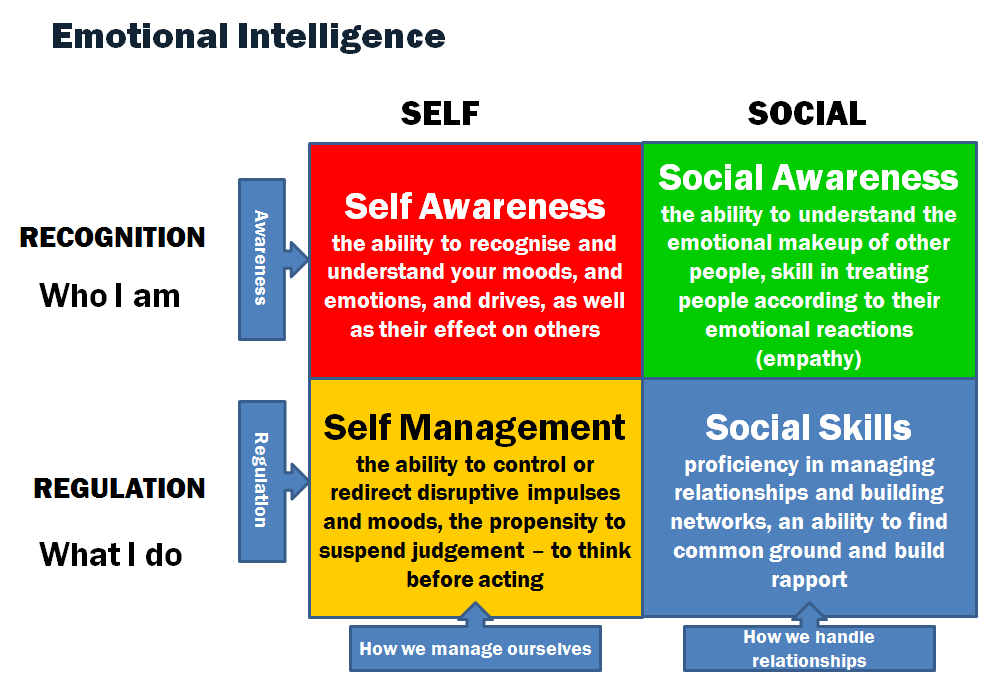
New Year’s resolutions are very energizing really. Whether we meet our goals or not, there is great promise within the resolution for resetting our thinking. A keen sense of self, or self-awareness, makes a difference in understanding our habits and progressing toward true habit change.

A couple of times in my life, I resolved to go off sugar. With a resolution like that, it means abstaining from chocolate…which is a topic all its own.

Anyway, I was successful for over a year each of those times in excluding sugar from my diet. Never having really lost the weight from my first pregnancy, I decided to remove sugar from my diet for the pregnancy of our second-born. In those days, there was a chapter of Overeaters Anonymous in our town, and that group was a great help in my dealing with pretty much a sugar addiction.

The second time I “gave up” sugar was over 2 years ago, and I stayed the course of that habit change for over 1 1/2 years. Less accountability but even more resolve. Now I sometimes have dessert or sugary snacks but I am still operating with more self-awareness than ever before. Self-awareness, not self-condemnation. A very different experience.

Without knowing it, I was using a practice of habit change that Ken Sande writes about on his blog, Relational Wisdom 360. He first influenced my life years ago with his work on conflict resolution through his Peacemaker Ministries. He is a gentle guide in many of the issues that complicate our lives.

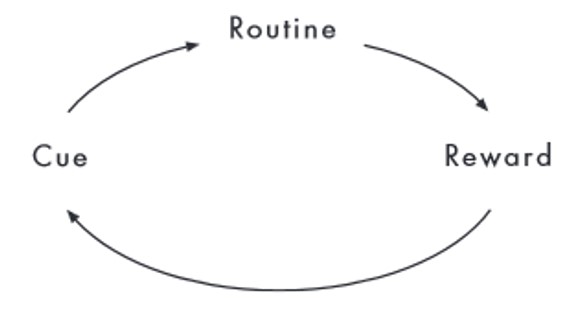
His New Year article on Seven Principles of Habit Change comes at a great time. Sande talks quite kindly about how we develop habits and what it takes to change them. His first principle of habit change gives us a look at the cycle of habits – the cue, the routine (or response), and the reward. Anyone who loves chocolate can understand this easily. For me, in eating sugar (or in overeating, in general), the cue could be a number of things – fatigue, anxiety, loneliness, presence of yummy food. It never takes much to send me to the refrigerator or pantry. The routine: feed the cue, whatever it is…with high-carb oral gratification. The reward: a brief soul satisfaction and temporary relief from whatever was the cue.

Blog - Habit Change - relational wisdom 360Photo Credit: Relational Wisdom 360

In my two seasons of not eating added sugar, I actually followed Ken Sande’s principles below (without knowing the wisdom of it).

  1. Every habit has three parts: a cue, a routine, and a reward.
  2. You can change an undesirable habit by keeping the cue and reward but learning a new routine.
  3. The best way to overcome the temptation to revert to old routines is to have a detailed action plan.
  4. Habit change builds momentum if you can change a single “keystone habit” and then continue to build on consecutive “small wins”.
  5. Will power is like a muscle: it can be strengthened and yet needs to be exerted strategically.
  6. Faith is an essential part of changing habits.
  7. Habit change is more likely to occur within a community (even if it’s just two people).Ken Sande

[If any readers want to talk further about habit change regarding sugar addiction, I would love the exchange, either through the comments or email.]

Self-awareness is a huge factor relating to habit change. I can see that more now having come through seasons of looking at my own habits.

“Self-awareness is defined as conscious knowledge of oneself; it’s a stepping stone to reinventing oneself, learning to make wiser decisions, and helps you tune into your thoughts and feelings. So often we place blame on externalities because it’s the easiest excuse, when in fact we should be thinking about our thinking, reflecting, trying on different perspectives, and learning from our mistakes.”Paul Jun

Matt Monge wrote a great piece on 13 questions we might ask ourselves to better understand why we do what we do. He is applying these questions to leadership and workplace, but they apply as well to habits. Also, in researching for this blog, I came upon this YouTube video of David Wallace Foster giving a commencement speech on awareness. Really thought-provoking as well as entertaining.

It is possible to affect true habit change if we are willing to take a studied look at ourselves – our awareness and our engagement with making choices/decisions and within relationship. I used to think that self-awareness was morally charged, i.e., it drove us to becoming more self-centered. That doesn’t have to be the case. When we take time to really examine where our minds go, through the day, we can train our thinking toward what matters most to us – related to people, resources, and life purpose.

When we are willing to do that, New Year’s resolutions can become much more life-changing than just going off sugar for a few weeks. These same habit change principles can apply to anger issues, pornography, other addictions, and pretty much any habitual process that negatively affects your work, relationships or general peace of mind.

I’d like to close with Ken Sande’s thoughts on taking self-awareness to other-awareness and God-awareness:

“The better we know and follow God (God-aware, God-engaging), the more we will know and discipline ourselves (self-aware, self-engaging), which opens the way for us to better understand, relate to, and serve our neighbors (other-aware, other-engaging).

To close the loop and spur us on developing relational wisdom, the Lord promises that the more we obey his command to love our neighbors, the closer we will draw to God himself (John 14:21-23). Thus, relational wisdom is a circle of interrelated skills that continually fuel one another.”Ken Sande

Blog - Relational Wisdom - Ken SandePhoto Credit: RelationalWisdom360

Do You Want to Change Your Habits? – Relational Wisdom – Ken Sande

Seven Principles of Habit Change – Relational Wisdom – Ken Sande

13 Questions to Increase Your Self-Awareness – The Mojo Company – Matt Monge

Why Self-Awareness Is the Secret Weapon for Habit Change – Paul Jun

This is Water – David Foster Wallace on Awareness

RW Acrostics in Action – Relational Wisdom – Ken Sande

Need Help With Your New Year’s Resolutions? – David Lose

Monday Morning Moment – Mission Drift – 12 Quotes on Being True to Our Mission

  Blog - Mission DriftPhoto Credit: Peter K. Greer, President & CEO of Hope International

[From the Archives]

“You are the salt of the earth; but if the salt loses its flavor, how shall it be seasoned? It is then good for nothing but to be thrown out and trampled underfoot by men. You are the light of the world. A city that is set on a hill cannot be hidden. Let your light so shine before men, that they may see your good works and glorify your Father in heaven.” – Matthew 5:13-14, 16

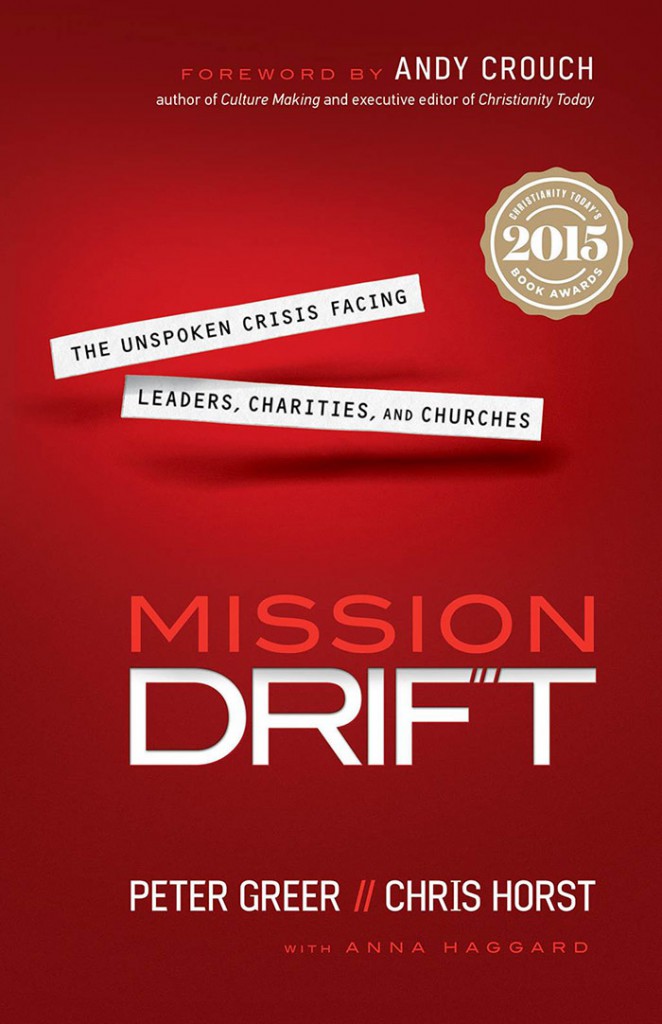
Peter Greer and Chris Horst (with Anna Haggard) wrote an incredible little book entitled Mission Drift. The book’s byline is “The Unspoken Crisis Facing Leaders, Charities, and Churches”. I enthusiastically recommend this book to anyone who has invested their lives in a faith-based organization, or Christ-centered business, or Christian charity. In fact, if you haven’t already read it, and you’re a Christ-follower, please make it a priority.

Mission drift is the slow and insidious shift away from the original mission, purpose, and identity of an organization. Greer and Horst have done extensive research on organizations who have either remained “mission true” or have fallen sadly away from their mission. The stories are fascinating and compelling. They lay a foundation that can help all of us prevent mission drift in our own lives and in our spheres of influence.

12 quotes from the book follow. These are just to whet your appetite. Mission Drift is an easy read and the truths resonate with our desire to be faithful and true stewards.

“Mission Drift…is pervasive and affects faith-based organizations of all varieties – nonprofits, churches, denominations, businesses, foundations, and schools. ..be optimistic…that drift is not inevitable.” (pp. 19, 22)

Mission True organizations know why they exist and protect their core at all costs. They remain faithful to what they believe God has entrusted them to do. They define what is immutable: their values and purposes, their DNA, their heart and soul…To remain Mission True is to adapt and grow, so long as that adaptation and growth does not alter the core identity.” (p. 27)

Mission True organizations know who they are and actively safeguard, reinforce, and celebrate their DNA. Leaders constantly push toward higher levels of clarity about their mission and even more intentionality about protecting it.” (p. 51)

Leaders often first ask what, then move to how, and finally transition to why. ..Great innovators…start with why. The ordering really matters. Everything flows from why. Not only does it motivate others to join you, it also guides what you do – and often more important – what you don’t do.” (pp. 71-72)

The gravitational pull of secularism is felt perhaps most acutely in hiring…Mission True leaders hire carefully, intentionally, and prayerfully. They approach each hiring decision seriously, recognizing that each staff member represents the mission of the organization. ” (pp. 103, 107)

“Mission True organizations recruit and engage Mission True donors.” (p. 115)

You are what you measure…Our highest goal is to remain faithful to our Christ-centered identity and mission. Because of our identity, we must pursue excellence. Metrics can be self-serving. We need to be clear why we pursue them. Seeing God for who He is clarifies our role: We are stewards. Metrics help us to remain accountable for the work that God has placed in our hands.”  (pp. 131, 133, 136)

“Slapping an ichthus (the Christian fish symbol of the early church) on product packaging does not mean it honors God. Christian shoddy is still shoddy. In Mission True organizations, quality must be nonnegotiable.” (p. 139)

“‘Culture eats strategy for breakfast.’  Mission True organizations get this. They focus on the little things. They understand how important practices and norms are to the living and breathing cultures of their organizations. The small decision each and every day may seem inconsequential, perhaps even trivial, but these little things protect against Mission Drift…Beyond policies, Mission True organizations recognize that culture is composed of all the ‘little things’.” (pp. 148-149, 155)

“Clear language reinforces identity and also leads to accountability. Being clear with your plans and identity enables people to keep you on mission. If you regularly talk about who you are, you invite scrutiny and accountability. Publicly proclaiming who you are strengthens your identity and empowers people to point out inconsistencies.” (p. 163)

“Also I say to you, whoever confesses Me before men, him the Son of Man also will confess before the angels of God. But he who denies Me before men will be denied before the angels of God.” – Luke 12:8-9

“For organizations who desire to protect against Mission Drift, one of the most powerful anchors is the local church…Wisdom lies in anchoring ourselves to the church as the church is anchored to Christ. Across time and culture and trends, the church remains.” (pp. 167, 173)

“Courageous Mission True leaders…have stood unwaveringly upon the Truth of the Gospel. In all areas, they have demonstrated intentionality and clarity in retaining Christian distinctiveness. They are committed to Christ, first and foremost.” (pp. 180-181)

********************************************************************

One organization very dear to me keeps its mission before its personnel and donors in regular, consistent, creative and winsome ways. We know what we are about. There is never a doubt what we’re to be about. What safeguards does that beloved faith-based organization of yours have in place to hold back mission drift?

Peter K. Greer Blog

Chris Horst Blog

The Subtle Danger of Mission Drift

50 Years of Charlie Brown Christmas – Why It Still Resonates With All Us Charlie Browns

2015 December - Charlie Brown Christmas, Retirement Celebration 008Photo Credit: Charlie Brown Christmas

Happy 50th Anniversary, Charlie Brown (Christmas)!

I can’t say how many times we’ve watched Charlie Brown Christmas through the years… It still touches our hearts across time and generations.

Steve Woodworth wrote a piece recently for Think Christian that perfectly describes the phenomenon of this timeless little animated film. Following are 3 quotes from his article, but read it in full here. So much truth.

“I am Charlie Brown. And you, if you are honest, are often Charlie Brown as well. A Charlie Brown Christmas has endured because it is true.” – Stephen Woodworth

2015 December - Charlie Brown Christmas, Retirement Celebration 031Photo Credit: Charlie Brown Christmas

“Charlie Brown’s Christmas is a sincere Christmas that refuses to hide behind glazed hams, perfectly trimmed trees or the plastic smiles on a greeting card. It is an honest Christmas that speaks to the reason why the very first Christmas was so utterly necessary. It is the well-known reason delivered to us annually by Linus as the lights dim and a spotlight falls on Luke 2:10-11: ‘Fear not, for behold, I bring you tidings of great joy that will be for all the people. For unto you is born this day in the city of David a Savior, who is Christ the Lord.’” – Stephen Woodworth

https://www.youtube.com/watch?v=DKk9rv2hUfA

“It is a message that promises “great joy” for those, like Charlie, who are no longer fooled by the world’s twinkling lights and Santa Claus parades. The sort of people who wait all year for this honest, 20-minute reminder that, although it is dark, the Light has come.” – Stephen Woodworth

2015 December - Charlie Brown Christmas, Retirement Celebration 005Photo Credit: Charlie Brown Christmas

Why a Charlie Brown Christmas Still Resonates 50 Years Later by Stephen Woodworth

Blog - Charlie Brown Christmas 50 yearsPhoto Credit: Amazon.com

5 Friday Faves – Millennials, Christmas Lights, Post-Traumatic Stress Disorder, “a Good Man is Hard to Find”, and a Christmas Album

Blog - Friday Faves

Happy Friday! Hope you’ve had a sweet week in the crazy of December…snatching some quiet moments from all the loud. Here are my favorite finds for this week:

  1. Millennials –  Mat Luschek’s Millennials at Work offers a quick and thoughtful read on our workplace, especially as it is changing or must change. “Millennials will outnumber the Boomers in the workplace this year.” So what are they looking for in a job? The paycheck is still important, for sure, but also import is the work culture. Luschek describes 4 areas that are especially engaging for millennials: 1) Flexibility, 2) Coaches not managers (as a Boomer I favor that as well), 3) Boredom at a minimal), and 4) Collaboration & Leadership. Fascinating read. Bottom line for all of us in the workplace is that what’s good for these millennials is good for us as well…maybe, we just didn’t consider pressing for it.Blog - Millenials - bpnews.netPhoto Credit: BPNews.net

2. Christmas Lights – Previously I wrote about Richmond’s Tacky Light Tour. Christmas lights in our own neighborhood are lovely as well, especially when we know the folks inside. Our neighborhood is an old one tucked into an ancient forest. In the yard light displays around us, there are few nativities. Christmas lights here are more whimsical than worshipful…still they warmly light the cold winter nights, and invite us in to the home of a friend.Blog - Neighborhood Christmas Lights2015 December - Christmas Community Group, Tacky Light Tour 0042015 December - Christmas Community Group, Tacky Light Tour 011Sometimes, neighbors are “best-in-show” Tacky Light Tour participants. All you have to do is walk down the street and enjoy them. Not our neighbors, but friends of ours. So fun!2015 December - Christmas Community Group, Tacky Light Tour 080

3. Post-Traumatic Stress Disorder (PTSD)Mayo Clinic defines PTSD as “a mental health condition that’s triggered by a terrifying event — either experiencing it or witnessing it. Symptoms may include flashbacks, nightmares and severe anxiety, as well as uncontrollable thoughts about the event…if the symptoms get worse or last for months or even years and interfere with your functioning, you may have PTSD. Getting effective treatment after PTSD symptoms develop can be critical to reduce symptoms and improve function.”

We often think of PTSD as a post-war calamity of our military veterans. There are also others among us who suffer from the smoldering aftermath of a tragedy (either a single event or years of abuse). PTSD can be very damaging to the person suffering from it and those who love them.

Dr. Brad Hambrick is the counseling pastor on staff at Summit Church, Durham, N. C. He has produced a video series on PTSD which I found very helpful recently in dealing with the PTSD of a friend.   He also makes available his seminar notebook on the subject, free of charge. You can request a copy from Summit’s counseling office at counseling@summitrdu.com. Whether you are a Christ-follower or not, this video series and notes will help you understand PTSD better and give you steps to deal with it.Blog - Brad Hambrick - PTSD

Photo Credit: BradHambrick.com

4) “A Good Man Is Hard to Find” – Ashlin Horne’s They Say a Good Man Is Hard to Find may not be at all what you’re thinking. No pity party for one here. She handles a sometimes hurtful subject so sensitively. As I read her blog, it felt like sitting with coffee across from a good friend. You women (AND men) will want to read this and pass it on to others. Following is just a bit of it: Men are not God. If there’s one thing I’d like to tattoo on the arms of girls everywhere it’s that truth. They will not heal you. They are not your redemption. I think it’s time to stop loading up the shoulders of the good men in our lives, or the ones we’ve yet to meet, with expectations that only God can fulfill.” Read on, Loves.Blog - Good Men - Ashlin Horne - vine.coPhoto Credit: Vine.co

5) Latest Favorite Christmas Album – David Crowder Band’s Oh For Joy. This album is a rowdy mix of Christmas standards arranged as only Crowder does it. It was released in 2011 before the original David Crowder Band “disbanded”, and it’s a “must-own”.  My favorite track on the album is the last song. Here’s Sarah Fine’s description of it: As amazing as this album as this is, the true standout track is the final song on the record. Another live Passion recording, the band puts their stamp on what has quickly become one of this generations most beloved holiday songs, Trans Siberian Orchestra’s “Carol Of The Bells / Christmas in Sarajevo.” The song starts off with a brief introduction from David, stating that Christmas doesn’t technically end till Epiphany on Jan. 6. Spoken in a way only he could master, the intro leads directly into one of the best versions of this song I’ve heard since the Orchestra recorded it themselves. Dare I say, this version might even be better. If there ever was ever a way to end a Christmas album with a bang, this would be it.” The YouTube video of this song follows.Blog - David Crowder Band Christmas - Oh For JoyPhoto Credit: Amazon.com

What are some of your favorites of late? Would love to hear about them in the Comments. Make it your own kind of special weekend.

Liz Wiseman’s Leadership Book on Multipliers and the Story of a Multiplier in Our Lives

Blog - Multipliers Book

Photo Credit: Amazon.com

For several years, we had the great privilege of living and working in Cairo, Egypt. My husband directed a Middle Eastern Studies program. I helped him oversee the comings and goings of bright, energetic 20-somethings. When the work, heat, or press of city life became too much, we would escape to the Sinai and the Red Sea. Usually the resort town of Ras Sudr was our quick get-away, where we could take a weekend just to clear our heads with blue skies and salty sea air.

This time, we went for a week to Dahab, on the far side of the Sinai. r_seaman@hotmail.com

Photo Credit: Egypttailormade.net

We were finishing our time in this director role and would take a short sabbatical in the US. We would then return to Egypt, this time for a regional consulting job, guiding the expansion of these study centers.

We were tired, and a consulting job was a dream, with the prospect of just giving a hand to other directors – not nearly the intenseness of being responsible for so many young people.

Driving through the desert of the Sinai, with the kids in the backseat, we got a phone call.

Whoever it was on the other end, (Dave hadn’t called him by name), the conversation, from my side, was warm and affectionate at first, and then serious. As they talked, visible goose bumps rose on Dave’s arms. Goose bumps on a hot deserty day in Egypt?! I knew no one had died from his side of the conversation, but something huge was clearly being introduced by the caller.

When the call ended, I got the details. Dave spoke quietly so the kids wouldn’t be distracted by a call that could change the course (and geography) of our lives. The person on the other end of the conversation was his dearest mentor – a man for whom he had the deepest respect, even love. On the phone call, he had asked Dave to consider not taking the job of consultant but to take a job with him where he would have even more leadership responsibility. Supervising many more than a couple of dozen 20-somethings in one city. This job would require him to provide leadership to about 100 people spread over 6 different countries AND we would have to move from our beloved Cairo.

Thus, the goose bumps.

Dave did walk away from the “easier” job of consultant to take on the much larger, scarier job his mentor asked of him. We did eventually break the news to our children that we would be moving away from Cairo to a whole new country of possibilities and friendships. It was a stretching move for us (more so than our original move to Cairo), and it was a job and situation we would never have aspired to…were it not for this mentor…this multiplier of leaders.

Liz Wiseman has written the most incredible book on leadership – Multipliers – How the Best Leaders Make Everyone Smarter . Her book describes this mentor of my husband as if she knew him personally. Wiseman is the president of The Wiseman Group, a leadership research and development firm, headquartered in Silicon Valley, California.

Blog - Liz Wiseman

Photo Credit: LiveIntentionally.org

I first heard her speak at the Global Leadership Summit this year. Her presentation centered on her more recent book Rookie Smarts. This engaging young woman clearly has had multipliers in her own life and has obviously learned from some diminishers as well.

On the inside cover of Wiseman’s book Multipliers, she defines the terms “Diminishers” and “Multipliers”:

“The first type drain intelligence, energy, and capability from the ones around them and always need to be the smartest ones in the room. These are idea killers, the energy sappers, the diminishers of talent and commitment. On the other side of the spectrum are leaders who use their intelligence to amplify the smarts and capabilities of the people around them…These are the leaders who inspire employees to stretch themselves to deliver results that surpass expectations.” – Liz Wiseman

Have you ever been in a job where you felt your wisdom, understanding, experience were being drained right out of you? As if you were getting stupider and stupider? That can happen…or at least the sense of it happening is so strong it might as well be real. Some of this we must own ourselves, and some of it is owned by our leaders.

[Sidebar – It’s not like Diminishers are evil people. Possibly, their focus is so tuned to the endgame that people and processes get lost in the pursuit. I believe whenever they have an “aha!” moment, maybe through the multipliers in their own lives, they could change their habits and disciplines.]

This mentor of Dave’s was/is a Multiplier. For much of Dave’s professional life, this man has “popped in” and pressed my husband to reach farther than he might have in his career.

I want to be this sort of leader myself – this one who inspires confidence in others, who sees the possibilities, who risks by giving over control to another, who stirs thinking and enlarges the lives of those in his/her circle of influence…a circle that’s widely inclusive.

Being a leader is a humbling, stretching experience and, for the sake of those under your watch in the workplace, you want to offer the best leadership you can. We can all fall into habits over time that diminish others. Forging disciplines that keep us from doing so is wisdom. Note them from Liz Wiseman’s book:

Blog - Liz Wiseman's Multipliers

Wiseman also talks about leaders as change agents – do we reserve the right to make the final decision every time or do we wrestle through decisions with those most affected by them? The latter can definitely be more messy but is also more effective and honoring.Blog - Multipliers by Liz Wiseman -2 (2)

“Multipliers invoke each person’s unique intelligence and create an atmosphere of genius—innovation, productive effort, and collective intelligence…He’ll outstretch all your capabilities to make it happen. He is highly demanding, but you feel great. You know you are signing up for something that will challenge you on a daily basis for many years to come. You will challenge yourself and all your capabilities…Exhilarating, exhausting, challenging, gratifying. He’s a big source of energy. He is a source of power and a tail-wind for what we do.”  – Liz Wiseman

Thank you, Liz Wiseman. You are a wise woman (I’m sure you get this all the time…couldn’t resist). Thank you, to that unnamed mentor multiplier in my husband’s life…and to all those multipliers in my life’s journey.

Read Wiseman’s book. I’d love to hear your stories of multipliers in your life…and any diminishers that you learned from but (hopefully) were not diminished in the season you were together…maybe you became a multiplier in that person’s life. Journey strong, Friends.

Multipliers – How the Best Leaders Make Everyone Smarter by Liz Wiseman with Greg McKeown

YouTube Video – Leaders as Multipliers with Liz Wiseman

YouTube Video – Liz Wiseman – The Multiplier Effect 0

Multipliers Quotes from GoodReads

2013 Global Leadership Summit Session 3a: Liz Wiseman

Brian Dodd – 4 Leadership Lessons From Mt. rainier and the Inc. 500 Fastest Growing Business List – another example of a Multiplier

Monday Morning Moment – Relational Wisdom – the Way It Could Be – at Work & Home

Blog - Monday Morning email

Monday morning emails can be treacherous… This morning when I woke,  my husband told me he’d just heard from a valued colleague that he had secured another job. Dave was expecting this because of previous communications they’ve had with each other. Through an organizational re-structuring, there are many whose jobs are changing. This email was good news because this person will be a tremendous addition to any team – good news and sad news. We will miss this man on our team but we celebrate a great job match.

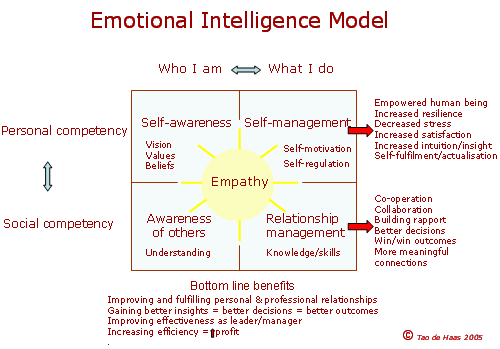
Then another email came in. It was from the person who will be his new supervisor. It was full of respect and regard – a courtesy email that is not necessarily company culture these days but an email that shows understanding and empathy. When change comes, even good change, there is still that adjustment, that grieving of the good that was. Those two emails speak volume about emotional intelligence or relational wisdom…and that’s something we always need in the workplace…and at home.

The holidays have a particular call for wisdom to soften difficult expectations, disarm family conflicts, and personalize interactions to fit the needs of those nearest to us.

Blog - Monday Morning Moment - MarriagePhoto Credit: rw360.org

One very simple way we can tune into holiday celebrations is to deal with our own stuff. Keeping our minds on the goodness of the holidays helps. It’s easy to find daily Advent readings for the month of December…depending on your favorite author or blogger, they’ve probably written some.

Related to both our work and home relationships, Ken Sande, founder of Relational Wisdom 360, has given us a great gift, and we don’t have to wait another day for it. He has written 33 Ways to Enjoy Highly Relational Holidays. A fast-read blog a day on relational wisdom, starting on November 23 to take you right through to December 25.

I attended Dr. Sande’s Peacemaker course years ago during a challenging work season, and what I learned then continues to be a tremendous help to me today. If your work or family situation is somewhat intimidating, don’t despair. There are those in our lives (Ken Sande is one) who will come alongside and help/mentor us, if we’re willing to take care of our own hearts and minds.Monday Morning Moment - Post traumatic growthPhoto Credit: coldspringcenter.org

As Thanksgiving approaches and Christmas not far behind, I hope you can look forward to happily memorable times together with family. As far as work goes, just like with the emails above, we can do our part to make our workplace a kind and honoring experience – our part (not someone else’s) in making it the way it could be…the way it should be…Blog - Monday Morning Good Work BraceletPhoto Credit: GoodWorksBracelet.com

What helps you thrive in stressful situations at work? What has made a difference in bringing peace and joy to your holiday celebrations? Please comment and share with those searching for that wisdom.

Surviving Christmas – Advent Devotions for the Hard and Holy Holidays – Anne Marie Miller – free ebook

Advent Devotional Readings Online by Lifeway

Good News of Great Joy by John Piper

Unwrapping the Greatest Gift: a Family Celebration of Christmas by Ann Voskamp