Category Archives: Life Skills

Monday Morning Moment – Stewarding Our Influence Well

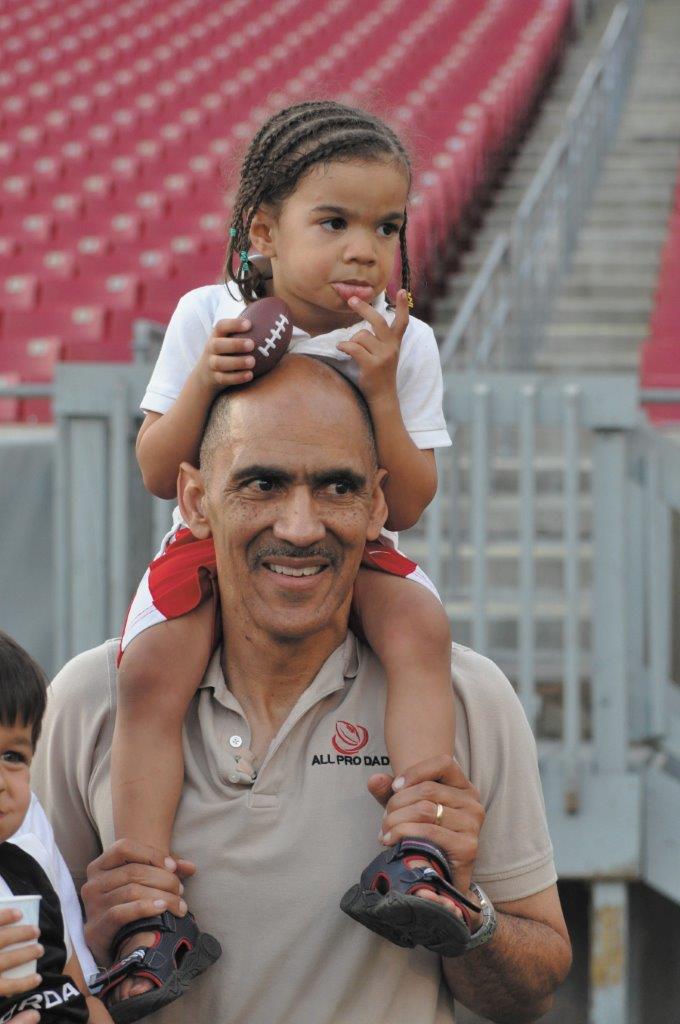
Blog - Influence - Alex & Stephen KendrickBlog - Influence - Tony Dungy Son - BPNews net (3)Photo Credit: BPNews.net

Be imitators of me, just as I also am of Christ. 1 Corinthians 11:1

We are all influencers in one way or another. How we steward our influence is strongly affected by those who have influenced us.

[This Monday morning moment has a spiritual bent, but the principles apply, whatever your belief system. It would be disingenuous for me to write about influence without including the impact of following Christ and Christ-followers in the mix. Thanks for your understanding of this.]

When I was in graduate school, my days were heavily committed to class time, clinical work, research and writing. Meeting with my thesis advisor was a regular “intrusion” into that schedule. For weeks, I would arrive late to our meetings, excusing myself always with some sort of “more important” fill-in-the-blank.  Communicating “more important than our time together”. My advisor was one of the most gracious women I’ve ever known. She was always spot-on ready for our meeting, having read my latest submission, with her notes in hand. If ever I was “fly-by-the-seat-of-my-pants”, it was with her.

Finally, one day, without warning, she nailed my tardiness for what it was…and I will never forget her for that. She taught me so much about professionalism and excellence in practice, but she taught me most in this area of honoring a colleague. I will always be grateful to Rose McGee for that.

Since those early years in my professional life, there have been many influencers in my life. Bosses, supervisors, coworkers. Some influencers had more celebrity status, but because they wrote for people like me, I soaked up their wisdom.Blog - Influence - Priscilla Shirer - BPNews net (2)Photo Credit: BPNews.net

Ben Kirksey recently wrote a short piece entitled Are You Worthy of Workplace Imitation?. It got me thinking of how my own workplace processes have changed because of those mentors, friends, and coaches in my life. 7 points of stewardship came to mind:

  1. Time – We all have the same amount. Honoring others’ time does matter – being interruptible, not shortchanging people, keeping and being present in meetings. It’s a balancing act, but we want to be dependable and resourceful in this area.
  2. Tweaking – only when absolutely necessary. Show you value others’ work. Give up control whenever possible. Whenever possible, trust their ownership of their work.
  3. More questions/Less Advice – We jump to advice (or direction). Learning to ask thoughtful and compelling questions is a discipline worthy of our time and effort. Jesus was masterful at this.
  4. Genuine Affirmation – To be truly known is such an empowering gift. General praise or cheery compliments are nothing compared with informed and specific affirmation. You affirm my thinking and hard work on a problem, and I will apply myself even more.
  5. Building Capacity – Investing in others’ success at work while, at the same time, expecting the most out of yourself, builds capacity all around. This collective commitment to the work and each other delivers. Building capacity is a “both/and” arrangement. We can’t cast vision for it effectively, without digging in ourselves.
  6. Leading by Influence – I have rarely enjoyed a position of authority…it is by influence that I have both learned and led in life. Authority has its own cross to bear in that the responsibility for return on investment sometimes interferes with relationships. Too bad, really. It’s through the relationships that we can see a greater return…as we steward influence.
  7. Perspective – I will never forget a workplace story about a creative director and his lead creative. They rarely agreed. In fact, as the younger man tells the story, their discussions could become very heated over the direction of any given project. Then there would come a moment when his boss would say, something like, “Let’s get some coffee.” or “It’s lunch time, let’s grab a bite to eat.” No matter the seriousness of the conversations, this older man was able to bring relational perspective to bear. Their relationship was more valuable than any project decision. I daresay the work didn’t suffer from this perspective.

I am so grateful for those who have influenced my work. As mentioned before, they include some whom I have never met physically. The Apostles Paul and Peter, and Jesus himself teach us volumes on stewarding influence well.

Shepherd the flock of God among you, exercising oversight not under compulsion, but voluntarily, according to the will of God; and not for sordid gain, but with eagerness; nor yet as lording it over those allotted to your charge, but proving to be examples to the flock.1 Peter 5:2-3

Do nothing from selfish ambition or conceit, but in humility count others more significant than yourselves. Let each of you look not only to his own interests, but also to the interests of others. Have this mind among yourselves, which is yours in Christ Jesus, who, though he was in the form of God, did not count equality with God a thing to be grasped, but emptied himself, by taking the form of a servant, being born in the likeness of men.  And being found in human form, he humbled himself by becoming obedient to the point of death, even death on a cross.Philippians 2:3-8

Finally, brethren, whatever is true, whatever is honorable, whatever is right, whatever is pure, whatever is lovely, whatever is of good repute, if there is any excellence and if anything worthy of praise, dwell on these things. The things you have learned and received and heard and seen in me, practice these things, and the God of peace will be with you.Philippians 4:8-9

Do you have a story of an influencer in your life and how that person changed the way you work? I would love to hear it through the Comments below.Blog - Influence - Jesus

Are You Worthy of Workplace Imitation? by Ben Kirksey

The People Skills of Jesus by William Beausay II

The Management Methods of Jesus by Bob Briner

The Other Side of Organizational Downsizing – What Survivors and Their Managers Can Do Going Forward

Blog - Downsizing strategies - slideshare.netPhoto Credit: Slideshare.net

Recently, a young friend of mine told me about an abrupt change in his company. He went in one morning to the usual – team meeting, work routine, cubicle life. Then in the early afternoon, without any prior notice or indication, the head of the company walked around the building with envelopes. By the end of the day, in this small tech support company, one-third of the employees had packed up and left the building.

Surprise lay-offs are the hardest to bear, but any kind of downsizing, no matter how necessary, is stressful and disorienting. When crisis precipitating a downsizing occurs, organizational leaders are wise to put together a transition team right away.

For those who were laid-off or who took the separation package in a carefully orchestrated downsizing, there is colossal adjustment. Hopefully, they will get the support they need to get that next job or to thrive in retirement.

For those who remain with the company, their adjustment can be great as well. Do an internet search for “surviving downsizing” and you will find hundreds of articles, and even several books on the subject.

Employees who survive the downsizing (whether because of their age, capabilities, or department) will still go through a period of post-traumatic stress. On that Monday, for instance, after their colleagues leave, they must re-orient to a new normal.

Blog - Downsizing threat or opportunity - slideshare.netPhoto Credit: Slideshare.net

Michael Sanders, author of 7 Critical Mistakes Employees Make in a Downsizing, wrote an empowering Linkedin article on how to take charge of one’s own survivors’ syndrome and move forward. First Sanders defines the elements of “sickness”; elements which include guilt, mistrust, sadness, anxiety, and disagreeability. Then he moves right to ten “power moves” that employees can make for a healthier, more substantive work situation. I list these, but don’t miss, in the article, what he says further on each.

  1. Practice instant alignment re-centering.
  2. Play by the new rules.
  3. Speed up.
  4. Practice intensive task management.
  5. Fall in love with your work, again.
  6. Take on new assignments.
  7. Expand your business affiliations.
  8. Continue your education.
  9. Become your own hero.
  10. Keep in touch with laid-off [or “downsized”] work friends.

Some of Sanders’ action items may seem more than you can handle as you adjust yourself to a work life very different than the previous one. His bottom line is  to refuse to be a victim. Whether your organization is proactive in retaining and retraining you, you can champion your own professional needs and career. It will benefit you and either your current employer or your next one.

Stress specialist Morton C. Orman, M.D. also wrote a prescriptive piece entitled 18 Ways to Survive Your Company’s Reorganization, Takeover, Downsizing, or Other Major Change. Below are 8 of the points I believe are most helpful (again refer to his article for the rest of his wisdom).

  1. Be prepared for [more] change.
  2. Watch out for unrealistic expectations.
  3. Get creative.
  4. Expand your value to the company.
  5. Celebrate your accomplishments.
  6. Seek appropriate compensation or “risk share” arrangements.
  7. Improve lines of communication.
  8. Become more efficient.

Again, these may seem obvious, on one hand, and annoyingly intrusive as well. You’re grieving the beloved colleague who was laid-off or that great boss who retired. In the process of that grief which may be with you for some time, you still have that job to do…with probably more responsibility added. Sadness and anxiety tend to affect our performance negatively. That’s why it’s imperative to set in place processes you may not have needed before but need now to recover and embrace what’s ahead.

Hopefully you have leaders and managers who are already astutely moving the company forward…with you in mind, as well as the  product/services. If not, you can’t risk waiting. Do your reading, evaluate your course of action, build your new work community, and demonstrate to yourself and those around you…you are a survivor! In the best sense of the word.

The Downsizing Jungle: 10 Power Moves by Mike Sanders

The Effects of Downsizing on Survivors: a Meta-analysis – Dissertation of Dr. Gladys West; Virginia Polytechnic Institute and State University, 2000 – an excellent presentation of the issues of organizational commitment, job satisfaction, turnover intention, role conflict, job involvement, supervisor support, procedural and distributive fairness. [scholarly piece but worth wading through.]

Slideshare – Downsizing Best Practices – Survivors are Key – Don’t Neglect Them – Carol Beatty

Survivor Employees: What You Need to Know – description of 6 common profiles of employees dealing with “layoff survivor syndrome”

After Layoffs, Help Survivors Be More Effective – excellent article on what’s at stake for survivors of layoff and how, from a management standpoint, to turn things around.

18 Ways To Survive Your Company’s Reorganization, Takeover, Downsizing, or Other Major Change

Blog - Downsizing - slideshare.netPhoto Credit: Slideshare.net

5 Friday Faves – a Country Store, Mixing Thanksgiving and Christmas, an Argument for Trouble, Teaching Empathy in the Classroom, Teaching our Children to be Entrepreneurial

Blog - Friday Faves

Happy Friday! Posting from Atlanta, visiting Dad and family.

1) A Country Store – In an era of “buying local”, it’s easy to forgive a huge franchise when it feels like a country store. Cracker Barrel is like coming home. It’s my dad’s favorite restaurant (breakfast all day, and a huge menu full of “home-cooked” favorites). Walking into Cracker Barrel, you enter the country store section ahead of the restaurant. It is a retail paradise, especially if you’re from the South. Or maybe for everyone. It was lovely  seeing it recently through the eyes of a Moroccan-Scottish friend visiting. So much fun, this place, whether you buy anything or not!

IMG_1023IMG_1173

2) Mixing Thanksgiving and Christmas – Beautiful Fall leaves and pumpkins are still with us in Virginia, although the season is waning. Even with our American Thanksgiving still days away, Christmas is also upon us – with decorations, music, and the wooing to the stores for gift-buying. I don’t mind the mix at all. There’s enough to delight in both holidays.

IMG_1146FullSizeRenderIMG_1174

3) An Argument for Trouble – Mark Modesti’s Argument for Trouble – YouTube video (TED Institute) – take the time to watch. Even the Bible tells us we will always have trouble, so wisdom is to learn how to thrive in it…and make it work for us and others.

4) Teaching Empathy in the Classroom – Dr. Marilyn Price-Mitchell’s article on Empathy in Action: How Teachers Prepare Future Citizens. I love when educators are committed to working with parents in helping our children to grow into responsible, thoughtful adults. Growing up happens all too quickly – redeem the time.

5) Teaching Our Children to Be Entrepreneural – Charmian Solter’s 8 Entrepreneurial Skills You Should Teach Your Kids (in an info graphic). Like 4), these are things we might as parents want to consider to help our children face the future that awaits them.

That’s the quick and short of my favorite finds this week – what are yours? Would love to hear about them. Enjoy your weekend!

IMG_1160

5 Friday Faves – Leadership, Keeping House, Mentors, Wonderful Defects, & a Phenomenal Guitarist

Blog - Friday Faves

Fridays come so fast. So here we are again. My top finds this week (and there were so many great reads and experiences this week, it was hard to narrow down to 5). Hope yours is a lovely day and a stretched-out weekend.

1. On Leadership – Brian Dodd creates great lists. In this week’s blog, he published 24 Steps to Successfully Leading Through CrisisOf his 24 steps, these are my favorite (but do read all of them):

  • To Successfully Lead Through Crisis You Must Provide Stability – Stabilizing the organization gives your people a sense of security.
  • To Successfully Lead Through Crisis You Must Become A Giving Engine – Rather than focusing inward and solely on the issues you are facing, look outward and turn your attention to others.
  • To Successfully Lead Through Crisis You Must Offer Hope – This tells others success is in their future.
  • To Successfully Lead Through Crisis You Must Offer A Plan – Hope is not a strategy.  There must also be a detailed roadmap showing why hope exists.
  • To Successfully Lead Through Crisis You Must Change – The behaviors which got you in the crisis will not get you out of the crisis.

Also not to miss is Paul Sohn’s Top 30 Must Read Posts on Leadership October 2015.

2. Keeping House – I struggle with keeping order in my house, even though now it is only Dave and me. No one else to make the mess but us. Ann Voskamp, farm wife, mother of 6, and best-selling author, wrote about keeping house this week – 6 Ways to Speed Clean to a Clean Enough House. Her photographs of life are so gorgeous that it’s hard to imagine things out of place or not camera-ready. Yet, even Ann had to come up with a system of order which she shares in this blog. My two favorite suggestions from her list of 6 follow:

  • Make your bed every morning. I love this one because it’s so easily done. It gives its own cheer of “Hurrah! You’re off to getting lots more done.” BLog - Keeping HouseMy husband and I have very different “sides of the bed” – he’s a bit neater; I’m a piler. Projects, bits of paper, “things to read later”…sigh…but, the bed is made. Score!
  • 30 Minute Love SHAKs“Do Surprising Home Acts of Kindness — Love SHAKs — 30  minutes of random cleaning [right after dinner], just 30 minutes of every single person who lives here seeing something that needs to be cleaned —- and everybody cleaning as quickly as they can. The point of everybody working together at the same time to surprise everybody? Everybody models the kindness of cleaning for each other, nobody gets to say what they’ve got going is too important to get in on loving each other, real progress is made because everybody is working fast and together, spurring each other on — and we all get to say we are on the same team.” I love this! Might start with 15 minutes with the love of my life. What do you think, Dave?

3. Mentors Jon Acuff rarely has guest bloggers, but this week he shared his spot with Lewis Howes, author of The School of Greatness. Howes writes about his personal experience of connecting with top mentors. Having been a professional football player, he might have been tempted to just ask them out for coffee. No, he did something altogether different. He offered to serve them in any capacity they would find helpful. Don’t miss his wise counsel on this.

“Don’t ask for anything. Just offer to be of meaningful service, in any capacity that will help the mentor in achieving what is important to them. Offer to work for free. Say yes to anything. Hustle hard. Show them you are grateful and willing to learn. Keep your word.” – Lewis Howes

4. Wonderful Defects – This week, I discovered Paul Phillips and his blog He’s Taken Leave. He tells a beautiful story of an old beautifully marred violin and bridges that to our own propensity to comparing ourselves to others.

“As with the old violin, the comparisons with others prove nothing.  Each person who walks through my door is a masterpiece of unique design. Every one, a treasure.  Every single one. Fearfully and wonderfully made (Psalm 139:14). I can almost hear the music again.”

Blog - Old Violin - wqxr.orgPhoto Credit: wqxr.org

5. Phenomenal Guitarist – This guy. Nathan Mills – related? Yes. I get to be Mom to this amazing young man… Because we are related and it’s not always comfortable for him how effusive I am about his music…I restrain myself. Once in awhile, it feels down-right wrong not to share with you something about him. Right now, he’s fairly new to that larger world of music, but he’s playing, teaching, arranging, and composing. One day, you will know him…and be able to enjoy his music beyond YouTube, social media, or local performance. Mark it down.Nathan at guitarPhoto Credit: Duy Nguyen

What are your favorites from this week? Would love to hear about them. Share in comments, please.

Blog - Fall Back YardOur back yard this week – Fall

Building a Healthy Work Culture – in a Season of Change, Uncertainty, and Dips in Morale

Blog - Culture of FunPhoto Credit: Grasshopper.com

What are you celebrating at work these days? Hopefully you didn’t have to think really hard. Just having a job is something to celebrate, for sure. Beyond that, hopefully you have work that gets you up in the morning with a sense of purpose and a gladness of heart for your work community.

What if that’s not the case this morning? Any number of things can cause our workplace to become more stressful than healthful – a disappointing outcome in our research, a conflict over division of labor, a company merger or buy-out, a downsizing. I am awkwardly  list such things because none may touch on your situation. What is your work situation and your current work culture?

Whatever it is, working over a protracted period of time with low morale makes for a difficult work situation. We want to do whatever we can to turn that around. Not just for the sake of the organization and the goals of same, but for the sake of the personnel. The wellbeing of employees is the biggest factor in the long-term productivity of organizations. Yet, how do we wrap our collective leadership minds around such a thing as morale and engagement?

The key is work culture – and fostering a healthy work culture with as much energy and thought as we do our product line or customer service.

I was reading about work culture, especially related to a season of spiraling morale, and came across a pdf introduction of the book How to Build a Thriving Culture at Work by Rosie Ward and Jon Robison.

Not having read beyond the introduction of the book, I can’t give a full recommendation yet. However, the first few pages have already resonated with me about what is at play related to morale, or well-being, and what could be possible to restore it. Here are some quotes from Ward & Robison’s Introduction:

“Despite overwhelming evidence of a powerful link between effective leadership styles, positive work cultures and higher levels of organizational performance, many companies still operate with a top down, authoritarian management style, do not measure or intentionally create their desired culture, and do not effectively develop current and future leaders to maximize employee engagement and wellbeing.”

The authors go on to say that even in work situation where the leadership style is more employee-centered, the idea of work culture may not be well-understood or operationalized.

“Culture is the differentiating factor between high-performing and low-performing companies; however, most companies have not identified, articulated, measured or intentionally created their desired culture.”

The dilemma of employee morale may actually extend to the leadership team itself.

“The majority of executive leadership teams are not operating in a truly cohesive manner, and many leaders themselves are at a point of burnout.”

“Edgar Schein, PhD, leading researcher on corporate culture, describes culture as ‘the hidden force that drives most of our behavior both inside and outside organizations’. It’s like looking at a river. All of the things you see on the surface, from the flow of the water to the shape of the riverbed, are manifestations of an ever-changing, powerful current beneath the surface. In terms of culture, the current that ultimately guides the strength and direction of the organization includes the unconscious, taken-for-granted beliefs, perceptions, thoughts and feelings of employees. The interaction between leaders and culture is profound and critical when considering how to transform or evolve the overall culture and subcultures within an organization.

“Patrick Lencioni writes that, to be successful, an organization must focus on two basic qualities: It must be smart, and it must be healthy. According to Lencioni, a ‘smart organization’ is one that excels in the classic fundamentals of business — i.e., strategy, operations, finance, marketing and technology. A “healthy organization” is one in which there are minimal politics, minimal confusion, high morale, high productivity and low turnover. While being smart is only half of the equation, for most organizations, it occupies almost all of the time, energy and attention of leaders. Yet, according to Lencioni: ‘Once organizational health is properly understood and placed into the right context it will surpass all other disciplines in business as the greatest opportunity for improvement and competitive advantage. Really.‘”

Blog - How to Build a Thriving Culture at Work

Photo Credit: Amazon.com

How to Build a Thriving Culture at Work, Featuring the 7 Points of Transformation by Rosie Ward and Jon Robison

Work culture and employee well-being are not addressed by just another wellness program. Organizational ethos and values must incorporate both philosophy and programming to build morale, trust, and engagement of employees. Especially if the organization has been through a protracted season of change and uncertainty.

The good news is that possibilities abound. Workplace development literature is rich with approaches and frameworks that you will find helpful in attacking your own set of challenges. One such article is Workplace Culture is Everything: 20 Ideas For Building a Thriving Team – Great links to 20 articles on Workplace Culture. [I apologize, since I’m citing this resource, for the “coded” profane word in the title of one article. Good read otherwise].

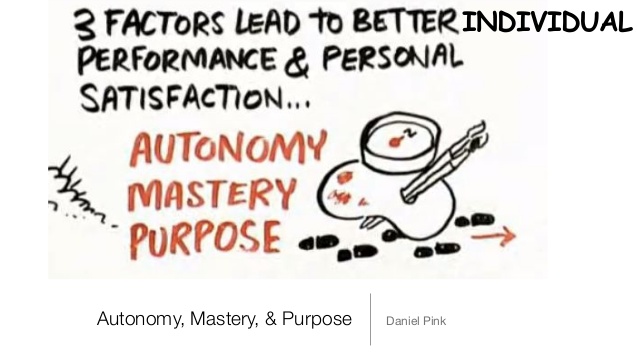
Another book I re-discovered in reading about morale this weekend is Daniel Pink’s Drive. When a company is in the middle of a reorganization or restructuring, employee wellbeing (engagement, performance, satisfaction) can get lost in the sheer workload of the executive leadership team. This is when Human Resources, Membercare, or the Employee Medical Program can offer their own recommendations as to how to rebuild the work culture from the personnel side.

Are you in such a season? What have you done in this area? What has been helpful? I would love to hear about how your organization has dealt with employee morale and engagement during seasons of transition.

Blog - Healthy Culture - Motivation - Slideshare.netPhoto Credit: Slideshare.net

Drive: The Surprising Truth About What Motivates Us by Daniel H. Pink

11 Ways to Create a Thriving Workplace

How to Create and Maintain a Workplace Culture That Will Make Your Company Thrive

Grit – When You’re Hurtin’ But Not Quittin’ – the Role of Personal Resolve and a Team Alongside

131118-Z-WM549-015Photo Credit: Pacific News Center

Diligence is a word that defined my many years in learning Arabic while we lived overseas. Keeping at it, even when I wanted to quit, helped immensely. The joy of living life in a second language is worth all the work. Diligence is a great assist to staying on course, but it is not “grit”.

I saw grit at work recently in a group of servicemen, in Virginia Beach, doing their morning exercise. [Not the picture above but that image has its own neat story of grit]. We had taken a couple of days away from the city to get our breath, by the ocean. Walking on the boardwalk early in the morning, we encountered this small group of airmen from the nearby Naval Base, doing a group jog. We saw them starting the run and saw them again coming back – 6 miles total. Most of them were young, thin, and fit.

What caught our eye, in particular, were two men in mid-life, carrying a bit of weight, bringing up the rear. Approaching the end of that run, they looked like they were hurting, but they definitely weren’t quitting. I’m sure to stay as fit as the rest of the group was, a certain measure of grit was at play…but these two, in this snapshot of life, showed the grit that brought me to write today.

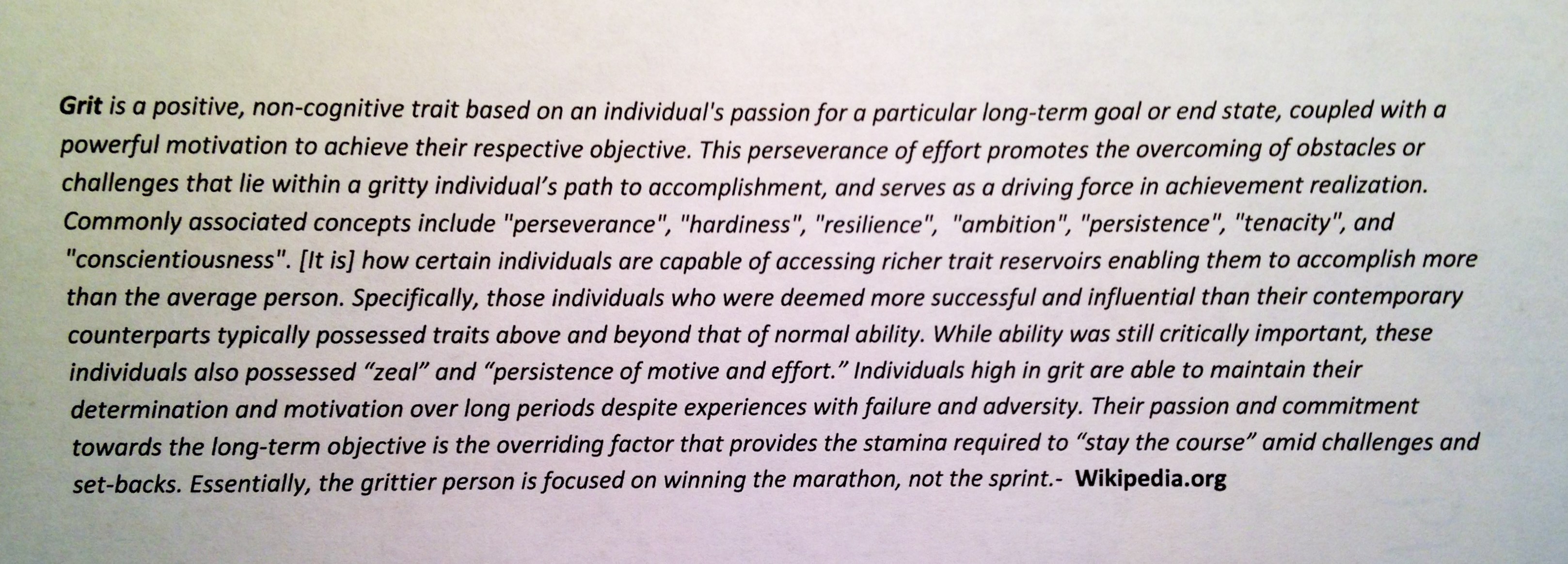
Wikipedia.org defines grit as a character trait  of applying passion and perseverance over time toward a goal, end state or objective. Grit goes beyond ability and can withstand failure, keeping the end goal in sight, and pushing through to it.Blog - Grit - Definition 2

Bill Hybels, at the Global Leadership Summit 2015*, talked about grit as “one of the greatest indicators of success”. Gritty people, he said, are the ones who “play hurt” and rarely ever give up. “They expect progress to be difficult, but believe with their whole being that they can be successful if they don’t quit.” It’s “The Little Engine That Could”. Abraham Lincoln. Nelson Mandela. Gandhi. Martin Luther King. Hybels also encouraged the audience that grit can be developed. From childhood through adulthood.

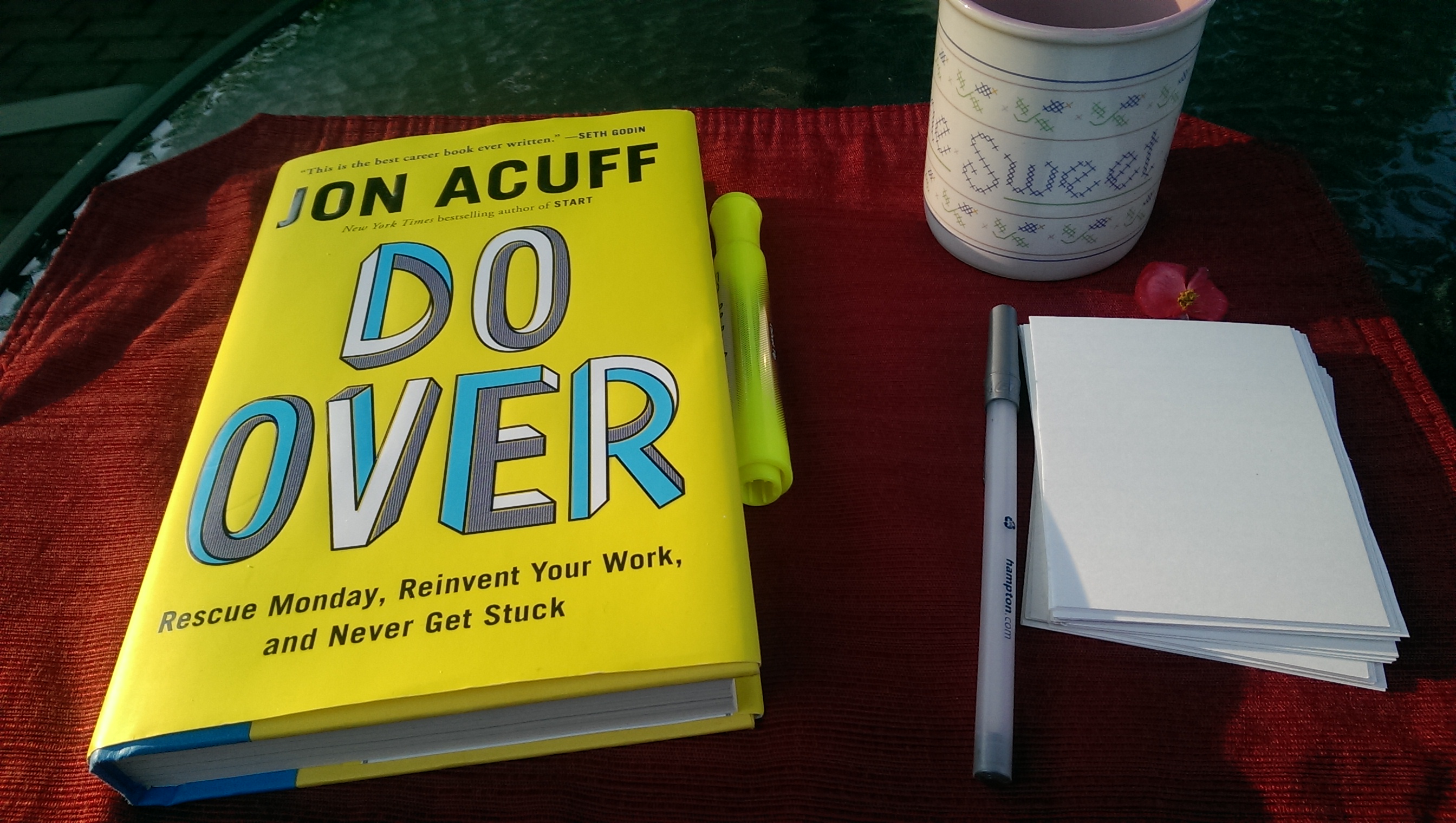
Jon Acuff (author of Do Over) defines grit as “stubbornness in the face of fear“.  In his book, he gives a short list of what’s needed in making gritty decisions (in the “hustle” of work):

  • Time – we think the world “hustle” has to mean fast, but it can also mean focus, intention, pace.
  • Counsel – Lean on your relationships. Some of the worst decisions are made alone. Who are your advocates? Have you given them time to reflect on it or are you rushing right by the wisdom they have to offer? Let them speak into it. A year from now, looking back on the decision, you’ll be glad you made it as a team.
  • Questions – Always ask awesome opportunities, awesome questions. We skimp on due diligence. “What am I not seeing right now?”
  • Kindness – Give yourself permission to make the wrong decision, because…you’re going to. Break the tension of feeling like you’re going to be perfect by giving yourself some kindness from the outset.
  • Honesty – When you look back on a decision, remember that you made that decision with the best information you had at the time.

As we saw those two older heavyset men running just behind their younger airmen colleagues, we saw men with a goal in mind. There was also something more – the cadence to the group’s run that seemed to work to keep them all together. Whether at work or in family relationships, we want to do all we can to help those gritty ones be successful. Their resolve may get them to the goal anyway, but we all benefit when we are able to “stay on course” together.

Have you “grown gritty” over your lifetime? Are there gritty folks in your life who you love to champion? Tell us about them below.

*Session 1: Bill Hybels Opening Session – Global Leadership Summit

Wikipedia Article on Grit

The Truth About Grit

The Grit Test

Jon Acuff on the Role of Hustle in Taking Hold of Career Opportunities – Notes & Quotes – Part 5 of Do Over Series

How to Make Grit Decisions and Built a Grit List by Jon Acuff

Do Over: Rescue Monday, Reinvent Your Work, and Never Get Stuck by Jon Acuff

Does Teaching Kids To Get ‘Gritty’ Help Them Get Ahead?

5 Friday Faves – a Language Learning Guide, a Tribute to Jeannie Elliff, a Friend’s Blog, an Infographic, and Singing Contractors

Blog - Friday Faves

1. A 12-Step Program for Language Learning – 12 Rules for Learning Foreign Languages in Record Time — The Only Post You’ll Ever Need by Tim Ferriss. Besides English, I’ve learned Spanish, Arabic, and a bit of French – through a variety of learning methods. This blog post with Benny Lewis is the best counsel for anyone embarking on learning a foreign language. He offers 12 rules for learning a foreign language and includes several links to more resources. Really helpful! Maybe I’ll learn Mandarin one day…

Blog - Language Learning - Tim Ferriss on Twitter

Photo Credit: Tim Ferriss; Twitter.com

2. A Radio Program – Tribute to Jeannie Elliff  Our friend, Jeannie Elliff, died on July 20 after a long battle with breast cancer. She was a young 69 years old. Her husband, Tom, and all four of her children spoke at her memorial service. It was the most beautiful service I’ve ever seen honoring a woman who loved God and all of us so completely. Revive Our Hearts Radio is doing a two-part tribute (October 1 & 2) entitled Faithful to the Finish: The Life of Jeannie Elliff. Nancy Leigh DeMoss moderates the tribute, using audioclips from the memorial service. You can listen via the website and the transcript of the program is included in the link.Jeannie & Tom in chemo clinicJeannie & Tom in Chemo Clinic – Photo Credit: Facebook.com

3. A Friend’s Blog on Love – My friend, Marlo, writes a blog entitled Pressing On which chronicles her family’s journey to life after the death of their daughter/sister, Anna. This piece focuses on the sixth verse of 1 Corinthians 13 (also known as the “Love Chapter” of the Bible).

Love does not rejoice at wrongdoing, but rejoices with the truth. – 1 Corinthians 13:6

I never really thought about this verse until I read her blog. It’s an important truth and Jesus lived it lovingly. As are we to do so as well.

“He was both/and. He was holy and he was loving. His holiness was not a barrier to people because it was paired with love. Jesus met people where they were. He knew their sins and loved them anyway. He did not rejoice in their wrongdoing, but showed them a better way. If we are going to be like him, we have to approach people the same way.” – Marlo

Blog - Love - 1 Corinthians 13

Photo Credit: Pinterest.com

4. An Infographic20 Common Ways We Make Bad Decisions. I love infographics, being a visual learner. This one is fascinating as it lists out the many factors that lead us to making bad decisions. Which ones are you the most vulnerable to?

Blog - InfographicPhoto Credit: DailyInfographic.com

5. Singing Contractors – Have you ever taken advantage of an empty room to belt out a song? It sounds so good, right? Well, not as good, maybe as these guys can make an empty room sound. I don’t know how The Singing Contractors got started singing together, while working, but I’m glad they did. You are watching the beginning of a YouTube phenomenon.

What are some of your favorites from this week? I’d love to hear them.

Givers, Takers, or Matchers in the Workplace – Which One Are You? – with Adam Grant

Blog - Givers, Takers, Matchers - Adam GrantPhoto Credit: Chuck Scoggins.com

A smart and gifted friend of mine is going through a taxing time on her new job. Long hours, piling up responsibilities, with no end in sight. She lamented that maybe the problem is that she’s a people-pleaser. That expression seems to communicate a character weakness, and I don’t see that operating so much with this friend of mine. What seems more her dilemma is that she’s what Adam Grant calls a “giver”…which is a good thing. The dilemma for my friend and her workplace is to establish a culture where she, and other givers, can thrive.

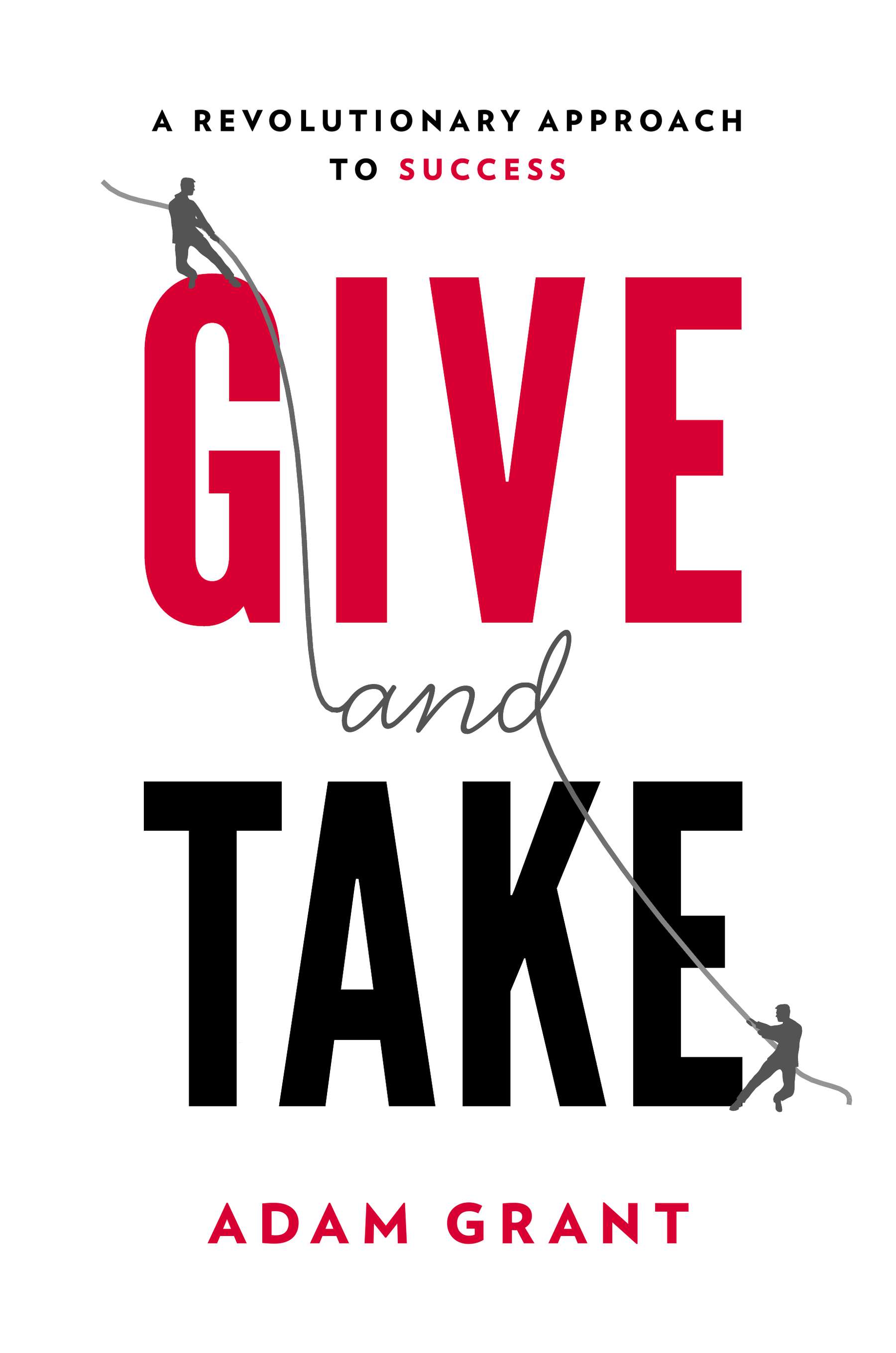
Adam Grant is a professor at the Wharton School of the University of Pennsylvania. He has also written this great book – Give and Take: Why Helping Others Drives Our Success. I heard him speak at the Global Leadership Summit and bought his book. His take on the three tops of people who make up our work culture was both fascinating and practical.Blog - Give and Take by Adam Grant - cminds.netPhoto Credit: Amazon.com

Grant sees us all as either givers, takers, or matchers. “It’s very hard to judge our own style. What values you live each day is in the eye of the beholder.” We may not necessarily see ourselves in these categories, but our colleagues will. Ask them, if you have the courage. Then you might consider taking what you learn and thinking through how you might use that information to become a more effective employee and valued colleague.

Takers are those who often manage to do the least amount of work yet gaining the most notice. They manage to get “the lion’s share of credit for collective achievements”, notes Grant. The Takers are the shirkers in the workplace. They are not at their desks because they are off schmoozing (oops, I meant networking, right?) in another department. They somehow get their jobs done partly by leaning on the strong work ethic of the Givers.

Givers are the people who simply enjoy helping others – “no strings attached”. They get to work early and stay late, if necessary. Their core values resonate in the quantity and quality of their work.

Matchers are most of us, really, doing our part in the workplace. Matchers can be counted on to keep things “fair” at work. “I’ll do something for you if you do something for me” is their mantra. They believe in “an eye for an eye” and “just worlds”.  They are the “fairness” or “Karma” police in the workplace.

Grant readily admits that we may operate out of all three styles from time to time, but we each have a dominant style at work.

How do givers, takers, and matchers fare in the workplace? Which of these sinks to the bottom in terms of performance and impact?

Givers are the worst performers (but keep reading). “The ones who get the least work done are the ones who help the others and never get their own jobs done”, reports Grant.  “I love helping others” is not the one on top of the heap of performers. “The lowest revenue accrues to the most generous salespeople.”

It’s sad news that givers sink to the bottom. If you want to boost your organization, have more givers….unfortunately the givers do it at their own expense – unless the organization builds a culture that helps the givers to thrive.

Who rises to the top?

If givers are the worst performers, who are the best performers? You think it’s takers? Takers rise quickly, and fall quickly. They often fall at the hands of the Matchers who can use gossip (or, said another way, workplace channels of influence) to call out the abuse of the Takers. Beware, Takers, of the Matchers in the shadows. Also, other Takers can also take down those more abusive, or less-well-liked Takers.

Are the Matchers the best performers? Not usually. The best results belong to the Givers. Wait! How can they also be the best performers? It’s a both/and situation.

Grant encourages: “Helping others can sink your career but it can also accelerate your careers. Hang in there.”

It takes a while for Givers to learn and build connections, but when they do, it’s a win-win for the organization.

How can we build cultures to help Givers be successful?

3 Things We Can Do:

  1. Keep the wrong people off the bus. – Get the right people on the bus. If possible, keep Takers off the bus. “One Taker on the team and paranoia starts to spread.” Put one Giver on the team, and you don’t necessarily have an explosion of generosity. It’s not bringing in the Givers; it’s weeding out the Takers. Matchers follow the norm. Matchers will follow the example of the Givers.
  2. Redefine Giving.   Wisdom is to know who is who in the workplace. Or at least not be thrown off by behaviors vs. motives. Then we can shape our work culture to empower Givers, influence Matchers, and avoid enabling Takers. In an interview with Adam Grant, Thinkers50 spelled this process out very well. For instance, consider Agreeableness vs. Disagreeableness – in Takers, Givers, and Matchers. We usually think Takers are disagreeable, but not necessarily so. Givers aren’t always agreeable either. Just because someone is nice to you (an agreeable Taker) doesn’t mean they care about you (Givers, in general, really care). Adam Grant also talks about the importance of kindness in the workplace. This is a strength of Givers, but it can also push them to over-work and exhaustion. Grant prescribes “5-minute favors (a microloan of your time, skills, or connections). Volunteering – 100 hours a year – is the sweet spot. Greater than 100 hours a year is too much. 2 hours a week.”
  3. Encourage Help-Seekers – A work culture of Help-Seekers will take silos down. “People step up when others say ‘I’m stuck; I need some help’. If no one asks for help, you have a lot of frustrated Givers in your organization.” Grant recommends an exercise called the Reciprocity Ring – Gathering teams together and having each person state a request of something they want or need and then everyone else in the room tries to use their expertise and networks to make it happen. “People are often unbelievably generous if you ask for help. Givers step up. The Takers become more generous. All the offers of help are visible. Takers don’t want to get outed. The Matchers realize that matching is useful, but it’s an inefficient way to run an organization. If you have given help to others without getting back, then you can increase your productivity because you don’t have to just ask those you’ve helped.”

Givers ask the question “How can I be the rising tide that lifts all boats?” We can move our organizations in this direction of maximum impact and satisfaction, by nurturing a Giver culture.  Instead of workplace paranoia, imagine a culture distinguished by a “Pro-noia” – the “delusion” that other people are plotting your wellbeing.  May it not be a delusion but a daily reality.

Give and Take – An Interview with Adam Grant by Thinkers50

Give and Take – A Revolutionary Approach to Success by Adam Grant

Outward Focused Lives // Givers, Takers, Matchers

Give and Take – An introduction

YouTube Video – Adam Grant, Professor – Givers, Takers, and Matchers

YouTube Video – Adam Grant’s Give and Take Talk at Google

Global Leadership Summit 2015

The Reciprocity Ring

Live Blog: 2015 Leadership Summit – 30 Leadership Quotes from Adam Grant – Brian Dodd on Leadership

The Global Leadership Summit Session Three – Adam Grant – Notes by Chuck Scoggins

Looking for a Job…or the Next Job? – 4 Ideas to Consider

Blog - Do Over #2

When you need a job, or a new job, you are in a tender place. I will treat that place with honor. You have gifts, experience, and workplace wisdom that are needed somewhere…so please don’t despair. Any bitterness that could be taking root in your heart will only get in your way. You have choices, more than you think. You have probably had more advice than you can even follow, so I don’t want to burden you with another load of it. Just 4 ideas.

  1. Read an encouraging and practical book.  For me, that book is Jon Acuff’s Do Over. Acuff gives sound counsel, mixed with fun stories, about how to get on with your life in the marketplace. In fact, I wrote 5 blogs on his book (see links below). I leave out the stories, but his “next steps” are extremely helpful and sometimes surprisingly counter-intuitive. He boosts the reader’s confidence in a genuine way and  doing the exercises in his book can make a huge difference in job hunting. So much affirmation…real affirmation.
  2. Network with lots of people. It’s not just about “who you know”. It’s also about “who knows you”. Sometimes we don’t even recognize our own strengths (OR weaknesses). Trusted friends or even respected acquaintances can give you much-needed food for thought and action. Maybe you don’t even know what to do, job-wise – your future is wide open but looks (to you) very dark. Input from others who care about you or who are caring, in general, can help you focus. You may not have even considered what they may be telling you – either about your own hireability or the job market itself. Listen and learn. P.S. Don’t go to them for a job; go to them for wisdom about getting a job.
  3. Try something completely new. The film The Intern with Robert De Niro and Anne Hathaway speaks to this something new. A 70-year-old takes an internship in a cool successful company. Funny and winsome and could be one of us, right? Then I have also been hearing a lot lately about advanced manufacturing and the need for apprentices in this field. You may have a “white collar” education that could be more finely tuned with some “blue collar” experience. Those terms may be antiquated with the blurring of boundaries in our more technology-rich manufacturing companies. You could be that intern or apprentice.

4. Consider working with a head-hunter or job placement agency. In a conference recently, I heard Michael Thompson, founder and CEO of Turas Group, speak to a group of job-seekers. His approach was warm and positive. In that half-hour session, he gave strong individualized counsel to each person, based on what information they had already sent them. Counsel that helped everyone in the room really, but also individualized to each person’s needs. He also asks really good questions which is incredibly helpful for clarification – when you really don’t know what to do next.

One thing Thompson expressed was the importance of doing lots of interviews. His counsel included: a) prepare and do research to know your interviewers; b) arrive early; c) have your 60 second pitch down; d) – smile a lot, have energy, be excited and maintain eye contact; e) answer directly and concisely; and finally f) if you don’t know the answer to a question, share that, but then offer what you would do (especially if you’ve never done that something needed). Thompson also encouraged the participants to join LinkedIn (a global online professional network).Blog - Friday Faves - Turas Group

Whether you’re just out of college or you find yourself in the throes of a company downsizing, you know something of what you offer any employer. Allow these 4 ideas to fill in some of the holes you can’t see that would make job hunting a less painful and more productive endeavor.

As to dealing with the disappointment of not finding a job right out of school, or the loss of satisfying work you loved, please don’t let that define you. You have choices…maybe very different that you first imagined, but you have them. Make those lists of strengths and people of influence in your life as Jon Acuff advises; talk (well, listen more) to friends and advocates; and stay open to a real positive turn in your career. Finally, I personally would add “Pray” to all this. Prayer will help you to not panic or grow bitter when your emotional energy would better serve your pursuit of that job – the one you can’t imagine right now. Remember who you are and Whose you are.

Any comments on what has helped you or what is sustaining you in your job hunt? Please share below.

Do Over – Rescue Monday, Reinvent Your Work, and Never Get Stuck – by Jon Acuff – Notes (Part 1)

Do Over – Jon Acuff on Work Relationships – Notes (Part 2 of Do Over Series)

10 Quotes by Jon Acuff on Developing New Skills & Sharpening Old Ones – Part 3 of Do Over Series

Jon Acuff on Character at Work – 9 Quotes & a Challenge – Part 4 of the Do Over Series

Jon Acuff on the Role of Hustle in Taking Hold of Career Opportunities – Notes & Quotes – Part 5 of Do Over Series

Turas Group – Michael Thompson, CEO – Michael@turasgroup.com – or connect via LinkedIn

Tips for a Successful Job Search – Tulane University

5 Friday Faves – a Favorite Beverage, a Pic of a Little Girl, a List of Critical Habits, a Pinterest Page of VIdeo Clips, and Job Search/Recruitment Group

Blog - Friday Faves

How does a week fly by so fast?! Here are my 5 Friday Faves. It’s been a tough work week here. That’s for another day. It has, of course, had an impact on my Friday Faves. Be encouraged, get moving, enjoy a laugh, and remember God loves you and is in the work of bringing good out of every situation…

  1. Favorite Beverage – Coffee. Hello! The coffee we drink in our house is an inexpensive and completely satisfying brand  – Eight O’Clock Colombian Peaks. Available in most grocery stores around here but we order from Amazon.com so we never run out. If I can’t have Moroccan coffee in Morocco (below, right), then it’s Eight O’clock.

Blog - Friday Faves - CoffeeBlog - Friday Faves - Coffee 2

2) Pic of a Little Girl – A friend of mine taught English in China last year. One of the classroom teaching strategies was for each child to have a name more common in Anglophone countries. This probably was a help both to the teacher and to the students. This darling little girl had my name: Blog - Faves - Chinese girl with my English class name Hailey Williams teacher (2)Photo Credit: Hailey Williams

Can’t leave this Friday Fave without putting up one more “little girl” picture. This little Moroccan girl singing her heart out in Bouskoura Forest, outside of Casablanca:

Little Girl Singing

3. Critical Habits of Mentally Strong People – Travis Bradberry published a super helpful article on mental toughness. He lists 15 critical habits of mentally strong people. Take a minute to go to this article for some quick, clear counsel on building up your mental muscle. – not just for work, also for anything where mental toughness (not hardness) would help.Blog - Friday Faves - Habits of Mentally Strong People - slideshare.netPhoto Credit: Slideshare.net

4) A Pinterest Page of Video Clips – This board belongs to Heather VanStaalduinen.  She has pinned several fun videos to use in the classroom to teach various concepts and character traits. Pixar and Disney animation are well represented along with other videos you will recognize. My classical guitarist son is adding teaching groups of middle school students to his repertoire. These might come in handy.

Blog - Friday Faves - Video Clips - Pinterest

Photo Credit: TeachTrainLove.com – also a great resource for videos.

5) Job Search/Recruitment Group – I had the opportunity, via Skype, this week to meet Michael Thompson, founder and managing director of the Turas Group. He was working remotely with a group looking to take a leap into new careers. Very smart, personable, and handling each participant with respect and individual care. If I was looking for a job right now, Turas Group would be the go-to agency for me. More about Michael Thompson and this group next week.Blog - Friday Faves - Turas Group

Have a great re-charging weekend. I love my work such that Friday isn’t the goal for me. This week, I find myself among those who rejoice that it’s finally here. Will leave you with this verse from God’s Word:

“We have this treasure in earthen vessels, so that the surpassing greatness of the power will be of God and not from ourselves; we are afflicted in every way, but not crushed; perplexed, but not despairing; persecuted, but not forsaken; struck down, but not destroyed.” –                   2 Corinthians 4:8-9

If you had a hard week – use this weekend to take a deep breath, regain perspective, and see all the good that surrounds us. I’ll be right there with you, in this.