Category Archives: Lessons Learned

5 Friday Faves – Reading Wars, Lord of the Rings on Guitar, Walking in America, Boomer Parents, and Susan Boyle

You know the story…how fast this week (this month, this year) is flying by. No time to waste. So let’s get right with it. Five of my favorite finds this week.

  1. Reading Wars – What does that even mean, right? It’s the title of Philip Yancey‘s captivating article on waging battle on the mental clutter that crowds out even the possibility of deep thinking. What is our weapon against the onslaught of shallow that we expose ourselves through social media, email, and texting communication? Reading. Reading for learning. So simple and yet how many minutes a week do we commit to it?

“A commitment to reading is an ongoing battle, somewhat like the battle against the seduction of internet pornography. We have to build a fortress with walls strong enough to withstand the temptations of that powerful dopamine rush [which also happens with distracted media scanning] while also providing shelter for an environment that allows deep reading to flourish.” (Philip Yancey)

Photo Credit: Envision Experience

Sure, we can learn from what we find on social media. My friend Ann Lovell pointed us to this article through her Facebook page. If I just scan the article then I continue to “not” learn from it…as happens with most of the content that shows up in my various newsfeeds. This time…I’m taking it to heart. Yancey points out several cultural powerhouses who commit to a mininum of 5 hours of reading a week. I am joining them. Thanks, Mr. Yancey. Thanks, Ann.

[Sidebar: Whole cultures in the world prefer oral vs. written information delivery. Deep, detail-rich, reproducible storying. I wonder how these cultures are changing because of the same short-cut habits of sharing information we have developed here in the West. What do you think?

2) Lord of the Rings on Guitar – Nathan Mills of Beyond the Guitar posted another of his arrangements this week. This one is from the legend Lord of the Rings Trilogy. You who love LOTR as much as I do will recognize The Riders of Rohan. It is another great orchestral piece translated by Nathan to classical guitar (like Beyond the Guitar‘s recent Game of Thrones arrangement). Just beautiful. Takes us back to the glorious battles of Lord of the Rings.

3) Walking in America – I feel so fortunate to have neighbors who walk. They make it so easy for me to join in even 6 days a week. It’s amazing how such a simple exercise wakes up the brain and loosens up the body. Whether we can afford a gym or whatever our health situation, walking is something we can do for ourselves. [Winter pic, I know, but it shows these neighbors of mine are out walking in all kinds of weather.]

After seeing the video below comparing “Walking in America & Walking in South Korea” I am glad for an easy neighborhood to walk in. However, it’s also clear how those in huge cities make do, with walking and staying healthier.

Here’s How Much the Average American Walks Every Day – Laura Donovan

Here’s How People in 8 Other Countries Stay Healthy – Slideshow – Anna Medaris Miller

What Steps Data Tells Us About Country Lifestyles – Angela Chieh

4) Boomer Parents & Their Stuff – What are we going to do with all this stuff? Our parents’ stuff and our own. The kids just aren’t interested in it. Samantha Bronkar’s article on the subject is thought-provoking. What do we do with all the collections? All the unique, hand-worked furniture? All the china and glassware? When we start down-sizing, we may have to think creatively what we do to dispose of these treasures of years past. Any thoughts?Photo Credit: Pinterest

I wonder, if our civilization is around for another 100 years, what will be in our natural and civil history museums? There could be a gap with all the “stuff” that will go eventually into today’s landfills. Would love to hear your thinking on this…as one of the many with unwanted treasures.

5) Susan Boyle – Just a few years ago, a middle-aged Scottish woman walked on the stage of Britain’s Got Talent and shocked the world with her singing. On that night and the days that followed, everyone in the English-speaking world had heard of Susan Boyle. Here’s the performance that brought her celebrity and a place in our hearts:

Just this week, I heard her sing Unchained Melody. Still magical. Her lovely simplicity in demeanor and her mesmerizing voice are a powerful combo. Do you know what happened to her? She’s still out there and is now a wealthy woman still living in her small family home in West Lothian, Scotland. She had a dream…and it came true. Her life inspires us all.

Happy Weekend. Be safe and be inspired…so much to enjoy in this life and to take joy in…even in the hard.


Worship Wednesday – I’m Just Unfinished – Mandisa

Photo Credit: CBN

I am sure of this, that He who started a good work in you will carry it on to completion until the day of Christ Jesus.Philippians 1:6

So Jesus asked the Twelve, “Do you want to leave too?” Simon Peter replied, “Lord, to whom would we go? You have the words of eternal life. We believe and know that You are the Holy One of God.” – John 6:67-69

Why are we so hard on ourselves and each other? Intuitively, we know in our core, that we can be better…and that others should be. We mark behavior. We analyze successes and failures. We self-reference. Am I measuring up? Are you measuring up? To what?

All this judging should completely wear us out. Yet…we become unaware we are even doing it. In fact, our bent toward judging is probably one of the reasons we (Christians and those who don’t follow Christ) struggle with addictions…to turn off that part of our brain. Unfortunately, the safeguard of judging (that of critical and logical thinking) is also impacted here.

This whole lifestyle of having opinions and being sometimes critical spills over into our faith. We judge God.

We judge God. Listen to that. How strange for the Created to question the mind of the Creator! Yet, we struggle with what we don’t understand. We shake our heads and raise our “why” to Heaven. Or worse…some precious ones walk away from God…disappointed.

Disappointment with God: Three Questions No One Asks Aloud – Philip Yancey

Christian artist Mandisa went through a very dark time spiritually and emotionally as she lost her best friend to cancer. Take the time to read her story, please. Her album Out of the Dark came out of her journey back to God after this terrible loss.

The song “Unfinished” (from that album) speaks so beautifully to our experience of not being where we want to be…hoped to be…and the truth of God’s work in us…and for us.

Worship with me.

Not scared to say it
I used to be the one
Preaching it to you
That you could overcome
I still believe it
But it ain’t easy

‘Cause that world I painted
Where things just all work out
It started changing
And I started having doubts
And it got me so down

But I picked myself back up
And I started telling me
No, my God’s not done
Making me a masterpiece
He’s still working on me

He started something good
And I’m gonna believe it
He started something good
And He’s gonna complete it
So I’ll celebrate the truth
His work in me ain’t through
I’m just unfinished

I know His history
And the kind of God He is
He might make it a mystery
But He’s proven I can trust in Him
And yeah, I believe it

Still working
Still, still working on me
He’s still working
Still, still working on me*

Mandisa’s Unfinished reminded me of an old praise chorus  sung by Steve Green.  Taken straight from Scripture, we are reminded that “He who began a good work in you will be faithful to complete it”.

With all our travels, we’ve been to some of the world’s great museums. In them, often there’s a painting by one of the Masters…unfinished. The artwork still shows off the fine hand of the painter…but it is incomplete…without detail. Stopped abruptly.

For us, God has promised we won’t forever be unfinished. He will complete what He’s started in our lives. For this reason alone, we are called to be gentle with ourselves and with each other. Reminding ourselves that we all are works in progress.

As for our judging God, in the crush of disappointment or confusion? I always go back to Peter’s words to Jesus (John 6:67-69) – “To whom would we go?” No one…nothing…is like Him.

We don’t yet know how it all comes out…but we know God. He will finish what He has begun.

*Lyrics to Unfinished – Songwriters: Ben Glover and Colby Wedgeworth

Why Are People So Judgmental? – Quora

Why Are Christians So Judgmental? – Jason Malec

Monday Morning Moment – the Power of Reflection and Journaling

Photo Credit: JimileeK, Flickr

My mom was an intuitively reflective person. All of life was full of meaning for her. People mattered – what they said, what they did…what they didn’t say or do. She noticed how things played out, and she made decisions based on outcomes. Her decision-making was tempered by her faith and her understanding of the constancy of God. She was intentional in all she did.[a magnet always on Mom’s refrigerator]

She wasn’t perfect, of course. Reflection can spiral down to worry or fretting, and Mom struggled with that. Reflection can also err in over-thinking or over-analyzing. Mom could fall into “meddling”, giving instructions, or offering advice not asked for, but this was a most rare occasion. Even when she did it, I knew and appreciated her heart. She was right on the mark much of the time.

My whole life I have strived to learn from her and to be like her.

Reflection as a life habit is difficult for me. I like to fill time…even if it’s only with purposeless activity. Screens are my nemesis, be they computer, phone, or TV. Also over-committing or over-scheduling also hamper reflection. There seems a perverse and mythical work ethic that requires our days be full of meetings. If we don’t have our weekends similarly filled, we vigorously look for ways to fill them.

To our peril.

Reflection is to look back – over our day, or an event, or a conversation – and to pause and think deeply about it. What did we learn? How do we adapt our thinking and actions related to what we experienced? How do we go forward?

Photo Credit: Loppear, Flickr

We can have reflective practices in our work and personal lives, even built into our days. These include alone thinking time, “sharing thoughts” conversations, and journaling/writing. My husband comes home from work and, in good weather, changes clothes and heads to work in his garden. After awhile, he settles into a lawn chair and just sits, watching and thinking. At some point in those moments, reflection blossoms.

[I benefit because he shares those reflections with me…and others later sometimes.]

Benjamin P. Hardy, my favorite writer on productivity right now,  doesn’t talk about reflection so much, but he preaches it without saying the word. He recommends the deep work that happens outside of work. He also strongly promotes journaling as a “keystone habit”. In his article Why Keeping a Daily Journal Could Change Your Life, he is so thorough in his support of journaling that I can’t imagine anyone NOT journaling after hearing him list out the many life benefits.

I have journaled all my life, but it hasn’t always been as focused as it could be. My journals have sometimes just been reporting tools, emotion-processing devices, rant writing, and the like.

However, like my Mom, I discovered that writing is a way to bring reason to my irrationality and resolution to conflict. After writing awhile, I can come back to life, refreshed and better equipped to do what’s next…whatever that might be.

Forbes writer and executive coach, Henna Inam (author of Wired for Authenticity) counsels leaders to keep a journal.

The exercise of leadership is not unlike a sport you play. When you review your actions in the field you learn what worked, what didn’t, and adjust along the way. Leadership guru Peter Drucker said: “ Follow effective action with quiet reflection. From the quiet reflection will come even more effective action. ”

Photo Credit: Slideshare

Inam provides a kickstart to journaling with these questions and writing prompts:

  • What’s present for me now?
  • What’s going well? What’s creating that?
  • What’s challenging? What’s creating that?
  • What needs my attention?
  • What’s meaningful? What am I grateful for?
  • What strengths do I notice in myself?
  • What strengths and contributions do I notice in others?
  • What am I learning?
  • What is an action I’m committing to?

Inam’s questions are helpful. They can bring focus to our ramblings. You might choose a different approach to how you use journaling in your reflections. Please share in Comments. Also, journaling may not be your preferred vehicle for reflection. I love, for instance, when workplace leaders encourage reflection over the course of a work day. Isn’t it lovely when a training or conference has reflection time built into the program…so it’s not just an “information dump” with no time to process. If you have experiences, either negative or positive, about your own use of reflection in the workplace, please share with us. We’re not just talking about productivity here, but personal growth and community building.

Talk a few minutes and reflect on the possibilities.

To Be an Effective Leader Keep a Leadership Journal – Henna Inam

Why Keeping a Daily Journal Could Change Your Life – Benjamin P. Hardy

Reflecting On Work Improves Job Performance – Carmen Nobel

YouTube Video – The Power of Reflection at Work – HEC Paris Professor Giada Di Stefano

Learning and Leading with Habits of Mind – Learning Through Reflection – Arthur L. Costa and Bena Kallick

Teaching/Learning Critical Thinking Using Reflective Journaling – Dr. Mara Kaufmann – Slideshare

Monday Morning Moment – Community in the Workplace – We Need It

Photo Credit: Pixabay

Working on teams made for some of the highest performance years of my career. I used to think it was a weakness of mine that I didn’t thrive professionally if I wasn’t on a team. Looking back at seasons of life where my work required solitary focus as well as the times when collaborative effort was the expectation, the difference in quality of life and product was astounding.

We need each other. Author C. S. Lewis even observed that we are all “one vast need”. This thinking goes counter to our culture’s bias toward self-sufficiency and independence. In the workplace, our brilliance does not have to be defined as always being the lone ranger or the self-starter. How we work with others, and what we draw out of each other, in terms of value, creativity, and resource could be the difference in both performance and morale.

“When we live our lives in isolation, what we have is unavailable and what we lack is unprocurable,” wrote Basil (an early Church father). When we live our lives independently, other people are poorer because they cannot benefit from our gifts: “what we have is unavailable.” Also, when we isolate ourselves, we are poorer because the benefits of others’ gifts are lost to us, so what we lack, we cannot get. There are good things in others that are “unprocurable” unless we interact with them…You are “one vast need” and must avoid the extremes of saying, “I am not needed,” or, “I don’t need you.”Art Lindsley

Community – and Why We Need It – Art Lindsley, C. S. Lewis Institute

Early in my career, people invested in my professional development and in me as a person. I had rich opportunities to work alongside both leaders and practitioners who shaped what I had to offer in the workplace. You have read about some of the teams I’ve had the privilege to be a part (here and here)… The work of those teams continues to thrive.Photo Credit: Wikimedia Commons

What we do together far surpasses what we can do individually.

Individualism is a fine idea. It provides incentive, promotes leadership, and encourages development—but not on its own. We are social animals who cannot function effectively without a social system that is larger than ourselves. This is what is meant by “community”—the social glue that binds us together for the greater good. Community means caring about our work, our colleagues, and our place in the world, geographic and otherwise, and in turn being inspired by this caring. Tellingly, some of the companies we admire most—Toyota, Semco (Brazil), Mondragon (a Basque federation of cooperatives), Pixar, and so on—typically have this strong sense of community…Somehow, in our hectic, individualist world, the sense of community has been lost in too many companies and other organizations. – Henry Mintzberg

I agree with these authors and many others on the importance of community in the workplace. Right now my work is done in a very solitary environment. Thankfully, I have friends and colleagues who fill some of the void where I miss team. In times when our workplace lacks community, we shouldn’t wait on outside forces to alter our situation. We must take steps to create community. Brook Manville has written an excellent step-by-step process to embolden us in this effort. Missing community at work is just wrong, especially because we can do something about it.

Can major transformation really begin…almost spontaneously, with small acts by people who are not part of the senior leadership?…In his recent book Community: The Structure of Belonging, Peter Block, an authority on workplace learning and performance, wrote, “Most sustainable improvements in community occur when citizens discover their own power to act…when citizens stop waiting for professionals or elected leadership to do something, and decide they can reclaim what they have delegated to others.”Henry Mintzberg

Rebuilding Companies as Communities – Henry Mintzberg, Harvard Business Review

Can we have community on every work team? Maybe not. Can we have community at work? Absolutely. Whether it is a core value of a company or not, we can create and cultivate community whatever our role is and wherever we find ourselves in the workplace.

Let’s get after it!Photo Credit: Vimeo, Belbin

Wisdom for the Teaming Masses – Brook Manville, Forbes

Saturday Short – a Space and a Place on the Team – Deb Mills

Belbin Improving Teams 2017 – Vimeo

Worship Wednesday – How Deep the Father’s Love For Us – Stuart Townend

[Adapted from the Archives]

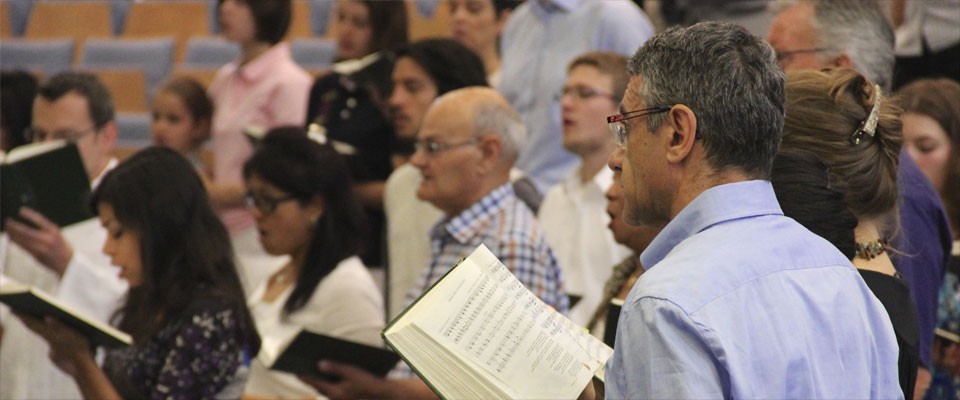
Worship can be a deeply emotional experience. In fact, sometimes, we lose our focus on God Himself in the midst of the singing of a familiar song. Our minds wander as memories of other times and places take us out of the moment. Not a bad thing necessarily, but…

That happened to me recently as the praise band at Movement Church opened the hymn How Deep the Father’s Love For Us. I love this Stuart Townend hymn. He published it in 1995, the year we moved to Cairo, Egypt. New to us, this hymn became a standard in our family from those early days of adjusting to a new life in another country. [This and another hymn of his – In Christ Alone.]

On Fridays, we would join other internationals and a smattering of Egyptian Christians, at Heliopolis Community Church, and we would sing and pray in English. Such a refreshment to our souls as we spent most of our week, learning and using Arabic in our work and with neighbors and friends. English was our worship language.blog-international-church-worship-how-deep-the-fathers-lovePhoto Credit: CCCLux

Sweet memories of hot Friday mornings, singing with believers from all over the world, as the call to prayer broke through from a nearby mosque. Sweet memories of a oneness with each other…and with God.

Then my thoughts sprang back to the present, as the gathered church at Movement sang this lyric:

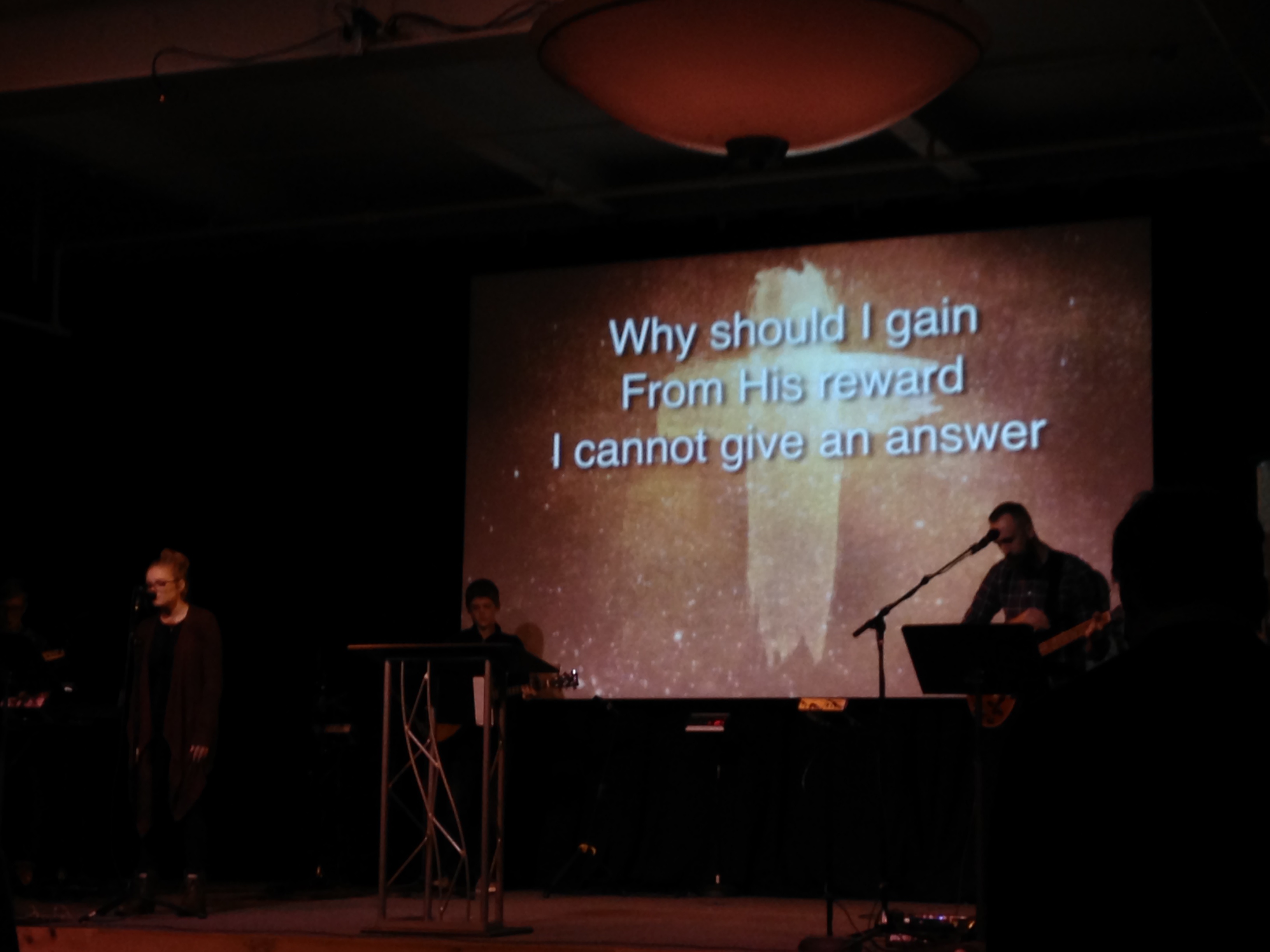
Why should I gain from His reward?
I cannot give an answer;
But this I know with all my heart –
His wounds have paid my ransom.

Because of what Christ did for me…for us…on the cross, I am no longer separated from God by the penalty of my rebellion against Him. The debt I built up through life is paid in one great act of God through Christ – His perfect, sinless life substituted, in death, for my own sin-filled mess…for our own. There is nothing left to pay…nothing. Christ paid in full, on the cross, for all our sins.

At what cost? Oh…we can imagine the considerable cost Jesus paid because our own flesh cringes at the excruciating pain of the cross. Yet, we also must take in, as much as we can, the cost to the Father. Such great love He has…for His own son…and for us…each one of us. The whole world, in fact.

When Stuart Townend was writing this hymn, he was very aware of the emotions that can be elicited in praise music. Just as I have described, the personal joy, refreshment, and happy memories that can be so satisfying in the experience of individual and corporate worship. His hope was to write in such a way as to help the worshiper get beyond himself and to a greater awareness of God.

“The danger now is that we are so focused on the experience our worship can become self-seeking and self-serving. When all of our songs are about how we feel and what we need, we’re missing the point. There is a wonderful, omnipotent God who deserves our highest praise, and how we feel about it is in many ways irrelevant!  I want to encourage the expression of joy, passion and adoration, but I want those things to be the by-product of focusing on God – I don’t want them to become the subject matter. I’m trying to write songs that refer to us as little as possible, and to Him as much as possible!”Stuart Townend

Hymns like How Deep the Father’s Love For Us complement our prayer life and study of God’s Word. For those friends of ours who don’t yet believe…those who say, “That’s nice for you that you believe God. I just don’t believe like you do.”…we have a witness in worship.

It is not just that we “believe”… What Townend describes in this hymn, reflective of the truth of Scripture, isn’t just what we believe…it is what happened and was witnessed by others – the deep love of God displayed in the self-emptying life and death of His Son. Hallelujah!

Worship with me.

How deep the Father’s love for us,
How vast beyond all measure,
That He should give His only Son
To make a wretch His treasure.
How great the pain of searing loss –
The Father turns His face away,
As wounds which mar the Chosen One
Bring many sons to glory.

Behold the man upon a cross,
My sin upon His shoulders;
Ashamed, I hear my mocking voice
Call out among the scoffers.
It was my sin that held Him there
Until it was accomplished;
His dying breath has brought me life –
I know that it is finished.

blog-how-deep-the-fathers-love-youtubePhoto Credit: YouTube

I will not boast in anything,
No gifts, no power, no wisdom;
But I will boast in Jesus Christ,
His death and resurrection.
Why should I gain from His reward?
I cannot give an answer;
But this I know with all my heart –
His wounds have paid my ransom.*

blog-movement-church-how-deep-the-fathers-love-worship-2

See what kind of love the Father has given to us, that we should be called children of God; and so we are.1 John 3:1

…the life I now live in the flesh I live by faith in the Son of God, who loved me and gave himself for me.Galatians 2:20b

*Lyrics – How Deep the Father’s Love For Us – Stuart Townend

YouTube Video – How Deep the Father’s Love for Us – Cover by Joy Williams

YouTube Video – How Deep the Father’s Love For Us – Lyrics (with Scripture portions that support them)

The Depth of Christ’s Love: Its Cost – John Piper

YouTube Video – Story Behind the Song – How Deep the Father’s Love for Us – Stuart Townend

The High Cost of the Cross – Joe Crews

Hymn Reflection: How Deep the Father’s Love For Us – Adam Faughn

Monday Morning Moment – Taking the Social Capital Challenge – 5 Steps Forward

Photo Credit: Pixabay

You know that experience of events converging and what was foggy before becomes crystal clear? I just had that kind of week. A series of non-random things happened that caused a chain reaction of a magnitude that launched me out of my  creative doldrums.

Here’s what happened.

Backtracking a bit, I’ve been thinking solidly for several weeks on social capital – what kind of resource that is and what it takes to have it (or restore it).

Social capital is the willingness of people to help each other. It often replaces money which people would use to buy the same help. Most ways of measuring social capital have to do with trust – people who trust that favors and help will be available when they need it will favor and help others more. Social capital is a lot like real capital. Simple English Wikipedia

I wrote about social capital twice – here and here. After posting that last blog, the following events had huge impact on how I’ve been doing life.

  1. The right book landed in my hands. Literally.

It was Jeff Goins‘ latest book that was just released. His 5th book and already a best-seller, Real Artists Don’t Starve: Timeless Strategies for Thriving in the New Creative Age came in the mail.

I tore into it and was so encouraged and empowered by his stories and counsel for artists, like him. No, not like him in the best-selling author part…but like him in the before “possibility-season” of his life.

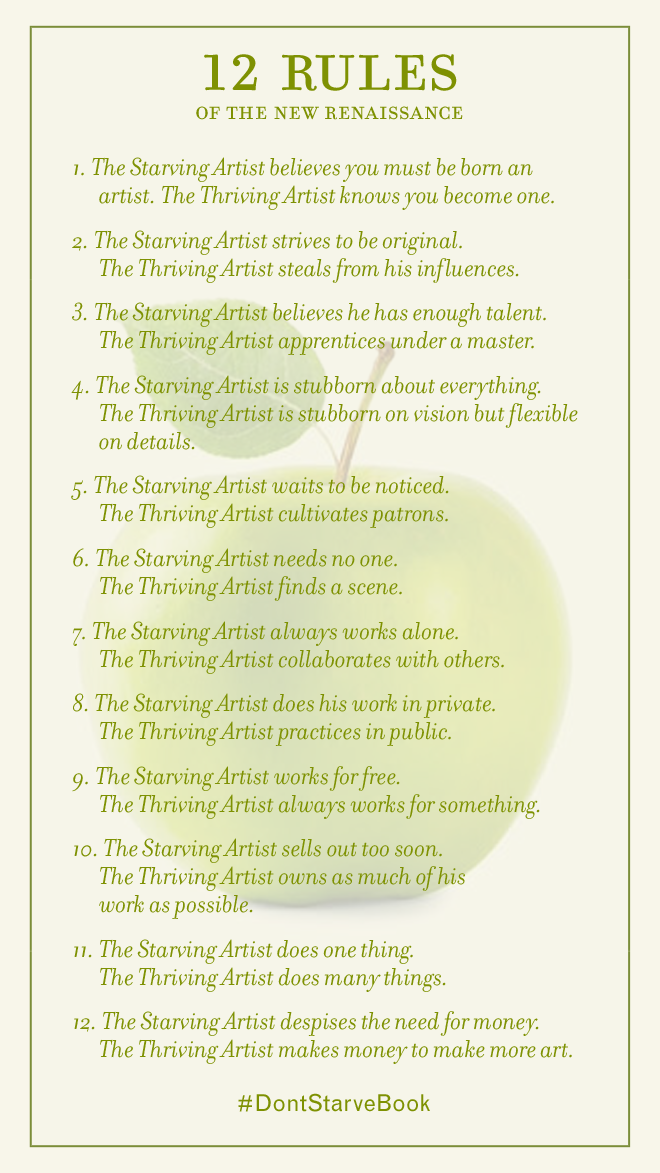
In Real Artists Don’t Starve, Goins gives 12 principles of how to actually be effective and successful as a creator (whether it’s music, writing, painting, or any other creative work). Reading his principles and the stories of artists and crafters through history give not only hope but tools through which we can make a living with our craft.Photo Credit: Jeff Goins

Book Marketing 101: What Works and What Doesn’t (Lessons From My Latest Launch) – Jeff Goins

2) Significant conversations followed. After posting my last blog, a writer acquaintance suggested we get together. Ann Lovell is a seasoned writer and currently employed as a Communications Director. Not only that, she continues busy with her own writing and is editing the manuscript of another incredible author. We talked about writing, and she offered her help. That was huge for me and right out of Jeff Goins’ book. Then another author friend Kevin Prewett with whom I share workspace some weeks also gifted me with good and thought-provoking questions about my writing. So helpful. Finally, through one more conversation, I realized how my own focus had been more on guiding and encouraging younger  writers and artists around me without noticing my own craft had gone untended. That conversation, with our guitarist son Nathan Mills,   was much illuminating. This time I benefited from a younger artist.

Significant conversations all.

3) A “Come to Jesus Moment” happened with my best friend. The one person in my life who has read all the blogs and has celebrated every high and encouraged me through every low is that husband and friend of mine, Dave. I am sometimes guilty of giving counsel too quickly (ok, advice…really. Unasked for advice. Dang it!). It’s much easier to look in others’ lives and suggest a small tweak than to face full on what totally needs rerouting in our own lives. In the last couple of years, taking early retirement and being too much on the outside looking in, I have time to come up with a prescription for anyone else’s problem. [Yes…guilty.] Not that I’m wrong, necessarily, but the situation is not mine. Most probably, Dave, or Nathan, or whomever it might be knows far more about where he/she is on that trajectory toward next steps than I could possibly conjecture. So here’s the “Come to Jesus Moment”. Over the weekend, Dave and I were talking about this season of life. We resonated together about lost social capital…those strong influencer groups with whom we once were a part and now not so much. In that brief conversation, when I would usually cheer on Dave to rally, the proverbial light bulb went off. Not just for him but for me as well. It is still possible to reclaim ground lost. Now was the time to act.

4) I applied for a job. I’d been toying with this for awhile. Until my dad died, I was making so many trips to help care for him, it seemed impossible for me to work anywhere. I would toss around options with family and friends (teaching ESL, hospice, school nursing), but nothing seemed to fit. Then for several months, I would hear of friends being hired into the coolest jobs and struggled to have unreserved joy for them. It was time for me to either continue with contentment in my current state of not working or take aim in one direction or another and do something. One job caught my eye. One job. I did the hours of updating my resume, pulling together samples of my writing, and crafting a cover letter. If I don’t get that job, I’ll apply for another.

5) I took the Social Capital Challenge.  A couple of months ago, I discovered Jordan Harbinger online. He writes and podcasts for a website called The Art of Charm. He invites his readers/listeners to something called a social capital challenge. I signed on…weeks ago for a month-long challenge…and then did nothing.

Photo Credit: Screen Shot – Art of Charm

Until today…

Today I created a written goal and posted it somewhere public.

I joined the Facebook page for The Art of Charm Challenge just now, and here was my first posting.

“Hello, everyone. I signed up for the challenge weeks ago. Even though its email reminders, baby to bigger steps, have been feeding my inbox, I wouldn’t even open them. Until today. Today I am ready. My goal is to have a manuscript with the art work publish-ready by the end of the year. My co-author and I had our first sit-down today, to share story idea and flesh it out some and to do the beginning photographer for the illustrator. Whew! There it is.”

Photo Credit: Pixabay, Jess_the_VA

I’m taking a deep breath…and we’ll see where this all lands. Whatever lies ahead, I’m so grateful for good counsel, courageous and creative friends and family, and clarity. It’s a very good Monday.

Monday Morning Moment – Social Capital – an Invaluable Resource We Can Develop – and a Tool to Help – Deb Mills Writer

Monday Morning Moment – When Connections Are Lost – a Rant, a Resolve, and a Request – Deb Mills Writer

6 Things You Need to recover From Every Day – Benjamin P. Hardy

Social Capital Challenge – The Art of Charm

Jordan Harbinger – The Art of Charm – Twitter

Real Artists Don’t Starve: Timeless Strategies for Thriving in the New Creative Age – Jeff Goins

6 Things You Need to Recover From Every Day – Benjamin P. Hardy

28 Lessons From Great Writers, Artists, and Creators on Mastering Your Craft – Ryan Holiday

The Whuffie Factor – Tara Hunt

Monday Morning Moment – Grit – the Role of Personal Resolve and a Team Alongside

[Adapted from the Archives]

Diligence is a word that defined my many years in learning Arabic while we lived overseas. Keeping at it, even when I wanted to quit, helped immensely. The joy of living life in a second language is worth all the work. Diligence is a great assist to staying on course, but it is not “grit”.

Once on a beach weekend, I saw grit at work in a group of servicemen, in Virginia Beach, doing their morning exercise. [Not the picture above but that image has its own neat story of grit]. Walking on the boardwalk early in the morning, my husband and I encountered this small group of airmen from the nearby Naval Base, doing a group jog. We saw them starting the run and saw them again coming back – 6 miles total. Most of them were young, thin, and fit.

What caught our eye, in particular, were two men in mid-life, carrying a bit of weight, bringing up the rear. Approaching the end of that run, they looked like they were hurting, but they definitely weren’t quitting. I’m sure to stay as fit as the rest of the group was, a certain measure of grit was at play…but these two, in this snapshot of life, showed the grit that brought me to write today.

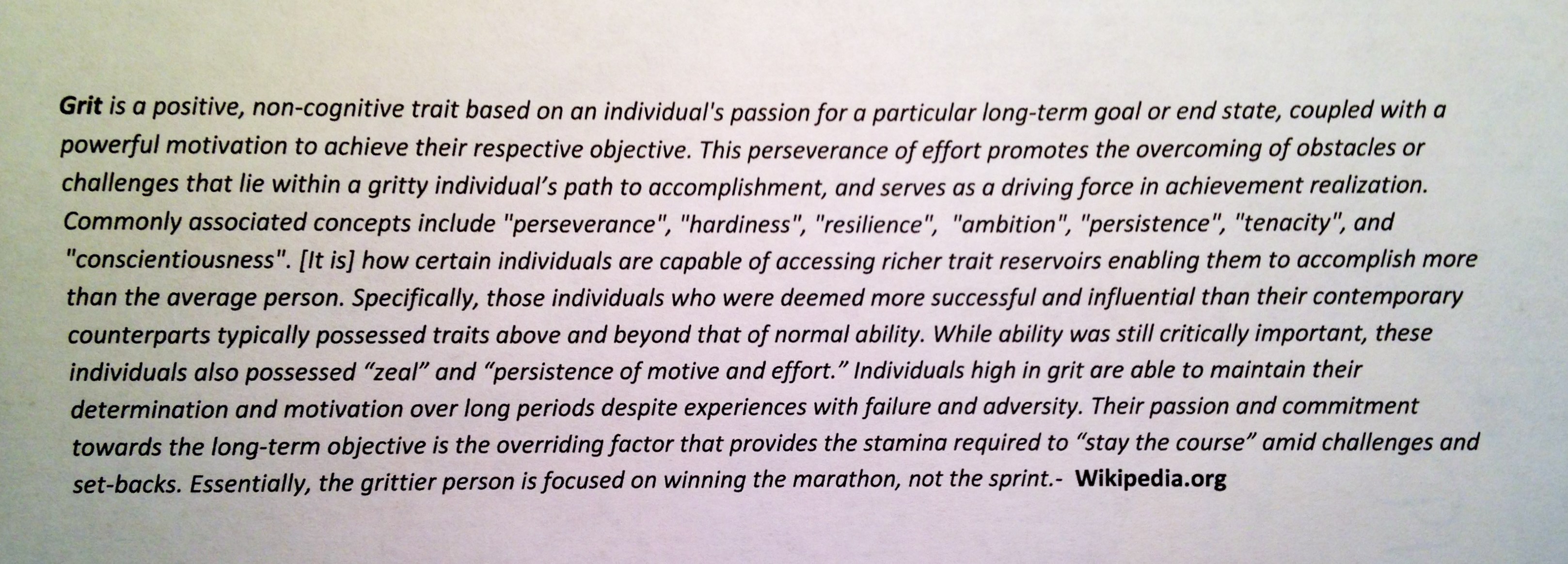
Wikipedia.org defines grit as a character trait  of applying passion and perseverance over time toward a goal, end state or objective. Grit goes beyond ability and can withstand failure, keeping the end goal in sight, and pushing through to it.Blog - Grit - Definition 2

Bill Hybels, at the Global Leadership Summit 2015*, talked about grit as “one of the greatest indicators of success”. Gritty people, he said, are the ones who “play hurt” and rarely ever give up. “They expect progress to be difficult, but believe with their whole being that they can be successful if they don’t quit.” It’s “The Little Engine That Could”. Abraham Lincoln. Nelson Mandela. Gandhi. Martin Luther King. Hybels also encouraged the audience that grit can be developed. From childhood through adulthood.

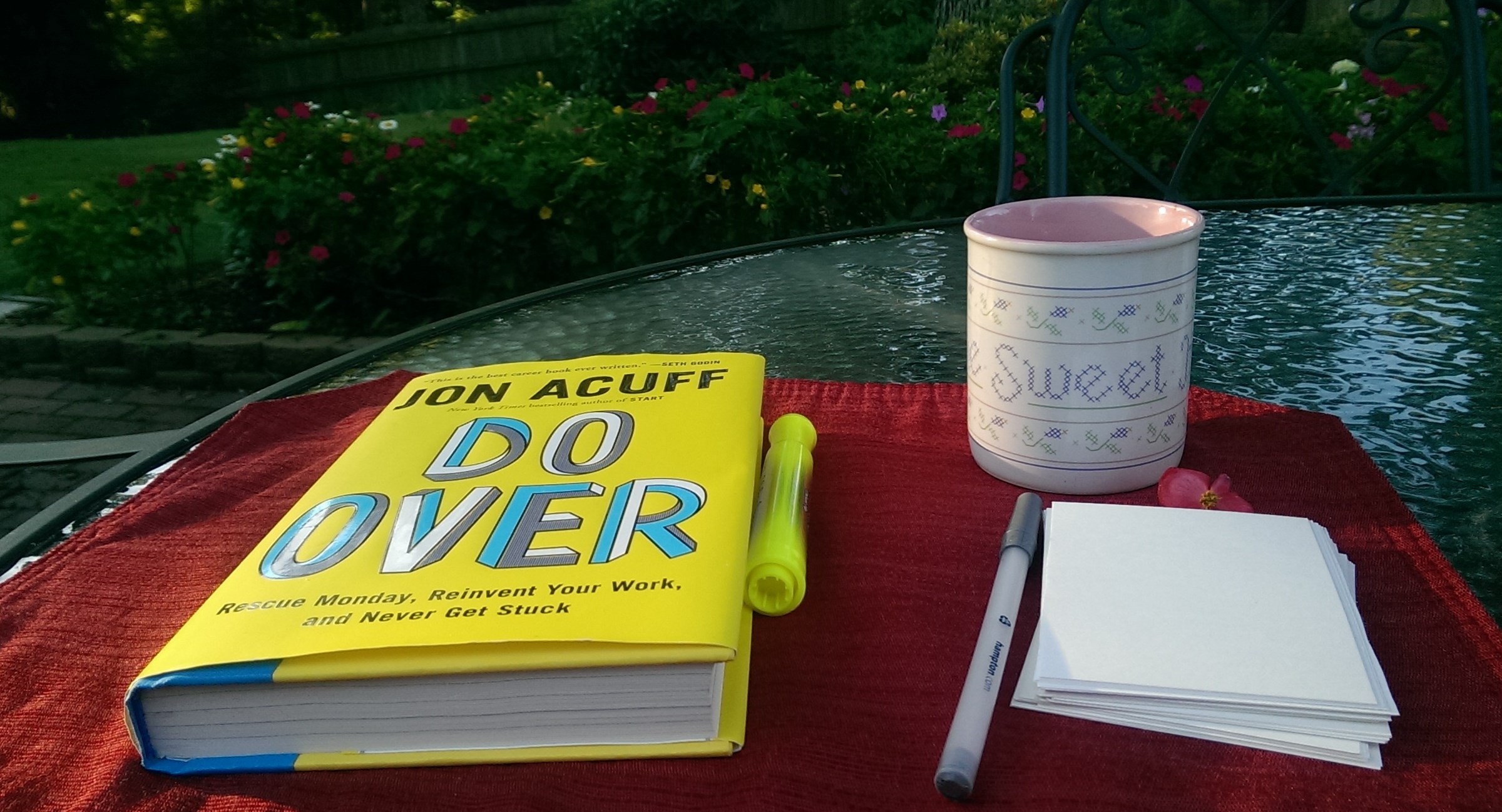
Jon Acuff (author of Do Over) defines grit as “stubbornness in the face of fear“.  In his book, he gives a short list of what’s needed in making gritty decisions (in the “hustle” of work):

  • Time – we think the world “hustle” has to mean fast, but it can also mean focus, intention, pace.
  • Counsel – Lean on your relationships. Some of the worst decisions are made alone. Who are your advocates? Have you given them time to reflect on it or are you rushing right by the wisdom they have to offer? Let them speak into it. A year from now, looking back on the decision, you’ll be glad you made it as a team.
  • Questions – Always ask awesome opportunities, awesome questions. We skimp on due diligence. “What am I not seeing right now?”
  • Kindness – Give yourself permission to make the wrong decision, because…you’re going to. Break the tension of feeling like you’re going to be perfect by giving yourself some kindness from the outset.
  • Honesty – When you look back on a decision, remember that you made that decision with the best information you had at the time.

As we saw those two older heavyset men running just behind their younger airmen colleagues, we saw men with a goal in mind. There was also something more – the cadence to the group’s run that seemed to work to keep them all together. Whether at work or in family relationships, we want to do all we can to help those gritty ones be successful. Their resolve may get them to the goal anyway, but we all benefit when we are able to “stay on course” together.

Have you “grown gritty” over your lifetime? Are there gritty folks in your life who you love to champion? Please share in the Comments below so that we can all learn.

*Session 1: Bill Hybels Opening Session – Global Leadership Summit

Wikipedia Article on Grit

The Truth About Grit

The Grit Test

Jon Acuff on the Role of Hustle in Taking Hold of Career Opportunities – Notes & Quotes – Part 5 of Do Over Series

How to Make Grit Decisions and Built a Grit List by Jon Acuff

Do Over: Rescue Monday, Reinvent Your Work, and Never Get Stuck by Jon Acuff

Does Teaching Kids To Get ‘Gritty’ Help Them Get Ahead?

5 Friday Faves – Writer Jeff Goins, Refugees, Community, Situational Awareness, and a Memorial

Happy Friday. Summer’s coming on hard here with temps into the 90s for the next week. Hope you get to play hard and rest hard over the weekend. Here are my favorite finds for this week. Enjoy!

1) Writer Jeff Goins – I am so excited about Jeff Goins‘ latest book. This is his 5th book – Real Artists Don’t Starve: Timeless Strategies for Thriving in the New Creative Age. It arrived 2 days ago, and I’m already deep into it.

Pre-ordering this book was an excellent plan, because the Barnes & Noble store near us is having to re-order already just 3 days into the launch. These books are flying off the shelves.

Why? Goins has already proven himself as a fascinating story-teller and wise counselor regarding creative work and turning dreams into reality. This book is a thrilling culmination of all that for those of us who want to put our work out there and make a living at the same time.

In Real Artists Don’t Starve, Goins gives 12 principles of how to actually be effective and successful as a creator (whether it’s music, writing, painting, or any other creative work). Reading his principles and the stories of artists and crafters through history give not only hope but tools through which we can make a living with our craft.

I’m so glad I bought this book early. Reading it is like having a successful and kind mentor guiding me through the next steps of my career. Whatever your passions, you will glean so much from Jeff Goin’s own journey and wisdom.

Real Artists Don’t Starve: Timeless Strategies for Thriving in the New Creative Age – Jeff Goins

28 Lessons From Great Writers, Artists, and Creators on Mastering Your Craft – Ryan Holiday

2) Refugees –  We never want to lose sight of the plight of displaced peoples – of refugees. Photographer Steve Evans and writer Zee Jenkins put together a beautiful and riveting photo essay – Trail of Tears – Refugees in Greece. Take a look and remember this is happening every day.Photo Credit: Steve Evans, Life Force Magazine

3) Community – We need each other. Community is something we experience when we reach out to those around us to help in whatever way we can. Community is also receiving that help when we are the one in need.Photo Credit: Army

How do we teach and model community to our children? How do we raise them to be situationally aware and compassionate to those around them? Please share your experiences (in the Comments below) of what you’re doing to raise up children to be adults who are socially responsible…who genuinely care about those around them.

This little video went viral and you’ll understand why. Beautiful!

4) Situational Awareness – This is a life skill that fascinates me. In fact, I wrote about it in detail here . Situational awareness is a discipline of being tuned into your surroundings in such a way that you can be alert to a threat or crisis before it actually happens. It came to mind this week when I saw this fascinating video below about things we can easily miss if we’re not alert to our surroundings. Watch Evan below.

Hopefully it didn’t just make you uncomfortable. Hopefully it made you think how we might not just be aware of a threat or a crisis, but that we might intervene early enough to change the situation. To get avert the crisis and to get help for that person in trouble.

A friend of mine lost a brother to suicide. His was a terrible impulsive final act and his family will grieve for a long time. What about those who show signs of depression or deep sadness? Maybe we can help there as well. It’s tragic when the family has to fight alone for the life of a loved one. I don’t have answers here, but we all have community agencies who can help us.

5) A Memorial – The news cycle is fast and fickle. We hear news (usually bad news) and then while we’re still coping with the fallout, media moves on. We forget too soon, even when that’s not our desire. Today is my older brother’s 71st birthday. Robert died suddenly 10 years ago. His online memorial is here. Today, I remember him. Also today, I want to remember 17y/o Sarah Harmening.Photo Credit: 11 Alive News

I did not know her at all until a bus accident in Georgia sent many to the hospital, and her life was gone. Still, the little I know of her made me want to pause and remember her with you. Below you will note her journal entry, written on that bus sometime before that accident. As she herself wrote, I believe with her that, in her life and in her passing, “God is going to do incredible things”.

Photo Credit: Facebook – The Alabama Baptist Newspaper

Breaking News: Multiple Huntsville Church Passengers Injured in a Bus Accident Outside of Atlanta

Another terrible incident that was short-lived in the news cycle was the slaughter of 28 Egyptian Coptic Christians last week. Again, in this moment, I want to memorialize them and…remember them.

Gunmen in Egypt Force Coptic Christian Pilgrims Off the Bus and Kill 28 – Declan Walsh and Nour Youssef

Don’t Look Now, But… – this is a hard read about the ambush and killing of these Egyptian Christians. This article found me and I’m glad I read it although it was disturbing. I don’t know if all the details are true, but this is true: 28 lives were taken and bear remembering.

This Friday Faves was not as light-hearted as most are. Still it’s what continues to resonate in my head and heart going into the weekend. Be safe out there, pray for one another, and let’s be kind to those around us…we never know what a difference that can make.

Bonuses

The Ultimate Character Test Any Great Leader Passes – Carey Nieuwhof

Mom: Let’s Stop Drinking the KoolAid – OK…this is a rant on our focus on nutrition for our children – which is a good thing until it becomes an all-consuming thing. Good article wherever you stand on this.

YouTube Video – Real Life Trick Shots – Dude Perfect

Monday Morning Moment – When Connections Are Lost – a Rant, a Resolve, and a Request

Photo Credit: Pixabay

Here written is a cautionary tale…one with a happy ending to follow.

Across my professional and personal life, I’ve experienced a great wealth of teams, affinity groups, communities and networks. Real flesh-and-blood people gathered passionately around products or services. People who trusted and enjoyed each other, who used their influence to do good. People who expanded both their influence and ability to do good by holding doors open to others with like vision.

…and I got to be a part of all that. It was an incredible life…and I want it back.

This is not to say that my life is lacking. That’s the rub. Life is amazingly good right where I am…wait for it…but, (such a small word that screams discontent, right?). There is something that has faded, and it can for you as well, if you’re not aware and nurturing it. Don’t let it happen because it’s too valuable.

What I have discovered over the last year is that the wide-reaching, lively connections in my work and personal life have been lost…or, for sure, diminished. This is what I’m determined to correct.

You know that odd experience when you lose a phone conversation (either because of passing through a cell service dead zone or you hit the disconnect button). You or the other person continues talking for a bit not realizing the other person is not listening…has left the conversation (intentionally or not intentionally)…and once re-connected, if you’re able, you have to awkwardly figure out where you left off.

Lost connections are jarring because they interrupt a process of communicating, collaborating or cooperating together on something of value.

Human capital is when you are connected to different individuals who have the capacity and desire to do good together (in creating or innovating – a product or service). Social capital – that of teams, agencies, or other communities working together – is an even larger, richer commodity than individual human capital.

I wrote about social capital previously here.

Social capital is the willingness of people to help each other. It often replaces money which people would use to buy the same help. Most ways of measuring social capital have to do with trust – people who trust that favors and help will be available when they need it will favor and help others more. Social capital is a lot like real capital. The more money a person or a society has, the easier it is to do things and the better off people are.Simple English Wikipedia

Photo Credit: IResearchNet

Through a variety of circumstances in recent years, I have lost some social capital. Reflecting on this real situation has been very helpful and motivating for me personally.

Jon Acuff, in his book Do Over, talks about the importance of not burning bridges when we leave a job or affiliation. I’m a bridge-builder not burner, but bridges can break down, through neglect or vision change and resource realignment.

At times, the sheer force of too much change can cause connections to be lost. Repeated change can lead to chronic states of transition, and we, in those situations, can find ourselves floundering, not sure really what or whom we call team or community.

There’s the regret and the resolve.

After years of living in many countries and working in various roles, we seem settled here in Virginia, at least for now. Still, in the past few years, we have experienced many changes here in work and community affiliations. Change can be so exhausting. It can either galvanize relationships or cause trust to sag a bit…and tempt us to circle the wagons.

I’m resolved to find my way out of this…even at my “old age” and in my semi-retired status…In other words, I have the opportunity AND the resolve.

Just now I’m reading a somewhat dated but still fascinating book on social capital. Written by Tara Hunt it has a curious title: The Whuffie Factor: Using the Power of Social Networks to Build Your Business.

Photo Credit: Amazon

Hunt took that title from a commodity in Cory Doctorow‘s sci-fi novel Down and Out in the Magic Kingdom. In Doctorow’s futuristic setting, “whuffie” was the currency and it was gained by being “nice, networked, and/or notable”. A little simplistic, but I do appreciate Hunt’s 5 principles of building social capital (this in the work world, but it can be applied in other situations as well):

  1. Stop talking and start listening.
  2. Become part of the community you serve and figure out who it is you are serving. [It isn’t everyone.]
  3. Be notable and create amazing experiences/remarkable products for your customers.
  4. Embrace the chaos. Don’t overplan. Learn to be agile. Recognize everyday magic.
  5. Find your higher purpose. Social capital only gains in value as you give it away. Figure out how you are going to give back to the community and do it…often.         – Tara HuntPhoto Credit: Pixabay

7 Ways to Increase Your Whuffie Factor – Tara Hunt – Fast Company

As I keep reflecting on re-building connections,  social capital is now a goal. It may look very different these days than before, but what’s most important is getting back in the game.

Jordan Harbinger, blogger and podcaster for a website called The Art of Charm, has issued a challenge that intrigues me. This social capital challenge is what I need right now. Photo Credit: Screen Shot – Art of Charm

The challenge itself is designed to take a month, and I’ve been sitting on it a month already. Reading books and articles on the topic and avoiding the first challenge – settling on a written goal of improving my social capital (and sharing it publicly).

Next time I write about social capital, it will be with the challenge ON! Here’s my request: it would be so helpful for me (and others) if you shared your experiences or thoughts in this area (via Comments below or in a private email). Don’t let the phrase social capital put you off. Remember it just means working/networking with groups toward something that benefits others. I’ve known the great value of that and want to figure out how to invest like that again.

Let’s shake up the world…for good…together. Game on!

Monday Morning Moment – Social Capital – An Invaluable Resource We Can Develop – and a Tool to Help – Deb Mills Writer

Deep Connections Like These Will Make You Very Influential – Ron Carucci

Social Capital Challenge – The Art of Charm

Jordan Harbinger – The Art of Charm – Twitter