“Because of the Lord’s great love we are not consumed, for His compassions never fail. They are new every morning; great is Your faithfulness.” – Lamentations 3:22-23
“Let me hear in the morning of Your steadfast love, for in You I trust. Make me know the way I should go, for to You I lift up my soul.” – Psalm 143:8
“He will cover you with his pinions, and under his wings you will find refuge; his faithfulness is a shield and buckler.” – Psalm 91:4
Holy Week of 2024 is finished. How glorious the annual recounting of what happened in those days for our sakes. Jesus faithfully lived each of those momentous days – holy living, sacrificially loving, dying with Eternity in view.
So here we are on Monday – ordinary start to another week. Or is it ordinary? No. For some, it is a crawling out of bed with every bit of will we can muster, facing a hard, an unknown, a breath-taking challenge.
The phrase “Strength for today and bright hope for tomorrow” comes from a treasured hymn “Great Is Thy Faithfulness” written by Thomas Chisholm. I was reminded of this in a Caring Bridge journal entry from a dear friend whose 6 y/o is in the throes of chemotherapy. She wrote this:
“Our God provides us with strength for today, and because He lives and has Risen…as we [celebrated] on Easter, we can also have and expect “bright hope for tomorrow.” May we be faithful and believe this! May we fear not and focus more on living life for eternity and not just the circumstances that occupy our present!” – [Niccole, not linking journal entry for the family’s privacy]
So this is for you, Dear Ones. That precious one confronting a shocking cancer diagnosis, and a young mom with a newborn and her own mom struggling with diminishing health leaning on this young mom, and a husband and father dealing with a fractured family, and…you can fill in the blank (God knows).
If you could use a deeper reminder of this old hymn and the Scripture-drenched truths of its message, here are the lyrics and a video you can sing them with. For this day, meditate on God’s faithfulness, not just for the nations and generations, but for you, Dear One.
“Great is Thy faithfulness,” O God my Father, There is no shadow of turning with Thee; Thou changest not, Thy compassions, they fail not As Thou hast been Thou forever wilt be.
“Great is Thy faithfulness!” “Great is Thy faithfulness!” Morning by morning new mercies I see; All I have needed Thy hand hath provided— “Great is Thy faithfulness,” Lord, unto me!
Summer and winter, and springtime and harvest, Sun, moon and stars in their courses above, Join with all nature in manifold witness To Thy great faithfulness, mercy and love.
Pardon for sin and a peace that endureth, Thine own dear presence to cheer and to guide; Strength for today and bright hope for tomorrow, Blessings all mine, with ten thousand beside!
Lyrics written by Thomas Obediah Chisholm – shared from Hymnal.net
“Strength for today and bright hope for tomorrow” is ours…in Him.
1) Good Friday – Holy Week 2024 is coming to an end. Every day, I join many around the world reflecting on the events and meaning of each day of that last week of Jesus’ earthly life. Up through the crucifixion and onto Resurrection Sunday. You can read my countdown here.
“It was not nails that held Jesus to that wretched cross; it was his unqualified resolution, out of love for his Father, to do his Father’s will—and it was his love for sinners like me.” – D.A. Carson
And as You speak A hundred billion failures disappear Where You lost Your life so I could find it here If You left the grave behind You so will I I can see Your heart in everything You’ve done Every part designed in a work of art called love If You gladly chose surrender so will I I can see Your heart Eight billion different ways Every precious one A child You died to save If You gave Your life to love them so will I
Like You would again a hundred billion times But what measure could amount to Your desire You’re the One who never leaves the one behind – Hillsong (So Will I (100 Billion X)
Here’s Nathan’s rendition on classical guitar. So moving!
3) How to Know a Person – How to really know a person? David Brooks’ book delves into that so practically. I hadn’t heard of this book until someone I follow on social media described it as a masterpiece. then I caught Brooks’ interview on The Next Big Idea podcast.
So far, I love everything I have heard and read about this book. A few quotes from the book follow:
“The real act of, say, building a friendship or creating a community involves performing a series of small, concrete social actions well: disagreeing without poisoning the relationship; revealing vulnerability at the appropriate pace; being a good listener; knowing how to end a conversation gracefully; knowing how to ask for and offer forgiveness; knowing how to let someone down without breaking their heart; knowing how to sit with someone who is suffering; knowing how to host a gathering where everyone feels embraced; knowing how to see things from another’s point of view.” – David Brooks, How to Know a Person
“The worst sin towards our fellow creatures is not to hate them,” George Bernard Shaw wrote, “but to be indifferent to them: that’s the essence of inhumanity.” – David Brooks, How to Know a Person
“On social media you can have the illusion of social contact without having to perform the gestures that actually build trust, care, and affection. On social media, stimulation replaces intimacy. There is judgment everywhere and understanding nowhere.” – David Brooks, How to Know a Person
“As the Harvard psychologist Robert Kegan has observed, what the eye sees more deeply the heart tends to love more tenderly.” – David Brooks, How to Know a Person
Brooks offers story after story of human connections, the kind we all long for…and how they happen. With curiosity and care and a measure of intentionality. Get the book!
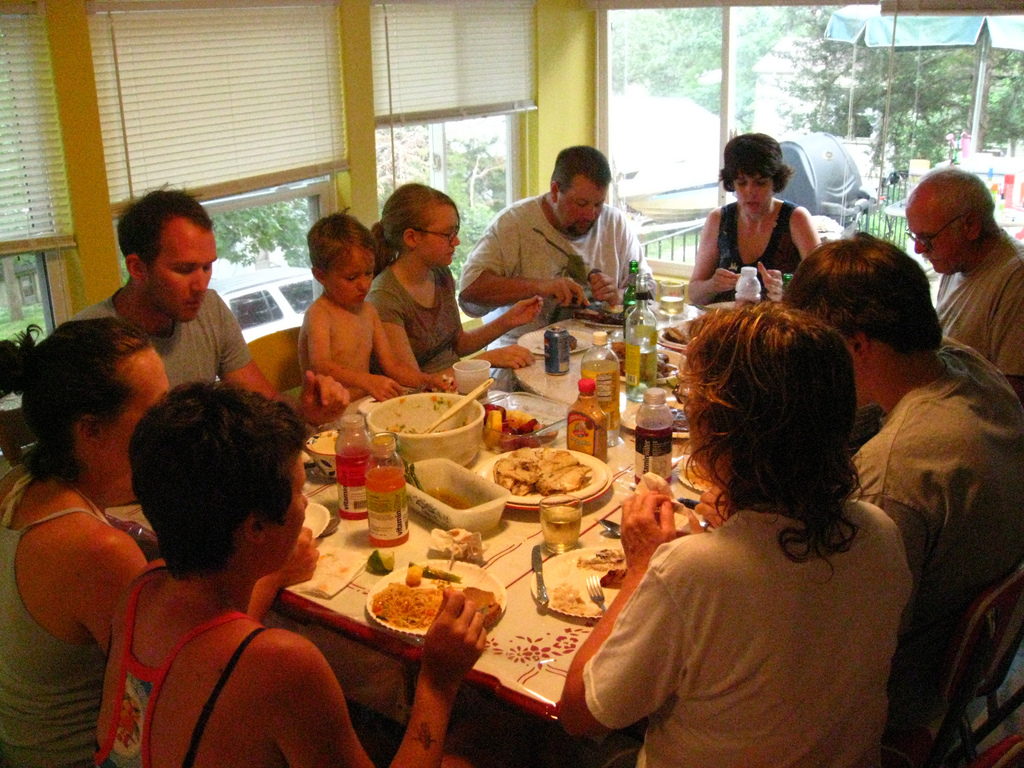
4) Scruffy Hospitality – Hospitality follows along the same thinking as David Brooks’ book on knowing people. When we put out the welcome mat for folks, we gain as much as we give, and it doesn’t have to be perfect.
“Scruffy hospitality means you’re not waiting for everything in your house to be in order before you host and serve friends in your home. Scruffy hospitality means you hunger more for good conversation and serving a simple meal of what you have, not what you don’t have. Scruffy hospitality means you’re more interested in quality conversation than the impression your home or lawn makes. If we only share meals with friends when we’re excellent, we aren’t truly sharing life together.
Don’t allow a to-do list disqualify you from an evening with people you’re called to love in friendship. Scheduling is hard enough in our world. If it’s eating with kind, welcoming people in a less than perfect house versus eating alone, what do you think someone would choose? We tell our guests ‘come as you are,’ perhaps we should tell ourselves ‘host as you are.’” – Jack King
I was reminded of this sort of hospitality when a neighbor dropped by recently without notice. I felt a bit embarrassed by the piles of books on my coffee table and the general messiness of the kitchen. I was cooking for a special occasion, and the counters were full of preps in progress. She wasn’t bothered by any of it, and we had a great visit.
Just today after a meal shared with extended family, we were sitting and talked, and I noticed how dusty the floor was in the afternoon sun – the areas that don’t get “swept up” by sock-clad feet. Sigh… Even as we were visiting, I pulled out the dust-mop and tidied up the floor. It didn’t bother our visitors, but it did me, once I saw it. Couldn’t unsee it.
The important thing is to keep inviting folks into your home, into your welcome. The condition of the house is secondary. There are too many folks out there eating alone because we want the comfort of our own homes without the work of making them presentable to others. Since COVID, also, we seem to have gotten out of the sweet habit of gathering, like we once did. Worth re-visiting.
5) Flowering Trees – We’re in Springtime here, and the flowering trees and bushes are giving us quite the show! I remember with great delight the fragrance of flowering Jasmine when we used to live in North Africa. For a brief time, the Viburnum bushes with new blossoms gives that same intoxicating smell. Everywhere you look right now, trees are like watercolor paintings with flowers popping and new leaves unfurling. Spectacular time of the year!
So much more…but with this being a special week of celebrating the life, death, and resurrection of Jesus the Messiah…will close here. Thanks for stopping by. It means so much.
Small acts of kindness aren’t really so small. They add up and can alter your day. Take stopping into Wawa – “the ultimate convenience store for food, drink, fuel, and more”. [If you don’t have Wawa in your town, it’s wherever you stop for gas and coffee.] Now, Wawa seems to be a working person’s stop-on-the-go place. Fueling the car and grabbing a quick beverage (plus food maybe). Customers are on the move. They have places to go.
What happens there, in seconds, is noteworthy. When folks go to and from the store, they almost without exception, hold the door for the next customer. Literally, I sometimes just stand and watch, while filling my gas tank. [It would have been creepy for me to video this activity although I was tempted. It’s a constant where the one opening the door waits for the oncoming person exiting or entering.
So considerate. So courteous. Now, I’m sure there are folks who run in to grab coffee and are lost in their thoughts. They enter and exit without thinking. Not noticing the person in front or behind them. This happens…just doesn’t seem to happen here.
I love that about Wawa. Working people who have jobs to do but take the seconds to hold the door. A small act of kindness. Do we do that intuitively? Or did we learn it from someone – at home, in the classroom? It’s definitely a work culture phenomenon as well. Check out the #1 element of work culture that matters in the SloanReview article:
We lived overseas for many years and were amazed at the courtesy extended toward us and others. If I was at tea with local ladies and children entered from school, without prompting, they would go around the circle of women and greet each one of us. No matter how old they were. That was just one example of the almost ceremonial expression of hospitality wherever we found ourselves. Now, every culture has its imperfect treatment of people, but I was struck but the impact of courtesy and consideration expressed even from small children, even from teens.
A verse in the Bible comes to mind related to this: “Do nothing from selfishness or empty conceit, but with humility consider one another as more important than yourselves.” (Philippians 2:3) In that moment, considering another more important than myself. A great exercise in life.
What does it take to teach, model, and reward/reenforce such qualities as consideration and courtesy such that they continue throughout life? I’d love to hear your take on this, in the Comments.
It was a sweet visit to Wawa for me. Consistent with every other visit. My favorite coffee (Hazelnut with vanilla creamer) even came free today and it’s not even Free Coffee Tuesday.
So…think about slowing down a bit and consider others just ahead of or behind you, and hold the door. If you read this far, you probably already make a habit of showing that level of care. Thank you.
[Postscript: Below you’ll find another quote on being a friend or creating community. It goes beyond the scope of this Monday Morning Moment but is apropos to how we treat people, even in the moment, even strangers.]
What’s the last thing (or person) that caused you to complain? You felt totally justified, right? When we think of the negative aspects of complaining, others come to mind as being “those people”. The complainers, the contrarians, the grumpy people, or the ones you just can never please.
For much of my early life, people who knew me well would describe me as a Pollyanna, someone who looks for the silver lining, the good in people, “the cup half full [or fuller], the possibilities. “If you can’t say something nice, don’t say nothing at all.” The Pollyanna turns into an accidental contrarian.
Maybe life itself changes us – dealing with hard situations, losses, failures, etc. We harden a little. We analyze, scrutinize, and make ourselves the tweakers of people and things (always looking for those little improvements that, we think, need to be made).
Once we begin to complain, we find others willing to join in. Commiserating is born. It’s not a happy community. Complaining becomes a habit and even a lifestyle, if we’re not careful.
On Sunday, we listened to Cliff Jordan‘s sermon entitled “Complaining in the Wilderness”, pondering the strangeness of a delivered and protected people’s complaints against God.
Cliff talked about how complaining actually rewires the brain – how we see others, ourselves, our circumstances, and even God. I’m not going to address the science of this, but do an online search and you’ll see how this happens and the negative outcomes of chronic complaining.
The source of complaining, Cliff noted, relates to our memory. Do we focus on the irritants to the detriment of remembering the good in our jobs, the people we work with, the many graces of life, and the kindness of God? Complaining has a stubbornness to it. It wants satisfaction and has very little patience for others. As we practice more positive thinking, we are poised, not to minimize the situation but to maximize the potential outcome…including safeguarding our relationships.
Andrew Kirby, a successful Youtuber and entrepreneur, actually posted a super helpful video on how complaining rewires the brain.
Kirby also acknowledged that not all complaining IS negative. When we complain about something, it’s an indicator of a change that might need to be made.
The key is to not stay in the complaining mode but to act in a way that brings positive change. Too much complaining can drive a person to make unwise changes, based on advice given to them by sympathetic hearers of their complaints. Better to be judicious in what change needs to be made and take wise steps toward that change.
The prescription for rewiring our brain away from complaining is straightforward and easy, with practice. In fact, these four reminders could easily sit on a card at our work station to help us stay on the road and out of the ditch:
Be grateful. – Keep a journal and write down things/persons for which you’re grateful – morning and evening. Turn your thoughts toward gratitude when you’re tempted to go negative/complaining.
Catch yourself. – Shake off the temptation to complain before your friends/coworkers intervene…or pull away. Learn to catch yourself and change course.
Change your mood. – If your emotions start to spiral downward, shift your environment. Take a walk. Listen to music. Step away from your work station. Grab a few minutes with a friend.
Practice wise effort. – “Wise effort is the practice of letting go of anything that doesn’t serve you. If your worry [complaint] won’t improve your situation or teach you a lesson, simply let it go and move on.This is much easier said then done, of course, but if you write it out, ask friends for advice, and take some time to think it through constructively, it really can be done.” – Daily Health Post
All this is common sense. Still, in an age of outrage, we must practice thinking positively (refraining from chronic complaining) until it becomes a discipline…a healthy habit.
“What you practice, you get very good at.”
As that relates to complaining, do we really want to get good at that? No. In fact, practice doesn’t always make us good at something. We can practice unhelpful, unhealthy habits and they can become ingrained….even permanent…unless we intentionally do the work to reverse them.
When we know something needs to change, make the complaint count by refusing to think ill of others involved and taking your concern to the right people. Make yourself part of the solution. Whenever possible, remember all the good you can. It will keep you humble and grateful.
Photo Credit: L) Chadwick Boseman – Gage Skidmore, Flickr, R) Chad Stephens (pic taken by Deb Mills)
[This piece is adapted from the Archives on the 30th anniversary of my nephew Chad Stephens’ death. He was 23 when he died instantly in a car accident. After so many years, I’m not sure who all have the sweet memories of Chad that his family has. As to legacy…only God knows. I was reminded today in remembering Chad of another’s legacy – the actor/influencer Chadwick Boseman. His legacy is large and public. For both of them, Chad and Chadwick, dying sooner and harder than any of us imagined would have happened…who knows the extent of their legacy – either Chad, a young man with most of his promise still ahead of him, or the profoundly gifted Chadwick Boseman, dying in his 40s. Below you’ll find excerpts from a blog I wrote when Chadwick died, as I also remember Chad today.]
Shock waves covered our country and the world at the news of actor and Black Panther superhero ‘s death. He was/is a bigger-than-life figure in our culture. As we all know now, he had late-stage colon cancer since 2016 (four years prior to his death). That the public didn’t know he was ill isn’t a surprise, given Boseman’s private nature and also the incredible production of 10 of his films from 2016 until now (one of them Ma Rainey’s Black Bottom released after his death). Fighting his battle with cancer at the same time, what grace, focus, and courage he displayed through all the making of those films!
Boseman was very committed to raising the opportunity and quality of life for fellow black people. He used his work to reflect the dignity of humankind. He showed his own respect for others not only in the Marvel blockbuster Black Panther but in all his films. Several of which were biopics – two of my favorites being Marshall (on the life of Justice Thurgood Marshall) and “42” (on the life of baseball player Jackie Robinson). Both movies are timeless in their handling of justice for blacks in America.
After seeing the incredible film Black Panther some time ago, I was reminded of the relatively small part Boseman also played in Draft Day. Two very different films, but both where he played one who took his platform to champion others. This seemed to be true of Boseman’s public and private life.
After a weekend of trying to get hold of the life and character of this man from Anderson, South Carolina…this man who became a Christ follower as a boy and served in his church’s choir and youth group…I couldn’t get to sleep.
What Boseman accomplished in his relatively short life as a public figure will last as long as we watch the movies…and longer still.
What can a regular non-celebrity do in our world gone mad? What really can this older white woman in the suburbs of a small city? What can you do?
Last night, in the dark trying not to wake my husband, I grabbed my phone and wrote the following list. It came quickly. Hopefully it is understandable.
Listen hard with ears, mind and heart open.
Seek to understand.
Ask the question: “What are we hearing?”
Ask the question: “What are we not hearing?”
Ask the next layer of question without judging: “What sounds true? What sounds like deception motivated by something else? How can we know?
What is the source of what we are hearing? [Sidebar: Where we get our news is often where we get our attitudes. If we take in news at all, we need a mix of views or we won’t critically be able to sift for what is true…or hopefully true.]
Then…
Speak up on behalf of one another.
Stand up against evil and for the truth.
Act up? NO. Act in love.
Mobilize our resources, relationships, and influence to actually make a true, lasting difference for those most vulnerable in our country.
Who has the courage to say “Enough” to what is hurting more than healing, to what is destroying more than building up, to what is not really for change for those who most need the change?
Boseman once said: “The only difference between a hero and the villain is that the villain chooses to use that power in a way that is selfish and hurts other people.”
Boseman’s life reflected his faith in Jesus.
Therapist Kalee Vandergrift-Blackwell wrote a beautiful piece (below) on “a brown, immigrant, refugee, colonized Jesus”.
Jesus died at the hands of the political and religious leaders of the day, but…He did not die a victim. He gave his life in all its beauty, courage, and truth – for our sakes…and He gave his life, even for the political and religious leaders of the day.
When He called out the wrong motives of religious leaders and turned over the tables of opportunists, everything He did, He did in love. He calls us, His followers, to do the same.
Jesus calls us to love our neighbors…and even to love our enemies. We aren’t allowed to just take sides…we are to full-bore, wide open love people – to recognize, respect, and validate in all we do the worth, dignity, and God-breathed humanity of all.
This is our legacy…this is what I want to have the courage and the depth of love to leave when my life is over.
Not complacency. Not comfort. Not smugness. Not arrogance. Not blaming another party or one president over another (if there’s blame it extends much farther…). Not violence. Not isolation.
So…that is the burn I got this weekend after taking in and grieving over the loss of Chadwick Boseman.
One last quote from Boseman that is especially poignant and inspiring right now is this: “When I stand before God at the end of my life, I would hope that I would not have a single bit of talent left, and could say, ‘I used everything You gave me.”
In remembering Chad, also, I’m reminded of his legacy…not as publicized as a great actor who died too early…but of a young man who had also given his life to Christ. A young man with great heart and strong convictions. A young man who thought of others. A young man who lavished love and joy on all of us, just entering the room and then staying in the room. A young man who could flip the tension of a family dispute…just being present, by showing up over and over, even in the uncomfortable and imperfect.
Whatever our influence or audience – the world as with Chadwick Boseman, or a much smaller sphere as our Chad – we all leave a legacy. We learn from those who’ve gone before us. Because of what Jesus did for us, and knowing that both Chad and Chadwick received Jesus for themselves, we will see them again.
That makes today a little less hard and a whole lot more hopeful.
Soon a violent windstorm came up, and the waves were breaking over the boat, so that it was being swamped. But Jesus was in the stern, sleeping on the cushion. So they woke Him and said, “Teacher, don’t You care that we are perishing?” Then Jesus got up and rebuked the wind and the sea. “Silence!” He commanded. “Be still!” And the wind died down, and it was perfectly calm. – Mark 4:37-39
We are all ships in a storm, with Jesus onboard. He is our safe harbor. Not a place but a person. Safe in Him.
I follow this young man Ian Simkins. He does these succinct devotionals that are incredibly powerful. The one below inspired me to write on this topic today.
“Apart from the Holy Spirit, the Christian life isn’t difficult. It’s impossible…
We are sailboats. God is the wind. Even tattered sails do pretty well in a windstorm.
“The wind blows where it wishes, and you hear its sound, but you do not know where it comes from or where it goes. So it is with everyone who is born of the Spirit.” – John 3:8
“A ship in harbor is safe, but that is not what ships are built for.” – John A. Shedd
“One cannot discover new lands unless they have the courage to lose sight of the shore.” – Andrew Gide
A pastor at The Bridge Church in Nashville, Tennessee, Ian tells the story of an Indian couple whose home he visited while on a summer in India. They were poor, but in wisdom, very rich. The wife said to him, “We pray for you Christians in America. We can’t imagine trying to be with someone like Jesus in a place as distracting as America.”
A Kenyan pastor, after a violent attack, on a university campus a few years ago, left 150 people dead, responded:
“This attack has strengthened our conviction and resolve that the safest and securest place to be is at the center of God’s will. As it has been said, “Peace is not the absence of trouble but the assurance that God is with us no matter what.”
We have this temptation to strive for safety. For ourselves and our families. What does it even look like to be “safe”? To build a perimeter between us and anything that might present a threat. What are we teaching our children and grandchildren? That we have to protect ourselves? From what?
With Christ within, no matter what happens, no matter the hardship or worry, we have a profound safe harbor in Him.
Just yesterday, I discovered that Tyler Staton, a young brother and spiritual father of mine, is in treatment for recurrent cancer. He is lead pastor for Bridgetown Church in Portland, Oregon and the author of the transformative book Praying Like Monks, Living Like Fools.
In a video recently, Tyler gave a health update on how he is with treatment and in his walk with God through this cancer recurrence. He commented on how God is a master story-teller and is writing our stories. He calls us to “say yes to the story He’s writing” and step into/walk in that story. Tyler reported on how he was praying both Psalm 23 and Psalm 21. Psalm 23 reminds Tyler of “green pasture” and “still water” days and also days “in the shadow of death” – they are all part of our lives. Tyler expressed his desire “for God’s presence more than His power”. He also is praying Psalm 21 (“maybe hedging (his) bets with God”) which is a cry for God to lengthen his days – to grow old with his wife Kirsten and to see his children’s children.
From the time I first read Tyler’s book and returned to it many times since, I’m not at all surprised at how he has faced this cancer.
Does Tyler feel safe? I’m not even sure that is even the point for him. He wants to receive whatever God has for him, and if cancer is a part of that, then he receives it. Will he battle it? Absolutely. However you do not hear him recoil from God or question the His goodness in this. It is just part of the story of Tyler’s life.
Rather than safety as we might count it and go after it in this crazy world…let’s reconsider and deepen our understanding of how safe we are in Christ Jesus’ keeping.
[Verse 1] Under Your grace, Your mercy amazes me Under Your wings, Your shadow covers me Your promise of love, where my heart is safely undone
[Verse 2] Speak to me, Lord, Your servant is listening Over the noise, I hear You whispering My hope has come and my heart is safely undone
[Chorus] I found my fortress, in You And my soul is anchored, with You My resting place, is in Your name Forever safe
[Verse 2] Speak to me, Lord, Your servant is listening Over the noise, I hear You whispering My hope has come and my heart is safely undone, oh-oh
[Chorus] I found my fortress, in You And my soul is anchored, with You My resting place, is in Your name I found my fortress, in You And my soul is anchored, with You My resting place, is in Your name
[Bridge] You are never far away Always reaching out to save My weakness covered by Your strength And I am found forever safe You are never far away Always reaching out to save My weakness covered by Your strength And I am found forever safe
[Chorus] I found my fortress, in You And my soul is anchored, with You My resting place, is in Your name Forever safe I found my fortress, in You And my soul is anchored, with You My resting place, is in Your name I found my fortress, in You And my soul is anchored, with You My resting place, is in Your name Forever safe*
[The video below is a scene from The Chosen. It is based on the account of Jesus walking on rough waters and Peter coming out of the boat to Him. As long as Peter kept his eyes on Jesus, he was safe. This passage, like the one in Mark above, speaks to our safety in the midst of a storm as long as He holds us. Lots more to this story…but the scene beautifully demonstrates it.]
Photo Credit: Julian of Norwich, Cedarfield Pinnacle Living Readings and Reflections for Lent 2019
[Before jumping into this, let’s take a moment to give space for those who tried for a long, long time…and then felt there was no recourse but to give up. I have given up, too, in some situations, with some relationships…either because I lost hope, or heart, or strength, or opportunity, or time. We all have such stories. Today, let’s pause and consider the large and life-affirming possibility of just NOT giving up.]
Have you said any of these things recently? “I quit!” “I’m tired of trying.” “I give up.” “It’s not fair.” “It’s not worth it.” “Why do I have to do everything?” “It won’t last.” “There’s no use.” “I’m just not good at it.” “What difference does it make?”
Words matter. They can move us toward positive outcomes or negative ones. The negative affirmations above, spoken or just thought, sound true. Some may even be factual. They move us to action. The problem is when we are moved to act in ways that make things worse instead of better.
Whether it is your job, a lifestyle change, or relationship…we choose whether to be proactive or reactive. Whether we give up or keep at it. Bit by bit. Day by day.
All of life is a journey. We move toward one another or away. Our temptation is to self-protect…or protect someone we love thinking it requires pulling away from someone else. We can give up without even realizing it. Just in the disappointment…the distancing. We pull away from possible solutions. They are just too hard. Or are they?
When we get to the point of giving up, it’s not just giving up on that person, but giving up on ourselves in relationship to that person. Maybe even giving up on God to help us repair the rupture, thus opening one between us and Him.
You may think I am philosophizing or making this too simple. Believe me, I totally get how complicated “not giving up” can be. And painful. And even isolating. However, giving up is more isolating…and potentially more painful. We can bury the pain, cover it over, but it’s still there.
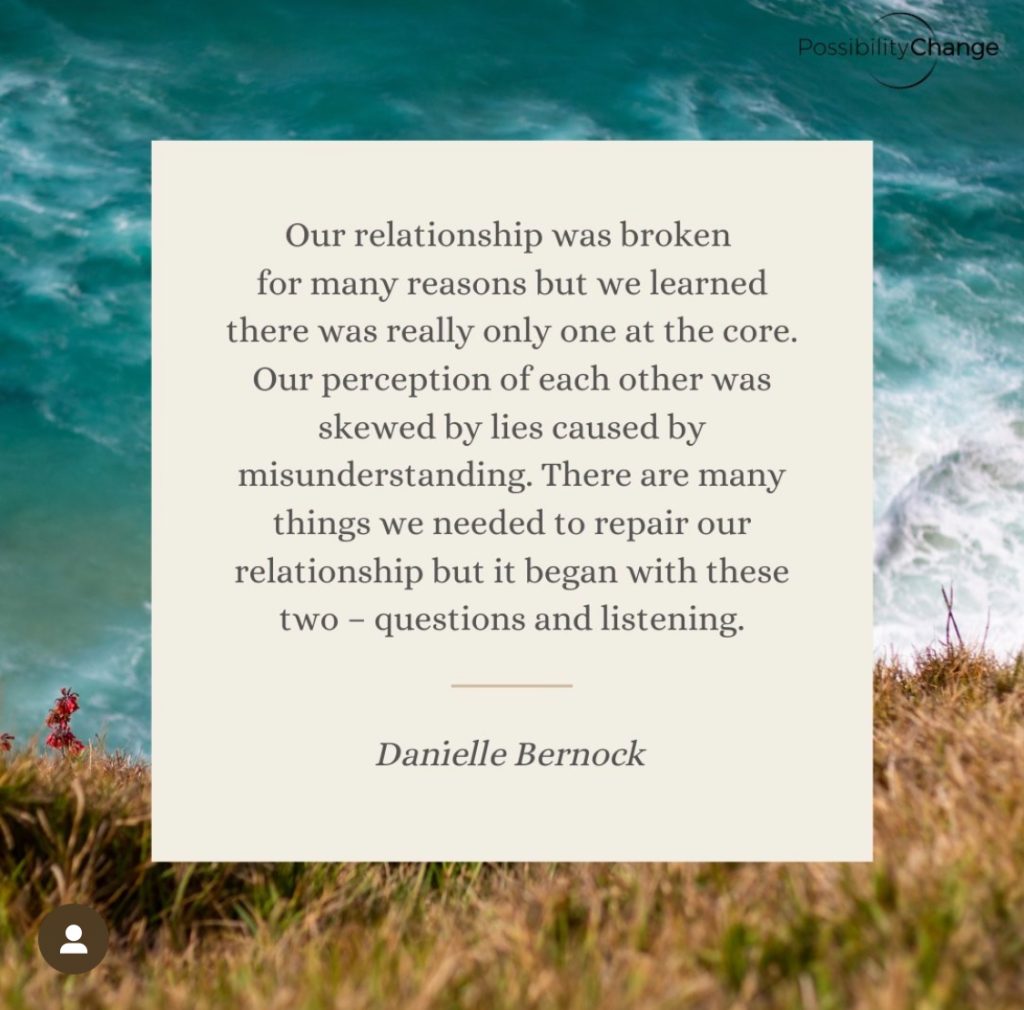
Now, we may not be able to restore the relationship…or heal a family wounded by rupture…but when we quit on them, the door to repair, from our side, closes.
The day will come, I am hoping and believing, with God’s help, that we will see good come through this hard place. For me, I am NOT giving up.
Stories of feeling the need or desire to quit abound. It may be your story as well. There is no blame here. No shaming whatsoever. It’s what we do with our stories that matters.
Attorney, writer, coach Marelisa Fabrega offers 8 strategies for not quitting. Her commentary is thought-provoking so don’t miss reading the article. I’m listing her strategies and adding my own quick thoughts.
Adopt an “I Won’t Quit” Mindset. Make that decision ahead of the situation. When Dave and I began talking about marriage together, we both stated pretty emphatically that, for us, divorce would be off the table. I grew up in a blended family and divorce impacted all my brothers’ adult lives. With Dave, it was extended family who experienced the pain of divorce, and his family felt that pain. Marriage has had its hard seasons for Dave and me, but we fought through together. [Not everyone gets that opportunity as the other spouse can ditch the marriage without your input. I get how painful that is.] Whether in marriage, friendships, work, or physical/mental health, an “I won’t quit” mindset gives you fortification in hard situations.
Watch Someone Else Persevere.It is a beautiful and poignant thing to watch when loved ones refuse to quit. I’m not saying to be a doormat or to continue to take terrible abuse. What I’m talking about is when people keep pressing forward in tough work or relationships when everything in their being and all those around are screaming, “Quit!” Two women come to mind here. One friend went though a struggle early in her marriage when her husband had an affair. All our friends (but me) advised her to divorce him and make him suffer for what he did to her. I asked her, “Do you still love him? Because if you do, and you could imagine being willing to take him back…wait.” She did love him and she decided to wait. He came back, wholeheartedly repentant. They went on to have a beautiful marriage, children, and now grandchildren. Another friend is in the furnace of a difficult relationship right now. I am watching her persevere. She has strong faith in God and a few deep friendships who are cheering her on. I believe she/they will make it.
Call Someone. This is huge! I’m thinking have more than one person you can trust to be with you (and for you) in this arena when quitting feels like all you want to do. If you’ve already decided up-front that you want to not give up, these friends and family can stand with you when the battle has exhausted you. They are for you. Hopefully they are also for your spouse and family member. It’s better to have folks who are fighting for you AND for your relationship. Not out of some scruple or moralistic platform, but because it’s your life and your battle. It’s what you want. [That may change at some point down the road, and if it does, these same people who love you will still be there.]
Go Back to Your “Why”. It’s extremely important to have a why for not giving up. A list of why’s, even better. I have loved ones very close to me who, if treated badly or served poorly, will determine not to trust an individual or business anymore. They just won’t go back. This is a much smaller situation than a deteriorating relationship. However, I’ve never understood the why and, after reading Fabrega’s piece, I plan to ask. These same people do not quit on family relationships, for which I’m grateful. So…we need to go back to our “why’s” of staying in relationship, or in a job for that matter.
Find a Different “How”. If a difficult boss is blocking the way for you to succeed at a job you once loved, figure out a respectful work-around. If the approach you have always used for managing conflict in your marriage isn’t working, think of a different way. If you continue to struggle with managing a healthy lifestyle or avoiding cycles of anxiety/depression, seek help (counseling, coaching/mentoring, medical advice, support groups). Find another way forward. Outlast the person or problem.
Succeed at Something Else. If you have been immersed in a painful situation, determining not to quit, you may just need a respite. A brief reprieve. A focus elsewhere for a few hours or days will be refreshing. Not seeing success in an area important to us colors how we feel about our self globally. Even when success isn’t visible to us, it may be coming, so we don’t give up. For that second wind, we might be refreshed by setting our sights on areas where we are seeing success (work, health, hobbies). Preferably, we do both – staying in the battle and interspersing life-giving activities.
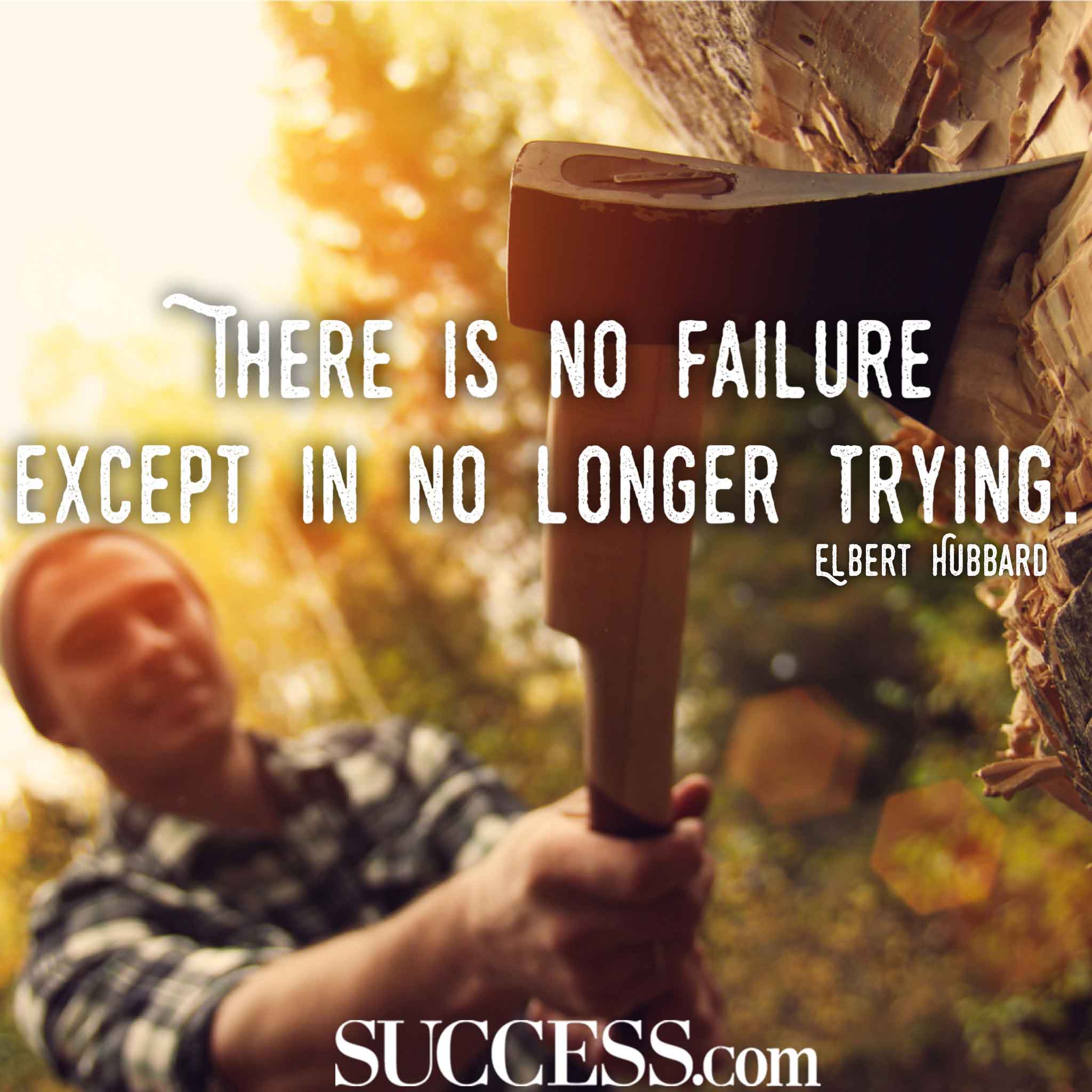
Use Failure as a Stepping Stone. No retaliation. No victim mentality. You have already made the decision of what kind of character you want in life. Keep growing. Don’t let failure define you. It actually may not even be your failure at all. So, as much as you can yourself, live the life and be the person you want to be. It is a journey after all.
Keep Chipping Away. Like Fabrega has already said so well…keep going. Keep doing what you know is right. This is part of your story. Whatever happened in the relationship or work situation, you are making a future for yourself, and maybe for your children or family. Again, who you are is much more than what you’ve come through. – How to Not Give Up – 8 Strategies For Not Quitting – Marelisa Fabrega
9. Look for Beauty. It is there. Just outside. Or just there within reach. Just in all the reasons you are you.
I’ve read all of psychiatrist Curt Thompson‘s books and he has inspired me to look for the beauty in front of us even in situations where we feel like giving up. He inspired Bill Haley to write an essay on beauty. Here is an excerpt:
“Etty Hillesum, a young Jewish woman from Holland, wrote one of the most truly amazing things I’ve ever read. The context of her words makes all the difference. She wrote them while imprisoned at Westerbork transit camp waiting to be taken to Auschwitz, where she died in 1943 at age 29. Her diaries and letters were compiled intoAn Interrupted Life.
A very hard day. But I keep finding myself in prayer. And that is something I shall always be able to do, even in the smallest space: pray. And I know for certain that there will be a continuity between the life I have led and the life about to begin…
I often walk with a spring in my step along the barbed wire and then time and again it soars straight from my heart — I can’t help it, that’s just the way it is, like some elementary force — the feeling that life is glorious and magnificent, and that one day we shall be building a whole new world. Against every new outrage and every fresh horror we shall put up one more piece of love and goodness, drawing strength from within ourselves. We may suffer, but we must not succumb…
What kind of people do we choose to be? With all my heart, I want to be one who is not giving up. My family (immediate and extended) knows I am for them. Also, hopefully other folks as well – friends and neighbors. I’m not going anywhere. This is not just a commitment. This is an issue of character that goes way beyond any circle I’m a part of. It’s the kind of person I want to be. It’s not a small thing. I get it. Probably a God-sized endeavor. God is for all of us. He does not give up. He is not going anywhere. He is in the room…and He is staying.
You may say…well, you haven’t reached your breaking point, and you are right, of course. We can’t know what it will take for us to get to the place that we want to quit. Sometimes, we have no other option but to let go, because the other person is, or appears to be, already gone. My hope and resolve is to hold out as long as possible. Who knows what difference that could make? I’m holding onto that.
1) Beyond the Guitar – It’s been awhile since I’ve posted Friday Faves, but rest assured #1 of my weekly round-down hasn’t changed. Nathan at Beyond the Guitar continues to make beautiful music. He also teaches through his arranging academy, practice club, etc.
Below you’ll find a couple of his most recent videos as he showcases two different guitars. Beautiful!
His short videos (with film and video game clips attached) are so much fun and emotionally satisfying (why go to TikTok when you can just hang on his channel? Just scroll down his YouTube channel to Shorts).
Something about Nathan you might not know if you don’t follow him on Instagram is that he has also become a personal trainer in the field of health/fitness, mental/spiritual disciplines, and all the stuff of being a guy out there (family, work, habits, and disciplines). For his music, you know where to go. For this sort of inspiration, head over to his Instagram account.
2) Walking Her Home – This has been a super sentimental week for me. Some health issues, family stuff, and friends going through hard times. When I came across the UNC Clef Hangers video (seen many times before), it has hung in the air for me.
The song Walking Her Home recounts the story of a 60-year relationship. From first date until the elderly wife was dying. Whew! So beautiful.
Dave and I have our 40th wedding anniversary later this year, and this sweet lyric brings back such memories of our own life together. All the beautiful not dimmed by the hard. In fact, only made more beautiful by staying and waiting out (praying out) the hard together. Not everyone gets that opportunity, sadly. Just let me share this song…may it encourage you about your own relationships whatever they are.
3) Post-traumatic Growth – We have all heard much spoken and written about post-traumatic stress (PTSD). Just in recent months have I heard the concept of post-traumatic growth. An internet search yields much on this topic. Post-traumatic growth is defined as “the experience of positive change that occurs as a result of the struggle with highly challenging life crises”.
This sort of growth can happen when we recognize that we don’t have to be forever victimized by the trauma we’ve experienced, as children or adults. There is a way forward.
I’m only mentioning it briefly here, but if you have experienced this sort of growth post-trauma, and you feel comfortable to talk about it, please use the Comments section to share some of what happened.
Sometimes what stands in opposition to our growth is the person or persons unwilling to let go of the past. Maybe our PTSD relates to being the victim of trauma. Other times, however, we struggle to get out of the past because of harm we ourselves have caused. Even when we have owned our part, asked forgiveness, made whatever restitution we could…the past won’t always go away.
Writer/speaker Ashley Alford writes about this poignantly. Below you’ll find a bit of her take on it:
Kicking ash is what they’re doing.
Standing in the middle of the ashy remainder of what you once did.
The soot of who you once were.
The smoke of who you used to be.
They’re standing in the middle of an old story…one they don’t like to let go of.
One that still tries to burn with reminders of the licking flames of your shame.
They kick the mess around you hoping to stir up the old accusations…
Hoping to reignite the sparks of something that God himself put out…
They can run the ashes of that fire through their fingers all they want…
But they’ll never know the pain it took for you to heal from those burns.
They’ll never know the raw ache of fresh wounds straight from hell.
Not like Jesus does.
They weren’t there when He bandaged you at that altar.
They weren’t there when he breathed life back into you again on that closet floor.
So let them kick ash and stir up the soot of that life and lie you used to host.
And remember when they mock you…They’re mocking the Holy Ghost.
Because they can tell tales of the fire that almost consumed you and they can backstab and stare…
But it would do them good to remember that just like Shadrach, Meshach and Abednego…
4) Breaking Out of Negative Thinking – I first wrote about negative thinking five years ago (that blog linked below). Since then we have come through COVID 2020, great racial unrest and social upheaval, contentious election cycles, ongoing wars, and a downturn in our economy. Lots to think negatively about with good reason, but if we’re not careful we will begin gearing our thinking in that direction to the detriment of our mental and relational health.
The team at Daily Health Post focused on complaining as a culprit that can actually cause our brains to default to anxiety and depression. From experience, I know this is true. Check out the article below:
Before leaving this topic, I want to point to the article below which champions negative emotions as a sometime benefit. We learn from regrets, and sadness is telling us something about what matters to us. Negative emotions have value, but it’s the weight we allow them and the headspace they will consume that we must question and resist.
That’s my 5 faves for this week. Gleaned from a much longer list of finds that I didn’t write about over the last several weeks (including my beloved “Best of” Christmas Ad videos). Thanks for stopping by. Talk to us in the Comments if you have the time. Blessings always.
Centering Prayer calls us away from all our distractions, our plans, our worries, our over-thinking, our busyness…and calls us into a time of rest and focus on God whose presence we are never without.
Last week, I was checking out of our local free clinic with my Afghan grandmother friend. It’s always a stretching experience with trying to understand (even with an interpreter) what her health complaints are. Finally, we were finished with the doctor. As I stepped up to the counter to receive the forms for her bloodwork, specialist referral, and next appointment, I saw the sign (in the image above).
God is always with us. Period. Full-stop. That verse is one that brings to rest everything whirring around in our minds, remembering that God’s got this. Being present with a ever-present God transforms everything.
Another passage that reminds us to be still and stop fighting battles He means to fight Himself…for us…is Psalm 46. Below is the entire psalm. It is so worthy your stopping and reading along (or hear it read for you).
46 God is our refuge and strength, A very present help in trouble. 2 Therefore we will not fear, Even though the earth be removed, And though the mountains be carried into the midst of the sea; 3 Though its waters roar and be troubled, Though the mountains shake with its swelling. Selah
4 There is a river whose streams shall make glad the city of God, The holy place of the tabernacle of the Most High. 5 God is in the midst of her, she shall not be moved; God shall help her, just at the break of dawn. 6 The nations raged, the kingdoms were moved; He uttered His voice, the earth melted.
7The Lord of hosts is with us; The God of Jacob is our refuge. Selah
8 Come, behold the works of the Lord, Who has made desolations in the earth. 9 He makes wars cease to the end of the earth; He breaks the bow and cuts the spear in two; He burns the chariot in the fire.
10 Be still, and know that I am God; I will be exalted among the nations, I will be exalted in the earth!
11 The Lord of hosts is with us; The God of Jacob is our refuge. Selah
Psalm 46 is a glorious and victorious psalm to encourage and embolden a people beleaguered by hardship (we don’t have details but given the context it was war, or some sort of calamity or terror). The psalmist was reminding the people that God is with them (with us) and will pierce through the noise of battle, with His powerful and persevering presence. He is here today just as much as He was with His people in the psalmist’s day.
Our part, like theirs, is to turn our ears, and our hearts, our bodies to Him.
Psalm 46 begins, not with a lament or cry for help, but an anthem of praise. “God is our refuge and strength, a very present help in trouble. Therefore we will not fear”. Then he goes on to talk about super fearful things…yet from a place of awe and certainty. Even as the psalmist speaks with great confidence about God’s presence and provision in times of catastrophe, the Lord Himself enters the psalm with the command “Be still!”
Not just “Be quiet” but “Be still”. Stop!
Stop. Come away (from the battle). Quieten yourself. Cease striving.
God calls both His people and our enemies to essentially “put down your weapons!”
Especially to His own people, He urges them (and us today) to ‘snap out of it,’ ‘wake up,’ ‘stop fearing’—acknowledge who God is—be in awe! For us to take His “Be still” and treat it as “be quiet” is not incorrect, it’s just not enough to describe what God is truly saying.
God is about His business in fighting for us and those we love. Fighting also those who would see to do us harm. We don’t know how it will go in the moments ahead of us (whether this battle will “seem” lost or won to us) but we do know His promises that hold us fast, even in battle, for now and forever.
It’s for us to “be where our feet are”. To quieten our hearts and slow our steps. To put down the phone. To find His beauty to focus our eyes on. To “breathe the life around me” and “listen as my heart beats. Right. On. Time.”
Centering prayer prompts us to lay down our burden and determine to stop worrying. Not just as a mindfulness exercise but with the God who loves us in full view. To see the anxiety for what it is – a tool used against us to take our peace away. To recognize that the depression we experience can be lightened if we open ourselves to Him and to His people praying with and for us. To remember that all the things that distract us dull our senses to the most real relationship we have in this life and the next.
“Centering Prayer,” written by Brian Eichelberger, Nicholas Chambers and Kate Bluett — and featuring Andrew Peterson and Leslie Jordan — invites the listener to a sense of groundedness with its calm melody. The lyrics give language to a clinically recommended practice of grounding that invites practitioners to reconnect with themselves in the present. The song, with lyrics asking for God’s help to “be where my feet are,” is itself a tool for calming anxieties and opening a more accessible prayer experience. – Kathy Powell
Recently a conversation with a young friend drew me to the idea of “a principled life”. She recalled a comment a friend of hers made about this friend’s life, something along the lines of how remarkably principled her life was. As if that was an odd thing. Unusual. Commendable but on an altogether different plane.
We were both surprised at this. Doesn’t reaching adulthood come with the establishing of certain principles for living? Those attitudes and actions that define us as people.
In our family, we often have conversations around the dinner table about how we engage with people, especially those who are challenging, demanding, and even uncaring. It makes sense, at some level, to distance ourselves from such folks, put walls between us and them, and not be drawn into their neediness or manipulation.
The question for me, however, in such situations, is “what kind of person do I want to be?” Is another’s behavior going to change the way I want to show up in relationships? Is another’s character going to move me to change my own?
Thus the thinking about a principled life. What does that look like for each of us? What does that look like to our children and grandchildren?
Now, we derive our principles from varied sources. Some from our parents. Some from teachers or mentors. Some from classical literature, history, or sacred texts. Some of our principles (whether we consciously acknowledge it or not) may even come from movie quotes and characters. Below you will see some examples of principles.
Ex-heroin addict and neuroscientist Brian Pennie PhD writes and speaks regularly on this topic:
“Principles are fundamental truths that are universal in nature.” – Brian Pennie
“Values are beliefs, attitudes and standards of behaviour about what’s important in life. They are also subjective and may change over time.” – Brian Pennie
“Unlike values which are subjective, principles are fundamental truths that are permanent, unchanging, and universal in nature.” – Brian Pennie
[Values and principles can often be seen used interchangeably, as in the graphic below.]
A principled life is one that demonstrates a foundation and follow-through of certain truths consistent with how a person thinks and behaves – living life with intention not in reaction.
Principles are action-oriented (see below as an example).
Principles form a life compass. Brian Pennie writes: “Through my own suffering and aimless behavior [during those days as a young drug addict], I developed a technique based on values and principles. I call it my life compass, and use it whenever I feel anxious, overwhelmed, or frustrated; or any negative state for that matter. In other words, I use it when I’m not aligned with my values.
The aim is to develop a set of principles that will guide your actions when life gets tough. Note that values direct you towards what’s important in life, while principles are actionable and always result in outcomes.
Below is a list of my own values, and several of the principles I’ve developed to keep me on the path.”
For me, a principled life aligns with the life of Jesus. Albeit imperfectly, given my human tendency to serve self. The Apostle Paul writes in his letter to the Roman church about “the marks of a Christian life”:
“Let love be genuine. Abhor what is evil; hold fast to what is good. Love one another with brotherly affection. Outdo one another in showing honor. Do not be slothful in zeal, be fervent in spirit, serve the Lord. Rejoice in hope, be patient in tribulation, be constant in prayer. Contribute to the needs of the saints and seek to show hospitality.
Bless those who persecute you; bless and do not curse them. Rejoice with those who rejoice, weep with those who weep. Live in harmony with one another. Do not be haughty, but associate with the lowly. Never be wise in your own sight. Repay no one evil for evil, but give thought to do what is honorable in the sight of all. If possible, so far as it depends on you, live peaceably with all. Beloved, never avenge yourselves, but leave it to the wrath of God, for it is written, “Vengeance is mine, I will repay, says the Lord.”To the contrary, “if your enemy is hungry, feed him; if he is thirsty, give him something to drink; for by so doing you will heap burning coals on his head.” Do not be overcome by evil, but overcome evil with good.” – Romans 12:9-21
That is a principled life.
[What are your thoughts as to the guiding principles of your life? What are you modeling for your family, friends, colleagues – just by showing up? What do people count on you for? What are you intentionally teaching to your children/grandchildren? Would love to hear about these in the Comments section. Thanks for stopping by.]