
Category Archives: Monday Morning Moment

Monday Morning Moment – 7 Skills of the Top Leaders of Tomorrow – Whatever Your Age or Stage – with Matt Monge

Blog - Tomorrow's Leaders - Mojo companyPhoto Credit: The Mojo Company

[From the Archives]

Leaders of Tomorrow. What age group came to mind? Probably not your own. Maybe that’s one of our dilemmas in life and work. We either think we have already arrived as tomorrow’s leader today (ugh!). Or we stop thinking of how we can develop into that change agent of tomorrow because we’ve fixed our course…or settled into what we know already. It’s served us well so far, right?

Here’s my Monday morning gift to you: an introduction to the person, writing, and wisdom of Matt Monge.  Earlier in his career, he worked in finance (credit unions, in particular), and had fascinating titles like Chief Culture Officer and Vice-President of People and  Development. Currently he is is president of The Mojo Company, a leadership development consulting firm. His Facebook page bio reads: “My mission? Make the world a better place by helping people, leaders, & workplaces be more human. Depression fighter. Keynote speaker. Head of The Mojo Co.”
Blog - Monday Morning - Matt Monge - Leadership is about serving - FacebookPhoto Credit: Matt Monge Facebook Page

I read everything Matt Monge writes. Even his promotional video taught me more about leadership (you’ll want to take notes).

Monge posted a blog a few weeks back and I’ve been thinking through it since… It’s his 7 Skills Tomorrow’s Top Leaders Are Developing Today. I decided to post his bullet points here and how they stirred my thoughts on skill development today. [Don’t miss reading his thinking on this and other leadership topics in links.]

  1. Being Others-Oriented – While other employee development folks have moved away from “servant leadership” language, Matt Monge continues wisely to be a strong supporter of it. I, too, am delighted by leaders who continue to seek out the greatest good for both employees and customers. The bottom line is best served here. As the years go by, or as tribes are built, our temptation is to coast in this area…making the negative assumption that someone else is serving while we’re the idea leaders. As leaders go, so go the organizations.
  2. Persuasion, Logic, & Negotiation – First, Monge sees top leaders as practicing persuasion and negotiation differently “not with power, position, coercion, or even deception; but rather through logic, reason, and with an eye toward the good of the whole.” It’s funny how unaware leaders can be in thinking that manipulation and coercion go unnoticed by employees under their authority. It’s always better to do the work of taking the high road of negotiating and persuading. When we engage in the give-and-take of healthy debate and problem-solving, it’s a win-win for everyone. It does require time, trust, homework, and humility.
  3. Reframing – This is a discipline of looking at a problem or situation from different perspectives. Monge talks about doing this in such a way that we wrestle with our own biases and blind spots. Reframing can make for a decision or problem solved that have wider success or effectiveness.
  4. Knowing How to Think about and Make Decisions – Monge makes the distinction of being decisive vs. being a good decision-maker. I love this because often we experience leaders who get the job because they are decisive. Period. Full-stop. What does it take though to be a good decision-maker? To become an effective leader is to examine how we make decisions – what are my decision-making processes, who are my guides, what are those factors that always weigh in on my decisions? [Monge names those factors as presuppositions and core values. We need to think about what those are.]
  5. The Ability to Work and Build Community with Others – This is such a core value of mine and yet after years in my career, it bears refreshing. I’m reminded, as Monge writes about this, of the Old Boys’ Network. Today, maybe it’s less-gender-defined and called other things, like C-Suite executives, or even tribe. Still, if it’s a few making decisions for the many, it’s not community. Monge’s constant message is that the strength and health of an organization is in the community. Leaders must do the work of leaning in to their colleagues (outside the executive suite) to draw on the wealth of knowledge there and to affirm the value and varied roles of those coworkers.Blog - Matt Monge - human - twitterPhoto Credit: Twitter
  6. Leadership – The leaders of tomorrow are continuing to develop themselves toward that future. We can be always learning, always growing – not necessarily just like other leaders in our lives, but learning what we need to learn to remain relevant/useful. Resting on the laurels of past successes or doing “what we’ve always done” will eventually pull us to the sidelines. I’m in the painful, personal throes of dealing with this right now myself. Shaking it off and moving forward!
  7. Understanding Humanness & Emotional Intelligence – Monge defines emotional intelligence as having “four basic components: self-awareness, self-management, social awareness, and relationship management”. Foundational to emotional intelligence, in Monge’s thinking, is this whole element of humanness. As the workplaces of the future give way to more and more technology, we will be wise in tuning into the growing need for humanizing our organizations and our human employee experience. Being tech-savvy and not people-savvy misses what could be. Leaders of tomorrow, take note.

So that’s it for today. I love Mondays because they bring another opportunity to hit “the refresh” key of our work lives. We are not only motivated for the week ahead – differently than Fridays when the focus is the weekend – but we’re fresh in our view of our work community…and hopeful.

Matt Monge and others like him give me the encouragement I need to cast off from the safe, still shore and re-enter the fast and deep water of today’s work environment, determined to maneuver well there…and maybe even coax other quality people back in from the shallows. Whatever our ages or sensibilities, we can work toward being tomorrow’s leaders of excellence.

Monday Morning Moment – Syrian Refugees – No One Puts Their Children On a Boat…Unless

What drives people to leave everything behind – everything they have known and owned – and board a sea-bound, over-loaded boat for an unknown future? My sense is it’s running for one’s life…rather than their path to terrorism.

These days in the US, we are adjusting to a new presidential administration and changing policies. Protests and social media wars abound. How to understand and what to really believe are challenging.

What is true?

A wise friend responded to my voiced struggle of what to think about our nation’s changing views on immigrants and refugees:

“The people trying to escape evil we want to welcome. The people who want to export evil we want to identify and shut down.”

Though not prepared myself to address the latter, I would like to highlight the plight of refugees…especially Syrian refugees. A poem I discovered just yesterday is real and riveting…and can put the reader on that sagging boat, holding our children tight, and hoping we will make it to that distant shore. With no idea what will come next.Photo Credit: CNN

Warsan Shire, a young Somali woman who grew up in London, writes deeply personal poetry about life and struggle. Her poem Home is a powerful description of the refugee experience…especially the Syrian, but it could speak to others as well [read the whole poem here].

No one leaves home unless
Home is the mouth of a shark
You only run for the border
When you see the whole city running as well

You only leave home
When home won’t let you stay.

No one leaves home unless home chases you
Fire under feet.

You have to understand,
That no one puts their children in a boat
Unless the water is safer than the land
No one burns their palms
Under trains
Beneath carriages
No one spends days and nights in the stomach of a truck

No one crawls under fences
No one wants to be beaten
Pitied

No one chooses refugee camps.

Go home…

Refugees
Dirty immigrants
Asylum seekers
Sucking our country dry…
Messed up their country and now they want
To mess ours up

How do the words
The dirty looks
Roll off your backs
Maybe because the blow is softer
Than a limb torn off

I want to go home,
But home is the mouth of a shark
Home is the barrel of the gun
And no one would leave home
Unless home chased you to the shore

I don’t know what I’ve become
But I know that anywhere
Is safer than here.          – Warsan Shire

What can we do for refugees? Jesus’ teaching prevents his followers from blaming others, airing our impotent opinions, or sinking into compassion fatigue. Jesus poured his life out for us…all of us…and teaches us to do the same.

“Then the King will say to those on his right, ‘Come, you who are blessed by my Father, inherit the kingdom prepared for you from the foundation of the world. For I was hungry and you gave me food, I was thirsty and you gave me drink, I was a stranger and you welcomed me, I was naked and you clothed me, I was sick and you visited me, I was in prison and you came to me.’ Then the righteous will answer him, saying, ‘Lord, when did we see you hungry and feed you, or thirsty and give you drink? And when did we see you a stranger and welcome you, or naked and clothe you? And when did we see you sick or in prison and visit you?’ And the King will answer them, ‘Truly, I say to you, as you did it to one of the least of these my brothers, you did it to me.’” – Jesus – Matthew 25:34-40

http://debmillswriter.com/wp-content/uploads/2016/06/12993627_10156889362110061_8126408917090936937_n.jpg

To the refugee (probably not reading this, but I want to come out of silence somehow): There are those of us, in this country, who will do what we can to welcome you here and to be neighbor to you when you finally arrive. Forgive us that we haven’t done more. We have been shaken out of our slumber of unbelief at your suffering. Praying for you until you are home again…wherever that will be.

Home by Warsan Shire

YouTube Video – People of Nowhere – Lior Sperandeo

Baptist Global Response

Loving the Alien – PDF – Bible Study from Jubilee Centre, Cambridge, UK

Scripture and Immigration

5 (Biblical) Reasons Christians Must Care for Asylum Seekers – Matt Darvas

Monday Morning Moment – 22 Influencers and Thought Leaders You Want In Your Life

Photo Credit: Arnold Street

Who are the influencers in your life? Those people who hold your attention, who cause you to think, who give impetus to change. Who are those thought leaders who challenge you – those whose reach exceeds their grasp?Photo Credit: Inc.

It wasn’t so long ago, in the training division of our company, that our director actually reprimanded new employees about their phone use during a session. It wasn’t so long ago…but it seems so. These days, no matter who is speaking at the front of the room, heads are down in the audience, folks pounding out texts or scrolling for their amusement. How do we fight this mental and relational disconnect?Photo Credit: PC World

What has helped me in recent years is finding people both inside and outside of my organization whose thinking inspires me…and learn from them. We have so many helps in print and electronic form. So much encouragement and possibility…in the words, attitudes, and actions of these business and professional leaders.Photo Credit: Hashmeta

In 2012, I became a Twitter user. It was a boon for me intellectually and a huge assist as I began a very new and challenging job. I began by following people I knew and respected in my field and then chose from whom they followed. Social media can keep you from deep thinking and problem-solving UNLESS you use these networks to broaden your understanding of people and processes. Twitter has done that for me.

[Sidebar: Social media has also been a source of professional encouragement for me. When Patrick Lencioni followed me on Twitter after I wrote about his influence in my professional thinking, it was, as you can imagine, huge for me. Such a small thing…but so significant for a novice writer and workplace thinker.]

Below you will find 22 influencers in my life, in alphabetical order, most of whom I discovered via Twitter. [These are just a few, but as I was going through my Twitter follows, these are the ones I wanted to showcase first.] Give them a look-see and a follow if they scratch your particular itch…professionally. You can find them via their websites also, especially if you’re not interested in subscribing to Twitter. It’s been akin to graduate education for me (but much more practical and timely, given where I am career-wise).

Moe Abdou – Founder of 33 Voices – interviews (podcasts and blog) with a wide array of entrepreneurs, innovators, thought leaders.

Sam Adeyemi – Senior Pastor of Daystar Christian Centre, based in Lagos, Nigeria. International speaker and a positive force in casting vision and leadership development for a new Nigeria…and Africa.

Ron Carucci –  Cofounder of Navalent –  best-selling writer, consultant, and speaker on executive leadership, change, and strategy. He is one of the good guys…how do I know? He actually follows ME on Twitter and has even read my blog. Sharp and people-smart. I’ve also learned from one of his teammates: Jarrod Shappell.

Randy Conley –  Works with Ken Blanchard and writes for Leading With Trust. Selected as one of the Top 100 Trust Leaders (2012).

Mark C. Crowley – Authored the book Lead From the Heart and writes at his website on the same topic. Speaker and consultant. Love his thinking.

Brian Dodd – Writes at Brian Dodd on Leadership. Prolific and brilliant maker of bulleted lists. My goal is to make one of his lists one day. Dodd serves pastors but helps all of us with leadership insights from a huge range of sources – athletes and coaches, and a myriad of other cultural icons.

Tom Elliff – Tom is not on Twitter but you will want to hear him speak any chance you can. He also writes at Living In The Word. Author of many books, his latest is The Unwanted Gift focusing on his and his wife’s journey with God through cancer and grief. Tom is a master story-teller, effective encourager, and all-round good guy.

Christopher Gray – Founder of My Scholly. While in high school with no means to go to college, he did the work of applying for every scholarship for which he was a candidate. Tedious, tedious effort that paid off. This deserving young man was awarded 1.3 million dollars in scholarship monies. He was able to both pay for his college education and set up a business to help other young people, as well, find the means to pay for their college education. Amazing story.

Mike Henry Sr. – Founder of Lead Change Group. Writing for global leaders who want to apply Christian principles to their business. Solid practical training/teaching/mentoring no matter your beliefs.

Photo Credit: Inbound Growth

Ryan Holmes  – Founder of Hootsuite – a great help to us in juggling our workplace or personal social media needs. Holmes is also an insightful futurist who writes and consults to prepare us for what’s next in the business world. He has written on Generation C and old-school hacks for building a 2017 work culture. Fascinating stuff.

Gerald Leonard PfMP – Writer, consultant and speaker on business processes and work culture.  Author of Culture Is The Bass. A business thinker, Leonard is also a bass player and uses music as a platform for teaching on culture. Great teaching (written and video) on his website Principles of Execution.

Susan Mazza – Speaker, trainer, leadership coach. Writes at Random Acts of Leadership.

Ron McIntyre – Principle leadership coach at TLGCoach. Consultant and writer. Great helps on website.

David Mills – Google this guy and you will find a professor, writer, atheist, and actor…none of whom are him. He is a quiet man with strong integrity. A PhD. in chemistry and a couple of decades working overseas. He was leading from the heart years before Crowley’s excellent book came out on the same topic. Mills’ workplace and leadership insights inform much of my thinking. He follows me on Twitter and I follow him…not surprisingly since I’ve been following him for more than 30 years…wherever life takes us.

Michael A. Milton – Founder and president of Faith for Living, Inc. He is a theologian, song-writer, and teacher. Author of the book Silent: No More: a Biblical Call for the Church to Speak to State and Culture. His tweets and writing on his website inspire and challenge.

Mark Modesti – Consultant with UPS Customer Solutions. TED Talk – The Argument for Trouble – Disruption in BusinessGreat leadership resource on Twitter.

Matt Monge – Founder of The Mojo Company.  He consults and writes on all things business, leadership, and work culture. He has also endured through depression which gives him particular insight into some of the things that make us want to give up. If you work, you want to learn from Matt Monge. Full stop. And HE follows me on Twitter.

Carey Nieuwhof – Pastor, blogger, podcaster. His is one of the few blogs that I welcome to my inbox. He has authored Lasting Impact and Leading Change. He writes to leaders, some of whom are pastors.

Star Parker – President and founder of the Center for Urban Renewal and Education (Urban CURE) – political conservative confronting poverty in our country with real substantive solutions (quoted here). Inspiring and courageous voice.

Srinivas Rao – CEO of The Unmistakable Creative Podcast. I learn so much from this guy and his varied guests – all unmistakably creative.

Paul Sohn – Award-winning blogger, speaker, leadership coach. Author of Quarter-Life Calling. Appreciate his blogs so much.

Liz Wiseman – President of The Wiseman Group. Author of Multipliers. Heard her speak at the Global Leadership Summit and just wanted to follow her around and bring her coffee. Truly smart and encouraging.

That’s it for now…would love to know who some of your influencers and thought leaders are. Please share in Comments for all of us. Thanks.

Global Leadership Summit – Registration Information

Monday Morning Moment – True Humility in Leadership – So Not Cliché

Photo Credit: LinkedIn

There is just so much cliché out there these days. From what’s hip in men’s facial hair, to cool shoes or right purses, to shirts in or out, jeans skinny and cuffed…and the lingo. Oh the lingo!Photo Credit: Contently

Vu Le writes this hilarious article: 21 Irritating Jargon Phrases, and New Clichés You Should Replace Them With. He doesn’t just list out some of those phrases we hear (and say?) at work…ad nauseam. He also suggests alternative language. Just read the piece. Your endorphin level will rise…unless they are your fave phrases…oops!Photo Credit: Disquscdn

I’m weary of having to search for just the right phrase to communicate that what I have to say has merit (see…I shied away from the word “value”). Oh…for a culture where plain speak isn’t judged or suspect or treated as just too uncool.

Where jargon becomes cliché, our definitions can as well. What it takes to be good leaders has had a gargantuan amount written about it…and being a servant or humble leader can also fall into the category of cliché – just another fancy of today’s business culture.

Not so with true humility. Here’s my take on humility in the workplace. There is this seeming humility that masks something else – whether arrogance or insecurity, I couldn’t say. Then there is true humility – this is what makes a leader so easy to follow.

Writer Pat Lencioni has written a book on humility as one of three essential virtues of team players. In his book,  The Ideal Team Player – How to Recognize and Cultivate the three Essential Virtues, he tells a story about humility, hunger, and smarts.

Photo Credit: Amazon

“There are three required virtues that make someone an ideal team player. Those virtues are humble, hunger and smarts. The most important of those virtues is humility. The ultimate foundation of being a team player is a person being willing and able to put the team’s interests above his or her own. Only a truly humble person can do this effectively. The second virtue required is hunger, the desire to work hard, make a difference and get things done. The third and final virtue of an ideal team player is something I call smarts. It has nothing to do with intelligence, however, but is all about social awareness and interpersonal common sense. Ideal team players, in addition to being humble and hungry, demonstrate smarts with their ability to understand their colleagues and work with them effectively.” – Patrick Lencioni, Author Q & A, TableGroup
This ideal team player is the kind of person we hope to always have leading our team…and our organizations.
I asked my husband recently what was the mark of a truly humble person. This was his response:
“Humble people pay attention to the people around them, whether they’re big or little.”
As wise as my husband is, he got that idea from Patrick Lencioni after reading his book.
Lencioni had much to say about humility, including:

“So many people there are so concerned about being socially conscious and environmentally aware, but they don’t give a second thought to how they treat the guy washing their car or cutting their grass.” – Pat Lencioni

[I write about the power of noticing people here.]

Humility is cliché if it’s just coming at you from the front of the room or the head of the conference table. True humility communicates a right, or proper, understanding of relationship between colleagues, clients, and customers. No lone rangers or rock stars in this equation.  Photo Credit: AZQuotes

“Great team players lack excessive ego or concerns about status. They are quick to point out the contributions of others and slow to seek attention for their own. They share credit, emphasize team over self, and define success collectively rather than individually. It is no great surprise, then, that humility is the single greatest and most indispensable attribute of being a team player.” – Pat Lencioni

True humility in leadership is so not cliché. It can be observed, modeled, and developed. What’s cool today can become cliché tomorrow. True humility?…never.

“Throw the passes when no one is watching. Write the pages no one sees. Work through the business plans people don’t believe in yet. Hustle long before the spotlight finds you. You don’t need the whole world on your side to create something that changes the world.” – Marcus Mariota

6 Ways Humility Can Make You a Better Leader – Fast Company – Gwen Moran

Your Picks for the Worst Nonprofit Jargon by Cody Switzer

Infographic: 50 Terrible Work Phrases You Need to Stop Using by Nicole Dieker

Monday Morning Moment: Rocking Your New Year’s Resolutions With True Habit Change

Blog - New Year's Resolutions - davidlose.net - Calvin & HobbsPhoto Credit: DavidLose.net

[From the Archives]

New Year’s resolutions are really very energizing. Whether we meet our goals or not, there is great promise within the resolution for resetting our thinking. A keen sense of self, or self-awareness, makes a difference in understanding our habits and progressing toward true habit change.

A couple of times in my life, I resolved to go off sugar. With a resolution like that, it meant abstaining from chocolate…which is a topic all its own.

Anyway, I was successful for over a year each of those times in excluding sugar from my diet. Never having really lost the weight from my first pregnancy, I decided to remove sugar from my diet for the pregnancy of our second-born. In those days, there was a chapter of Overeaters Anonymous in our town, and that group was a great help in my dealing with pretty much a sugar addiction.

The second time I “gave up” sugar was over 3 years ago, and I stayed the course of that habit change for over 1 1/2 years. Less accountability but even more resolve. Although I am back having dessert or sugary snacks sometimes, I am still operating with more self-awareness than ever before. Self-awareness, not self-condemnation. A very different experience.

Without knowing it, I was using a practice of habit change that Ken Sande writes about on his blog, Relational Wisdom 360. He first influenced my life years ago with his work on conflict resolution through his Peacemaker Ministries. He is a gentle guide in many of the issues that complicate our lives.

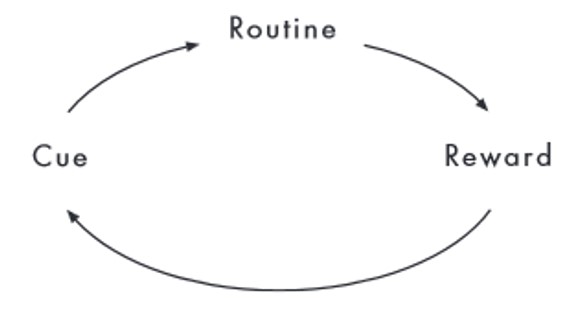
His New Year article on Seven Principles of Habit Change comes at a great time. Sande talks quite kindly about how we develop habits and what it takes to change them. His first principle of habit change gives us a look at the cycle of habits – the cue, the routine (or response), and the reward. Anyone who loves chocolate can understand this easily. For me, in eating sugar (or in overeating, in general), the cue could be a number of things – fatigue, anxiety, loneliness, presence of yummy food. It never takes much to send me to the refrigerator or pantry. The routine: feed the cue, whatever it is…with high-carb oral gratification. The reward: a brief soul satisfaction and temporary relief from whatever was the cue.

Blog - Habit Change - relational wisdom 360Photo Credit: Relational Wisdom 360

In my two seasons of not eating added sugar, I actually followed Ken Sande’s principles below (without knowing the wisdom of it).

  1. Every habit has three parts: a cue, a routine, and a reward.
  2. You can change an undesirable habit by keeping the cue and reward but learning a new routine.
  3. The best way to overcome the temptation to revert to old routines is to have a detailed action plan.
  4. Habit change builds momentum if you can change a single “keystone habit” and then continue to build on consecutive “small wins”.
  5. Will power is like a muscle: it can be strengthened and yet needs to be exerted strategically.
  6. Faith is an essential part of changing habits.
  7. Habit change is more likely to occur within a community (even if it’s just two people). – Ken Sande

[If any readers want to talk further about habit change regarding sugar addiction, I would love the exchange, either through the comments or email.]

Self-awareness is a huge factor relating to habit change. I can see that more now having come through seasons of looking at my own habits.

“Self-awareness is defined as conscious knowledge of oneself; it’s a stepping stone to reinventing oneself, learning to make wiser decisions, and helps you tune into your thoughts and feelings. So often we place blame on externalities because it’s the easiest excuse, when in fact we should be thinking about our thinking, reflecting, trying on different perspectives, and learning from our mistakes.” – Paul Jun

Matt Monge wrote a great piece on 13 questions we might ask ourselves to better understand why we do what we do. He is applying these questions to leadership and workplace, but they apply as well to habits. Also, in researching for this blog, I came upon this YouTube video of David Wallace Foster giving a commencement speech on awareness. Really thought-provoking as well as entertaining.

It is possible to affect true habit change if we are willing to take a studied look at ourselves – our awareness and our engagement with making choices/decisions and within relationship. I used to think that self-awareness was morally charged, i.e., it drove us to becoming more self-centered. That doesn’t have to be the case. When we take time to really examine where our minds go, through the day, we can train our thinking toward what matters most to us – related to people, resources, and life purpose.

When we are willing to do that, New Year’s resolutions can become much more life-changing than just going off sugar for a few weeks. These same habit change principles can apply to anger issues, pornography, other addictions, and pretty much any habitual process that negatively affects your work, relationships or general peace of mind.

I’d like to close with Ken Sande’s thoughts on taking self-awareness to other-awareness and God-awareness:

“The better we know and follow God (God-aware, God-engaging), the more we will know and discipline ourselves (self-aware, self-engaging), which opens the way for us to better understand, relate to, and serve our neighbors (other-aware, other-engaging).

To close the loop and spur us on developing relational wisdom, the Lord promises that the more we obey his command to love our neighbors, the closer we will draw to God himself (John 14:21-23). Thus, relational wisdom is a circle of interrelated skills that continually fuel one another.” – Ken Sande

Blog - Relational Wisdom - Ken SandePhoto Credit: RelationalWisdom360

Do You Want to Change Your Habits? – Relational Wisdom – Ken Sande

Seven Principles of Habit Change – Relational Wisdom – Ken Sande

13 Questions to Increase Your Self-Awareness – The Mojo Company – Matt Monge

Why Self-Awareness Is the Secret Weapon for Habit Change – Paul Jun

This is Water – David Foster Wallace on Awareness

RW Acrostics in Action – Relational Wisdom – Ken Sande

Need Help With Your New Year’s Resolutions? – David Lose

Monday Morning Moment – A Word of Wisdom for the New Year – Holding Onto Good Employees

Photo Credit: Forbes

It’s the end of the year…anyone who is able is grabbing those vacation days and running with them. Probably few people are reading leadership posts this week, but even on end-of-year time off, I still think about the workplace. Occupational hazard (so to speak).

Thinking about the coming year always sets momentum for change for me. Not just wishful New Year’s resolutions…but actually taking strategic steps toward some change or another. When I came across Ron Carucci‘s post this week on leadership, he got me thinking about what keeps us on our jobs…and what causes us to pull away.

Thinking about work, we gravitate to what challenges us more than what satisfies us. Having interesting work, close colleagues, and a good boss would be a wonderful way to start the new year. If that’s your situation, then you should be off sipping hot cider, head in that new book, or playing games with your grandchildren.

If the challenges of your job are causing you to rethink whether to stay or look for other work, take some time to evaluate what is it that would put you on such a course of action. Having a job at all is no small thing. Go slowly in changing course and know, for sure, why you would make such a change.

There’s a cliché that surfaces in leadership articles (like the ones linked below) which speaks to the reasons why employees quit. It goes something like this: “People don’t leave jobs; they leave managers.”Photo Credit: Pinterest

Bosses have their own struggles – balancing the bottom line with keeping their employees equipped and engaged. It can be complicated to keep the customers, employees, and investors all pleased with their efforts and the product/service provided. Still…it is those in leadership that have the onus of keeping the best employees on the job.

So much has been written about this, because losing good people is hard on everyone in the workplace. Carucci talks about the three types of power that bosses wield: positional, relational, and informational. Using their power, managers can do much to assure fair treatment throughout divisions, to invest personally in individuals and teams, and to keep information pathways open and multi-directional. Read more of Carucci’s advice here…and here.

I’ve had some great bosses across my career – bosses that made me want to stay even when the work had become too hard or too same and colleagues had become too wearisome (or maybe it was me). There were times I stayed because of my relationship with that boss.

One of those bosses was Mary Florence Woody. In my first job after graduate school, she was the director of nursing of an 1100-bed inner-city teaching hospital. I interviewed with her for the oncology clinical specialist job. In my mid-20s, full of youth and confidence with little understanding of how much I didn’t know, I presented myself to this great lady. She was a giant in nursing in those days, and for all of her career actually. She asked me big questions that day and listened deeply, and somehow I got that job. It was a tremendous launch into a profession that was very kind to me.

Photo Credit: WHSC

Ms. Woody gave me some great counsel that day. She told me not to let my youth or inexperience define me. “If you determine to get to know and revere the people and their work, at all levels, then respect and regard will be returned to you.” Over the whole of my seven years working there, in the role of educator and practitioner, I did as she had advised. Mopping up spills, delivering food trays, making beds, troubleshooting equipment, rounding with physicians, nurses, dietitians, and chaplains. In whatever capacity the patients were served, I tried my hand at it. Not always well…but with persistence. That’s how I learned how valuable each person was on the team…and it helped me have perspective on the piece of care I provided as well.Photo Credit: Massey

Mary Woody helped me from that first day. Did we hang out together? Absolutely not. She had enormous responsibilities and time constraints, but she communicated what mattered.  Ms. Woody cared about her employees and it was obvious to all of us. She also let us find our own way, but not without applying her position and influence on our behalf.

Was I a “keeper”? Not sure…but I never had to guess whether Ms. Woody had confidence in me. She did…and the strength of that kept me out of the ditch for months into that new role. In fact, opportunities came my way that I could never have imagined. Thanks to Ms. Woody and other colleagues like her, I left that job to teach at Yale University…having so much more to offer than before.

All that to say what? When we look to the future as to whether we stay in a job or leave for another one, we must reckon with what matters most to us. There is no guarantee we won’t find a similar set of circumstances in the next job, so there’s that…

I hope you’ll read the Carucci, Bradberry and Myatt articles below. They all resonate with the same message, just different aspects of it. What can make a difference in keeping quality personnel on the job? Care and control are the critical components – more caring and less controlling. Something we can all consider in the new year…whatever our position…

Photo Credit: LinkedIn

Hold onto that resignation letter for a bit.  What would compel you to stay? When the right next job presents itself, take it…absolutely …but know for sure why you’re leaving this job. Then leave burning as few bridges as possible…like Jon Acuff advises, “Make sure you leave with one finger raised high: your thumb. As in, ‘Thumbs‑up guys. Thanks for letting me work here. I’m off to a different adventure, but you guys are awesome.'”

If you stay, maybe you can influence others by genuinely caring for them and by letting go of some control yourself. If your boss struggles in these areas, she could learn from you. Who knows?

Happy New Year…done with thinking about work for today… Bring on the apple cider.Photo Credit: Foodie Misadventures

Bad Mistakes That Make Good Employees Leave – Travis Bradberry

9 Things That Make Good Employees Quit – Travis Bradberry

10 Reasons Your Top Talent Will Leave You – Mike Myatt

Monday Morning Moment – Them and Us, How Can That Be? Could Them and Us Become a We?

Blog - Work Culture - delta7Photo Credit: Delta 7

From the archives:

Recently, I was in an odd conversation with a friend from work. The more we talked, the more we sounded like a Dr. Seuss book. It went something like this:

“I don’t know how to be us with them. To be with them is to just be them. We must lose us; us no more will be. There’s no us in them; it’s so strange to me. How can they be them, with no us, you see? To give up us is too hard for me. So I can’t see a way to get to we.”

[Seriously, the conversation went like that…but better.]

Battling the us-them assignation is an ongoing workplace discipline. Even in the happiest, coolest companies, there is still an intentionality to keep work life positive for every employee. That inclusiveness is a hallmark for high morale and low walls (read: no silos).

BLog - Us vs Them - Work Culture - Silos - prolearn academy

Photo Credit: Prolearn-Academy

In a work culture where silos still exist, an us/them mentality can grow as each team or department draws in on itself and ignores or suspects the actions/values of others. It’s not a healthy situation for any of us…whether it’s the executive team insulated from others or the [fill in the blank] team hunkered down in its own mode of trying to survive. The first can be as unaware as the subject of the story “The Emperor’s New Clothes“, the second, well, is just miserable, and growing more so by the pay period.

So much has been written on this problem in the workplace – about that culture where us/them thinking and operations color productivity and morale. I have included several links below describing various recommendations and protocols to restore health to such organizations.

Blog - Work Culture 2Photo Credit: My Turnstone

I’ve always been that person who says, “Why can’t we just all get along?” In reality, we don’t have that situation always, but we can grease the tracks in that direction. Here are my own workplace rules regarding moving us and them to we:

  1. Make a practice of assuming the best of your bosses and colleagues. “Refuse to think ill of others” is my goal…and my accuracy in hitting that goal comes with practice and determination…and grace.
  2. Lean in to those with whom you struggle the most – the “thems” in your worklife. Especially the most powerful ones. Study them. Learn their language. Know them as well as you can. NOT for self-serving reasons, but for the benefit of the work itself. Any motive that only serves your personal situation will only make matters worse… ‘Nuff said.
  3. Refuse to get caught up in us/them complaining. Don’t make a big deal about it, but do your best to turn the conversation toward a positive end, change the subject altogether, or bow out if all else fails. Those negative conversations just bring you and your colleagues down and don’t accomplish anything. A short-lived “misery loves company” satisfaction isn’t worth the fall-out of such conversations.
  4. Bring down the silos, one brick at a time, if necessary. Maybe you aren’t experiencing any us/them anguish, but you know it exists. What can you do, individually and as a work team, to move to “we”? We have lots of work models out there for this. In fact, silos in the workplace are “so 80’s” (whatever that means…I hear it a lot, so I’m using it here). Use some of that meeting time, or talks over coffee, to be creative in how you can work better across teams…how you can learn more from each other…how you can defuse territoriality? If the “them” is management, you initiate dialog on setting work culture values that maximizes product excellence and employee engagement.
  5. Put processes in place – through your culture – to keep silos down. I would love to hear what your situation is and how you are making positive steps to grow/keep a healthy culture. Please comment below.

Sure…there are times we need to process a difficult situation at work with a trusted friend. Yes, us/them scenarios are painful…and wrong, honestly…especially in the workplace where we are meant to have shared goals, working toward the same outcomes. Maybe, the us/them relationships in a company are too distracting and we can’t see any solution (back to the Dr. Seuss-like conversation above). In that case, it’s possible we look outside our company for another situation. However, you take with you a piece of the us/them dilemma. You take you along to the next job. Better to develop muscle memory on how to “be we”, whenever possible, right where we are.

[Sidebar: I’ve written a lot about work culture – too many to mention – but you can search work culture under Blog – Deb Mills and learn as I have about what is possible if we stay engaged in our workplace.]

Blog - Work Place Culture - open.bufferPhoto Credit: Buffer

Overcoming Us vs. Them Challenges

Breaking the “Us and Them” Culture

How to Avoid Us vs. Them – Huffington Post

The 10 Buffer Values and How We Act on Them Every Day

The 4 Elements That Make Great Company Culture

How to Save a Broken Work Culture

From Us and Them to We Participative Organizational Culture

Them and us – How to use Trust as a Competitive Advantage

How CEOs Can End an Us Them Mentality

Us vs. Them – a Simple Recipe to Prevent Strong Society from Forming

Monday Morning Moment – Turning Around a Work Culture – From “Not Good Enough” to “Job Well Done”

blog-demanding-bosses-linkedin-dave-kerpenPhoto Credit: LinkedIn – Dave Kerpen

Aha moments can occur in all sorts of settings. My latest happened during our pastor’s sermon this week. Toward the end of a deep and fascinating exposition of Colossians 2, Pastor Cliff reminded us that we are not meant to earn God’s approval. He gives it unconditionally. Then Cliff talked about how we get caught in the trap of “It’s never enough!” when thinking of our efforts or accomplishments. Then “It’s never enough” or “Not good enough” too easily turns into “You’re not good enough.” This is the place where what we do intersects with who we are…

Switch from the Sunday Bible lesson to the Monday workplace application. I’m not talking the unconditional love of God here, but what happens to us in continuous feedback loops. Stay with me…This made me think uncomfortably about the way I once operated in the area of idea generation and innovation.

I am “an editor”…it gives me great satisfaction to take a document or process and make it better. Recently a friend asked me to edit his manuscript. It’s going to be such a great read…can’t wait for it to be published. Still, there will be lots of edits. For me, being an early reader, I just took care of some grammar and flow issues. There will be more qualified editors down the road. It’s enough for me to do quick, elementary edits and wildly praise the author and his riveting storyline, cheering him on to the next steps of publishing.

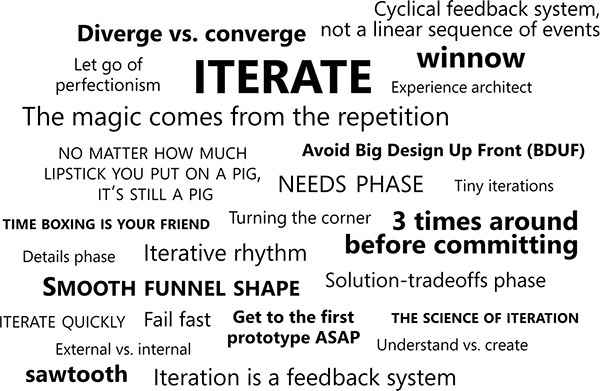
The tweaking that I used to do regularly in my earlier professional life was more intense in those days…and less forgiving. I wanted it (whatever it was) to be right, and it was my immodest opinion that I could get it to right. Especially when evaluating someone else’s work (ironically, I was less hard on my own work – figuring it was perfect already, right? Sigh…). The tweaking of another era has come round to a newish process called iteration.

One definition of iteration is the “process of learning and development that involves cyclical inquiry, enabling multiple opportunities for people to revisit ideas and critically reflect on their implication”. These feedback loops are meant to be fast-paced with the finish in view.

ScenarioPhoto Credit: SafariBooksOnline

Where iteration (or tweaking) breaks down (if I might be so bold) is when it’s taken well past rapid feedback loops into a realm of fine-tuning that has the team guessing “will it ever be good enough?” Product design and process development are vital to any company, but what we must also consider is the team or personnel involved.

If the feedback loops relate to the launch of a new product or a new business process, excitement and brainstorming are part of the momentum. Continuing to tweak over months instead of weeks before the launch can take a negative toll on the team. No one wants to forfeit excellence, but we don’t want to lose excellent personnel either.

blog-demanding-bosses-lifehackerPhoto Credit: Lifehacker

Trusting the judgment of our best thinkers is worth the risk of possibly releasing a product or service when we may not all be sure it’s “perfect”. That is what beta-testing is all about…the feedback that then comes to us from the consumer or user.

I’m really talking out of my element here (not being a designer or innovator so much as a lifelong learner). My leap from the sermon to the workplace relates to my own past struggle with wanting something with my name on it to be perfect while exhausting my teammates  with “what if we do this?” or “What if we say it this way?”

What a gift for us to take a well-thought-out proposal and, instead of putting it through the “just not good enough” wringer, we read it and pass it back to that colleague and say, “Good job”…empowering them to execute the proposal. How often does that happen these days?

Please share stories [in the Comments] of work situations where you experienced genuine affirmation for a job well-done.

Recently when water started backing up into the kitchen sink, I was afraid that it was something I had done. Too liberal using the disposal, for instance. Dave was out of town and nothing I could do would remedy the situation. Finally, on a Sunday afternoon, in desperation, I called our plumber (Richmonders, if you need a good plumber, email me, and I will give you his contact info). He came and fixed the problem, and best of all, it wasn’t my fault, after all. This young man literally LOVES his job and was kind to take the time, after he was off the clock, to give me the breakdown of what the problem was. What he charged me? Worth every penny…especially the part where it wasn’t something I had done wrong.

Why I bring this up is that being a fairly capable and creative person doesn’t prevent me from faltering at the likelihood that I messed-up.  See the Imposter Syndrome. My mental wiring is such that I get discouraged when my contribution to a situation actually causes more work for someone else, adds expense, or slows down progress. I’ve learned over the years that all that tweaking I may not have taken the product from good to great, and most assuredly caused some amount of frustration to hard-working, quality colleagues. Lesson learned.

There are times and seasons when tweaking is appropriate in developing a product and changing a business process. What we want to take into account is the cost of that tweaking, or iteration, on the people who make things happen in our workplaces. Free them from the “not good enough’s” to enjoy the fruit of “jobs well done”.blog-demanding-bosses-the-musePhoto Credit: The Muse

10 Tips for Dealing With an Overly Demanding Boss – Jacquelyn Smith

How to Get Over the Feeling that You’re Not Good Enough for Your Job – Michele Hoos

10 Things You Can Do to Get Out of Your Boss’s Doghouse – Brian Dodd

Why Incentive Plans Cannot Work – Alfie Kohn – Harvard Business Review

Good Is Not Good Enough: The Culture of Low Expectations and the Leader’s Challenge – Karlene M. Kerfoot

Innovation and Iteration: Friends Not Foes – Scott Anthony – Harvard Business Review

Holding a Team Retrospective – Morale

Workplace Bullying: Protecting Yourself at Work – Slideplayer

Monday Morning Moment – People You Love Working With – and Becoming One of Them

blog-likable-guys-at-work-askmenPhoto Credit: AskMen

It’s Monday morning and whatever you’re facing today, these folks help to bring down your stress and lighten your load…just by being in your path. You can name them easily. They are the ones who make you laugh and see a different side to your situation. They are the ones who give you second thoughts when considering a job change. They are the ones who add value to you, not just as a colleague but as a real in-the-skin human being. These are the folks who can turn the course of your day with just a few minutes conversation…or even a wave from across the parking lot. It’s just that simple.blog-likeable-cowoers-muffy-bennettPhoto Credit: Mashable

For you guys in a dark place…and not one person comes to mind…maybe, it’s good to think back…to people in your past who helped set you on a positive course in your career…think of those people. If you are in a hole in your workplace right now, and many of us have been there at some point in our professional lives, could you rally and become one of these people who light up the place?

blog-likeable-coworkers

Photo Credit: Friendship.about

Here’s the challenge for today. I read an article by content strategist Scott Tousley recently which got me thinking about this.  Is it possible to become “a rising tide that lifts all boats”? If you’ve read this far, you probably are already that kind of person. However, if somehow you struggle with keeping fellow employees in your view while dealing with large-scale problem-solving, you might want to consider a personal assessment and do-over. It’s never too late.

Scott Tousley – who has the longest eyelashes and most infectious smile – also gets to live and work in San Diego, California. Besides all that, he writes really insightful articles about the workplace. His article, The 9 Habits of Insanely Likable and Charismatic People, is so good, I’m not going to write my own commentary on this topic, because you HAVE to go read his article. It lists the 9 habits (included below) with real-life anecdotes, brilliant support data, and links to read more. So don’t miss it – lightning-fast read for us visual learners.

Tousley’s 9 habits of insanely likable & charismatic people: 

1. They are empathetic

2. They are humble

3. They are vulnerable

4. They have a sense of humor

5. They are present

6. They are genuinely interested in EVERYONE

7. They avoid social narcissism

8. They are generous and altruistic

9. They reciprocate praise (and take blame)

Being likable and charismatic isn’t about being popular or climbing the career ladder as much as it’s about making a huge chunk of our lives just more enjoyable… We have choices here.

blog-likable-coworkers-the-question-academyblog-likeable-coworkers-amanda-gorePhoto Credit: The Question Academy; LinkedIn

If you had trouble calling to mind people you really like at work, then you’ve probably fallen down but you can get up! Don’t let that snarky, seemingly self-important coworker or boss mess with your head and steal your joy. Refocus to those in your workspace who you can’t help but be encouraged around them. Don’t miss them in that cloud of bother over the less likable ones around you. So what if they don’t seem to care about you or others at work. You be one who cares…and it can make a big difference. Take Scott Tousley’s excellent counsel in noting and affirming those likable ones around you…and set your course to return to being one yourself.

The 9 Habits of Insanely Likable and Charismatic People – Scott Tousley

4 Simple Questions That Will Instantly Make You More Likable at Work – Sara McCord

Being More Likable at Work – Cherie Burbach

10 Traits of Likeable People – Evan West

13 Habits of Exceptionally Likeable People – Travis Bradberry

How to Develop Your Charisma and Become More Likable – WATCH the Olivia Fox Cabane Video – Patrick Allan

How To Be More Likeable at Work – 10 Things To Do Today – G. L. Hoffman

YouTube Video – Amanda Gore – Stress Busters and Mood Management and Turning on the Joy Switch

Reformation Day – A Halloween That Changed the World

blog-martin-luther-reformation-day-prae-huPhoto Credit: Prae.hu

For by grace you have been saved through faith. And this is not your own doing; it is the gift of God, not a result of works, so that no one may boast. – Ephesians 2:8-9

On October 31, 1517, Catholic priest Martin Luther nailed a document known as his 95 theses on the door of the Wittenberg church. In this public stand against the Catholic practices of that day, he would divide Christianity into at least two camps – that of Protestants (the Reformers) and the Catholics.

Now we are on the eve of the 500th anniversary of the Protestant Reformation. Today, October 31 is known as Reformation Day…and, of course, Halloween.

October 31, for most, is a family/community cultural event (very different from the historical Halloween). Parties, dress-up, spooky decorations, and sweet treats.blog-halloween-2016

For those of us who are Christian, identifying more Protestant than Catholic, we wouldn’t want to miss the historic significance of this day as well.

Justin Holcomb‘s piece on the five solas lists the fundamental elements of the Christian faith (as put forth by the Reformers) and the substantiating Scriptures. Below are the five (see article for commentary and Bible verses):

  1. Sola Scriptura (“Scripture alone”): The Bible alone is our highest authority.
  2. Sola Fide (“faith alone”): We are saved through faith alone in Jesus Christ.
  3. Sola Gratia (“grace alone”): We are saved by the grace of God alone.
  4. Solus Christus (“Christ alone”): Jesus Christ alone is our Lord, Savior, and King.
  5. Soli Deo Gloria (“to the glory of God alone”): We live for the glory of God alone.*

[See links below for articles/resources on the full relevance of this day for us personally, for our families, and for culture, in general.]

Something else happening today that is redemptively newsworthy is the visit between Pope Francis and Bishop Munib Younan, head of the Lutheran World Federation. They are meeting today for an ecumenical prayer service in Lund, Sweden.blog-reformation-day-radiovaticana-munib-younan-and-pope-francesPhoto Credit: Vatican Radio

Pope Francis calls Christians, Catholic and Protestant, to lay down the division between them. He recently even commended Martin Luther for rebelling against a Catholicism that, at that time, was “no model to imitate”. He called for unity for the sake of peace-keeping efforts and humanitarian work and for the benefit of those experiencing religious persecution.

In all you might savor in this day, this 31st day of October, consider how Martin Luther changed a world, by taking a stand… Some of our children will choose to dress-up in super-hero costumes – taking on larger than life personas for the good of those around them. They are more like Martin Luther, in that, than they may know.

blog-halloween-martin-luther-costumeblog-martin-luther-legos-pinterest

Photo Credit: Pinterest; Pinterest

*5 Points From the Past That Should Matter to You – Justin Holcomb

5 Bible Verses to Read on Reformation Day – Andy Rau

October 31 – Halloween Dress-up and Reformation Day Stand-up – DebMillsWriter

Reformation Day: Resources to Help Us Remember – Desiring God

Man Between God and the Devil: Martin Luther and the Reclamation of Halloween – William E. Flippin, Jr.