Category Archives: Purpose

Monday Morning Moment – the Power of Acknowledgement

Photo Credit: Pinterest

A pastor friend of mine, Dave Lyle, posted about an encounter he recently had with a homeless man. The man did not ask for money. He just wanted Dave’s opinion on something. As Dave came closer, he noticed a large kitchen knife on the bench near the man, so he kept some distance. It turns out the man was once a chef, thus his knife, and had come on hard times. Homeless for the last 10 years. In Dave’s post, he had noted several other people who passed the man without looking his way, treating him as if he wasn’t really there.

“To acknowledge another person costs you nothing” was Dave’s observation.

Pastor Dave’s story reminded me of a man who “begs” on a busy corner in our city. I put the word “begs” in quotes because he doesn’t really ask for anything. He stands there with a cardboard placard with words of encouragement and affirmation on it for those waiting at the traffic light or driving by. His words are the substance of “a rising tide lifts all boats”. I wonder if, given another set of circumstances, he wouldn’t be a department head or even a CEO. He has given me more impetus to always have food in my car to give to people, like him…especially him. He is a great example of how acknowledgement can affect mindset and action.

Author and trainer Judith W. Umlas has written an excellent book on this subject: The Power of Acknowledgment (©2006 IIL Publishing, New York).

The website for her Center for Grateful Leadership extensively covers the topic of acknowledgement (at work and life, in general).

Her 7 Principles of Acknowledgment follow in brief:

  1. The world is full of people who deserve to be acknowledged…start by practicing your acknowledgment skills on people you don’t know very well, or even know at all. [Acknowledging those you most care about will follow easily.]
  2. Acknowledgment builds intimacy and creates powerful interactions. Acknowledge the people around you directly and fully, especially those with whom you are in an intimate relationship. Look for ways to say how much you value them, and then be prepared for miracles!
  3. Acknowledgment neutralizes, defuses, deactivates and reduces the effect of jealousy and envy! Acknowledge those you are jealous of, for the very attributes you envy.
  4. Recognizing good work leads to high energy, great feelings, high-quality performance and terrific results. Not acknowledging good work causes lethargy, resentment, sorrow and withdrawal. Recognize and acknowledge good work, wherever you find it.
  5. Truthful, heartfelt and deserved acknowledgment always makes a difference, sometimes a profound one, in a person’s life and work.
  6. It is likely that acknowledgment can improve the emotional and physical health of both the giver and the receiver.
  7. Practice different ways of getting through to the people you want to acknowledge. Develop an acknowledgment repertoire that will give you the tools to reach out to the people in your life in the different ways that will be the most meaningful to each situation and each person.

Acknowledgement is more than a compliment or positive feedback. It also has much greater impact that “criticism, finding fault, or saying nothing at all” (see links below). Acknowledgement demonstrates, whether talking to someone you know or a stranger, that you see the person. You truly see them and you see something they are doing that has meaning and gives meaning. You acknowledge, whether it is small thing or large, how that person, in that moment, had influence in your life…or that of others.

The Power of Acknowledgement – Part 1 – Alison Whitmire

The Power of Acknowledgement – Part 2 – Alison Whitmire

Acknowledgement communicates a genuine felt experience. To truly acknowledge someone, we must step into their space. We must pause our agenda. We must search for words to express what just happened for us. Finally, we engage bodily with our words (by this I mean our non-verbal communication aligns with what we are saying). We lean in, give eye contact, and tune our facial expression to what we want to express.

Acknowledgement then is best given in person. However…it can be done via other communication mediums. We can be creative, but the main point of all this is to go the extra mile and not let opportunities for acknowledging others pass us by. [The social distancing foisted on us by COVID has kicked to the corner much of the practice of acknowledgement. We are wise to shake off our doldrums and reestablish these practices.]

Is it your practice to regularly (honestly and in a timely fashion) acknowledge those in your lives who have made a difference? These may be close colleagues, near family, or even essential workers we see regularly and the occasional stranger we may meet only once.

Photo Credit: IZ Quotes

To close, I want to give a shout-out to this one guy I know. He is an off-the-chart introvert, but he regularly and without hesitation uses his voice to give acknowledgement to folks in his work (and life). Often, it comes on the heels of praise he is receiving for some innovation or decision made at a point of crisis. He passes that praise on to those who, in his reckoning, made possible the culmination of an excellent work. I have actually counseled with him to take the acknowledgement himself from time to time, but he is unmoved. In a culture where we are elevated because of ownership of ideas and our confidence in ourselves, he and others like him give the most relatable picture of “it takes a village”.

Photo Credit: Twitter

So…are you the glad recipient of acknowledgements in your workplace or home space? How do you practice acknowledgement in these challenging days – when eyes meet less, heads are down, and we have too often insulated ourselves to task, tribe, or timetable? Please comment below.

5 Friday Faves – New Year’s Resolutions, Habit Planner, Year-End Review, Word for the Year, and the Last Days of 2021

2021 is rapidly winding down. Whew! Here are my Friday Faves to get us ready for the new year…hopefully a joyful one!

1) New Year’s Resolutions – 2021…the end is in sight. What do we do with this new year ahead? Do we revisit those habits we thought about changing up in this tumultuous year? Maybe so. Or maybe we didn’t alter course so much for good reason. Let’s give pause a moment and consider…

Photo Credit: David Lose

Monday Morning Moment  – 2021 Come On! – New Year’s Resolutions

Are We Doing New Year’s Resolutions After a Year as Lousy as 2020? There’s One I think We Need More Than Ever – Heidi Stevens

How to Make Healthy, Attainable New Year’s Resolutions During COVID-19 – Ashley Welch, Healthline

Are You Making a New Year’s Resolution This Year? Readers Weigh In – Sarah Fielding

I take New Year’s resolutions very seriously. They have served me well through the years in shaking up troublesome habits as well as galvanizing better ones. New (or restored) habits that nurture the body, the spirit….and, when possible, family and community.

New Year’s resolutions are not always exercises in futility. They can be excellent pathways to help us get off to a strong start into the next year. Some of my family and friends treat resolutions with disdain…they never work; they never last. Oh, but not always!

They are really very energizing. Whether we meet our goals or not, there is great promise within the resolution for resetting our thinking. A keen sense of self, or self-awareness, aids in our understanding of habits and true habit change.

Without knowing it, I have actually used a practice of habit change that Ken Sande writes about on his blog, Relational Wisdom 360. He first influenced my life years ago with his work on conflict resolution through his Peacemaker Ministries. He is a gentle guide in many of the issues that complicate our lives.

His article on Seven Principles of Habit Change came at a great time. Sande talks quite kindly about how we develop habits and what it takes to change them. His first principle of habit change gives us a look at the cycle of habits – the cue, the routine (or response), and the reward. I actually followed Ken Sande’s principles below (without knowing the wisdom of it).

  1. Every habit has three parts: a cue, a routine, and a reward.
  2. You can change an undesirable habit by keeping the cue and reward but learning a new routine.
  3. The best way to overcome the temptation to revert to old routines is to have a detailed action plan.
  4. Habit change builds momentum if you can change a single “keystone habit” and then continue to build on consecutive “small wins”.
  5. Will power is like a muscle: it can be strengthened and yet needs to be exerted strategically.
  6. Faith is an essential part of changing habits.
  7. Habit change is more likely to occur within a community (even if it’s just two people).Ken Sande

Self-awareness is a huge factor relating to habit change. I can see that more now having come through seasons of looking at my own habits.

“Self-awareness is defined as conscious knowledge of oneself; it’s a stepping stone to reinventing oneself, learning to make wiser decisions, and helps you tune into your thoughts and feelings. So often we place blame on externalities because it’s the easiest excuse, when in fact we should be thinking about our thinking, reflecting, trying on different perspectives, and learning from our mistakes.”Paul Jun

It is possible to affect true habit change if we are willing to take a studied look at ourselves – our awareness and our engagement with making choices/decisions and within relationship. I used to think that self-awareness was morally charged, i.e., it drove us to become more self-centered. That doesn’t have to be the case. When we take time to really examine where our minds go, through the day, we can train our thinking toward what matters most – related to people, resources, and life purpose.

New Year’s Resolutions and Reality Checks – Wally Bock

When we are willing to do that, New Year’s resolutions can become much more transformative than just a few weeks of good intentions. These habit change principles can apply to anger issues, pornography, other addictions, and pretty much any habitual process that negatively affects your work, relationships or general peace of mind.

Consider these questions as you think on resolutions for 2022:

  1. What do I want to keep from the changes I made to cope with the pandemic?
  2. What do I want to reclaim from the pre-pandemic time?
  3. How would I “build back better” if I were in charge of the world or my neighborhood?Katherine Arbuthnott

Four years back, our pastor Cliff at Movement Church challenged us to commit to some resolutions to the Lord…together [podcast of 12/31/2017 here].  I have kept the resolutions made that day in a visible place, to be reminded of the good change in life, and the struggle… I still have them in view…four years out. Still relevant to now. For 2022, on it again…plus prayer for wisdom how to be creative and intentional, given COVID’s continued intrusion. And also added this year: writing my life’s story (capturing the memories and maybe restoring/refining some as I write).

Jonathan Edwards, the great 18th century preacher and theologian, definitely understood the importance of praying through and writing out resolutions that would inform his daily life. Over the course of several months, he composed seventy resolutions for life. You can read them here. The five resolutions I made during church on a New Year’s Eve are weighty enough for me…can’t imagine 70! Edwards just gives an example of a man who, even as deeply devoted as he already was, did not want to miss God in a busy life of ministry. Nor did he want to miss the people God placed in his life.

Resolutions help us to keep the main thing the main thing. Sure, we may struggle to keep our bodies and houses in order. Those are temporary situations. Where we hope most to be successful is in keeping our hearts tuned to what matters most. Going deep with God and others. Even in the face of a continuing pandemic...if we are ruthless and wise, and don’t give in to another year of listlessness and waiting.

We’ve already enough of that…coming up on two years.

I am resolved…

Photo Credit: Reformed Outfitters

Resolved – The Resolutions of Jonathan Edwards

Do You Want to Change Your Habits? – Relational Wisdom – Ken Sande

Habit Change is a Team Project – Ken Sande

Seven Principles of Habit Change – Relational Wisdom – Ken Sande

Make Habits, Not Resolutions – Justin Whitmel Earley

Why Self-Awareness Is the Secret Weapon for Habit Change– Paul Jun

RW Acrostics in Action– Relational Wisdom – Ken Sande

Ten Questions for a New Year – Don Whitney – Desiring God

Need Help With Your New Year’s Resolutions? – David Lose

Understanding True Habit Change and Rocking Your New Year’s Resolutions – Deb Mills Writer

2) Habit Planner –Anyone who knows the writing of Justin Whitmel Earley knows his commitment to a life well-lived. He is determined to live intentionally, not leaving the substance of his life to outside powers or sloppy habits.

Unlike resolutions, we actually become our habits. There are no changed lives outside of changed habits. And if we want to actually change, we need to take a sober look at where our habits are leading us.”Justin Whitmel Earley

Habits are the little things we do over and over without thinking about them. And the tiny and subconscious nature of habits makes them powerful. Why? Because they create our “normal.” Normal life is what stays with you from January through December. Normal life is what shapes your kids, your body, your schedule, and your heart.”Justin Whitmel Earley

His two books – The Common Rule and Habits of the Household – lay out a simple path for examining our current lives and then setting strategy for habit change. So accessible and engaging whatever our preferences for methods are. If spreadsheets help, he has one for you. If you need a more fuzzy-boundaried approach (that would be me), you can glean from his wisdom, and alter course accordingly.

Below are his own examples of the habit planner. I appreciate his heart so much. He helps us all he can (in his books and free resources):

Photo Credit: Justin Whitmel Earley, Screenshots

Habits of the Household – Habit Planner – pdf – Justin Whitmel Earley

Make Habits, Not Resolutions – Justin Whitmel Earley

Unlock the Power of Family Habits in 2022 – Justin Whitmel Earley

3) Year-End Review – Business writer Stephen Jones shares author Tim Ferriss’ practice of doing a quick past year review. Ferriss prefers this over new year’s resolutions, and Jones gives a quick snapshot of his 5 steps.

Below is Tim Ferriss’ guide for a past year review from his own blog (and podcast):

  1. Grab a notepad and create two columns: POSITIVE and NEGATIVE.
  2. Go through your calendar from the last year, looking at every week.
  3. For each week, jot down on the pad any people or activities or commitments that triggered peak positive or negative emotions for that month. Put them in their respective columns.
  4. Once you’ve gone through the past year, look at your notepad list and ask, “What 20% of each column produced the most reliable or powerful peaks?”
  5. Based on the answers, take your “positive” leaders and schedule more of them in the new year. Get them on the calendar now! Book things with friends and prepay for activities/events/commitments that you know work. It’s not real until it’s in the calendar. That’s step one. Step two is to take your “negative” leaders, put “NOT-TO-DO LIST” at the top, and put them somewhere you can see them each morning for the first few weeks of 2022. These are the people and things you *know* make you miserable, so don’t put them on your calendar out of obligation, guilt, FOMO, or other nonsense.

We do a year-end review but not in order to plan out the next year. Mostly to celebrate the year rapidly coming to an end and to reflect on how we might reorder the course of the next year (re the negatives).

A creative friend of ours put his “year-end review” into a cool video:

Photo (Video) Credit: Todd AO, Facebook

4) Word for the Year –A year ago, I read Debbie Macomber‘s book One Perfect Word. She tells fascinating stories of persons’ choosing a word to guide their year. Finishing her book and praying a bit, the word compassion became my focus. 2021 was a good year for that as we dealt with so many divisions over COVID, race, politics, etc. Compassion for all on both sides of each issue.

At first I wasn’t going to do “a word” for 2022, and then a rapid series of “coincidences” drew me to the word: joy. As this year ends, I’ve become negative and even a bit cynical. Still having faith in God but not so much in humans, including myself. Even after a year of compassion!!
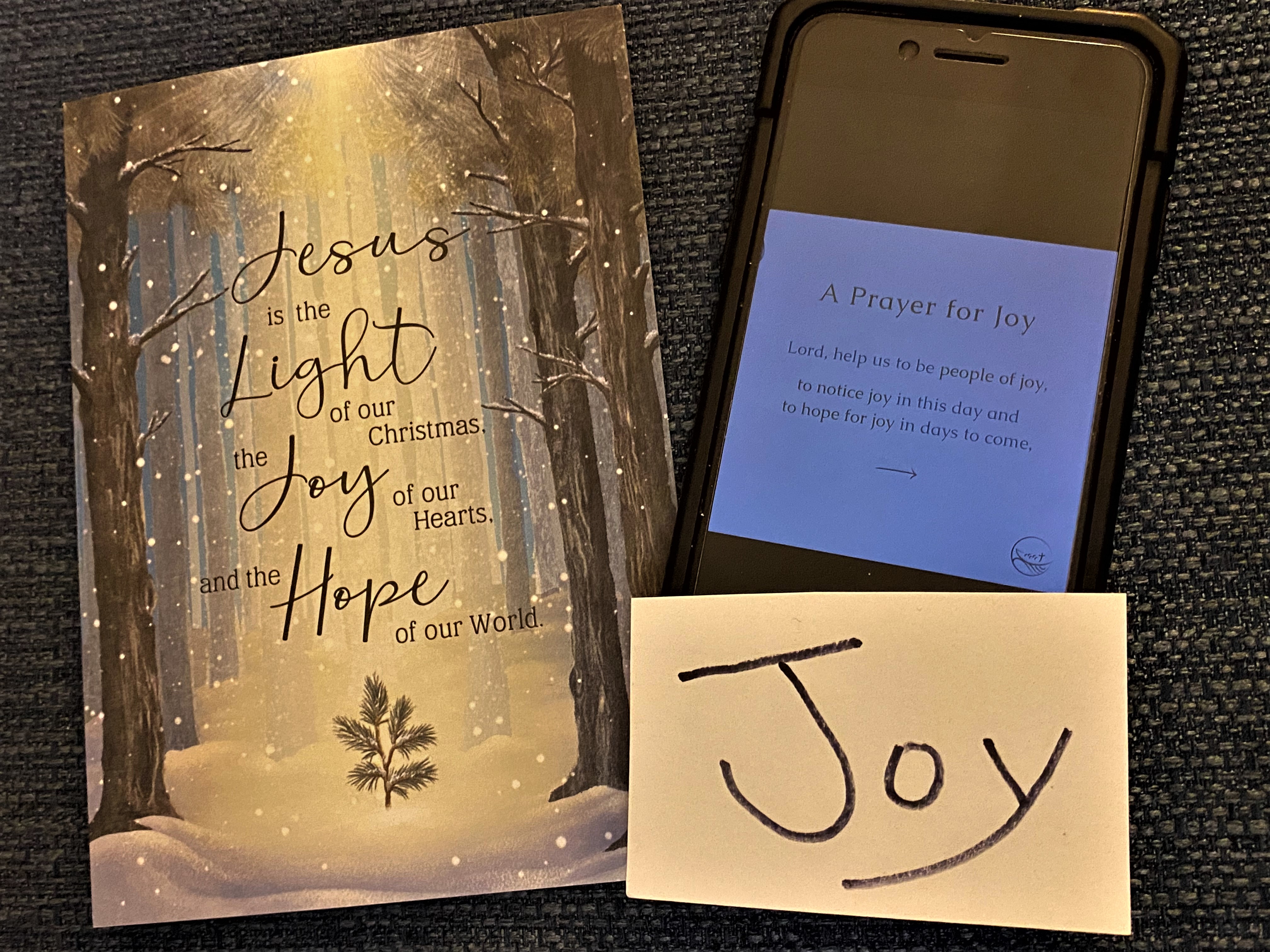
It dawned on me that I haven’t been “counting it all joy”. Or remembering that “the joy of the Lord is my strength”. Now my heart is resolved to be set on joy in 2022…no matter what.

Lord, help us to be people of joy,

to notice joy in this day and to hope for joy in days to come,

to look for light and share it with others this Advent season,

to see beauty in creation and the people we encounter,

to laugh heartily with childlike glee,

to feel true joy in your presence.     Amen.

Photo Credit: Prayer @inthecoracle, Instagram

5) The Last Days of 2021 – As may have been many of your experiences, we had people we know and love dealing with COVID in this last week of 2021. Still managed a sweet end-of-year. Hope yours was as well.


Now on to 2022!! Thanks for stopping by. It means a lot to me.

Bonuses:

Vimeo Video by Rodrigo Souza – Heart – with Nathan Mills, Beyond the Guitar

How to Stop All Procrastination: Dear You Trying to Do that Hard Thing in the New Year – Ann Voskamp (great piece on procrastination and perfectionism – both keeping us from presenting the gifts God’s given us)

Photo Credit: Samantha Reynolds, @Bentlily, Instagram (w/ permission)

52 Week Bible Reading Plan – Michael Coley

What is an Accessory Dwelling Unit (ADU) and Tips for Building One

Photo Credit: Facebook

Monday Morning Moment – Walled In, Dismissed, Frazzled, and Discouraged…Nevertheless

Photo Credit: Heartlight

What’s your situation? How’s your heart? What is your body holding onto? Remember when you were so full of the possibilities of life, so fresh with anticipation of what was ahead, what you could accomplish?

Then life happens, and it doesn’t always work out like you thought it would. Running turned into slogging. Your passion got sucker-punched. The opportunities and advancements kept coming in, but at some point, bewilderment set in. You just got tired…just plain weary.

Some call this burnout, and it may be. What if it is more than that? What if it is a bloody battlefield where, if not our very lives, our joy is under full attack. What if those God-given strengths, those life-honed skills, and serendipitous accomplishments seem not to be at play. Maybe you’re overthinking, or maybe…just maybe…the way through is surprisingly simple.

We all have an important place to occupy in this world. Every single one of us. Fight for it. Walls may seem high, bottlenecks too narrow, and, at times, adversaries hammering around us. Nevertheless…We can find a way to bring the walls down (or just go around them), squeeze through the bottlenecks, and shake off the idea that we can’t win…just. too. tired.

Circumstances in life and work can drain us. Especially over time. Oddly we can still be effective in life but the emotional, mental, and physical toll adds up. The body remembers…and keeps score.

Jesus gives us a beautiful and intimate picture of the “nevertheless”. The night before he would die on a Roman cross, he appealed to the Father, as his painful and humiliating death loomed ahead of him.

Photo Credit: Biblepic

Nevertheless…here was the Messiah, the Christ, in all the sinless perfection of his life, coming to the very end of himself. Exhausted, emotionally overwrought, yet clear-minded, understanding exactly what would be required from him. Nevertheless…he stayed the course. He was not giving up. He knew what was at stake. He trusted the Father, and he persisted in what he was called to finish.

Photo Credit: Leonard Ravenhill, QuoteFancy

For us, we have choices. We can resign ourselves to a life and work not what we anticipated…or we can clear our heads and remember our own callings. No walls are too high nor adversaries too strong.

Photo Credit: Biblepic

We each bring something to the table. If we withdraw from the table or accept a perceived exclusion, we can miss the fullness of life we were meant to have. Others will miss us as well. Believe that. It’s true.

When fatigue and discouragement set in, and our bodies are drained of response, we need to take hold of the “nevertheless”. It’s reminiscent of the many “but God’s” in Scripture and in life. We may be up against a Red Sea like Moses, or a Goliath like young David, or a corrupting culture like Jesus. We lament “but God”…we are too inadequate. Too small. Too aware of risk. Nevertheless, our “but God’s” can change to what is truth. The meaning of the protest changes into the “but God” miracles when He shows up and does what only He can do…in us. Through us.

Photo Credit: Biblepic

Hoping you lean into the “nevertheless” today.

Podcast – Why Everyone’s Freaking Out (& Why We Don’t Need To) – David Marvin, Guest on Relatable Podcast with Allie Beth Stuckey

15 Proven Ways to Suck the Life Out of Your Staff – Scott Cochrane – applies to any workplace. Take note of the “Strategies To-Avoid List”.

6 Things That Can Suck the Life Out of You! – Dale Hudson (and Part 2 on his story and how he dealt with those things that sucked the life out of him – to get you started, they are: People, Problems, Pressure, Pace, Pain, and Personal Sin)

The Humble Rejoice – Rick Bee

Nevertheless – Robert Ferguson

Photo Credit: Pinterest

Worship Wednesday – Shame Faced – O Come to the Altar – Elevation Worship

Photo Credit: Heartlight

We have renounced secret and shameful things, not acting deceitfully or distorting the word of God, but commending ourselves before God to everyone’s conscience by an open display of the truth. – 2 Corinthians 4:2

Instead of shame, My people will have a double portion, and instead of humiliation, they will rejoice in their share; and so they will inherit a double portion in their land, and everlasting joy will be theirs.
 – Isaiah 61:7

For the Scripture says, Everyone who believes on him will not be put to shame.Romans 10:11

No wait. Don’t scroll by.

No shaming here. In fact, we may have stuffed our shame so deep inside ourselves, we are pretty sure it is ever someone else’s problem and not our own.

Wait though. We can know the beauty and freedom in life that comes from wrestling with shame…until it has no power over us. We may think it has no power over us when we tamp it down so effectively that others don’t see it…but we know it’s there.

Shame faced can be defused…and freedom follows. Beauty and fullness of life and relationships as well. Worth the vulnerability.

Until recently I didn’t think much about shame. I was more a guilt-driven person (rather than shame-driven), or so I thought. Guilt is more about doing bad, rather than “being bad” (which defines shame). However, now I see how we hide our shame and hope no one sees.

Canadian pastor Darryl Dash wrote this incredible piece on shame (linked below), taking us right from the beginning. You remember how Adam and Eve were described originally as being “naked but unashamed”? Can you imagine the beauty and freedom in that?

The Beginning of Shame (Genesis 2:24-3:10, 21) – Darryl Dash

Once sin entered, their eyes were opened…to what is now their reality. Naked and ashamed. Fearful. Wanting to hide. They were never meant to experience this darkness…this isolation from God or one another.

Dash reveals the impact of sin:

  • Shame is a result of sin — either ours, or someone else’s.
  • Shame isolates us. It makes us think that if others knew the truth about us, that they couldn’t possibly love us. It keeps us from being known and loved.
  • Shame damages us. Ultimately it can kill us.

Dash also writes about how our strategies to deal with shame only cause us to hide or avoid or attack (ourselves or others) – see graphic below from another source.

Photo Credit: The Compass of Shame, D. L. Nathanson, IIRP

Lastly, Dash reminds us of God’s glorious response to our shame – He pursues us and He clothes us.

Christian psychiatrist Dr. Curt Thompson has written an important, hugely insightful book on shame. The Soul of Shame. The quotes that follow are from this book and help put the pieces of our shame together in ways we can then open ourselves up to healing. Giving those pieces to God.

“When we experience shame, we tend to turn away from others because the prospect of being seen or known by another carries the anticipation of shame being intensified or reactivated. However, the very act of turning away, while temporarily protecting and relieving us from our feeling (and the gaze of the ‘other’), ironically simultaneously reinforces the very shame we are attempting to avoid…Indeed this dance between hiding and feeling shame itself becomes a tightening of the noose.  We feel shame, and then feel shame for feeling shame. It begets itself.”

“The defining relational motif for humankind is not that we need to work as hard as we can, or at least harder than we are. It is not to do our best or to guarantee that our children will have a better life than we had. It is not about being right or the acquisition of power. Each of those (and other versions like them) play into the hand of shame’s anxiety. No – rather, we were created for joy. Not a weak and watery concept of joy that merely dilutes our sadness and pain. Rather it is the hard deck on which all of life finds its legs, a byproduct of deeply connected relationships in which each member is constantly known.

“To relationally confront our shame requires that we risk feeling it on the way to its healing. This is no easy task. This is the common undercurrent of virtually all of our relational brokenness. We sense, image, feel and think all sorts of things that we never say, because we’re far too frightened to be that honest, that vulnerable. But honest vulnerability is the key to both healing shame -and its inevitably anticipated hellish outcome of abandonment -and preventing it from taking further root in our relationships and culture.

“Shame positions itself in such a way so as to keep borders tightly closed and vulnerability at a minimum.”

“In reality, vulnerability is not something we choose or that is true in a given moment, while the rest of time it is not. Rather, it is something we are. That is why we wear clothes, live in houses and have speed limits. So much of what we do in life is designed, among other things, to protect us from the fact that we are vulnerable at all times. To be human is to be vulnerable… Vulnerability is not a question of if but rather to what degree….in seeing the place of vulnerability in the pages of the Bible we cannot but help be amazed at its place and purpose. It begins in the beginning, where we are introduced to a vulnerable God. Vulnerable in the sense that he is open to wounding. Open to pain. Open to rejection. Open to death.

We deeply long for connection, to be seen and known for who we are without rejection. But we are terrified of the vulnerability that is required for that very contact...God does not leave. The loving relationship shared between Father, Son and Spirit is the ground on which all other models of life and creativity rest. In this relationship of constant self-giving, vulnerable and joyful love, shame has no oxygen to breathe.

 We have in Jesus one who was willing to put his naked vulnerability on full display, opening himself to all that we in evil’s employ could throw at him. He was the first to trust us with himself, revealing himself, risking abandonment in the process.” – Curt Thompson, The Soul of Shame

We all have shame and can keep ourselves tightly hidden in the comfort of this small group or that…or we can follow Jesus in His naked vulnerability. Recognizing (again) that we all have shame and we all need God and each other. What comes after is the life He means for us to have…not the smaller, hidden life we think is the only one possible. Oh, Dear One…it is meant to be so much more.

Worship with me. [Lyrics in the link]

Are you hurting and broken within
Overwhelmed by the weight of your sin
Jesus is calling
Have you come to the end of yourself
Do you thirst for a drink from the well
Jesus is calling

O come to the altar
The Father’s arms are open wide
Forgiveness was bought with
The precious blood of Jesus Christ

Leave behind your regrets and mistakes
Come today there’s no reason to wait
Jesus is calling
Bring your sorrows and trade them for joy
From the ashes a new life is born
Jesus is calling

O come to the altar
The Father’s arms are open wide
Forgiveness was bought with
The precious blood of Jesus Christ

O come to the altar
The Father’s arms are open wide
Forgiveness was bought with
The precious blood of Jesus Christ

Oh what a Savior
Isn’t He wonderful
Sing alleluia, Christ is risen
Bow down before Him
For He is Lord of all
Sing alleluia, Christ is risen

Oh what a Savior
Isn’t He wonderful
Sing alleluia, Christ is risen
Bow down before Him
For He is Lord of all
Sing alleluia, Christ is risen

O come to the altar
The Father’s arms are open wide
Forgiveness was bought with
The precious blood of Jesus Christ

O come to the altar
The Father’s arms are open wide
Forgiveness was bought with
The precious blood of Jesus Christ

Bear your cross as you wait for the crown
Tell the world of the treasure you’ve found*

[I love the whole of this song in dealing with shame. We hide our shame because we don’t want to confront the pain – either of our own sin or that of another. Following Jesus, receiving all He has for us, includes a cross. However, we never have to carry the cross – whatever it is – alone. He is with us all the way.]

*Lyrics to O Come to the Altar – Elevation Worship – Songwriters: Steven Furtick, Christopher Joel Brown, Mack Donald Iii Brock, Wade Joye

Breaking the Power of Shame – Jon Bloom, Desiring God

What Does It Mean to Be Approved of God? – Ed Elliott

20 Quotes from Curt Thompson’s The Soul of Shame

Monday Morning Moment – How Shame Affects Our Thinking and How We Can Break Free – Deb Mills

Shame is More Common Than You Think with Dr. Curt Thompson – Jennie Allen podcast

Monday Morning Moment – Gently Confronting the Conflict Generated by Reductionism (You Want to Know this Word)

Photo Credit: Quote Master

Today, I want to talk about reductionism – how we reduce a whole person into one part – one facet that we take great pleasure in mocking or deriding. Thinking highly of ourselves in the process. Don’t miss this! Here we go.

Pierce Taylor Hibbs is a writer, teacher, and gentle theologian. I came across a piece he wrote this past week, and it has brought such clarity to a murky subject. The piece is “Reductionism: the Disease that Breeds Conflict”.

Don’t let that big word reductionism put you off. Hibbs will define it, but first, let me give you a scenario or two where we have seen this in action (and when we might have added to the fire of such a situation). We’re at a party of peers. We feel comfortable to just say what we think about any number of people, policies, or processes. No filters. What kinds of things pop up in those conversations? Mind you…they all are met with heads nodding (or shaking), laughter, and attitude. Mocking derision even.

Who are we in this conversation? The chief propagator of said comment. The amused and agreeing audience. The one uncomfortably close in character or worldview of the one being mocked. The one not necessarily close to the subject of putdown, but not comfortable with the putdown…or the people enjoying it.

Now…the definition of reductionism before we weigh in on our conversation topics. Hang in there. it’s so worth it. Pierce Taylor Hibbs on reductionism:

“Reductionism is the stepchild of our desire for mastery (complete control), which emerged from the ancient evil of autonomy Autonomy is the idea that you’re completely and utterly independent…You want full control. The thing is, you can’t have that. . . you know, because you’re not God. You’re limited by nature. That’s how you and I were made. But we’re so stubborn that we don’t accept limitation. We refuse to think we can’t master our own lives. So, within what John Frame calls the fantasy world of autonomy, we chase after mastery, and when we can’t get it (again, we never will get it), then we pretend to have it with . . . reductionism…If we can’t master our lives, then we can simplify them and make it seem as if we’re in full control. We can reduce the complexity of our own lives, the people in them, and the problems that surround us. We can take, in other words, an issue or person with a thousand dimensions and pretend that there’s only one dimension. That’s reductionism. Put differently by my friend and teacher, [Vern Poythress], reductionism happens when people “reduce the world to one dimension of the whole. . . . But reductionism is poverty-stricken, not only in its threadbare endpoint consisting of only one dimension, but also in its explanatory power.””

Reductionism, in short, is when people make something a lot simpler than it is. They do this for the sake of convenience, or egoism, or to build their own self-righteousness. There’s no shortage of motives, but I can’t think of any that are wholesome. And note what Poythress ended with: it lacks explanatory power. Read: it doesn’t actually explain much...In our frustration we reduce people, problems, and situations to manageable bits (ignoring swaths of information) in order to convince ourselves of our own mastery. You can start to predict why this is so destructive.”

Reductionism hurts people because it flattens them. It takes a human life (or a situation, political topic, etc.) and crushes it down to a single dimension, ignoring all of the others. That not only fails to align with reality (reality is always more complicated than we could ever dream); it insults people by making judgments based on that single dimension.”

OK…here we go on the topics “reduced”:

Vaxxers/non-vaxxers. Maskers/non-maskers. Cool/Not Cool. Liberals/Conservatives. Republicans/Democratics. Pro-lifers/Pro-Choice/Abortion. Boomers/Ageists. Patriot/Isolationist. Racists. Privileged. Stupid. Misogynist. Hurtful. Offensive. Homophobe. Sexist. Small-minded. Evangelicals. Enneagram or other reductionist labeling.

We can reduce a person into a box of one word or phrase. What is up with that? Nothing good. It’s handy for a laugh at a party or a sympathetic ear who “gets” people “like that”.

It is not reality. It may be entertaining, but it furthers the accepted divide between people. It degrades not only the subject of the derision but the audience, as well as the person speaking. Hibbs suggests a solution for those who want one:

“Reductionism is killing us because it’s killing our conversations. It’s killing open, receptive dialogue. It’s polarizing the nation, even the world. For our part, we have to start identifying and assaulting reductionism whenever it crops up in our conversations…But what are we supposed to do instead?…We need God and other people to understand not just the world, but even ourselves truly. We need two things: humility and a withholding of assumptions.” – Pierce Taylor Hibbs

He goes on in his piece, giving specifics of how humility and withholding assumptions work together to soften the elements of conflict, even to the possible healing of rifts. Hibbs is a Christian theologian and speaks eloquently of the life of Jesus in his people in the call to a ceasing of conflict. Not just avoiding conflict, but confronting reductionism. Whatever your faith, his counsel is sound in acknowledging the sting of our current biting and devouring social culture. And resisting the temptation of engaging in it…but not be just keeping silent and existing the conversation. Definitely worth our consideration.

Photo Credit; Janet Mock, Audi Quotes

Why Do We Have to Make Others Wrong to Be Right? – Lolly Daskal

Personality Tests: Why Are We Obsessed with Labeling Ourselves? – Sara Abdelbarry

[The above video is fascinating. Wow!]

Bullying: Scoffers, Mockers, Ridicule, and Scorn in the Bible and Today – Kelly Ann Christensen

Monday Morning Moment – Spend a Minute with Pollyanna and the Contrarian – There’s a Place for Each of Us

A friend recently gave me the card above and it set me thinking about how far we get from who we are sometimes. She gets me. She knows my heart, even when it feels a tad dried up.

What would you say to the idea that we are all on some spectrum of Pollyanna to Contrarian (Curmudgeon even)?

Is that a bad thing? I say no.

Since my teens, friends (and not so friendlies) have used the word “Pollyanna” to define my responses and outlook. That person is defined as one who “looks for the good in everyone and everything – and she finds it!” For some odd reason, it wasn’t to be considered a compliment. Even one of my sons has said, “You can’t trust Mom’s take on people” – the reason being I see beauty in everyone, and all sorts of redeeming qualities. Well…I used to anyway.

Now, in recent years, reluctant contrarian is more what I’ve become. [After writing this piece, I came across someone who writes under the title of reluctant contrarian. Funny.] It certainly wasn’t my ambition to become curmudgeonly…but life happens. We see the things that, if tweaked, could make a difference in a person, product, or process…and wonder aloud why not? Then, if we persist in our opinion, we become like a dripping faucet or clanging cymbal. Sigh…

When my friend gave me the card (image above), it set in motion a resolve in me. To rediscover that Pollyanna inside. To look for the good. To extend grace. To brighten the day. To play Pollyanna’s Glad Game…until it becomes a habit again.

Photo Credit: The Glad Game, Pollyanna, Pinterest

The Glad Game – Lost in the Magic – Shez C.

What’s Wrong with Being a Pollyanna? – Christin Ditchfield

Pollyanna Principle: The Psychology of Positivity Bias – Courtney E. Ackerman

The Perils and Possibilities of Pollyanna – Dr. Judith Rich

Pollyanna vs. Curmudgeon: The Case for Realistic Optimism – Peggy Haslar

This contrarian/curmudgeon thing that happened to me in the last few years probably relates to some process of entropy – how life in this broken world drifts toward disorder or randomness…unless we constantly intervene.  This idea breaks down with those who start as contrarians. They don’t move toward being more Pollyanna’ish over time, BUT…it could be they move to being curmudeongly. What do you think?

[Sidebar: I asked my husband – who naturally bends more in the direction of contrarian: “Which would you say you are: Contrarian or Curmudgeon?” He answered quickly: “Are those my only two choices?!” We got a good chuckle out of that…and then decided he was serious more than contrarian, analytical more than curmudgeonly.]

What’s the contrast between these extremes? Night and day.

Photo Credit: Thesaurus

How to Become a Curmudgeon – Wikihow

Curmudgeon’s Day – Word List – Facebook

Walter – Analyst Contrarian – Corsairs – Some language but fascinating workplace observations

Finding My Inner Curmudgeon – Chuck Bloom

I do think there is a healthy place in the world for us to co-exist. The Pollyannas and the Contrarians. In fact, The article above – Walter – Analyst Contrarian – Corsairs – speaks to this somewhat in the workplace. I see the wisdom of cooperating “adversarial pairs” in any setting. Here’s a bit of what the article poses:

“There are two sides to most things. Honestly, most things are wickedly multi-dimensional but most humans are only good at comparing two things…two distinct points of view…Forcing alternate perspective is a great technique for combating cognitive bias…It doesn’t prevent it. It simply makes it more apparent…Minimally, take the contrarian side of every issue…Always test the opposite hypothesis…By forcing a counter view, you expose both sides of the argument…Taking the opposite position artificially, occasionally exposes that your initial inclinations were actually dead wrong. Two perspectives create intellectual leverage…use it.” – Walter – Analyst Contrarian – Corsairs 

For life in the world beyond business, I have had the great pleasure of being on advisory boards and ministry teams, both having very different sorts of people as members. Some more task-oriented, some more people-oriented. Some more thinkers, some more feelers. This is reminiscent of Roger Martin’s The Opposable Mind – regarding integrative thinking – where you are able to seriously consider different points of view – like how we grab hold (with our hands) and understand assessments not our own.

Beware, if you’re looking at yourself [people who think just like you] all around the board or conference room table. We gain from both the Contrarian and the Pollyanna… and all those in between.

Finally, brothers and sisters, whatever is true, whatever is honorable, whatever is right, whatever is pure, whatever is lovely, whatever is commendable, if there is any excellence and if anything worthy of praise, think about these things. – Philippians 4:8

Worship Wednesday – Tyler Perry’s “Refuse Hate.” and Revolutionary by Josh Wilson

Photo Credit: Heartlight

[Adapted from the Archives]

Be angry, and do not sin; ponder in your own hearts on your beds, and be silent. Selah. Offer right sacrifices, and put your trust in the Lord. In peace I will both lie down and sleep; for you alone, O Lord, make me dwell in safety.Psalm 4:4-5, 8

Be angry and do not sin; do not let the sun go down on your anger, and give no opportunity to the devil.Ephesians 4:26-27

“You have heard that it was said, Love your neighbor and hate your enemy. But I tell you, love your enemies and pray for those who persecute you, so that you may be children of your Father in heaven. For he causes his sun to rise on the evil and the good, and sends rain on the righteous and the unrighteous.”Matthew 5:43-45

The 2021 Oscars (Academy Awards Ceremony) this week delivered the lowest ratings in the award show’s history. It’s been a strange year. The highlight for us was actually the acceptance speech for this year’s Jean Hersholt Humanitarian Award. The recipient is the filmmaker and benefactor Tyler Perry.

Watch his very different, almost politically incorrect, 3-minute acceptance speech below. [Full transcript here.]

An excerpt follows:

I refuse to hate someone because they’re Mexican or because they are Black or white, or LGBTQ. I refuse to hate someone because they’re a police officer. I refuse to hate someone because they are Asian. I would hope that we would refuse hate.
So anyone who wants to meet me in the middle, to refuse hate, to refuse blanket judgment and to help lift someone’s feet off the ground, this one is for you, too. God bless you and thank you Academy, I appreciate it.”Tyler Perry
As  followers of Christ, we cannot join the throngs of people who hate. We may want to block or cancel the words or actions of others. Yet, we are confronted ourselves by the truth that we were all once the enemies of God…and He forgave us. Do we presume that our indignation is more righteous than His? Do we consider our being wronged as more needful of judgment than His own? God have mercy!
What is the response of the believer toward those we are tempted to feel hate?

Only love. Spoken and acted out in kindness and mercy.

Do we stomp and kick the dust at that calling and command? Do we hold tighter to our stones? Do we give lip service to “forgiving” but everything in our actions and attitudes tells a different story?

How thankful we can be to a God who is all-wise and all-loving! He understands us completely. He walked among us, in the sandals of the incarnate Christ. He experienced hatred and persecution, even to His last breath on this earth. Yet…He forgave, He loved, He administered the greatest kindness possible – His life for ours.

In His loving mercy, He has taught us how to live in this life.

We are to love. We are to forgive. We are to keep our own hearts from sinning against another. We are to remember that we and our neighbor (enemy or friend) are both made in the image of God. We are not to forget our own bent toward sin…the very sin that caused Jesus to take the cross upon Himself…for us. Not just for another.

God calls us to remember whose we are. He is at work in our hearts, in that of our neighbors (and enemies), and in the nations.

We can join Him…through revolutionary acts of kindness.

I’ve just recently discovered the writing of Lois Tverberg. She teaches the Scripture in context, meaning within the culture of the world in which it was written. We might think Jesus’ command to us to love our enemies is hard. Yet, if we recall our own struggle with sin and how neighbors and enemies are not so different from us, we can access the grace of God to love…and show kindness.

Jesus’ Most Radical Teaching – Lois Tverberg

Loving Your Neighbor, Who Is Like You – Lois Tverberg

Instead of striving to be right…what if we strove to be kind – loving, serving, and praying for those our flesh cries out to hate? This is the way of Jesus.

Josh Wilson (with a team of other songwriters) gave us the song “Revolutionary” in October 2019, having no idea what 2020 or 2021 would hold. It was a prophetic call to the church to love…all.

“It seems natural, almost effortless, to focus on our differences with others rather than our similarities. Drawing attention to those differences keeps us glued to the news and social media because of the moral outrage we feel towards the “other.” I think there’s a better way though, and that’s the way of empathy and understanding, the way of kindness….No matter what side of the political spectrum we’re on, deep down I know that we are not as different as we are led to believe. There is peace to be made, there are names to be learned, meals to be had, chasms to be crossed, and it all starts with kindness.Josh Wilson

Worship with me.

Maybe you’re not like me
Maybe we don’t agree
Maybe that doesn’t mean
We gotta be enemies
Maybe we just get brave
Take a big leap of faith
Call a truce so me and you
Can find a better way
Let’s take some time, open our eyes, look and listen, yeah
And we’re gonna find we’re more alike than we are different, yeah
Why does kindness seem revolutionary
When did we let hate get so ordinary
Let’s turn it around, flip the script
Judge slow, love quick
God help us get revolutionary
Whoa oh
Revolutionary
Whoa oh
Let’s get, let’s get
Whoa oh
Revolutionary
Whoa oh
I’m turning the TV down
Drowning their voices out
‘Cause I believe that you and me
Can find some common ground
See maybe I’m not like you
But I’ll walk a mile in your shoes
If it means I might see
The world the way you do
Let’s take some time, open our eyes, look and listen
And we’re gonna find we’re more alike than we are different
Why does kindness seem revolutionary
When did we let hate get so ordinary
Let’s turn it around, flip the script
Judge slow, love quick
God help us get revolutionary
Whoa oh
Revolutionary
Whoa oh
Let’s get, let’s get
Whoa oh
Revolutionary
Whoa oh
What would Jesus do
He would love first
He would love first, hmm
What would Jesus do
He would love first
Yeah, He would love first
So we should love first
Why does kindness seem revolutionary
When did we let hate get so ordinary
Let’s turn it around, flip the script
Judge slow, love quick
God help us get revolutionary
Whoa oh
Revolutionary
Whoa oh
Let’s get, let’s get
Whoa oh
Revolutionary
God help us get revolutionary*
“‘Revolutionary’ is all about kindness,” shares Josh Wilson. “I believe that kindness matters. It’s so easy to get caught up in all of the negativity we see in the world and on the news, and this song is a reminder that we are called to more than that. We’re called to love as Christ has loved us. I am so encouraged by the acts of kindness I’ve seen recently, even amidst a worldwide pandemic, even in an election year. In many ways, our struggles are actually bringing us together. We’re learning that we all have a lot more in common than we thought, and it’s beautiful to see the ways people are serving each other. The lyrics are a prayer for God, through us, to start a revolution of kindness. Will you join us?”Josh Wilson

Postscript:

Josh Wilson also wrote “Dream Small” which I covered here. He capturing how God has wrapped all commands into two – for our good and to the glory of our magnificent God:
Love God
Love others.
“Keep loving, keep serving
Keep listening, keep learning
Keep praying, keep hoping
Keep seeking, keep searching
Out of these small things and watch them grow bigger
The God who does all things makes oceans
From rivers.”

Worship Wednesday – Dream Small – Josh Wilson – Deb Mills

Story Behind the Song “Revolutionary”

Worship Wednesday – the Small Virtue of Humility – the Grand Journey of Self-Forgetfulness

Do nothing from selfish ambition or conceit, but in humility count others more significant than yourselves. Let each of you look not only to his own interests, but also to the interests of others. Have this mind among yourselves, which is yours in Christ Jesus, who, though he was in the form of God, did not count equality with God a thing to be grasped, but emptied himself, by taking the form of a servant, being born in the likeness of men. And being found in human form, he humbled himself by becoming obedient to the point of death, even death on a cross.Philippians 2:3-8

Thus says the LORD: “Let not the wise man boast in his wisdom, let not the mighty man boast in his might, let not the rich man boast in his riches, but let him who boasts boast in this, that he understands and knows me, that I am the LORD who practices steadfast love, justice, and righteousness in the earth. For in these things I delight, declares the LORD.”Jeremiah 9:23-24

I’m still making my way through a re-read of The Screwtape Letters by C. S. Lewis. Long over-due. Although the chapters are super short, each contains such a wealth of wisdom to think through and process.

In The Letters, a senior demon, Screwtape, is advising his nephew on how to draw away a young Englishman from his new-found faith in God, whom the demon calls The Enemy. The nephew is given strategies to muddle up “the patient’s” thinking on God and how one is to live, “loving our neighbors as ourselves”.

Chapter 14 (in just 3 pages) dissects the issues of humility, pride, and self-forgetfulness. We may think ourselves that humility is having and expressing a low regard of self, even self-deprecation. That is not humility. In the fullest sense, humility is a right understanding of God, other people and ourselves, in relation to all. God and others.

True humility is a growing awareness of how all things work together, including the hard things in life, and an appreciation of the good and glory in the world. Celebrating God, and His choosing to continue to display His goodness in all of life…in mine and yours, and throughout the natural world.

When we can pull our eyes off our own successes or, on the flip side, our challenges, perspective comes. Not puffing ourselves up or bringing yourselves down, but just seeing God everywhere. He purposefully and beautifully knit each of us together and His purposes are not thwarted.

Focused on God and others, we can live in a place of self-forgetfulness. Satan wants to destroy such peace by pressing us to ever compare, ever put ourselves down, or ever feel envy and longing regarding others’ good works. Or, if he can to even push us into pride, thinking more highly of ourselves, even though we operate out of the gifts and opportunities God gives us.

Here’s a bit of Screwtape’s instruction to Wormwood in the tempting of the young Christian:

“To anticipate the Enemy’s strategy, we must consider His aims. The Enemy wants to bring the man to a state of mind in which he could design the best cathedral in the world, and know it to be the best, and rejoice in the fact, without being any more (or less) or otherwise glad at having done it than he would be if it had been done by another. The Enemy wants him, in the end, to be so free from any bias in his own favour that he can rejoice in his own talents as frankly and gratefully as in his neighbour’s talents – or in a sunrise, an elephant, or a waterfall.C. S. Lewis, The Screwtape Letters, Chapter 14

Photo Credit: Brainy Quote

Let’s worship the God who frees us from self as we turn our eyes each day, and through the day, onto Him. Why this old song? It speaks to troubled hearts. If humility is not where we live, our hearts become troubled – either in some embattled state of self-loathing or self-obsessing. We can live free of all that.

O soul, are you weary and troubled?
No light in the darkness you see?
There’s a light for a look at the Savior,
And life more abundant and free!

Chorus:
Turn your eyes upon Jesus,
Look full in His wonderful face,
And the things of earth will grow strangely dim,
In the light of His glory and grace.

Through death into life everlasting
He passed, and we follow Him there;
Over us sin no more hath dominion—
For more than conquerors we are!

Chorus

His Word shall not fail you—He promised;
Believe Him, and all will be well:
Then go to a world that is dying,
His perfect salvation to tell!

Chorus*

Why did I call humility “a small virtue”? Because it doesn’t draw attention to itself. It points to God and to others. However, it doesn’t leave us out. We also get to be on this grand journey. We are flesh, so when God gives us the opportunity to do something amazing, we naively may say, “Wow, I did that!” Pride rears its head, even for a moment. We can then either beat ourselves for the pride and make ourselves small in some sort of false humility or…we regain perspective. “Wow, I got to do that! Thank You, God!” If it was someone else who “got to do that”, we rejoice the same. It is the beautiful sphere of self-forgetfulness.

The Freedom of Self-Forgetfulness – Tim Keller

Room for everyone on the podium in a very real way…because God is at the foundation of every podium we will ever encounter. Actually, forget the podium. The ground is level at the foot of the Cross. We’ve all heard this. Humility is where we live it.

“The thing we would remember from meeting a truly gospel-humble person is how much they seemed to be totally interested in us. Because the essence of gospel-humility is not thinking more of myself or thinking less of myself, it is thinking of myself less. Gospel-humility is not needing to think about myself. Not needing to connect things with myself…True gospel-humility means I stop connecting every experience, every conversation, with myself. In fact, I stop thinking about myself. The freedom of self-forgetfulness. The blessed rest that only self-forgetfulness brings.”– Tim Keller, The Freedom of Self-Forgetfulness

Hallelujah!

Photo Credit: 2 Chron 714 Network, Facebook

*Lyrics – Turn Your Eyes Upon Jesus – Songwriter: Helen Howarth Lemmel

Humble and Kind – Restless Pilgrim Blog & Podcast on The Screwtape Letters – Chapter 14

YouTube Video – Blessed Self-Forgetfulness by Tim Keller – Edited Synopsis – 7 Minutes

YouTube Video – Lyric Video – Turn Your Eyes Upon Jesus – Hillsong Worship

Monday Morning Moment – One Shocking Revelation After Another – Shaking Off Our Fantasies and Grounding Ourselves in the Real

A dear old friend gave me a book shortly before Christmas of 2020. Just starting to read it in January, and once in, I realized I was way behind. Debbie Macomber‘s One Perfect Word gives a strong case for choosing a word for the year. A word to dissect, and meditate on, and to make real in both our thoughts and walks of life. One Perfect Word. For the year.

[Thanks, Kay, for this book.]

Here, a bit into this year, the word compassion has become my word for 2021. For clarity: It is best defined as: to recognize the suffering of others and then take action to help. Compassion embodies a tangible expression of love for those who are suffering.

For those who know or think they know me, compassionate is a word that might seem already descriptive of who I am. “Seem” is the operative word.

10 Ways to Show Compassion – Katie Krawczyk

You see I have always thought of myself as compassionate. Being there for friend and family. A cancer nurse for many years. Hospice, as well. Living overseas for love’s sake. Volunteering in my community and beyond. Love God. Love neighbor. Love even my enemies. This is life…the life Jesus lived; the life I’ve ascribed to live.

So I chose a word compassion to examine and flesh out in my life.

As fate would have it, some friends and I decide to tackle an old and brilliant book: C. S. Lewis’ The Screwtape Letters (1942). In affectionately abbreviated TSL, Lewis presents a series of fantastical letters from a master demon (Screwtape) to his nephew, Wormwood. The nephew is on assignment to mess in the affairs of a certain young Englishman. In the letters, God is referred to as The Enemy.

[I recommend this book to everyone, whatever your worldview or belief system – the wisdom captured on the pages of this small book is phenomenal. Our human nature and struggles or challenges in life are exposed. Fortunately, we are also given a way forward; oddly by looking at the schemes set in place to trip us up or cause us to fail.  This book is both fascinating and heady. It requires a deep read, for sure.]

In Chapter 6 of TSL, the demon uncle advises his younger on how to trouble the human assigned to him. In the particular area of worrying about the future. This is where fantasy can overtake the real, and, fortunately vice versa: the real can prevail, if we pay attention. Remember my word, compassion.

Screwtape gives much “good counsel” to Wormwood on how to trouble the human by keeping his thoughts on the fears of and hopes for the future rather than on what is right in front of him. For those who do believe in God’s providential care of people, Lewis wholly satisfies us readers as well.

The main message of Screwtape is to keep the human off balance and focused on himself, thinking that he cares for people and outcomes and that he is a good person. The reality is that the human is actually overcome by cares of the world yet does little about them.

How do we shake off our fantasies and ground ourselves in the real?

Screwtape instructs Wormwood to deal with the human as one made up of concentric circles of will, intellect, and fantasies or imagination. Our will, or our heart in spiritual terms, is the deepest part of who we are. It is where we make our choices on how to act and then, in turn, take action. Different than intellect, or what we know about life (intellect) or what we imagine or fantasize about life…or about doing life.

YouTube Video – Screwtape Letter 6 – Providence eLearning – Dr. Arthur Hippler – a clear and excellent resource

Photo Credit: Providence eLearning, YouTube, Screwtape Letters

So I can think I am a compassionate person. In fact, one can choose to be compassionate. However, we can also simply apply our intellect to the whole idea of compassion and then only fantasize or imagine ourselves doing acts of compassion… This is NOT what we think it is. Compassion, in its truest most real sense, happens in the will…and in the moment. Oh, we can plan on acts of compassion and put in place steps toward compassionate outcomes… but, until we act, compassion itself lies in the realm of imagination or fantasy.

Sobering and extremely helpful.

A huge and relevant example in modern culture right now is the statement, and call to action, “Black Lives Matter”. Do black lives matter? Absolutely. Do all lives matter? Of course. Do lives “womb to tomb” matter? Not to everyone…but that’s for another day.

We can say and lean into powerful messaging. Yet, until we grapple with the realities of that messaging, and sort out what truly communicates the truth of that message…not just in word but also in deed…then, in fact, the messaging is just so many words.

Screwtape has wreaked his havoc in our culture and in us as fellow humans, as we struggle with how to respond to messaging. Both in our news and social media platforms, and conversations with neighbors and friends. What is fantasy and what is reality and how shall we then act?

“Do what you will, there is going to be some benevolence, as well as some malice, in your [human’s] soul. The great thing is to direct the malice to his immediate neighbours whom he meets every day and to thrust his benevolence out to the remote circumference, to people he does not know. The malice thus becomes wholly real and the benevolence largely imaginary.Screwtape to Wormwood, Chapter 6, The Screwtape Letters

Related to compassion, my word for 2021, I no longer want to stay locked in debate over whose lives matter or what hasn’t been done than needs to be done. I would love to settle in my will to act…with compassion. Not thinking I am showing some sacrificial compassion out there among those I don’t even know…but in fact, acting in compassion, toward my housemates, my extended family and friends, this neighborhood and beyond. Leaving off the malice of disagreeing or tweaking each others messages out there in the world somewhere.

This is the goal: shaking off my fantasies about compassion and the idea of my being a compassionate person and grounding myself, my very will, in the real…acting in compassion, in the moment and moving toward making it habit.

Restless Pilgrim – Pints With Jack – The Screwtape Letters 6 – “Should I Stay or Should I Go?”the most fun to be had in diving deep into C. S. Lewis’ The Screwtape Letters

YouTube Channel – C. S. Lewis Doodle

Monday Morning Moment – Flipping COVID Lethargy into a Larger Life Productivity – Tim Challies

Photo Credit: Tim Challies, How to Get Things Done

How do we get everything done in our day? We can’t. Well, consider that maybe we aren’t supposed to…then we choose a path…driven by external forces (the tyranny of the urgent, the job as defined by the manager, the should’s and ought-to’s)…or internal. What are our internal forces? What kind of life do we hope to live, and the product we hope to leave as foundational for those we care most about?

A favorite old proverb of ours goes like this:Where no oxen are, the crib is clean: but much increase is by the strength of the ox.” (Proverbs 14:4). Canadian writer Tim Challies presents this proverb as a parable on productivity. That “much increase” can be enhanced by having the right tools (oxen, for instance). However, given the right tools, productivity can still be very messy. Hard to perfectly control, thus, cycling back, needing the best tools for the job. Sometimes those tools are people in our lives and workplace, and sometimes they are lists, schedules, apps, or right equipment – even a vacuum cleaner (my highly organized, hard working daughter-in-law had a new vacuum on the top of her Christmas list this year).

Several years ago, Challies wrote an incredibly practical blog series on How to Get Things Done. He has become a master at “learning how to simplify life and how to maximize productivity”. Now in the era of COVID, his counsel on productivity is even more timely as we slog through this pandemic.

[Now for those of you who are essential workers and you lay down exhausted every night, it may seem this isn’t for you. However, with the restrictions of life with COVID, you probably struggle with redeeming time with family and deciding how to maximize your time off the job. Tim Challies has wisdom for you as well. Thanks, also for how you serve us all, out there every day.]

In Challies’ blog intro to his book “Do More Better: A Practical Guide to Productivity”, he offers several work sheets useful for those of us who need to organize our thoughts and time toward greater simplicity and productivity.

Don’t try to do it all. Do more good. Better.

Photo Credit: Tim Challies, Amazon

Too often, we measure the purpose of our lives by “how much” we can get done. What if we flipped that? What if we first sort out what the mission (or purpose) of our lives is? …Given our gifts, our education, our experiences, our opportunities, the people in our circle of influence, and the season in which we live at the moment. COVID informs that as well…informs but doesn’t define.

We do the work of sorting out our purpose, and then we order our days with that as foundation. We can’t do everything, therefore, we set our days on “doing more good…better”. Does that mean my house is always clean or my inbox is always manageable? No…but it is a shift away from shame/guilt and toward intentionality and joyful making of new habits. Sometimes we will have to say no, but the “yes’s” that are then ours to speak can be so freeing.

For me, this kind of restructuring my routines and thinking toward productivity require some prayer and reflection. Then, old-fashioned worksheets help. Challies also suggests other more techy tools, but I prefer starting with pen and paper.

Challies writes: “To be productive, you need a system. You need to build it, use it, perfect it, and rely on it. Your system needs to gain your confidence so that you can trust it to remember what needs to be remembered, to alert you to what is urgent, to direct you to what is important, and to divert you away from what is distracting…When you ought to be working on your computer, you are only ever one or two clicks away from checking out your friends on Facebook or welcoming a few minutes of mindless entertainment on YouTube. Text messages provide a welcome distraction from deep thinking, and binge watching the latest series on Netflix can set you back a week. You are surrounded by temptations to laziness and may succumb far more often than you think.”
COVID has not affected my health, for which I’m very thankful. However, the physical distancing has reeked havoc with daily life, work, routines of a few months ago, and even relationships. We have to work harder…smarter to keep high engagement in life and with our people. Tim Challies’ blog series, productivity tools, and book are a great starting place…for that good night’s sleep. Sweetly exhausted from “doing more good…better”.