Category Archives: Productivity

5 Friday Faves – Pink Panther on Guitar, Avoiding Dehumanization, the Power of Words and Names, After School Restraint Collapse, and Using a Timer for Work

Welcome to your weekend…unless it’s not. Here are my favorite finds for this week. A couple are longer than others. Pick and choose. Hope it’s helpful.

1) Pink Panther on Guitar – In 1963, The Pink Panther comedy film debuted starring David Niven and Peter Sellers. So popular, it launched a cartoon series, followed by several sequels and a 2-film reboot in the 2000s starring Steve Martin.

YouTube Video – 15 Life Lessons from Peter Sellers – Classical Pink Panther Moments and More

The jazzy theme for Pink Panther was written by American composer Henry Mancini.

Nathan Mills, at Beyond the Guitar, has masterfully arranged and performed the theme. It brings back waves of nostalgia from those films/cartoons. All through my younger years, the Mancini theme was part of high school band performances and jazz dance concerts.

This piece is something altogether different and yet delightfully familiar, at the same time. Enjoy.

Here you go:

2) Avoiding Dehumanization – For some time, the verbal bashing of people in the news and on our own social media has been unsettling for me. Character defamation, name calling, shaming, and blame-shifting are escalating and inflaming.

When we find someone’s speech or behavior inhumane or dehumanizing, how does it help the situation if we call them out by behaving similarly? Does that not put us in a similar camp with the one we consider offensive?

Author, researcher Brené Brown speaks to this much more articulately than I:

“Here’s what I believe:
1. If you are offended or hurt when you hear Hillary Clinton or Maxine Waters called b**ch, wh**e, or the c-word, you should be equally offended and hurt when you hear those same words used to describe Ivanka Trump, Kellyanne Conway, or Theresa May.
3. If you felt belittled when Hillary Clinton called Trump supporters “a basket of deplorables” then you should have felt equally concerned when Eric Trump said “Democrats aren’t even human.”
3. When the president of the United States calls women dogs or talks about grabbing p*ssy, we should get chills down our spine and resistance flowing through our veins. When people call the president of the United States a pig, we should reject that language regardless of our politics and demand discourse that doesn’t make people subhuman.
4. When we hear people referred to as animals or aliens, we should immediately wonder, “Is this an attempt to reduce someone’s humanity so we can get away with hurting them or denying them basic human rights?”
5. If you’re offended by a meme of Trump Photoshopped to look like Hitler, then you shouldn’t have Obama Photoshopped to look like the Joker on your Facebook feed.

There is a line. It’s etched from dignity. And raging, fearful people from the right and left are crossing it at unprecedented rates every single day. We must never tolerate dehumanization—the primary instrument of violence that has been used in every genocide recorded throughout history.”  Brené Brown, Braving the Wilderness: The Quest for True Belonging and the Courage to Stand Alone

How to Handle Political Bullying on Facebook – Sherri Gordon

We need to call ourselves to the same standard we expect in others… I sure don’t mean this to sound preachy. Many times, in various situations, I’ve wanted to call out someone’s words as being hurtful or disingenuous or their behavior as deceitful or self-serving. We want to do something!! Words are the cheapest action we can take. Does it change anything to verbally criticize someone on social media? I don’t think so.

Psychologist and author Dr. Henry Cloud, in his excellent book Necessary Endings, counsels us how to deal with three different types of people – the wise, the foolish, and the evil.

  • Wise people – Dr. Cloud points out that wise people can take feedback and use it in a helpful way. In dealing with wise people, talk to them (not about them).  Put the truth out there in non-judgmental ways. Because they can handle feedback and will most probably use it to make changes, the way to deal with people in this category is to keep talking. Bring your concerns to the table and thoughtful and respectful ways. Communicate your own willingness to work for change, by actually working for change. No blaming, nor rationalizing behavior (yours or theirs)…staying in “good faith” relationships can actually invigorate the process of changes.
  • Foolish people – “The fool tries to adjust the truth so he does not have to adjust to it.” Again, talking about the person rather than with her doesn’t change anything, and, in fact, can inflame the situation if done publicly and she hears of it.Dr. Cloud advises, when dealing with the foolish:  stop talking. Nagging will not improve a situation with a foolish person. Rather, set limits and, if possible, create some sort of consequence for the problem you wish you could talk to her about. Limits gave you some space and protection. That consequence alone may drive the person to look at their behavior and change it… At least, it takes the responsibility for change off of you and on to her.
  • Evil people – If the person you want to castigate on social media (or whom you want to believe news reports on her behavior) has shown herself to be evil, then don’t expect change. It can happen, but not by your behavior reflecting hers. As Dr. Cloud talks about putting limits up for yourself with foolish people, you put limits on the evil person when at all possible. He quotes the Warren Zevon song, “Lawyers, Guns and Money“. Maybe somewhat facetiously but also seriously, Cloud is warning to use what resources you have (within the law) to put distance between the evil person and you (and those you love). Antagonizing them in the news/on social media helps no one…and it dehumanizes everyone in its wake. [Guns have become a difficult and divisive subject. Guns is used here in the context of wars against evil or protecting oneself or one’s family against evil.]

Necessary Endings – Summary by Rex Williams for Actionable Books

3) The Power of Words and Names – Just as name-calling (see above) only dehumanizes us, we can use words and names as agents for giving life and honor. They can actually elevate a person, people, or situation. They can move people toward their best selves.

Words mean things.

Author, educator Karen Swallow Prior has written a fascinating book on how her voracious reading of books from childhood onward strongly and positively impacted her. To become the person she is today. The book is entitled Booked – as it should be.

Dr. Prior makes note of the power of words and names in her Booked chapter on E. B. White’s Charlotte’s Web. In the story, a spider, Charlotte, gives her pig friend Wilbur a different understanding of who he is by the descriptors of him that she wove into her web. Powerful.

Charlotte’s Web is a metaphor for the power words have to shape us into who others see us as well as how we see ourselves.” – KS Prior

“Names are powerful words…All words are names, for all words signify something. The power of naming is a subset of the power of all language. God spoke the universe into existence and, in giving us the gift of language, He gave us a lesser, but still magnificent, creative power in the ability to name: the power to communicate, to make order out of chaos, to tell stories, and to shape our own lives and the lives of others.” –  KS Prior

I love the power of words and parallel power in names. When we lived in North Africa, names and their meanings told us about who belonged to who and what they valued in the giving of names.

How we use words and how we choose names are part of what we give to the world…and to those we love.

4) After School Restraint Collapse – When our children would come in from school grumpy and disrespectful, I would feed them. Then we always had a bit of a break before any homework or other expectation was foisted on them. Little did I know that these are prescribed interventions for something called After School Restraint Collapse.

At the first of the school year, children (and young people) are adapting to new teachers, new routines and rhythms, new expectations. They are trying to cope with all the new and keep their names “on green” or off the teacher’s watch list. By the end of the school day, they are emotionally and physically done, so to speak. Thus, the disagreeable behavior on transferring from school to home. It’s like they need to blow off steam, or get out all the pent-up energy, trying to stay well-behaved all day.

Photo Credit: Need Pix

Besides nourishment and a bit of a break, all the authors recommend that personal touch with their parents. Connecting through the day (notes in a lunch box or a book) helps. Having a no-expectations quiet affirming moment (in whatever way the child prefers receiving it) is also encouraged.

Screens only as a last resort.

After-School Restraint Collapse Is a Real Thing – Here’s How to Deal With It – Colleen Seto

After-School Restraint Collapse is Real – Here’s How to Help Your Child – Heather Marcoux

7 Ways to Help Your Child Handle “After School Restraint Collapse” – Andrea Loewen Nair

5) Using a Timer for Work – When it comes to writing, I could sit at my desk for hours on end. Sometimes, in fact, I do. However, other responsibilities clamber for attention. Using the alarm clock function has become a daily habit for me not to get lost in what is right in front of me. Just recently using a timer as well has become a great discipline. For larger tasks, I may set the timer for 30-45 minutes. For smaller tasks, and just to stay on track, I set 10 minute intervals. Before starting back up, a stretch break or checking on a teammate or a quick food or drink refreshment are all welcome.Photo Credit: MaxPixel

Sometimes, the timer works as a stop point, to move on to a meeting or another work function.  Time fairly flies anyway, so a timer has given me a sense of both urgency and intentionality. It has also helped me be aware of when I’m wasting time or it’s being wasted by someone else (of course, that bears some gentleness in dealing with either situation). Photo Credit: Facebook, Jason Morehead

A timer has helped not just with writing and other work day responsibilities but also with cleaning house. It has added a sense of reward seeing how much can be done in short spurts of time.

Clean House Fast and Efficiently Using a Timer – Ashley

___________________________________________________________________________

Thanks for reading. I hope you were able to pick and choose. A lot of words this week. Blessings on the rest of your weekend!

Bonuses:

The Why Behind the Picture – Dani Fairbairn

Rory Feek – This Life I Live – Documentary

Why Slack Employees Don’t Get Distracted by Slack – Damon Brown

12 Idols We Might Wrongly Follow – Chuck Lawless

Many Beautiful Things – a Documentary on the Life of Lilias Trotter, starring Michelle Dockery

Change the World RVA

Photo Credit: Facebook, Jeanne Barney

Monday Morning Moment – Rewiring Your Brain Toward Thinking in the Positive

Photo Credit: Hubspot, Carly Stec

OK…so today started really great. Then it got a bit murky…then downright dark. I was all set to turn today’s blog into the ultimate rant! Fortunately, something else happened along the way.Photo Credit: AZ Quotes

Looking up meanings to words like “disingenuous” and thinking of the ways that people communicate that shut others down. Aarrgghh!

25 Phrases That Kill Workplace Relationships – John Rampton

Which of These Incredibly Annoying Pet Peeves is the Worst? – Analise Dubner

Then…I snapped out of it. Negative thinking is such an unhelpful, unhealthy activity. It is not how I want to be, nor was I ever…routinely negative, that is… until recent years. Getting older seems to bend us toward negativity. My mama sure didn’t raise me to be that way.Photo Credit: Disney Film Bambi, CineLessons, Pinterest

Somewhere in the middle of beefing up my rants on condescension  and exclusivity and those most affected by decision-making not having a place at that table (see the downward spiral?)…I took a deep breath and turned around. Dave will sometimes tell me “pull up” when he could see me mentally plunge downward…and so I did…pull up.

You may have read what I wrote previously about identifying negativity and correcting course. It seems to be a bit of a recurrent subject of late. Those pieces are here:

Monday Morning Moment – Grumpy Begets Grumpy – Understanding It, Not Reacting, and Turning It Around – Deb Mills

Monday Morning Moment – Negativity – Its Cost and Cure – Deb Mills

Today, I came across a super-simple prescription for rewiring our thinking toward positivity. The team at Daily Health Post focused on complaining as a culprit that can actually cause our brains to default to anxiety and depression. From experience, I know this is true. Check out the article below:

How Complaining Physically Rewires Your Brain to Be Anxious and Depressed

Photo Credit: Daily Health Post

The prescription for rewiring our thinking is straightforward and easy, with practice. In fact, these four reminders could easily sit on a card at our work station to help us stay on the road and out of the ditch:

  • Be grateful. – Keep a journal and write down things/persons for which you’re grateful – morning and evening. Turn your thoughts toward gratitude when you’re tempted to go negative/complaining.
  • Catch yourself. – Shake off the negativity before your friends/coworkers intervene…or pull away. Learn to catch yourself and change course.
  • Change your mood. – If your emotions start to spiral, shift your environment. Take a walk. Listen to music. Step away from your work station. Grab a few minutes with a friend.
  • Practice wise effort. – Wise effort is the practice of letting go of anything that doesn’t serve you. If your worry won’t improve your situation or teach you a lesson, simply let it go and move on.This is much easier said then done, of course, but if you write it out, ask friends for advice, and take some time to think it through constructively, it really can be done.” – Daily Health Post

All this is common sense. Still, in an age of outrage, we must practice thinking positively until it becomes a discipline…a healthy habit.

So…as fascinating as you would have found my rant, I’m sure…better to let it go…and the stress along with it. For now. There are things, destructive hurtful actions (or communications) that might need our intervention along the way. However, we only hurt ourselves and those closest to us when we just go all negative, faithless, and brooding. Thanking God, this is not how this day will end.

The Art of Being a Great Coworker: 13 Ways to Improve Your Work Relationships – Carly Stec

Photo Credit: Frank Sonnenberg Online

Monday Morning Moment – the Hobbit Life – a 30-Day Journey

Photo Credit: Flickr

Monday mornings can start so well and then sort of spiral. This was that sort of Monday around here. So much stress – with tough news, tight deadlines, and too much time in my own head…

Then a lovely idea…sparked by Tea with Tolkien (a Twitter account I follow)…lifted my spirit and cleared my mind. 30 Days to a Hobbit Heart. The focus of these 30 days is “slowing down, choosing simple joys, and forming new hobbity habits together”.

At the top of my movie list are The Lord of the Rings Trilogy (LOTR) and The Hobbit – both from the pen of British author J. R. R. Tolkien. Tolkien’s stories are of great adventures, loyal friendships, and battles for good against evil. The music from these films does justice to the stories. [Sidebar: Two songs from above film series inspired Nathan at Beyond the Guitar to arrange and perform them – here and here.]

I signed up for the 30-day journey. Let me know if you do, and we’ll do it together. The guide for the 30 days is actually a simple checklist of how to order your day in a hobbity way. [I want to say that word at least a few more times.] Suggestions include less screen time (of course), more time outside, more time with friends, simple suppers, second breakfasts, and time for walks, reading, and writing.[Just a bit of my husband’s garden which he makes hobbity time for]

Where do we find the time for these habits of life? If there is room for all that Marie Kondo requires in minimizing our stuff, then there is room for Tolkien’s ideas of reshaping how we spend our time…and with whom.

One of the suggestions is actually reading some of Tolkien’s letters. I’ve already begun today. It was thrilling to read in one letter (#47) how he was nearly finished with the sequel to The Hobbit. He mentioned how it would be a much longer story (The Lord of the Rings) but that the reader would not be disappointed.

Author Cam Clark describes how being familiar with The Hobbit Life actually made him a better person. He talks about how hobbits value the simpler things of life – friends, food, and stories. He also points to two characteristics that distinguish them from folks of our era. They are 1) not beleaguered by status anxiety (fearing have a lower status than others), and 2) they are more technophobic (whereas the villains of Tolkien’s LOTR were advanced in their weaponry). Hobbity people today would not be so bothered by pursuing status, and they would incline toward being less attached to their devices.

So there you have it…this little distraction brightened my day and altered my perspective. Looking forward to the 30-day journey to  wherever this hobbit life idea takes me.

By the way, the tough news and tight deadlines are still there…I’m just differently engaged…hopefully in a better way.

The Hobbit Life: How The Lord of the Rings Helped Me Become a Better Person – Cam Clark

7 Habits of Highly Effective Hobbits – Alex Knapp

A Day in the Life of a Hobbit – Alice

My Own Shire- Living a Hobbit Life in the Modern World – Arwen

Tea With Tolkien

Tolkien the Film

Monday Morning Moment – Raising Adults – Part 1 – Responsibility Is Two Words

[Adapted from my presentation at a recent home-school conference. Part 2 – Raising Adults – Creating a Culture of Serving can be found here.]

Being a parent is a humbling work…one way or other, it takes us to our knees at some point. In thinking about how we shape our little ones and raise them into adulthood, I was driven to prayer…a lot.

“Oh God, You have given us such crucial work in raising our children to adulthood. Help us to be faithful to live in the tension of remembering they are still small/young and yet pointing them to their place in this world and Your Kingdom. In Jesus’ name. Amen.”

In the book of Genesis, we have a beautiful picture of God’s work – His eye for detail, His gift of order – He provided everything that was needful…including work for us.

God has given us all work to do. It was His plan from the beginning… In training up our children, we will always push against the counter-pressure of entitlement in our kids’ lives (and in our own)… but we are not alone. He’s already promised that “His yoke is easy, and His burden’s light”.

The Scripture is full of wisdom pointing us toward teaching our children to become responsible adults…understanding the importance of showing up, working in whatever capacity they can.

So we built the wall and the whole wall was joined together to half its height, for the people had a mind to work.Nehemiah 4:6

Anyone who can be trusted in little matters can also be trusted in important matters. But anyone who is dishonest in little matters will be dishonest in important matters.Luke 16:10

Train up a child in the way he should go; even when he is old he will not depart from it. Proverbs 22:6

Whatever you do, do it enthusiastically, as something done for the Lord and not for men, knowing that you will receive the reward of an inheritance from the Lord – you serve the Lord Christ.”Colossians 3:23-24

What goes into raising adults? Teaching our children and giving opportunity to see the value of work, to treat people and possessions appropriately, and to see themselves as a responsible part of a larger community. When does it start? Very early.

Author and parenting coach Reggie Joiner talks about the key to raising responsible adults is to give them responsibilities…now.

Raising Adults – Reggie Joiner

We are called, by God, to work…from the beginning…to have dominion…and to essentially clean up our own messes. As we learn to do that at home – caring for ourselves and contributing to our family – we can quite naturally expend the effort, and extend that, toward our larger community.

Joiner defines responsibility and counsels parents how to train it:

“Responsibility is an interesting word.
It’s actually two words.
Response and ability.

Do you see the link between the two concepts? If you want to raise kids to become responsible, then lead them toward a life where they develop the right attitude toward work and tasks. Give them chores at every stage.

  • Lead so their response reveals their ability.
  • Lead so their response matches their ability.
  • Lead so their response grows their ability.

Think about it this way:
Home should be the first job every kid ever has. What kind of experiences are you giving your children to prepare them to be responsible adults?”
Reggie Joiner

Raising Adults – Reggie Joiner

Just last week I was listening to a podcast from Liberty University. The guest was writer, thought leader, and world-shaker-upper Karen Swallow Prior:

She talks about this being the anxiety generation. Some of that anxiety revolves around the pressures coming out of social media. “There is an existential anxiety that goes with having so many choices in front of you and being afraid you’re going to make the wrong choice and miss out and go down the wrong path.” – “Everything you do in life [marriage, work, weekends] is supposed to be this huge self-fulfillment…such that you can post it on social media.” Too often, our experiences aren’t fulfilling and then the anxiety comes, “did I make the wrong choice?” – Notes from the podcast with Karen Swallow Prior

Dr. Prior supports education as a help in correcting the “tunnel vision and distorted vision” that can evolve in young people’s thinking. Work throughout our children’s growing up years can also impact thinking as well…restoring perspective.

One of my favorite books on this topic is Escaping the Endless Adolescence by Joseph Allen and Claudia Worrell Allen. The Allen’s write about the “failure to launch” generation. Teens who are exhausted at what seems required of them to be adults and therefore resist doing more than the minimum, coasting through life.

Instead of asking: “What will keep our teens out of trouble?” “What will make them happy?” or “What will get them into college?”, we need to switch our focus to a different set of queries: “How can we introduce realistic elements of adulthood into their worlds?” What activities best provide real feedback about their effort and skill?” and “Which other adults can we recruit to help pass our values on to them?” In short, we need to switch our focus from activities that reflect living happily as a teenager to activities that let our young people actually use their energy, connect with adults, and make choices that matter in order to begin moving successfully into adulthood.Allen & Allen

In their helps for parents of teens (and younger children), the Allen’s coach how to guide kids to become contributing members of the family, how to give genuine, real-world feedback toward maturity, how to connect their kids with role model adults (including the parents themselves), and how to positively stretch their kids toward skill- and confidence-building.

Writer and stylist Jo-lynne Shane shares a ‘raising adults” system she uses with her three children.

 [Her] system based on the following principles:

  1. logical consequences vs discipline and anger
  2. choices vs commands
  3. questions vs lectures
  4. no nagging
  5. no idle threats
  6. no yelling

You see, when you allow them to experience the natural consequences of their choices rather than resorting to nagging, yelling, idle threats, and unrelated punishments, you put the responsibility for their actions on their shoulders.  Too often parents make their kids’ problems their problems.  Then the parents get angry and the kids learn nothing. 

By giving them choices rather than commands, they don’t have the option to disobey.  The key is to give only choices that you can live with, and then to be willing to follow through. 

Asking questions instead of lecturing encourages kids to think for themselves and be discerning. – Jo-lynne Shane

Raising Responsible Kids – a Series – Jo-lynne Shane

Finally, writer and parent Cara Sue Achterberg offers this exercise:

List the abilities and qualities you hope your children will have by the time they are eighteen.

Back track from that point and begin thinking of chores and responsibilities you can give your children now which will help them attain those abilities and qualities before they leave home.

Instead of thinking in terms of what they can’t do, begin to see them as the capable human beings they are and discover what they can do.Cara Sue Achterberg

Are You Teaching Kids Responsibility? 50 Simple Challenges to Get You Started – Cara Sue Achterberg

…and then they were grown.

All our children are, bit by bit, becoming adults. [Like we are often told, it comes faster than we can imagine.] We as parents recognize the adult inside each one and build scaffolding, just enough support, to help each child grow into that adult. At every age, they can see it matters that they show up. It matters.

15 Tips to Raise a Responsible Child Dr. Laura Markham

Are You Teaching Your Kids Responsibility? 50 Simple Challenges To Get You Started – Cara Sue Achterberg

Practicing What You Preach – Raising Responsible vs. Entitled Children – Marsha B. Sauls

The Goal Is Not to Raise Good Kids, but Great Adults – Dave Ramsey

I Took ‘Adulting Classes” for Millennials – Andrew Zaleski

Monday Morning Moment – Overthinking – Handicap or Superpower?

Photo Credit: Confessions of an Overthinker

A blog on overthinking has been on my radar for weeks now, but I keep overthinking it!

How about a definition to start? Overthinking: “Something is on your mind and you continuously think about it, the thought gets deeper and you start thinking about circumstances, events and possibilities that could be…” I like this definition because it feels normal rather than obsessive, anxiety-provoking, or neurotic…with the resultant analysis paralysis.

My husband is a deep thinker but he is not an overthinker. He is adept at compartmentalizing and seems to know what each issue requires in terms of his own decision-making and personal responsibility.

For me, thinking through things is much more fuzzy-boundaried. I can be crystal clear about solutions – what needs to be done to take us (whomever “us” might be) to the next level of operation or relationship. Where I get muddled up is when a decision or a direction doesn’t make sense. Overthinking the why’s and “what happened?” goes into overdrive.

Being an overthinker is a new revelation for me. The “aha” moment came recently during a conversation with a brilliant young woman, a friend of mine who considers herself an incorrigible overthinker. We have deep conversations on just about everything. Total ease and transparency. No judging. It dawned on me as we talked that evening that we agreed on how much of life required some measure of overthinking. It’s just not that simple…life.

As I have processed this whole overthinking thing, it seemed a good solution might be to have a support group…along the lines of overthinkers anonymous. After a quick online search, a plethora of such blogs, websites, and Facebook pages popped up – with the goal of helping those of us who overthink.Photo Credit: Breadbin, Ken Breadner, Will Farrell

If you have a bent toward overthinking but you find it uncomfortable, then you have all sorts of resources to recognize it and turn it around. Below are just a few of those postings. [Scroll past them if you don’t want to be “fixed” for some happier news.]

Stop Overthinking and Live in the Present! – Darius Foroux

Overthinkers Anonymous

Rule 33 – If It Exists, I Have Overthought It – Ken Breadner

Overthinkers Anonymous – the 12 Steps – Thirsk Counseling

Are You an Overthinker? You’ve Been Poisoned.

Science Says This Is What Happens to You When You Overthink Everything – Amy Morin

What if…let’s just say…overthinking is a positive thing? What if we overthinkers bring certain strengths to the table that could prove valuable to a work team or family/friend group? What if overthinking, when disciplined and matured, could be like a regular superpower?!Photo Credit: Pinterest

The links below are all about overthinking is a positive (or potentially positive) character trait. The authors list out several strengths found in overthinkers. They include creativity, tact, self-awareness, eye for detail, memory/recall, intuition, life-long learning, empathy, compassion, careful decision-making, and a commitment to doing what’s right.

Overthinking Is Not as Bad as They Told You: 3 Good Reasons Why It Might Be a Real Superpower

12 Hidden Benefits of Being an Over-Thinker That You Need to Realise – Katie Adcock

Overthinking Is Actually a Good Thing – Holly Riordan

5 Exceptional Personality Traits of an Over-Thinker

6 Reasons Why Overthinking Could Be Good – Javannah Melissa Evans

Overthinking has to be trained and tooled toward positive outcomes. Since beginning to see my own bent toward overthinking, I no longer view it as a weakness. Others might, but hopefully not forever.

Overthinkers are sometimes criticized for “beating a dead horse“. It is very hard for us to give up on something that we feel strongly about. Here’s what might help, those of you who have us on your team or in your organization…to harness our problem-solving and decision-making capabilities:

Just trust that we mean “good and not evil“. Reason with us rather than just diagnosing us as bothersome. If we feel like something seems murky, if not downright wrong, consider the possibility. Entrust us with a meaningful project or body of work…we will apply ourselves probably more than is necessary, but you will reap the good of it, if you can endure the discomfort of our overthinking. We get that it is just easier to make that decision without a lot of extra input, but it’s possible the overthinker has thought of something you haven’t.

Just sayin’.

[I’d love to hear your thoughts on overthinking – in the Comments below. This overthinker has just scratched the surface of this topic and would love a chance to dialogue about all the positives and negatives.]

Monday Morning Moment – World-Class Leadership – Let’s Get After It

Photo Credit: Pixabay, Alexas Fotos

Monday’s are usually real up days for me. An opportunity for a fresh start…a new beginning. This morning I was dragging. Not really feeling it. In fact, wrestling against a flat-out negative mind-set.

What does it matter if I show up…or not?

Sure, we keep our commitments, make it to the meetings, answer the emails. However, a rut begins to form. A tuning down of expectations…or hopes. We check off our lists, but if we’re not vigilant, we find those lists lackluster…the vision dimmed.

You may never have to climb out of your own ditch, but I do sometimes. Having the help of another can make all the difference. A word of encouragement that resonates with understanding and care.

The quote below from my Twitter feed was all it took to get me back on course:

Photo Credit: Twitter, Ron McIntyre, PH McGillicuddy

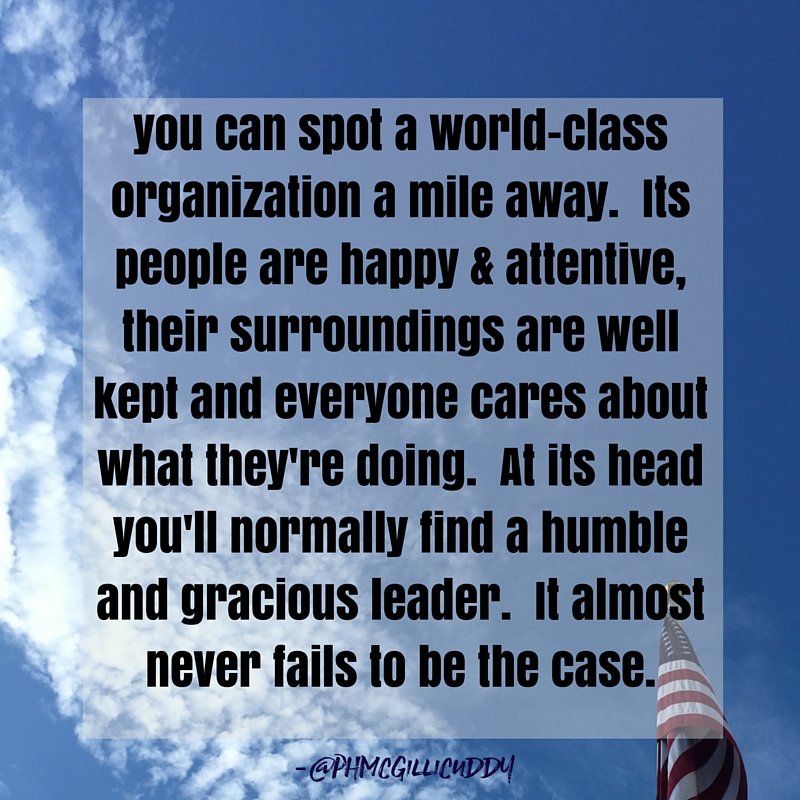
A world-class organization: Happy, attentive people. Well-kept surroundings. Everyone cares about what they’re doing. A humble and gracious leader.

A world-class organization is the workplace where you want to alert your friends when a new position opens up. It’s the church you talk about all week long because being a part of it is real true community. It’s the charity you can trust with generous support.

Marketing strategist Julie Taeko Gramlich lists six characteristics of a world-class organization:

  • Delighted employees, customers, and vendors;
  • Innovation-focused, dynamic;
  • Outstanding leadership;
  • Mission-driven;
  • Operational excellence; and
  • Sense of ownership.

Gramlich prioritizes the role of the leader, whom we think of as the CEO, or the lead in product design, or the senior pastor, or whomever is at the helm.

If your boss or primary influencer is gracious, humble, generous with ownership, and driven by mission and excellence, then you have the great pleasure of working for a world-class organization. Or, for sure, it can be…

I am convinced we all lead, in one way or another. We bring to the table our own skills and our own caring for the others around the table. Mission drift doesn’t just happen to CEOs or boards of an organization.

It can happen to any one of us. This Monday morning I was reminded of the importance of staying on course, of not giving up, of genuinely caring for those around me, and of marking excellence in others and making it my goal daily…

I’m out of the ditch…one more Monday. Let’s get after it.

The Most Important Factor to Become a World-Class Organization – Julie Taeko

How to Make Your Organization an Irresistible Place to Work – Ron Carucci

Secrets of Kick Ass Teams – SlideShare – Paul McGillicuddy

Monday Morning Moment – Strengthening Decision-making with Collaborative Conversations

Blog - Collaborative ConversationsPhoto Credit: AJCarlisle.files.wordpress.com

[Adapted from the Archives]

Change is normal, and resisting change is normal as well. You may be part of an organization or company where sweeping changes are being implemented, even this week. Or maybe you are not on the inside loop of these decisions, so you are not privy to the change coming. Whether you are part of that process or not, consider how you might have a role in making change work, in your sphere of influence, among your colleagues.

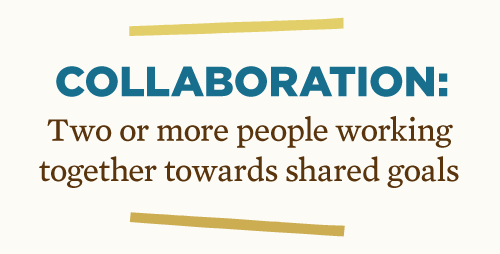
You may already have read and profited from the book Crucial Conversations. Now consider collaborative conversations. Collaboration, simply defined, is “working together towards shared goals”. Collaborative conversations bring a collective intelligence to bear on the problem to be solved, vision to be defined, or direction to be changed.Blog - Collaborative ConversationsPhoto Credit: ThoughtFarmer.com

David Perkins, a Harvard professor, wrote about collaborative conversations in the workplace, using the metaphor of King Arthur’s round table. He described the beneficial nature of bringing several principal players (or stakeholders) to the table and treating each one with an equal or autonomous voice.

Perkins’ book King Arthur’s Round Table: How Collaborative Conversations Create Smart Organizations is a tremendous resource in developing this kind of decision-making work environment. An Executive Book Summary* can help you get started.

“A round table makes it a little easier to pool mental effort. A round table makes a group a little more intelligent…For a group to display intelligence in a sustained way, the members have to value their exchanges and stick together to keep making them. This depends on positive symbolic conduct [side messages sent by our words and behavior]…and collaboration… It’s not ideas, but people with ideas that make things happen.”David Perkins

“One of the simplest ways to immunize a culture against broken trust, corruption, and animosity is to build a common vision.”David Perkins

I personally thrive in such a setting and intuitively understand the value-adding nature of collaborative conversations. In researching this workplace topic, and choosing the links below, I came across a fascinating paper** by Heather Davis, a professor of RMIT University Australia.

Davis presented her paper at the 14th International Conference on Thinking (2009, Malaysia). She discussed how workplace leaders often choose “languages of war” in making and communicating decisions and creating change. Her paper is heady stuff but if you read her thoughts below you will want to read the whole paper. It gives huge support to the role of collaborative conversations.

“In [leadership’s] ‘language of zealous allegiance’, there are expectations of allegiance [in the workplace] that lay a path for uncritical acceptance and passivity. This manifests in an expectation that followers be conscripted wholly to the cause. There is little room for questioning. ‘Conscription means one important thing: there is no questioning of orders, one only executes them; “either you’re with us or you’re against us”.’ “

“Rhetoric plays out in the workplace too and can be tested by how well leaders:

  • hear and acknowledge the ‘other’ point of view,
  • see the ‘other’ as people rather than pawns or simply abstractions,
  • manage the distance, materially and metaphorically, between themselves and the people and sites affected by their decisions.”

“In the corporate world there are many examples of executives living and working in gated communities or otherwise removed by dint of corporate hierarchy or geography from the people and conditions affected by their decisions. Often, these leaders are also surrounded by people who can only agree, leading to little opportunity for double loop learning or deeply reasoned decision making processes. Whether our leaders live in gated communities is their business, but if they think, work and take refuge within a ‘gated’ mindset then we all need to be concerned. These conditions lead to hubris and have been the undoing of many leaders and corporations.”

The role of the organisation is ‘to know its purpose and not be diverted from it’ (Drucker, 1993). This is a timely reminder here – easier said than done in times of flux, complexity and discontinuous change.”

“The main difference between Perkins’ languages of war and peace are that the war metaphor is founded on exclusivity and a preference for limiting discourse to its [leadership’s] own narrowly defined boundaries. Perkins’s peace metaphor is founded on inclusivity and opening up the space for conversations and conflicting views [i.e., collaborative conversations].”

“Oppositional language and the pitting of one deeply held worldview against another will not lead to resolving the underlying problems of the workplace. Rather, space for conversations to surface underlying assumptions is required. Perkins’ language of peace metaphor confirms that that there are always other lenses to view the world through, not just the one that [leadership] prefers.”Heather Davis

Provocative reading from this Australian educator.

Bottom line: Those of us in leadership carry a great burden of responsibility. We at times must make difficult and sometimes painful decisions. Adding voices to that decision-making can generate even more challenging processes to negotiate. However, we will make more sustainable decisions for “better futures” if we bring those most affected (or most experienced or insightful) to the table. Whenever possible. That’s the gain of collaborative conversations – working together toward shared vision and shared ownership.

Stay engaged in your workplace. Don’t entertain indifference. Stay in the conversation. You can make a difference.

*King Arthur’s Round TableHow Collaborative Conversations Create Smart Organizations by David Perkins – an Executive Book Summary

**Troubling Invisible Barriers to Better Futures: Surfacing the “Five Languages of War” in the Workplace – a scholarly paper by Heather Davis, presented at the 14th International Conference on Thinking

Leadership Lessons from King Arthur – a Review of Harvard Professor David Perkins’ book King Arthur’s Round Table

The Five Literacies of Global Leadership – What Authentic Leaders Know and You Need to Find Out – by David Hames – Business Book Summary

The Perils of Indifference – a Speech by Elie Wiesel

How to Lead When Change is the New Normal – Emer Coleman

The Art of Collaboration (Collaborative Behaviors) – by Steve Dale (includes a SlideShare)

Collaboration: What Does It Really Mean? – Carlos Dominguez

What Is a Coaching Conversation? from Opening the Door to Coaching Conversations by Linda Gross Cheliotes and Marceta Fleming Reilly 

Cutting Through the Hype – What “Collaboration” Really Means – ThoughtFarmer.com

5 Choices You’ll Regret Forever – Travis Bradberry

Monday Morning Moment – Ian Bremmer – on Global Politics and Replacing Rage with Hope

Photo Credit: Wikipedia

How do American politics affect our ability and capacity to be a force for good on the world stage?  What elements align to make any of global nations consequential or inconsequential? What natural or geopolitical events will lead to migrations of people to who knows where? What are the top political risks facing our country and our world today?

Political scientist and thought leader Ian Bremmer was just an unknown name on our Richmond Forum subscription for this year’s season. Then we heard him speak. Wow! My ignorance was what was showing.

Ian Bremmer is a brilliant, funny, courageous, optimistic analyst of all things global. He has conversations with world political and economic leaders and their staff, and I’m sure he asks excellent questions. His analysis is intriguing because he clearly knows what he’s talking about and he kindly brought it down to a fifth grader’s understanding.Photo Credit: Richmond Forum

Ian Bremmer Engages with Geopolitics, Honesty, and Humor at The Richmond Forum – Thomas Breeden

The best part of the whole evening was his unflappable honesty. He clearly had his biases regarding world leaders, including our own country’s leaders. Yet, he takes the larger and longer view. I so appreciated that. It’s part of why he’s not “crazy”, as he encouraged us not to be as well when we read and watch the news each day.

Bremmer told the audience his goal for the evening was to make us all “10% less crazy.” What makes us crazy regarding our country’s politics? He summed it up memorably:

A lot of us feel like our system is rigged. A lot of us feel like our representatives are not representing us. A lot of us feel like the American dream no longer applies to us. And they feel like when the political leaders or the CEOs or the bankers or the journalists or the public intellectuals—God forbid—are talking to us, that they’re lying.”Ian Bremmer

If we daily wonder if we’re being lied to by our politicians and not truly represented by our elected officials, then we do become a little crazy…distrusting our government and divided and polarized in our thinking, depending on our particular brand of politics.

Adding to this, Bremmer gives four other factors that fuel the divide:

  • Immigration – So much talk and very little done on either side of the aisle to improve the system – with the hope of making it fair for all who would like a chance to immigrate as well as humane and just for those foregoing lawful entry to the country.
  • Economic Inequality – This continues to increase, and it heightens the political divide between peoples as well. It adds to the “us vs. them” scenario.
  • Wars – When we seem always on the brink of a war (either threatened by a nuclear power or compelled to enter because of an oppressed ally, we struggle again with trusting our leadership, especially as our spouses and children lay their lives on the line for these wars. For what purpose?
  • Social Media – The rage of the average citizen who feels unheard or discounted by his government is stoked through the comments of others on social media. Where are the conversations being had by reasonable people with a stake in the outcome?

Ian Bremmer addressed these stressors and then he calmly proceeded with a survey of global and national threats and trends. I won’t go into them here but you can follow his generous, insightful commentary on all the latest news via his website, broadcasts, books, and Twitter/Facebook feeds. He will educate you and encourage how to engage rather than isolate.

[Forgive me for staying general on this, regarding geo-political risks.]

Bremmer gave two excellent challenges to us. The first is to find a person who we disagree with politically but who we respect (I have a short list of those valuable friends and family members). Then engage in conversation, with the goal to listen, learn, and better understand. Our default is to be enraged but not engage…we just read their social media posts and don’t comment, or worse, do…when we could actually create face-to-face dialogue. Neither of us may change but we have the opportunity to grow closer in coming to viable solutions to the problems we face.

His second challenge was to encourage our young people to study abroad…even in high school, even just for a semester. To put themselves in the minority. To learn from others who have similar problems as well as quite different ones. To learn how to draw down conflict and create understanding. To learn how to problem-solve with less monetary resources. These young people of ours will be the ones who will have to figure out how to flourish in the world we are leaving them.

Ian Bremmer talks reality but with hope and a healthy sense of humor. We would do well to follow his example in this…whether we agree with him on all points or not.

From a secular point of view, he came as close to answering my life-long question “Why can’t we all get along?” Bremmer’s talk also reminded me of Dr. Seuss’ book Oh, the Places You’ll Go. In the midst of a forum on global politics, economic upheaval, war and poverty, he posed the possibility of hope…if we show up and engage with one another.

YouTube Video – Ian Bremmer on the Failure of Globalism – some of the content we enjoyed at the Richmond Forum.

YouTube Video – Ian Bremmer – How the US Should Use Its Superpower Status

Global Warming: Severe Consequences for Africa – Dan Shepard [Ian Bremmer got me to consider global warming more seriously when he talked about how the peoples of equatorial Africa will one day have to leave their countries and immigrate north.]

Monday Morning Moment – Grumpy Begets Grumpy – Understanding It, Not Reacting, and Turning It Around

Photo Credit: Grant Wood, Wikipedia

My poor husband. The last month has been fairly brutal. His father had a massive stroke and died a week later. Between travel to be with his dad in his last days and travel for the funeral, Dave had a packed work schedule. In the midst of that, a friend died. After PopPop’s funeral and our friend’s funeral, we settled back into another busy work week. Interrupted for me by a vicious stomach bug. Interrupted for Dave by a vigilant attempt to avoid said stomach bug. We saw little of each other as he slept in the guest room and tried to stay clear of my germs, except for kindly offering me provisions. The day that I was for sure well, he got the same bug, even harder hit than I was.

So sick, he was forced to miss the majority of a week of meetings he had helped plan and was looking forward to. Such is life when sick.

At some point in all this, I began to get grumpy.

Don’t get me wrong…there was grace upon grace for all we experienced this month. Grace upon grace.

Still, in strain, stress, and suffering we can discover a measure of what’s going on inside our hearts by what comes out of our mouths (Matthew 12:34, Proverbs 8:13 ).

Standing Up Under Pressure – Tom Macartney

My grumpiness was a product of assumptions about how life should go and arrogance that it should always go well for me. Right?

I was frustrated that Dave had to get sick after all our safeguards against it. Also frustrated that he had to miss meetings he should have been able to attend.

With both of us recovering from heart grief and grumbling tummies, grumpiness came as a default reaction. Sadly, toward each other. [I have asked his forgiveness already, by the way., and he mine].

This happens with grumpiness. Whether we are prone to it in our closest relationships or in more casual work or friend situations, grumpy begets grumpy.

As a teenager, our middle child, Nathan, had waves of grumpiness easily turned around with some cheese or a sandwich. The quicker I assessed he was hungry (“hangry” before that became a word), the faster he returned to his usual, more fun self…once his blood sugar was on the rise.

Health Check: the Science of ‘Hangry’  or Why Some People Get Grumpy When They’re Hungry – Amanda Salis

When we have chronically grumpy coworkers, they can bring a whole team down, unless we are proactive in responding to them.

Writer and entrepreneur Will Jeakle gives us a humorous and insightful read on Three Tips for Dealing with a Grumpy Employee:

1. Recognize analysis paralysis.

2. Change the subject.

3. Put Eeyore in charge of a project. – Will Jeakle

Photo Credit: pngimg

[Click on the link above for Jeakle’s fascinating commentary on the subject. Helpful also if you are the grumpy coworker.]

One author actually talked about how being grumpy and bad-tempered can have a positive impact on your career – but I’m not sure it’s worth the risk. [So, Nathan, keep popping that protein when your grumpiness comes on.]

Why It Pays to Be Grumpy and Bad-Tempered – Zaria Gorvett

Grumpy begets grumpy if it goes unchecked. When we are grumpy to others, over and over, it is almost impossible not to react in kind. And I don’t mean kindly.

Habits can develop that lead to us isolate ourselves…especially as we age.Photo Credit: QuoteFancy

Canadian writer Ian Fortey wrote  a somewhat coarse and humorous (unless you’re its subject) piece on getting older. When he covered the general grumpiness of today’s older people, he made this observation:

“It doesn’t help that today’s old-folks were raised at a time when it wasn’t considered cool to talk about your problems in any kind of constructive way. You sucked it up and lived with it….Well, if you “suck it up” for 80 years it eventually just overflows onto everyone who walks past your house.”

Realtor and writer Gary Woltal also speaks with understanding on this same topic: The negativity [in old age] comes from regrets they harbor about missteps in their judgment, hard feelings about words inflicted upon them along the way, omissions of things they should have said and done, and just life’s disappointments…Unfortunately, I think they also believe they will have no good legacy. The fact is starting TODAY we ALL can have a great legacy if we work at it. We all should not go through life with hard hearts.

Check yourself in the mirror today and use a few role models I have used on how you want to exit stage left someday. Women or men, think of these great celebrities who left us with nary a discouraging word said about them. Lou Gehrig, Jimmy Stewart, Fred Rogers, Red Skelton, Mother Teresa. Gary Woltal

Some Day You Won’t Have Me to Kick Around Anymore – Gary Woltal

Previously I wrote on negativism and its cost and cure which you might also find helpful if you missed it first time around.

Dave and I are off to a new week…all forgiven…and hopefully not too wounded or wary from the brushes with grumpiness of the weeks prior. If you’re finding yourself in a season of grumpiness, my hope is that you can turn that ship around before grumpy begins to define you.

We all don’t have to be saints, but we can leave behind people feeling like this about us: “When you were born, you were crying and everyone around you was smiling. Live your life so that when you die, you’re the one smiling, and everyone around you is crying.”Gary Woltal

Three Tips for Dealing with a Grumpy EmployeeWill Jeakle

Health Check: the Science of ‘Hangry’  or Why Some People Get Grumpy When They’re Hungry – Amanda Salis

Monday Morning Moment – Negativism – Its Cost and Cure – Deb Mills Writer

How to Raise Happy Teenagers – Michael Odell

Monday Morning Moment – Operational Transparency – Opening Up Windows to Our Lives at Work, Home, and Community

Photo Credit: Flickr

Let’s take a close look at our work and life for a moment. When product and customer service are both excellent, we experience the greatest value as both employees and consumers. However, when there are processes at work that we can’t really visualize or don’t understand, we may question the value of either the product or the service. Especially when those processes are obscured in their availability. Especially if when we seek to see and understand, we remain without adequate information. We can grow disheartened, disgruntled, and even repelled.

Let’s have a look.

We could take a deep dive into government operations or into a large for-profit or non-profit, but let’s just look first at a very normal experience of a popular fast-food restaurant. Without naming the company, this chain is known worldwide for providing consistently good food. When the product is excellent, we don’t feel the need to look inside the operation (or kitchen, so to speak). As for customer service, that’s another matter.

In the rush of lunch-time ordering and food delivery at the drive-through, a young mother with two small children in-tow has to leave her car and come inside the restaurant twice for corrections on her order. One correction was just the number of chicken pieces (four when she asked for and paid for six). The counter staff person couldn’t take the four-piece back, in accordance with health standards, and give her a six-piece. So instead of just saying to the customer, “We’re so sorry. Keep the four-piece and I’ll get you a six-piece”, she tossed the four-piece in the trash can and returned, without emotion, with a six-piece. The rest of the exchange, on both sides, was polite but not restorative for either.

The mom will probably go back…one day…but this did not build the trust that could have been built. The employee also was probably not left with any sense of appreciation for how hard everyone was working behind the counter for demanding customers.

What does this have to do with operational transparency?

Well, given the perceived quality of the product, little transparency in food preparation was required. That wasn’t the issue. The small but significant dilemma here was the transparency of the customer service model (which was bare-bones “correct the problem” without consideration of customer experience or inconvenience – or so it seemed, from the employee’s response to the mother).

Harvard Business School professor Ryan W. Buell defines operational transparency as the deliberate design of windows into and out of the organization’s operations to help customers and employees alike understand and appreciate the value being created. To determine when and how to design such windows, managers must understand when and how customers and employees want to open up operations to scrutiny—and when both parties would prefer that work be undertaken behind the scenes.*

*Operational Transparency – Ryan W. Buell

Is too much of a company’s operations behind the scenes? Are we expected to just trust that companies, governments, and civic organizations are working with our best interests in mind?Photo Credit: Flickr

The article by Ryan W. Buell linked above is a brilliant examination, with lots of real-world examples, of how important transparency is in our operations. For internal and external outcomes – both with product and employee/customer relations. [Don’t miss the read.]

Back to restaurants, the food service industry is really starting to run with this. One of our favorite restaurants is Mezeh Mediterranean Grill. It is a highly visual food experience. You order at the counter with the help of customer-savvy servers who guide the diner through the process.Photo Credit: Reston Now

Employees not helping the diners are doing food prep and working the grill, all in plain view. By the time the customers reach check-out, they have a bowl or plate of generous portions of savory, authentic Mediterranean food plus an added sense of value from the excellent customer service.

Operational transparency.

Home delivery food franchises and online shopping companies are upping their transparency by providing accurate tracking options for their customers as well as other perks aimed toward customer satisfaction and loyalty.

Photo Credit: Twitter

In the workplace, we need to listen to customers who actually give us feedback, especially complaints. There’s much to be learned by that sort of engagement. Becoming more and more transparent will help. Buell’s research shows the employees benefit as much as the customer with greater operational transparency.

As a stay-at-home, work-from-home spouse, I understand my husband’s question of “What did you do today?” It is the same as my question to him. “Writing and laundry” and “meetings all day” neither tell the whole story of either of our days. Operational transparency applied to our dinner conversation could make it a whole lot more engaging and valuable.

Taking the mystery out of how decisions get made and products/services actually happen can add greatly to the employee and customer experience.

Just as our teachers in school instructed us to “show our work”, we can do that for each other in creative and credible ways.

I have no idea how a letter gets from my friend in London to me in Virginia in less than a week…but it is easy to get frustrated when it hasn’t arrived in three weeks. The postal worker dealing with my frustration would be well-served…as would I…by opening a window into the complexities of the work of mail gathering, sorting, and delivering.

My father-in-law went from being admitted to an ICU post-stroke one day, to lying in bed all the next with an IV hanging but not dripping and no word from a doctor, to a visit and discharge by a palliative care team the third day. We welcomed the discharge home but a bit more transparency on that second day would have been really helpful.

Operational transparency builds trust, enhances communication, and facilitates accountability (see image below). Even when transparency reveals a negative (as in the fast food experience of the young mom), the company can turn that around once exposed.

From the Ryan Buell’s article, in closing:

“Don’t forget to close the loop. Transparency is the most beneficial when it’s allowed to flow in both directions—from the customers into the operation and from the employees out to the customers. Forcing employees to toil in obscurity deprives them of seeing how their work is helping customers, reducing their feeling that their work is appreciated and undermining their motivation. What’s more, transparency for employees can give them the information they need to customize service and help them learn better ways of operating.

Consumers [can] take work for granted and employees [can] lose out on the learning and motivation that customer connections afford. With that in mind, businesses should stop reflexively hiding their operations for the sake of efficiency and instead thoughtfully consider when and how to open them up to create more value for customers and employees alike.”

Operational Transparency – Ryan W. Buell

Photo Credit: Flickr

Creating Reciprocal Value Through Operational TransparencyRyan W. Buell, Tami Kim and Chia-Jung Tsay

Let’s Be Real – Why Transparency in Business Should Be the Norm – Robert Craven

YouTube Video – Defaulting to OpenWhile transparency is often associated with increased accountability to the public, the most visible outcome of open public data in recent years has been more and better services for citizens. This session addresses the opportunities and challenges of making open data useful, actionable, and relevant for users inside and outside government. Mike Migurski Chief Technology Officer at Code for America moderates a conversation with Alan Williams, 2013 Code for America Fellow; Joy Bonaguro, Chief Data Officer, City and County of San Francisco; Ryan Buell, Assistant Professor, Harvard Business School; and Mark Head, Developer Evangelist, Accela

Open Data