Tag Archives: Monday morning moment

Monday Morning Moment – “What Are You Doing These Days?” – the Utility Infielder

Photo Credit: Service Desk Show, James West

When I was a little girl, the question “What do you want to be when you grow up?” was easy to answer. I wanted to be a nurse. Being on the serving end of helping people in crisis was the stuff that even populated my nighttime dreams. It was my passion as a child.

In my teen years, teachers and other adults commended me on my writing. For years, kind people who actually read what I wrote have asked, “When are you going to write that book?” A much harder question for me than the earlier one.

Photography, music and drama clubs were my loves in high school and college, mixed with a budding political activism. That activism was baby steps at first, with rallies and protests. Long conversations over coffee on Saturday mornings. Nothing requiring much commitment. Our military conflicts were confusing to me (with seemingly never an end in sight). In my youth, I would write to soldiers serving in far countries…doing my small part to encourage them and humanize their situation. I still have a box of letters from those soldier pen-pals.

My girlhood goal was to do nursing overseas…among the poorest of the poor. Those strong youthful dreams directed me first to Emory University for nursing and grad school. Then a few years later to Yale University to teach. In the between time, my “poorest of the poor” turned out to be on the oncology unit of Grady Hospital, in Atlanta, Georgia’s inner city…

The “what do you want to do when you grow up?” question took on a life of its own. As did the question: “What are you doing these days?”

Depending on the season of life, it was cancer nursing, home-schooling mom, cross-cultural living, facilitating a cultural exchange program, teaching ESL, communications strategist/social media manager, and finally freelance writing.

Now…after all these seasons and address changes, the question, “What are you doing these days?” is mystifying. I almost feel a bit ashamed that I haven’t landed anywhere as a specialist in anything.

Just this morning, a friend posted on her Facebook page a TED talk that encouraged her…and it also encouraged me.

The speaker on the TED talk was writer, creator Emilie Wapnick. She describes herself as a multipotentialite which she defines as “someone with many interests and creative pursuits“.  Wapnick is the founder of the website Puttylike…out of which has evolved a fascinating global community of other multipotentialites.

In her TED talk, Wapnick describes three “superpowers” of these multipotentialites. They are:

  • Idea synthesis – “combining two or more fields and creating something new at the intersection”
  • Rapid learning – multipotentialites “go hard” at learning. They have been beginners many times, therefore, they aren’t afraid to try a new way. They “rarely start from scratch”.
  • Adaptability – “the ability to morph into whatever you need to be in a given situation”.

Why Some of Us Don’t Have One True Calling – Emilie Wapnick TEDx

The Fine Art of Bringing Together Unrelated Ideas Emilie Wapnick

Now whether being a multipotentialite applies to my career journey…or yours, it is so refreshing to to be reminded that going in multiple directions professionally can be a normal and good thing.

I love “both/and” situations, and there are lots of them out there, if we open our eyes to see them. A few careers back, I had the opportunity of being a cancer nursing specialist, but looking ahead, being an expert in any given discipline is unlikely. Being decent, however, (maybe even good) at both this…and that is possible. Being a generalist works for me… However, I can still aim at being a versatilist (see below). How about you? Where are you in your career?Photo Credit: Gartner, Shi Wen, HR in Asia

Talent Archetypes: Specialists, Generalists, and VersatilistsShi Wen

You may have never heard the term multipotentialite or versatilist, but in America, especially in the summer, you may have heard of a utility infielder. “A utility infielder (UI) is a baseball player, usually one who does not have a regular starting role on the team and who is capable of playing more than one of the four defensive infield positions:   second base, third base, shortstop, and less typically first base. Utility infielders are generally considered excellent defensive players who do not hit well enough to remain in the starting lineup,[2] but can fill in at multiple defensive positions to give the various starters a rest, or replace a starter late in a game to provide improved defense when the team is winning.” – Wikipedia

Photo Credit: Dan Ryan, Ryan Search & Consulting

Why You Want to Be a Utility Infielder – Dan Ryan

A utility infielder is definitely someone you want on your team. I’m married to one. Multipotentialite, versatilist, utility infielder. Whatever this person’s title, he or she brings their own special strengths.

Some days, dark days, I despair of some of my career choices and wonder if I’d been more focused, or less inclined to chase after this opportunity or that dream…would I have been more effective? Would I have made a greater difference? Today, and more days lately, I am content with the roads taken. Some of us have laser focus and sharp skills. Others of us are more like the Swiss Army utility knife. Both are indispensable. Both/and.Photo Credit: CBT Nuggets

The Value of an Adaptable Skill Set – Leadership Made Simple

5 Ways a Compliance officer Is Like a Swiss Army Knife – Compliance Experts

Getting Ahead at Work: Are You a Hammer or a Swiss Army Knife? – Carlos Portocarrero

Monday Morning Moment – Picking a Lane – It’s Never Too Late – Deb Mills – an example of a multipotentialite who is excellent in all his pursuits, best I can tell.

Monday Morning Moment – 10 Characteristics of a Good Leader – What Do You Say?

Photo Credit: Wolfgang Lehmacher, Quora

Too often we focus on what makes for a bad boss rather than looking at those good leaders in our lives. For the last several days, I’ve been asking friends what makes for a leader of excellence…one who  brings excellence to the table and also brings it out in their teams.

Before I asked these friends…from various disciplines (education, health care, private sector, and non-profits)…I developed my own list. As they talked about the good leaders in their lives – either past or present – their characteristics resonated with mine below.

10 Characteristics of a Good Leader

  • They enjoy their personnel. – Story after story of bosses who made the workplace more pleasant by their sheer enjoyment of their colleagues and teams. They were present. They didn’t have to have the room’s attention. They clearly just took pleasure in the folks with whom they worked (up and down the chain of command).
  • They know their personnel. – Leaders were described as excellent when they really knew their employees. They not only asked about the progress of work but how the individual was doing as well. They knew successes and failures. They knew the families. Maybe not in so many details, but it was obvious, by their interest that they genuinely cared about their employees…as well as what they were doing on the job.
  • They treat their personnel with dignity, even in hard conversations. – When conversations were disciplinary or corrective, these leaders still respected boundaries and showed care. No raised voices, no demeaning, no putdowns, no threats.
  • They reel in stress, instill confidence, and bring perspective. – Along with the above, when outcomes weren’t as hoped or when difficult change had to be executed, these leaders kept drama out of it. What was communicated was that we would get through this…together. Now, that wasn’t always possible, as when downsizing has to happen, for instance, but every effort was taken to care for those most negatively impacted.
  • They sacrifice for their personnel. – Business coach Ron Carucci wrote a post earlier this year entitled 3 Ways Senior Leaders Create a Toxic Culture. He talks about how easy it can be for leaders to become isolated from the majority of their employees, so focused on the success of the company…or their own success…that employees below them are neglected in the process. Time and time again, friends talked about how leaders would interrupt their own schedule…even travel or meetings…to deal with some difficult situation with a team or employee. This is a rare circumstance, I’m sure, but what a trust-builder, right?
  • They develop their personnel. – None of us know really what kind of person we can be until we have proven ourselves through experience and training. I hear so often about the problem of “not enough leaders”. Good leaders develop their personnel with broad generous strokes. Then, in time, they will discover who may very well be of the caliber to be in the line of succession for their jobs…avoiding the crisis of “not enough”.
  • They provide platforms for their personnel to shine. – One comment I received repeatedly was “She believed in me.” or “He knew I could do it.” Being challenged and then given the resources to be successful/effective were huge for folks describing good leaders.
  • Their decisions make sense to their personnel. – Because good leaders keep their teams up-to-date with vision, plans of execution, outcomes, then their decision-making brought no confusing after-shocks. Besides, good leaders instill trust, so buy-in comes more naturally. Often because leaders allowed their teams to speak into the decision as well. This is huge.
  • They extend their reputation to their personnel. – By this, I mean that good leaders share – with those on their teams – the responsibility and rewards of engineering a product or service. It’s not just the upper echelon leaders who collect the kudos. It’s the organization as a whole.
  • They show up when their personnel need them. – Lastly, this characteristic seemed to carry a high emotional ring to it with those I questioned. When an employee is in a tough situation, with an unhappy parent, or a litigious customer, or just having a really bad day, these leaders don’t leave it always to someone else. If they are needed they come…one way or another. “He always had our back.” “She knows me so she knew how hard it was for me that day.” For leaders to show this kind of character requires margin in their lives and willingness to let go of some other piece of their work to show up in this way. Again, I’m thinking these situations are rare, but they reflect a level of leadership that we all appreciate.

Photo Credit: Lone Wolf Technologies

Good leaders are others-focused. They have fought off the natural tendency of being self-focused and self-promoting. They are self-aware (they know themselves and know how they may be perceived by others). They have trained themselves in the habit of putting others first. This discipline is the cut of the fabric of excellence in leadership.

Now, I didn’t go into the other critical parts of a leader’s responsibility – that of keeping the business of the organization running well. This was all about what goes into the kind of leader we are glad to work for. When it comes to bottom-line and performance, Carucci in his article shows research that demonstrates the profitability of keeping priorities (like those above) and focusing positively on personnel. Photo Credit: Assad Schuitema, Care and Growth

“If a video camera captured your leadership team in action for a full day, how would you feel about that video being used as training for the rest of the organization? Serving on a leadership team should be viewed as a privilege. And along with that privilege comes a responsibility to behave in ways you would be proud to have the rest of the organization emulate.” – Ron Carucci

What do you think about what makes for a good leader? Please comment below. Whether you comment or not, take a moment to consider those leaders in your life that have made a tremendous positive impact on your worklife…and through that, your personal life as well. Maybe you’re a good leader because of the influence of those who mentored you.

Have a great Monday!

3 Ways Senior Leaders Create a Toxic CultureRon Carucci

Want to Be a Better leader? – 5 Powerful Ways Kindness Can Help – Peter Economy

What Is the Essence of Leadership? – Quora

Monday Morning Moment – 6 Basic Elements of Leading Well – Dave Mills

Leadership is a process that has been a great interest all my adult life. There’s this man I know well who actually spends concentrated time studying about leadership, both through books and observing it in practice. He has had the experience of being a leader of few and many. He has managed teams, budgets, and action plans. Other times, he has led only by influence, without authority. He is my go-to person on what is good leadership – which is never a finished product. Leadership changes as organizations and cultures change.

Yet, the basic elements of leadership that builds leaders and, at the same time, gets the job done are foundational.

The man is my husband. He, from time to time, has also been my boss in the workplace. Dave Mills wears many hats. He most recently applies himself to risk/crisis management, security processes, and strategic partnerships. Making leadership development happen is his professional happy place.

In the training he does on Leading From the Heart, he lays out these 6 Basic Elements of Leading Well. With permission, they are excerpted in brief below:

  • Be clear about what you want personnel to do (What)
  • Make sure they know why it is important (Why)
  • Make sure they have what they need to do the job (How)
  • Give them a way to know how they are doing
  • Follow up regularly on priorities and progress (accountability)
  • Make sure they know you care about them

This is intended to help leaders understand what they need to provide for people to thrive in their work. This doesn’t address vision or strategy; it focuses on the people part of the process – the interaction between leaders and those we are responsible to lead.

For someone to thrive in a job, they need all six of these in place.

6 Basic elements of leading people:

1. What:  Be clear about what you want them to do.

People tend to underestimate the amount of communication effort required to achieve clarity.  This requires repeated communication to hammer home a clear understanding of the task. A feedback loop where you ask the team member to explain the assignment back to you is essential.  Even when they can do that, you still need to revisit it regularly.  Do not short-change the work involved to achieve clarity.

[This is very different from micro-managing. This is empowering through comprehensive, understandable information-sharing.]

2. Why:  Make sure they know why it is important.

Do not assume that employees understand why the task is important.  Make sure that is clearly communicated.  If they already know the importance, it helps them to hear it so they know their leader understands the importance.

This is often neglected.  Sometimes it is because it is assumed that the person knows why the task is important.  Sometimes it may be obvious why it is important.  However, it is worth unpacking that together to reinforce the importance of the task and your confidence in the person to successfully carry out the assignment.  The most common scenario is probably just to ignore the issue and never bother to help the person understand why their work is important.  This is one of the points in Lencioni’s three characteristics of a miserable job.  He calls it irrelevance.

3. How:  Make sure they have what they need to do the job.

When you assign a task you must be sure that the person has what is needed to do it.  This may involve resources, like access to equipment or funding.  It may be knowledge.  It may be connections to other people.  There may be a training need.  Or it may be capacity.  Do they have the capacity to take on the task you are assigning to them?  Make sure they have capacity, or free them up from something else, or give them someone to help them with the task.  Also recognize that sometimes at the beginning it may not be clear where the gaps are.  This is something that should be regularly revisited with people – Don’t forget to ask them if they have everything they need.

[This is another area where micro-managing would stifle rather than empower employees. Give team members the authority to get what they need to get the job done.]

4. Give them a way to know how they are doing.

People need to know what a good job looks like.  At the end of a day they need to be able to assess whether or not they did a good job that day.  What are the most important outcomes that you are expecting from them?  Have you expressed these in ways that can be quantified?

5. Accountability: Follow up regularly on priorities and progress.

Check in with them regularly, with intentionality, about progress and priorities.  The leader must take responsibility for driving this.  The frequency depends on the employee and situation, but there should be a regularly set time.  This needs to be a one-on-one conversation with each direct report to discuss what progress has been made since the last check-in and what are the priorities to be focused on until the next check-in.

Not only do you give them a way to assess their own performance, you regularly review their progress and provide feedback on how they are doing.  This is a good opportunity to revisit whether or not they have everything they need to accomplish the assigned work.  This is where coaching and accountability happen.

6. Heart level connections: Make sure they know you care about them.

Relationships are key to leadership.  You need to be intentional and deliberate about building heart level connections with those you lead.  There is an enormous amount of research indicating the importance of this.  If you do all the other parts of the process well and fail on this one, your people may endure your leadership but they will not thrive.  On the other hand, if you are not so great on some of the other parts but do this one well, people will cut you a lot of slack if they know you care about them.  Relationships are the oil that keeps the work machinery going.  Like having something with a lot of moving parts – as long as the oil is there, it runs smoothly.  If you throw some sand in the works, it doesn’t run so well and over time it will grind down to a point where it doesn’t work at all.

Caring about our employees (direct reports, in particular) involves investing in their development. Proactively looking for ways to help someone improve and grow in their work is a very caring and practical thing to do.

[Be careful that you, as a leader, don’t presume a relationship exists. This is only effective when the employee experiences the relationship as positive and caring.]

– Dave Mills, Leading From the Heart

___________________________________________________________________________

What do you think? Any element you could use as a leader or team member? In our work (both together and in work independent of each other), Dave and I also believe that leadership development – intentional and proactive – should begin at orientation. The tendency in the workplace is to load development on those already in authority. Entry level and mid-level employees don’t always have benefit of the care needed to provide opportunity to grow and develop in their areas of expertise. It is something to consider on the order of company core values.

Lastly, I just wanted to give a shout-out to some of the folks who have demonstrated excellent leadership to Dave…as well as those in relationship with him who have developed as excellent leaders themselves during the time they worked together. These make for long and rewarding relationships across a lifetime of work.

[Just a few of those remarkable ones are in the following images]

Monday Morning Moment – What You Think of Others Matters – Workplace Wisdom – Deb Mills

Monday Morning Moment – Chuck Lawless on Executing Positive Change

Photo Credit: Maxpixel

A conference room table is much more winsome than rows of chairs facing the front of the room. At least for me. Chairs facing each other give the impression that all those at the table have a voice. Enlarge that to an organizational level. Especially related to change. When employees understand some sort of change is necessary for the growth of the organization, then having the opportunity to speak into that change has tremendous value.

Not just for embracing the change but for the execution of the best change possible.

A few years ago, I had the opportunity to be on a board of directors of a private international school in another country. Also a parent of students in that school, it was easy and satisfying to engage in the various problems and challenges the board faced for the sake of the school. Initiating change was always a part of that. Early on during my tenure on the board, I saw how difficult it was for the average parent to get the ear of the board. This was grievous to me that I had more influence than most of the parents on decisions affecting all our children’s school situation.

Out of this personal pressure point, a parents’ organization was birthed. It was a difficult labor, but worth all the effort in terms of trust-building and overall outcomes. Photo Credit: Better Together, Balcony People, Deb Mills Writer

Theologian Chuck Lawless has written an article on executing change. His focus is the church but his succinct 10 thoughts are relevant to any organization. See what you think:

  1. The healthiest organizations are always in a state of change.
  2. All generations can be opposed to change.
  3. People want to know the “why” behind the change.
  4. Their opposition to change isn’t always a personal attack on the leader.
  5. They might oppose change (in the church, on their team or subset of their organization) simply because that’s the only place they have a voice about change.
  6. Some aren’t opposed to the change; they’re opposed to the process.
  7. The best change agents take their time to secure support.
  8. Our assessment of opposition could be overly optimistic.
  9. A vote for change is not a guarantee of support for that change.
  10. Often, any immediate chaos caused by a change settles down after that change is done.

Photo Credit: Flickr

Thinking back on the formation of that parents’ organization, we learned the wisdom of securing feedback early from those most affected by the change. Feedback well before the roll-out of the change. We also gained an understanding of how “knowledge is power”.  Parents who had access to the knowledge of looming change as well as an avenue to speak into that change became advocates and influencers for the change.

Who are your critical thinkers? Those folks on your team who think deeply about work and the processes at work that affect personnel. Not all of them are the greatest cheerleaders and definitely not just the isolated inner circle of leadership.

Are we willing to value and seek out the critics, skeptics, naysayers, contrarians? If our ideas are so fragile that we can’t bear the input of these folks, how can we press these ideas on a whole organization? If we only take the input of those consummately agreeable with our ideas, then do we avoid, even lack, the feedback that could launch our ideas toward the most favorable change?

Business writer Oliver Staley gives organizational psychologist Adam Grant‘s take on the positive impact of the disagreeable giver – in regards to change:

Cheerful and helpful workers are beloved by their bosses, and just about everyone else, really. Enthusiastic optimists make for great colleagues, rarely cause problems, and can always be counted on.

But they may not necessarily make the best employees, says Adam Grant, the organizational psychologist and Wharton professor.

The agreeable giver may seem like the ideal employee, but Grant says their sunny disposition can make them averse to conflict and too eager to agree. Disagreeable givers, on the other hand, can be a pain…, but valuable to an organization, Grant says.

They’re more likely to fight for what they believe in, challenge the status quo, and push the organization to make painful but necessary changes, he says. And because they’re stingy with praise, when it’s offered, it generally can be trusted.

Disagreeable givers “can get more joy out of an argument than a friendly conversation” and be tough to work with, Grant says. But for organizations eager to avoid complacency and determined to improve, they also can be invaluable. – Oliver Staley

In Chuck Lawless’ 10 Thoughts, he doesn’t speak outright about disagreeable givers, but they are present and valued. One of Lawless’ readers, Jerry Watts, commented with this insight: “One time, in a culture far-far away, I heard a pastor say, ‘People aren’t afraid of change, they’re afraid of loss.’ – I thought those were good words to remember. After 40+ years, I have discovered that change is okay as LONG AS you don’t mess with me.

Change does mix loss with gains. When personnel have the opportunity to grieve ahead of time, their problem-solving acumen is sparked to help drive a better change, not just for themselves but for the organization as a whole. Is it messy including more people in the decision-making? Of course…but the process for everyone yields far more meaning and understanding.

The Best Employees Are Not the Agreeable Ones, According to Adam GrantOliver Staley

Changing Company Culture Requires a Movement, Not a Mandate – Bryan Walker and Sarah A. Soule

Negotiating Change – the Key to Survival in the 21st Century – Grande Lum

4 Ways to Face the Challenge of Disruptive Change – Ron Carucci

YouTube Video – Adam Grant and Beth Comstock – How Non-Conformists Change the World – Change Makers Book Club

Monday Morning Moment – On Silos and Tribalism – Taking “Us” and “Them” to a Better “We” – Deb Mills

Monday Morning Moment – When Your Work Culture’s In Trouble – with Matt Monge

Photo Credit: Career Addict

Business thought leader and writer Matt Monge is my go-to guy on company culture. The fact that he also struggles personally with depression tenders my heart to what he has to say. He is a straight-talker. Courageous, transparent, and caring. Monge knows toxic work cultures. He is consulted to help fix them, and through his writing he gives generous help to all who struggle to thrive in a culture that makes that a challenge. Take heart, those of you currently in troubled work cultures. Once you have identified what the murkiness is about, you can then act to clear it out…or, if necessary, you can clear out. You have options.

Below you will find Monge’s piece 7 Signs Your Culture Is In Trouble. Click on the link to go further into depth on what these mean.

  • Your culture is in trouble if your CEO is a toxic leader. Matt Monge delineates this further in his article 10 Traits of Ego-driven Leaders. Employees and teams can experience huge shifts in their own thinking and behavior toward each other and customers, just in response to top-down influence. Beware of mission drift also.
  • Your culture is in trouble if poor managers are allowed to remain poor managers indefinitely. This is sad for both the manager herself and the team under her. When a company is frantic with reacting to the demands of toxic leadership, the simplest processes of feedback, teaming, and  development take a backseat. Everyone suffers.
  • Your culture is in trouble if humanness and vulnerability are absent. In a troubled work culture, trust deteriorates. The bottom line is the driving force. Keeping one’s job and the perks of that job trumps everything else that might have once mattered in a work culture.
  • Your culture is in trouble if accountability is misunderstood and only selectively applies. Healthy accountability is meant to be a two-way process. Leaders and subordinates are best-served when they have open communication and transparency is high. An employee is much more open to accountability when he sees that his leaders also submit to the accountability of others.
  • Your culture is in trouble if people aren’t learning much. Opportunities for training and growth are signs of a healthy environment where employees clearly matter to the organization.
  • Your culture is in trouble if teams and departments have ongoing problems performing their core functions. This is a glaring sign of trouble. When performance is off and morale matches it, a cry for help is being sounded. When personnel just don’t care, something has to be done to turn that around. What that something is and who is capable to doing it can be sorted out by both managers and employees. Punitive action is not the answer.
  • Your culture is in trouble if executive team morale is low. This speaks to the ripple effect starting from a toxic CEO, through the organization and then back up the chain-of-command. Morale, as we know, has a huge impact on performance. When the executive team is struggling with low morale, reflecting that of the company, then it’s to the point that someone from the outside must come in to help correct course. This takes enormous vulnerability on the part of the executive team.

Having come through a cancer diagnosis, my experience is that it’s better to know what’s going on than to remain in the dark…or that murkiness of knowing something is wrong but you’re not sure what.

Once we identify what the struggle is with our work culture, we can begin to rectify our situation. Some things we may have little control over, but what we can change, we must.Photo Credit: Venture Lab, Pauline James

Business writer Joanna Zambas has given us examples that mirror Matt Monge’s list on company culture (see links below). One of her lists celebrates companies who have made culture a priority.

25 Unmistakable Signs of a Bad Company Culture – Joanna Zambas

20 Examples of Great Company Culture – Joanna Zambas

Southwest Airlines made Zambas’ list. It is my favorite domestic airline. Mainly because of its customer service. However, that customer service is rooted in a work culture that is very pro-employee. Photo Credit: Business2Community

I know that first-hand because of my contact, over many years, with one Southwest employee. Her kindness, demeanor, and consistent care at every touchpoint have demonstrated to me the very heart of this company.

My hope for all of us is that we can work toward a company culture like this one…bottom-to-top if necessary. For you as company leaders, you may not see this or any such piece…but I hope you can be encouraged or re-energized to grow such a culture. The impact will nothing but positive…you know it somewhere in that leader heart of yours.

7 Signs Your Culture Is In TroubleMatt Monge

YouTube Video – Matt Monge: Speaker, Writer, Leadership & Culture Expert, Depression Fighter

What Not to Do When You’re Trying to Motivate Your Team – Ron Carucci

Turnover Trouble: How a Great Company Culture Can Help You retain Your Best Employees – Emma Sturgis

Monday Morning Moment – Kindness Over Cleverness – Work Culture Where Employee Satisfaction Impacts Marketing – Deb Mills

Monday Morning Moment – Workplace Culture – Do Things that Don’t Scale

Photo Credit: Medium, Ian Tang

Scalability refers to a company’s ability to increase its production profitably. – Merriam Webster

This is a new concept for me. Isn’t that like growth or profit? It’s like waking up out of a deep sleep and terminology in the workplace has changed. Is scalability the same as reproducibility?

What if profit comes out of something beyond scalability? Or at least is it possible to be successful without changing who you are as a business? These questions pop up for me when I hear the word scalable.

[Hang on, you faithful readers…not a usual topic for me, but what I learned was highly satisfying…hopefully for you, too.]

Sometimes learning about a new concept is enhanced by reinforcing what it is NOT.

Following you will find quotes from three business leaders who talk about the positive nature of things that don’t scale or reverse scale.

Shawn Askinosie is a lawyer turned chocolatier. Then he wrote a book about the journey. Meaningful Work: A Quest to Do Great Business, Find Your Calling, and Feed Your Soul. In a recent blog, Askinosie wrote exquisitely about scale and reverse scale. See what you think?

We write about reverse scale extensively in the book. What is it? It’s a practice of recognizing the value of not scaling…. We’re conditioned by our business culture to believe that unless the idea is big and capable of rapid scale then it has little value. Can we take a step back and reconsider this dogma? Could we assess value even if our idea helps only one person or if it only transforms us? True sustainability lies within the answers to these questions. If more of us answered the call to action on the supposedly “small” ideas then imagine the kind of social problems the world could address.

We tend to think “more” and “bigger” will always be better, that somehow they will allow us to finally breathe easier when we arrive. The problem is that it’s often an illusion because we never really arrive at the place that’s just out of reach. Scale demands that every single person in the chain focus on what’s next and on finding someone to do the thing that’s now ‘below’ them in order to move themselves up. Anything less than that and you will lose the race for scale, because someone else is more focused than you.

Reverse scale could also be called human scale. It is in the smallness of one on one relationships that we find meaning because we’re not insulated from the pain and sorrows of these connections. We tend to lose this when we’re so focused on scale and growth. – Shawn Askinosie

This guy, as you can tell, has no interest in blowing out the roof on profits. He wants to deliver a quality product with the help of a small company of people who he wants genuine relationships with…and he wants margin to focus on his definition of what really matters in life. Cool, huh?

Investor and thought leader Paul Graham is also one who advises entrepreneurs to Do Things That Don’t Scale. The infographic below was inspired by his article. His ideas are almost revolutionary in today’s high-pressure workplaces, yet his thinking is also that of some of the greats, including Steve Jobs , co-founder of Apple, Inc.

Photo Credit: Funders and Founders, Idealog

Paul Graham elaborates (read his whole piece; the following speaks to a couple of components):

The question is ask about an early stage startup is not “is this company taking over the world?” but “how big could this company get if the founders did the right things?” And the right things often seem both laborious and inconsequential at the time.

You should take extraordinary measures not just to acquire users, but also to make them happy…Your first users should feel that signing up with you was one of the best choices they ever made. And you in turn should be racking your brains to think of new ways to delight them.

A lot of startup founders are trained as engineers, and customer service is not part of the training of engineers. You are supposed to build things that are robust and elegant, not be slavishly attentive to individual users like some kind of salesperson.

Delighting customers scales better than you expected.

Recruit users manually and give them an overwhelmingly good experience. The unscalable things you have to do to get started…change the company permanently for the better. If you have to be aggressive about user acquisition when you’re small, you’ll probably still be aggressive when you’re big….and most importantly, if you have to work hard to delight users when you only have a handful of them, you’ll keep doing it when you have a lot.

I am enthralled by the thinking of these men. They have started me thinking about the whole idea of scaling…and also doing the things that don’t scale but still have tremendous value.

Check out the pieces/examples below which also support the strong foundation, in any size business, of a work culture where people matter first and then the product/service rolls out of that.

Infographic: Do Things That Don’t Scale In Startups – Idealog

Do Things That Don’t ScaleIan Tang

Four Ways to Put Culture First as Your Company Scales – Fond Blog

YouTube Video – Rising Tide Startups – Podcaster Kevin Prewett

Nathan Mills – Beyond the Guitar

Photo Credit: Beyond the Guitar, Patreon

Monday Morning Moment – Great Bosses and Those Not So Much – What Makes an Exemplary Leader?

Photo Credit: Identity Magazine, Shereen Gaber

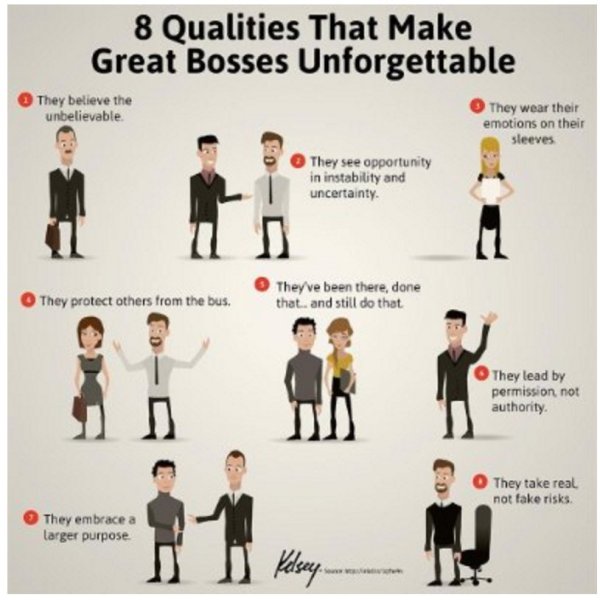
We burn entirely too much energy and each other’s time commiserating over bad bosses. We are all best served by remembering the great ones and what it is about them that makes us better for knowing them. When we take the time to puzzle out what makes for a great boss, we have the path marked for becoming that sort of boss…or leader…ourselves.

Last week, I discovered a piece on great bosses by seminary dean and leadership writer Chuck Lawless. In a bit, you will read his 10 characteristics he puts forward as common in his personal experience of top ten leaders.

10 Common Characteristics of the Top Ten Leaders I’ve Ever Worked With – Chuck Lawless

First though, after i took some time myself, thinking back on what was it about the great bosses I had that distinguished them above all others.

Here are my 10 Characteristics of Great Bosses, in no particular order:

  1. They were trustworthy. We knew they had our back…always.
  2. They had consummate integrity. They were consistent in attitude and action no matter the audience. Even under intense pressure, whatever it cost them, they stood their ground for what mattered.
  3. They showed faith in me and each of us on the team. Not just to get the job done but to do it as only I/we could.
  4. They (those male leaders) didn’t treat us women differently. In fact, if they ever did seem to treat us differently, the great ones modeled a valuing of what the women brought to the conversation. Great leaders never diminished us, either overtly or covertly.
  5. They showed genuine care, even fondness, for us. They didn’t just spend their best time and energy on work meetings outside our team. They actually carved time out with us as a team for seemingly the sheer joy of it.
  6. They gave us a voice in the decision-making…especially as it related to our particular work and how we thought it should be done.
  7. They knew us well enough to call us on our own character stuff. It was never just about the work, the project, the product or service. It was about our own growth.
  8.  They kept a sense of humor and regularly brought perspective. This wasn’t just about lightening the mood; this was about returning our thinking to the bigger picture, the greater good.
  9. They provided opportunities for each of us to keep growing and developing professionally.
  10. They pushed us in meaningful ways toward a shared vision…to keep our focus and stay on track.

That’s my 10 in looking back to the many great bosses…invaluable leaders…I’ve had in my career.

Dr. Lawless’ 10 Common Characteristics are these (go to his article for helpful commentary on each).

  1. They know Christ. – (his article was to a Christian audience. Still, many consider Jesus of Nazareth the greatest leader who ever lived.*)
  2. They continually dream about what’s next. 
  3. They trust the team they’ve enlisted. 
  4. They take care of their team. 
  5. They read present-tense reality well. 
  6. They get a lot done while still taking time off.
  7. There is no pretense in them. 
  8. They know the organization is bigger than they are. 
  9. They laugh a lot. 
  10. They adore their family and make time for them. Chuck Lawless

12 Characteristics of Effective Team Members – Chuck Lawless

*The Greatest Leader of All – Geoff Loftus

Whatever experience we have had with great bosses or those not so much, we can learn from them. I was glad to have Dr. Lawless’ prod to look back on the leadership in my own life. It was remarkable how both great bosses and bad ones hang in our memories. One day I might write about the bad ones – and I have stories… Today, I just want to think about them with compassion, figuring they didn’t get to that place without being negatively influenced somewhere along the way.

As for those great bosses…the ones who lead brilliantly, with genuine care and provision for those who work under them…here’s to you. May we learn from you, follow hard after you, and not be shy to show our own appreciation and consideration for you as well.

Photo Credit: Twitter, David Chou

In closing, I would love to hear about some of your great bosses… those leaders in your lives that stand out in your memory (or present experience). Please comment below. Feel free to tell stories or give tributes. We can celebrate together!

Are You a Great Boss? – John Lynn, Healthcare IT Today

Four Types of Bosses You Need to Avoid – Shereen Gaber

Photo Credit: Workboard

Monday Morning Moment – Trust Me – Sharing Economy, Idling Capacities, and Trust with Rachel Botsman

Photo Credit: YouTube, Rachel Botsman

Trust me. If you ever have the opportunity to hear thought leader Rachel Botsman speak, don’t miss it. Don’t miss her.

Who Can You Trust?: How Technology Brought Us Together and Why It Might Drive Us Apart – Rachel Botsman [Botsman’s latest book]

I discovered Rachel Botsman just a few weeks ago and, of course, wrote a bit about her work.

The concept of “shared economy” and “idling capacities” isn’t new. However, when I heard her use those terms in a TED Talk, my heart about leapt out of my chest. This resonates so with my idea of work and workplace, in terms of valuing people and resources as well as maximizing outcomes.

Rachel Botsman defines these terms as:

Sharing economy – “an economic system that unlocks the value of underused assets through platforms that match ‘needs’ with ‘haves’ in ways that create greater efficiency and access”. – Rachel Botsman

Idling capacity – “untapped social economic and environmental value of underused assets – tend[ing] to fall into three categories: physical stuff, labor assets (time, skills, human potential), and capital assets (crowd-funding, crowd equity, peer-to-peer lending platforms)” – Rachel Botsman

She talks about this broken system of supply-and-demand. “How can we extract more value from existing assets?”

These ideas are captured in a short video of her speaking here.

I see idling capacities and underused assets in all areas of my life… maybe it’s because I struggle with my own idling or being “idled”. That is not for this conversation. What matters more is how to get folks “in the game”, so to speak, who have so much to bring to the table. Yet, for whatever reasons, are idling. At their work station. In meetings without voice. Working at an idling pace when they have capacity for so much more.

Are you aware of such a situation? Share it in Comments below.

A sharing economy breaks down organizational silos, even departmental and team silos, and creates an environment where assets (people, products, places) are maximized. It can be a messy fuzzy-boundaried process. If organizational leaders are willing to give some latitude to the process and the people “idling”, a much healthier and more efficient workplace could be birthed.

Botsman introduces how technology has spurred the evolution of the sharing economy.

Photo Credit: Rachel Botsman

In considering how to have a more expansive mindset related to applying available resources to a problem, we have to be willing to do some difficult things. There are those who will have to give up some control. In a sharing economy, there’s no such only one “smartest person in the room”. Trusting other people on our teams with chunks of decision-making along with the work both conserves and optimizes.

We have to be willing to think outside that proverbial box and ask questions like “what more can we do with….” or “who else can we include….” or “what is it we don’t want to leave out”.

I love those kinds of questions!

Maddening for some, I know. I get it…

For today, I just wanted to introduce this subject…still very much a preschooler in this arena. However, I see it as so influential positively in today’s workplace. So fundamental, too.

Build in idling for reflection, rest, and recalibration…but don’t leave assets in that state for very long. It devalues people and delays product development.

Even when we have the technology to streamline processes and move projects to completion, we have to understand how technology affects trust. Botsman has a quick summation here:

https://twitter.com/twitter/statuses/1001446581244227591

Again, this is just the start of learning in this area for me…Will stop for now. Any thoughts on what you have read or watched?

YouTube Video – TED Talk – The Currency of the New Economy Is Trust – Rachel Botsman

YouTube Video – TED Talk – We’ve Stopped Trusting Institutions and Started Trusting Strangers – Rachel Botsman

Thinking – Rachel Botsman

Slideshares – Rachel Botsman

Rise of the Shared Workplace in the Sharing Economy and How the Sharing Economy Is Influencing the Workplace

YouTube Video – TED Talk – How to Trust People We Don’t Like – WorkLife with Adam Grant

Monday Morning Moment – Crisis: Its Physical Impact and Its Bonding Power in Relationships

Photo Credit: 403rd Wing

We are living in the early aftermath of many days of rain and the threat of flooding. For some it was worse than for us. It was nothing compared to the flooding we’ve seen in other parts of the country.Photo Credit: WikimediaPhoto Credit: 403rd Wing

Still, for us, it was a quick study on what it must be for others who experience such a crisis and its aftermath. In small measure, but same lessons.

Our basement is both a storage space and living area. We, in fact, do a lot of life there…with friends and grandkids. The storage consists of 1) boxes of our memorabilia from our years of travel and our children’s growing up, and 2) boxes of stuff from my Mom’s estate, given to us but as yet unboxed…until now.

When we discovered water coming into our basement from an over-saturated yard, on Friday night, we had to act fast or we don’t know how high it would have risen. Dave, our youngest son, and I began the work of dealing with a relentless flow of water into spaces it wasn’t welcome. Our son-in-law and older son came and we worked for hours attempting various diagnostics and maneuvers to stop the water and hold it back. It was exhausting work. Finally, sometime in the middle of the night, the water stopped coming in.

[My husband was supposed to have been at a work conference far from home, but other circumstances kept him here. You can imagine how thankful I am that he was home for all of this.]

When the rain stopped, we began the drying out process…and the cleanup. The work of making our basement into the friendly, happy space it was is almost disorienting. Hard to know where to start.

It will all happen. We are so fortunate. Now, more than before, we have an inkling of understanding of what others have gone through suffering tremendous crisis…like losing their furnishings and more in a flood.

In a quiet moment since Friday night, when we were taking a break, we marveled at what happens in human response to crisis. I’ve participated in crisis management throughout my career, and in our microcosm experience this weekend, we saw those practices at work…without even thinking about it.

Who Is Involved in a Crisis Response?

1) Crisis manager – the person in charge; the one running the crisis response; the one who knows what’s happening where and has all that in his head

2) Secondary managers – the persons who could be in charge but are working themselves on a piece of the operation

3) Frontliners – those with or without crisis manager skills but who have a piece of the response; the ones counted on to persevere in their tasks until they’re told to do something else.

4) Supply Line – the ones who by the nature of their skillset (or lack thereof) or physical ability who support all the above – the “go-fers”, the bringers of food, water, tools, encouragement. These, like the crisis manager, have the purview of the whole crisis and how each person is responding. They also, because they don’t have the stress of leadership, may see more clearly the toll on the individuals. They influence by alleviating stress through the supply line or by stating need to the manager (for rest or relief for frontliners, for instance).

5) Lastly, the Persons in crisis – they may very well be a part of the above, as was our situation. They carry the brunt of the crisis and its longer term impact. They also may not have capacity to respond to the needs of those around them, also in crisis [this was hard for me personally, knowing others we loved also having water issues.]

Crises show what we are made of, but they also show us our capacity and our potential. We’ve all responded to crises. What did we discover about ourselves? Sometimes we hesitate to respond to crises because of past negative or difficult experiences. Yet, we see those, who become our heroes, run (not away from danger but) into danger for someone’s sake. Every single time. Photo Credit: GeauxGuard

How do we become more like them in responding to danger (or crisis)?

  • We see the possible outcome as greater than the cost.
  • We build capacity by continuing to stay open to the smaller daily crises of each day (this helps me).
  • We learn from our heroes – not just about courage but about skillsets and thinking and even community-building.
  • We lean on each other, and (if you will) on God in crisis. All we can do ourselves is not always enough. Being in community and keeping our faith in a living God help us endure crisis and manage it, helping others.

It is much easier for me to write these thoughts than to do the next round of clean-up. All the wet cardboard went out this morning with our recycling. Now it’s what do I keep and where do I put it…Stuff. There is our treasure and there is stuff meant to be someone else’s treasure…none of it should stay forever in cardboard boxes.

The real crisis is over. The fatigue and “let-down”* will pass. The best part of it all was the human part. To work into the night with family who love each other willing to drop what they were doing and come. Working together, even though we are all people of strong opinions; dropping that for the sake of the work and each other. This was, for us, the greatest impact and power of this crisis. We are grateful.

Reactions to Crisis and Trauma (pdf)

The Power of Personal Relationships in Times of Crisis

*The Left-Down Effect: Why You Might Feel Bad After the Pressure Is Off – Stacey Colino

Crisis Communication Within a Community: Bonding, Coping, and Making Sense Together – Sifan Xu

Photo Credit: Sifan Xu, ScienceDirect

Monday Morning Moment – Doing What It Takes for Positive Impact

Photo Credit: Wikimedia Commons

When we institute change, any change, there is a ripple effect. We have impact on those absorbing the change. Making and executing a decision can be quite satisfying, but impact is a whole other thing. No matter how necessary, innovative or even brilliant we think the change is, the outcome and impact may be less than we had hoped. Part of the change must take into consideration those most affected by it…Input in anticipation of change is key to positive impact.

We don’t want to use a new invention until we understand it. That doesn’t mean we need to understand how it functions. However, we need to grasp what it can do and what it can give us. Rachel Botsman

What happens when a new business process is introduced as a done deal? What happens when your job is to translate it to your team in such a way that there is buy-in, ownership and adoption? Hopefully, you are thrilled with the possibilities it presents. But…what if you’re not. What if you are moved t to wonder how it will alter your work team’s relationships and responsibilities…?

The “what if” questions lead middle managers or team leaders to “if only” assessments. If only our team could have spoken into this…a much better outcome and more positive impact could follow… without the disruption and chaos you know will come… unnecessarily.

We must be careful, as decision-makers to avoid the default of being task and development oriented to the point that we lose sight of the people impacted. It’s not just “get ‘er done”; it’s also “get ’em won”.

Leadership has its rewards in delivering on bottom line and fulfilling the expectations of shareholders. Where we struggle sometimes is moving too quickly in identifying a problem and developing a solution. Occasionally even publishing our solution cold to our department heads or work teams. They do not always meet our hard work and great solutions with enthusiasm…not because our teammates are ungrateful or clueless. No, in fact, they may have had their finger on the very pulse of those same  problems, working out solutions together but not to the point of finished product. We, as leaders, can swoop in like the cavalry, communicating that we alone can “fix the problem”. No need for input here, right? Wrong…sadly wrong.

Before putting in motion a sweeping new initiative, we can hope for maximum impact. Maximum positive impact.

How? If we are willing to do the extra work of gleaning from teams, we can build trust and an openness to adopt change. It’s a win-win.

The Three Steps of Building Trust In New Ideas and BusinessesRachel Botsman

Kathy Caprino, a career coach and leadership developer, wrote an excellent piece on having genuinely positive impact.

9 core behaviors of people who positively impact the world:

  1. They dedicate themselves to what gives their life meaning and purpose.
  2. They commit to continually bettering themselves.
  3. They engage with people in open, mutually-beneficial ways.
  4. They invest time and energy not in what is, but what can be.
  5. They embrace critique.
  6. They spread what they know. [No gatekeepers or bottlenecks here.]
  7. They uplift others as they ascend.
  8. They view the journey as the goal.
  9. They use their power and influence well.Kathy Caprino

[Caprino goes into much more depth in her article. Don’t miss it.]

Just a word on disruption. It, of course, can be a good thing. The thing for us all to remember about disruption, especially in the workplace, is that it is never recreational, especially to those whose positions or purposes are being disrupted. As Rachel Botsman demonstrates in the image below…when change is initiated, we may see one of at least three reactions. When we build trust and demonstrate valuing of those most affected by the change, positive impact can be that sought-after outcome of our endeavors.Photo Credit: Wikimedia Commons

It’s worth the work – and we are better leaders for doing it.

Thoughts?

When Disruption in the Workplace Turns to Dysfunction – Annemaria Duran

http://www.expressworks.com/change-leadership-capability/the-four-fundamentals-of-successful-teams/?utm_campaign=TeamEffectiveness&utm_medium=Promoted_Content&utm_source=Social

YouTube Video – Time to Brave Up – Kathy Caprino – TEDx Talk