Category Archives: Workplace or Marketplace

Monday Morning Moment – True Humility in Leadership – So Not Cliché

Photo Credit: LinkedIn

There is just so much cliché out there these days. From what’s hip in men’s facial hair, to cool shoes or right purses, to shirts in or out, jeans skinny and cuffed…and the lingo. Oh the lingo!Photo Credit: Contently

Vu Le writes this hilarious article: 21 Irritating Jargon Phrases, and New Clichés You Should Replace Them With. He doesn’t just list out some of those phrases we hear (and say?) at work…ad nauseam. He also suggests alternative language. Just read the piece. Your endorphin level will rise…unless they are your fave phrases…oops!Photo Credit: Disquscdn

I’m weary of having to search for just the right phrase to communicate that what I have to say has merit (see…I shied away from the word “value”). Oh…for a culture where plain speak isn’t judged or suspect or treated as just too uncool.

Where jargon becomes cliché, our definitions can as well. What it takes to be good leaders has had a gargantuan amount written about it…and being a servant or humble leader can also fall into the category of cliché – just another fancy of today’s business culture.

Not so with true humility. Here’s my take on humility in the workplace. There is this seeming humility that masks something else – whether arrogance or insecurity, I couldn’t say. Then there is true humility – this is what makes a leader so easy to follow.

Writer Pat Lencioni has written a book on humility as one of three essential virtues of team players. In his book,  The Ideal Team Player – How to Recognize and Cultivate the three Essential Virtues, he tells a story about humility, hunger, and smarts.

Photo Credit: Amazon

“There are three required virtues that make someone an ideal team player. Those virtues are humble, hunger and smarts. The most important of those virtues is humility. The ultimate foundation of being a team player is a person being willing and able to put the team’s interests above his or her own. Only a truly humble person can do this effectively. The second virtue required is hunger, the desire to work hard, make a difference and get things done. The third and final virtue of an ideal team player is something I call smarts. It has nothing to do with intelligence, however, but is all about social awareness and interpersonal common sense. Ideal team players, in addition to being humble and hungry, demonstrate smarts with their ability to understand their colleagues and work with them effectively.”Patrick Lencioni, Author Q & A, TableGroup
This ideal team player is the kind of person we hope to always have leading our team…and our organizations.
I asked my husband recently what was the mark of a truly humble person. This was his response:
“Humble people pay attention to the people around them, whether they’re big or little.”
As wise as my husband is, he got that idea from Patrick Lencioni after reading his book.
Lencioni had much to say about humility, including:

“So many people there are so concerned about being socially conscious and environmentally aware, but they don’t give a second thought to how they treat the guy washing their car or cutting their grass.” Pat Lencioni

[I write about the power of noticing people here.]

Humility is cliché if it’s just coming at you from the front of the room or the head of the conference table. True humility communicates a right, or proper, understanding of relationship between colleagues, clients, and customers. No lone rangers or rock stars in this equation.  Photo Credit: AZQuotes

Great team players lack excessive ego or concerns about status. They are quick to point out the contributions of others and slow to seek attention for their own. They share credit, emphasize team over self, and define success collectively rather than individually. It is no great surprise, then, that humility is the single greatest and most indispensable attribute of being a team player.Pat Lencioni

True humility in leadership is so not cliché. It can be observed, modeled, and developed. What’s cool today can become cliché tomorrow. True humility?…never.

“Throw the passes when no one is watching. Write the pages no one sees. Work through the business plans people don’t believe in yet. Hustle long before the spotlight finds you. You don’t need the whole world on your side to create something that changes the world.”Marcus Mariota

6 Ways Humility Can Make You a Better Leader – Fast Company – Gwen Moran

Your Picks for the Worst Nonprofit Jargon by Cody Switzer

Infographic: 50 Terrible Work Phrases You Need to Stop Using by Nicole Dieker

Monday Morning Moment – A Word of Wisdom for the New Year – Holding Onto Good Employees

Photo Credit: Forbes

It’s the end of the year…anyone who is able is grabbing those vacation days and running with them. Probably few people are reading leadership posts this week, but even on end-of-year time off, I still think about the workplace. Occupational hazard (so to speak).

Thinking about the coming year always sets momentum for change for me. Not just wishful New Year’s resolutions…but actually taking strategic steps toward some change or another. When I came across Ron Carucci‘s post this week on leadership, he got me thinking about what keeps us on our jobs…and what causes us to pull away.

Thinking about work, we gravitate to what challenges us more than what satisfies us. Having interesting work, close colleagues, and a good boss would be a wonderful way to start the new year. If that’s your situation, then you should be off sipping hot cider, head in that new book, or playing games with your grandchildren.

If the challenges of your job are causing you to rethink whether to stay or look for other work, take some time to evaluate what is it that would put you on such a course of action. Having a job at all is no small thing. Go slowly in changing course and know, for sure, why you would make such a change.

There’s a cliché that surfaces in leadership articles (like the ones linked below) which speaks to the reasons why employees quit. It goes something like this: “People don’t leave jobs; they leave managers.”Photo Credit: Pinterest

Bosses have their own struggles – balancing the bottom line with keeping their employees equipped and engaged. It can be complicated to keep the customers, employees, and investors all pleased with their efforts and the product/service provided. Still…it is those in leadership that have the onus of keeping the best employees on the job.

So much has been written about this, because losing good people is hard on everyone in the workplace. Carucci talks about the three types of power that bosses wield: positional, relational, and informational. Using their power, managers can do much to assure fair treatment throughout divisions, to invest personally in individuals and teams, and to keep information pathways open and multi-directional. Read more of Carucci’s advice here…and here.

I’ve had some great bosses across my career – bosses that made me want to stay even when the work had become too hard or too same and colleagues had become too wearisome (or maybe it was me). There were times I stayed because of my relationship with that boss.

One of those bosses was Mary Florence Woody. In my first job after graduate school, she was the director of nursing of an 1100-bed inner-city teaching hospital. I interviewed with her for the oncology clinical specialist job. In my mid-20s, full of youth and confidence with little understanding of how much I didn’t know, I presented myself to this great lady. She was a giant in nursing in those days, and for all of her career actually. She asked me big questions that day and listened deeply, and somehow I got that job. It was a tremendous launch into a profession that was very kind to me.

Photo Credit: WHSC

Ms. Woody gave me some great counsel that day. She told me not to let my youth or inexperience define me. “If you determine to get to know and revere the people and their work, at all levels, then respect and regard will be returned to you.” Over the whole of my seven years working there, in the role of educator and practitioner, I did as she had advised. Mopping up spills, delivering food trays, making beds, troubleshooting equipment, rounding with physicians, nurses, dietitians, and chaplains. In whatever capacity the patients were served, I tried my hand at it. Not always well…but with persistence. That’s how I learned how valuable each person was on the team…and it helped me have perspective on the piece of care I provided as well.Photo Credit: Massey

Mary Woody helped me from that first day. Did we hang out together? Absolutely not. She had enormous responsibilities and time constraints, but she communicated what mattered.  Ms. Woody cared about her employees and it was obvious to all of us. She also let us find our own way, but not without applying her position and influence on our behalf.

Was I a “keeper”? Not sure…but I never had to guess whether Ms. Woody had confidence in me. She did…and the strength of that kept me out of the ditch for months into that new role. In fact, opportunities came my way that I could never have imagined. Thanks to Ms. Woody and other colleagues like her, I left that job to teach at Yale University…having so much more to offer than before.

All that to say what? When we look to the future as to whether we stay in a job or leave for another one, we must reckon with what matters most to us. There is no guarantee we won’t find a similar set of circumstances in the next job, so there’s that…

I hope you’ll read the Carucci, Bradberry and Myatt articles below. They all resonate with the same message, just different aspects of it. What can make a difference in keeping quality personnel on the job? Care and control are the critical components – more caring and less controlling. Something we can all consider in the new year…whatever our position…

Photo Credit: LinkedIn

Hold onto that resignation letter for a bit.  What would compel you to stay? When the right next job presents itself, take it…absolutely …but know for sure why you’re leaving this job. Then leave burning as few bridges as possible…like Jon Acuff advises, “Make sure you leave with one finger raised high: your thumb. As in, ‘Thumbs‑up guys. Thanks for letting me work here. I’m off to a different adventure, but you guys are awesome.'”

If you stay, maybe you can influence others by genuinely caring for them and by letting go of some control yourself. If your boss struggles in these areas, she could learn from you. Who knows?

Happy New Year…done with thinking about work for today… Bring on the apple cider.Photo Credit: Foodie Misadventures

Bad Mistakes That Make Good Employees Leave – Travis Bradberry

9 Things That Make Good Employees Quit – Travis Bradberry

10 Reasons Your Top Talent Will Leave You – Mike Myatt

Monday Morning Moment – Them and Us, How Can That Be? Could Them and Us Become a We?

Blog - Work Culture - delta7Photo Credit: Delta 7

From the archives:

Recently, I was in an odd conversation with a friend from work. The more we talked, the more we sounded like a Dr. Seuss book. It went something like this:

“I don’t know how to be us with them. To be with them is to just be them. We must lose us; us no more will be. There’s no us in them; it’s so strange to me. How can they be them, with no us, you see? To give up us is too hard for me. So I can’t see a way to get to we.”

[Seriously, the conversation went like that…but better.]

Battling the us-them assignation is an ongoing workplace discipline. Even in the happiest, coolest companies, there is still an intentionality to keep work life positive for every employee. That inclusiveness is a hallmark for high morale and low walls (read: no silos).

BLog - Us vs Them - Work Culture - Silos - prolearn academy

Photo Credit: Prolearn-Academy

In a work culture where silos still exist, an us/them mentality can grow as each team or department draws in on itself and ignores or suspects the actions/values of others. It’s not a healthy situation for any of us…whether it’s the executive team insulated from others or the [fill in the blank] team hunkered down in its own mode of trying to survive. The first can be as unaware as the subject of the story “The Emperor’s New Clothes“, the second, well, is just miserable, and growing more so by the pay period.

So much has been written on this problem in the workplace – about that culture where us/them thinking and operations color productivity and morale. I have included several links below describing various recommendations and protocols to restore health to such organizations.

Blog - Work Culture 2Photo Credit: My Turnstone

I’ve always been that person who says, “Why can’t we just all get along?” In reality, we don’t have that situation always, but we can grease the tracks in that direction. Here are my own workplace rules regarding moving us and them to we:

  1. Make a practice of assuming the best of your bosses and colleagues. “Refuse to think ill of others” is my goal…and my accuracy in hitting that goal comes with practice and determination…and grace.
  2. Lean in to those with whom you struggle the most – the “thems” in your worklife. Especially the most powerful ones. Study them. Learn their language. Know them as well as you can. NOT for self-serving reasons, but for the benefit of the work itself. Any motive that only serves your personal situation will only make matters worse… ‘Nuff said.
  3. Refuse to get caught up in us/them complaining. Don’t make a big deal about it, but do your best to turn the conversation toward a positive end, change the subject altogether, or bow out if all else fails. Those negative conversations just bring you and your colleagues down and don’t accomplish anything. A short-lived “misery loves company” satisfaction isn’t worth the fall-out of such conversations.
  4. Bring down the silos, one brick at a time, if necessary. Maybe you aren’t experiencing any us/them anguish, but you know it exists. What can you do, individually and as a work team, to move to “we”? We have lots of work models out there for this. In fact, silos in the workplace are “so 80’s” (whatever that means…I hear it a lot, so I’m using it here). Use some of that meeting time, or talks over coffee, to be creative in how you can work better across teams…how you can learn more from each other…how you can defuse territoriality? If the “them” is management, you initiate dialog on setting work culture values that maximizes product excellence and employee engagement.
  5. Put processes in place – through your culture – to keep silos down. I would love to hear what your situation is and how you are making positive steps to grow/keep a healthy culture. Please comment below.

Sure…there are times we need to process a difficult situation at work with a trusted friend. Yes, us/them scenarios are painful…and wrong, honestly…especially in the workplace where we are meant to have shared goals, working toward the same outcomes. Maybe, the us/them relationships in a company are too distracting and we can’t see any solution (back to the Dr. Seuss-like conversation above). In that case, it’s possible we look outside our company for another situation. However, you take with you a piece of the us/them dilemma. You take you along to the next job. Better to develop muscle memory on how to “be we”, whenever possible, right where we are.

[Sidebar: I’ve written a lot about work culture – too many to mention – but you can search work culture under Blog – Deb Mills and learn as I have about what is possible if we stay engaged in our workplace.]

Blog - Work Place Culture - open.bufferPhoto Credit: Buffer

Overcoming Us vs. Them Challenges

Breaking the “Us and Them” Culture

How to Avoid Us vs. Them – Huffington Post

The 10 Buffer Values and How We Act on Them Every Day

The 4 Elements That Make Great Company Culture

How to Save a Broken Work Culture

From Us and Them to We Participative Organizational Culture

Them and us – How to use Trust as a Competitive Advantage

How CEOs Can End an Us Them Mentality

Us vs. Them – a Simple Recipe to Prevent Strong Society from Forming

Monday Morning Moment – Turning Around a Work Culture – From “Not Good Enough” to “Job Well Done”

blog-demanding-bosses-linkedin-dave-kerpenPhoto Credit: LinkedIn – Dave Kerpen

Aha moments can occur in all sorts of settings. My latest happened during our pastor’s sermon this week. Toward the end of a deep and fascinating exposition of Colossians 2, Pastor Cliff reminded us that we are not meant to earn God’s approval. He gives it unconditionally. Then Cliff talked about how we get caught in the trap of “It’s never enough!” when thinking of our efforts or accomplishments. Then “It’s never enough” or “Not good enough” too easily turns into “You’re not good enough.” This is the place where what we do intersects with who we are…

Switch from the Sunday Bible lesson to the Monday workplace application. I’m not talking the unconditional love of God here, but what happens to us in continuous feedback loops. Stay with me…This made me think uncomfortably about the way I once operated in the area of idea generation and innovation.

I am “an editor”…it gives me great satisfaction to take a document or process and make it better. Recently a friend asked me to edit his manuscript. It’s going to be such a great read…can’t wait for it to be published. Still, there will be lots of edits. For me, being an early reader, I just took care of some grammar and flow issues. There will be more qualified editors down the road. It’s enough for me to do quick, elementary edits and wildly praise the author and his riveting storyline, cheering him on to the next steps of publishing.

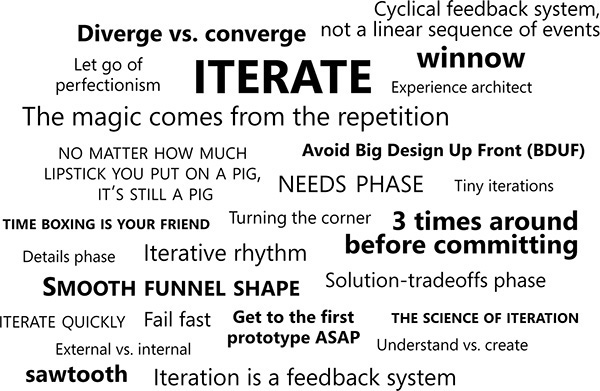
The tweaking that I used to do regularly in my earlier professional life was more intense in those days…and less forgiving. I wanted it (whatever it was) to be right, and it was my immodest opinion that I could get it to right. Especially when evaluating someone else’s work (ironically, I was less hard on my own work – figuring it was perfect already, right? Sigh…). The tweaking of another era has come round to a newish process called iteration.

One definition of iteration is the “process of learning and development that involves cyclical inquiry, enabling multiple opportunities for people to revisit ideas and critically reflect on their implication”. These feedback loops are meant to be fast-paced with the finish in view.

ScenarioPhoto Credit: SafariBooksOnline

Where iteration (or tweaking) breaks down (if I might be so bold) is when it’s taken well past rapid feedback loops into a realm of fine-tuning that has the team guessing “will it ever be good enough?” Product design and process development are vital to any company, but what we must also consider is the team or personnel involved.

If the feedback loops relate to the launch of a new product or a new business process, excitement and brainstorming are part of the momentum. Continuing to tweak over months instead of weeks before the launch can take a negative toll on the team. No one wants to forfeit excellence, but we don’t want to lose excellent personnel either.

blog-demanding-bosses-lifehackerPhoto Credit: Lifehacker

Trusting the judgment of our best thinkers is worth the risk of possibly releasing a product or service when we may not all be sure it’s “perfect”. That is what beta-testing is all about…the feedback that then comes to us from the consumer or user.

I’m really talking out of my element here (not being a designer or innovator so much as a lifelong learner). My leap from the sermon to the workplace relates to my own past struggle with wanting something with my name on it to be perfect while exhausting my teammates  with “what if we do this?” or “What if we say it this way?”

What a gift for us to take a well-thought-out proposal and, instead of putting it through the “just not good enough” wringer, we read it and pass it back to that colleague and say, “Good job”…empowering them to execute the proposal. How often does that happen these days?

Please share stories [in the Comments] of work situations where you experienced genuine affirmation for a job well-done.

Recently when water started backing up into the kitchen sink, I was afraid that it was something I had done. Too liberal using the disposal, for instance. Dave was out of town and nothing I could do would remedy the situation. Finally, on a Sunday afternoon, in desperation, I called our plumber (Richmonders, if you need a good plumber, email me, and I will give you his contact info). He came and fixed the problem, and best of all, it wasn’t my fault, after all. This young man literally LOVES his job and was kind to take the time, after he was off the clock, to give me the breakdown of what the problem was. What he charged me? Worth every penny…especially the part where it wasn’t something I had done wrong.

Why I bring this up is that being a fairly capable and creative person doesn’t prevent me from faltering at the likelihood that I messed-up.  See the Imposter Syndrome. My mental wiring is such that I get discouraged when my contribution to a situation actually causes more work for someone else, adds expense, or slows down progress. I’ve learned over the years that all that tweaking I may not have taken the product from good to great, and most assuredly caused some amount of frustration to hard-working, quality colleagues. Lesson learned.

There are times and seasons when tweaking is appropriate in developing a product and changing a business process. What we want to take into account is the cost of that tweaking, or iteration, on the people who make things happen in our workplaces. Free them from the “not good enough’s” to enjoy the fruit of “jobs well done”.blog-demanding-bosses-the-musePhoto Credit: The Muse

10 Tips for Dealing With an Overly Demanding Boss – Jacquelyn Smith

How to Get Over the Feeling that You’re Not Good Enough for Your Job – Michele Hoos

10 Things You Can Do to Get Out of Your Boss’s Doghouse – Brian Dodd

Why Incentive Plans Cannot Work – Alfie Kohn – Harvard Business Review

Good Is Not Good Enough: The Culture of Low Expectations and the Leader’s Challenge – Karlene M. Kerfoot

Innovation and Iteration: Friends Not Foes – Scott Anthony – Harvard Business Review

Holding a Team Retrospective – Morale

Workplace Bullying: Protecting Yourself at Work – Slideplayer

Monday Morning Moment – People You Love Working With – and Becoming One of Them

blog-likable-guys-at-work-askmenPhoto Credit: AskMen

It’s Monday morning and whatever you’re facing today, these folks help to bring down your stress and lighten your load…just by being in your path. You can name them easily. They are the ones who make you laugh and see a different side to your situation. They are the ones who give you second thoughts when considering a job change. They are the ones who add value to you, not just as a colleague but as a real in-the-skin human being. These are the folks who can turn the course of your day with just a few minutes conversation…or even a wave from across the parking lot. It’s just that simple.blog-likeable-cowoers-muffy-bennettPhoto Credit: Mashable

For you guys in a dark place…and not one person comes to mind…maybe, it’s good to think back…to people in your past who helped set you on a positive course in your career…think of those people. If you are in a hole in your workplace right now, and many of us have been there at some point in our professional lives, could you rally and become one of these people who light up the place?

blog-likeable-coworkers

Photo Credit: Friendship.about

Here’s the challenge for today. I read an article by content strategist Scott Tousley recently which got me thinking about this.  Is it possible to become “a rising tide that lifts all boats”? If you’ve read this far, you probably are already that kind of person. However, if somehow you struggle with keeping fellow employees in your view while dealing with large-scale problem-solving, you might want to consider a personal assessment and do-over. It’s never too late.

Scott Tousley – who has the longest eyelashes and most infectious smile – also gets to live and work in San Diego, California. Besides all that, he writes really insightful articles about the workplace. His article, The 9 Habits of Insanely Likable and Charismatic People, is so good, I’m not going to write my own commentary on this topic, because you HAVE to go read his article. It lists the 9 habits (included below) with real-life anecdotes, brilliant support data, and links to read more. So don’t miss it – lightning-fast read for us visual learners.

Tousley’s 9 habits of insanely likable & charismatic people: 

1. They are empathetic

2. They are humble

3. They are vulnerable

4. They have a sense of humor

5. They are present

6. They are genuinely interested in EVERYONE

7. They avoid social narcissism

8. They are generous and altruistic

9. They reciprocate praise (and take blame)

Being likable and charismatic isn’t about being popular or climbing the career ladder as much as it’s about making a huge chunk of our lives just more enjoyable… We have choices here.

blog-likable-coworkers-the-question-academyblog-likeable-coworkers-amanda-gorePhoto Credit: The Question Academy; LinkedIn

If you had trouble calling to mind people you really like at work, then you’ve probably fallen down but you can get up! Don’t let that snarky, seemingly self-important coworker or boss mess with your head and steal your joy. Refocus to those in your workspace who you can’t help but be encouraged around them. Don’t miss them in that cloud of bother over the less likable ones around you. So what if they don’t seem to care about you or others at work. You be one who cares…and it can make a big difference. Take Scott Tousley’s excellent counsel in noting and affirming those likable ones around you…and set your course to return to being one yourself.

The 9 Habits of Insanely Likable and Charismatic People – Scott Tousley

4 Simple Questions That Will Instantly Make You More Likable at Work – Sara McCord

Being More Likable at Work – Cherie Burbach

10 Traits of Likeable People – Evan West

13 Habits of Exceptionally Likeable People – Travis Bradberry

How to Develop Your Charisma and Become More Likable – WATCH the Olivia Fox Cabane Video – Patrick Allan

How To Be More Likeable at Work – 10 Things To Do Today – G. L. Hoffman

YouTube Video – Amanda Gore – Stress Busters and Mood Management and Turning on the Joy Switch

Monday Morning Moment – Getting Outside and Taking a Real Breather From Work

blog-taking-a-break-from-work-youtubePhoto Credit: YouTube

Some weekends are meant for lots of play mixed with Fall clean-ups…this was one of those. Then Monday comes around.  You pull your tired body out of bed, try to stretch those shoulders out and loosen up your knees again. In a matter of minutes, you settle that frame in your desk chair, and expect your brain to be on task with new work-week vigor. Right?

Maybe. Whether it’s Monday or any other day, our workspaces (especially if it’s cubicle life) can, over the course of the day, do a number on our creative thinking and problem-solving. Our minds and bodies cry out for stretch breaks…and not just to hit the restroom and pour the next cup of coffee. A change in location – i.e., to the next meeting – isn’t the recipe for clearing our heads either.

Getting outside…now that’s a grand solution.

My husband works on an incredibly beautiful street in our city. He is in meetings inside, of course, much of the day. When not in meetings, he’s at his desk. Eating his apple and bag of nuts, at lunchtime…right there. At his desk.

While this is going on outside…

blog-work-break-in-fall-monument-ave-flickriverPhoto Credit: FlickRiver

I don’t take advantage of being outside myself, so no shaming here. Still, the individual worker and the work itself would certainly profit from a breather…a step away from the desk or conference room table…a few minutes on the outside.blog-work-break-foster-school-of-businessPhoto Credit: University of Washington

“Brain breaks can make a big difference in your ability to be productive, creative, and innovative. The paradox is that doing less often allows you to do more.” – Jeff Stibel

In Courtney Seiter’s article The Science of Taking Breaks at Work: How to Be More Productive by Changing the Way You Think About Downtime, she gives support to the broad benefits of taking breaks. Taking your coffee, outside, for a walk around the block are some of my favorites tips of hers.blog-break-at-work-open-bufferPhoto Credit: Open.Buffer

Walking into an office building and around the folks smoking, I think, “Hey, nice they [have to] go outside…just that alone probably counters some of the impact of smoking on their health.”

Hopefully, you didn’t use up your break reading the blog today…unless you’re reading it while you’re sitting outside in the sun.

I love Philip Terman’s poem Some Days about the replenishing affect of the quietening out-of-doors. Here’s a portion:

Some days you have to turn off the news
and listen to the bird or truck…
You have to close all the books and open
all the windows so that whatever swirls
inside can leave and whatever flutters
against the glass can enter. Some days
you have to unplug the phone and step
out to the porch and…allow the sun to tell you what to do.
Philip Terman, Our Portion: New and Selected Poems

blog-work-break-daily-mailPhoto Credit: Daily Mail

Take that breather…clear your head…and stretch your legs. Either with someone or all alone. It’s worth the trouble…

The Science of Taking Breaks at Work: How to Be More Productive by Changing the Way You Think About Downtime – Courtney Seiter

The Writer’s Almanac with Garrison Keillor

5 Ways to Give your Brain a Break Right Now – Jeff Stibel

3 Easy Ways to Give Your Brain a Break During Your Workday– Jacquelyn Smith

Monday Morning Moment – Uncommon Courtesy in the Workplace

blog-courtesy-adding-value-john-maxwell-iluvquotesPhoto Credit: iluvquotes

My mom raised me to be courteous…thoughtful towards all…civil in every circumstance…extending grace. Recently, I have become aware that my behavior in the company of others has become less courteous overall. Not in an intentional way, hopefully, but in a careless neglectful way. This is disconcerting because it makes me wonder how long has this been a part of my demeanor and deportment. Not necessarily with those closest to me…but with “the others” in life – the stranger, the coworker, the customer.

blog-common-courtesy-quoteaddictsPhoto Credit: Quote Addicts

Yesterday, not at work, I interrupted the conversation of three people. Not overtly, maybe, but it was a quiet drawing away the attention of one of them. Without even thinking, I was rude.

We don’t really mean to be rude or discourteous probably…but in the neglect of practicing courtesy…we can become “those people”…rude, disingenuous, self-serving people.

What does that look like in the workplace?

John Kyle describes rudeness at work:

“It can range from subtle things like eye-rolling to outrageous things like berating a colleague in a meeting.

Here are some common examples:

  • Gossiping and talking behind someone’s back.
  • Giving colleagues the silent treatment.
  • Interrupting someone when they are speaking.
  • Leaving trash and food containers in public areas like the office kitchen.
  • The work around – excluding colleagues from projects or meetings even though they should, by role and responsibilities, be included.
  • Being late for meetings or in other ways not respecting someone else’s time.
  • Speaking to people in a condescending way.

All of these examples of rudeness are forms of disrespect. A pastor-friend of mine once said that giving someone the silent treatment is the relational equivalent of saying, ‘I don’t respect and care enough about you to talk to you.'”

John Kyle, Chief Operating Officer for The Institute of Faith, Work, and Economics, also delivers some simple advice on how we might overcome rudeness at work. One of his tips is to make a practice of greeting people…just saying hello (using their name if you know it). How simple is that?! Yet, too often, we walk quickly by, head down, lost in our brilliant and important thoughts, or hanging on every word of that one we’re accompanying. Is it so hard to smile and nod our head at those we are passing by? Those who work with us, have the same vision, hope for the same outcomes, wrestling with the same struggles at work or home.

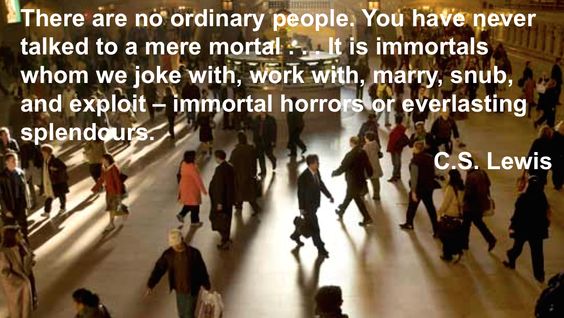
What Kyle reveals in his article on being courteous at work is that we expose our lack of regard for those around us by not taking the time for them…to say or do the small graces for each other that communicates that “there are no ordinary people”.

blog-courtesy-no-ordinary-people-c-s-lewis-pinterestPhoto Credit: Pinterest – WitandWisdomofCSLewis

His counsel echoes a book I recently read by John Maxwell – Intentional Living – Choosing a Life That Matters. Maxwell, like Kyle, talks about adding value to people…communicating that if we are not intentionally adding value to people then we show that we devalue them.

What do you think? It would be such a gift to have your comments on stories where you were treated with uncommon courtesy at work. Do you have examples of how such actions and attitudes are rewarded in your workplace? Do your bosses display this sort of worldview? Please share your stories…even the negative ones that might have given you pause about your own altered attitudes over the years.

As I described in the story earlier, this has certainly given me pause. I want to be a load-lifter at work. An encourager. A respecter of all persons…not just the ones who can help me get ahead with my career. It’s possible that I might have become a bit more curmudgeonly over time…and that’s not really the kind of coworker I want to be. My mom would be glad to see that I’m climbing out of this insufferable ditch – resolved anew to make a habit of uncommon courtesy.

Bringing Courtesy Back to the Workplace – Harvard Business Review – Ron Ashkenas

Why Is Common Courtesy Increasingly Uncommon at Work? Rudeness on the Rise – John Kyle

How do You Practice Common Courtesy at Work?

Workplace Etiquette – 4 Ways to Show Courtesy to Coworkers – Rachel Wagner

Uncommon Courtesy – Blog

Slideshare – Courtesy

How To Become a Curmudgeon – WikiHow – just for a chuckle!

Monday Morning Moment – What You Think of Others Matters – Workplace Wisdom

Blog - What You Think of People Matters - Dave 5

[From the Archives]

At first, you really liked working with this person. Then, bit by bit, he/she began wearing on you. He is always playing with his phone. Her solution to today’s problem is too labor-intensive. His email responses have become terse. She is late for your meeting. You think, maybe I was wrong about him. He is not the person I thought he was. Maybe, she’s the wrong person on the bus.

When a relationship begins to deteriorate at work (or home), you are wise to take steps to turn this around as quickly as possible. You could be in a work situation that has been difficult from the outset. It is still possible for you to make inroads in turning that relationship toward a more healthy or positive one. If not altogether, at least from your side. Consider an adage that has had a long and useful run in our family and work.

Your opinion of someone approximates their opinion of you.Dave Mills

There are exceptions, but I have found this to be wise counsel (from my husband, no less) in both personal and professional relationships. When what was a warm, congenial relationship takes a turn toward the negative, you can actually work, from your side, to restore the relationship. Even to take it to a deeper level. It can get more uncomfortable at first, because you have to start with your own thoughts toward that person. How have they changed?

We send signals to each other – whether we speak or not.

My Mom raised us out of the era of Walt Disney’s Bambi:

“If you can’t say something nice, don’t say nothing at all.”

Good counsel except for the conversations that still go on in our heads and color our attitudes, our tone of voice, our preferences, and our decisions.

Let’s say I have an amicable relationship with a colleague, and then something happens. I may not even be aware of it – a misunderstanding, a misconstrued action, an insensitivity unaware. Then a chill develops, or a clear outright dislike. I have a window of opportunity to clear that up. Otherwise, if I don’t act, then a process can begin where I decide that person is a jerk and has woefully misjudged me…and off we go.

Remember: This can go both ways. You may have had a few off days with a colleague, and find yourself just not thinking so well of him, then stop it! It’s possible you can keep them from picking up that signal and prevent the relationship from getting more toxic as they decide you’re not so great either.

If I refuse to think ill of another person and discipline myself to be respectful, deferrent in my demeanor, and tireless in pursuing understanding, I could restore that relationship. If it doesn’t improve right away, my attitude and actions work for my own benefit and can definitely help build trust with my team members. One day…that relationship may also turn. It’s worth the effort.

Blog - What You Think of People Matters - Dave

Jon Acuff talks about the four ways we invest in our careers – through skills, character, hustle, and relationships. In an interview with LifeReimagined.com, he had this to say about difficult, or neglected, work relationships:

“Even if you have skills, character and hustle, without relationships, it’s the career version of the Emperor’s New Clothes. Why?”

“If you don’t have relationships, you eventually don’t have people in your life who can tell you the truth about the decisions you’re making. You don’t have people who can tell you no or question you honestly. What I’ve learned is that leaders who can’t be questioned end up doing questionable things.”LifeReimagined.com interview with Jon Acuff

He identifies three types of people in our lives (work or otherwise, really): friends, foes, and advocates. Jon writes in Do Over:

“The best thing to give a foe is distance. We should ignore most foes. The problem of course is that we won’t. If your definition of foe is too loose and is essentially “anyone who kind of bothers me ever,” your job is going to be miserable. If you see people as your adversaries, it’s almost impossible to have a good working relationship with them. The first thing is to understand whether these foes are clueless or calculated. A clueless foe is that person whose behavior encourages you to fail. They are not malicious. They are not trying to make you lose, but with the power of their influence you are. “Bad habits are almost always a social disease – if those around us model and encourage them, we’ll almost always fall prey. Turn ‘accomplices’ into ‘friends’ and you can be two-thirds more likely to succeed.”Jon Acuff, Do Over

I think what Jon says is true. Because of my own worldview and value system (and married to Dave all these years), I don’t think we can just acknowledge there are foes out there and distance yourself from them. Sometimes, that is virtually impossible and still be effective at work. Because what can happen, if we don’t act to keep our own thinking clear, is that we take on some of that “foe-dom” ourselves. Maybe you aren’t going to be bosom buddies with this person, but your own work and other relationships can suffer if you develop bad habits around this person. Better to work on the relationship.

Blog - What You Think of People Matters - Dave 6 (2)Blog - What You Think of People Matters - Dave 6

“For no matter what we achieve, if we don’t spend the vast majority of our time with people we love and respect, we cannot possibly have a great life. But if we spend the vast majority of our time with people we love and respect – people we really enjoy being on the bus with and who will never disappoint us – then we will almost certainly have a great life, no matter where the bus goes. The people we interviewed from the good-to-great companies clearly loved what they did, largely because they loved who they did it with. – Jim Collins, Good to Great

Blog - What You Think of People Matters - Dave 3

For as he thinks within himself, so he is. Proverbs 23:7

Finally, brothers, whatever is true, whatever is honorable, whatever is just, whatever is pure, whatever is lovely, whatever is commendable, if there is any excellence, if there is anything worthy of praise, think about these things.Philippians 4:8

Blog - What You Think of People Matters - Dave 2

 Do Over by Jon Acuff

Fourteen Indispensable Leadership Quotes from Jim Collins – Thom Rainer

How to Deal With Difficult Co-workers – Read keeping in mind that some days you might be the one perceived as difficult.

Blog - What You Think of People Matters - Dave 4

Photos: Just a few of the men in Dave’s life who required no special work on his part to love and respect…and there are many more. Grateful.

Monday Morning Moment – Ultra-Productive People & What They Do Differently – 2 Infographics

blog-productivity-silicon-valley-reportPhoto Credit: Silicon Valley Report

We all have exactly the same amount of time. At least in a day. Some of us have less time than others in our lives, probably, which makes using that valuable time wisely all the more important. However, that’s the false perception of time. The idea that, because we’re young, we have all the time in the world…so chill. Enjoy. Right? Just because we’re young, how we use our time will set habits that build a foundation for our life and work. Young or old, learning how to be consummately productive is a very good plan. When we do the work of learning to be “ultra productive” part of what we gain out of that is…more time. Definitely worth the work.

I’ve written on productivity other times (in particular, about “Chris Bailey’s life of productivity”). Using time and brain power wisely is important to me because I am well aware of how easy it is to squander both. When I discovered the two infographics below, they affirmed some of the changes I’ve already made in my life and other habits worthy of establishing.

Kevin Kruse in a Forbes article gives us results of his survey of 200 ultra-productive people. He asked each their secret of productivity.  The infographic below lists out the 15 ideas gleaned from his study.blog-productive-people-do-things-differently-15-time-secretsPhoto Credit: Online Learning Tips

Anything surprise you? I was surprised at getting rid of to-do lists by scheduling everything. The “say no to everything” idea can be agonizing to execute and also infuriating when you’re on the receiving end.  Every idea in the list of 15 is doable and easy to develop as a habit. Worth a try, right?

Another infographic (from Dylan Roach and Jacquelyn Smith in Business Insider) highlights the morning habits of successful people. This also resonated with what I have discovered in the lives of influential and productive friends and colleagues. blog-productive-people-do-things-differently-16-things-at-start-of-each-day-update-or-diePhoto Credit: Business Insider

I appreciate the ideas of this infographic…especially the ones on helping others and being grateful. Soft habits maybe? Not really. When the ideas above get hard-wired in us through habit formation and intentionality, our productivity ramps up and our definition of success may widen to a more shared experience in our life and work.

Monday Morning Moment – Praying For Your Spouse [or Fill-in-the-Blank] in the Workplace

Blog - Praying for Your Spouse - the lifePhoto Credit: The Life

Sometimes really crucial opportunities pass us by…responsibilities, too, fall off our plates. We get busy…distracted. We choose the urgent without thinking. The urgent over the ultimately important.

This time, one year ago, I saw the film War Room. The plot centered on an older praying woman who mentored a younger woman, whose marriage was falling apart. She mentored, not so much about marriage, but about praying for her marriage. It had a huge impact on my heart…and my prayerlife.BLog - War Room to publish 2Photo Credit: War Room Movie

I prayed my heart out for my husband…and our children…some extended family…and close friends. I still pray for them…but in recent months, the urgency had faded. Other lesser things piled in and I allowed myself to become distracted and dull.

Until this past week…. This past week, I started a Bible study with some other friends who meet together regularly. The book study is The Armor of God by Priscilla Shirer. She is also the person, in the film War Room, playing the young woman in the troubled marriage. The study focuses on the Bible passage, Ephesians 6:10-19, and speaks about our role in spiritual warfare.

I had forgotten how important it is not just to pray generally and regularly for those we love, but to pray specifically and persistently. There is a big difference.

For several days, I have been praying for a difficult situation in my husband’s work life. It has been ongoing for some time, and he finally arrived to a point of taking action.

Yipes…I wasn’t at all sure I had prayed well enough for him. In fact, I was sure I hadn’t. There is no going back, but today, fresh in studying how best to pray for those we love, I took God at his word and have prayed differently. Trusting God to intervene as I stood, fortified, in his presence…as the Apostle Paul instructed in Ephesians 6.Blog - Praying for your spouse - true agapePhoto Credit: True Agape

The details of what happened at work are not necessary for today’s posting, but praying specifically, persistently, and according to God’s Word has made for a very encouraging turn in the situation. Honestly, I don’t think it would have played out as it has, if both my husband and I weren’t really seeking God’s solution for this.

Will it always work out to be a glorious outcome when we pray hard and in faith? I can’t say…not always praying hard nor in faith. However, when we do pray for situations at work instead of just ranting or processing over the dinner table, outcomes will decidedly be better.

Our work is such a huge chunk of our lives. To leave it to chance or charm or even competence…seems a risky business. What a privilege to pray staunchly and strategically for those we love in the workplace – our spouses, our closest friends, our children… Praying for our bosses and colleagues, as well, could improve both their lives and ours as well…not to mention the enormous ripple effect that can spread as God works in a situation.

This afternoon our joy is full. Even though my husband’s workplace may “seem” unchanged…it is wholly different because he has seen God work in a hard place. With complete assurance. I rejoice with him.

Work is a 3-song commute from home. As I was traveling in this morning, thinking about what was ahead of him and praying for the situation en route, these songs were the ones that came back-to-back on the radio as I drove in:

Pretty amazing, huh? What seems extraordinary can be our ordinary when we pray to a Father who wants to show himself mighty on our behalf. What better thing can I do for those I love than to pray hard…pray believing for them?