Category Archives: Attitude

5 Friday Faves – Beyond the Guitar’s “Spirit”, Reducing Brain Fog, Crucial Conversations, the Precious Nature of Life, and What We Have in Common

1) Beyond the Guitar’s “Spirit” – Below you will find the latest Beyond the Guitar video from the 2002 movie Spirit: the Stallion of the Cimarron. Nathan’s treatment of “Homeland” theme by masterful composer Hans Zimmer 2002 movie theme is beautiful. One of the commenters on his YouTube video stated that it was as if Zimmer composed it for guitar. Nathan’s arrangement definitely does justice to this incredibly triumphant orchestral piece. Enjoy!

2) Reducing Brain Fog – Brain fog is an inability to concentrate. It is essentially a feeling of “being in a fog” – you feel slowed-down, tired, draggy, unable to think clearly or even find the right words at times.

Photo Credit: Marcus Aurelius, Pexels

Writer and business consultant Thomas Oppong wrote this brilliant article on what we can do to reduce brain fog. He goes into great detail so be sure, if you struggle with this issue, to read his piece. He doesn’t quote from the science literature but his takes on the six points below make enormous sense. All worth a try.

  • Give up the clutter. – Decluttering bit by bit will lower stress and sharpen focus.
  • Stop the multi-tasking. – “Narrow down your most important tasks to 3, and then give one task your undivided attention for a period of time. Allow yourself to rotate between the three, giving yourself a good balance of singular focus and variety.”
  • Give up the urgent distraction. – We have our lists and our goals, but the easier and lesser things around us draw away our attention. Resisting the distractions help us stay on track.
  • Stop feeding your comfort. – Beware of the well-worn ruts in work and life. “Seeking new experiences, learning new skills, and opening the door to new ideas inspire us and educate us in a way improves mental clarity.”
  • Don’t sit still. – Plan physical activity into the day.  It helps us stay mentally fresh and focused.
  • Stop consuming media and start creating it. – Social media can rob us of our hours and energy. “Let creation determine consumption. Allow curiosity to lead you to discover and pursue something you deepy care about. Make time to create something unique. The point is to get lost in awe and wonder like you did when you were a child. When you achieve that feeling from a certain activity, keep doing it!” – Thomas Oppong

How to Overcome Brain Fog From a Long-time Sufferer – Tim Denning

3) Crucial Conversations – So many conversations don’t happen because they are just too risky. They make us feel too vulnerable. Yet we long for deep conversations. For conversations that enlarge us and bring understanding, even between people who don’t share opinions or worldviews.

Crucial Conversations: Tools for Talking When Stakes Are High – Kerry Patterson, Joseph Grenny, Ron McMillan, Al Switzler, & Laura Roppe

Top 10 Takeways From Crucial Conversations – Tabitha Bower

Last week, I listened to a Jennie Allen podcast on “life-giving conversations”.

Between the current political division and the physical distancing necessitated by COVID, we are having fewer crucial conversations. That’s not to say we aren’t on video meetings or phone calls for much of the day, but we have to work harder to have satisfying conversations.

March 2020 (BC – Before COVID mediation)

April 2020 – AC (After COVID mediation)

Certainly conversations between people who disagree are happening less. They are just too hard. Especially via screens. Especially when opportunities to talk deeply are just not there.

What got me thinking about this is a couple of podcasts (see below) and also watching (and feeling) the strain of months long requirements of video meetings with work (and church) groups…instead of in-person opportunities.

How to Have Life-Giving Conversations – Podcast – Jennie Allen

How Shame Affects All of Us – Podcast – Jennie Allen with Dr. Curt Thompson

Crucial conversations, whether one-on-one or in a group structure, are harder these days. How can we get past the superficial or the daily grind kinds of talk? I’m thinking there’s a discipline we can develop – to really dig in and want to know the person(s) in front of us and to ask questions and pose topics others can really engage with…especially if we can communicate that we are safe with each other.

“We want to be seen and known in the place we live… we want to ask questions that invite people to be curious and creative. Tell me about something this past week that was really hard for you. Caused you joy.  That caused you to be creative. Regularly take time to validate that in each other. We want to invite people to be curious and creative.” – Jennie Allen, Dr. Curt Thompson

Anything with psychiatrist and writer Dr. Curt Thompson involved is great quality content. Whether it is on belonging, vulnerability, shame, or dealing with physical/social distancing, he has a wealth of practical and neurologically sound counsel. Just watch the YouTube videos with him talking.

Thoughts?

4) The Precious Nature of Life – What we think on this has divided our nation – those more for life from conception and those more for the rights of the conceiving adults.

As a mother and grandmother who has lost all but one of her cherished older relatives, I want to celebrate the precious nature of life. I want to invite you to celebrate as well.

We never know when we will be gone from here or when those we love will be either. We just never know. Thus, the imperative to not let anything stand in our way of loving…or at least honoring the lives of those in our own.

Why this for a Friday Fave?

The 21 y/o son of friends of ours died this week. The whole wrong gone of this dear young man has stopped us all in our tracks. God’s grace holds people up…as does His grace with clothes on, friends and other family, leaning in to love. His passing has been very much on my mind, and his parents on my heart.

Canadian author Tim Challies also lost his son, Nick, recently…also suddenly. 20 years old. We are thankful that the Challies family has a huge circle of support, too. He has been writing about their loss of Nick in a series of blogs. Here is one: The Cruelty of Quarantine: A Lament.

If you could use some help with your own grief, walk with Tim through his.

Cherish these loved ones we’re privileged to have in our lives. In all their scruffiness, various differences, political activism or not…they are gifts to us. We don’t throw them back. We figure out how to love them and be there for them…and hopefully, they do the same for us.

Right?

COVID (and its mediation) is putting incredible stress on our lives and relationships. Important to keep our eyes and minds clear on the precious nature of life…not just ours, but each others, of course.

5) What We Have in Common – When there are rifts (political or familial) or a growing discontent (in a relationship or at work) or a vain sense that life could be better with someone else, it’s good to give pause to that thinking, and consider: What do we have in common with each other? What might we be giving up that we may not see in the every day but that, once out the door, we may miss and regret the decision?

Photo Credit: Wikipedia

Think of the person(s) you may be having difficulty with. Now, come up with what you have in common, make as long a list as possible. Be creative.

I’m thinking…ok, here goes:

  • We share the same core values.
  • We care about the world we’re leaving to our children.
  • We both want to be successful, but also to be effective.
  • We’ve both lost a parent (or two).
  • We are both American (fill in your country) and we care about our country.
  • We’ve both been to the doctor way too many times this year.
  • We both struggle with insecurity, although it surfaces differently.
  • We both have trouble talking with each other about these things.
  • Yet, we both know we are a part of a greater story.

Can we take the things we have in common and move toward each other instead of more apart?

_________________________________________________________________________

Just a few thoughts that didn’t get laid down until after a busy, lovely weekend. Hope the rest of your week is peaceful and full of good.

Bonuses:

How to Overcome the 5 D’s of Leadership and Life: Doubt, Distortion, Discouragement, Distraction, and Division – Carey Nieuwhof Leadership Podcast – with Guest Jon Gordon (Podcast & Transcript)

The Curse of the Honeycrisp Apple – Deena Shanker and Lydia Mulvany

Fall Leaves in All Their Glory (Before the Rains Came)

Wednesday Worship – What Are We Defending in Anger – Who Is Your Defender? – Francesca Battistelli & Steffany Gretzinger

Photo Credit: Wendell Berry, QuoteFancy

My dear brothers and sisters, understand this: Everyone should be quick to listen, slow to speak, and slow to anger.James 1:19

The LORD will fight for you, and you must be quiet (stay still/hold your peace).”Exodus 14:14

Have you been angry lately? You find an internal burn firing up over an offense? An injustice. A false accusation. A public rebuke. A mean comment. A certain look or tone.

Your anger rises, and you feel justified – to react, to strike back, to level…that person or persons “at fault”.

Anger in itself is not a sin. What we do with it keeps it righteous or turns it into something damaging. God has shown us what righteous anger looks like. He also warns us about anger turned sinfully toward ourselves or others. Or even toward Him.

He will take our anger…because He loves us and won’t stop loving us.

This week, I listened to Bible teacher Jennie Allen‘s podcast on Anger. It was a great launch into a deeper look at anger. In her podcast, Allen referred to a sermon by Pastor Tim Keller.

YouTube Video – The Healing of Anger – Tim Keller (12 minutes in, for sure, but all of it is important so take the time)

In this podcast, Keller tells of how just waiting on his food order in a restaurant, he found himself getting angry at the wait. The question came to him, “What are you defending?”

“Anger is defending something you love.”

When we get angry, we may be defending our own (or someone else’s) rights or entitlement to something. It could be our reputation, our ego, our sense of importance. What do we love? We will defend it.

“What is it that you love so much?…I’m afraid of how I’m going to look, I’m afraid that it’s going to come out…I’m defending my ego. I’m defending me…There’s a place in Jeremiah where God says, ‘Seekest thou great things for thyself? Seek them not.’ [Jeremiah 45:5]…We are ordering our love…Disordered love [leads to] disordered anger…”Tim Keller

If God’s love is not more important than any other love, we will be at the whim of disordered anger.

“When anything in life is an absolute requirement for your happiness and self-worth, it is essentially an ‘idol’, something you are actually worshiping. When such a thing is threatened, your anger is absolute. Your anger is actually the way the idol keeps you in its service, in its chains. Therefore if you find that, despite all the efforts to forgive, your anger and bitterness cannot subside, you may need to look deeper and ask, ‘What am I defending? What is so important that I cannot live without?’ It may be that, until some inordinate desire is identified and confronted, you will not be able to master your anger.” – Tim Keller, Counterfeit Gods

In his sermon, Keller talked about three ways we deal with anger. We either stow (stuff) anger, blow anger, or slow anger. Neither of the first two types are good for us or for anyone else.

God calls us to be slow to anger. He knows our frame. He loves us and He loves those who “make” us angry or whom our anger targets.

If we die to our rights/entitlements as God calls us to do, then our love for Him and for others becomes ordered in such a way we are less prone to striking out in anger.

Defending ourselves using anger is exhausting and can leave relationships broken or destroyed. When the situation is someone else angry with us, Keller gives us a way (the way) to deal with the disordered anger: A surgical strike on disordered anger from another without losing the relationship:

  1. Come in close.
  2. Insist on the truth (staying with what you and he/she know is true – not just how you/they feel.
  3. Absorb the pain of their disordered rage without paying back.

This is huge.

This is what Jesus did for us, in his life and death. This is our great Defender.

Francesca Battistelli with songwriter Steffany Gretzinger gives us a beautiful anthem in praise of our “Defender”.

Let’s worship together.

You go before I know
That You’ve even gone to win my war
You come back with the head of my enemy
You come back and You call it my victory, oh-ooh

You go before I know
That You’ve even gone to win my war
Your love becomes my greatest defense
It leads me from the dry wilderness

And all I did was praise
All I did was worship
All I did was bow down, oh
All I did was stay still

Hallelujah, You have saved me
So much better Your way
Hallelujah, great Defender
So much better Your way

You know before I do
Where my heart can seek to find Your truth
Your mercy is the shade I’m living in
And You restore my faith and hope again

And all I did was praise, ohhh, oh-ooh
All I did was worship
All I did was bow down, oh
All I did was stay still, stay still

Hallelujah, You have saved me
So much better Your way
Hallelujah, great Defender
So much better Your way

When I thought I lost me
You knew where I left me
You reintroduced me to Your love
You picked up all my pieces
Put me back together
You are the defender of my heart
When I thought I lost me
You knew where I left me
You reintroduced me to Your love
You picked up all my pieces
Put me back together
You are the defender of my heart
When I thought I lost me
You knew where I left me
You reintroduced me to Your love
You picked up all my pieces
Put me back together
You are the defender of my heart

Hallelujah, You have saved me
So much better this way
Hallelujah, great Defender
So much better Your way
So much better Your way (I know it’s so much better)
So much better Your way (I know it, I know it)

And all I did was praise
All I need to do is worship
Lord, I will just bow down
I’m just gonna stay still*

*Lyrics to Defender – Songwriters: Steffany Gretzinger with Rita Springer and John-Paul Gentile

Story Behind the Francesca Battistelli’s New Song “Defender” – Mornings with Rebecca and Burns

100 Bible Verses about God As Our Defender

YouTube Video – Heartsong Cedarville University – A Mighty Fortress Is Our God

Photo Credit: AZ Quotes

Monday Morning Moment – Gratitude and the Brain – All Good Gains

Photo Credit: Twitter

Have you noticed the increased expressions of gratitude on your social media? At least in the US, we are gearing up for Thanksgiving. Some of us take this occasion as an opportunity to daily and publicly express our gratitude. Based on what we know from research, this could make November one of our happiest and least stressful months of the year.

Below you’ll find quotes from some of these authors, reporting on both clinical research and anecdotal data that support how the practice of gratitude can actually alter our habits of thinking and our sense of well-being. It’s all good for us and those around us.

“Our brain is always on alert to threat and is more predisposed to look at the negative side of life [stress response]. There are many things that happen to us everyday that are positive but we don’t notice them because we are always looking for the next threat to us. Now these actions are below our level of awareness. It takes some concerted effort to get our brain to move to the positive side of life. And that is where paying attention and expressing gratitude plays a role in establishing that positive mindset. When we start to place attention on the positive events in our life our brain responds by producing the neurotransmitter dopamine…We do feel better when dopamine is flowing but that also makes are brain wanting more – so it becomes the motivating neurotransmitter also…In addition, the brain loves confirmation bias: it looks for things that prove what it already believes to be true. Dopamine then strengthens that action. So if you start seeing things in your life that you are grateful for, your brain will start looking for more things to be grateful for.”Patricia Faust, How Gratitude Affects the Brain

Six Habits of Highly Grateful People – Jeremy Adam Smith

  1. Once in awhile, they think about death and loss. – As we think of past losses and future losses (say of those we love), we remember and reflect on the good we’ve known in those situations or relationships. Of future losses, we then take action to savor and bless those persons while we have them near.
  2. They take time to smell the roses. – Whether our current situation feels difficult or just mundane, we look for the beauty.
  3. They take the good things as gifts, not birthrights. – We see entitlement for the life-diminishing thing it is.
  4. They’re grateful to people, not just things. – We can be thankful for great food, for blue skies, for warm clothing, but we go beyond that to the one(s) who provided the good we have.
  5. They mention the pancakes. Being grateful for the specific little things disciplines us to enlarge our gratitude for the greater things in our lives. Those things that can cause stress if we don’t remember the value and significance in them.
  6. They thank outside the box. Even in adversity or hard times, we can find things for which to be grateful. Gratefulness doesn’t minimize the difficulty; it actually strengthens us to endure.

What Gets in the Way of Gratitude? – Robert Emmons

“Given its magnetic appeal, it is a wonder that gratitude might be rejected. Yet it is. If we fail to choose it, by default we choose ingratitude. Millions make this choice every day.

Why? Provision, whether supernatural or natural, becomes so commonplace that it is easily accepted for granted.  We believe the universe owes us a living. We do not want to be beholden. Losing sight of protection, favors, benefits and blessings renders a person spiritually and morally bankrupt.  It’d be hard to improve upon the words of our 16th President in 1863:

‘We have grown in numbers, wealth and power as no other nation ever has grown; but we have forgotten God! We have forgotten the gracious Hand which preserved us in peace, and multiplied and enriched and strengthened us; and we have vainly imagined, in the deceitfulness of our hearts, that all these blessings were produced by some superior wisdom and virtue of our own.'” – What Gets in the Way of Gratitude? – Robert Emmons

8 Ways to Express Your Gratitude

  1. Keep a gratitude journal.
  2. Write a gratitude letter to a past mentor or teacher.
  3. Count how many things you can find to be grateful for in each room of your home.
  4. Listen to a guided gratitude meditation [my suggestion if you don’t prefer guided meditation: spend some time in the Psalms].
  5. Start business meetings with a “what went well” one-sentence reflection.
  6. Savor receiving thanks.
  7. Take a daily photo of something you are grateful for and post to Instagram or Facebook, tagging it with #365project.
  8. Try a gratitude jar or tree.        – Tamara Lechner, The Neuroscience Behind Gratitude: How Does Cultivating Appreciation Affect Your Brain?

So…what are you grateful for at this moment?

How Gratitude Changes You and Your Brain – Joshua Brown, Joel Wong

How Gratitude Can Help You Through Hard Times – Robert Emmons

Choosing Gratitude: Your Journey to Joy – Nancy Leigh DeMoss

The Science of Gratitude – a White Paper – UC Berkeley

Photo Credit: Robert Emmons, Greater Good, Daily Good

Monday Morning Moment – I’m Going to Change the World…or At Least Try

Photo Credit: Inblix

[Adapted from the Archives – here and here]

My husband always brings me coffee. He did again this morning. When I asked what he had on his schedule, he replied, “Work…the usual stuff”.  Then he asked about my day ahead.

“I’m going to change the world.”

Now, that isn’t a usual Monday morning response. It actually surprised me. I really have absolutely nothing on my schedule. Nothing.

When he gave his take on his day, it reminded me of our Sunday night.

We both sometimes struggle with a bit of depression and foreboding on Sunday evenings…especially after a sweet weekend.

Kind of a shudder and shake preparing our heads for a new week.

Well…it’s Monday morning now…who knows what can happen, if we look for it. I am going to clear my head of all the sluggishness that’s set in from devouring too much political news…it’s a new day.

Making the bed every morning has been a habit of mine since childhood. Somehow in the middle of the chaos and clutter of life, that “made” bed stands in hopeful defiance.

Blog - Make Your Bed - habit formation (2)

Admiral William H. McRaven a highly decorated Navy Seal, retired in 2014 from a 37-year military career. He oversaw Operation Neptune Spear – the military operation that culminated in the death of Osama bin Laden. In the year of his retirement, he was commencement speaker at the graduation ceremony of University of Texas – Austin. Blog - Change the World - Make Your Bed - pinterestPhoto Credit: Pinterest

As he encouraged the young graduates, he told of 10 lessons in his SEAL basic training. Beginning with “Make Your Bed”, they follow in brief (you can watch the video of his speech or read more detailed highlights here).

10 Life Lessons to Change Your World

1. If you want to change the world, start off by making your bed.

2. If you want to change the world, find someone to help you paddle.

3. If you want to change the world, measure a person by the size of their heart, not the size of their flippers.

4. If you want to change the world get over being a sugar cookie and keep moving forward.

5. If you want to change the world, don’t be afraid of the circuses.

6. If you want to change the world sometimes you have to slide down the obstacle head first.

7. If you want to change the world, don’t back down from the sharks.

8. If you want to change the world, you must be your very best in the darkest moment.

9. If you want to change the world, start singing when you’re up to your neck in mud.

10. If you want to change the world don’t ever, ever ring the bell.

Steve Nguyen, Workplace Psychology

Adm. McRaven closed the commencement speech with the following challenge:

“Start each day with a task completed. Find someone to help you through life. Respect everyone. Know that life is not fair and that you will fail often . . . but if you take some risks, step up when the times are the toughest, face down the bullies, lift up the downtrodden and never, ever give up….if you do these things, the next generation, and the generations that follow will live in a world far better than the one we have today, and what started here will indeed have changed the world for the better.”Navy Adm. William McRaven


You WILL change the world!

Besides making the bed, a habit of prayer and time in God’s Word also helps clear my head and set the course of my day. This morning, a resolve was stirred afresh to set myself on the course of a world-changing God. He loves us and will work good out of every situation for those who love Him and respond to His call on their lives (Romans 8:28).

A powerful piece by Jon Bloom a few years back continues to encourage and inspire. Below is just an excerpt:

“You will change the world, more than you know. And because of that, because your life will impact so many others, Jesus wants you to live prayerfully (Ephesians 6:18), walk carefully (Ephesians 5:15), and seek his kingdom first (Matthew 6:33). If you do, if you faithfully invest the “little” he has entrusted to you, no labor of yours in this life will be in vain (1 Corinthians 15:58) and he will entrust you with more in the life to come (Matthew 25:21).”Jon Bloom, Desiring God

You Will Change the World – Wisdom from Jon Bloom – Deb Mills

So to you out there…and especially to you, Dave…the bed’s made. Praying for you and for me…as we prepare and brace ourselves to change the world. Who knows what God will do as we stand ready?!Blog - No Life wasted 11

[Postscript: Thank you, Dave, for your willingness to follow God where He leads you…and all the amazing people, memories, and God-lessons we have in our lives because of that willingness. Thank You, God, for every stamp in my passport, and for being there every step of the way…including this very day. Help me to take hold of it…I can change the world, because of You.]


Monday Morning Moment – the Art of Argument

We were younger than we thought. Fresh out of graduate or med schools. In our first big real-world work. Most Saturdays in those days, we met for breakfast at Horton’s (now a Chipotle) and lingered over coffee. Talking about life and how to solve the problems around us. We didn’t always agree, and sometimes we got loud and passionate…but never unkind. We loved each other after all. We also cared about the same things but often saw those very same things differently.

Each going our separate ways those Saturdays, we had learned from one another. Always coming away with a larger sense of what it takes to make a better world. We valued our debates, our arguments, as much as our happier takes on life. Civil and thoughtful – with space to disagree.

A few years later, we all relocated across the US, in next real-world jobs. I took a teaching post at Yale University. My first foray out of the South. There, I had the same experience as with our Saturday morning breakfast club. Lively debate on life, university regulations, student issues, course content, and the politics of the day. I was definitely an outlier on some of the topics, being one of the youngest on faculty and from a part of the country sometimes maligned for its thinking. Still, the grace and respectful interest given to me by my colleagues again gave room to grow…maybe for all of us as we wrestled together things that mattered. The experience of belonging also breathed consideration into our arguments. We shared commonalities. A tenure track respected no one over another.

Recently, a lawyer friend of mine, in Seattle, sent me the following article on this topic of argument or dissent:

The New Truth – When the Moral Imperative Trumps the Rational Evidence, There’s No Arguing – Jacob Siegel

What we are witnessing, in the rapidly transforming norms around race, sex, and gender, is not an argument at all but a revolution in moral sentiment. In all revolutions, the new thing struggling to be born makes use of the old system in order to overthrow it. At present, institutions like the university, the press, and the medical profession preserve the appearance of reason, empiricism, and argument while altering, through edict and coercion, the meaning of essential terms in the moral lexicon, like fairness, equality, friendship, and love. That the effort wins so much support speaks to the deep contradictions and corruption of American meritocratic institutions, and of the liberal individualist moral regime it seeks to replace.

Moral revolutions cannot tolerate ambiguity, but there is so much that I’m not sure of. How does one argue with this new form of truth? Not in the old way. Not by taking the bait.Jacob Siegel

Siegel writes about the lost art of argument. His is a long and scholarly piece very worth the read. In brief, he states a strong case of how American culture, in particular, has become intolerant of reasoned debate. Pick the issue, and folks line up on one side or the other. If you are not on my side, then you are dead wrong. More than just wrong, you are a racist, sexist, fascist, Communist. And so it goes…far from the days of civil disagreement.

Photo Credit: Prezi, Christopher Lasch, Stephanie Rugo

I am still hopeful.

In the midst of all the meanness, especially in this election year, with political debates upon us, I believe we can turn this around.

Surely, we see the danger of hateful, polarizing exchanges. Part of our dilemma is that we are less face-to-face than we used to be. Before email and social media. Before COVID.

It’s too easy to use social media to make a public case on an issue and then dare someone to expose her biases and disagree.

I’m so thankful to have friends and family who allow for arguments on issues of religion, politics, etc. but without attacking.

The key to the art of argument is our persistent care for the person across from us. We may not love them, may not even like them, but we refuse to belittle or grow contempt for them. We refuse.

We determine to show respect, no matter how hot the argument becomes. We learn how to deescalate because the person matters more than the problem.

Scott Sauls speaks often on this matter of argument. His Tweet below expresses it better than I can.

Twitter source: Scott Sauls

“Attack problems not people…especially problems that attack people.”

Although in the public arena we see too much ungracious confrontations, we can find exceptions. I’ve taken to watching Blogging Heads on YouTube. On split-screen, two people (often educators but others as well) tackle some of our most pressing societal issues. They have been immensely helpful to me. Equipping their listeners on how to problem-solve and see issues in ways we might not have before. Mentoring on how to have respectful, thoughtful discussions on topics they may or may not agree on…but they amicably agree to disagree.

Twitter source: Ian V. Rowe

The art of argument (debate) doesn’t have to be lost. We can choose to weigh in on matters of extreme importance without taking the other person to the mat. Stating our reasoning without condescension. Listening, learning, allowing that we could be missing some part of the issue. Whether or not we get the same treatment, we both lose if at least one doesn’t remember the person in front of us has greater value than winning the the argument.

In closing, you’ll find two clips from Denzel Washington‘s 2007 film The Great Debaters. The plot is based on the true story of the rising debate team of the historically black Wiley College. The time was the 1930’s during the era of Jim Crow. The place, Texas. Washington played the role of Melvin Tolson, the outspoken debate coach. These two clips are riveting examples of an argument and a debate…and how it might be done again.

Thoughts? Please. In the comments below.

The Art of Having a Productive Argument

The Lost Art of Argument – Stephanie Rugo

YouTube Video – The Art of Argument – Jordan Peterson

Social Control and Human Dignity – Ben Peterson

5 Friday Faves – Shrek Revisited, 200 Days, Humanity Over Politics, Civil Thought & Voices, Mushrooms Everywhere

Here we go! Friday Faves late edition.

1) Shrek Revisited – The Fairytale theme from the movie Shrek (by English composers Harry Gregson-Williams and John Powell) is  sweetly suited to classical guitar. Especially arranged and performed by Beyond the Guitar‘s Nathan Mills. Enjoy.

2) 200 Days – It’s been 200 days of physical distancing and wearing masks in public. Over half a year. COVID-19 has been a global health threat for many months now. We have learned so much in how to prevent, mediate, and treat. It’s become a political issue which is unfortunate and unfair. It is a novel virus. We are all learning.

For me, the biggest thing, after not contracting the virus, is how to navigate life with physical distancing. I’ve found instead of my capacity for work and people growing, it has contracted. Fatigue is a daily issue to battle. This is so curious since we are in the physical lives of far fewer people…and much of the clutter in our work lives has been removed.

Still…we are challenged to stay in play in life and relationships. I really appreciated the counsel of the two articles below. Won’t elaborate here, but read what you need…and don’t give in to the sluggishness of this constrained life. It will get better or stay different – we want to effectively meet the challenge whatever it is.

The Nine Habits to Increase Your Energy – Scott Young

How to Build Closer Relationships – Advice from 7 TED Speakers on Creating Better Connections – Kara Catruzulla

Photo Credit: Spencer Seim, Facebook

3) Humanity Over Politics – “Don’t let politics take away your humanity. Don’t let the fact that you agree or disagree with someone on various issues, don’t let that stop you from having sympathy for them, compassion…In general, people need to stop trying to dunk on people, insult people, dunking on people when they are…sick, going through dark times. It’s just despicable behavior. This is not me virtue-signaling. This is just me trying to encourage you to be a decent human being. Humanity over politics always!”Zuby

I follow @ZubyMusic on Twitter. This young man is British with an international accent (sounds American to me, raised and schooled in Saudi Arabia). He is truly brilliant with a wide range of giftings – podcaster, rapper, health/fitness coach, author, and culture commentator. He seems to truly care about people…and even us Americans, which is so refreshing. I learn from him daily.

4) Civil Thoughts and Voices – Who are those in your lives? Please comment below and let us in on those we might want to learn from, as well. On the Christian front, writer/pastor Scott Sauls is one of those for me. His book A Gentle Answer: Our ‘Secret Weapon’ in an Age of Us Against Them is a great resource.

In the last several weeks, you have heard me rave about economics professor and social scientist Glenn Loury. He is one of the thought leaders in our world today, and his voice has helped me stay calm in a world gone crazy. He is weekly on a YouTube Blogging Heads episode and also on other media platforms. This week, Loury speaks with Ian Rowe on education and society. There is not one dry point in this whole conversation.

Hope-giving. Whatever your biases or preconceived notions are, Do. Not. Miss. This. Especially if you love children.

Rowe is currently a fellow with the American Enterprise Institute, focusing on education and upward mobility, family formation, success sequence, adoption, and poverty studies. If you truly care about issues related to racism, poverty, opportunity, and family, you want to read everything he writes…and talk about it with whomever and wherever you have a voice.

[Rowe also talks about the role of not only individuals but mediating institutions who will add to the conversation and strengthen the solutions.]

The Power of the Two-Parent Home Is Not a Myth – Ian Rowe

1776 Unites – free US history curriculum, alternative to 1619 Project

Photo Credit: Facebook, Chris Bear & Wendy McCaig

The Politics of Spin and Culture War Fatigue – Scott Sauls

Six Tips for Speaking Up Against Bad Behavior – Catherine A. Sanderson

5) Mushrooms Everywhere – The natural world around us is full of wonder and surprises. I had the pleasure of a walk in the woods this week. Highlighted by a closer to the ground view by two small grandchildren. They spotted and we marveled at the incredible array and variety of mushrooms and fungi growing on the forest floor and downed logs.

We see mushrooms pop up in our yards overnight. How do they do it? Seemingly out of nowhere. Not tackling that here, but you can find several timelapse videos of mushroom growth on YouTube.

For today, I just wanted to post some (not all) of the mushrooms we discovered on that one walk. Phenomenal!

Time-lapse video of composting worms – ok, so this has nothing to do with the above topic, but… When my husband takes the grandchildren fishing, they fish with worms. Dug up from our compost pile. Except for the creepiness factor, it amazes how worms can turn garbage into compost, and over a very short amount of time.

___________________________________________________________________________

That’s it for this week. Hope you had a great weekend (given this is posted after the weekend instead of on Friday). Stay well out there.

Bonuses:

COVID-19 Emergency Measures and the Impending Authoritarian Pandemic – Stephen Thomson

Here’s How US Presidents Get Elected (It’s Not Be Winning the Most Votes) – the Electoral College Explained – John Letzing

Warren Buffett Says This 1 Simple Habit Separates Successful People From Everyone Else – Marcel Schwantes  – In case you don’t read the article, the habit is that successful people say “No to almost everything”. Schwantes also quotes Steve Jobs and Jim Collins on how we make our decisions in choosing what really matters to us.

“Every ‘yes’ you say means a ‘no’ to something else.” – my husband, Dave

Twitter source: Kenneth Williams

“There are times in the experience of almost every community, when even the humblest member thereof may properly presume to teach — when the wise and great ones, the appointed leaders of the people, exert their powers of mind to complicate, mystify, entangle and obscure the simple truth — when they exert the noblest gifts which heaven has vouchsafed to man to mislead the popular mind, and to corrupt the public heart, — then the humblest may stand forth and be excused for opposing even his weakness to the torrent of evil.” – Frederick Douglass, from Maria Popova’s article “Frederick Douglass on the Wisdom of the Minority and the Real Meaning of Solidarity

The following video is an intersection in Cairo, Egypt. I never could bring myself to drive when we lived there, but I loved watching how the drivers made their way through all the traffic. Fascinating!

Why the World Needs Heroes – Jenn Phillips

I posted this Howard University commencement speech once before – if you didn’t see it, don’t miss it. Chadwick Boseman.

Monday Morning Moment – On Maturity in Temptestuous Times – with Coleman Hughes and Ayishat Akanbi

Photo Credit: YouTube, Coleman Hughes

Who are you? With whom or with what groups do you affiliate? How do you identify yourself?

Important questions in any season.

Today, we sift what people say about their beliefs and ideas and assess value based on their groups and affiliations. We do.

For the last several months, we have had the opportunity thrust upon us (if we weren’t so engaged before) to think deeply about what we believe. Now the temptation exists, as we are very much communal beings, to go with groups…groups we have always trusted.

Groups (and group-think) are fluid. Our tendency is to think they are fixed, but they are not.

Of late, I’ve been trying to be diligent to seek out people who don’t look like me, who don’t necessarily think like me, with the goal of listening and learning. Face-to-face is best and most fruitful. However, with COVID and affiliations (associations) too homogeneous (unfortunately), I’ve often resorted to finding these thinkers on-line.

Writer philosopher Coleman Hughes and stylist culture commentator Ayishat Akanbi recently had an immensely helpful conversation. On maturity. On curiosity over defensiveness. You can watch/listen to this bit (a mini-clip) of their conversation here or the whole conversation here.

In fact, below you will find some of Coleman’s and Ayishat’s conversation. I wish there was a transcript for the whole podcast but this segment was so powerful, it’s right here:

___________________________________________________________________________

ColemanMaturity is being able to hear something undesirable about your in-group and view it objectively instead of defensively.

AyishatIt seems to be one of the foundational problems of everything. We cannot hear anything undesirable about a group that we belong to. We are only willing to accept the narrative…only willing to look at the part of the story that focuses [outwardly]. We’re not allowed to acknowledge that any problem could potentially start at home.

We just want to outsource blame constantly.

Conversations are very stagnant.

I prioritize curiosity above many things. If someone was to say something negative about me, before I get defensive, I’m just like, “Hmmm, interesting. I wonder if this is true.” I’m more likely to interrogate at first. If we’re able to look at something with more curiosity than defensiveness, we’re in a better position.

I just think if we’re if we recognize having undesirable aspects of our communities or groups…it doesn’t mean they’re bad; it doesn’t mean you’re a wrong person. It’s a little texture. It think we just see everything as good or bad.

ColemanJust like a person can have flaws and imperfections, a person of maturity can see their own flaws and always be curious about them. If your significant other says, “Hey, you have this thing you always do and it makes me feel bad.” Maturity in that moment is the ability to say, “Wait, are they right? Let me think about this.” Maybe they’re not, but maybe they are.

We all recognize that’s true of the individual case, but when it comes to groups, it seems people aren’t able to do that.

Conversations with Coleman

__________________________________________________________________________

I’d like to close with a bit of transparency. I am a follower of Jesus Christ, which, for me, includes trusting that God has preserved and protected every word of His message to us through the Holy Scriptures. In religious circles, I identify as evangelical, not deterred by our culture’s attack on evangelicals right now. Trying to be curious and not defensive about that. Growing up during the women’s rights movement (ERA), the shockingly late desegration of schools, and Roe v. Wade being made law. Same sex attraction became especially real to me when a cherished friend in college sought a romantic relationship with me. A deep personal loss when she ended that friendship because I turned out to be un-altering in my heterosexuality. Always captivated by politics, I was staunchly liberal and a Democrat…until I wasn’t. Today my politics are more conservative, even Republican, but driven by policy rather than personality. I am an older white woman with all that seems to communicate.

Daughter. Sister. Friend. Nurse. Wife. Mother. Gram. Writer. [Decided I couldn’t leave any of these out. More for me than you.]

How many sentences into the above paragraph did it take, if you don’t know me personally, to think either better of me…or worse? Believe me, I have been there…and, too often, done that.

We have an opportunity before us…to stop thinking we know people by the groups with whom we align…to stop judging people by only what we think we see without learning how we came to that way of thinking. Listen and learn. Outsourcing blame only keeps us divided from one another.

If we want our grandchildren to have a world to thrive in, we can teach them how to listen, learn, and then live according to the greatest good possible. I saw a billboard this weekend. It was a stark black background with the white letters emblazoned brightly: “Love One Another”. For me, it was immediately refreshing and comforting as this is something Jesus taught and lived without exception…even calling us to also love our enemies. On the billboard, the message was attributed to The Beatles band member George Harrison.

The message is true. If we bristle, it’s because our group alignment is showing. The message is still true.

[Postscript: the quote below really has nothing to do with the post above. I just love it because it is a personal struggle, and because I’m listening to Ayishat (the “t” is silent in her name) A. Akanbi.]

Photo Credit: Pinterest, Instagram

Sunday Reflection – Am I My Brother’s Keeper? – On Neglect – Part 1

Blog - Neglect

[From the Archives]

Then the LORD said to Cain, “Where is Abel your brother?” He said, “I do not know. Am I my brother’s keeper?” – Genesis 4:9

We must give the more earnest heed to the things we have heard, lest we drift away. For if the word spoken through angels proved steadfast, and every transgression and disobedience received a just reward, how shall we escape if we neglect so great a salvation?…Therefore, in all things He had to be made like His brethren, that He might be a merciful and faithful High Priest in things pertaining to God, to make propitiation for the sins of the people. For in that He Himself has suffered, being tempted, He is able to aid those who are tempted. – Hebrews 2:1-3, 17-18

Neglect/Neglectful to leave behind, to omit by carelessness or design, to slight, to omit to receive/embrace, to disregard, to be inattentive, to become accustomed to omit what may or ought to be done.

Who wants a life riddled with gaping holes of neglectfulness? Or who wants to leave a heritage of neglect. Who? Yet it can happen ever so subtly in our pursuit of safety and security, circling our wagons tightly around what personally matters most to us.

And the rest of the world?

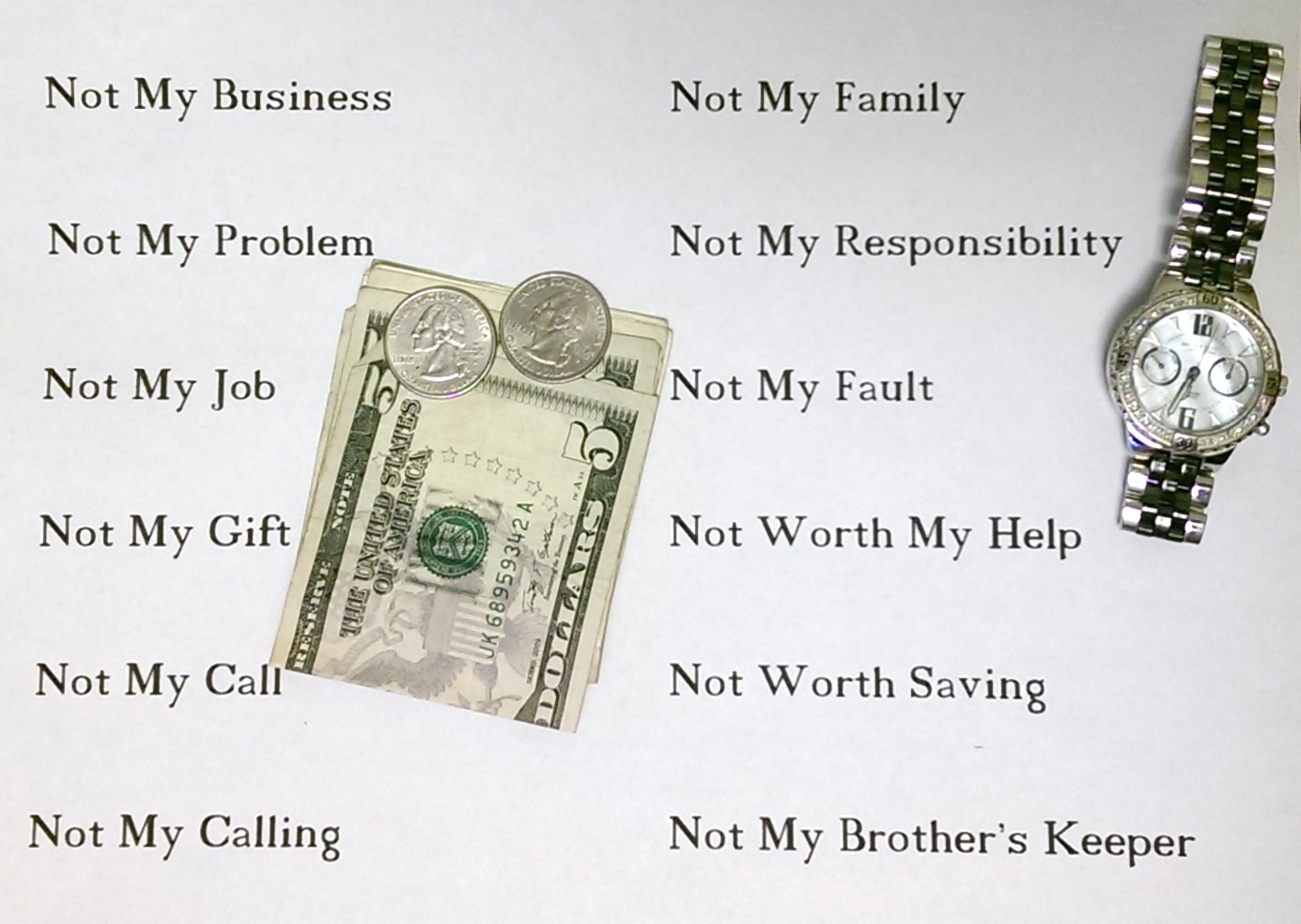
Not My Business

Not My Problem

Not My Family

Not My Job

Not My Call

Not My Responsibility

Not My Fault

Not My Gift

Not My Calling

Not Worth My Time/Money

Not Worth Saving

The most winsome thing I know of God is that He loves the whole world (John 3:16). I don’t want to line out my life…set boundaries… such that some around me are more deserving of grace than others…that some are worthy of aid or intervention but others are not…that some are outside of the Gospel and others, by “accident” of geography or opportunity, are not.  As citizens of the Kingdom of God, we have been given a great salvation – “so great a salvation” that we cannot neglect His intent of it, for our sakes, and for those around us. There is no such thing as benign neglect.*

We, individually and corporately, can’t save the world, as much as we would like. However, our humanity,  with whatever perceived limited capacity we have, was meant to glorify God by our nature and pursuits. We can determine to live lives faithful and pleasing to God – “to do justly, to love mercy, and to walk humbly with  God” (Micah 6:8).

If you look at the list of “not’s” above, you may, like I do, see phrases we’ve used before for decisions made and actions not taken. Look now at some of the antonyms for neglect – what it is to not yield to being neglectful – intentional, diligent, constant, loving, inclined, conscious, determined, caring, keeping, dedicated, patient, carrying through, preserving, mindful, attending, cherishing, conserving, celebrating, listening, nourishing, obedient, inspiring, giving, remembering, redeeming, watchful, purposeful.

With so great a salvation that we have received, how could we choose to be any other way toward others?

“To fail to exhibit that we take truth seriously at those points where there is a cost in our doing so, is to push the next generation in the relative, dialectical millstream that surrounds us. ” Francis A. Schaeffer

Part 2 is here.

Denzel Washington, Martin Luther, and Our Strange Neglect of the Bible

Francis A. Schaeffer – a modern-day prophet, author of How Shall We Then Live?

The Age of Personal Peace and Affluence

Do Not Neglect the Weightier Matters of the Law

Charles Spurgeon’s Sermon on Neglecting Our Personal Work in the Kingdom

 Forgotten God: Reversing Our Tragic Neglect of the Holy Spirit

Worst-Case Scenarios: The Problem of Neglect

*“Benign” neglect  – a noninterference that is intended to benefit someone or something more than continual attention would.

Worship Wednesday – Let Revival Come (Revive Me) – People & Songs

Photo Credit: Facebook, Let Revival Come

Therefore, so that I would not exalt myself, a thorn in the flesh was given to me, a messenger of Satan to torment me so that I would not exalt myself. Concerning this, I pleaded with the Lord three times that it would leave me. But he said to me, “My grace is sufficient for you, for my power is perfected in weakness.”

Therefore, I will most gladly boast all the more about my weaknesses, so that Christ’s power may reside in me.So I take pleasure in weaknesses, insults, hardships, persecutions, and in difficulties, for the sake of Christ. For when I am weak, then I am strong. – 2 Corinthians 12:7-10

Our perfect God loves His children perfectly. We, on the other hand, are far from perfect. Between our own sin nature, living in a fallen world, with an adversary in the Devil…life can be a challenge.

Yet we are never alone. God gives grace…glorious, complete, specific to our needs.

Our family needed particular grace this week. A surprising altercation (my experience). A hard decision. A week of long days. An unexpected ailment.

Then smack dab in the middle of it all, God’s grace poured down.

A dear acquaintance of ours, Rev. Michael Catt, senior pastor of Sherwood Baptist Church and founder of the Refresh Conference was a part of that grace. To begin this year’s Refresh [Online] Conference (always focusing on revival), he invited Rev. Tom Elliff to speak twice this past Sunday at Sherwood.

Tom Elliff is a close friend…many would say that about him because he brings the fragrance of Christ into every conversation and relationship. So loving, joyful, encouraging. Rock solid in his faith in God and in the work God means to finish in His children.

[Husband Dave & Tom Elliff]

On the morning after the hardest night, I found one of Tom’s Refresh sermons online. It was Fresh Surrender (starts at minute 29:28 on this video). In this sermon, he focuses on the Scripture passage 2 Corinthians 12:7-10. It is the Apostle Paul’s testimony of his “thorn in the flesh”. He had prayed for God to remove it, but He didn’t. Then Paul gloriously testifies how God assured that His grace was sufficient for the thorn in Paul’s life. So moved by that experience of God’s love, Paul declared, “I take pleasure in weaknesses, insults, hardships, persecutions, and in difficulties, for the sake of Christ. For when I am weak, then I am strong.”

[Watch Tom’s Refresh sermons here and here…whatever you’re going through, you will be encouraged.]

Hardships come into all our lives. When they happen, we are tempted to rail at the pain, to question God, and to seek to remove ourselves from that particular hard.

God calls us to surrender our will to Him…our pain, our problems, our preferences…He gives grace to us, and we give glory to Him…when we surrender ourselves to Him afresh.

This can be where revival starts in our own hearts…and in the church.

A song I never heard before was in the mix of worship songs at this year’s Refresh Conference. It is from the worship collaborative of People and Songs“Let Revival Come” is the cry of our hearts…for our own lives and that of our country right now.

Worship with me (it’s 21:30 minutes into this Sherwood Baptist worship service). Also the People and Songs lyric video is here.

Heavenly Father, I come
Don’t have much to offer,
Holy One
I’m humbled by all that you have done

Even though I walk through the valley,
I don’t have to fear, No-
You have called me from my sorrow to gladness, I have you
What more could I want?

CHORUS:
(So) Raise my faith
a little higher
Set my spirit on fire
Lord, we’re asking You to move

Cause You’re the God of Restoration
The One who gives salvation
Lord, Let revival come, Let revival come

VERSE 2:
You are the God who calms the sea
The same God who healeth me
You are the One who makes me strong

BRIDGE: x4
Revive me
Revive me with the
Joy that You bring
Joy that You bring

CHORUS 2:
(So I) Raise my hands a little higher
Now my spirit’s on fire
Lord, we’re asking You to move

‘Cause You’re the God of Restoration
The One who gives salvation
Lord, Let revival come, Let revival come*

*Lyrics to Let Revival Come – Songwriters: Kevin Jones, Joshua Sherman, Jonathan Frazier, The Emerging Sound Publishers

Let Revival Come – Song Story – Kevin Jones

Monday Morning Moment – Sensitiveness – This Might Not Be About You

Photo Credit: QuickMeme

Adapted from the Archives

The word “victim” is one I rarely use because the word itself further victimizes the person. Sometimes we may intend to wound with our words, but often we just state/post a thought, viewpoint, or opinion having no idea what a strong and public reaction we may receive in the aftermath.

Just yesterday, I was in a Twitter conversation where what I said exploded a barrage of words (from passersby not the person with whom I was engaged). My person (we follow each other but don’t know each other) had been victimized by an awful situation and I was trying to comfort and reason with him over it. Then the attacks came (not from him but from others). The words “Karen”, “gaslighting”, “oppressor”, and a “cishet” Christian (not in a good way) were used to describe me (I had to look up the linked words).

We stick to our own in life, in a way to enjoy a certain measure of understanding and acceptance. If we stay surface enough, we hopefully don’t offend, don’t disturb the sensitiveness of another.

Decide to go deeper or venture out among those different from us (be it politically, or gender identity, or race/ethnicity), in our current culture, it can get messy.

I want deep and wide relationships with people, but at times, I will mess up or be misunderstood. Our social media walls can get full of the most always graffiti, well-deserved, others might say.

Real face-to-face conversation and not fleeing the scene can both help…at least the relationship. The passer-bys? Not so much. I want to scream sometimes, “This might not be about you.”

Photo Credit: Flickr

I digress…

Years ago, my best friend and I went on a cross-country sight-seeing trip. Our plan was to camp out a couple of nights and then stay in a hotel for the third, and continue in that rhythm for the two weeks we were on our adventure. It didn’t always go well. I loved camping; she preferred the hotel. Our food preferences were more different than we realized. We did, fortunately, agree on the “not to be missed” aspects of our journey across America.

Along with all the great memories made, we had some humdinger disagreements through the course of our time away and returned home even better friends as an outcome. However, it didn’t come easily for either of us.

It turns out I could majorly stomp on her feelings without even knowing that was happening.

First, you must know I never intended to plow through her preferences to race toward my own. She was my dearest friend. It gave me joy to see her happy. Still…somewhere I crossed a line.

We have both matured greatly since then so this can encourage you…it has encouraged me in more recent times when I find myself in similar situations.

In our responses to one another, as friends, family, colleagues, (even strangers on social media) we can discover things both about ourselves and about the other.

Emotions are different from feelings. I’m not going into the physiological pathways or mental habit formation of all this, but the quote below by Debbie Hampton is very helpful:

Feelings and emotions are two sides of the same coin and highly interconnected but are two very different things…Emotions originally helped our species survive by producing quick reactions to threat, reward, and everything in between in their environments. Emotional reactions are coded in our genes. Emotions precede feelings, are physical, and instinctual. Feelings are sparked by emotions and colored by the thoughts, memories, and images that have become subconsciously linked with that particular emotion for you. But it works the other way around too. For example, just thinking about something threatening can trigger an emotional fear response. While individual emotions are temporary, the feelings they evoke may persist and grow over a lifetime…In the gaps between emotion, feeling, and acting, we all have the power to change and direct our lives for the better. “Debbie Hampton

In the milliseconds between any stimulus and our response to it, we can choose how we will respond emotionally. However, because we have set a course “over a lifetime” of responding certain ways, emotional patterns (feelings) are formed and put into practice. We can change these, if we find them detrimental to our physical, emotional, and relational lives.

That happened between my friend and me. In close proximity, for two weeks, our daily experience being very dependent on the other, we found we could each be irritating. The statements “That hurt my feelings” or “You hurt my feelings” became her lament…this from an accomplished teacher and successful manager of a classroom of tiny people.

For me…inconceivable. I loved her and had no desire to hurt her, ever. Still, it happened.

[By the way, this expression of sensitiveness using the word “feelings” may be more encountered in women, but men have some similar experience – you know you do – but call it different things. “Offended”, maybe? “Annoyed”? Is that where sarcasm or cynicism is birthed?]

Back to the story: In some way, my behavior set off for my friend emotions that were tagged by past feelings of being discounted, not considered, not favored. It wasn’t pretty…for either of us.

Fast forward, decades later.

We live in a culture of lofty sensitiveness. The measure for political correctness in our speech continues to get moved upward. We are a nation so easily offended that we can’t even discern what is truly intentionally offensive from what is just true.

Have you ever been in a season with a friend or colleague that feels emotionally murky? You don’t really know what’s going on, but you sense something is. Then…you step on the landmine – and you say something or do something or your face shows something – that explodes all kinds of feelings in the other person, from what seems a life-time of storing up.

This is what has now been popularized as weaponizing feelings or emotions. The outcome? Guilt, shame, wounding, and (for some) returning fire.

It will make me sad if this post “hurts feelings”, especially of those dear to me who read the blog. The thing is, just like my friend and me, we can go deeper in our relationships when we refuse to let feelings define our friendships. When we refuse to think ill of others we grow a spiritual maturity and neuroplasticity that impacts our emotional responses and our relational resilience.

What got me thinking about all this, this week was actually a reading from British scholar C. S. Lewis

He talks about the danger of weaponizing sensitiveness long before it became the cultural phenomenon it is today:

“‘Did you fight fair?’ Or did we not quite unknowingly falsify the whole issue? Did we pretend to be angry about one thing when we knew, or could have known, that our anger had a different and much less presentable cause? Did we pretend to be ‘hurt’ in our sensitive and tender feelings…when envy, ungratified vanity, or thwarted self-will was our real trouble? Such tactics often succeed. The other parties give in. They give in not because they don’t know what is really wrong with us but because they have long known it only too well, and that sleeping dog can be roused, that skeleton brought out of its cupboard, only at the cost of imperilling their whole relationship with us. It needs surgery which they know we will never face. And so we win; by cheating. But the unfairness is very deeply felt. Indeed what is commonly called ‘sensitiveness’ is the most powerful engine of domestic tyranny sometimes a lifelong tyranny. How we should deal with it in others I am not sure; but we should be merciless to its first appearances in ourselves.Preparing For Easter: Fifty Devotional Readings from C. S. Lewis.

After being an atheist, Lewis did not come to faith in Christ until his mid-thirties. His intense study of the Bible, relationship with God, and deep, gut-honest conversations with a circle of intimate friends moved him to such understanding of people and life…and our responses to both.

Any thoughts on this? Please comment below.

Preparing For Easter: Fifty Devotional Readings from C. S. Lewis

What Is the Difference Between Feelings and Emotions? – Debbie Hampton

The “Weaponizing” of EmotionsWade Trimmer

The A-Z Guide to Feelings and Emotions – Sebastian Gendry

Monday Morning Moment – Neuroplasticity – Resetting Your Brain for Success at Work and Life – Deb Mills

Inner Circles – the Mad Pursuit of Position, Power, Prominence, and Plenty – Deb Mills

Invisible Wounds of the Sensitive, Empathic and Emotionally Intense Child – Imi Lo – this is a sobering, emotionally charged article. I resonated with it in preparing for the blog above and include it because it might be helpful for some to read. Just a warning that it is hard to read because it honestly did not give much place for hope. [If I missed it, please illuminate me in the Comments below.] Maybe the hope comes in recognizing what we as parents might be doing that’s hurtful to an emotionally intense child and correct course.