10 years writing this blog. I started 10 years ago this very month. The reason, in particular, was because I felt my memory clouding some, and there were memories and counsel I wanted to make sure were left for my children. As writing does, the blog cut its course through many topics – God, life, marriage, parenting, beauty, friendship, work, meaning, purpose, and reflections of all sorts. Now 10 years out, my memory is still hanging in there, and for that I’m thankful. Also for the having of words to share with those I love.
Our friend Clyde Meador started a blog himself 3 years ago this month. He may have had similar hopes – to leave something for his children and for the sake of a greater work.
Leadership was a topic that I studied for years (posting in my Monday Morning Moment). I learned so much from great leaders in my life, as well as some leaders who could have used some mentoring by our friend Clyde. That may not have been kind, but good leaders matter – in our lives and in the futures of organizations.
In the first year of Clyde’s blog, he wrote a series of posts entitled 6 Sacrifices of Leadership. The topics were:
Loss of Constant Firsthand Involvement
Too Much Negative Knowledge
Constant Criticism
Leaving
Sacrifice, Isolation, Ostracism
Impact on Family Ties Due to Travel and Workload
Take the time to study those posts to learn from Clyde. In a recent tribute to him, a friend and colleague, Charles Clark wrote a brief summary of Clyde’s six sacrifices, their dangers and rewards. You find them in the image below:
In April 2024, Clyde Meador, this wise, humble, and insightful leader friend of ours, died, at 70 years of age. Complications of a long battle with cancer. He leaves a big hole, for his family, but also for the many people who have known him and loved him through the years. However, he would say something along the lines of God doesn’t leave holes.
We all have stories with Clyde in them – his lessons on life and leading. His legacy is that he never wavered in his faith walk, his love for his family, or his determination to do excellence in the work God had given him. He and Elaine have been a picture of constancy in our lives. Leading and loving.
In July of 2023, life and cancer treatment got in the way of Clyde continuing his blog. What turned out to be his last blog is so appropriate and beautiful. “To Those Who Come After Us”. Here are the last paragraphs.
“I will sing of the steadfast love of the Lord, forever; with my mouth I will make known your faithfulness to all generations.” (Psalm 89:1, ESV) “We will not hide them from their children, but tell to the coming generation the glorious deeds of the Lord, and His might, and the wonders that He has done.” (Psalm 78:4, ESV) This commitment of faithful followers of the Lord must be our commitment, also.
“So even to old age and gray hairs, O God, do not forsake me, until I proclaim your might to another generation, your power to all those to come.” (Psalm 71:18, ESV) I am grateful that I have reached old age and gray hair, and pray that I will faithfully do all I can to communicate the truth of the Gospel to those who come after me.
Of all those things which we teach our children and those who come after them, nothing is more important, more urgent than the truth of the Gospel. I have a less-than-perfect record of success in this endeavor, yet I seek to faithfully persist in sharing the Truth. I challenge each of us to a major focus on sharing all we know about our Lord and Savior with the next generations! – Clyde Meador, To Those Who Come After Us
[Dave & Clyde, a few weeks before Clyde went to be with the Lord. So grateful. What a humble and wise mentor he was to so many.]
And Jesus said, “There was a man who had two sons; and the younger of them said to his father, ‘Father, give me the share of property that falls to me.’ And he divided his living between them. Not many days later, the younger son gathered all he had and took his journey into a far country, and there he squandered his property in loose living. And when he had spent everything, a great famine arose in that country, and he began to be in want. So he went and joined himself to one of the citizens of that country, who sent him into his fields to feed swine. And he would gladly have fed on the pods that the swine ate; and no one gave him anything. But when he came to himself he said, ‘How many of my father’s hired servants have bread enough and to spare, but I perish here with hunger! I will arise and go to my father, and I will say to him, “Father, I have sinned against heaven and before you;I am no longer worthy to be called your son; treat me as one of your hired servants.”’ And he arose and came to his father. But while he was yet at a distance, his father saw him and had compassion, and ran and embraced him and kissed him. And the son said to him, ‘Father, I have sinned against heaven and before you; I am no longer worthy to be called your son.’But the father said to his servants, ‘Bring quickly the best robe, and put it on him; and put a ring on his hand, and shoes on his feet; and bring the fatted calf and kill it, and let us eat and make merry; for this my son was dead, and is alive again; he was lost, and is found.’ And they began to make merry.
“Now his elder son was in the field; and as he came and drew near to the house, he heard music and dancing. And he called one of the servants and asked what this meant. And he said to him, ‘Your brother has come, and your father has killed the fatted calf, because he has received him safe and sound.’ But he was angry and refused to go in. His father came out and entreated him, but he answered his father, ‘Lo, these many years I have served you, and I never disobeyed your command; yet you never gave me a kid, that I might make merry with my friends. But when this son of yours came, who has devoured your living with harlots, you killed for him the fatted calf!’ And he said to him, ‘Son, you are always with me, and all that is mine is yours. It was fitting to make merry and be glad, for this your brother was dead, and is alive; he was lost, and is found.’” – Luke 15:11-32
The following is a treasure by writer and researcher Trevin Wax, used with permission. We met only once, but I’ve been learning from him for several years. You are in for a treat – a life-giving infusion of truth, wisdom, and grace.
“Every now and then, a song brings me to tears.
Sometimes it’s an older song that stirs the heart in a new way. I’ve never been able to sing the last verse of Isaac Watts’s hymn, “There Is a Fountain,” because I’m too moved by that image of my “poor lisping, stammering tongue” lying “silent in the grave” before rising again to sing a “nobler, sweeter song” of Christ and his “power to save.”
Songs about the cross and resurrection strike that chord, such as the vision at the end of “O Praise the Name (Anástasis)” of resurrection hope when our gaze will be fixated on the Savior. Andrew Peterson’s “Well Done, Good and Faithful” builds on a Watts hymn and imagines the Father affirming the Son’s sacrificial work; I blubber every Easter season when I hear it. Other songs do the trick too, even simple ones like Steven Curtis Chapman’s “My Redeemer is Faithful and True” or Fernando Ortega’s “Give Me Jesus.”
But for all the times when glorious gospel truth has me fumbling for a Kleenex, there many times when I sing about amazing grace with dry eyes and a lukewarm heart. This has me wondering, What dries up the heart and keeps us from feeling and experiencing the marvelous, matchless grace of God? What keeps the tear ducts blocked?
For starters, there’s the posture of the older brother in the parable of the prodigal son: the self-righteous, self-sufficient one who remains “close” to the father, at least in terms of proximity, while his heart is far from home. The consummate rule-follower believes deep down that the only possible reason God would love us is because we’ve done something to deserve salvation.
This assumption can manifest itself in many ways, even among those who talk about grace all the time. The self-justifying tendencies of the human heart can lead us to stand on a pedestal of Christian teaching about grace and then look down on others who’ve not arrived at our level of doctrinal understanding or theological precision.
But we cannot weep before the majestic grace of God if we’re still searching for scraps of self-sufficiency. Tears of gratitude will never fall from eyes looking down on others, only from eyes looking up to God’s grace.
But there’s a second posture that keeps us from marveling at the grace of God: the desire to validate ourselves by doing away with sin.
The New Testament’s insistence on our need for redemption humbles us. But redefining sin removes the need for humility, leaving us affirmed in our natural state.
For many today, the problem isn’t the disease of sin, but those who’d diagnose the disease. So, instead of a father running to us with a heart overflowing with forgiveness and healing mercy, we want a father who runs to affirm us and tell us all is well, that what we’ve done either wasn’t that bad or wasn’t bad at all. We want a God to provide a spiritual presence, a transcendent dimension for the life we’ve chosen to live. God becomes the approver of our own self-validation.
This second posture is also rooted in self-righteousness, but it masks itself in false mercy. For some, sin is not that big a deal because God is merciful and it’s his job to forgive. For others, our focus on brokenness and suffering outstrips any notion of sin as transgression or treason against God. God’s mercy and help are there to make us whole, but this “wholeness” must ultimately be defined by every individual.
The first and greatest commandment is “Be true to yourself.” The second is like it: “Affirm whatever self your neighbor decides to be true to.” In this way, we rid ourselves of vice, not through forgiveness, but through redefining vices as virtues, as part of our authentic selves.
And so, the father runs to the repentant son, not to shower him with undeserved grace, but to follow him to the pigsty, where he insists the son’s rebellion was a bold and courageous act of independence, and the diet of pig food is really a feast for the self-actualized.
This posture strips us of the power to weep at grace. Sin is waved, not washed, away. To deny or minimize your sinfulness is to sever the root of gratitude for undeserved favor. Make favor deserved, a reward that showcases your innate worth and value and goodness, and you’ve gutted grace of everything that makes it amazing.
In both cases, whether it’s the elder brother who won’t lower himself to join the feast, or the younger brother who won’t come to his senses because he wants to be “free” to choose the pigsty, self-righteousness blocks tears of gratitude.
Only Jesus gives us grace that meets us in our darkest hour, grace that plumbs the depths of our cavernous hearts, grace that transforms the heart of stone into a heart of flesh.
Undeserved favor strips us of self-righteousness and shows up our paltry attempts at self-validation. Submit to that humble stripping away of all our pride, and then we can bask in the grace that makes us sing louder, shout for joy, and weep with gratitude. That’s the grace we see in the running feet of the father.” – Trevin Wax, Facebook, May 5, 2024
[If you have time, and want to sing praise to God for His great grace, click on any of the song links – old or new.]
What just happened? When you read the title “What If You’re Wrong”, was there a reaction in mind or body? If I had written “What If I’m Wrong”, it would have been far less provocative, right? Clearly, it’s possible for me to be wrong on many things. Not just possible but actual. I am most probably wrong on a number of things, either out of ignorance, preference, a lack of understanding, or neglect of the truth.
Is there a way we can talk about the stuff that matters to us with people who care about very different sorts of things? People who strongly disagree. People who are sure they are right, when we are also sure that we are…and they are wrong.
Below you’ll find an old video of a Richard Dawkins lecture at a Virginia university. He took questions from the floor, and one very brave, if not naive, student asked him “What if you’re wrong?” His answer, or non-answer but more repartee, was clearly one he had fashioned for just that question. Have a listen.
The lecture must have had to do with the existence of God, and Dr. Dawkins, though once a “Christian” is now an atheist. His response to the student was condescending, dismissive, and unkind. Oddly, his reasoning fell along the same lines as a 16y/o Muslim student in my World Religions class in Morocco. My student surmised that people followed the religion of their parents. Yet, here, Dr. Dawkins disproved what he said himself by leaving the Christian faith for atheism. In the video, maybe he considered disrespectful the student asking the question, therefore, he responded with mirrored disrespect. Who knows?
This is what I’m wanting to know. Can people engage each other with curiosity, care, and consideration (hope you don’t mind alliteration)…when they are at opposite ends of a worldview or belief system?
The key is those 3 c-words above. If I truly want to understand the position of another person, hopefully that can be communicated in such a way that engenders an openness. If that person knows I truly care about him/her, maybe they would be willing to trust me with such a conversation. If they knew my desire is to take into consideration how they came to their conclusions, maybe they would risk digging down into their reasoning. No judgment. On either side.
That would be amazing.
Writer, creator Adam Dachis posted a helpful piece for Lifehacker.
Common Denominator – Find It. What might the continuing point of contention between you? Find that “button” that always gets pushed and choose together to find a way for it not to be the confounding issue.
Considering What’s Right – Convictions & Outcomes When you analyze your positions (convictions), it is possible to consider which would lead to a better outcome. This is a growth point toward understanding if not change.
Changing Someone Else’s Behavior – Shouldn’t Be the Goal. – Trying to change the other person’s opinion or worldview can’t be the goal. They are in control there, but you can change something about your own behavior toward them or the situation. This approach is not about people-pleasing but about defusing and deescalating. The goal has to be relationship, or why bother?
Consult the Facts. We tend to focus on and be influenced by information that aligns with how we think, not even considering that the information might be wrong. If one of us considers the other wrong, the temptation is to attack (if I am the one feeling right or feeling wrong, the default is to become defensive and tempted to attack). Listen to the other side. Be tuned into what you are feeling as well. Stay in the conversation. Treat yourself and the other person with compassion. The goal is understanding.
Gustavo Razzetti, a work culture design consultant, writes about the difference between the soldier mindset and the scout mindset in dealing with conflicting worldviews:
“The soldier mindset is rooted in the need to defend ourselves. The pressure to be right elevates our adrenaline—we experience a fight-or-flight response.
A more curious mindset is that of the scout—this role is about understanding, not defending our beliefs. The scout goes out, maps the terrain, and identifies the real challenge—he wants to know what’s really there.
The mindset you choose affects your judgment, analysis, and decision-making.
The soldier mindset is rooted in emotions like aggression and tribalism. The scout mindset is rooted in curiosity—it’s about the pleasure of learning new things, being intrigued when new facts contradict our beliefs, and not feeling weak about changing our mind.
I lived for many years in countries where the majority religion was not my own. Local friends would at some point or other ask me the “right or wrong” sort of question… “Why wouldn’t I consider their religion?” I treated that question with the care I had for those friends. In fact, I have a document on my computer where I considered all their tenets of faith and what kept me from becoming a follower of their religion. What was right for them was wrong for me.
However, the most beautiful experience of those “What if you’re wrong” scenarios was what happened with my dearest local friends. Without knowing the concept at the time, we determined to make each other feel “seen, soothed, safe, and secure”. Although my own faith (especially my belief in Jesus as Savior and Lord) would not be altered, these friends mattered deeply to me. We reconciled our differences in faith through the depth of our friendship. If one had to be considered right and the other wrong, we would still love each other. Period. Full-stop.
Photo Credit: L) Chadwick Boseman – Gage Skidmore, Flickr, R) Chad Stephens (pic taken by Deb Mills)
[This piece is adapted from the Archives on the 30th anniversary of my nephew Chad Stephens’ death. He was 23 when he died instantly in a car accident. After so many years, I’m not sure who all have the sweet memories of Chad that his family has. As to legacy…only God knows. I was reminded today in remembering Chad of another’s legacy – the actor/influencer Chadwick Boseman. His legacy is large and public. For both of them, Chad and Chadwick, dying sooner and harder than any of us imagined would have happened…who knows the extent of their legacy – either Chad, a young man with most of his promise still ahead of him, or the profoundly gifted Chadwick Boseman, dying in his 40s. Below you’ll find excerpts from a blog I wrote when Chadwick died, as I also remember Chad today.]
Shock waves covered our country and the world at the news of actor and Black Panther superhero ‘s death. He was/is a bigger-than-life figure in our culture. As we all know now, he had late-stage colon cancer since 2016 (four years prior to his death). That the public didn’t know he was ill isn’t a surprise, given Boseman’s private nature and also the incredible production of 10 of his films from 2016 until now (one of them Ma Rainey’s Black Bottom released after his death). Fighting his battle with cancer at the same time, what grace, focus, and courage he displayed through all the making of those films!
Boseman was very committed to raising the opportunity and quality of life for fellow black people. He used his work to reflect the dignity of humankind. He showed his own respect for others not only in the Marvel blockbuster Black Panther but in all his films. Several of which were biopics – two of my favorites being Marshall (on the life of Justice Thurgood Marshall) and “42” (on the life of baseball player Jackie Robinson). Both movies are timeless in their handling of justice for blacks in America.
After seeing the incredible film Black Panther some time ago, I was reminded of the relatively small part Boseman also played in Draft Day. Two very different films, but both where he played one who took his platform to champion others. This seemed to be true of Boseman’s public and private life.
After a weekend of trying to get hold of the life and character of this man from Anderson, South Carolina…this man who became a Christ follower as a boy and served in his church’s choir and youth group…I couldn’t get to sleep.
What Boseman accomplished in his relatively short life as a public figure will last as long as we watch the movies…and longer still.
What can a regular non-celebrity do in our world gone mad? What really can this older white woman in the suburbs of a small city? What can you do?
Last night, in the dark trying not to wake my husband, I grabbed my phone and wrote the following list. It came quickly. Hopefully it is understandable.
Listen hard with ears, mind and heart open.
Seek to understand.
Ask the question: “What are we hearing?”
Ask the question: “What are we not hearing?”
Ask the next layer of question without judging: “What sounds true? What sounds like deception motivated by something else? How can we know?
What is the source of what we are hearing? [Sidebar: Where we get our news is often where we get our attitudes. If we take in news at all, we need a mix of views or we won’t critically be able to sift for what is true…or hopefully true.]
Then…
Speak up on behalf of one another.
Stand up against evil and for the truth.
Act up? NO. Act in love.
Mobilize our resources, relationships, and influence to actually make a true, lasting difference for those most vulnerable in our country.
Who has the courage to say “Enough” to what is hurting more than healing, to what is destroying more than building up, to what is not really for change for those who most need the change?
Boseman once said: “The only difference between a hero and the villain is that the villain chooses to use that power in a way that is selfish and hurts other people.”
Boseman’s life reflected his faith in Jesus.
Therapist Kalee Vandergrift-Blackwell wrote a beautiful piece (below) on “a brown, immigrant, refugee, colonized Jesus”.
Jesus died at the hands of the political and religious leaders of the day, but…He did not die a victim. He gave his life in all its beauty, courage, and truth – for our sakes…and He gave his life, even for the political and religious leaders of the day.
When He called out the wrong motives of religious leaders and turned over the tables of opportunists, everything He did, He did in love. He calls us, His followers, to do the same.
Jesus calls us to love our neighbors…and even to love our enemies. We aren’t allowed to just take sides…we are to full-bore, wide open love people – to recognize, respect, and validate in all we do the worth, dignity, and God-breathed humanity of all.
This is our legacy…this is what I want to have the courage and the depth of love to leave when my life is over.
Not complacency. Not comfort. Not smugness. Not arrogance. Not blaming another party or one president over another (if there’s blame it extends much farther…). Not violence. Not isolation.
So…that is the burn I got this weekend after taking in and grieving over the loss of Chadwick Boseman.
One last quote from Boseman that is especially poignant and inspiring right now is this: “When I stand before God at the end of my life, I would hope that I would not have a single bit of talent left, and could say, ‘I used everything You gave me.”
In remembering Chad, also, I’m reminded of his legacy…not as publicized as a great actor who died too early…but of a young man who had also given his life to Christ. A young man with great heart and strong convictions. A young man who thought of others. A young man who lavished love and joy on all of us, just entering the room and then staying in the room. A young man who could flip the tension of a family dispute…just being present, by showing up over and over, even in the uncomfortable and imperfect.
Whatever our influence or audience – the world as with Chadwick Boseman, or a much smaller sphere as our Chad – we all leave a legacy. We learn from those who’ve gone before us. Because of what Jesus did for us, and knowing that both Chad and Chadwick received Jesus for themselves, we will see them again.
That makes today a little less hard and a whole lot more hopeful.
[Before jumping into this, let’s take a moment to give space for those who tried for a long, long time…and then felt there was no recourse but to give up. I have given up, too, in some situations, with some relationships…either because I lost hope, or heart, or strength, or opportunity, or time. We all have such stories. Today, let’s pause and consider the large and life-affirming possibility of just NOT giving up.]
Have you said any of these things recently? “I quit!” “I’m tired of trying.” “I give up.” “It’s not fair.” “It’s not worth it.” “Why do I have to do everything?” “It won’t last.” “There’s no use.” “I’m just not good at it.” “What difference does it make?”
Words matter. They can move us toward positive outcomes or negative ones. The negative affirmations above, spoken or just thought, sound true. Some may even be factual. They move us to action. The problem is when we are moved to act in ways that make things worse instead of better.
Whether it is your job, a lifestyle change, or relationship…we choose whether to be proactive or reactive. Whether we give up or keep at it. Bit by bit. Day by day.
All of life is a journey. We move toward one another or away. Our temptation is to self-protect…or protect someone we love thinking it requires pulling away from someone else. We can give up without even realizing it. Just in the disappointment…the distancing. We pull away from possible solutions. They are just too hard. Or are they?
When we get to the point of giving up, it’s not just giving up on that person, but giving up on ourselves in relationship to that person. Maybe even giving up on God to help us repair the rupture, thus opening one between us and Him.
You may think I am philosophizing or making this too simple. Believe me, I totally get how complicated “not giving up” can be. And painful. And even isolating. However, giving up is more isolating…and potentially more painful. We can bury the pain, cover it over, but it’s still there.
Now, we may not be able to restore the relationship…or heal a family wounded by rupture…but when we quit on them, the door to repair, from our side, closes.
The day will come, I am hoping and believing, with God’s help, that we will see good come through this hard place. For me, I am NOT giving up.
Stories of feeling the need or desire to quit abound. It may be your story as well. There is no blame here. No shaming whatsoever. It’s what we do with our stories that matters.
Attorney, writer, coach Marelisa Fabrega offers 8 strategies for not quitting. Her commentary is thought-provoking so don’t miss reading the article. I’m listing her strategies and adding my own quick thoughts.
Adopt an “I Won’t Quit” Mindset. Make that decision ahead of the situation. When Dave and I began talking about marriage together, we both stated pretty emphatically that, for us, divorce would be off the table. I grew up in a blended family and divorce impacted all my brothers’ adult lives. With Dave, it was extended family who experienced the pain of divorce, and his family felt that pain. Marriage has had its hard seasons for Dave and me, but we fought through together. [Not everyone gets that opportunity as the other spouse can ditch the marriage without your input. I get how painful that is.] Whether in marriage, friendships, work, or physical/mental health, an “I won’t quit” mindset gives you fortification in hard situations.
Watch Someone Else Persevere.It is a beautiful and poignant thing to watch when loved ones refuse to quit. I’m not saying to be a doormat or to continue to take terrible abuse. What I’m talking about is when people keep pressing forward in tough work or relationships when everything in their being and all those around are screaming, “Quit!” Two women come to mind here. One friend went though a struggle early in her marriage when her husband had an affair. All our friends (but me) advised her to divorce him and make him suffer for what he did to her. I asked her, “Do you still love him? Because if you do, and you could imagine being willing to take him back…wait.” She did love him and she decided to wait. He came back, wholeheartedly repentant. They went on to have a beautiful marriage, children, and now grandchildren. Another friend is in the furnace of a difficult relationship right now. I am watching her persevere. She has strong faith in God and a few deep friendships who are cheering her on. I believe she/they will make it.
Call Someone. This is huge! I’m thinking have more than one person you can trust to be with you (and for you) in this arena when quitting feels like all you want to do. If you’ve already decided up-front that you want to not give up, these friends and family can stand with you when the battle has exhausted you. They are for you. Hopefully they are also for your spouse and family member. It’s better to have folks who are fighting for you AND for your relationship. Not out of some scruple or moralistic platform, but because it’s your life and your battle. It’s what you want. [That may change at some point down the road, and if it does, these same people who love you will still be there.]
Go Back to Your “Why”. It’s extremely important to have a why for not giving up. A list of why’s, even better. I have loved ones very close to me who, if treated badly or served poorly, will determine not to trust an individual or business anymore. They just won’t go back. This is a much smaller situation than a deteriorating relationship. However, I’ve never understood the why and, after reading Fabrega’s piece, I plan to ask. These same people do not quit on family relationships, for which I’m grateful. So…we need to go back to our “why’s” of staying in relationship, or in a job for that matter.
Find a Different “How”. If a difficult boss is blocking the way for you to succeed at a job you once loved, figure out a respectful work-around. If the approach you have always used for managing conflict in your marriage isn’t working, think of a different way. If you continue to struggle with managing a healthy lifestyle or avoiding cycles of anxiety/depression, seek help (counseling, coaching/mentoring, medical advice, support groups). Find another way forward. Outlast the person or problem.
Succeed at Something Else. If you have been immersed in a painful situation, determining not to quit, you may just need a respite. A brief reprieve. A focus elsewhere for a few hours or days will be refreshing. Not seeing success in an area important to us colors how we feel about our self globally. Even when success isn’t visible to us, it may be coming, so we don’t give up. For that second wind, we might be refreshed by setting our sights on areas where we are seeing success (work, health, hobbies). Preferably, we do both – staying in the battle and interspersing life-giving activities.
Use Failure as a Stepping Stone. No retaliation. No victim mentality. You have already made the decision of what kind of character you want in life. Keep growing. Don’t let failure define you. It actually may not even be your failure at all. So, as much as you can yourself, live the life and be the person you want to be. It is a journey after all.
Keep Chipping Away. Like Fabrega has already said so well…keep going. Keep doing what you know is right. This is part of your story. Whatever happened in the relationship or work situation, you are making a future for yourself, and maybe for your children or family. Again, who you are is much more than what you’ve come through. – How to Not Give Up – 8 Strategies For Not Quitting – Marelisa Fabrega
9. Look for Beauty. It is there. Just outside. Or just there within reach. Just in all the reasons you are you.
I’ve read all of psychiatrist Curt Thompson‘s books and he has inspired me to look for the beauty in front of us even in situations where we feel like giving up. He inspired Bill Haley to write an essay on beauty. Here is an excerpt:
“Etty Hillesum, a young Jewish woman from Holland, wrote one of the most truly amazing things I’ve ever read. The context of her words makes all the difference. She wrote them while imprisoned at Westerbork transit camp waiting to be taken to Auschwitz, where she died in 1943 at age 29. Her diaries and letters were compiled intoAn Interrupted Life.
A very hard day. But I keep finding myself in prayer. And that is something I shall always be able to do, even in the smallest space: pray. And I know for certain that there will be a continuity between the life I have led and the life about to begin…
I often walk with a spring in my step along the barbed wire and then time and again it soars straight from my heart — I can’t help it, that’s just the way it is, like some elementary force — the feeling that life is glorious and magnificent, and that one day we shall be building a whole new world. Against every new outrage and every fresh horror we shall put up one more piece of love and goodness, drawing strength from within ourselves. We may suffer, but we must not succumb…
What kind of people do we choose to be? With all my heart, I want to be one who is not giving up. My family (immediate and extended) knows I am for them. Also, hopefully other folks as well – friends and neighbors. I’m not going anywhere. This is not just a commitment. This is an issue of character that goes way beyond any circle I’m a part of. It’s the kind of person I want to be. It’s not a small thing. I get it. Probably a God-sized endeavor. God is for all of us. He does not give up. He is not going anywhere. He is in the room…and He is staying.
You may say…well, you haven’t reached your breaking point, and you are right, of course. We can’t know what it will take for us to get to the place that we want to quit. Sometimes, we have no other option but to let go, because the other person is, or appears to be, already gone. My hope and resolve is to hold out as long as possible. Who knows what difference that could make? I’m holding onto that.
1) Beyond the Guitar – It’s been awhile since I’ve posted Friday Faves, but rest assured #1 of my weekly round-down hasn’t changed. Nathan at Beyond the Guitar continues to make beautiful music. He also teaches through his arranging academy, practice club, etc.
Below you’ll find a couple of his most recent videos as he showcases two different guitars. Beautiful!
His short videos (with film and video game clips attached) are so much fun and emotionally satisfying (why go to TikTok when you can just hang on his channel? Just scroll down his YouTube channel to Shorts).
Something about Nathan you might not know if you don’t follow him on Instagram is that he has also become a personal trainer in the field of health/fitness, mental/spiritual disciplines, and all the stuff of being a guy out there (family, work, habits, and disciplines). For his music, you know where to go. For this sort of inspiration, head over to his Instagram account.
2) Walking Her Home – This has been a super sentimental week for me. Some health issues, family stuff, and friends going through hard times. When I came across the UNC Clef Hangers video (seen many times before), it has hung in the air for me.
The song Walking Her Home recounts the story of a 60-year relationship. From first date until the elderly wife was dying. Whew! So beautiful.
Dave and I have our 40th wedding anniversary later this year, and this sweet lyric brings back such memories of our own life together. All the beautiful not dimmed by the hard. In fact, only made more beautiful by staying and waiting out (praying out) the hard together. Not everyone gets that opportunity, sadly. Just let me share this song…may it encourage you about your own relationships whatever they are.
3) Post-traumatic Growth – We have all heard much spoken and written about post-traumatic stress (PTSD). Just in recent months have I heard the concept of post-traumatic growth. An internet search yields much on this topic. Post-traumatic growth is defined as “the experience of positive change that occurs as a result of the struggle with highly challenging life crises”.
This sort of growth can happen when we recognize that we don’t have to be forever victimized by the trauma we’ve experienced, as children or adults. There is a way forward.
I’m only mentioning it briefly here, but if you have experienced this sort of growth post-trauma, and you feel comfortable to talk about it, please use the Comments section to share some of what happened.
Sometimes what stands in opposition to our growth is the person or persons unwilling to let go of the past. Maybe our PTSD relates to being the victim of trauma. Other times, however, we struggle to get out of the past because of harm we ourselves have caused. Even when we have owned our part, asked forgiveness, made whatever restitution we could…the past won’t always go away.
Writer/speaker Ashley Alford writes about this poignantly. Below you’ll find a bit of her take on it:
Kicking ash is what they’re doing.
Standing in the middle of the ashy remainder of what you once did.
The soot of who you once were.
The smoke of who you used to be.
They’re standing in the middle of an old story…one they don’t like to let go of.
One that still tries to burn with reminders of the licking flames of your shame.
They kick the mess around you hoping to stir up the old accusations…
Hoping to reignite the sparks of something that God himself put out…
They can run the ashes of that fire through their fingers all they want…
But they’ll never know the pain it took for you to heal from those burns.
They’ll never know the raw ache of fresh wounds straight from hell.
Not like Jesus does.
They weren’t there when He bandaged you at that altar.
They weren’t there when he breathed life back into you again on that closet floor.
So let them kick ash and stir up the soot of that life and lie you used to host.
And remember when they mock you…They’re mocking the Holy Ghost.
Because they can tell tales of the fire that almost consumed you and they can backstab and stare…
But it would do them good to remember that just like Shadrach, Meshach and Abednego…
4) Breaking Out of Negative Thinking – I first wrote about negative thinking five years ago (that blog linked below). Since then we have come through COVID 2020, great racial unrest and social upheaval, contentious election cycles, ongoing wars, and a downturn in our economy. Lots to think negatively about with good reason, but if we’re not careful we will begin gearing our thinking in that direction to the detriment of our mental and relational health.
The team at Daily Health Post focused on complaining as a culprit that can actually cause our brains to default to anxiety and depression. From experience, I know this is true. Check out the article below:
Before leaving this topic, I want to point to the article below which champions negative emotions as a sometime benefit. We learn from regrets, and sadness is telling us something about what matters to us. Negative emotions have value, but it’s the weight we allow them and the headspace they will consume that we must question and resist.
That’s my 5 faves for this week. Gleaned from a much longer list of finds that I didn’t write about over the last several weeks (including my beloved “Best of” Christmas Ad videos). Thanks for stopping by. Talk to us in the Comments if you have the time. Blessings always.
Recently a conversation with a young friend drew me to the idea of “a principled life”. She recalled a comment a friend of hers made about this friend’s life, something along the lines of how remarkably principled her life was. As if that was an odd thing. Unusual. Commendable but on an altogether different plane.
We were both surprised at this. Doesn’t reaching adulthood come with the establishing of certain principles for living? Those attitudes and actions that define us as people.
In our family, we often have conversations around the dinner table about how we engage with people, especially those who are challenging, demanding, and even uncaring. It makes sense, at some level, to distance ourselves from such folks, put walls between us and them, and not be drawn into their neediness or manipulation.
The question for me, however, in such situations, is “what kind of person do I want to be?” Is another’s behavior going to change the way I want to show up in relationships? Is another’s character going to move me to change my own?
Thus the thinking about a principled life. What does that look like for each of us? What does that look like to our children and grandchildren?
Now, we derive our principles from varied sources. Some from our parents. Some from teachers or mentors. Some from classical literature, history, or sacred texts. Some of our principles (whether we consciously acknowledge it or not) may even come from movie quotes and characters. Below you will see some examples of principles.
Ex-heroin addict and neuroscientist Brian Pennie PhD writes and speaks regularly on this topic:
“Principles are fundamental truths that are universal in nature.” – Brian Pennie
“Values are beliefs, attitudes and standards of behaviour about what’s important in life. They are also subjective and may change over time.” – Brian Pennie
“Unlike values which are subjective, principles are fundamental truths that are permanent, unchanging, and universal in nature.” – Brian Pennie
[Values and principles can often be seen used interchangeably, as in the graphic below.]
A principled life is one that demonstrates a foundation and follow-through of certain truths consistent with how a person thinks and behaves – living life with intention not in reaction.
Principles are action-oriented (see below as an example).
Principles form a life compass. Brian Pennie writes: “Through my own suffering and aimless behavior [during those days as a young drug addict], I developed a technique based on values and principles. I call it my life compass, and use it whenever I feel anxious, overwhelmed, or frustrated; or any negative state for that matter. In other words, I use it when I’m not aligned with my values.
The aim is to develop a set of principles that will guide your actions when life gets tough. Note that values direct you towards what’s important in life, while principles are actionable and always result in outcomes.
Below is a list of my own values, and several of the principles I’ve developed to keep me on the path.”
For me, a principled life aligns with the life of Jesus. Albeit imperfectly, given my human tendency to serve self. The Apostle Paul writes in his letter to the Roman church about “the marks of a Christian life”:
“Let love be genuine. Abhor what is evil; hold fast to what is good. Love one another with brotherly affection. Outdo one another in showing honor. Do not be slothful in zeal, be fervent in spirit, serve the Lord. Rejoice in hope, be patient in tribulation, be constant in prayer. Contribute to the needs of the saints and seek to show hospitality.
Bless those who persecute you; bless and do not curse them. Rejoice with those who rejoice, weep with those who weep. Live in harmony with one another. Do not be haughty, but associate with the lowly. Never be wise in your own sight. Repay no one evil for evil, but give thought to do what is honorable in the sight of all. If possible, so far as it depends on you, live peaceably with all. Beloved, never avenge yourselves, but leave it to the wrath of God, for it is written, “Vengeance is mine, I will repay, says the Lord.”To the contrary, “if your enemy is hungry, feed him; if he is thirsty, give him something to drink; for by so doing you will heap burning coals on his head.” Do not be overcome by evil, but overcome evil with good.” – Romans 12:9-21
That is a principled life.
[What are your thoughts as to the guiding principles of your life? What are you modeling for your family, friends, colleagues – just by showing up? What do people count on you for? What are you intentionally teaching to your children/grandchildren? Would love to hear about these in the Comments section. Thanks for stopping by.]
Memories of childhood can be sparse…difficult to pull forward into the present. It’s hard to accept that some of those memories, as we re-engage with them, are still colored by the fears of a 7y/o or the anger of a 15y/o. Even though we now, as adults, can reframe them. Those memories don’t have to keep us as victims. We are grown now. We can look at them again from a different viewpoint…and heal.
I’ve been immersed for a few years now in examining family of origin stuff, generational trauma, and how those experiences (both the bad and beautiful) are passed onto our children. Some close friends and family have said to me that exploring the past is not helpful. Being present in the present is the way to live. I agree for the most part, except the past is still with us in the present. I don’t want the past to mess with my present…or the future of my children and grandchildren.
A few weeks ago, I had the pleasure of attending an Allender Center conference on our family of origin story. What a treat to sit under the teaching of these wise therapists and hear how to engage the memories of our childhood. This is not at all about blaming parents for mistakes they made raising us. However, it is about confronting what we continue to carry with us from those days. We often say, “They did the best they could…or knew to do.” That may be true. As I look at my own parenting, I sometimes didn’t do the best I could or knew to do. Sometimes I did wrong to my children. It is part of life along with the beautiful, so we reckon with it and wrestle with it, for the sake of the good that is possible.
We can learn from our mistakes and our parents’ mistakes on a path to healing. In the conference I attended, Allender, Loerzel, and Young all called for three components necessary in engaging our family of origin stories:
Curiosity, Kindness, and Community – We don’t just leave the past “in the past”. It is always with us. However, to heal from the hard of our past, we must gaze into our memories with curiosity and kindness and within a trusted community. Sometimes memories seem few and spotty, but as we engage them, recalling them, they will come more to our consciousness. The adage, “If we don’t learn from the past, we’re bound to repeat it.”, is truer than we think.
I have appreciated taking a deeper look into my own family of origin (thanks to the helps and guidance of these therapists, Dr. Curt Thompson, and others).
Here’s part of my story. Consider examining your own. You might be surprised at the freedom that comes.
My parents grew up in the American South at the end of the Great Depression. They knew poverty. I know next to nothing about my paternal grandparents, but my mom’s parents were very much in our lives. That’s grandma in the picture below surrounded by some of her grandchildren. Grandpa rarely made it into a picture. He was a loner and alcoholic who clearly experienced terrible disappointment during those years of under-employment. 5 children, all boys except mom who was the middle child. Her role in the family was a buffer for her dad’s anger, and the boys all left home as soon as they could get into the military.
[My 3 brothers and me in the front of pic][Grandpa and Grandma Byrd, my mom’s parents]
My biological father didn’t work. He grew up on a farm, but when he and mom married, he just couldn’t quite hold down a job. Mom worked long days, but instead of my father caring for us, she had to hire babysitters. He didn’t want the responsibility. I don’t know much more. They divorced when I was 5 or 6. I saw him only once after that.
[My biological father]
Abandonment and neglect were part of my mom’s childhood and part of mine. She loved us and did what she could to feed us and house us. While we were growing up, we didn’t feel particularly poor. I did somehow experience food insecurity and fear which led to a life-long struggle with food and fear that I hoped not to pass on to my children.
Generational trauma has become a fascination for me in recent years because of the therapists above and others and because of its frightfully common occurrence. It is a concept that winds its way through human history (“sins of the fathers revisited on their children to the third and fourth generation”). We know from personal experience that we learn habits and responses from our parents (and they learned from their parents). We have the capability, as parents ourselves, of continuing healthy expressions of care for our children. We also have it in us to stop the succession of wrongs we have endured in family relationships…if we are attuned to them in our own parenting and grand-parenting.
Attunement – our parents’ ability to read how we were doing/feeling
Responsiveness – our parents’ willingness to respond to our upset (whatever it might be)
Engagement – our parents’ desire to genuinely know us (at a heart level, whatever age)
Affect regulation – our parents’ ability and willingness to soothe us, whatever our emotional state was at the time – scared, angry, shut down, etc.
“Strong enough to handle your big emotions” – our parents’ ability to stay with us when our emotions were potentially uncomfortable for them; not taking these big emotions personally but welcoming them rather than shaming them.
Willingness to repair – our parents’ willingness to own and right any harm they may have done to us as children (whatever the age).
My siblings and I grew up much loved by our Mom. She did what she could to give us a safe and secure childhood. One of her struggles was having had a childhood that leveled its own share of hard. She brought that forward without knowing. She knew abandonment and didn’t want us to experience it. I believe this is one of the reasons, ironically, that she divorced my biological father. We wouldn’t have to experience up-close his own lack of care for us. Never knowing him or his family, I have wondered in recent years what affected his own neglect of us.
You can tell it’s all very curious for me. I hope you are curious as well. Not to blame a parent but to understand your experience growing up and the impact of attachment in your relationship to your parents and their relationship with theirs. With the hope of setting a foundation of deep love and care for your children and theirs. It doesn’t have to be the situation of where “hurt people hurt people”.
Would you consider journaling your family of origin story and processing it with trusted individuals? Curiosity, kindness, and community – Be curious about your family as far back as you can take it. Treat those memories…those family members…with kindness. It’s very possible those memories will have greater meaning as you explore them as an adult. Where they were painful, repair and healing are possible…if we don’t just try to stuff them somewhere out of sight, out of mind. In community, our stories help us to understand each other and ourselves…and find the beauty and freedom there in the discovery.
Even Hollywood gets it right sometimes. In the TV show FBI (S6, E2, “Remorse”), the last line of the episode is so pertinent. A father (who struggled with alcoholism) talking to his teenaged son (who had begun drinking and was repentant):
“Mistakes are just part of the game. What’s important is what we do next.” Owning your part. Asking forgiveness. Treating each other with kindness, not contempt. Repentance and repair.
I’ll come back to this another day…hoping to learn from your journey as well. Thanks for stopping by.
[Mom, our step-dad, and our 3 kiddos – much loved all the way around][Dave’s parents][4 generations with Dave’s grandmother, mom, and our first-born][Another 4 generations pic with Dave’s dad, Dave, our son, and wee grandson]…they grew up so fast.
[Today is Mom’s birthday – 22 of them now in Heaven. This blog adapted from the Archives. ]
Our little family has never lived close to the grandparents. This was not easy…for any of us. Before I married, I lived close to home, and Mom was my best friend. She died 22 years ago, and I still miss her every day. To people who knew her well, I would often say “when I grow up, I want to be just like her.” Still working on that.
Mom and I shared a weakness for words…they are probably excessively important to us, delivering both positive and (sometimes) negative weight. She was a consummate encourager. She rarely missed an opportunity to lift another’s spirit or to speak loving truth to someone desperate for God’s touch.
When I moved away to take a teaching job, she and my dad helped me with the move. New Haven, Connecticut would be a 2-day drive from Georgia. At that time, it was the farthest I had ever lived from home. She stayed a week to help me settle in. While there, she was such great company. We explored the city together and laughed over a new culture and cried at the missing that was ahead for us.
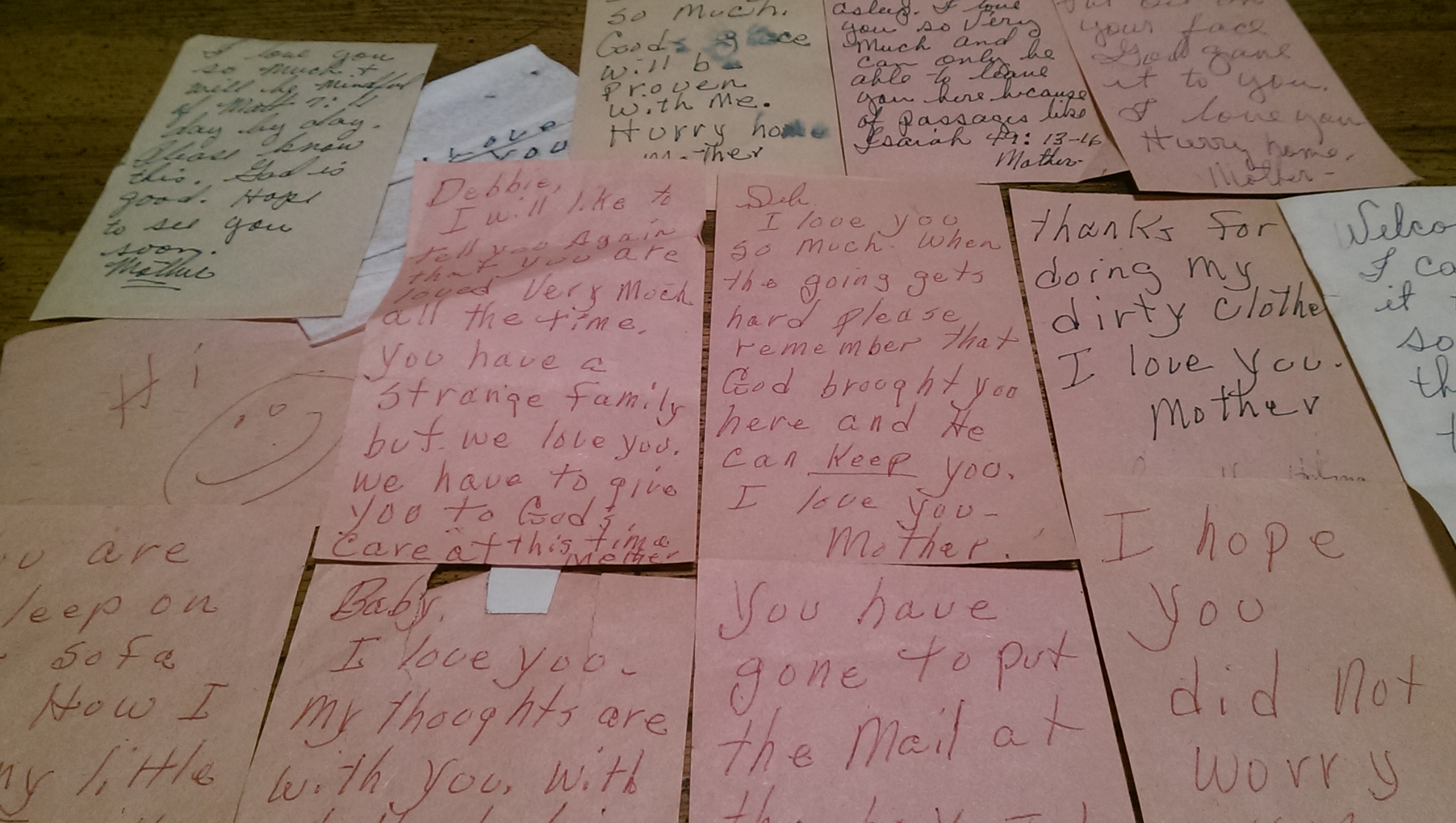
She filled my freezer with her baking, and, while I was at work, she wrote notes. Then she hid them everywhere. After she flew home, I began finding them. In my coffee mug. Under my pillow. In the pocket of my coat. Among my reference books. Behind my music books on the piano. She was with me in the love notes she left, and it made the distance between us…less.
My mom and I also had a weakness for bits of paper. I have kept every one of her notes. These from that move over 30 years ago are fading…red ink on pink paper. There is a lifetime of notes between Mom and me. The tradition she started on that first move has become a life-long tradition for our family. Our visits back and forth, across the US and then the globe, have been papered by little notes like these.
Our children, from the time they could write, entered into this tradition much to the joy of their grandparents. Before we would leave from visits with them, these three young ones would write of their affection for their grandparents and hide them all over their houses. I delighted in their cooperation in this conspiracy of love.
Mom always wrote notes…not just to us but to so many. She and her Sunday School Class ladies would send cards every week to the sick ones or the sad ones. She had a special burden for the elderly, for widows (including functional widows, deserted by husbands) and for fatherless children (again including those “orphaned” by still-living fathers). She inspired me by her humble ambition .
Pure and undefiled religion before our God and Father is this: to look after orphans and widows in their distress and to keep oneself unstained by the world. – James 1:27
I am so thankful for my mom’s bits of paper…for her love…and for her perseverance in encouraging and serving others. Her generation is sadly almost gone, and it is for us to pick up these traditions, or traditions like them. Passing them on somehow to the next generations…Maybe there won’t be bits of paper or love notes like in the past. I do hope we still take the time to write. Definitely, the call to serve and to encourage is as current as ever. My life continues to be rich with those, young and old, who reach out with words of kindness and encouragement. Written or spoken, they are love notes to the heart.
[Thankfully, our grown-up children continue to show love to their parents with words – both written and spoken.]
Thanks, Mom. After twenty-two years, many may have forgotten you for now. Many more won’t know of you this side of Heaven. Your life may have seemed small, but it was larger than life to me.
Thank you. Thank God for you.
Therefore encourage one another and build up one another, just as you also are doing. – 1 Thessalonians 5:11
[One of the W-3 Huddles – staff retreat for Holston Valley Hospital’s W-3 cancer nurses]
What is it that distinguishes an individual or group and sets them apart from all the rest?
I’ve had the privilege of working with such folks from time to time through my life. In the late 80s-early 90s, it was a group of nurses in Kingsport, Tennessee. We had moved there as young marrieds after Dave finished his Ph.D. for him to start work as a research chemist at Tennessee Eastman Chemical Company. I left my job as professor in the nursing program at Yale University to find my way into a tight medical community. People were kind, but it would take awhile for me to prove that I had something to offer.
The nurses on 3rd Floor Wilcox Hall of Holston Valley Hospital, in those days, were a rare collection of capable and caring women. We all know the adage about working smarter, not harder. They worked both smart and hard. I was honored just to help in whatever way I could as they shouldered heavy patient loads with stressed families to care for as well.
They were funny, scrappy, no-nonsense, determined, and loving. It’s been almost 30 years since our days together, but I will never forget them (and others of whom I don’t have pictures).
L to R: Nurses – Nan Ritchie, Kay Mitchell, Debbie Seymore Shields, Chris Blue
Just this weekend, I was on a long, refreshing phone conversation with Kay Mitchell. She, Kathy Visneski, and I worked closely together during those W-3 days. Kay was nurse manager, Kathy a nurse educator, and I was clinical nurse specialist. We dreamed, planned, and executed programming, support, and training for some of the best nurses we would ever know.
Kathy and I led a support group for cancer survivors and their families. Part of its success was the trust these folks had in the care they received during the times when the cancer was new and raw, and for some, when it would finally take them. The W-3 nurses would be wholly there for them in every season.
[in conversation during Take Time…to Help to Heal cancer support group][an activity from the Take Time…to Help to Heal support group]
In our phone call, Kay told me a story. A few months back she had a knee replacement surgery. Years of nursing, like with many professions, are hard on our knees. As she was “ambulated” – being walked in the hall shortly after surgery, she was in the company of nursing friends who’d come to see her. Friends from the era we shared. Like Kay, they had gotten older (it is odd how we get older but still, with each other, feel the full vigor of life shared in the workplace). It must have been a sight, this nurse “patient” and her friends filling the hall, walking slowly together, in conversation and encouragement. A physical therapist observing them captured the scene with the word, “Hall-of-Famers”. These women who were known and, as it should be, revered.
Kathy Visneski & Dr. Chip Helms, Radiation OncologistL to R: Nurses Chris Blue, Ruth Couch, Kathy Visneski, Volunteer Sherry WeaverAmy Thacker, Chemo NurseSherri Rogers, Nurse Manager
So how do people become “hall-of-famers”? What made these women…and other men and women like them…notable? Remembered with tremendous fondness and honor.
Here’s what I think. It was their servant leadership. Whether staff nurses or nurse managers, they led with excellence and a serving heart.
The phrase “servant leadership” is not new, but it is more than just a prescriptive or descriptive style of leading. Such a leader, as described by Collins and Collins, is “‘compelled by an unshakeable desire to serve’. Leaders who lack that core belief are not servant leaders but rather using servant leadership practices among the many in their toolkits. Notice we are not describing a servant but a servant leader. Servants generally don’t have a choice, but a servant leader, through humility, chooses to put others first…Leaders who do this well focus on where they can bring the most value to others…When we see someone step up in a difficult situation despite the probability of failure and commit themselves wholly because it is the right thing to do, we are more likely to join with them for the long journey. The unconditional nature of serving may be the most defining quality”..of these women.
“I saw this picture today that captured so well the amazing nurse Chris Blue. I was so blessed to have had the best role models as nurses! Chris Blue, Nan Ritchie, Joan Bishop, Jane Faries, Evelyn Parker, Kathy Visneski, Deb Mills, Amy Thacker, Ruth Couch, and Cynthia Wright to name a few. This picture captures the care we provided on good ole W3! Beyond blessed. So glad my roots are strong that started with this group. Brought back some amazing memories!” – Teresa Bailey, 2020Teresa Bailey
Hall-of-famers. Steadfast. Hard-working. Resilient. Intelligent. Caring. Full of life and love.
Who are the hall-of-famers in your life? Maybe you share your workload with some of these wonders. Please comment, if you’d like, about your experience with hall-of-famers. Maybe you are one…or on your way to becoming one. Thank you.
[A note I sent to our nurses and other cancer nurses in the region in 1994, the year we left East Tennessee]Kathy, me, and Kay…some years later.