Work space is always a premium in companies. Whether you work in a cubicle or a full-fledged office with a door, a space of some sort that belongs to you (shared or not) is vital. I remember vividly a time I had the opportunity to pour over a department’s new office space design. It was a fascinating and eye-opening experience.
Some of the team members work remotely, and I noticed there wasn’t a space designated for those who are not regularly in the office. Showing this to the person on point for working out the space assignments yielded an “Aha!” moment. She was kind to listen to a relative outsider, initially explaining how that probably happened because they are rarely in the office. Could it be that they are rarely there because there is no space for them? Something to think about if you want to rub shoulders and share ideas with those valued team members…if space is made for them.
Along with space comes the idea of a place on the team. Do you know your place on your work team? What you bring to the table? What unique role you play in the mission of your organization? C-suite leaders and department heads, of course, define some of that through a title, vision, and job description. They made a place for you on the team organizationally. Your role is to carve that place out…to add value to the work of the team through your own passion and applied competencies. Also you, as team member, can add value to your colleagues by your care for them – by being “the rising tide that lifts all boats” – [Quote #30 – Adam Grant].
How exhilarating it is when our bosses communicate to us and the larger team how relevant we are to them and the work! However, that can’t be our motivation. We must set in our own minds, that as part of the team, we have that grand opportunity to make a real difference. Whether obvious to leadership or not, we can apply our best selves to the vision, to the outcome, and to the people we work with and for. Business leader John Maxwell once spoke at the Global Leadership Summit on this very topic.
Maxwell’s book Intentional Living: Choosing a Life that Matters focuses on this idea of “adding value” to others. At first, I thought that an odd idea because people already have value. Period. Then, the more I listened to him and the more I read about healthy teams, I saw the wisdom in this. We can get absorbed in the task and the goals, and miss the people within the tasks. It is part of the whole “space and place” component of team. Give a listen to Maxwell in this brief but packed 3:40 minute video on “adding value to people”.
In the course of busy work and personal lives, we are not even thinking sometimes of the need for “space and place”. This Monday morning, spend a quiet minute maybe on the people you call team and what space and place you’ve made for them to thrive and grow. It will always come back, like Adam Grant says, to benefit you as well.
What do our faces and body language communicate? A friend and I were talking recently about how, as we’ve aged, our faces apparently have a resting pose of anger or disapproval. What?! When we were clued in on this, we both took action to keep a bit of a smile on, as a practice to avoid being misunderstood.
Not really a blind spot or is it? Blind spots are features of our personality (and physicality) that communicate something (usually negative) to others yet we are unaware of it ourselves. Blind spots are not necessarily intentional and if we were made aware of them we might be highly motivated to change or reckon with them.
Do we have blind spots in our posture and our behavior? In our decision-making or execution? Yes…and yes.
This isn’t a case for navel-gazing or over-thinking. We actually can’t discover our own blind spots without the help of others. However, sorting out our blind spots can, in fact, makes for healthier and happier relationships. As we realize how these not-easy-to-see patterns can have impact on work and life.
Following are four takes on blind spots by four business leaders. You seriously might want to jot down any of the blind spots that could be at work in you. Then check out these authors’ take on how to wrestle with these blind spots. Read the full articles by clicking on the links.
[Teman goes into these 10 surprising “don’ts” in her article here with excellent counsel on how to get started dealing with these blind spots. Her expertise in crisis management in companies and careers gives weight to the idea of steering clear of over-trust and leaning into tested verification. Fascinating.]
Levin’s consulting firm provides help with leadership and strategy development, as well as culture-building. I am amazed sometimes what kind of assistance we can get online for such things. You can read more on her 10 leadership blind spots and especially her 5 compelling prescriptions for them here.
Over-estimating your strengths. You think you’re a great communicator. They think you’re boring.
Over-estimating your approachability. You see yourself as welcoming and open. Teammates nickname you, “Pitbull.”
Over-estimating your listening skills. You think you’re exploring options. In reality, you’re killing ideas, cutting people off, and talking too much.
Over-confidence in your solutions. You call it problem solving. They call it defending your viewpoint and devaluing theirs.
Over-confidence in your ability to understand how others think and feel. You call it insight. They call it out of touch.
Rockwell gives 10 gut-punch but empowering rapid-read prescriptions on how to take blind spots to breakthroughs. Read them here, if you’re ready to deal with those 5 blind spots or others.
Expecting Others to Put in More Than You’re Willing to Put In
[Read Nieuwhof’s succinct and helpful commentary on each of these here.]
Months ago, I also wrote about blind spots (here). The following is an excerpt:
Life coach and writer Martha Beck prescribes a way to discover our blind spots.
“I know how valuable honest feedback can be, how much precious time it can save in my struggle to awaken. I still have to force myself to go looking for it, but when I do I almost always benefit.
Try this: For a week, ask for blind-spot feedback from one person a day, never asking the same person twice. Just say it: “Is there anything about me that I don’t seem to see but is obvious to you?” You’ll probably want to start with your nearest and dearest, but don’t stop there. Surprisingly, a group of relative strangers is often the best mirror you can find. I’ve worked with many groups of people who, just minutes after meeting, could offer one another powerful insights. Like the emperor in his new clothes, we often believe that our illusions are confirmed by the silence of people who are simply too polite to mention the obvious. Breaking the courtesy barrier by asking for the truth can change your life faster than anything else I’ve ever experienced.” – Martha BeckPhoto Credit: Vimeo
As hard as negative feedback is to stomach, it is a great help to avoid continued odd responses from people or the distancing that can happen when our blind spots get in the way of intimacy and care in relationships.
Now blind spots and “buttons” are different and yet connected. Buttons – those things people do that make us crazy – actually point to some of our blind spots in the way we respond to people pushing those buttons.
For instance, one of my buttons is when someone treats me like I’m stupid, or gullible. Like when a person tries to help me understand a decision he/she has made as if it’s a good thing when I know, and he/she knows, it’s not necessarily a good thing for me. This sort of thing makes me really burn (standing in the need of prayer here). OK…that’s a button, but my response can reveal a blind spot. My blind spot is that if I take a stand in some area then it means that I am “totally right” in that stand. Sort of the same as the button but from a different direction, you know what I’m saying? My blind spot response in that situation leaves little room for figuring out what the other person’s own “stand” truly meant. It’s helpful to know our blind spots and our buttons so we can work out ways of being more honest and honoring in our communications with colleagues…well, with everyone.
Here is a lightning fast rundown of my favorite finds this week:
1)The Speech of a Great Leader – I wanted to quickly point you to Rams coach Sean McVay’s speech accepting the NFL award of 2017 Coach of the Year. He never made it about himself. He expressed gratitude for man after man in his organization (and also his mom and girlfriend). Great leaders make it about everybody else.
Also…just wanted to share this video of the Philadelphia Eagles:
2) Free USA3 – The Winter Olympic Games has its Opening Ceremony today. How beautiful to watch this display of international cooperation! To see all the athletes representing their nations is quite a sight. This year, as well as a few other times, North and South Korean athletes have walked together in the parade of nations. We will want to applaud.
Just yesterday, I was reminded of another sober reason not to celebrate. Three Americans are still being detained in North Korea. Businessmen. Educators. Americans. Held without reason. Sentenced without a trial to hard labor. Months ago…
Sol Kim, the son of detainee Tony Kim, posted a video on Youtube about the plight of these three Americans.
Please do what you can if you are at the Olympics or on social media talking about the Olympics. Use #USA3 as a hashtag.Raise 3 fingers if you are present at the Games, when you cheer for our US athletes.
This app is going away after today. It was a livestreaming platform for artists – new ones and seasoned ones alike. It was a springboard for many, including Beyond the Guitar.
I’m sad – watching many artists doing their “last stream” on Krue today. They will go to other platforms and we will find them. What I will miss is this community. It was extraordinary.
4) Valentine Sweetness – Gather a bunch of great women friends around February 14, and you get a feast of Valentine sweetness. Here is just a sampling:
5) Bonuses – This week was about 5 minutes long. I will close it out with what was going to be the bonuses. These will suffice for my fifth find:
A Quote: “There are so many ways of being despicable it quite makes one’s head spin. But the way to be really despicable is to be contemptuous of other people’s pain.” – James Baldwin
A Newly Discovered Product: Probably over 10 years ago, at Christmas time, in Cairo, Egypt, I attempted to make caramel. A Brazilian friend of mine told me how. Take unopened cans of sweetened condensed milk and cover them with water and heat on the stovetop for 3 hours. Really simple. Unless you fall back asleep after putting the turkey in the oven in the pre-dawn of a Christmas morning. At some point later, I awoke to a loud pop! On my way to the kitchen, another pop happened. When I arrived the white walls of our kitchen looked like the side of a Guernsey cow. The water had boiled out, and the cans had exploded. Golden brown caramel was splattered over every surface of the kitchen…on Christmas morning. I never made caramel again.
This was a lovely find this week:
and…Spring is coming:
Have a weekend of making memories with those you love. See you soon.
Today’s Friday Faves blog comes to you on Saturday. It’s been that kind of week, full to busting. Along with it were fun times with friends, poignant occasions to serve people in crisis, beautiful sunrises and sunsets (plus a Blue Moon), and a few moments of quiet calm to process it all. I hope your week was memorable.
Writing helps me remember (even if it’s a few lines in a journal or on an old-school calendar)…maybe your memory is better. Here are five of my favorite discoveries for the week. Please share yours in Comments below.
1) Right Bus/Wrong Seat – Writer, seminarian Chuck Lawlessposted recently on dealing with employees who appear to be on the right bus, but in the wrong seats. He wrote about church culture but
his counsel reminded me of work situations as described by business leader and writer Jim Collins. – in his book Good to Great: Why Some Companies Make the Leap and Others Don’t. Collins focuses on the importance of having the right people “on the bus”. Then he pushes deeper in employers or leaders getting those right people into the right seats. We can find ourselves wondering at times if we’re in the right company when really the question could be that we may not be in the right job within that company. Collins’ approach puts people over product, but he knows the better product will come out of better-positioned people. Right bus/right seat.
Have 100% of the key seats on the bus filled with the right people. This doesn’t mean 100% of ALL seats have the right people, but 100% of the key seats. If you think there might be a “wrong who,” first give the person the benefit of the doubt that perhaps he or she is in the wrong seat. Whenever possible, give a person the chance to prove himself or herself in a different seat, before drawing the conclusion that he or she is a wrong person on the bus.
Spend a significant portion of time on people decisions: get the right people on the bus, get the right people in the right seats, get the wrong people off the bus, develop people into bigger seats, plan for succession, etc. Develop a disciplined, systematic process for getting the right people on the bus. With each passing year, ensure the percentage of people decisions that turn out good versus bad continues to rise. – Wendy Maynard, Jim Collins
2) Live Streaming – I am really not fond of paying the high ticket prices required these days for celebrity entertainment. What intrigues me more are the younger (or newer) artists pushing into the public’s eye through live streaming. In 2015, KrueTV was launched, and it has made a huge impact on where I go for music. A live streaming app. Where I get to watch, listen to, and chat with artists who are just beginning to hone their craft. Rough sometimes, but so fresh and very much “in the moment. Beyond the Guitar streamed on Krue from early on. Photo Credit: Screenshot, KrueTV
A community of followers was born there, many of whom support him on Patreon. KrueTV also made it possible for me to meet and enjoy the music of other artists – a young country-western singer from Ohio, an Indie artist from Canada, a sibling band with killer harmonies, a Portuguese singer who brings us all-things-Eurovision. And many others.
The bad news came this week that Krue’s creators are going a different direction. Another app will eventually come, but Krue will be shut down soon. It made all of us sad, all of us who enjoy the streams there.
Turning that sad into action, the artists continue to stream on Krue for now and commiserate with each other and their fans. Also sorting out what live streaming app to jump on next.
I was surprised to find out that there are several now. GigFM. StreetJelly. Twitch.TV. One of these apps will become my next favorite, depending on where these favorite artists land. Because it’s not just their performances, it’s also the community around them. Never would I have thought, in all my life, that this would become important to me. Online communities. Gamers understand this, but it’s new to me.
3) Words – Any of you who continue to stick with me on this blog know I love words. If you walked into our home, you would see them everywhere. Bookcases in every room. Words on the walls.
Books by my bed and beside my computer. Notes on top of my keyboard. Words that can remind, instruct, encourage.
In my resolve to read more, this year of 2018, I’m currently in the middles of a strange and fascinating book. It is The Elements of Eloquence: Secrets of the Perfect Turn of Phrase by Mark Forsyth. It’s a book about the English language and what makes us love and remember certain phrases by how they are written. I will probably write about this book later, but here are some words that have caused me to think…this week.
4) Mommy Blogs – The blogs I subscribe to are usually about leadership, the Bible, or living cross-culturally. However, lately, “mommy blogs” have come to my attention, thanks to the young women in my life who read and write them. This week, I discovered Liz B. who writes Life in a Coffee Spoon. A mom of two who also works outside the home, she posted this week on the challenges of life that literally drive her to write in order to process it all. Photo Credit: Pixabay
Her writing is like that coffee – real, strong, and just right for when you need it.
5) The Inevitabilities of Life – This has been one of those weeks when life has been full of the inevitable – sickness, hard news, death. There are also the inevitabilities, thankfully, of new babies, good news, and happy anniversaries. This has not been a week of those.
[There was a time just a bit ago that I didn’t take any meds. Then…it happened. The inevitable, I presume.]
Still in the middle of all the hard, I’m struck by the great gift of community, the strength of true friendship and family, the power of prayer. The presence in our lives of a loving God and those we can lean on – good neighbors, first responders, trusted colleagues, and those sainted strangers – all, in their time, are there for us, as we are for them. The leaning in and showing up – in the inevitabilities of life. It’s really quite beautiful…and takes so much of the sting away.
“These things I have spoken to you, so that in Me you may have peace. In the world you have tribulation [trouble; suffering], but take courage; I have overcome the world.”– Jesus – John 16:33
So there are my 5’s this week. What are some of yours? Have a safe and splendid weekend, hopefully with those you love or in your own good company.
In Which I Am Learning to Live with the Ache – Sarah Bessey
Quote: I am an historian, I am not a believer, but I must confess as a historian that this penniless preacher from Nazareth is irrevocably the very center of history. Jesus Christ is easily the most dominant figure in all history. – H.G. Wells
[I finally saw the Denzel Washington film Fences adapted from August Wilson‘s play….whew.]
“I think my plays offer (white Americans) a different way to look at black Americans,” he told The Paris Review. “For instance, in Fences they see a garbageman, a person they don’t really look at, although they see a garbageman every day. By looking at Troy’s life, white people find out that the content of this black garbageman’s life is affected by the same things – love, honor, beauty, betrayal, duty. Recognizing that these things are as much part of his life as theirs can affect how they think about and deal with black people in their lives.” – August Wilson
If you’re like me, you might not know what that even means – Assassin’s Creed. It’s a popular videogame set in the Caribbean during the 18th century. Lots of swashbuckling, sword-wielding pirates, I suppose. The best part of this game for me (since I never played)? This guy playing this arrangement on this guitar:
Follow Beyond the Guitarhere. Every week, more music, just for us.
2) Carey Nieuwhof on Leadership Development – Carey Nieuwhof is a pastor, writer, podcaster, and leadership coach. His thinking on leadership development goes beyond the church straight into the secular workplace. He has much to offer to anyone wanting to raise up qualified leaders. His own wisdom and experience as a leader and student of leadership make him a worthy mentor. Then there are also his choices of leader interviews for his podcast. I’d like to point you to two he interviewed and then posted among his Top 10 Podcasts of 2017.
Adkins on intentionality: Leadership development requires intentionality. If you think that leadership development is going to naturally happen over time, you’re wrong. Usually leaders are also ambitious doers, and striking a healthy balance between doing and developing is only something that happens with intentionality.
Adkins on building leaders from within the organization: Are you building people or buying them? If you look at your staff and realize that you bought most or all of them, then it’s time to reevaluate your leadership development culture. There is a time or a place to buy staff, but a healthy leadership culture also produces leaders from within.
Groeschel on feedback: Create a culture where feedback is craved rather than avoided. The higher you rise in any form of leadership, the harder it is for people to tell you the truth. As a leader, your posture sets the tone throughout the organization. If you don’t ask for feedback and receive it well, you’re limiting your own growth and the growth of everyone working around you. Not only will people refrain from telling you what they think, they will also fail to hear constructive criticism for themselves.
Groeschel on delegating: Delegating empowers other leaders in your church. Lead pastors try to hold on to too much because of issues with trust and control. But delegating empowers other leaders and breaks down the limitations that come with one person carrying the load. Overtime, pastors should give up more than they could ever think possible.
7 Ways to Grow Church Attendance by Increasing Engagement – Carey Nieuwhof – There is so much wisdom here, not just about church attendance but about how to get folks engaged. With the tension of disengagement and productivity in the workplace, Nieuwhof gives sound counsel on how we can demonstrate valuing and increase engagement.
3) Snow Days – Love snow days. The sparkle of sun-lit snow. The profound quiet. How all the other colors around us pop against the white background. The breaking up of routine. The pot of a favorite hot on the stove. Movies, books, fires in the fireplace. Mmmmmm.
Thankful also for all those folks out there who keep working – you medical and emergency staff, you power and water company employees, you whoever you are who still get out there in the deep cold. Thank you!
4) Internet Discoveries –The internet is replete with fascinating subject matter. The danger is being drawn off task by chasing rabbits that pop up during a “quick check” of Twitter, Facebook, etc. Here is one that happened to me this week and, as it happens, enriched my life (even momentarily). Photography is my hobby, so when the Master Class with Annie Leibovitz came up in my Facebook feed, I watched the teaser. Photo Credit: Wikimedia Commons
In the video, she talked about photographing Pulitzer Prize-winning poet Robert Penn Warren. He had cancer at the time and would later die from it. If you love poetry, maybe you know his work. Or that of his daughter, Rosanna Warren. I didn’t know them until now.
Studying some of Robert Penn Warren’s biography and reading father’s and daughter’s poetry was a highlight of this week’s finds.
Poetry inspires me but I am not a student of poetry. This was a momentary, fascinating find. Have you had one of those finds this week – incidental, serendipitous? Please share with us (Comments below).
5) Cost of Security – Anyone who travels on airlines (especially since the 2001 9-11 bombings) knows something of the cost of security. There have been too many other public attacks since then, moving us to give up personal privacy and freedom for the sake of safety and security. We have all been in these conversations; some of us even in on the decision-making related to security protocol.
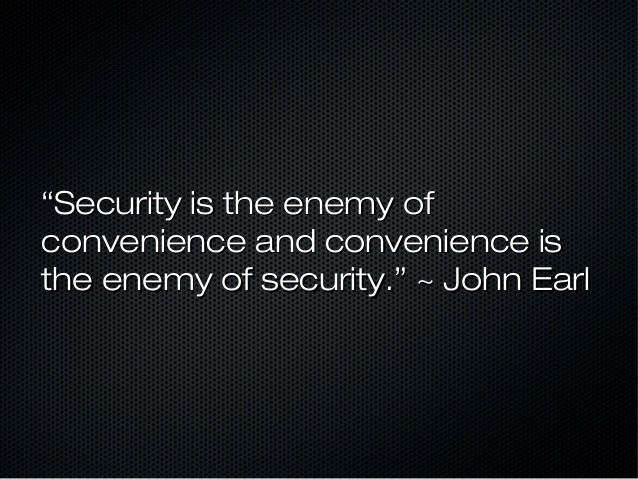
So what makes this a find of the week? This statement made around a table of friends earlier this week: “Convenience and habits are the enemies of security.” It got me to thinking about what we are willing to give up, in terms of convenience and routines, to fortify our security (and the security of others, actually). Things like passwords and keys are not easy to keep up with, but they are essential in today’s world. Photo Credit: Slideshare
Routines or habits that make us more vulnerable might need changing. Like going back and forth to work the same time/way every day. Or running alone. Or being the last one out of the building. When we have routines in our public life, we tend to become less situationally aware. If we all do the work of assessing our own security situation and become more in tune to potential hazards, then we may avoid losing more personal freedom and privacy to other agencies given the task of keeping us safe.
Something to think about…and I have this week. Tightening up some habits and tweaking some routines.
Shyndigz – a dessert restaurant (always a pleasure, not just for the sweets but the surroundings. A beautiful experience. Photo Credit: Screenshot from Shyndigz website
Gel Pens – Celebrating these wonderful little inventions. About the time our daughter moved from pencil to pen, we were living in Cairo, Egypt. In the Korba district of the city, we found a lovely little gift shop called EveryMan’s. This was the place and the season, mid-90s, that we discovered gel pens. I was reminded of the wonder they are this week during our mid-week small group meeting. We were all women in attendance with just Dave as our only guy (which was unusual). At some point, the conversation turned to gel pens (oh, we were writing New Year’s resolutions), and we all sang their praises. Dave commented, “I feel like we wouldn’t be having this discussion if there were more guys here.” Probably…their loss, his gain to be in our mix that night.Photo Credit: Pixabay
OK, any of us familiar with Chick-Fil-A restaurants know the yummy goodness of their chicken sandwiches and waffle fries. However, the stand-alone deliciousness of the food can not actually be separated from the quality of customer service. If I lived in Lenoir, North Carolina, for instance, I would drive across town to dine at operator Mike Sheley’s Chick-Fil-A. His character, kindness, and community commitment infuse his staff. “It’s my pleasure” is part of their heart language and also our customer experience.
My loyalty to Southwest Airlines is similar. The free bag check and cheap fares definitely matter as I choose what airlines to book. Then there is the customer service as fleshed out in Southwest employees like Candace Hewitt. She reached out to me, sitting at the gate, in a time of grieving over two years ago…and she still does from time to time.
That’s the kind of employee that inspires customer loyalty to a company.
Companies these days are often focused sharply on business processes that streamline innovation and the quality and availability of the product or service. Competition is a constant stressor.
What if we are missing the opportunity to nurture our hidden customers? The employees themselves.
Thought leader Michael Lowenstein researches and writes extensively on this. This making employees “ambassadors” of our companies. For those interested in exploring what he and others recommend, I’ve included links below.
In brief, if you’re thinking this might be an issue to address, here are Lowenstein’s recommendations for building such a workplace philosophy and ethic:
Some years ago, my colleague Jill Griffin and I identified nine ‘best practices’ for generating employee behavior which extends beyond loyalty to contribution and commitment.
1. Build a Climate of Trust – That Works Both Ways 2. Train, Train, Train and Cross-Train 3. Make Sure Each Employee Has A Career Path 4. Provide Frequent Evaluations and Reviews 5. Seek To Inform, Seek To Debrief 6. Recognize and Reward Initiative 7. Ask Employees What They Want 8. By All Means, Have Fun 9. Hire The Right Employees In The First Place
To build more of the first best practice, employee trust and empowerment, into the company culture, consider the following:
• Insure staff trust and empowerment are key values in the firm’s mission and vision statements • Practice effective story-telling • Create company rites and rituals that help reinforce the rewards of employee trust • Maintain a free flow of information between management and staff to reinforce the trust factor and help prevent negative communication and gossip. • Actively expose all employees to customers’ perception of experience value • Teach senior managers the importance of ‘walking the talk’ and inspiring employee trust. – Michael Lowenstein
Whatever our company or organization, cultivating practices which enhance employee loyalty will yield the fruit of customer loyalty. Whether or not we can measure that, in the end, the former is a worthy goal all on its own.
Sanborn uses his experience of a mail carrier named Fred as the hero of his story. Fred, because of his commitment to personal care and service, elevates a seemingly mundane job into the stuff of excellence and fulfillment. On the long drive over, I opened the book and re-read the bits of wisdom we can learn from such a person’s character. We actually have such a mail carrier in our daily lives, and the mail delivery when he is on vacation is very different than when he is on the job.
[Our leader guy friend is a deep thinker who actually referred us to one of his favorite books as well: The 33 Strategies of Warby Robert Greene. When we returned home we promptly ordered it and will be reading it by mid-week. Our friend can easily read the little book we gave him in a quick evening. My re-reading it on the drive over stirred its wisdom in my heart and my desire to share it with you as well. One day, I’ll share what Robert Greene teaches us from The 33 Strategies of War.]
The Fred Factor includes five distinctive features:Photo Credit: SlideShare
We can determine to deliver excellence in our action and attitude at work, no matter our situation. Mail carrier Fred demonstrated that and modeled the content for Sanborn’s book.
Just to give you a taste of his writing, I list four quotes from the book:
1) “When those who know are able to show, those who learn are able to grow.” – Mark Sanborn
A clear lesson here is to note your personnel who have shown mastery in their work and make opportunities for them to mentor those who are eager learners. It is a perfect win-win. Leadership development is an often-discussed topic but isn’t always executed in effective ways.
2) “When people feel that their contributions are unappreciated, they will stop trying. And when that happens, innovation dies.” – Mark Sanborn
Excellent employees don’t need appreciation or acknowledgement to keep them at the task. However, over time, they will weary of the task (and the vision meant to inspire innovation) if they don’t see how what they do fits in the larger picture. One strategy that prevents stagnation or disengagement is going back to 1) – teaming up mentors and those ready to learn.
3) “You are the spark that sets others on fire when you initiate.” – Mark Sanborn
Initiative is rewarded in a culture where there is freedom to create and ownership of work. Control is at a minimum and inclusion in problem-solving is high. For us as employees, nurturing our initiative is huge. For us as leaders, we do ourselves and our employees good when we guard against waning initiative.
4) “Faithfully doing your best, independent of the support, acknowledgment, or reward of others, is a key determinant in a fulfilling career.” – Mark Sanborn
At the end of the day, for all of us, we are the masters of our own work, in terms of excellence. The greatest challenge to how our day goes is our own attitude. We all know this. Still, it’s easy for us to allow the negative impact of others diminish who we are or what we do. We are wise to keep learning on the job, especially from folks like Fred (and writer Mark Sanborn).
The Energizer Bunny is an iconic symbol of its own message: “It just keeps going and going…” Such is our belief in high capacity employees and volunteers. In fact, the default is never imagine these tireless folks could run out of steam.Photo Credit: Sarah_Ackerman, Flickr
They don’t usually. However, there are situations when their “keep going and going” is out the door.
[High capacity: Nieuwhof describes these folks as those who “can attract other capable leaders; don’t drop balls; love a challenge; constantly overperform”.]
This content is easily generalized to the workplace.
Before we launch into Nieuwhof’s observations, let’s celebrate high capacity folks for a moment. Even as you read this, you may be thinking of a colleague or fellow volunteer who immediately came to mind. That person who stays long at-task after others have lost interest, determined to figure out the solution or finish the project. That person we count on to be “a rising tide that lifts all boats”. That person who carries the ball or puts all she has in the game as if the outcome depends on her. Dependable, tireless, and visionary. Like in the classroom, we in leadership roles too often focus on others more than these because 1) others are either more needy or more demanding, and 2) we figure these “energized” ones don’t need our oversight.Photo Credit: Pixabay
We communicate core values in this, whether we’re aware or not. Nieuwhof’s insight and counsel are much-needed in a high-pressure workplace or organization. For leaders who themselves are already stretched, we count on our high capacity folks to stay at the work they love and we focus our energy elsewhere. Actually, the return on such our investment here, as prescribed by Nieuwhof, would work to our advantage.
The challenge isn’t big enough. – When the role is too well-defined and task-oriented with little scope for a broader impact, high capacity individuals may lose interest. It’s less that they have to matter (to the larger organization) but that their work matters…and they can see that by the trust given to them in the challenge.
Your vision, mission and strategy are fuzzy. – Nieuwhof defines these as:“Mission is the what. Vision is the why. Strategy is the how.” If high capacity individuals are clear on the why, they can engage with the mission and go all crazy with the generation and execution of strategy. Leaders are wise to set vision and then let loose these folks to get after it.
You’re disorganized. – Plenty of us struggle with being organized. It can come with the chaotic schedule of leaders and managers. As we work with our high capacity employees and volunteers, we are wise to focus on providing them with what they need to be successful (direction, resources, right people at the table – including those in charge, on occasion). As time-consuming as this may seem, the outcomes will always be worth it.
You let people off the hook too easily. – Nieuwhof doesn’t mean this in a mean-spirited way. Without intention, we can find ourselves modeling a low-accountability, slacker-friendly work ethic. Not because it is what we value but because our own heavy work-load keeps us from moving our personnel (or volunteers) to the next level of performance. We talk about it (in meetings galore) but we struggle to truly expect it in a real (work)life situation. We keep depending on our high performers to carry the bulk of the workload. High capacity individuals don’t necessarily mind the work but they crave high standards. They see the value and want it for themselves and for those they work alongside. Again, not in a mean way but in a genuinely caring way.
You’re not giving them enough personal time. – Ouch! Where on our full to busting schedules are we going to insert time to touch base with our high capacity folks? We’re talking minutes here – fractions of time in a workweek – that will yield way more than we think. Dropping a meeting or two off our schedule to add face-time with these individuals will speak volumes to how you value them and what they bring. “Unless you’re intentional, you’ll end up spending most of your time with your most problematic people and the least amount of time with your highest performing people. Flip that.” – Carey Nieuwhof
You don’t have enough other high capacity volunteers (or employees) around them. – We make a grave error in judgment when we think our high performers just want to be left alone to do their work. These individuals are often energized by others like them. They welcome opportunities to learn from and encourage each other. Turn over large projects to these folks and give them the authority and resources to run them together. Then give them the perks of such responsibility – they present on the project; their names are linked to the project; they travel to represent the project. Is it because high capacity individuals need the recognition or significance such a collaboration gives them? No. They have already had the satisfaction of doing a good work with valued coworkers. What this does is to say to the company, organization or world that their bosses truly know and publicly value their contribution. That matters.
A lot to chew on on a Monday morning. Thanks, Carey Nieuwhof. Please write another piece on how you apply this wisdom in your own workplace.
[By the way, y’all, don’t miss the Carey’s commentary on his 6 reasons AND the comments at the end of his blog – so good!]
Friday! Tonight, in the Richmond area, we have our first hard freeze this Fall. That means Dave finishes picking our peppers from the garden. He hopes the greens will survive. It’s a beautiful day – sunny and breezy – with showers of brightly colored leaves covering the grass. Both stained glass windows and patchwork quilts come to mind in this feast for the eyes. Hope your Friday is as lovely. Here are my faves for the week. Enjoy.
1) Concerning Hobbits – The Lord of the Rings film trilogy was a very big deal in our growing-up family. When these films came out, we wanted our kids (then middle-school and high school aged) to read the books first. The Hobbit and The Lord of the Rings novels by J. R. R. Tolkien. Surprisingly, our kids did, along with their dad re-reading these classics. They were captivated by the stories and the courage and endurance of the characters. The Hobbits were especially endearing as they were tiny folk, carried along by a grand mission. Much beyond their physical abilities but not beyond their great hearts.
This past week, Nathan Mills, at Beyond the Guitar, arranged the film theme Concerning Hobbits. Composed by Howard Shore, this melody captures the sweetness and hominess of the Hobbits. There is a rise to crescendo in Mills’ arrangement that also speaks to the willingness of the wee Hobbits to rise to battle when necessary.
I’m reminded of the Hobbit Samwise Gamgee’s role in the novel and film. Two quotes follow – one about him by the author and one by him:
“One tiny Hobbit against all the evil the world could muster. A sane being would have given up, but Samwise burned with a magnificent madness, a glowing obsession to surmount every obstacle, to find Frodo, destroy the Ring, and cleanse Middle Earth of its festering malignancy. He knew he would try again. Fail, perhaps. And try once more. A thousand, thousand times if need be, but he would not give up the quest.” – J. R. R. Tolkien
“There’s some good in this world, Mr. Frodo, and it’s worth fighting for.” – SamwisePhoto Credit: Pinterest
2) Flag at Half Staff – It seems our country’s flag is at half staff too frequently these days. This month we remember our military on Veterans Day and many businesses and private homes will display the American flag in honor of these men and women who served our country.
When a flag is flown at half staff it usually relates to the death of someone significant to all Americans.Photo Credit: Wikimedia Commons
This week, again, our flag is at half staff. This time, in our state, it flies in mourning for those victims of the Sutherland Springs church shooting.
This tragedy has reminded us again of the brevity of life, the great value of life and community, and how important it is to reach out always to our neighbors. We grieve with our neighbors in Texas.
Yesterday our flags were at half staff for them:
Governor’s Flag Order for the Commonwealth of Virginia
Pursuant to President Trump’s Presidential Proclamation to lower the United States flag, I do hereby order that the flags of the United States of America and the Commonwealth of Virginia are to be flown at half-staff over the state Capitol and all local, state, and federal buildings and grounds to honor the victims of the attack in Sutherland Springs, Texas, on November 5, 2017.
I hereby order that the flags shall be lowered until sunset, November 9, 2017.
3) Relational Shock Absorbers – I’d like us to consider for a moment the great gift of relational shock absorbers. Those people in our lives who are safe. Those people who sometimes take the brunt of our outbursts or brooding, without returning evil for evil and without inserting their own drama into what we’ve created. I am NOT talking about people who “just take” our bad behavior out of fear or insecurity or their own struggle. That’s codependence and doesn’t help heal either party.
What I am talking about is those in our lives who are rock-solid in their care for us, who recognize that we are not our best selves at that moment, and who refuse to think ill of us. They don’t make whatever issue is going on…about them. Relational shock absorbers are those in our lives who give space and grace, who hug instead of withhold, who listen for the truth behind the tantrum, and who love us forever. No trade-ins. Ever. Our mom was one of those in our lives…I have a long list of others. Give a shout-out to some of yours in the Comments. Photo Credit: Vimeo
4) Leader Smarts – It is so easy for us to become better at our work if we want it badly enough. Pursuing higher education in leadership or business administration is definitely one way. Or searching out leadership mentors online is another way accessible to all of us. Marcel Schwantes is one of my go-to guys, especially related to servant leadership. In a recent piece for Inc., he makes a case for why employees quit, and what leaders can do to keep them.
5) Making Family Happen – Everybody’s busy. I get that. So how do we make family happen without it being an undue burden on our loved ones, either our children or theirs?
I’m trying to figure this out and would love any wisdom from you willing to share (please comment below). Just this past week, we experienced a generous dose of “making family happen”.
Dave and I traveled to Georgia for a family visit, and it was a sweet touch-point with many we loved there. Like our trips to visit our Delaware family, this one brought all sorts of beauty and kindnesses which will sooth our hearts for many months to come.
In all our married life, we have never lived close to family – sometimes states away, and sometimes countries apart. I have always missed that drop-in nearness with loved ones. Now with both parents gone, my hope is that we next generations will carry on relationships that matter. The traditions may change some, but as long as there are sweet memories…that’s a big part of making family happen. I’m very thankful for a brother and sister-in-law who made family happen for us this past week…and all the younguns who could.
As the holidays of Thanksgiving and Christmas quickly come, I hope for all of us that we can lean in – to God and each other. Photo Credit: Wikimedia Commons
When we see individuals in the military with some form of Special Forces training and experience, we are captivated and sorely aware of how different they are from most of us. That level of discipline, courage, expertise and physicality is uncommon. Nothing I ever imagined for myself. Still what can we learn from these leaders that we can apply to life and work?
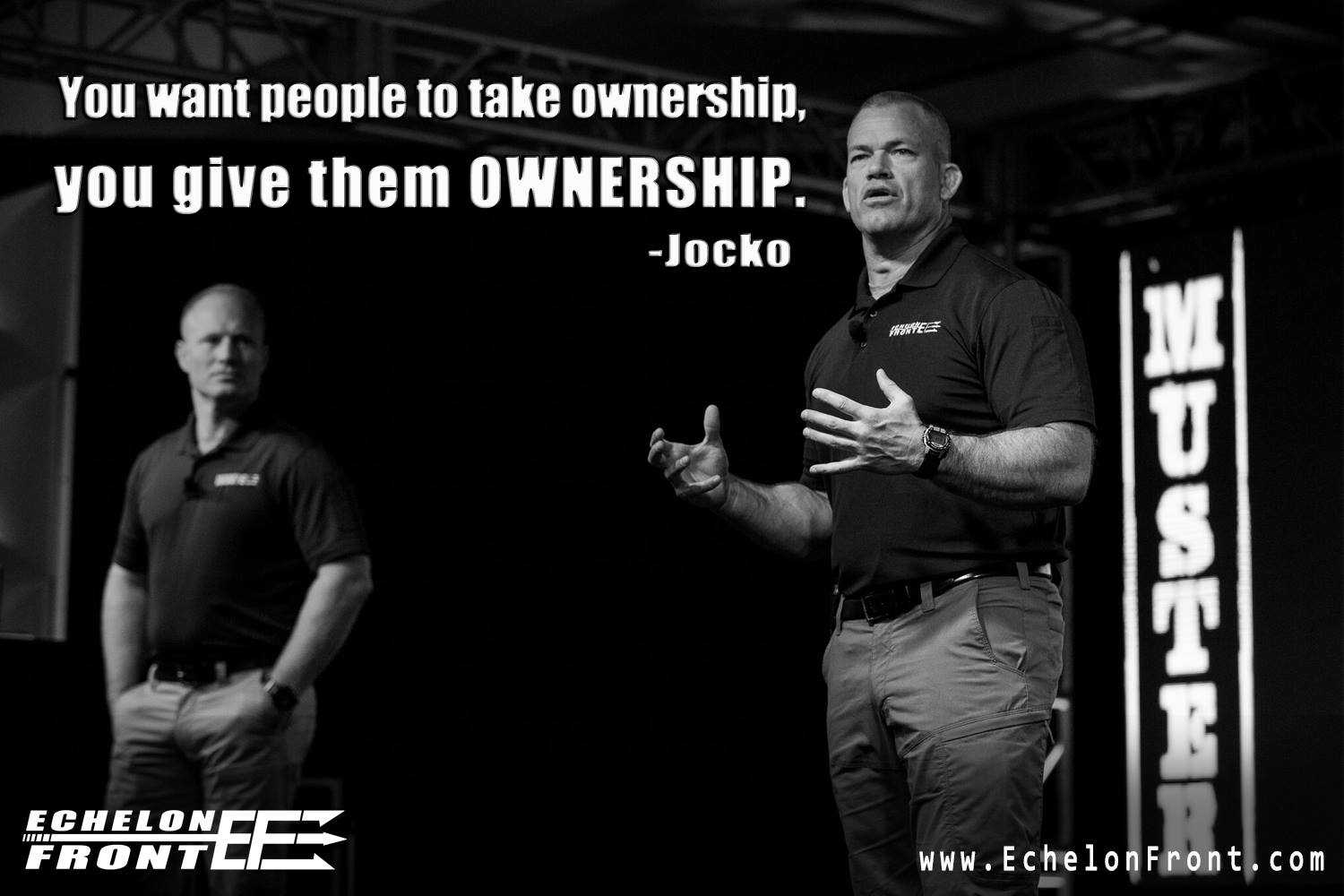
Although the book Extreme Ownership was published in 2015, it was unknown to me until this weekend. Thanks to my Twitter feed and then reading some reviews, I ordered my own personal copy. The authors, and former Navy SEAL team commanders, Jocko Willink and Leif Babin are heroes and the stuff of legend.
[OK…I haven’t read the book yet…pre-ordered the latest edition coming out November 21, 2017. however, the reviews and summaries (listed in the links below) have already been so informative, I will gush away even before reading the book. So sink your teeth into these bits below until we have both read the book…or have you already read it?]
The phrase extreme ownership really tantalized because it spoke to my own leader heart. It resonates with servant leadership which is hard to fathom as a norm in military structure and authority. The idea of everyone on a team, in an organization, owning their part of a vision or operation is thrilling to me. It makes sense that this would, of course, lead to highest performance…provided…and this is imperative: the leadership, up and down the organization, is equipping each team member, communicating thoroughly, and sharing decision-making as appropriate.
“Without a team – a group of individuals working to accomplish a mission – there can be no leadership. The only meaningful measure for a leader is whether the team succeeds or fails.”
“For leaders, the humility to admit and own mistakes and develop a plan to overcome them is essential to success. The best leaders are not driven by ego or personal agendas. They are simply focused on the mission and how best to accomplish it.”
“Leaders must own everything in their world. There is no one else to blame.”
“There are only two types of leaders: effective and ineffective. Effective leaders that lead successful, high-performance teams exhibit Extreme Ownership. Anything else is simply ineffective. Anything else is bad leadership.”
“Leadership isn’t one person leading a team. It is a group of leaders working together, up and down the chain of command, to lead.”
“Ego clouds and disrupts everything: the planning process, the ability to take good advice, and the ability to accept constructive criticism. It can even stifle someone’s sense of self-preservation. Often, the most difficult ego to deal with is your own.”
“As a leader, it doesn’t matter how well you feel you have presented the information or communicated an order, plan, tactic, or strategy. If your team doesn’t get it, you have not kept things simple and you have failed. You must brief to ensure the lowest common denominator on the team understands.”
“Human beings are generally not capable of managing more than six to ten people.”
“Trust is not blindly given. It must be built over time. Situations will sometimes require that the boss walk away from a problem and let junior leaders solve it, even if the boss knows he might solve it more efficiently.”
Business leader Tom Niesen also lists his takeaways from the book, and they align nicely with the other summaries I read:
Mission (Commander’s Intent and Effectiveness)
It is on the leader! (Assuming a good “hire,” now, it is the leader).
Extreme Ownership – everyone believes in the “why”, understands the “why”, and then pursues the “what”. Beginning with the leader. But, everyone “owns it all”.
Get rid of the undermining, not-carrying-the-load, under-performer [this should be a rare necessity in extreme ownership but it can happen].
Get very good at information sharing.
Simplify! Keep it simple. (Not simplistic – simple).
Communicate – thoroughly communicate. Up and down and all around. Confirm that the communication was sent and received and understood.
I hope these two summaries (and others in the links below) will whet your appetite to consider reading Willink’s and Babin’s book. Especially consider taking steps toward extreme ownership in your business or organization.
Sometimes, we struggle in leadership to trust those around us to speak into decisions or even to carry out their assignments without us hovering. Worse is when we just don’t trust others and, as a result, take too much responsibility on ourselves or just a few trusted members of the team. I’ve learned through my life to take joy in the many…even with all its messiness.
I’m reminded of a proverb along these lines:
Without oxen a stable stays clean, but you need a strong ox for a large harvest.– Proverbs 14:4Photo Credit: Wikimedia Commons
If we want processes neat and tidy, we must hold tight to control and keep our trust to a very few colleagues. We lose so much in the process…holding onto control, trusting just our “tribe”, and excluding the input and energy of those outside the circled wagons.
Extreme ownership requires a great deal from leaders…a letting go; an allowing ownership to spread through to a greater mass of people toward a greater good.
We must operate with wisdom and excellence to fully equip our teams and then to give them the freedom to execute. Clear and full communication, up and down the command chain, greases the tracks for this kind of operation. Shouldering personal responsibility at all levels is also crucial, but the key is ultimately the executive leader takes full responsibility in the end…especially if something goes wrong.
I love this concept of extreme ownership. Who’s with me? Fortunately we can apply these principles without having to go through the grueling process of being a Navy SEAL. Thanks, Gentlemen, for your incredible service.Photo Credit: Wikimedia Commons

 Photo Credit: Gtrinity
 Photo Credit: The Brand Bank



 Photo Credit: Carey Nieuwhof