Category Archives: Work Culture

Monday Morning Moment – Negativism – Its Cost and Cure

Photo Credit: Forbes, Jacquelyn Smith

Who ever aspires to become negative? No one out there wants to be considered a Negative Nancy, or, get this, a Debbie Downer. Sheesh.

The fact that there are names for people who struggle with negativism shows they are not fun to be around, even laughable for some. We stir up little compassion for the person inside of that moniker and what might have gotten them there.

Negativism  happens by degree…with time and practice.

Even the Eeyores in our lives, those darksome brooding outsiders, have our sympathy, even affection. We allow that they can’t help their personalities. It’s just how they are. Except for our Eeyore colleagues, friends and family members, we communicate little time or patience for negativism. In fact, we default to our culture’s no-skin-in-the-game of “you’re better off without them around you”.

Well…give yourself time. With enough life experiences and bumps along the journey, you might find yourself becoming that “grumpy old man”. Without even being aware it’s happening.Photo Credit: Pixabay, Peter ZieglerPhoto Credit: Flickr, Paul Waite

You can probably tell I care about this.

Not so long ago, people in my life considered me almost Pollyannaish (determined to be positive about everything that happens; always refusing to think ill of others). I still want to be that person, to be honest. Unfortunately…a few rough hits happened.

Abruptly having to leave a country through circumstances beyond our control. Our home, our friends there. [That story is for another day.] Watching family members go through extreme hard times. Having to leave a church we loved. [Also another story.] Retiring earlier than I wanted. Living day-to-day with this incredible man who has experienced more loss than he imagined or that others really know…squeezed into a few years. I could go on…but then you’d know I’m at risk of becoming a Debbie Downer.

[If you think it’s already happened…I refuse that…because it is not really who I am.]

Our kids have always been taught not to hold court in judging whether something’s fair or not. We did not want to raise a bunch of fairness police. However, we have had numerous round tables over whether something is right or not…and if not, what might our role be in righting a wrong.

The biggest initiator of flipping negativism is figuring out how to respond to something that is just wrong. At home. At work. In our community. In the world.

If you are struggling with negativism, is it because you believe something is just not right?

You could be entirely correct about what is terribly wrong. Unfortunately, if you find you can’t fix what’s broken, then what can be altered are your own relationships, health, and well-being. Either toward the negative…
Photo Credit: Pixabay

or, hopefully, toward the positive.Photo Credit: Skilled Impact

[For those struggling right now with negativism…or maybe not struggling anymore but just living negative at the moment: remember what it was like before when your life was more like the caped crusader in the above image?]

We can flip our negativity to positive but it takes great effort… especially if we’re so drained from it, we can hardly get out of our own way. Just getting the job done or barely maintaining the relationship. This is understandable given what negativism takes out of a person over time. Photo Credit: Pixabay

[That’s one of the reasons I feel strongly about how others respond to it because they don’t see the toll it takes on the individual experiencing it. Not judging here, because I have been exhausted by someone else’s negativism as well. Just more understanding now… having gone through it and seeing those I love slog through it.]

As this has been weighing on my mind recently, I’ve done a fair amount of reading on the topic. There is no small amount of writing about it. Very helpful pieces are linked below. My takeaways are bulleted with the link below it (take time to read more if you will, because I’ll be leaving a lot of great advice out of the bullet points).

Flipping Negative to Positive:

  • Don’t allow yourself to complain unless you also offer one or two possible solutions. Use complaining as a catalyst for positive change.
  • Be aware of the external environment, but don’t let it consume you.
  • Practice the art of “zoom focusing.” Tune out the negative voices, focus in on your choices, and start getting things done.
  • View your life as an inspirational tale, not a horror movie.
  • Make a gratitude list and start a success journal.
  • Don’t quit at Mile 20.
  • Trust in God, not the media (or other naysayers).

 15 Ways to Turn Negative Energy Into Positive SolutionsJon Gordon

  • Psychologists link negative thinking to depression, anxiety, chronic worry and obsessive-compulsive disorder (OCD).  Almost all human beings contend with it — even those born with a positive outlook.

    It’s because of the way our brains are constructed. Our amygdala and limbic system are built to notice threats, to protect our survival. Today, the same parts of our brain are active even when physical threats are minimal. The threats we deal with today are more cognitive — involving finances, whether we’re loved, whether we’re succeeding at work. They can set our hearts racing. That’s why we can panic on a Sunday night just thinking about work.

    Rather than change the way you think, I recommend changing your relationship to your thoughts. Those thoughts that are negative are more likely to capture our awareness, or become “sticky.”

    I recommend learning to watch your thoughts, rather than engaging with them. Practicing mindfulness can take you away from the thinking experience.

    Mindfulness helps us program in ourselves a sense of that which is right. We can systematically notice what’s going well in the present. We can notice something favorable about each person we encounter. Words of admiration help us notice the rightness of things.

How to Turn Around Your Negative Thinking Scott Bea

  • Value the negative experiences.
  • Don’t rush judgment.
  • Take complete responsibility for your life.

3 Ways to Turn Negative Experiences AroundMatt Mayberry

  • A problem can only be resolved if someone brings attention to it but if you don’t plan to be constructive, keep your thoughts to yourself.
  •  If you, however, would like to be, known as a problem solver instead of a complainer, speak up. If you do it the right way, you will make a positive change that could do a lot to improve your work environment. Rather than raising your boss’s ire, you may instead be the recipient of his or her appreciation.

5 Tips to Help You Lose Your Negative Attitude at WorkDawn Rosenberg McKay

  • It takes a real effort a lot of the time to concentrate on the positive. I know there’s a direct link to positive thoughts and success. I have read about it, studied it, and tried to live it most of my adult life.

“The Nattering Nabobs of Negativism”Gary Weiner

[Again, the articles in full have more helpful info…when you have the time or inclination to read further. At the end are two links to HR and supervisors/managers.]

My own small observations (beyond the above excellent points):

  • If the workplace itself is fueling negativism, do what you can to shakeup where you work. Try a different venue for day-to-day work. Traveling can be a tremendous help (if you can financially and strategically make it happen – for yourself and others). Working remotely doesn’t fix what’s hard but it dilutes contact and interaction with what’s hard.
  • If others have judged you by this current season of life and don’t want to work with you, don’t let that deter you from your purpose. Mend relationships if you can. If not, embrace the “what is” in your life, and celebrate the healthy relationships you have and pursue work you love, wherever you can make a difference.
  • Stay in the present moment. The past, distant or recent, is where your negativism was birthed. The future either strikes more fear in your heart or stirs hope (as in a job change or some other imagined change) that you can’t be sure is real. For this moment, stay at task, nurture your current relationships, focus in.

An expression floating around the internet lately goes something like this:

“What you practice, you get very good at.”

As that relates to negativism, do we really want to get good at that? No. In fact, practice doesn’t always make us good at something. We can practice unhelpful, unhealthy habits and they can become ingrained….even permanent…unless we intentionally do the work to reverse them. Photo Credit: QuoteFancy

Where are you in all this? Please comment below. It would be helpful for us to hear from each other. This is a safe place.

Negativism is contagious, but so is positivity. Both have their own satisfactions. There may come a day that the new-honed habit of negativism turns on us and we see if for the robber it is. Then the work will begin to turn our lives around…before it’s too much damage is done.

If you don’t currently struggle with negativism, take note of those around you who do struggle. This is not something (or someone) to just avoid…this is someone who even the Apostle Paul determined to help…

“Finally brothers, whatever is true, whatever is honorable, whatever is just, whatever is pure, whatever is lovely, whatever is commendable–if there is any moral excellence and if there is any praise–dwell on these things.” – Philippians 4:8

3 Tips for Decreasing Workplace Negativity – [written with a Human Resources focus]

Turning Around Negative Attitudes [a must read for supervisors and managers]

5 Friday Faves – A Happy Place, Preventing Generosity Burnout, Whistle-blowers, Spotify, and Beautiful Documentaries

Happy Weekend…without further ado, here are my Friday Faves, before it gets too much farther into the weekend. Enjoy.

1) My Happy Place – “My happy place” has usually been a phrase that makes me cringe when I hear it. What does that really mean? Then it came to mind this week as I strolled through a local business. RVA Antiques. This huge space is a showcase for all things 20th Century, upcycled and updated for today’s customer. Artful and lovely. Having just picked up a prescription at the pharmacy next door, I had some time on my hands so popped in…just on a whim. It was a real refreshment for my soul. I like old things…the stuff of my mom’s era makes me think of her…and that makes me happy. Words also just bring smiles …those words worthy of being painted on a canvas or splashed on a piece of wood. Just strolled around the different vendors’ booths. Even met one of the owners, Dean Lewis, who made me feel welcome. Now that my understanding of such “a happy place” has been enlarged, what’s one of your “happy places”?

2) Preventing Generosity Burnout An article by Adam Grant and Reb Rebele got me thinking this week about generosity burnout. Beat Generosity Burnout confronts the crucial fine line between effectively helping others and giving so selflessly we lose our joy and capacity. We burn out. If we base our helping on “the need”, we won’t build in safeguards, boundaries if you will, to determine how best to meet that need. Serving our communities is definitely something we need to always consider, but we serve best by applying sustainable, capacity-building planning and practice.

Photo Credit: Adam Grant, Reb Rebele, Craig Ellis – LinkedIn

Think of the ways you serve your various communities across a typical week or month. Are you all-in or holding back out of fear of too great a commitment or fear of burnout? Or what else? We definitely want to rise above the latter but what might “all-in” look like to be sustainable? For you personally and for the sake of the community you serve?

I would love this sort of dialogue with you.  Either in Comments below or via email.

[Sidebar – for those of you who flew through this, already cynical and shut down from demands/needs of your organization or community, please reconsider and lean in. People very close to you may be teetering on generosity burnout and could use your thinking on sustainability.]

Beat Generosity Burnout –  Adam Grant & Reb Rebele

Generosity Burnout – Selflessness Exhaustion – Craig Ellis

The Invisible Costs of Giving: How to Combat Generosity Burnout at WorkNicole Abi-Esber

Harvard Business Review – List of Articles on Generosity Burnout

3) Whistle-blowers – Who are these people? These who bring unethical or illegal practices into the light? These who risk reputation and career…even more at times…to expose wrong? This was a big news week in America. One of those related to Christopher Wylie, a former employee of Cambridge Analytica (CA) and a whistle-blower. Wylie revealed an incredible, yet not-surprising abuse of Facebook user data by the political consulting company Cambridge Analytica. This company has probably had influence on presidential elections in the US, Kenya, Argentina, and other countries.
Photo Credit: Wikimedia
First, the company secured Facebook user data by claiming it would be for academic research purposes rather than commercial purposes. Then the company used an app (a pop-up quiz on Facebook) to glean more data about the user’s personality. This was multiplied through the users’ friend lists…resulting in millions of Facebook users manipulated by Cambridge Analytica. Based on their findings, CA would then post “fake news” to these users’ pages that would move them to possibly vote in a certain way. This is essentially “weaponizing the internet”.
I’m not sure of Christopher Wylie’s motives in whistle-blowing at this time, but it definitely gives pause to every request we consider in clicking yes to an app having access to our data.
What is also thought-provoking is how this practice goes much farther back than just the 2016 presidential election.
Something to ponder…thanks to Christopher Wylie, previously the perpetrator, now a champion for truth.
4) Spotify – So many of you may already use Spotify, this music service for smartphones and computers. I’m a late adopter but now I’m a happy consumer of this free medium. Especially since Beyond the Guitar has his first album on the site. So nice just to be able to click on, and listen to Nathan’s music while I’m driving or working.
His first published original composition, Evenglow, is also available on Spotify.
Photo Credit: Beyond the Guitar
Be a Patron – Support Beyond the Guitar music creation on Patreon.
5) Beautiful Documentaries – Documentaries are becoming film favorites of late…especially when they focus on documenting the beautiful and redemptive sides of life.

Jay Lyons Productions partnered with Topher Hall to create this amazing piece with current and vintage footage for Prison Fellowship. This documentary tells the story of how people who committed unspeakable crimes found a sustaining and redeeming faith in Christ while in prison.

Prison Fellowship – Video Review

Another of Jay’s documentaries that is coming out soon is The Long Goodbye: The Kara Tippetts Story. Kara died 3 years ago this week. She was a magnificent woman, full of love and faith.  Watch for this film.

 Have a rich weekend. Every day is a gift, right? Love on those people around you. Love you.
Bonuses: 

The Man That Came After – Michelle E. Steinke

Little Marlana – My Story

https://www.simplemost.com/salvation-army-supermarket/?utm_campaign=gardenbudget&utm_source=facebook&utm_medium=partner&utm_partner=gardenbudget

Photo Credit: FrankSonnenberg Online

FSO_50-shades-of-waste

Monday Morning Moment – A Space and a Place on the Team

Blog - Space and a place - gtrinityPhoto Credit: Gtrinity

Work space is always a premium in companies. Whether you work in a cubicle or a full-fledged office with a door, a space of some sort that belongs to you (shared or not) is vital. I remember vividly a time I had the opportunity to pour over a department’s new office space design. It was a fascinating and eye-opening experience.

Some of the team members work remotely, and I noticed there wasn’t a space designated for those who are not regularly in the office. Showing this to the person on point for working out the space assignments yielded an “Aha!” moment. She was kind to listen to a relative outsider, initially explaining how that probably happened because they are rarely in the office. Could it be that they are rarely there because there is no space for them? Something to think about if you want to rub shoulders and share ideas with those valued team members…if space is made for them.

Along with space comes the idea of a place on the team. Do you know your place on your work team? What you bring to the table? What unique role you play in the mission of your organization? C-suite leaders and department heads, of course, define some of that through a title, vision, and job description. They made a place for you on the team organizationally. Your role is to carve that place out…to add value to the work of the team through your own passion and applied competencies. Also you, as team member, can add value to your colleagues by your care for them – by being “the rising tide that lifts all boats” – [Quote #30 – Adam Grant].

Blog - team a place for you - the brand bankPhoto Credit: The Brand Bank

How exhilarating it is when our bosses communicate to us and the larger team how relevant we are to them and the work! However, that can’t be our motivation. We must set in our own minds, that as part of the team, we have that grand opportunity to make a real difference. Whether obvious to leadership or not, we can apply our best selves to the vision, to the outcome, and to the people we work with and for. Business leader John Maxwell once spoke at the Global Leadership Summit on this very topic.

Maxwell’s book Intentional Living: Choosing a Life that Matters focuses on this idea of “adding value” to others. At first, I thought that an odd idea because people already have value. Period. Then, the more I listened to him and the more I read about healthy teams, I saw the wisdom in this. We can get absorbed in the task and the goals, and miss the people within the tasks. It is part of the whole “space and place” component of team. Give a listen to Maxwell in this brief but packed 3:40 minute video on “adding value to people”.

In the course of busy work and personal lives, we are not even thinking sometimes of the need for “space and place”. This Monday morning, spend a quiet minute maybe on the people you call team and what space and place you’ve made for them to thrive and grow. It will always come back, like Adam Grant says, to benefit you as well.

5 Friday Faves – Right Bus/Wrong Seat, Live Streaming, Words, Mommy Blogs, and the Inevitabilities of Life

Today’s Friday Faves blog comes to you on Saturday. It’s been that kind of week, full to busting. Along with it were fun times with friends, poignant occasions to serve people in crisis, beautiful sunrises and sunsets (plus a Blue Moon), and a few moments of quiet calm to process it all. I hope your week was memorable.

Writing helps me remember (even if it’s a few lines in a journal or on an old-school calendar)…maybe your memory is better. Here are five of my favorite discoveries for the week. Please share yours in Comments below.

1) Right Bus/Wrong Seat – Writer, seminarian Chuck Lawless posted recently on dealing with employees who appear to be on the right bus, but in the wrong seats. He wrote about church culture but

10 Ways to Deal with People on the Right Bus, but in the Wrong Seat

his counsel reminded me of work situations as described by business leader and writer Jim Collins. – in his book Good to Great: Why Some Companies Make the Leap and Others Don’t. Collins focuses on the importance of having the right people “on the bus”. Then he pushes deeper in employers or leaders getting those right people into the right seats. We can find ourselves wondering at times if we’re in the right company when really the question could be that we may not be in the right job within that company. Collins’ approach puts people over product, but he knows the better product will come out of better-positioned people. Right bus/right seat.

Have 100% of the key seats on the bus filled with the right people. This doesn’t mean 100% of ALL seats have the right people, but 100% of the key seats. If you think there might be a “wrong who,” first give the person the benefit of the doubt that perhaps he or she is in the wrong seat. Whenever possible, give a person the chance to prove himself or herself in a different seat, before drawing the conclusion that he or she is a wrong person on the bus.

Spend a significant portion of time on people decisions: get the right people on the bus, get the right people in the right seats, get the wrong people off the bus, develop people into bigger seats, plan for succession, etc. Develop a disciplined, systematic process for getting the right people on the bus. With each passing year, ensure the percentage of people decisions that turn out good versus bad continues to rise. Wendy Maynard, Jim Collins

Good to Great: Why Some Companies Make the Leap and Others Don’tJim Collins

2) Live Streaming – I am really not fond of paying the high ticket prices required these days for celebrity entertainment. What intrigues me more are the younger (or newer) artists pushing into the public’s eye through live streaming. In 2015, KrueTV was launched, and it has made a huge impact on where I go for music. A live streaming app. Where I get to watch, listen to, and chat with artists who are just beginning to hone their craft. Rough sometimes, but so fresh and very much “in the moment. Beyond the Guitar streamed on Krue from early on. Photo Credit: Screenshot, KrueTV

A community of followers was born there, many of whom support him on Patreon. KrueTV also made it possible for me to meet and enjoy the music of other artists – a young country-western singer from Ohio, an Indie artist from Canada, a sibling band with killer harmonies, a Portuguese singer who brings us all-things-Eurovision. And many others.

The bad news came this week that Krue’s creators are going a different direction. Another app will eventually come, but Krue will be shut down soon. It made all of us sad, all of us who enjoy the streams there.

Beyond the Guitar’s Last Great Stream on KrueTV

Turning that sad into action, the artists continue to stream on Krue for now and commiserate with each other and their fans. Also sorting out what live streaming app to jump on next.

I was surprised to find out that there are several now. GigFM. StreetJelly. Twitch.TV. One of these apps will become my next favorite, depending on where these favorite artists land. Because it’s not just their performances, it’s also the community around them. Never would I have thought, in all my life, that this would become important to me. Online communities. Gamers understand this, but it’s new to me.

Beyond the Guitar’s Latest Arrangement – The Hunger Games: Hanging Tree

3) Words – Any of you who continue to stick with me on this blog know I love words. If you walked into our home, you would see them everywhere. Bookcases in every room. Words on the walls.

Books by my bed and beside my computer. Notes on top of my keyboard. Words that can remind, instruct, encourage.

In my resolve to read more, this year of 2018, I’m currently in the middles of a strange and fascinating book. It is The Elements of Eloquence: Secrets of the Perfect Turn of Phrase by Mark Forsyth. It’s a book about the English language and what makes us love and remember certain phrases by how they are written. I will probably write about this book later, but here are some words that have caused me to think…this week.

The Elements of Eloquence: Secrets of the Perfect Turn of PhraseMark Forsyth

Mark Forsyth Blog

Young at Heart (Slightly Older in Other Places) – Day Brightener

4) Mommy Blogs – The blogs I subscribe to are usually about leadership, the Bible, or living cross-culturally. However, lately, “mommy blogs” have come to my attention, thanks to the young women in my life who read and write them. This week, I discovered Liz B. who writes Life in a Coffee Spoon. A mom of two who also works outside the home, she posted this week on the challenges of life that literally drive her to write in order to process it all. Photo Credit: Pixabay

Her writing is like that coffee – real, strong, and just right for when you need it.

Life in a Coffee Spoon – On Mommy Blogging in 2018

Family. Life. Organized – Bekkah Mills

17 Things You Should Do to Every Blog Post Before + After You Hit Publish (Free Checklist) – Melyssa Griffin – for any of you, Dear Ones, thinking of blogging.

5) The Inevitabilities of Life – This has been one of those weeks when life has been full of the inevitable – sickness, hard news, death. There are also the inevitabilities, thankfully, of new babies, good news, and happy anniversaries. This has not been a week of those.

[There was a time just a bit ago that I didn’t take any meds. Then…it happened. The inevitable, I presume.]

Still in the middle of all the hard, I’m struck by the great gift of community, the strength of true friendship and family, the power of prayer. The presence in our lives of a loving God and those we can lean on – good neighbors, first responders, trusted colleagues, and those sainted strangers – all, in their time, are there for us, as we are for them. The leaning in and showing up – in the inevitabilities of life. It’s really quite beautiful…and takes so much of the sting away.

“These things I have spoken to you, so that in Me you may have peace. In the world you have tribulation [trouble; suffering], but take courage; I have overcome the world.”  – Jesus – John 16:33

So there are my 5’s this week. What are some of yours? Have a safe and splendid weekend, hopefully with those you love or in your own good company.

Bonuses

Photo Credit: Rick Fischler, Facebook

In Which I Am Learning to Live with the Ache – Sarah Bessey

Quote: I am an historian, I am not a believer, but I must confess as a historian that this penniless preacher from Nazareth is irrevocably the very center of history. Jesus Christ is easily the most dominant figure in all history. – H.G. Wells

[I finally saw the Denzel Washington film Fences adapted from August Wilson‘s play….whew.]

“I think my plays offer (white Americans) a different way to look at black Americans,” he told The Paris Review. “For instance, in Fences they see a garbageman, a person they don’t really look at, although they see a garbageman every day. By looking at Troy’s life, white people find out that the content of this black garbageman’s life is affected by the same things – love, honor, beauty, betrayal, duty. Recognizing that these things are as much part of his life as theirs can affect how they think about and deal with black people in their lives.” – August Wilson

TED Talk – Susan David: The Gift and Power of Emotional Courage

Prescriptions Without Pills – For Relief from Depression, Anger, Anxiety, and More – Susan Heitler

Photo Credit: Amazon, Susan Heitler

Monday Morning Moment – the Components of Truly Multiethnic Organizations – Color, Culture, Compromise, and Community

Photo Credit: ProExcell, Eclassified

Is being multiethnic part of your organization’s DNA or core values?

Whether a part of a Fortune 500 company or a megachurch, or whether just beginning a small business or a new church plant, our values are soon exposed. First, by our goals and then by our makeup.

“Like begets like”. For better or worse.

So…what if we see the value of multiethnicity in our organization, is it apparent in our makeup?

A quick assessment can come out of the 80/20 rule: when one racial group accounts for 80 percent or more of the membership (or organization).* In the US, if our company has 100 employees, and 79 or fewer are white, we are moving in the direction of being multiethnic in our makeup. Easier than counting through employees, just look at the makeup of the leadership team. That readily speaks to the direction of the organization.

I’m not talking quotas here, at all. Racial diversity is probably not the ultimate goal. It can, however, be a part of the goal.

If we are part of a mono-cultural (a racial majority) organization, there is benefit in asking these questions: Should we look more like the rest of the world? What do we communicate when we don’t? What problems do we make for ourselves in keeping the status quo? What positive impact can we have on the present and future, if we do act, moving toward multiethnicity, with intentionality?

For starters, let’s examine the components of a multiethnic organization – color, culture, compromise, and community.

Color and Culture Pastor and writer Bryan Loritts gives perspective in his book Right Color, Wrong Culture: The Type of Leader Your Organization Needs to Become Multiethnic (A Leadership Fable). Written in the style of the great Patrick Lencioni leadership books, it’s a fast and fascinating read, with much to mull over afterward.Photo Credit: Cedarville University

In his book, Loritts paints a clear picture of color and culture as he defines 3 types of cultural expression.

C1 – Persons within a certain ethnic group who have assimilated into another ethnic group. Loritts uses one such example from our TV pop culture of a few years ago: Carlton Banks of The Fresh Prince of Bel Air -and the It’s Not Unusual dance. On the surface, these persons would seem to easily blend into an emerging multiethnic organization. They bring racial diversity without rocking the institutional boat. Will just considering skin color get us to goal?

C3 – At the other end of the spectrum, the persons within an ethnic group who absolutely refuse to assimilate within other ethnic groups or cultures. Again, from the same 90s TV show, Loritts uses a different character as a light-hearted example: Fresh Prince Will Smith Dancing. C3s do not blend into the majority ethnic group and have no intention of doing so. What they bring to an organization is ethnic definition.

Hang in there with me. Especially if you’re thinking this has nothing to do with competence or corporate excellence. There’s more.

C2 Those persons who have the unique ability to go from one culture to another, without compromising or losing who they are in the process.

Who did Loritts give as a person we can all recognize as a probable C2? Denzel Washington. When you look down the 30-years-plus of Washington’s films, he chose to portray a wide range of characters at which we watched and wondered. C1s, C3s, and, of course, C2s. Washington is a black man with the wisdom and understanding of one who will bring his best to any situation, without losing himself.

This breakdown of cultural expressions made me take a long, hard look at my own life – if not my preferences, definitely my default. I’m a C2 wannabe in a C3 life AND organization. In earnest, I do want to be a C2, but too many actualities in my life point to the fact that I’m not there yet…but “there” is my goal.

We need C2s to grow into truly multiethnic organizations.

Compromise – To move our organizations toward a goal of multiethnicity, compromise, in the best sense of the word, will be required. As we look at our makeup and our market, we must ask hard questions of ourselves. What are we really willing to invest to get to a multiethnic leadership and true organizational partnership across cultures?

If leaders are interested in exploring and reaching beyond their particular demographic, they must understand that a lot of it has to do with …leadership. This is something that has to be flowing out of the leader. This intentionality and staffing will always prove to be a major catalyst for change. DeYmaz also issues a call for intentionality when it comes to developing diverse leadership teams…Bryan Loritts says the ideal candidate for a leadership role is what he refers to as a C2 leader. “A C2 is a person who is culturally flexible and adaptable without becoming ethnically ambiguous or hostile.” As an example of a C2 individual he points to actor Denzel Washington,as someone with the unique ability to play a variety of culturally-different roles while remaining true to himself in the process.* – Jeff Fehn

A Training Curriculum Model of Multiethnic Ministry Best Practices Designed for Harmony Vineyard Church – Jeffrey A. Fehn

Community – With intentionality and the willingness to give space to other ethnicities and cultures, our organizations can look like and identify with the world we serve. Our products and identity can  communicate both excellence, relevance, and highest humanity as we become more multiethnic. In fact, while we may strive toward diversity or multiethnicity… really the goal needs to be multiculturalism…enriching and empowering each other personally and organizationally.

While cultures are defined by their distinctiveness, community and interaction rely upon commonalities to establish unity. In order to have intercultural relationships, some accommodation must be made on one or both sides of the cultural divide. But the act of accommodation represents, to some degree, a compromise and loss of cultural values.Mark Naylor

Photo Credit: Together for Adoption
A truly multiethnic organization will be multicultural.
What is gained in formulating goals that bring together ethnicities and cultures with processes that encourage positive compromise and rich community? I’d say…the world.
Thoughts?

Where will these kids work, serve, and do community one day?Photo Credit: Flickr

[Postscript: Pat Lencioni’s most recent post popped up in my email this morning, a day after my weekly post went up. He adds one other “C”: Conflict – check out his read on Diversity’s Missing Ingredient.]

Right Color Wrong Culture: The Type of Leader Your Organization Needs to Become Multiethnic (A Leadership Fable) – Book Review by Chis Pappalardo and J. D. Greear

Right Color, Wrong Culture: The Type of Leader Your Organization Needs to Become Multiethnic (A Leadership Fable) – Bryan Loritts

*A Training Curriculum Model of Multiethnic Ministry Best Practices Designed for Harmony Vineyard Church – Jeffrey A. Fehn

Monday Morning Moment – Are Customers Loyal to Your Company or to Your Employees?

OK, any of us familiar with Chick-Fil-A restaurants know the yummy goodness of their chicken sandwiches and waffle fries. However, the stand-alone deliciousness of the food can not actually be separated from the quality of customer service. If I lived in Lenoir, North Carolina, for instance, I would drive across town to dine at operator Mike Sheley’s Chick-Fil-A. His character, kindness, and community commitment infuse his staff. “It’s my pleasure” is part of their heart language and also our customer experience.

My loyalty to Southwest Airlines is similar. The free bag check and cheap fares definitely matter as I choose what airlines to book.  Then there is the customer service as fleshed out in Southwest employees like Candace Hewitt. She reached out to me, sitting at the gate, in a time of grieving over two years ago…and she still does from time to time.
That’s the kind of employee that inspires customer loyalty to a company.

Companies these days are often focused sharply on business processes that streamline innovation and the quality and availability of the product or service. Competition is a constant stressor.

What if we are missing the opportunity to nurture our hidden customers? The employees themselves.

Thought leader Michael Lowenstein researches and writes extensively on this. This making employees “ambassadors” of our companies. For those interested in exploring what he and others recommend, I’ve included links below.

In brief, if you’re thinking this might be an issue to address, here are Lowenstein’s recommendations for building such a workplace philosophy and ethic:

Some years ago, my colleague Jill Griffin and I identified nine ‘best practices’ for generating employee behavior which extends beyond loyalty to contribution and commitment.

1. Build a Climate of Trust – That Works Both Ways
2. Train, Train, Train and Cross-Train
3. Make Sure Each Employee Has A Career Path
4. Provide Frequent Evaluations and Reviews
5. Seek To Inform, Seek To Debrief
6. Recognize and Reward Initiative
7. Ask Employees What They Want
8. By All Means, Have Fun
9. Hire The Right Employees In The First Place

To build more of the first best practice, employee trust and empowerment, into the company culture, consider the following:

• Insure staff trust and empowerment are key values in the firm’s mission and vision statements
• Practice effective story-telling
• Create company rites and rituals that help reinforce the rewards of employee trust
• Maintain a free flow of information between management and staff to reinforce the trust factor and help prevent negative communication and gossip.
• Actively expose all employees to customers’ perception of experience value
• Teach senior managers the importance of ‘walking the talk’ and inspiring employee trust. – Michael Lowenstein

Whatever our company or organization, cultivating practices which enhance employee loyalty will yield the fruit of customer loyalty. Whether or not we can measure that, in the end, the former is a worthy goal all on its own.

Research: Are Clients Loyal to Your Firm or the People in It? – Joe Raffiee

Why Managers Should Care About Employee Loyalty? – Timothy Keiningham and Lerzan Aksoy

Does Employee Loyalty = Customer Loyalty? And, Did It Ever? – Michael Lowenstein

World-Class Customer Service – The Key Is Caring – Horst Schulze on a Culture of Service – Deb Mills Writer

Eyes on the Customer Experience Prize: Will 2016 Be the Year of the Emotionally-Driven Employee Ambassador? – Michael Lowenstein

Jeffrey Pfeffer: Why Companies No Longer Reward Loyal Employees – Eilene Zimmerman

8 Reasons to Keep Your Customers Loyal – Rama Ramaswami

Monday Morning Moment – Turning Ordinary into Extraordinary – The Fred Factor

Photo Credit: SlideShare

Happy Monday, Friends! This weekend’s activities included a visit with friends in their home in the Virginia mountains. The wife is an artisan, and the husband is on staff at a nearby university. He, in fact, mentors student leaders as part of his work. In my little gift bag for them was a favorite leadership story by Mark Sanborn. Its odd title is The Fred Factor: How Passion in Your Work and Life Can Turn the Ordinary into the Extraordinary

Sanborn uses his experience of a mail carrier named Fred as the hero of his story. Fred, because of his commitment to personal care and service, elevates a seemingly mundane job into the stuff of excellence and fulfillment. On the long drive over, I opened the book and re-read the bits of wisdom we can learn from such a person’s character. We actually have such a mail carrier in our daily lives, and the mail delivery when he is on vacation is very different than when he is on the job.

[Our leader guy friend is a deep thinker who actually referred us to one of his favorite books as well: The 33 Strategies of War by Robert Greene. When we returned home we promptly ordered it and will be reading it by mid-week. Our friend can easily read the little book we gave him in a quick evening. My re-reading it on the drive over stirred its wisdom in my heart and my desire to share it with you as well. One day, I’ll share what Robert Greene teaches us from The 33 Strategies of War.]

The Fred Factor includes five distinctive features:Photo Credit: SlideShare

We can determine to deliver excellence in our action and attitude at work, no matter our situation. Mail carrier Fred demonstrated that and modeled the content for Sanborn’s book.

Just to give you a taste of his writing, I list four quotes from the book:

1) “When those who know are able to show, those who learn are able to grow.” – Mark Sanborn

A clear lesson here is to note your personnel who have shown mastery in their work and make opportunities for them to mentor those who are eager learners. It is a perfect win-win. Leadership development is an often-discussed topic but isn’t always executed in effective ways.

2) “When people feel that their contributions are unappreciated, they will stop trying. And when that happens, innovation dies.” – Mark Sanborn

Excellent employees don’t need appreciation or acknowledgement to keep them at the task. However, over time, they will weary of the task (and the vision meant to inspire innovation) if they don’t see how what they do fits in the larger picture. One strategy that prevents stagnation or disengagement is going back to 1) – teaming up mentors and those ready to learn.

3) “You are the spark that sets others on fire when you initiate.” – Mark Sanborn

Initiative is rewarded in a culture where there is freedom to create and ownership of work. Control is at a minimum and inclusion in problem-solving is high. For us as employees, nurturing our initiative is huge. For us as leaders, we do ourselves and our employees good when we guard against waning initiative.

One Behavior Separates the Successful from the Average – Benjamin P. Hardy

Six Simple Ways to Rekindle Your Employees’ Love For Their Job – Lama Ataya

4) “Faithfully doing your best, independent of the support, acknowledgment, or reward of others, is a key determinant in a fulfilling career.” – Mark Sanborn

At the end of the day, for all of us, we are the masters of our own work, in terms of excellence. The greatest challenge to how our day goes is our own attitude. We all know this. Still, it’s easy for us to allow the negative impact of others diminish who we are or what we do. We are wise to keep learning on the job, especially from folks like Fred (and writer Mark Sanborn).

Photo Credit: SlideShare

The Fred Factor – SlideShare – Jitendra Gupta

GoodReads Quotes – The Fred Factor: How Passion in Your Work and Life Can Turn the Ordinary into the Extraordinary by Mark Sanborn

Monday Morning Moment – Taking Care of Our High Capacity Employees and Volunteers

Photo Credit: Ben+Sam, Flickr

The Energizer Bunny is an iconic symbol of its own message: “It just keeps going and going…” Such is our belief in high capacity employees and volunteers. In fact, the default is never imagine these tireless folks could run out of steam.Photo Credit: Sarah_Ackerman, Flickr

They don’t usually. However, there are situations when their “keep going and going” is out the door.

Photo Credit: LinkedIn

This week, Carey Nieuwhof, one of my favorite leadership guys, pointed us to the 6 reasons he believes we lose high capacity volunteers.  

[High capacity: Nieuwhof describes these folks as those who “can attract other capable leaders; don’t drop balls; love a challenge; constantly overperform”.]

This content is easily generalized to the workplace.

Before we launch into Nieuwhof’s observations, let’s celebrate high capacity folks for a moment. Even as you read this, you may be thinking of a colleague or fellow volunteer who immediately came to mind. That person who stays long at-task after others have lost interest, determined to figure out the solution or finish the project. That person we count on to be “a rising tide that lifts all boats”. That person who carries the ball or puts all she has in the game as if the outcome depends on her. Dependable, tireless, and visionary. Like in the classroom, we in leadership roles too often focus on others more than these because 1) others are either more needy or more demanding, and 2) we figure these “energized” ones don’t need our oversight.Photo Credit: Pixabay

We communicate core values in this, whether we’re aware or not. Nieuwhof’s insight and counsel are much-needed in a high-pressure workplace or organization. For leaders who themselves are already stretched, we count on our high capacity folks to stay at the work they love and we focus our energy elsewhere. Actually, the return on such our investment here, as prescribed by Nieuwhof, would work to our advantage.

6 reasons you’re losing high capacity volunteers (employees)

  1. The challenge isn’t big enough. – When the role is too well-defined and task-oriented with little scope for a broader impact, high capacity individuals may lose interest. It’s less that they have to matter (to the larger organization) but that their work matters…and they can see that by the trust given to them in the challenge.
  2. Your vision, mission and strategy are fuzzy. – Nieuwhof defines these as: Mission is the what. Vision is the why. Strategy is the how.” If high capacity individuals are clear on the why, they can engage with the mission and go all crazy with the generation and execution of strategy. Leaders are wise to set vision and then let loose these folks to get after it.
  3. You’re disorganized. – Plenty of us struggle with being organized. It can come with the chaotic schedule of leaders and managers. As we work with our high capacity employees and volunteers, we are wise to focus on providing them with what they need to be successful (direction, resources, right people at the table – including those in charge, on occasion). As time-consuming as this may seem, the outcomes will always be worth it.
  4. You let people off the hook too easily. – Nieuwhof doesn’t mean this in a mean-spirited way. Without intention, we can find ourselves modeling a low-accountability, slacker-friendly work ethic. Not because it is what we value but because our own heavy work-load keeps us from moving our personnel (or volunteers) to the next level of performance. We talk about it (in meetings galore) but we struggle to truly expect it in a real (work)life situation. We keep depending on our high performers to carry the bulk of the workload. High capacity individuals don’t necessarily mind the work but they crave high standards. They see the value and want it for themselves and for those they work alongside. Again, not in a mean way but in a genuinely caring way.
  5. You’re not giving them enough personal time. – Ouch! Where on our full to busting schedules are we going to insert time to touch base with our high capacity folks? We’re talking minutes here – fractions of time in a workweek – that will yield way more than we think. Dropping a meeting or two off our schedule to add face-time with these individuals will speak volumes to how you value them and what they bring.
    “Unless you’re intentional, you’ll end up spending most of your time with your most problematic people and the least amount of time with your highest performing people. Flip that.” – Carey Nieuwhof
  6. You don’t have enough other high capacity volunteers (or employees) around them. – We make a grave error in judgment when we think our high performers just want to be left alone to do their work. These individuals are often energized by others like them. They welcome opportunities to learn from and encourage each other. Turn over large projects to these folks and give them the authority and resources to run them together. Then give them the perks of such responsibility – they present on the project; their names are linked to the project; they travel to represent the project. Is it because high capacity individuals need the recognition or significance such a collaboration gives them? No. They have already had the satisfaction of doing a good work with valued coworkers. What this does is to say to the company, organization or world that their bosses truly know and publicly value their contribution. That matters.

A lot to chew on on a Monday morning. Thanks, Carey Nieuwhof. Please write another piece on how you apply this wisdom in your own workplace.

[By the way, y’all, don’t miss the Carey’s commentary on his 6 reasons AND the comments at the end of his blog – so good!]

Blessings!

6 Reasons You’re Losing High Capacity Volunteers – Carey Nieuwhof

9 Phrases Bosses Should Say Often to Inspire and Motive Others – Marcel Schwantes

The 5 Languages of Appreciation in the Workplace: Empowering Organizations by Encouraging People – Gary Chapman & Paul White

The 5 Languages of Appreciation in the High-Tech Industry: a Tool for Engineers to Grow Soft Skills – Paul White

8 Bad Mistakes That Make Good Employees Leave – Travis Bradberry

Great Entrepreneurs Look After Their Employees

Photo Credit: Pixabay

Monday Morning Moment – Extreme Ownership – the Greater Good of Both Taking Responsibility and Letting Go of Control

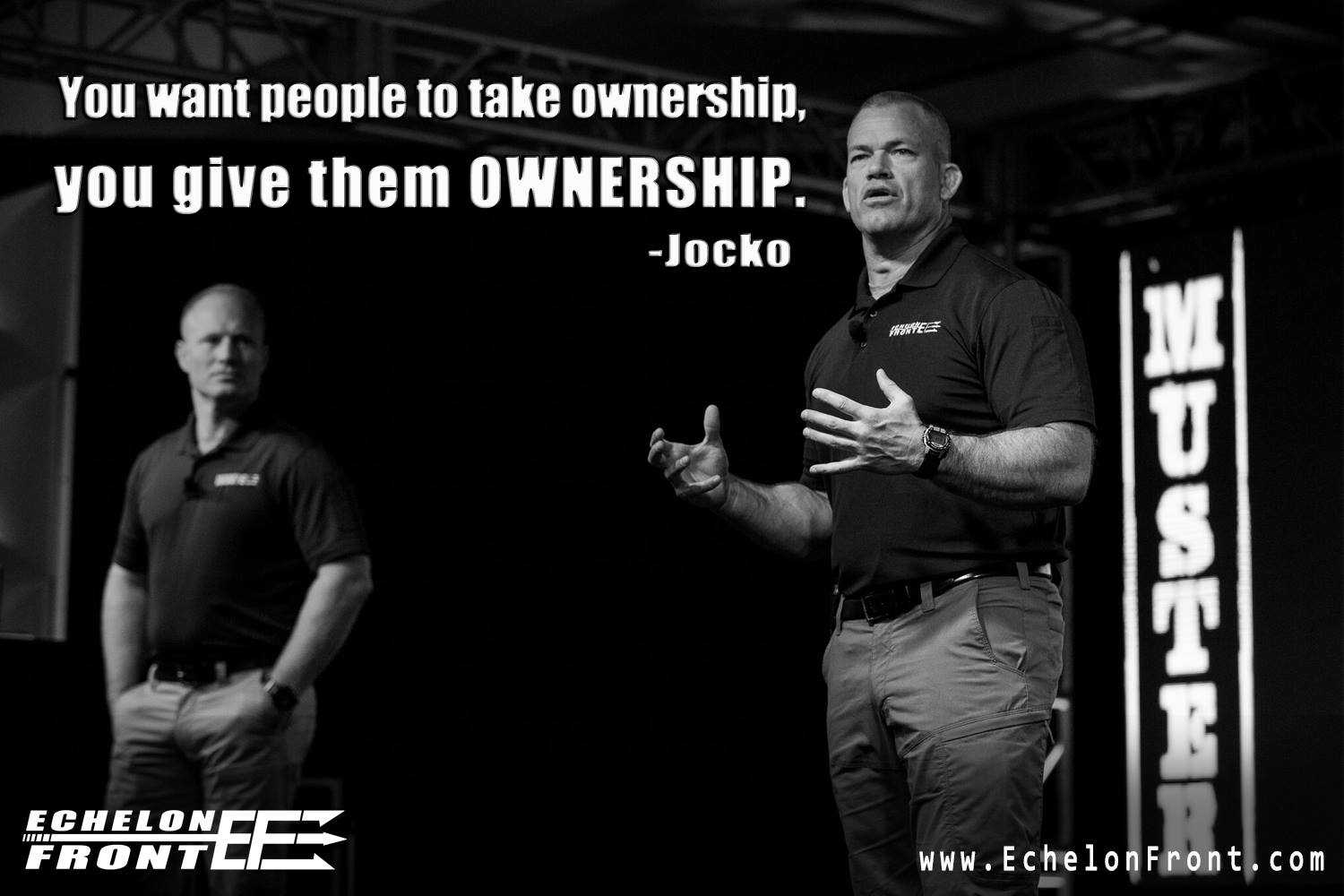
Photo Credit: Echelon Front, Facebook

When we see individuals in the military with some form of Special Forces training and experience, we are captivated and sorely aware of how different they are from most of us. That level of discipline, courage, expertise and physicality is uncommon. Nothing I ever imagined for myself. Still what can we learn from these leaders that we can apply to life and work?

Although the book Extreme Ownership was published in 2015, it was unknown to me until this weekend. Thanks to my Twitter feed and then reading some reviews, I ordered my own personal copy. The authors, and former Navy SEAL team commanders, Jocko Willink and Leif Babin are heroes and the stuff of legend.

[OK…I haven’t read the book yet…pre-ordered the latest edition coming out November 21, 2017. however, the reviews and summaries (listed in the links below) have already been so informative, I will gush away even before reading the book. So sink your teeth into these bits below until we have both read the book…or have you already read it?]

The phrase extreme ownership really tantalized because it spoke to my own leader heart. It resonates with servant leadership which is hard to fathom as a norm in military structure and authority. The idea of everyone on a team, in an organization, owning their part of a vision or operation is thrilling to me. It makes sense that this would, of course, lead to highest performance…provided…and this is imperative: the leadership, up and down the organization, is equipping each team member, communicating thoroughly, and sharing decision-making as appropriate.

Leadership coach Brian Dodd was the one who first guided me to the book Extreme Leadership through his blog: 25 Lessons on Extreme Ownership – How the U.S. Navy SEALS LEAD And WIN. Some of his points from the book are:

  1. “Without a team – a group of individuals working to accomplish a mission – there can be no leadership.  The only meaningful measure for a leader is whether the team succeeds or fails.”
  2. “For leaders, the humility to admit and own mistakes and develop a plan to overcome them is essential to success.  The best leaders are not driven by ego or personal agendas.  They are simply focused on the mission and how best to accomplish it.”
  3. “Leaders must own everything in their world.  There is no one else to blame.”
  4. “There are only two types of leaders: effective and ineffective.  Effective leaders that lead successful, high-performance teams exhibit Extreme Ownership.  Anything else is simply ineffective.  Anything else is bad leadership.”
  5. “Leadership isn’t one person leading a team.  It is a group of leaders working together, up and down the chain of command, to lead.”
  6. “Ego clouds and disrupts everything: the planning process, the ability to take good advice, and the ability to accept constructive criticism.  It can even stifle someone’s sense of self-preservation.  Often, the most difficult ego to deal with is your own.”
  7. “As a leader, it doesn’t matter how well you feel you have presented the information or communicated an order, plan, tactic, or strategy.  If your team doesn’t get it, you have not kept things simple and you have failed.  You must brief to ensure the lowest common denominator on the team understands.”
  8. “Human beings are generally not capable of managing more than six to ten people.”
  9. “Trust is not blindly given.  It must be built over time.  Situations will sometimes require that the boss walk away from a problem and let junior leaders solve it, even if the boss knows he might solve it more efficiently.”

Business leader Tom Niesen also lists his takeaways from the book, and they align nicely with the other summaries I read:

  1. Mission (Commander’s Intent and Effectiveness)
  2. It is on the leader! (Assuming a good “hire,” now, it is the leader).
  3. Extreme Ownership – everyone believes in the “why”, understands the “why”, and then pursues the “what”. Beginning with the leader. But, everyone “owns it all”.
  4. Get rid of the undermining, not-carrying-the-load, under-performer [this should be a rare necessity in extreme ownership but it can happen].
  5. Get very good at information sharing.
  6. Simplify! Keep it simple. (Not simplistic – simple).
  7. Communicate – thoroughly communicate. Up and down and all around. Confirm that the communication was sent and received and understood.
  8. Prioritize and execute. – [Tom Niesen’s summary of Extreme Ownership]

I hope these two summaries (and others in the links below) will whet your appetite to consider reading Willink’s and Babin’s book. Especially  consider taking steps toward extreme ownership in your business or organization.

Sometimes, we struggle in leadership to trust those around us to speak into decisions or even to carry out their assignments without us hovering. Worse is when we just don’t trust others and, as a result, take too much responsibility on ourselves or just a few trusted members of the team. I’ve learned through my life to take joy in the many…even with all its messiness.

I’m reminded of a proverb along these lines:

Without oxen a stable stays clean, but you need a strong ox for a large harvest.  Proverbs 14:4Photo Credit: Wikimedia Commons

If we want processes neat and tidy, we must hold tight to control and keep our trust to a very few colleagues. We lose so much in the process…holding onto control, trusting just our “tribe”, and excluding the input and energy of those outside the circled wagons.

Extreme ownership requires a great deal from leaders…a letting go; an allowing ownership to spread through to a greater mass of people toward a greater good.

We must operate with wisdom and excellence to fully equip our teams and then to give them the freedom to execute. Clear and full communication, up and down the command chain, greases the tracks for this kind of operation. Shouldering personal responsibility at all levels is also crucial, but the key is ultimately the executive leader takes full responsibility in the end…especially if something goes wrong.

I love this concept of extreme ownership. Who’s with me? Fortunately we can apply these principles without having to go through the grueling process of being a Navy SEAL. Thanks, Gentlemen, for your incredible service.Photo Credit: Wikimedia Commons

Extreme Ownership: How US Navy SEALS Lead and Win – Jocko Willink and Leif Babin

25 Lessons on Extreme Ownership – How the U.S. Navy SEALS LEAD And WIN – Brian Dodd

United States Navy SEAL Teams

Here are my 8 Lessons and Takeaways from Extreme Ownership by former Navy SEALs Jocko Willink and Leif Babin

Extreme Ownership – Leadership Lessons From the SEAL Team – Gerardo A. Dada

Extreme Leadership Training

YouTube Video – Extreme Ownership – Jocko Willink – TEDx University of Nevada

New Release (November 21, 2017) – Extreme Ownership: How US Navy SEALS Lead and Win – Jocko Willink and Leif Babin

Extreme Leadership – Leading Blog @LeadershipNow – Michael McKinney

Extreme Ownership by Jocko Willink – Book Summary & PDF – Paul Minors

15 Minute Business Books – First Friday Book Synopsis

Monday Morning Moment – Workplace Bullying

Photo Credit: Flickr

Just saying the word bullying prompts a memory and even a victim mentality. No one is immune from this experience, either being the target or the one targeting another. Bullying can sometimes beget bullying, but this doesn’t have to be the case. Understanding and intervening in damaging situations can turn the course of the experience for all involved.

Childhood bullying has been subject to much research and policy-setting in schools. What about when bullying happens between adults and in the workplace? What can be done there?

The Workplace Bullying Institute defines bullying as:

Workplace Bullying is repeated, health-harming mistreatment of one or more persons (the targets) by one or more perpetrators. It is abusive conduct that is :

The Workplace Bullying Institute Definition of Workplace Bullying

When bullying happens in the workplace, we want to call it something else…controlling, rudeness, or maybe incivility. If we call it bullying, we must acknowledge that we could be a victim, or worse, we stood by and watched it happen without intervening. Or even worse, we could be confronted with the possibility that we, because of our commanding personality or position, have become a bullying adult.

I don’t think I’ve ever bullied someone else…but it is possible. When we find ourselves in a changing culture, we can change as well. A wise friend once told me, “A toxic workplace can corrode everyone.” I have, for sure, experienced workplace bullying. Especially early in my career. It’s never pretty, and even thinking about it today causes me to cringe. One situation was very private; no one knew but the two of us. A nurse manager was threatened by my role as clinical specialist and nurse educator on her unit. I had to learn to deflect and avoid confrontations with her (not in a frightened cowardly way but in a “wise as serpents, gentle as doves” way).

Another situation was when a physician wrongly accused me of misjudgment in patient care. This time was very public and he was determined to have me fired. I was not at fault (in fact, one of his interns elected not to act on my assessment of the patient which caused harm to her). Fortunately for me, the nursing chain of command was in complete support of my actions, and his rampage against me was neutralized. Whew! Bullying is costly.

[Sidebar: I don’t mean to disparage either person. Neither was a villain. They just saw things differently and chose to deal with it by coming down on me. I wasn’t a victim after all…especially in the second situation, the patient was the one who suffered during that blame-shifting. Bullying cuts a much wider wake than we think.]

Let’s think about our workplaces. Have we given into a workplace that mimics today’s “modern” culture – technology over humanity, coolness over experience, short-term gains over long-term legacy. Bullying doesn’t necessarily come out of any of this, except that our rules of engagement can change. Within that can evolve a level of incivility that gives birth to bullying, if we are not vigilant in preventing it.

Why “Modern” Work Culture Makes People So Miserable – Jeffrey Pfeffer

Refusing to ignore bullying and calling it out when it happens are crucial. This can be risky. We have to decide if we can handle the potential negative outcomes. If we don’t wrestle with the problem,  it can become commonplace and the silence is deafening.

“Words denied mean analyses not offered, things not grasped, surprise not registered, strangeness not taken in, all of which means that terrible mistakes are repeated, wounding ways of acting in the world never seriously reconsidered. The words’ absence chains you to the present, to what’s accepted and acceptable.”Tom Engelhardt

Am I wrong here? Is our workplace immune to what our culture is going through? The US is divided right now over how we are handling some huge social issues- racism, poverty, immigration, and potential national threats from outside the US. The media is peppered with Americans calling foul on what is perceived as bullying – from our leaders as well as special interest groups.

What is our recourse? One popular action seems to be to bully back…to villainize…to essentially return blow for blow. Social media is slammed with “he said, she said” hateful rhetoric. I’m so thankful for those who take a path of peace and wisdom (like the news story recently of 5 young people in our city who struck a blow for genuine rather than symbolic change. Transformative change).

Maybe, bullying in the workplace is hard to change because we as adults should be able to fight our own battles, unlike children who need help when caught up in this destructive cycle. We want our children to feel safe and to learn effective ways to deal with confrontation and conflict. In the workplace, we also want to have an atmosphere of mutual respect, purposefulness, and trust.

While insulating ourselves from bullying is one approach to deal with it, hopefully we can consider a more proactive stance. Many schools these days have a “No Tolerance” bullying policy. The students didn’t come up with that. It was people in authority advocating for them – parents, teachers, the school board. What would a “No Tolerance” model look like where we work? Who would set that in place? How would it work?

As peers, we can confront bullying and intervene with each other. However, to change a whole culture, we need those with greater authority to advocate for such a work environment.

Something to think about…and consider.

Please check out the links below – excellent reading on this weighty topic. Also if you have experienced workplace bullying or if you’ve known success in curtailing bullying in your workplace, please share in Comments below.

Anti-Bullying Week: Of Weasels, Snakes, and Queen Bees [Don’t miss the short video – clarifying & tremendously useful]

Infographic – 7 Facts of How to Deal with a Bully at Work – Catherine Adenle

Who Is a Workplace Bully’s Target? – Sally Kane

The Top 5 Threat Assessment and Workplace Violence Prevention Trends in 2017 – Arnette Heintze

75% of Workers Are Affected By Bullying – Here’s What To Do About It – Christine Comaford

The Hidden Toll of Workplace Incivility – Christine Porath