Category Archives: Attitude

Monday Morning Moment – New Year’s Resolutions and Habit Formation…Resolved

Photo Credit: David Lose

[Adapted from the Archives]

What do we have? 1 more day in 2019 of reckless eating, not enough sleep, routines all turned topsy-turvy. Then…resolved. Right?

I take New Year’s resolutions very seriously. They have served me well through the years in shaking up troublesome habits as well as galvanizing better ones. New (or restored) habits that nurture the body AND the spirit.

Whether sugar detox or a decluttering project, New Year’s resolutions are not always exercises in futility.They can be excellent devices to help us get off to a strong start into the next year. Some of my family and friends treat resolutions with disdain…they never work; they never last. Oh, but not always!

They are really very energizing. Whether we meet our goals or not, there is great promise within the resolution for resetting our thinking. A keen sense of self, or self-awareness, aids in our understanding of habits and true habit change.

A couple of times in my life, I resolved to go off sugar. With a resolution like that, it meant abstaining from chocolate…which is a topic all its own.

Anyway, I was successful for over a year each of those times in excluding sugar from my diet. Never having really lost the weight from my first pregnancy, I decided to remove sugar from my diet for the pregnancy of our second-born. In those days, there was a chapter of Overeaters Anonymous in our town, and that group was a great help in my dealing with pretty much a sugar addiction.

The second time I “gave up” sugar was over 3 years ago, and I stayed the course of that habit change for over 1 1/2 years. Less accountability but even more resolve. Although I am back having dessert or sugary snacks sometimes, I am still operating with more self-awareness than ever before. Self-awareness, not self-condemnation. A very different experience.

Without knowing it, I was using a practice of habit change that Ken Sande writes about on his blog, Relational Wisdom 360. He first influenced my life years ago with his work on conflict resolution through his Peacemaker Ministries. He is a gentle guide in many of the issues that complicate our lives.

His article on Seven Principles of Habit Change came at a great time. Sande talks quite kindly about how we develop habits and what it takes to change them. His first principle of habit change gives us a look at the cycle of habits – the cue, the routine (or response), and the reward. Anyone who loves chocolate can understand this easily. For me, in eating sugar (or in overeating, in general), the cue could be a number of things – fatigue, anxiety, loneliness, the mere presence of yummy food. It never takes much to send me to the refrigerator or pantry. The routine: feed the cue, whatever it is…with high-carb oral gratification. The reward: a brief soul satisfaction and temporary relief from whatever was the cue.

In my two seasons of not eating added sugar, I actually followed Ken Sande’s principles below (without knowing the wisdom of it).

  1. Every habit has three parts: a cue, a routine, and a reward.
  2. You can change an undesirable habit by keeping the cue and reward but learning a new routine.
  3. The best way to overcome the temptation to revert to old routines is to have a detailed action plan.
  4. Habit change builds momentum if you can change a single “keystone habit” and then continue to build on consecutive “small wins”.
  5. Will power is like a muscle: it can be strengthened and yet needs to be exerted strategically.
  6. Faith is an essential part of changing habits.
  7. Habit change is more likely to occur within a community (even if it’s just two people).Ken Sande

[If any readers want to talk further about habit change regarding sugar addiction, I would love the exchange, either through the comments or email.]

Self-awareness is a huge factor relating to habit change. I can see that more now having come through seasons of looking at my own habits.

“Self-awareness is defined as conscious knowledge of oneself; it’s a stepping stone to reinventing oneself, learning to make wiser decisions, and helps you tune into your thoughts and feelings. So often we place blame on externalities because it’s the easiest excuse, when in fact we should be thinking about our thinking, reflecting, trying on different perspectives, and learning from our mistakes.”Paul Jun

It is possible to affect true habit change if we are willing to take a studied look at ourselves – our awareness and our engagement with making choices/decisions and within relationship. I used to think that self-awareness was morally charged, i.e., it drove us to becoming more self-centered. That doesn’t have to be the case. When we take time to really examine where our minds go, through the day, we can train our thinking toward what matters most to us – related to people, resources, and life purpose.

When we are willing to do that, New Year’s resolutions can become much more life-changing than just going off sugar for a few weeks. These same habit change principles can apply to anger issues, pornography, other addictions, and pretty much any habitual process that negatively affects your work, relationships or general peace of mind.

A couple of years back, our pastor Cliff challenged us at Movement Church to commit to some resolutions to the Lord…together [podcast of 12/31/2017 here].  I have kept the resolutions made that day in a visible place, to be reminded of the good change in life, and the struggle… I still have them in view…two years out. Still relevant to now. For 2020, on it again.

Jonathan Edwards, the great 18th century preacher and theologian, definitely understood the importance of praying through and writing out resolutions that would inform his daily life. Over the course of several months, he composed seventy resolutions for life. You can read them here. The five resolutions I made during church on a New Year’s Eve are weighty enough for me…can’t imagine 70! Edwards just gives an example of a man who, even as deeply devoted as he already was, did not want to miss God in a busy life of ministry. Nor did he want to miss the people God placed in his life as the focus of that ministry.

Resolutions help us to keep the main thing the main thing. Sure, we may struggle to keep our bodies and houses in order. Those are temporary situations. Where we hope most to be successful is in keeping our hearts tuned to what matters most. Going deep with God and others. I am resolved…

Photo Credit: Reformed Outfitters

New Year’s Day – Resolved – Deb Mills Writer

Resolved – The Resolutions of Jonathan Edwards

Do You Want to Change Your Habits? – Relational Wisdom – Ken Sande

Seven Principles of Habit Change – Relational Wisdom – Ken Sande

13 Questions to Increase Your Self-Awareness – The Mojo Company – Matt Monge

Make Habits, Not Resolutions – Justin Whitmel Earley

Why Self-Awareness Is the Secret Weapon for Habit Change – Paul Jun

RW Acrostics in Action – Relational Wisdom – Ken Sande

Ten Questions for a New Year – Don Whitney – Desiring God

Need Help With Your New Year’s Resolutions? – David Lose

Understanding True Habit Change and Rocking Your New Year’s Resolutions – Deb Mills Writer

Worship Wednesday – Advent – Is He Worthy? He Is – Andrew Peterson

[Adapted from the Archives]
We live in a “not so much”,  “couldn’t care less” world.
Our senses are bombarded with the material – the stuff we think adds value. The “too cool for school” attitude of self-importance pushes past high school into adulthood. We think highly of ourselves, and the coolest of us settle into tight tribes – actually cool or not, we find our people and tuck ourselves in.
Advent gives pause. Even for those who do not celebrate Christmas, the presence of a God-child, a baby like no other, must be grappled with…even for a transformative moment. For believers and non-believers alike, we can stop the show of our lives…and consider Jesus.
Who is he? What is there in him that must be, at least, examined?
Consider.
So much of Scripture is plain and clear in its teaching such that any of us could follow it and apply it to our lives. The last book of the Bible, Revelation, written by the Apostle John under the direction of the Holy Spirit…is not like any other text. It is full of the mystery of God and yet can yield great truth to the least theological of us. Read what John, in his last days on earth, wrote about Jesus:

“Then I saw in the right hand of the one seated on the throne a scroll with writing on both sides, sealed with seven seals. I also saw a mighty angel proclaiming with a loud voice, “Who is worthy to open the scroll and break its seals?” But no one in heaven or on earth or under the earth was able to open the scroll or even to look in it. I wept and wept because no one was found worthy to open the scroll or even to look in it. Then one of the elders said to me, “Do not weep. Look, the Lion from the tribe of Judah, the Root of David, has conquered so that he is able to open the scroll and its seven seals.

Photo Credit: The Henry Luke Journey

Then I saw one like a slaughtered lamb standing in the midst of the throne… He went and took the scroll out of the right hand of the one seated on the throne.

When he took the scroll…they sang a new song:

You are worthy to take the scroll
and to open its seals,
because you were slaughtered,
and you purchased people
for God by your blood
from every tribe and language
and people and nation.Revelation 5:1-9

The passage above from Revelation 5 is derived from a God-infused vision that John experienced and then transcribed for us to learn from it.  We don’t know for sure what the scroll represents – is it the purposes of God? Is it the finale of world history? Is it the judgment for the sins of all humankind? We don’t know for sure, but what we do know, is the scroll could not be opened…except by One worthy. Not just able to open it, but worthy to open it.

Jesus, the sinless Savior, was/is worthy. He is given many names in Scripture. The spotless Lamb of God is one. The perfect sacrifice. He alone could give His life for ours. He alone could pay our debt to a holy God. He, without sin, gave Himself in our place for us to be reconciled to God. Jesus is also called the Lion of Judah. One day He will come for us in the might and majesty of a conquering king – this lion of God, unmatched by any foe, wholly able to deliver us to the Father.

During the weeks of Advent this year, our praise team at Movement Church is leading us through this beautiful song, considering Jesus: Is He Worthy?

Singer/songwriter Andrew Peterson wrote this song for a congregation to participate responsively with the worship leaders. The reading or singing of this song is liturgical in form…something I’m not used to…but appreciate.

“One of the things I like best about liturgy is the more or less constant involvement of the congregation. The word “liturgy” means “the work of the people.” It’s not so much about us coming to sit while the pastor and the elders do everything, but about all of us together rehearsing the story of redemption, edifying each other by reading Scripture aloud, reaffirming what we believe, embodying worship by kneeling or singing together—all of it culminating, of course, in the Lord’s Supper. I can’t overstate how much I crave the moment at the end of the service when I kneel at the front and a friend of mine places the unleavened bread in my open hands, looks me in the eye and says, ‘Andrew, this is the body of Christ, broken for you.’

Every week my wayward, hungry soul is confronted by the love of Jesus. Like clockwork.” – Andrew Peterson

Photo Credit: GodTube, Andrew Peterson

Let’s worship together with this glorious anthem by Andrew Peterson.

[Verse 1]
Do you feel the world is broken? (We do)
Do you feel the shadows deepen? (We do)
But do you know that all the dark won’t stop the light from getting through? (We do)
Do you wish that you could see it all made new? (We do)

[Verse 2]
Is all creation groaning? (It is)
Is a new creation coming? (It is)
Is the glory of the Lord to be the light within our midst? (It is)
Is it good that we remind ourselves of this? (It is)

[Chorus]
Is anyone worthy? Is anyone whole?
Is anyone able to break the seal and open the scroll?
The Lion of Judah who conquered the grave
He is David’s root and the Lamb who died to ransom the slave

[Refrain 1]
Is He worthy? Is He worthy?
Of all blessing and honor and glory
Is He worthy of this?
He is

[Verse 3]
Does the Father truly love us? (He does)
Does the Spirit move among us? (He does)
And does Jesus, our Messiah hold forever those He loves? (He does)
Does our God intend to dwell again with us? (He does)

[Chorus]
Is anyone worthy? Is anyone whole?
Is anyone able to break the seal and open the scroll?
The Lion of Judah who conquered the grave
He is David’s root and the Lamb who died to ransom the slave

[Bridge]
From every people and tribe
Every nation and tongue
He has made us a kingdom and priests to God
To reign with the Son

[Refrain 2]
Is He worthy? Is He worthy?
Of all blessing and honor and glory
Is He worthy? Is He worthy?
Is He worthy of this?
He is!
Is He worthy? Is He worthy?
He is!
He is!*

[Sidebar: If you worshiped God with the help of this video, you saw a sea of white faces as the singers. Andrew Peterson wrote an apology worthy of your time. Let’s none of us falter from what he calls a misstep and miss the larger message of this beautiful song.]

Jesus…You are worthy.

“You are worthy to take the scroll
and to open its seals,
because you were slaughtered,
and you purchased people
for God by your blood
from every tribe and language
and people and nation.”Revelation 5:9Photo Credit: The Rabbit Room

*Lyrics to Is He Worthy? by Andrew Peterson

Story Behind the Song Is He Worthy? by Andrew Peterson – Kevin Davis

Waking Up to Is He Worthy?: an Apology – Andrew Peterson

Andrew Peterson’s New Song for the People – The Gospel Coalition – Andrew Peterson

Revelation 5 – The Lion, the Lamb, and the Scroll – Commentary – David Guzik

Monday Morning Moment – Emotional Intelligence at Work and in Life – a Story

blog-emotional-intelligence-ucreativePhoto Credit: UCreative

[I have written before on Emotional Intelligence here, here, and here. Below you’ll find the summaries from those pieces.]

You can probably remember an encounter with someone who was so engaging and interesting that you hoped you would meet them again, or work with them some more, or even become their friend.

Over the last few weeks, I had such an experience.

Background: Being a part of a beloved organization, engaged and working hard, we can get a passion to take it to the next level. We see both what we’re doing well and also what’s missing. For awhile, I’d been putting together an idea in my head of a particular next step. Even though it wasn’t a strength of mine to carry the ball on it, I saw such a need for it to happen that I floated it a couple of times to our leads.

It didn’t go anywhere…timing, not the right people in place…lots of variables.

Then, out of the blue, an announcement came down that we were going to run a pilot on that very idea. The woman leading the pilot was perfect for it. Enthusiastic, funny, bright, humble, and inclusive. Perfect.

I messaged her about how excited I was about the pilot and told her if I could be any help at all, just let me know.

Because of who she was (and maybe the timing…although I think it was just her), the project is humming along. Lots of others jumped in to help. I was so excited. Felt no need to push in but wanted to cheer-lead anyway possible.

Then she wrote me this brief message – surprising and lovely – full of emotional intelligence. She said at that time she didn’t need more folks on the project, BUT she commended me and expressed her gratitude for my support. Just a message. A few lines.

It was just what I needed and I didn’t even know I needed it.

Emotional intelligence (EI) is the ability to monitor one’s own and other people’s emotions, to discriminate between different emotions and label them appropriately, and to use emotional information to guide thinking and behavior.” 

__________________________________________________________________________

Emotional Intelligence and Success – Study Wizards  – rapid read with definition and characteristics of emotional intelligence.

__________________________________________________________________________

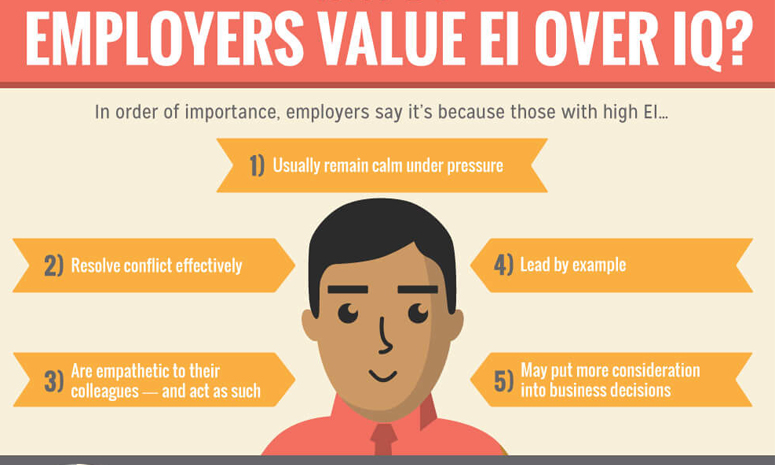
Remember this distinction: there are smart people and then there are emotionally intelligent people. If you don’t have a sense of the difference in these two, Paul Sohn posted an infographic (yay!) that gives an excellent description of emotional intelligence. There are a lot of smart people out there but what a joy when your boss, as smart as he may be, is also a great communicator with and appreciator of people.  [Go back and click on that infographic – very helpful!]

Emotional Intelligence is a concept that’s been around for awhile now.  Matt Monge’s article for The Mojo Company sparked my interest some time ago. He described 6 symptoms of leaders with low emotional intelligence.

Two of Monge’s points were: 1) Leaders with low emotional intelligence say “I’m sorry you feel that way” more than “I’m sorry,” and 2) Leaders with low emotional intelligence often blame the people they hurt for the situations leading to them being hurt.

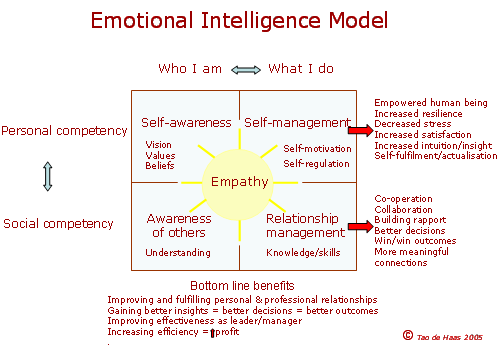
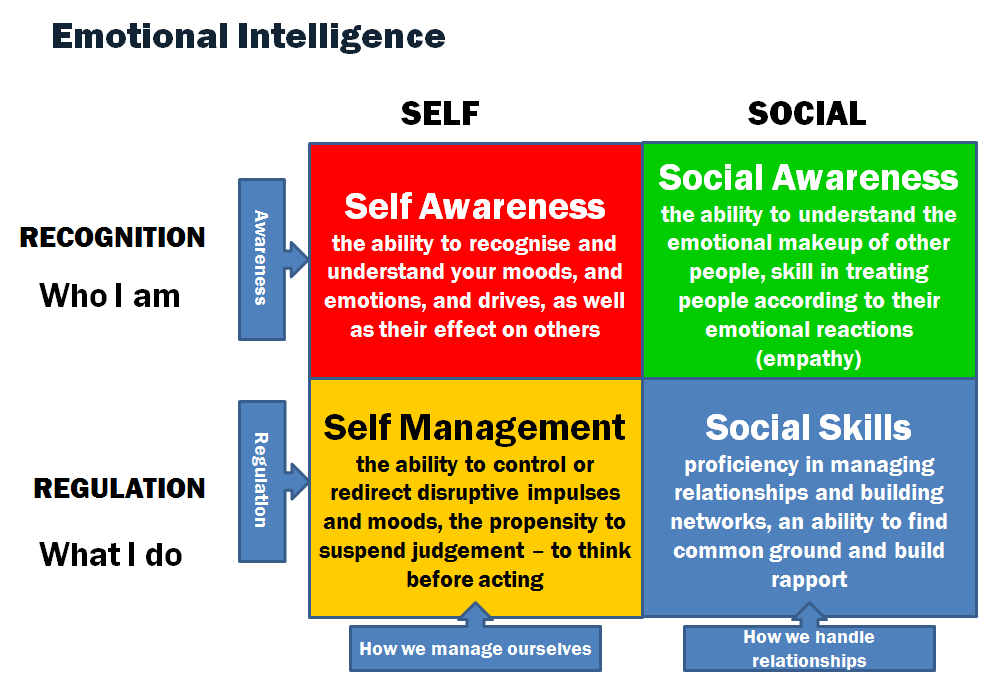
Daniel Goleman has written several books on this topic including Emotional Intelligence: Why It Can Matter More Than Intelligence and Social Intelligence: The New Science of Human Relationships. The very cool thing about emotional intelligence is that it can be developed. The big dilemma is whether bosses or even teammates, not bothered by their impact on others, would buy into this relational skillset. Incorporating such concepts in personnel accountability metrics might provide some incentive. I’ve added graphics below that helped me further understand emotional intelligence.

Blog - Friday Faves - Emotional Intelligence - grid - dollieslagerPhoto Credit: Dollie Slager

Blog - Friday Faves - Emotional Intelligence - low & highPhoto Credit: The King and Queen

___________________________________________________________________________

Even people with strong emotional intelligence can find themselves off-balance when in conflict with someone. Leadership writer Marcel Schwantes gives counsel for this in 7 Brilliant Things Emotionally Intelligent People Do When Their Buttons Are Pushed.Photo Credit: Wikimedia Commons

Schwantes encourages us to respond rather than react in a conflict situation. His seven action points follow (read more of his article for his commentary on each one).

  1. Get perspective.
  2. Take a 6-second pause.
  3. Stay humble.
  4. Try empathy.
  5. Ask the most conflict-diffusing question. [“Are you ok?” What’s going on?”….what else would you think would diffuse the situation?]
  6. Speak from your authentic self.
  7. Be the first to reach out after conflict.

Don’t miss the brief video at the end of Schwantes’ piece on 3 Simple Questions to Improve Your Emotional Intelligence.

Blog - Friday Faves - Leadership - Emotional IntelligencePhoto Credit: Self Study History 

I hope you’re surrounded by emotionally intelligent people. Maybe you’re an “EI” rockstar yourself. For me, that woman above, piloting the project, had my respect from the beginning, but because she responded to me in such an honoring, genuinely considerate way, she also has my complete support and more.

Do you have any emotional intelligence stories? Please comment below. We can always use  stories of great bosses and coworkers to inspire and spur us on.

___________________________________________________________________________

Try These Two Smart Techniques to Help You Master Your Emotions – Lisa Feldman Barrett

How Emotional Intelligence Boosts Your Endurance – Alex Hutchinson

___________________________________________________________________________

Bonus: Resources for Raising Our Children to Be Emotionally Intelligent

Research Shows Reading Improves Kids’ Emotional Intelligence and Increases Empathy – Katie Priske

This Is How to Raise Emotionally Intelligent Kids: 5 Secrets From Research – Eric Barker

Chores Lead to Happy Children. So Why Do So Few Parents Require Them? – Annie Holmquist – OK…this doesn’t really have to do with emotional intelligence but it fits in the mix of raising kids well.

Worship Wednesday – We Are Blessed to Be a Blessing – Andy Flannagan

Photo Credit: Heartlight

[Adapted from the Archives]

“And I will make of you a great nation, and I will bless you and make your name great, so that you will be a blessing.” – God to Abraham –  Genesis 12:2

We are so blessed. It is not a cliche. It is truth. Even those who don’t believe that God is will still use the expression of being blessed.

I wonder, “by whom?”.

Earlier this week I wrote about silence as punishment…withholding our words, ourselves, from others. Today we focus on the opposite – blessing others, through our words and actions. Reaching out, drawing in. Speaking life and love. Listening close. Blessing.

We are blessed to be a blessing. From the beginning of time, when God instructed His first man and woman. Especially to childless Abraham who would receive that promise in faith…blessed to be a blessing.

Writer Tina Boesch has written a beautiful book on blessing: Given: the Forgotten Meaning and Practice of Blessing. The first page of the book begins with a Scottish blessing:Life be in my speech, sense in what I say…the love Christ Jesus gave  filling me for every one.” Boesch writes about how, no matter the situation or the persons in front of us, we can bless them, because He has so utterly blessed us.

Whatever you do, in word or in deed, do everything in the name of the Lord Jesus, giving thanks to God the Father through Him.Colossians 3:17

From a young British friend’s Facebook page sometime ago, I was introduced to songwriter Andy Flannagan and Reverend Kevin Lewis. They both love Jesus and sing and write about blessing…

They cheer us on to shake off the weight of self-interest and reach out to a broken world…that those desperate for love will find it in the same Savior we know…and show by our love – our words and deeds – that He loves them, also.

Worship Wednesday – Spirit Pour Out – Andy and Rachel Graham

And when he [Jesus] drew near and saw the city, he wept over it.Luke 19:41

Jesus continued going around to all the towns and villages, teaching in their synagogues, preaching the good news of the kingdom, and healing every disease and every sickness.  When he saw the crowds, he felt compassion for them, because they were distressed and dejected, like sheep without a shepherd. – Matthew 9:35-36

Unless the Lord builds the house, those who build it labor in vain. Unless the Lord watches over the city, the watchman stays awake in vain. Psalm 127:1

Thus says the Lord of hosts, the God of Israel, to all the exiles whom I have sent into exile from Jerusalem to Babylon: “Build houses and live in them; plant gardens and eat their produce…But seek the welfare of the city where I have sent you into exile, and pray to the Lord on its behalf, for in its welfare you will find your welfare. – Jeremiah 29:4-5, 7

The shining city we call home is Richmond, Virginia. It is a beautiful, gleaming mix of old and new.  A river runs east-west through it, and interstate highways divide it north-south. The divide goes much deeper than the highways cut through neighborhoods decades ago, but these transportation portals speak to that divide.

After the Civil War (during which Richmond was the capital of the Confederate States of America), the African-American community began to thrive here. In fact, Jackson Ward, a Richmond neighborhood still today, was once known as “Black Wall Street” and “the Harlem of the South”. Beautiful homes, large churches, successful businesses, and popular entertainment venues were all part of this thriving neighborhood.

Then “progress” happened. City and state officials determined the design of what is now our vast interstate system. This all-white group of officials made the decision of what would best serve the city and beyond. The highways would be laid down right through Jackson Ward. 1000 homes were lost through the city’s powers of eminent domain.

Roads to Nowhere: How Infrastructure Built Built on American Inequality – Johnny Miller

Recently I saw a TV show, All Rise, that featured an anquished young man, wrongly accused of a felony. While awaiting the jury’s verdict, his public defender sat with him. She asked about why he was studying urban planning. This was the powerful scene that speaks to what happened in our city and others:

“Every shining city is built on something pretty dark.”

The above statement from the scene isn’t always true (especially when I think of Heaven), BUT. God, in His Word, demonstrated both understanding of and love for cities.

The peoples of cities. Peoples like us, and others not like us but loved. Exquisitely, generously loved by God. We are meant to love as He loves. We are blessed to be a blessing to all peoples.

Not just transactional charity…where we give of our goods but not ourselves. Jesus did feed the thousands (transactional) but He also gave all of Himself to all people (transformational). He left that example for us…that transformational model of loving people.

Seek Your City’s Good – John Piper

This past Sunday, our worship team at Movement Church, led us in a song new to me. Spirit Pour Out. It was written by Andy and Rachel Graham out of a worship experience with Urban Doxology, a ministry based in Richmond. Members of Urban Doxology live, work, worship, and serve in the racially diverse (and divided) neighborhoods of Richmond. They bring a message and vision for reconciliation – with God and each other. See the Ted Talk about Urban Doxology here. The YouTube video below shows footage of our city, Richmond, Virginia. It is a call to prayer for cities – for ours and for all cities.

Worship with me.

Spirit pour out and flood this city
Heaven come down and shake the walls
Fill us Lord the world is waiting
Father let your kingdom come

Come restore generations of desolation
Bind up the poor and broken heart
Plant and sow, till and grow what time has ravaged
Break down the walls of race and war

Spirit pour out and flood this city
Heaven come down and shake the walls
Fill us Lord the world is waiting
Father let your kingdom come

God we seek the peace and welfare of our city
Prosper redeem her as your own
That all would see your glory here in greater measure
Through us your church your kingdom come

Spirit pour out and flood this city
Heaven come down and shake the walls
Fill us Lord the world is waiting
Father let your kingdom come

You are the God who builds
You are the one who saves
You are the God who prospers
Evil has no claim
You are the God builds
You are the one who saves
You are the God who prospers
Fervently we pray*

Peter says that Christians are “sojourners and exiles” (1 Peter 2:11) and Paul says “our citizenship is in heaven” (Philippians 3:20). In fact, we will do most good for this world by keeping a steadfast freedom from its beguiling attractions. We will serve our city best by getting our values from “the city that is to come” (Hebrews 13:14). We will do our city most good by calling as many of its citizens as we can to be citizens of “the Jerusalem above” (Galatians 4:26).

So, let’s live — let’s do so much good (1 Peter 2:12) — that the natives will want to meet our King. – John Piper

*Lyrics to Spirit Pour Out – Songwriters: Andy & Rachel Graham

YouTube Video – Spirit Pour Out – Urban Doxology

Monday Morning Moment – What Stirs Motivation, Initiative, and Innovation – What Kills It

Photo Credit: Flickr

We all have the capability of motivating those around us…or demotivating them. We can stir initiative or slow it down. We can grease the tracks for innovation or derail it.

How are motivation, initiative, and innovation defined? Considering the definitions will help us remember how crucial they are to forward progress – in serving others, in product development, and in employee (or volunteer) engagement.

MotivationInternal and external factors that stimulate desire and energy in people to be continually interested and committed to a job, role or subject, or to make an effort to attain a goal. Motivation results from the interaction of both conscious and unconscious factors such as the (1) intensity of desire or need, (2) incentive or reward value of the goal, and (3) expectations of the individual and of his or her peers. These factors are the reasons one has for behaving a certain way.

InitiativeAn individual’s action that begins a process, often done without direct managerial influence. For example, an employee might take the initiative to come up with a new product or service that the company could offer…Demonstrat(ing) initiative by sharing their ideas, helping to improve our business, speaking up about problems, and suggesting potential solutions.

InnovationThe process of translating an idea or invention into a good or service that creates value or for which customers will pay. To be called an innovation, an idea must be replicable at an economical cost and must satisfy a specific need. Innovation involves deliberate application of information, imagination and initiative in deriving greater or different values from resources, and includes all processes by which new ideas are generated and converted into useful products. In business, innovation often results when ideas are applied by the company in order to further satisfy the needs and expectations of the customers.

We can celebrate situations where we experience daily motivation and have the freedom and support to run with our initiative and participate in innovation. It’s in other situations that we need internal and external encouragement to press on, even without the help or support of our managers, leaders, bosses.

Dealing with bottlenecks, micro-managing, and continually reiterating leaders or bosses can tempt us to disengage and slow down in our own work…even in areas where our passion and commitment are high.

“One of the signals that managers might need more training is when their engineers aren’t taking initiative.”Jean Hsu, Why Aren’t My Engineers Taking Initiative?

“We agree completely that micromanagement is a big mistake. It diminishes people’s self-confidence, saps their initiative, and stifles their ability to think for themselves. It’s also a recipe for screwing things up—micromanagers rarely know as much about what needs to be done as the people they’re harassing, the ones who actually do it.” – Larry Bossidy and Ram Charan

Photo Credit: Flickr

This piece today is really not to vent about those in authority over us who make our work or volunteering difficult (and sometimes joyless). Listed below (in the links) are several lists on particulars that stifle or kill motivation, initiative, and innovation. Especially if you are a manager or boss, these would be important to consider.

We may need to process a bit about our struggle to get a project finished or an idea embraced. This particular blog came out of such a frustration. Still, what I hope is to take the power to spoil out of the hands of our bosses (most probably that is not their primary intention) and to empower ourselves to push on in ways we can. Without being divisive or insubordinate. Empathy is one of the tools we can use.Photo Credit: Brian Solis, Flickr

Empathy is defined as “the feeling that you understand and share another person’s experiences and emotions: the ability to share someone else’s feelings”.

The Truth About Why Empathy is a Required Skill in the Workplace

Empathy probably seems a bit counter-intuitive when you’re feeling blocked by a controlling boss. Think about it. Once you think through her reasoning on slowing down a process, you can then give support to your ideas with language that speaks to her concerns.  For example, a micromanager may have several critical and costly projects going at the same time and could be afraid himself of dropping the ball on some, so he slows everything down and reins in decision-making. It can make a work team nuts, but if you determine to understand something of his position, you can stay in the conversation rather than just bolting.

Hating on your boss will only cloud the relationship from both sides. Then there’s the ripple effect to other relationships. None of us really want that. See link below…wisdom.

Workplace Wisdom – Dave’s Observation on Work (and Other) Relationships – What You Think of Others Matters – Deb Mills

You can help here, respectfully, by thinking through other ways to get to the solution of the problem or impasse. Empathy is a discipline that keeps conversations positive and inclusive of all those needed to make the decision on a new direction.Photo Credit: Career Contessa

Empathy at Work – Why It (Really) Matters – Jacqueline McElhone

Besides empathy, I have also discovered a different path. Maybe like you, I am one of those persons who generates ideas like other people generate the responses “we tried that” or “that’s good, but”. Creatives aren’t always well-received in the decision-making hierarchy. In recent years, I went through a season of de-motivation and diminished initiative. Life is too short to spend long in that mindset.

I finally shook off the troubled slumber of that season, in three ways:

  • Making the decision to continue working with the same organization, but
  • Looking for other avenues (non-profits, start-ups) to express the energy and passion of these ideas which I believed would make a difference.
  • Playing with and developing these ideas in an environment of inclusion and all-voices-wanted-at-the-table.

It wasn’t long that my confidence and sense of how to work smarter helped me to re-engage my workspace, with empathy. The bottlenecks may still be there, the control may still be weighted, but I am the one who changed. More ready for the battles and taking them less personally.

You matter. Your ideas, your solutions to problems, your presence at the table.

Thoughts? Would love to hear them (in Comments).

Photo Credit: Needpix

What Kills Motivation at Work – Justin Reynolds

7 Ways Toxic Managers Stifle Employee Motivation and Productivity – Kristin Marquet

7 Ways Micromanagement Stifles Creativity – Wayne Hastings

Nine Rules for Stifling Innovation – Rosabeth Moss Kanter

10 Ways Weak Managers Stifle Innovation – Liz Ryan

10 Things Companies Do That Kill Employee Motivation – Paul Petrone

Why Aren’t My Engineers Taking Initiative? – Jean Hsu

Monday Morning Moment – Micro-actions and Micro-behaviors – a Conspiracy of Small

Photo Credit: Edmund Burke, Pinterest

Micro-actions aren’t not the myriad of tasks that appear on our daily to-do lists. I’m defining micro-actions as all those brief, intentional acts we do that help us “get to goal”, “avoid mission drift”, or communicate value to those around us. Micro-actions can show up on in our daily habits (like my making the bed every morning, or Dave daily bringing me coffee). More often than not, they are  spontaneous – fitting the situation or need of the moment.Photo Credit: Slideshare, Mathew Sweezey

Micro-actions can include acknowledging the creativity/good sense of a teammate, writing thank you notes, taking a parking place farther from the building, making the difficult phone call (regarding a death or serious illness), stopping by the desks of coworkers just to say hi, sharing the praise for a project well-done, ordering a pizza for a young family.

Small, positive actions…that could have gone undone and unnoticed if undone…but the impact!! The impact can be substantial for a teammate, family member, or neighbor.

Take these wise words from Small Kindnesses by Danusha Laméris:

I’ve been thinking about the way, when you walk
down a crowded aisle, people pull in their legs
to let you by. Or how strangers still say “bless you”
when someone sneezes, a leftover
from the Bubonic plague. “Don’t die,” we are saying.
And sometimes, when you spill lemons
from your grocery bag, someone else will help you
pick them up. Mostly, we don’t want to harm each other.
We want to be handed our cup of coffee hot,
and to say thank you to the person handing it. To smile
at them and for them to smile back. For the waitress
to call us honey when she sets down the bowl of clam chowder, and for the driver in the red pick-up truck to let us pass. We have so little of each other, now. So far
from tribe and fire. Only these brief moments of exchange.
What if they are the true dwelling of the holy, these
fleeting temples we make together when we say, “Here,
have my seat,” “Go ahead—you first,” “I like your hat.” – Danusha Laméris

What micro-actions do you incorporate in your day, regularly or occasionally? Please comment below. Also we would love to hear your stories of a “micro-action” someone did with you in mind.

Micro-behaviors go deeper than micro-actions. They are defined as  tiny, often unconscious gestures, facial expressions, postures, words and tone of voice which can influence how included (or not included) the people around us feel.  Micro-behaviors become habitual and unconscious. They expose how we think and reveal our current worldview…our preferences, our prejudices, our bias. Our micro-behaviors send messages to others without us even being aware. A look (or look away), a tone of voice, a move toward inclusion or exclusion.

When our micro-behaviors (or those we observe in others) are positive, they are a not-so-subliminal uplifting experience – communicating affirmation, belonging, care. It’s when they are negative that we need to check them (when we become aware) and decide is that really what we want to communicate. Is that really who we have become toward certain segments of people?

Our American culture has shifted away from civility and community and more toward sarcasm and tribalism. [See Alan Weiss‘ piece on Tribalism vs. Community] These changes show up in our micro-behaviors.

Author, educator Karen Swallow Prior, in her book Booked, writes about satire in a way that reflects our culture’s bent toward sarcasm:

“[Jonathan] Swift helped turn my contempt for the foolishness I saw in others into compassion. While contempt leads to the case of isolation, compassion leads to a freedom found only in community…It was so easy to see [foolishness] in others, much harder to recognize it in myself. “Satire is a sort of glass,” Swift said, “wherein beholders do generally discover everybody’s face but their own.” Did I love satire only because in it I saw everyone else but me? Was I as blind to my own faults as Swift showed others to be? It seemed so.” – Karen Swallow Prior

Photo Credit: Facebook, William Curtis

Micro-actions and micro-behaviors…something to consider on a Monday. How can I take a few minutes here and there through the day to encourage or empower a colleague…or stranger, even? What am I communicating when keeping eye contact during a conversation and showing genuine interest in the other person? On the converse, what does my face fixed on my phone or computer screen, or my head down, shooting through the lobby toward my office, say to those we might have greeted but didn’t…discounting them by our behavior?

Thoughts?

How Can You Spot Really Good Leaders? They Practice These Simple 2-Minute Habits DailyMarcel Schwantes

Be a Pal, My Dudes – Erika Hall

#MicroActions on Twitter

#Microbehaviors on Twitter

Hack the Culture with Micro Changes – Marcella Bremer

Micro-actions, Fragmentation, and Influence – Peter Roy – Asian Efficiency Team

What Are Micro-behaviours and How Do They Impact Inclusive Cultures? The Little Things That Make a Big Difference – Caroline Arnold

Micro-Behaviours – What They Are and How They Impact Inclusion – Jan Hills

How Micro-Actions Can Help You Conquer Your Goals – Megan Nye

The Top 6 Micro-Actions for Entrepreneurs

5 Friday Faves – Pink Panther on Guitar, Avoiding Dehumanization, the Power of Words and Names, After School Restraint Collapse, and Using a Timer for Work

Welcome to your weekend…unless it’s not. Here are my favorite finds for this week. A couple are longer than others. Pick and choose. Hope it’s helpful.

1) Pink Panther on Guitar – In 1963, The Pink Panther comedy film debuted starring David Niven and Peter Sellers. So popular, it launched a cartoon series, followed by several sequels and a 2-film reboot in the 2000s starring Steve Martin.

YouTube Video – 15 Life Lessons from Peter Sellers – Classical Pink Panther Moments and More

The jazzy theme for Pink Panther was written by American composer Henry Mancini.

Nathan Mills, at Beyond the Guitar, has masterfully arranged and performed the theme. It brings back waves of nostalgia from those films/cartoons. All through my younger years, the Mancini theme was part of high school band performances and jazz dance concerts.

This piece is something altogether different and yet delightfully familiar, at the same time. Enjoy.

Here you go:

2) Avoiding Dehumanization – For some time, the verbal bashing of people in the news and on our own social media has been unsettling for me. Character defamation, name calling, shaming, and blame-shifting are escalating and inflaming.

When we find someone’s speech or behavior inhumane or dehumanizing, how does it help the situation if we call them out by behaving similarly? Does that not put us in a similar camp with the one we consider offensive?

Author, researcher Brené Brown speaks to this much more articulately than I:

“Here’s what I believe:
1. If you are offended or hurt when you hear Hillary Clinton or Maxine Waters called b**ch, wh**e, or the c-word, you should be equally offended and hurt when you hear those same words used to describe Ivanka Trump, Kellyanne Conway, or Theresa May.
3. If you felt belittled when Hillary Clinton called Trump supporters “a basket of deplorables” then you should have felt equally concerned when Eric Trump said “Democrats aren’t even human.”
3. When the president of the United States calls women dogs or talks about grabbing p*ssy, we should get chills down our spine and resistance flowing through our veins. When people call the president of the United States a pig, we should reject that language regardless of our politics and demand discourse that doesn’t make people subhuman.
4. When we hear people referred to as animals or aliens, we should immediately wonder, “Is this an attempt to reduce someone’s humanity so we can get away with hurting them or denying them basic human rights?”
5. If you’re offended by a meme of Trump Photoshopped to look like Hitler, then you shouldn’t have Obama Photoshopped to look like the Joker on your Facebook feed.

There is a line. It’s etched from dignity. And raging, fearful people from the right and left are crossing it at unprecedented rates every single day. We must never tolerate dehumanization—the primary instrument of violence that has been used in every genocide recorded throughout history.”  Brené Brown, Braving the Wilderness: The Quest for True Belonging and the Courage to Stand Alone

How to Handle Political Bullying on Facebook – Sherri Gordon

We need to call ourselves to the same standard we expect in others… I sure don’t mean this to sound preachy. Many times, in various situations, I’ve wanted to call out someone’s words as being hurtful or disingenuous or their behavior as deceitful or self-serving. We want to do something!! Words are the cheapest action we can take. Does it change anything to verbally criticize someone on social media? I don’t think so.

Psychologist and author Dr. Henry Cloud, in his excellent book Necessary Endings, counsels us how to deal with three different types of people – the wise, the foolish, and the evil.

  • Wise people – Dr. Cloud points out that wise people can take feedback and use it in a helpful way. In dealing with wise people, talk to them (not about them).  Put the truth out there in non-judgmental ways. Because they can handle feedback and will most probably use it to make changes, the way to deal with people in this category is to keep talking. Bring your concerns to the table and thoughtful and respectful ways. Communicate your own willingness to work for change, by actually working for change. No blaming, nor rationalizing behavior (yours or theirs)…staying in “good faith” relationships can actually invigorate the process of changes.
  • Foolish people – “The fool tries to adjust the truth so he does not have to adjust to it.” Again, talking about the person rather than with her doesn’t change anything, and, in fact, can inflame the situation if done publicly and she hears of it.Dr. Cloud advises, when dealing with the foolish:  stop talking. Nagging will not improve a situation with a foolish person. Rather, set limits and, if possible, create some sort of consequence for the problem you wish you could talk to her about. Limits gave you some space and protection. That consequence alone may drive the person to look at their behavior and change it… At least, it takes the responsibility for change off of you and on to her.
  • Evil people – If the person you want to castigate on social media (or whom you want to believe news reports on her behavior) has shown herself to be evil, then don’t expect change. It can happen, but not by your behavior reflecting hers. As Dr. Cloud talks about putting limits up for yourself with foolish people, you put limits on the evil person when at all possible. He quotes the Warren Zevon song, “Lawyers, Guns and Money“. Maybe somewhat facetiously but also seriously, Cloud is warning to use what resources you have (within the law) to put distance between the evil person and you (and those you love). Antagonizing them in the news/on social media helps no one…and it dehumanizes everyone in its wake. [Guns have become a difficult and divisive subject. Guns is used here in the context of wars against evil or protecting oneself or one’s family against evil.]

Necessary Endings – Summary by Rex Williams for Actionable Books

3) The Power of Words and Names – Just as name-calling (see above) only dehumanizes us, we can use words and names as agents for giving life and honor. They can actually elevate a person, people, or situation. They can move people toward their best selves.

Words mean things.

Author, educator Karen Swallow Prior has written a fascinating book on how her voracious reading of books from childhood onward strongly and positively impacted her. To become the person she is today. The book is entitled Booked – as it should be.

Dr. Prior makes note of the power of words and names in her Booked chapter on E. B. White’s Charlotte’s Web. In the story, a spider, Charlotte, gives her pig friend Wilbur a different understanding of who he is by the descriptors of him that she wove into her web. Powerful.

Charlotte’s Web is a metaphor for the power words have to shape us into who others see us as well as how we see ourselves.” – KS Prior

“Names are powerful words…All words are names, for all words signify something. The power of naming is a subset of the power of all language. God spoke the universe into existence and, in giving us the gift of language, He gave us a lesser, but still magnificent, creative power in the ability to name: the power to communicate, to make order out of chaos, to tell stories, and to shape our own lives and the lives of others.” –  KS Prior

I love the power of words and parallel power in names. When we lived in North Africa, names and their meanings told us about who belonged to who and what they valued in the giving of names.

How we use words and how we choose names are part of what we give to the world…and to those we love.

4) After School Restraint Collapse – When our children would come in from school grumpy and disrespectful, I would feed them. Then we always had a bit of a break before any homework or other expectation was foisted on them. Little did I know that these are prescribed interventions for something called After School Restraint Collapse.

At the first of the school year, children (and young people) are adapting to new teachers, new routines and rhythms, new expectations. They are trying to cope with all the new and keep their names “on green” or off the teacher’s watch list. By the end of the school day, they are emotionally and physically done, so to speak. Thus, the disagreeable behavior on transferring from school to home. It’s like they need to blow off steam, or get out all the pent-up energy, trying to stay well-behaved all day.

Photo Credit: Need Pix

Besides nourishment and a bit of a break, all the authors recommend that personal touch with their parents. Connecting through the day (notes in a lunch box or a book) helps. Having a no-expectations quiet affirming moment (in whatever way the child prefers receiving it) is also encouraged.

Screens only as a last resort.

After-School Restraint Collapse Is a Real Thing – Here’s How to Deal With It – Colleen Seto

After-School Restraint Collapse is Real – Here’s How to Help Your Child – Heather Marcoux

7 Ways to Help Your Child Handle “After School Restraint Collapse” – Andrea Loewen Nair

5) Using a Timer for Work – When it comes to writing, I could sit at my desk for hours on end. Sometimes, in fact, I do. However, other responsibilities clamber for attention. Using the alarm clock function has become a daily habit for me not to get lost in what is right in front of me. Just recently using a timer as well has become a great discipline. For larger tasks, I may set the timer for 30-45 minutes. For smaller tasks, and just to stay on track, I set 10 minute intervals. Before starting back up, a stretch break or checking on a teammate or a quick food or drink refreshment are all welcome.Photo Credit: MaxPixel

Sometimes, the timer works as a stop point, to move on to a meeting or another work function.  Time fairly flies anyway, so a timer has given me a sense of both urgency and intentionality. It has also helped me be aware of when I’m wasting time or it’s being wasted by someone else (of course, that bears some gentleness in dealing with either situation). Photo Credit: Facebook, Jason Morehead

A timer has helped not just with writing and other work day responsibilities but also with cleaning house. It has added a sense of reward seeing how much can be done in short spurts of time.

Clean House Fast and Efficiently Using a Timer – Ashley

___________________________________________________________________________

Thanks for reading. I hope you were able to pick and choose. A lot of words this week. Blessings on the rest of your weekend!

Bonuses:

The Why Behind the Picture – Dani Fairbairn

Rory Feek – This Life I Live – Documentary

Why Slack Employees Don’t Get Distracted by Slack – Damon Brown

12 Idols We Might Wrongly Follow – Chuck Lawless

Many Beautiful Things – a Documentary on the Life of Lilias Trotter, starring Michelle Dockery

Change the World RVA

Photo Credit: Facebook, Jeanne Barney

Monday Morning Moment – The Great Good of Doing a Favor and Some Rules for Asking a Favor

Photo Credit: All Hands

We all need a favor from time to time. Every occasion Dave helps a friend move, he says, “That’s the last time”. Then there’s the next time.

There’s great good in doing a favor because it expresses care… sometimes great care. Of course, favors can be done for selfish reasons. Business writer and professor Adam Grant has written a book on three styles of behavior that speak to this. These styles are givers, takers, and matchers. There are those of us who do favors for the joy of helping others (givers), those who more often ask for favors (takers), and finally those who will do a favor for someone who’s done one for her already (matchers).

“Every time we interact with another person at work, we have a choice to make: do we try to claim as much value as we can, or contribute value without worrying about what we receive in return?”Adam Grant

I recently attended a conference. It was a poignant experience because the organizer of the conference is moving toward a secession plan for her role. This is a brilliant, generous, like-no-other professional I’m just grateful to know.

The conference ended and I was helping with the final tying up of loose ends. She and I passed in the hallway, and I took the opportunity to tell her how much she had influenced my life’s work. Then I laid out a proposition:

“If I can do anything at all for you, just ask. it would be an honor.”

“Well…there is something.”

Then she asked me for a favor that was totally out of my expertise and comfort zone. A favor that I knew would take hours, even days, to complete. A favor that I was sure someone else should be doing – fearful to be a disappointment to her.

Still…I had made the proposal and she accepted.

Without going into too many details, let me just say I have been up to my eyeballs in Excel spreadsheets. They are no longer outside my expertise…thanks to online tutorials…and all this experience I have now.

So the short of it is that by tomorrow, I will be finished with my favor. Next time I’m feeling an overwhelming sense of gratitude for her, it may stop short of offering such an open-ended favor. I’ll find a different way to express how much she means to me. Flowers, maybe.

My husband told me several times that I needed to renegotiate that favor. He knew it wasn’t a strength of mine to do what she asked.

I just couldn’t take my offer back. She is the kind of person who should have favors done for her every day…she’s just that person.

In preparing to write about doing favors, I did come across two fascinating articles on this topic.

Asking for a Favor: The Three Keys – Jodi Glickman

In brief, the three keys for asking a favor are:

  1. Set the Stage: “I have a favor to ask you”.
  2. Give a Reason.
  3. Provide an Escape Clause.

[Read the whole piece. It’s a fast read and insightful for those who ask for favors – I don’t so much, but it was good stuff to know.]

The Five Golden Rules of Favor Asking – Tynan

Tynan offers these golden rules when asking him for a favor:

  1. Your benefit must greatly outweigh my inconvenience.
  2. You should make it as easy as possible for me to do the favor.
  3. Ask immediately. Don’t small talk.
  4. Do everything you can first.
  5.  Reciprocate.

[This piece also is an excellent larger read.]

These rules are all super nice and would be much appreciated if someone asks us for a favor. I find though that if someone asks for a favor, they often are pretty desperate for help and may not have asked with the finesse Tynan would like observed. Unless they are Adam Grant’s takers.

This favor, this Excel spreadsheet favor, was not solicited, except from my prompting. I gave this amazing woman the gift of asking for whatever I could do for her. Genie-like. She took me at my word.

Now that the time has been carved out, and a new skill has been honed, I’m thankful it worked out.

Doing favors for people isn’t a regular activity of mine, but it is something to aspire to. It is a great good.

We have had so many favors done for us. Two of the many that come to mind are a lawn mowed during a time we struggled caring for a our hospitalized little girl (thanks always J.R.) and the company offered to Dave in a surgery waiting room (thanks, Harriet).

It might be a helpful activity to write down all the favors done for us, or for others that we know about. Such a beautiful thing a kindness with nothing expected in return.

If you have some data demanding an Excel spreadsheet…and you need some help…maybe just wait a few days, ok? Same with moving.

[Any stories of doing or asking for a favor? Please tell us in the Comments below.]

Monday Morning Moment – Leaders We Want to Imitate – 10 “I” Adjective Descriptors (All)Iterated

Photo Credit: Boom Positive

From the time we were small children, we learn by imitating. We master both our mindsets and our capacities and competencies by learning from others…by imitating those we see doing well or doing good. We imitate until it becomes our own, and then amazingly sometimes others imitate us as well.

That is both sobering and challenging for us as leaders. It also gives pause in our choice of whom we imitate. We may sometime have to go out of our way to find excellent leaders to learn from. It does not take away necessity of following the direction of our bosses. We become like those we spend time with. The warning here is if we struggle with appreciating our leaders we may still default to become like them.

So we keep people in our lives worthy of imitating.

[I wanted to write about a much heavier topic this morning as our country is reeling from two mass shootings this weekend leaving at least 30 dead. So utterly devastating. I hope to write on this another day but today the words fail. Please, if you pray, pray for our country and especially for those grieving the loss of their loved ones.]

What characterizes a person we would profit by imitating? In a 12-minute teaching, author theologian John Piper emphasizes the importance of both the passion and the practice of the one we would seek to imitate. Both “the feeling and the living” for the sake of others rather than one’s own ambition.

Photo Credit: Desiring God; John Piper

I’ve said before that I love the grammar device of alliteration, and in writing today, it was easy to pull 10 distinctives together all beginning with “i” to describe a leader to imitate:

1) Inclusive – This leader would open the circle of leadership to include content experts, team leaders/coaches, and a sampling of those most affected by decisions being made. She/he is not threatened by a wider circle of influence.

2) Intelligent – I do not know how intelligent I am but have benefited from the thinking of others. Intelligence includes good judgment and sound reasoning.

3) Interested – You have probably experienced the difference when one is feigning interest vs. one who is genuinely interested in the person(s) right in front of him. She/he genuinely cares what others think and how they are affected by the direction of the organization.

4) Impassioned – It is easy to get behind someone who loves what they are doing and care about the outcomes (and their impact on people). When the cause is right or just, we can understand how the impassioned one is unflagging in his commitment. Adding the “i’s” above to “impassioned” moves folks forward in positive ways.

5) Involved – By involved, I don’t mean a micro-manager nor the opposite of an armchair quarterback . Involved is taking responsibility for the part that belongs to the leader and doing what he/she can to help the others on the team to do their part. With leaders like this, we don’t have to search for them. They’re close by.

6) Inspiring/Inspired –We are fueled to imitate someone when we see that what he/she is about matters. Even when the task is hard and the goal is beyond our view, this type person will encourage us to keep persevering.

7) Innovative/Imaginative – I’m an idea person who would be throwing ideas out and throwing ideas out until everyone left the room. Thankfully, I’ve had the opportunity through the years to work with people who know how to take good ideas and turn them into great products/services. I’ve learned through the years by imitating these teammates – of going through the steps of taking an idea through to the innovation. So grateful for leaders who allowed me…welcomed me…to stay in the conversation.

8) Indefatigable – It’s easy to get tired and give up. People worthy of imitating are those who keep at it…who don’t stop until “it’s” done.

9) Intrepid – Along with indefatigable is intrepid – that characteristic of one who is not afraid of what could happen or what could be stirred up in the doing. She/he takes risks, values the adventure we are on, doesn’t mind the messy.

10) Irreproachable – Finally, character. Consistent, dependable character. We know we are safe to imitate this person because he/she is not going to surprise us with moral failure or self-serving or indifference or favoritism. Again, I’m so thankful for men and women who have given me space at their tables through the years…who continue to be the same sorts of people now as they were decades ago. Just more of whom I want to be like as I get older.

So there’s my list. It’s sort of like a “perfect leader person”, right? Or maybe you are thinking other characteristics more appropriate to the person you would hope to imitate. Please comment below – they don’t have to start with an “i”.

Philippians 3:17 – the Kind of Person You Should Imitate – John Piper