Category Archives: Habits

Monday Morning Moment – Workplace Wisdom – From the Shallows Back Out Into the Rapids – 5 Resources

Photo Credit: Wikimedia Commons

The river of work is often a fast current – the movers and shakers are in the rushing waters. If you find yourself in the shallows how did that happen? Illness (yours or someone in your family), underemployment, qualifications issue, somehow just not the “flavor of the month”? Any or all of these situations could have prompted a detour out of the faster waters of your work.

Some of us thrive in the shallows. I want to learn how, now that I’m semi-retired. Still, the rapids call me  back…for many reasons.

If you, like me, are in the shallows and you are bewildered rather than refreshed by them, think why that might be.

The rushing waters are where the action is. They’re here and gone, but they carry along whatever is happening in the river.

Occasionally something interesting and important will pop out for you from the current – and you tackle it with excitement – and when you finish it, then it’s gone. Taken back up by the river as if it never visited the shallows, as if you never touched it.

The shallows are a lovely place to visit…especially when you’re exhausted from the rapids. Especially when you need a new vantage point…a new view of your work. The shallows provide that. Being long in the shallows is a strange experience…if you’re used to the rapids.

How does one push back out into the current?

OK…enough metaphor. Here are 5 super useful resources to help us push back into the running river of work…if that’s where we want to be. Choose which fits the most right now, and dig into the article:

1) Achieving Stadium Status – Why not have a colossal goal, right? Leadership consultant Skip Prichard posted a piece recently on How to Achieve Stadium Status. Photo Credit: Wikimedia Commons

He gives a hardy review of John Brubaker‘s book Stadium Status: Taking Your Business to the Big Time. From the book, Prichard covers such topics as how to use affirmations, dealing with critics, rising above the noise, leaving our comfort zones, avoiding comparing, and not repeating others’ mistakes. Until you can read the book, catch Prichard’s article to get started toward the main stage.

Stadium Status: Taking Your Business to the Big Time – John Brubaker

2) Bouncing Forward After a Big Fail – One of my favorite writers on leadership and the workplace is  Adam Grant . He takes a very different view of failure at work in his article When You Get Fired Or Fail Big, This Is How You Bounce Forward. Photo Credit: Pexels

Quoting Grant here:

“Most of the time, when someone fails, it’s not because there’s a bad apple spoiling the barrel. It’s because the barrel is a bad relationship.

In other words: It’s not me. It’s not you. It’s us.

That doesn’t mean shirking responsibility or failing to hold others accountable. It means realizing that in many of our struggles, the biggest problem lies not in individuals but in relationships.

It helps to remember that in most failures, relationships are a major factor. We just have to make sure we don’t pull the wool over our own eyes.” – Adam Grant

Option B: Facing Adversity, Building Resilience, and Finding Joy – Sheryl Sandberg & Adam Grant

3) Addressing Team Alignment – Leadership trainer Jesse Lyn Stoner looked at how team alignment influences team performance. In her piece, Team Alignment is for the Birds, she had this to say:


Team alignment is often “leader dependent. Followers depend on the leader to make decisions on direction and tell them what to do.

Team members [in this scenario]. . .

. . . should not act independently.

. . . have little need to communicate with each other.

. . . are following the leader, with no idea where they are going.

We need teams composed of individuals who are able to make quick decisions on how to respond to what comes their way, who are able to use their good judgment to solve problems, who coordinate their efforts with each other, and who come up with fresh new ideas.

A compelling vision (that includes common purpose and shared values) is a more powerful way of unifying your team than trying to align them through structure, policies and procedures.

When a team is organized around a unifying vision, the vision becomes the glue that holds your team together.” – Jesse Lyn Stoner

6 Benchmarks of High Performance Teams – Jesse Lyn Stoner

4) Excellence in Execution – Strategy thinker Robin Speculand writes on what it takes to effectively implement change. In his blog (guest post on Skip Prichard’s website), Speculand talks about the role of the leader in driving strategy forward. To effectively execute change, leaders must demonstrate their own commitment to the strategy. How visible they are to the rest of the company’s employees attests to how valuable the execution of that change is to them personally. Speculand talks about how to carve out time and energy from a busy schedule in order to be fully available to those most impacted by the strategy change. Photo Credit: All Hands

Intriguing ideas, especially for any of you in the shallows. To be a person who executes well is a valuable employee. Don’t lose sight of that.

A Leader’s Role in Achieving Excellence in Execution – Robin Speculand

Excellence in Execution: How to Implement Your Strategy – Robin Speculand

Robin Speculand Presentations – Slideshares

5) Becoming More Likable – Work is not a popularity contest. However, likable people are just a whole lot more fun to work with than folks who insist on being controlling or contrarian. Marcel Schwantes lays out 6 qualities of folks we would all like on our teams…

  • Be curious and ask interesting questions.
  • Describe other people in the positive.
  • Make an immediate good first impression with your face.
  • Listen. Really listen.
  • Choose every opportunity to experience joy.
  • Don’t pass judgment.Photo Credit: Flickr

6 Qualities of Extremely Likable People, According to Science – Marcel Schwantes

Bonus: a Critical People Skill with Kate Nasser

A Critical People Skills Moment to Handle With Ease – Kate Nasser

When others ask you to change a behavior that rubs them the wrong way, what is your response? They will remember how you reply to this critical people skills moment.

Do you …

  1. Give a list of reasons why you do it?
  2. Ask them to explain why it bothers them?
  3. Suggest that they are being demanding, irrational, unprofessional, or childish for asking?
  4. Take offense and avoid these people whenever possible?
  5. Stop doing it?

Check out Kate Nasser‘s lightning fast read on looking seriously at the 5th response above. We want our preferences…we want things done our way. We want “me” to win, not “we” to win. Something to think about.

Let’s push out into the fast water of our workplace…we’ve had enough time in the shallows.

5 Friday Faves – Financially Fit, Beyond the Guitar, Addiction Recovery, Parenting, and One-Anothering

Happy Friday! I hope you’re ending your week on a high note. If not, you might find some help right here. So pick your Friday Fave, and dig in.

1) Financially Fit – One of my absolute favorite blog writers and thought leaders today is Benjamin P. Hardy. Unless I didn’t notice it before, he has been ending his blogs lately with a free Going Big Checklist. The checklist speaks to a person’s desire for financial freedom and heightened productivity. I got it and it’s really good! He also recommends a financial coaching firm by the name of Financially Fit. Hardy is actually one of their clients and has been for over a year. As incentive to do a phone appointment with one of their consultants, I could receive Hardy’s upcoming book The Proximity Effect. Sold!Photo Credit: Financially Fit

Before my appointment, I poured over their website. It was informative, user-friendly, and convincing. My conversation with Chris Patton, a client consultant, was even more compelling.

The focus of this company is to educate, motivate, and provide accountability to their clients toward debt elimination and wealth creation. I’ve never pursued wealth, myself, but after talking to Chris, the idea of creating greater cashflow was intriguing. Just think, to have the money to fulfill big dreams and life aspirations (not just for yourself but to help others) is something to consider.

Anyway, I’m also considering signing on for financial coaching with Financially Fit. The price is incredibly reasonable and there are no entangling strings attached. Check out their website, read some of the stories of people who have eliminated their debt and created wealth, and educate yourself. I’ll check back in with an update on my own financial fitness.

Financially Fit

The 13-Minute Definitive Guide to Living Your Dreams – Benjamin P. Hardy

2) Beyond the GuitarNathan Mills, classical guitarist, continues to create beautiful musical content. Currently he is posting Daily Shorts – arrangements on request – on his Facebook page, Instagram, and Twitter. They are tasty morsels of favorite themes that he arranges for classical guitar. Follow him and you won’t miss these dailies.

This past week, he also posted an arrangement of “The Forgotten City” from RiME. Photo Credit: Nathan Mills, Beyond the Guitar

Inspired by violinist Lindsey Stirling‘s piece on YouTube. Both are gorgeous using different instruments. Here’s Nathan’s version:

3) Addiction Recovery – I’m not talking about street or prescription drug addiction but one that can cause some of the same struggle. Recently, I wrote about a sugar detox. Today I’m a week into dealing with my dependence on sugar. About three years ago, the articles written on sugar intake’s negative impact on the brain (especially memory) were beginning to pile up in my social media streams.Photo Credit: Pixabay

Memory especially is something I’d really like to retain. After watching my dad’s spiral downward with Alzheimer’s, it’s been cause for daily reflection – both on how much he loved sweets, and how much I love them.

One-month Sugar Detox: a Nutritionist Explains How and Why– Lisa Drayer

Too Much Sugar Linked to reduced Memory, Brain Volume – Alice G. Walton

7 Best Foods For Improving Your Memory – Russell Lundstrom

Low Carb Vegetables – The Best and the Worst – Diet Doctor

I’ve successfully gone off sugar in the past, and I’m hoping to do it again…at least detoxing, and then strongly curbing my dependence on sugar. The first days of “no sugar” were not that hard. Then yesterday, I hit a wall of sorts. Depression is a struggle sometimes, and my ready remedy historically is a carb load (some sort of sugary or fatty carb-filled treat to sedate my troubled brain). An emotional cloud settled around me yesterday, and sugar wouldn’t be my go-to to pierce the cloud.

I have found that certain activities can effectively help with bouts of depression. They are:

  • Prayer – I prayed. It did help.
  • Exercise – Walked with the neighbors. Also helped.
  • Serving others – Helped a refugee family with paperwork and shopping. Also helped.

Still, the darkness didn’t lift altogether. Then something amazing happened. I texted the parents of our little grandson a longing sort of message (that not many adult children love receiving). My daughter-in-law wrote back quickly and proposed dropping by after an errand.

Added immediately to my list of depression aids and dealing with sugar withdrawal and addiction recovery – GRANDCHILDREN.

In very close proximity. If you struggle as I do, this is something I highly recommend. Even if you don’t have any in your family, find some! We have two grandchildren who are a complete delight to the heart and a brightening of any burden. OK…enough. Doing better today and still off sugar. Whew….

4) Parenting – Anyone who is a parent and wants to do right by our children have already read much of what’s out there. Victoria Prooday, an occupational therapist, writes a piece that won’t necessarily give you new information. However, The Silent Tragedy Affecting Today’s Children – and What to Do About It does succinctly propose direction for weary parents of over-stimulated, emotionally distant children. Prooday posts provocative statistics which may not be wholly verifiable, but her statement of problems of children today is spot-on. Technology addiction, sedentary lifestyle, and emotional disconnectedness are three areas that parents must address to help children grow into healthy adulthood.

Photo Credit: Flick

[If you check out the article, which is a fast read, don’t finish without reading the comments. Fascinating mix of parents/educators who agree with her and others who offer other helpful views.]

Kids on Drugs…I Mean Screens – Deb Mills Writer

5) Infographic on One-AnotheringJeffrey Kranz

Being a visual learner, I love infographics. Here’s one on caring for “one another”. The teaching of Jesus focused on this as second only to our love for God. We all long for community. No matter our religion, the wisdom of “one-anothering” can transform our relationships. What do you think?Photo Credit: Overview Bible

All the “One Another” Commands in the NT – Infographic – Jeffrey Kranz

Have a restful weekend. Please comment below on your favorite finds this week…either of the ones I’ve posted or ones you’ve discovered yourselves. Appreciate you.

Monday Morning Moment – Taking the Social Capital Challenge – 5 Steps Forward

Photo Credit: Pixabay

You know that experience of events converging and what was foggy before becomes crystal clear? I just had that kind of week. A series of non-random things happened that caused a chain reaction of a magnitude that launched me out of my  creative doldrums.

Here’s what happened.

Backtracking a bit, I’ve been thinking solidly for several weeks on social capital – what kind of resource that is and what it takes to have it (or restore it).

Social capital is the willingness of people to help each other. It often replaces money which people would use to buy the same help. Most ways of measuring social capital have to do with trust – people who trust that favors and help will be available when they need it will favor and help others more. Social capital is a lot like real capital. Simple English Wikipedia

I wrote about social capital twice – here and here. After posting that last blog, the following events had huge impact on how I’ve been doing life.

  1. The right book landed in my hands. Literally.

It was Jeff Goins‘ latest book that was just released. His 5th book and already a best-seller, Real Artists Don’t Starve: Timeless Strategies for Thriving in the New Creative Age came in the mail.

I tore into it and was so encouraged and empowered by his stories and counsel for artists, like him. No, not like him in the best-selling author part…but like him in the before “possibility-season” of his life.

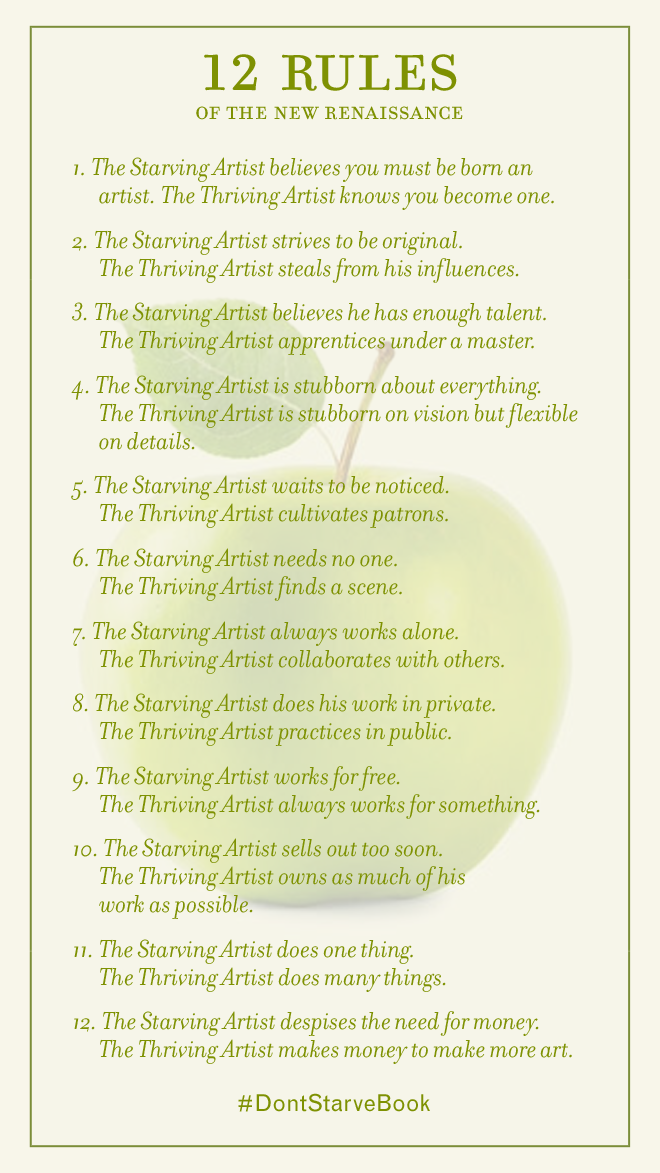
In Real Artists Don’t Starve, Goins gives 12 principles of how to actually be effective and successful as a creator (whether it’s music, writing, painting, or any other creative work). Reading his principles and the stories of artists and crafters through history give not only hope but tools through which we can make a living with our craft.Photo Credit: Jeff Goins

Book Marketing 101: What Works and What Doesn’t (Lessons From My Latest Launch) – Jeff Goins

2) Significant conversations followed. After posting my last blog, a writer acquaintance suggested we get together. Ann Lovell is a seasoned writer and currently employed as a Communications Director. Not only that, she continues busy with her own writing and is editing the manuscript of another incredible author. We talked about writing, and she offered her help. That was huge for me and right out of Jeff Goins’ book. Then another author friend Kevin Prewett with whom I share workspace some weeks also gifted me with good and thought-provoking questions about my writing. So helpful. Finally, through one more conversation, I realized how my own focus had been more on guiding and encouraging younger  writers and artists around me without noticing my own craft had gone untended. That conversation, with our guitarist son Nathan Mills,   was much illuminating. This time I benefited from a younger artist.

Significant conversations all.

3) A “Come to Jesus Moment” happened with my best friend. The one person in my life who has read all the blogs and has celebrated every high and encouraged me through every low is that husband and friend of mine, Dave. I am sometimes guilty of giving counsel too quickly (ok, advice…really. Unasked for advice. Dang it!). It’s much easier to look in others’ lives and suggest a small tweak than to face full on what totally needs rerouting in our own lives. In the last couple of years, taking early retirement and being too much on the outside looking in, I have time to come up with a prescription for anyone else’s problem. [Yes…guilty.] Not that I’m wrong, necessarily, but the situation is not mine. Most probably, Dave, or Nathan, or whomever it might be knows far more about where he/she is on that trajectory toward next steps than I could possibly conjecture. So here’s the “Come to Jesus Moment”. Over the weekend, Dave and I were talking about this season of life. We resonated together about lost social capital…those strong influencer groups with whom we once were a part and now not so much. In that brief conversation, when I would usually cheer on Dave to rally, the proverbial light bulb went off. Not just for him but for me as well. It is still possible to reclaim ground lost. Now was the time to act.

4) I applied for a job. I’d been toying with this for awhile. Until my dad died, I was making so many trips to help care for him, it seemed impossible for me to work anywhere. I would toss around options with family and friends (teaching ESL, hospice, school nursing), but nothing seemed to fit. Then for several months, I would hear of friends being hired into the coolest jobs and struggled to have unreserved joy for them. It was time for me to either continue with contentment in my current state of not working or take aim in one direction or another and do something. One job caught my eye. One job. I did the hours of updating my resume, pulling together samples of my writing, and crafting a cover letter. If I don’t get that job, I’ll apply for another.

5) I took the Social Capital Challenge.  A couple of months ago, I discovered Jordan Harbinger online. He writes and podcasts for a website called The Art of Charm. He invites his readers/listeners to something called a social capital challenge. I signed on…weeks ago for a month-long challenge…and then did nothing.

Photo Credit: Screen Shot – Art of Charm

Until today…

Today I created a written goal and posted it somewhere public.

I joined the Facebook page for The Art of Charm Challenge just now, and here was my first posting.

“Hello, everyone. I signed up for the challenge weeks ago. Even though its email reminders, baby to bigger steps, have been feeding my inbox, I wouldn’t even open them. Until today. Today I am ready. My goal is to have a manuscript with the art work publish-ready by the end of the year. My co-author and I had our first sit-down today, to share story idea and flesh it out some and to do the beginning photographer for the illustrator. Whew! There it is.”

Photo Credit: Pixabay, Jess_the_VA

I’m taking a deep breath…and we’ll see where this all lands. Whatever lies ahead, I’m so grateful for good counsel, courageous and creative friends and family, and clarity. It’s a very good Monday.

Monday Morning Moment – Social Capital – an Invaluable Resource We Can Develop – and a Tool to Help – Deb Mills Writer

Monday Morning Moment – When Connections Are Lost – a Rant, a Resolve, and a Request – Deb Mills Writer

6 Things You Need to recover From Every Day – Benjamin P. Hardy

Social Capital Challenge – The Art of Charm

Jordan Harbinger – The Art of Charm – Twitter

Real Artists Don’t Starve: Timeless Strategies for Thriving in the New Creative Age – Jeff Goins

6 Things You Need to Recover From Every Day – Benjamin P. Hardy

28 Lessons From Great Writers, Artists, and Creators on Mastering Your Craft – Ryan Holiday

The Whuffie Factor – Tara Hunt

5 Friday Faves – Psychological Tricks, Leadership Hacks, Parenting, Egyptian Food, and Pressing On

Welcome to Friday, Folks! It’s a breezy, warming Spring day. Almost summer. Hope you have a safe and refreshing weekend. Here are five of my favorite finds this week. Please comment below what your favorites are this week. Blessings!

1) Psychological Tricks – Whether we are aware or not, we apply mental processes to our interactions. For better or worse. How we sit in a room, for instance. If we have a problem with someone, we are tempted to sit across from them, rather than beside them. This is actually counter-intuitive because people are less apt to attack the person seated beside them. Another action I’ve learned over the years is to never have a two-on-one difficult meeting. If the meeting requires the presence of three people, the person being disciplined should have one of those persons seated beside him/her, almost as an advocate. The meeting will then be less threatening and potentially more productive. Distractions, like posture and unnecessary verbiage, are easy for us to control with practice.

Photo Credit: The Power of Ideas, Ideapod

Saying “I think” or “I feel” is redundant and draws down the power of the message that follows. Also slumping or folding arms across your chest can communicate something other than your intent and again weakens your message. Communicating effectively is worth the study into our own quirks and applying psychological “tricks”. Not to manipulate but to increase message clarity. An interesting article I discovered this week is 15 Clever Psychological Tricks That Everyone Should Know and Start Using Immediately. Rapid read.

[Sidebar: Don’t be put off by a few grammatical errors. The piece doesn’t appear to be written by a native English speaker.]

2) Leadership Hacks – Two of my favorite leadership coaches are Marcel Schwantes and Carey Nieuwhof. Any of us who truly want to be effective leaders would do well to hear their counsel. Schwantes has written a piece entitled: To Be a Strong Leader, There Are 6 Things You Must Give Your People (Most Rarely Do). He delineates what strong leaders give their employees:

  • They give employees their ear.
  • They give employees empathy.
  • They give employees rewards and recognition.
  • They give employees space to recharge.
  • They give employees plenty of information communicating both the good and the bad.
  • They give employees fairness.

Photo Credit: Flickr

Click here for Schwantes’ commentary on each. Leaders too often think they do well in these areas and thus do not discipline themselves to keep tooled. Unfortunately, if not checked,  weaknesses in these areas will permeate a company.

Nieuwhof posted about a growing problem in leadership – Why Busy Leaders Make Bad Leaders. We expect to be busy as leaders because we have loads of responsibility. So why is it that some leaders seem to have the time to be the kind of leader Schwantes notes in his article above? Leaders who delegate and don’t need to control processes or employees are those who most see the value of employees and their impact on the product and customer satisfaction. Read his article linked above. Here is how he closes:

Busy people love to act like they have no choice and they’re oh-so-slammed. Until you catch them binge watching Netflix, or lingering over an iced coffee checking Instagram, or talking for 30 minutes at a workmate’s desk about nothing in particular.

I’m not trying to be judgmental. I’m all for iced coffees and Instagram. It’s just there’s a cognitive dissonance in many of us between what we believe and what’s true.

You have the time for what matters. After all, every leader gets 24 hours in a day. You have the time to get the most important things done. You just didn’t make the time—you spent it doing something else.Carey Nieuwhof

3) Parenting – Parenting is a tough job and advice abounds. I am cautious in recommending parenting books and articles because the sense of guilt for parents is already sizable. Every child is different and every situation is as well. Having said all that, I do see hope in simplifying one’s family life and environment…just so both the parent AND the child can breathe.Photo Credit: Simplicity Parenting

Kim John Payne is a writer, researcher, and speaker in the field of simplicity parenting. Having spent over two decades in the school and family counseling field, he has seen the chaotic nature of family lives and its impact on children. His book  Simplicity Parenting: Using the Extraordinary Power of Less to Raise Calmer, Happier, and More Secure Kids is a best-seller. I have not yet read his book but have already been captivated by his teaching on his website.

If all we do is throw away toys as a way to simplify our children’s lives, we are not really dealing with the issue of chaos in their lives. Too often, we replace material possessions with the pursuit of experiences (what we may call social, athletic, or academically enriching). Experiences, especially where our children learn to serve and value others, can be life-transforming. However, we must be careful that experiences don’t continue to cause our littles to be over-stimulated making them addiction-prone in later years. Needing more, more, more to be satisfied.

Check out Payne’s website, and listen to his lectures both on his website and YouTube. I love when parents write comments (on Amazon reviews, for instance). Some have experienced his prescriptions as heavy and guilting, creating their own form of chaos. The major take-away of all parenting advice must be what speaks to you and your child’s situation. The rest is its own clutter.

YouTube Video – LoveParenting: Simplicity Parenting – Which Toys to Get Rid Of (Minimalistic Approach to Play)

YouTube Video – LoveParenting: Minimalism – the only 10 TOYS you “need”

According to Harvard Psychologists – Parents Who Raise “Good” Kids Do These Five Things

The Silent Tragedy Affecting Today’s Children

YouTube Video – Raising Children – Jeff Foxworthy

4) Egyptian Food – I’ve spent the last several days in the home of a very good Egyptian friend. She is an incredible cook. Egyptians are known for their hospitality and it was lavished on me in that visit. We had many of my favorite Egyptian foods, and my friend is an outstanding cook. In celebration of that, I wanted to extend to you the recipes of three of those dishes: Macarona Bechamel, Koshari (or Kushary), and Basboosa.

Macarona Bechamel

KoshariPhoto Credit: Wikimedia

Basbousa (Coconut Yogurt Semolina Cake)Photo Credit: Flickr

5) Pressing On – A friend of ours, Marlo Salamy, writes a blog about life, God, and her family following the death of their youngest, Anna, to cancer in 2007. I’m always touched by the honesty and faith reflected in her writing. In this week’s blog, What Matters, she writes about how we might act in the potential lost moments of our lives. Her illustration is from the tornado that blasted through Joplin, Missouri, when over 100 people lost their lives on May 22, 2011. The video posted in the blog makes you think. Wow!

YouTube Video – Aftermath of First Person Joplin Tornado (shown above in Marlo Salamy’s blog) – https://www.youtube.com/watch?v=W-P4P68YyNM

Bonus: Spotlight Syria

https://www.youtube.com/watch?v=W_6aXNB77us or https://www.facebook.com/ajplusenglish/videos/966031366871704/

Monday Morning Moment – Leading When You’re In Over Your Head – Cultivating a Thick Skin and Tender Heart

Photo Credit: Carey Nieuwhof

First, a leader has to recognize he/she is in over their heads. This often doesn’t happen because it’s incredibly threatening to a person’s ego as well as the ability to execute responsibilities. If a leader can wrestle with the actuality that her/his job is beyond her ability today, then there is great hope both for the leader and those under their authority.

Carey Nieuwhof and Eric Geiger are two leaders I follow on Twitter. They write extensively on leadership and have that platform because they are life-long learners and savvy watchers of life. They have “skin in the game” and have learned how to lead and continue to do so. No finished product here which gives them even more credibility to be heard.

I want to briefly summarize a couple of their articles and then point you to read the rest. If you are the leader in over your head, you will find help here. The same goes for those under the lead of a struggling leader.

Some time ago, I bookmarked Carey Nieuwhof’s piece How To Lead When You’re In Over Your Head. He lists out 5 steps to dealing with that reality and I have posted them below. If they seem simplistic to you, they are simple but not easy.

  1. Stay humble.
  2. Get a great team around you who are smarter than you.
  3. Become an avid learner.
  4. Grow comfortable saying “I don’t know”.
  5. Trust God.

There is no shame in finding yourself in over your head if you face it and push through it. No shame.

We often default to focusing on our strengths, and lead out of them instead of dealing with the weaknesses taking us down…to our detriment and that of the organization. You know that adage, “If it ain’t broke, don’t fix it”? Well, the leader in over her head can flip that on its head by breaking what’s not broken.

Read Nieuwhof’s coaching on his 5 steps. What will help any of us to be successful in dealing with a situation where we’re in over our heads is to do heart and skin checks. I say this after reading Eric Geiger’s article Thick Skin, Tender Hearts, and Four Types of Leaders.

Photo Credit: Eric Geiger

Every one of us in leadership can work through Geiger’s diagnostic and check the tenderness of our hearts and the thickness of our skin.

For those dealing with the ripple effect of the leader reeking unchecked havoc in the workplace – either because she seemingly doesn’t really care or cares more about her own ego, identity, or position than she does her employees or customers. This is a sometime reality in the workplace. Don’t be pulled down or disqualified yourself by this. It could change at any time.

You may think there’s nothing you can do about such a situation and you may be right, to a degree. However, you are completely empowered to check your own heart and skin. Has your heart grown calloused in a difficult work situation? Has your skin grown thin where you take things too personally?

Geiger, as with Nieuwhof, gives great counsel on how to cultivate that tender heart and thick skin. You may not agree with all of what both writers say (they speak from a Christian worldview). However, they have wisdom for anyone who wants to grow professionally and lead well in whatever situation you find yourself.

5 Friday Faves – Adoption, The Last of the Mohicans, Being Single, Craveability, and Honoring

Another Friday…they come so fast. Today, I am not in my usual spot but didn’t want to miss sharing this week’s favorite finds. Enjoy…

1) Adoption – I don’t hear the phrase much anymore, but in my child-bearing years, when asked what a couple wanted (boy or girl), the response was often, “I don’t care…just as long as it’s healthy.” A wise older friend told me one time that God gives life and every child is perfect in His eyes. One population we see less of in our country these days is people with Down Syndrome. Photo Credit: Flickr

Of of the genetic tests done during pregnancy, one is to rule out Down Syndrome in the fetus. If the parents have objections to keeping a baby with Down Syndrome, abortion is an option to some…as is adoption. Raising a child with health or developmental issues is challenging. We adopted such a child and thrill to see how he continues to meet his challenges…and to bless all around. We did not adopt a child with Down’s but we have friends who did. The videos below are a beautiful sampling of this population of perfect children and adults.

2) The Last of the Mohicans – To be honest, I have never been able to watch this painful and beautiful film all the way through. Its theme (originally composed by Dougie Maclean and arranged for this film by Trevor Jones) is exquisite. Listen here on YouTube with a composite of scenes from the movie. When Nathan arranged this grand orchestral piece (“Promentory”) for classical guitar, I knew it would have to be extraordinary. See what you think. Listen here:

YouTube Video – The Last of the Mohicans – Promontory – Classical Guitar – Beyond the Guitar

3) On Being Single – The whole dating scene in my 20s was something I pulled out of long before marrying. It wasn’t pretty. By the time I entered my 30s, life was filled with great friends, strong family relationships, challenging work, and serving in church and community. Loneliness crept in at times, but it still does even after marrying later in life. These days I am privileged to enjoy the friendship of several women (and a few men) who are single. Do some of them want to married? Yes, but not all. When I saw the video below, it resonated – how society can mis-communicate the great value of these women and men…I never want to do the same.

“‘Leftover women’ are outstanding. ‘Leftover men’ should try harder.”Marriage Market Takeover

3 Ways to Guard the Single Women In Your Life – Grace Thornton

Invite Someone Single To Dinner – Jasmine Holmes – Desiring God


4) Craveability – A few years back, I took myself off of sugar. For over a year, I just refused to eat it (desserts, snacks, etc.). It was a healthy choice for me at the time. I lost a lot of weight and stopped craving sugar. Gradually, as with many lifestyle changes, I went back mostly to my old ways (still not eating chocolate or doughnuts – two trigger foods). I watched an interesting YouTube video this week on crave ability – Michael Pollan on Cooking. In it, Pollan compared the nutritive value of food cooked by corporations vs. that cooked by humans. Now, corporations (restaurants, food processing companies, etc) don’t really “cook”.  His premise though was compelling. When we cook, we control how much sugar, salt, and fats we add to food. When we buy food already prepared commercially, the craveability factor is at work. Foods we return to buy again and again have been developed to tap into our cravings.

My husband was on a work trip to California this past week. A much-loved fast-food restaurant was on the list of eateries. In-N-Out Burger. He and his colleague even ate there twice one day. Now, the food must be pretty special, but it speaks to Pollan’s observation about how we eat when driven by cravings. If we were eating at home, we have French fries rarely. Yet, eating out (for lunch each day, for instance), we might have fries more often.Photo Credit: Marco Fischer, Pexels

We in the US have a fair amount of food weirdness in our striving to eat healthy or, on the flip-side, in our indulging of cravings. Considering what is behind our food preferences, even our addictions, might help us make wiser choices in what we eat – especially related to sugar, salt, and fats.

YouTube Video – Michael Pollan: “Cooked: A Natural History of Transformation”

5) Honoring – Respect and honor are two very different actions and experiences. I’ve heard people say, “I just don’t respect him/her.” or “He/she doesn’t deserve my respect.” There can be such derision or contempt in those statements, they also seem to communicate “can’t” and “never will”. Honor is defined as “valuing or esteeming highly.” We live in a culture that defaults to valuing self over anyone else…we have to fight against this strong pull to elevate ourselves over even those we say we love the most. In one of the Apostle Paul’s letters, he writes: Love one another with brotherly affection. Outdo one another in showing honor. (Romans 12:10) Whether someone deserves honoring or not is of no consequence. We choose to honor others. Photo Credit: Pinterest

Do we choose to honor others in our every word and deed? Think about the trash talk we can so easily fall into in relationships. It seems harmless enough but it sets us up to follow suit with dishonoring actions and attitudes. My hope is to be a person you can trust to keep your name safe on my lips.

In our current political climate and knee-jerk one-upmanship in social and work circles…what if? What if we tried to “outdo one another in showing honor”? How would that change our homes, workplaces, world? How do we teach that sort of valuing to our children? How do we re-awaken our hearts to it as adults? I would love to hear your thoughts (in Comments below).

Well, those were my favorite finds this week. How about yours? Please share any of those in the Comments. Have a safe and refreshing weekend.

Bonuses:

Quote about Prayer:

“The greatest thing we can do for one another is to pray. Prayer is striking the winning blow at the concealed enemy; our service is gathering up the results.” Corrie ten Boom, Not Good If Detached

Photo Credit: AZ Quotes

Looking for a Remote Job? 15 Companies Reveal What They Look for in Remote Employees – Marcel Schwantes

Weird Parenting Trends We’re Tried the Past 100 Years – Good Housekeeping

Things It’s Time to Get Rid Of – Good Housekeeping

Monday Morning Moment – Social Capital – an Invaluable Resource We Can Develop – and a Tool to Help

Photo Credit: Screen Shot – Art of Charm

I had an Aha moment recently when I discovered something had shifted in this season of my life. Social capital. To be honest, I didn’t even know what that was until a couple of weeks ago. Now, I can’t stop thinking about it and how to develop it…not for what it would benefit me personally but for what matters to me out there.

Social capital is the willingness of people to help each other. It often replaces money which people would use to buy the same help. Most ways of measuring social capital have to do with trust – people who trust that favors and help will be available when they need it will favor and help others more. Social capital is a lot like real capital. The more money a person or a society has, the easier it is to do things and the better off people are.Simple English Wikipedia

Photo Credit: IResearchNet

There is a significant difference between social capital and human capital. The Difference Between article below gives an excellent contrast. Simply put, human capital is the skillset I bring to a team or organization. Social capital involves networks or groups of people resourcing one another to achieve something they all want.

http://www.differencebetween.com/difference-between-human-capital-and-vs-social-capital/

I could be a part of a team that has enormous human capital – brilliant, gifted, visionary people – but our potential for making remarkable change would be hampered if we ignored the social capital we could bring to bear. This is the silo effect in organizations. It’s also the inner circle handicap in other parts of our lives – where we focus on our own benefit and not that of a larger society. I referred to Jeremy Writebol’s article on this here.

My experience throughout life with social capital (before even knowing what it was) has been rich and fruitful. Just a couple of examples follow:

  • Years ago when I worked in a cancer center in East Tennessee, we wanted a vehicle for patient and family support that would endure throughout the experience with cancer (either to cure or death). There were several on our team who brought immense human capital to the table. Fortunately we also brought the resources of many networks alongside – the patients and families themselves, a nearby university, the cancer center’s foundation, the local American Cancer Society, churches and other private benefactors, and volunteer groups. It was an amazing collaborative experience and that support program continues to this day.
  • When we were living in North Africa, and our children were in high school, I was struck by the number of musically gifted young people with no avenue to share their art. In fact, at their school as wonderful as it was, there was no parent group, no booster club of any sort, to drive projects that would benefit neither the school nor the community. This small observation grew into a much larger idea and then, with surprisingly wide-reaching social capital of parents, staff, and the students themselves, a group called Better Together was formed. Out of this group was birthed an annual visual and performing arts festival which continues today. Also out of this group, our group was able to use our social capital (our various social networks) to benefit some of the local charities as well as the overall offerings of the school itself.

Social capital can be a solid foundation for developing a service or product or opportunity that benefits many. However, it can be squandered or diminished if not nurtured over time. Social capital depends on trusting relationships.

Photo Credit: NBS

Because of several factors in my own life – relocating geographically, job changes, and a series of other personal hurdles – I have let some of my social capital go cold. This happened in a season when I’m probably most aware of the enormous potential for deep, broad-reaching networking opportunities.

I just haven’t focused there lately…

Until now.

Recently I discovered Jordan Harbinger online. He writes and podcasts for a website called The Art of Charm. To be honest, the title did not draw me in, but the content did. He invites his readers/listeners to something called a social capital challenge. I signed on.

It’s not a fluffy challenge, I can assure you. In fact, it is supposed to be finished in a month, and I’m still stuck on Week 1. However, be assured, I WILL PREVAIL.

The first challenge is settling on a written goal of improving my social capital (and sharing it publicly). Here my personal struggle is deciding which of the many areas of benefiting others I’d like to land. If you are part of my now smaller social networks, you’ll hear more about this in the coming days. I’m going to need your social capital at play…and I’m confident we can accomplish more and Better Together.

What are your experiences with social capital? Your stories? Your thoughts on developing social capital? I would love to hear, in the Comments section below.

Social Capital Challenge – The Art of Charm

Jordan Harbinger – The Art of Charm – Twitter

Social Capital – IResearchNet

Measuring Social Capital – A Systematic Review – Prepared by Moses Acquaah, Kwasi Amoako-Gyampah and Nceku Q. Nyathi 

The Whuffie Factor – Tara Hunt

Photo Credit: Amazon

Monday Morning Moment – Servant Leadership – Trending Forward

Photo Credit: Tri Pham, FLickr

The servant-leader is servant first.

It begins with the natural feeling that one wants to serve. Then
conscious choice brings one to aspire to lead. The best test is: do those served grow as persons; do they, while being served, become healthier, wiser, freer, more autonomous, more likely themselves to become servants?Robert K. Greenleaf
“…more likely themselves to become leaders” – Isn’t that how you thought Greenleaf would end that sentence? I read it that way. We don’t naturally think of aspiring to serve – “moving up the ranks” to better position ourselves to serve.
Why write about servant leadership?
So much has been and continues to be written about servant leadership. The terms change and trend a bit differently over time. Of late, relational leadership has gained in popularity. This type of leadership is defined as “as a relational process of people together attempting to accomplish change or make a difference to benefit the common good.”
I love that concept and style of leading, but servant leadership goes even farther. Relational leaders can focus on their particular team or tribe, in a mentoring, collaborative role…for the good of those leaders and the organization and client base. Servant leaders aspire to a wide reach. Not just leader to leader, but to permeate the whole of the organization with an ethic that everyone, at every level, matters. This is a huge aspiration but the gains are huge as well.

Marcel Schwantes, founder of Leadership from the Core, has written a piece on the 10 Leadership Habits Found in the World’s Best Leaders. These ten habits are derived by Larry Spears from the Robert Greenleaf‘s pioneer work in servant leadership. Read the article for Schwantes full commentary, but the 10 habits follow:

  • Listening
  • Empathy
  • Healing
  • Awareness
  • Persuasion
  • Conceptualization
  • Foresight
  • Stewardship
  • Commitment to the Growth of People
  • Building Community

Another list of qualities to consider is posted by business leader Skip Prichard‘s 9 Qualities of the Servant Leader. Both Prichard’s list below and Schwantes’ list above are excellent markers for your own leadership:

  • Values diverse opinions
  • Cultivates a culture of trust
  • Develops other leaders
  • Helps people with life issues
  • Encourages
  • Sells instead of tells
  • Thinks you, not me
  • Thinks long-term
  • Acts with humility

Finish the whole of his article here (and don’t miss the comments – fascinating).

Photo Credit: Virginia Guard Public Affairs, Flickr

Marcel Schwantes has also written 10 Compelling Reasons Servant Leadership May Be the Best, Says Science. In this piece Schwantes tackles the misconceptions about servant leadership as well as the many reasons why it’s the best form of leadership. I personally love this article because the evidence of the kind of company that prospers under servant leadership is undeniable. We know these organizations by their service – like Chick-Fil-A, Southwest Airlines, Home Depot, Ritz Carlton, FedEx, UPS, U.S. Marine Corps, and many others. Very persuasive.

Finally, I’d like to share General Stanley McChrystal‘s view of leading “like gardeners”. My husband is a gardener. Even after a long, tiring day at his regular job, he puts in the time necessary to tend the plants he’s growing. Bent over, on his knees sometimes, doing the work of nurturing them to reach their maximum fruitfulness.

“Regular visits by good gardeners are not pro forma gestures of concern—they leave the crop stronger. So it is with leaders.”

Employees and customers know the experience (or lack thereof) of the leader who truly attends to their needs. No drive-by visits here. No sprinkling of some corporate fairy-dust just by the sheer presence of the leader in the room, or the building, or on podcast/commercial.

McChrystal warns against the leader who becomes too important to personally serve his personnel or customers.

“I would tell my staff about the “dinosaur’s tail”: As a leader grows more senior, his bulk and tail become huge, but like the brontosaurus, his brain remains modestly small. When plans are changed and the huge beast turns, its tail often thoughtlessly knocks over people and things. That the destruction was unintentional doesn’t make it any better.”

Always in thinking of leadership, we are tempted to look to our own leaders…to measure them by the scale of excellence (seen above). The servant leader is servant first. Don’t get muddled up by checking off what your leader is not. Serve that leader, as you serve other personnel and customers. Serve. Serve by leading. Lead by serving.
“Servant-leadership is more than a concept, it is a fact. Any great leader, by which I also mean an ethical leader of any group, will see herself or himself as a servant of that group and will act accordingly.”
[Please don’t miss the links below…especially those not mentioned in this blog. Also please share examples (in Comments section below) of servant leadership you have experienced…or your own personal journey in becoming a servant leader.]
Journey strong. Serve long.

YouTube Video – Servant Leadership – Leadership From the Core – Marcel Schwantes

10 Compelling Reasons Servant Leadership May Be the Best, Says Science – Marcel Schwantes

9 Qualities of the Servant Leader – Skip Prichard

The Understanding and Practice of Servant-Leadership – Larry C. Spears

General Stanley McChrystal: We Should All Lead Like Gardeners

Glassdoor’s 2017 Best Places to Work Rankings: The Importance of Common Purpose – Barry Sanders

Monday Morning Moment – True Humility in Leadership – So Not Cliché – Deb Mills

Monday Morning Moment – 7 Skills of the Top Leaders of Tomorrow – Whatever Your Age or Stage – With Matt Monge – Deb Mills

Larry C. Spears and Robert K. Greenleaf

The World’s 10 Top CEOs (They Lead in a Totally Unique Way) – Marcel Schwantes

World-Class Customer Service – The Key Is Caring – Horst Schulze on a Culture of Service – Deb Mills

Monday Morning Moment – 3 Quick Reads on Leadership – to Help You Stay the Course, Not Be a Jerk, While Being Innovative – Deb Mills

Happily Ever After – What Makes Relationships Work – Poster – Frank Sonnenberg

5 Friday Faves – Spring Flowers, Podcasters, Organization, Caring, and Frosted Strawberry Lemonade

Happy Friday! We made it! You know those weeks where so much is going on it’s hard to process it all? I’ve surfed on top of the waves of this week…thankful for all the helps along the way. How was your week?

Always glad to hear your views on life, not only on the Friday Faves, although they’re fascinating, but on anything you want to talk about. Please share in Comments below.

Here are my Friday Faves. Enjoy!

1) Spring Flowers – Search “Spring” on my blog and you will find several posts on this incredible season. We’ve lived in countries where Spring isn’t as obvious as it is here, but Spring comes all over the world, in subtlety and in glorious spectacle. Where we are, trees are flowering, buds are popping, and leaves are unfolding. Oh the beauty of the earth! Love!

2) Podcasters – So many to choose from. I’m a late adopter but have found this sort of information-sharing very helpful. You can find some of my favorite podcasts before here. When our favorite classical guitarist livestreams on KrueTV, I wonder when podcasting might become part of the features of this unique music platform app. Anyway, this week I discovered a couple of great lists related to podcasting. One is a “best of ” list of 12 leadership podcasters by Lolly Daskal. Her article is a good place to start in getting solid content on leadership. The other is a fascinating piece by Tom Hunt – Why You Should NOT Start a Podcast: Insights From 12 Top Podcasters. Photo Credit: Flickr

These guys give a bit of their stories and their counsel on what is required to build an online community and have a successful podcast.  Great reading!

3) Organization – Fuzzy boundaries and project piles are part of my battle in life (work and home). Love to keep my options open, I guess. It requires all the discipline I can muster to finish well. When folks write about organization, routines, and habits, I take note. The best articles are those that are consummately practical – and encourage rather than condemn.Photo Credit: Flickr

My 4 favorite reads this week on this topic are:

Quotations About Habits

4) Caring – In recent months, I have been increasingly aware of two health issues requiring great insight and caring – 1) Adverse Childhood Experiences and 2) Alzheimer’s Disease. A film debuted in 2015 titled Paper Tigers. Its focus is a high school in Washington state and how the staff and other caregivers began turning things around for traumatized high schoolers who deal daily with toxic levels of stress. These are the same kind of kids that too often get less care than more because they are difficult to engage.Photo Credit: Marshfield News Herald

Much of their struggle goes back to adverse childhood experiences (or ACEs). Here is the trailer for Paper Tigers:

Love Your Neighbor – the Resilience Movie and Adverse Childhood Experiences (ACEs) – DebMillsWriter

Alzheimer’s Disease is a frightening disease as we watch someone we love change and diminish, both in their thinking and their function. As hard as it must be on the one who has dementia, it is also devastating to those who love that person. That’s what makes it so amazing when a son, for instance, takes the time and effort to honor a mom with dementia. Joey Daley, of Lima, Ohio, has taken on a video project to document their journey through dementia.

I haven’t watched all the videos, but the ones I’ve watched have allowed us, strangers to their experience, to see inside their relationship in a difficult time. His visits with his mom are as sweet as any son’s would be…with dementia added. He knows, and we know, the days will become more difficult. I think we will see his love for her endure…

YouTube Video Series – Joe Joe – A Mother and Son’s Journey with Dementia

MollyJoey Facebook Group

5) Frosted Strawberry Lemonade –
Chick-Fil-A, a US restaurant chain, has this incredible refreshment blending ice cream with lemonade. I already raved about their frosted lemonade here. This Spring, there’s a seasonal addition to the menu. Strawberries added – enough said.

Photo Credit: The Chicken Wire

Bonuses

3 Embarrassing Networking Mistakes Everyone Makes (And What You Should Do Instead – Brian D. Evans

Effective Strategies to Get More Social Engagements – Katherine Brunt

YouTube Video – Mom’s Rant on Red Ribbon Week

YouTube Video – Carl Hardee Sr. Returns

Monday Morning Moment – When You Love Your Job – and Your Power to Make It So

Photo Credit: Maxpixel

I had trouble getting my enthusiasm up for work today. This is highly unusual, because I LOVE Mondays. Even went to bed early last night; only to have bad dreams and restless sleep.

OK…so it happens sometimes. Shake it off and embrace the day, right?

I want to write about what happens when we love our job. Remember when that was? …if it isn’t that way for you today, don’t let this season bring you down, and your work down.

A friend shared with me recently that he has come to figure his worklife into decades. He makes strategic decisions based on where he is today in his job and what he hopes to be doing in the next decade. We all know the years go by quickly…so he got me thinking.

If I don’t love my job today, I really either need to do something to correct course, or, before jumping ship, think where I hope to be over the next several years.

This morning I came across a funny and invigorating video on Facebook. It is When You Really Love Your Job. Watch below.

This little video showed a number of employees doing their jobs well and with speed and finesse. It had a poignant touch for me because I have personally watched servers in North Africa make crepes, cut up fruit, and pour tea like the workers in the video. I miss that.

If you search online for loving what you do, you find lots of helps on how that works and how to make it happen (again).

Jeff Haden posted a helpful piece entitled 15 Revealing Signs You Genuinely Love What You Do. It’s a quick read and it will either encourage you that you really DO love your job, or, if not, maybe there are some simple steps you can make to change it up. Some of the signs are : You enjoy attending meetings. You think about what to say, not how. You help without thinking. Definitely something to consider…as are the other signs.

Photo Credit: The Muse

If you love your job, that is worth celebrating and worth protecting as the job or company changes. If you don’t love your job so much, then you have to ask yourself the question, is it time to look elsewhere or do you have capacity to do what it takes to restore joy to your job, as it is?

Photo Credit: Flickr

Benjamin P. Hardy writes about this in One Behavior Separates the Successful From the Average. What is that behavior? Initiative! We determine for ourselves how we shake out our day. Sure, there are going to be obstacles and difficult people and various struggles over the years. It’s always worth it for our own sake, to take back control of how we love our jobs. Exercising initiative, as Hardy suggests, is the way out…either out of the joyless season you’re in and stay in your job, or out of the job. Just don’t take the joylessness with you.

Here’s to loving our jobs!

Do You Love Your Job? – Deborah Repplier

Discover the Work You Were Born to Do – James Gonyea

17 Inspiring Quotes About Loving Your Job – Michael D. Pollock

This Is Your Life. Do What You Love – The Holstee Manifesto Lifecycle Video

Photo Credit: Vimeo