Category Archives: Relationships

Worship Wednesday – MercyMe’s “I Can Only Imagine” – My Story About This Song

Photo Credit: New Release Today

The film I Can Only Imagine debuted in the Spring of this year. It’s the story of how a young man, Bart Millard, came to compose one of the most beautiful poignant songs written in recent years.

Millard is the lead singer for the Christian band MercyMe. The song I Can Only Imagine was inspired by his own faith walk and the death of his father to cancer. The lyrics express the wonder at what Heaven will be like for us when our time comes. Photo Credit: To Save a Life

The film featuring this song chronicles Millard’s early life with an angry, abusive father. Bart hated his father, and although he was sure God could forgive his father, Bart believed he himself never would.

Bart Millard: ‘I Can Only Imagine’ Was Born From a Life of Abuse – Jenny Rapson

It is a powerful story that resonates with many of us. My biological father (not this Dad) wasn’t physically violent toward me but he was emotionally abusive in his neglect and indifference toward us four children. Our older brother may have experienced worse abuse from our dad but he never talked about it. What makes me wonder is how angry he was as an adult. My brother died a few years ago, finally beginning to heal out of decades of bitterness and rage…just before he died.

This song and film, birthed out of a childhood marred by violence, remind me of how good God is and how He works healing even in the worst of situations.

My mom loved this song. I didn’t know its significance to her until right before her death in 2002. We were living overseas the year the song came out (2001, and I don’t remember even hearing it until Mom asked a friend to sing it for her, just days before she died. After her funeral, as we returned to “normal”, it seemed I heard that song every day for months. It had become wildly popular, winning two GMA Dove awards, and successfully crossing over to pop/country charts. That connection with her, day in and day out, helped me to grieve and heal the loss of the woman I loved most in the world. . Imagining her life in Heaven was very good for me…then and now.

Years later, when my older brother died, I heard the song again in an odd situation. We were visiting Dad, in the house where I grew up. My brother lived with them for many years, and I went into his bedroom. He had been gone for a few weeks at that time. There was an old-timey, pale blue box radio in the bathroom he used. I switched it on just to see what station he listened to. It was a Christian station which was strange because, although he was a Christian, he wasn’t into “churchy stuff”. The song that was playing when I turned on that radio was “I Can Only Imagine”. There…in a sacred moment, missing my brother, the Lord comforted me again…with this amazing song…and message.

Worship with me please.

I can only imagine what it will be like
When I walk by your side
I can only imagine what my eyes will see
When your face is before me
I can only imagine

Yeah

Surrounded by your glory
What will my heart feel?
Will I dance for you, Jesus,
Or in awe of you be still?
Will I stand in your presence
Or to my knees will I fall?
Will I sing hallelujah?
Will I be able to speak at all?
I can only imagine
I can only imagine

I can only imagine when that day comes
And I find myself standing in the sun
I can only imagine when all I will do
Is forever, forever worship you
I can only imagine, yeah
I can only imagine

Surrounded by your glory
What will my heart feel?
Will I dance for you, Jesus,
Or in awe of you be still?
Will I stand in your presence
Or to my knees will I fall?
Will I sing hallelujah?
Will I be able to speak at all?
I can only imagine
Yeah
I can only imagine

Surrounded by your glory
What will my heart feel?
Will I dance for you, Jesus,
Or in awe of you be still?
Will I stand in your presence
Or to my knees will I fall?
Will I sing hallelujah?
Will I be able to speak at all?
I can only imagine
Yeah
I can only imagine

I can only imagine
Yeah
I can only imagine
I can only imagine
I can only imagine

I can only imagine
When all I will do
Is forever, forever worship you

I can only imagine*

Just this week, I saw the film for the first time…in the living room, lights dimmed, with sweet family. Some in my close circle of family and friends don’t rush to watch “Christian” films because, they say, they are too amateurish and trite. Not this one. Beautifully filmed, raw dialogue between Bart and his father, layer upon layer of brokenness. Then…the miracle of healing. Of God piercing through the pain and bringing beauty out of ugliness. Reconciling…first with Him…and then with each other.

See the film. Listen to Bart sing his own story of wondering about Heaven…and then let all that settle around you as it has me so many times…just the thought of what Heaven will be like…seeing my Mom again…my brother…others who have gone ahead…and especially the God of this universe…the One who saved me…the One who saved Bart’s Dad and Bart, and then the One gave Bart grace to forgive.

*Lyrics to I Can Only Imagine Written by Bart Millard

YouTube Video – Bart Millard Reveals the Origin of His Biggest Hit “I Can Only Imagine” – Huckabee

YouTube Video – I Can Only Imagine – “Forgiveness” Scene

YouTube Video – I Can Only Imagine – MercyMe

5 Friday Faves – the Fortnite Phenomenon, Back to School, Clean Comedy, God’s Heart for Justice, and Bonuses Make Five

Happy Friday! One of those weeks that so rapidly entered history. Lots of travel and family and birthdays and then work, of course. Will go right to the faves before the clock runs down. Hope your weekend is long and lovely.

1) The Fortnite Phenomenon – Not a gamer myself, but when the game Fortnite comes up in conversation with men and boys of all ages, it’s easy to see what a phenomenon it is. A multi-player battle game (with elements of construction as well), Fortnite is free-to-play and wildly popular right now in the gaming universe. A unique component of the game includes avatars who break out into dance. These dances are emulated by player fans, and you would recognize some of them because of boys, in particular, master them as they master the game. These dances have become part of Nathan Mills‘ (Beyond the Guitar) classical guitar repertoire. His YouTube channel subscriber numbers have more than tripled since his first post of Fortnite Dances…and views of his videos are in the millions. Enjoy the latest…as the commenters clamor for Fortnite Dances #4.

YouTube Video – Beyond the Guitar – Fortnite Dances on Guitar (Part 2)

YouTube Video – Beyond the Guitar – Fortnite Dances on Guitar (Part 1)

2) Back to School – That time of year is back. So much new happens as summer ends, and Fall stretches out before us. Routines and rhythms crank up again. Growth spurts require new clothes. Then there are all the school supplies required for starting a new year.

As our children grew up, we had varying seasons of “back-to-school” between home schooling and other schooling, both in the US and in Africa. It was never easy for me to see them off, when we didn’t homeschool. I missed them…and those moments together when they talked about life as they saw it. I also missed being able to protect them from some of the meanness in the world. Still, the start of the school year is a hopeful time of anticipation and wonder, of new beginnings and possibilities.[Kudos to the teachers, Stacie Mills & Kirby Joseph, whose classrooms pre-student-return, were my inspiration on this fave.]

How thankful I am for teachers who really care for their students. Teachers who see themselves as partners with parents, even the most woefully unprepared ones…for the sake of these kiddos who will hold the future in their hands one day. What a marvel this is.

Putting the Basket in the Water: Trusting God in the Next Phase of Your Child’s Life – Ashlei Woods

The Trauma-Informed Teacher – Silent Front Line

3) Clean Comedy – So just this week I discovered Dry Bar Comedy. It showcases stand-up comedy that is actually family-friendly. No profanity. No sex. No mean putdowns. The first act (on video) that I caught was Leanne Morgan, a gorgeous Southern woman who puts her arm around our experiences of being female at all ages. Hilarious!

Another clean comic (not with Dry Bar) who I adore is John Crist. His tour this Fall brings him to Richmond, Virginia, and we have tickets. Crist is a preacher’s kid and uses that church experience as fodder for many of his routines. You can see his videos on his website or YouTube channel. Don’t miss him…high energy, so funny.

Michael Jr. Comedy – another favorite of mine.

4) God’s Heart for Justice – For the next six weeks, I’m digging into a study on God’s heart for justice through the International Justice Mission. I bought the book, but if you sign up for daily emails, you can glean great good just in that content and the resource videos.

It’s too easy to turn a blind eye away from the injustices of this world – human trafficking, poverty, racial and religious oppression… Arise focuses on the Biblical definition of justice and the mandate for each of us in turning the tide on it…until Jesus returns and rights all wrongs. We too often are numbed by the immensity of the problem, when, in fact, we can swing the pendulum toward justice… Each one of us can do something. Sign up for daily emails and discover your place in God’s mission of love for those most vulnerable.

https://www.ifgathering.com/if-equip/arise-a-study-on-gods-heart-for-justice/

5) Bonuses: 5 bonuses make up my fifth find. Please don’t miss them.

What’s Happening to Our Kids? Technology’s Latest Disruptions – The Middle School Relationship – Alex Whitcomb

Leaf by Leaf: Satisfied (the journey of Mom Melissa and Teen Daughter Maggie through Stage 4 Colon Cancer – and Maggie’s Death and Homegoing – one of the most beautiful stories I’ve ever read

72 Challenging and Truthful Leadership Quotes from Craig Groeschel Opening This Year’s Global Leadership Summit – Brian Dodd

 YouTube Video – Faith In Imagination: The Fantasy Makers – Trailer

YouTube Video – Aretha Franklin (March 25, 1942-August 16, 2018)  – Nessun Dorma – and the National Anthem as only she could do it. Goosebumps! Thank you, Aretha, for all the music.

That winds down this week. Hope yours was stunning – full of meaningful work, real rest, family and friends, and deep conversations. Be gentle with yourself and each other. – some of those people in our lives. #Friends #Community

Monday Morning Moment – the Endearing, Enduring Multipliers in the Workplace

Photo Credit: Amazon.com

[Adapted from the Archives]

For several years, we had the great privilege of living and working in Cairo, Egypt. My husband directed a Middle Eastern Studies program. I helped him oversee the comings and goings of bright, energetic 20-somethings. When the work, heat, or press of city life became too much, we would escape to the Sinai and the Red Sea. Usually the resort town of Ras Sudr was our quick and quiet get-away, where we could take a weekend just to clear our heads with blue skies and salty sea air.

This time, we went for a week to Dahab, on the far side of the Sinai. r_seaman@hotmail.comPhoto Credit: Egypttailormade.net

Dave was finishing his time in this director role and would take a short sabbatical in the US. We would then return to Egypt, this time for a regional consulting job, guiding the expansion of these study centers.

We were tired, and a consulting job was a dream, with the prospect of just giving a hand to other directors – not nearly the intensity of being responsible for so many young people.

Driving the long road to Dahab, through the calming desert of the Sinai, kids in the backseat, Dave got a phone call.

Whoever it was on the other end, (Dave hadn’t called him by name), the conversation, from my side, was warm and affectionate at first, and then serious. As they talked, visible goose bumps rose on Dave’s arms. Goose bumps on a hot deserty day in Egypt?! I knew no one had died from his side of the conversation, but something huge was clearly being introduced by the caller.

When the call ended, I got the details. Dave spoke quietly so the kids wouldn’t be distracted by a call that could change the course (and geography) of our lives. The person on the other end of the conversation was his dearest mentor – a man for whom he had the deepest respect, even love. On the phone call, he had asked Dave to consider not taking the job of consultant but to take a job with him where he would have even more leadership responsibility. Supervising many more than a couple of dozen 20-somethings in one city. This job would require him to provide leadership to about 100 people spread over 6 different countries AND we would have to move from our beloved Cairo.

Thus, the goose bumps.

Dave did walk away from the “easier” job of consultant to take on the much larger, scarier job his mentor asked of him. We did eventually break the news to our children that we would be moving away from Cairo to a whole new country of possibilities and friendships. It was a stretching move for us (more so than our original move to Cairo), and it was a job and situation we would never have aspired to…were it not for this mentor…this multiplier of leaders.

Liz Wiseman has written the most incredible book on leadership – Multipliers – How the Best Leaders Make Everyone Smarter . Her book describes this mentor of my husband as if she knew him personally. Wiseman is the president of The Wiseman Group, a leadership research and development firm, headquartered in Silicon Valley, California.

Blog - Liz Wiseman

Photo Credit: LiveIntentionally.org

I first heard her speak at the Global Leadership Summit. Her presentation centered on a more recent book Rookie Smarts. This engaging young woman clearly has had multipliers in her own life and has obviously learned from some diminishers as well.

On the inside cover of Wiseman’s book Multipliers, she defines the terms “Diminishers” and “Multipliers”:

“The first type [diminishers] drain intelligence, energy, and capability from the ones around them and always need to be the smartest ones in the room. These are idea killers, the energy sappers, the diminishers of talent and commitment. On the other side of the spectrum [the multipliers] are leaders who use their intelligence to amplify the smarts and capabilities of the people around them…These are the leaders who inspire employees to stretch themselves to deliver results that surpass expectations.” – Liz Wiseman

Have you ever been in a job where you felt your wisdom, understanding, experience were being drained right out of you? As if you were getting stupider and stupider? That can happen…or at least the sense of it happening is so strong it might as well be real. Some of this we must own ourselves, and some of it is owned by our leaders.

[Sidebar – It’s not like diminishers are evil people. Possibly, their focus is so tuned to the endgame that people and processes get lost in the pursuit. I believe if ever they have an “aha!” moment, maybe through the multipliers in their own lives, they could change their habits and disciplines…especially those who become accidental diminishers – in video at minute 28:35.]

This mentor of Dave’s was/is a Multiplier. For much of Dave’s professional life, this man has “popped in” and pressed my husband to reach farther than he might have in his career.

I want to be this sort of leader myself – this one who inspires confidence in others, who sees the possibilities, who risks by giving over control to another, who stirs thinking and enlarges the lives of those in his/her circle of influence…a circle that’s widely inclusive.

Being a leader is a humbling, stretching experience and, for the sake of those under our watch in the workplace, we want to offer the best leadership possible. We can all fall into habits over time that diminish others. Forging disciplines that keep us from doing so is wisdom. Note them from Liz Wiseman’s book:

Photo Credit: Wikimedia Commons

Wiseman also talks about leaders as change agents – do we reserve the right to make the final decision every time or do we wrestle through decisions with those most affected by them? The latter can definitely be more messy but is also more effective and honoring.

“Multipliers invoke each person’s unique intelligence and create an atmosphere of genius—innovation, productive effort, and collective intelligence…He’ll outstretch all your capabilities to make it happen. He is highly demanding, but you feel great. You know you are signing up for something that will challenge you on a daily basis for many years to come. You will challenge yourself and all your capabilities…Exhilarating, exhausting, challenging, gratifying. He’s a big source of energy. He is a source of power and a tail-wind for what we do.”  – Liz Wiseman

Thank you, Liz Wiseman. You are a wise woman (I’m sure you get this all the time…couldn’t resist). Thanks also to that unnamed mentor and multiplier in my husband’s life…and to all those multipliers in my life’s journey.

Read Wiseman’s book. [If you watch this video, you will want to buy the book…if I haven’t already sold you.] I’d love to hear your stories of multipliers in your life…and any diminishers that you learned from but (hopefully) were not diminished in the season you were together…maybe you became a multiplier in that person’s life. Journey strong, Friends.

Multipliers – How the Best Leaders Make Everyone Smarter by Liz Wiseman with Greg McKeown

Photo Credit: Leadership Natives

Leadership Natives – About Multipliers

YouTube Video – Leaders as Multipliers with Liz Wiseman

Multipliers Quotes from GoodReads

Monday Morning Moment – How an Accidental Diminisher Becomes a Multiplier – Deb Mills

2013 Global Leadership Summit Session 3a: Liz Wiseman

Brian Dodd – 4 Leadership Lessons From Mt. Rainier and the Inc. 500 Fastest Growing Business List – another example of a Multiplier

5 Friday Faves – Mission Impossible, Digital Dementia, Habits that Can Change Your Life, Piles of Books, and Food for Thought

Friday! Whew! With family visiting and some travel also, writing took a back seat the last couple of weeks. It’s always good for me to sit down at my desk and put words on the screen. Something really soothing to my mind in the sound of clicking away on computer keys. Hope the reading soothes you as well.

1) Mission Impossible – Nathan Mills, with all the lovely summer interruptions, still managed to get out an arrangement of the Mission: Impossible Fallout theme. Watch it here.  This makes the sixth of the Mission Impossible films  He covered the film trailer which blends the Mission Impossible theme and Imagine Dragons’ Friction.
Photo Credit: Beyond the Guitar

YouTube Video – Mission: Impossible – Fallout – Classical Guitar Cover by Beyond the Guitar

2) Digital Dementia

Brain researcher Manfred Spitzer coined the term “digital dementia”. It relates to the deterioration of brain function with the overuse of technology. This could include memory loss, attention issues, concentration, and emotional distress such as depression. He would have all digital technology taken out of classrooms. We know that is not going to happen, therefore we must intentionally “exercise our brains” in ways that counteract the brain drain caused by digital technology.  The following are found in Jessica Gwinn‘s piece:

  • Use Your Head. Retrieve information from your brain organically. Sit there and concentrate until you can recall it. [“Use it or lose it, the experts contend. The brain, just like a muscle in our body, can atrophy if we don’t use it.  Perhaps consider a digital sabbatical…If we focus instead on having real conversations, reading books, getting out into nature, and disconnecting from technology, we will be taking care of our brain health and our emotional health as well.”]
  • Crack Open a Book. That’s right. Reading an actual book rather than a tablet has been shown to improve memory retention.
  • Learn a new language. Putting you outside your comfort zone helps your brain work harder, which makes you smarter.
  • Play a new instrument. Instruments require the use of both side of the brain – like the piano or the guitar, for example, which help strengthen and balance it.
  • Get physical. Physical exercise increases blood flow and accelerates the transport of vital nutrients to your brain. – Jessica Gwinn, Dr. Carolyn Brockington

Overuse of Technology Can Lead to Digital Dementia – Jessica Gwinn

Dealing with the Effects of Digital Dementia – Tony Bradley

Digital Dementia: The Memory Problem Plaguing Teens and Young Adults

Kwik Brain: Memory Improvement | Accelerated Learning | Speed-Reading | Brain Hacks | Productivity Tips | High Performance – Jim Kwik, Brain Coach, Founder of Kwik Learning

https://unmistakablecreative.com/podcast/adam-gazzaley-neuroscience-attention/

3) Habits That Can Change Your Life– We develop habits of all kinds in our lives. They happen almost without thinking. Let’s consider what we want for our lives and then think of what habits we could deliberately put in place to support that desire. I love New Year’s Resolutions, and one of mine from this January is now a habit that will hopefully stick for the rest of my life. It is the habit of making the first voice of each day that of God. Attorney and thought leader Justin Whitmel Earley talks about that as one of his habits as well.

[I previously wrote about Justin Earley’s habits of love here.]

In the midst of life in a high-pressure law practice, he had a revelation that he wanted his life to be structured around habits of love. He lays out these habits on his website and book The Common Rule.

Photo Credit: The Common Rule

What habits would you like to eliminate to make room for others? What habits would move your life in the direction you hope to go?

The Common RuleJustin Whitmel Earley

Scripture Before Phone, and Other Habits That Could Change Your LifeTrevin Wax

YouTube Video – Waking up at 5AM Is Changing My Life – Jordan Taylor [Dealing with his phone addiction]

4) Piles of Books – If you love to read…and love books, in general, you may have something called tsundoku. BBC journalist Tom Gerken introduced me to this term which essentially means having piles of unread books. I struggle with this. Now, I will eventually read the books, but sometimes the stack gets larger as I fall behind on my reading. Keeping them close, as on my bedside table or desk, gives me the comfort of the possibility of reading them. To dangerous to put them on a bookcase unread. Such is the dilemma.

Tsundoku: The Art of Buying Books and Never Reading Them – Tom Gerken

Here’s my current pile. Some have been almost completed but not quite. How about you? Is tsundoku a word that defines the state you find yourself, regarding books yet to be read?

5) Food for Thought – Dave and I celebrated our wedding anniversary last weekend. We were passing through Williamsburg, Virginia, on that Saturday afternoon, with the plan in mind to stop at a favorite restaurant. It is Food for Thought and we love everything about it. The food is excellent and the whole restaurant experience prompts sweet conversation. You are literally surrounded by words at Food for Thought. Quotes of note. Conversation starter cards stacked on each table. Political and literary opinions framed on the walls. Whether Democrat or Republican, it is a friendly and welcoming place. The whole idea is bringing people together for food and talk – both of which are meant to be enjoyed and reveled in. During our meal, restaurant owner Howard Hopkins joined us for a bit of conversation. It felt as natural as an old friend sitting awhile on her way to her own table. Lovely time all the way around. I’m thinking this will be where we’ll be for our next anniversary.

Food for Thought, More Than a Clever Name – Tammy Jaxtheimer

Bonuses:

A Guide to the Science of Giving – Rafael Sarandeses

A Generation Grows Up in China Without Google, Facebook or Twitter – Li Yuan

The Most Dangerous Prayer a Christian Can Pray – Darrell B. Harrison

Photo Credit: Frank Sonnenberg, Twitter

Jesus Understand Your Loneliness – Jon Bloom

My Lord God,
I have no idea where I am going.
I do not see the road ahead of me.
I cannot know for certain where it will end,
nor do I really know myself,
and the fact that I think I am following your will
does not mean that I am actually doing so.
But I believe that the desire to please you
does in fact please you.
And I hope I have that desire in all that I am doing.
I hope that I will never do anything apart from that desire.
And I know that if I do this you will lead me by the right road,
though I may know nothing about it.
Therefore will I trust you always though
I may seem to be lost and in the shadow of death.
I will not fear, for you are ever with me,
and you will never leave me to face my perils alone.
Thomas Merton

Monday Morning Moment – 6 Basic Elements of Leading Well – Dave Mills

Leadership is a process that has been a great interest all my adult life. There’s this man I know well who actually spends concentrated time studying about leadership, both through books and observing it in practice. He has had the experience of being a leader of few and many. He has managed teams, budgets, and action plans. Other times, he has led only by influence, without authority. He is my go-to person on what is good leadership – which is never a finished product. Leadership changes as organizations and cultures change.

Yet, the basic elements of leadership that builds leaders and, at the same time, gets the job done are foundational.

The man is my husband. He, from time to time, has also been my boss in the workplace. Dave Mills wears many hats. He most recently applies himself to risk/crisis management, security processes, and strategic partnerships. Making leadership development happen is his professional happy place.

In the training he does on Leading From the Heart, he lays out these 6 Basic Elements of Leading Well. With permission, they are excerpted in brief below:

  • Be clear about what you want personnel to do (What)
  • Make sure they know why it is important (Why)
  • Make sure they have what they need to do the job (How)
  • Give them a way to know how they are doing
  • Follow up regularly on priorities and progress (accountability)
  • Make sure they know you care about them

This is intended to help leaders understand what they need to provide for people to thrive in their work. This doesn’t address vision or strategy; it focuses on the people part of the process – the interaction between leaders and those we are responsible to lead.

For someone to thrive in a job, they need all six of these in place.

6 Basic elements of leading people:

1. What:  Be clear about what you want them to do.

People tend to underestimate the amount of communication effort required to achieve clarity.  This requires repeated communication to hammer home a clear understanding of the task. A feedback loop where you ask the team member to explain the assignment back to you is essential.  Even when they can do that, you still need to revisit it regularly.  Do not short-change the work involved to achieve clarity.

[This is very different from micro-managing. This is empowering through comprehensive, understandable information-sharing.]

2. Why:  Make sure they know why it is important.

Do not assume that employees understand why the task is important.  Make sure that is clearly communicated.  If they already know the importance, it helps them to hear it so they know their leader understands the importance.

This is often neglected.  Sometimes it is because it is assumed that the person knows why the task is important.  Sometimes it may be obvious why it is important.  However, it is worth unpacking that together to reinforce the importance of the task and your confidence in the person to successfully carry out the assignment.  The most common scenario is probably just to ignore the issue and never bother to help the person understand why their work is important.  This is one of the points in Lencioni’s three characteristics of a miserable job.  He calls it irrelevance.

3. How:  Make sure they have what they need to do the job.

When you assign a task you must be sure that the person has what is needed to do it.  This may involve resources, like access to equipment or funding.  It may be knowledge.  It may be connections to other people.  There may be a training need.  Or it may be capacity.  Do they have the capacity to take on the task you are assigning to them?  Make sure they have capacity, or free them up from something else, or give them someone to help them with the task.  Also recognize that sometimes at the beginning it may not be clear where the gaps are.  This is something that should be regularly revisited with people – Don’t forget to ask them if they have everything they need.

[This is another area where micro-managing would stifle rather than empower employees. Give team members the authority to get what they need to get the job done.]

4. Give them a way to know how they are doing.

People need to know what a good job looks like.  At the end of a day they need to be able to assess whether or not they did a good job that day.  What are the most important outcomes that you are expecting from them?  Have you expressed these in ways that can be quantified?

5. Accountability: Follow up regularly on priorities and progress.

Check in with them regularly, with intentionality, about progress and priorities.  The leader must take responsibility for driving this.  The frequency depends on the employee and situation, but there should be a regularly set time.  This needs to be a one-on-one conversation with each direct report to discuss what progress has been made since the last check-in and what are the priorities to be focused on until the next check-in.

Not only do you give them a way to assess their own performance, you regularly review their progress and provide feedback on how they are doing.  This is a good opportunity to revisit whether or not they have everything they need to accomplish the assigned work.  This is where coaching and accountability happen.

6. Heart level connections: Make sure they know you care about them.

Relationships are key to leadership.  You need to be intentional and deliberate about building heart level connections with those you lead.  There is an enormous amount of research indicating the importance of this.  If you do all the other parts of the process well and fail on this one, your people may endure your leadership but they will not thrive.  On the other hand, if you are not so great on some of the other parts but do this one well, people will cut you a lot of slack if they know you care about them.  Relationships are the oil that keeps the work machinery going.  Like having something with a lot of moving parts – as long as the oil is there, it runs smoothly.  If you throw some sand in the works, it doesn’t run so well and over time it will grind down to a point where it doesn’t work at all.

Caring about our employees (direct reports, in particular) involves investing in their development. Proactively looking for ways to help someone improve and grow in their work is a very caring and practical thing to do.

[Be careful that you, as a leader, don’t presume a relationship exists. This is only effective when the employee experiences the relationship as positive and caring.]

– Dave Mills, Leading From the Heart

___________________________________________________________________________

What do you think? Any element you could use as a leader or team member? In our work (both together and in work independent of each other), Dave and I also believe that leadership development – intentional and proactive – should begin at orientation. The tendency in the workplace is to load development on those already in authority. Entry level and mid-level employees don’t always have benefit of the care needed to provide opportunity to grow and develop in their areas of expertise. It is something to consider on the order of company core values.

Lastly, I just wanted to give a shout-out to some of the folks who have demonstrated excellent leadership to Dave…as well as those in relationship with him who have developed as excellent leaders themselves during the time they worked together. These make for long and rewarding relationships across a lifetime of work.

[Just a few of those remarkable ones are in the following images]

Monday Morning Moment – What You Think of Others Matters – Workplace Wisdom – Deb Mills

Monday Morning Moment – Chuck Lawless on Executing Positive Change

Photo Credit: Maxpixel

A conference room table is much more winsome than rows of chairs facing the front of the room. At least for me. Chairs facing each other give the impression that all those at the table have a voice. Enlarge that to an organizational level. Especially related to change. When employees understand some sort of change is necessary for the growth of the organization, then having the opportunity to speak into that change has tremendous value.

Not just for embracing the change but for the execution of the best change possible.

A few years ago, I had the opportunity to be on a board of directors of a private international school in another country. Also a parent of students in that school, it was easy and satisfying to engage in the various problems and challenges the board faced for the sake of the school. Initiating change was always a part of that. Early on during my tenure on the board, I saw how difficult it was for the average parent to get the ear of the board. This was grievous to me that I had more influence than most of the parents on decisions affecting all our children’s school situation.

Out of this personal pressure point, a parents’ organization was birthed. It was a difficult labor, but worth all the effort in terms of trust-building and overall outcomes. Photo Credit: Better Together, Balcony People, Deb Mills Writer

Theologian Chuck Lawless has written an article on executing change. His focus is the church but his succinct 10 thoughts are relevant to any organization. See what you think:

  1. The healthiest organizations are always in a state of change.
  2. All generations can be opposed to change.
  3. People want to know the “why” behind the change.
  4. Their opposition to change isn’t always a personal attack on the leader.
  5. They might oppose change (in the church, on their team or subset of their organization) simply because that’s the only place they have a voice about change.
  6. Some aren’t opposed to the change; they’re opposed to the process.
  7. The best change agents take their time to secure support.
  8. Our assessment of opposition could be overly optimistic.
  9. A vote for change is not a guarantee of support for that change.
  10. Often, any immediate chaos caused by a change settles down after that change is done.

Photo Credit: Flickr

Thinking back on the formation of that parents’ organization, we learned the wisdom of securing feedback early from those most affected by the change. Feedback well before the roll-out of the change. We also gained an understanding of how “knowledge is power”.  Parents who had access to the knowledge of looming change as well as an avenue to speak into that change became advocates and influencers for the change.

Who are your critical thinkers? Those folks on your team who think deeply about work and the processes at work that affect personnel. Not all of them are the greatest cheerleaders and definitely not just the isolated inner circle of leadership.

Are we willing to value and seek out the critics, skeptics, naysayers, contrarians? If our ideas are so fragile that we can’t bear the input of these folks, how can we press these ideas on a whole organization? If we only take the input of those consummately agreeable with our ideas, then do we avoid, even lack, the feedback that could launch our ideas toward the most favorable change?

Business writer Oliver Staley gives organizational psychologist Adam Grant‘s take on the positive impact of the disagreeable giver – in regards to change:

Cheerful and helpful workers are beloved by their bosses, and just about everyone else, really. Enthusiastic optimists make for great colleagues, rarely cause problems, and can always be counted on.

But they may not necessarily make the best employees, says Adam Grant, the organizational psychologist and Wharton professor.

The agreeable giver may seem like the ideal employee, but Grant says their sunny disposition can make them averse to conflict and too eager to agree. Disagreeable givers, on the other hand, can be a pain…, but valuable to an organization, Grant says.

They’re more likely to fight for what they believe in, challenge the status quo, and push the organization to make painful but necessary changes, he says. And because they’re stingy with praise, when it’s offered, it generally can be trusted.

Disagreeable givers “can get more joy out of an argument than a friendly conversation” and be tough to work with, Grant says. But for organizations eager to avoid complacency and determined to improve, they also can be invaluable. – Oliver Staley

In Chuck Lawless’ 10 Thoughts, he doesn’t speak outright about disagreeable givers, but they are present and valued. One of Lawless’ readers, Jerry Watts, commented with this insight: “One time, in a culture far-far away, I heard a pastor say, ‘People aren’t afraid of change, they’re afraid of loss.’ – I thought those were good words to remember. After 40+ years, I have discovered that change is okay as LONG AS you don’t mess with me.

Change does mix loss with gains. When personnel have the opportunity to grieve ahead of time, their problem-solving acumen is sparked to help drive a better change, not just for themselves but for the organization as a whole. Is it messy including more people in the decision-making? Of course…but the process for everyone yields far more meaning and understanding.

The Best Employees Are Not the Agreeable Ones, According to Adam GrantOliver Staley

Changing Company Culture Requires a Movement, Not a Mandate – Bryan Walker and Sarah A. Soule

Negotiating Change – the Key to Survival in the 21st Century – Grande Lum

4 Ways to Face the Challenge of Disruptive Change – Ron Carucci

YouTube Video – Adam Grant and Beth Comstock – How Non-Conformists Change the World – Change Makers Book Club

Monday Morning Moment – On Silos and Tribalism – Taking “Us” and “Them” to a Better “We” – Deb Mills

Monday Morning Moment – When Your Work Culture’s In Trouble – with Matt Monge

Photo Credit: Career Addict

Business thought leader and writer Matt Monge is my go-to guy on company culture. The fact that he also struggles personally with depression tenders my heart to what he has to say. He is a straight-talker. Courageous, transparent, and caring. Monge knows toxic work cultures. He is consulted to help fix them, and through his writing he gives generous help to all who struggle to thrive in a culture that makes that a challenge. Take heart, those of you currently in troubled work cultures. Once you have identified what the murkiness is about, you can then act to clear it out…or, if necessary, you can clear out. You have options.

Below you will find Monge’s piece 7 Signs Your Culture Is In Trouble. Click on the link to go further into depth on what these mean.

  • Your culture is in trouble if your CEO is a toxic leader. Matt Monge delineates this further in his article 10 Traits of Ego-driven Leaders. Employees and teams can experience huge shifts in their own thinking and behavior toward each other and customers, just in response to top-down influence. Beware of mission drift also.
  • Your culture is in trouble if poor managers are allowed to remain poor managers indefinitely. This is sad for both the manager herself and the team under her. When a company is frantic with reacting to the demands of toxic leadership, the simplest processes of feedback, teaming, and  development take a backseat. Everyone suffers.
  • Your culture is in trouble if humanness and vulnerability are absent. In a troubled work culture, trust deteriorates. The bottom line is the driving force. Keeping one’s job and the perks of that job trumps everything else that might have once mattered in a work culture.
  • Your culture is in trouble if accountability is misunderstood and only selectively applies. Healthy accountability is meant to be a two-way process. Leaders and subordinates are best-served when they have open communication and transparency is high. An employee is much more open to accountability when he sees that his leaders also submit to the accountability of others.
  • Your culture is in trouble if people aren’t learning much. Opportunities for training and growth are signs of a healthy environment where employees clearly matter to the organization.
  • Your culture is in trouble if teams and departments have ongoing problems performing their core functions. This is a glaring sign of trouble. When performance is off and morale matches it, a cry for help is being sounded. When personnel just don’t care, something has to be done to turn that around. What that something is and who is capable to doing it can be sorted out by both managers and employees. Punitive action is not the answer.
  • Your culture is in trouble if executive team morale is low. This speaks to the ripple effect starting from a toxic CEO, through the organization and then back up the chain-of-command. Morale, as we know, has a huge impact on performance. When the executive team is struggling with low morale, reflecting that of the company, then it’s to the point that someone from the outside must come in to help correct course. This takes enormous vulnerability on the part of the executive team.

Having come through a cancer diagnosis, my experience is that it’s better to know what’s going on than to remain in the dark…or that murkiness of knowing something is wrong but you’re not sure what.

Once we identify what the struggle is with our work culture, we can begin to rectify our situation. Some things we may have little control over, but what we can change, we must.Photo Credit: Venture Lab, Pauline James

Business writer Joanna Zambas has given us examples that mirror Matt Monge’s list on company culture (see links below). One of her lists celebrates companies who have made culture a priority.

25 Unmistakable Signs of a Bad Company Culture – Joanna Zambas

20 Examples of Great Company Culture – Joanna Zambas

Southwest Airlines made Zambas’ list. It is my favorite domestic airline. Mainly because of its customer service. However, that customer service is rooted in a work culture that is very pro-employee. Photo Credit: Business2Community

I know that first-hand because of my contact, over many years, with one Southwest employee. Her kindness, demeanor, and consistent care at every touchpoint have demonstrated to me the very heart of this company.

My hope for all of us is that we can work toward a company culture like this one…bottom-to-top if necessary. For you as company leaders, you may not see this or any such piece…but I hope you can be encouraged or re-energized to grow such a culture. The impact will nothing but positive…you know it somewhere in that leader heart of yours.

7 Signs Your Culture Is In TroubleMatt Monge

YouTube Video – Matt Monge: Speaker, Writer, Leadership & Culture Expert, Depression Fighter

What Not to Do When You’re Trying to Motivate Your Team – Ron Carucci

Turnover Trouble: How a Great Company Culture Can Help You retain Your Best Employees – Emma Sturgis

Monday Morning Moment – Kindness Over Cleverness – Work Culture Where Employee Satisfaction Impacts Marketing – Deb Mills

Monday Morning Moment – Workplace Culture – Do Things that Don’t Scale

Photo Credit: Medium, Ian Tang

Scalability refers to a company’s ability to increase its production profitably. – Merriam Webster

This is a new concept for me. Isn’t that like growth or profit? It’s like waking up out of a deep sleep and terminology in the workplace has changed. Is scalability the same as reproducibility?

What if profit comes out of something beyond scalability? Or at least is it possible to be successful without changing who you are as a business? These questions pop up for me when I hear the word scalable.

[Hang on, you faithful readers…not a usual topic for me, but what I learned was highly satisfying…hopefully for you, too.]

Sometimes learning about a new concept is enhanced by reinforcing what it is NOT.

Following you will find quotes from three business leaders who talk about the positive nature of things that don’t scale or reverse scale.

Shawn Askinosie is a lawyer turned chocolatier. Then he wrote a book about the journey. Meaningful Work: A Quest to Do Great Business, Find Your Calling, and Feed Your Soul. In a recent blog, Askinosie wrote exquisitely about scale and reverse scale. See what you think?

We write about reverse scale extensively in the book. What is it? It’s a practice of recognizing the value of not scaling…. We’re conditioned by our business culture to believe that unless the idea is big and capable of rapid scale then it has little value. Can we take a step back and reconsider this dogma? Could we assess value even if our idea helps only one person or if it only transforms us? True sustainability lies within the answers to these questions. If more of us answered the call to action on the supposedly “small” ideas then imagine the kind of social problems the world could address.

We tend to think “more” and “bigger” will always be better, that somehow they will allow us to finally breathe easier when we arrive. The problem is that it’s often an illusion because we never really arrive at the place that’s just out of reach. Scale demands that every single person in the chain focus on what’s next and on finding someone to do the thing that’s now ‘below’ them in order to move themselves up. Anything less than that and you will lose the race for scale, because someone else is more focused than you.

Reverse scale could also be called human scale. It is in the smallness of one on one relationships that we find meaning because we’re not insulated from the pain and sorrows of these connections. We tend to lose this when we’re so focused on scale and growth. – Shawn Askinosie

This guy, as you can tell, has no interest in blowing out the roof on profits. He wants to deliver a quality product with the help of a small company of people who he wants genuine relationships with…and he wants margin to focus on his definition of what really matters in life. Cool, huh?

Investor and thought leader Paul Graham is also one who advises entrepreneurs to Do Things That Don’t Scale. The infographic below was inspired by his article. His ideas are almost revolutionary in today’s high-pressure workplaces, yet his thinking is also that of some of the greats, including Steve Jobs , co-founder of Apple, Inc.

Photo Credit: Funders and Founders, Idealog

Paul Graham elaborates (read his whole piece; the following speaks to a couple of components):

The question is ask about an early stage startup is not “is this company taking over the world?” but “how big could this company get if the founders did the right things?” And the right things often seem both laborious and inconsequential at the time.

You should take extraordinary measures not just to acquire users, but also to make them happy…Your first users should feel that signing up with you was one of the best choices they ever made. And you in turn should be racking your brains to think of new ways to delight them.

A lot of startup founders are trained as engineers, and customer service is not part of the training of engineers. You are supposed to build things that are robust and elegant, not be slavishly attentive to individual users like some kind of salesperson.

Delighting customers scales better than you expected.

Recruit users manually and give them an overwhelmingly good experience. The unscalable things you have to do to get started…change the company permanently for the better. If you have to be aggressive about user acquisition when you’re small, you’ll probably still be aggressive when you’re big….and most importantly, if you have to work hard to delight users when you only have a handful of them, you’ll keep doing it when you have a lot.

I am enthralled by the thinking of these men. They have started me thinking about the whole idea of scaling…and also doing the things that don’t scale but still have tremendous value.

Check out the pieces/examples below which also support the strong foundation, in any size business, of a work culture where people matter first and then the product/service rolls out of that.

Infographic: Do Things That Don’t Scale In Startups – Idealog

Do Things That Don’t ScaleIan Tang

Four Ways to Put Culture First as Your Company Scales – Fond Blog

YouTube Video – Rising Tide Startups – Podcaster Kevin Prewett

Nathan Mills – Beyond the Guitar

Photo Credit: Beyond the Guitar, Patreon

Worship Wednesday – Undivided – First Call

Photo Credit: Every Day Is Special

I appeal to you, brothers, by the name of our Lord Jesus Christ, that all of you agree, and that there be no divisions among you, but that you be united in the same mind and the same judgment. – 1 Corinthians 1:10

Eager to maintain the unity of the Spirit in the bond of peace. There is one body and one Spirit—just as you were called to the one hope that belongs to your call— one Lord, one faith, one baptism, one God and Father of all, who is over all and through all and in all.Ephesians 4:3-6

But he, knowing their thoughts, said to them, “Every kingdom divided against itself is laid waste, and a divided household falls.” – Luke 11:17

“Always pull from the same end of the rope.” This was the marriage advice given to Nathan and Bekkah by a couple of strangers. An older man and woman came up to Bekkah after one of Nathan’s concerts and just engaged her in conversation. Over the course of their chat, they gave this young couple a jewel of wisdom…not just for marriage but for life…

“Always pull from the same end of the rope.”

We live in a divided world.

Even in the church, the unity God means for us to have with one another is constantly under fire. By our differences, our ambitions, and our passions. How do we link arms when offenses and attitudes and preferences loom large? Sometimes larger, if we are all honest, than our calling in Christ.Photo Credit: Paul Lee, Heartlight

God help us…and He will.

In my regular Bible reading this morning, in Nehemiah 3, God displayed a beautiful picture of unity. Nehemiah, a cupbearer for King Artaxerxes, heard of the distress of the Jews in the broken-down city of Jerusalem. He was personally moved to action on their behalf and asked leave to go help them. He would undertake supervising the great task of the rebuilding of the wall around Jerusalem.

Throughout chapter 3 of Nehemiah, you read the phrases “after him” or “next to them”. Nehemiah recorded name after name of the men stationed one beside the other, doing the work of rebuilding the wall. In Nehemiah 4, when the local authorities felt threatened by the work, they did all they could to demoralize the workmen. Even to the point of inciting fear for their lives. Nehemiah, for the sake of the workers and the work, assigned half of them to shifts repairing the wall and half to stand ready with spears. In fact, even those laboring on the wall would have their weapons at hand. Ready to fight for each other whenever necessary…whenever the alarm is sounded.

“In the place where you hear the sound of the trumpet, rally to us there. Our God will fight for us.” – Nehemiah 4:20

This is unity.

The determination to be one together…as in a part of the whole…as we see in the unity of God in Three (John 17:22). The conviction that division, no matter the worthiness of the reason, robs us of our power and influence Robs God of His glory in His people. The humility and courage to root out division – with our work tools in one hand and our weapons in the other.

“By this all people will know that you are my disciples, if you have love for one another.” – JesusJohn 13:35

In an era sadly in the past, churches would, as needed, call themselves into a solemn assembly. This wasn’t just a share around a campfire, or a “confess fest”. A solemn assembly provides the setting for a deep dealing with sin in the church. Division, unholy and self-serving, can only be rooted out by corporate prayer and repentance.

Each of us can make a difference in the lives of our families, our churches, our cultures by refusing to be divided against each other. If we are willing to walk humbly and biblically with each other.  Working with one hand and holding God’s Word (toward love and against division) with the other. We are rarely given the option, in Scripture, to just walk away. To be repulsed by what we think is wrong; to pull ourselves out of the work and relationships; to just walk away.

[If an enemy threatens…we have God’s instructions as well…and His power fighting for us. However, to just abandon one another, especially to an enemy…and weaken the work and our witness? This is not the answer. Dealing with an enemy that divides us takes great wisdom, faith, and both courage and humility. Pointing our fingers at another is part of the problem, and we all know it if we would open our eyes to it. However, confronting the enemy in wise and Godly ways, may be required of any or all of us at some point in our lives. Remembering also that our enemy is spiritual more than physical.]

When we are having a hard time in this work of being in unity, Dave and I sometimes run through the names of people who give us hope. Those whom we know will always hold the rope for us if we are dangling off the edge of a cliff. Those also for whom we would do the same. It’s an exercise that helps us remember that God calls us to fight for each other…for those most worthy and even those, in our estimation, least worthy… In actuality, we are not the judge of this, God is. It is God who is worthy and He calls us, in His strength, to stand with each other. Alongside each other. Undivided.

Take a moment to savor the singing of this song Undivided by the vocal trio First Call. In this rendition, they are joined by Wayne Watson, Larnelle Harris, and Steve Green – all pioneers in contemporary Christian music.

[I get cold chills every time.]

Worship with me to Undivided by First Call:

We may worship different ways
We may praise Him
And yet spend all of our days
Living life divided

But when we seek Him with open hearts
He removes the walls we built
That keep us apart
We trust Him to unite us

In our hearts, we’re undivided
Worshiping one Savior, one Lord
In our hearts, we’re undivided
Bound by His spirit forevermore
Undivided

It doesn’t matter if we agree
All He asks is that we serve Him faithfully
And love as He first loved us
He made us in His image

And in His eyes, we are all the same
And though out methods they may be different
Jesus is the bond that will remain

In our hearts, we’re undivided
Worshiping one Savior, one Lord
In our hearts, we’re undivided
Bound by His spirit forevermore
Undivided

In our hearts, we’re undivided
Worshiping one Savior, one Lord
In our hearts, we’re undivided
Bound by His spirit forevermore
Undivided*

Put on then, as God’s chosen ones, holy and beloved, compassionate hearts, kindness, humility, meekness, and patience, bearing with one another and, if one has a complaint against another, forgiving each other; as the Lord has forgiven you, so you also must forgive. And above all these put on love, which binds everything together in perfect harmony. And let the peace of Christ rule in your hearts, to which indeed you were called in one body. And be thankful. – Colossians 3:12-15

*Lyrics to Undivided written by Melodie Tunney, 1986

First Call Music

Don’t Give Up – Jon Bloom – Desiring God

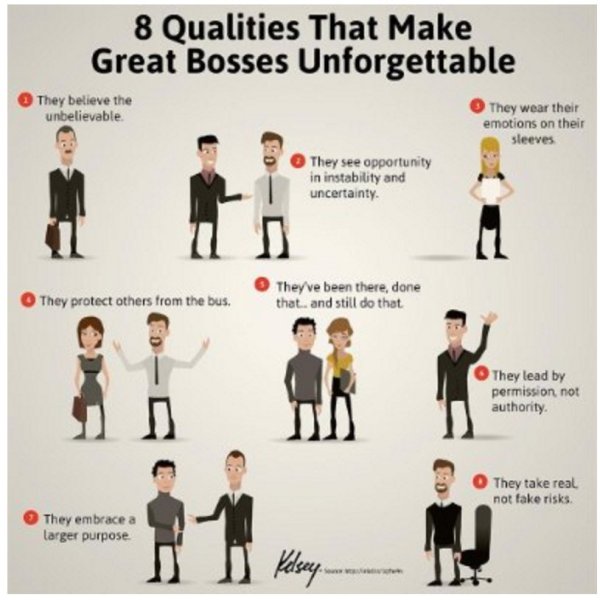
Monday Morning Moment – Great Bosses and Those Not So Much – What Makes an Exemplary Leader?

Photo Credit: Identity Magazine, Shereen Gaber

We burn entirely too much energy and each other’s time commiserating over bad bosses. We are all best served by remembering the great ones and what it is about them that makes us better for knowing them. When we take the time to puzzle out what makes for a great boss, we have the path marked for becoming that sort of boss…or leader…ourselves.

Last week, I discovered a piece on great bosses by seminary dean and leadership writer Chuck Lawless. In a bit, you will read his 10 characteristics he puts forward as common in his personal experience of top ten leaders.

10 Common Characteristics of the Top Ten Leaders I’ve Ever Worked With – Chuck Lawless

First though, after i took some time myself, thinking back on what was it about the great bosses I had that distinguished them above all others.

Here are my 10 Characteristics of Great Bosses, in no particular order:

  1. They were trustworthy. We knew they had our back…always.
  2. They had consummate integrity. They were consistent in attitude and action no matter the audience. Even under intense pressure, whatever it cost them, they stood their ground for what mattered.
  3. They showed faith in me and each of us on the team. Not just to get the job done but to do it as only I/we could.
  4. They (those male leaders) didn’t treat us women differently. In fact, if they ever did seem to treat us differently, the great ones modeled a valuing of what the women brought to the conversation. Great leaders never diminished us, either overtly or covertly.
  5. They showed genuine care, even fondness, for us. They didn’t just spend their best time and energy on work meetings outside our team. They actually carved time out with us as a team for seemingly the sheer joy of it.
  6. They gave us a voice in the decision-making…especially as it related to our particular work and how we thought it should be done.
  7. They knew us well enough to call us on our own character stuff. It was never just about the work, the project, the product or service. It was about our own growth.
  8.  They kept a sense of humor and regularly brought perspective. This wasn’t just about lightening the mood; this was about returning our thinking to the bigger picture, the greater good.
  9. They provided opportunities for each of us to keep growing and developing professionally.
  10. They pushed us in meaningful ways toward a shared vision…to keep our focus and stay on track.

That’s my 10 in looking back to the many great bosses…invaluable leaders…I’ve had in my career.

Dr. Lawless’ 10 Common Characteristics are these (go to his article for helpful commentary on each).

  1. They know Christ. – (his article was to a Christian audience. Still, many consider Jesus of Nazareth the greatest leader who ever lived.*)
  2. They continually dream about what’s next. 
  3. They trust the team they’ve enlisted. 
  4. They take care of their team. 
  5. They read present-tense reality well. 
  6. They get a lot done while still taking time off.
  7. There is no pretense in them. 
  8. They know the organization is bigger than they are. 
  9. They laugh a lot. 
  10. They adore their family and make time for them. Chuck Lawless

12 Characteristics of Effective Team Members – Chuck Lawless

*The Greatest Leader of All – Geoff Loftus

Whatever experience we have had with great bosses or those not so much, we can learn from them. I was glad to have Dr. Lawless’ prod to look back on the leadership in my own life. It was remarkable how both great bosses and bad ones hang in our memories. One day I might write about the bad ones – and I have stories… Today, I just want to think about them with compassion, figuring they didn’t get to that place without being negatively influenced somewhere along the way.

As for those great bosses…the ones who lead brilliantly, with genuine care and provision for those who work under them…here’s to you. May we learn from you, follow hard after you, and not be shy to show our own appreciation and consideration for you as well.

Photo Credit: Twitter, David Chou

In closing, I would love to hear about some of your great bosses… those leaders in your lives that stand out in your memory (or present experience). Please comment below. Feel free to tell stories or give tributes. We can celebrate together!

Are You a Great Boss? – John Lynn, Healthcare IT Today

Four Types of Bosses You Need to Avoid – Shereen Gaber

Photo Credit: Workboard