Category Archives: Critical Thinking

Monday Morning Moment – the Art of Argument

We were younger than we thought. Fresh out of graduate or med schools. In our first big real-world work. Most Saturdays in those days, we met for breakfast at Horton’s (now a Chipotle) and lingered over coffee. Talking about life and how to solve the problems around us. We didn’t always agree, and sometimes we got loud and passionate…but never unkind. We loved each other after all. We also cared about the same things but often saw those very same things differently.

Each going our separate ways those Saturdays, we had learned from one another. Always coming away with a larger sense of what it takes to make a better world. We valued our debates, our arguments, as much as our happier takes on life. Civil and thoughtful – with space to disagree.

A few years later, we all relocated across the US, in next real-world jobs. I took a teaching post at Yale University. My first foray out of the South. There, I had the same experience as with our Saturday morning breakfast club. Lively debate on life, university regulations, student issues, course content, and the politics of the day. I was definitely an outlier on some of the topics, being one of the youngest on faculty and from a part of the country sometimes maligned for its thinking. Still, the grace and respectful interest given to me by my colleagues again gave room to grow…maybe for all of us as we wrestled together things that mattered. The experience of belonging also breathed consideration into our arguments. We shared commonalities. A tenure track respected no one over another.

Recently, a lawyer friend of mine, in Seattle, sent me the following article on this topic of argument or dissent:

The New Truth – When the Moral Imperative Trumps the Rational Evidence, There’s No Arguing – Jacob Siegel

What we are witnessing, in the rapidly transforming norms around race, sex, and gender, is not an argument at all but a revolution in moral sentiment. In all revolutions, the new thing struggling to be born makes use of the old system in order to overthrow it. At present, institutions like the university, the press, and the medical profession preserve the appearance of reason, empiricism, and argument while altering, through edict and coercion, the meaning of essential terms in the moral lexicon, like fairness, equality, friendship, and love. That the effort wins so much support speaks to the deep contradictions and corruption of American meritocratic institutions, and of the liberal individualist moral regime it seeks to replace.

Moral revolutions cannot tolerate ambiguity, but there is so much that I’m not sure of. How does one argue with this new form of truth? Not in the old way. Not by taking the bait.Jacob Siegel

Siegel writes about the lost art of argument. His is a long and scholarly piece very worth the read. In brief, he states a strong case of how American culture, in particular, has become intolerant of reasoned debate. Pick the issue, and folks line up on one side or the other. If you are not on my side, then you are dead wrong. More than just wrong, you are a racist, sexist, fascist, Communist. And so it goes…far from the days of civil disagreement.

Photo Credit: Prezi, Christopher Lasch, Stephanie Rugo

I am still hopeful.

In the midst of all the meanness, especially in this election year, with political debates upon us, I believe we can turn this around.

Surely, we see the danger of hateful, polarizing exchanges. Part of our dilemma is that we are less face-to-face than we used to be. Before email and social media. Before COVID.

It’s too easy to use social media to make a public case on an issue and then dare someone to expose her biases and disagree.

I’m so thankful to have friends and family who allow for arguments on issues of religion, politics, etc. but without attacking.

The key to the art of argument is our persistent care for the person across from us. We may not love them, may not even like them, but we refuse to belittle or grow contempt for them. We refuse.

We determine to show respect, no matter how hot the argument becomes. We learn how to deescalate because the person matters more than the problem.

Scott Sauls speaks often on this matter of argument. His Tweet below expresses it better than I can.

Twitter source: Scott Sauls

“Attack problems not people…especially problems that attack people.”

Although in the public arena we see too much ungracious confrontations, we can find exceptions. I’ve taken to watching Blogging Heads on YouTube. On split-screen, two people (often educators but others as well) tackle some of our most pressing societal issues. They have been immensely helpful to me. Equipping their listeners on how to problem-solve and see issues in ways we might not have before. Mentoring on how to have respectful, thoughtful discussions on topics they may or may not agree on…but they amicably agree to disagree.

Twitter source: Ian V. Rowe

The art of argument (debate) doesn’t have to be lost. We can choose to weigh in on matters of extreme importance without taking the other person to the mat. Stating our reasoning without condescension. Listening, learning, allowing that we could be missing some part of the issue. Whether or not we get the same treatment, we both lose if at least one doesn’t remember the person in front of us has greater value than winning the the argument.

In closing, you’ll find two clips from Denzel Washington‘s 2007 film The Great Debaters. The plot is based on the true story of the rising debate team of the historically black Wiley College. The time was the 1930’s during the era of Jim Crow. The place, Texas. Washington played the role of Melvin Tolson, the outspoken debate coach. These two clips are riveting examples of an argument and a debate…and how it might be done again.

Thoughts? Please. In the comments below.

The Art of Having a Productive Argument

The Lost Art of Argument – Stephanie Rugo

YouTube Video – The Art of Argument – Jordan Peterson

Social Control and Human Dignity – Ben Peterson

5 Friday Faves – Shrek Revisited, 200 Days, Humanity Over Politics, Civil Thought & Voices, Mushrooms Everywhere

Here we go! Friday Faves late edition.

1) Shrek Revisited – The Fairytale theme from the movie Shrek (by English composers Harry Gregson-Williams and John Powell) is  sweetly suited to classical guitar. Especially arranged and performed by Beyond the Guitar‘s Nathan Mills. Enjoy.

2) 200 Days – It’s been 200 days of physical distancing and wearing masks in public. Over half a year. COVID-19 has been a global health threat for many months now. We have learned so much in how to prevent, mediate, and treat. It’s become a political issue which is unfortunate and unfair. It is a novel virus. We are all learning.

For me, the biggest thing, after not contracting the virus, is how to navigate life with physical distancing. I’ve found instead of my capacity for work and people growing, it has contracted. Fatigue is a daily issue to battle. This is so curious since we are in the physical lives of far fewer people…and much of the clutter in our work lives has been removed.

Still…we are challenged to stay in play in life and relationships. I really appreciated the counsel of the two articles below. Won’t elaborate here, but read what you need…and don’t give in to the sluggishness of this constrained life. It will get better or stay different – we want to effectively meet the challenge whatever it is.

The Nine Habits to Increase Your Energy – Scott Young

How to Build Closer Relationships – Advice from 7 TED Speakers on Creating Better Connections – Kara Catruzulla

Photo Credit: Spencer Seim, Facebook

3) Humanity Over Politics – “Don’t let politics take away your humanity. Don’t let the fact that you agree or disagree with someone on various issues, don’t let that stop you from having sympathy for them, compassion…In general, people need to stop trying to dunk on people, insult people, dunking on people when they are…sick, going through dark times. It’s just despicable behavior. This is not me virtue-signaling. This is just me trying to encourage you to be a decent human being. Humanity over politics always!”Zuby

I follow @ZubyMusic on Twitter. This young man is British with an international accent (sounds American to me, raised and schooled in Saudi Arabia). He is truly brilliant with a wide range of giftings – podcaster, rapper, health/fitness coach, author, and culture commentator. He seems to truly care about people…and even us Americans, which is so refreshing. I learn from him daily.

4) Civil Thoughts and Voices – Who are those in your lives? Please comment below and let us in on those we might want to learn from, as well. On the Christian front, writer/pastor Scott Sauls is one of those for me. His book A Gentle Answer: Our ‘Secret Weapon’ in an Age of Us Against Them is a great resource.

In the last several weeks, you have heard me rave about economics professor and social scientist Glenn Loury. He is one of the thought leaders in our world today, and his voice has helped me stay calm in a world gone crazy. He is weekly on a YouTube Blogging Heads episode and also on other media platforms. This week, Loury speaks with Ian Rowe on education and society. There is not one dry point in this whole conversation.

Hope-giving. Whatever your biases or preconceived notions are, Do. Not. Miss. This. Especially if you love children.

Rowe is currently a fellow with the American Enterprise Institute, focusing on education and upward mobility, family formation, success sequence, adoption, and poverty studies. If you truly care about issues related to racism, poverty, opportunity, and family, you want to read everything he writes…and talk about it with whomever and wherever you have a voice.

[Rowe also talks about the role of not only individuals but mediating institutions who will add to the conversation and strengthen the solutions.]

The Power of the Two-Parent Home Is Not a Myth – Ian Rowe

1776 Unites – free US history curriculum, alternative to 1619 Project

Photo Credit: Facebook, Chris Bear & Wendy McCaig

The Politics of Spin and Culture War Fatigue – Scott Sauls

Six Tips for Speaking Up Against Bad Behavior – Catherine A. Sanderson

5) Mushrooms Everywhere – The natural world around us is full of wonder and surprises. I had the pleasure of a walk in the woods this week. Highlighted by a closer to the ground view by two small grandchildren. They spotted and we marveled at the incredible array and variety of mushrooms and fungi growing on the forest floor and downed logs.

We see mushrooms pop up in our yards overnight. How do they do it? Seemingly out of nowhere. Not tackling that here, but you can find several timelapse videos of mushroom growth on YouTube.

For today, I just wanted to post some (not all) of the mushrooms we discovered on that one walk. Phenomenal!

Time-lapse video of composting worms – ok, so this has nothing to do with the above topic, but… When my husband takes the grandchildren fishing, they fish with worms. Dug up from our compost pile. Except for the creepiness factor, it amazes how worms can turn garbage into compost, and over a very short amount of time.

___________________________________________________________________________

That’s it for this week. Hope you had a great weekend (given this is posted after the weekend instead of on Friday). Stay well out there.

Bonuses:

COVID-19 Emergency Measures and the Impending Authoritarian Pandemic – Stephen Thomson

Here’s How US Presidents Get Elected (It’s Not Be Winning the Most Votes) – the Electoral College Explained – John Letzing

Warren Buffett Says This 1 Simple Habit Separates Successful People From Everyone Else – Marcel Schwantes  – In case you don’t read the article, the habit is that successful people say “No to almost everything”. Schwantes also quotes Steve Jobs and Jim Collins on how we make our decisions in choosing what really matters to us.

“Every ‘yes’ you say means a ‘no’ to something else.” – my husband, Dave

Twitter source: Kenneth Williams

“There are times in the experience of almost every community, when even the humblest member thereof may properly presume to teach — when the wise and great ones, the appointed leaders of the people, exert their powers of mind to complicate, mystify, entangle and obscure the simple truth — when they exert the noblest gifts which heaven has vouchsafed to man to mislead the popular mind, and to corrupt the public heart, — then the humblest may stand forth and be excused for opposing even his weakness to the torrent of evil.” – Frederick Douglass, from Maria Popova’s article “Frederick Douglass on the Wisdom of the Minority and the Real Meaning of Solidarity

The following video is an intersection in Cairo, Egypt. I never could bring myself to drive when we lived there, but I loved watching how the drivers made their way through all the traffic. Fascinating!

Why the World Needs Heroes – Jenn Phillips

I posted this Howard University commencement speech once before – if you didn’t see it, don’t miss it. Chadwick Boseman.

Monday Morning Moment – On Maturity in Temptestuous Times – with Coleman Hughes and Ayishat Akanbi

Photo Credit: YouTube, Coleman Hughes

Who are you? With whom or with what groups do you affiliate? How do you identify yourself?

Important questions in any season.

Today, we sift what people say about their beliefs and ideas and assess value based on their groups and affiliations. We do.

For the last several months, we have had the opportunity thrust upon us (if we weren’t so engaged before) to think deeply about what we believe. Now the temptation exists, as we are very much communal beings, to go with groups…groups we have always trusted.

Groups (and group-think) are fluid. Our tendency is to think they are fixed, but they are not.

Of late, I’ve been trying to be diligent to seek out people who don’t look like me, who don’t necessarily think like me, with the goal of listening and learning. Face-to-face is best and most fruitful. However, with COVID and affiliations (associations) too homogeneous (unfortunately), I’ve often resorted to finding these thinkers on-line.

Writer philosopher Coleman Hughes and stylist culture commentator Ayishat Akanbi recently had an immensely helpful conversation. On maturity. On curiosity over defensiveness. You can watch/listen to this bit (a mini-clip) of their conversation here or the whole conversation here.

In fact, below you will find some of Coleman’s and Ayishat’s conversation. I wish there was a transcript for the whole podcast but this segment was so powerful, it’s right here:

___________________________________________________________________________

ColemanMaturity is being able to hear something undesirable about your in-group and view it objectively instead of defensively.

AyishatIt seems to be one of the foundational problems of everything. We cannot hear anything undesirable about a group that we belong to. We are only willing to accept the narrative…only willing to look at the part of the story that focuses [outwardly]. We’re not allowed to acknowledge that any problem could potentially start at home.

We just want to outsource blame constantly.

Conversations are very stagnant.

I prioritize curiosity above many things. If someone was to say something negative about me, before I get defensive, I’m just like, “Hmmm, interesting. I wonder if this is true.” I’m more likely to interrogate at first. If we’re able to look at something with more curiosity than defensiveness, we’re in a better position.

I just think if we’re if we recognize having undesirable aspects of our communities or groups…it doesn’t mean they’re bad; it doesn’t mean you’re a wrong person. It’s a little texture. It think we just see everything as good or bad.

ColemanJust like a person can have flaws and imperfections, a person of maturity can see their own flaws and always be curious about them. If your significant other says, “Hey, you have this thing you always do and it makes me feel bad.” Maturity in that moment is the ability to say, “Wait, are they right? Let me think about this.” Maybe they’re not, but maybe they are.

We all recognize that’s true of the individual case, but when it comes to groups, it seems people aren’t able to do that.

Conversations with Coleman

__________________________________________________________________________

I’d like to close with a bit of transparency. I am a follower of Jesus Christ, which, for me, includes trusting that God has preserved and protected every word of His message to us through the Holy Scriptures. In religious circles, I identify as evangelical, not deterred by our culture’s attack on evangelicals right now. Trying to be curious and not defensive about that. Growing up during the women’s rights movement (ERA), the shockingly late desegration of schools, and Roe v. Wade being made law. Same sex attraction became especially real to me when a cherished friend in college sought a romantic relationship with me. A deep personal loss when she ended that friendship because I turned out to be un-altering in my heterosexuality. Always captivated by politics, I was staunchly liberal and a Democrat…until I wasn’t. Today my politics are more conservative, even Republican, but driven by policy rather than personality. I am an older white woman with all that seems to communicate.

Daughter. Sister. Friend. Nurse. Wife. Mother. Gram. Writer. [Decided I couldn’t leave any of these out. More for me than you.]

How many sentences into the above paragraph did it take, if you don’t know me personally, to think either better of me…or worse? Believe me, I have been there…and, too often, done that.

We have an opportunity before us…to stop thinking we know people by the groups with whom we align…to stop judging people by only what we think we see without learning how we came to that way of thinking. Listen and learn. Outsourcing blame only keeps us divided from one another.

If we want our grandchildren to have a world to thrive in, we can teach them how to listen, learn, and then live according to the greatest good possible. I saw a billboard this weekend. It was a stark black background with the white letters emblazoned brightly: “Love One Another”. For me, it was immediately refreshing and comforting as this is something Jesus taught and lived without exception…even calling us to also love our enemies. On the billboard, the message was attributed to The Beatles band member George Harrison.

The message is true. If we bristle, it’s because our group alignment is showing. The message is still true.

[Postscript: the quote below really has nothing to do with the post above. I just love it because it is a personal struggle, and because I’m listening to Ayishat (the “t” is silent in her name) A. Akanbi.]

Photo Credit: Pinterest, Instagram

Sunday Reflection – Am I My Brother’s Keeper? – On Neglect – Part 1

Blog - Neglect

[From the Archives]

Then the LORD said to Cain, “Where is Abel your brother?” He said, “I do not know. Am I my brother’s keeper?” – Genesis 4:9

We must give the more earnest heed to the things we have heard, lest we drift away. For if the word spoken through angels proved steadfast, and every transgression and disobedience received a just reward, how shall we escape if we neglect so great a salvation?…Therefore, in all things He had to be made like His brethren, that He might be a merciful and faithful High Priest in things pertaining to God, to make propitiation for the sins of the people. For in that He Himself has suffered, being tempted, He is able to aid those who are tempted. – Hebrews 2:1-3, 17-18

Neglect/Neglectful to leave behind, to omit by carelessness or design, to slight, to omit to receive/embrace, to disregard, to be inattentive, to become accustomed to omit what may or ought to be done.

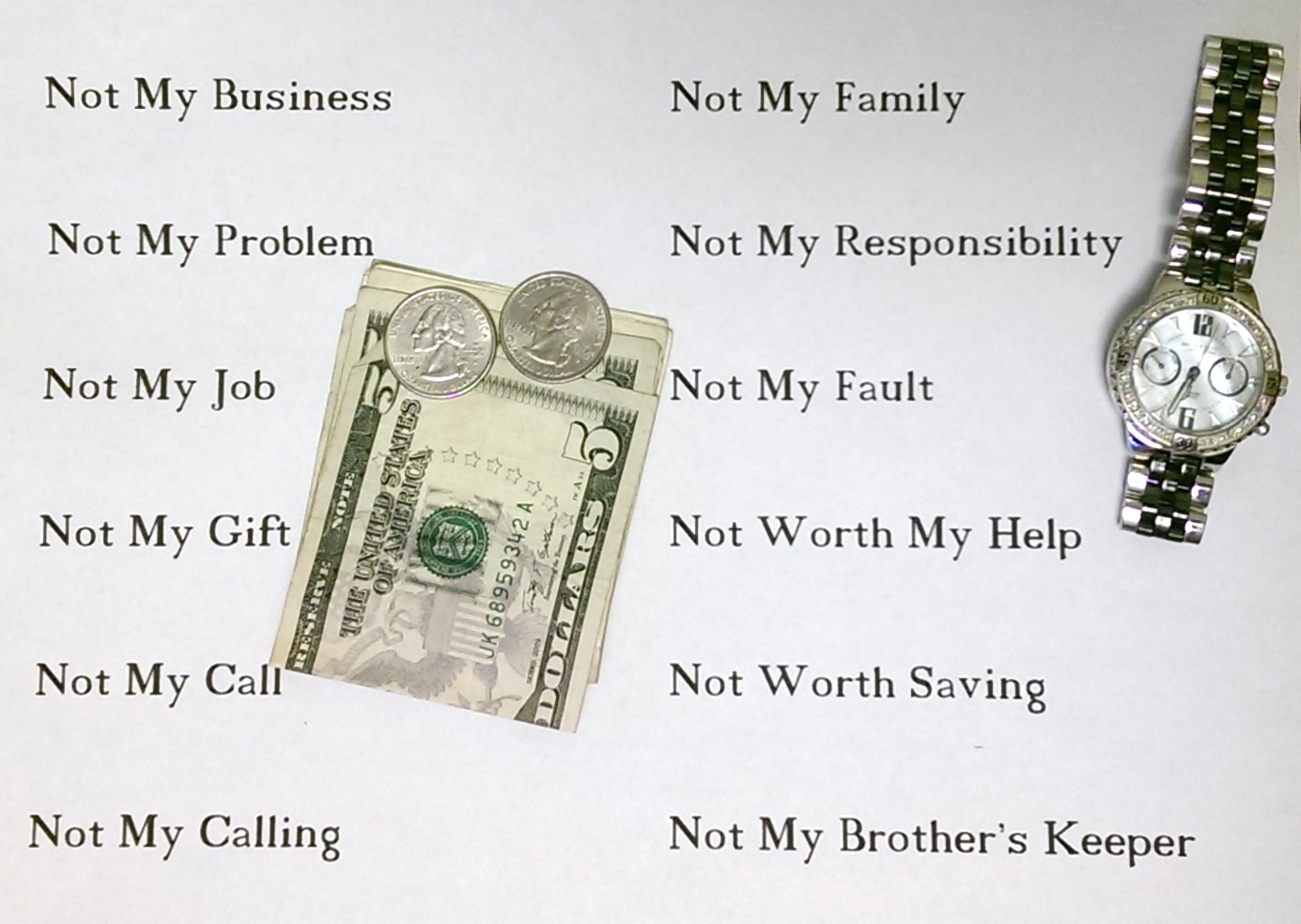
Who wants a life riddled with gaping holes of neglectfulness? Or who wants to leave a heritage of neglect. Who? Yet it can happen ever so subtly in our pursuit of safety and security, circling our wagons tightly around what personally matters most to us.

And the rest of the world?

Not My Business

Not My Problem

Not My Family

Not My Job

Not My Call

Not My Responsibility

Not My Fault

Not My Gift

Not My Calling

Not Worth My Time/Money

Not Worth Saving

The most winsome thing I know of God is that He loves the whole world (John 3:16). I don’t want to line out my life…set boundaries… such that some around me are more deserving of grace than others…that some are worthy of aid or intervention but others are not…that some are outside of the Gospel and others, by “accident” of geography or opportunity, are not.  As citizens of the Kingdom of God, we have been given a great salvation – “so great a salvation” that we cannot neglect His intent of it, for our sakes, and for those around us. There is no such thing as benign neglect.*

We, individually and corporately, can’t save the world, as much as we would like. However, our humanity,  with whatever perceived limited capacity we have, was meant to glorify God by our nature and pursuits. We can determine to live lives faithful and pleasing to God – “to do justly, to love mercy, and to walk humbly with  God” (Micah 6:8).

If you look at the list of “not’s” above, you may, like I do, see phrases we’ve used before for decisions made and actions not taken. Look now at some of the antonyms for neglect – what it is to not yield to being neglectful – intentional, diligent, constant, loving, inclined, conscious, determined, caring, keeping, dedicated, patient, carrying through, preserving, mindful, attending, cherishing, conserving, celebrating, listening, nourishing, obedient, inspiring, giving, remembering, redeeming, watchful, purposeful.

With so great a salvation that we have received, how could we choose to be any other way toward others?

“To fail to exhibit that we take truth seriously at those points where there is a cost in our doing so, is to push the next generation in the relative, dialectical millstream that surrounds us. ” Francis A. Schaeffer

Part 2 is here.

Denzel Washington, Martin Luther, and Our Strange Neglect of the Bible

Francis A. Schaeffer – a modern-day prophet, author of How Shall We Then Live?

The Age of Personal Peace and Affluence

Do Not Neglect the Weightier Matters of the Law

Charles Spurgeon’s Sermon on Neglecting Our Personal Work in the Kingdom

 Forgotten God: Reversing Our Tragic Neglect of the Holy Spirit

Worst-Case Scenarios: The Problem of Neglect

*“Benign” neglect  – a noninterference that is intended to benefit someone or something more than continual attention would.

Monday Morning Moment – Sensitiveness – This Might Not Be About You

Photo Credit: QuickMeme

Adapted from the Archives

The word “victim” is one I rarely use because the word itself further victimizes the person. Sometimes we may intend to wound with our words, but often we just state/post a thought, viewpoint, or opinion having no idea what a strong and public reaction we may receive in the aftermath.

Just yesterday, I was in a Twitter conversation where what I said exploded a barrage of words (from passersby not the person with whom I was engaged). My person (we follow each other but don’t know each other) had been victimized by an awful situation and I was trying to comfort and reason with him over it. Then the attacks came (not from him but from others). The words “Karen”, “gaslighting”, “oppressor”, and a “cishet” Christian (not in a good way) were used to describe me (I had to look up the linked words).

We stick to our own in life, in a way to enjoy a certain measure of understanding and acceptance. If we stay surface enough, we hopefully don’t offend, don’t disturb the sensitiveness of another.

Decide to go deeper or venture out among those different from us (be it politically, or gender identity, or race/ethnicity), in our current culture, it can get messy.

I want deep and wide relationships with people, but at times, I will mess up or be misunderstood. Our social media walls can get full of the most always graffiti, well-deserved, others might say.

Real face-to-face conversation and not fleeing the scene can both help…at least the relationship. The passer-bys? Not so much. I want to scream sometimes, “This might not be about you.”

Photo Credit: Flickr

I digress…

Years ago, my best friend and I went on a cross-country sight-seeing trip. Our plan was to camp out a couple of nights and then stay in a hotel for the third, and continue in that rhythm for the two weeks we were on our adventure. It didn’t always go well. I loved camping; she preferred the hotel. Our food preferences were more different than we realized. We did, fortunately, agree on the “not to be missed” aspects of our journey across America.

Along with all the great memories made, we had some humdinger disagreements through the course of our time away and returned home even better friends as an outcome. However, it didn’t come easily for either of us.

It turns out I could majorly stomp on her feelings without even knowing that was happening.

First, you must know I never intended to plow through her preferences to race toward my own. She was my dearest friend. It gave me joy to see her happy. Still…somewhere I crossed a line.

We have both matured greatly since then so this can encourage you…it has encouraged me in more recent times when I find myself in similar situations.

In our responses to one another, as friends, family, colleagues, (even strangers on social media) we can discover things both about ourselves and about the other.

Emotions are different from feelings. I’m not going into the physiological pathways or mental habit formation of all this, but the quote below by Debbie Hampton is very helpful:

Feelings and emotions are two sides of the same coin and highly interconnected but are two very different things…Emotions originally helped our species survive by producing quick reactions to threat, reward, and everything in between in their environments. Emotional reactions are coded in our genes. Emotions precede feelings, are physical, and instinctual. Feelings are sparked by emotions and colored by the thoughts, memories, and images that have become subconsciously linked with that particular emotion for you. But it works the other way around too. For example, just thinking about something threatening can trigger an emotional fear response. While individual emotions are temporary, the feelings they evoke may persist and grow over a lifetime…In the gaps between emotion, feeling, and acting, we all have the power to change and direct our lives for the better. “Debbie Hampton

In the milliseconds between any stimulus and our response to it, we can choose how we will respond emotionally. However, because we have set a course “over a lifetime” of responding certain ways, emotional patterns (feelings) are formed and put into practice. We can change these, if we find them detrimental to our physical, emotional, and relational lives.

That happened between my friend and me. In close proximity, for two weeks, our daily experience being very dependent on the other, we found we could each be irritating. The statements “That hurt my feelings” or “You hurt my feelings” became her lament…this from an accomplished teacher and successful manager of a classroom of tiny people.

For me…inconceivable. I loved her and had no desire to hurt her, ever. Still, it happened.

[By the way, this expression of sensitiveness using the word “feelings” may be more encountered in women, but men have some similar experience – you know you do – but call it different things. “Offended”, maybe? “Annoyed”? Is that where sarcasm or cynicism is birthed?]

Back to the story: In some way, my behavior set off for my friend emotions that were tagged by past feelings of being discounted, not considered, not favored. It wasn’t pretty…for either of us.

Fast forward, decades later.

We live in a culture of lofty sensitiveness. The measure for political correctness in our speech continues to get moved upward. We are a nation so easily offended that we can’t even discern what is truly intentionally offensive from what is just true.

Have you ever been in a season with a friend or colleague that feels emotionally murky? You don’t really know what’s going on, but you sense something is. Then…you step on the landmine – and you say something or do something or your face shows something – that explodes all kinds of feelings in the other person, from what seems a life-time of storing up.

This is what has now been popularized as weaponizing feelings or emotions. The outcome? Guilt, shame, wounding, and (for some) returning fire.

It will make me sad if this post “hurts feelings”, especially of those dear to me who read the blog. The thing is, just like my friend and me, we can go deeper in our relationships when we refuse to let feelings define our friendships. When we refuse to think ill of others we grow a spiritual maturity and neuroplasticity that impacts our emotional responses and our relational resilience.

What got me thinking about all this, this week was actually a reading from British scholar C. S. Lewis

He talks about the danger of weaponizing sensitiveness long before it became the cultural phenomenon it is today:

“‘Did you fight fair?’ Or did we not quite unknowingly falsify the whole issue? Did we pretend to be angry about one thing when we knew, or could have known, that our anger had a different and much less presentable cause? Did we pretend to be ‘hurt’ in our sensitive and tender feelings…when envy, ungratified vanity, or thwarted self-will was our real trouble? Such tactics often succeed. The other parties give in. They give in not because they don’t know what is really wrong with us but because they have long known it only too well, and that sleeping dog can be roused, that skeleton brought out of its cupboard, only at the cost of imperilling their whole relationship with us. It needs surgery which they know we will never face. And so we win; by cheating. But the unfairness is very deeply felt. Indeed what is commonly called ‘sensitiveness’ is the most powerful engine of domestic tyranny sometimes a lifelong tyranny. How we should deal with it in others I am not sure; but we should be merciless to its first appearances in ourselves.Preparing For Easter: Fifty Devotional Readings from C. S. Lewis.

After being an atheist, Lewis did not come to faith in Christ until his mid-thirties. His intense study of the Bible, relationship with God, and deep, gut-honest conversations with a circle of intimate friends moved him to such understanding of people and life…and our responses to both.

Any thoughts on this? Please comment below.

Preparing For Easter: Fifty Devotional Readings from C. S. Lewis

What Is the Difference Between Feelings and Emotions? – Debbie Hampton

The “Weaponizing” of EmotionsWade Trimmer

The A-Z Guide to Feelings and Emotions – Sebastian Gendry

Monday Morning Moment – Neuroplasticity – Resetting Your Brain for Success at Work and Life – Deb Mills

Inner Circles – the Mad Pursuit of Position, Power, Prominence, and Plenty – Deb Mills

Invisible Wounds of the Sensitive, Empathic and Emotionally Intense Child – Imi Lo – this is a sobering, emotionally charged article. I resonated with it in preparing for the blog above and include it because it might be helpful for some to read. Just a warning that it is hard to read because it honestly did not give much place for hope. [If I missed it, please illuminate me in the Comments below.] Maybe the hope comes in recognizing what we as parents might be doing that’s hurtful to an emotionally intense child and correct course.

Sunday Reflection on a Very Present God and the Faith to Believe

Photo Credit: Flickr

[Adapted from the Archives]

For by grace you have been saved through faith. And this is not your own doing; it is the gift of God.Ephesians 2:8

For the first twenty years of my professional life, my great privilege was to have close encounters with people in deep crisis and five life-changing realities. It was a season of caring for cancer patients and their families – when their diseases were raging and in the final days of life. These experiences galvanized my faith in God and how his image is embedded in us – his creation. These realities are:

  1. Courage in exceedingly hard places
  2. Deep enduring love across a harsh illness and when time is fleeting
  3. Hope mingled with humor
  4. Death isn’t final…our spirits go somewhere (for sure, they leave the body)
  5. Faith to believe

Caring for patients receiving chemotherapy and other treatments for life-threatening complications can prompt an intimate caring relationship. To watch patients (and families) deal with such hard and to be in a position to help them through it gave me a window to extend love and honor to dear ones in crisis.

Was there always courage? Was love always expressed between us all? Was humor or hope or faith a constant?

No…but remarkably, more often than not, this was what I observed… especially in those sustained by a relationship with God.

In the last couple of years, I have personally experienced a cancer diagnosis and a couple of respiratory emergencies that brought those same realities into my life. In such times, much in life gets clarity…a sharper focus, a deeper understanding.

Breathe has been a theme in my life for over a year now…put that together with the title of a film starring Andrew Garfield…and it caused me to NOT “skip the ad” on YouTube.Photo Credit: Breathe, YouTube

The film Breathe tells the story of Robin Cavendish. He was a Brit who developed polio at the young age of 28. He was paralyzed from the neck down and required a ventilator to breathe. In those days (1958), he would have been confined in a hospital for the remainder of his days. However, he nor his wife, Diana, would hear of it. After a year in hospital, he went home and adjusted to this very different life, as only Robin would. They had a child and he would be able to see him grow up (in fact, son Jonathan Cavendish produced this film). Robin was a pioneer in advocating for the disabled, especially those like him needing more extreme measures to live a more normal life. He died at 64.

[Since my years in graduate studies in rehab and cancer nursing…the courage I saw in so many patients and families…courage in struggle…has never ceased to inspire me.]

“Based on a true story” films are intriguing. Reading up on Robin Cavendish’s story, my heart soared and then sank…fullstop at the short statement below:

Cavendish was an atheist.Wikipedia

I have never understood atheism. Even during spiritually flat and confusing times in my life, the existence of God put me to puzzling but ever so briefly. In a matter of moments of reflection, the fact of His presence blew past the questions.

Especially watching beloved believing patients at the moment of death…their faces relaxing and their bodies emptying of who they really were. We don’t just stop existing…life here stops and starts at exactly the same moment…There.

Now that I know Robin Cavendish, he has my admiration and respect at how he took back his life and helped others do the same. I wonder if, before his life was done…he had the faith to believe. One line in his obituary reads:

It is a strange irony that, though professing to be an unbeliever himself, he had a capacity for making other people feel closer to God.*

*Obituary – Robin Cavendish – Alice and Tim Renton

What a great gift is faith to believe. We don’t conjure it up. God Himself presents us the faith to believe…it is ours to reject or receive.

Worship with me. Below you will find two songs – Faith to Believe by Shane & Shane and Jesus Is Better by Austin Stone. Choose either or both in celebrating the God who gives us the faith to believe. [Then scroll down to the prayer at the end.]

YouTube Video – Shane & Shane – Faith to Believe – (with lyrics)

Give me the faith to believe You
When I’m stuck here in my fear
Give me the strength to trust You
When my vision’s blurred by tears
Give me a hope for tomorrow
Because today has gone so wrong
I’m on my knees
Give me the strength to believe

Even when I cannot see You
You’re still shining, You’re still shining
Even when I cannot hear You
You’re still calling out my name
Even when I cannot see You
Your arms are open
Always holding on to me
Give me the faith to believe

You say You’ll never leave me
Your love will conquer fear
You say Your day is coming
When You’ll wipe away my tears
Give me a hope for tomorrow
Because today has gone so wrong
I’m on my knees
Give me the faith to believe

Give me the faith to see the invisible
Give me the faith to believe the impossible
Give me the faith to receive the incredible
Oh give me the faith to believe it**

There is no other so sure and steady, my hope is held in your hand
When castles crumble and breath is fleeting, upon this rock I will stand
Upon this rock I will stand

Glory, glory, we have no other king
But Jesus Lord of all
Raise the anthem, our loudest praises ring
We crown Him Lord of all

Your kindly rule has shattered and broken the curse of sin’s tyranny
My life is hidden ‘neath Heaven’s shadow, Your crimson flood covers me
Your crimson flood covers me

Glory, glory, we have no other king
But Jesus Lord of all
Raise the anthem, our loudest praises ring
We crown Him Lord of all

In all my sorrows, Jesus is better – make my heart believe

In all my victories, Jesus is better – make my heart believe

Than any comfort, Jesus is better – make my heart believe

More than all riches, Jesus is better – make my heart believe

Our souls declaring, Jesus is better – make my heart believe

Our song eternal, Jesus is better – make my heart believe

Glory, glory, we have no other king
But Jesus Lord of all

Glory, glory, we have no other king
But Jesus Lord of all
Raise the anthem, our loudest praises ring
We crown Him Lord of all

Glory, glory, we have no other king
But Jesus Lord of all
Raise the anthem, our loudest praises ring
We crown Him Lord of all***

Photo Credit: Flickr

Maybe this is the first step for atheists, too (it was for me)…so thankful for the faith to believe…to see the truth and beauty of Scripture. The Word of God walks us right up the staircase to be with Him – now and forever.

Thank You, God, for the faith to believe. With my whole being, I’m sure you daily, moment by moment, extend grace to all of humanity to know You, through one witness of Yourself or another. Help us to receive this grace. God, give us all this faith to believe.

**Lyrics to Faith to Believe – written by Shane Everett & Phil Wickham

***Lyrics to Jesus Is Better – written by Aaron Ivey & Brett Land

Monday Morning Moment – Building Our Own Personal Surge Capacity in the Longer Stretch of COVID-19

Photo Credit: Long Running Living

Let’s talk about capacity! I’m still working on my Monday blog on a Tuesday. One of the fall-outs of COVID.

What started, in our country, as a sprint in March is turning into more a long-distance run. 6 months now. 184 days thus far of physical distancing (for this medically at-risk person).

Remember how we first thought it might be just 2 weeks of quarantining to eradicate the threat? OK, I was super-naive.

We’re becoming weary of certain words and phrases. Pandemic. Unprecedented. Uncharted. New normal. We’re all in this together. Even social distancing. [I was thankful when that phrase went out of vogue and “physical distancing” replaced it. “Social distancing” put a wrongful prescription on its hearers. We need to physical distance, yes, but never social distance. We have learned.]

Remember when surge capacity became a worrisome phrase in our daily news cycle. Will our hospitals have enough ICU beds and ventilators to properly care for the rising numbers of persons with grave cases of COVID? That was the fear. We heard the daily troubling reports from New York state officials. Those reports were heard, and hundreds of ventilators were sent, as well as the provision of field hospitals, even the arrival of a huge hospital ship.  Peak hospitalizations with COVID have passed for now. Surge capacity tested and proven ample.

Why does this matter?

Each of us has our own surge capacity (related to stress, trauma, loss). During COVID, we are all having it tested. Some more than others. I think of parents trying to juggle work, child care, and monitoring schooling. Teachers preparing in-class lessons and teaching remotely as well in the various hybrid programs. Essential workers. First responders. Hospital personnel.

Here is a general definition of capacity-building. It is where we are.

Capacity-building is defined as the “process of developing and strengthening the skills, instincts, abilities, processes and resources that organizations and communities need to survive, adapt, and thrive in a fast-changing world.” An essential ingredient in capacity-building is transformation that is generated and sustained over time from within; transformation of this kind goes beyond performing tasks to changing mindsets and attitudes. – United Nations Academic Impact

Remember when we first started experiencing COVID (at least in the news)? We had big plans for the physical distancing and working remotely and the time we would recoup in that experience. We would take a college course, learn a new language, renovate the house, or declutter our lives.

Then we were surprised at the sluggishness that we encountered. The dullness. The quiet that gradually turned into isolation.

We mentally prepared for a sprint, but the rules changed. We had to change how we ran to set our minds and bodies for a longer run.

Science journalist Tara Haelle recently posted an excellent piece on human surge capacity. “We need to recognize that we’re grieving multiple losses while managing the ongoing impact of trauma and uncertainty. The malaise so many of us feel, a sort of disinterested boredom, is common in research on burnout, Masten says. But other emotions accompany it: disappointment, anger, grief, sadness, exhaustion, stress, fear, anxiety — and no one can function at full capacity with all that going on.”

[Her article is one of a collection of three articles at Medium.com on capacity, power surge, zoom fatigue, and workplace diversity and inclusion.]

Haelle writes in detail on our surge capacity and how we can endure and actually build capacity for this season of prolonged uncertainty. Her main points follow (read her piece for greater detail).

  • Accept that life is different right now
  • Expect less from yourself
  • Recognize the different aspects of grief
  • Experiment with “both-and” thinking
  • Look for activities, new and old, that continue to fulfill you
  • Focus on maintaining and strengthening important relationships
  • Begin slowly building your resilience bank account

We don’t want to fall victim to what seemed like it would be a sprint but has turned into a marathon. Organizational psychologist and professor Adam Grant tweeted wisdom about the problem of becoming sluggish or judging that in others. [I do disagree that we’re all socially awkward now…just pointing to his Tweet.]

Photo Credit: Twitter, Adam M. Grant

Moving into the 7th month of COVID experience, we are making decisions on how to better maneuver. Still committed to safe practices but re-engaging in life with people we love…people whose influence and very presence we have missed in these physically distanced days.

Life is precious. There is a balance in what is real and how we can build capacity to meet that reality. Otherwise life becomes something less. We know what’s working and what’s not. If not, we can counsel with each other. I say we go for it…stretching ourselves out for the long distance run, bringing all those we can along with us.

Forgive the “motivational speechiness” – it’s what happens when I think too long on something and yet lack the answers. Recognition, desire and hope all together birth action…so let’s get after it!

Please post in Comments what is working in your life to build capacity. See you on the road.

[Postscript: The image below is one sort of those “both-and” situations Haelle prescribes. We as parents teach our children had to be resourceful and responsible in hard times, and we also teach them how they might make the world a kinder place for us all.]Photo Credit: The Purposeful Parenting Movement, Facebook

I’m Listening – Talk Has the Power to Save Lives – Radio Show

5 Friday Faves – Beyond the Guitar’s Batman Theme, The Good Ones, Some Favorite Thinkers, The Human Library, and “This Is Your Time”

Lightning fast read. Thanks for stopping by.

1) Beyond the Guitar’s Batman Theme – Nathan Mills posted two arrangements this week – super nice for his fans and community.

The Batman Teaser – film scheduled for release October, 2021

Plus this one:

Brawl Stars

2) The Good Ones – Let’s celebrate those “good ones” in our lives. Country artist Gabby Barrett was inspired by her husband Cade Foehner) to write The Good Ones.

YouTube Video – The Good Ones – Official Video (watch it to the end – sweet story of a couple dealing with her paralysis).

Your good one may be a spouse…or it could include a parent or friend. Thank God, for those who love us well. May we love well also.

3) Some Favorite Thinkers – Fake news abounds these days. Social media gurus don’t deny it. In fact, documentaries are being produced about how we are being manipulated by news and social media makers – The Twisted Truth and The Social Dilemma are two.

As conversations heat up about politics, racial unrest, and COVID (heading toward the US Presidential election), we should check our news sources for where we get our opinions on all the above. Even if we try to sample a mix of liberal and conservative sources, we still have to wonder if what we hear is true. How deep does news and political bias go?

We need to seek out thinkers who themselves are burdened by the state of our streets, our politics and policies, and the next generation. Just thinking we’re right and resting on those laurels will no get us to a better place. Reasoning, thinking deeply, listening, talking together (especially with those with whom we don’t necessarily agree)…we need people who will help guide us through to higher understanding and healthier actions than we see around us.

Glenn Loury and Coleman Hughes are two of those men who currently influence my thinking. You can find them at least weekly in some conversation on their own podcasts or others. Blogging Heads is one of my favorite platforms.

Another fascinating person (on Twitter and his/her own blog) is @EthicalSkeptic. I’m not smart enough to understand most of what he says, but it gives pause (especially related to COVID).

The thing about thinkers…you may not always agree with them but what they say can be a check of your own thinking. Are you teachable? Are you listening? Are you willing to consider?

Three, among the many Christian thinkers I follow these days, are Scott Sauls, Karen Swallow Prior, and Jackie Hill Perry.

Who do you follow? Listen to? Read?

4) The Human Library– Twenty years ago, this non-profit was established in Copenhagen, Denmark. The Human Library was designed to give people an opportunity to just tell their stories to other people. For the purpose of understanding, inclusion, and dealing with prejudice or bias. From what I can gather from the website and this Facebook page, people can gather in a library environment and, instead of reading books found there, they share and listen to life stories. The people are “the books”. I want to know more about this…maybe even figure out how to create such an environment or event.Photo Credit: Facebook, Wieteke Koolhof, Facebook

5) “This Is Your Time”  – The recently deceased actor Chadwick Boseman spoke at the commencement service at Howard University, his alma mater, in 2018. He was magnificent. Boseman told stories about his life – powerful stories of his experiences as a student, a young black man, and a believer in God. He quoted the Bible ( Jeremiah 29:11), about God’s plans for our lives. He urged the graduates to steer clear of victimhood but to move toward their purpose with faith and fortitude.

“…Sometimes you need to get knocked down before you can really figure out what your fight is and how you need to fight it…When I dared to challenge the systems that would relegate us to victims and stereotypes with no clear historical backgrounds, no hopes or talents, when I questioned that method of portrayal, a different path opened up for me — the path to my destiny. When God has something for you, it doesn’t matter who stands against it…God will move someone that is holding you back away from the door and put someone there who will open it for you…if it’s meant for you. I don’t know what your future is, but if you are willing to take the harder way, the more complicated one, the one with more failures at first than successes, the one that’s ultimately proven to have more victory, more glory, then you will not regret it. Now…this is your time.

[In the tweet below, you’ll find the closing comments of this speech.]

https://twitter.com/i/status/1299713576542916608

YouTube Video – Chadwick Boseman’s Howard University 2018 Commencement Speech – 7 minutes into the video is the beginning of his 28-minute powerful speech.

Bonuses:

6 Ways We Make Life Harder Than It Needs to Be – Paul Tripp

De-Escalating a Conflict – Scott Sauls

Are Christians More Confident in Politics Than in Christ? – Eugene Park

Coronavirus: Tests ‘Could Be Picking Up Dead Virus’ – Rachel Schraer

Photo Credit: Of Verona, Facebook

7 years ago, a friend of ours taught English in China for a year. She offered names of her American friends as ways her students could address each other so they could learn name pronunciation, too. This beautiful little girl picked my name. I wonder where she is today and how she’s doing.Photo Credit: Hailey Mullins, Facebook – September 2013

5 Traits of People with High EQ [Emotional Intelligence] – Peter Economy

Worship Wednesday – For Such a Time As This – John G. Elliott

Photo Credit: Heartlight

Finally, brothers, whatever is true, whatever is honorable, whatever is just, whatever is pure, whatever is lovely, whatever is commendable, if there is any excellence, if there is anything worthy of praise, think about these things. Philippians 4:8

The Apostle Paul, guided by the Holy Spirit, penned the instructions above in part of a letter to the Philippian church. He was encouraging the church to deal with a presumed conflict between two of the believers, and then he went on to compel the church to be gentle with each other. Also, he called them not to be anxious but to remember, in everything, to pray with thanksgiving…with the fruit of the glorious peace of God. The “Finally, Brothers….” bit of counsel followed powerfully.

Paul could have been talking to the American church today, in the throes of a contentious political campaign. We as believers agree, for the most part, on Christ and who He is; we do not agree on all things political.

It can get nasty…which is a shame as the world looks on.

Just a couple of days ago, I was drawn into a Facebook conversation with two believer friends, both of whom I know to be gentle, God-fearing people. As more people joined the conversation, it got ugly (you’ve seen and lamented this yourselves, I’m sure). We would never have talked so frankly and harshly in real life.

I pulled out of the conversation….

Not so ironically Philippians 4:8 was our community group’s memory verse for this week.

Pastor writer Scott Sauls, author of A Gentle Answer, addresses the subject of opposing Christian voices in the video below. He states the following: “Three things we all have to have to live in community together are humility, empathy, and putting our life where our mouth is.”

“There’s blood on the hands” of both our parties. Dr. Sauls goes on to talk about how Christians (together, no matter our political party) can come together and “be better at loving the world better than we [government] does” because we put our trust in almighty God and we stand together on behalf of the poor, the marginalized, the born and unborn.

Be encouraged. Press into unity. Pray against division. Forgive one another. Join together to use our collective power (under the authority of Jesus Christ) to make a difference in this troubled world.

John G. Elliott‘s song For Such a Time As This is part of his 1988 album Let All the Thirsty Come. This came to mind as God stirred my heart.

Worship with me if you would:

Each of us was born to hear the holy call

To find our place in God’s unfolding plan

When His voice is heard, it’s glorious to obey

And bear His light and truth to every man

We’re called to be the generation that turns the tide within our nation,

But who will go and who will stand…?

For such a time as this we were born to speak the truth

Anointed words that move the hearts of men

If we are silent now, the Lord will send some other men

Faithful men whose hearts are wholly His

For such a time as this

Each of us was born to know the heart of God

His deep desire to love and to forgive

He does not delight in judgment or in wrath

But calls to all to turn to Him and live.

The words that bring a true repentance

That turn away God’s judgment sentence

Are words that only we can give

For such a time as this we were born to speak the truth

Anointed words that move the hearts of men

If we are silent now, the Lord will send some other men

Faithful men whose hearts are wholly His

For such a time as this

For such a time as this we were born to speak the truth

Anointed words that move the hearts of men

If we are silent now, the Lord will find Himself some other men

Faithful men whose hearts are wholly His

For such a time as this (x3)

In closing,when we read some of the passages (particularly in the Old Testament) which relate to a rebellious people and God’s shaking judgment of His own, they sound strangely familiar to what’s happening now.

…”Fear the Lord your God, and he will rescue you from all your enemies.” However, these nations would not listen but continued observing their former practices. They feared the Lord but also served their idols. Still today, their children and grandchildren continue doing as their ancestors did.2 Kings 17:39-41 (read the whole chapter for excruciating context)

As we see the chaos around us and wonder if a peaceful presidential election is even possible, we must only remember that God has promised He will never leave His people. Even in judgment, He decides what is enough and who executes that judgment. We do not look for saviors in politicians…they are all imperfect. In an odd way, we may be choosing/voting (without the privilege of God’s eyes to see what will come in the future) our “preferred” judgment.

Whatever happens…we must return to the words of our elder brother Paul. We know what we must do – be gentle, don’t be anxious, pray with thanksgiving, rejoice in His peace, and think on what is good…because God is good.

Let’s close on the glorious goodness of God – He is the Overcomer!!

The Saviour: Story of God’s Passion for His People (1994) (majestic choral work – you can find it here in its entirety beginning at minute 9:45 (pick it up at 14:30 with God (powerfully sung by Wintley Phipps) creating Adam.

Take heart, ye children of the Promise
For God will not be mocked
For the Lord will repay,
and His Kingdom remains

Blessed are His children.
Blessed are His covenants
Blessed is His mighty Kingdom
And blessed is the Name of the Lord

Blessed the name of Lord
In power, in glory His Kingdom, His Kingdom will come!
His Promise is now and forever and ever Amen! – Kings of the Earth

Let All the Thirsty Come album – John G. Elliott

Monday Morning Moment – What You Think of Others Matters – Dave’s Wisdom

Blog - What You Think of People Matters - Dave 5

[Adapted from the Archives]

Picture this scenario.

At first, you really liked working with this person. Then, bit by bit, he/she began wearing on you. He is always messing with his phone. Her solution to today’s problem is too labor-intensive. His email responses have become terse. She is late for your meeting. You think, maybe I was wrong about him. He is not the person I thought he was. Maybe, she’s the wrong person on the bus…at least on my bus.

When a relationship begins to deteriorate at work (or home), you are wise to take steps to turn this around as quickly as possible. You could be in a work situation that has been difficult from the outset. It is still possible for you to make inroads in turning that relationship toward a more healthy or positive one. If not altogether, at least from your side. Consider an adage that has had a long and useful run in our family and work.

Your opinion of someone approximates their opinion of you.Dave Mills

There are exceptions, but I have found this to be wise counsel (from my husband, no less) in both personal and professional relationships. When what was a warm, congenial relationship takes a turn toward the negative, you can actually work, from your side, to restore the relationship. Even to take it to a deeper level. It can get more uncomfortable at first, because you have to start with your own thoughts toward that person. How have those thoughts changed?

We send signals to each other – whether we speak or not.

Mom raised us hoping we would be positive, peaceful people – often using the saying from Walt Disney’s film Bambi:

“If you can’t say something nice, don’t say nothing at all.”

Good counsel except for the reality of those conversations that still go on in our heads and color our attitudes, our tone of voice, our preferences, and our decisions.

Let’s say I have an amicable relationship with a colleague, and then something happens. I may not even be aware of it – a misunderstanding, a misconstrued action, an insensitivity unaware. Then a chill develops, or a clear outright dislike. I have a window of opportunity to clear that up. Otherwise, if I don’t act, then a process can begin where I turn around and decide that person is also a jerk and has woefully misjudged me…and off we go.

Remember: This can go both ways. You may have had a few off days with a colleague, and find yourself just not thinking so well of him, then stop it! It’s possible you can keep them from picking up that signal and prevent the relationship from getting more toxic as they decide you’re not so great either.

If I refuse to think ill of another person and discipline myself to be respectful, deferent in my demeanor, and tireless in pursuing understanding, I could restore that relationship. If it doesn’t improve right away, my attitude and actions work for my own benefit and can definitely help rebuild trust with my team members. One day…that relationship may also turn. It’s worth the effort.

Blog - What You Think of People Matters - Dave

Job coach and writer Jon Acuff talks about the four ways we invest in our careers – through skills, character, hustle, and relationships. In an interview with LifeReimagined.com, he had this to say about difficult, or neglected, work relationships:

“Even if you have skills, character and hustle, without relationships, it’s the career version of the Emperor’s New Clothes. Why?”

“If you don’t have relationships, you eventually don’t have people in your life who can tell you the truth about the decisions you’re making. You don’t have people who can tell you no or question you honestly. What I’ve learned is that leaders who can’t be questioned end up doing questionable things.”LifeReimagined.com interview with Jon Acuff

He identifies three types of people in our lives (work or otherwise, really): friends, foes, and advocates. Jon writes in Do Over:

“The best thing to give a foe is distance. We should ignore most foes. The problem of course is that we won’t. If your definition of foe is too loose and is essentially “anyone who kind of bothers me ever,” your job is going to be miserable. If you see people as your adversaries, it’s almost impossible to have a good working relationship with them. The first thing is to understand whether these foes are clueless or calculated. A clueless foe is that person whose behavior encourages you to fail. They are not malicious. They are not trying to make you lose, but with the power of their influence you are. “Bad habits are almost always a social disease – if those around us model and encourage them, we’ll almost always fall prey. Turn ‘accomplices’ into ‘friends’ and you can be two-thirds more likely to succeed.”Jon Acuff, Do Over

I think what Jon says is true. Because of my own worldview and value system (and married to Dave all these years), I don’t think we can just acknowledge there are foes out there and distance ourselves from them. Sometimes, that is virtually impossible to do and still be effective at work. Because what can happen, if we don’t act to keep our own thinking clear, is that we take on some of that “foe-dom” ourselves. Maybe you aren’t going to be bosom buddies with this person, but your own work and other relationships can suffer if you develop bad habits around this person. Better to work on the relationship.

Blog - What You Think of People Matters - Dave 6 (2)Blog - What You Think of People Matters - Dave 6

“For no matter what we achieve, if we don’t spend the vast majority of our time with people we love and respect, we cannot possibly have a great life. But if we spend the vast majority of our time with people we love and respect – people we really enjoy being on the bus with and who will never disappoint us – then we will almost certainly have a great life, no matter where the bus goes. The people we interviewed from the good-to-great companies clearly loved what they did, largely because they loved who they did it with. – Jim Collins, Good to Great

Blog - What You Think of People Matters - Dave 3

For as he thinks within himself, so he is. Proverbs 23:7

Finally, brothers, whatever is true, whatever is honorable, whatever is just, whatever is pure, whatever is lovely, whatever is commendable, if there is any excellence, if there is anything worthy of praise, think about these things.Philippians 4:8

Blog - What You Think of People Matters - Dave 2

 Do Over by Jon Acuff

Fourteen Indispensable Leadership Quotes from Jim Collins – Thom Rainer

How to Deal With Difficult Co-workers – Read, keeping in mind that some days you might be the one perceived as difficult.

Blog - What You Think of People Matters - Dave 4Photos: Just a few of the men in Dave’s life who required no special work on his part to love and respect…and there are many more. Grateful.