Category Archives: work

5 Friday Faves – Fall Trees, Handling Change, Naming Our Grief, Cool Job, and an Icebreaker Question

2015 October - Blog, Fall, Trees, Sadie 065

  1. Fall Trees – Is it a sugar maple or a yellow poplar? I don’t know, but isn’t it beautiful in the Fall leaf-turning? In the first year of our marriage, Dave and I lived in New Haven, Ct. where I was teaching and he was finishing his Ph.D. In the Fall, the sidewalks of our street were carpeted with these new-fallen soft yellow leaves. It was a magical time…just weeks after our wedding. I will always remember walking those yellow paths in the brief days before the snow came. The leaves dried and became crinkly. When the wind blew, or we crunched and kicked the leaves along, they blew up into the air. As if in a dance of joy. Sorry, there’s a deep romance in my heart that stirs at the sight of these trees in their Fall glory. Love!Fall yellow leaves by Shay WhitePhoto Credit: Shay White Photography

Blog - Fall Leaves Covering SidewalkPhoto Credit: Ann Williams, pinterest.com

2) Handling Change – Change is part of our lives every day, yet we struggle with it. Coming to grips and making peace with change helps us to move ahead to whatever is next. When Brian Dodd talks about handling change, he is speaking to pastors and church leaders. However, there is wisdom for any of us going through change in his article on the strange struggle of Jacob – wrestling with God (Genesis 32:22-32).

  • Change affects those you love.
  • Change costs you some change.
  • Change can be lonely.
  • Change takes time.
  • Change requires struggle.
  • Change does not leave you the same.
  • Change requires grit.
  • Changes requires humbleness.
  • Change is necessary for you to get better.
  • Change allows you to see God.

“Change is a true constant to be leveraged.  Not a temporary burden to avoid.” – Brian Dodd

Another related study on Genesis 32:22-32 I found helpful is Broken But Blessed.2015 October - Blog, Fall, Trees, Sadie 048

3) Naming our Grief – Grief always has a name and naming our grief helps us to heal. Having lived overseas for many years, we understand “Hellos-Goodbyes-Hellos” – both the sorrows and the joys of them. As the years go by, we experience job changes, relocations of friends and family, and deaths of loved ones. In a few days, it will be the 13th anniversary of my Mom’s Homegoing, and every day I still think of her. That grief definitely has a name. Sometimes grief feels more vague, like a sadness with a cloudy source. When I found this piece Because Grief Has a Name by Abby Alleman, it touched my heart. She says it well:

“Naming grief is our heart acknowledging its significance and place in our lives. In this way, grief is a friend, like Sadness from the movie Inside Out. It teaches us the shape of our own unique story and guides us to tastes of the ‘fullness of joy’ found in God’s presence. Acknowledging and entering grief also guards our hearts from the calcifying effects of the denial of pain, hurt or loss. Instead of resentment, bitterness or hatred, we get healing, strength and hope. We also become those who grieve well with others. This is a true gift.” – Abby Alleman


2015 October - Blog, Fall, Trees, Sadie 0592015 October - Blog, Fall, Trees, Sadie 064

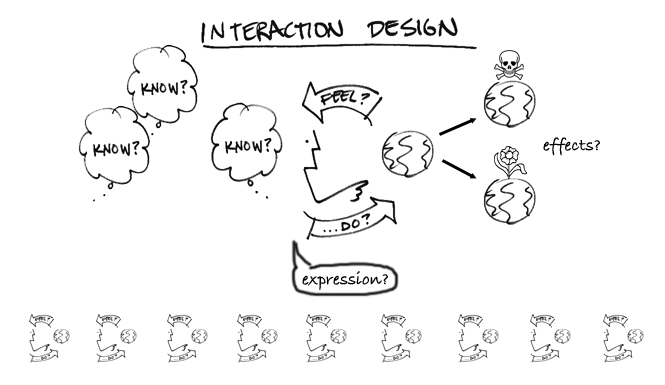
4) Cool Job – Interaction Designer – Complete Beginner’s Guide to Interaction Design – I am not going to say much about this because my ignorance will became obvious quickly. My first hearing of this job was around the supper table this week during our community group (Movement Church). Brian is an interaction designer. As he talked about his work, I was captivated. He works to make internet resources available to a set of consumers all over the world, and does it in such a way that is so user-friendly that even I could maneuver painlessly on that website. When you enter a website that gives you exactly what you need without bottlenecks, extra steps, or language that puts you off, then an interaction designer is probably at work unnoticed in the background of that site. Thanks, Brian, for what you do. Wow!Deb's BlogPhoto Credit: Interaction-Design.org
5) Icebreaker Question – I love icebreakers. They are a fun way to get to know a little bit more about the people around the room or in the meeting. This week, I was in a situation where the following question was used to get us started:

When was the last time you did something for the first time? What was it?”

I had to think a minute, but then it came: Soothing my wee granddaughter as if it was all up to me to settle her, even though her mommy was in the next room. [The next time will be much easier.]

What was your most recent “doing something for the first time”? What’s a favorite icebreaker question can you recommend?

Blog - Icebreaker questions - howdoyouplay.netPhoto Credit: Howdoyouplay.net

2015 October - Blog, Fall, Trees, Sadie 069

Worship Wednesday – I Am Yours, and You Are Mine – Oceans – Revisited

Blog - Kari Jobe - OceansKari Jobe, singing Oceans

[Adapted from a blog I wrote here.]

Thus says the Lord:  “Fear not, for I have redeemed you; I have called you by your name; You are Mine. When you pass through the waters, I will be with you; and through the rivers, they shall not overflow you. When you walk through the fire, you shall not be burned, nor shall the flame scorch you. For I am the Lord your God…” Thus says the Lord, who makes a way in the sea and a path through the mighty waters.Isaiah 43:1-2, 16

“Fear not” is the most frequent command of God found in His Word. “Fear not” – over 200 times. It’s not that hard to understand how it is He calls us not to fear but to trust Him in our circumstances.

There are times we just can’t see above the waves of our life…maybe it’s not our own storm but the storm others we love are passing through. The critical need to make a decision. The (re-)entrusting of work into the hands of God…or the hands of another. The walking into a future that’s shrouded from our sight… It always has been an unknown, but it seems more so today.

The truest reality is that there is still nothing to fear, really. God is with us. He went before us, preparing for where we are today. He will prepare for our tomorrows. He calls us to keep our eyes on Him.

My husband and his work team are going through such a glorious season (if I may call it that). There is nowhere to look but to Jesus.

It is such a season where God’s call to not fear and have faith stills our heart and steadies our resolve like no other time.

Dave wrote his team this email recently:

“I keep thinking of the account in Matthew 14 of Peter walking to Jesus on the water.  It is pretty amazing that Peter got out of the boat and walked to Jesus.  He actually got all the way across the water to Jesus.  As he was walking on water in the midst of that storm Peter must have been intensely focused on Jesus.  When he got to Jesus, it seems that he momentarily lost focus, turned and looked at everything around him.  At that point, his fear overwhelmed him and he began to sink.  As Peter cried out for help, ‘Jesus immediately reached out his hand and took hold of him.’  When Peter’s faith failed, Jesus grabbed him and pulled him back.  In recent days, I have been thinking a lot about that story.  Like Peter, when I am looking at Jesus, I’m good to go.  When I look at what is around me, I become afraid and distracted.  When I call out to Jesus, He rescues me.  So the stresses and challenges make me recognize my dependence on the Lord and push me closer to Him.  For that I can be grateful.  Let’s keep encouraging each other to run well (Hebrews 12:1-2).  I thank God for all of you and for the privilege of running with such great brothers and sisters.”

I was also reminded recently of the Apostle Paul’s letter to his “son” Timothy where he encouraged him to be confident in this:

“It is He who saved us and chose us for His holy work not because we deserved it but because that was His plan long before the world began — to show his love and kindness to us through Christ.” – 2 Timothy 1:9

We are in a time of making hard work decisions. In an organizational downsizing, some will be retiring soon. Many leave a work they love and face a very different future – both which they will  entrust to the God who will show Himself trustworthy. For those staying on the job, these may also see their work change. The phrase, “there will be lots of holes to plug” is something meant to comfort those remaining. It’s more how does anyone “fill the shoes” of those leaving? Those seasoned, revered “old” ones…

Tempted to fear…No, fear not.

I love words…and was delighted when my friend, Alicia, gave me a piece of art she made just for me. It is a line from the song Oceans sung by Kari Jobe. I didn’t know that song until we, together with other close friends, attended a night of worship featuring Jobe.

“When oceans rise, my soul will rest in Your embrace.”

Blog - Kari Jobe - Oceans 2

Lord, give us ears to hear You even amidst rolling waves and raging seas. Fill us with Your faithfulness.

Worship with me:

You call me out upon the waters
The great unknown where feet may fail
And there I find You in the mystery
In oceans deep
My faith will stand

(Chorus)
And I will call upon Your name
And keep my eyes above the waves
When oceans rise
My soul will rest in Your embrace
For I am Yours and You are mine

Your grace abounds in deepest waters
Your sovereign hand
Will be my guide
Where feet may fail and fear surrounds me
You’ve never failed and You won’t start now

(Chorus)

Spirit lead me where my trust is without borders
Let me walk upon the waters
Wherever You would call me
Take me deeper than my feet could ever wander
And my faith will be made stronger
In the presence of my Savior

(Chorus)

“For I know the plans that I have for you,” declares the LORD, “plans for welfare and not for calamity to give you a future and a hope. Then you will call upon Me and come and pray to Me, and I will listen to you. You will seek Me and find Me when you search for Me with all your heart.”Jeremiah 29:11-13

Oceans Lyrics – song writers – Matt Crocker, Joel Houston, and Salomon Ligthelm

YouTube Video with Lyrics – Oceans (Where Feet May Fail) – Hillsong United – Lyrics – Zion 2013

YouTube Video with Lyrics – Oceans (Where Feet May Fail) – Hillsong United – with Lyrics – with powerpoint of ocean waves

Building a Healthy Work Culture – in a Season of Change, Uncertainty, and Dips in Morale

Blog - Culture of FunPhoto Credit: Grasshopper.com

What are you celebrating at work these days? Hopefully you didn’t have to think really hard. Just having a job is something to celebrate, for sure. Beyond that, hopefully you have work that gets you up in the morning with a sense of purpose and a gladness of heart for your work community.

What if that’s not the case this morning? Any number of things can cause our workplace to become more stressful than healthful – a disappointing outcome in our research, a conflict over division of labor, a company merger or buy-out, a downsizing. I am awkwardly  list such things because none may touch on your situation. What is your work situation and your current work culture?

Whatever it is, working over a protracted period of time with low morale makes for a difficult work situation. We want to do whatever we can to turn that around. Not just for the sake of the organization and the goals of same, but for the sake of the personnel. The wellbeing of employees is the biggest factor in the long-term productivity of organizations. Yet, how do we wrap our collective leadership minds around such a thing as morale and engagement?

The key is work culture – and fostering a healthy work culture with as much energy and thought as we do our product line or customer service.

I was reading about work culture, especially related to a season of spiraling morale, and came across a pdf introduction of the book How to Build a Thriving Culture at Work by Rosie Ward and Jon Robison.

Not having read beyond the introduction of the book, I can’t give a full recommendation yet. However, the first few pages have already resonated with me about what is at play related to morale, or well-being, and what could be possible to restore it. Here are some quotes from Ward & Robison’s Introduction:

“Despite overwhelming evidence of a powerful link between effective leadership styles, positive work cultures and higher levels of organizational performance, many companies still operate with a top down, authoritarian management style, do not measure or intentionally create their desired culture, and do not effectively develop current and future leaders to maximize employee engagement and wellbeing.”

The authors go on to say that even in work situation where the leadership style is more employee-centered, the idea of work culture may not be well-understood or operationalized.

“Culture is the differentiating factor between high-performing and low-performing companies; however, most companies have not identified, articulated, measured or intentionally created their desired culture.”

The dilemma of employee morale may actually extend to the leadership team itself.

“The majority of executive leadership teams are not operating in a truly cohesive manner, and many leaders themselves are at a point of burnout.”

“Edgar Schein, PhD, leading researcher on corporate culture, describes culture as ‘the hidden force that drives most of our behavior both inside and outside organizations’. It’s like looking at a river. All of the things you see on the surface, from the flow of the water to the shape of the riverbed, are manifestations of an ever-changing, powerful current beneath the surface. In terms of culture, the current that ultimately guides the strength and direction of the organization includes the unconscious, taken-for-granted beliefs, perceptions, thoughts and feelings of employees. The interaction between leaders and culture is profound and critical when considering how to transform or evolve the overall culture and subcultures within an organization.

“Patrick Lencioni writes that, to be successful, an organization must focus on two basic qualities: It must be smart, and it must be healthy. According to Lencioni, a ‘smart organization’ is one that excels in the classic fundamentals of business — i.e., strategy, operations, finance, marketing and technology. A “healthy organization” is one in which there are minimal politics, minimal confusion, high morale, high productivity and low turnover. While being smart is only half of the equation, for most organizations, it occupies almost all of the time, energy and attention of leaders. Yet, according to Lencioni: ‘Once organizational health is properly understood and placed into the right context it will surpass all other disciplines in business as the greatest opportunity for improvement and competitive advantage. Really.‘”

Blog - How to Build a Thriving Culture at Work

Photo Credit: Amazon.com

How to Build a Thriving Culture at Work, Featuring the 7 Points of Transformation by Rosie Ward and Jon Robison

Work culture and employee well-being are not addressed by just another wellness program. Organizational ethos and values must incorporate both philosophy and programming to build morale, trust, and engagement of employees. Especially if the organization has been through a protracted season of change and uncertainty.

The good news is that possibilities abound. Workplace development literature is rich with approaches and frameworks that you will find helpful in attacking your own set of challenges. One such article is Workplace Culture is Everything: 20 Ideas For Building a Thriving Team – Great links to 20 articles on Workplace Culture. [I apologize, since I’m citing this resource, for the “coded” profane word in the title of one article. Good read otherwise].

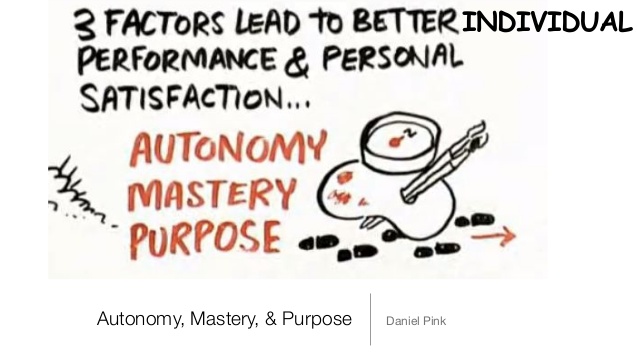
Another book I re-discovered in reading about morale this weekend is Daniel Pink’s Drive. When a company is in the middle of a reorganization or restructuring, employee wellbeing (engagement, performance, satisfaction) can get lost in the sheer workload of the executive leadership team. This is when Human Resources, Membercare, or the Employee Medical Program can offer their own recommendations as to how to rebuild the work culture from the personnel side.

Are you in such a season? What have you done in this area? What has been helpful? I would love to hear about how your organization has dealt with employee morale and engagement during seasons of transition.

Blog - Healthy Culture - Motivation - Slideshare.netPhoto Credit: Slideshare.net

Drive: The Surprising Truth About What Motivates Us by Daniel H. Pink

11 Ways to Create a Thriving Workplace

How to Create and Maintain a Workplace Culture That Will Make Your Company Thrive

Creativity, Inc. – Ed Catmull’s Story of Pixar, Working with Creatives, & Steve Jobs

untitledIMG_0223Photo Credit: Amazon.com (l) & Deb Mills (r)

Dave, the husband in my story, has always pointed me in the direction of transformative books and learning experiences. That path converged with this year’s Global Leadership Summit and Ed Catmull’s Creativity, Inc.

Bill Hybels interviewed Ed Catmull about his role in co-founding Pixar Animation Studios and pioneering the field of computer animation. Now President of Pixar Animation and Disney Animation, he has an extraordinary story to tell of leading creatives in innovative film-making. Mr. Catmull’s wisdom and humility can be well-applied in any workplace situation.Blog - GLobal Leadership Summit - Ed Catmull by brainpickings.orgPhoto Credit: brainpickings.org

“Science and art are not incongruous. Art isn’t about drawing; it’s about learning to see. Which business or professions do you not want to have enhanced ability to see?”

During this interview at GLS15, he talked about the business processes he uses in film-making. We can relate this level and quality of  accountability in any organization or company:

  1. Teams working together (using a Brain Trust – a group of colleagues all acting as peers, with vested interest, giving feedback;
  2. When failures happen in production – embracing [failure] but at the same time dealing with it with both total candor and kindness; and
  3. Operating within constraints (a budget) – actually pushes creativity higher and delivers better outcomes.

“Stories influence the world. We want to use story-telling for good.”

Listening to Ed Catmull talk about leading at Pixar and Disney whetted our appetites to read his book Creativity, Inc.

Originally, Mr. Catmull worked in the computer graphics department of Lucasfilm, in the beginning years of computer animation. In his book, he tells about his incredible journey in those early years right through to today. It was a wildly bumpy road at first and the work was almost sidelined had it not been for Steve Jobs buying Pixar from Lucasfilm.

Toward the end of the book, Catmull writes about Steve Jobs. They worked together for over 25 years, and the Jobs he knew was a much more complex and lovely man than who we knew through other media. A tribute full of “candor and kindness” – as much about how Ed Catmull sees people as about the amazing leader that was Steve Jobs.

Whatever your work, you want to read this book. Catmull describes how he modeled openness, confidence in, and care for his employees. There are trust builders and wide gates for innovation woven into Pixar’s business processes. Whatever our sphere of influence is, we can all learn to be more effective leaders as we think through how Catmull leads.

At the end of Creativity, Inc., there are 5 pages of bulleted principles that Mr. Catmull encourages as starting points for critical thinking. Here are just a few:

  • If there are people in your organization who feel they are not free to suggest ideas, you lose. Do not discount ideas from unexpected sources. Inspiration can, and does, come from anywhere.
  • It’s isn’t enough merely to be open to ideas from others. Engaging the collective brainpower of the people you work with is an active, ongoing process. As a manager, you must coax ideas out of your staff and constantly push them to contribute.
  • There is nothing quite as effective, when it comes to shutting down alternative viewpoints, as being convinced you are right.
  • If there is more truth in the hallways than in meetings, you have a problem.
  • Change and uncertainty are part of life. Our job is not to resist them but to build the capability to recover when unexpected events occur. If you don’t always try to uncover what is unseen and understand its nature, you will be ill prepared to lead.

Creativity, Inc. is not just a book for whom we now consider “creatives”. It’s a book for any of us who want to employ and empower people to grow personally and in community and to produce in ways that yield great products/services.

We all have stories that can influence the world for good…if we grow a work culture where those stories matter and can be freely explored.

Creativity, Inc.: Overcoming the Unseen Forces That Stand in the Way of True Inspiration by Ed Catmull and Amy Wallace

Global Leadership Summit – 7 Take-Aways from Day One of #GLS15

YouTube Video – Steve Jobs Remembered by Larry Ellison and Pixar’s Ed Catmull

YouTube Video – Ed Catmull: Keep Your Crises Small

Monday Morning Moment – On Silos and Tribalism – Taking “Us” and “Them” to a Better “We”

Blog - Silos & TribalismPhoto Credit: Slideshare.net

“Silos”, as a workplace term, is such a fitting description for what we do to distinguish ourselves from each other. It means compartmentalization based on specialization. Now the term “silos” is less used, replaced by the cooler term “tribes”. Unfortunately, because the workplace woes of old are still in operation, “tribes” have deteriorated into “tribalism” or…[Hello] “silos”.

I began thinking about this again this weekend when a retweet came up in my Twitter feed featuring Gianpiero Petriglieri. So much organizational resource – money and time – is spent on specialization and grooming leaders. It’s a pity when the outcome actually draws down the organization ( to small pockets of “tribal buddies”) instead of honing expertise and relationships across departments, across disciplines.Blog - Silos and Tribalism

What if we could break down silos, and reorient and reenergize tribes? What if workplace tribes incorporated a grand plan that nurtured inclusion – creating “a rising tide that lifts all boats” (Adam Grant)?

Years ago, when I was a young instructor at Yale University, I experienced workplace silos. There were bottlenecks through which I had to maneuver, until I figured out how to win those beyond the bottlenecks. Since then silos have been a part of life for me, as I’m sure they are for us all. Oncology nursing had a different prestige than critical care nursing. Was one better than the other? No.

Working in the Middle East had its own set of challenges different from working in Europe. Does that mean one elicits greater respect or benefits than another? Of course not. Right? Communication between those in the field and those in the home office can also become very much an “us” and “them” transaction.  Even within the home office, one department may seem more the “flavor of the month” than another. What are your silo/tribe challenges?

Brilliant business writers can give us great tools and insight with breaking down silos (see fast reads in the links below). If you are anticipating a major change in your organization (buy-out, down-sizing, shift in focus/product line), it makes for a perfect storm to deal with silos. Of course, if management across the organization leads out with a unifying goal (a “battle-cry”), the possibility for success is heightened. I don’t think, however, that this is the only hope for success.

What if one department, a single silo or tribe, decided to tackle the problem? What would that look like? From my work experience and from learning from great leaders, both celebrity and colleague, here’s a bare-bones minimum how-to-get-started list:

  • What is your common goal as an organization? What is the clear unified rallying cry around which you can collaborate?
  • What are your own silo biases? Do you communicate that you think your department, location, specialization should have some sort of favor? Deal with that. It’s the first barrier that has to come down.
  • If trust has been disrupted or destroyed, who can you partner with to begin to rebuild trust? Name them, and begin the process (if you pray, you might begin praying for their success as a department/division – make it NOT about you).
  • What objectives can you establish as a department to guide you in staying focused on high-value collaboration across-specialties?
  • How will you measure the course of your action toward becoming a non-silo, less tribal department? Set a time. 6 months or across whatever acute crisis you see coming. Be as intentional and broad-reaching as you are able, given your own workload. Remember that silos alter the math in a workplace – 1 + 1 + 1 = 2 when teams aren’t sharing information and working at cross-hairs. We can make the math work better, as we work, against the flow, toward creative collaboration. 

My professional life has had various silo experiences, from teaching in an Ivy League university to working on a highly innovative team (recklessly creating its own brilliant unintentional silo, later with personal regret). Silos and workplace tribes never get us where we want to go collectively. Bring ’em down.

I would love to hear about your work experiences…any struggles, breakthroughs, or victories in this area of breaking down silos and building a culture of “Yes, WE can…together.”

Blog - Organizational CUlture - Lencioni book Silos, Politics & Turf WarsPhoto Credit: Amazon.com

Silos, Politics and Turf Wars – A Leadership Fable about Destroying the Barriers that Turn Colleagues into Competitors

Silos and Tribes – Think Different

http://www.slideshare.net/JDDillon/breaking-down-silos-how-social-learning-changed-everything-for-kaplan-atdtk

17 Strategies for Improving Collaboration – from the Freiberg’s – Do Not Miss This One.

How to Build Trust and Fight Tribalism to Stimulate Innovation

Breaking Bad – Squash Silos & Tribalism – Breakthrough Personal Branding

Leadership Axioms: Powerful Leadership Proverbs by Bill Hybels

5 Friday Faves – Fall Colors, Krispy Kreme Doughnuts, 9 Questions Before You Quit, Sherlock, and the Story of God for Postmoderns

Blog - Friday Faves

As I write I can hear Christmas music blasting as Dave rides his bike (on a trainer, in his office). We start listening to Christmas albums in October because we have so many favorites that it takes 3 months to savor them all. The days always seem to fly between now and the end of the year. Slow down! It’s Friday again, and here are my faves.

  1. Fall Colors – My favorite season is Fall, and it is so stunning here in the US. We are just starting to see leaves changing color in Virginia, so I might have to showcase them another time. Here are a few images, and I would love to see some of yours.

2015 Phone Pics Sadie, Fall, Blog, Virginia Beach 1762010 October Fall Fun 018Fall on Frances Moon's roadPhoto Credit: Bottom picture from North Georgia, Frances Moon

2. Krispy Kreme Doughnuts   – Doughnut preferences are very personal. Since moving to Richmond, Westhampton Pastry Shoppe doughnuts (mentioned in another Friday Fave) are faves. However, that said, I have known and loved Krispy Kreme Doughnuts for almost 50 years. They are so scrumptious. To watch the cooking operation is fun as they bob through their deep fat-frying bath and then dip under the shower of sugar glaze. Krispy Kreme also has a knack for decorating for holidays through the year. Actually, I don’t eat doughnuts currently, because I can’t stop at a reasonable number…especially when they are hot glazed doughnuts from KK. Still, if I were eating them…it would be here.2015 Phone Pics Sadie, Fall, Blog, Virginia Beach 1792015 Phone Pics Sadie, Fall, Blog, Virginia Beach 1802015 Phone Pics Sadie, Fall, Blog, Virginia Beach 1812015 Phone Pics Sadie, Fall, Blog, Virginia Beach 178

3. 9 Questions Before You Quit – I have dear friends going through a downsizing in their organization. They are praying about their next steps regarding retirement or other work in their future. Dr. Chuck Lawless writes so empathetically about this type of situation in his article 9 Questions to Ask Before leaving a Ministry. His 9 Questions could really apply to any job, not just to one with a Christian organization. They are so insightful and thought-provoking. One question is: Do I feel both a “push” and a “pull”?  “Responding to a push from one ministry without a pull toward another may lead to making a premature move.” Another is If I leave, what would be my honest reason for leaving? Deciding to leave, whether it’s taking retirement or seeking other work, is probably more complicated than we can articulate. Dr. Lawless encourages, “At least be honest with yourself when you’re making a life decision.”Blog - Friday faves - Questions by Chuck LawlessPhoto Credit: MinistryBestPractices.com

4. Sherlock – BBC’s Sherlock is returning “soon-ish” for its fourth season! Benedict Cumberbatch as Sherlock and Martin Freeman as Dr. Watson are so amazing together. I’ve watched Seasons 1, 2, 3, (available through Amazon.com and other sellers) and am very excited for Season 4. The trailer teaser is out (see it below), but the “soon-ish” arrival of Sherlock won’t happen probably until early in 2016. It’s also a short season – one special and 3 episodes – and I don’t want to miss it. Along with Sherlock, I’m counting down to the 6th and final season of Downton Abbey – also coming to the US in January (No spoilers please!).Blog - Friday Faves - Sherlock Returns - pbs.orgPhoto Credit: pbs.org

The trailer for Season 4 of Sherlock has been out since summer, but I just saw it this week. Sherlock returns…in January? February? What a tease!

5) The Story of God for Postmoderns – How would you answer the question, “What is the Bible all about?” If you were to prepare an answer of this question for a Post-modern, you might be disappointed. A true Post-modern is probably not going to ask you that question. However, what if our friends could get hold of the idea that the Bible is not just a grand story that Christians have concocted? The Bible, in truth, is a winsomely unified story God actually tells about Himself from the first page to the last. Dr. David Teague, in the article, The Biblical Metanarrative, lays out the clearest explanation I’ve ever read of the Story of God – of how the Bible is God’s own revelation of Himself to His people. Don’t miss this gem.Blog - Friday faves - Peanuts & Postmoderns

Photo Credit: Peanuts, ParkingSpace23.com

What were your discoveries this week? What were your favorites? I’d love to hear about them.

Grit – When You’re Hurtin’ But Not Quittin’ – the Role of Personal Resolve and a Team Alongside

131118-Z-WM549-015Photo Credit: Pacific News Center

Diligence is a word that defined my many years in learning Arabic while we lived overseas. Keeping at it, even when I wanted to quit, helped immensely. The joy of living life in a second language is worth all the work. Diligence is a great assist to staying on course, but it is not “grit”.

I saw grit at work recently in a group of servicemen, in Virginia Beach, doing their morning exercise. [Not the picture above but that image has its own neat story of grit]. We had taken a couple of days away from the city to get our breath, by the ocean. Walking on the boardwalk early in the morning, we encountered this small group of airmen from the nearby Naval Base, doing a group jog. We saw them starting the run and saw them again coming back – 6 miles total. Most of them were young, thin, and fit.

What caught our eye, in particular, were two men in mid-life, carrying a bit of weight, bringing up the rear. Approaching the end of that run, they looked like they were hurting, but they definitely weren’t quitting. I’m sure to stay as fit as the rest of the group was, a certain measure of grit was at play…but these two, in this snapshot of life, showed the grit that brought me to write today.

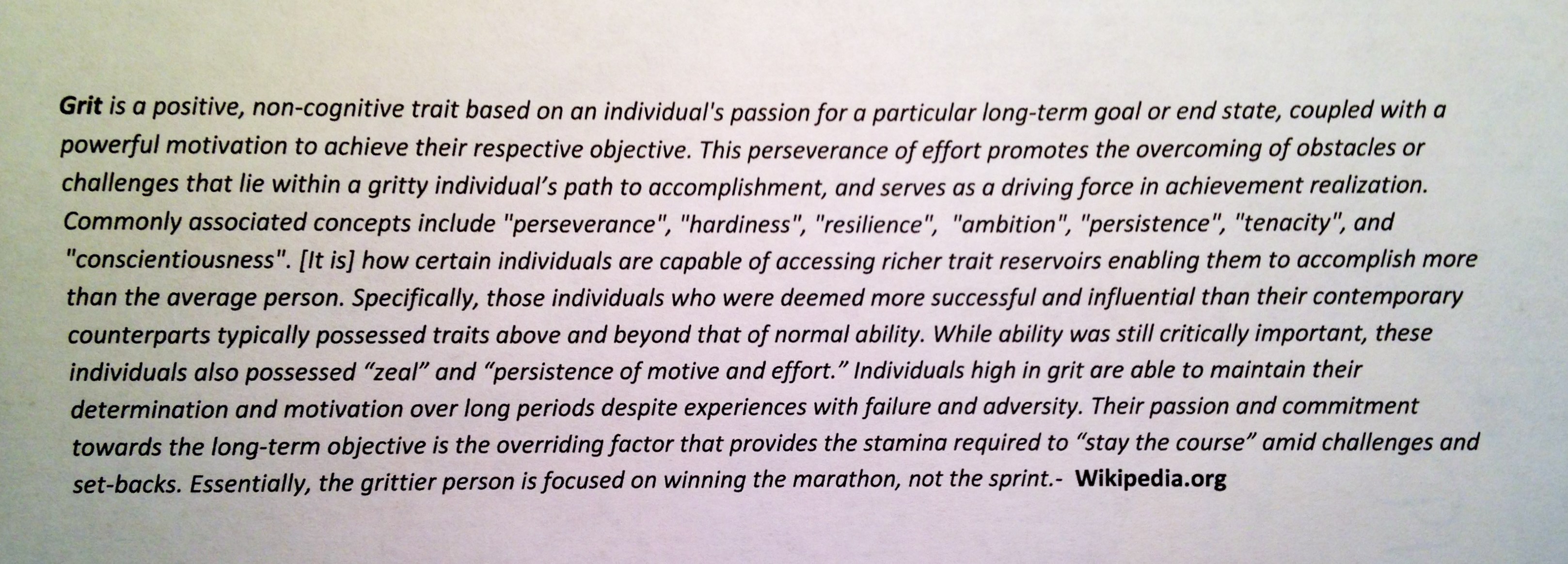
Wikipedia.org defines grit as a character trait  of applying passion and perseverance over time toward a goal, end state or objective. Grit goes beyond ability and can withstand failure, keeping the end goal in sight, and pushing through to it.Blog - Grit - Definition 2

Bill Hybels, at the Global Leadership Summit 2015*, talked about grit as “one of the greatest indicators of success”. Gritty people, he said, are the ones who “play hurt” and rarely ever give up. “They expect progress to be difficult, but believe with their whole being that they can be successful if they don’t quit.” It’s “The Little Engine That Could”. Abraham Lincoln. Nelson Mandela. Gandhi. Martin Luther King. Hybels also encouraged the audience that grit can be developed. From childhood through adulthood.

Jon Acuff (author of Do Over) defines grit as “stubbornness in the face of fear“.  In his book, he gives a short list of what’s needed in making gritty decisions (in the “hustle” of work):

  • Time – we think the world “hustle” has to mean fast, but it can also mean focus, intention, pace.
  • Counsel – Lean on your relationships. Some of the worst decisions are made alone. Who are your advocates? Have you given them time to reflect on it or are you rushing right by the wisdom they have to offer? Let them speak into it. A year from now, looking back on the decision, you’ll be glad you made it as a team.
  • Questions – Always ask awesome opportunities, awesome questions. We skimp on due diligence. “What am I not seeing right now?”
  • Kindness – Give yourself permission to make the wrong decision, because…you’re going to. Break the tension of feeling like you’re going to be perfect by giving yourself some kindness from the outset.
  • Honesty – When you look back on a decision, remember that you made that decision with the best information you had at the time.

As we saw those two older heavyset men running just behind their younger airmen colleagues, we saw men with a goal in mind. There was also something more – the cadence to the group’s run that seemed to work to keep them all together. Whether at work or in family relationships, we want to do all we can to help those gritty ones be successful. Their resolve may get them to the goal anyway, but we all benefit when we are able to “stay on course” together.

Have you “grown gritty” over your lifetime? Are there gritty folks in your life who you love to champion? Tell us about them below.

*Session 1: Bill Hybels Opening Session – Global Leadership Summit

Wikipedia Article on Grit

The Truth About Grit

The Grit Test

Jon Acuff on the Role of Hustle in Taking Hold of Career Opportunities – Notes & Quotes – Part 5 of Do Over Series

How to Make Grit Decisions and Built a Grit List by Jon Acuff

Do Over: Rescue Monday, Reinvent Your Work, and Never Get Stuck by Jon Acuff

Does Teaching Kids To Get ‘Gritty’ Help Them Get Ahead?

Efficiency, Effectiveness, and Adaptability – The Very Human Side of These Business Processes

Blog - Effectiveness vs. Efficiency

Photo Credit: digital-knowledge.nl.dikn/en

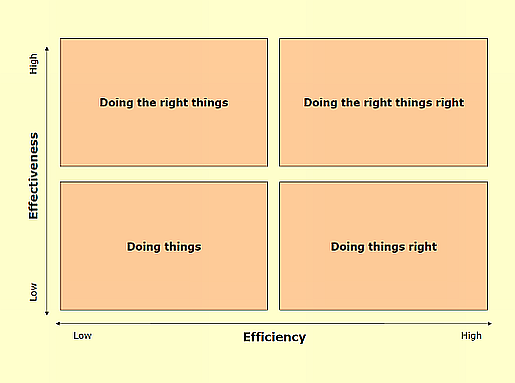
I will never forget when an elder statesman in an organization (both dear to me) was “let go”, so to speak, because of a need for more “bang for the buck”. The expression was so toxic then and still carries a deep pain. It speaks to the tension between efficiency and effectiveness, and the pressing need for adaptability as our world rapidly changes. At the same time, we have to remember, in almost all situations, it’s people in the mix of these business processes.

Efficiency is a good thing. However, it must be secondary to effectiveness. Effectiveness is primary always. How best to assure both is to build an organizational culture of adaptability.

Tom Coyne has defined effectiveness, efficiency, and adaptability brilliantly in a published 2-page pdf*. Here they are:

“Effectiveness measures the extent to which the results you have achieved match your goals.” Strategy leaders set those goals, and the goals determine who does the work, when, where, and how.

“Efficiency measures the amount of scarce resources used to obtain the results achieved.” His use of the term “scarce resources” is thought-provoking. When we focus on efficiency – getting the most benefit from the least resources – we can lose our objective. Resources are precious. Full-stop. Whether they are people, time, or finances. We must consider how we spend resources always, and especially when they are scarce.  However, if we miss the mark on our objective because we misspent our resources or allocated them unwisely, then we paid for efficiency with effectiveness. A poor transaction.

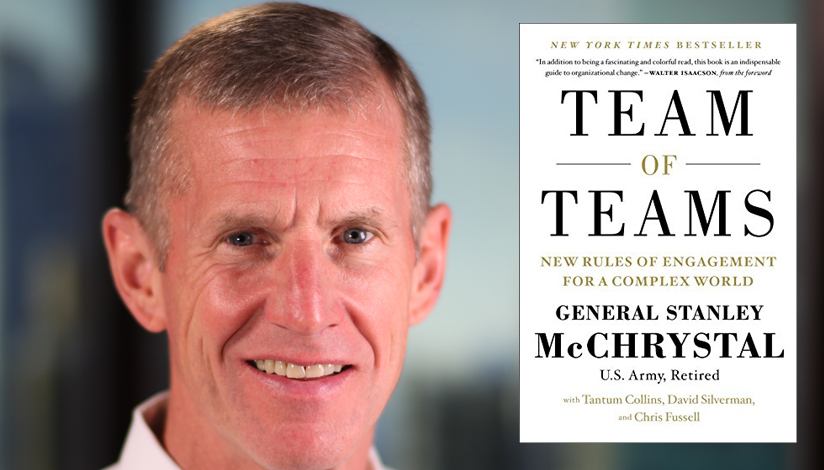
Gen. McChrystal, speaks to this, in his book Team of Teams (more about this book follows). He puts a captivating twist on it in his challenge: “If I told you that you weren’t going home until we win—what would you do differently?” We can’t focus primarily on efficiency when effectiveness is the outcome we desire. Adaptability is really what will get us to where we want to go.

Adaptability measures the change in Effectiveness and Efficiency for a given level of change in the agent or organization’s environment…One of our great failings as human beings is our reluctance to acknowledge the full implications of living in a world of complex adaptive systems. The causes of yesterday’s success are impossible to fully understand, and unlikely to be replicable to the same extent in the futureWe naturally try to succeed again in the future, using the approach that worked in the past, with frequently disappointing and occasionally fatal results.”

Coyne goes on to write about how to work these processes out toward business and employee/team success in a changing world.

Good stuff to know and implement.

Early on in my career, one of the mantras I heard repeatedly was this:

“The three most important things to learn in your work is flexibility…flexibility…flexibility.”

That later changed, in company vernacular, to “fluidity” x 3. The only problem was the temptation to decide for myself what was fluidity/flexibility and what was not. This is where silos and self-interest evolve when we’re not even aware, until we find ourselves not being successful (effective/efficient). In the very work we’ve immersed ourselves in for years…working hard, but not working as smart as we could have. [I know, that hurts – and it will take more than efficiency gurus to bring us out of such a predicament healthy.]

It is possible to turn the ship around…and it takes a whole crew.

Decentralized, empowered teams. Trust. Transparency and collaboration in decision-making. Broad information-sharing. Ownership in real time not just in philosophy. Bringing down silos and working together to nurture an organizational culture where we expect change and thrive in it.

What focus yields a win-win in our workplace? Both from the human side and the business side of performance and organizational culture. What can we do to enhance our business processes – whether we are in management or on the frontlines of our organization?

The following quotes should help to stir thinking. They are out of the book Team of Teams by retired U.S. Army General Stanley McChrystal, currently with The McChrystal Group.

“In complex environments, resilience often spells success, while even the most brilliantly engineered fixed solutions are often insufficient or counterproductive.”  – Gen. Stanley McChrystal, Team of Teams

“In place of maps, whiteboards began to appear in our headquarters. Soon they were everywhere. Standing around them, markers in hand, we thought out loud, diagramming what we knew, what we suspected, and what we did not know. We covered the bright white surfaces with multicolored words and drawings, erased, and then covered again. We did not draw static geographic features; we drew mutable relationships—the connections between things rather than the things themselves.” – Gen. McChrystal, Team of Teams

[Sidebar: I had the great pleasure of writing for such a team over the last 3 years. It was a privilege to see that level of creativity and collaboration, in a team of equals, birthing a workplace initiative in sync with a changing world. Amazing experience.]

“Specifically, we restructured our force from the ground up on principles of extremely transparent information sharing (what we call “shared consciousness”) and decentralized decision-making authority (“empowered execution”).” – Gen. McChrystal, Team of Teams

“In a resilience paradigm, managers accept the reality that they will inevitably confront unpredicted threats; rather than erecting strong, specialized defenses, they create systems that aim to roll with the punches, or even benefit from them. Resilient systems are those that can encounter unforeseen threats and, when necessary, put themselves back together again.”  – Gen. McChrystal, Team of Teams

View your leadership as being less about giving top-down orders and more about cultivating those who follow you, empowering them to make the right decisions. Many leaders are tempted to lead like a chess master, striving to control every move, when they should be leading like gardeners, creating and maintaining a viable ecosystem in which the organization operates.This is especially applicable to private sector leaders; the world is moving too quickly for those at the top to master every detail and make every decision. Empowering, cultivating, and ultimately serving those who follow you will unlock massive potential within your organization, allowing you to solve for problems in real time.” – Gen. McChrystal, Forbes.com

*Effectiveness, Efficiency, and Adaptability – The Three Keys to Performance Measurement

Effectiveness Before Efficiency

Efficiency vs. Effectiveness

The Power of Business Process Improvement: 10 Simple Steps to Increase Effectiveness, Efficiency, and Adaptability by Susan Page

GoodReads Team of Teams Quotes

Stanley McChrystal: What The Army Can Teach You About Leadership

Gen. Stanley McChrystal: Adapt to Win in the 21st Century

Team of Teams: New Rules of Engagement for a Complex World by General Stanley McChrystal

Blog - Efficiency and Adaptability - General McChrystalPhoto Credit: Forbes.com

5 Friday Faves – On Foster Care, Losing Control, Best Bakeries, Pornography, and Efficiency

Blog - Friday Faves

Happy Friday! I have guests visiting from out of country so writing time has taken a back seat to sweet times with friends. Still, what a week this has been in discovery. I chose just five favorites but would love to hear (in Comments below) what some of your faves of this week are. Learning is one of my favorite pastimes.

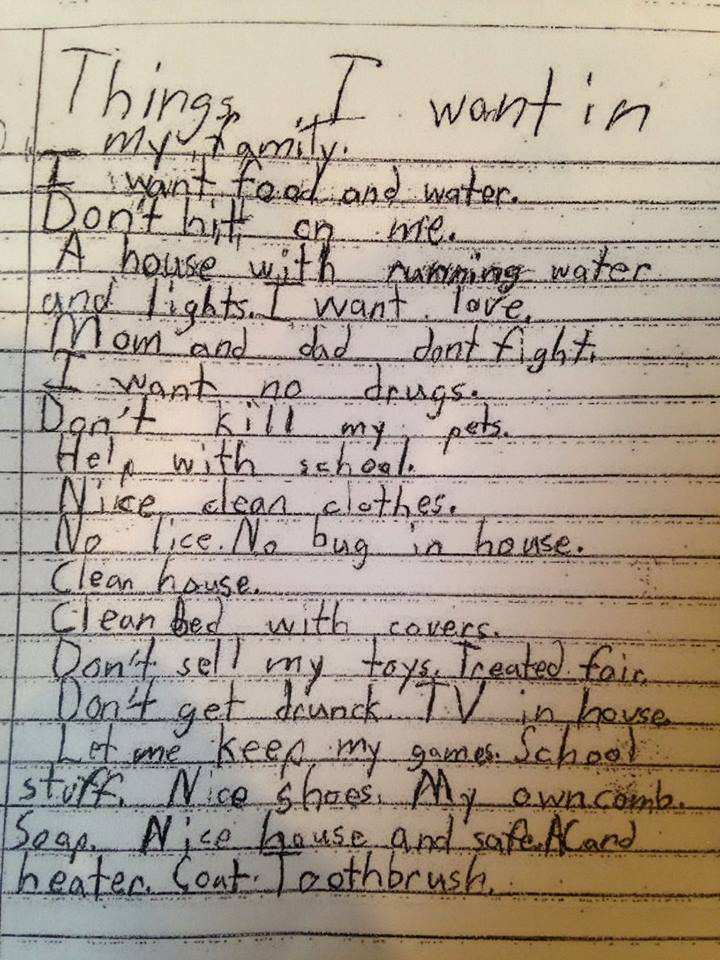
  1. On Foster Care    – It’s dangerous for me to start with such a topic because many will click out of this blog just on reading the title (“Not me”; “Not interested”). Foster care is not for everyone, but it has to be for some of us. What if we worked together to provide safe and loving homes for every child in crisis? Chris Campbell and Team of 111Tulsa, in Tulsa, Oklahoma, started just such an initiative. I read a bit of the story in his wife’s blog  A Turning Point then I wrote about foster care. We can care for these children together.Blog - Foster LetterPhoto Credit: AshleyAnnPhotography.com

2.  On Losing Control – This week, a blog by Jenilee Goodwin entitled The End of Me popped up in my inbox on a busy day. It might have gone unread except for that title. My Mom, my life-long best friend and the head cheerleader of Team Me, died over a decade ago. That was a grace-covered jolt to my sense of life and its dependability. God helped me through that long season of grief because He had already brought me through an “end of me” experience very similar to the one Jenilee describes in her blog. Crossing cultures and learning languages and the raw not-doing-anything-well are huge opportunities to see how tenuous our “control” is. God is dependable; our circumstances are not. Her piece was beautiful and deeply personal. Wherever you are in life, you will gain much by reading her story.Blog - Mom's funeral

3. On Best Bakeries – When Business Insider does an photo-splashed article on The Best Bakery in Every State, I took the time to read it. Or should I say “savor it” – without endangering my health. Finding that the “best bakery” in Virginia to be Blackbird Bakery in Bristol (as far across the state from us as could be found), I will drop my own “Best Bakery” in here. For doughnuts anyway, that bakery is the Westhampton Pastry Shop.  Ridiculously yummy. What’s your favorite?

Blog - Best Bakery - Westhampton Pastry Shop

Photo Credit: Westhampton Pastry Shop, yelp.com

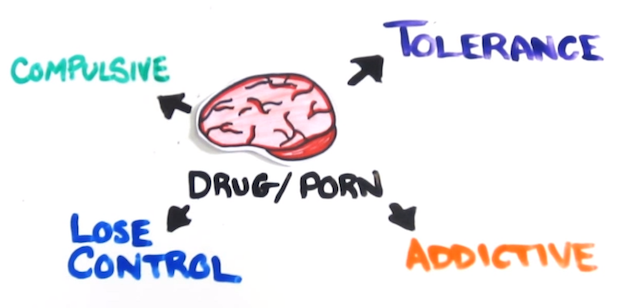
4) On Pornography – A very serious topic – I placed it on purpose under “best bakeries” because there are all kinds of addictions. The scary difference is the fact that some addictions have outward presentations (like food, drug, and alcohol addictions). Not pornography. Addiction to pornography can do its damage in the quiet and isolation of one’s personal space in front of a screen (phone, tablet, computer). Yet, its damage reaches into relationships, career, and even our own anatomy and physiology. This Is Your Brain on Porn probably won’t deter someone addicted to pornography, but it could sound a warning that what you think is “not hurting anyone” really is…those you love…and you.Blog - Your Brain on PornPhoto Credit: Ideapod, Churchm.ag

5) On Efficiency – If you got this far, you are in for a huge treat. This week, as I watch friends go through a company downsizing, the subject came up of efficiency and effectiveness. Does one necessarily lead to the other? Are they the same? In learning more about that, I came across this happy little article by Eric Gilbertson on the push for efficiency in our colleges and universities – The Pursuit of Efficiency and the Pursuit of Folly. Sweet article. Then the book Team of Teams which my husband recently read (devoured really) came to mind. General McChrystal writes brilliantly about adaptability, not efficiency, as our greatest need in the workplace of the 21st century. Work matters…and the people doing the work matter. Get this book…your appetite will be whetted by the articles linked below.Blog - Efficiency and Adaptability - General McChrystal

Team of Teams by General Stanley McChrystal

Efficiency in Business Isn’t Key Says Retired General

Gen. Stanley McChrystal: Adapt to win in the 21st Century

Work Smart – Let General Stanley McChrystal Explain Why Adaptability trumps Hierarchy – Forget everything you ever knew about your company’s org chart—and that’s an order.

The Tim Ferriss Experiment – General Stan McChrystal on Eating One Meal Per Day, Special Ops, and Mental Toughness

Your Brain On Porn

Love Your Neighbor – Foster Parenting & Adoption – Every Child in a Safe and Loving Home – www.debmillswriter.com

Monday Morning Moment – You Have Three Choices – in Work and Life

Blog - Monday Morning - Facebook imagePhoto Credit: Nourish the Dream – Facebook.com

Slaves, in all things obey those who are your masters on earth, not with external service, as those who merely please men, but with sincerity of heart, fearing the Lord. Whatever you do, do your work heartily, as for the Lord rather than for men, knowing that from the Lord you will receive the reward of the inheritance. It is the Lord Christ whom you serve.Colossians 3:22-24

Hopefully, you’re not feeling like a slave this Monday morning. You have choices. Even Paul, in writing to the Colossian church, spoke to those believers, enslaved at that time, as persons with choices.

My Monday mornings these days have been filled with thoughts and prayers for friends working in difficult and unusual circumstances – uncertain futures, struggling to stay on course, grappling with coming change. If you’re not in such a challenge, be glad and learn from those who are. How thankful I am for those in my life who shine as “stars in the universe” (Philippians 2:14-16).

Every single day, we have choices of how we deal with our work and our co-workers…especially in the press of uncertainty and change.

1. We could give up. What a temptation this is. When we are faced with what seems like a waning future (dwindling opportunities, more work with less workers, damaged trust), it is easy actually to give up. We clock in and do what’s necessary. Stay below the radar. Spend breaks researching other jobs. Keep doing what we’ve been doing with no vision for the future. This is an easy default…don’t make it yours. You’re better than that.

2. We could give in. – This is the darker choice. This is when we allow bitterness to take root in our hearts and color our attitudes and work. Giving in is when our performance actually deteriorates because we figure who cares anyway. Giving in is when we say the ugly things we’ve been thinking about our situation. Giving in is when we treat colleagues who were once friends as competitors, as threats to our position rather than supporters. Giving in does no one any favors and actually adds to the burden we already feel in what may be a very complicated situation already. Giving in is never where we want to go.Blog - Look Back, Look forward - Nourish the dreamPhoto Credit: Nourish the Dream Facebook.com

3. We could give it all we’ve got. Here’s where huge faith and great character come in. It’s so easy to say, “Keep doing what you’re doing”, “Stay in the game.”, “Trust God”. Don’t get me wrong; these encouragements are wise and true…it’s when we are struggling with the muck and mire of actually putting feet to faith in a situation that seems wrong. The difficulty at work may not even be wrong; it may be completely necessary…It’s when the force of the impact lands squarely on you that these choices become so real. Still, we have choices. It’s not the workplace that forces these choices on us. They are always ours. Every. Single. Workday.

If I can speak into my friends’ struggle, please stay on the course you’ve been on – such a way that you continue to build/leave a legacy of glory – to God and to the work He’s given us to do. One friend of ours in the thick of a stressful, stressful work situation, told another friend of mine, “Don’t lose heart”.  When you hear that kind of encouragement from someone determined to keep his own focus on what matters it resonates with such verity you want to do nothing less. So, let’s never lose heart and let’s do the work of trusting God in our situations. It’s so much better than the consequences of the other choices. So much better.Blog - Unknown future and a Known God - Monday MorningPhoto Credit: Nourish the Dream Facebook.com

After all, it’s only Monday morning. Who knows what the rest of the week will bring? For my friends who are in complicated work situations, having to drag yourselves out of a ditch each day to do a good job, I want to say how thankful I am to know you. How honored to see the fruit of your work. How joyful that our paths have crossed in the workplace. How much more trusting I am of God myself, because of you.

As our friend said, please “don’t lose heart”.

For all things are for your sakes, so that the grace which is spreading to more and more people may cause the giving of thanks to abound to the glory of God. Therefore we do not lose heartFor momentary, light affliction is producing for us an eternal weight of glory far beyond all comparison.2 Corinthians 4:15-17

Let us not lose heart in doing good, for in due time we will reap if we do not grow weary. So then, while we have opportunity, let us do good to all people, and especially to those who are of the household of the faith. – Galatians 6:9-10

Blog - Encouragement, Empowered, every good workPhoto Credit: Nourish the Dream, Facebook.com

Nourish the Dream – Your Headquarters for Biblical Business Success – Facebook page – David G. Johnson

13 Bible Verses to Overcome Disappointment