Category Archives: Hustle

Monday Morning Moment – Turning Around a Work Culture – From “Not Good Enough” to “Job Well Done”

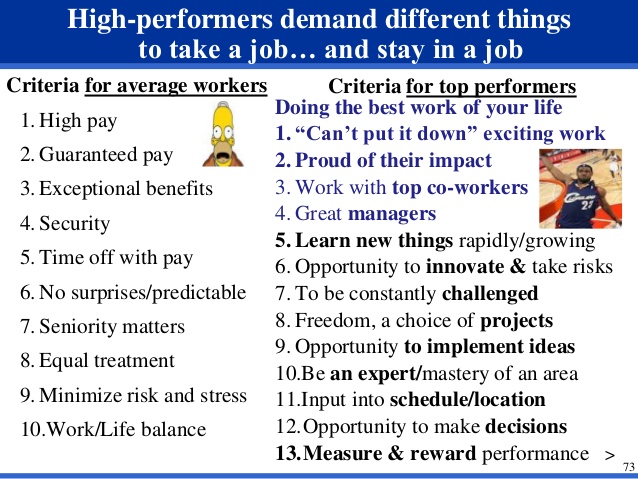
blog-demanding-bosses-linkedin-dave-kerpenPhoto Credit: LinkedIn – Dave Kerpen

Aha moments can occur in all sorts of settings. My latest happened during our pastor’s sermon this week. Toward the end of a deep and fascinating exposition of Colossians 2, Pastor Cliff reminded us that we are not meant to earn God’s approval. He gives it unconditionally. Then Cliff talked about how we get caught in the trap of “It’s never enough!” when thinking of our efforts or accomplishments. Then “It’s never enough” or “Not good enough” too easily turns into “You’re not good enough.” This is the place where what we do intersects with who we are…

Switch from the Sunday Bible lesson to the Monday workplace application. I’m not talking the unconditional love of God here, but what happens to us in continuous feedback loops. Stay with me…This made me think uncomfortably about the way I once operated in the area of idea generation and innovation.

I am “an editor”…it gives me great satisfaction to take a document or process and make it better. Recently a friend asked me to edit his manuscript. It’s going to be such a great read…can’t wait for it to be published. Still, there will be lots of edits. For me, being an early reader, I just took care of some grammar and flow issues. There will be more qualified editors down the road. It’s enough for me to do quick, elementary edits and wildly praise the author and his riveting storyline, cheering him on to the next steps of publishing.

The tweaking that I used to do regularly in my earlier professional life was more intense in those days…and less forgiving. I wanted it (whatever it was) to be right, and it was my immodest opinion that I could get it to right. Especially when evaluating someone else’s work (ironically, I was less hard on my own work – figuring it was perfect already, right? Sigh…). The tweaking of another era has come round to a newish process called iteration.

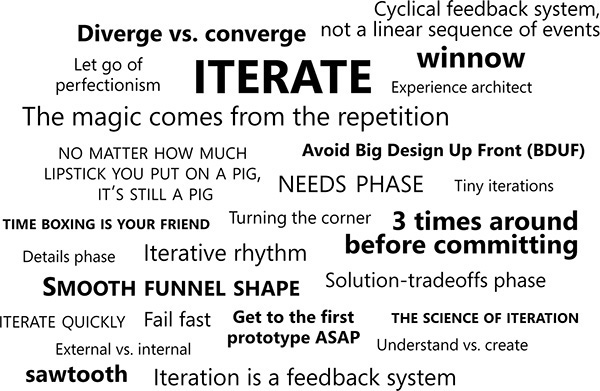
One definition of iteration is the “process of learning and development that involves cyclical inquiry, enabling multiple opportunities for people to revisit ideas and critically reflect on their implication”. These feedback loops are meant to be fast-paced with the finish in view.
ScenarioPhoto Credit: SafariBooksOnline

Where iteration (or tweaking) breaks down (if I might be so bold) is when it’s taken well past rapid feedback loops into a realm of fine-tuning that has the team guessing “will it ever be good enough?” Product design and process development are vital to any company, but what we must also consider is the team or personnel involved.

If the feedback loops relate to the launch of a new product or a new business process, excitement and brainstorming are part of the momentum. Continuing to tweak over months instead of weeks before the launch can take a negative toll on the team. No one wants to forfeit excellence, but we don’t want to lose excellent personnel either.

blog-demanding-bosses-lifehackerPhoto Credit: Lifehacker

Trusting the judgment of our best thinkers is worth the risk of possibly releasing a product or service when we may not all be sure it’s “perfect”. That is what beta-testing is all about…the feedback that then comes to us from the consumer or user.

I’m really talking out of my element here (not being a designer or innovator so much as a lifelong learner). My leap from the sermon to the workplace relates to my own past struggle with wanting something with my name on it to be perfect while exhausting my teammates  with “what if we do this?” or “What if we say it this way?”

What a gift for us to take a well-thought-out proposal and, instead of putting it through the “just not good enough” wringer, we read it and pass it back to that colleague and say, “Good job”…empowering them to execute the proposal. How often does that happen these days?

Please share stories [in the Comments] of work situations where you experienced genuine affirmation for a job well-done.

Recently when water started backing up into the kitchen sink, I was afraid that it was something I had done. Too liberal using the disposal, for instance. Dave was out of town and nothing I could do would remedy the situation. Finally, on a Sunday afternoon, in desperation, I called our plumber (Richmonders, if you need a good plumber, email me, and I will give you his contact info). He came and fixed the problem, and best of all, it wasn’t my fault, after all. This young man literally LOVES his job and was kind to take the time, after he was off the clock, to give me the breakdown of what the problem was. What he charged me? Worth every penny…especially the part where it wasn’t something I had done wrong.

Why I bring this up is that being a fairly capable and creative person doesn’t prevent me from faltering at the likelihood that I messed-up.  See the Imposter Syndrome. My mental wiring is such that I get discouraged when my contribution to a situation actually causes more work for someone else, adds expense, or slows down progress. I’ve learned over the years that all that tweaking I may not have taken the product from good to great, and most assuredly caused some amount of frustration to hard-working, quality colleagues. Lesson learned.

There are times and seasons when tweaking is appropriate in developing a product and changing a business process. What we want to take into account is the cost of that tweaking, or iteration, on the people who make things happen in our workplaces. Free them from the “not good enough’s” to enjoy the fruit of “jobs well done”.blog-demanding-bosses-the-musePhoto Credit: The Muse

10 Tips for Dealing With an Overly Demanding Boss – Jacquelyn Smith

How to Get Over the Feeling that You’re Not Good Enough for Your Job – Michele Hoos

10 Things You Can Do to Get Out of Your Boss’s Doghouse – Brian Dodd

Why Incentive Plans Cannot Work – Alfie Kohn – Harvard Business Review

Good Is Not Good Enough: The Culture of Low Expectations and the Leader’s Challenge – Karlene M. Kerfoot

Innovation and Iteration: Friends Not Foes – Scott Anthony – Harvard Business Review

Holding a Team Retrospective – Morale

Workplace Bullying: Protecting Yourself at Work – Slideplayer

Monday Morning Moment – Forming 5 Simple Habits that Lead to Success/Effectiveness

Blog - Habits - CGInternationalincPhoto Credit: CGInternational

Habits. Daily routine. These are things we wrestle with. Fortunately the more we wrestle and stay on them, the more successful we are, and (hurrah!), the more our lives are positively affected. Ben Slater has posted a very doable routine in his piece 5 Simple Daily Habits That Lead to Ultimate Success. They are:

  1. Wake up early. Slater is not talking waking up early enough to just get to work on time. He’s talking 5ish. To wake up that early requires going to bed early…not just napping on the couch (guilty), but habitually, getting to bed early to get up early. This is determined by how much sleep you need…whether you’re a morning person or night person, that amount of time is pretty much set. “Sleeping in” – that weekend luxury – can derive negative gains. Is it worth it? Just asking the question he raises.Blog - Wake Up Early - Monday Morning - thefemalenetworkPhoto Credit: The Female Network
  2. Exercise regularly. OK, so nothing new, right? This is not about staying in shape, physique-wise. That could be a benefit of exercise, but the goal is to sweat! We know the great benefits to regular exercise, many of which are mental. Feeling happier is one. It’s making exercise a habit that’s key here – for all its physical, mental, emotional, and even vocational benefits.Blog - Exercise - breatheryPhoto Credit: Beamery
  3. Focus, don’t multitask. I have actually prided myself for years on the ability to multitask. No more. It’s possible it wreaked havoc on my memory and probably on the quality of my work and relationships. Slater talks about the importance of a daily routine of planning, execution, review and starting a plan for the next day. “Work out the 3-5 things that you need to accomplish over the course of the day and focus on them first.” Focus is key. I’m learning.Blog - Focus vs. Multitasking - massolutionsPhoto Credit: Massolutions
  4. Learn from mistakes.  When our day doesn’t go quite how we hoped, we too often default to blaming (too many meetings, interruptions, demanding bosses, time-wasters and trust-busters). We make mistakes in our decision-making and assessments; what’s important is that we deal with them humbly and proactively. Refuse to blame others. Learn from the mistake and move on. Sidebar: If it’s someone else’s mistake or poor judgment or questionable character, then learn from their mistakes as well. Don’t get muddled up, fuming about another, when your own life is at stake. You have it in you to control that.Blog - Learn from your mistakes - ultrapreneursayingsPhoto Credit: UltrapreneurSayings
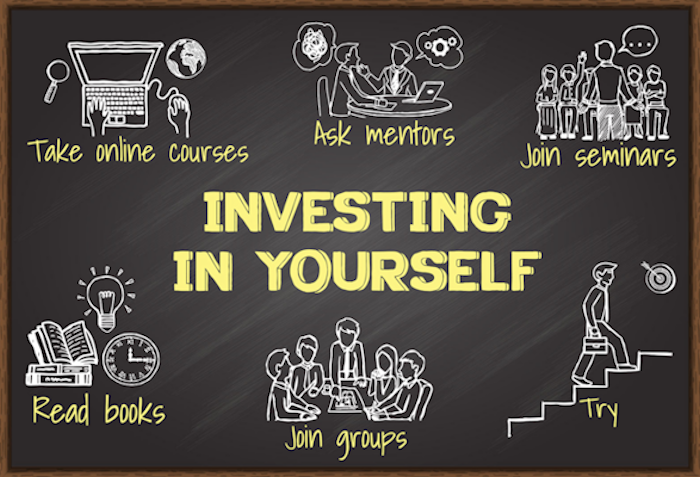
  5. Make personal investments. What habits have you put in place to continue to grow and develop? Habits, not just hopes or goals set somewhere in the distant future. Slater observes: “The world’s most successful people are always prepared to invest time and resources in their own personal development. If you stripped someone like Bill Gates of his assets and dumped him on the street I’d be willing to bet he’d be ok – he’s constantly invested in himself and built up huge reserves of human capital, major companies would be falling over themselves to offer him a job.”  This is where weekly goals come in, and maybe a mentor…someone you trust who will help you stay accountable to your goals. Don’t miss this valuable habit…I definitely need more discipline in this area.Blog - Investing in yourself - salestrainingsolutionsPhoto Credit: SalesTrainingSolutions

I’ve written a lot in Monday Morning Moments about habit formation (see links below). There are so many great resources online about this important professional life skill. Slater’s article on these 5 simple daily habits reminded me again of how possible it is to know success/effectiveness if we do the work of putting these habits into our daily routine. I’m on it…once again. [Like with New Year’s Resolutions, we may not be successful over the long-haul with every one, but we move closer to goal every time we push in that direction.]

What are habits you have seen make a difference in your personal and professional day-to-day life? What habits would you like to make part of your daily routine? Please share in Comments.

15 Critical Habits of Mentally Strong People – Travis Bradberry

Habits of Successful People Who Always Reach Their Goals – SlideShare

Creating a Lasting Early Morning Routine – The Two Most Overlooked Aspects – Joel Gascoigne

Defend Your Research: The Early Bird really Does Get the Worm – Christoph Randler

Focus on Multi-Finishing Instead of MultiTasking – Dave Mastovich

Monday Morning Moment – Notes on Chris Bailey’s Life of Productivity – DebMillsWriter

Monday Morning Moment – Make Your Bed Every Morning and Be Ready to Change the World – DebMillsWriter

Monday Morning Moment – Screen Time – Give It a Rest – DebMillsWriter

Monday Morning Moment – Understanding True Habit Change and Rocking Your New Year’s Resolutions – DebMillsWriter

Monday Morning Moment – Our Work Ethic Pushes Us On When Our Passion Wanes – How’s Your Work Ethic?

Blog - Work Ethic & Passion - twitterPhoto Credit: Twitter

Can our work ethic sustain us when our passion wanes?

Eric Chester has been studying and writing about today’s emerging workforce since the 1980’s, when Generation Y was in its infancy. Millennials have been examined and critiqued so much, but Chester has done his homework in how to help them be successful in the workplace. He also challenges employers to equip these young adults with what they may not have upon entering the workforce – that being a strong work ethic.

In his article in The MHEDA Journal, Chester defines work ethic as simply “knowing what to do and doing it“. Through his research, Chester created a list of seven indisputable, non-negotiable core values that he strongly believes every employer should demand: positivity (positive attitude), reliability, professionalism, initiative, honesty, respect, and gratitude (cheerful service).

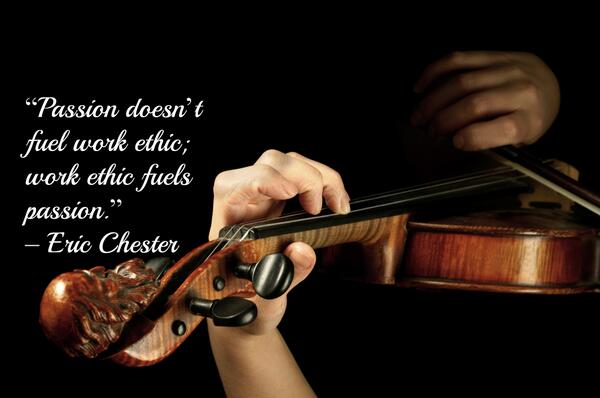
This is not just so for millennials but for all of us in the workforce. What do we need to be successful or effective across a career? Is it passion or work ethic? Passion (strong or powerful emotion, deep desire, intense conviction) is a big buzzword right now in hiring, but what we really need is work ethic. As Chester states, in his book Reviving Work Ethic, “passion doesn’t fuel work ethic; work ethic fuels passion.”

A strong work ethic will carry us through seasons in our career when we’re “just not feeling it”.  I appreciate the distinction Chester makes about how our work ethic actually fuels our passion and not the other way around. We may not all have passion in measures that enhance our success, but we can apply ourselves with diligence and intentionality such that we can push through to the finish, whatever it is. When passion wanes, this is a great encouragement to me.

Blog - Work Ethic 1 - pinterestBlog - Work Ethic 2Photo Credit: Pinterest, Pinterest

Arlene Hirsch quotes Mark Cuban’s thinking on passion and work ethic:

“’Follow Your Passion’ is easily the worst advice you could ever give or get.

1.  When you work hard at something you become good at it.

2.   When you become good at doing something, you will enjoy it more.

3.   When you enjoy doing something, there is a very good chance you will become passionate or more passionate about it.

4.   When you are good at something, passionate and work even harder to excel and be the best at it, good things happen.

Don’t follow your passion, follow your effort. It will lead you to your passions and to success, however you define it.”

Chester uses the analogy of building a fire in a fireplace. You have to set the logs in place before you start the fire. Passion will heat up a conversation or spark a vision, but it won’t get the job done, whatever it is. This is where our work ethic when applied will get us to goal, to mastery, to the finish. That in turn gives rise to passion as we see what is possible when we put forth the best effort that is each of ours to bring.

Blog - Work Ethic and Passion - slidesharePhoto Credit: SlideShare

Whether you are newly employed in the workforce or a seasoned veteran, it’s wise to consider the bottom line of what we ought to bring to our jobs. This will vary across organizations and companies, especially as our workforce itself changes in the years to come. Chester’s summation is noteworthy for all of us:

“Employers are searching for positive, enthusiastic people who show up for work on time, who are dressed and prepared properly, who go out of their way to add value and do more than what’s required of them, who are honest, who will play by the rules, and who will give cheerful, friendly service regardless of the situation.”

How’s your work ethic?…

Whatever our passion might be today, our work ethic can be rock solid…something we count on in each other at work in the every day.

Reviving Work Ethic: A Leader’s Guide to Ending Entitlement and Restoring Pride in the Emerging Workforce by Eric Chester

On Fire at Work: How Great Companies Ignite Passion in Their People Without Burning Them Out by Eric Chester

Employers Must Pick Up the Slack, Instill Work Ethic in the Emerging Workforce – article by Eric Chester

Follow Your Energy, Not Your Passion – article by Arlene Hirsch

What’s Wrong with Work Ethic in America? – article by Patricia Fripp

SlideShare – Metric Driven Talent Management – 21st Century Talent Management Conference – Tanzania

YouTube Video – Book Trailer for Reviving Work Ethic by Eric Chester

YouTube Video – Book Trailer for On Fire at Work by Eric Chester

Work Ethic Quotes – Pinterest

Blog - Work Ethic over Passion - starecatPhoto Credit: Starecat

Monday Morning Moment – Make Your Bed Every Morning and Be Ready to Change the World

Blog - Make Your Bed - habit formation (2)

I make the bed every morning. It’s been a habit of mine most of my life. Somehow in the middle of the chaos and clutter of my life, that made bed stands in hopeful defiance.

Admiral William H. McRaven a highly decorated Navy Seal, retired in 2014 from a 37-year military career. He oversaw Operation Neptune Spear – the military operation that culminated in the death of Osama bin Laden. In the year of his retirement, he was commencement speaker at the graduation ceremony of University of Texas – Austin. Blog - Change the World - Make Your Bed - pinterestPhoto Credit: Pinterest

As he encouraged the young graduates, he told of 10 lessons in his SEAL basic training. Beginning with “Make Your Bed”, they follow in brief (you can watch the video of his speech or read more detailed highlights here).

10 Life Lessons to Change Your World

1. If you want to change the world, start off by making your bed.

2. If you want to change the world, find someone to help you paddle.

3. If you want to change the world, measure a person by the size of their heart, not the size of their flippers.

4. If you want to change the world get over being a sugar cookie and keep moving forward.

5. If you want to change the world, don’t be afraid of the circuses.

6. If you want to change the world sometimes you have to slide down the obstacle head first.

7. If you want to change the world, don’t back down from the sharks.

8. If you want to change the world, you must be your very best in the darkest moment.

9. If you want to change the world, start singing when you’re up to your neck in mud.

10. If you want to change the world don’t ever, ever ring the bell.

Steve Nguyen, Workplace Psychology

Adm. McRaven closed the commencement speech with the following challenge:

“Start each day with a task completed. Find someone to help you through life. Respect everyone. Know that life is not fair and that you will fail often . . . but if you take some risks, step up when the times are the toughest, face down the bullies, lift up the downtrodden and never, ever give up….if you do these things, the next generation, and the generations that follow will live in a world far better than the one we have today, and what started here will indeed have changed the world for the better.”Navy Adm. William McRaven

Commencement speeches are meant to be inspiring, and this definitely hit the mark. What actually stayed with me the most was the formation of habits as key to changing the world – making your bed, building community, enduring with hope, never quitting.

Maybe making your bed isn’t the one small task completed that makes for the foundation of the many larger tasks of your day. Whatever your particular routines or habits, they are worth considering for the weight of importance they might have in your life…with the possibility, even, of changing a world.

What habit or routine gets you started well each day? How do Adm. McRaven’s 10 Lessons of Basic SEAL training resonate? Maybe “changing the world” is too big a goal for a Monday morning, but whatever the goal, where do we begin to take aim?

How to be a Success at Everything – How I Became a Morning Person, Read More Books, and Learned a Language in a Year by Belle Beth Cooper

Make Your Bed Each Morning to Kickstart Better Habits by Eric Ravenscraft

Why Making Your Bed Every Morning Matters, According to a Navy Seal by Dave Greenbaum

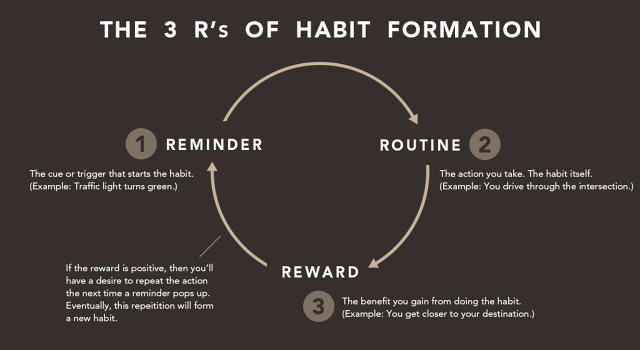
BLog - 3 R's of habit Formation - fastcompanyPhoto Credit: Fast Company

Monday Morning Moment – How Our Expectations at Work Shape Our Successes

Blog - Expectations - slidesharePhoto Credit: SlideShare

A blog title intrigued me recently – Almost Everyone Who Is Unhappy with Life Is Unhappy for the Same Reasons. It was a re-post of a LinkedIn blog written by Dr. Travis Bradberry (author of Emotional Intelligence 2.0). He writes about the role of expectations (of ourselves and others) and the impact those expectations have on our work life and relationships.

I see this so much in myself and in relationships both at work and in community. On one end of the spectrum, there are the expectations that undermine our successes – we don’t think we have what it takes to realize our dreams or goals. [This can also include our expectations of others, in the same way, especially if our expectations influence those colleagues’ view of reality.] On the other end of the spectrum, we may have expectations that are so unreasonably and unrealistically positive that we don’t do the work of realizing those same dreams or goals. [Again, this works against relationships when we have these expectations of others.]

In his article, Bradberry lists 8 common expectations that impact our work life and work relationships. He lists them and talks about them. Here I have written my own observations related to these expectations.

As you read and reflect, Dr. Bradberry is not saying get rid of expectations, nor am I. Expectations when honest, thoughtful, and kind are great motivators toward success. The adage “Keep your expectations low and you will never be disappointed” doesn’t really get us where we want to go.

After you consider the following expectations and thoughts, I would love to hear some of yours (in the comments below).

  1. Life should be fair. I have never understood the lament “That’s not fair!” It really reveals the heart of “That’s not fair for me!” How do we even make life fair? Our children, growing up, were never rewarded when they cried foul on fairness. We tried to raise them to practice kindness and generosity. That usually led to better than fair. In fact, if we flipped fairness on its head, our western work situations and family lifestyles would be quite altered, if what was usual for other parts of the world became our usual. That would be fair, right?
  2.  Opportunities will fall into my lap. There are times that opportunities “fall” into our laps. I call it “a God thing”. Whatever you might call that, it is rare and wonderful. In the day-to-day, we are to go after opportunities. Sometimes our very expectations of entitlement or pessimism keep us from even seeing opportunities right in front of us). Continue working hard, build your skill-set, learn from mentors, help your colleagues, practice thinking well of your boss, and seek out challenging assignments – these are fields where opportunities grow.
  3. Everyone should like me. I have tripped over this expectation. We think our own foibles are so much less annoying than those of others. If I consider myself congenial, you should comply, right? [The fairness problem nudges in here, for sure.] Bradberry summarizes this workplace problem well: “When you assume that people are going to like you, you take shortcuts; you start making requests and demands before you’ve laid the groundwork to really understand what the other person is thinking and feeling.” Rather than expecting others to be won by our personality, expertise, and past experience, we should discipline ourselves to practice winning the trust of a colleague, boss or customer… every time, as if it were the first time. This is a game-changer.
  4. People should agree with me. We honestly don’t want to have to work for people to agree with us. In the workplace, whenever possible, our default is to hang with those who do agree with us. This temptation sets us up for failure because we don’t gain from the critique of those who see things differently. Put your vision or project before those in other departments and see with their eyes what you might have missed with your own. Granted, be wise with whose counsel you seek, but do the work of seeking that counsel. Then share credit as appropriate.
  5. People know what I’m trying to say. Emails and text messages are almost communication. In corporate culture, even meetings don’t always cultivate clear communication. Be as clear and succinct as possible. Don’t lose the message in a jumble of clarifiers, justification, or story-telling. I’m not saying story-telling isn’t valuable; it is. The problem with story-telling is it can be contrived to emotionally engage when it actually takes away from the message. Again Bradberry wrote: “Communication isn’t anything if it isn’t clear, and your communication won’t be clear until you take the time to understand the other person’s perspective.”Blog - Communication at work - cbbainsealcareersPhoto Credit: CB Bain Seal Careers

Having lived overseas, we discovered the importance of learning the local “heart language”. In a work situation, the same holds true. How you communicate is colored by the focus of the one you’re addressing – whether it’s about ROI/ROV, employee engagement, product development….or fill in the blank. You can learn to balance between being true to your own style or values and adapting somewhat to the person in front of you (as a chameleon communicator).

6. I’m going to fail. “If you pursue an endeavor, believe with all your being that you’re going to succeed in that endeavor.” – Bradberry    We all fail sometimes; having that perspective is healthy. The problem is when we are so insecure or self-deprecating, our colleagues, boss, or customers lose confidence in us, based on our own assessment of our abilities. Not something you want to ensure by your own hand. [Read the whole of Bradberry’s article to get at the heart of this.]

7. Things will make me happy. If you’re not happy at work today, there’s not one thing beyond yourself that can change that. Not a different boss, not a better team, not more vacation, not a higher salary. This is a work on the inside that has to change your experience of work on the outside. We all know this. We all know…this.

8. I can change him/her. Okay, if you’re married, you already know the futility of this statement (and your spouse can say the same thing, by the way). When we get our focus on that boss we don’t understand or that colleague who makes us nuts, we aren’t able to focus on our work or the relationships that encourage and empower us. So what if you can’t change that coworker or boss? Can you be successful in your work if he/she doesn’t change? Most probably, the answer is yes…whether it feels like it or not. We lose enormous time and emotional energy on colleagues with whom we struggle. If changing jobs isn’t plausible or desirable, then figure out how to compartmentalize the distractions, and get on with your work. You can be a rock star even with difficult work relationships. I don’t want to issue a bunch of platitudes…but it is disturbing how much is lost from our workday in ruminating over (or talking about) stuff we can’t change…when there is still so much we can accomplish. Don’t sideline yourself with brain clutter – negative thoughts that negatively affect your work and relationships.

Blog - expectations - missworkerbeePhoto Credit: MissWorkerBee

Keep those expectations high (for yourself) and hopeful (for others)! Happy Monday!

Unrealistic Expectations That Do You Harm – LinkedIn article by Travis Bradberry

Emotional Intelligence 2.0 by Travis Bradberry and Jean Greaves

Emotional Intelligence 2.0 Quotes from GoodReads

Manage Expectations So They Don’t Manage You – Alli Worthington

The Key to Being More Attractive – Business Insider Video with Tony Robbins [Quote: “Trade your expectations for appreciation.”]

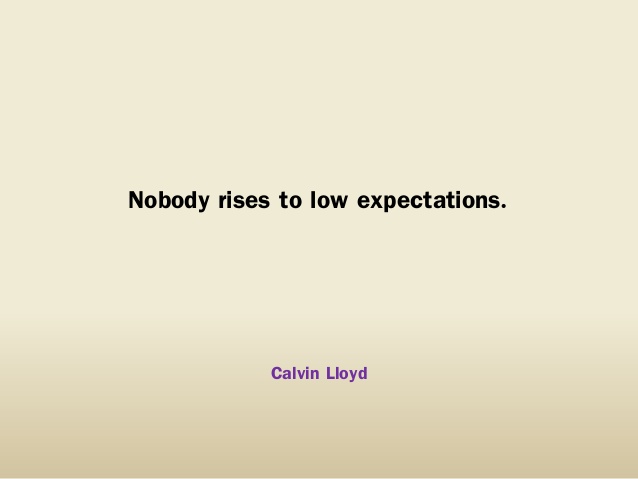
Set High Expectations Because Nobody Rises to Low Expectations – Barry Canada

The Expectation Effect – (in the classroom) – SlideShare

Blog - Emotional Intelligence - amazon

Photo Credit: Amazon

5 Friday Faves – Leadership, Keeping House, Mentors, Wonderful Defects, & a Phenomenal Guitarist

Blog - Friday Faves

Fridays come so fast. So here we are again. My top finds this week (and there were so many great reads and experiences this week, it was hard to narrow down to 5). Hope yours is a lovely day and a stretched-out weekend.

1. On Leadership – Brian Dodd creates great lists. In this week’s blog, he published 24 Steps to Successfully Leading Through CrisisOf his 24 steps, these are my favorite (but do read all of them):

  • To Successfully Lead Through Crisis You Must Provide Stability – Stabilizing the organization gives your people a sense of security.
  • To Successfully Lead Through Crisis You Must Become A Giving Engine – Rather than focusing inward and solely on the issues you are facing, look outward and turn your attention to others.
  • To Successfully Lead Through Crisis You Must Offer Hope – This tells others success is in their future.
  • To Successfully Lead Through Crisis You Must Offer A Plan – Hope is not a strategy.  There must also be a detailed roadmap showing why hope exists.
  • To Successfully Lead Through Crisis You Must Change – The behaviors which got you in the crisis will not get you out of the crisis.

Also not to miss is Paul Sohn’s Top 30 Must Read Posts on Leadership October 2015.

2. Keeping House – I struggle with keeping order in my house, even though now it is only Dave and me. No one else to make the mess but us. Ann Voskamp, farm wife, mother of 6, and best-selling author, wrote about keeping house this week – 6 Ways to Speed Clean to a Clean Enough House. Her photographs of life are so gorgeous that it’s hard to imagine things out of place or not camera-ready. Yet, even Ann had to come up with a system of order which she shares in this blog. My two favorite suggestions from her list of 6 follow:

  • Make your bed every morning. I love this one because it’s so easily done. It gives its own cheer of “Hurrah! You’re off to getting lots more done.” BLog - Keeping HouseMy husband and I have very different “sides of the bed” – he’s a bit neater; I’m a piler. Projects, bits of paper, “things to read later”…sigh…but, the bed is made. Score!
  • 30 Minute Love SHAKs“Do Surprising Home Acts of Kindness — Love SHAKs — 30  minutes of random cleaning [right after dinner], just 30 minutes of every single person who lives here seeing something that needs to be cleaned —- and everybody cleaning as quickly as they can. The point of everybody working together at the same time to surprise everybody? Everybody models the kindness of cleaning for each other, nobody gets to say what they’ve got going is too important to get in on loving each other, real progress is made because everybody is working fast and together, spurring each other on — and we all get to say we are on the same team.” I love this! Might start with 15 minutes with the love of my life. What do you think, Dave?

3. Mentors Jon Acuff rarely has guest bloggers, but this week he shared his spot with Lewis Howes, author of The School of Greatness. Howes writes about his personal experience of connecting with top mentors. Having been a professional football player, he might have been tempted to just ask them out for coffee. No, he did something altogether different. He offered to serve them in any capacity they would find helpful. Don’t miss his wise counsel on this.

“Don’t ask for anything. Just offer to be of meaningful service, in any capacity that will help the mentor in achieving what is important to them. Offer to work for free. Say yes to anything. Hustle hard. Show them you are grateful and willing to learn. Keep your word.” – Lewis Howes

4. Wonderful Defects – This week, I discovered Paul Phillips and his blog He’s Taken Leave. He tells a beautiful story of an old beautifully marred violin and bridges that to our own propensity to comparing ourselves to others.

“As with the old violin, the comparisons with others prove nothing.  Each person who walks through my door is a masterpiece of unique design. Every one, a treasure.  Every single one. Fearfully and wonderfully made (Psalm 139:14). I can almost hear the music again.”

Blog - Old Violin - wqxr.orgPhoto Credit: wqxr.org

5. Phenomenal Guitarist – This guy. Nathan Mills – related? Yes. I get to be Mom to this amazing young man… Because we are related and it’s not always comfortable for him how effusive I am about his music…I restrain myself. Once in awhile, it feels down-right wrong not to share with you something about him. Right now, he’s fairly new to that larger world of music, but he’s playing, teaching, arranging, and composing. One day, you will know him…and be able to enjoy his music beyond YouTube, social media, or local performance. Mark it down.Nathan at guitarPhoto Credit: Duy Nguyen

What are your favorites from this week? Would love to hear about them. Share in comments, please.

Blog - Fall Back YardOur back yard this week – Fall

Grit – When You’re Hurtin’ But Not Quittin’ – the Role of Personal Resolve and a Team Alongside

131118-Z-WM549-015Photo Credit: Pacific News Center

Diligence is a word that defined my many years in learning Arabic while we lived overseas. Keeping at it, even when I wanted to quit, helped immensely. The joy of living life in a second language is worth all the work. Diligence is a great assist to staying on course, but it is not “grit”.

I saw grit at work recently in a group of servicemen, in Virginia Beach, doing their morning exercise. [Not the picture above but that image has its own neat story of grit]. We had taken a couple of days away from the city to get our breath, by the ocean. Walking on the boardwalk early in the morning, we encountered this small group of airmen from the nearby Naval Base, doing a group jog. We saw them starting the run and saw them again coming back – 6 miles total. Most of them were young, thin, and fit.

What caught our eye, in particular, were two men in mid-life, carrying a bit of weight, bringing up the rear. Approaching the end of that run, they looked like they were hurting, but they definitely weren’t quitting. I’m sure to stay as fit as the rest of the group was, a certain measure of grit was at play…but these two, in this snapshot of life, showed the grit that brought me to write today.

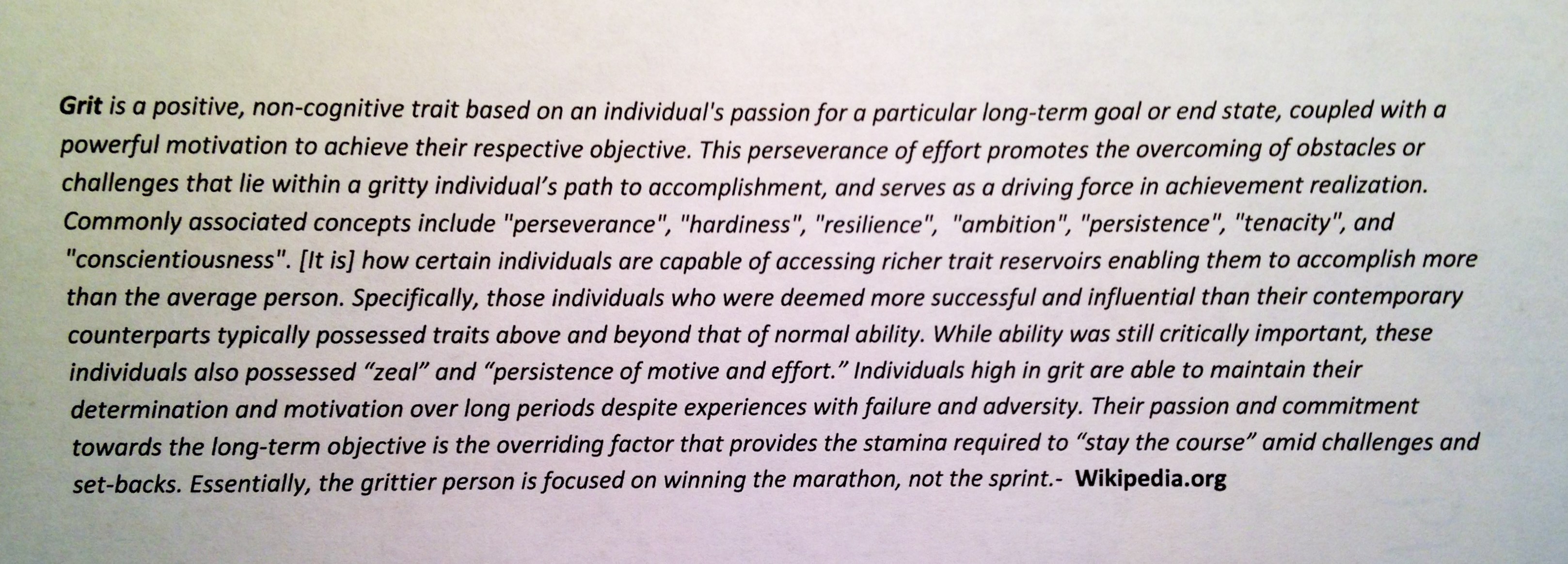
Wikipedia.org defines grit as a character trait  of applying passion and perseverance over time toward a goal, end state or objective. Grit goes beyond ability and can withstand failure, keeping the end goal in sight, and pushing through to it.Blog - Grit - Definition 2

Bill Hybels, at the Global Leadership Summit 2015*, talked about grit as “one of the greatest indicators of success”. Gritty people, he said, are the ones who “play hurt” and rarely ever give up. “They expect progress to be difficult, but believe with their whole being that they can be successful if they don’t quit.” It’s “The Little Engine That Could”. Abraham Lincoln. Nelson Mandela. Gandhi. Martin Luther King. Hybels also encouraged the audience that grit can be developed. From childhood through adulthood.

Jon Acuff (author of Do Over) defines grit as “stubbornness in the face of fear“.  In his book, he gives a short list of what’s needed in making gritty decisions (in the “hustle” of work):

  • Time – we think the world “hustle” has to mean fast, but it can also mean focus, intention, pace.
  • Counsel – Lean on your relationships. Some of the worst decisions are made alone. Who are your advocates? Have you given them time to reflect on it or are you rushing right by the wisdom they have to offer? Let them speak into it. A year from now, looking back on the decision, you’ll be glad you made it as a team.
  • Questions – Always ask awesome opportunities, awesome questions. We skimp on due diligence. “What am I not seeing right now?”
  • Kindness – Give yourself permission to make the wrong decision, because…you’re going to. Break the tension of feeling like you’re going to be perfect by giving yourself some kindness from the outset.
  • Honesty – When you look back on a decision, remember that you made that decision with the best information you had at the time.

As we saw those two older heavyset men running just behind their younger airmen colleagues, we saw men with a goal in mind. There was also something more – the cadence to the group’s run that seemed to work to keep them all together. Whether at work or in family relationships, we want to do all we can to help those gritty ones be successful. Their resolve may get them to the goal anyway, but we all benefit when we are able to “stay on course” together.

Have you “grown gritty” over your lifetime? Are there gritty folks in your life who you love to champion? Tell us about them below.

*Session 1: Bill Hybels Opening Session – Global Leadership Summit

Wikipedia Article on Grit

The Truth About Grit

The Grit Test

Jon Acuff on the Role of Hustle in Taking Hold of Career Opportunities – Notes & Quotes – Part 5 of Do Over Series

How to Make Grit Decisions and Built a Grit List by Jon Acuff

Do Over: Rescue Monday, Reinvent Your Work, and Never Get Stuck by Jon Acuff

Does Teaching Kids To Get ‘Gritty’ Help Them Get Ahead?

Jon Acuff on the Role of Hustle in Taking Hold of Career Opportunities – Notes & Quotes – Part 5 of Do Over Series

Blog - Hustle - Jon AcuffTurning that last page of a great book is both satisfying and a bit sad. Satisfying in that I have gained so much insight and empowerment in reading Jon Acuff’s Do Over. Sad in that I will miss this super-practical literary journey with Acuff. Such a great read and such a fascinating journey. Looking forward to your next project, Jon.

[Jon Acuff’s words are in italics or bold font. Enjoy.]

Jon starts his section on hustle with a quote by Jack Gilbert: “Music is in the piano only when it is played.” Writing as a not-so-musical member of a musical family, I resonate with this.

In Do Over, hustle is defined as “shorthand for ‘work hard’. Hustle is not just something we add to our Career Savings Account. It is something that multiples everything else we have in it.”

Remember Jon’s formula in Do Over:

(Relationships + Skills + Character) x Hustle = Career Savings Account

To apply hustle, you need grit, flexibility and awareness. As I plowed through Jon Acuff’s writing on hustle, it became very clear that to go after our dreams we have to let go of fear and doubt, all the “what-if’s”, and take hold of what we have to do to get us where we hope to go. It’s work. It’s doable, but we can’t go into it half-way. It takes grit.

“Fear hates hustle. Nothing enrages fear like deciding to actually work hard…Grit is being stubborn in the face of fear. Grit is believing in can when can’t is loud.” – Jon Acuff

Stephen Pressfield says, “The amateur believes he must first overcome his fear; then he can do his work. The professional knows that fear can never be overcome. He knows there is no such thing as a fearless warrior or a dread-free artist.” (p. 213)

Nathan at guitarPhoto Credit: nathanmillsguitar.com

Flexibility enters in when you refuse to have a narrow view of perfection or success. Instead of believing fear’s lie of “I don’t have what it takes,” flexibility gives you the courage to say, “I have what it takes to try.”

Blog - Hustle 8

“Fear is not the same thing as regret. Regret is a small stream that cuts a canyon into your heart slowly over time. Will you face the fear of today or the regret of forever? Will you attack your fear of failure, maybe even fail and try again?” – Jon Acuff

Make Grit Decisions.

Here is what Jon says every grit decision needs:

  • Time – we think the world “hustle” has to mean fast, but it can also mean focus, intention, pace.
  • Counsel – Lean on your relationships. Some of the worst decisions are made alone. Who are your advocates? Have you given them time to reflect on it or are you rushing right by the wisdom they have to offer? Let them speak into it. A year from now, looking back on the decision, you’ll be glad you made it as a team.
  • Questions – Always ask awesome opportunities, awesome questions. We skimp on due diligence. “What am I not seeing right now?”
  • Kindness – Give yourself permission to make the wrong decision, because…you’re going to. Break the tension of feeling like you’re going to be perfect by giving yourself some kindness from the outset.
  • Honesty – When you look back on a decision, remember that you made that decision with the best information you had at the time.

Acuff encourages the reader to build a Grit List – those things you may not want to do but you know they are the things that will get you in position to take advantage of that career opportunity (stronger relationships, sharpened skills, deeper character). For Jon, one of those things was e-mail. He reconciled the hard work of writing and responding to e-mail in a wise and timely fashion. What would be on your Grit List?

Be aware. “The first half of hustle is addition [new relationships, new skills and new character], but you don’t get to add anything to your life unless you remove something else…You’ll need to find space in your life. “

Blog - Jon Acuff on HustlePhoto Credit: acuff.me

My husband says, “Whenever you say yes to something, you have to say no to something else.” What will you say no to, to say yes to this?

In review, at some point during your career you will:

  • Hit a Career Ceiling and get stuck, requiring sharp skills to free yourself.
  • Lose a job unexpectedly, or need one upon graduating, requiring strong relationships to survive.
  • Make a Career Jump, requiring solid character to navigate the chaos that jumps always generate.
  • And finally, in the case of hustle, you will get a surprise opportunity you didn’t see coming, requiring smart hustle to make the most of it. In moments like that, you’ll need awareness to recognize what to do, grit to actually do it and flexibility to respond to the surprises.

Jon tells story after story in his section on Hustle about ordinary people who overcame their fears and doubts and worked hard to have the careers they wanted. “Every Do Over avoided because of fear fails. Hustle, grit, and flexibility is ‘crawling through a window when the door is slammed shut.'”

“Let no one be deluded that a knowledge of the path can substitute for putting one foot in front of the other.” – Mary Caroline Richards

Why not me? Why not now? Why not here?

“You really think you can do this?” You’ve probably asked yourself that question. Fear loves that question. On a walk in the woods, on a calm spring day I answered it for myself. “Apparently, I can.”

Finally Jon Acuff looks us straight in the eye, kindly, and says, “I think that can be your answer too. Do you think you can have a Do Over?

Apparently, you can.

[Buy Jon’s book, subscribe to his blog, follow him on Facebook and Twitter, listen to his podcasts. I don’t say this casually. He has won an audience by doing all the hard things he encourages the reader to do and then sharing what he’s learned for pennies when you think how much your life is worth. I’m on my own Do Over. Going for it. Thanks again, Jon.]

Blog - Do Over with Jon AcuffPhoto Credit: SmartCreativeWomen.com

My Previous Blogs on Jon Acuff’s Do Over – Part 1, Part 2, Part 3, Part 4 – Today’s Blog is final piece in Series

YouTube Video – Jon Acuff’s Top Tips on Hustle (in 1 Minute)

Jon Acuff Hustle Archives

Jon Acuff Starts Over

Start: Jon Acuff on Rescuing Time, Hustle, and His Book Start – Podcast

What Hustling Means, with Jon Acuff – Podcast