Category Archives: Leadership

Worship Wednesday – Thank God for Vacation Bible School & Those Strong Winsome Women Who Make It Happen

Photo Credit: Monterey Bay Parent

Then some children were brought to Him so that He might lay His hands on them and pray; and the disciples rebuked them. But Jesus said, “Let the children alone, and do not hinder them from coming to Me; for the kingdom of heaven belongs to such as these.” – Matthew 19:13

But Jesus, knowing what they were thinking in their heart, took a child and stood him by His side, and said to them, “Whoever receives this child in My name receives Me, and whoever receives Me receives Him who sent Me; for the one who is least among all of you, this is the one who is great.”Luke 9:47-48

See that you do not despise one of these little ones, for I say to you that their angels in heaven continually see the face of My Father who is in heaven.” – Matthew 18:10

In the summer of my 9-year-old life, I came to faith in Jesus…at Vacation Bible School (VBS). My mom always worked outside the home so someone must have brought my brothers and me each day for 5 days. I have sown parts of that week deep in my heart and memory.

Strong winsome women leading the Bible School. A week of mornings packed with fun. Koolaid & cookies for snack. Pastor doing the Bible lesson for us like he did our parents on Sunday. Big songs I can still remember. Bible verses we memorized. Craft time. Friday night “graduation” service where we performed for our parents.

This was the Vacation Bible School of my childhood. I asked my daughter what she remembered about Bible School. Some similar memories…the songs stay with you. Here are some she remembers from her childhood:

Jumping Up and Down, Shout Hosanna

Kind, K-I-N-D, Kind; Love Is Kind

Romans 16:19 – Be Excellent at What Is Good

Ain’t No Rock Gonna Cry in My Place

Behold What Manner of Love the Father Has Given Unto Us

For today’s Worship Wednesday, I just wanted to thank God for Vacation Bible School. Although having received solid Bible teaching as a child through Sunday School, preaching, and my parents, VBS sealed the deal for me that year I was 9.

We have young moms in our lives today who seek out Vacation Bible School for their children through the summer…sometimes more than one. The churches who have made VBS part of their DNA amaze me. It has to be very hard work to pull off that kind of programming (even if it’s shortened time-wise to 2-hour evening sessions).

Earlier today, I talked to one of those strong winsome women who make VBS happen at her church. She talked about how the success of the Vacation Bible School hinges on their volunteers. She is blessed to have workers who really love the children of their church…sounds like they follow how Jesus thinks of children.  I’m thinking this friend models that for her volunteers. VBS has to be led by a woman (or it could be a man) who casts this vision for other adults and gathers them to extend themselves farther than they might usually be inclined. Photo Credit: Midway Community Church

Vacation Bible School makes for an obvious outreach opportunity for kids within the church community, but more than that, it’s an opportunity for an extended and concentrated touch into the lives of the kids in our own churches.

I will spend eternity with the Lord because of a Vacation Bible School…because some strong winsome women did the hard work (including recruiting the pastor and other Godly men) to break up a long, lazy summer with a fun, penetrating, life application of the Word of God.

Every Breath I Take (lyrics & music)

All That Is Good (lyrics & music)

Deep Cries Out (lyrics & music)

God Is For Me (lyrics & music)

VBS in the 1980s: Cookies, Kool-Aid, Songs and Jason – Holly Hollman

10 Myths People Believe About VBS – Part 1 and Part 2 Lori Hatcher

What Jesus Thinks About Children – R. Kent Hughes

YouTube Video – Never Let Go of Me – Songs from Shipwrecked 2018 VBS

YouTube Video – Honest VBS Volunteer – John Crist

Monday Morning Moment – 6 Basic Elements of Leading Well – Dave Mills

Leadership is a process that has been a great interest all my adult life. There’s this man I know well who actually spends concentrated time studying about leadership, both through books and observing it in practice. He has had the experience of being a leader of few and many. He has managed teams, budgets, and action plans. Other times, he has led only by influence, without authority. He is my go-to person on what is good leadership – which is never a finished product. Leadership changes as organizations and cultures change.

Yet, the basic elements of leadership that builds leaders and, at the same time, gets the job done are foundational.

The man is my husband. He, from time to time, has also been my boss in the workplace. Dave Mills wears many hats. He most recently applies himself to risk/crisis management, security processes, and strategic partnerships. Making leadership development happen is his professional happy place.

In the training he does on Leading From the Heart, he lays out these 6 Basic Elements of Leading Well. With permission, they are excerpted in brief below:

  • Be clear about what you want personnel to do (What)
  • Make sure they know why it is important (Why)
  • Make sure they have what they need to do the job (How)
  • Give them a way to know how they are doing
  • Follow up regularly on priorities and progress (accountability)
  • Make sure they know you care about them

This is intended to help leaders understand what they need to provide for people to thrive in their work. This doesn’t address vision or strategy; it focuses on the people part of the process – the interaction between leaders and those we are responsible to lead.

For someone to thrive in a job, they need all six of these in place.

6 Basic elements of leading people:

1. What:  Be clear about what you want them to do.

People tend to underestimate the amount of communication effort required to achieve clarity.  This requires repeated communication to hammer home a clear understanding of the task. A feedback loop where you ask the team member to explain the assignment back to you is essential.  Even when they can do that, you still need to revisit it regularly.  Do not short-change the work involved to achieve clarity.

[This is very different from micro-managing. This is empowering through comprehensive, understandable information-sharing.]

2. Why:  Make sure they know why it is important.

Do not assume that employees understand why the task is important.  Make sure that is clearly communicated.  If they already know the importance, it helps them to hear it so they know their leader understands the importance.

This is often neglected.  Sometimes it is because it is assumed that the person knows why the task is important.  Sometimes it may be obvious why it is important.  However, it is worth unpacking that together to reinforce the importance of the task and your confidence in the person to successfully carry out the assignment.  The most common scenario is probably just to ignore the issue and never bother to help the person understand why their work is important.  This is one of the points in Lencioni’s three characteristics of a miserable job.  He calls it irrelevance.

3. How:  Make sure they have what they need to do the job.

When you assign a task you must be sure that the person has what is needed to do it.  This may involve resources, like access to equipment or funding.  It may be knowledge.  It may be connections to other people.  There may be a training need.  Or it may be capacity.  Do they have the capacity to take on the task you are assigning to them?  Make sure they have capacity, or free them up from something else, or give them someone to help them with the task.  Also recognize that sometimes at the beginning it may not be clear where the gaps are.  This is something that should be regularly revisited with people – Don’t forget to ask them if they have everything they need.

[This is another area where micro-managing would stifle rather than empower employees. Give team members the authority to get what they need to get the job done.]

4. Give them a way to know how they are doing.

People need to know what a good job looks like.  At the end of a day they need to be able to assess whether or not they did a good job that day.  What are the most important outcomes that you are expecting from them?  Have you expressed these in ways that can be quantified?

5. Accountability: Follow up regularly on priorities and progress.

Check in with them regularly, with intentionality, about progress and priorities.  The leader must take responsibility for driving this.  The frequency depends on the employee and situation, but there should be a regularly set time.  This needs to be a one-on-one conversation with each direct report to discuss what progress has been made since the last check-in and what are the priorities to be focused on until the next check-in.

Not only do you give them a way to assess their own performance, you regularly review their progress and provide feedback on how they are doing.  This is a good opportunity to revisit whether or not they have everything they need to accomplish the assigned work.  This is where coaching and accountability happen.

6. Heart level connections: Make sure they know you care about them.

Relationships are key to leadership.  You need to be intentional and deliberate about building heart level connections with those you lead.  There is an enormous amount of research indicating the importance of this.  If you do all the other parts of the process well and fail on this one, your people may endure your leadership but they will not thrive.  On the other hand, if you are not so great on some of the other parts but do this one well, people will cut you a lot of slack if they know you care about them.  Relationships are the oil that keeps the work machinery going.  Like having something with a lot of moving parts – as long as the oil is there, it runs smoothly.  If you throw some sand in the works, it doesn’t run so well and over time it will grind down to a point where it doesn’t work at all.

Caring about our employees (direct reports, in particular) involves investing in their development. Proactively looking for ways to help someone improve and grow in their work is a very caring and practical thing to do.

[Be careful that you, as a leader, don’t presume a relationship exists. This is only effective when the employee experiences the relationship as positive and caring.]

– Dave Mills, Leading From the Heart

___________________________________________________________________________

What do you think? Any element you could use as a leader or team member? In our work (both together and in work independent of each other), Dave and I also believe that leadership development – intentional and proactive – should begin at orientation. The tendency in the workplace is to load development on those already in authority. Entry level and mid-level employees don’t always have benefit of the care needed to provide opportunity to grow and develop in their areas of expertise. It is something to consider on the order of company core values.

Lastly, I just wanted to give a shout-out to some of the folks who have demonstrated excellent leadership to Dave…as well as those in relationship with him who have developed as excellent leaders themselves during the time they worked together. These make for long and rewarding relationships across a lifetime of work.

[Just a few of those remarkable ones are in the following images]

Monday Morning Moment – What You Think of Others Matters – Workplace Wisdom – Deb Mills

Monday Morning Moment – Chuck Lawless on Executing Positive Change

Photo Credit: Maxpixel

A conference room table is much more winsome than rows of chairs facing the front of the room. At least for me. Chairs facing each other give the impression that all those at the table have a voice. Enlarge that to an organizational level. Especially related to change. When employees understand some sort of change is necessary for the growth of the organization, then having the opportunity to speak into that change has tremendous value.

Not just for embracing the change but for the execution of the best change possible.

A few years ago, I had the opportunity to be on a board of directors of a private international school in another country. Also a parent of students in that school, it was easy and satisfying to engage in the various problems and challenges the board faced for the sake of the school. Initiating change was always a part of that. Early on during my tenure on the board, I saw how difficult it was for the average parent to get the ear of the board. This was grievous to me that I had more influence than most of the parents on decisions affecting all our children’s school situation.

Out of this personal pressure point, a parents’ organization was birthed. It was a difficult labor, but worth all the effort in terms of trust-building and overall outcomes. Photo Credit: Better Together, Balcony People, Deb Mills Writer

Theologian Chuck Lawless has written an article on executing change. His focus is the church but his succinct 10 thoughts are relevant to any organization. See what you think:

  1. The healthiest organizations are always in a state of change.
  2. All generations can be opposed to change.
  3. People want to know the “why” behind the change.
  4. Their opposition to change isn’t always a personal attack on the leader.
  5. They might oppose change (in the church, on their team or subset of their organization) simply because that’s the only place they have a voice about change.
  6. Some aren’t opposed to the change; they’re opposed to the process.
  7. The best change agents take their time to secure support.
  8. Our assessment of opposition could be overly optimistic.
  9. A vote for change is not a guarantee of support for that change.
  10. Often, any immediate chaos caused by a change settles down after that change is done.

Photo Credit: Flickr

Thinking back on the formation of that parents’ organization, we learned the wisdom of securing feedback early from those most affected by the change. Feedback well before the roll-out of the change. We also gained an understanding of how “knowledge is power”.  Parents who had access to the knowledge of looming change as well as an avenue to speak into that change became advocates and influencers for the change.

Who are your critical thinkers? Those folks on your team who think deeply about work and the processes at work that affect personnel. Not all of them are the greatest cheerleaders and definitely not just the isolated inner circle of leadership.

Are we willing to value and seek out the critics, skeptics, naysayers, contrarians? If our ideas are so fragile that we can’t bear the input of these folks, how can we press these ideas on a whole organization? If we only take the input of those consummately agreeable with our ideas, then do we avoid, even lack, the feedback that could launch our ideas toward the most favorable change?

Business writer Oliver Staley gives organizational psychologist Adam Grant‘s take on the positive impact of the disagreeable giver – in regards to change:

Cheerful and helpful workers are beloved by their bosses, and just about everyone else, really. Enthusiastic optimists make for great colleagues, rarely cause problems, and can always be counted on.

But they may not necessarily make the best employees, says Adam Grant, the organizational psychologist and Wharton professor.

The agreeable giver may seem like the ideal employee, but Grant says their sunny disposition can make them averse to conflict and too eager to agree. Disagreeable givers, on the other hand, can be a pain…, but valuable to an organization, Grant says.

They’re more likely to fight for what they believe in, challenge the status quo, and push the organization to make painful but necessary changes, he says. And because they’re stingy with praise, when it’s offered, it generally can be trusted.

Disagreeable givers “can get more joy out of an argument than a friendly conversation” and be tough to work with, Grant says. But for organizations eager to avoid complacency and determined to improve, they also can be invaluable. – Oliver Staley

In Chuck Lawless’ 10 Thoughts, he doesn’t speak outright about disagreeable givers, but they are present and valued. One of Lawless’ readers, Jerry Watts, commented with this insight: “One time, in a culture far-far away, I heard a pastor say, ‘People aren’t afraid of change, they’re afraid of loss.’ – I thought those were good words to remember. After 40+ years, I have discovered that change is okay as LONG AS you don’t mess with me.

Change does mix loss with gains. When personnel have the opportunity to grieve ahead of time, their problem-solving acumen is sparked to help drive a better change, not just for themselves but for the organization as a whole. Is it messy including more people in the decision-making? Of course…but the process for everyone yields far more meaning and understanding.

The Best Employees Are Not the Agreeable Ones, According to Adam GrantOliver Staley

Changing Company Culture Requires a Movement, Not a Mandate – Bryan Walker and Sarah A. Soule

Negotiating Change – the Key to Survival in the 21st Century – Grande Lum

4 Ways to Face the Challenge of Disruptive Change – Ron Carucci

YouTube Video – Adam Grant and Beth Comstock – How Non-Conformists Change the World – Change Makers Book Club

Monday Morning Moment – On Silos and Tribalism – Taking “Us” and “Them” to a Better “We” – Deb Mills

Monday Morning Moment – When Your Work Culture’s In Trouble – with Matt Monge

Photo Credit: Career Addict

Business thought leader and writer Matt Monge is my go-to guy on company culture. The fact that he also struggles personally with depression tenders my heart to what he has to say. He is a straight-talker. Courageous, transparent, and caring. Monge knows toxic work cultures. He is consulted to help fix them, and through his writing he gives generous help to all who struggle to thrive in a culture that makes that a challenge. Take heart, those of you currently in troubled work cultures. Once you have identified what the murkiness is about, you can then act to clear it out…or, if necessary, you can clear out. You have options.

Below you will find Monge’s piece 7 Signs Your Culture Is In Trouble. Click on the link to go further into depth on what these mean.

  • Your culture is in trouble if your CEO is a toxic leader. Matt Monge delineates this further in his article 10 Traits of Ego-driven Leaders. Employees and teams can experience huge shifts in their own thinking and behavior toward each other and customers, just in response to top-down influence. Beware of mission drift also.
  • Your culture is in trouble if poor managers are allowed to remain poor managers indefinitely. This is sad for both the manager herself and the team under her. When a company is frantic with reacting to the demands of toxic leadership, the simplest processes of feedback, teaming, and  development take a backseat. Everyone suffers.
  • Your culture is in trouble if humanness and vulnerability are absent. In a troubled work culture, trust deteriorates. The bottom line is the driving force. Keeping one’s job and the perks of that job trumps everything else that might have once mattered in a work culture.
  • Your culture is in trouble if accountability is misunderstood and only selectively applies. Healthy accountability is meant to be a two-way process. Leaders and subordinates are best-served when they have open communication and transparency is high. An employee is much more open to accountability when he sees that his leaders also submit to the accountability of others.
  • Your culture is in trouble if people aren’t learning much. Opportunities for training and growth are signs of a healthy environment where employees clearly matter to the organization.
  • Your culture is in trouble if teams and departments have ongoing problems performing their core functions. This is a glaring sign of trouble. When performance is off and morale matches it, a cry for help is being sounded. When personnel just don’t care, something has to be done to turn that around. What that something is and who is capable to doing it can be sorted out by both managers and employees. Punitive action is not the answer.
  • Your culture is in trouble if executive team morale is low. This speaks to the ripple effect starting from a toxic CEO, through the organization and then back up the chain-of-command. Morale, as we know, has a huge impact on performance. When the executive team is struggling with low morale, reflecting that of the company, then it’s to the point that someone from the outside must come in to help correct course. This takes enormous vulnerability on the part of the executive team.

Having come through a cancer diagnosis, my experience is that it’s better to know what’s going on than to remain in the dark…or that murkiness of knowing something is wrong but you’re not sure what.

Once we identify what the struggle is with our work culture, we can begin to rectify our situation. Some things we may have little control over, but what we can change, we must.Photo Credit: Venture Lab, Pauline James

Business writer Joanna Zambas has given us examples that mirror Matt Monge’s list on company culture (see links below). One of her lists celebrates companies who have made culture a priority.

25 Unmistakable Signs of a Bad Company Culture – Joanna Zambas

20 Examples of Great Company Culture – Joanna Zambas

Southwest Airlines made Zambas’ list. It is my favorite domestic airline. Mainly because of its customer service. However, that customer service is rooted in a work culture that is very pro-employee. Photo Credit: Business2Community

I know that first-hand because of my contact, over many years, with one Southwest employee. Her kindness, demeanor, and consistent care at every touchpoint have demonstrated to me the very heart of this company.

My hope for all of us is that we can work toward a company culture like this one…bottom-to-top if necessary. For you as company leaders, you may not see this or any such piece…but I hope you can be encouraged or re-energized to grow such a culture. The impact will nothing but positive…you know it somewhere in that leader heart of yours.

7 Signs Your Culture Is In TroubleMatt Monge

YouTube Video – Matt Monge: Speaker, Writer, Leadership & Culture Expert, Depression Fighter

What Not to Do When You’re Trying to Motivate Your Team – Ron Carucci

Turnover Trouble: How a Great Company Culture Can Help You retain Your Best Employees – Emma Sturgis

Monday Morning Moment – Kindness Over Cleverness – Work Culture Where Employee Satisfaction Impacts Marketing – Deb Mills

5 Friday Faves – Solitude, a Culture Wall, Like a Mother – Serena Williams, Our Children, and Food With a Friend

Check this week as done. For us around here, it’s been a week of great highs punctuated by distinct lows. How amazing that we can pray through and lean in to God and each other for the lows…and celebrate the highs, in quiet and in company. Life is good and real.

1) Solitude – Writer, philosopher Zat Rana caught my eye with his article The Most Important Skill Nobody Taught You. Turns out his view of that most important untaught skill is solitude. That ability to just enjoy being alone. Sitting or walking alone. Lost in your own thoughts. Except for a self-portrait for a photography class, you won’t see many signs in my life that solitude is something that comes easy.

“All of humanity’s problems stem from man’s inability to sit quietly in a room alone.” Blaise Pascal

The Most Important Skill Nobody Taught YouZat Rana

According to Pascal, we fear the silence of existence, we dread boredom and instead choose aimless distraction, and we can’t help but run from the problems of our emotions into the false comforts of the mind.

The issue at the root, essentially, is that we never learn the art of solitude. – Zat Rana

[My husband who often sits by himself at dawn and dusk to recharge. For him, solitude is something that has come naturally.]

Rana talks about how technology has connected us in a myriad of ways but the connectedness is more virtual than real. – We now live in a world where we’re connected to everything except ourselves.”

“Our aversion to solitude is really an aversion to boredom…we dread the nothingness of nothing. We can’t imagine just being rather than doing. And therefore, we look for entertainment, we seek company, and if those fail, we chase even higher highs. We ignore the fact that never facing this nothingness is the same as never facing ourselves. And never facing ourselves is why we feel lonely and anxious in spite of being so intimately connected to everything else around us.” – Zat Rana

Everything I Have Learned in 500 Words – Zat Rana

2) A Culture Wall – Benjamin Hardy is a writer, organizational psychologist dude. I am reading his book Willpower Doesn’t Work: Discovering the Keys to Success. This week he posted about having a culture wall, and it totally engaged this visual learner. Designed by Gaping Void, this is an art-as-inspiration tool for the workplace.Photo Credit: Benjamin Hardy, Medium; Gaping Void

Looking at Benjamin Hardy’s culture wall got me thinking of the truths that keep me going at work and at home. Coming up with those sayings or mantras, as a team, or family, would be an excellent exercise…and then making the art happen would flow naturally out of that. It doesn’t have to be 20 pictures, like Hardy’s. Even one is a good start.

[Sidebar – Guitarist, YouTuber Nathan Mills, at Beyond the Guitar, in his videos, often features a “nerd shrine” with striking wall art. I wonder what a culture wall would look like in his studio.]

These 20 Pictures Will Teach You More Than Reading 100 BooksBenjamin Hardy

3) Like a Mother – Serena Williams – American tennis champion Serena Williams made it to the Wimbledon final this year. She didn’t win but she played #LikeaMother.  The expression “like a mother” brings all sorts of images to mind…and makes for marketing genius… Two examples are a Lysol commercial and one by Gatorade, the latter featuring Serena Williams.

Here’s to Serena Williams…including a couple of interviews where she and husband investor Alexis Ohanian describe how they met.

4) Our Children – Writer Frederica Mathewes-Green could have been a buddy of mine in college. In those days of the Vietnam War, we were those conflicted ones who wrote our high school sweethearts away in the military and we vocally protested at the same time. The Roe v. Wade decision was very new and felt very progressive to all of us, in those days…the “make love, not war” crowd. I was young and being pro-life or pro-choice wasn’t even on my radar…until after that court case divided us into mostly two camps. Mathewes-Green has written the most definitive piece on abortion and the legacy we are leaving our children in the article When Abortion Suddenly Stopped Making Sense.

She writes:

“Whatever your opinion is on abortion, I ask you to read this article. Fresh eyes. Mathewes-Green was around when that court decision was made. She was also feminist, as were so many of us in those days. She is still very pro-women…pro-human.

We expected that abortion would be rare. What we didn’t realize was that, once abortion becomes available, it becomes the most attractive option for everyone around the pregnant woman. If she has an abortion, it’s like the pregnancy never existed. No one is inconvenienced. It doesn’t cause trouble for the father of the baby, or her boss, or the person in charge of her college scholarship. It won’t embarrass her mom and dad.

Abortion is like a funnel; it promises to solve all the problems at once. So there is significant pressure on a woman to choose abortion, rather than adoption or parenting.

A woman who had had an abortion told me, “Everyone around me was saying they would ‘be there for me’ if I had the abortion, but no one said they’d ‘be there for me’ if I had the baby.””

and

“No one wants an abortion as she wants an ice cream cone or a Porsche. She wants an abortion as an animal, caught in a trap, wants to gnaw off its own leg.”

Photo Credit: CASA

Her article frames this Friday Fave.  Why “our children” as the heading? When I read Mathewes-Green’s article, she reminded me that our children or our children’s children may judge these decades very differently than our culture has – these decades of thousands of babies not delivered alive. Definitely, if those not delivered alive could speak…those silenced by their own mothers (out of desperation with no one offering to help them in life-giving ways)…if they could speak, we might see things differently today. Thankful for women, like Frederica Mathewes-Green, who provide a call to reconsider and a platform for the voices of all our children.

When Abortion Suddenly Stopped Making Sense Frederica Mathewes-Green

Video – 50 Mums – 50 Kids – 1 Extra Chromosome

Tending your Garden – Colleen Searcy

5) Food With a Friend – Don’t you love surprise visits with a friend, now living states away? When I got Nikki’s text to meet up for a lunch this week, it was like a healing balm on my heart. She suggested a restaurant new to me: Mezeh Mediterranean Grill.

How have I missed this yummy place? All the food memories of our years in the Arab world mixed together in a big bowl. Pretty much my experience that day.

Add a long conversation between friends (including one other who joined our happy table)…and it was like Heaven here in Richmond, Virginia. Any such happy occasions come to mind for you this week? Hope so.

___________________________________________________________________________

That’s the week. Please comment below on any of these faves of mine or introduce your own… Have a restorative weekend… whatever that means for you and those you love.

Bonuses

Here’s Exactly What to Do If a Tick Bites You – Kate Sheridan

http://www.laraequy.com/blog/personal-leadership/what-to-do-when-you-think-your-life-sucks/

I Love Jesus But I Want to Die: What You Need to Know About Suicide – Sarah

The Space Between – Marilyn Gardner

Paris, the evening of the World Cup FinalPhoto Credit: Nikaley Chandler

Tour de France – The Climbers and Rapid Descenders – the stages through the Alps happened this week – so incredibly exciting watching these riders – their toughness and endurance:Photo Credit: Cyclist

Happily Ever After – 100 Wedding Songs for Your Ceremony and Reception – Music Notes

Photo Credit: Jimmy Lee Thompson, Facebook

Monday Morning Moment – Workplace Culture – Do Things that Don’t Scale

Photo Credit: Medium, Ian Tang

Scalability refers to a company’s ability to increase its production profitably. – Merriam Webster

This is a new concept for me. Isn’t that like growth or profit? It’s like waking up out of a deep sleep and terminology in the workplace has changed. Is scalability the same as reproducibility?

What if profit comes out of something beyond scalability? Or at least is it possible to be successful without changing who you are as a business? These questions pop up for me when I hear the word scalable.

[Hang on, you faithful readers…not a usual topic for me, but what I learned was highly satisfying…hopefully for you, too.]

Sometimes learning about a new concept is enhanced by reinforcing what it is NOT.

Following you will find quotes from three business leaders who talk about the positive nature of things that don’t scale or reverse scale.

Shawn Askinosie is a lawyer turned chocolatier. Then he wrote a book about the journey. Meaningful Work: A Quest to Do Great Business, Find Your Calling, and Feed Your Soul. In a recent blog, Askinosie wrote exquisitely about scale and reverse scale. See what you think?

We write about reverse scale extensively in the book. What is it? It’s a practice of recognizing the value of not scaling…. We’re conditioned by our business culture to believe that unless the idea is big and capable of rapid scale then it has little value. Can we take a step back and reconsider this dogma? Could we assess value even if our idea helps only one person or if it only transforms us? True sustainability lies within the answers to these questions. If more of us answered the call to action on the supposedly “small” ideas then imagine the kind of social problems the world could address.

We tend to think “more” and “bigger” will always be better, that somehow they will allow us to finally breathe easier when we arrive. The problem is that it’s often an illusion because we never really arrive at the place that’s just out of reach. Scale demands that every single person in the chain focus on what’s next and on finding someone to do the thing that’s now ‘below’ them in order to move themselves up. Anything less than that and you will lose the race for scale, because someone else is more focused than you.

Reverse scale could also be called human scale. It is in the smallness of one on one relationships that we find meaning because we’re not insulated from the pain and sorrows of these connections. We tend to lose this when we’re so focused on scale and growth. – Shawn Askinosie

This guy, as you can tell, has no interest in blowing out the roof on profits. He wants to deliver a quality product with the help of a small company of people who he wants genuine relationships with…and he wants margin to focus on his definition of what really matters in life. Cool, huh?

Investor and thought leader Paul Graham is also one who advises entrepreneurs to Do Things That Don’t Scale. The infographic below was inspired by his article. His ideas are almost revolutionary in today’s high-pressure workplaces, yet his thinking is also that of some of the greats, including Steve Jobs , co-founder of Apple, Inc.

Photo Credit: Funders and Founders, Idealog

Paul Graham elaborates (read his whole piece; the following speaks to a couple of components):

The question is ask about an early stage startup is not “is this company taking over the world?” but “how big could this company get if the founders did the right things?” And the right things often seem both laborious and inconsequential at the time.

You should take extraordinary measures not just to acquire users, but also to make them happy…Your first users should feel that signing up with you was one of the best choices they ever made. And you in turn should be racking your brains to think of new ways to delight them.

A lot of startup founders are trained as engineers, and customer service is not part of the training of engineers. You are supposed to build things that are robust and elegant, not be slavishly attentive to individual users like some kind of salesperson.

Delighting customers scales better than you expected.

Recruit users manually and give them an overwhelmingly good experience. The unscalable things you have to do to get started…change the company permanently for the better. If you have to be aggressive about user acquisition when you’re small, you’ll probably still be aggressive when you’re big….and most importantly, if you have to work hard to delight users when you only have a handful of them, you’ll keep doing it when you have a lot.

I am enthralled by the thinking of these men. They have started me thinking about the whole idea of scaling…and also doing the things that don’t scale but still have tremendous value.

Check out the pieces/examples below which also support the strong foundation, in any size business, of a work culture where people matter first and then the product/service rolls out of that.

Infographic: Do Things That Don’t Scale In Startups – Idealog

Do Things That Don’t ScaleIan Tang

Four Ways to Put Culture First as Your Company Scales – Fond Blog

YouTube Video – Rising Tide Startups – Podcaster Kevin Prewett

Nathan Mills – Beyond the Guitar

Photo Credit: Beyond the Guitar, Patreon

Monday Morning Moment – Laughter in the Hallways – Workplace Humor

Photo Credit: Arkadin, Sophie Huss

Michael Kerr makes a living with Humor at Work. His video  “It’s Monday Morning!…I can’t wait to go to work.” is the stuff of wonder. Wasn’t there a time you couldn’t wait to get to work? If never, or especially not today, then you could start with lightening your workday baggage with lightening your heart.

Photo Credit: Awesome at Your Job Podcast

Kerr talks about using three mental tools – 3 R’s – to shake-up your perspective in a happy way:

  1. Reframe – Stress is one person’s take on a stressor. Where the voices in our heads take us isn’t necessarily how the situation will play out in reality. So wisdom is to “practice playing with the voices in our heads”. Reeling in our negative reactions to stress isn’t about stuffing them but about turning them into healthy (and potentially) humorous responses. My husband and I have a couple of mantras – lines from an old Western movie titled Silverado – that we use to lighten a situation:
    “It’s working out real good.” – Danny Glover responding to a question of how he was; bloody, beaten, and unscathed by it, in his resolve to get the bad guys.                                                                   “That ain’t right and I’ve had enough of what ain’t right.” – again, Glover.                                                                                                                     YouTube – Silverado – Film Clip – Ready for Revenge
  2. Reward – Kerr prescribes attaching a reward to something that is stressful. Say if there is a specific type of meeting or a particular colleague that stresses you out. Put a reward in place that you can go to after those meetings/encounters. It doesn’t have to be chocolate. It can be a walk around the building – inside to say hi to encouraging people or outside to just enjoy nature. If you find yourself demoralized by a situation, what can you do to both laugh at yourself and give others the opportunity to do the same? We can take ourselves and our stresses entirely too seriously. Our enjoyment of work and our work itself can both be debilitated if we can’t figure out how to “pull up”. Rewards. What sounds like it would work for you? For your team?
  3. RelaxStress does terrible things to us mentally, physically, and emotionally. Laughter does just the opposite. Sometimes, our focus on spreadsheets, email, and weighty decision-making leaves little room for laughter in our work lives. Who’s responsible for that? We can blame our boss, or the CEO, or whomever. However, we can also just learn to relax – creating space – putting distance between us and what causes our stress. Kerr talks about a Humor First Aid Kit. This could include funny books, workplace humor photo signs to use for selfies etc., props to wear or place on your or your coworkers’ desks, bobbleheads …chocolate. What would you recommend?Photo Credit: AppAdvice

The Power of Workplace Humor – Podcast with Michael Kerr – Awesome at Your Job

Image may contain: text

Photo Credit: Sam Glenn, Facebook

We have all had the occasional forced fun day foisted upon us by C-suite execs – leaders who have diagnosed that way too many employees are silently and loudly giving all indication that morale is low. They are trying so give some grace here. Don’t punish yourself by refusing the free lunch or tshirt. Just come up with your own ideas of what helps you and your team get the joy back.

“It’s Monday morning!! I can’t wait to get to work.” Do it for yourself and for those you care about at work.

Utilizing Humor in the Workplace – Michael Kerr

The Work-Laugh Balance: Why Humor Is Key to Workplace HappinessSophie Huss

YouTube Video – Humor at Work – Andrew Tarvin – TEDx Talk

Photo Credit: Andrew Tarvin, TEDx Talk, YouTube

YouTube Video – The Skill of Humor – Andrew Tarvin – TEDx Talk

YouTube Video – Communications – What Could Possibly Go Wrong?

Workfront and Tripp and Tyler Present: “Email in Real Life” – includes Outtakes

The Four Keys to a Successful Workplace Culture That Drives Business Results Michael Kerr


5 Friday Faves – Summer Reading, US Supreme Court, Patreon, Redeeming Loneliness, and Echoes of Time

1) Summer Reading – Summer lends itself to reading just for the sheer joy of it. Longer days. Breaks from strenuous outside work or play are perfect for picking up a book. Reruns of TV programming are no draw when you can just open a book to another world. What’s on your reading list for this summer?Photo Credit: Max Pixel

Writer Ryan Holiday has his own list to share. I wouldn’t call it your basic beach novel genre but lots of variety and heady content. Don’t be put off by some of the language (sigh…) or the politics. In recent months, I’ve learned a lot in our current political culture… helpful in understanding people and making a difference in a divided world.

2) US Supreme Court – Speaking of a divided world, this was a huge week of happenings in the Supreme Court of the United States.

[The Roberts Court, June 1, 2017. Seated, from left to right: Justice Ruth Bader Ginsburg, Justice Anthony M. Kennedy, Chief Justice John G. Roberts, Jr., Justice Clarence Thomas, Justice Stephen G. Breyer. Standing, from left to right: Justices Elena Kagan, Samuel A. Alito, Sonia Sotomayor, and Neil M. Gorsuch. Photograph by Franz Jantzen, Supreme Court Curator’s Office.]

Photo Credit: Wikimedia Commons

Weighty rulings which I don’t plan to discuss here, but your social media pages have fired up with reactions.

Decision Time: Supreme Court’s Major Rulings in 2018 – David G. Savage

Then there was the announcement by Justice Anthony M. Kennedy that he will retire. The news should be full of tribute toward this justice and his contributions to Americans, both liberal and conservative. What is instead at the forefront is the joy or anguish, depending on our ideology, regarding who will take his place on the bench? Appointment of the Supreme Court justices was one of the reasons Americans voted as they did in this last presidential election.Photo Credit: Twitter, The Senate Majority

A big week indeed.

3) Patreon – You’ve read about Patreon on my Friday Faves before, but today I wanted to praise the impact it can make on an artist’s career…the impact you can make on an artist’s career.  Patreon is a crowd-sourcing platform, for folks like us to extend support to a creator or artist. If 10s and 100s of us give $1 or $100 per month, we can supplement the income of someone whose craft inspires us. Someone we want to see more of…and enjoy the beauty of his/her creations on a more regular basis.

So how does an artist arrange, memorize and perform a classical guitar piece and then videotape, edit, and publish the piece every couple of weeks (sometimes weekly)? And still provide for his family?

Cue Nathan Mills of Beyond the Guitar. Before he became part of Patreon, his art had to take a backseat to making a living – he taught guitar in a middle school and did hours and hours each week of private lessons with students. Thanks to the support of over 300 patrons, he was able to leave his middle school job. He is not completely supported by those of us who love his work, thus he continues to have private students, but he is able to create.Photo Credit: Patreon, Beyond the Guitar

Listening to his music on Spotify and watching his videos on YouTube are free to us all, thanks to those who support Nathan on Patreon. As patrons, we have various levels of perks, depending on our support. Perks at the lowest level of support include access of his Discord chat channel which allows us to engage with Nathan as well as other patrons, many of whom are also artists, scientists, and various other cool people.

Depending on the level we can get discounts on his sheet music, patrons-only live streams with Nathan, a private Skype guitar lesson, and at the $100/month level of support: an arrangement of a song of our choice. As I write, he is doing a live stream for us patrons as he begins arranging his next song (you’ll see that arrangement posted here next week).

Anyway…that’s what Patreon gives us…more of Beyond the Guitar.

4) Redeeming Loneliness – Blogger and mom Rachel Macy Stafford has posted a piece on the loneliness of being rejected or excluded. It resonated. By the way, if you haven’t felt the sting of rejection or exclusion, don’t be those people who do the deed…unwittingly; unaware. Take time to read the whole but here is part.

Photo Credit: Max Pixel

It’s together for each other that we find strength to ask, learn, and never fold up and disappear.

If that’s not life’s highest lesson, I don’t know what is.

Let me remember it now, especially now, when the world’s collective pain is so deep, so wide, and so heavy.

But there is hope …

Because what we can do individually to heal the world’s collective pain is quite miraculous. We can half the pain by being one person’s person.

With one invitation, we can take someone
From outsider to insider
From outcast to beloved member
From unknown neighbor to coffee companion
From wallflower to life-of-the-party
From shortened life expectancy to 80 years of joy.* – Rachel Macy Stafford

*Am I Invisible? One Mom’s Pain-relieving Response to Being ExcludedRachel Macy Stafford

Why All of Us Need a BarnabasChuck Lawless

Between Solitude and Loneliness – Donald Hall

5) Echoes of Time – Growing up in a small town, driving down country roads was a part of the experience. Old houses with tin roofs, stoops where children shelled peas in summer, and noisy screen doors that let you know of comings and goings. Since adulthood, I’ve lived in cities. The images of the past are comforting and stir memories of grandparents – sitting on their porches, watching for us to pull up the driveway for a visit.

The Facebook page Echoes of Time and the website Countryside Poet are Susie Swanson‘s shout-out to the life of a different era… Below you will find one of her poems and the image that caught my eye this week.Photo Credit: Echoes of Time, Facebook Page

We all need to go back to an old screen door
So we can hear the sound of it slamming some more

And those famous words, “stop letting the flies in”
Not giving it a second thought and doing it over again

Catching fireflies after dark and putting them in a jar
And lying out on a blanket and wishing upon a star

Listening to the whop-per-wills calling every night
The serenading of crickets, a special, kind of quiet

Running through the meadows in the sun kissed dew
Climbing high up in a tree with a better angle view

Can’t you just see those June bugs tied with a string
Or swinging really high on that old, tire swing

Going fishing in the creek with that little fishing pole
Enjoying a hot, summer day at that ole swimming hole

Or riding that old, rusted bicycle with nary a brake
Running through the thickets, never thinking of a snake

Oh the joy of blackberry picking and eating a juicy pie
Worth every chigger but wishing they’d go bye, bye

Playing a good game of softball on a Sunday afternoon
Our mothers waiting supper, hoping we’d be home soon

Running through the broom sage in the cool, fall breeze
Sliding down snowy hills till our hands and feet would freeze

Nary a trail or sapling did we miss, if we had to crawl
And scraping off that beggar lice was no fun at all

We all need to go back to that special, old place
Where all of our footsteps we can happily retrace

And listen to the sound of that old screen door
Slamming, slamming just like before

© Susie Swanson 2018 (posted with permission)
http://countrysidepoet.blogspot.com

Facebook Page – Echoes of Time – Susie Swanson

__________________________________________________________________________

These were my five favorites of this week…plus the bonuses below. I wanted to include them somewhere in my Friday Faves, they are that good…so don’t miss them.

Have a sweet weekend, filled with people who speak love to you and hear love when you speak.

Bonuses:

Christian Hospitality in an Age of ‘They’re Not Welcome Anymore, Anywhere’ – Karen Swallow Prior

Rising Tide Startups Podcast – Episode 26 – Ian Anderson Gray – Founder of Seriously Social – on live marketing, imposter syndrome, bootstrapping, and mastermind groups

Ian Anderson Gray

Seriously Social Facebook Page

10 Extreme Bootstrapping Ideas – Christina Desmarais

Thoughts of Every-Day Living – Maltbie D. Babcock, 1901

5 Friday Faves – Bringing Children into the Light, Jurassic Park on Classical Guitar, Chris Pratt’s Rules of Life, Comic Aparna Nancherla on Depression, and Babies & Birthdays

It’s Friday! Summer solstice was just yesterday. Even here at the tiptop beginning of summer, the days will begin to shorten. Maybe that’s the pressure of summer to squeeze every bit of yummy goodness out of the days that have our children home from school and vacation plans unfold. On this shortening Friday, here are my favorite finds of this week.

1) Bringing Children into the Light – Even being a writer myself, I don’t trust media. To believe something that pops up on my newsfeed, especially something provocative, I go to different sources to try to piece together what could possibly be true in all the bias and politicalization of our news today. The detention of illegal immigrant children has been going on for years now, and I was totally blind to it. This week, it came to light for me and for many.Photo Credit: The Cut

I’m not going into detail here. The news is full of how this happened – how children are separated from their incarcerated parents and warehoused. Older children can understand and hold onto the hope that, in time, they will be reunited with their parents. Little children do not have the maturity to understand…

It is wrong. I don’t know what’s right in dealing with people who make such desperate decisions to flee their countries and cross into another one illegally. I just know this is wrong. Thinking of my little grandchildren being put in the same situation was unthinkable. How would a 2 y/o or 3 y/o not be somehow wounded in this action.

When I read Brene Brown‘s Facebook post on this, it was a much-needed wake-up call, bringing these children’s plight into the light for me. The over 5000 comments were also a great education, as one after the other gave personal accounts – not just about the kids in detention centers but others damaged or destroyed by their parents’ choices. Even choices they think are the only ones they have. Or choices for darker motives… Within the comments were laments about children in our broken foster care system as well as children who never see light themselves because of the choice of abortion.

I don’t want to just talk and talk and talk about these issues. God help us to do something of substance for the children, now that we’re paying attention. This is too critical to last just one week’s news cycle. This problem is way bigger than one executive order, although hopefully that will stop the hemorrhaging. Hopefully.Photo Credit: Twitter, Arnold Schwarzenegger

[We did see something this week about the powerful voice of the American people. The outcry, across political ideologies, was heard. I also think the anguished prayer of people of faith was also heard and answered by a much higher authority than our government.]

Together Rising – How to Change the World with $25 – one way to give

The Missing Children: How Abortion Changed America’s Literary Landscape – Jonathon Van Maron

2) Jurassic Park on Classical GuitarJurassic World: Fallen Kingdom is the latest film in the Jurassic Park series.  I haven’t seen any of them because dinosaur-devouring-human action is not my idea of entertainment. Still the film scores are beautiful with John Williams as the brilliant composer. Nathan Mills of Beyond the Guitar has written a lovely classical guitar arrangement of the main theme. With the videography team of Tyler Scheerschmidt and John Shutika, the YouTube video of this theme is both gorgeous and whimsical. Not afraid of that little featured dinosaur wandering around the beautiful James River environs of Richmond, Virginia.

3) Chris Pratt’s Rules of Life 9 rules of life– On a recent awards show, actor Chris Pratt used his acceptance speech to spell out his . Here they are:

9 Rules to Life From Chris Pratt

  1. Breathe.
  2. You have a soul. Be careful with it.
  3. Don’t be a turd. If you are strong, be a protector. If you are smart, be a humble influencer. Strength and intelligence can be weapons. Do not wield them against the weak.
  4. When giving a dog medicine, put it in a little piece of hamburger. They won’t even know they’re eating medicine.
  5. Doesn’t matter what it is, earn it.
  6. God is real. God loves you. God wants the best for you. Believe that.       I do.
  7. If you have to poop at a party, lock the door, sit down. Get all the pee out first. Then poop, flush, poof!
  8. Learn to pray. It’s easy.
  9. Nobody is perfect. You are imperfect, but there is a powerful Force that designed you that way. If you’re willing to accept that, there’s grace. Grace is a gift. Like the freedom we enjoy in this country, that grace was paid for with somebody’s blood. Do not forget it. Don’t take it for granted. Chris Pratt

4) Comic Aparna Nancherla on Depression – I never heard of Aparna Nancherla until this week. An accidental comedian, she is 35 years old and single. Nancherla struggles with anxiety and depression; growing up as a terribly shy child into a funny articulate woman. Her humor is so understated and staggeringly spot-on, especially for us as women. I’m thinking, though, she has perspective for men people as well. Her YouTube videos have me binge-watching. Writer E. Alex Jung posted an article on Nancherla this week entitled If You’re Feeling Anxious or Depressed, Aparna Nancherla Has Some Jokes for You.Photo Credit: The Day, Chris Barton

Nancherla has this to say about depression: “No matter how far or wide you go or how many lives you touch or how much money you make or success you achieve, your brain can tell you different. It is a constant companion and you cannot take a break from it…The truth of depression is it is often quiet and it is boring and it is insidious in its lack of spectacle.”Aparna Nancherla

5) Babies & Birthdays – This week brought a sweet new baby into our family and a second birthday. The baby is a girl and much-longed-for, making me a great-great-aunt (sounds old, I know, but the mommy and grandmother both married very young). Our little grandson can now turn forward in his car seat and he is discovering a whole new world looking in the same direction as his parents.

These are my five favorite finds of the week. I would love for you to share one or more of yours (in Comments below). Have a safe and sweetly peopled weekend.

Bonuses:

Vacation Bible School – This is a summer fixture around a lot of cities. Our church doesn’t currently offer Vacation Bible School, but young moms in my life are scurrying to find them around town as a wholesome summer option for their kiddos. I’ve decided that VBS is a community service. Tons of work on the part of the adults, not cheap, but worth it for families around town. The husband of a good friend of mine volunteers in the VBS at their church. 300 kids show up daily for that week of Bible stories, singing, crafts, and games. He helps the older elementary kids make their own Adirondack chairs. Great way to break up the routine of summer.

Is God Enough? – A Soulful Conversation  Podcast – Special Guest Helen Phillips – [she’s a friend of mine] with Sheila and Frank Battle

Reclaiming Your Family Trips From Technology – Chris McKenna

Photo Credit: Music Notes

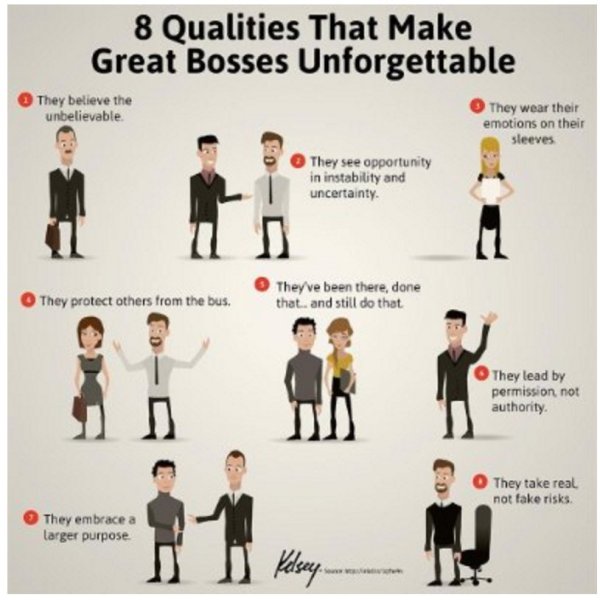
Great Infographic!!! – Below is just one frame of the whole. Check it out.

Photo Credit: Music Notes

Monday Morning Moment – Great Bosses and Those Not So Much – What Makes an Exemplary Leader?

Photo Credit: Identity Magazine, Shereen Gaber

We burn entirely too much energy and each other’s time commiserating over bad bosses. We are all best served by remembering the great ones and what it is about them that makes us better for knowing them. When we take the time to puzzle out what makes for a great boss, we have the path marked for becoming that sort of boss…or leader…ourselves.

Last week, I discovered a piece on great bosses by seminary dean and leadership writer Chuck Lawless. In a bit, you will read his 10 characteristics he puts forward as common in his personal experience of top ten leaders.

10 Common Characteristics of the Top Ten Leaders I’ve Ever Worked With – Chuck Lawless

First though, after i took some time myself, thinking back on what was it about the great bosses I had that distinguished them above all others.

Here are my 10 Characteristics of Great Bosses, in no particular order:

  1. They were trustworthy. We knew they had our back…always.
  2. They had consummate integrity. They were consistent in attitude and action no matter the audience. Even under intense pressure, whatever it cost them, they stood their ground for what mattered.
  3. They showed faith in me and each of us on the team. Not just to get the job done but to do it as only I/we could.
  4. They (those male leaders) didn’t treat us women differently. In fact, if they ever did seem to treat us differently, the great ones modeled a valuing of what the women brought to the conversation. Great leaders never diminished us, either overtly or covertly.
  5. They showed genuine care, even fondness, for us. They didn’t just spend their best time and energy on work meetings outside our team. They actually carved time out with us as a team for seemingly the sheer joy of it.
  6. They gave us a voice in the decision-making…especially as it related to our particular work and how we thought it should be done.
  7. They knew us well enough to call us on our own character stuff. It was never just about the work, the project, the product or service. It was about our own growth.
  8.  They kept a sense of humor and regularly brought perspective. This wasn’t just about lightening the mood; this was about returning our thinking to the bigger picture, the greater good.
  9. They provided opportunities for each of us to keep growing and developing professionally.
  10. They pushed us in meaningful ways toward a shared vision…to keep our focus and stay on track.

That’s my 10 in looking back to the many great bosses…invaluable leaders…I’ve had in my career.

Dr. Lawless’ 10 Common Characteristics are these (go to his article for helpful commentary on each).

  1. They know Christ. – (his article was to a Christian audience. Still, many consider Jesus of Nazareth the greatest leader who ever lived.*)
  2. They continually dream about what’s next. 
  3. They trust the team they’ve enlisted. 
  4. They take care of their team. 
  5. They read present-tense reality well. 
  6. They get a lot done while still taking time off.
  7. There is no pretense in them. 
  8. They know the organization is bigger than they are. 
  9. They laugh a lot. 
  10. They adore their family and make time for them. Chuck Lawless

12 Characteristics of Effective Team Members – Chuck Lawless

*The Greatest Leader of All – Geoff Loftus

Whatever experience we have had with great bosses or those not so much, we can learn from them. I was glad to have Dr. Lawless’ prod to look back on the leadership in my own life. It was remarkable how both great bosses and bad ones hang in our memories. One day I might write about the bad ones – and I have stories… Today, I just want to think about them with compassion, figuring they didn’t get to that place without being negatively influenced somewhere along the way.

As for those great bosses…the ones who lead brilliantly, with genuine care and provision for those who work under them…here’s to you. May we learn from you, follow hard after you, and not be shy to show our own appreciation and consideration for you as well.

Photo Credit: Twitter, David Chou

In closing, I would love to hear about some of your great bosses… those leaders in your lives that stand out in your memory (or present experience). Please comment below. Feel free to tell stories or give tributes. We can celebrate together!

Are You a Great Boss? – John Lynn, Healthcare IT Today

Four Types of Bosses You Need to Avoid – Shereen Gaber

Photo Credit: Workboard