Category Archives: Critical Thinking

Monday Morning Moment – Extreme Ownership – the Greater Good of Both Taking Responsibility and Letting Go of Control

Photo Credit: Echelon Front, Facebook

When we see individuals in the military with some form of Special Forces training and experience, we are captivated and sorely aware of how different they are from most of us. That level of discipline, courage, expertise and physicality is uncommon. Nothing I ever imagined for myself. Still what can we learn from these leaders that we can apply to life and work?

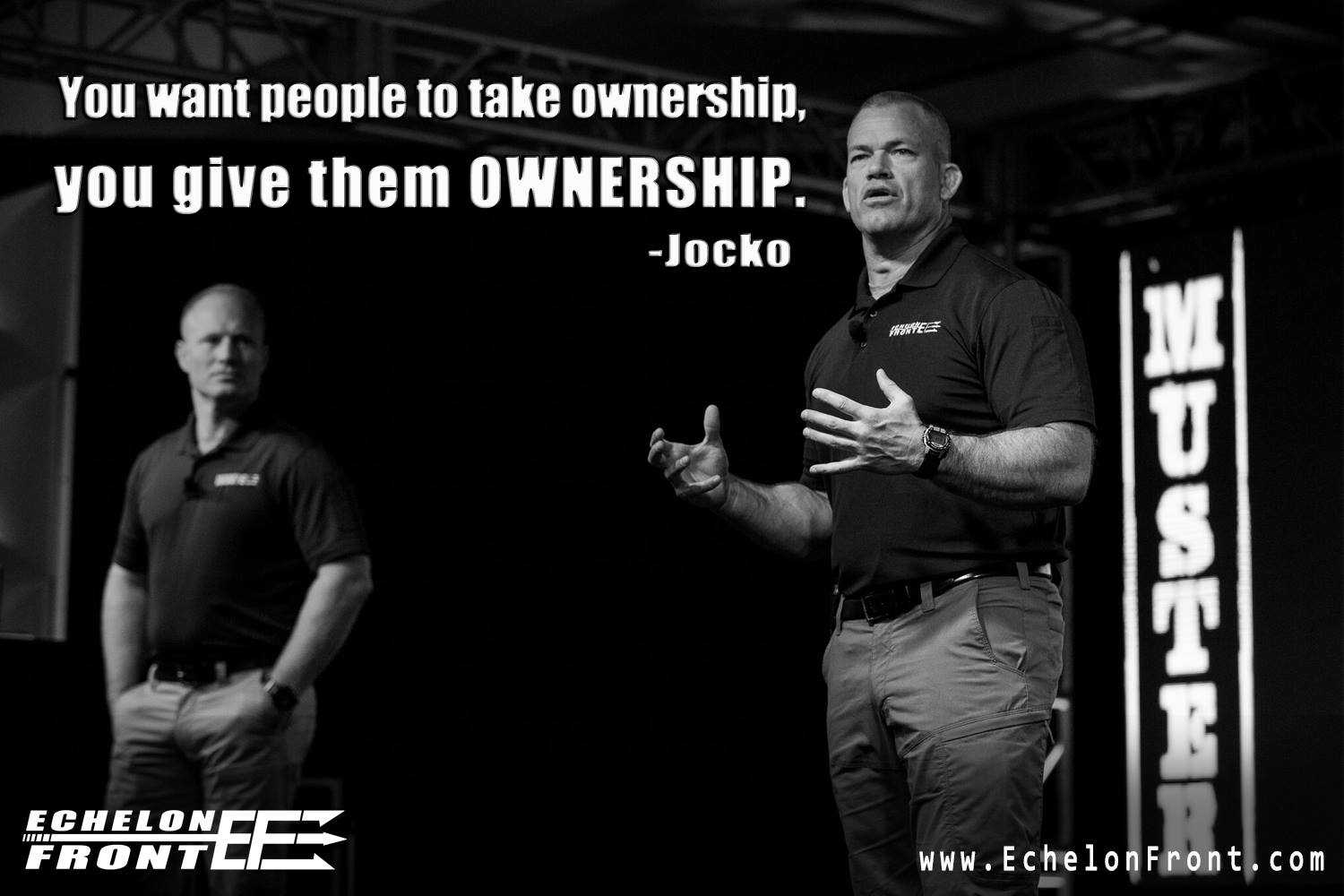
Although the book Extreme Ownership was published in 2015, it was unknown to me until this weekend. Thanks to my Twitter feed and then reading some reviews, I ordered my own personal copy. The authors, and former Navy SEAL team commanders, Jocko Willink and Leif Babin are heroes and the stuff of legend.

[OK…I haven’t read the book yet…pre-ordered the latest edition coming out November 21, 2017. however, the reviews and summaries (listed in the links below) have already been so informative, I will gush away even before reading the book. So sink your teeth into these bits below until we have both read the book…or have you already read it?]

The phrase extreme ownership really tantalized because it spoke to my own leader heart. It resonates with servant leadership which is hard to fathom as a norm in military structure and authority. The idea of everyone on a team, in an organization, owning their part of a vision or operation is thrilling to me. It makes sense that this would, of course, lead to highest performance…provided…and this is imperative: the leadership, up and down the organization, is equipping each team member, communicating thoroughly, and sharing decision-making as appropriate.

Leadership coach Brian Dodd was the one who first guided me to the book Extreme Leadership through his blog: 25 Lessons on Extreme Ownership – How the U.S. Navy SEALS LEAD And WIN. Some of his points from the book are:

  1. “Without a team – a group of individuals working to accomplish a mission – there can be no leadership.  The only meaningful measure for a leader is whether the team succeeds or fails.”
  2. “For leaders, the humility to admit and own mistakes and develop a plan to overcome them is essential to success.  The best leaders are not driven by ego or personal agendas.  They are simply focused on the mission and how best to accomplish it.”
  3. “Leaders must own everything in their world.  There is no one else to blame.”
  4. “There are only two types of leaders: effective and ineffective.  Effective leaders that lead successful, high-performance teams exhibit Extreme Ownership.  Anything else is simply ineffective.  Anything else is bad leadership.”
  5. “Leadership isn’t one person leading a team.  It is a group of leaders working together, up and down the chain of command, to lead.”
  6. “Ego clouds and disrupts everything: the planning process, the ability to take good advice, and the ability to accept constructive criticism.  It can even stifle someone’s sense of self-preservation.  Often, the most difficult ego to deal with is your own.”
  7. “As a leader, it doesn’t matter how well you feel you have presented the information or communicated an order, plan, tactic, or strategy.  If your team doesn’t get it, you have not kept things simple and you have failed.  You must brief to ensure the lowest common denominator on the team understands.”
  8. “Human beings are generally not capable of managing more than six to ten people.”
  9. “Trust is not blindly given.  It must be built over time.  Situations will sometimes require that the boss walk away from a problem and let junior leaders solve it, even if the boss knows he might solve it more efficiently.”

Business leader Tom Niesen also lists his takeaways from the book, and they align nicely with the other summaries I read:

  1. Mission (Commander’s Intent and Effectiveness)
  2. It is on the leader! (Assuming a good “hire,” now, it is the leader).
  3. Extreme Ownership – everyone believes in the “why”, understands the “why”, and then pursues the “what”. Beginning with the leader. But, everyone “owns it all”.
  4. Get rid of the undermining, not-carrying-the-load, under-performer [this should be a rare necessity in extreme ownership but it can happen].
  5. Get very good at information sharing.
  6. Simplify! Keep it simple. (Not simplistic – simple).
  7. Communicate – thoroughly communicate. Up and down and all around. Confirm that the communication was sent and received and understood.
  8. Prioritize and execute. – [Tom Niesen’s summary of Extreme Ownership]

I hope these two summaries (and others in the links below) will whet your appetite to consider reading Willink’s and Babin’s book. Especially  consider taking steps toward extreme ownership in your business or organization.

Sometimes, we struggle in leadership to trust those around us to speak into decisions or even to carry out their assignments without us hovering. Worse is when we just don’t trust others and, as a result, take too much responsibility on ourselves or just a few trusted members of the team. I’ve learned through my life to take joy in the many…even with all its messiness.

I’m reminded of a proverb along these lines:

Without oxen a stable stays clean, but you need a strong ox for a large harvest.  Proverbs 14:4Photo Credit: Wikimedia Commons

If we want processes neat and tidy, we must hold tight to control and keep our trust to a very few colleagues. We lose so much in the process…holding onto control, trusting just our “tribe”, and excluding the input and energy of those outside the circled wagons.

Extreme ownership requires a great deal from leaders…a letting go; an allowing ownership to spread through to a greater mass of people toward a greater good.

We must operate with wisdom and excellence to fully equip our teams and then to give them the freedom to execute. Clear and full communication, up and down the command chain, greases the tracks for this kind of operation. Shouldering personal responsibility at all levels is also crucial, but the key is ultimately the executive leader takes full responsibility in the end…especially if something goes wrong.

I love this concept of extreme ownership. Who’s with me? Fortunately we can apply these principles without having to go through the grueling process of being a Navy SEAL. Thanks, Gentlemen, for your incredible service.Photo Credit: Wikimedia Commons

Extreme Ownership: How US Navy SEALS Lead and Win – Jocko Willink and Leif Babin

25 Lessons on Extreme Ownership – How the U.S. Navy SEALS LEAD And WIN – Brian Dodd

United States Navy SEAL Teams

Here are my 8 Lessons and Takeaways from Extreme Ownership by former Navy SEALs Jocko Willink and Leif Babin

Extreme Ownership – Leadership Lessons From the SEAL Team – Gerardo A. Dada

Extreme Leadership Training

YouTube Video – Extreme Ownership – Jocko Willink – TEDx University of Nevada

New Release (November 21, 2017) – Extreme Ownership: How US Navy SEALS Lead and Win – Jocko Willink and Leif Babin

Extreme Leadership – Leading Blog @LeadershipNow – Michael McKinney

Extreme Ownership by Jocko Willink – Book Summary & PDF – Paul Minors

15 Minute Business Books – First Friday Book Synopsis

Monday Morning Moment – How an Accidental Diminisher Becomes a Multiplier

Liz Wiseman has written on this brilliantly in her leadership book – Multipliers – How the Best Leaders Make Everyone Smarter . Wiseman is the president of The Wiseman Group, a leadership research and development firm, headquartered in Silicon Valley, California.

Blog - Liz Wiseman

Photo Credit: LiveIntentionally.org

I first heard her speak at the Global Leadership Summit this year. This engaging young woman clearly has had multipliers in her own life and has obviously learned from some diminishers as well.

On the inside cover of Wiseman’s book Multipliers, she defines two terms: “Diminishers” and “Multipliers”:

“The first type drain intelligence, energy, and capability from the ones around them and always need to be the smartest ones in the room. These are idea killers, the energy sappers, the diminishers of talent and commitment. On the other side of the spectrum are leaders who use their intelligence to amplify the smarts and capabilities of the people around them…These are the leaders who inspire employees to stretch themselves to deliver results that surpass expectations.” – Liz Wiseman

Photo Credit: Slideshare

[Sidebar – Diminishers are not necessarily evil people. Their focus could be so tuned to the endgame that people and processes get lost in the pursuit. It’s possible some are accidental diminishers. Hopefully they will have an “aha!” moment, maybe through the multipliers in their own lives. They, too, could change their habits and disciplines.]Photo Credit: Multipliers Books

A diminisher (accidental or not) holds tightly to control, is exclusive (tribal) in her relationships, gives rationale that seems well-thought-out but demeans the hearer, wants the stage, breaks down trust, and lacks care or respect for those in her charge. I shudder at the possibility that I could become such a person…but it is possible for any of us to stray into the relational style of a diminisher.

A hard-wired diminisher may not be able to change – wouldn’t see her thinking or methods as a problem, in fact, sees them as part of how she ended up in charge. However, an accidental diminisher could recover…if he saw what was happening…through over-work, too much responsibility, or having personally experienced the ill of diminishing and taking on its qualities without being aware.

I want to always be a multiplier – one who genuinely cares for people, who inspires confidence in others, who sees the possibilities, who risks by giving over control to another, who stirs thinking and enlarges the lives of those in his/her circle of influence…a circle that’s widely inclusive.

Being a leader is a humbling, stretching experience and, for the sake of those under your watch in your workplace or organization, we want to offer the best leadership we can, right? However, we can all fall prey to habits over time that diminish others.

Forging disciplines that keep us from diminishing is wisdom. Liz Wiseman and Greg McKeown offer three points from which to start:

  1. Shift from giving answers to asking questions. The best leaders don’t provide all the answers, they ask the right questions.
  2. Dispense your ideas in small doses. If you are an idea guy who is prone to tossing out more ideas than anyone can catch, you have “the gift of gab.” Try articulating your ideas in increments. Introduce fewer ideas and leave white space. First, it creates room for others to contribute, and second, your words will be heard more frequently and will be more influential.
  3. Expect complete work. People learn best when they are fully accountable and face the consequences of their work. Ask people to go beyond pointing out problems. Ask them to find a solution. By wrestling with it themselves, they’ll grow their capability and be able to operate more independently.

Wiseman also talks about effective leaders (or multipliers) as operating in the role of change agentsdo we reserve the right to make the final decision every time or do we wrestle through decisions with those most affected by them? The latter can definitely be more messy but is also more effective and honoring.

“Multipliers invoke each person’s unique intelligence and create an atmosphere of genius—innovation, productive effort, and collective intelligence…He’ll outstretch all your capabilities to make it happen. He is highly demanding, but you feel great. You know you are signing up for something that will challenge you on a daily basis for many years to come. You will challenge yourself and all your capabilities…Exhilarating, exhausting, challenging, gratifying. He’s a big source of energy. He is a source of power and a tail-wind for what we do.”  – Liz Wiseman

Thank you, Liz Wiseman. You are a wise woman (I’m sure you get this all the time…couldn’t resist). Thank you, to all those multipliers in my life’s journey.

Read Wiseman’s book. I’d love to hear your stories of multipliers in your life…and any diminishers that you learned from but (hopefully) were not diminished in the season you were together…maybe you became a multiplier in that person’s life. Journey strong, Friends.*

Multipliers – How the Best Leaders Make Everyone Smarter by Liz Wiseman with Greg McKeown

*Excerpts from my previous blog: Liz Wiseman’s Leadership Book on Multipliers and the Story of a Multiplier in Our Lives – Deb Mills Writer

Are You an Accidental Diminisher? – Liz Wiseman & Greg McKeown

Leadership Mindset – Are You a Multiplier or a Diminisher? – Tony Flatau

Can a Diminisher Become a Multiplier?

The Shadow Side of Leadership – Jesse Lyn Stoner – [Read comments]

Slideshare – The Multipliers – Why Some Leaders Create Genius Everywhere – Greg McKeown

YouTube Video – Leaders as Multipliers with Liz Wiseman

YouTube Video – Liz Wiseman – The Multiplier Effect 0

Multipliers Quotes from GoodReads

2013 Global Leadership Summit Session 3a: Liz Wiseman

Brian Dodd – 4 Leadership Lessons From Mt. Rainier and the Inc. 500 Fastest Growing Business List – another example of a Multiplier

5 Friday Faves – Uncommon Friendship, Compounding Your Time, Bon Iver’s Holocene, Fear of Dying, and Parenting Post-Childhood Trauma

Happy Friday! Jumping right in to this week’s Friday Faves:

1) Uncommon Friendship – Would you push a wheelchair for a friend across a 500 mile journey? Patrick Gray gladly did that for his friend Justin Skeesuck. They are both heroes. They love each other and give each other the opportunity to live large…live unlimited. Watch the video. Buy the book.

Two Friends and One Wheelchair on the Pilgrim’s Way: Justin and Patrick Live Unlimited on the Camino de Santiago

I’ll Push You – Facebook Page

I’ll Push You: A Journey of 500 Miles, Two Best Friends, and One Wheelchair – Patrick Gray and Justin Skeesuck

2)Compounding Your Time – Compounding your time is like compounding interest – a small investment over time that yields multiplying dividends. Writer and social entrepreneur Michael Simmons recently posted a super helpful article on maximizing your time use. In Why Successful People Spend 10 Hours a Week on “Compound Time”, Simmons describes compound time as an element of the day of high performers. They “step away from urgent work, slow down, and invest in activities that have a long-term payoff in greater knowledge, creativity, and energy. As a result, they may achieve less in a day at first, but drastically more over the course of their lives.” Simmons’ 6 hacks to incorporating compound time in your life are listed below, but don’t miss his fuller fleshing these out here.

Hacks for Compounding Your Time (Over Time):

  1. Keep a journal.
  2. Take a nap.
  3. Walk 15 minutes every day.
  4. Read.
  5. Invest in conversation partners.
  6. Experiment regularly.

“To get started, follow the 5-hour rule: for an hour a day, invest in compound time: take that nap, enjoy that walk, read that book, have that conversation. You may doubt yourself, feel guilty or even worry you’re “wasting” time… You’re not! Step away from your to-do list, just for an hour, and invest in your future. This approach has worked for some of the world’s greatest minds. It can work for you, too.” – Michael Simmons

What have you found helpful to compound time in your own life? Please share in Comments.

3) Bon Iver’s Holocene – The American Indie folk band Bon Iver wrote and performed this incredible song, Holocene. It’s part of the soundtrack in a couple of favorite films of mine (The Judge and We Bought A Zoo). The music is ethereal and just plain lovely. The lyrics?

Bon Iver’s obscure lyrics make those of us who love the song search for its meaning…here one commentor gives my favorite interpretation:

The point that struck me the other day though, was the beauty in the title. Holocene: an epoch spanning over 10,000 years- “connectedness” to the earth from present to the past. Not only are we are aware the world is vast- we are aware that we are only a small speck in time. There is beauty in such simple humanity of a flickering flame, the pink hues of a sunrise- things enjoyed by humankind for eons. It connects our present world of Facebook and Smartphones to centuries of humanity that existed before us- and to the future that lays ahead.

He has these “moments” where everything is right with the world: “not the needle nor the thread, the lost decree… Saying nothing was enough for me”. Conversation is not needed, you are absorbed in the moment of the “hallowed bright” of Christmas Eve or “Laying waste to Halloween”, but “at once”, you are struck with the realization that your “moment” is not significant… “I was not magnificent”. In this though, there is joy in the feeling that despite that, you are still a part of something.

You are a part of the fabric of humanity- over 10,000 years of ‘people’. “Hulled from far the highway aisle”, separated from race, religion, politics and war- but connected to love, jealously, empathy, depression and beauty- emotions spanning borders and time. “Someway baby its part of me, apart from me”.

Holocene reminds us, humbles us and empowers us. My Interpretation – Bevanreay

4) Fear of Dying – I entered motherhood as a cancer nursing specialist. Cancer was all around me in those days, and I embraced what I learned of how precious and tenuous life could be. We were still in the first few days at home with our daughter when, while showering, I discovered a knot under one of my arms. It shook me so much, I literally had to lean against the wall of the shower for a few seconds. Well, thankfully, it turned out to be a non-malignant swollen lymph node common to breast-feeding mothers.

Still, then, and more recently dealing with the real deal cancer, I am acutely aware of how the shadow of death can fall on a life. Just. Like. That. A shadow is just a shadow and often it passes, and all is well again. However, we land at a different place emotionally and spiritually when “well” comes again. A better and broader place.

Mom and blogger Heather Anne Naples  writes about that transformation in her own confrontation with a frightening experience as a mom of a small child. Photo Credit: Heather Anne Naples

How the Fear of Dying Taught Me How to LiveHeather Anne Naples

As she relived her medical emergency and hearing her baby crying and calling for her as the paramedics took her out to the ambulance, she became terrified at the idea that she might not make it and her daughter would not remember her.

I ask you to ask yourself: What will be said about you when you are gone?

Are you kind? Are you gentle? Are you giving? Are you loving?

I am…Now.

Confessing to having previously been a gossipy, sassy “mean girl” before her medical emergency, she turned that all around…not perfectly, of course (not any of us can claim that)…but she altered her life’s course for her daughter…and all in her life from then on out.

The fear of dying should never consume us…that would be a form of dying while living. However, we can learn from a brush with death…that learning can help us live life differently…and better.

http://www.acesconnection.com/blog/making-the-good-stuff-louder-trauma-dad-bryon-hamel

5) Parenting Post-Childhood Trauma – I have people in my life who have decided not to parent because of the trauma in their own lives growing up. They think they are too damaged and don’t want to pass that on to their own children. That is so tragic to me. It’s like the abusive adults in their lives continue to wreak havoc in the adult survivors of childhood trauma.

I’m sure there are situations where not having children is the answer, but it is thrilling to know of people like Byron Hamel.

Photo Credit: ACEs Connection

ACEs Connection writer Christine Cissy White interviewed Hamel, filmmaker and child/parent advocate. Her post, entitled Making the Good Stuff Louder: Trauma Dad, Byron Hamel, gives hope and empowerment. Read the full interview but here Hamel summarizes.

“Childhood isn’t safe. Predators are everywhere. A guy exposed himself to my kid last week at a park. You get your kid out of the park and you call the police. Be vigilant. Learn what grooming is and how to stop it. Monitor their activity online. Ask them about school. Tell them they can tell you ANYTHING and they won’t get in trouble. Tell them they don’t have to fear for their safety, or indeed for YOUR safety. And don’t wait for them to come to you. Ask them regularly. Make your home a fortress for their well-being. Make it feel like the safest place they can possibly be. Show them the greatest love. Be their greatest protector. Listen the most intently.”

A Cycle Broken – Byron Hamel Productions

Care Can Not Be Purchased – Byron Hamel

Guardians of the Children

Love Your Neighbor – The Resilience Movie and Adverse Childhood Experiences (ACEs) – Deb Mills Writer

Dance Like You Matter

That’s a wrap on this week’s Faves. Have a great weekend. Be kind to yourself and those around you…you just never know.

Bonuses:

http://paulsohn.org/30-quotes-that-will-help-you-get-through-the-day/

Motivated Reasoning Is Why You Can’t Win an Argument Using Facts

Living Out – Same Sex Attraction – Anne [website for Christians grappling with SSA]

5 Friday Faves – Braveheart and Classical Guitar, Inheriting Our Parents’ Traits and Trauma, Destination Addiction, Confederate Monuments, and Lunch with Seniors

Friday! Yes…the weekend is upon us and the start of Fall. Hope you’ve had a week full of grace. What a season of hurricanes and earthquakes and wars and rumors of war! We hold onto God and each other, and perspective comes much more readily.

Here are five of my favorite discoveries this week, as well as a few bonuses at the end. Hope you’re encouraged and positively emboldened in the reading below.

1) Braveheart and Classical Guitar – The 1995 Mel Gibson film Braveheart moved the hearts of all who saw it. Braveheart was an epic telling of Scotland’s fight for freedom from England into the 13th century. Historical accuracy wasn’t a goal of the filmmakers, but grandeur of the clashing battlefronts was riveting.I couldn’t watch every frame because of the medieval war violence and the grisly execution of William Wallace (played by Gibson). Photo Credit: Fanpop

My family is Scottish with both Wallace and Bruce in our family tree. When son Nathan of Beyond the Guitar arranged a medley of the beautiful James Horner soundtrack, I told him he should wear a kilt for the video… No kilt, but gorgeous themes bringing back the intense emotion of the film. Made me want to see Braveheart all over again. Photo Credit: YouTube, Beyond the Guitar

Here’s the YouTube video of Beyond the Guitar’s Braveheart. Lovely.

2) Inheriting Our Parents’ Traits and Trauma – My whole life people have told me, “You look just like your mother.” That was fine by me because I loved her deeply and thought she was beautiful.

As I’ve grown older, it’s not just looks but actions that also are a part of my link with my mom. Even though she is no longer with us, I will do things or react in certain ways that remind me of Mom.

April Dembosky has written a piece on intergenerational transfer of trauma. It is entitled Just Like Mother: How We Inherit Our Parents’ Traits and Tragedies.

Dembosky writes about a Vietnamese family immigrating to the US after enduring war trauma. She described vividly how the struggles a parent endures can be transferred to the children in the ways they also react to adverse situations and their coping mechanisms.

Love Your Neighbors – The Resilience Movie and Adverse Childhood Experiences (ACEs) – Deb Mills Writer

Understanding the possibility of intergenerational transfer of trauma is not to make victims of a future generation. Understanding allows us to recognize if we have vulnerability and to set in place healthy barriers against the impact of our parents’ trauma.

My mom grew up with an alcoholic father who vented his frustrations about life on his wife and children. Mom stood against his abuse of her own mother and brothers. Her fighter responses were tempered as an adult when she became a believer (follower of Christ). Still that quickness to take offense and wariness of mean-spiritedness were reactions she had to fight. I see that also in myself.

Children of Alcoholics and Addicts Have PTSD – Leslie Glass

3) Destination Addiction – No it’s not about our next vacation, but destination addiction is very much about whether or not we can find contentment in our day-to-day life. Robert Holden, a British psychologist, writes and speaks about the pursuit of happiness.

To be honest, I’m not taken with all Holden says about happiness or contentment, but destination addiction is something to avoid, for sure. When we long for that next thing…whether it is the vacation, or next job, or next house, or even next relationship…we cease to live in the present. This addiction, like all others, is never satisfied.Photo Credit: AZ Quotes

If this is a struggle for you, and it sure has been for me at various seasons of my life, recognize it and deal with it. Sure, we can look forward to the “something new’s” in our life, but not to the exclusion of what is real and valuable and not-to-be-missed right now.

The links below are quick reads and excellent helps.

Destination Addiction – Edie Weinstein

Do You Have Destination Addiction? – Gabrielle Treanor

The Search for Happiness – a Brief Look at ‘Destination Addiction’ – Mark D. Griffiths

4) Confederate Monuments – Richmond, Virginia is a city steeped in American Civil War history…a history that has come sharply under fire recently. There has been a clarion call to take down the monuments to the Confederacy. Whether those monuments come down or not in the days ahead, the conversation spurred across cultural lines is crucial. The voices of those most marginalized by present-day racism must be heard. Five Richmond young people visited Monument Ave. recently, and their response might surprise you.Photo Credit: Richmond Cycling Corps, Facebook

Reporter Matthew Chaney‘s post revisted a Facebook post by Richmond Cycling Corps. Daquan, one of the five teenagers, wrote brilliantly their collective response on seeing the statues of Confederate generals displayed on Monument Ave.

“Everybody’s pointing blame at Monument Avenue and the statues that reside there, but those statues never did anything to me or people that I care about,” he wrote. “The only thing that ever harmed people in low-income areas is the violence that resides there.”

“Instead of using money to knock down statues that most people in low-income areas never even seen, how about using that money to improve schools, fix up the community that we see every day, or why not protest in our neighborhoods where we see violence and hate the most.”

Read the entire post as Daquan raises the more crucial issues of violence, hunger, poor schooling, and hopelessness they see every day in their Richmond community.

The monuments may still come down in the attempt to deal with the racism in this city. What is needed more is this 17y/o man’s counsel.

5) Lunch with Seniors – This is not about taking high school or college students to lunch. That would be much appreciated, I’m sure…but this is about going to lunch with those older ones in our lives. It’s what neighbor friends of ours did earlier this week, taking a 91 y/o widower out to lunch at his favorite restaurant.

Seminary professor Chuck Lawless gives 12 Reasons to Have Lunch With a Senior Citizen or a Bunch of Them. Some of the reasons include how much we can learn from those more experienced than us, how funny they can be, how they also need encouragement, and how they will sometimes pray for us.

It doesn’t take much sorting out to see the value in such an interruption to our day. Thankfully those older than us also understand the value of such times together…for them and for us. All we have to do is make that phone call…stepping out of the comfort zone of texting. So worth it.

That’s my five. How about you? Please share in the Comments something you’ve gleaned from this week. Have a weekend that replenishes your soul. Be kind to yourself and those around you.

Worship Wednesday – the Faith to Believe

Photo Credit: Flickr

For by grace you have been saved through faith. And this is not your own doing; it is the gift of God.Ephesians 2:8

For the first twenty years of my professional life, my great privilege was to have close encounters with people in deep crisis and five life-changing realities. It was a season of caring for cancer patients and their families – when their diseases were raging and in the final days of life. These experiences galvanized my faith in God and how his image is embedded in us – his creation. These realities are:

  1. Courage in exceedingly hard places
  2. Deep enduring love across a harsh illness and when time is fleeting
  3. Hope mingled with humor
  4. Death isn’t final…our spirits go somewhere (for sure, they leave the body)
  5. Faith to believe

Caring for patients receiving chemotherapy and other treatments for life-threatening complications can prompt an intimate caring relationship. To watch patients (and families) deal with such hard and to be in a position to help them through it gave me a window to extend love and honor to dear ones in crisis.

Was there always courage? Was love always expressed between us all? Was humor or hope or faith a constant?

No…but remarkably, more often than not, this was what I observed… especially in those sustained by a relationship with God.

In the last couple of years, I have personally experienced a cancer diagnosis and a couple of respiratory emergencies that brought those same realities into my life. In such times, much in life gets clarity…a sharper focus, a deeper understanding.

Breathe has been a theme in my life for over a year now…put that together with the title of a film starring Andrew Garfield…and it caused me to NOT “skip the ad” on YouTube.Photo Credit: Breathe, YouTube

The film Breathe tells the story of Robin Cavendish. He was a Brit who developed polio at the young age of 28. He was paralyzed from the neck down and required a ventilator to breathe. In those days (1958), he would have been confined in a hospital for the remainder of his days. However, he nor his wife, Diana, would hear of it. After a year in hospital, he went home and adjusted to this very different life, as only Robin would. They had a child and he would be able to see him grow up (in fact, son Jonathan Cavendish produced this film). Robin was a pioneer in advocating for the disabled, especially those like him needing more extreme measures to live a more normal life. He died at 64.

[Since my years in graduate studies in rehab and cancer nursing…the courage I saw in so many patients and families…courage in struggle…has never ceased to inspire me.]

“Based on a true story” films are intriguing. Reading up on Robin Cavendish’s story, my heart soared and then sank…fullstop at the short statement below:

Cavendish was an atheist.Wikipedia

I have never understood atheism. Even during spiritually flat and confusing times in my life, the existence of God put me to puzzling but ever so briefly. In a matter of moments of reflection, the fact of His presence blew past the questions.

Especially watching beloved believing patients at the moment of death…their faces relaxing and their bodies emptying of who they really were. We don’t just stop existing…life here stops and starts at exactly the same moment…There.

Now that I know Robin Cavendish, he has my admiration and respect at how he took back his life and helped others do the same. I wonder if, before his life was done…he had the faith to believe. One line in his obituary reads:

It is a strange irony that, though professing to be an unbeliever himself, he had a capacity for making other people feel closer to God.*

*Obituary – Robin Cavendish – Alice and Tim Renton

What a great gift is faith to believe. We don’t conjure it up. God Himself presents us the faith to believe…it is ours to reject or receive.

Worship with me. Below you will find two songs – Faith to Believe by Shane & Shane and Jesus Is Better by Austin Stone. Choose either or both in celebrating the God who gives us the faith to believe. [Then scroll down to the prayer at the end.]

YouTube Video – Shane & Shane – Faith to Believe – (with lyrics)

Give me the faith to believe You
When I’m stuck here in my fear
Give me the strength to trust You
When my vision’s blurred by tears
Give me a hope for tomorrow
Because today has gone so wrong
I’m on my knees
Give me the strength to believe

Even when I cannot see You
You’re still shining, You’re still shining
Even when I cannot hear You
You’re still calling out my name
Even when I cannot see You
Your arms are open
Always holding on to me
Give me the faith to believe

You say You’ll never leave me
Your love will conquer fear
You say Your day is coming
When You’ll wipe away my tears
Give me a hope for tomorrow
Because today has gone so wrong
I’m on my knees
Give me the faith to believe

Give me the faith to see the invisible
Give me the faith to believe the impossible
Give me the faith to receive the incredible
Oh give me the faith to believe it**

There is no other so sure and steady, my hope is held in your hand
When castles crumble and breath is fleeting, upon this rock I will stand
Upon this rock I will stand

Glory, glory, we have no other king
But Jesus Lord of all
Raise the anthem, our loudest praises ring
We crown Him Lord of all

Your kindly rule has shattered and broken the curse of sin’s tyranny
My life is hidden ‘neath Heaven’s shadow, Your crimson flood covers me
Your crimson flood covers me

Glory, glory, we have no other king
But Jesus Lord of all
Raise the anthem, our loudest praises ring
We crown Him Lord of all

In all my sorrows, Jesus is better – make my heart believe

In all my victories, Jesus is better – make my heart believe

Than any comfort, Jesus is better – make my heart believe

More than all riches, Jesus is better – make my heart believe

Our souls declaring, Jesus is better – make my heart believe

Our song eternal, Jesus is better – make my heart believe

Glory, glory, we have no other king
But Jesus Lord of all

Glory, glory, we have no other king
But Jesus Lord of all
Raise the anthem, our loudest praises ring
We crown Him Lord of all

Glory, glory, we have no other king
But Jesus Lord of all
Raise the anthem, our loudest praises ring
We crown Him Lord of all***

Photo Credit: Flickr

Maybe this is the first step for atheists, too (it was for me)…so thankful for the faith to believe…to see the truth and beauty of Scripture. The Word of God walks us right up the staircase to be with Him – now and forever.

Thank You, God, for the faith to believe. With my whole being, I’m sure you daily, moment by moment, extend grace to all of humanity to know You, through one witness of Yourself or another. Help us to receive this grace. God, give us all this faith to believe.

**Lyrics to Faith to Believe – written by Shane Everett & Phil Wickham

***Lyrics to Jesus Is Better – written by Aaron Ivey & Brett Land

Monday Morning Moment – Principles of Execution – and Teams That Get It Done

Photo Credit: USAFA

Two workplace scenarios. The first is when either the manager or the team is super excited about a goal, and action items are determined and given to just the right team member and calendared for quick turnaround. Photo Credit: JSC

The second scenario is when either the manager or the team is super excited about a goal, then one or the other digs in their heels. The meeting ends with no clear shared responsibilities, no movement forward, no hope of change.Photo Credit: GangplankHQ, Flickr

Sigh…all the most excellent strategic planning can take place inside a conference room…and without execution. Essentially, nothing happened there.

I’ve had both kinds of team experiences and want to focus on the former one above. Talk about high employee morale when a group of colleagues operate as a finely tuned machine and the yield is high-quality productivity.

FranklinCovey is a leadership consulting firm. I discovered this firm through the book The 4 Disciplines of Execution authored by leaders in the firm.

The 4 Disciplines of Execution: Achieving Your Wildly Important Goals is written by Sean Covey, Chris McChesney, and Jim Huling.

When you go to the website, you actually are able to immediately grow in your understanding of how to influence execution in your company. The video below is an incredible teaching tool – 17 minutes of powerful content on execution:

In brief, their 4 disciplines of execution are:

  1. Focus on the wildly important goals (WIGs). The day-to-day operations always stand against those game-changer goals. Determine to be unyielding on the highest-priority goals (1-3 maximum).
  2. Act on the Lead Measure. [New terminology for me.] The lag measure is the goal itself. The lead measure is what you can influence to accomplish the lag measure. Lead measures are the leverage used to get to the lag measure (goal). Lead measures are “predictive and influenceable“.
  3. Create a compelling scoreboard. I appreciate the wisdom of this (Chris McChesney describes it so well in video above). The scoreboard is not for the manager. It’s all about the players at this juncture, and it should feel like a game. [Actually an element of fun and energy incorporated. What a concept!] The scoreboard would be simple, highly visible and the players (employees) should be able to tell right away from the scoreboard whether they are winning or losing toward meeting the goal.
  4. Create a cadence of accountability. Everybody is going to love this! 20-minute meetings are calendared every week, at the same time. All the people in the room have “skin in the game”.  This meeting is sharply focused on 3 things (related to the lead measures only): each person reports on the week before; reviews/updates the scoreboard; makes commitments for coming week. That’s it! How streamlined and forward-moving, is that?!

[ 4 points taken from the video above: 4 Disciplines of Execution]

Many years ago, I was on a work team that was given the responsibility and liberty to determine what else was needed in the formation of a comprehensive cancer center. We had many places already in place – excellent medical and nursing care, an engaged community, and a charitable foundation to provide extra resources for taking us to a state-of-the-art cancer center.

3 nurses – Kay, Kathy, and I – had the question to answer of “Why Else?” What else did we need? We worked together on the planning and execution of comprehensive support services and education. Each of us brought our own giftings – I had vision and ideas, Kay was an influential nurse manager, and Kathy was detail-oriented and had a gift for taking a project to completion. Some of the services that came out of those problem-solving sessions are still embedded deeply into the DNA of that cancer center today.

Ray Dalio, founder of Bridgewater Associates, presented some of his business principles in a TED Talk entitled “How to Build a Company Where the Best Ideas Win”.

Start at 6:17 minutes in (if you don’t want story and context), and you will hear his wisdom about the importance of radical truthfulness and radical transparency.

“One of the greatest tragedies of mankind: People arrogantly, naively holding opinions in their minds that are wrong…and acting on them, and not putting them out there to stress-test them, and that’s a tragedy.” Ray Dalio

“Collective decision-making is so much better than individual decision-making if it’s done well.” – Ray Dalio

Kathy, Kay, and I had that sort of team relationship – radical truthfulness and radical transparency.

Whether you are part of a team, or an independent entrepreneur, there are excellent principles here.

Finally, in Gerald Leonard‘s piece on Steve Jobs‘ principles of execution, Leonard listed 9 nuggets of wisdom:

1) Do what you love for a living.

2) Build partnerships that will turn into lifelong friendships.

3) Attend college to get an education not just a degree.

4) Join your local industry associations.

5) Experiencing other cultures will open your eyes to new worlds.

6) Find others who have complementary strengths and recruit them.

7) Don’t be afraid to recruit others that are stronger than you.

8) Practice CANI – Continuous and Never-Ending Improvement.

9) When one door closes, another will open if you look for it.

Principles of Execution 014: Insights from Steve Jobs on Visionary Leadership – Gerald Leonard

If you want to take an honest and critical look at your team or company’s success in operation, you have great helps here – in the FranklinCovey’s counsel, in Ray Dalio’s discoveries and in the philosophies of business leaders like Steve Jobs. I’d also like to add anything on teaming by Patrick Lencioni.

I would love to hear how you get to execution…because until you do, it’s just meetings upon meetings.

Please add in Comments below any other resources that have proved helpful to you in getting to effective execution with the added impact of high morale in getting to goal.

Get Better: 15 Proven Practices to Build Effective Relationships at Work – Todd Davis, FranklinCovey

The 4 Disciplines of Execution: Achieving Your Wildly Important Goals – Chris McChesney, Sean Covey, and Jim Huling

YouTube Video – The 4 Disciplines of Execution in a Nutshell

Patrick Lencioni – 3 Indispensible Virtues that Make Teams Successful – Dan Schwabel

Having a Team Scoreboard – The Table Group

Building a Healthy Work Culture – in a Season of Change, Uncertainty, and Dips in Morale – Deb Mills Writer

Monday Morning Moment – Social Capital – an Invaluable Resource We Can Develop – and a Tool to Help – Deb Mills Writer

Monday Morning Moment – Taking the Social Capital Challenge – 5 Steps Forward – Deb Mills Writer

Monday Morning Moment – True Humility in Leadership – So Not Cliché – Deb Mills Writer

The Five Characteristics of a Highly Functional Team – Dennis Hopper

YouTube Video – 4 Disciplines of Execution – Gwinnett Medical Center – This was personally very satisfying and encouraging for me. My dad was a patient at this medical center during the time when there were banners flying everywhere about it being one of the top medical centers in the country. At the same time, we family members stayed with him around the clock, because nurses did not come when we called, nor were other services offered with any communication that my dad or we mattered to staff. To see that they also came to recognize this was a problem and took effective steps to correct it was exciting.

Nabeel Qureshi – 1983-2017 – Less About Religion, All About God

Photo Credit: Nabeel Qureshi

I am grieving today for someone who has touched my heart in a huge way, though we have never met.

Nabeel Qureshi is a son, brother, husband, and father. He is a writer, speaker, theologian, and medical doctor. Until recently he also was in treatment for a very aggressive cancer.

None of these descriptors speak to how deeply he has moved my heart and mind. His faith…and the God of his faith…speak volumes.

He is a follower of Jesus today, after being a devout Muslim. His relationship with God through Christ is laid out in detail in his books Seeking Allah, Finding Jesus and No God, But One. Much of his story and the object of his faith are also highlighted on several YouTube videos.

His courageous battle against cancer ended yesterday. At the age of 34. Father of a little girl. Just really at the beginning of his career.

I have never spent much energy in questioning God when one of us dies. My understanding of such things is so limited. Why Nabeel had to die so young is beyond my understanding. One thing I am convinced of is that just as God worked in his life, God will work in his death.

That’s why I’m writing this brief announcement of his passing… He is now in the presence of the God who loves him, the God whom he loves. God will comfort his family and friends and will provide for his wife and daughter. Many of us will know more of Nabeel in his death than we did in his life. I am thankful he wrote about his spiritual journey and spoke so lovingly and articulately about the God who drew him to Himself.

“After loving us with the most humble life and the most horrific death, Jesus told us, “As I have loved you, go and love one another.” How could I consider myself a follower of Jesus if I was not willing to live as He lived? To die as He died? To love the unloved and give hope to the hopeless?”Nabeel Qureshi, Seeking Allah, Finding Jesus

“All suffering is worth it to follow Jesus. He is that amazing. I pray that I will meet you someday, my dear friend, so we can rejoice and praise God together for our joys and our sufferings.”Nabeel Qureshi, Seeking Allah, Finding Jesus

My first knowledge of Nabeel Qureshi‘s cancer and death yesterday was through Justin Taylor‘s blog posting. Please take the time to read it (and watch the videos included). If you have never heard of Nabeel Qureshi, you will have an introduction to him, his life, and his discovery and embrace of God. Below is Taylor’s close to his tribute of our brother Nabeel Qureshi.

Today, Nabeel Qureshi, beholding his Savior face to face, is able to declare what is true:

I have fought the good fight.

I have finished the race.

I have kept the faith.

Henceforth there is laid up for me the crown of righteousness, which the Lord, the righteous judge, will award to me on that day, and not only to me but also to all who have loved His appearing. – 2 Timothy 4:7-8

Entering into the joy of his Master, he undoubtedly heard the words, “Well done, my good and faithful servant.”Justin Taylor

Postscript: I have dear Muslim friends who may take offense at his story. He spoke painfully in his book and vlogs about the loss of closeness with his beloved parents and sister…for a season. I was grateful to see that in his last-published vlog before his death, he spoke of them with gratitude as they were with him caring for him along with his wife, Michelle. Love is larger than anything that would separate us. So thankful for that.

Seeking Allah, Finding Jesus and No God, But OneNabeel Qureshi

Nabeel Qureshi – 1983-2017 – Justin Taylor – The Gospel Coalition

Nabeel Qureshi – Quotes – Good Reads

YouTube Video – Vlog 33 – A Very Special Guest – My Dad! – Nabeel Qureshi

Why This Muslim-Turned-Christian Resonated With So Many Before His Death at 34 – Ravi Zacharias

5 Friday Faves – Replacing Your To-Do List, Unsung Heroes, Legacy, Gaslighting, and Emotional Intelligence in Conflict

Here’s to another Friday. As the heat of summer fades slowly into the cooler shorter days of fall, at least some of us welcome the change. This, like so many weeks, has had its unexpected joys and challenges. I so appreciate the wisdom, helps, and encouragements that lift and help us to stay in our lanes.

Below you’ll find my 5 Friday Faves for this week plus as many bonuses at the end. It was a rich week…hope yours was as well. Also, please share any of your finds in the Comments section. We all can happily learn from each other.

1) Replacing Your To-Do List – Leadership coach Tony Stubblebine has posted a brilliant piece on doing away with our to-do lists. He prescribes a problem-solver, thinker model of interstitial journaling. This makes productive use of the space between completing one project and starting the next. It entails jotting a few sentences in a journal (electronic or paper) – summarizing what we finished and jumpstarting our thinking on what is before us. This takes our to-do lists to a whole new level of getting things done.

Replace Your To-Do List With Interstitial Journaling to Increase Productivity

Photo Credit: The Inner Sage Australia

“We weren’t built for multi-tasking, so transitions between projects are very tough. We end up getting lost in procrastination. Even when we manage to transition quickly into our next project, our brain is still thinking about the last project. That means our second project suffers from partial attention. The science of multi-tasking says partial attention can mean a 40% or more reduction in cognitive performance. The Interstitial Journaling tactic solves all of these normal problems. It kills procrastination, empties our brain of the last project, and then gives us space to formulate an optimal strategy for our next project.”Tony Stubblebine

This article is hosted on Medium which offers Members Only reading (free membership) but it should allow you to read it on a first-time link click. That’s how I found Medium…and lots of helpful reading through it.

Tony Stubblebine – Productivity, Habits & Life iPhone App

2) Unsung Heroes – As I write this week’s Friday Faves, we have just finished our remembrance of the 9-11 terror attack and losses of 2001. Reading again about so many courageous victims and families, first responders and a nation in shock and grief helps in sorting out afresh what happened that day.

We don’t know what was the intended target of hijacked Flight 93 but we do know that several of the passengers heroically charged the cockpit. Among them were  Todd Beamer  and Mark Bingham. What courage!

“Let’s roll.” – The Real Story of Flight 93 – Ed Vulliamy

Another man I didn’t know about until this year was Rick Rescorla. He was the director of security for a very large company in the South Tower of the World Trade Center. After the first plane crashed in the North Tower, the building occupants were advised to stay at their desks, but he knew better. Rescorla got them all out as quickly as possible and returned to the building to make sure that everyone was out. He never got out with the collapse of the South Tower.

This running into danger instead of away is what we’ve come to expect of first responders, but we should never stop remembering them…or the cost they often pay.

3) Legacy – This week, seminary professor Chuck Lawless posted a thought-provoking piece on leaving a legacy – What Kind of Shadow Are You Leaving Behind?  He listed 14 possible “shadows” we cast for our children, colleagues, and friends. They include: Unbounded Love, Continual Selfishness, Material Idolatry, Genuine Faith, Committed Parent.Photo Credit: Pixabay

We cast shadows whether we plan them or not. They happen over time. Better for all of us to decide and intentionally establish what kind of shadow, what kind of legacy, we leave for those we love.

After you read his list, what would you add? If you comment, I’ll also share the ones that came to mind not on the list.

4) Gaslighting  – Have you ever heard this term? I had this extraordinary Aha moment this week when this term came across my Twitter feed. If you’ve had this experience you will find these definitions familiar:

“Gaslighting is a form of manipulation that seeks to sow seeds of doubt in a targeted individual or members of a group, hoping to make targets question their own memory, perception, and sanity. Using persistent denial, misdirection, contradiction, and lying, it attempts to destabilize the target and delegitimize the target’s belief.” – Wikipedia

“Gaslighting is a colloquial term that describes a type of psychological abuse in which the abuser denies the victim’s reality, causing him/her to question him/herself, his/her memory, or his/her perceptions. The term gaslighting is also sometimes used to apply to the use of inflammatory behavior or language that provokes someone to behave in an uncharacteristic way.” – TheGoodTherapy.org Team

Gaslighting often happens in relationships when one person uses a sometimes subtle manipulation to cause the other to think maybe she/he misunderstood or over-reacted to something the former did or said. In this unhealthy situation repeated over the course of the relationship, the one being “gaslighted” can begin to distrust her/himself and even go as far as to question their sanity.

I have had this experience and it is highly unsettling.

Think of how brutal this can be for a twosome, family, or work team.

Read psychologist Stephanie Sarkis‘ two pieces below. Very helpful.

11 Signs of Gaslighting in a Relationship

Are Gaslighters Aware of What They Do? – Stephanie Sarkis

Photo Credit: Wikipedia

You’re Not Going Crazy: 15 Signs You’re a Victim of Gaslighting – Aletheia Luna

5) Emotional Intelligence in Conflict – Even people with strong emotional intelligence can find themselves off-balance when in conflict with someone. Leadership writer Marcel Schwantes gives counsel for this in 7 Brilliant Things Emotionally Intelligent People Do When Their Buttons Are Pushed.Photo Credit: Wikimedia Commons

Schwantes encourages us to respond rather than react in a conflict situation. His seven action points follow (read more of his article for his commentary on each one).

  1. Get perspective.
  2. Take a 6-second pause.
  3. Stay humble.
  4. Try empathy.
  5. Ask the most conflict-diffusing question. [“Are you ok?” What’s going on?”….what else would you think would diffuse the situation?]
  6. Speak from your authentic self.
  7. Be the first to reach out after conflict.

Don’t miss the brief video at the end of Schwantes’ piece on 3 Simple Questions to Improve Your Emotional Intelligence.

Okay, Friends…let’s have a safe weekend, enjoy the weather, and be kind to those along the way.

Bonuses – Fascinating and worthy of their own Friday Faves slot – it was a rich week of learning and savoring what others bring to the table.

You Went to a Funeral and Then You Went Home – Courtney

Ryan JonYouTube Video – I’ve Never Met My Biological Mother

A Child’s Brain Develops Faster with Exposure to Music EducationAnita Nee

YouTube Video – The Clothing Industry Wants to Make Us Shop – More Waste – Opposing Views or Opposing Views’ Facebook page

How America’s Health Care System Got So Jacked Up – and How We Can Fix It – Jonathan Clark

5 Friday Faves – Community Helpers, Leadership Scoreboard, Better Together Cultures, Networks, and Bread

September 1st and it feels like Fall. This time of year always stirs the possibility of new beginnings. It’s my favorite time of the year.

Here are this week’s faves:

1) Community Helpers: We are currently in the long aftermath of flooding in the US and other parts of the world. Photo Credit: JSC Features, NASA

What a wonder to see neighbors helping neighbors…even among the poorest of the poor.  Rachel Stern describes the impact of this beautiful phenomenon below:

Natalie Simpson, chair of the Department of Operations Management and Strategy in the School of Management, says there really is no good evacuation plan when it comes to major disasters in densely populated areas. Simpson, who studies on-the-ground first-response and disaster preparedness, says the reality is that when a disaster gets beyond a certain size, there will never be enough professional help. It will take everybody…

“We’ve already gotten remarkably stronger at channeling people’s individual efforts to support the larger response,” Simpson says. “This is very evident right now as we watch fleets of boats continue to save people in Houston.

“When it comes to disaster preparedness, we are experiencing a dawning of awareness. Everyone must solve large problems together. The key is motivating and empowering everybody to feel confident enough to start solving what little part of this big, messy thing they can on their own.”

Neighbor Helping Neighbor Is Best Practice in Large Disasters – Rachel Stern

YouTube Video – Fred Rogers – Look For the Helpers

2) Leadership Scorecard – If we’re honest, we can be pretty analytical and judgmental when it comes to our leaders’ character and performance. I’m no fan of scorecards, but Frank Sonnenberg has developed one that we would be wise to use. Not just on our leaders – absolutely not – but on ourselves as well.Photo Credit:  Frank Sonnenberg

The only leader I know who could ace this scorecard would be Jesus. However, it shows areas we might have blind spots in and in Sonnenberg’s article he goes into detail about the various components of being an effective emotionally intelligent leader. Worth a look, for sure. Any of these areas you struggle in? Please also share (in the Comments below) any examples of leaders you have experienced who demonstrate this sort of excellence.

Leadership Scorecard – Frank Sonnenberg – Linkedin

3) Better Together Cultures – When we lived in North Africa, I had the privilege of working with a great group of parents who founded a parent-teacher organization for our children’s school. It was a relatively new concept there. Well, in a positive sense. We determined to keep it from being an arena for airing complaints but rather a movement for good in our school. For families, staff, and the community around us. We named our organization Better Together.I think I learned at an early age, and beginning with my mom, that so much more can be accomplished in an environment of inclusion where people genuinely care for and trust each other. Serving goes deeper and celebrating comes naturally. Nurturing a culture of better together at work or in any organization is worth the effort and the risk.

[Search inside DebMillswriter for “Better Together” and you’ll see my fascination and concern/hopefulness in the topic.]

4) Networks – A lot of my faves this week seem wrapped around groups of people. Organizational psychologist, and all-round interesting guy, Adam Grant has posted an encouraging piece on networks – To Build a Great Network You Don’t Have to Be a Great Networker.

Photo Credit: Adam Grant

Here is Grant’s wisdom on the subject:

“…many people view networking as the path to accomplishment, forgetting that accomplishments make it easier to network.

When you create something exciting, you don’t have to rely on charisma or name-drop mutual acquaintances to get your foot in the door. The door opens to you. Sponsors, mentors, investors, and collaborators gravitate toward people who demonstrate potential, and a portfolio is a stronger signal than a promise.

It’s possible to develop a network by becoming the kind of person who never eats alone, who wins friends and influences people. But introverts rejoice: there’s another way. You can become the kind of person who invests time in doing excellent work and sharing your knowledge with others.Adam Grant

He has much more to say on networks along with fascinating stories. Read more here.

5) Bread – Can we just take a minute to sing the praises of bread? There may be some countries in the world where bread isn’t a staple, but I’m glad to have lived places where it is. In fact, everywhere I have ever been, it is a staple. From Southern biscuits (best eaten with gravy) and cornbread, Mexican corn tortillas, Egyptian baladi pocket bread, Ethiopian sour-dough injera, British seeded breads, French croissants and baguettes,  Tunisian flatbread, and Moroccan khboz and msemen…and I could go on. Don’t you just love the pull and chew in bread.

Ironically, bread isn’t a part of my diet currently…BUT it’s a part of every food memory I have associated with happy times with family and friends, here and overseas. So…a new grocery store with a European bakery opened here recently. Lidl‘s bread loveliness is with us. When bread comes back into my diet, it will come from there…or my daughter’s bread machine.

Those are my Friday Faves. How about yours? It’s raining out there in our “neck of the woods”. Be safe and be kind to each other…we never know what is really going on in each other’s lives.

Bonuses:

The Impact of Hurricane Harvey Compared to Your State – Twenty-Two Words

The Largest Religious Groups in Every County Across the U.S. – DidYouKnowFacts?

Monday Morning Moment – Audacious Leadership – Lead Like Jesus

Photo Credit: Leo Reynolds, Flickr

Today’s workplace bends with the culture. Historical and current contexts are present in our work culture, whether or not we acknowledge it.  What if our culture has lost its interest in history…in experience… in the wisdom of the ages? What does that mean for those of us in the workplace, when cultural context isn’t seasoned by what we learn from the past? What does history teach us about leadership, about work, about each other?

When I think of audacious leaders, by definition, they can be two different sorts of folks:

  1. Courageous bold risk-takers, or
  2. Arrogant, impudent decision-makers

A negatively audacious leader demands followership. A positively audacious leader, in his own way, also demands followership. Still the most followable leader is the one who leads with both courage AND care.

Hopefully your experience of audacity in leadership is the most a positive one (as will be spelled out more below). Two things leaders always communicate, either positively or negatively, is that “work matters” and “people matter”. Context and history both matter, also, even though the trend in thinking is toward the ever-changing “latest and greatest”.

I am sounding really old here, but fortunately those who speak with much greater authority across the business world are starting to sound the same clarion call. Take Steve Farber and Paul Sohn.

What do they say about radical, audacious history-changing leadership?

In leadership coach Steve Farber‘s article What Is Extreme Leadership?, he talks about taking a “radical leap”. He asks the question: “What can I do, right now, regardless of what others around here are or are not doing, to change my piece of this world/company/organization for the better”?

The acronym is LEAP:

  1. L – Cultivate love.
  2. E – Generate energy.
  3. A – Inspire audacity.
  4. P – Provide proof.

Photo Credit: Extreme Leadership, Steve Farber

The Radical Leap – a Personal Lesson in Extreme Leadership – Steve Farber

I love Farber’s definition of extreme (audacious) leadership and I’ve had the great fortune of working with leaders like that.

Paul Sohn, also a leadership coach, write about a bold leadership model – one that incorporates the practices and wisdom of Jesus of Nazareth.

[Sidebar: It’s a shame that most think of Jesus as belonging to Christianity. I wonder, even, if only Christians read to this point of the piece. There is so much to learn and appreciate in the teachings of Jesus. Being put off by how we as clay-footed believers represent him at times is part of our dilemma today. Please don’t miss the wisdom and understanding his life offers to all of us.]

In Sohn’s article, 12 Leadership Lessons Every Leader Should Learn From Jesus, he lists out these lessons and gives context and commentary. Click on the link above to read more.

  1. To serve is to be great.
  2. There is a cure for worry.
  3. Love conquers all.
  4. Follow the Golden Rule.
  5. Ask for what you need.
  6. Judge not.
  7. Keep your word.
  8. Give in secret.
  9. Forgive others.
  10. Speak good words.
  11. Nothing is impossible if you have faith.
  12. Use it or lose it.                        – Paul Sohn from the teachings of Jesus

http://paulsohn.org/12-life-lessons-every-leader-should-learn-from-jesus/

On Sohn’s bio page, he showcases this quote:

“If you want to build a ship, don’t drum up people to collect wood and don’t assign them tasks and work, but rather teach them to long for the endless immensity of the sea.”

“One will weave the canvas; another will fell a tree by the light of his ax. Yet another will forge nails, and there will be others who observe the stars to learn how to navigate. And yet all will be as one. Building a boat isn’t about weaving canvas, forging nails, or reading the sky. It’s about giving a shared taste for the sea, by the light of which you will see nothing contradictory but rather a community of love.”Antoine de Saint-Exupery

This is such a beautiful picture of audacious leadership in the most positive sense. We who work together to develop a product or deliver a service can create something better together. Not only is the product or service better suited for the customer, but we are changed in the process.Photo Credit: George Couros, Flickr

I do actually think it matters who the leader is, because our whole culture moves and shifts in response to who’s making decisions. However, we can determine (as leaders or as team players) to honor and elevate one another…as servant leader Jesus demonstrated in his life and teaching. We can build capacity, caring, and community, as Farber and Sohn prescribe, in how we lead and work.

We look back to what history has taught us; we consider the context of current culture; and we work forward to, hopefully, a better future. It’s only in giving up, that we fail. Be audacious in moving forward. It’s Monday…lots can happen.

The People Skills of Jesus – William Beausay II

The Management Methods of Jesus – Bob Briner

Lead Like Jesus Revisited – Ken Blanchard, Phil Hodges, Phyllis Hendry

Culture Eats Strategy for Breakfast – Paul Sohn

Wisdom for the Workplace – The Christian Working Woman – Mary Lowman

17 Powerful Workplace Scriptures – Work Matters – Whitney Gaines