Category Archives: Leadership

5 Friday Faves – Mental Errors in Decision-making, Country Forever, Peggy Noonan, Love Letters, and Boomers

Another week; another weekend. Flew by. Here are my Friday Faves on a Sunday. Go.

1) Mental Errors and Decision-making – I really like the writer/speaker James Clear. He is the author of the best-seller Atomic Habits. He writes authoritatively about habits and decision-making, both topics that I find fascinating and life- and work-enriching. He also cares about the problem of malaria and its impact on the most vulnerable. [He donates a percentage of his book sales, etc. to the Against Malaria Foundation.] How is it that we haven’t come up with a cure for malaria?!Photo Credit: James Clear

This week, I discovered his article 5 Common Mental Errors That Sway Your Decision Making. Errors in our thinking can negatively affect our decision making, and we won’t necessarily see it happening. Clear’s 5 are listed below but click on the link for his fascinating and informative commentary on each:

  1. Survivor Bias – we point to those who are successful and forget that there are many more who tried doing the same thing without success.
  2. Loss Aversion – we err on the side of conservative when we hold onto what we already have rather than risking the gain of something even better.
  3. The Availability Heuristic – James Clear’s definition: We overvalue and overestimate the impact of things that we can remember and we undervalue and underestimate the prevalence of the events we hear nothing about. [Global violence/global peace. Examples in your life?]
  4. Anchoring – The tendency of “anchoring” your mind on the first information you obtain, and then jumping on the next bits of information as improved from the first (ex. regular price and then sale price).
  5. Confirmation Bias – We are more included to look for information that supports our beliefs rather than consider what goes against our beliefs.

Read Clear’s book, subscribe to his weekly newsletter, and follow James Clear on Twitter. He will help you become an excellent decision-maker.

The Decision Making Guide: How to Make Smart Decisions and Avoid Making Bad Ones – James Clear

YouTube Video – Atomic Habits: How to Get 1% Better Every Day – James Clear

2) Country Forever – If you don’t like country music, this might not be your thing. Still the production of this medley of country songs made me smile. Just to think back on all these great songs. Marking the seasons of life sweetened by this music. Click on the link and you’ll see what I’m talking about. So glad to have these memories.

3) Peggy Noonan – I’m so thankful we were invited by friends to share in a subscription to The Richmond Forum. This past week, we sat enthralled listening to the latest speaker, writer Peggy Noonan. Her take on the last six presidents of the United States and what they could have learned from their predecessors was brilliant. Insightful, and both funny and sobering. I took notes in the dark as she spoke.

Peggy Noonan was speech writer to President Reagan, and she continues to use her words to help our nation understand where we are and how we might think on our situation. She is courageous, fair, hopeful. I’m still processing her talk on our Presidents, but she was one of this week’s Faves for me. Below are some of my favorite quotes of hers from other places and times:

We must try again to be alive to what the people of our country really long for in our national life: forgiveness and grace, maturity and wisdom.

You don’t have to be old in America to say of a world you lived in: That world is gone.

You don’t tell people who disagree with you they’d be better off somewhere else. And you don’t reduce them to stereotypes; you address them as fully formed people worthy of respect. You try to persuade them.

I love eulogies. They are the most moving kind of speech because they attempt to pluck meaning from the fog, and on short order, when the emotions are still ragged and raw and susceptible to leaps.

Presidents have a right to certain prerogatives, including the expectation of a certain deference. He’s the president; this is history. But we seem to have come a long way since Ronald Reagan was regularly barked at by Sam Donaldson, almost literally, and the president shrugged it off.

Democracy involves that old-fashioned thing called working it out.

I ought to pray as much as God’s on my mind, because then I’d pray a lot. All I can tell you is God is real, and so that infuses everything.

[All the above Peggy Noonan quotes are taken from Brainy Quote, except the first was on The Richmond Forum page.]

4) Love Letters – Dave and I discovered we were in love at the first part of summer in 1983. We parted company for that summer as I returned to Georgia and he stayed in Connecticut. He wrote me every day…every single day…until I returned again. I’m pretty sure it ruined him for letter writing from then on.

An early and powerful influence in my life was the writing of Jim Elliot. The quote below had a strong impact in my 20-something life.Photo Credit: Brainy Quote, Jim Elliot

Years ago, I read a collection of his journal published by his wife:

Shadow of the Almighty: the Life and Testament of Jim Elliot – Elisabeth Elliot

Now their one daughter, Valerie Elliot Shepard, just 10 months old when her father was killed, has published a collection of love letters.

Devotedly, the Personal Letters and Love Story of Jim and Elisabeth Elliot

The love letters between Jim and Elisabeth Elliot.

I’ve just started reading the book, and it is one of the most intimate experiences I’ve had in reading. Elisabeth Elliot, through the years, also became a distant mentor to me. Her writing and teaching. I would never meet her or hear her speak in person, but it didn’t matter. She, like her late husband, Jim, taught me much about fiercely and resolutely loving God with all one’s heart.

The letters span their friendship, lengthy courtship, and engagement. They wrestled with their love for each other, because both loved God first…supremely. They finally found a way to walk together with God, and their letters are so beautiful, so full of love for Him and for each other.

[Video preview]

5) Boomers – I still watch the TV show This Is Us. It is so emotional and full of flash-backs and flash-forwards that Dave stopped watching it with me. Season 4/Episode 15 “Clouds” was the one I watched this week. In the episode, the expression “OK Boomer” was used by son, Kevin, when he watched his mom, Rebecca, at a record store, reminisce over the Joni Mitchell song “Our House” (actually written by Graham Nash). Mom Rebekah said, “I miss the crackle on the record right before the music starts.”

I knew exactly what she was talking about…that sound. “OK Boomer!” Anyway, that scene (not on YouTube or I would share it) did take me back…to my own younger Boomer days when singer/songwriters Joni Mitchell and Crosby, Stills, Nash, and Young made up some of the  soundtracks of our lives.

Photo Credit: Neil Young News

Graham Nash “Our House” – Lydia Hutchinson

OK Boomers, any memories of your own you’d be willing to share in Comments below?

___________________________________________________________________________

That’s it for this week. Hope you are well and able to have a bit more rest before the weekend closes down. Monday awaits.

Bonuses:

As An Assistant Principal, I’m Sick To My Stomach At What I Find On Students’ Cell Phones

Just How Contagious is COVID-19? This Chart Puts It in Perspective – Matthew R. Francis

Death Index: Top 59 Ways Americans Die – some surprises and some not.

Monday Morning Moment – Cultural Contradictions – Why We Can’t All Just Get Along*

Photo Credit: Deb Mills, Mission BBQ

Right through college, I wondered, with hope, at the question:

“Why can’t we all just get along?”

With enough will, effort, and care, we should all be able to find some common ground…where we can agree more than we disagree.

That was decades ago, and the world has changed so much. We still remember how it once was (we all do, no matter our generation), and we examine our world today with those lenses…and are mortified.

I am still hopeful…but not in the somewhat childish idea that it is possible to agree if we care enough. However, I do believe we can understand each other, if we care enough. And be gracious.

It is not necessary, and no way helpful, to blame, and boil over in anger at what we consider the stupidity or short sidedness of “the other side”…whatever that is. It just alienates and isolates and dims the possibility of working toward real solutions to problems.

Monday Morning Moment – Life and Politics – What If We Refused to Get Angry? – Deb Mills

I don’t want to be angry anymore. I want to treat people with grace, and respect, and genuine interest. Including people who don’t agree with me…and I’m not alone.

Defuse America’s Explosive Politics – Politicians in Both Parties Need to Clean Up Their Own Side of the Street – Peggy Noonan

America is divided along so many lines. Those lines are blurred by cultural contradictions. What does that mean? When we say we believe one thing but our actions communicate something very different. Or vice versa.

Examples?

  • We celebrate Thanksgiving Day in America, expressing gratitude for all we have, and then make a mad rush to the stores hours later to buy more.
  • Our elected officials say they care about the poor and yet the economically disadvantaged continue to be so, but our politicians get richer and richer.
  • We talk about health care for all, but in its current state it’s too costly for those who can already afford to pay for some measure of insurance. We do nothing about health care reform but want health care for all.
  • Americans have a high regard for life, and yet the most vulnerable – those who can’t defend themselves – the unborn – are, at times, considered disposable.
  • We see the painful racial divides in our country, and yet the walls continue to go up (built by the major political parties in their own unique ways, along with educators and celebrity influencers).
  • We feel a sense of ownership/stewardship over the earth, but again, we mainly just point fingers in blame, rather than coming to a policy table to wrestle through the problems and solutions.
  • We are proud of being a nation of immigrants, and yet for decades our government has been unable to exact reform in our sluggish immigration system – except either to temporarily protect or bar illegal immigrants or to wall off our borders. Our immigrant numbers dwindle and we blame…rather than work across our differences.

[Even in writing these examples, I find myself blaming. Forgive me. As an evangelical and political conservative, I have my own hopes for solving the contradictions listed above…but it would be thrilling to have the opportunity to observe or participate in problem-solving that “reaches across the aisle.”].

As another example, it’s a grievous thing when we Christians rabidly go after each other – on social media mostly – over our choices of political platforms or candidates. If we follow the teachings and life of Christ, we are always to forgive, no matter what, and to love even our enemies. How would our social media posts look during an election year if we, just us Christians, practiced our faith in this way?

How would our conversations go if we would keep listening and asking questions across our cultural contradictions? And determined not to judge each other in those contradictions?

What got me thinking about this is the increase of fairly surly posts popping up as the Presidential primaries are upon us…We agree on so many things…but some of the “loudest” things currently being broadcasted divide us and get personal. Righteous indignation doesn’t stay righteous when it moves from issues to individuals.

Then Trevin Wax‘s blog got my attention – The Maddening Contradictions of Our Current Moment . He engaged with the British journalist Douglas Murray on his book The Madness of Crowds: Gender, Race and Identity . Two brilliant men who agree and disagree and yet give us much to consider in this contentious culture of ours. Take time to read that post…I learned so much.

Another place that helps me, as a passionate but somewhat passive observer, is Twitter. I follow some who are very much like me, somewhat like me, and nothing at all like me. They teach exquisite lessons on our post-Christian culture…where we do not have to interact in a post-Christ way. We can still be civil, caring and clear.

This is its own form of cross-cultural communication – learning how to winsomely engage people given all our cultural contradictions. We find ourselves in an intellectual and spiritual quagmire, but we can learn to recognize distinctions and learn how to keep talking and to stay engaged with each other.

[Don’t miss these writers below – whether you agree with all they say…their clarity is refreshing. Let’s learn from them.]

Must Pro-Life Mean Pro-Trump? – Karen Swallow Prior

The Science of Being ‘Nice’: How Politeness Is Different From Compassion – Kun Zhao and Luke Smillie

Four Lies on the Left That Make It Tough to Change Culture – David French

Managing Cultural and Emotional ‘Contradictions” at Work – Michael Moffa

*Can’t We All Just Get Along? – Warren Berger

Monday Morning Moment – Life & Politics – What If We Refused to Get Angry?

Photo Credit: The Blue Diamond Gallery

A friend of mine reached out to me this week with this dilemma. A Christian friend of mine finds herself in the middle of a stand-off between pro-choice colleagues and pro-life friends. Each side angry at the other, without even knowing each other, just on principle alone.

I’ve been puzzling over her situation all week, and then yesterday, thanks to a pastor friend, an answer came. In fact, it is the most definitive answer to so many conflictive situations in our lives. Is it easy, no? Simple, yes.

The answer…or the path to the answer…is to refuse to get angry. OK, maybe we can’t refuse to get angry, but we can determine our response to anger. Here’s where we can act: refuse to think ill of another. Refuse.

I’m not talking about stuffing our anger somewhere inside, keeping it pressurized until it explodes sometime later. Refusing to act in anger is actually a step toward defusing it. Anger demands action. We take the energy of the anger and do something altogether different with it.

Jesus of Nazareth once delivered a short sermon known as the Sermon on the Mount. No matter our current faith, if we applied his teaching to life and politics, we could change the world for good. In the crowd that day, many religious leaders saw him as a threat, and would seek to destroy him in the months to come. However, that day…the wisdom and authority of Jesus’ words hit home to those in hearing, and they “were amazed”.

Here’s what Jesus said about anger:

“You have heard that the ancients were told, ‘You shall not commit murder’ and ‘Whoever commits murder shall be liable to the court.’ But I say to you that everyone who is angry with his brother shall be guilty before the court; and whoever says to his brother, ‘You good-for-nothing,’ shall be guilty before the supreme court; and whoever says, ‘You fool,’ shall be guilty enough to go into the fiery hell.” – Matthew 5:21-22

See the contrast…we would never even think of murder as the solution but we allow ourselves to stir up anger like it’s nothing… especially if “deserved”. Jesus sees it differently.

When someone cuts us off in traffic, puts us down at work, or sets in motion legislation against a cause dear to us, we get angry. What is our response?

Anger too often goes to a place which escalates the situation rather than altering it in a positive way.

If we take to responding to anger, with a quietened heart, this is far from passivism. This is about as intentional and reasoned an action possible for us to take. Refusing to act in anger…refusing to think ill or speak ill of another.

Our strong opinions about politics today (especially, this being an election year) drive us to put relational wedges between ourselves and those with whom we disagree. What if we responded differently to those with whom anger becomes the first emotion?

We would listen, with our finger on the pulse of their hearts. We would seek to understand. Our disagreements become a launch pad for positive action. Anger would cease being a call to retaliatory or retributive action. It would become a flag, a button, a cue to respond in love and forgiveness.

Not as satisfying as “righteous indignation”, right? Not as definitive as my definition of justice…my, my, my.

What if there is another path to justice or rightness? We have another example from the life of Jesus…well, maybe examples, but here is one that peels away any sense of my right to express anger.

Jesus’ enemies would press to prevail against his life. It wasn’t really about the Jewish religious leaders or the Roman political authorities. Jesus gave his life for us. He was always in control, and his purposes were fulfilled, not thwarted, on the cross.

At any time, Jesus could have turned the situation around that day. When he was beaten, ridiculed, and falsely accused, he could have walked away. When he was attached to the cross, he could have taken himself down (Matthew 27:40-41). When he saw the sorrow on Mary’s face or his friend John’s torment, he could have acted in anger against those causing so much pain.

He did not. How he responded was an altogether different way:

Then Jesus said, “Father, forgive them, because they do not know what they are doing.”Luke 23:34

When we find ourselves getting angry or having reason for anger, we can take another path through it. Instead of hardening our hearts toward those who cut us off or block our goals, we can take the anger a different way. We are not obliged to cultivate hatred and contempt…for reckless drivers, power brokers at work, or politicians or political parties.

Remember that “righteous indignation”? It goes unrighteous in milliseconds. Unless we alter course.

What if anger sparked in us an intentionality to love and forgive.  What if, instead of railing in Facebook posts or blogs or office conversations, we work toward solutions about the things we care most about?…the things that suffer when we do nothing but express anger about them. What if we prayed more for our President, for instance…for Congress…for our governors and State legislatures. What if we thought deeply about solutions and then wrote them to those decision-makers? Rather than just talking to friend (or enemy) about how we disagree with them…or to those with whom we agree and then agree together to hate the other side.

What if (for my friend above) we took our anger at abortion or protecting choice on the other side of the conversation, and we worked to make access to birth control and health care truly available for those most vulnerable?

What would the world look like if we refused to act on anger in hateful, punishing ways? What if we remembered we are all frail humanity? No matter how we come across to others or how powerful or powerless we may be, we can alter the course of anger… in ways that heal instead of hurt.

There is another verse in the Bible where the Apostle Paul says, “Be angry but do not sin.” (Ephesians 4:26). We, as Christians, sometimes justify our anger by calling it righteous, when our actions say otherwise. When we act out of anger, we can’t reflect the One who lived a life without sin…unless we act in love, tempering our anger into something that elevates rather than diminishes.

Thanks, Cliff, for that sermon, and thanks, Sherry, for reaching out to me…and making me think about this.

Movement Church – Sermon on the Mount Series – on Anger

The Twist in the Sermon on the Mount That You Probably Missed – Mark L. Ward, Jr.

Monday Morning Moment – Don’t Mess with my Facebook – a Cautionary Tale

Photo Credit: Pexels

I didn’t want to write this…but it had to be done so I could move on. Fortunately, waiting a day, some of the fire has died down.  Smoldering into reason.

Yesterday was a church gathering for us. At the start of the sermon, I had my journal open and my pen ready. Being a visual learner, it helps me to retain information if I “see” it by taking notes.

The pastor began with a long and pointed rant on social media – the time-sink it is and the fakery it showcases. The particular target was Facebook and Facebook users. I love our pastor-teacher guy, so it surprised me how mad I got listening to him showering putdowns on Facebook, Twitter and the like. Especially knowing Facebook is a key communication tool we use as a church.

What was causing all the anger inside of me? So silly especially related to social media…Facebook, of all things.

Later in the evening, I realized…the spent anger probably related to the fact that my Facebook usage could equate to an addiction. Not like pornography. Nor alcohol/drugs. Not even that of food or shopping. Facebook is something I have grown dependent on… accustomed to… comfortable with.

It is useful to me.

It is nothing like face-to-face communication or staying in touch by phone or mail with people I love. It’s nothing like getting in the car and driving across town (or country) to see the actual people I love, not just love seeing on Facebook.

Especially those I can’t easily get to…friends in Morocco, for instance. Facebook allows me to chat with them and see into their lives when reality prevents the same for me…although I have tried to get there…and will continue to do so.

I will share with my pastor the impact of this part of his sermon had on me… Not in anger but in understanding now that some time and reason have done their work…and most probably God.

For those of you, my Facebook friends, who have left Facebook because it’s less cool since us older ones are present, or it is all fakery and foolishness, or it’s an election year and the comments will cut like a knife…I understand and I will miss you.

Why don’t I leave?

  • Joining in 2007, Facebook gave me glimpses of the world that my college-aged children were entering – leaving home almost 4000 miles away. It helped make the distance not so achingly far.
  • It facilitated my finding some of the dearest college friends whom I’d lost track of. Now we see each other at least once a year in real time, but Facebook helps us catch snatches of each other’s lives in between.
  • Facebook picks the news it shows me, and I wish I had more of a say. Still that news of those friends helps me know when reaching out needs to happen – sooner than it might if I waited for a birthday or a passing memory or fleeting thought.
  • It doesn’t just display happy, healthy babies, engagements or weddings, or the new look of a friend having lost weight or on a new skin regime. It doesn’t just showcase where friends hang together on weekends and what fun they’re having… That’s cool and doesn’t bother me usually. Facebook especially helps when the news is hard and it’s broadcasted without hurting so much because it’s less personal to do it this way. We don’t have to call so many, because Facebook sends out the hard news past our immediate families and circle of friends and associates. The cancer diagnosis. The job opportunity that didn’t happen. The miscarriage. The breakup. The election lost. The death of a dear old one. All the harder things of life. Facebook gives us a place to send that out to the wind to carry it where we don’t have the strength to go.
  • Especially in an election year, Facebook gives us a platform to state our highest hopes and our darkest dreads regarding the possible outcomes. We can use the posts of our friends and families to gauge what we talk about…and how to…when we are actually face-to-face. Right? I have learned so much from this public venue that seems to feel safe to folks who post.

I could go on and on but will stop here. How about you? Any why’s or why not’s on Facebook, or social media, in general? Some of the dearest people in my life are minimal social media users. What’s your story? How do you stay in touch with people in your periphery…or it doesn’t matter?

Facebook has nothing on real flesh-and-blood encounters. It is better than nothing…or nearly nothing. I have 1,330 friends on Facebook right now. Some of them I see in real life, of course. Probably only see a tiny fraction of them in my Facebook newsfeed… but those (as a personal for instance) make my real life happier and my relational load lighter. They give hints about their lives – that they are there, engaged in life, and they see me sometimes (even on social media, it means a lot). They also get the same back from me hopefully…a “love”, a bit of encouragement, a private message reminding them of more love. This “almost reach” is a small but considerable thing in a polarized world and fast-paced life.

The cautionary tale is that Facebook can usurp our privacy, devour our precious time, market to us without our blessing, and choose what friends we see. Beware.

Also, if we wake at night, and instead of praying, pick up our phones and scroll away, we miss out on the most real person available to any of us. The One who is the most worthy of our following. If we pull up Facebook during the day, and never pull up in front of that friend’s house…or pull up her number in our phone directory…we have forgotten what Facebook is not. If we chat up our dearest causes or fight our political battles with social media posts and not with real skin in the game, then we miss out on the best of life…the rest of life. The #LoveYourNeighbor possibilities out there.

OK…I’m done.

Don’t mess with my Facebook, Pastor Friend. Putting my feet to the fire won’t change my social media usage (yet), but you caused me to think. Thanks.

5 Friday Faves – Beyond the Guitar’s Mad World, Kobe and Multiple Losses, Great Acting/Great Scripts, Coronavirus Panic, and Troubling Ideals

1) Nathan’s Mad World – You know that experience when you are transfixed – so moved, without even knowing the extent of it, that your heart slows, your body quietens, your thoughts settle on the moment. That was my experience listening to Nathan‘s (Beyond the Guitar) arrangement of the Tears for Fears song Mad World (the Gary Jules version for the film Donnie Darko). Here you go:

2) Kobe and Multiple Losses – I wrote earlier this week about the precious nature of life and its brevity. The sudden and tragic loss of philanthropist and basketball great Kobe Bryant, daughter, and friends inspired that. We have watched all the news this week of the huge impact Kobe has had on so many people, young and old. Then to see the articles on the others lost in the accident – daughter, friends and colleagues. All gone too quickly for the many who loved them, separate from Kobe. Grieving their own and grieving Kobe, too. It’s been a week of reflection for sure.

Photo Credit: Wikimedia

Teenage Girls and Beloved Coaches Were Among the 9 Victims of the Helicopter Crash that Killed Kobe Bryant

God Didn’t Need Kobe and Gigi in Heaven – Holly Erickson

3) The Coronavirus Panic– As health agencies around the world keep surveillance of victims, and airlines make decisions to stop service to and from China, our knowledge and concern builds regarding the Coronavirus health crisis. How bad is it? This one article below was so helpful to me on the risks as well as the rapid response in gene typing, diagnosis and global response to this new outbreak. Definitely worth the read:

The Wuhan coronavirus seems to have a low fatality rate, and most patients make full recoveries. Experts reveal why it’s causing panic anyway. – Holly Secon

The greatest at-risk population has to be the Chinese nationals and others quarantined in-country – and the risk may be less about the virus and more about access to food and services should the quarantine continue.

Photo Credit: AFP Factcheck

4) Great Acting/Great Scripts – OK, so I’m partial to TV shows and films majoring on the law and courtroom drama. Much of my knowledge of US laws has come through a TV or film rendition of them (could be a problem) . For a brief two seasons – 20 episodes – the TV show For the People (2018 TV series) was my favorite classroom for learning about the law. – Why was it cancelled? I have no idea. There was one sub-plot with a sexual relationship as the focus, but other than that, the show was pretty much clean viewing. The show followed various legal cases, with the team of prosecutors and the team of public defenders sparring over whether the accused was guilty and whether they deserved the verdict coming. The writers dealt with many of our culture’s hot legal topics: mandatory sentences, race, juvenile detention, drugs, mental illness, law enforcement, the role of the internet/gaming/social media in the law.

Every single episode left me thinking and researching and thinking some more about the legal dilemmas posed in these stories and how they affect our neighbors…and us. Below are videos of just a few of the unforgettable monologues/dialogues from this show:

5) Troubling Ideals – This Fave title comes from an article written by research fellow Erika Bachiochi. Her piece is The Troubling Ideals at the Heart of Abortion Rights. She writes about some of the history (from 1870) of women’s fight for equal rights, equal citizenship with men, and her sovereign rights over her own body. The problem – the troubling ideal – is when that battle infringes on the rights of another. Whatever your leaning, this article is crucial reading. Here’s a bit:

Victoria Woodhull, a leading suffragist and radical, and the first woman to run for president of the United States, nominated by the Equal Rights Party in 1872. With her peers in the 19th-century women’s movement, she asserted, among a host of other rights, the right to be free of the common-law sexual prerogative that husbands then enjoyed over their wives. Understanding the asymmetrical consequences of sexual intercourse for women, Woodhull anticipated a time “when woman rises from sexual slavery to sexual freedom into the ownership and control of her sexual organs, and man is obliged to respect this freedom.”

But owning and controlling one’s body did not extend, for Woodhull and other advocates of “voluntary motherhood,” to doing what one willed with the body of another. Rather, these women sought sovereignty over their own bodies in part because they could claim no legitimate authority to engage, in Woodhull’s words, in “antenatal murder of undesired children.” An outspoken advocate of constitutional equality for women, Woodhull also championed the rights of children—rights that “begin while yet they remain the fetus.” In 1870, she wrote:

Many women who would be shocked at the very thought of killing their children after birth, deliberately destroy them previously. If there is any difference in the actual crime we should be glad to have those who practice the latter, point it out. The truth of the matter is that it is just as much a murder to destroy life in its embryonic condition, as it is to destroy it after the fully developed form is attained, for it is the self-same life that is taken.

from the piece by Erika Bachiochi

Is there recourse for us who fight for women to have place in society equal to men as well as protecting the rights of the marginalized – those who can’t fight for themselves?

Another clip from the above mentioned TV show gives a window to the experience of being on a jury. Judge Byrne reflected on the exhilarating encounter he had with 11 other jurors in this weighty and leveling experience of working together, across values, opinions, and biases.

We fight and ridicule each other on issues that seem so critical but don’t look to the root of those issues…the problems that if we tackled them with each other, the surface issues might also be addressed…but with more sustainable, more compassionate solutions.

What are some of these issues we disagree bitterly on? What is the root problem? I’m going to propose possibles, but please help me here. Comment below. Proposing the possible root problem still doesn’t fix it or the surface ones. Still, couldn’t we try to work on them together?

Choice vs. abortion – root issue: sanctity of life (of both the woman and the child – with access to contraception; access to health care/support; access to concrete and timely services in a crisis pregnancy)

61 Million Babies Have Died in Abortions, a Death Toll That’s the Population of Italy

In a future blog, I’d like to add health care, the opioid epidemic, race, and immigration…but for now, just the huge issue of choice and abortion. I know it is a deep heart issue…trying to determine what would make a difference if we did revisit this issue as a panel of peers.

I am so very thankful for friends and acquaintances who stay in my life although our political and ideological views are very different. I learn so much from them, and appreciate them so very much. That kind of love – love across differences – is the kind of love that our nation and world need. The kind of love that could put policies in place for all of us to thrive in this place.

Bonuses:

What Is Attention Management and How It Can Help You – Maura Thomas

Director of Powerful New Clarence Thomas Documentary Opens Up: ‘He Just Got Tired of Having His Story Distorted’ – Emily Jashinsky

5 Friday Faves – Storytelling, Just Mercy, Productivity Hacks, Birthdays, and the Impact of Our Lifestyles on Our Brains

What a week! A gun rights rally on Martin Luther King Jr. Day. The Roe v. Wade anniversary commemorated by a March for Life and name change (Sanctity of Human Life Day). An impeachment trial. All of this matters. All of it. We have to stop the hatred, the contempt, the division and start listening to each other…and apply ourselves to real and lasting solutions to our nation’s struggles.

1) Storytelling – We all love a good story, right? In our throw-away culture, stories take up very little room and hold incredible information and insight for us to consider.

Thanks to the Richmond Forum, we were able to hear great stories through three story-telling platforms and their pioneering founders. Dave Isay of StoryCorps. Catherine Burns of The Moth. Brandon Stanton of Humans of New York. Just amazing to hear the stories…

Photo Credit: Richmond Forum

Here are some samples of the stories found on each platform:

StoryCorps – Danny & Annie

The Moth – Anthony Griffith – The best of times; the worst of times. [Be prepared – this story will break your heart.]

Humans of New York – Brandon Stanton’s platform is pictures/videos and interviews of random people on the streets of New York (and now other places in the world). Below is one:

2) Just Mercy – On Martin Luther King Jr. Day, Dave and I went to see the film Just Mercy, from the book of the same title.

Photo Credit: IMDB; Barnes & Noble

The author of the book, attorney Bryan Stevenson, is the founder of Equal Justice Initiative. He has worked for over 30 years on behalf of wrongfully accused, minors with harsh sentences, and those incarcerated with disabilities/mental illness.

Don’t miss this film, this book, or this man. I feel so fortunate that we will be hearing him speak at The Richmond Forum next month.

TED Talk – “We Need to Talk About Injustice” – Bryan Stevenson

3) Productivity Hacks – Redeeming the precious commodity of time and adding value are two things we all want to do at work and in life. There’s tons written on productivity including in my own blog.

Photo Credit: Andrea Lane, Redbooth

This week, Rockwood’s piece sparked my interest as did Andrea Lane’s on the same topic. See links below.

What’s Your Productivity Style? How 4 Personalities Can Get More Done – Kate Rockwood

How to Discover Your Personal Productivity Style – Andrea Lane

They talked about 4 personality styles bring different strengths to the work table, and how to optimize the strengths of these folks.

  1. The “Prioritizer” – analytical and competitive
  2. The “Planner” – detail-oriented and deadline-motivated
  3. The “Arranger” – facilitating and communicative
  4. The “Visualizer” – risk-taking and big-picture thinking

These cryptic descriptions may be all you need to find yourself identified, but read these authors’ hacks on how to best work your magic and help others on your team to do/be their best as well.

I am kind of a blend of an arranger and visualizer. Thankful for you prioritizers and planners in my work life that help us keep on task in bringing ideas and plans to execution.

Postscript: Business consultant Cameron Herold has written a book on how incompetent we are at running meetings – Meetings Suck: Turning One of the Most Loathed Elements of Business Into One of the Most Valuable. He coaches on how to successfully manage meetings. He also advises on how to maximize the effort and experience of each of the personalities in attendance – those different productivity types. [Note: read this piece on how he defines the personalities – somewhat differently from the authors above.]

Understanding Personality Types for Productivity – Slideshare – Tom Fox

4) Birthdays – It was my birthday week along with a lot of yours. There’s more and more of a push to make birthdays count for something. In my community, children have fewer parties with scores of friends and presents. The trend is toward experiences over presents which is also cool. For adults, often we are given the opportunity to donate to a cause dear to our birthday friends’ hearts. For me, the best celebration is just being with those I love – family and friends – and to stretch the birthday train as far as I can get away with. This year it was a birthday week… Next year with the turn of a big decade, I might take it to a month. Be prepared. [Thanks for the flowers and sweet cards from those too far to get together. You know how much I love words.] How are you with birthdays these days? Yay or not so much? Well, happy birthday, to you, too…out there, whenever it is.

5) The Impact of Our Lifestyles on our Brains – OK, so you just saw some of the birthday sweets we enjoyed… A sugar detox is always a good idea – for a month, a season, or a lifetime.

Below you will find two articles that were super compelling to me this week. One on the ill effect of unrestrained sugar intake – especially on our brain and mental health.

https://nomadrs.com/neuroscientist-explains-impact-too-much-sugar-brain/?utm_content=buffer13f6f&utm_medium=social&utm_source=twitter.com&utm_campaign=buffer

The second article describes 7 habits or lifestyles most damaging to the brain. Definitely something to consider before the longterm impact takes hold.

7 Habits/Lifestyles Most Damaging to the Brain

  • Inflammation – multiple factors cause inflammation – here’s a source for intervention – especially with diet.
  • Overfeeding
  • Nutrient deficiency
  • Toxic exposure – a list of brain toxins
  • Chronic stress
  • Physical stagnation – Exercise may be the single most important intervention on our brain and mental health.
  • Sleep loss

7 Modern Lifestyle Habits Doing the Most Damage to Your Brain

Thanks for reading. This, my Friday Faves, on a Monday. Some weeks are challenging to post on time. Have a great week!

Bonuses:

The Pain of Suicide – Clay Smith

https://rabbitroom.com/2020/01/a-2020-guide-to-rabbit-room-content/?fbclid=IwAR1E9MAlk0M0fh_TC5I-Fn_CBfiLLe2q81h5FaDAt95X60pcGOywBSMKiu8

https://twitter.com/i/status/1220345439301656576

Monday Morning Moment – the Culture of Contempt and How to Change It…or At Least Yourself Within It

Photo Credit: Paul Ekman Group

Today is Martin Luther King Day. It’s also my birthday, but that’s not today’s subject. In Richmond, Virginia, today a gun rights rally is scheduled because of new gun control laws slated to be passed in our state. Thousands are expected to attend. Some argue that having such a rally on Martin Luther King Day is morally wrong. The political divide on the issue of guns in our country is as wide as it’s ever been.

Later today, Dave and I will see the film Just Mercy, based on Bryan Stevenson‘s book of the same title.  The film tells the story of one of the cases attorney Stevenson fought and won for the release of an innocent man from death row. It speaks to the hatred and contempt found in culture, along racial lines, but also along the lines of class, authority, and privilege.

Our country…America…”one nation under God” a phrase still in our pledge (for now)…is woefully divided. With our presidential election looming later this year, we are sturdying ourselves to withstand the character assassinations of one political party for the other…Either trying to determine truth from falsehood and where we can stand. No matter what side politically we lean, we find it awkward and uncomfortable because of the behavior of those on our side and their contempt for the other.

“Contempt is the deadliest form of relationship cancer. So says John Gottman…[he] defines contempt as trying to speak from a higher level while attempting to push another down to a lower level. Contempt – closely related to disgust – is all about hierarchy and wielding elitist power to hatefully exclude another from the community.”Robert E. Hall

Is there any way forward in this culture of contempt? I believe there is. In fact, many are writing and speaking from their different platforms on how that might look…and how we might engage with one another.

Author and social scientist Arthur C. Brooks is one of the voices in this crucial conversation. His book Love Your Enemies speaks to a way we can counter contempt in our own character and culture. 

“We don’t have an anger problem in American politics. We have a contempt problem. . . . If you listen to how people talk to each other in political life today, you notice it is with pure contempt. When somebody around you treats you with contempt, you never quite forget it. So if we want to solve the problem of polarization today, we have to solve the contempt problem.” – Arthur Brooks, Love Your Enemies

I experience contempt – not personally as much as from the social media broadcasting again “people like me”. If people who would have contempt for people “like me” really knew how deeply I feel about some of today’s issues, the contempt register would get personal.

From reading, listening to others, and trying to understand how to even be a healthy, engaged part of our culture…these 5 actions items are what I subscribe to:

1) Determine to stay engaged with those “on the other side”. Now I understand how we come to the point of needing to block others’ opinions in our lives (social media or social distancing in real life). However, I don’t think that gets us anywhere positive. [This is not to say a person must stay in an abusive relationship. Exit for safety’s sake, but bear in mind, healing requires more than exiting.] Exiting relationships out of contempt means the opportunity to move forward is gone…with that person and future “like” persons. We are practicing an exit clause that can become habitual across wider life experience. Arthur Brooks has much to say on this. Simply, “Just because you disagree with something doesn’t mean it’s hate speech or the person saying it is a deviant.” 

2) Listen.Listening Is an Act of Love. Too often we listen to respond, right? What if we listened just to know the other person? Just to show love and to communicate, “You are being heard. You are seen. You have value.” StoryCorps is even launching a venture giving opportunity for people who have polarized views and relationships to sit face-to-face and explore their differences and what they are about. Check out One Small Step.

3) Love your enemies. Jesus spoke these words to those who would follow him. Evangelicals have gotten a bad rap in our country these days, and maybe some of it is deserved… but if they are true followers of Jesus, they are not your enemy. A bold statement, but true if Jesus’ teaching is paramount to their lives. As for those politically polarized from each other…the far right and the far left… what if we truly tried to love them, to show them respect, to not make sweeping judgments on who they are as people? What if…

4) Pray. A huge way to deal with contempt is to pray for the individual (or group) for whom you feel it. Not to pray that she/he/they fail, but to pray for wisdom, to pray for excellent counsel in their lives, to pray for understanding. Prayer, in the very act of doing it, can change our hearts toward other people. Talking, talking, talking about people for whom we battle contempt…with those who feel the same as we do just fuels our contempt. Unless we are committed to pray and have our understanding of them seasoned with the love of God. Our stand on issues aren’t the issue. It’s our opinion of other people, not the issues, that can change our culture.

5) Take action with hope and good faith. Lean in. Forgive…every single time. [Not easy, nor will it be for someone who questions my heart or take on things.] Work toward listening opportunities with those we may oppose or who oppose us. Find ways in our workplaces, churches/etc, communities to join with others, maybe not like us, to learn, grow, gain understanding, in hopes of making substantive change for our world.

“Push opportunity to the people who need it the most.”Arthur Brooks

Even as I write this, there’s this creeping sense that those reading might think “She has really lost it now”. The thing is, I have always believed that “together we can make things better”. Nothing original here. This cultural calamity of contempt has gotten so big that even people I might not align with agree something has to change…and I am with them.

Sick and Tired of the Culture of Contempt? Here Are 5 Ways You Can Subvert It – Arthur Brooks

Take One Small Step with StoryCorps

What Is Contempt? – Paul Ekman Group

Saving America From Our Culture of Contempt – Arthur Brooks Lecture, UVA – Miller Center (Video)

The Pursuit – A Better World For All Starting at the Margins – Arthur Brooks Documentary

YouTube – Arthur Brooks on the Eric Metaxas Show

To Change Our ‘Culture of Contempt’, Arthur Brooks Suggests All of Us  ‘Love Your Enemies – Helen Raleigh

How You Can Subvert Our Pervasive Culture of Contempt – Leroy Seat

5 Friday Faves – Classical Guitar Loveliness, Spoiling Our Children, Answered Prayer, the Gentling Nature of Christmas, and a Bunch of Great Reads

Happy New Year! With travel and a family illness, I have been more out-of-pocket than usual. It will show in my Friday Faves. Some of them are carry-overs from previous weeks but not to be missed. Hope your New Year is off to a grand start.

1) Classical Guitar Loveliness – Since it’s been a bit, this Friday Faves includes 3 videos by Nathan Mills at Beyond the Guitar. Enjoy!

  • The Witcher 3: The Slopes Of The Blessure – composed by Piotr Musial.  Arranged and performed by Nathan Mills.

  • Netflix “The Witcher”: Toss A Coin To Your Witcher – composed by Sonya Belousova and Giona Ostinelli. Arranged and performed by Nathan Mills.

  • FRIENDS – “I’ll Be There For You” – composed by The Rembrandts. Arranged and performed by Nathan Mills.

2) Spoiling our Children – What does that even mean really? We all want the best for our children…at least we want to want it, for sure.

Photo Credit: Flickr, Wikimedia

As parents we have many layers of responsibilities plus we are faced with our own inadequacies and outright fatigue. How do we keep from disadvantaging our children by our parenting? Everyone has an opinion – some more educated and well-thought-out than others. Here are two:

The Silent Tragedy Affecting Today’s Children – Victoria Prooday – Prooday is an occupational therapist and educator on parenting all-round healthy children. This article sets up her premise that parents are the most instrumental in providing their children with the foundation for growing up resilient. Her bullet points are easily accomplished in most situations: technology-free meals, chore assignments, time outside, training children in emotions, and teaching them manners are just some of what she advises. Read and consider the other of Prooday’s points. Being invested and emotionally connected ourselves to our children is crucial.

Do You Agree With This Viral Post About the “Silent Tragedy” of Spoiled Children? – Jessica Suss – English teacher, writer Suss sounds a cautious rebuttal to Prooday’s article. She agreed with much of what she prescribed, but she objected to the tone of the “Silent Tragedy” piece. Suss argues that Prooday was talking to wealthier parents rather than those who might not have the means to carry out all her prescriptions. “Healthy food at every meal is a great goal, so long as you can afford it. But when more than 100 million people in America are food insecure, getting anything on the table is a better goal. Playing outside is also great, but if you live in the city or in an area that’s unsafe (as many lower-income families do), you’re not going to be able to complete the daily, hour-long hike Prooday says is necessary for a healthy child. And family game nights and dinners are all well and good, but when parents are working two jobs (or nontraditional hours), that might not be feasible.”

Two viewpoints – one prompting parents to be more intentional and the other giving a pass to parents – depending on the day and the situation, we need both.

10 Alternative Parenting Styles That Might Be Right For You – Samantha Steiner – Interesting Read; 10 parenting styles? Still, interesting.

3) Answered Prayer – I mentioned at the top about family illness. Our youngest granddaughter was very ill for about a week.

I can’t say enough of what it meant that so many prayed for her. We are so thankful for answered prayer and that she is back to her fun, lively self. When life takes us and those we love into the back of ambulances and down corridors of emergency departments of hospitals…we never know what will happen next. So thankful for those who wait with us, and encourage us, and serve us…all when they have their own situations that need attention. Thank God, thank you, and thank God for you.

4) The Gentling Nature of Christmas – It’s long since passed, both Western and Eastern Christmas. We still have our Christmas lights up…just because. It’s winter and feels darker than the rest of the year. Those lights warm the world where we are, so we have no rules as to exactly when we put away all the decorations.

Whether we celebrate Christmas or not, I think it’s true that there’s a gentling nature in this holiday. People are more thoughtful of others, more generous, more willing to give space to others. In general. Even in politics…well, sometimes.

I wanted to just include three short videos with Christmas themes that speak to the beautiful and connecting nature of Christmas. One is a scene from The Andy Griffith Show. The second is a performance of Saviour – The Story of God’s Passion For His People. [On the second video, 14 minutes in, you hear the singer Wintley Phipps. Any opportunity to hear him sing is magical.] The last video is the 2019 John Lewis Christmas advert…so darling.

5) A Bunch of Great Reads – It’s been over a month since I’ve posted my Friday Faves. Lots of stuff that has influenced and enlightened me. I didn’t want to miss sharing it all with you. Photo Credit: Needpix

So here goes. 10 of my favorites from the last few weeks – all very different – take your pick.

10 Simple Ways to Take Care of Yourself

We’re Treating Friendships Like Transactions and It’s Ruining Relationships – Ephrat Livni

What Happened to Richmond’s Thriving Black Community of Navy Hill?

10 Books to Give You Superpowers in 2020 – William Treseder

Emily Norton Opens Up About Battling Depression as a Caregiver – Alikay Wood

What Widowers Wonder at Night – Erich Bridges

Q & A with Sherry Stout – Building Capacity and Collaboration for Energy Resilience [Sherry Stout is a dear friend of ours. Fun to see her in print.]

No One Wants Your Used Clothes Anymore – Adam Minter

The Curse of the Honeycrisp Apple Deena Shanker & Lydia Mulvany

Who Killed the Knapp Family? Nicholas Kristof and

Bonuses:

The True Story Behind Your Thanksgiving Cornbread – Adina Steiman

Enneagram & Coffee Facebook Page

Photo Credit: Facebook, Country Girls Do It Better

Monday Morning Moment – Focus – This Won’t Take Long

Photo Credit: Picpedia

Click. Click. Click.

Notifications. Notifications. Notifications.

Meetings. Meetings. Meetings.

We live and work these days in a culture of distraction where focus is a rare commodity.

“The culture of distraction makes your ability to think deeply and creatively constantly threatened. Conceiving ideas and putting them into practice requires time for reflection, and for that you need a personal organization method like GTD: if you are able to create a space where you can think and reflect, you will be able to move forward with more things, with less energy and less time.”Francisco Sáez

Doing research this morning on focus, I came across the Tweet below:

All these devices can make our lives hackable, too. Our deep thinking time…our complex problem-solving capability…vulnerable.

What can we do to recover our focus? To be able to expand our recall and use our memory…our mind to its greatest capacity?

Entrepreneur and teacher/mentor William Treseder, co-founder of BMNT has written a book on this topic:

Reset: Building Purpose in the Age of Digital Distraction

Photo Credit: Amazon

While you’re waiting for the book to arrive, Treseder has also written a rapid read on focus where he outlines The Two Things Killing Your Ability to Focus . Those two killers are screen distractions (smart phones/tablets) and meetings.

He offers 5 easily executable ways out of our mental chaos and into focus. They are listed below but don’t miss his commentary on each here.

  • Practice mindfulness.
  • Organize tasks.
  • Clean up.
  • Shrink meetings.
  • Preserve buffers.

I am personally very easily distracted. To make these few adjustments is worth getting my focus back. Thoughts?

Oh…last thing: Treseder also wrote a thought-provoking piece on How to Develop a Mission Mentality. This takes the issue of focus to a much more “big picture” place. When we have set the “why” and “who” of our daily focus, we are compelled to stay at the task and bring others with us. That is mission mentality.

10 Tips to Stay Focused – Francisco Sáez 

Photo Credit: James Clear

Monday Morning Moment – Emotional Intelligence at Work and in Life – a Story

blog-emotional-intelligence-ucreativePhoto Credit: UCreative

[I have written before on Emotional Intelligence here, here, and here. Below you’ll find the summaries from those pieces.]

You can probably remember an encounter with someone who was so engaging and interesting that you hoped you would meet them again, or work with them some more, or even become their friend.

Over the last few weeks, I had such an experience.

Background: Being a part of a beloved organization, engaged and working hard, we can get a passion to take it to the next level. We see both what we’re doing well and also what’s missing. For awhile, I’d been putting together an idea in my head of a particular next step. Even though it wasn’t a strength of mine to carry the ball on it, I saw such a need for it to happen that I floated it a couple of times to our leads.

It didn’t go anywhere…timing, not the right people in place…lots of variables.

Then, out of the blue, an announcement came down that we were going to run a pilot on that very idea. The woman leading the pilot was perfect for it. Enthusiastic, funny, bright, humble, and inclusive. Perfect.

I messaged her about how excited I was about the pilot and told her if I could be any help at all, just let me know.

Because of who she was (and maybe the timing…although I think it was just her), the project is humming along. Lots of others jumped in to help. I was so excited. Felt no need to push in but wanted to cheer-lead anyway possible.

Then she wrote me this brief message – surprising and lovely – full of emotional intelligence. She said at that time she didn’t need more folks on the project, BUT she commended me and expressed her gratitude for my support. Just a message. A few lines.

It was just what I needed and I didn’t even know I needed it.

Emotional intelligence (EI) is the ability to monitor one’s own and other people’s emotions, to discriminate between different emotions and label them appropriately, and to use emotional information to guide thinking and behavior.” 

__________________________________________________________________________

Emotional Intelligence and Success – Study Wizards  – rapid read with definition and characteristics of emotional intelligence.

__________________________________________________________________________

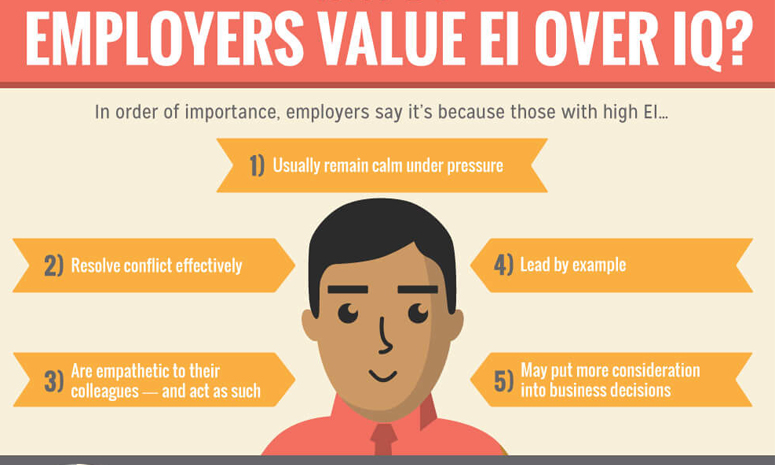
Remember this distinction: there are smart people and then there are emotionally intelligent people. If you don’t have a sense of the difference in these two, Paul Sohn posted an infographic (yay!) that gives an excellent description of emotional intelligence. There are a lot of smart people out there but what a joy when your boss, as smart as he may be, is also a great communicator with and appreciator of people.  [Go back and click on that infographic – very helpful!]

Emotional Intelligence is a concept that’s been around for awhile now.  Matt Monge’s article for The Mojo Company sparked my interest some time ago. He described 6 symptoms of leaders with low emotional intelligence.

Two of Monge’s points were: 1) Leaders with low emotional intelligence say “I’m sorry you feel that way” more than “I’m sorry,” and 2) Leaders with low emotional intelligence often blame the people they hurt for the situations leading to them being hurt.

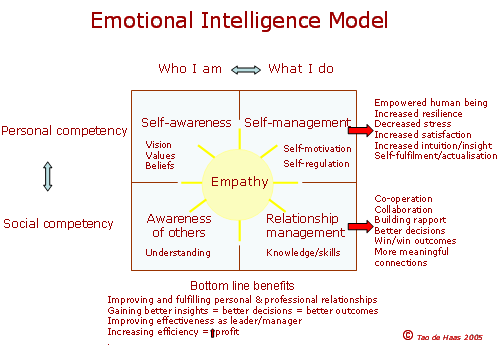
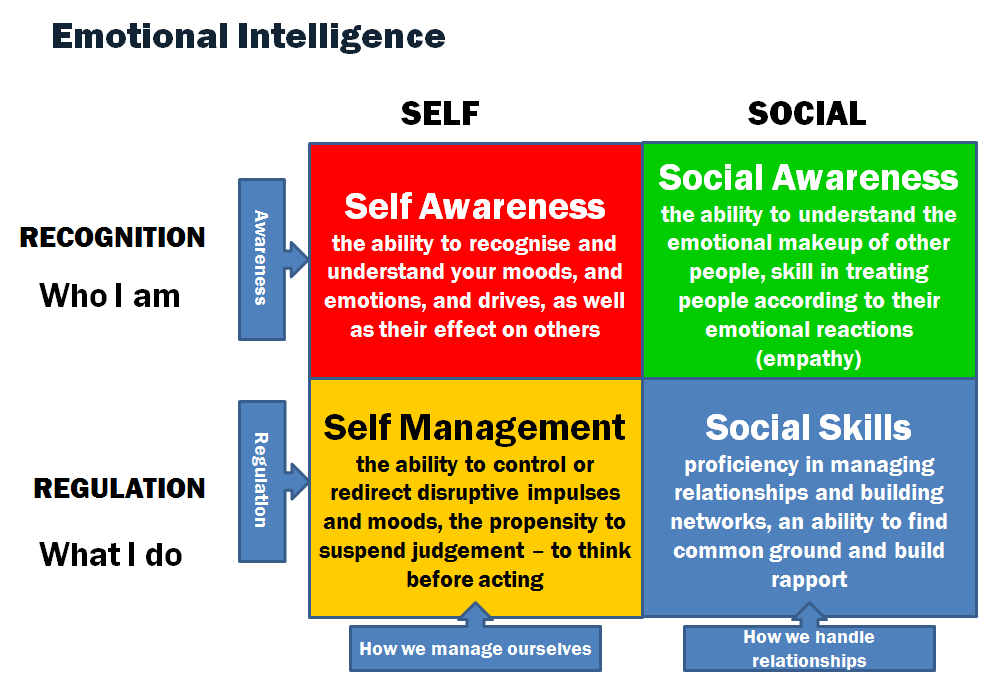
Daniel Goleman has written several books on this topic including Emotional Intelligence: Why It Can Matter More Than Intelligence and Social Intelligence: The New Science of Human Relationships. The very cool thing about emotional intelligence is that it can be developed. The big dilemma is whether bosses or even teammates, not bothered by their impact on others, would buy into this relational skillset. Incorporating such concepts in personnel accountability metrics might provide some incentive. I’ve added graphics below that helped me further understand emotional intelligence.

Blog - Friday Faves - Emotional Intelligence - grid - dollieslagerPhoto Credit: Dollie Slager

Blog - Friday Faves - Emotional Intelligence - low & highPhoto Credit: The King and Queen

___________________________________________________________________________

Even people with strong emotional intelligence can find themselves off-balance when in conflict with someone. Leadership writer Marcel Schwantes gives counsel for this in 7 Brilliant Things Emotionally Intelligent People Do When Their Buttons Are Pushed.Photo Credit: Wikimedia Commons

Schwantes encourages us to respond rather than react in a conflict situation. His seven action points follow (read more of his article for his commentary on each one).

  1. Get perspective.
  2. Take a 6-second pause.
  3. Stay humble.
  4. Try empathy.
  5. Ask the most conflict-diffusing question. [“Are you ok?” What’s going on?”….what else would you think would diffuse the situation?]
  6. Speak from your authentic self.
  7. Be the first to reach out after conflict.

Don’t miss the brief video at the end of Schwantes’ piece on 3 Simple Questions to Improve Your Emotional Intelligence.

Blog - Friday Faves - Leadership - Emotional IntelligencePhoto Credit: Self Study History 

I hope you’re surrounded by emotionally intelligent people. Maybe you’re an “EI” rockstar yourself. For me, that woman above, piloting the project, had my respect from the beginning, but because she responded to me in such an honoring, genuinely considerate way, she also has my complete support and more.

Do you have any emotional intelligence stories? Please comment below. We can always use  stories of great bosses and coworkers to inspire and spur us on.

___________________________________________________________________________

Try These Two Smart Techniques to Help You Master Your Emotions – Lisa Feldman Barrett

How Emotional Intelligence Boosts Your Endurance – Alex Hutchinson

___________________________________________________________________________

Bonus: Resources for Raising Our Children to Be Emotionally Intelligent

Research Shows Reading Improves Kids’ Emotional Intelligence and Increases Empathy – Katie Priske

This Is How to Raise Emotionally Intelligent Kids: 5 Secrets From Research – Eric Barker

Chores Lead to Happy Children. So Why Do So Few Parents Require Them? – Annie Holmquist – OK…this doesn’t really have to do with emotional intelligence but it fits in the mix of raising kids well.